


1. AIM AND SCOPE OF THE PAPER
The empirical focus of this paper is the English it-cleft, exemplified in (1a) below. In terms of syntax and interpretation, the it-cleft in (1a) shares a number of properties with the patterns in (1b–d). First, both in the it-cleft (1a) and in the example of focus fronting (1b) the constituent the cat is focused (see É. Kiss Reference É. Kiss and Mereu1999 for discussion and comparison between the two types of focussing). Second, both in (1a) and in the wh-interrogative (1c) the content of the clause (IP) is presupposed, i.e. ‘Mary saw something’. Finally, it-clefts contain an element that looks like a relative clause, here that Mary saw, and thus also share properties with relativization, illustrated in (1d) (see, among others, Authier & Reed Reference Authier and Reed2006; Reeve Reference Reeve2012: 18ff. for discussion). In syntactic analyses of it-clefts some or all of these properties are often explored.
- (1)
(a) It was the cat that Mary saw. (it-cleft)
(b) The cat Mary saw. (focus fronting)
(c) What did Mary see? (wh-interrogative)
(d) I know the cat that Mary saw. (relative)
The commonality between it-clefts and relative clauses like that in (1d) is prominent in the traditional biclausal analyses (e.g. Jespersen Reference Jespersen1937; Chomsky Reference Chomsky, Culicover, Wasow and Akmajian1977; Delahunty Reference Delahunty1981; Reference Delahunty1984; É. Kiss Reference É. Kiss1998; Clech-Darbon, Rialland & Rebuschi Reference Clech-Darbon, Rialland, Rebuschi, Tuller and Rebuschi1999; Hedberg Reference Hedberg2000; Jayaseelan Reference Jayaseelan2001; Belletti Reference Belletti2009; Reeve Reference Reeve2010, Reference Reeve2011, Reference Reeve2012; see Reeve Reference Reeve2012 for a survey). Though implementations differ widely, in such approaches it-clefts are analysed as complex sentences containing two extended projections (in the sense of Grimshaw Reference Grimshaw1991, Reference Grimshaw2005): the projection that constitutes the cleft relative (that Mary saw in (1a)) is embedded in the projection of the cleft copula be. We do not dwell on these approaches here.
Recently some authors have maximally exploited the similarity between focus fronting (as in (1b)) and clefting (as in (1a)) and have elaborated an analysis according to which (1a) and (1b) are to a large extent isomorphic and in which the syntax of it-clefts is assimilated to that of focus fronting. Hence, it-clefts are derived by movement of the focused constituent, the cat in (1a), to what has come to be known as the ‘left periphery’ of the clause, the domain of the clause that is geared towards the expression of discourse-related concepts such as topicalization and focussing and that is also implicated in the derivation of the fronted focus in (1b). As a result of the derivation, what originates as a biclausal structure results in a monoclausal pattern with the cleft focus functioning as the focus of the matrix clause. ‘Monoclausal’ analyses of it-clefts have been advocated by Meinunger (Reference Meinunger, Tamanji and Kusumoto1998), Frascarelli & Ramaglia (Reference Frascarelli and Ramaglia2009, in press), and Sleeman (Reference Sleeman2011).Footnote 2 In these monoclausal analyses, the cleft copula itself does not head a fully projected clausal domain. For Frascarelli & Ramaglia (Reference Frascarelli and Ramaglia2009, in press), for instance, the copula be functions as a linker (Den Dikken Reference Den Dikken2006) in a defective clausal domain.Footnote 3
The monoclausal analysis is attractive because it relates (1a) and (1b) more tightly than the biclausal analysis would do, and it aligns English it-clefts with monoclausal clefts in other languages (see the authors cited for examples). However, the monoclausal approach leads to precise predictions in terms of internal and external syntax of it-clefts. In our paper we examine these predictions and we will conclude that, in spite of its initial appeal, the approach raises a number of problems which do not arise in the biclausal approach.Footnote 4
The paper is organized as follows: Section 2 provides the background to the monoclausal analysis which we will be examining. Since the authors discussed here adopt the cartographic approach, we first present the core theoretical ingredients required in Section 2. In Section 3 we present the monoclausal analysis of it-clefts in detail and in Sections 4 and 5 we show that it raises problems both in terms of the internal syntax of the it-cleft and in terms of the external syntax. Section 6 is a brief conclusion.
2. CARTOGRAPHY: A BRIEF INTRODUCTION
The cartographic approach (Rizzi Reference Rizzi and Haegeman1997, Cinque Reference Cinque1999, Cinque & Rizzi Reference Cinque, Rizzi, Heine and Narrog2010) aims at decomposing the structure of the clause into the primitive constituents associated with interpretation. What were in earlier versions of the generative model assumed to be unitary projections (‘IP’, ‘CP’) become decomposed into sequences of elementary projections. For discussion of the underlying motivation of the cartographic approach we refer to Rizzi (Reference Rizzi and Haegeman1997), Cinque (Reference Cinque1999) and to Cinque & Rizzi (Reference Cinque, Rizzi, Heine and Narrog2010), and for an implementation in English we also refer to Haegeman (Reference Haegeman, Horn and Kato2000a, Reference Haegeman and Rowlettb, Reference Haegeman2012). In this section we introduce the components of cartography that will be required for our paper. Readers familiar with cartography can feel at liberty to skip the remainder of the present section.
2.1 Cartography and the left periphery
In the 1980s generative model, the clause was assumed to consist of three layers: (i) VP, the core thematic domain encoding the predicate and its arguments, (ii) IP (or TP), the layer encoding modal, temporal and aspectual relations, and (iii) CP, which interfaces between the clause and its context, as illustrated in (2).
(2) CP > IP > VP
Rizzi (Reference Rizzi and Haegeman1997) argues that the CP layer should be decomposed into an array of hierarchically organized functional heads, associated, among others, with topic and focus information. He replaces the unitary CP by the articulated structure in (3a) below, where the asterisk marks a recursive category. Relevantly for the discussion, Rizzi assumes that arguments preceding the canonical subject position in English occupy SpecFocP, as shown in (3b), when focused, and SpecTopP, as shown in (3c), when topicalized. In root questions, the fronted wh-phrase, which is the focus of the question, also moves to SpecFocP, as shown in (3d).
- (3)
(a) ForceP > TopP* > FocP > TopP* > FinP > IP (Rizzi Reference Rizzi and Haegeman1997: 279)
(b) [FocP The cat [FinP Mary saw]].
(c) [TopP Their cat, [FinP they have named Felix]].
(d) [FocP Which book did [FinP you prefer]]?Footnote 5
Elaborating the original ‘split CP’, Rizzi (Reference Rizzi, Cinque and Salvi2001) postulates an additional functional projection IntP, whose head hosts the interrogative conjunction (English if and its equivalents) and whose specifier hosts the wh-phrases why and how come and their analogues in other languages. Evidence for IntP is provided by Italian (4a), in which the interrogative conjunction se ‘if’ co-occurs with the focused constituent questo ‘this’ in SpecFocP. This leads Rizzi to postulate the hierarchy in (4b).
- (4)
(a) Mi domando, a Gianni, se, ieri, questo, alla fine della
I wonder to Gianni SE yesterday this at.the end of.the
riunione, avremmo potuto dirgli (non qualcos'altro).
meeting have.subj.1pl can.part say.him not something.else
‘I wonder, to Gianni, if, yesterday, this, at the end of the meeting, we could have said it to him.’
(b) ForceP >TopP* >IntP >TopP* >FocP >TopP* >FinP >TP
(Rizzi Reference Rizzi, Cinque and Salvi2001: 297)
It has also been proposed that the recursive TopP* should be reinterpreted in terms of specialized topic projections which host a range of specialized topical constituents. We return to this point briefly in Section 3.2 (see Benincà & Poletto Reference Benincà, Poletto and Rizzi2004, Poletto & Pollock Reference Poletto, Pollock and Rizzi2004, Frascarelli & Hinterhölzl Reference Frascarelli, Hinterhölzl, Winkler and Schwabe2007, Bianchi & Frascarelli Reference Bianchi and Frascarelli2010).
2.2 Criterial freezing
A second core ingredient of the cartographic model is referred to as ‘Criterial freezing’, defined in (5) and illustrated in (6), a constraint which essentially restricts the application of A′-movement (Rizzi Reference Rizzi, Corver and Cheng2006, Reference Rizzi2010; Abels Reference Abels and Abdollahi2008; Maeda Reference Maeda2010).
(5) Criterial freezing
An element satisfying a Criterion cannot be moved further (e.g. to satisfy another Criterion).
(Rizzi & Shlonsky Reference Rizzi, Shlonsky and Frascarelli2006: 341)
- (6)
(a) Bill wonders [ForceP which book [she read t]].
(b) *Which book does Bill wonder [ForceP t [she read t]]?
Given (5), a wh-constituent moved to a left-peripheral landing site for wh-checking is frozen in that position and cannot move to a higher left-peripheral position to satisfy an interpretive requirement. Thus in (6), once the wh-constituent which book has moved to the embedded left periphery to encode the interrogative Force of the embedded clause, as in (6a), it is frozen in place, shown in (6b).Footnote 6
3. THE MONOCLAUSAL ANALYSIS OF IT-CLEFTS
There is a consensus in the literature that it-clefts such as (1a) above convey a specific organization of information structure: put informally, in (1a), the CAT is the focus of the sentence and the proposition ‘Mary saw something’ is given, i.e. it corresponds to backgrounded (‘topical’) information. The it-cleft in (1a) is interpretively similar to a sentence such as (1b), in which the object the CAT has been fronted, by hypothesis to the left-peripheral (abbreviated as LP) FocP. In English focus movement of an argument to the left periphery as in (1b) is associated with contrast (see É. Kiss Reference É. Kiss1998, Reference É. Kiss and Mereu1999; Molnár Reference Molnár, Molnár and Winkler2006), the cleft focus in (1a) is also typically contrastive (see discussion in Reeve Reference Reeve2012: 17–19).
Meinunger (Reference Meinunger, Tamanji and Kusumoto1998), Frascaralli & Ramaglia (Reference Frascarelli and Ramaglia2009, Reference Frascarelli, Ramaglia, Veenstra, Hartmann and Zimmermanin press) and Sleeman (Reference Sleeman2011) capitalize on the interpretive similarity between (1a) and (1b) and assume that the two sentences are ‘isomorphic’ in the sense that the landing site of the cleft focus in (1a) is the same as that of the the fronted argument in (1b) and that both ‘focused’ constituents are located in the ‘same’ LP position. Though the precise execution of this hypothesis varies considerably among the authors cited, their analyses share the following properties:
• The cleft focus is hosted by the specifier of FocP in the LP of the clause. Clefting thus implies movement to the ‘matrix’ CP area.
• The pronominal subject (it) and the copula be are situated in an LP layer dominating FocP. In other words, it and the copula are located in the same CP area.
• The cleft copula does not head a full-fledged clausal structure, rather in the ‘radically’ monoclausal approach (Meinunger Reference Meinunger, Tamanji and Kusumoto1998) the verb of the cleft relative heads the entire clause, or in a ‘weakly’ monoclausal approach (Frascarelli & Ramaglia in press: Section 5.1),Footnote 7 what is to some extent a biclausal structure becomes reconfigured through various movement operations whose result is to integrate the components of the cleft relative domain with that of the domain headed by the copula.
Though the monoclausal analysis successfully captures the interpretive similarity between (1a) and (1b), and would align English it-clefts fully with monoclausal cleft patterns found in other languages (e.g. for Russian, see King Reference King1993, Junghanns Reference Junghanns, Lindseth and Franks1997; for Gungbe, see Aboh Reference Aboh2006), we will show that its implementation raises several questions. The problems that we point out are not present in the traditional biclausal approach.
3.1 Meinunger (Reference Meinunger, Tamanji and Kusumoto1998): It-clefts are monoclausal
To the best of our knowledge, Meinunger (Reference Meinunger, Tamanji and Kusumoto1998) was the first to propose a radically monoclausal derivation of it-clefts. His analysis is summarized in (7).
(7)

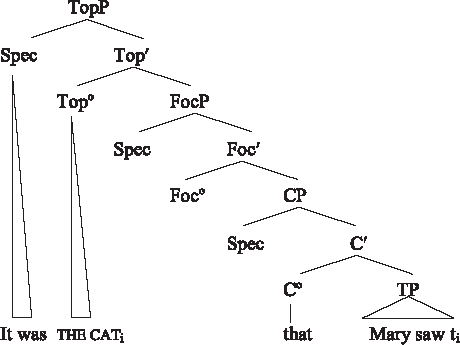
Apart from the interpretive parallelism between (1a) and (1b), additional arguments put forward for this derivation are the observation that in many languages the equivalents of English clefts are monoclausal, as well as the observation that in clefts there is a ‘reverse’ temporal dependency by which the tense of the relative clause determines that of the copula.
In Meinunger's approach the copula be does not head an extended projection (in the sense of Grimshaw Reference Grimshaw1991, Reference Grimshaw2005), and the conjunction that spells out the ‘matrix’ complementizer (C). Unfortunately, Meinunger's analysis remains rather sketchy and a thorough evaluation is therefore difficult.Footnote 8 However, the drawbacks pointed out out for monoclausal analyses in Sections 4 and 5 would also arise with Meinunger's version of this approach.
3.2 Frascarelli & Ramaglia (in press)
Frascarelli & Ramaglia (in press) present a carefully worked out cartographic analysis of it-clefts in which there is a tight match between syntactic position and interpretation. One merit of their analysis is that it allows us to assess the full implications of a monoclausal analysis for other areas of the grammar not covered in their paper. We therefore base the remainder of our evaluation on monoclausal analyses of it-cleft solely on their analysis. We first present the core ingredients of their analysis. For reasons of exposition and space, we leave aside those details of the execution that we consider tangential to our discussion and we refer the reader to the paper in question.
Frascarelli & Ramaglia (henceforth F&R) capture the similarity in interpretation between (1a) and (1b) derivationally: in their analysis the focused constituent in it-clefts is moved to an LP focus position and the ‘relative clause’ which is part of the cleft pattern occupies a specific LP topic projection, labeled FamP. We cite from their text:
[T]the relative DP is dislocated … , thus constituting a right-hand Topic in clefts. (F&R in press: Section 4.1)
As for the interpretation of the clefted phrase, the latter is the undisputed Focus of the sentence. In some languages (e.g., Somali, Tagalog, Tigrinya, Igbo) it is interpreted as an (Exhaustive) Information Focus (though a contrastive interpretation can be obtained by means of intonation), whereas in others (e.g., Italian, English, Basque) a contrastive reading is normally induced … However, it should be noted that even in languages of the latter type, clefts can be used as answers to wh-questions (hence, to obtain Information Focus). (F&R in press: Section 4.1; emphasis in the original)
Taking the it-cleft in (8) as a starting point, let us identify the core ingredients of their analysis.
(8) It is me that you saw.
This sentence is derived as follows:
(i) The clefted XP (i.e., the focus) starts out as the NP predicate (i.e. a non-argument) in a small clause (SC) structure whose subject is it.
(ii) This small clause is the complement of the copula, which acts as a linker (in the sense of Den Dikken Reference Den Dikken2006, see F&R in press: footnote 4 of Section 1 and Section 2), in I. This is shown in (9a).
(iii) The subject of the SC, it, moves to SpecIP, as is shown in (9b).
- (9)
(a) [IP copula [SC it [NP me]]]
(b) [IP it is [SC tit [NP me]]]
(iv) The presupposed ‘relative DP’ (=that you saw) is generated as the specifier of an LP SpecTopP.Footnote 9 In line with Frascarelli & Hinterhölzl (Reference Frascarelli, Hinterhölzl, Winkler and Schwabe2007) and Bianchi & Frascarelli (Reference Bianchi and Frascarelli2010) this projection is identified as FamP, to reflect that its content is interpreted as a Familiar Topic. This in effect aligns the syntax of the relative DP with that of an extraposed clause, a hypothesis which is in line with the analyses by, among others, Akmajian (Reference Akmajian1970), Emonds (Reference Emonds1976), Belletti (Reference Belletti2011); see Reeve (Reference Reeve2011, Reference Reeve2012) for a survey.Footnote 10 This structure is shown in (10).
(10) [FamP [that you saw] [IP it is [SC tit [NP me]]]]
By means of a number of leftward movements all the components of the IP layer in (10) also end up in the LP of the clause. We go over the various steps briefly here, focusing on those elements that will figure later in the argumentation. We refer to the original paper for details of the analysis and for more motivation.
(v) The SC predicate ME, the focus of the cleft, is attracted to the LP FocP dominating the matrix IP in order to be interpreted as a Focus.Footnote 11 We assume that like other movements to the LP triggered by interpretive requirements, the relevant movement is A′-movement and is subject to the locality constraints applicable to this type of movement (see Rizzi Reference Rizzi1990, Reference Rizzi1993):
(11) [FocP [NPme] [FamP [that you saw] [IP it is [SC tit tNP]]]]
(vi) The remnant IP, from which the focus of the cleft has been evacuated, moves to the specifier of an LP functional projection dominating FocP which, following Poletto & Pollock (Reference Poletto, Pollock and Rizzi2004), is identified as ‘GroundP’. GroundP (or GP) is a specialized projection hosting backgrounded material expressing presupposed information (see F&R in press: footnote 31 of Section 3). The appeal to GP captures the similarity of it-cleft and wh-questions such as (1c) above, in which the content of IP ‘Mary saw something’ is also presupposed. This is shown in (12).
(12) [GP [IP it is [SC tit tNP]] [FocP [NP me] [FamP [DP [SC [NP pro] [CP that you saw]]] tIP]]]
The outcome of the derivation is that the clause built around be is broken up and its components are redistributed in the ‘matrix’ LP. The tree diagram in (13) is a representation corresponding to (12).
(13)
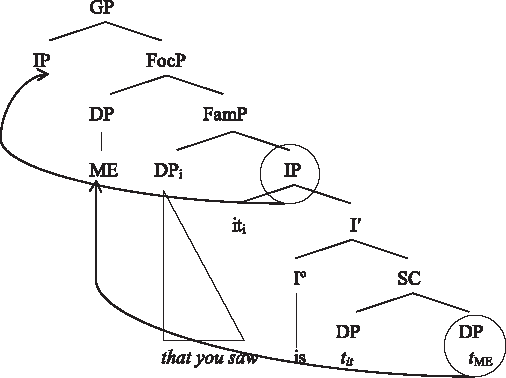
Frascarelli & Ramaglia (in press) develop a similar analysis for Italian it-clefts. Any differences between their analysis of Italian it-clefts and that of English it-clefts are related to the pro-drop nature of Italian and are, as far as we can judge, tangential to our discussion; we refer to F&R (in press). In our paper we only discuss F&R's analysis of English it-clefts, but most of our reservations extend to Italian.
It is noteworthy that though F&R postulate a number of displacements to the LP, they do not discuss the locality restrictions, if any, that regulate these movements. For instance, one needs to assume that, like clitic left dislocation in Romance or like sentence-initial adjuncts in English (Haegeman & Ürögdi Reference Haegeman and Ürögdi2010a, Reference Haegeman and Rowlettb; Haegeman Reference Haegeman2012), the LP relative clause that you saw in SpecFamP does not give rise to intervention effects with respect to the A′-movement of the cleft focus ME to SpecFocP and with respect to the remnant A′-movement of IP to Spec,GP. Similarly, one has to assume that the remnant IP constituent can move to Spec,GP crossing both the relative cleft that you saw in the lower SpecFamP as well as the focused constituent ME in SpecFocP. Observe that if one were to argue, for instance, that contrastive focus implies D-linking (Göbbel Reference Göbbel, Benedicto, Romero and Tomioka1998, Reference Göbbel, Winkler and Schwabe2007; Bush Reference Bush2000), the fact that ME can cross the constituent FamP would be unproblematic, since D-linking is known to facilitate extraction, but conversely it would be unexpected that the remnant IP can subsequently cross the D-linked focused constituent. Since the authors do not to explore this issue, we will not consider it further here but we return to locality considerations briefly in Section 4.2 below.
Representation (13) has some points to recommend itself. It captures the similarity between (1a) and (1b) in a straightforward way, in that the focus of the it-cleft occupies exactly the same position as the fronted constituent in focus fronting in (1b). The analysis is economical in the sense that there is a unique landing site for focused constituents, whether these be cleft or not. Moreover, through the appeal to the projection GP, which is typically associated with backgrounded material (as in Poletto & Pollock Reference Poletto, Pollock and Rizzi2004), the derivation also captures a similarity between it-clefts like that in (1a) and wh-questions like that in (1d), which both presuppose the content of their IP.Footnote 12 Finally, though the underlying structure of the it-cleft is biclausal, the resulting representation in (13) is similar to the representation of cleft sentences in languages in which the copula has fully grammaticalized to a focus particle and clefting is monoclausal (see Meinunger Reference Meinunger, Tamanji and Kusumoto1998 and F&R in press for examples).
However, in spite of some attractive features, in what follows we will show that rather than being economical in terms of a uniform matching of form and interpretation – with a unique landing site hosting both the focused constituent in (1a) and that in (1b), and with a uniform crosslinguistic analysis of clefting, (13) leads to several complications. Our discussion is restricted to syntactic issues; the problems identified here pertain (i) to the internal syntax of it-clefts, and specifically to the proposal that the position of the focused constituent in (1a) is SpecFocP and thus identical to that in (1b), and (ii) to the external syntax of it-clefts, and specifically the distribution of it-clefts like (1a) in comparison to the distribution of clauses with focus fronting like (1b):
(i) To capture the observed word order variations in English it-clefts, additional enrichment of the LP will be shown to be required, leading to a proliferation of focus projections, and specifically to the need for postulating a specialized ‘lower’ focus position for clefts. As a result of this reduplication, the representation no longer captures the parallelism between (1a) and (1b). Two specific problems of implementation are dealt with in Section 4.Footnote 13 The data examined also raise questions about the implementation of Criterial freezing in (5) above.
(ii) All things being equal, (13), which takes the derivation of it-clefts to imply focus fronting, leads to the incorrect prediction that, like other instances of focus fronting in English, it-clefts will be unavailable in infinitival domains and that it-clefts have the distribution of root phenomena (in the sense of Emonds Reference Emonds1976) or main clause phenomena (in the sense of Hooper & Thompson Reference Hooper and Thompson1973). This prediction is evaluated in Section 5 below.
4. INTERNAL SYNTAX: MOVING THE CLEFT FOCUS
According to the analysis of it-clefts in (13), the focus of the cleft moves to an LP SpecFocP, where, by Criterial freezing in (5), it should be frozen in place. Surprisingly, though, this is not the case. In the present section we turn to two patterns in which the focus of the it-cleft itself is moved leftward. Two examples are given in (14): (14a) displays wh-movement of the focus of the it-cleft and (14b) illustrates focusing of the cleft-focus.
- (14)
(a) What was it ___ that you saw?
(b) %The dog it was ___ that died.Footnote 14
The latter type of example is not accepted by all speakers but examples are attested (see also the discussion in Reeve Reference Reeve2012: 86). We discuss these two patterns in turn.
4.1 Wh-movement of the clefted XP
Additional examples of wh-movement of the focus of the it-cleft are given in (15). (15a–e) are root wh-questions, (15f) is an embedded wh-question, (15g) and (15h) are exclamatives, (15i) illustrates a headed relative clause, (15j) is a free relative clause, (15k) illustrates root wh-movement of the cleft focus in Italian and is taken from F&R's own paper.
- (15)
(a) What was it ___ that you saw? (=(14a))
(b) When was it ___ that you met him for the first time?
(c) Who was it ___ that you were going to invite?
(d) How many papers was it ___ that you had to read?
(e) How good a player is it ___ that you found him?
(Declerck Reference Declerck1988: 197, ex (48a))Footnote 15
(f) It could help you focus on what it is ___ you want.
(Guardian 4 June 2011, p. 7 col. 3)
(g) How happy it is ___ that she looks! (Declerck Reference Declerck1988: 197, ex. (47a))
(h) What a glorious bonfire it was ___ you made! (Quirk et al. Reference Quirk, Greenbaum, Leech and Svartvik1985: 1386)
(i) I was also introduced to the woman whose job it was ___ that I would take over.
(j) Whoever it was ___ that told you this, …
(k) Chi è (stato) ___ che ha rotto il vaso?
who be.3sg be.prt that have.3sg break.part the vase
‘Who is it that broke the vase?’
(F&R in press: Section 4.1, ex. (29))
In Rizzi's (Reference Rizzi and Haegeman1997, Reference Rizzi, Cinque and Salvi2001) cartographic approach to the LP, a root wh-question such as (16a) has the representation in (16b). Crucial for our purposes is his assumption that the fronted wh-phrase targets the LP FocP.
- (16)
(a) What was it?
(b) [FocP What [Foc is] [FinP [IP it iswhat]]]?
Rizzi (Reference Rizzi, Cinque and Salvi2001) shows that wh-elements in Italian root questions cannot co-occur with a focused constituent, in either order: the incompatibility of wh-fronting and focus is interpreted as showing that wh-elements in root questions move to SpecFocP, and hence compete with focused constituents.
- (17)
(a) *A chi questo hanno detto (non qualcos'altro)?
to whom this they said not something.else
(b) *Questoa chi hanno detto (non qualcos'altro)?
this to whom they said not something.else
(Rizzi Reference Rizzi, Cinque and Salvi2001: 290, exx. (13a–b))
Further evidence for equating the landing site of wh-movement with SpecFocP comes from the fact that in some languages the particle used in focus fronting, and which is taken to head FocP, is also deployed for wh-fronting. Gungbe wε in (18) is a case in point:
- (18)
(a) Sέná wε ∂ù blε∂ì lo!
eat foc eat bread det
‘Sena ate the bread!’
(b) Mέnu wε ∂ù blε∂ì lo?
Who foc eat bread det
‘Who ate the bread?’ (Aboh Reference Aboh2006: 7, ex. (9))
In Meinunger's and in F&R's analyses of it-clefts, the focused constituent in the (declarative) it-cleft occupies SpecFocP and the string it+copula is hosted by the specifier of a dominating projection (TopP in Meinunger Reference Meinunger, Tamanji and Kusumoto1998, GP in F&R in press). In the examples in (15), however, the wh-constituent which constitutes the focus of the it-cleft ends up to the left of the string it+copula, meaning that the wh-constituent must have moved on to a position higher than GP, the projection dominating FocP which hosts the remnant IP. One way of providing an extra position for this moved constituent (see also Lee Reference Lee, Megerdoomian and Barel2001) would be to make use of Rizzi's IntP, the projection postulated for yes–no questions (4) above, as in (19a). However, Rizzi (Reference Rizzi, Cinque and Salvi2001) specifically introduced IntP to set Italian yes–no questions and wh-questions introduced by ‘why’ and its equivalents apart from other wh-questions. Generalizing all wh-movement to IntP would thus undo that distinction.Footnote 16 Alternatively, as in (19b), the relevant projection might be ForceP itself, which, in terms of the cartography of the left periphery proposed by Rizzi (Reference Rizzi and Haegeman1997), is the topmost projection whose role is to type the clause
- (19)
(a) [ForceP [IntP What [Int was] [GP [IP it wassc] [FocPwhat [that you saw]]]]]?
(b) [ForceP What [Force was] [GP [IP it wassc] [FocPwhat [that you saw]]]]?
There may be other ways of enriching the LP (see Poletto & Pollock Reference Poletto, Pollock and Rizzi2004), but whichever solution is proposed, the outcome will be that wh-fronting in root questions and focus fronting are no longer a unified phenomenon: some cases of root wh-fronting will be hosted by FocP, while in others the wh-constituent will move to the higher projection. In both cases, movement of the fronted wh-constituents in English root clauses triggers subject–auxiliary-inversion. The question arises as to whether there is independent empirical evidence to the effect that the wh-constituent in the English clefted root wh-interrogative as in (14a) and (15a) occupies a distinct position from that in regular, i.e. non-clefted, root wh-interrogatives (by hypothesis, SpecFocP), as in (20a). Crucially for the current discussion, at this point, the economy argument that was the attraction of the LP analysis of it-clefts, i.e., the similarity between (1a) and (1b), becomes jeopardized since we are now led to the conclusion that the syntax of the LP of English wh-questions in (20a) must be different from that in (20b).
- (20)
(a) What did you see?
(b) What was it that you saw?
Furthermore, given Criterial freezing in (5), the question also arises as to how the focused wh-constituent in the cleft pattern is able to move from the LP FocP to a higher projection such as, for instance, IntP or ForceP. One proposal is to say that the second movement of the cleft focus is triggered by a [+wh] feature on the cleft constituent. This implies that in root clauses the wh-feature is not invariably checked in the FocP, a further departure from the original proposal in Rizzi (Reference Rizzi and Haegeman1997, Reference Rizzi, Cinque and Salvi2001) and one which is not discussed in Meinunger's or F&R's papers.Footnote 17
Since in (15a) above the wh-constituent, which is also the cleft focus, precedes the pronoun it, it must have been able to cross the fronted IP remnant in the specifier of the LP GP. As mentioned already, at no point do F&R (in press) spell out the locality conditions that govern the various movements to the LP, but it seems to us that the question arises as to why the topicalized remnant IP in GP does not block the movement of the fronted wh-constituent. Observe that there is a potential paradox here. First, one has to assume that the remnant IP containing the subject it and the copula be may cross the focused constituent to move to SpecGP. In terms of a featural version of Relativized Minimality (Rizzi Reference Rizzi1990, Reference Rizzi and Belletti2004 a; Starke Reference Starke2001; Haegeman Reference Haegeman2012), this could be captured if the fronted remnant IP were argued to be featurally richer than the focused constituent. For instance, containing backgrounded and presupposed information, one might claim that the remnant IP is ‘D-linked’ (see Starke Reference Starke2001, Rizzi Reference Rizzi and Belletti2004 a, Abels Reference Abels2012, Haegeman Reference Haegeman2012). However, in terms of the same featural Relativized Minimality a problem arises: if the remnant IP in SpecGP is featurally richer than the fronted constituent in SpecFocP and is, because of its feature content, able to cross the focused constituent, then, by virtue of being featurally richer, the remnant IP in SpecGP would be expected to itself block subsequent movement of the same constituent from SpecFocP, contrary to fact.
4.2 (Focus) movement of the cleft focus
In the above section we have shown that if it-clefts are derived as in (13), by movement of the cleft focus to the LP FocP, the fact that the cleft focus is found to undergo wh-movement implies that a higher landing site must be invoked to host the wh-moved cleft focus. This conclusion partly undermines the economy argument that was the initial motivation for the LP analysis, namely the parallelism between (1a) and (1b). The data discussed here are not considered by Meinunger (Reference Meinunger, Tamanji and Kusumoto1998) or F&R (in press).
Further questions arise from (14b) and the comparable data in (21). In these examples, the focus of the cleft sentence has itself been fronted. We note that not all our informants accepted such examples; it is not clear what determines the variability in judgments.Footnote 18 The examples in (21d–h) are attested. Following Halliday (Reference Halliday1967: 237), Dryer (Reference Dryer1996: 494–495) and Ward, Birner & Huddleston (Reference Ward, Birner, Huddleston, Huddleston and Pullum2002: 1420), let us assume that the trigger for this movement is focusing.Footnote 19
- (21)
(a) Was it Sue who polished off the cookies?
No, Pat it was who ate them. (Ward et al. Reference Ward, Birner, Huddleston, Huddleston and Pullum2002: 1420, ex. (21))
(b) JOHN it was that Mary saw. (Reeve Reference Reeve2011: 169, ex. (94a))
(c) Me it is that you saw?!!!!! (Andrew Radford, p.c.)
(d) For 45 minutes Arsenal had been purring like a stringy, stray cat who had fallen off one too many walls. They needed someone to pick them up. Van Persie it was who stepped forward to get them back on their feet.
(Observer 25 September 2011, p. 27 col. 1)
(e) The Benedictine monks took their name from St Benedict, a hermit, monk, and abbot, who was born in Italy around the year 480 and died in the mid sixth century. Benedict it was who composed what he called his ‘little rule for beginners’, a rule that was in time to become the blueprint for monastic life in the medieval world.
(http://www.monasticwales.org/showarticle.php?func=showarticle&articleID=4)
(f) This was helped, surely, by Alan Yentob and Rushdie having been friends for so long; Yentob it was whose car appeared suddenly to whip Rushdie away from the fresh-meat press hounds the day the story broke.
(Observer 23 September 2012, p. 23 col. 1)
(g) Katherine Kelly, the actress who was for five years unmissable as barmaid Becky, is now one of the stars of Jamie Lloyd's production of She stoops to conquer. She it is who does the stooping.
(Observer 5 February 2012, p. 28 col. 1)
(h) This led her to nothing better than isolation, ever more at a loss, on an island in the middle of Marylebone Road. Then it was that she decided to view in daylight the street in which she had said goodbye to Stella.
(Elizabeth Bowen, The heat of the day.
Vintage Books, London, pp. 291–292)Footnote 20
According to the monoclausal account of it-clefts outlined above, sentences such as (21a) should presumably be derived as in (22a): the cleft focus is moved up from its LP landing site to a higher focus position. The primary outcome of this derivation is that we now seem to be needing two (contrastive) focus positions in the LP, one above GP and one below GP. One possible response to that is the structure in (22a), where the landing site of the contrastively focused cleft constituent above GP is in fact the ‘regular’ LP focus position, postulated in Rizzi (Reference Rizzi and Haegeman1997) and much related work (see footnote 23 in Section 5 below for additional evidence), which É. Kiss (Reference É. Kiss1998, Reference É. Kiss and Mereu1999) associates with contrastiveness.
- (22)
(a) [FocP The dog [GP [IP it was] [FocPthedog [that died]…]]].
(b) [FocP1 What [Foc1 was] [GP [IP it was sc] [FocP2what [FamP [that you saw]
[IPIP]]]]]?
(c) [FocP1 The dog [GP [it was [sc]] [FocP2thedog [FamP that died] [IPIP]]]]].
If this were the case, then, we could also extend this analysis to the instances of wh-fronting of the cleft focus discussed in the preceding section. As a result, the analysis of wh-movement of the cleft focus in Section 4.1 would be brought back in line with earlier proposals in that the host of the moved wh-constituent would be Rizzi's ‘original’ LP FocP. In (22b) and (22c) we represent the ‘Rizzian’ focus position as FocP1 and the specialized landing site postulated for the focus of the regular it-clefts (1a) as FocP2.
But if such a representation is required, then this implies that the landing site of the it-cleft focus in (1a) would emphatically not be Rizzi's original LP FocP (1b); rather it is now identified as an additional lower LP focus position which at this point is specialized for it-clefts. This step defeats the initial argument of economy and of interpretive parallelism between (1a) and (1b), which seemed to be the intuition underlying the LP analysis. Moreover, in such a scenario, the relation of FocP2 to the articulated LP remains to be worked out and the relation between GP and wh-fronting must be brought in line with Poletto & Pollock's (Reference Poletto, Pollock and Rizzi2004) original discussion.
Like some data presented earlier in our paper, (22b) and (22c) raise the question of Criterial freezing: Why can a constituent move from the lower SpecFocP2 to the higher SpecFocP1? Which feature is the trigger for the movement? Observe also that in these examples not only do we have to assume that there are two distinct LP projections hosting a focused constituent, but these have to be activated in the same sentence. This seems contrary to the assumption that the LP Focus is unique (Rizzi Reference Rizzi2012).
It also remains unclear why in (22c) the fronted remnant IP in SpecGP would not block the movement of the focused constituent to the higher position. (For an additional argument, see footnote 23 below.)
5. EXTERNAL SYNTAX: THE DISTRIBUTION OF IT-CLEFTS
In this section we turn to a set of distributional problems that arise for the monoclausal analyses of it-clefts, according to which the cleft focus moves to the matrix LP focus. We look at two cases: (i) For English non-finite clauses it is generally assumed that the left periphery is not available for fronting operations, yet such non-finite domains are compatible with it-clefting. We discuss these in Section 5.1. (ii) A subset of finite clauses is generally considered to be incompatible with so-called main clause phenomena (MCP), among which is focus fronting. These domains remain compatible with it-clefting, which is surprising if it-clefting is derived through the same movement to FocP as that used to derive focus fronting. We discuss these domains in Section 5.2.
5.1 Non-finite contexts with impoverished LP
Because of their structural reduction (in the sense of Hooper & Thompson Reference Hooper and Thompson1973: 484, see also Haegeman Reference Haegeman2012), infinitival clauses are incompatible with some LP phenomena in English. For instance, (23) shows that temporal adjuncts cannot be fronted to the left of the subject of an infinitival clause: (23a) illustrates for clauses, (23b) illustrates exceptional case marking (ECM) environments, and (23c) illustrates bare infinitival complements.
- (23)
(a) For John to be in charge of the project at that point would be undesirable.
*For at that point John to be in charge of the project would be undesirable.
(b) I believe John to have been in charge of the project at the time.
*I believe at the time John to have been in charge of the project.
(c) Don't let John be in charge of the project at that point.
*Don't let at that point John be in charge of the project.
As expected, these infinitival clauses also exclude focus fronting.
- (24)
(a) *For this project John to be in charge of at that point would be unexpected.
(b) *I believe this project John to have been in charge of at the time.
(c) *Don't let this project John be in charge of at that point.
Though disallowing fronting to their LP, the infinitival environments remain compatible with it-clefting: (25) illustrates it-clefting in a for clause, (26) illustrates an it-cleft in an ECM environment, and (27) illustrates the pattern in bare infinitival complements.
- (25)
(a) For it to be John who is in charge would be rather unexpected.
(b) Even though he longed for it to be him that she chose,…
(c) It seems the Americans are only happy for it to be them that kill to protect their freedom.
(RC, Oxted Surrey. BBC website)
- (26)
(a) I believe it to have been John who was in charge at the time.
(b) I just want it to be him that I end up with.
(http://www.compatible-astrology.com/getting-my-virgo-man-back.html)
(c) I would actually really like it to be him that came out, but that is very unlikely.
(http://bippidee.blogspot.com/2011/02/referral-to-crisis-team.html)
(27) Don't let [ it be you that gets arrested]!
If it-clefting involves focus fronting to the left periphery, then, given the ungrammaticality of the fronting operations in (24), we would expect that it-clefting should be ungrammatical in these infinitival domains, since there should equally be no LP space for the cleft focus to move to.
For ECM patterns it is usually assumed that the CP layer is missing and that the subject of the infinitival clause ends up in the matrix domain for reasons of case assignment. This means that such clauses would not have an LP at all and the monoclausal derivation according to which the focus of the it-cleft is in the LP of the clause headed by the copula becomes unavailable.
To maintain the monoclausal analysis for infinitival complements one might postulate that the focus of the it-cleft is actually extracted from the infinitival domain and moved into the matrix domain, with remnant movement of a larger chunk of structure. The example in (28a) is a simplified representation: the cleft relative who was in charge is merged in the FamP of the root clause, the focus of the cleft John is A′-moved to the root SpecFocP, the remnant root IP I believe it to have been sc is A′-moved to SpecGP. However, if it-clefting in non-finite domains extracts the focus of the cleft to a root LP, additional problems of implementation will arise. For instance, to mention just one such problem: to derive (28b), fronting of the cleft focus John either has to take place within the bracketed relative clause, an option that is independently unavailable, as is shown in (29), or the focusing of the constituent John has to extract it from the relative clause, which is also banned since the relative clause is a strong island.
- (28)
(a) [GP [IP I believe [IP it to have been sc]] [FocP [John] [FamP who was in charge [IPI believe it to have been [SC tit [John]]]]]].
(b) Don't pay attention to [DP those [CP who believe [IP it to have been John who was in charge]]].
(29) *Don't pay attention to [DP those [CP who John believe [IPJohn to have been in charge]]].
5.2 Main clause phenomena
5.2.1 Domains incompatible with MCP
The monoclausal LP analysis of it-clefts also makes incorrect predictions concerning the distribution of it-clefts in finite embedded clauses. If it-clefts are derived by the familiar A′-movements to the LP that are at the basis of argument fronting in English, then all things being equal, it-clefts should be incompatible with those finite domains in which A′-focus fronting is independently known to be unavailable or degraded. In other words, if the argument fronting operations in (1a) and in (1b) are parallel – and this is the assumption that underlies the monoclausal analysis – then it-clefts should pattern with so-called ‘main clause phenomena’ (Hooper & Thompson Reference Hooper and Thompson1973) or ‘root phenomena’ (Emonds Reference Emonds1976, see also Emonds Reference Emonds, Adger, DeCat and Tsoulas2004 for an update), and they should have the distribution of other LP fronting operations such as those illustrated in (30): (30a) illustrates focus fronting, (30b) negative inversion, (30c) locative inversion, (30d) inversion around be and (30e) illustrates VP fronting.Footnote 21
- (30)
(a) Money we don't need.
(b) Not a single proposal did I agree with.
(c) In each hallway is (hangs, has long stood) a large poster of Lincoln.
(Emonds Reference Emonds1976: 37, ex. (40)).
(d) Present at the meeting were the company directors.
(e) Fix the car, he will.
Though their contribution to the information structure may well vary, all these fronting operations are known to be by and large restricted to main clauses and a subset of finite embedded clauses. The following domains are for many speakers incompatible with MCP.Footnote 22 We illustrate the patterns for argument-fronting in (31).
- (31)
(a) *When this song I heard, I remembered my first love.
(central adverbial clauses; Haegeman Reference Haegeman2012: 66, ex. (33a))
(b) *John still resents that his sister they appointed as director of the company.
(complements of factive predicates; constructed)
(c) *That this house he left to a friend was generous of him.
(sentential subjects; Emonds Reference Emonds1976: 31, ex. (26))
(d) *A promise that defective sets the company will fix has been made by John.
(complement clauses to nouns; Emonds Reference Emonds, Adger, DeCat and Tsoulas2004: 77, ex. (3))
(e) *It's important that the book he study carefully.
(subjunctive clauses; Hooper & Thompson Reference Hooper and Thompson1973: 485, ex. (166))
5.2.2 Clefting is not an MCP
If English it-clefts are derived by leftward movement of the cleft focus to the LP SpecFocP combined with leftward movement of the remnant IP to the LP GP, the default prediction is that clefting is an MCP, since in English both (contrastive) focus fronting and topicalization of an argument are restricted to root clauses and a small subset of embedded clauses. This prediction is incorrect. Indeed, in his seminal work Emonds (Reference Emonds1976) assumed that clefting is structure preserving, i.e., it operates within the constituent labeled ‘S’, the current IP or TP (Emonds Reference Emonds1976: 138–140), an assumption shared by Hooper & Thompson (Reference Hooper and Thompson1973: 472). Put differently, for Emonds as well as for Hooper & Thompson, clefting was not identified as a root transformation or an MCP. While there may well be some restrictions on the distribution of it-clefts, related to interpretive or information structure constraints, we will briefly demonstrate in the following sections that domains incompatible with MCP remain compatible with it-clefts. We discuss two relevant patterns: adverbial clauses in Section 5.2.2.1 and complements of factive verbs in Section 5.2.2.2
5.2.2.1 Adverbial clauses
Adverbial clauses are compatible with in situ contrastive focus. Consider (32):
- (32)
(a) Whenever we needed money, George could not be reached.
(b) If I had wanted a right wing government, I would not have voted for Labour.
(c) As soon as you need cash, George is no longer interested.
While focus fronting is licit in English root clauses, adverbial clauses are not compatible with argument fronting (e.g. Hooper & Thompson Reference Hooper and Thompson1973; Emonds Reference Emonds1976, Reference Emonds, Adger, DeCat and Tsoulas2004). This is shown for temporal clauses in (33a) and (33b) and for conditional clauses in (33c):
- (33)
(a) Money I need, not advice about a website!
*Whenever money I needed, George could not be reached.
(b) Cash we need, not a website manager.
*As soon as cash you need, George is no longer interested.
(c) A leftwing government I want, not a centrist one.
*If a right wing government I had wanted I would not have voted for Labour.
Given the appropriate discourse background, however, adverbial clauses are compatible with it-clefts expressing contrastive focus: (34) contains relevant examples. Assuming the LP analyses of the it-cleft, the alleged LP (contrastive) focus unexpectedly patterns unlike regular LP contrastive focus.Footnote 23
- (34)
(a) Whenever it was money we needed, George was nowhere to be seen.
(b) If it was a right wing government that I wanted I would not have voted for the lib dems.
(c) We are supposed to turn a blind eye when it is famous directors or media people who are involved in rape charges.
(d) As soon as it was John who started doing the minutes, the meetings went more smoothly.
For completeness's sake, we point out that the contrast between the restricted distribution of fronting in adverbial clauses, which are known to resist MCP, and the availability of it-clefts in the same environements might actually be made to follow from the monoclausal analysis.Footnote 24 Following Haegeman (Reference Haegeman2012: 199ff.), we might assume that such adverbial clauses are derived by movement of a (temporal/conditional) operator from within IP to the left periphery (34): a temporal when clause would be derived by A′-movement of temporal when, for instance, and in conditional clauses an abstract World operator (OP) would be A′-moved (Arsenijević Reference Arsenijević2006, Bhatt & Pancheva Reference Bhatt, Pancheva, Everaert and Riemsdijk2006).
- (35)
(a) When [I twhen needed money …]
(b) OP If [I tOP had wanted money …]
As shown in the representation in (36), the movement of this IP-internal operator will be blocked if the LP contains an intervener, thus ruling out MCP in adverbial clauses. We refer to Haegeman (Reference Haegeman2012: Chapter 5) for full motivation and discussion of the movement derivation of such adverbial clauses.
- (36)
(a) *When money [I twhen needed …]
(b) *OP If money [I tOP had wanted …]
Assuming this specific derivation of adverbial clauses, the compatibility of such clauses with clefting can be made to follow from F&R's analysis. This is so because according to F&R's derivation, once the cleft focus has been fronted, the remnant IP is fronted across the LP focus to SpecGP. The movement of the remnant IP (it was) across the cleft focus will then in fact enable the temporal or conditional operator to circumvent the intervention effect created by the focused constituent. IP-movement to SpecGP will ‘smuggle’ (in the sense of Collins Reference Collins2005) the operator close enough to the LP landing site to make extraction of the operator possible. A schematic representation is given in (37).
- (37)
(a) When [IP it twhen was] money that I needed …
(b) OP If [IP it tOP was] money that I had wanted …
At first sight, however, the remaining problems discussed for F&R do not seem readily amenable to a similar solution.
5.2.2.2 Finite that-clauses
While incompatible with argument fronting in (38a), complements of factive verbs remain compatible with in situ focus, as is shown in (38b). Such finite clauses also remain fully compatible with it-clefts, as shown in (38c).
- (38)
(a) *John still resents that his sister they appointed as director of the company.
(b) John still resents that they appointed his sister as director of the company.
(c) John still resents that it was his sister that they appointed as director of the company.
Again, if movement to the left periphery is blocked in such clauses, as suggested by the ungrammaticality of (38a), and if it-clefts were derived by focus movement to the left periphery, then the grammaticality of (38c) would be unexpected.Footnote 25.
5.3 Conclusion
From the discussion in this section we conclude that if – based on the interpretive parallelisms between the it-cleft in (1a), focus fronting in (1b) and wh-questions in (1d) – it-clefts are derived by focus movement of a constituent to the ‘matrix’ LP dominating the copula, this movement must be distinct from regular focus fronting in English since its distribution is not restricted in the same way. In particular, while non-finite clauses are incompatible with focus fronting, they remain compatible with it-clefts, and while a subset of finite clauses are incompatible with a range of LP fronting operations these domains remain compatible with it-clefting.
Obviously, one might salvage the monoclausal account by arguing that the LP movement involved in the derivation of it-clefts differs substantively from focus fronting, both in terms of landing sites (as already suggested in Section 4) and in terms of locality effects, but this line of reasoning undermines the initial attraction of the LP analysis, namely the interpretive and derivational parallelism between it-clefts like that in (1a), focus fronting like that in (1b) and wh-questions. One would have to postulate a specific LP position for clefting, which seems at this stage to be sui generis.
6. CONCLUSION
In this paper we have shown that the monoclausal analysis of clefting first developed in Meinunger (Reference Meinunger, Tamanji and Kusumoto1998) and recently elaborated in detail by F&R (in press) capitalizes on the parallels between clefting in (1a) and focus fronting in (1b), assigning the same LP position to the fronted constituent in (1b) and to the cleft focus in (1a). We summarize the problems raised in Sections 4 and 5 as follows:Footnote 26
(i) The focus of an it-cleft can be moved to a higher LP position through wh-movement, or (for some speakers, in certain registers) through focus movement. Accommodating this movement necessitates postulating an additional landing site for A′-movement in the LP and it is not clear what would be the trigger for the focus movement of the cleft focus.
(ii) Wh-movement and focus movement of the cleft focus also pose problems for Criterial freezing.
(iii) A monoclausal LP analysis of English it-clefts, which has to allow for multiple applications of fronting to the LP, leads to the prediction that, like other types of focus fronting in English, clefting is a main clause phenomenon/root transformation, contrary to fact.
The first and the third problems follow from the assumption that it-clefts are derived by movement to a matrix LP domain. Solving them in terms of an LP analysis requires postulating a specialized lower LP position for the cleft focus in the matrix LP and postulating that movement to that position is distinct from other types of LP argument fronting. Thus, one loses any effect of economy for the analysis based on the parallelism between (1a) and (1b).


