As shown by proteomic and two-hybrid strategies, protein–protein interactions (PPIs) are extensive and ubiquitous in biology (Refs Reference Stelzl1, Reference Rual2). PPIs hold together the key multi-protein complexes of the cell, guide subcellular trafficking and form the backbone of its major signalling pathways (Refs Reference Jones and Thornton3, Reference Gavin4, Reference Ryan and Matthews5, Reference Kuriyan and Eisenberg6). Accordingly, many PPIs are also potential therapeutic targets in disease (Refs Reference Balch and Yates7, Reference Vidal, Cusick and Barabasi8) and inhibiting PPIs has become an increasingly attractive goal for both drug discovery and the generation of new research probes (Ref. Reference Arkin9).
The last 20 years have witnessed considerable progress in the area of small-molecule-based PPI inhibitors, with an explosion of literature reports and multiple PPI inhibitors entering clinical trials (Refs Reference Morelli, Bourgeas and Roche10, Reference Thangudu11). For example, a 2012 search of PubChem for projects involving ‘protein–protein’ interactions shows more than 800 results. In these projects, research groups are employing a wide array of technologies and often these methods are particularly suited for PPIs. At the same time, structural and computational biologists are becoming more adept at predicting PPIs and many groups are studying these interfaces to identify common topological features suitable for binding to inhibitors (Refs Reference Reynolds, McLaughlin and Ranganathan12, Reference Yang and Wang13, Reference Geppert14, Reference Reichmann15). Clearly, this field is maturing rapidly and ‘tricks’ are being developed to overcome the historical challenges associated with targeting PPIs. In other words, the prevailing attitude has changed considerably in the last two decades and PPIs are no longer considered uniformly ‘undruggable’. In this review, we retrospectively analyse a subset of successful cases to explore what lessons can be learned and we analyse the frontiers of PPI research, where inhibitors are still difficult to identify.
Challenges of targeting PPIs
Despite advances, small-molecule inhibitors of PPIs remain a relatively daunting challenge, an idea clearly articulated in a number of recent reviews (Refs Reference Wells and McClendon16, Reference Keskin17, Reference Berg18, Reference Veselovsky19, Reference Gordo and Giralt20, Reference Meireles and Mustata21, Reference Toogood22, Reference Arkin and Whitty23). Informal polls of colleagues in the field suggest that successes are equally balanced with frustrations. There are several, well-described factors that contribute to this issue. Firstly, proteins that interact with other proteins typically do so using relatively large contact surfaces (1500–3000 Å2) (Ref. Reference Jones and Thornton3). This value is much larger than the average size of the contact area between a small molecule and protein target, which is estimated to be between 300 and 1000 Å2 (Ref. Reference Cheng24). This larger surface creates problems because molecules that target PPIs through competitive binding must typically have a high molecular weight to overcome the distributed free energy (ΔG) of the larger contact surface (Ref. Reference Wells and McClendon16). Accordingly, the resulting compounds may have difficulty fitting within the reported limits on the size of orally available drugs, as summarised by the Rule of Five (RO5) (Ref. Reference Lipinski25). RO5 violations may shelve traditional drug leads; however, a strict adherence to the RO5 for PPI programmes seems likely to prove detrimental. In fact, the chemical properties of successful PPI antagonists have steadily shifted away from this benchmark (Ref. Reference Morelli, Bourgeas and Roche10). Still, the sheer size of many PPIs poses an unavoidable challenge. One possible solution to this problem is that ‘hotspots’ within some PPI sites create a scenario in which a handful of amino acids contribute a disproportionate amount of the binding ΔG (Refs Reference Clackson and Wells26, Reference Erlanson, Wells and Braisted27). Thus, targeting these specific regions typically has a more dramatic influence on the overall affinity and effectiveness of a small molecule. One of the earliest strategies to take advantage of this idea was the tethering method explored by Wells and colleagues (Ref. Reference Clackson and Wells26). In this approach, compound fragments are covalently directed to hotspots to maximise the chances of developing potent PPI inhibitors. More recently, fragment-based screening by mass spectrometry, crystallography and nuclear magnetic resonance (NMR) have become next-generation platforms for this type of discovery (Ref. Reference Valkov, Hyvönen and Davies28). NMR, in particular, has proven a powerful method for finding building blocks that bind to topologically or energetically interesting sites on protein targets.
Another major issue related to PPI inhibition is that, compared with more traditional targets of antagonism, PPI partners often lack substantial grooves or deep pockets at their interacting surfaces (Ref. Reference Hopkins and Groom29). For example, the Arora group reported an interesting study in which they analysed PPI structures from the Protein Database (PDB), focusing on those PPIs involving α-helical interactions. They categorise these PPIs into examples with well-defined clefts and those with extended, flat interfaces and use this information to suggest that PPIs with shallow surfaces are less likely to be readily inhibited (Ref. Reference Jochim and Arora30).
Regardless of the type of contact, screens for chemical PPI inhibitors often produce hits that are large, with complex topology, especially compared with traditional inhibitors (Refs Reference Wells and McClendon16, Reference Lipinski25, Reference Walters, Murcko and Murcko31). These features can create synthetic challenges, in addition to possible issues with pharmacokinetics and solubility. Many groups have explored ways of improving chemical libraries to maximise the topological complexity of the library members and enrich for PPI inhibitors. The goal in these approaches, such as diversity-oriented synthesis and others (Refs Reference Schreiber32, Reference Xu33), is to produce compounds able to match the topology of PPIs. These challenges have also sparked revitalised interest in natural products as another rich source of potential PPI inhibitors, given the high average complexity of these molecules (Ref. Reference Reayi and Arya34). Similarly, peptidomimetics, cyclic peptides and stapled peptides are being increasingly used to inhibit PPIs (Refs Reference Woodman35, Reference Kritzer36). These ligands mimic natural protein–protein contacts by presenting multiple amino acid side chains from architecturally complex cores (Refs Reference Verdine, Hilinski, Wittrup and Gregory37, Reference Walensky38, Reference Zhang39, Reference Horswill, Savinov and Benkovic40, Reference Ruvo41). Finally, small-molecule–protein hybrids have been developed to artificially increase apparent molecular mass and target the most difficult PPIs (Refs Reference Gestwicki, Crabtree and Graef42, Reference Gestwicki and Marinec43).
A related challenge to overcome in the search for PPI inhibitors is that a single contact surface on a protein can often have multiple binding partners (Ref. Reference DeLano44) and, moreover, these partners can exchange in complex, dynamic equilibria (Ref. Reference Sprinzak, Altuvia and Margalit45). Thus, PPI inhibitors may have to contend with multiple protein competitors in the cell and, conversely, a single inhibitor might simultaneously disrupt multiple contacts, which could have unintended consequences on biology. Multi-protein complexes are often combinatorially assembled from a selection of possible subunits in the cell. For example, certain chromatin-remodelling complexes and chaperone systems are built from components that bind in a mutually exclusive way (Refs Reference Lessard, Crabtree and Schekman46, Reference Hohfeld, Cyr and Patterson47), allowing creation of complexes with distinct functions. This is the biological complexity that must be overcome when considering which PPI to target and what to expect from successful inhibition.
Classes of PPIs inhibited by small molecules
The first literary example of inhibiting a PPI came from a peptide mimic against the ribonucleotide reductase (RR) of herpes simplex virus type 1 (HSV1) in 1986. Two independent groups showed that a nonapeptide representing the C-terminus of an essential subunit in the HSV1 RR holoenzyme was sufficient to inhibit RR activity (Refs Reference Cohen48, Reference Dutia49). Since then, the field has produced a large and ever increasing number of successful inhibitors (Refs Reference Wells and McClendon16, Reference Keskin17, Reference Arkin and Whitty23). With that growing list of examples, can we begin to ‘bin’ PPIs into categories that are predictive of their relative chances of success? Similarly, can this retrospective analysis show common topological features that make PPIs more or less challenging?
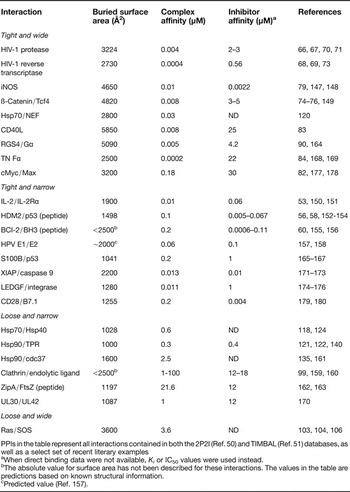
As one way to approach these questions, we compiled a list of PPIs with known inhibitors from the 2P2I (Ref. Reference Bourgeas50) and TIMBAL (Ref. Reference Higueruelo51) databases, as well as from recent examples in the literature (Table 1). For each of these ‘inhibit-able’ PPIs, we measured the surface area that is buried in the protein–protein contact, based on available crystal structures (Fig 1a), and we looked up the reported affinity (Kd) of the interaction. Plotting each PPI according to these two physical properties provided an overview of the types of interactions that have been reported to be inhibited by small molecules (Fig. 1b). We were struck by how this analysis seemed to create four general categories of PPIs and we colloquially termed these quadrants: ‘tight and narrow’, ‘tight and wide’, ‘loose and narrow’ and ‘loose and wide’ (Fig. 1a). In these arbitrary categories, narrow was defined as less than 2500 Å2, whereas wide was greater than 2500 Å2. Likewise, the affinity of the contact was separated into tight (K d less than 200 nM) or loose (K d greater than 200 nM). From this analysis, it is clear that there are relatively few examples of inhibitors in the ‘loose and wide’ category, whereas inhibitors were clustered in the ‘tight and narrow’ and ‘weak and narrow’ categories. To see if specific types of chemical structures tended to cluster in these categories, we examined 19 published inhibitors (Fig. 1a). However, other than a previously observed tendency towards high molecular mass (Ref. Reference Wells and McClendon16), we did not note any obvious consensus. In the following sections, we further discuss PPI inhibitors in the context of this quadrant nomenclature to ask what lessons might be gleaned.
Categorisation of protein–protein interactions (PPIs) and their inhibitors. PPIs with known inhibitors were obtained from the 2P2I (Ref. Reference Morelli, Bourgeas and Roche10) and TIMBAL (Ref. Reference Bourgeas50) databases and recent literature. These PPIs were then categorised by the affinity (Kd) of the PPI and the buried surface area from cocrystal structures (see Table 1). These values were used to arbitrarily categorise the ‘inhibit-able’ PPIs into four quadrants. To illustrate the types of proteins in each category, structures of representative PPIs from each class are shown, with each partner depicted in either blue or red. For ‘tight and wide’ the interaction is between the armadillo repeat region of β-catenin and the catenin binding domain of Xenopus TCF3 (PDB: 1G3J). For ‘tight and narrow’ the interaction is between IL-2 and the IL-2α receptor (PDB: 1Z92). For ‘loose and narrow’ the interaction is between TPR1 and a C-terminal peptide of Hsc70 (PDB: 1ELW) and for ‘loose and wide’ the interaction is between Ras and SOS (PDB: 1BKD). Also shown are 19 representative chemical structures of the PPI inhibitors, illustrating the lack of consensus in molecular weight, shape or other characteristics.

Features of select PPIs and their inhibitors

PPIs in the table represent all interactions contained in both the 2P2I (Ref. Reference Bourgeas50) and TIMBAL (Ref. Reference Higueruelo51) databases, as well as a select set of recent literary examples
aWhen direct binding data were not available, K i or IC50 values were used instead.
bThe absolute value for surface area has not been described for these interactions. The values in the table are predictions based on known structural information.
cPredicted value (Ref. Reference Abbate, Berger and Botchan157).
PPIs ‘tight and narrow’
To date, this category of PPI has proven most amenable to inhibition, producing the most potent inhibitors and a large number of examples (Fig. 2). The reasons for this relative success could be due to the fact that the physical features shared by members of this class are most similar to traditional, enzyme targets. These PPIs are those with high affinity encompassed in a relatively small surface area. They also typically have deep pockets that are engaged by less than five major amino acids that contribute a majority of the binding ΔG. Because of these concise features, some of the strategies used in typical drug discovery campaigns, such as high throughput screening (HTS) and structure-based design, can be readily used to target these PPIs. However, a number of PPI-specific methods have also been developed and some of those methods have subsequently been used to tackle more challenging targets.
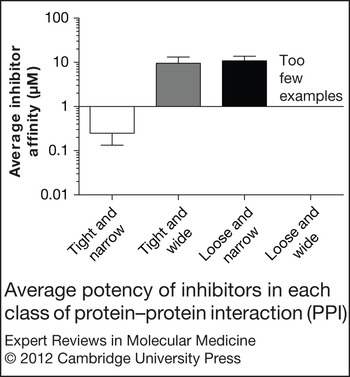
Average potency of inhibitors in each class of protein–protein interaction (PPI). The most potent inhibitors published for each interaction listed in Table 1 were averaged within the four PPI categories. The category of ‘loose and wide’ did not have enough examples to be included.

In 1997, a group at Hoffmann-La Roche screened a series of acylphenylalanine derivatives intending to competitively inhibit the interaction between interleukin 2 (IL-2) and the IL-2α receptors (Ref. Reference Tilley52). Their mid-micromolar inhibitor was developed by researchers at Sunesis Pharmaceuticals into the mid-nanomolar antagonist SP4206, compound 8(K i = 60 nM; Fig. 1). The Sunesis group utilised structural information provided by NMR, combined with tethering, to incrementally build this molecule (Ref. Reference Raimundo53). An instructive idea that arose from that work came from the fact that the structural characterisation of these compounds was originally based on their direct binding to IL-2. It was only after the structure of the IL-2/IL2Rα complex was solved that it became apparent that SP4206 bound to IL-2 and stabilised a conformation that was less competent to bind the IL-2Rα. Moreover, SP4206 induced this conformational change at the PPI surface by interacting with the same residues that were shown by alanine scanning to encompass a disproportionate amount of binding ΔG for the IL-2/IL-2Rα interaction (e.g. a ‘hotspot’) (Ref. Reference Thanos, DeLano and Wells54). Thus, this early example of a successful PPI inhibitor uncovered a number of principles that became repetitive themes in other systems; namely, compound-induced conformational change and hotspot binding.
Small-molecule inhibitors of the PPI between p53 and mouse double minute 2 (MDM2) were identified based on the results of a high throughput screen. As was observed in the case of IL2, these cis-imidazolines, termed nutlins, were shown to occupy the same binding pocket on MDM2 that is critical for binding to p53 (Ref. Reference Fry55). Nutlin-3, compound 9 (Fig. 1), was shown to have mid-nanomolar (~70 nM) and enantioselective activity towards the p53–MDM2 complex, leading to an accumulation of p53 and subsequent tumour suppression (Ref. Reference Vassilev56). Nutlin-3 is currently in phase I clinical trial for the treatment of retinoblastoma, illustrating the promise of PPI inhibitors as drugs and solidifying the idea that surface mimicry and hotspot binding are key tools for targeting this class of PPI. The concept of mimicking the natural interactions was also used in a parallel strategy to inhibit p53–MDM2. This strategy was inspired by the natural product spiro(oxindole-3,3′-pyrrilodine) scaffold, which mimics the indole ring of Trp23 in p53 that binds to a deep, hydrophobic cavity in MDM2 (Ref. Reference Ding57). This rational-design approach, coupled with medicinal chemistry efforts yielded MI-63, which was further developed into MI-219, compound 10 (Fig. 1) to improve its pharmacokinetic profile. MI-219 shows low nanomolar (~5 nM) inhibition of complex formation with sub-micromolar (0.4–0.8 µM) IC50 values for tumour growth inhibition (Ref. Reference Shangary58). The Wang group has pioneered additional rational design approaches in which they start with the structure of the PPI, perform alanine scans to identify possible hotspots and then design peptidomimetics and synthetic scaffolds that are intended to disrupt critical contacts (Refs Reference Ding57, Reference Wang59). These examples are clear cases in which the structure of the PPI can be used to launch inhibitor programmes.
Another key lesson is illustrated by the work of Abbott investigators in their search for inhibitors of B-cell lymphoma 2 (Bcl-2). Fesik and colleagues used fragment-based screening by NMR, followed by extensive SAR by NMR to develop ABT-737, compound 12 (Fig. 1), which binds the antiapoptotic molecules Bcl-XL, Bcl-2 and Bcl-W, and prevents their association with pro-apoptotic proteins BAD and BAX (K i < 1 nM) (Ref. Reference Bruncko60). This compound, and its orally bioavailable derivative ABT-263, shows antiproliferative activity against a number of cancer cell lines, as well as antitumour activity in xenograft animal models (Ref. Reference Oltersdorf61). ABT-263 is currently in phase I/II trial as a single agent for relapsed or refractory lymphoid malignancies, and in phase II trial for lymphatic leukaemia in combination with the antibody therapeutic rituximab. This work was some of the first to document how NMR could be used as a primary discovery tool for identifying and elaborating drug leads, and the first to do so using a fragment-based approach (Ref. Reference Murray and Rees62). More broadly, NMR-based design of PPI inhibitors, often combined with some form of HTS, has been particularly successful in this category of interactions, as illustrated by examples in the Runx1-CBFβ (Ref. Reference Gorczynski63) and MLL (Ref. Reference Grembecka64).
PPIs ‘tight and wide’
Some PPIs involve extensive and often convoluted or discontinuous interaction surfaces, creating contacts with large buried contact areas and tight affinities. These features can create special difficulties in developing small-molecule inhibitors because of the slow off rates and the large surfaces to overcome. Still, a number of successful examples have been reported and a review of these cases suggests some methodologies with potentially far-reaching utility.
Of the 15 enzymes encoded in the human immunodeficiency virus (HIV) genome, three are essential homo- or pseudo-dimers (Ref. Reference Frankel and Young65). Two of these proteins, HIV-1 protease (HIVp) and reverse transcriptase (RT), have been successfully targeted with small-molecule inhibitors. The HIVp dimer has an interacting face with over 3000 Å2 of buried surface area (Ref. Reference Weber66) and a K d value in the low nanomolar range (Ref. Reference Zhang67). Similarly, the HIV-1 RT multimer interface buries 2730 Å2 (Ref. Reference Ding68) with a K d of 400 pM (Ref. Reference Divita, Restle and Goody69). In the late 1990s, two groups identified HIVp dimerisation inhibitors by screening natural products (compounds 1 and 2; Fig. 1) (Refs Reference Fan, Flentke and Rich70, Reference Quere, Wenger and Schramm71). Likewise, exploration of non-nucleoside inhibitors of HIV-1 RT showed compound 5 (Fig. 1), which was subsequently shown to have antidimerisation activity (Refs Reference Balzarini72, Reference Bonache73). These findings support the idea that topologically complex natural products are suitable scaffolds for inhibiting even complex and large PPIs. To further exemplify this idea, the interaction surface between β-catenin and Tcf/LEF family members is also particularly large (>3000 Å2), making it another difficult target (Ref. Reference Graham74). Yet, compound 6 (Fig. 1) was identified in a natural product screen that relied on measuring binding of Tcf4 to β-catenin (Ref. Reference Lepourcelet75). However, natural products are not exclusive in their ability to inhibit these types of interactions. Recently, an in silico screen showed compound 7 (Fig. 1), a simpler structure that is predicted to bind to a hotspot region and inhibit the β-catenin–Tcf4 interaction (Ref. Reference Tian76). Additional structural information will be needed to fully understand the binding mode and mechanistic basis for these activities, but the findings suggest that topologically complex chemical libraries may be good starting points for identifying PPI inhibitors.
The inducible isoform of nitric oxide synthase (iNOS) has been implicated in inflammatory and autoimmune diseases (Ref. Reference Amin and Abramson77), while the endothelial isoform has a vital role in vascular homeostasis (Ref. Reference Nathan and Xie78). In an effort to identify selective inhibitors of iNOS, McMillan et al. (2000) conducted an in vitro screen against iNOS enzyme activity using a compound library based on a pyrimidine–imidazole core (Ref. Reference McMillan79). This screen resulted in no active compounds, but a cell-based screen against nitric oxide production yielded the potent inhibitor compound 3 (Fig. 1). The compound was shown to have a high affinity for the iNOS monomer and, upon binding, it allosterically inhibited subsequent dimerisation, explaining why the original in vitro screen against the pre-formed iNOS dimer produced no inhibitors. This example nicely illustrates a growing realisation that allostery and allosteric mechanisms are powerful tools in targeting larger PPIs (Refs Reference Reynolds, McLaughlin and Ranganathan12, Reference Lee and Craik80). Moreover, this study illustrates how dynamics can have a large impact on success in HTS-based PPI campaigns. Only when iNOS was allowed to sample both monomeric and dimeric structures were allosteric inhibitors uncovered.
Other interesting examples of this class are found in inhibitors of the c-Myc/Max dimer, the CD40 ligand (CD40L) trimer and the eukaryotic translation initiation factors (eIF) eIF4E and eIF4G. A hurdle to small-molecule inhibition of c-Myc/Max dimerisation is the vast increase in dimer stabilisation in the presence of DNA (Ref. Reference Fieber81). To circumvent this issue, the Berg group developed a clever HTS approach in which c-Myc/Max binding to a fluorophore-labelled oligonucleotide was measured, showing Mycros 1 and 2 as micromolar inhibitors (Ref. Reference Kiessling82). This study nicely leveraged known biophysical features of the PPI to design a screen especially targeting a key aspect of the complex. Similarly, identifying inhibitors of CD40L trimerisation is also difficult, given the tight affinity of this complex. Yet, a direct binding assay was used to produce BIO8898, compound 4 (Fig. 1), a small molecule that populates a deep, allosteric pocket between two subunits of the trimer (Ref. Reference Silvian83). Binding by BIO8898 distorts the interface enough to prevent binding of CD40L to the CD40 receptor. This is a more subtle form of inhibition than seen in previous studies of the homologous TNFα, where an inhibitor was found that completely ejected one subunit from the trimer (Ref. Reference He84). These examples suggest that even challenging PPIs can sometimes be amenable to HTS approaches, using methodologies, such as AlphaLisa, fluorescence and luminescence complementation, ELISA, SPR and FRET (Refs Reference Magliery85, Reference Liu86, Reference Heeres87, Reference Porter88) and the resulting compounds, if the screen is designed carefully, can access unexpected and interesting molecular mechanisms. This concept is further re-inforced by work from the Wagner group, in which they developed a high-throughput fluorescence polarisation screen against the initiation factor eIF4E using a peptide from the binding motif of eIF4 G (Ref. Reference Moerke89). This screen showed the inhibitor 4EGI-1 that disrupts full-length eIF4 G binding, and interestingly, clears the path for natural modulators of translation (4E-BP) to interact and thereby inhibit translation. Together, these examples demonstrate the diversity of solutions to the problem of blocking large, tight interactions.
As illustrated by the examples above, this class of PPIs has been successfully targeted and the resulting compounds access interesting mechanisms. Another example was provided by the Neubig group, in which they used a flow cytometry protein interaction assay to target regulators of G-protein signalling (RGS). They identified CCG-4986, which inhibits the RGS4-Gα PPI by covalent modification of a cysteine residue adjacent to the interaction surface (Ref. Reference Roman90). This example highlights a growing resurgence of covalent modifiers as probes and drugs (Ref. Reference Potashman and Duggan91). Covalent modifiers might be particularly attractive for PPIs because irreversible binding can be used to overcome problems of weak interaction and shallow binding sites.
Amyloids are ordered protein aggregates defined by a characteristic appearance in electron microscopy, affinity for the dye, congo red and large contact interfaces between monomers (Ref. Reference Reinke and Gestwicki92). The interface challenge is exacerbated by the repetitive structure of amyloids, involving thousands of monomer interactions and thousands of cumulative Å2 of buried surface area. Amyloids underlie a number of neurodegenerative disorders and other diseases of protein misfolding (Ref. Reference Eisenberg and Jucker93), so inhibitors of amyloid PPIs are of medical interest. Numerous small molecules with tight affinity for amyloids have been described, some based on synthetic scaffolds and others based on peptidomimetics (Refs Reference Reinke and Gestwicki92, Reference Findeis94, Reference Lee95). Some of these molecules have even advanced to clinical trials in Alzheimer's disease. Interestingly, these compounds typically have good K d values, yet their ability to block PPIs between amyloid-forming monomers (IC50) is typically 10- to 1000-fold worse. The disconnect between these values is thought to arise from compound binding being insufficient to fully block the large amyloid surfaces, which often lack clear ‘hotspots’. In 2004, it was discovered that hybrids between congo red and the FK506-binding protein (FKBP) created bifunctional inhibitors that better matched the size and complexity of the amyloid surface, producing inhibitors with nanomolar IC50 values (Ref. Reference Gestwicki, Crabtree and Graef42). Interestingly, increasing the size of the FKBP portion enhanced the apparent IC50 of the hybrids, suggesting that larger surfaces were more effective inhibitors (Ref. Reference Bose96). Another clever solution to this problem can be found in antiamyloid strategies using compounds that dissolve pre-formed aggregates by allostery (Ref. Reference Roberts97). Thus, even for some of the most extreme PPIs, allostery and other mechanisms can be used to inhibit their formation.
PPIs ‘loose and narrow’
PPIs within this category are characterised by weak (K d > 200 nM) binding but relatively small contact areas. Since these interactions are typically transient, it is not unusual for the surfaces to be shared by multiple partners. These hurdles, often coupled with a lack of structural data and relatively shallow binding pockets, make these interactions especially challenging targets (Fig. 2). However, in one example of a successful approach, the N-terminal β-propeller domain (TD) of the clathrin heavy chain was targeted. Clathrin heavy chain serves as a central interacting hub for accessory proteins in the endocytic pathway (Ref. Reference Schmid and McMahon98). Two molecules termed pitstops, one from a naphthalimide core compound 15 and the other from rhodanine compound 16 (Fig. 1) were identified in an ELISA-based high-throughput screen (Ref. Reference von Kleist99). These compounds were shown to compete with accessory proteins for binding to a common site on the clathrin TD, limiting endocytosis and thereby inhibiting viral entry. Despite this success, general strategies for targeting this class are not yet clear.
In another interesting example that illustrates the challenges in this type of PPI, the Mapp group identify compounds that inhibit transcriptional activation within the activator complex (Ref. Reference Lee and Mapp100). These authors recognised that a conserved structural element of natural activation domains is that they are amphipathic. They showed polar functionality from an isoxazolidine core and, indeed, found that the only apparent requirement for creating artificial activators was that the molecule needed to be amphipathic (Refs Reference Buhrlage101, Reference Casey102). This relatively loose structural constraint suggests that the strategies for optimising inhibitors of this type of PPI will be substantially different than for other types of targets.
PPIs ‘loose and wide’
At the extreme end of the PPIs are the contacts defined by large surface areas and weak affinities. To our knowledge, few potent inhibitors of contacts within this category have been described and these targets remain a particularly challenging area. Yet, very recent evidence suggests that inhibition at this level is possible. The interaction between the small GTP-binding protein Ras and its guanidine nucleotide exchange factor SOS (Son of Sevenless) spans approximately 3600 Å2 (Ref. Reference Boriack-Sjodin103) and the catalytic domains bind with an affinity in the low micromolar range (Ref. Reference Sondermann104), placing this PPI squarely within the ‘loose and wide’ category. Recent work has produced a stapled peptide (Ref. Reference Patgiri105) and a small molecule (compound 19; Fig. 1) (Ref. Reference Maurer106) capable of inhibiting this interaction both in vitro and in cells. Other biological examples of these PPIs are plentiful in the literature, especially in the area of GPCR clustering, cell–cell interactions and carbohydrate–protein interactions (Ref. Reference Kiessling, Gestwicki and Strong107), creating a need for PPI inhibitors.
Advancing PPI inhibitors in difficult systems
As evident from visually placing PPIs into quadrants (Fig. 1), some systems, especially weaker interactions and those that make contacts over a wide area, remain notoriously resistant to inhibition. This challenge is further evident by the large differences in the average potency values for inhibitors targeting the different classes. On average, compounds that inhibit ‘tight and narrow’ PPIs have 10-fold better potency than those targeting ‘loose and narrow’ contacts (Fig. 2). Many of these resistant systems have commonalities among them, such as limited structural information, transient and weak contacts and promiscuous binding interfaces. To further illustrate these ideas and highlight methodologies developed to specifically address these challenges, we focus on the heat shock protein 70 (Hsp70) and heat shock protein 90 (Hsp90) systems for further discussion. Hsp70 and Hsp90 are molecular chaperones that each form multi-protein complexes with important roles in protein folding and stabilisation. Moreover, there is compelling evidence, in both cases, to suggest that targeting PPIs in the Hsp70 and Hsp90 complexes may be an effective therapeutic strategy in cancer and neurodegeneration (Refs Reference Evans, Chang and Gestwicki108, Reference Patury, Miyata and Gestwicki109, Reference Brodsky and Chiosis110, Reference Brandt and Blagg111, Reference Powers and Workman112). These systems also provide a convenient model for these discussions because the PPIs inherent in Hsp70 and Hsp90 complexes provide examples of nearly every type of PPI category.
Heat shock protein 70
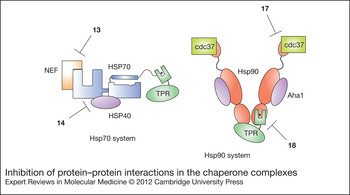
Hsp70 has an important role in normal protein homeostasis and it is implicated in several disease states, such as cancer, neurodegeneration and amyloidosis (Refs Reference Evans, Chang and Gestwicki108, Reference Patury, Miyata and Gestwicki109, Reference Hartl and Hayer-Hartl113, Reference Meimaridou, Gooljar and Chapple114). The protein consists of two domains, a nucleotide binding domain (NBD) that hydrolyses ATP and a substrate-binding domain (SBD) that binds to exposed hydrophobic regions of polypeptides (Fig. 3). NMR-based fragment screens conducted by the biotechnology company, Vernalis, have shown that the ATP-binding site of Hsp70 is not particularly amenable to discovery of selective or potent inhibitors (Ref. Reference Massey115). Thus, the PPIs between Hsp70 and its numerous cochaperones have become attractive alternatives (Refs Reference Evans, Chang and Gestwicki108, Reference Patury, Miyata and Gestwicki109, Reference Miyata116). There are three main classes of proteins that bind to Hsp70s. The Hsp40 (or DnaJ) superfamily is characterised by a conserved J-domain that binds to Hsp70 and stimulates its ATPase activity (Ref. Reference Kampinga and Craig117). This stimulation of ATP turnover promotes tight binding of substrates in the SBD via a conformational change. Nucleotide exchange factors (NEFs) bind Hsp70 and facilitate ADP release, helping to release substrates. And, finally, a family of tritetracopeptide repeat (TPR) domain-containing cochaperones binds to the SBD, helping to arbitrate the fate of Hsp70-bound substrates (Ref. Reference Meimaridou, Gooljar and Chapple114). Thus, either promoting or inhibiting PPIs between Hsp70 and its cochaperones can modulate the biology of the system (Refs Reference Evans, Chang and Gestwicki108, Reference Patury, Miyata and Gestwicki109).
Inhibition of protein–protein interactions in the chaperone complexes. Complexes between Hsp70 and Hsp90 and their cochaperones are shown. PES 13 inhibits the Hsp70–Bag1 interaction, myricetin 14 inhibits the Hsp70–Hsp40 interaction, celastrol 17 inhibits Hsp90–cdc37 and San A 18 inhibits the Hsp90–TPR interactions. Abbreviations: NEF, nucleotide exchange factor; TPR, tetratricopeptide repeat domain-containing cochaperone; San A, sansalvamide A.

The J domain of the prokaryotic Hsp40, DnaJ, binds to the Hsp70, DnaK, across a largely polar interface between the NBD and SBD (Ref. Reference Ahmad118). The K d of this interaction is weak (>1 µM) and a structure of the auxilin J-domain fused to mammalian Hsp70 suggests a relatively modest interaction surface (1028 Å2) (Ref. Reference Jiang119). Costructures of Hsp70 and NEFs suggest a larger (2800 Å2) interaction, with much higher affinity (30 nM) (Ref. Reference Harrison120). Finally, the TPR domain interaction with Hsp70 is approximately 1 µM (Ref. Reference Schmid121) and occurs over an area of 1330 Å2, based on a crystal structure of a representative TPR domain with the C-terminus of Hsp70 (Ref. Reference Scheufler122). Based on genetic studies, each of these interfaces is attractive as a therapeutic target.
Our group has become particularly interested in targeting the Hsp70–Hsp40 interaction because of the unusually weak affinity between these partners and the importance of the contact in chaperone biology (Ref. Reference Kampinga and Craig117). Recent work by the Zuiderweg group has shown that the prokaryotic Hsp70–Hsp40 contact is largely polar, with a complex and shallow topology (Ref. Reference Ahmad118). We originally considered it unlikely that a screen for direct (e.g. competitive) inhibitors of the direct PPI would be fruitful, given the weak binding of the two partners. Accordingly, we pursued a different strategy, termed ‘grey box screening’. In this method, the ATPase activity of Hsp70 is stimulated by reconstituting its complex with an Hsp40 in vitro. Any compounds that disrupt Hsp40-stimulated ATP turnover would be identified as a ‘hit’ in the screen. This approach is termed grey box screening because it has some features in common with ‘black box’ screens, in which whole cells or animals are used as the target. In cell-based screens, the physiological relevance of the platform is high, but target identification is a challenging task. In the grey box approach, some of the natural complexity of the system is mimicked by reconstitution of the multi-protein system. This approach has been used to identify a number of inhibitors of the Hsp70–Hsp40 complex, some of which bind directly at the PPI interface (Ref. Reference Wisen123) and others that bind distal, allosteric sites (Ref. Reference Chang124). For example, the flavonoid myricetin compound 14 (Fig. 1) was found to bind an unanticipated site in the NBD, about 30 Å from the Hsp70–Hsp40 interface, trapping a conformation that is not able to interact with Hsp40 (Ref. Reference Chang124). Interestingly, the binding site for myricetin is not apparent in the crystal structures of the Hsp70 NBD, suggesting that dynamic movements in this region are required to open the compound-binding site (Ref. Reference Bhattacharya125). Since this screening approach is amenable to HTS in low volume, large numbers of compounds can be screened (Refs Reference Chang126, Reference Miyata127). This strategy might be applicable in other systems involving weak interactions, especially those in which nonenzyme partners allosterically modify the activity of a core enzyme component.
The tighter Hsp70–NEF interaction has been targeted using a ‘black box’ high throughput screen. From a cell-based assay against p53-mediated apoptosis, PES compound 13 (Fig. 1) was identified as a small molecule that decreases tumour cell viability (Ref. Reference Leu128). In follow-up studies, PES appears to block the binding of Hsp70 to the M isoform of bcl-2 associated athanogene 1 (BAG-1), an NEF for Hsp70. These findings (along with the nutlin work described above) suggest that phenotypic screens can sometimes show PPI inhibitors, even if the target PPI is relatively large. One power of these methods is that the target PPI is allowed to undergo its natural dynamics, often providing unanticipated mechanisms of inhibition. The challenge is that the mechanism of inhibition is not clear until follow-up studies are performed.
Heat shock protein 90
The Hsp70 and Hsp90 systems are linked through a shared TPR-domain cochaperone, HOP (Hsp70–Hsp90 organising protein) (Ref. Reference Li, Soroka and Buchner129). And like Hsp70, Hsp90 is an abundant molecular chaperone that relies on a network of these cochaperones for its activity (Ref. Reference Kamal, Boehm and Burrows130) (Fig. 3). Under both stress and normal conditions, Hsp90 regulates the stability and maturation of over 200 client proteins, many of which either harbour mutations or are over-expressed in cancers (Ref. Reference Whitesell and Lindquist131). In fact, inhibitors of the ATPase activity of Hsp90, which bind to the N-terminal ATP-binding pocket, have been extensively explored and some of these have advanced to clinical trials as anticancer agents (Ref. Reference Porter, Fritz and Depew132). These inhibitors bind classically defined pockets and do not appear to directly impact cochaperone binding. However, one drawback of these molecules is that they elicit a heat shock response, through activation of heat shock factor 1 (HSF1) (Ref. Reference Bagatell133). This cytoprotective response has the potential to undermine the antiproliferative effects of Hsp90 inhibition. These issues have driven interest in targeting the C-terminal ATP-binding site (Ref. Reference Donnelly and Blagg134) and, importantly for this review, PPIs between Hsp90 and its cochaperones.
Hsp90 interacts with the important cochaperones Aha1, cdc37, p23 and a number of TPR-domain proteins (Ref. Reference Li, Soroka and Buchner129). These interactions tune the ATPase activity of Hsp90 and these PPIs are being recognised as potential drug targets (Ref. Reference Powers and Workman112). The TPR–Hsp90 interaction surface resembles the one in the TPR–Hsp70 system, being relatively weak but narrow. Cdc37 interacts with relatively poor affinity (2.5 µM) (Ref. Reference Sreeramulu135) to Hsp90, burying 1600 Å2 of solvent exposed surface area, whereas Aha1 binds across a very large, polar surface of Hsp90 (Ref. Reference Meyer136) with moderate affinity (0.6 µM) (Ref. Reference Siligardi137). Thus, like the Hsp70 system, this multi-protein complex has a wide range of affinities and surface areas.
An investigation into how the natural product, celastrol compound 17 (Fig. 1) inhibited Hsp90 and elicited a heat-shock response initially showed that the compound reduced the interaction between Hsp90 and the cancer associated cochaperone cdc37 (Ref. Reference Zhang138). Upon further analysis, it was shown that celastrol covalently binds to the Hsp90 cochaperone, cdc37 (Ref. Reference Sreeramulu139). Recently, the molecule compound 18 (Fig. 1) based on another natural product, Sansalvamide A, was reported to bind to Hsp90 and inhibit the interaction of TPR domain-containing cochaperones (Ref. Reference Ardi140). Other inhibitors of the Hsp90–TPR interaction have also been identified by HTS approaches (Refs Reference Ardi140, Reference Yi and Regan141). Thus, like in the Hsp70 system, ‘biology-driven’ HTS was used as a successful strategy to identify PPI inhibitors in the Hsp90 system and natural products were common hits.
Conclusions
PPIs are the ‘glue’ that drive biology. To take advantage of potential therapeutic and emerging research opportunities, a growing urgency has emerged around inhibiting PPIs. In addition, a number of successes in the field of chemical inhibitors of PPIs, including initiation of multiple clinical trials, have provided a strong motivator for continued experimental focus.
What can be learned from analysing prior successes and failures in targeting PPIs with small molecules? One over-whelming observation is that PPI inhibitors are not as hard to find as one might expect. Many straightforward HTS methods have successfully produced micromolar and nanomolar inhibitors, especially of concise (e.g. ‘tight and narrow’) PPIs. Also, many of the most successful PPI inhibitors have taken advantage of hotspots that effectively reduce large, flat surfaces to more manageable targets. Another common solution is found in compounds that bind allosteric sites to modify PPIs, as was the case with the CD40L inhibitor and myricetin in the Hsp70 system. These compounds utilised well-defined pockets to enact global changes at either adjacent (in the case of CD40L) or distal (in the case of Hsp70) PPI contacts. Allostery can work over substantial distances (Ref. Reference Gandhi142), further suggesting that even topologically complex surfaces can be impacted. Also, allosteric sites can be versatile tools, sometimes allowing switching between agonism and antagonism (Refs Reference Wisen123, Reference Motlagh and Hilser143).
What methods are best for identifying PPI inhibitors? The answer to this question appears to be dependent on the type of PPI, the specific biological goals and other factors. Rational design approaches have succeeded in cases of both large surface areas (as is the case with stapled peptides) and concise PPIs (as was seen with inhibitors of p53–MDM2). NMR will possibly continue to be a powerful method for discovery of PPI inhibitors because it combines structural insights with fragment-based approaches (as was seen in the case of Bcl-2). Finally, unbiased HTS methods, especially grey box screening and cell-based methods, have proven surprisingly fruitful in the search for PPI inhibitors. These methods seem particularly attractive in systems involving large contact surfaces, owing to their propensity to find unanticipated allosteric sites.
What do these studies mean for understanding basic biology? Many, if not all, biological processes are dependent on the function of multi-protein complexes (Refs Reference Chari and Fischer144, Reference Peterson-Kaufman145, Reference Good, Zalatan and Lim146). In a post-genomic world, chemical biologists and biologists are increasingly focusing on PPIs as key regulatory hubs. Thus, the development of research probes that target these interactions is important for understanding the logic of biological networks. It seems likely that substantial insights will emerge from efforts to create new solutions to the problem of inhibiting PPIs.
Acknowledgements
We apologise that many outstanding examples of PPI inhibitors could not be included due to space constraints. Our work on PPI inhibitors is funded by the NIH (NS059690) and NSF (MCB-0844512). M.C.S. is funded by a training grant from the NIH (AG000114) and a Rackham Merit Fellowship. The authors also thank J.A. Townes and members of the Gestwicki group for helpful conversations.