INTRODUCTION
Most knowledge and theory about the function of reef environments is based on coral reef studies (Longhurst & Pauly, Reference Longhurst and Pauly2007), mainly done in the Indo-Pacific and Caribbean regions (Sale, Reference Sale1991). In coral reefs, biogeographical factors (Bellwood & Wainwright, Reference Bellwood, Wainwright and Sale2002) and habitat features (Nanami & Nishihira, Reference Nanami and Nishihira2002; Baron et al., Reference Baron, Jordan and Spieler2004) have strong influence over the fish community structure because biogeographical factors govern the species distribution on a large scale, whilst the biotic and physical characteristics of each place affect the local distribution of taxa.
Some tropical provinces and habitats, many constituted of rocky shores and reefs, have received less attention from specialists and thus have been excluded from important macroecological and biogeographical analysis (Floeter & Gasparini, Reference Floeter and Gasparini2000). Studies realized during the last decade on rocky reef fish fauna sought to explore zoogeographical patterns and the relationship between species and habitat features by comparing communities sampled in distinct environmental settings (Ferreira et al., Reference Ferreira, Gonçalves and Coutinho2001; Floeter et al., Reference Floeter, Krohling, Gasparini, Ferreira and Zalmon2007; Mendonça-Neto et al., Reference Mendonça-Neto, Monteiro-Neto and Moraes2008). However, in comparison to coral reefs (Chabanet et al., Reference Chabanet, Ralambondrainy, Amanieu, Faure and Galzin1997; Almany, Reference Almany2004; Gratwicke & Speight, Reference Gratwicke and Speight2005), little is known about the small-scale spatial distribution of species on rocky shores.
To verify the presence of small-scale changes in the fish community structure on rocky reefs of a coastal island we conducted underwater visual censuses (UVCs) of fishes along depth, structural complexity and wave exposure gradients of a tropical coastal island of the south-western Atlantic. Our study aims at establishing the relationships between fish communities and reef environments to provide important information about the processes that govern the reef fish community structure (Lara & Gonzalez, Reference Lara and Gonzalez1998; Nagelkerken et al., Reference Nagelkerken, van der Velde and Morinière2001). Such knowledge would facilitate cooperation in the implementation of local management plans (Lara & Gonzalez, Reference Lara and Gonzalez1998; Ferreira et al., Reference Ferreira, Gonçalves and Coutinho2001) and of scientific sample strategies in reef areas.
MATERIALS AND METHODS
Study area
This study was conducted on the coast of the State of Espírito Santo (18°22′S21°19′S), on the south-eastern coast of Brazil, a transitional tropical–subtropical zone where the predominant tropical oligotrophic waters of the Brazilian current flow southwards and coastal southern up-welling occurs seasonally (Schmid et al., Reference Schmid, Schafer, Podesta and Zenk1995). Additionally, Espírito Santo is located in a zone of transition between the northern biogenic reef ecosystems (0°52′N–19°00′S) and the southern rocky reef ecosystems (20°00′S–28°00′S) of the Brazilian coast.
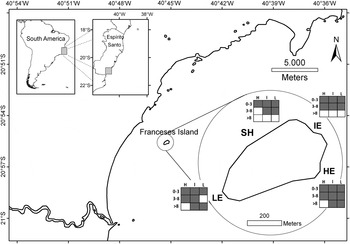
Franceses Island (Figure 1: 20°55′S40°45′W) is a coastal island located in the south of Espírito Santo. The island is located 4 km from the coast, is formed by a crystalline base and has an area of 0.135 km2; its largest axis (500 m) is located parallel to the coastline (Figure 1). In spring and summer, the predominant wind comes from the north-east, which influences in a distinct way the wave action on the reefs and shores. Thus, the island has zones with high exposure (on its eastern and north-eastern faces—up to 12 m deep), intermediate exposure (on its northern face—up to 8 m deep), low exposure (on its southern face—up to 10 m deep) and in sheltered regions (on its western face—up to 5 m deep) (Figure 1). Seasonal south-westerly cold fronts reverse exposure but this situation remains unstudied due to heavy wave action and extremely low underwater visibility (well less than 1 m).
Location of Franceses Island, south-eastern Brazil, showing the distinct faces of the island (SH, sheltered zone; LE, low exposure; IE, intermediate exposure; HE, high exposure). The depth and complexity (H, high complexity; I, intermediate complexity; L, low complexity) of each face is showed (filled squares indicate the existence of censuses).

The island is an important tourist attraction, mainly during summer. However, the activities conducted in the island (tourism, fishing, barbecuing, etc.) are not managed (Pinheiro et al., Reference Pinheiro, Ferreira, Molina, Protti, Zanardo, Joyeux and Doxsey2009).
Fish census
Five expeditions to Franceses Island were undertaken between October 2005 and February 2006 (27 October; 26–28 December; 7–12 January and 25–28 January; 8–9 February). During these field trips, 208 were performed by SCUBA diving. The censuses were conducted using belt transects of 20 × 2 m. This small-width transect method is adequate for conditions of low water transparency of coastal waters (about 5 m in summer) (see Floeter et al., Reference Floeter, Krohling, Gasparini, Ferreira and Zalmon2007). Each census was performed in two steps: on the way out (by letting out a 20 m tape), the diver counts the larger and more mobile species and on the way back (by winding in the tape) the smaller and more cryptic species. The abundance is estimated as the number of individuals per 40 m2.
The UVCs were performed on rocky shore, interface and patch reef habitats, and represent 26 cross-categories of exposure (four categories), depth (3) and substrate complexity (3; Figure 1) (ten cross-categories were not found). The four exposure zones were: sheltered (32 censuses), low exposure (29), intermediate exposure (43) and high exposure (104). The depth categories were: shallow (0–3 m; 95 censuses), intermediate depth (3–8 m; 84) and deep (>8 m; 29). The maximum depth sampled was 12 m, which corresponds to the maximum depth of the island. The structural complexity of substrata varied between high (substrata composed of big boulders and holes >1 m of size and depth, respectively; 39 censuses), which provide shelter for a great variety of fish; intermediate (substrata with a predominance of gorgonians and fire-corals or small boulders and holes <1 m of size and depth, respectively; 100), which provide shelter for small fish; and low (few and small benthic organisms and a predominance of epilithic algae; 69), with few shelters for fish (Floeter, Reference Floeter2003).
Data analysis
Recent taxonomic changes suggested by Craig et al. (Reference Craig, Sadovy and Heemstra2011) and Westneat & Alfaro (Reference Westneat and Alfaro2005) were adopted. Thus, Epinephelidae forms part of Serranidae and Scaridae has been incorporated into Labridae. The trophic guild of each species was defined following Ferreira et al. (Reference Ferreira, Floeter, Gasparini, Ferreira and Joyeux2004) and Randall (Reference Randall1967). A similarity matrix, using species as factors, among censuses was built using the Bray–Curtis dissimilarity index. This matrix was used to run similarity analyses (ANOSIM; Clark & Warwick, Reference Clark and Warwick1994) among groups of environmental variables. Chi-squared tests were used to determine if the average abundance of trophic guilds at each depth, exposure and complexity differed from the general assemblage. This general assemblage was estimated as the average abundance of trophic guilds between the 26 existing environmental cross-categories.
Three-way analysis of variance with two-way interactions tests and Tukey post-hoc tests (Zar, Reference Zar1999) were performed to detect differences in abundance of trophic guilds, in total abundance of fish, in diversity (Shannon–Wiener index) and in richness (species number) among depth, exposure and complexity categories. A canonical correspondence analysis (CCA), conducted in the program MVSP, was run using the mean abundance of each trophic guild and the environmental characteristics (exposure, depth and complexity) of each one of the 26 cross-categories of the environmental characteristics. Environmental categories were coded according to their nominal strength (1, 2 and 3 for depth and complexity; 1, 1.66, 2.33 and 3 for exposure). In all analyses, abundance was log-transformed (log10(abundance + 1)) to approximate the prerequisites of normality and homoscedasticity of parametric analyses.
RESULTS
Composition and abundance
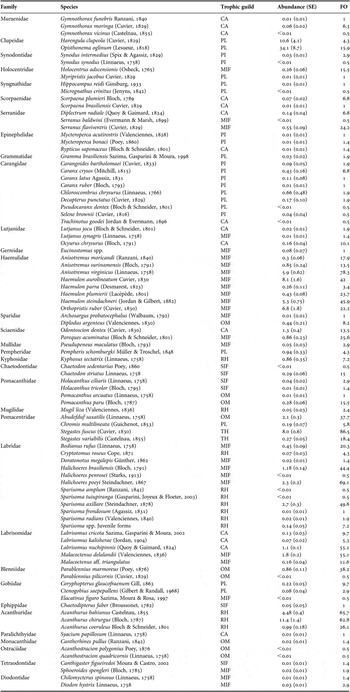
A total of 15,425 specimens were counted during the census. It included 90 species distributed in 33 families and 9 orders (Table 1). Perciformes was the richest order (22 families), followed by Tetraodontiformes (4). Labridae was the richest family (11 species), followed by Carangidae (9), Haemulidae (8) and Labrisomidae (5). The richest genera were Sparisoma (5 species), Haemulon (4), Acanthurus (3), Anisotremus (3), Gymnothorax (3), Halichoeres (3) and Labrisomus (3) (Table 1).
Trophic guild, abundance (and standard error; in 40 m2) and frequency of occurrence (FO; in %) of the reef fish species at Franceses Island, Brazil. Families are listed phylogenetically following Nelson (Reference Nelson2006). CA, carnivores; TH, territorial herbivores; RH, roving herbivores; MIF, mobile invertebrate feeders; SIF, sessile invertebrate feeders; OM, omnivores; PI, piscivores; PL, planktivores.

Haemulidae was the most abundant family with 37% of the total abundance. It was followed by Acanthuridae (22%), Pomacentridae (14%) and Labridae (8%). Twenty-eight species combined accounted for about 95% of the total abundance, while 62 species accounted for the remainder. The ten most abundant species, in descending order, were: Acanthurus chirurgus, Haemulon aurolineatum, Stegastes fuscus, Orthopristis ruber, Anisotremus virginicus, Haemulon steindachneri, Acanthurus bahianus, Sparisoma axillare, Halichoeres poeyi and Abudefduf saxatilis. These species represented 76.7% of the total abundance (Table 1).
Fourteen species were considered rare, represented by a single individual in all censuses (Table 1; species with abundance <0.01 40 m−2 and occurrence = 0.5%). The species Harengula clupeola, Opistonema oglinum (Clupeidae) and Chloroscombrus chrysurus (Carangidae) together were present in 24.5% of the censuses. However, these three species were excluded from the abundance analysis calculations due to their schooling behaviour.
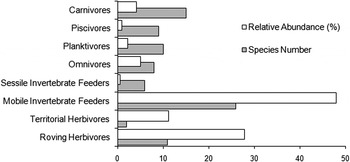
Number of species and relative abundance of each trophic guild is shown in Figure 2. Mobile invertebrate feeders were the most abundant and richest group, while sessile invertebrate feeders were the least abundant group and had the lowest richness of species.
Relative abundance and number of species for the trophic guilds found on the rocky reefs of Franceses Island, south-eastern Brazil.

Spatial variation of community structure
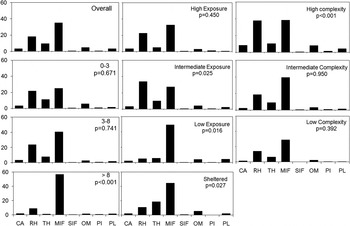
Differences in community structure (species abundance) were observed among categories of exposure (ANOSIM; R = 0.248; P = 0.001), depth (ANOSIM; R = 0.234; P = 0.001) and complexity (ANOSIM; R = 0.063; P = 0.002). The trophic structure of the assemblages observed in sheltered, low and intermediate exposures, in the deepest and in the most complex zones differed significantly from the general assemblage (χ 2 tests; Figure 3).
Relative abundance of the trophic guilds overall and as a function of the different environment variables on the rocky reefs of Franceses Island, Brazil. Results of Chi-squared tests comparing trophic structure for each category of environmental variables to that of the overall structure are displayed. CA, carnivores; TH, territorial herbivores; RH, roving herbivores; MIF, mobile invertebrate feeders; SIF, sessile invertebrate feeders; OM, omnivores; PI, piscivores; PL, planktivores.

EXPOSURE
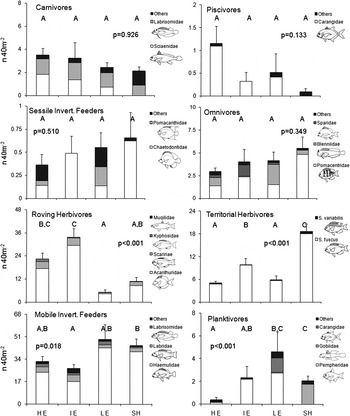
Roving herbivorous fish composed the single guild that is most abundant in high exposure zones (Figure 4). Specimens of the genus Kyphosus were only observed in its zone. However, specimens of the genus Mugil were only found in sheltered zones. Planktivorous fish were least abundant in the high exposure zone. Within this group, however, species were distributed unevenly in respect of exposure. Thus, pempherids and small carangids preferred intermediate exposure zones, while gobiids were observed mainly in the sheltered zone and Chromis multilineata and Gramma brasiliensis were most abundant in high exposure zones. Territorial herbivores, predominantly Stegastes fuscus, were more abundant in the most sheltered zones (Figure 4).
Trophic guild abundance (bars are standard error) in distinct exposure zones of Franceses Island (SH, sheltered; LE, low exposure; IE, intermediate exposure; HE, high exposure). Analysis of variance significance for the variable is shown. Post-hoc Tukey homogeneous groups are indicated where tests were performed.

DEPTH
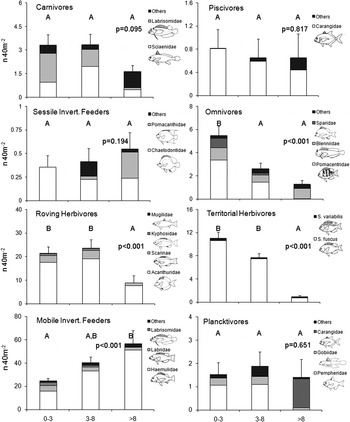
Although the study area consists only of shallow reefs, the community showed significant changes according to depth. The roving herbivores, territorial herbivores and omnivores were more abundant in shallow environments (0–3 m), and showed decreasing abundance with depth (Figure 5). Kyphosus sectatrix was only found in shallow and intermediate depths, while acanthurids and scarids were also observed roving in the deepest zones. The common omnivore, A. saxatilis, inhabitant of the column water, hardly occurred in the deepest zone while the cryptic and bottom-associated genus Parablennius was most abundant in this zone. Mobile invertebrate feeders were most abundant in the deepest zones (Figure 5), predominantly at the interface between the reef and sand/gravel beds.
Trophic guild abundance (bars are standard error) in the different depth zones of the rocky reefs of Franceses Island, Brazil. Analysis of variance significance for the variable is shown. Post-hoc Tukey homogeneous groups are indicated where tests were performed.

COMPLEXITY
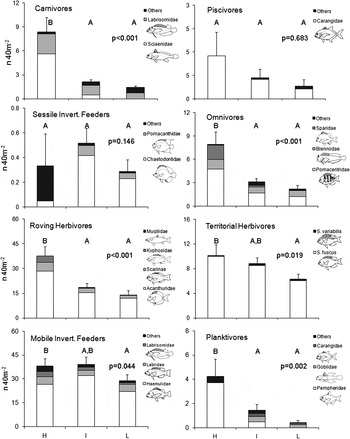
The abundance of almost all trophic guilds rose as complexity increased (Figure 6). Only piscivores and sessile invertebrate feeders, due to their low overall abundance, did not display any pattern according to substrata complexity (Figure 6). Kyphosus sectatrix, Diplodus argenteus, Odontoscion dentex and Pareques acuminatus were regularly observed in high complexity habitats, while haemulids, pomacentrids, acanturids and chaetodontids were mainly found in lower complexity environments (Figure 6).
Trophic guild abundance (bars are standard error) along the complexity gradient found at Franceses Island (H, high complexity; I, intermediate complexity; L, low complexity). Analysis of variance significance for the variable is shown. Post-hoc Tukey homogeneous groups are indicated where tests were performed.

RICHNESS, DIVERSITY AND ABUNDANCE
Mean richness, diversity and total abundance per 40 m2 were 11.5 (±0.2 standard error) species, 1.85 (0.03) and 74.1 (3.4) individuals, respectively. However, these general features change within each environment variable (Table 2). Diversity and richness were higher in shallow environments, while abundance did not vary along the depth gradient. Diversity and richness were also higher in the most exposed zones, although Tukey post-hoc tests were not sensitive enough to detect differences among exposure zones for richness (Table 2). Abundance did not differ among exposure zones. Richness and abundance were higher in highly complex habitats (Table 2).
Richness, diversity and total abundance (40 m2) among environmental variables studied on the rocky reefs of Franceses Island, Brazil. Probability for the significance of the environmental variable in the three-way ANOVA model is given. When significant, categories were tested by Tukey Post Hoc test and homogeneous groups are listed from lower to higher mean (A < B < C).

SH, sheltered zone; LE, low exposure; IE, intermediate exposure; HE, high exposure; H, high complexity; I, intermediate complexity; L, low complexity; NS, non significant, *The Tukey post-hoc test did not detect any significant difference among exposure categories.
COMMUNITY STRUCTURE
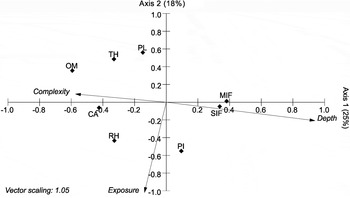
The CCA performed pointed out the depth as the most important factor structuring the rocky reef community of Franceses Island, followed by exposure (Figure 7). Exposure was independent of depth and complexity, while these last were strongly and negatively correlated. Piscivores and roving herbivores, positively, and planktivores, territorial herbivores and omnivores, negatively, were more influenced by exposure than the other guilds (Figure 7). The abundance of sessile and mobile invertebrate feeders positively correlated with depth and negatively with complexity, while omnivores, carnivores, territorial and roving herbivores showed the inverse pattern.
Canonical correspondence analysis, evidencing the relationships between trophic guilds and environmental variables on the rocky reefs of Franceses Island, Brazil. CA, carnivores; TH, territorial herbivores; RH, roving herbivores; MIF, mobile invertebrate feeders; SIF, sessile invertebrate feeders; OM, omnivores; PI, piscivores; PL, planktivores.

DISCUSSION
Many researchers refer to environmental factors such as exposure, depth and reef complexity as powerful agents influencing reef fish community structure (Chabanet et al., Reference Chabanet, Ralambondrainy, Amanieu, Faure and Galzin1997; Ferreira et al., Reference Ferreira, Gonçalves and Coutinho2001; Letourneur et al., Reference Letourneur, Ruitton and Sartoretto2003; Floeter et al., Reference Floeter, Ferreira, Dominici-Arosemena and Zalmon2004, Reference Floeter, Krohling, Gasparini, Ferreira and Zalmon2007). The present work demonstrates that in a single coastal island with narrow rocky shores, the community structure displays significant changes as a function of all factors cited above. However, as discussed below, the spatial distribution of the species and trophic guilds appears highly variable and almost unpredictable in our present state of knowledge.
Floeter et al. (Reference Floeter, Krohling, Gasparini, Ferreira and Zalmon2007), comparing rocky reef fish communities of distinct coastal islands of south-eastern Brazil, showed omnivores, planktivores, carnivores and piscivores increasing in abundance towards a more exposed habitat. In the present study only roving herbivores were significantly more abundant in high exposure zones. In addition, and contrary to other studies (Ferreira et al., Reference Ferreira, Gonçalves and Coutinho2001; Floeter et al., Reference Floeter, Krohling, Gasparini, Ferreira and Zalmon2007), planktivorous fishes were less abundant in high exposure reefs. In fact, exposure directly influences the habitat structure (substratum heterogeneity) of each site in a different manner (Gust, Reference Gust2002). The high herbivores abundance in exposed sites may be related to the availability of turf and calcareous algae (Costa, Reference Costa2009). The planktivores pattern may be explained by the low abundance or even lack of common planktivorous fishes, such as Chromis multilineata, Cephalopholis furcifer and Clepticus brasiliensis, which appear to prefer highly exposed sites located in reefs of higher water transparency.
Some studies show a rise in diversity, richness and abundance with an increase in exposure of habitat (Ferreira et al., Reference Ferreira, Gonçalves and Coutinho2001; Gust et al., Reference Gust, Choat and McCormick2001). The present work confirms such pattern for diversity and richness, but not for abundance, which did not differ among exposure zones. The characteristics of the rocky shore, much narrower (transversal extension) in sheltered sites of the island, tended to force the aggregation of small-sized haemulids and pomacentrids, and are probably directly responsible for the decrease of diversity and richness in these zones.
While distribution patterns are expected to vary, a number of common characteristics are apparent. Territorial herbivores, for example, are known to inhabit shallow and sheltered zones of reefs (Floeter et al., Reference Floeter, Krohling, Gasparini, Ferreira and Zalmon2007). Additionally, many researchers cited structural complexity as the main contributor for abundance and reef communities composition patterns (Chabanet et al., Reference Chabanet, Ralambondrainy, Amanieu, Faure and Galzin1997; Lara & Gonzalez, Reference Lara and Gonzalez1998; Almany, Reference Almany2004; Gratwicke & Speight, Reference Gratwicke and Speight2005), because it contributes to a decrease in predation rates, due to a more protected position, and to an increase in food resources, due to a higher diversity of micro-habitats (Willis & Anderson, Reference Willis and Anderson2003). The present study research confirms this pattern, demonstrating that the abundance of most trophic guilds increases as reef complexity increases.
The variability of distribution patterns observed can reflect the variability of environmental features found in each study site. For example, some researchers relate a higher abundance and richness of fish in the deepest areas (Dominici-Arosemena & Wolff, Reference Dominici-Arosemena and Wolff2006; Francini-Filho & Moura, Reference Francini-Filho and Moura2008), a fact sometimes correlated with the higher structural complexity and coral cover of these areas (Friedlander et al., Reference Friedlander, Sladek Nowlis, Sanchez, Appeldoorn, Usseglio, McCormick, Bejarno and Mitchell-Chui2003; Floeter et al., Reference Floeter, Krohling, Gasparini, Ferreira and Zalmon2007). However, in the present study, the deepest environments represent the interface between reef and soft grounds, and the highest complexity, which is correlated with high abundance and richness, is mainly found at shallow and intermediate depths.
Species and trophic guild distribution often are strongly associated with food and shelter abundance (Nagelkerken et al., 2001; Ferreira et al., 2004; Francini-Filho & Moura, Reference Francini-Filho and Moura2008). The combination of these elements can increase or diminish the similarity of the community found in distinct environments, even with differences in exposure, depth or structural complexity of the reef. Also, the structure of the community, independently of abiotic factors, can be influenced by biological factors such as recruitment, predation and competition (Nanami & Nishihira, Reference Nanami and Nishihira2002; Almany, Reference Almany2004), migratory movements (Diaz-Ruiz et al., Reference Diaz-Ruiz, Aguirre-Leon and Arias-Gonzales1998) as well as unknown factors provided by human-induced impacts (Ferreira et al., Reference Ferreira, Gonçalves and Coutinho2001), and due to this, any results and conclusions about the trophic structure of a determined area should be adopted with caution.
The conclusion is that rocky reefs, even narrow in transversal extension (Floeter et al., Reference Floeter, Krohling, Gasparini, Ferreira and Zalmon2007), do show important changes in their community structure that are directly related to small scale environmental gradients and variables. Studies based on sample designs restricted to specific zones or areas (normally sheltered or of high complexity) can make an inaccurate record of local communities. This study is in agreement with the understanding of the relationships among fish communities and rocky reefs, providing strong evidence of the importance of considering distinct environmental factors when looking for determinants of community structure patterns.
ACKNOWLEDGEMENTS
We thank B.P. Ferreira and C.E.L. Ferreira for critically reading an earlier version of the manuscript, F. Frizzera, R. Molina, A. Ferreira, L. Schuler, J.M. Madureira, P. Assis, L. Baião, T. Simon and V. Brilhante for their help in the field, Cazimiro, Carimbo, Josias and Vito for providing transport to the island, R. Sforza (TAMAR/ICMBio Project) and S. Pinheiro for their support in the initial phases of the project, J.L. Gasparini, S.R. Floeter, C.E.L. Ferreira, R. Noguchi and C.G.W. Ferreira for logistics and training in UVC techniques and fish identification and J.B. Teixeira for technical support. Fundamental partnership and logistical support to diving activities have been provided by diving operators Flamar and Windive and by NGO Voz da Natureza. This work was supported by Fundação O Boticário de Proteção à Natureza for project funding (0643-20042) and CNPq and CAPES for financial support to H.T.P. (Pibic 2005–06 and PPGOAm) and ASM (grant number 305350/2009–9).