




No CrossRef data available.
Article contents
Low salivary cortisol levels and externalizing behavior problems in youth
Published online by Cambridge University Press: 07 April 2005
Abstract
Research linking basal cortisol levels with internalizing and externalizing behavior problems in youths has yielded inconsistent results. We hypothesize that the high moment to moment variation in adrenocortical activity requires an analytical strategy that separates variance in cortisol levels attributable to “stable traitlike” versus “state or situationally specific” sources. Early morning saliva samples were obtained from 724 youths (M age = 13.5 years; range = 6–16 years in Year 1) on 2 successive days 1 year apart. Latent state–trait modeling revealed that 70% of the variance in cortisol levels could be attributed to statelike sources, and 28% to traitlike sources. For boys only, higher levels of externalizing problem behaviors were consistently associated with lower cortisol attributable to traitlike sources across 3 years of behavioral assessment. The inverse association between individual differences in cortisol and externalizing problem behavior has previously only been reported in studies of at-risk or clinical groups. The present findings suggest the relationship is a stable phenomenon that spans both normative and atypical child development. Studies are needed to reveal the biosocial mechanisms involved in the establishment and maintenance of this phenomenon, and to decipher whether individual differences in this hormone–behavior link confers risk or resilience.
This research was supported in part by the Behavioral Endocrinology Laboratory, and the Population Research Institute (PRI) at Pennsylvania State University, as well as the W. T. Grant Foundation (Grant 9617796). PRI has core support from the National Institute of Child Health and Development (Grant 1-HD28263). Collection of data on family process and child psychosocial functioning was supported by two grants from the National Institute of Child Health and Human Development (HD 32336 and HD 29409) to Ann Crouter and Susan McHale.
Information
- Type
- Research Article
- Information
- Copyright
- © 2005 Cambridge University Press
Research linking cortisol levels with behavior problems has yielded mixed results that have been attributed to differences in subject populations (e.g., Stansbury & Gunnar, 1994) and sample collection schedules and techniques (e.g., Magnano, Diamond, & Gardner, 1989; Schwartz, Granger, Susman, Gunnar, & Laird, 1998), and have led some investigators to question whether exploration of this relationship is worthwhile (e.g., Granger, Weisz, & Kauneckis, 1994). We hypothesize that the problem may involve dramatic moment to moment variation in adrenocortical activity. To address this possibility, we employed an analytical strategy that separates variance in cortisol levels attributable to “stable traitlike” versus “state or situationally specific” sources, then tested relationships with internalizing and externalizing behavior in a large sample of normally developing youth.
Significant advances in knowledge have resulted from studying how variance in cortisol levels relates to situational factors or processes related to the person–situation interaction (e.g., Gunnar, Bruce, & Donzella, 2000; Stansbury & Gunnar, 1994). Modeling individual differences in salivary cortisol measured in response to discrete, definable events, such as parent–child conflict (e.g., Granger, Weisz, McCracken, Ikeda, & Douglas, 1996), public performance (Kirschbaum, Pirke, & Hellhammer, 1993), and other cognitively or emotionally challenging laboratory tasks (Lewis, 1992) has linked cortisol reactivity to behavior problems in youth. Granger et al. (1996) found that consistent cortisol reactivity to parent–child conflict was associated with higher levels of social withdrawal and anxiety disorder symptoms 6 months later in clinic referred children. Klimes–Dougan, Hastings, Granger, Usher, and Zahn–Waxler (2001) reported that adolescents at high risk for emotional problems whose cortisol levels decreased in response to parent–child conflict had more attention problems and internalizing behavior problems. In preschoolers with early signs of emerging problem behavior, decreased cortisol reactivity to a novel social context predicted subsequent externalizing behavior problems, whereas internalizing behavior problems predicted increases in cortisol reactivity in familiar contexts (Granger, Stansbury, & Henker, 1994).
Although studies of cortisol reactivity have begun to contribute to our understanding of individual differences in internalizing and externalizing behavior problems, studies of cortisol levels have not yet been as revealing. Brennan and Raine (1997) suggest that externalizing behavior problems are associated with physiological hypoarousal and argue theoretically that cortisol levels should be low in children with externalizing behavior problems. In support, McBurnett, Lahey, Rathouz, and Loeber (2000) report that cortisol levels are lower in youth with attention-deficit/hyperactivity disorder who are also highly aggressive. Similarly, Van Goozen and colleagues reveal lower cortisol levels in youth with disruptive behavior or oppositional defiant disorder than normal controls (Van Goozen, Matthys, Cohen–Kettenis, Buitelaar, & Van Engeland, 2000; Van Goozen et al., 1998). With regard to internalizing behavior, Gunnar and Vazquez (2001) speculate that low morning cortisol levels should be associated with high internalizing behavior problems. The evidence is largely to the contrary. For instance, some studies of clinically depressed adolescents report higher morning (Goodyer, Herbert, Tamplin, & Altham, 2000), higher daytime (Goodyer, Herbert, Moor, & Altham, 1991), and higher evening cortisol levels (Goodyer, Herbert, Altham, Pearson, Secher, & Shiers, 1996; Goodyer, Park, & Herbert, 2001) in depressed compared to normally developing adolescents. In addition, a large number of studies fail to find a link between cortisol levels and depression (Dahl, Puig–Antich, Ryan, Nelson, Novacenko, Twomey, Williamson, Goetz, & Amrosini, 1989; Dahl, Ryan, Nguyen, Al-Shabbout, Meyer, & Perel, 1991; Goodyer et al., 1996; Kutcher, Malkin, Silverberg, & Marton, 1991; Puig–Antich, Dahl, Ryan, Novacenko, Goetz, Goetz, Twomey, & Klepper, 1989). The ability to detect an association between cortisol levels and internalizing problems may be compromised because either internalizing behavior problems are manifest as alterations in the normal diurnal pattern of cortisol secretion rather than levels (Goodyer et al., 1991, 1996), the association may be moderated by other hormone products of the hypothalamic–pituitary–adrenal (HPA) axis such as dehydroepiandrosterone (Goodyer, Herbert, & Altham, 1998; Granger & Kivlighan, 2003), or moment to moment change in emotions and feelings causes variability in HPA axis activity (Adam, 2002; Smyth, Ockenfels, Porter, Kirschbaum, Hellhammer, & Stone, 1998) that obscures the stable hormone–behavior relationship.
The clear majority of studies linking cortisol to internalizing and externalizing behavior problems have sampled clinic-referred (Granger et al., 1996), psychiatric (Virkkunen, 1985), or unique at-risk children (Granger, Serbin, Schwartzman, Lehoux, Cooperman, & Ikeda, 1998; Granger, Stansbury, & Henker, 1994; Cicchetti & Rogosch, 2001). We theorize that studies of normally developing youth may be particularly informative with respect to identifying biosocial mechanisms that moderate cortisol–behavior associations. Gunnar and colleagues (2000) forward the notion that normally developing children have a wide range of possible physiological responses to social contexts, but the HPA axis in at-risk children develops along a deleterious pathway such that they consistently fail to respond to contextual change. Gunnar and colleagues (2000) predict that the association between cortisol and externalizing problem behavior in normal children should be positive and highly sensitive to social context, but the association should be negative and less contextually dependent in at-risk youth. The evidence, however, largely contradicts these assumptions. Flinn and England (1995) report low basal cortisol levels in normally developing boys with subclinical levels of antisocial behavior. Tennes and Kreye (1985) report negative associations between basal cortisol and aggressive acting out behavior in second-grade boys. Finally, Cicchetti and Rogosch (2001) report externalizing behavior problems were associated with lower morning cortisol in their comparison but not maltreated group. Gunnar (2001) notes that alterations in HPA axis activity may be connected with internalizing behavior though the nature of this link in normally developing youth is not yet clear. Cicchetti and Rogosch (2001) report that internalizing problem behavior was positively associated with basal cortisol levels in maltreated but not normally developing children. In normal preschoolers (de Haan, Gunnar, Tout, Hart, & Stansbury, 1998) and adolescents (Colomina, Canals, Carbajo, & Domingo, 1997), internalizing problem behavior was positively associated with cortisol but low baseline cortisol levels are also seen in socially inhibited normally developing children (Davis, Donzella, Krueger, & Gunnar, 1999; Gunnar, Tout, de Haan, Pierce, & Stansbury, 1997). Clearly, there remain wide knowledge gaps that limit our ability to organize the findings and refine our working models of the biosocial mechanisms influencing the direction, magnitude, and meaning of the differences in these relationships (Granger & Kivlighan, 2003).
Most studies have focused on children ranging in age from 6 to 12 years (Smider, Essex, Kalin, Buss, Klein, Davidson, & Goldsmith, 2002; Tennes & Kreye, 1985; Tennes, Kreye, Avitable, & Wells, 1986). Walker, Walder, and Reynolds (2001) argue that middle childhood and adolescence may yield important clues about hormone–behavior relationships because behavior problems and gender differences in the expression of behavior problems often emerge during this time frame (see also Zahn–Waxler, Klimes–Dougan, & Slattery, 2000). This developmental period is also characterized by maturational change in the activity of the HPA axis (i.e., adrenarche; Parker, 1991; McClintock & Herdt, 1996) and integrative processes between the HPA and hypothalamic–pituitary–gonadal (HPG) axes (Susman, Nottelmann, Dorn, Inoff–Germain, & Chrousos, 1988). We specifically focus on cortisol–behavior associations in 6 to 16 year olds because adrenal activation begun after adrenarche (ages 6 to 13 years) and the HPA axis's changing relationship to HPG axis activity before and during puberty may potentiate the development of behavior problems (Viau, 2002). The relationship between the maturation of the HPA axis and the emergence of behavior problems is likely to occur within the normal range of behavior problems, illustrating the utility of examining behavior problems in normally developing adolescents (Susman et al., 1988).
As noted by Granger et al. (1996), most previous studies have focused on a single dimension of child psychopathology, and may have missed important additive or synergistic relations in the process. For example, McBurnett, Lahey, Frick, Risch, Loeber, Hart, Christ, and Hanson (1991) report that the combination of anxiety and conduct problems was associated with high salivary cortisol, and Van Goozen, Matthys, Cohen–Kettenis, Gispen–de Weid, Wiegant, and Van Engeland (1998) report that cortisol reactivity to a frustration task was highest in boys with comorbid conduct and anxiety disorders. Klimes–Dougan and colleagues (2001) reveal that adolescents whose cortisol levels increased in response to a parent–child interaction task had high levels of internalizing and externalizing problems. No studies (to our knowledge) have yet explored the combined independent, interactive, or moderating effects of internalizing and externalizing behavior problems on cortisol levels in normally developing youth.
It seems reasonable to assume that inconsistencies in the pattern of cortisol–behavior relationships, and at least some of the “null” results in file drawers, might be due to the dramatic moment to moment variation in AM cortisol levels. As noted by Kirschbaum, Steyer, Eid, Patalla, Schwenkmezger, and Hellhammer (1990), if diurnal variation is controlled by collecting samples at the same time of day, there remain three sources of variance in cortisol levels: internal person factors (i.e., trait), external situational and/or person–situational interaction (i.e., state), and the reliability of the biochemical assays used to measure cortisol (i.e., measurement error). If cortisol–behavior associations are tested using variance collapsed across these sources, the ability to detect an effect may be compromised. To address this possibility we use latent state–trait (LST) models (Kenny & Zautra, 2001; Nesselroade, 1988; Steyer, Schmitt, & Eid, 1999) to estimate the variance in cortisol levels attributable to these sources, and relate trait and state variance separately to internalizing and externalizing behavior (Deinzer, Steyer, Eid, Notz, Schwenkmezger, Ostendorf, & Neubauer, 1995; Steyer, Schwenkmezger, & Auer, 1990).
Dimensions of the Study
A study is needed that examines the association between cortisol and internalizing and externalizing behavior in normally developing youth that is (a) large enough to detect small expected effects, (b) includes multiple assessments of cortisol levels within and across years, (c) includes measures of behavior that are concordant as well as precede cortisol measurements, and (d) statistically separates the component sources of variance in state and trait cortisol levels. This study meets that need by using data from a large sample of normally developing youth, ages 6 to 16 years in Year 1. Using LST methodology, we decompose the variance in cortisol levels separately by gender, controlling for time of day effects. Consistent with Kirschbaum and colleagues (1990), we expect that the largest portion of the variance in cortisol levels will be attributable to state rather than trait sources. Gunnar and colleagues' (2000) assumptions lead us to predict positive associations between cortisol levels and both externalizing and internalizing behavior (de Haan et al., 1998), whereas the empirical observations of Cicchetti and Rogosch (2001) suggest cortisol levels will be negatively associated with externalizing behavior and the relationship to internalizing problems will be null. The combined influence of internalizing and externalizing problem behavior were explored by testing interaction and moderator effects of internalizing behavior on cortisol–externalizing behavior associations (Klimes–Dougan et al., 2001).
Methods
Sample
Data for this study came from the Pennsylvania State University Family Relations Project, a study of 400 families, 203 of which had two preteen children and 197 of which had two adolescent children (see also Booth, Johnson, Granger, Crouter, & McHale, 2003). The families were selected so that the gender composition of the offspring dyad was balanced with approximately equal numbers of male–male pairs, female–female pairs, male–female pairs where the male was older, and female–male pairs where the female was older. Families were recruited through 13 local school districts from students enrolled in either the fourth and fifth or the ninth and 10th grades. The study was approved by the Office of Research Compliance at Penn State University.
Families participating in the study were middle and working class and resided in rural areas, towns, and small cities. Median income for these predominantly dual earner families was $35,000 for fathers and $17,200 for mothers. Average educational attainment was 14.6 years. Ninety-seven percent of the participants were of European American origin. The remaining 3% were Asian and Latino. Mean age for offspring was 13.5 years (range = 6–16 years in Year 1). Parents had been married for an average of 17.5 years. Families were given a $100 honorarium and an additional $25 if they chose to provide saliva samples.
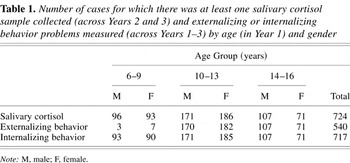
Youth were interviewed in 1997, 1998, and 1999, and provided two morning saliva samples 1 day apart in 1998 and 1999. Separate home interviews were conducted with both first- and second-born offspring. During these interviews youth reported family relationship experiences, individual wellbeing, and completed scales measuring internalizing and externalizing behavior. A saliva sample was collected during the interview as part of the instructions for collecting two morning saliva samples on successive mornings. A member of the household (usually the mother) was responsible for overseeing saliva collections for the entire family. An age-appropriate depression scale (Children's Depression Inventory [CDI]; Kovacs, 1980) was administered to very young respondents and the Center for Epidemiological Studies Depression Scale (CESD; Devins & Ore, 1985) was administered to all the others. Also, the risky behavior scale was not administered to very young subjects because of the inappropriateness of certain items. Of the 800 children (400 families with two children each), there were 724 youth with at least one salivary cortisol sample. Of these, there were 540 children for whom we had cortisol and externalizing behavior data and 717 children for whom we had cortisol and internalizing behavior data. A comparison of demographic characteristics and scores on the depression and risky behavior scales indicated no differences between those who provided saliva and those who did not. Table 1 indicates the number of children by age and gender for which we have cortisol and behavioral data.
Number of cases for which there was at least one salivary cortisol sample collected (across Years 2 and 3) and externalizing or internalizing behavior problems measured (across Years 1–3) by age (in Year 1) and gender

Measures
Salivary cortisol
Saliva was collected from each child upon arising on 2 consecutive days in Year 2 and then again according to the same schedule 1 year later, for a total of four samples for each child. Children who had a fever (2.5%) or problematic samples (i.e., discolored) were asked to provide saliva at a later date. Participants were instructed to provide saliva before brushing teeth or eating the morning meal on each of the four mornings. Following Dabbs (1991), subjects were instructed to chew Trident original flavor sugarless gum to stimulate saliva flow, and salivate 10–15 ml of saliva into a 20-ml scintillation vial over 15–20 min. At the time of sample collection, children reported whether they had used tobacco (5.5%) or anabolic steroids (0.15%), taken allergy (7%) or pain medication (15%), and when they had last eaten or exercised. Girls reported whether they had begun menstruating (88%), and, if so, the number of days since their last menstrual period began and whether they were taking oral contraceptives (4%). We obtained at least one saliva sample from 724 youth. A comparison of demographic characteristics of families whose children provided morning samples and those who did not revealed no systematic differences. There was sufficient variation in the actual time of the morning samples (M = 7:56 a.m., SD = 2:48) that time of day was included as a covariate in all analyses at the state cortisol level. How much this differs from the normal time of awakening and the amount of time that has passed since awakening still may influence cortisol levels. The impact of these factors on a single measure of cortisol are conceptually a component of state, not trait, cortisol. Thus, the impact of fluctuations in the diurnal rhythm should not influence trait cortisol–behavior associations.
Samples and controls (see below) were assayed for cortisol (micrograms per deciliter) using a modification of a serum-based coated tube radioimmunoassay for use with saliva (Diagnostic Products Corporation, Santa Monica, CA). The test used 200 μl of saliva, had a lower limit of sensitivity of 0.03 μg/dl, and had an upper limit of 2.0 μg/dl. The intraassay coefficient of variation (CV) for cortisol was 7.60%, with a correlation between duplicates of .993 (p < .0001). The interassay CVs, estimated across 128 separate runs (occurring over the course of 2 years) for the high (1.91 μg/dl), middle (0.86 μg/dl), and low (0.14 μg/dl) external controls, were 4.98, 5.08, and 10.42%, respectively. All samples were tested in duplicate, and duplicate tests values that varied by more than 5% error were subject to repeat testing. Cortisol levels were normally distributed (M skew = 0.70, range = 0.45–0.88).
Externalizing behavior
To measure externalizing behavior problems (see Booth et al., 2003) items from the Risky Behavior Scale developed by Eccles & Barber (1990) were selected because they represent the range and type of externalizing behavior expected in a normally developing sample. Youth were asked to report on the frequency of 18 activities during the past year using a 4-point scale: never, once, sometimes, more than 10 times. A principal components factor analysis of the items revealed a factor with 11 items, all of which had loadings exceeding .5. The 11-item scale had alpha coefficients of .82, .83, and .82 for boys and .77, .84, and .84 for girls in Years 1, 2, and 3, respectively. Examination of the distribution confirms that the scale captures sufficient variability with no evidence of floor or ceiling effects. Items include “skip a day of school,” “do something dangerous just for the thrill,” “contact with the police for something you did or they thought you did,” “damage public or private property,” “stay out all night without parents' permission,” “get suspended from school,” “take something from a store without paying for it,” “get sent to principal's office for misbehavior,” “disobey parents on an important issue,” “lie to parents about something important,” and “get into a fist fight.” This scale was not administered to younger siblings of fourth and fifth graders (age 6–10 in Year 1) because many items are not age appropriate. The scales were subject to log transformation (M skew = 1.38; after transformation M skew = 0.71).
Internalizing behavior
We represented internalizing behavior problems for younger children (age 6–13 in Year 1) using an age-appropriate 26-item adaptation of Kovacs' (1980) CDI. The scales had alpha coefficients of .78, .88, and .78 for boys and .76, .78, and .76 for girls in Years 1, 2, and 3, respectively. Adolescents (age 10–16 in Year 1) were administered a 12-item adaptation of the CESD (Devins & Ore, 1985). The scales had alpha coefficients of .73, .78, and .81 for boys and .78, .83, and .86 for girls in Years 1, 2, and 3, respectively. These measures were chosen because they capture a range of depressive symptoms likely to be expressed by normally developing children. Scales were subject to log transformation to correct for a mild skew. Separate models were run for the different age-appropriate scales.
Development
During middle childhood and adolescence, development is usually measured with chronological age or pubertal status. Researchers typically do not include both because they are highly intercorrelated. Indeed, in our sample, they were correlated .80 for girls and .83 for boys. We considered the merits of age and pubertal phase and chose age for two reasons. The majority of studies focused on hormones have denoted development with chronological age, and the Petersen, Crockett, Richards, and Boxer (1988) pubertal status index had less variability at the two ends of the scale in our sample. This measure of puberty focuses on the appearance of secondary sexual characteristics that emerge in middle puberty, but our sample includes youth from early through late puberty. Developmental differences across middle childhood and late adolescence are not captured well by this measure of puberty because there are floor effects in pubertal development in middle childhood (especially for boys) and ceiling effects in middle adolescence (especially for girls). Although we agree with Wohlwill (1973) that chronological age is only a marker of development, for our purposes it is the most useful marker available.
Analytical strategy
Two children from each family participated in this study, which potentially can produce unnaturally large estimates because each participant is not independent of the others. To test for this “clustering effect” (Johnson & Elliot, 1998), we removed one sibling and reran the analyses. This did not change the model parameters or behavioral associations, so in all analyses we treated each child in the sample as the unit of analysis.
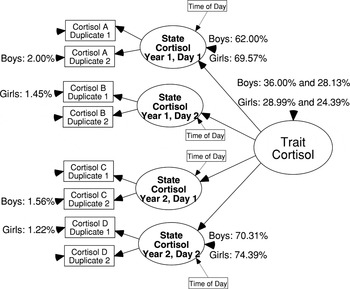
We used an LST strategy to examine the association between cortisol and behavior problems1
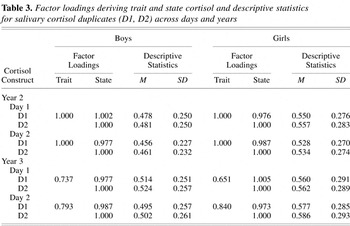
It is a possibility that maturational processes are a component of trait cortisol; therefore, we also examined an LST change model in which the change in cortisol from Year 2 to Year 3 was derived as a second-order latent factor following Steyer and colleagues (Steyer, Eid, & Schwenkmezger, 1997; Steyer, Partchev, & Shanahan, 2000). The fit of the change model was good, χ2 (116) = 187.09, NFI = 0.983, NNFI = 0.994, CFI = 0.994, RMSEA = 0.028. The change in cortisol from Year 2 to Year 3 was significant in both boys (0.015, t = 3.73, p < .001) and girls (0.022, t = 3.72, p < .001). Cortisol levels rose from Year 2 to Year 3 in boys and girls (see Table 3). For both boys and girls, the rise in cortisol across 1 year was not associated with externalizing behavior problems in any year (ps > .43) and did not change the cortisol–externalizing behavior problems association for boys (ps < .005). Internalizing behavior problems was associated with the rise in cortisol levels across the year in 2 of the 12 models (all other ps > .119). Boys who completed the CDI (age 6–13 in Year 1) with more internalizing problems in Year 1 had lower cortisol levels (β = −.210, p < .05) and a faster rise in cortisol levels across the year (β = .279, p < .05) compared to boys with fewer problems. Girls who completed the CDI with more internalizing problems in Year 3 had a faster rise in cortisol levels across the year (β = .375, p < .005).

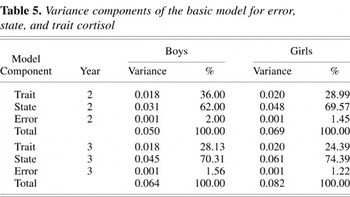
The basic latent state–trait model for salivary cortisol. Cortisol was measured in saliva samples collected on 2 days (samples A and B) in Year 2 and on 2 days in Year 3 (samples C and D). The duplicate assay results (duplicates 1 and 2) of each saliva sample were the manifest variables used to derive estimates of measurement error as well as four latent-state constructs. Time of day was controlled for at the state cortisol level. Trait cortisol was then derived from the four state constructs as a single latent variable. Separate models were computed for boys and girls. The error variance was greater in boys (2.00 and 1.56%) than girls (1.45 and 1.22%) in Years 2 and 3. The majority of variance was attributable to state. State variance was greater in girls (69.57 and 74.39%) than boys (62.00 and 70.31%) in Years 2 and 3. There were no gender differences in trait cortisol variance (24.39 to 36.00%).
Our sample size varied across analyses because the Eccles and Barber (1990) scale was not administered to very young children and internalizing behavior was assessed in all children using two different scales (CDI and CESD). The sample sizes by age, gender, and year of assessment are shown in Table 1.
Externalizing and internalizing behavior problems were examined in separate models, then a multiple group strategy was used to examine the interaction between externalizing and internalizing behavior. The possibility that internalizing behavior moderates cortisol–externalizing associations (and vice versa) was tested by including both behavioral assessments in the same model. An interaction between age and gender was investigated using a multiple group strategy across younger and older boys and girls.
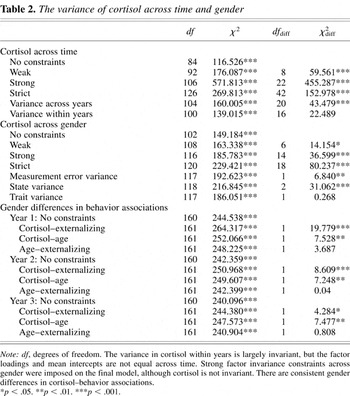
Factor invariance (FI) procedures provide a statistical test for invariance of measures and allow us to conclude that the constructs are comparable across time or groups (Hofer, 1999; Meredith, 1993; Meredith & Horn, 2001). FI procedures were utilized to determine whether cortisol could be considered the same across days and across 1 year (see also Granger, Shirtcliff, Zahn–Waxler, Usher, Klimes–Dougan, & Hastings, 2003). Weak FI (constraining the regression weights to be equal across time), strong FI (constraining the mean intercepts), and strict FI (constraining the variance estimates) caused extreme model misspecification (see Table 2) similar to other LST models (Dumenci & Windle, 1998). Constraining the variance to be equal within each year did not cause model misspecification, so these constraints are included in the final model. We can conclude that the variance in cortisol is similar across time.
FI procedures across gender were utilized to determine whether cortisol could be considered the same measure in boys and girls (see Table 2). Factor loadings and mean intercepts for the cortisol measures were statistically different in boys and girls, but the implication of this difference may be of little practical significance because cortisol levels and loadings are quite similar (see Table 3). Strong FI constraints are maintained so that boys' and girls' coefficients could be compared. We repeated all analyses without strong FI constraints and confirmed that the pattern of associations was the same in the unconstrained and strong FI models.
The variance of cortisol across time and gender

Factor loadings deriving trait and state cortisol and descriptive statistics for salivary cortisol duplicates (D1, D2) across days and years

Results
Basic model
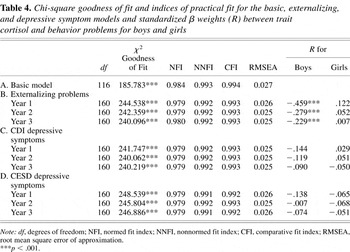
The indices of practical fit suggest that the basic LST model demonstrated good model fit (see Table 4, entry A). Variance estimates for measurement error were significantly larger for boys than girls (see Table 2). State cortisol comprised the largest percentage of the total variance and was significantly larger for girls than boys. The gender difference was largely due to the fact that girls had more total variance in salivary cortisol compared to boys (see Table 5). Importantly, the variance in trait cortisol estimates was significant in boys (0.02, t = 6.82, p < .001) and girls (0.02, t = 5.80, p < .001). There was no gender difference in trait cortisol estimates.
Chi-square goodness of fit and indices of practical fit for the basic, externalizing, and depressive symptom models and standardized β weights (R) between trait cortisol and behavior problems for boys and girls

Variance components of the basic model for error, state, and trait cortisol

Externalizing behavior problems
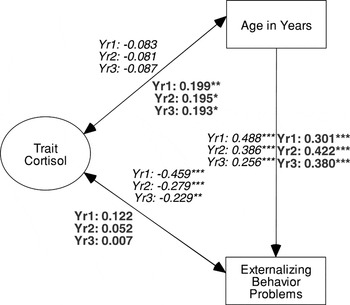
The fit of the externalizing behavior models was good (see Table 4, entry B). Gender differences in these behavioral associations were significant (see Table 2). Consistently, boys with more externalizing problems had lower cortisol (see Figure 2), but parallel relationships were not significant in girls. Cortisol–externalizing associations in boys were evident across all three years of behavioral assessment and, indeed, for every item of the externalizing scale. Time-lagged cortisol → externalizing and externalizing → cortisol directional associations were of similar magnitude for boys across all models (βs > −.18, ps < .006). For girls, Year 1 externalizing behavior problems negatively predicted trait cortisol (β = −.16, p < .01), but all other models were not significant.

Trait cortisol is strongly associated with age and conduct problems for boys but not girls (bold). Coefficients represent associations across the 3 years of behavioral assessments with Years 1–3 from top to bottom, respectively. *p < .05. **p < .01. ***p < .001.
For both boys and girls, state cortisol was not associated with externalizing behavior problems at any time (ps > .17). Concurrent trait cortisol–externalizing behavior links were not different in younger (ages 10–13 in Year 1) or older (ages 14–16 in Year 1) boys and girls based on a median split of subjects with complete behavioral data. The association between externalizing behavior problems and trait cortisol is significant in both younger and older boys, χdiff2 (1) < 1.70, p < .19, and is not significant in either younger or older girls, χdiff2 (1) < 1.40, p < .24.
Internalizing behavior problems
The fit of the internalizing behavior problem models for children and adolescents was good (see Table 4, entries C and D). Trait cortisol was not concurrently associated with internalizing behavior problems in boys or girls. Time-lagged cortisol → internalizing and internalizing → cortisol directional associations revealed that internalizing behavior problems in Year 1 negatively predicted trait cortisol for boys' ratings on the CDI (β = −.15, p < .05) and displayed a trend for boys' ratings on the CESD (β = −.12, p = .09).
State cortisol was not associated with internalizing behavior problems as measured by the CDI (ps > .31) or CESD methods (ps > .26). Concurrent trait cortisol–internalizing behavior links were not different in younger (ages 6–9 in Year 1) and older (ages 10–13 in Year 1) youth who completed the CDI and younger (ages 10–13 in Year 1) and older (ages 14–16 in Year 1) youth who completed the CESD based on a median split of the behavioral data, χdiff2 < 1.00, p < .32, for boys, and χdiff2 < 2.70, p < .10, for girls.
Combined influence of externalizing and internalizing problems
This analysis was limited to adolescents who completed the CESD because the externalizing behavior problem scale was not administered to the youngest siblings. Interaction effects between internalizing and externalizing behavior problems on concurrent trait cortisol were tested using a multisample approach following Ridgon et al. (1998). Across all 3 years, constraining the association between trait cortisol and externalizing problems to be equal in adolescents with low versus high levels of internalizing problems did not change the fit of the model. There was no evidence for an interaction between internalizing and externalizing behavior problems on trait cortisol.
The possibility that internalizing behavior moderated the cortisol–externalizing link was examined by including concurrent internalizing and externalizing behavior scales in one model. The association between cortisol and externalizing behavior was unchanged by the inclusion of internalizing behavior problems (ps < .005 for boys, ps > .326 for girls), but the weak cortisol–internalizing association was further reduced by the inclusion of externalizing behavior problems (ps > .38 for boys, ps > .21 for girls). The potential association between internalizing behavior and cortisol was explained by externalizing behavior.
Discussion
The findings confirm that a large portion (28%) of variance in salivary cortisol remains consistent across time (day to day and across 1 year) but that the majority of variance (70%) in a.m. cortisol levels can be attributed to moment to moment fluctuations in HPA axis activity. There was no evidence of a sex difference in traitlike cortisol levels. For boys only, low traitlike cortisol levels were associated with higher concurrent externalizing behavior problems. Furthermore, externalizing and internalizing behavior problems measured in year one predicted low trait cortisol levels in boys based on saliva samples measured 1–2 years later. Parallel associations were not significant for girls. There were no associations between state cortisol–behavior problems in either boys or girls. Evidence for an interaction between internalizing and externalizing behavior was lacking, but externalizing behavior explained potential associations between trait cortisol and internalizing behavior problems. Several aspects of the findings are noteworthy.
This study's findings clearly support Brennan and Raine's (1997) hypothesis that boys with more externalizing behavior problems have lower cortisol than boys with fewer problems and do not support the speculation that cortisol–externalizing links would only be evident in children at risk for behavior problems (Gunnar et al., 2000). The inverse direction of the cortisol–behavior association observed is consistent with the literature on extreme groups (McBurnett et al., 2000; Van Goozen et al., 1998, 2000) and younger normally developing children (Smider et al., 2002; Tennes et al., 1986; Tennes & Kreye, 1985). Our findings add to the accumulating body of findings by revealing robust associations between low cortisol and externalizing behavior across both concurrent and time-lagged assessments in boys. Importantly, the pattern of findings has now been observed in normal, at-risk, and psychiatric groups, and is consistent across multiple years. The present findings suggest the relationship is a stable phenomenon that spans both normative and atypical child development.
The inverse association between externalizing behavior problems and trait cortisol may reflect a number of different mechanisms. Gunnar and Vazquez (2001) and Heim, Ehlert, and Hellhammer (2000) have speculated about the meaning and implications of hypoarousal of the HPA axis. They suggest that individuals with low cortisol may be underaroused, overregulated, or may have an increased threshold for stress (Kruesi, Schmidt, Donnelly, Hibbs, & Hamburger, 1989). At the psychological level, individuals with low cortisol may display a lack of fear and anxiety across situations in which a mild stress response should be warranted. Fearlessness might predispose individuals toward externalizing behavior because the execution of such behavior requires a physiological state of low arousal (Raine, 2002). Conversely, individuals who are hypoaroused may have an increased threshold for stress, and consequently seek stimulation to induce a physiological response. Individuals with low cortisol may find externalizing behavior arousing, whereas those with higher trait cortisol levels mount a physiological response to more benign stimulation (Raine, 2002). Interestingly, in a large study of male military veterans, Gimbel and Booth (1996) reported that individuals with the lowest cortisol levels were likely to experience military combat in Vietnam. Gimbel and Booth (1996) hypothesize that men with the lowest cortisol levels were assigned to combat because of their superior stress management skills, or they sought out combat to attain a sense of control, a psychological high, and/or to receive admiration from others.
On a more biological level, lower cortisol levels in youth with externalizing behavior problems may allow for greater expression of testosterone-linked behaviors such as aggression, risky behavior, delinquency, and dominance (Finkelstein, Susman, Chinchilli, Kunselman, D'Arcangelo, Schwab, Demers, Liben, Lookingbill, & Kulin, 1997; Mazur & Booth, 1998; Schaal, Tremblay, Soussignan, & Susman, 1996; Tremblay, Schaal, Boulerice, Arseneault, Soussignan, Paquette, & Lauret, 1998). In animal studies, corticosterone (the rodent parallel to cortisol) affects receptor affinity for testosterone such that reduced corticosterone levels increase the availability of testosterone receptor sites and glucocorticoid and androgen receptors interact particularly during times of stress (Viau, 2002). Testosterone is able to bind to its receptor more easily when corticosterone levels are low. Bilaterally adrenalectomized rats develop spontaneous aggressive behavior within 24 hr of surgery, and low doses of testosterone elicit episodes of sustained attack behavior in adrenalectomized but not nonadrenalectomized rats (Essman, 1981). Nonhuman primate models also support an association between low cortisol levels and increased levels of defensive and offensive aggressive behaviors and testosterone (Kalin, 1999a, 1999b). If this extends to humans, individuals with low cortisol and high testosterone may be at particularly risk for externalizing behavior problems (Virkkunen, 1985). Our recent findings, however, suggest that the influence of testosterone on the expression of risk behavior in normally developing youth is moderated by the quality of parent–child relationships (Booth et al., 2003) suggesting that biological interactions between cortisol and testosterone may be influenced by the immediate social context.
In contrast to the robust association between cortisol and externalizing behavior, we did not reveal evidence of a concurrent association of trait cortisol with internalizing behavior problems. The coefficients with internalizing behavior problems where consistently (across all time points measured) in the p = .05–.15 range initially, but the association was near zero when externalizing behavior was included in the model. This null pattern is consistent with several studies that reveal internalizing behavior problems were not consistently associated with cortisol levels in normally developing and clinical samples (Cicchetti & Rogosch, 2001). Studies by Gunnar's laboratory (de Haan et al., 1998; Gunnar et al., 1997) report internalizing–cortisol relationships in preschool aged children, raising the possibility that the mechanisms that influence this biosocial relationship are fundamentally different before and after adrenarche.
The nature of the study's design allowed us to explore time-lagged associations between behavior problems and cortisol. We found that externalizing and internalizing behavior problems in Year 1 (when cortisol was not measured) negatively predicted trait cortisol based on samples collected 1–2 years later. Following Granger and colleagues (1996), we suggest that the relationship between cortisol and behavior problems is likely to be reciprocal with HPA axis activity affecting behavior and behavior mutually affecting the HPA axis.
Not unexpectedly, we found behavioral correlates of trait cortisol in boys but not girls (Smider et al., 2002; but see Pajer, Gardner, Kirillova, & Vanyukov, 2001). This gender difference may have been overlooked by researchers who have almost exclusively studied boys (e.g., Kruesi et al., 1989; McBurnett et al., 1991, 2000; Van Goozen et al., 1998; Vanyukov, Moss, Plail, Blackson, Mezzich, & Tarter, 1993) or did not test gender differences (e.g., de Haan et al., 1998; Gunnar et al., 1997; Tennes & Kreye, 1985; Tennes et al., 1986). Taylor, Klein, Lewis, Gruenewald, Gurung, and Updegraff (2000) argue that males have a fundamentally different biobehavioral response to stress than females. Female aggression involves less sympathetic arousal, is cerebral and primarily defensive, and is likely to be moderated by social context. Following Taylor and colleagues (2000), we suggest that externalizing behavior problems may be more strongly connected to traitlike levels of HPA activity in males than females.
We have demonstrated that the use of LST modeling may advance our understanding of hormone–behavior relationships, but the use of this statistical tool should not replace rigorous data collection (e.g., multiple saliva measures, noninterfering sampling strategies, controlling for time of day). LST modeling requires large samples (N ∼ 100) to return stable model estimates (Bollen, 1989), but only two saliva samples for each subject were required to derive an estimate of trait cortisol (Steyer et al., 1999). As Van Goozen et al. (1998) and Gunnar et al. (1997) discuss, and Moss, Vanyukov, and Martin (1995) demonstrate, including multiple measures of cortisol may yield more consistent hormone–behavior associations than a single measure. Given that approximately 70% of the variance in cortisol is due to context-specific factors, a substantial number of cortisol measures may be needed before a stable trait emerges using averaging techniques. For example, Gunnar et al. (1997) report using, on average, more than a dozen saliva samples per subject to estimate median cortisol levels (range = 5–23 samples). Extensive repeated sample collection may not be feasible for studies that require large numbers of subjects to examine interaction or moderating effects or when the expected effect size is small. We suggest that collecting fewer samples per subject may be practical when sample sizes permit the use of LST modeling.
This study has many strengths, but several issues limit the interpretation of the findings. Our measure of externalizing problems was administered to youth aged 10–16 in Year 1, constraining the interpretation of the findings to adolescent boys. This measure primarily taps into conduct and delinquent behaviors so our findings should not generalize to verbal, relational, or physical aggression. The findings from the different internalizing behavior scales, when different, may reflect method- or age-related differences in cortisol–behavioral associations. The two depression measures, however, largely converged in their results, suggesting minimal method- and age-related differences in cortisol–behavior relationships. Given that HPA axis is activated in response to social stress (Kirschbaum et al., 1993) and social anxiety (Granger et al., 1996), it is possible that studies that focus specifically on the anxiety component of internalizing behavior problems, in particular traitlike anxious behavior (Gunnar, 2001) may find consistent cortisol–behavior associations in normally developing populations (Colomina et al., 1997). It is important to note that trait cortisol represents the extent to which cortisol is invariant across the occasions of measurement included in this study. The variance that is attributable to trait cortisol may change if cortisol were measured in other contexts (e.g., at school, in novel environments, in stressful situations), across a different age range, or in other populations (Kirschbaum et al., 1990). Finally, the finding that variance in a.m. cortisol levels attributable to state sources was not associated with internalizing and externalizing behavior should be interpreted with caution. It is likely that statelike behavior patterns (e.g., concurrent emotions, moods or stress states) are associated with state cortisol (Adam, 2002).
Future studies are needed to refine our understanding of cortisol–behavior associations. First, trait cortisol may comprise a larger percentage of the total variance, or stress may be experienced by extreme groups differently than normally developing youth. For instance, cortisol may operate differently in maltreated compared to normal youth and may have different developmental sequelae across these groups (Cicchetti & Rogosch, 2001). Second, trait cortisol may be reflecting different amounts of physiological and environmental influences when assessed in the afternoon. It is possible that environmental forces impact p.m. trait cortisol variance more than a.m. cortisol because of the accumulated effects of the events of the day on adrenocortical activity (Adam, 2002). Third, while trait cortisol is not influenced by situation-specific factors evident at the time of sample collection (Kirschbaum et al., 1990), some stable contextual or persistent situational factors such as socioeconomic status (Lupien, King, Meaney, & McEwen, 2001), parental psychopathology (Ashman, Dawson, Panagiotides, Yamada, & Wilkinson, 2002; Hammen, Henry, & Daley, 2000), and parental alcoholism and chronic substance abuse (Moss et al., 1995) may still influence the association between trait cortisol and behavior. We suggest that researchers interested in examining trait cortisol take heed of the large amount of variance that is attributable to the situation, and consider using appropriate methodology to examine trait cortisol–behavior associations. To that end, we hope that the consistency and clarity of behavioral associations with salivary cortisol can be improved in the next generation of studies, furthering our understanding of when individual differences in HPA axis confers risk or resilience, and potentially refining biosocial models of behavior (Booth, Carver, & Granger, 2000).
References
REFERENCES
Adam, E. K.
(2002, April).
Momentary emotion and cortisol activity in adolescents'
everyday lives.
Paper presented at the Society for Research on Adolescents, New
Orleans, LA.
Ashman, S. B.,
Dawson, G.,
Panagiotides, H.,
Yamada, E., &
Wilkinson, C. W.
(2002).
Stress hormone levels of children of depressed mothers.
Development and Psychopathology
14,
333–349.Google Scholar
Bollen, K. A.
(1989).
Structural equations with latent variables.
New York:
Wiley.
Booth, A.,
Carver, K., &
Granger, D. A.
(2000).
Biosocial perspectives on the family.
Journal of Marriage and Family
62,
1018–1034.Google Scholar
Booth, A.,
Johnson, D.,
Granger, D. A.,
Crouter, A., &
McHale, S.
(2003).
Testosterone and child and adolescent adjustment: The moderating
role of parent–child relationships.
Developmental Psychology
39,
85–98.Google Scholar
Brennan, P., &
Raine, A.
(1997).
Biosocial bases of antisocial behavior: Psychophysiological,
neurological, and cognitive factors.
Clinical Psychology Review
17,
589–604.Google Scholar
Cicchetti, D., &
Rogosch, F. A.
(2001).
The impact of child maltreatment and psychopathology on
neuroendocrine functioning.
Development and Psychopathology
13,
783–804.Google Scholar
Colomina, M. T.,
Canals, J.,
Carbajo, G., &
Domingo, J. L.
(1997).
Salivary cortisol in a young population: Relationship with
psychopathological disorders.
Research Communications in Biological Psychology and
Psychiatry
22,
1–10.Google Scholar
Dabbs, J. M., Jr.
(1991).
Salivary testosterone measurements: Collecting, storing, and mailing
saliva samples.
Physiology and Behavior
49,
815–817.Google Scholar
Dahl, R. E.,
Puig–Antich, J.,
Ryan, N.,
Nelson, B.,
Novacenko, H.,
Twomey, J.,
Williamson, D.,
Goetz, R., &
Amrosini, P.
(1989).
Cortisol secretion in adolescents with major depressive
disorder.
Acta Psychiatrica Scandinavia
80,
18–21.Google Scholar
Dahl, R. E.,
Ryan, N. D.,
Nguyen, N. A.,
Al-Shabbout, M.,
Meyer, V. A., &
Perel, J.
(1991).
24-hour cortisol measures in adolescents with major depression: A
controlled study.
Biological Psychiatry
30,
26–36.Google Scholar
Davis, E. P.,
Donzella, B.,
Krueger, W. K., &
Gunnar, M. R.
(1999).
The start of a new school year: Individual differences in salivary
cortisol response in relation to child temperament.
Developmental Psychobiology
35,
188–196.Google Scholar
de Haan, M.,
Gunnar, M. R.,
Tout, K.,
Hart, J., &
Stansbury, K.
(1998).
Familiar and novel contexts yield different associations between
cortisol and behavior among 2-year-old children.
Developmental Psychobiology
33,
93–101.Google Scholar
Deinzer, R.,
Steyer, R.,
Eid, M.,
Notz, P.,
Schwenkmezger, P.,
Ostendorf, F., &
Neubauer, A.
(1995).
Situational effects in psychological assessment of traits: The FPI,
NEOFFI, and EPI questionnaires.
European Journal of Personality
9,
1–23.Google Scholar
Devins, G., &
Ore, C.
(1985).
Center for Epidemiological Studies Depression Scale. In
D. Keyser &
R. Sweetland (Eds.),
Test critiques (pp.
144–160).
Kansas City, MO:
Test Corporation of America.
Dumenci, L., &
Windle, M.
(1998).
A multitrait-multioccasion generalization of the latent
trait–state model: Description and application.
Structural Equation Modeling
5,
391–410.Google Scholar
Eccles, J., &
Barber, B.
(1990).
The risky behavior scale.
Unpublished manuscript,
University of Michigan.
Essman, W. B.
(1981).
Drug effects upon aggressive behavior. In
I. Valzelli &
I. Morgese (Eds.),
Aggression and violence: A psychobiological and clinical
approach
(pp.
150–175).
Edizioni Saint Vincent:
Edizioni Centro Culturale E Congressi Saint Vincent.
Finkelstein, J. W.,
Susman, E. J.,
Chinchilli, V. M.,
Kunselman, S. J.,
D'Arcangelo, M. R.,
Schwab, J.,
Demers, L. M.,
Liben, L. S.,
Lookingbill, G., &
Kulin, H. E.
(1997).
Estrogen or testosterone increases self-reported aggressive
behaviors in hypogonadal adolescents.
Journal of Clinical Endocrinology and Metabolism
82,
2433–2438.Google Scholar
Flinn, M. V., &
England, B. G.
(1995).
Childhood stress and family environment.
Current Anthropology
36,
854–866.Google Scholar
Goodyer, I. M.,
Herbert, J., &
Altham, P. M.
(1998).
Adrenal steroid secretion and major depression in 8- to
16-year-olds, III. Influence of cortisol/DHEA ratio at presentation on
subsequent rates of disappointing life events and persistent major
depression.
Psychological Medicine
28,
265–273.Google Scholar
Goodyer, I. M.,
Herbert, J.,
Altham, P. M.,
Pearson, J.,
Secher, S. M., &
Shiers, H. M.
(1996).
Adrenal secretion during major depression in 8- to 16-year-olds, I.
Altered diurnal rhythms in salivary cortisol and dehydroepiandrosterone
(DHEA) at presentation.
Psychological Medicine
26,
245–256.Google Scholar
Goodyer, I. M.,
Herbert, J.,
Moor, S., &
Altham, P. M.
(1991).
Cortisol hypersecretion in depressed school-aged children and
adolescents.
Psychiatry Research
37,
237–244.Google Scholar
Goodyer, I. M.,
Herbert, J.,
Tamplin, A., &
Altham, P. M.
(2000).
Recent life events, cortisol, dehydroepiandrosterone and the onset
of major depression in high-risk adolescents.
British Journal of Psychiatry
177,
499–504.Google Scholar
Goodyer, I. M.,
Park, R. J., &
Herbert, J.
(2001).
Psychosocial and endocrine features of chronic first-episode major
depression in 8–16 year olds.
Biological Psychiatry
50,
351–357.Google Scholar
Granger, D. A., &
Kivlighan, K. T.
(2003).
The biosocial model and child development research.
Child Development
74,
1058–1063Google Scholar
Granger, D. A.,
Serbin, L. A.,
Schwartzman, A. E.,
Lehoux, P. M.,
Cooperman, J. M., &
Ikeda, S.
(1998).
Children's salivary cortisol, internalizing behavior problems,
and family environment: Results from the Concordia Longitudinal Risk
Project.
International Journal of Behavioral Development
22,
707–728.Google Scholar
Granger, D. A.,
Shirtcliff, E. A.,
Zahn–Waxler, C.,
Usher, B. A.,
Klimes–Dougan, B., &
Hastings, P. D.
(2003).
Adolescent internalizing and externalizing behavior problems predict
individual differences in testosterone diurnal variation.
Development and Psychopathology
15,
431–449.Google Scholar
Granger, D. A.,
Stansbury, K., &
Henker, B.
(1994).
Preschooler's behavioral and neuroendocrine responses to social
challenge.
Merrill–Palmer Quarterly
40,
20–41.Google Scholar
Granger, D. A.,
Weisz, J. R., &
Kauneckis, D.
(1994).
Neuroendocrine reactivity, internalizing behavior problems and
control-related cognitions in clinic-referred children and
adolescents.
Journal of Abnormal Psychology
103,
267–276.Google Scholar
Granger, D. A.,
Weisz, J. R.,
McCracken, J. T.,
Ikeda, S. C., &
Douglas, P.
(1996).
Reciprocal influences among adrenocortical activation, psychosocial
processes, and the behavioral adjustment of clinic-referred
children.
Child Development
67,
3250–3262.Google Scholar
Gunnar, M.
(2001).
The role of glucocorticoids in anxiety disorders: A critical
analysis.
In
M. V. Vasey &
M. R. Dadds (Eds.),
The developmental psychopathology of anxiety (pp.
143–159).
New York:
Oxford University Press.
Gunnar, M.,
Bruce, J., &
Donzella, B.
(2000).
Stress physiology, health, and behavioral development. In
A. Thornton (Ed.),
The well-being of children and families: Research and data
needs (pp.
188–212).
Ann Arbor, MI:
University of Michigan Press.
Gunnar, M. R.,
Tout, K.,
de Haan, M.,
Pierce, S., &
Stansbury, K.
(1997).
Temperament, social competence, and adrenocortical activity in
preschoolers.
Developmental Psychobiology
31,
65–85.Google Scholar
Gunnar, M. R., &
Vazquez, D. M.
(2001).
Low cortisol and a flattening of expected daytime rhythm: Potential
indices of risk in human development.
Development and Psychopathology
13,
515–538.Google Scholar
Hammen, C.,
Henry, R., &
Daley, S. E.
(2000).
Depression and sensitization to stressors among young women as a
function of childhood adversity.
Journal of Consulting and Clinical Psychology
68,
782–787.Google Scholar
Heim, C.,
Ehlert, U., &
Hellhammer, D. H.
(2000).
The potential role of hypocortisolism in the pathophysiology of
stress-related bodily disorders.
Psychoneuroendocrinology
25,
1–35.Google Scholar
Hofer, S. M.
(1999).
Assessing personality structure using factor invariance
procedures.
In
I. Merviede,
I. Deary,
F. DeFruyt, &
F. Ostendorf (Eds.),
Personality psychology in Europe
(Vol. 7, pp.
35–49).
Amsterdam:
Tilburg University Press.
Johnson, D., &
Elliot, L.
(1998).
Sampling design effects: Do they affect the analyses of data from
the National Survey of Families and Households?
Journal of Marriage and the Family
60,
993–1001.Google Scholar
Kalin, N. H.
(1999a).
Primate models and aggression.
Journal of Clinical Psychiatry Monograph Series
17,
22–24.Google Scholar
Kalin, N. H.
(1999b).
Primate models to understand human aggression.
Journal of Clinical Psychiatry
60,
29–32.Google Scholar
Kenny, D. A., &
Zautra, A.
(2001).
Trait–state models for longitudinal data. In
L. M. Collins &
A. G. Sayer (Eds.),
New methods for the analysis of change (pp.
243–263).
Washington, DC:
American Psychological Association.
Kirschbaum, C.,
Pirke, K. M., &
Hellhammer, D. H.
(1993).
The “Trier Social Stress Test”—A tool for
investigating psychobiological stress responses in a laboratory
setting.
Neuropsychobiology
28,
76–81.Google Scholar
Kirschbaum, C.,
Steyer, R.,
Eid, M.,
Patalla, U.,
Schwenkmezger, P., &
Hellhammer, D. H.
(1990).
Cortisol and behavior: 2. Application of a latent state–trait
model to salivary cortisol.
Psychoneuroendocrinology
15,
297–307.Google Scholar
Klimes–Dougan, B.,
Hastings, P. D.,
Granger, D. A.,
Usher, B. A., &
Zahn–Waxler, C.
(2001).
Adrenocortical activity in at-risk and normally developing
adolescents: Individual differences in salivary cortisol basal levels,
diurnal variation, and responses to social challenges.
Development and Psychopathology
13,
695–719.Google Scholar
Kovacs, M.
(1980).
Rating scales to assess depression in school-aged children.
Acta Paedopsychiatrica
46,
306–315.Google Scholar
Kruesi, M. J. P.,
Schmidt, M. E.,
Donnelly, H.,
Hibbs, E. D., &
Hamburger, S. P.
(1989).
Urinary free cortisol output and disruptive behavior in
children.
Journal of the American Academy of Child and Adolescent
Psychiatry
28,
441–443.Google Scholar
Kutcher, S.,
Malkin, D.,
Silverberg, J., &
Marton, P.
(1991).
Nocturnal cortisol, thyroid stimulating hormone, and growth hormone
secretory profiles in depressed adolescents.
Journal of the American Academy of Child and Adolescent
Psychiatry
30,
407–141.Google Scholar
Lewis, M.
(1992).
Individual differences in response to stress.
Pediatrics
3,
487–490.Google Scholar
Li, F.,
Duncan, S. C.,
Duncan, T. E.,
Yang–Wallentin, F.,
Acock, A. C., &
Hops, H.
(2001).
Interaction models in latent growth curves. In
G. A. Marcoulides &
R. E. Schumacker (Eds.),
New developments and techniques in structural equation
modeling (pp.
561–614).
Hillsdale, NJ:
Erlbaum.
Lupien, S. J.,
King, S.,
Meaney, M. J., &
McEwen, B. S.
(2001).
Can poverty get under your skin? Basal cortisol levels and cognitive
function in children from low and high socioeconomic status.
Development and Psychopathology
13,
653–676.Google Scholar
Magnano, C. L.,
Diamond, E. J., &
Gardner, J. M.
(1989).
Use of salivary cortisol measurements in young infants: A note of
caution.
Child Development
60,
1099–1101.Google Scholar
Mazur, A., &
Booth, A.
(1998).
Testosterone and dominance in men.
Behavioral and Brain Sciences
21,
353–363.Google Scholar
McBurnett, K. M.,
Lahey, B. B.,
Frick, P. J.,
Risch, C.,
Loeber, R.,
Hart, E. L.,
Christ, M. A. G., &
Hanson, K. S.
(1991).
Anxiety, inhibition, and conduct disorder in children: II. Relation
to salivary cortisol.
Journal of the American Academy of Child and Adolescent
Psychiatry
38,
547–555.Google Scholar
McBurnett, K. M.,
Lahey, B. B.,
Rathouz, P. J., &
Loeber, R.
(2000).
Low salivary cortisol and persistent aggression in boys referred for
disruptive behavior.
Archives of General Psychiatry
57,
38–43.Google Scholar
McClintock, M., &
Herdt, G.
(1996).
Rethinking puberty: The development of sexual attraction.
Current Directions in Psychological Science
5,
178–183.Google Scholar
Meredith, W.
(1993).
Measurement invariance, factor analysis and factorial
invariance.
Psychometrika
58,
525–543.Google Scholar
Meredith, W., &
Horn, J. L.
(2001).
The role of factorial invariance in modeling growth and
change. In
L. M. Collins &
A. G. Sayer (Eds.),
New methods for the analysis of change (pp.
204–240).
Washington, DC:
American Psychological Association.
Moss, H. B.,
Vanyukov, M. M., &
Martin, C. S.
(1995).
Salivary cortisol responses and the risk for substance abuse in
prepubertal boys.
Biological Psychiatry
38,
547–555.Google Scholar
Nesselroade, J. R.
(1988).
Some implications of the trait–state distinction for the
study of development over the life span: The case of personality.
In
P. B. Baltes,
D. L. Featherman, &
R. M. Lerner (Eds.),
Life-span development and behavior.
Hillsdale, NJ:
Erlbaum.
Pajer, K.,
Gardner, W.,
Kirillova, G. P., &
Vanyukov, M.
(2001).
Sex differences in cortisol levels and neurobehavioral disinhibition
in children of substance abusers.
Journal of Child and Adolescent Substance Abuse
10,
65–76.Google Scholar
Parker, L. N.
(1991).
Adrenarche.
Endocrinology and Metabolism Clinics of North America
20,
71–83.Google Scholar
Petersen, A.,
Crockett, L.,
Richards, M., &
Boxer, A.
(1988).
A self-report measure of pubertal status: Reliability, validity, and
initial norms.
Journal of Youth and Adolescence
17,
117–133.Google Scholar
Puig–Antich, J.,
Dahl, R. E.,
Ryan, N.,
Novacenko, H.,
Goetz, D.,
Goetz, R.,
Twomey, J., &
Klepper, T.
(1989).
Cortisol secretion in prepubertal children with major depressive
disorder.
Archives of General Psychiatry
6,
801–809.Google Scholar
Raine, A.
(2002).
Biosocial studies of antisocial and violent behavior in children and
adults: A review.
Journal of Abnormal Child Psychology
30,
311–326.Google Scholar
Ridgon, E. E.,
Schumacker, R. E., &
Wothke, W.
(1998).
A comparative review of interaction and nonlinear modeling.
In
R. E. Schumacker &
G. A. Marcoulides (Eds.),
Interaction and non-linear effects in structural equation
(pp.
1–16).
Hillsdale, NJ:
Erlbaum.
Schaal, B.,
Tremblay, R. E.,
Soussignan, R., &
Susman, E. J.
(1996).
Male testosterone linked to high social dominance but low physical
aggression in early adolescence.
Journal of the American Academy of Child and Adolescent
Psychiatry
35,
1322–1330.Google Scholar
Schafer, J. L., &
Graham, J. W.
(2002).
Missing data: Our view of the state of the art.
Psychological Methods
7,
147–177.Google Scholar
Schwartz, E. B.,
Granger, D. A.,
Susman, E. J.,
Gunnar, M. R., &
Laird, B.
(1998).
Assessing salivary cortisol in studies of child development.
Child Development
69,
1503–1513.Google Scholar
Smider, N. A.,
Essex, M. J.,
Kalin, N. H.,
Buss, K. A.,
Klein, M. H.,
Davidson, R. J., &
Goldsmith, H. H.
(2002).
Salivary cortisol as a predictor of socioemotional adjustment during
kindergarten: A prospective study.
Child Development
73,
75–92.Google Scholar
Smyth, J.,
Ockenfels, M. C.,
Porter, L.,
Kirschbaum, C.,
Hellhammer, D. H., &
Stone, A. A.
(1998).
Stressors and mood measured on a momentary basis are associated with
salivary cortisol secretion.
Psychoneuroendocrinology
23,
353–370.Google Scholar
Stansbury, K., &
Gunnar, R.
(1994).
Adrenocortical activity and emotion regulation.
Monographs of the Society for Research in Child Development
59,
108–134.Google Scholar
Steyer, R.,
Eid, M., &
Schwenkmezger, P.
(1997).
Modeling true intraindividual change: True change as a latent
variable.
Methods of Psychological Research Online
2,
1–33.Google Scholar
Steyer, R.,
Partchev, I., &
Shanahan, M. J.
(2000).
Modeling true intraindividual change in structural equation models:
The case of poverty and children's psychosocial adjustment.
In
T. D. Little,
K. U. Schnabel, &
J. Baumert (Eds.),
Modeling longitudinal and multilevel data: Practical issues, applied
approaches and specific examples
(pp.
109–126).
Mahwah, NJ:
Erlbaum.
Steyer, R.,
Schmitt, M., &
Eid, M.
(1999).
Latent state–trait theory and research in personality and
individual differences.
European Journal of Personality
13,
389–408.Google Scholar
Steyer, R.,
Schwenkmezger, P., &
Auer, A.
(1990).
The emotional and cognitive components of trait anxiety: A latent
state–trait model.
Personality and Individual Differences
11,
125–134.Google Scholar
Susman, E. J.,
Nottelmann, E. D.,
Dorn, L. D.,
Inoff–Germain, G., &
Chrousos, G. P.
(1988).
Physiological and behavioral aspects of stress in
adolescence.
Advances in Experimental Medicine and Biology
245,
341–352.Google Scholar
Taylor, S.,
Klein, L. C.,
Lewis, B. P.,
Gruenewald, T. L.,
Gurung, R. A. R., &
Updegraff, J. A.
(2000).
Biobehavioral response to stress in females: Tend and befriend, not
fight-or-flight.
Psychological Review
107,
411–429.Google Scholar
Tennes, K., &
Kreye, M.
(1985).
Children's adrenocortical responses to classroom activities and
tests in elementary school.
Psychosomatic Medicine
47,
451–460.Google Scholar
Tennes, K.,
Kreye, M.,
Avitable, N., &
Wells, R.
(1986).
Behavioral correlations of excreted catecholamines and cortisol in
second-grade children.
Journal of the American Academy of Child and Adolescent
Psychiatry
25,
764–770.Google Scholar
Tremblay, R. E.,
Schaal, B.,
Boulerice, B.,
Arseneault, L.,
Soussignan, R.,
Paquette, D., &
Lauret, D.
(1998).
Testosterone, physical aggression, dominance and physical
development in early adolescence.
International Journal of Behavioral Development
22,
753–777.Google Scholar
Van Goozen, S. H. M.,
Matthys, W.,
Cohen–Kettenis, P. T.,
Buitelaar, J. K., &
Van Engeland, H.
(2000).
Hypothalamic–pituitary–adrenal axis and autonomic
nervous system activity in disruptive children and matched
controls.
Journal of the American Academy of Child and Adolescent
Psychiatry
39,
1438–1445.Google Scholar
Van Goozen, S. H. M.,
Matthys, W.,
Cohen–Kettenis, P. T.,
Gispen–de Weid, C.,
Wiegant, V. M., &
Van Engeland, H.
(1998).
Salivary cortisol and cardiovascular activity during stress in
oppositional defiant disorder boys and normal controls.
Biological Psychiatry
43,
531–539.Google Scholar
Vanyukov, M. M.,
Moss, H. B.,
Plail, J. A.,
Blackson, T.,
Mezzich, A. C., &
Tarter, R. E.
(1993).
Antisocial symptoms in preadolescent boys and in their parents:
Associations with cortisol.
Psychiatry Research
46,
9–17.Google Scholar
Viau, V.
(2002).
Functional cross-talk between the
hypothalamic–pituitary–gonadal and –adrenal axes.
Journal of Neuroendocrinology
14,
506–513.Google Scholar
Virkkunen, M.
(1985).
Urinary free cortisol secretion in habitually violent
offenders.
Acta Psychiatrica Scandinavia
72,
40–44.Google Scholar
Walker, E. F.,
Walder, D. J., &
Reynolds, F.
(2001).
Developmental changes in cortisol secretion in normal and at-risk
youth.
Development and Psychopathology
13,
721–732.Google Scholar
Wohlwill, J.
(1973).
The study of behavioral development.
New York:
Academic Press.
Zahn–Waxler, C.
(2000).
The development of empathy, guilt, and internalization of distress:
Implications for gender differences in internalizing and externalizing
problems.
In
R. J. Davidson (Ed.),
Anxiety, depression, and emotion: Wisconsin Symposium on
Emotion
(Vol. 1, pp.
222–265).
New York:
Oxford University Press.
Zahn–Waxler, C.,
Klimes–Dougan, B., &
Slattery, M. J.
(2000).
Internalizing problems of childhood and adolescence: Prospects,
pitfalls, and progress in understanding the development of anxiety and
depression.
Development and Psychopathology
12,
443–466.Google Scholar
Number of cases for which there was at least one salivary cortisol sample collected (across Years 2 and 3) and externalizing or internalizing behavior problems measured (across Years 1–3) by age (in Year 1) and gender
The basic latent state–trait model for salivary cortisol. Cortisol was measured in saliva samples collected on 2 days (samples A and B) in Year 2 and on 2 days in Year 3 (samples C and D). The duplicate assay results (duplicates 1 and 2) of each saliva sample were the manifest variables used to derive estimates of measurement error as well as four latent-state constructs. Time of day was controlled for at the state cortisol level. Trait cortisol was then derived from the four state constructs as a single latent variable. Separate models were computed for boys and girls. The error variance was greater in boys (2.00 and 1.56%) than girls (1.45 and 1.22%) in Years 2 and 3. The majority of variance was attributable to state. State variance was greater in girls (69.57 and 74.39%) than boys (62.00 and 70.31%) in Years 2 and 3. There were no gender differences in trait cortisol variance (24.39 to 36.00%).
The variance of cortisol across time and gender
Factor loadings deriving trait and state cortisol and descriptive statistics for salivary cortisol duplicates (D1, D2) across days and years
Chi-square goodness of fit and indices of practical fit for the basic, externalizing, and depressive symptom models and standardized β weights (R) between trait cortisol and behavior problems for boys and girls
Variance components of the basic model for error, state, and trait cortisol
Trait cortisol is strongly associated with age and conduct problems for boys but not girls (bold). Coefficients represent associations across the 3 years of behavioral assessments with Years 1–3 from top to bottom, respectively. *p < .05. **p < .01. ***p < .001.
 You have
Access
- 216
- Cited by