Among the world’s languages, there is considerable variation in basic word-order patterns (e.g., subject–verb–object [SVO], SOV, VSO) as well as within-language flexibility in the ordering of major constituents, to express emphasis, focus, or topicalization (Comrie, Reference Comrie1989; Greenberg, Reference Greenberg1966). Some configurations are far more frequent than others (e.g., the majority of the world’s languages prefer SOV or SVO patterns, with VSO coming in a rather distant third), and research suggests that the cognitive resources mustered in effective sentence processing may also vary as a function of word order, especially when the usual patterns in a language are altered (e.g., Bates, McNew, MacWhinney, Devescovi, & Smith, Reference Bates, McNew, MacWhinney, Devescovi and Smith1982; Kaiser & Trueswell, Reference Kaiser and Trueswell2004; Weyerts, Penke, Münte, Heinze, & Clahsen, Reference Weyerts, Penke, Münte, Heinze and Clahsen2002). Under normal conditions, however, there is no body of evidence favoring one major word-order configuration over another in terms of processing efficiency. In contrast to the broad typological diversity in principal constituent order, the placement of sentential negation is more tightly delimited. Regardless of the morphosyntactic instantiation of negation, the negators are almost always in the immediate proximity of the verb: just before, just after, or doubled and flanking the verb. When more syntactic material intervenes between the negator and the verb, the negator is usually situated at the beginning of the clause, corresponding to the common representation of negation in symbolic logic, and signifying in effect the contrary of everything that follows. Only a handful of languages routinely exhibit unbounded clause-final negation, apparently requiring that the entire clause be processed before its logical truth value can be ascertained. The scarcity of such negation patterns in contrast to the prevalence of verb-adjacent or clause-initial negation could potentially represent evidence that not all types of negation are equally effective.Footnote 1 The present study examines the possibility that processing of negation is more efficient the earlier in the utterance the negation is expressed.
Although psycholinguistic research has targeted possible processing costs of negative as opposed to affirmative utterances, there is little comparative research on the relative efficiency or efficacy of specific negation structures. In particular, possible differences in processing efficiency as a function of placement within the clause remain to be explored in depth. The present study represents a first attempt at comparing relative processing effectiveness of two diametrically opposed sentential negation patterns, one very common (immediately preverbal) and one quite rare and geographically delimited (unbounded clause-final). Data are presented from bilingual speakers of a typologically and sociolinguistically unique language dyad, Spanish and the Afro-Hispanic creole language Palenquero, spoken in the village of San Basilio de Palenque, Colombia. As will be detailed below, Spanish and Palenquero share highly cognate lexicons and nearly identical VO word-order patterns, with the exception of sentential NEG, which in Spanish is placed immediately preverbally while in Palenquero NEG normally occurs clause-finally. For bilingual speakers, this results in quasi-minimal pairs of lexically cognate and syntactically congruent utterances differing mainly in the placement of sentential NEG. As a consequence, it is possible to experimentally test the effects of varying NEG placement, in a preliminary attempt at assigning a differential efficiency measure depending on the relative position of NEG within an utterance.
In the present study, the focus is not on putative within-language processing cost of negation as compared with the corresponding nonnegative utterances, but on possible cross-linguistic differences in the effectiveness of negation strategies available to bilingual speakers depending on the language being used and the relative position of NEG within the utterance. Simple measures such as processing time do not provide meaningful cross-linguistic comparisons, as it is virtually a truism that the earlier in an utterance NEG appears the sooner negation can be processed. If the notion of efficiency in a grammatical subsystem is to have an empirical basis, it can only be by demonstrating a relative deficit in one configuration as opposed to another, that is, systematic instances where a given structure is not correctly processed, or where production errors rise above the usual performance-related infelicities: “a process can be considered being the more efficient, the less its performance declines when cognitive resources are taxed by a secondary task” (Deutsch, Kordts-Freudinger, Gawronski, & Strack, Reference Deutsch, Kordts-Freudinger, Gawronski and Strack2009, p. 441).
In the present study the relative processing efficiency of NEG placement options is judged by the extent to which utterances containing NEG are recognized as negative: a system in which negation is not robustly perceived and processed, especially when faced with additional cognitive demands, exhibits a deficit, and would therefore be judged as less efficient and therefore less effective than a system in which a higher proportion of negative utterances are recognized as such. In a series of interactive experiments conducted with Palenquero–Spanish bilinguals, including memory-loaded repetition, rapid translation, close shadowing, and sentence matching, the rates of acknowledgment of sentential negation in each language were taken as indirect measures of processing efficiency. The results suggest that unbounded clause-final negation requires greater reliance on other contextual and pragmatic cues than preverbal NEG, especially under increased cognitive loading.
PATTERNS OF SENTENTIAL NEGATION
Typologies of negation frequently center on the relative placement of the negative element(s) with respect to the main verb root, with the principal division being (often immediately) preverbal or (again often immediately) postverbal (e.g., Dahl, Reference Dahl1979; de Swart, Reference de Swart2010, p. 7). A number of (mostly VO) languages have dual negation elements on either side of the main verb, typified by French ne + V+pas constructions.
For languages with prevailing VO word order, there is a strong tendency for negative elements to be placed preverbally (de Swart, Reference de Swart2010, p. 8; Dryer, 1998; Payne, Reference Payne1985; Tesnière, Reference Tesnière1969, p. 219), a fact first systematically noticed by Jespersen (Reference Jespersen1917, p. 5): “there is a natural tendency, also for the sake of clearness, to place the negative first, or at any rate as soon as possible, very often immediately before the particular word to be negatived (generally the verb […]”; and again (Jespersen, Reference Jespersen1924, p. 297): “put the negative word or element as early as possible, so as to leave no doubt in the mind of the hearer as to the purport of what is said.” Horn (Reference Horn1989, p. 450) refers to this recurring tendency as the “NEG first principle” and Dahl (Reference Dahl1979, p. 90), building on observations by Steele (Reference Steele1975), asserts that “Neg morphemes tend to be placed close to the verb or in sentence initial position, the first tendency being the strongest.” Among the languages surveyed by Dryer (Reference Dryer1988), nearly 90% place NEG either immediately before or immediately after the verb, with preverbal position holding a 3:1 edge over postverbal NEG. Dahl (Reference Dahl2010, p. 22) notes that “there is a ‘canonical’ position for syntactic negators immediately before the verb which is relatively independent of Greenbergian basic word order.”
In addition to the prevailing NEG+V and V+NEG patterns, a small number of (mostly VO) languages places NEG clause-finally, for example, V+O+ […] NEG. Languages with VO word order and clause-final negation are largely clustered in central Africa, including languages from the Niger-Congo, Nilo-Saharan, and Afro-Asiatic families (Dryer, Reference Dryer2009), and therefore likely to be an areal feature (Idiatov, Reference Idiatov2010, Reference Idiatov2012, Reference Idiatov2015). A clause-final option is also found in vernacular Brazilian Portuguese (e.g., Martínez, Reference Martínez2012; Schwenter, Reference Schwenter2005), but only in short utterances as “metalinguistic negation” (i.e., involving repetition (and rejection) of a verb in a previous proposition; Teixeira de Sousa, Reference Teixeira de Sousa2012, Reference Teixeira de Sousa2015). A second cluster is found in Papua-New Guinea (Reesink, Reference Reesink2002; Vossen, Reference Vossen2011; Vossen & van der Auwera, Reference Vossen and van der Auwera2014).
Given the cross-linguistic preference for NEG elements to be in the immediate proximity of main verbs (including preferred preverbal negation) as well as the very small and regionally clustered number of languages with clause-final negation, it is useful to examine a bilingual environment in which two SVO languages are in contact, one with preverbal NEG and one with clause-final NEG. If Jespersen’s consistently insightful observations have empirical consequences in the case of NEG placement, then the proximity of sentential NEG elements to the main verb may be linked to relative sentence processing efficiency.Footnote 2 Experimental techniques employed in sentence processing research may prove to be relevant in the comparative study of negation structures.
NEGATION IN PALENQUERO (LENGUA RI PALENGE) VERSUS SPANISH
Palenquero is a Spanish-lexified creole language spoken in the Afro-Colombian village of San Basilio de Palenque, a community of around 3,500 residents some 70 km to the south of the Caribbean port of Cartagena de Indias. The total number of fluent speakers is not known, but is certainly greater than the 500 listed by Ethnologue (www.ethnologue.com/language/pln). Palenquero, known simply as Lengua ri Palenge “[the] language of Palenque” by community residents, is a highly restructured Afro-Iberian contact language, formed in the 17th century (probably between 1655 and 1674: Navarrete, 2008; Schwegler, Reference Schwegler2011a, Reference Schwegler2012) when enslaved Africans fled from Cartagena and established fortified communities in rural regions to the south. Grammatical descriptions are found in Schwegler (Reference Schwegler2013a, Reference Schwegler2013b, and the references therein). Most of the Palenquero lexicon is cognate or identical to local vernacular Spanish words (Cásseres Estrada, Reference Cásseres Estrada2005), and at the macrosyntactic level Spanish and Palenquero share SVO word order, postnominal adjective placement, head-first subordinate clauses, and prepositional phrases. Despite these similarities, Spanish and Palenquero are not mutually intelligible.
Spanish sentential negation is marked with no in immediate preverbal position, as in (1).
(1) María no tiene nietos María NEG have-3s grandchild-PL “María does not have [any] grandchildren”
In the predominant Palenquero pattern, the cognate negative marker nu is placed clause-finally, and frequently carries a high tone (Correa, Reference Correa2012; Hualde & Schwegler, Reference Hualde and Schwegler2008; Lipski, Reference Lipski2010). The following examples, taken from the author’s field recordings, represent fluent adult speakers.
(2) a. bo siribí pa hende salí ku bo nu you serve for people leave with you NEG “You’re not fit for people to go out with you” b. mahaná ri aola ta repetá má nu children of now PRES respect more NEG “Children nowadays are no longer respectful” c. ma kaya ri Palenge hwe bueno pa kalo lendrá nu PL street of Palenque COP good for car enter NEG “The streets in Palenque aren’t any good for cars to enter” d. bo a polé salí kaya nu you PERF able leave street NEG “You couldn’t go out in the street” e. aola polé semblá kaña andi ma losa nu now able plant cane LOC PL garden NEG “Now it’s no longer possible to plant sugar cane in the garden plots”
Double negation (preverbal no + clause-final nu) occurs occasionally (e.g., Dieck, Reference Dieck2000; Lewis, Reference Lewis1970, pp. 133, 152–153), especially in imperatives.
(3) no bai nu miho NEG go NEG my-son “Don’t go, son”
Exclusively preverbal no does occur in Palenquero, but very infrequently compared with clause-final negation.
(4) bo no sale pa losa si you NEG leave for garden POSS “You don’t go to your garden plot”
Friedemann and Patiño Rosselli (1983, p. 171) consider preverbal no in Palenquero to be due to interference from Spanish, while Bickerton and Escalante (1970, p. 264) consider the occasional preverbal negation in Palenquero to represent momentary switching to Spanish. Palenquero preverbal no can also occur in some subordinate clauses (e.g., Dieck, 2007, p. 299; Lewis, Reference Lewis1970, pp. 133, 151), possibly to avoid ambiguity, as in utterance-final position nu might be assumed to negate the verb in the main clause. Dieck (2007) and Lewis (Reference Lewis1970, p. 151) mention a few other instances where preverbal no may occur in Palenquero.
Despite the scarcity of preverbal NEG in spontaneously produced Palenquero, Schwegler (Reference Schwegler1991, Reference Schwegler2016, forthcoming) argues that interference from Spanish is not involved, but rather that preverbal and clause-final NEG (as well as double NEG) are all legitimate components of Palenquero, effectively in complementary distribution. The position of NEG is determined by the pragmatic frame: “postverbal negation rejects the set of propositions (knowledge, old information) which the speaker assumes the hearer believes true at the time of utterance and which are relevant in the context of the current discourse. By selecting postverbal nu over strictly preverbal no, speakers assign the focus of their utterance not to the ‘negative’ assertion of their statement but rather to the rejection of the pragmatic presupposition” (Schwegler, Reference Schwegler1991, p. 180; cf. Kiparsky & Condoravdi, Reference Kiparsky and Condoravdi2004). Preverbal negation “merely conveys information in a matter-of-fact way, and presuppositions about the truth value of the proposition simply remain outside the scope of negation” (Schwegler, Reference Schwegler1991, p. 182). Schwegler (Reference Schwegler1991, p. 184) speculates that as the majority of negative utterances contradict or reject the truth value of the corresponding affirmative utterance, the prevalence of postverbal NEG in Palenquero may be causing speakers to lose the original pragmatic differences between pre- and postverbal negation in favor of the latter. Schwegler’s consultants frequently regarded preverbal negation as “incorrect” even though they themselves produced such utterances (Schwegler, Reference Schwegler1991, p. 182), and experiments conducted by Lipski (Reference Lipski2013, Reference Lipski2015b, Reference Lipski2016a, Reference Lipski2016b) also reveal that Palenquero speakers implicitly regard preverbal no as a mixed intrusion, although such combinations often go unnoticed in everyday life. As an additional factor accounting for the overwhelming preference for clause-final negation in contemporary Palenquero, Schwegler (Reference Schwegler2016, p. 237, forthcoming) implicates the language revitalization process: “[…] in the linguistic consciousness of young and middle-aged Palenqueros, post-verbal nu now inherently has a more authentic flavor than its strictly pre-verbal counterpart, and to them this pattern seems best suited to symbolically convey local ethnolinguistic pride and Afro-Colombian identity” (Schwegler, Reference Schwegler2016, p. 258). However, Bickerton and Escalante (1970, p. 259) and Lewis (Reference Lewis1970, pp. 133, 151), based on field data collected in 1968–1969, well before language revitalization efforts, assert that clause-final negation was obligatory in main clauses, and the examples given by Escalante (1954), collected in the early 1950s, only contain clause-final nu. The present author’s observations, including experimental data collected during the current research endeavor, do not confirm the assertion that young Palenquero speakers prefer only clause-final negation; Spanish-like preverbal negation appears to be so firmly entrenched in their grammars that they often fail to fully process or produce Palenquero clause-final negation. In addition, while it is true that recent descriptions written by Palenquero language activists only mention clause-final negation, the grammatical components of these materials are not used in teaching, and even if the teachers themselves employ only clause-final negation in their own speech (and this may not be entirely accurate), students are not inductively picking up this negation strategy. In the aggregate, the present author’s numerous interviews, elicitation tasks, and observations over nearly a decade and representing Palenquero speakers of all ages and levels of proficiency do not fall into the pragmatically nuanced pre- versus postverbal patterns adduced by Schwegler, but rather reflect a nearly categorical preference for clause-final NEG in affirmative utterances. As in most sentence-processing research, it is always possible that extrapolation to more complex multisentence speech acts might alter some responses (cf. Kaiser & Trueswell, Reference Kaiser and Trueswell2004, for a possible scenario), but as all participants heard only clause-final negation in Palenquero and only preverbal negation in Spanish, a systematic comparison of the two negation systems is viable in the absence of additional pragmatic background.
Although proficiency in Palenquero varies among speakers, all community residents are fully fluent in Spanish, and it has been noted that when hearing only their production in Spanish, it is impossible to discern any interference from another language (Morton, Reference Morton2005, p. 163; Schwegler & Morton, Reference Schwegler and Morton2003). There is consequently no way to completely exclude a possible priming influence of Spanish preverbal no on Palenquero, but at the same time, there is no reason to expect any interspeaker differences in this regard. Prenegation contextual clues are not relevant in Spanish, given the immediately preverbal position of Spanish no, although some incremental prediction may nonetheless occur. Knowledge of Spanish is therefore regarded as a constant in the following experiments, but the relevance of possible interference from Spanish will be included in the general discussion.
PALENQUERO–SPANISH BILINGUALISM AS A TEST ENVIRONMENT FOR PROCESSING OF NEGATION
Palenquero–Spanish bilingualism in San Basilio de Palenque provides a unique research environment for studying the contrasts between preverbal and clause-final negation, because basic SVO constituent order is identical in both languages, most lexical items are highly cognate or identical, and only the relative placement of NEG varies according to language. Such inquiries are possible given the existence of substantial cohorts of Palenquero–Spanish bilinguals. Considered an endangered language as recently as two decades ago, Lengua ri Palengue has experienced a remarkable renovation through community activism and educational programs, and most Palenqueros now regard their ancestral language with pride (Lipski, Reference Lipski2011, Reference Lipski2012, Reference Lipski2014; Moñino, Reference Moñino2012; Schwegler, Reference Schwegler2011b). The Palenquero language is now being taught (in a limited fashion) in the community schools, although there is no explicit grammatical instruction, metalinguistic commentary, or feedback on student performance.
San Basilio de Palenque is also a challenging environment in which to conduct psycholinguistic research. In a village where doors remain open and where children, adults, and a variety of animals freely intrude indoors and out, research techniques must be adapted to this ecological reality. As a consequence of numerous extended visits conducted over the past decade, which include informal demonstrations and practice sessions with participants and observers, community members have become accustomed to interactive experiments and requests for metalinguistic judgments. The general level of familiarity with the author’s research techniques, as well as the diversity of the experimental tasks themselves, are crucial to the interpretation of the results reported below. The following sections describe an array of six partially overlapping experiments, which under more typical laboratory conditions might be regarded as excessive, but whose converging results in the noncanonical environment of Palenque are needed to allay any remaining doubts as to the validity of the data.Footnote 3
SELECTING PALENQUERO–SPANISH BILINGUALS
Although there is much to be learned from young L2 and heritage speakers’ use of Palenquero negation, in order to disentangle the processing of specific negation configurations from questions of proficiency, the present study only analyzes data from adult bilinguals. The pioneering studies of the Palenquero language examined the speech of a wide range of individuals, but most recent research has derived data from a small group of older and often nonliterate individuals considered to speak the most “traditional” form of the language. This limited selection overlooks the fact that numerous younger adults were raised in Palenquero-speaking households and, especially given community-wide attitude reversals, have continued to speak the language on a daily basis and taken together constitute a viable speech community. As there are no established proficiency measures for Palenquero, potential participants for the present study, all known to the author from numerous visits, were selected on the basis of observed language behavior (as verified by three Palenquero language teachers, widely regarded as “expert witnesses”), combined with the speakers’ self-reported linguistic histories. All have spoken Palenquero since childhood, speak the language routinely with other community members, have remained in Palenque for most or all of their lives, and none has had Palenquero language classes. The ages of the participants range from the late 30 s to the early 70 s (some middle-aged and older Palenqueros have no birth certificates or precise records of birth dates), and all meet the observational criteria for balanced bilinguals. No Palenquero language teachers or other university-trained community language activists are included in the results reported below, to avoid possible neopurist influences.Footnote 4 Although some of the participants have worked with the author on previous occasions, there have been no discussions of negation structures, and in the experiments to be described below, grammatical structures were never mentioned.
POSSIBLE PROCESSING DIFFICULTIES ASSOCIATED WITH NEGATION
There is considerable evidence that sentence processing is incremental and predictive, “so long as linguistic or non-linguistic context supports these predictions” (Pickering & Garrod, Reference Pickering and Garrod2007, p. 105; also Kuperberg & Jaeger, Reference Kuperberg and Jaeger2016). Because Spanish negation occurs immediately before the constituents to be negated, whereas in Palenquero negation typically occurs after the negated constituents, any anticipation of negation in online processing of Palenquero must depend on nongrammatical factors, including material contained in the utterance as well as contextual and pragmatic considerations. Deutsch et al. (Reference Deutsch, Kordts-Freudinger, Gawronski and Strack2009) provide evidence that processing negation requires working memory resources, which by inference become more depleted when successively longer utterance fragments must be retained before reaching the end. There is evidence linking processing cost to syntactic distance in dependencies, especially when constituent boundaries are crossed: “the longer a predicted category must be kept in memory before the prediction is satisfied, the greater is the cost for maintaining that prediction […] the greater the distance between an incoming word and the most local head or dependent to which it attaches, the greater the integration cost” (Gibson, Reference Gibson1998, p. 1; also Gibson, Reference Gibson2000; Hawkins, Reference Hawkins2001).
In the case of Palenquero, not only do all other constituents have to be retrieved from working memory upon reaching NEG, but also if sentence processing is assumed to be incremental and predictive, if no other clues point to upcoming negation, encountering NEG will require that the processor backtrack and reanalyze the already created syntactic and semantic structures. This reanalysis differs from the structure building that is the usual function of online sentence processing or the course corrections produced by garden-path sentences, as a fully grammatical Palenquero utterance is formed before reaching clause-final NEG. Thus unlike, for example, processing WH-dependencies or relative clauses, with clause-final negation there is no a priori reason for retaining constituents in working memory in anticipation of an extraction site. With no contextual clues suggesting a negative reading, final NEG potentially comes as a surprise. While not requiring a full reparsing of the utterance, an unanticipated final negation at the very least provokes an instant revision of expectations, the cognitive impact of which presumably depends both on the complexity of the utterance and on the subjective level of dissonance. Thus for the Nilo-Saharan Sudanic language Kresh, which also has clause-final NEG, Brown (Reference Brown1994, p. 165) observes that “[i]n some contexts one is not expecting a negative statement and may interpret a clause positively until reaching the end.” Similarly, in referring to a cluster of Papuan and Austronesian languages with strict clause-final NEG and the confusion experienced by second language learners of these languages, Reesink (Reference Reesink2002, p. 260) notes that “[n]ative speakers will be aided, when no clear prosodic signals are available to clear up the vagueness of a negative utterance, by their in-depth knowledge of contextual clues, if not by the general pragmatic principles that apply universally.” Even German potentially allows for long main clauses ending in NEG, so that as noted by Jespersen (Reference Jespersen1917, p. 10) “The hearer or reader is sometimes bewildered at first and thinks that the sentence is to be understood in a positive sense, till suddenly he comes upon the nicht, which changes everything […].” In naturalistic spoken German, such instances of surprise-ridden final negation are quite uncommon, although in early child language there is some evidence that clause-final negation not adjacent to the verb poses some processing difficulty (Wojtecka, Koch, Grimm, & Schultz, Reference Wojtecka, Koch, Grimm and Schultz2011).
The prosodic status of the Palenquero negator nu, a CV monosyllable that even when carrying a high tone is cliticized to the immediately preceding word, makes it more susceptible to delayed recognition (e.g., Grosjean, Reference Grosjean1985; Grosjean & Gee, Reference Grosjean and Gee1987), in effect placing additional demands on the “now-or-never bottleneck” (Christiansen & Chater, Reference Christiansen and Chater2016). From these facts it might be hypothesized that clause-final negation would make online processing more precarious than preverbal or immediately postverbal negation, especially in time-dependent environments, for example, when immediately followed by other material in connected discourse or when other tasks require immediate attention (cf. Lüdtke, Friedrich, De Filippis, & Kaup, Reference Lüdtke, Friedrich, De Filippis and Kaup2005, Reference Lüdtke, Friedrich, De Filippis and Kaup2008, on the time course of processing negation with respect to known truth values). The remainder of this study will explore this hypothesis in the Palenquero–Spanish bilingual environment.
CREATION OF PALENQUERO AND SPANISH EXPERIMENTAL STIMULI
In order to freely construct Palenquero and Spanish stimuli with a variety of grammatical combinations, and to avoid any potential bias caused by recognizable voices (in a community where the voice of virtually every adult speaker is known to all), many of the experimental stimuli were constructed using synthetic speech. There are no programs designed to synthesize Palenquero voices, but there are Spanish-language text-to-speech programs whose output can be modified to create reasonable approximations to Palenquero phonotactics. After many tests, a female voice from Cepstral Swift Talker® (www.cepstral.com) and another female voice from ISpeech (www.Ispeech.org) were chosen, both sampled from real human voices. Each stimulus was individually modified with PRAAT software (Boersma & Weenink, 1999–Reference Boersma and Weenink2005). Fundamental frequency (F0) was manipulated to imitate Palenquero intonation, which includes early peak alignment of prenuclear (H*) pitch accents and little declination and phrase-final tonic syllables with a “long fall” intonation (Hualde & Schwegler, Reference Hualde and Schwegler2008; Lipski, Reference Lipski2010). Nuclear accented syllables were also lengthened to imitate Palenquero rhythm. Whenever feasible, pitch tracks from actually occurring Palenquero utterances were superimposed on the synthetic stimuli. The end result was a series of utterances that while not identical to the voice of any identifiable Palenquero, did not sound noticeably alien. In debriefing sessions after various experiments, several speakers commented on the excellent speaking abilities of the “woman,” and even after receiving the explanation that the “voices” were computer generated, they continued to ponder the identity of a real but unknown Palenquero speaker. The fact that nearly all residents are accustomed to conversing over cellular telephones may have contributed to the ease with which participants accepted the synthesized voices as “real” Palenquero. This same procedure has been successfully employed in other experimental studies in Palenque (Lipski, Reference Lipski2013, Reference Lipski2015a, Reference Lipski2015b, Reference Lipski2016a, Reference Lipski2016b). The aforementioned studies compared the results of acceptability tasks using natural and synthesized Palenquero voices and found no significant differences. As an additional check on the validity of using synthesized voices, two of the experiments to be described below (speeded translation and memory-loaded repetition) were replicated using the natural voices of native Palenquero speakers (described in the online-only Supplementary Materials); no qualitative differences between the use of natural and synthesized voices were found.
The experiments described in the following sections are designed to probe the relative processing efficiency of (Palenquero) clause-final negation as opposed to preverbal (Spanish) negation as well as the role of intersentential cues in anticipating Palenquero clause-final negation. In order to determine whether acknowledgment of Palenquero clause-final negation is affected by incremental processing, and to preemptively face the challenge of stimuli presented in the absence of naturalistic speech acts, each of the experiments included negative sentences containing other cues as to negative status as well as sentences without any accompanying negative cues. It was hypothesized that incremental processing would result in cues of upcoming negation contributing to higher rates of acknowledgment of clause-final NEG. Among the stimulus utterances, cues to upcoming negation included culturally bound references widely associated with negative assertions, for example, “children nowadays are very respectful” and “the weather in Palenque is always cold” (cf. Hald, Kutas, Urbach, & Parhizkari, 2004) as well as lexical items logically entailing negative assertions, for example, kabá “to be used up.” The test stimuli were presented to three adult Palenquero speakers, all of whom have taught Palenquero language classes, and who have worked closely with the author. They were asked to judge whether the sentences were likely to end with a clause-final negator. Only those stimuli whose classification as probably negative (henceforth NEG-bias stimuli) or indeterminate as to negation (henceforth equi-bias stimuli) was unanimous among the three consultants and the author were used in the experiments. The stimuli for all experiments are included in Appendix A.
FIRST EXPERIMENT: RAPID TRANSLATION
A multipurpose rapid translation task was administered to a broad cross-section of Palenqueros.
Participants
Forty-one adult Palenquero speakers participated in this task (20 women and 21 men). Their ages ranged from 38 to middle 60 s (approximate mean=52).
Materials
The stimuli set consisted of utterances synthesized with the Cepstral Swift Talker® program, including 30 in Spanish and 30 in canonically described Palenquero (based on recorded naturalistic examples). The Palenquero stimuli contained 20 utterances containing the clause-final negator nu; 10 with other elements suggestive of negation (NEG-bias; e.g., [5]), and 10 utterances in which either an affirmative or a negative interpretation would be plausible without an extended context (equi-bias; e.g., [6]).
(5) aola komo ñame kabá ten má ñame nu now as yam finish have more yam NEG “Now that the yams have finished up, there are no more yams”
(6) kuando ané miní i resibí ané nu when they come I receive they NEG “When they came I didn’t receive them”
The Spanish stimuli contained 10 utterances with preverbal negation in no (e.g., [7]).Footnote 5
(7) en nuestra casa no tenemos animales in our(f.) house NEG have-1PL animal-PL “In our house [we] don’t have animals” “If they don’t have a job we have a hard time here”
Each stimulus was followed by a 500-ms gap and a beep. The stimuli were randomized and loaded onto a portable tablet computer. All stimuli are found in the online-only Supplementary Materials.
Procedure
Participants listened to the stimuli through headphones; stimuli and responses were digitally recorded on separate channels of a stereo recorder. The participants were told that they would hear utterances in both Spanish and Palenquero. The instructions were to translate Palenquero utterances into Spanish and to translate Spanish utterances into Palenquero upon hearing the beep. Repetition of the stimuli was not allowed, and participants were timed out if they did not initiate a response within 2 s after the beep.
Results and discussion
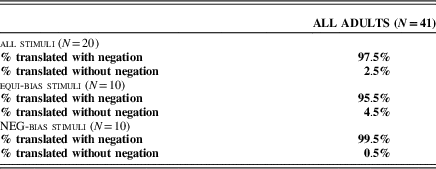
Although it might be assumed that the prominence of Palenquero negation, a frequently high-toned clitic occurring phrase-finally, would not be problematic to process, the results of the bilingual translation task reveal some facilitation of clause-final negation based on bias type. The usable responses (99.8%) are summarized in Table 1, where the nearly categorical processing and translation of NEG-bias stimuli (with a single outlier) can be clearly observed.
Translation into Spanish of Palenquero negative utterances

Palenquero clause-final nu to Spanish translations
In this experiment a viable response was considered to be a translation that preserved the subject and predicate of the stimulus (slight lexical substitutions were allowed, e.g., “window” for “door”). Valid responses were coded for presence or absence of the corresponding Spanish negator no. Given the unbalanced nature of the experiment (designed to probe for a wide variety of language-contact phenomena), a general linear (logistic regression) mixed-effects model was fitted in R (R Core Team, 2014, version 3.3.1), with (arcsine-transformed proportion of) acknowledgment of negation as the response variable and with participant as random intercept, using the lme4 package (Bates, Maechler, Bolker, & Walker, Reference Bates, Maechler, Bolker and Walker2014). P values were approximated with the lmerTest (Kuznetsova, Bruun Brockhoff, & Haubo Bojesen Christensen, Reference Kuznetsova, Bruun Brockhoff and Haubo Bojesen Christensen2014) and car (Fox & Weisberg, Reference Fox and Weisberg2011) packages. A likelihood comparison revealed that the model with bias type as a fixed effect accounted for significantly more of the variance than the model with no fixed effects, χ2 (1)=16.64; p<.0001, with bias type being significant (p<.002) in the model with bias type as a fixed effect (z=–3.116; estimate=–2.3439; standard error [SE]=0.7521).Footnote 6
Spanish preverbal no to Palenquero translations
For the 10 Spanish stimuli with preverbal negation in no, overall response rate for translation into Palenquero was 96.7%. In striking contrast to the Palenquero-to-Spanish translations, however, for all participants 100% of the Spanish-to-Palenquero translations of Spanish negative utterances took some form of negation in Palenquero; there were no instances in which a negative utterance in Spanish was translated as an affirmative in Palenquero.
Overall
These data indicate that for adult Palenquero speakers, phrase-final negation with nu is firmly implanted, while also demonstrating the role played by contextual clues in aiding in the recognition of Palenquero utterances as negative. The fact that Spanish negation was processed effortlessly by all participants provides a first bit of evidence as to the relative efficiency of preverbal versus clause-final negation. Similar results were found in a replication experiment (using natural voices); full details are given in the online-only Supplementary Materials.
SECOND EXPERIMENT: CONCURRENT MEMORY-LOADED REPETITION
Palenquero speakers’ recognition and processing of negation in clause-final nu was further probed in a concurrent memory-loading experiment. The rationale of such tasks is that “when listeners hear a sentence that exceeds the capacity of their short-term memory, they will pass it through their own grammar before repeating it” (Gullberg, Indefrey, & Muysken, Reference Gullberg, Indefrey and Muysken2009, p. 34). Previous work, for example, by Miller and Isard (Reference Miller and Isard1963), Marslen-Wilson (Reference Marslen-Wilson1985), and the studies reviewed by Vinther (Reference Vinther2002), has shown that in sentence repetition tasks, respondents’ errors frequently reflect their own grammars, that is, what they would have said instead of what was actually said. In the case of Palenquero clause-final negation in nu, it was hypothesized that if Palenquero negation was being processed, it would be retained in memory-loaded repetition.
Participants
Twenty-five adult bilinguals participated (11 women, 14 men; approximate median age=47).
Materials
Thirty-five Spanish and Palenquero stimulus utterances were prepared using the aforementioned text-to-speech software. Eight of the Palenquero sentences included the clause-final negator –nu; 4 contained other clues pointing to a negative reading (NEG-bias), and 4 could plausibly be construed as either affirmative or negative (equi-bias). The remainder were distractors. The Spanish stimuli included 8 instances of preverbal negation in no. The stimuli were similar to those used in Experiment 1, although no stimuli from that experiment were repeated. All stimuli are found in the online-only Supplementary Materials. Each utterance was accompanied by a 7-s video clip (without sound), taken from popular cartoon programs representative of Palenquero’s television-watching practices; clips were taken from series such as Loony Tunes, Batman, Superman, Green Lantern, Flash, and Spider Man. Each stimulus began with the target utterance (accompanied by the visual image of a listening ear), followed by a cartoon video clip, a video clip of an old-fashioned movie 10-s “countdown,” and finally the image of a speaking mouth. The stimuli were presented and responses recorded using a script written for the PEBL experiment-building platform (Mueller & Piper, Reference Mueller and Piper2014).
Procedure
Participants were instructed to listen to the stimulus utterance and retain it in memory. Upon seeing the video clip, they were given a 10-s window to describe the scene (indicated by the countdown video clip). When the image of a speaking mouth appeared, they were to repeat the stimulus utterance exactly as they recalled it. Participants manually advanced the stimuli following each repetition. All responses were digitally recorded by the PEBL script; a backup recording was also made with a portable digital recorder.
Results and discussion
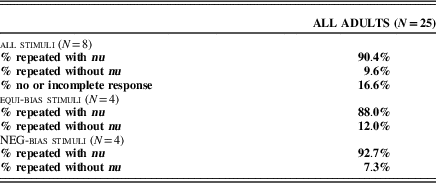
The results are given in Table 2, where a valid response was considered to be a repetition that preserved the subject and predicate of the stimulus, modulo slight lexical substitutions. Overall response rate was 85.3%. Valid responses were coded for repetition or omission of the Palenquero clause-final negator nu. A general linear mixed-effects model with repetition of NEG as the response variable and with speaker as random intercept was fitted. A likelihood comparison revealed that the model with bias type (equi-bias and NEG-bias) as a fixed effect accounted for significantly more of the variance than the model with no fixed effects, χ2 (1)=9.675; p<.002, with bias type being significant (p<.003) in the model with bias type as a fixed effect (z=2.985; estimate=1.2476; SE=0.4180).Footnote 7
Concurrent memory-loaded repetition of Palenquero negation in nu

There was only a single instance of an utterance containing Spanish preverbal negation in no being repeated as affirmative (Un refresco tiene mejor sabor cuando está frío y no está tan dulce, “a soft drink tastes best when it is cold and not too sweet”). Response rate for Spanish stimuli was 91.1%.
The responses point to some reliance on utterance-internal clues as to the ultimate affirmative or negative status of the stimuli, with a greater tendency to acknowledge Spanish preverbal no as negation as opposed to Palenquero clause-final nu. Similar results were obtained in a replication experiment using natural voices, explained in detail in the online-only Supplementary Materials.
THIRD EXPERIMENT: REPETITION WITH DISTRACTION
As an additional probe into Palenquero bilinguals’ processing of phrase-final negation, another group of participants performed a repetition task combined with distraction. The distraction consisted of two unrelated utterances after each target utterance. This task was designed to place additional demands on the processing of phrase-final negation by using complex sentences whose clause-final negator occurred utterance-medially. As with the concurrent memory-loaded repetition task, it was hypothesized that Palenquero negators in NEG-bias utterances would be repeated with a higher degree of accuracy than equi-bias utterances.
Participants
A total of 33 adult native Palenquero speakers participated (15 women and 18 men; approximate median age=49).
Materials
Thirty Palenquero-language stimuli were prepared using synthesized female voices. Because this experiment targeted processing of Palenquero clause-final negation with and without accompanying pragmatic cues, no Spanish stimuli were included. Each stimulus consisted of three unrelated utterances played successively with a 50-ms space between each, and ended with a beep. The target utterances were the first sentence in each group. The targets included 16 Palenquero negative utterances consisting of complex sentences with clause-final utterance-medial negation; 8 NEG-bias and 8 equi-bias. Examples of each are given in (8); the full stimulus set is found in the online-only Supplementary Materials.
(8) Neg-bias utterance i polé ndrumí nu poke ma pelo ta ladrá I able sleep NEG because PL dog ASP bark “I can’t sleep because the dogs are barking” equi-bias utterance ané a kriá mi asina nu kuand’í ta-ba pekeño they ASP raise me thus NEG when-I be-IMP small “I wasn’t raised like that when I was little”
Procedure
Participants were told that they would hear three unrelated utterances back-to-back, and were instructed to ignore the second and third sentences and to repeat the first sentence upon hearing the beep. Participants were instructed to wait until the third utterance had finished before repeating the first utterance of each group. No repetition of any stimuli was allowed. The stimuli were presented on a portable computer; participants listened through headphones and responded into a head-mounted microphone; stimuli and responses were recorded on the computer.
Results and discussion
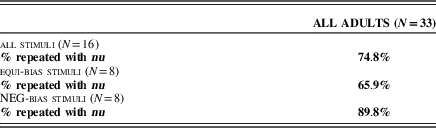
The results of this repetition task are given in Table 3, and indicate only those instances where some version of the first utterance in the stimulus was repeated, preserving subject and predicate, allowing for slight lexical substitutions (95.8%). Responses were coded for repetition or omission of the Palenquero negator nu.
Repetition of Palenquero clause-final utterance-medial negation in nu during the repetition with distraction task (figures for repetition indicate percentage of full responses (omitting incorrect responses)

A general linear mixed-effects model was fitted with repetition of negation as a response variable and participant as random intercept. A likelihood comparison revealed that the model with bias type as a fixed effect accounted for significantly more of the variance than the model with no fixed effects, χ2 (1)=45.509; p<.0001, with bias type being significant (p<.0001) in the model with bias type as a fixed effect (z=6.102; estimate=1.748; SE=0.286).Footnote 8 The results of this repetition task provide additional evidence of the relative fragility of clause-final negation during increased processing demands, even for the most fluent Palenquero speakers. As no Spanish stimuli were included in this task, a head-to-head comparison is not possible, but the results of previous experiments show almost no degradation of the processing of Spanish no under comparable circumstances.
FOURTH EXPERIMENT: CLOSE SHADOWING
As a further probe into Palenquero’s processing of clause-final negation in nu and in particular to verify whether nu was being perceived phonetically, a close-shadowing experiment was conducted. Close shadowing is a limiting case of elicited repetition, in which participants repeat stimuli before they have been fully received. In the case of Palenquero utterances with clause-final negation in nu, the line of reasoning is that repetition of nu during close shadowing indicates that this element is being perceived phonetically, whether or not nu is being grammatically processed.
Participants
The same 25 adult Palenquero–Spanish bilinguals who had participated in the memory-loaded repetition task with synthesized voices did the close-shadowing task at a different time.
Materials
Six paragraph-length Palenquero stimuli were prepared using the text-to-speech software. Each was approximately 1 min in length and contained 9 or 10 sentences arranged in a coherent sequence. In all, the stimuli contained 21 negative sentences with clause-final nu: 11 contained other contextual cues suggesting negation (NEG-bias) and 10 were ambiguous as to negative/affirmative status (equi-bias). The negator nu received an identical phonetic realization in all utterances. A full list of the stimuli for this experiment is found in the online-only s|upplementary Materials.
Procedure
The stimuli were presented on a portable computer, and participants listened through headphones. Participants were instructed to begin repeating the sentences as soon as they could and to continue following closely behind the voice until the end of each block. It was suggested that if they lost track, they should pause and wait for the beginning of the following sentence. A brief pause of approximately 10 s occurred after each block. Before beginning the experiment, participants were given a practice run with a block of stimuli not used in the experiment. Stimuli and responses were digitally recorded on separate channels of a stereo recorder.
Results and discussion
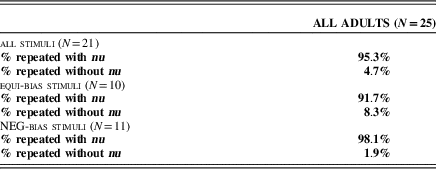
The results of the close-shadowing experiment are given in Table 4. A valid response was considered to be a repetition of the stimulus utterance preserving subject and predicate, allowing for slight lexical substitutions; valid responses were coded for repetition or omission of the Palenquero negator nu. Overall response rate was 86.9%. From the high rate of repetition of nu, it appears that clause-final nu is generally being perceived, although not always processed as a negative marker. A general linear mixed-effects model with repetition of NEG as a response variable and with speaker as random intercept was fitted. A likelihood comparison showed that the model with bias type as a fixed effect accounted for significantly more of the variance than the model with no fixed effects, χ2 (1)=8.144; p<.005, with bias type being significant (p<.009) in the model with bias type as a fixed effect (z=2.624; estimate=1.384; SE=0.527).Footnote 9 As with the translation experiment, no instances of Spanish preverbal negation were shadowed without the accompanying no. Taken overall, these results suggest that even under the temporal pressures inherent in close shadowing, at least some contextual clues appear to have been processed in time to affect perception and repetition of final nu.
Repetition of Palenquero negation in nu during close shadowing; figures for repetition indicate percentage of full responses (omitting missing or incomplete responses)

FIFTH EXPERIMENT: AUDITORY SENTENCE-MATCHING AND NONPREDICTIVE PROCESSING
The shadowing task showed that Palenquero clause-final nu was not always processed as a negative marker in connected speech when followed immediately by other material, although some predictive effects still emerged when the preceding context contained NEG-bias elements. The fifth experiment examined the extent to which post-NEG elements might influence the processing of utterance-medial nu in cases where incremental prediction was not available. The general approach was motivated by previous research on written sentence matching as a technique for indirectly probing for grammaticality (e.g., Forster & Stevenson, Reference Forster and Stevenson1987; Freedman & Forster, Reference Freedman and Forster1985). In the latter studies only results for matching stimuli are analyzed for reaction times, which are frequently longer for ungrammatical utterances than for fully acceptable configurations. In the case of Palenquero negation, grammaticality was not an issue; at stake was the ability to discern the presence versus absence of the Palenquero clause-final negator nu when otherwise identical utterances were presented pairwise. Given the results of the previous experiments, it was expected that not all mismatched pairs involving clause-final negation would be identified as such.
In this experiment, participants were required to determine whether two successively presented auditory stimuli were identical or (slightly) different, specifically involving presence/absence of utterance-medial nu. The task utilized biclausal utterances with the negator nu appearing at the end of the first clause, which contained no NEG-bias elements. The postnegative continuations were divided between equi-bias and NEG-bias phrases, based on the following two hypotheses. In the first scenario, in circumstances where no incremental prediction is possible, postnegation elements might be recruited to enhance the processing of clause-final nu. If this is the case, then mismatched utterances with NEG-bias clauses following nu might be expected to be identified at a higher rate than mismatched utterances with equi-bias continuations, as upon reaching the conclusion of the utterance it would become apparent that the expected nu at the end of the first clause had not appeared.Footnote 10 In contrast, if only incremental processing is involved in the perception of of clause-final negation, then mismatched pairs with equi-bias conclusions should behave no differently than mismatches with NEG-bias endings.
Participants
The same 33 adult participants in the repetition-with-distraction task performed the sentence-matching experiment at a different time. Due to a failure to follow instructions, data from 6 participants had to be discarded, leaving a total of 27.
Materials
Eighty Palenquero sentence pairs were created, using synthesized female voices. Forty pairs contained identical utterances, and 40 pairs differed by a single element, including gender marking, preverbal particles, and presence/absence of the Palenquero negator nu. All stimuli for this experiment are found in the online-only Supplementary Materials. No Spanish stimuli were included, as the issue of incremental processing versus post-NEG material is not relevant. For each pair, the fundamental frequency of one of the voices was lowered to 70% of the original. Each stimulus was created in stereo, having one utterance per channel, with a 50-ms gap between the utterances. The stimuli were counterbalanced for the order of channels and the order of the higher and lower pitched voices (e.g., to counteract the commonly observed “right-ear advantage”; Hugdahl, Reference Hugdahl2011). A PEBL script was created to record responses and reaction times. The script randomized the presentation order for each participant.
The stimuli included 24 paired utterances differing only in the presence/absence of the Palenquero negator nu in clause-final utterance-medial position, as in Experiment 3.Footnote 11 For each group, half contained the negator nu in the first utterance of the stimulus pair and half contained nu in the second utterance. Twelve of the utterance pairs contained postnegation equi-bias elements (e.g., [9]) and 12 contained postnegation NEG-bias continuations (e.g., [10]). None of the clauses ending in –nu contained NEG-bias or affirmative-bias elements, thereby placing the biasing onus on the postnegation phrase.Footnote 12
(9) abuela mi ta buká muhé {nu} pa kobá maní andi losa grandmother-1s ASP look woman{NEG}for dig peanut LOC field “My grandmother is {not} looking for a woman to dig up peanuts in the field”
(10) I a ten binieto {nu} pokke ma nieto mi a sali ku sangre mu frekko I have great-grandchild {NEG} because PL grandchild POSSPERF leave with blood very cool “I do {not} have great-grandchildren because my grandchildren turned out to be cold-blooded”
Procedure
Participants were told that they would hear pairs of utterances presented in random order, with each pair containing two voices differing in pitch. They were told that half of the stimuli contained identical utterances and half differed in small details, for example, no larger than a single word (sample utterances were presented, none involving negation). Participants listened to the stimuli over headphones, and were instructed to press the right shift key (covered with a green dot) for identical utterances and the left shift key (covered with a red dot) for utterance pairs that were different. On-screen icons reinforced the instructions. Participants were also told to wait until hearing both utterances completely before pressing a key, even if they had already detected a difference. Prior to the experiment, participants were given a practice run of 10 stimulus pairs (not included in the experiment proper), half identical and half different.
Results and discussion
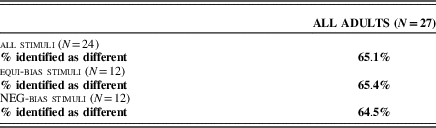
For all participants, a strong bias toward all-same responses was observed, resulting in more than 90% “correct” identification of identical utterances for all participants. Table 5 gives the results for correct identification of utterance pairs differing only in the presence/absence of the negator nu, that is, a left-shift response to the respective stimulus pairs. The considerably lower correct scores confirm “same” as a default response.Footnote 13
Correct identification of Palenquero utterance pairs differing only in the presence/absence of clause-final utterance-medial negation in nu, sentence-matching task

Taking correct (= different) versus incorrect (= same) as a response variable for utterance pairs differing only in the presence/absence of NEG, a general linear mixed-effects model with participant as random intercept showed no significant difference between equi-bias and NEG-bias stimuli:Footnote 14 p<.36 (z=–0.930; estimate=–0.189; SE=0.203).Footnote 15 The lack of significant differences in responses between equi-bias and NEG-bias stimuli is consistent with the postulated difficulty in rapid online processing of clause-final negation when immediately followed by other material in utterance-medial position, and may also be a function of the overall low rate of detecting all paired differences, manifested as the strong preference for all-same responses. The fact that this task entailed a post hoc assessment of negation rather than anticipation attenuated possible effects of bias, but the utterances were short enough that any retroactive bias effect should have been noticeable if this processing strategy had been recruited. The results are consistent with a disadvantage for clause-final NEG in rapid connected speech in the absence of incremental prediction. At the same time, given the participants’ overall preference for “same” responses, as well as the absence of comparative Spanish data, any conclusion regarding postnegation retroactive bootstrapping is only suggestive at this point.
SIXTH EXPERIMENT: ALL IN THE SOUND?
Because Palenquero phrase-final nu is frequently produced with a high tone, it is in principle possible that the overall prosodic patterns of negative utterances might contain phonetic clues as to an upcoming negator, for example, some type of anticipatory updrift. Prior to undertaking the present study, numerous Palenquero speakers were queried informally, and most responded that it was impossible to determine whether a sentence was negative or affirmative until the end of the utterance. Some mentioned obvious cues such as body language or previous context, thereby hinting at the use of nonlinguistic strategies, but a few also suggested that intonation alone could be a key factor. In order to put these comments to a more systematic test, an additional pilot experiment was conducted, to confine the responses to the speech signal itself.
Participants
Thirty adult Palenquero–Spanish bilinguals (14 women and 16 men; approximate median age=49) participated in this brief experiment.
Materials
A fluent male Palenquero speaker recorded 30 affirmative utterances, and in a separate session recorded negative versions of the same utterances, all with clause-final nu. Each utterance was truncated at the beginning of the final (nuclear) pitch accent, as in (11). Because even in negative utterances the truncation occurred at the beginning of the penultimate word, no anticipatory coarticulation effects of the nasal were present.
(11) akí Palenge teneba kasa ri materiá andi pl//asa (nu) here Palenque have-IMP house of material LOC pl//aza (NEG) “Here in Palenque there were (no) cement-block houses in the plaza”
Ten affirmative/negative pairs were judged (by the same consultants who provided feedback on the other experimental stimuli) to have an affirmative bias (affirm-bias), 10 pairs were biased toward a negative reading (neg-bias), and 10 pairs were judged to be neutral in terms of likely affirmative or negative readings (equi-bias). Examples are
(12) affirm-bias stimulus: bentana ta abieto i ma mokka ta len//drá {nu} window be open and PL fly ASP enter {NEG} “The window is open and flies are {not} entering” neg-bias stimulus: ma pelo ta lagrá i polé ndru//mí {nu} PL dog ASP bark I can sleep {NEG} “The dogs are barking; I can {not} sleep” equi-bias stimulus: i sabé kandá baile ri m//uetto {nu} I know sing dance of death {NEG} “I do {not} know how to sing the funeral chants”
Procedure
The utterances were normalized for intensity and incorporated into a PEBL script. The truncated stimuli were presented in random order, and participants had to press the right shift key if they felt that the full sentence was affirmative and the left shift key if they anticipated a negative ending. On-screen icons reinforced the instructions.
Results and discussion
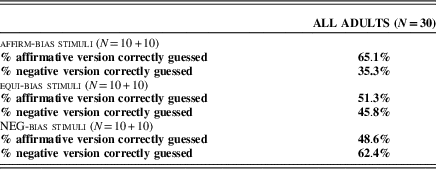
Aggregating all responses, no participant responded significantly above the level of chance, and the average d-prime score (a calculation of correct responses or “hits,” e.g., negative utterances correctly predicted, minus false-alarms, e.g., affirmative utterances also predicted as negative) was 0.022, indicating essentially randomly distributed responses. There was an affirmative bias in the overall responses: 56.6% of affirmative utterances correctly predicted versus 44.4% correct prediction of negative utterances. The consultant who had originally recorded the stimuli a few months previously also responded to the stimuli, and performed below chance (negative d-prime score), remarking afterward that the task was “too hard.” His responses are not included in the calculations. The results of the identification experiment are given in Table 6.
Correct guess of affirmative/negative status of Palenquero truncated utterances

Given the essentially random overall distribution of the responses, variances for both stimuli and participants were negligible. Nonetheless, mixed-effects models with both speaker and stimulus as random intercepts and correct guess as a response variable confirm the significance of bias type for both affirmative and negative utterances. For affirmative utterances, there was a main effect between equi-bias and affirm-bias stimuli: p<.003 (z=3.053; estimate=0.50276; SE=0.16467), and between neg-bias and affirm-bias sentences: p<.0004 (z=3.565; estimate=0.61348; SE=0.17207), but not between neg-bias and equi-bias items (p=.56). A likelihood comparison with the null model gives χ2 (2)=15.525; p<.0005. For negative utterances there was a main effect between equi-bias and affirm-bias stimuli: p<.006 (z=–2.792; estimate=–0.473; SE=0.1694), between neg-bias and equi-bias items: p<.0003 (z=3.631; estimate=0.7287; SE=0.2007), and between neg-bias and affirm-bias sentences: p<.0001 (z=–6.620; estimate=–1.2017; SE=0.1815). A likelihood comparison with the null model gives χ2 (2)=33.603; p<.0001.
The results suggest that participants are not using auditory cues to anticipate affirmative or negative readings. At the same time, this pilot experiment reflects bias-based expectations whose priming effects were illustrated in the previous experiments.
GENERAL DISCUSSION
The results of the experiments presented in this study must be interpreted with caution, as they represent various forms of controlled elicitation rather than spontaneous speech, include cognitive demands not typical of everyday conversations, and were not embedded in pragmatically complete speech acts or accompanied by body language or other visual cues. Nonetheless, there is noteworthy convergence across the experimental conditions. In a variety of conditions, ultimately involving more than 100 participants, Palenquero clause-final nu appears to be vulnerable to the effects of cognitive distractions, which produce a partial “deafness” despite frequent phonetic prominence (in the synthesized stimuli, the Palenquero negator nu was given an appropriately high pitch, based on recordings of natural speech).
For naturalistic speech processing, the relative disadvantage of clause-final negation is evidently small enough for this configuration to remain stable, but with increased cognitive demands, clause-final negation becomes degraded at a higher rate than preverbal NEG. In normal conversation where linguistic and nonlinguistic cues are more solidly grounded, rates of processing of clause-final negation are probably higher for all Palenquero speakers. The fact remains, however, that clause-final negation has been shown to evince a processing disadvantage vis-à-vis preverbal negation, which under less than ideal conditions (noise, distraction, distance, cognitive load, and nonavailability of incremental processing), increases the possibility for overlooking NEG altogether. As noted by Ferreira, Bailey, and Ferraro (Reference Ferreira, Bailey and Ferraro2002, p. 13), “[…] the linguistic representation itself is not robust, so that if it is not reinforced, a merely good-enough interpretation may result.” Such “good-enough” interpretations may underlie the aforementioned tendency to mis-recall negative sentences as affirmative (Cornish & Wason, Reference Cornish and Wason1970), as overlooking negative elements does not alter the grammaticality of a sentence. The same approach is clearly operative in the frequent failure to acknowledge clause-final negation in Palenquero. In the absence of adequate contextual cues as to a likely negative interpretation, Palenquero NEG evidently appears too late in the clause to fully forestall shallower NEG-less interpretations.
An anonymous reviewer has raised the question of whether processing costs associated with equi-bias utterances are due to the relative position of NEG or simply to the fact of infelicitous or inappropriate negation. While the latter possibility cannot be entirely dismissed, because all stimulus utterances were unanimously vetted for bias by three native speaker consultants (and many originally came from naturalistic recorded speech), any effects attributed to inappropriateness should be relatively small. Only in the sixth experiment, not designed to test the effects of NEG placement but only to determine the extent to which listeners could guess the outcome, were deliberately infelicitous utterances included.
The relatively greater processing efficiency in NEG-bias utterances is fully consistent with incremental models of sentence processing that include successive predictions (e.g., Altman & Mirković, Reference Altmann and Mirković2009; Altmann & Steedman, Reference Altmann and Steedman1988; Kamide, Reference Kamide2008; Kamide, Altmann, & Haywood, Reference Kamide, Altmann and Haywood2003; Van Berkum, Brown, Zwitserlood, Kooijman, & Hagoort, Reference Van Berkum, Brown, Zwitserlood, Kooijman and Hagoort2005). The tentative conclusions emerging from Experiment 5 also suggest greater reliance on incremental prediction than on postnegation elements. It is premature to characterize as “inefficient” Palenquero clause-final negation, but the very reduced geographical distribution of languages with unbounded clause-final negation may point to the limitations of incremental processing (e.g., reduced “utility” in the sense of Jaeger & Tily, Reference Jaeger and Tily2011) as a factor in the scarcity of this configuration. The contrasting behavior of Spanish and Palenquero negation highlights the possible role of processing mechanisms as contributing to typological differences among languages.
The most obvious potential limitation of this study is the fact that all contemporary Palenquero speakers are also fluent in Spanish; no monolingual Palenquero speakers remain, although many of the older speakers acquired Palenquero before Spanish. The participants in the present study are fully proficient in Palenquero, as judged by external observations as well as by peer commentary within the community. Their responses to a variety of tasks reveal no shortcomings that might suggest that Palenquero is their weaker language. Nonetheless, it must be acknowledged that Spanish is not only the de facto national language of Colombia but also the language heard most frequently in 21st-century Palenque. As Spanish preverbal negation is arguably less marked than Palenquero clause-final NEG, awareness of Spanish, even in balanced bilinguals, may distract participants from fully attending to clause-final negation in Palenquero, given evidence of cross-language syntactic activation in bilinguals (e.g., Bernolet, Hartsuiker, & Pickering, Reference Bernolet, Hartsuiker and Pickering2007, Reference Bernolet, Hartsuiker and Pickering2012, Reference Bernolet, Hartsuiker and Pickering2013; Desmet & Declercq, Reference Desmet and Declercq2006; Hartsuiker, Pickering, & Veltcamp, Reference Hartsuiker, Pickering and Veltkamp2004; Kantola & van Gompel, Reference Kantola and van Gompel2011; Loebell & Bock, Reference Loebell and Bock2003; Schoobaert, Hartsuiker, & Pickering, Reference Schoonbaert, Hartsuiker and Pickering2007; Shin & Christianson, Reference Shin and Christianson2009; Weber & Indefrey, Reference Weber and Indefrey2009). Rather than pondering what may be an unresolvable conundrum, the present study has focused on tangible measures of language processing that could shed light on the current bilingual configuration.
Conclusions
Do the data from Palenquero–Spanish bilinguals constitute an indictment of clause-final negation as an inefficient and potentially flawed mechanism doomed to marginal status in the natural selection process of language evolution? Clearly matters are not so simple, as Palenqueros have been communicating in lengua ri Palenge for several centuries, without misfortune. The experiments reported in the present study show a small advantage for preverbal over clause-final negation in contexts where the two systems can be compared head-to-head. This is a small step toward answering a very big question regarding evolutionary patterns across languages; the results encourage an examination of a wider range of little-studied bilingual contact environments, as well as the implementation of interactive experimental techniques with nontraditional speech communities. The potential for new insights more than compensates for the time and effort required to move beyond familiar laboratory settings.
ACKNOWLEDGMENTS
This work was supported by the National Science Foundation under Grant BCS-1357155. The author gratefully acknowledges the support and friendship of the following Palenqueros, all of whom have contributed significantly: Ana Joaquina Cásseres, Magdalena Navarro, Basilia Pérez, Bernardino Pérez Miranda, Manuel Pérez, Neis Pérez, Venancia Pérez, José de los Santos Reyes, Raúl Salas, Florentina “Yayita” Salas, Luis Felipe Salgado, Sebastián Salgado, Víctor Simarra Reyes, Faustino Torres, and Juana Torres. Armin Schwegler shared his insights, Lauren Perrotti aided in the data transcription, and Giuli Dussias offered many helpful suggestions on an earlier version. The anonymous reviewers’ suggestions as well as the close reading by associate editor Annie Tremblay led to numerous improvements. I bear sole responsibility for any remaining insufficiences.
SUPPLEMENTARY MATERIAL
To view the supplementary material for this article, please visit https://doi.org/10.1017/S0142716418000279
APPENDIX A
EXPERIMENTAL STIMULI
First experiment: Rapid translation
Palenquero equi-bias utterances
Kuando ane miní posá mi i resibi ané nu;
“when they came to my house I didn’t let them in”
ma kuendo Cho Tigre Cho Conejo i sabeba muy bien nu
“I don’t know the Brer Tiger and Brer Rabbit stories well”
aola polé semblá kaña andi ma losa nu
“Now we can no longer plant sugar cane in our garden plots”
i sabé kandá baile ri mueto nu
“I don’t know how to sing the funeral chant”
ya tené aló pa suto kotá má nu
“There is no more rice for us to cut”
ané kelé pagá mi lo ke kotá nu
“They don’t want to pay me what it’s worth”
í polé kondá bo to ma cusa lo que ta pasá aki palenge nu
“I can’t tell you everything that happened here in Palenque”
pokke yo lo ke ta akí i kriá asina nu
“because I here wasn’t raised like that”
bo konoselo nu poro bo polé konoselo
“You don’t know it but you could”
i akoddá ri ma nombre de to ma lo ke asé miní kasa mi nu
“I don’t remember the names of everyone who came to my house”
Palenquero NEG-bias utterances
aola komo ñame akabá ten má ñame nu
“Now that yams have played out there are no more yams”
bo siribí pa hende salí ku bo nu
“You’re not fit for people to go out with”
akí teneba kasa ri materiá nu lendro Palenge
“There were no cement-block houses here in Palenque”
si i matá un ngaina akí komo i ta kriá ané i ‘se tené gana ri kumé nu
“If I kill a chicken since I’ve been raising it I don’t have an appetite to eat it”
i ablaba un palabra malo nunka nu
“I’ve never said a bad word”
awé ten ke ta yendo pa loyo a buká awa nu
“Nowadays we don’t have to go to the creek to fetch water”
suto ten burú pa komblá kalo nu
“We don’t have any money to buy soup”
i sabé mucho nu pokke i teminá ni la primaria nu
“I don’t know much because I didn’t even finish elementary school”
kuan’i lebantá akí suto teneba lu ni awa nu;
“when I was growing up we had no electricity or water”
ma kaya ri Palenge hwe bueno pa ma moto lendrá nu
“Streets in Palenque are no good for motorbikes to enter”
Spanish negative utterances
en nuestra casa no tenemos animales
“We don’t have animals in our house”
dieron una respuesta falsa que no podemos aceptar
“they gave a false answer that we can’t accept”
lo que yo he visto en los tiempo mío ahora no lo etoy viendo
“the things I’ve seen in my time I’m not seeing now”
aquí no puede tener usted un pollo poque no vienen má a la casa
“You can’t keep chickens here because they don’t return home”
las calles de Palenque no son buenas para las motos
“the streets in Palenque are not good for motorbikes”
una señal debil no es adecuada para el teléfono
“a weak signal is no good for telephones”
una naranja no se debe comer cuando está pequeña y verde
“an orange should not be eaten if it is small and green”
no hablamos lengua palenquera con forasteros
“we don’t speak Palenquero with outsiders”
no tenemos plata para comprar carne ni pescado
“we don’t have any money to buy meat or fish”
pienso que no me voy a casar
“I don’t think that I am going to get married”
Second experiment: Concurrent memory-loaded repetition
Palenquero equi-bias stimuli
i akoddá ri ma nombre de to ma lo ke asé miní kasa mi nu
“I don’t remember the names of everyone who came to my house”
kuandi mamá mi taba bibo suto aseba bibí Kattagena nu
“When my mother was alive we did not live in Cartagena”
ma kuendo Cho Tigre Cho Conejo i sabeba muy bien nu
“I don’t know the Brer Tiger and Brer Rabbit stories well”
í polé kondá bo to ma cusa lo que ta pasá aki palenge nu
“I can’t tell you everything that happened here in Palenque”
Palenquero NEG-bias stimuli
ma kaya ri Palenge hwe bueno pa ma moto lendrá nu
“Streets in Palenque are no good for motorbikes to enter”
awé ten ke ta yendo pa loyo a buká awa nu
“Nowadays we don’t have to go to the creek to fetch water”
lengua suto é lengua mu ngande suto polé dehá lengua suto nu
“Our language is very important, we can’t give it up”
si i matá un ngaina akí komo i ta kriá ané i se tené gana ri kumé nu
“If I kill a chicken since I’ve been raising it I don’t have an appetite to eat it”
Spanish stimuli with preverbal no
una naranja no se debe comer cuando es pequeño y está verde
“an orange should not be eaten if it is small and green”
un refresco tiene mejor sabor cuando está bien frío y no está tan dulce
“a soft drink tastes best when it is very cold and not too sweet”
la solución que propusieron es muy poco razonado y no me convence
“the solution that was proiposed to me is unreasonable and I’m not convinced”
dieron una respuesta falsa que no podemos aceptar
“they gave a false answer that we can’t accept”
lo que yo he visto en los tiempo mío ahora no lo etoy viendo
“the things I’ve seen in my time I’m not seeing now”
aquí no puede tener usted un pollo poque no vienen má a la casa
“You can’t keep chickens here because they don’t return home”
las calles de Palenque no son buenas para las motos
“the streets in Palenque are not good for motorbikes”
una señal debil no es adecuada para el teléfono
“a weak signal is no good for telephones”
Third experiment: Repetition with distraction
Equi-bias target utterances
awa kelé yobé nu i mahanasito ta hugá andi kaya
“It doesn’t look like rain and the kids are playing in the street”
kombilesa mi tan komblá abaniko nu kuand’e ke bay San Kayetano
“my friend won’t buy a fan when he goes to San Cayetano”
Mario ta harocho nu pokké a ten ke bay Katahena maana
“Mario isn’t happy because he has to go to Cartagena tomorrow”
tata suto asé sendá ku suto nu kuando suto ta miná telebisió
“Our father doesn’t sit with us when we watch television”
i polé kondá bo nu to ma kusa lo ke ta pasá akí palenge
“I can’t tell you everything that is happening here in Palenque”
ané asé miná suto nu kuandi suto asé ablá lengua suto
“They don’t look at us when we speak our language”
abuela mi ta buká muhé nu pa kobá maní andi losa
“My grandmother is not looking for a woman to dig up peanuts in her garden plot”
ese kasa poleba bendé nu pokke ese kasa era de mi kuatro moná lo ke i teneba kuné
“That house can’t be sold because it belonged to the four children I had with him”
NEG-bias target utterances
i kelé makaniá andi losa mi nu kuando awa ta yobé
“I don’t want to work in my garden plot when it is raining”
akí teneba kasa ri materiá nu lendro Palenge
“There were no cement-block houses here in Palenque”
i polé ndrumí nu pokke ma pelo ta ladrá
“I can’t sleep because the dogs are barking”
ma kaya ri Palenge hwe bueno nu pa ma moto lendrá
“the streets of Palenque are not good for motorbikes to enter”
i ten binieto nu pokke ma nieto mi a salí ku sangre muy frekko
“I don’t have great-grandchildren because my grandchildren are cold-blooded”
i trompeaba ku ma tatá mi nu kuand’i taba pekeño
“I didn’t get into fist fights with my parents when I was little”
monasito polé ndrumí nu pokke el a kumé un chochá pekkao a merioría
“the little boy can’t sleep because he ate a lot of fish for lunch”
ma kapuchichimanga polé chitiá lengua suto nu kuando ané miní Palenge
“the white folks cannot speak our language when they come to Palenque”
Fourth experiment: Close shadowing
First paragraph
i a ten sinko numana y to ané ta kelá akí Palenge;
“I have 5 sibilings and they all live in Palenque”
kuan’i lebantá akí suto teneba lu ni awa nu;
“when I was growing up we had no electricity or water”
primera kasa ri materiaá lo ke asé akí hwe kasa ma tatá mi;
“the first cement-block house built here belonged to my parents”
aola Palengue ten tiela buena pa suto semblá;
“Now Palenque has good land for us to farm”
kuando ané asé miní akí ma afrikano suto asé kaminá ku ané;
“When Africans come to visit we walk around with them”
poro kuando ane miní i resibi ané nu;
“but when they came I didn’t let them in”
i atendé ané komo moná mi i parí;
“I take care them as though they were my own children”
i akoddá ri ma nombre rie to ma lo ke asé miní kasa mi nu
“I don’t remember the names of everyone who came to my house”
ané kriá mí asina kuand’i taba chikito
“I was raised like that when I was little”
Second paragraph
ma guaruma ta bisitá palenge
“Outsiders are visiting Palenque”
ma guarumá asé kelaba ku boka abieto kuando ané ta kuchá lengua suto.
“outsiders are open-mouthed when they hear our language”
ané ‘sé kelá loko pokke ané sabé lo ké hende ta kombesá nu
“they go crazy because they don’t know what people are saying”
lengua suto é lengua mu ngande suto polé dehá lengua suto nu
“our language is very important, we can’t give it up”
ma chikito tan pelé lengua pero suto ma bieho nu
“the kids are losing Palenquero but not us older folks”
suto asé kombesá lengua suto donde sea
“we speak our language everywhere”
ablá mi ké utere kelé má i tan repondé en lengua mi
“tell me what you want and I’ll answer in my language”
bo konoselo nu poro bo polé konoselo
“you don’t know it but you could”
utere lo ke ta miní hwe lo ke ten ke yulá suto
“you who come here have to help us”
Dioso ta watiá suto to ma ría
“God watches over us every day”
Third paragraph
i sabé mucho nu pokke i teminá ni la primaria nu
“I don’t know much because I didn’t even finish elementary school”
tatá mi a lungá kuando i teneba tre año
“my father died when I was three years old”
aki teneba kasa ri materiá nu
“There used to be no cement block houses here”
antonce ma muhé akí Palenge aseba komblá yuka San Kayetano
“then the women from Palenque would buy cassava in San Cayetano”
mamá mi aseba mboyo masoka ku hwisio
“my mother made excellent corn dumplings”
masamola mamá mi hueba muy sabroso tambié
“my mother’s corn stew was also very tasty”
awé ten ke etá yendo pa loyo a buká awa nu
“now we don’t have to go to the creek to fetch water”
ya tené aló pa suto kotá má nu
“there is no more rice for us to cut”
si bo nda mi sei mango i tan resibílo
“if you give me six mangoes I’ll take them”
bo tan pa kasa si i tan pa kasa mi
“you’re going to your house and I’m going to mine”
Fourth paragraph
pokke yo lo ke ta akí i kriá asina nu
“because I here wasn’t raised like that”
kuandi mamá mi taba bibo, a toká mi yebalo andi kanoa
“when my mother was alive I had to take her {to Cartagena} in a canoe”
i sabé kandá baile ri mueto nu
“I don’t know how to sing the funeral chant”
i a ten sinko año ke i asé ná nu pokke i enfemmá ri kolumna
“I haven’t done anything for five years because I injured my back”
awé mano mi ta maluko
“and now I’m down on my luck”
ku erá k’í tené i ta nda bo un ekplikasió
“at my age I’m giving you an explanation”
bo siribí pa hende salí ku bo nu
“you’re not fit for people to go out with”
bo a sabé ke hende a ten ke trompiá pa aprendé
“You know that people have to fight in order to learn”
pero si ané ten trabaho nu suto ase pasá trabaho akí
“But if they don’t have a job we have a hard time here”
aola polé semblá kaña andi ma losa nu
“now we can no longer plant sugar cane in our garden plots”
ya tené aló pa suto kotá má nu
“there is no more rice for us to harvest”
Fifth paragraph
i ablaba un palabra malo nunka nu
“I’ve never said a bad word”
suto memo asé resolbé to ma problema pokke suto e una sola henerasión
“we solve our problems ourselves because we are from the same generation”
si uno ta trabahá po ayá y uto ta trabahá po akí empresa kaminá nu
“if one is working here and another is working there, you can’t get the job done”
aola komo ñame akabá ten má ñame nu
“now that yams have played out there are no more yams”
si bo a kelé 500 peso i tan bendé bo ele
“if you want 500 pesos worth, I’ll sell it to you”
si i matá un ngaina akí komo i ta kriá ané i se tené gana ri kumé nu
“if I kill a chicken since I’ve been raising it I don’t have an appetite to eat it”
ese kasa poleba bendé nu pokke ese kasa era de mi kuatro moná lo ke i teneba kuné
“that house can’t be sold because it belonged to the four children I had with him”
Sixth paragraph
mahaná asé ndulá tre kuatro sinko ora kaya
“kids stay out in the street for three, four, five hours”
kuando i konosé a Palenge ma hende poleba ndrumí andi kaya
“when I was growing up in Palenque people could fall asleep in the street”
primé kasa ri materiá lo ke asé akí hwe kasa ma tatá mi
“The first cement-block house build here belonged to my parents”
kuando é mini primé kasa lo ké konosé hwe kasa mi
“when he came here, the first house he came to was mine”
a ten sinko ría awé ke awa ta miní nu
“it’s been five days today that there has been no water”
suto ten burú pa komblá kalo nu
“we don’t have any money to buy soup”
ané kelé pagá mi lo ke kotá nu
“they don’t want to pay me what it’s worth”
suto a ten ese derrota entre suto ndo ku ese muhé
“the two of us had a falling-out over that woman”
Fifth experiment: Auditory sentence matching
Stimuli with postnegation equi-bias elements
abuela mi ta buká muhé {nu} pa kobá maní andi losa
“my grandmother is {not} looking for a woman to dig up peanuts in her garden plot”
kombilesa mi tan komblá abaniko {nu} kuand’e ke bay San Kayetano
“my friend will {not}buy a fan when he goes to San Cayetano”
Mario ta harocho {nu} pokké a ten ke bay Katahena maana
“Mario is {not} happy because he has to go to Cartagena tomorrow”
mahaná ri aola asé ablá suto {nu} pa suto nda ané burú
“kids nowadays {do not} talk to us so that we give them money”
awa kelé yobé {nu} i mahaná ta hugá andi kaya
“it {does not} look like rain and the kids are playing in the street”
i resibí ané {nu} kuando ané a miní Palenge
“I did {not} meet them when they came to Palenque”
ané miná suto {nu} kuando ané a bisitá Palenque
“they {did not} look at us when they visited Palenque”
ané kriá mi asina {nu} kuand’í taba pekeño
“they {did not} raise me like that when I was little”
tata suto asé sendá ku suto {nu} kuando suto ta miná telebisió
“our father {does not} sit with us when we watch television”
suto aseba bibí Katahena {nu} kuando mamá mi taba bibo
“we did {not} live in Cartagena when my mother was alive”
suto kaminá ku ma afrikano {nu} kuando ané a miní
“we did {not} walk around with the Africans when they came”
ma hende poleba ndrumí andi kaya {nu} kuand’í lebantá akí Palenge
“people could {not} sleep in the streets when I was growing up here in Palenque”
Stimuli with postnegation NEG-bias elements
i ten binieto {nu} pokke ma nieto mi a salí ku sangre muy frekko
“I {do not} have great-grandchildren because my grandchildren are cold-blooded”
i polé ndrumí {nu} pokke ma pelo ta ladrá
“I can {not} sleep because the dogs are barking”
monasito polé ndrumí {nu} pokke el a kumé un chochá pekkao a merioría
“the little boy can {not} sleep because he ate a lot of fish for lunch”
i kelé makaniá andi losa mi {nu} kuando awa ta yobé
“I {do not} want to work in my garden plot when it is raining”
ma kaya ri Palenge hwe bueno {nu} pa ma moto lendrá
“the streets of Palenque are {not} good for motorbikes to enter”
ese kasa poleba bendé {nu} pokke i asé ese kasa pa ma tatá mi bibí
“that house can {not}be sold because I built that house for my parents to live in”
ten má ñame {nu} pokke ñame a kabá
“there are {no more} yams because the yams have played out”
ten alo pa suto kotá {nu} pokke tiela ta seko
“there is {no} rice for us to harvest because the land is dry”
ma mokka ta lendrá {nu} pokke bentana ta selao
“the flies are {not} coming in because the window is closed”
teneba lu ni awa {nu} kuand’i bibiba Palenge
“there was {no} electricity or water when I lived in Palenque”
ma hende aseba komblá yuka {nu} Malagana pokke suto aseba semblá aló akí Palenge
“people used to buy rice in Malagana because we grew rice here in Palenque”
ma pelo tan ensusiá lendro kasa {nu} si bo selá puetta
“the dogs will {not} make a mess inside the house if you close the door”
Sixth experiment: All in the sound?
Affirmative-bias utterances
Palenge a ten tiela bueno pa suto sembla (nu + Ø)
“Palenque has {no} good land for us to farm”
bentana ta abieto y ma mokka ta lendra (nu + Ø)
“the window is open and flies are {not} coming in”
kuando ané kuchá lengua suto ma kapuchichimanga asé kelá ku boka abieto (nu + Ø)
“when they hear our language, white people are {not}open-mouthed”
kuandi suto asé ablá lengua suto ma hende ri hwela asé miná suto (nu + Ø)
“when we speak Palenquero outsiders {do not} stare at us”
kuandi i lebantá akí Palenge ma hende poleba ndrumí andi kaya (nu + Ø)
“when I was growing up in Palenque one could {not} fall asleep in the streets”
kuandi suto asé ablá lengua suto, ané a miná suto (nu + Ø)
“when we speak Palenquero, they all {do not} stare at us”
bo polé miná sahino lendro monde (nu + Ø)
“you can {not} find wild pigs in the woods”
kuandi ma guarumá asé bisitá Palenge ma hende asé chitiá lengua ku ané (nu + Ø)
“when outsiders visit Palenque people {do not} talk to them in Palenquero”
abuela mi a buká muhé pa kobá maní andi losa (nu + Ø)
“my grandmother is {not} looking for a woman to dig up peanuts in her garden plot”
kuando ané a miní posá mi, i resibí ané ku hwisio (nu + Ø)
“when they came to my house I {did not} let them in properly”
Equi-bias utterances
kuandi mamá mi taba bibo suto aseba bibí Kattagena (nu + Ø)
“when my mother was alive we {did not} live in Cartagena”
ma kuendo Cho Tigre Cho Conejo i sabeba muy bien (nu + Ø)
“I do {not} know the Brer Tiger and Brer Rabbit stories well”
i sabé kandá baile ri muetto (nu + Ø)
“I do {not} know how to sing the funeral chant”
awa kelé yobé i mahanasito ta hugá andi kaya (nu + Ø)
“it looks like rain and the kids are {not} playing in the Street”
í polé kondá bo to ma cusa lo que ta pasá aki palenge (nu + Ø
“I can {not} tell you everything that happened here in Palenque”
kuando suto ta miná telebisión tata suto asé sendá ku suto (nu + Ø)
“when we watch television our father {does not} sit down with us”
kuand’e ke bay San Kayetano, kombilesa mi tan komblá abaniko (nu + Ø)
“when my friend goes to San Cayetano he will {not} buy a fan”
I akoddá ri ma nombre ri tó ma lo ke asé miní kasa mi (nu + Ø)
“I do {not} remember the names of everyone who has come to my house”
ese kasa era ri ma kuatro moná lo k’i teneba kuné antonse ese kasa poleba bendé (nu + Ø)
“that house belonged to the four children I had with him so that house can {not} be sold”
yo lo que ta akí i kriá asina (nu + Ø)
“I who am here was {not} raised like that”
NEG-bias utterances
kuando awa ta yobé i kelé makaniá andi losa mi (nu + Ø)
“when it is raining I {do not} want to work in my garden plot”
ma pelo ta ladrá i polé ndrumí (nu + Ø)
“the dogs are barking and I can {not} sleep”
ma nieto mi a salí ku sangre muy frekko antonse i ten binieto (nu + Ø)
“my grandchildren are cold-blooded so I have {no} great-grandchildren”
ma kaya ri Palenge hwe bueno pa ma moto lendrá (nu + Ø)
“the streets of Palenque are {not} good for motorbikes to enter”
awé ma hende tando pa loyo a buká awa (nu + Ø)
“nowadays people are {not} going to the creek to fetch water”
lengua suto é lengua mu ngande suto polé dehá lengua suto (nu + Ø)
“our language is very important, we should {not} abandon it”
i sabé mucho nu pokke i teminá la primaria (nu + Ø)
“I don’t know much because I did {not} even finish primary school”
aola como ñame a kabá ten má ñame (nu + Ø)
“now that yams have played out there are {no} more yams”
akí Palenge teneba kasa ri materiá andi plaza (nu + Ø)
“here in Palenque there used to be {no} cement block houses along the plaza”
bo siribí pa hende salí ku bo (nu + Ø)
“you are {not} good for people to go out with”