


Introduction
Bulimia nervosa (BN) is a common and disabling condition that, in the absence of treatment, typically follows a chronic course (Keski-Rahkonen et al., Reference Keski-Rahkonen, Hoeka, Linna, Raevuori, Sihvola and Bulik2009). A wealth of quantitative research supports CBT as an effective intervention for “bulimic disorders” (NICE, 2004; Chen et al., Reference Chen, Touyz, Beaumont, Fairburn, Griffiths and Butow2003). The main criticisms of CBT for bulimia nervosa (CBT-BN) are that only around 50% of individuals make a full and lasting recovery and that attrition rates are high (Vanderlinden, Reference Vanderlinden2008). An enhanced form of CBT-BN (CBT-E) offers a transdiagnostic approach to Eating Disorders (ED) as an overarching treatment for ED psychopathology regardless of specific diagnosis, since any subtype of eating disorder can be treated effectively by attending to the “core psychopathology” (Fairburn, Reference Fairburn2008).
Two research trials of individuals with varying ED classifications receiving CBT-E have shown promising results, reporting that 53–66% of individuals make a significant improvement and maintain improvement at follow-up (Fairburn et al., Reference Fairburn, Cooper, Doll, Bohn, Hawker and Wales2009; Byrne, Fursland, Allen and Watson, Reference Byrne, Fursland, Allen and Watson2011). Furthermore, individuals report improved quality of life following CBT-E, in addition to ED symptom relief (Watson, Allen, Fusland, Byrne and Nathan, Reference Watson, Allen, Fusland, Byrne and Nathan2012). Individuals with more complex presentations appeared to respond better to a subtype of treatment referred to as “Broad CBT-E”, which includes additional modules to address broader “external” maintaining mechanisms: mood intolerance, clinical perfectionism, low self-esteem and major interpersonal problems (see Fairburn, Reference Fairburn2008). However, attrition rates remain high, with factors such as lowest reported weight, the tendency to avoid affect, and time spent waiting for treatment being significant predictors of dropout (Carter et al., Reference Carter, Pannekoek, Fursland, Allen, Lampard and Byrne2012).
Research into CBT-E to date has employed only quantitative measures of outcome and it is therefore uncertain how individuals receiving CBT-E view the treatment or what components they deem responsible for therapeutic change. When service users have commented on their CBT for other disorders, they describe both specific and non-specific aspects being helpful (Hodgetts and Wright, Reference Hodgetts and Wright2007). Non-specific elements typically include a collaborative therapeutic relationship with a therapist who listens, shows understanding, and sees beyond a diagnosis to the whole person. More specific elements of CBT reported to be important in bringing about therapeutic change are challenging negative thoughts, the written formulation in understanding patterns/core beliefs, and behavioural tasks for confronting fears and reducing maintaining factors within a CBT model (Clarke, Rees and Hardy, Reference Clarke, Rees and Hardy2004). In addition, factors external to therapy, such as the impact of employment and social support, have also been identified by service-users as helpful (Berg, Raminani, Greer, Harwood and Safren, Reference Berg, Raminani, Greer, Harwood and Safren2008). Within ED, gaining insight into and understanding eating problems, improving body-experience, becoming aware of one's feelings and needs, and learning problem-solving practices were also considered core elements of treatment (Vanderlinden, Buis, Pieters and Probst, Reference Vanderlinden, Buis, Pieters and Probst2007).
In contrast, unhelpful elements include therapists’ viewing themselves as superior, being judgemental, being reluctant to explore difficult areas, and showing a lack of respect for the individual engaging with the therapy (Hodgetts and Wright, Reference Hodgetts and Wright2007). Individuals’ preferences for a longer duration of treatment may show a limitation of some forms of CBT (Berg et al., Reference Berg, Raminani, Greer, Harwood and Safren2008). However, what individuals report to be helpful or unhelpful may not be the specific factors responsible for therapeutic change. Without research being linked to outcome it is difficult to know what aspects of therapy play a role in bringing about therapeutic change.
Since the movement for service user involvement, there has been increasing recognition of the value of qualitative methods for understanding service users’ experiences within a systematic and epistemologically coherent framework (Hodgetts and Wright, Reference Hodgetts and Wright2007). Recent qualitative approaches, such as Interpretative Phenomenological Analysis (IPA; Smith, Flowers and Larkin, Reference Smith, Flowers and Larkin2009), are becoming well-established in applied psychology. IPA offers a philosophical approach to how individuals make sense of and experience their world, through emerging themes (Smith et al., Reference Smith, Flowers and Larkin2009).
The current study used a qualitative approach to investigate and understand participants’ subjective experiences of CBT-E. The researcher aimed to identify which elements of CBT-E individuals found most or least helpful, using interpretative activity within the analysis. IPA was chosen as the most appropriate method for achieving these objectives. It was hoped that information could contribute to the further refinement of CBT-E protocols for treating ED.
Method
Participants and ethical considerations
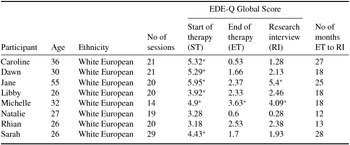
Ethical approval for the study was gained from the local NHS Research Ethics Committee. Service-users who had completed a standardized “CBT-E for ED” treatment protocol at the Eating Disorders Service (EDS), Cardiff within the previous 2 years were identified. Exclusion criteria were having dropped out of treatment or having a current acute mental or physical illness. Thirty-two people met the inclusion criteria and were invited to take part in the research by letter. Ten participants accepted the invitation; however two were unable to attend the interview due to personal circumstances. Eight individuals participated and were considered representative of the EDS service user population from their socio-demographic and clinical information (see Table 1). The number of months from end of therapy (ET) to research interview (RI) is also provided.
Participant demographics and psychometric scores

*Note: Scores met suggested clinical cut-off on the EDE-Q global score (Mond et al., Reference Mond, Hay, Rodgers and Owen2006).
Measures
The Eating Disorder Examination Questionnaire (EDE-Q; Fairburn and Beglin, Reference Fairburn and Beglin1994) was used pre and posttreatment and was repeated at the research interview to assess current symptomatology. Although authors of the EDE-Q recommend that subscale scores are reported alongside global score, for this research global scores are only provided to give an indication of severity and not for diagnostic purposes. Based on research investigating the norms of young women, a score of 3.36 and above on the global scale of the EDE-Q has been suggested as a clinical cut-off (Mond, Hay, Rodgers and Owen, Reference Mond, Hay, Rodgers and Owen2006). At interview (see Table 1), six individuals had maintained a good recovery. Two individuals (MichelleFootnote 1 and Jane) were experiencing difficulties with depression and weight concerns and further support was discussed.
Design
The research took place within the Cardiff and Vale EDS, an NHS service that offers evidence-based treatments (largely CBT) to individuals with ED. A retrospective design was employed using qualitative methodology guided by the principles of IPA (Smith et al., Reference Smith, Flowers and Larkin2009).
Service delivery and therapist information
Within the EDS, two part-time consultant clinical psychologists specialized in ED treatment and supervised 13 staff members via fortnightly supervision groups to deliver CBT-E. These “ED link therapists” were professionals from psychiatry, clinical psychology, nursing, dietetic and occupational therapy backgrounds. For the purposes of the research, a distinction was made between “specialist” and “generalist” therapists. The two consultant clinical psychologists were considered to be specialist therapists in the field of ED (as per recommendations by RCP, 2012), working solely in the specialist EDS for several years. The ED link therapists were considered to be generalist therapists with less experience in ED and working mainly within general mental health services (i.e. the CMHT). As a comparison, specialist therapists were likely to treat over 25 individuals with ED per year whereas generalist therapists were likely to treat fewer than 5 individuals with ED per year. Within the EDS, follow-up sessions were not provided on a routine basis.
The CBT-E intervention received
The CBT-E treatment is described by Fairburn (Reference Fairburn2008) and consisted of the following components: socialization to the model by means of generating a personalized formulation according to Fairburn, Cooper and Shafran (Reference Fairburn, Cooper and Shafran2003); establishing regular eating by means of food diaries being kept and reviewed within sessions; and in-session weighing to address avoidance and establish a healthy weight. Initial progress is reviewed and the remaining sessions aim to address key maintaining cognitive processes, including addressing the over-evaluation of shape and weight, body checking and “feeling fat”. If a “broad” version of CBT-E is deemed beneficial, one or more of the modules addressing “external” processes is used in addition (see Fairburn, Reference Fairburn2008). Finally, strategies and procedures to maintain progress are discussed.
Data collection and analysis
A semi-structured interview schedule was designed with four areas of enquiry: asking participants how they came to have CBT-E for BN; what aspects of CBT-E had been helpful or unhelpful; experiences at the time of discharge; and the impact of therapy on their current well-being and eating behaviours. Eight semi-structured interviews lasting 50–80 minutes were carried out and audio-recorded by LO. Semantic content was transcribed in full and anonymized at transcription.
Several guidelines (e.g. Elliott, Fischer and Rennie, Reference Elliott, Fischer and Rennie1999) were used as a framework for IPA to ensure methodological rigour during analysis. During the initial stage of analysis, the researcher began by reading and re-reading one interview transcript to become immersed in the participant's narrative and noting anything considered of interest or significance. The second stage of analysis involved recording emergent themes deemed to encapsulate the nature of the participant's experience. The themes were organized into clusters of concepts and these were given appropriate labels that were representative of their content.
Once all individual transcripts were analysed, themes across transcripts were integrated to produce a summary of master themes that reflected the relevant experiences of all the participants. During this process, master themes were checked against original transcripts to ensure the data remained consistent with participants’ narratives. Following integration of master themes with clusters of subordinate themes, analysis was considered to be complete. At each stage themes were discussed and developed through detailed collaboration with LW. The final thematic structure for these patterns was developed through discussion between LO, DW and TH.
Results
Qualitative analysis
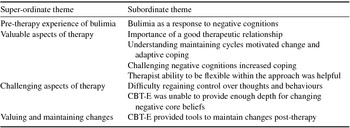
Following the IPA analysis, four super-ordinate themes were identified, each comprising further sub-ordinate themes (see Table 2). Super-ordinate themes were generated from evidence across all transcripts and are illustrated with a sample of quotes.
Super-ordinate and subordinate themes

Pre-therapy experience of bulimia nervosa
The first theme provides a context to individuals’ experiences of CBT-E, by illustrating shared experiences of difficulties prior to therapy.
Bulimia as a response to negative cognitions
All eight participants described overwhelming concerns with weight and dieting, with seven participants describing using food and bulimic behaviours as maladaptive coping and five women detailing a form of self-punishment:
It's the punishment for me, you know? I’m going to make myself feel really sick now - well it's just what you deserve. (Jane)
All individuals spoke of lengths taken to hide difficulties from others:
I’d hidden so much from [my husband]. . . He didn't know I was bulimic. He had no idea that I was using laxatives, that I’d been starving myself. That I felt that I just didn't want to be here anymore. (Caroline)
Each individual acknowledged ambivalence about seeking help, yet realizing they were unable to recover by themselves prompted the referral process.
Valuable aspects of therapy
This theme provided a description of the helpful elements of therapy, with six participants describing therapy as a valuable experience in prompting long-term changes in eating behaviours.
The importance of a good therapy relationship
Participants felt that a good relationship with their therapist was paramount to engagement, with six individuals believing a non-judgemental approach facilitated trust, openness and motivation to change. Five participants remarked on perceived therapist competence enhancing the therapeutic relationship and believed specialism in ED increased therapist empathy.
You could tell she had done it for years and really knew what she was doing. Having someone there that really understands who has almost been there because she had been there through other people, just made it easier. (Sarah)
By contrast:
Even though I would go to that doctor, it was really hard because I don't know whether she had experience herself with eating disorders, so I couldn't feel that she could empathize. So I’d felt as if I would say something, then she would say things back to me, from a doctor's point of view and something that she had learned, rather than something she could understand. So it was really hard. (Michelle)
Understanding maintaining cycles motivated change and adaptive coping
All individuals attributed gaining insight into triggers and maintaining cycles helpful when changing their relationship with food. Six participants felt that self-monitoring (e.g. food diaries) had increased awareness of cognitive and emotional triggers and four of the women described the formulation process as helpful.
Probably the best thing the therapy did for me was understanding it: that once you start eating a certain amount and you keep eating that amount, you’re not going to have the place where your energy levels drop too low and you need to binge because you’re desperate for food. (Natalie)
Challenging negative cognitions increased coping
Seven participants valued learning to challenge negative cognitions and felt that increased awareness helped to develop adaptive coping mechanisms.
[It helped to recognize] that when I felt negatively it sort of ended up turning into “I feel fat”. It was challenging going past the negative “I feel fat” into actually “what do I feel here?” and what would be the best way to try and access those feelings and do something positively about it. (Dawn)
I will get up and get a cup of tea, either read a book or do something proactive. . .if it's really bad I’ll go and write in the diary. I’ve got coping mechanisms now. (Libby)
Therapist ability to be flexible within the approach was helpful
Five individuals talked about helpful techniques that were deviations from the CBT-E protocol. Specialist therapists chose to incorporate techniques from other therapies when specific difficulties were not addressed within the CBT-E manual (e.g. childhood trauma, bereavement).
She got me to write a letter to my dad – never to give to him, it was just something that I wrote – and that was quite helpful as well. (Caroline)
Challenging aspects of therapy
The third theme reflected individuals’ experiences of aspects of therapy that they found to be unhelpful or challenging aspects.
Difficulty regaining control over thoughts and behaviours
Six participants described difficulties with changing behaviour “in the moment” due to the automatic and compulsive nature of maladaptive behaviours. Although participants showed awareness of thought challenging techniques, five experienced difficulties challenging negative thoughts in “real life” experiences.
It was really hard because you know all these things but, in that moment, thinking of these things is really difficult. (Sarah)
CBT-E was unable to provide enough depth for changing negative core beliefs
Five of the women experienced remaining difficulties with self-image and felt that CBT-E had focused on changing behavioural symptoms rather than changing core beliefs about self.
There was a lot dealing with your food, but not about how you were feeling inside about yourself, which is the bit I struggled with more - how I saw myself. (Rhian)
Valuing and maintaining changes
The final theme gives focus on ongoing changes that participants experienced following CBT-E. All eight participants experienced lapses in eating difficulties post-therapy. However, seven individuals viewed recovery as a process of managing lapses and found that continuing to use therapeutic tools was helpful.
The stuff you learn about the biology of the human body and all that helps me to stop myself relapsing because I know, I just know now. Even now, I have times when it's more difficult and I just have to remember what I’ve learnt. (Natalie)
Discussion
Summary of findings
The analysis identified four related themes to describe the process of therapy: pre-therapy experience of bulimia; valuable aspects of therapy; challenging aspects of therapy; and valuing and maintaining changes.
Pre-therapy experience of bulimia
Participants experienced BN as a debilitating problem that affected significant aspects of their lives. Themes of maladaptive coping and interpersonal difficulties, including feeling a need to punish oneself and hide difficulties from others, may reflect an underlying core belief of self-loathing and a corresponding sense of shame regarding their difficulties (Fairchild and Cooper, Reference Fairchild and Cooper2010).
Valuable aspects of therapy
Consistent with other studies, a good therapeutic relationship was considered an essential aspect of therapy (McManus, Peerbhoy, Larkin and Clark, Reference McManus, Peerbhoy, Larkin and Clark2010). Individuals valued the therapist being non-judgemental and empathic, facilitating openness and trust. Analysis revealed that individuals’ experience of therapist empathy was linked to therapist specialism in ED. Thwaites and Bennett-Levy (Reference Thwaites and Bennett-Levy2007) suggest that CBT therapists become more empathic through processing multiple therapeutic experiences. As the role of the clinical psychologist evolves into one of consultancy and the focus on improving access to psychological therapies leads increasingly to the recruitment of therapists from general mental health backgrounds, careful consideration needs to be given to the impact of therapist specialism.
Aspects of CBT-E considered helpful included gaining insight into maintaining cycles through psychoeducation, formulation and self-monitoring (Vanderlinden et al., Reference Vanderlinden, Buis, Pieters and Probst2007; McManus et al., Reference McManus, Peerbhoy, Larkin and Clark2010). Participants found experiential aspects of CBT-E helpful in transforming behaviours and cognitions and learning adaptive coping behaviours, providing good support for the hypothesized mediators of change in CBT-E, proposed by Fairburn (Reference Fairburn2008). Some individuals described helpful techniques that were not included in the CBT-E protocol and in all instances these were offered by specialist ED therapists. Fairburn (Reference Fairburn2008) clearly highlights the importance of adhering to the manual: “Experience can be a dangerous thing; the wise therapist adheres to the manual” and goes on to explain “More experienced therapists are tempted to deviate from the treatment protocol. This is not in the patient's interests” (p. 31).
As therapist adherence to the treatment manual was not monitored within the current research, this poses as a possible limitation of the study. One may argue the aim to investigate experiences of CBT-E relies on therapists adhering to the manual; however this design provided a useful insight into a “real-life” service rather than a controlled environment. Despite Fairburn's (Reference Fairburn2008) warning, most individuals experienced these “deviations” as extremely helpful, with others feeling inexperienced therapists were “just following the book”. Although caution in deviation from the manual is imperative, further research is needed as to whether experienced therapists go beyond the protocol in a helpful way, perhaps drawing from a range of strategies that can be tailored to the individual.
Challenging aspects of therapy
Individuals reported difficulty of changing behaviours “in the moment”, describing behaviours as “automatic” and “compulsive”. It may be that the addition of third generation therapies such as Mindfulness (Kabat Zinn, Reference Kabat Zinn1990) can assist individuals to become more aware and accepting of unhelpful behaviours and cognitions (Vanderlinden, Reference Vanderlinden2008). Furthermore, individuals described remaining difficulties with core perception of self. Criticisms of CBT suggest that it engages change at a surface level, seeking to identify and change processes that are easily accessible. Interventions that target deeper cognitive structures or underlying implicit emotional meanings (e.g. Schema Therapy; Young, Klosko and Weishaar, Reference Young, Klosko and Weishaar2003) may warrant further consideration.
Valuing and maintaining changes
Individuals described CBT-E as providing a welcome understanding and relief from ED through an increased sense of control over difficulties. Individuals felt more equipped to deal with remaining difficulties and continued to use therapeutic tools when needed. Shifts in cognitions were apparent, with individuals reporting an improved quality of life due to re-evaluating their relationship with weight and shape and improved relationships (Watson et al., Reference Watson, Allen, Fusland, Byrne and Nathan2012). This is a significant insight into the skills individuals learn from CBT-E that continue to be helpful post-therapy. It seems the practical tools allow individuals to monitor thoughts and behaviours independently of therapy. CBT-E appears to also help individuals readdress values and give other areas in their lives greater precedence, a process McManus et al. (Reference McManus, Peerbhoy, Larkin and Clark2010) describes as “re-engaging with the world” (p.588).
Further considerations of the research
Although methodological vigour was upheld throughout the research, there are a few considerations that are worth highlighting as possible limitations. First, the method of recruitment used produced participants who were self-selecting and the majority of participants had maintained good clinical progress. In addition, those who had not completed treatment were excluded. As drop-out rates in therapy can be high, these considerations may have created a bias in the sample. It is therefore important to recognize that information about unhelpful aspects of CBT-E may have been missed. Further research involving individuals who did not complete therapy may provide experiences of CBT-E different to those reported in this study.
The retrospective nature of the interview also needs highlighting. For some individuals they had received therapy 2 years prior to the research interview, which may have affected their recollection of the therapy and the therapeutic tools. Conversely, this delay may have allowed good consolidation of the therapy and its long term impact, providing a useful insight into how individuals continue to use therapeutic tools independently.
Conclusions
Conclusions drawn from this study must be interpreted in light of methodological limitations, in particular the small sample size and the focus on only one service providing CBT-E for BN. This research found that individuals experienced CBT-E as a helpful treatment, leading to positive outcomes maintained by the majority of individuals interviewed, even 2 years post-therapy. Factors relating to the therapeutic relationship, including the impact of therapist expertise on perceived empathy, together with factors related to specific intervention techniques, were reported to contribute to a successful therapeutic outcome. Specific to CBT-E, individuals valued understanding maintaining factors and developing adaptive coping. Remaining difficulties centred on negative core perceptions of self and body image. It is likely that these findings are not exhaustive and that other factors also contributed to individuals’ experience of therapy and therapeutic outcome. Further qualitative research may help to identify other factors that individuals believe to be important in CBT-E. Despite these considerations, the findings deliver an interesting additional perspective to the research field of CBT-E.



Comments
No Comments have been published for this article.