


Introduction
The prevalence of childhood trauma in young people attending first episode psychosis (FEP) services is high, with up to 82% reporting some type of trauma (Trauelsen et al., Reference Trauelsen, Bendall, Jansen, Nielsen, Pedersen and Trier2015). Not surprisingly, the co-morbidity of post-traumatic stress disorder (PTSD) and FEP is common, with one study finding that 61% of young people presenting with FEP and a history of trauma develop PTSD (Bendall et al., Reference Bendall, Alvarez-Jimenez, Hulbert, McGorry and Jackson2012). Furthermore, some individuals may experience their FEP and its treatment as extremely traumatic and subsequently develop post-traumatic symptoms or disorder as a consequence, and those who have experienced childhood trauma are at greater risk of traumatization from their psychotic experiences (Bendall et al., Reference Bendall, Alvarez-Jimenez, Hulbert, McGorry and Jackson2012). As such, it is important to intervene early after an individual has experienced an FEP, with studies showing that trauma symptoms attributable to the onset of psychosis respond effectively to psychological interventions (Jackson et al., Reference Jackson, Trower, Reid, Smith, Hall and Townend2009).
National clinical guidelines for psychosis recommend clinicians assess for trauma history and PTSD (Galletly et al., Reference Galletly, Castle, Dark, Humberstone, Jablensky and Killackey2016; NICE, 2014). However, guidelines differ as to whether those with co-morbid psychosis and PTSD should be offered an evidence-based treatment for PTSD (NICE, 2014) or not (Galletly et al., Reference Galletly, Castle, Dark, Humberstone, Jablensky and Killackey2016). This shows a lack of consensus on how to treat PTSD in those with psychosis, particularly with regard to treatment safety and tolerability. This is particularly the case for FEP, where there are no published trials for the treatment of PTSD from childhood trauma (Bendall et al., Reference Bendall, Alvarez-Jimenez, Nelson and McGorry2013). There is, however, agreement regarding the need for trials of interventions for the treatment of PTSD in those with psychosis (Galletly et al., Reference Galletly, Castle, Dark, Humberstone, Jablensky and Killackey2016; NICE, 2014).
The debate over the safety and tolerability of PTSD interventions is not confined to those with co-morbid psychosis. The effectiveness of trauma-focused treatments for PTSD as a primary diagnosis is supported by myriad evidence (Bisson et al., Reference Bisson, Roberts, Andrew, Cooper and Lewis2013). Several studies have found trauma-focused treatment for PTSD to be tolerable and safe, despite a minority of participants experiencing PTSD, anxiety or depression symptom exacerbation (Foa et al., Reference Foa, Zoellner, Feeny, Hembree and Alvarez-Conrad2002; Hundt et al., Reference Hundt, Barrera, Arney and Stanley2016; Jayawickreme et al., Reference Jayawickreme, Cahill, Riggs, Rauch, Resick, Rothbaum and Foa2014; Larsen et al., Reference Larsen, Wiltsey Stirman, Smith and Resick2016). Studies have shown that this minority of participants who experience symptom exacerbation do show improvements from treatment (Foa et al., Reference Foa, Zoellner, Feeny, Hembree and Alvarez-Conrad2002; Jayawickreme et al., Reference Jayawickreme, Cahill, Riggs, Rauch, Resick, Rothbaum and Foa2014; Larsen et al., Reference Larsen, Wiltsey Stirman, Smith and Resick2016); however, they were also more likely to retain their PTSD diagnosis compared with those who did not experience mid-treatment (i.e. in session four of twelve) exacerbations (Larsen et al., Reference Larsen, Wiltsey Stirman, Smith and Resick2016). Importantly though, when comparing symptom exacerbation in those on a waitlist compared with those in active treatment, those on the waitlist showed more exacerbations (Jayawickreme et al., Reference Jayawickreme, Cahill, Riggs, Rauch, Resick, Rothbaum and Foa2014), suggesting that the risk of symptom exacerbation during no treatment may be greater than any risk during trauma-focused treatment.
Despite this research, clinicians still have concerns about delivering trauma-focused treatments with an exposure component (Becker et al., Reference Becker, Zayfert and Anderson2004), in particular that ‘its ends do not justify its means’ (Deacon, Reference Deacon, Neudeck and Wittchen2012). This may be because past studies researching the participant's perspective have been consistent in their reports of initial worsening of PTSD symptoms, emotional exhaustion and other physical symptoms of anxiety during the exposure components of beneficial trauma-focused treatments (Hundt et al., Reference Hundt, Barrera, Arney and Stanley2016; Shearing et al., Reference Shearing, Lee and Clohessy2011; Vincent et al., Reference Vincent, Jenkins, Larkin and Clohessy2013). Thus, while trauma-focused treatment for PTSD is effective, it can also be difficult and distressing for participants to undertake.
This body of research has major implications for the development and trialling of interventions for PTSD in psychosis. There is limited research into treatments for individuals with this co-morbidity, partly due to the fact that psychosis is the most often applied exclusion criteria in trials of PTSD (Ronconi et al., Reference Ronconi, Shiner and Watts2014). One large randomized controlled trial, investigating prolonged exposure and eye movement desensitization and reprocessing for individuals with severe PTSD and chronic psychosis, found participants in both treatments had reduced PTSD symptoms at the end of treatment and follow-up. They also had less symptom worsening and less adverse events compared with those in the waitlist condition (van den Berg et al., Reference van den Berg, de Bont, van der Vleugel, de Roos, de Jongh, Van Minnen and van der Gaag2015, Reference van den Berg, de Bont, van der Vleugel, de Roos, de Jongh, van Minnen and van der Gaag2016). Furthermore, there were no occurrences of psychotic symptom exacerbation or increased suicidality in the first two active exposure sessions (van den Berg et al., Reference van den Berg, de Bont, van der Vleugel, de Roos, de Jongh, Van Minnen and van der Gaag2015, Reference van den Berg, de Bont, van der Vleugel, de Roos, de Jongh, van Minnen and van der Gaag2016). In fact, there was significant reduction in the severity of paranoid thoughts following trauma treatment (de Bont et al., Reference de Bont, van den Berg, van der Vleugel, de Roos, de Jongh, van der Gaag and van Minnen2016). This study supports the efficacy and safety of exposure-based trauma treatments for PTSD in those with psychosis. However, these findings may not completely allay clinicians’ fears that talking about trauma in a therapy session may induce exacerbation of psychotic symptoms before, during or after a treatment session (Frueh et al., Reference Frueh, Cusack, Grubaugh, Sauvageot and Wells2006; Gairns et al., Reference Gairns, Alvarez-Jimenez, Hulbert, McGorry and Bendall2015). In the study by van den Berg and colleagues (van den Berg et al., Reference van den Berg, de Bont, van der Vleugel, de Roos, de Jongh, van Minnen and van der Gaag2016), psychotic symptoms were measured at baseline, post-intervention, and immediately post-session in the first two (of up to seven) treatment sessions. No psychotic symptom exacerbations were found in any of these assessments, but whether exacerbations occurred immediately after the later exposure-based treatment sessions is unknown.
Additional research is required to expand this evidence base for clinicians to gain clarity regarding the safety and efficacy of treating PTSD in psychosis. This is especially the case for PTSD in FEP, as evidence is lacking in this area. There are likely to be differences in treatment needs, not least because those with FEP are experiencing the effects of their first episode of illness during a sensitive and complex stage of their development, which may be different from those who have adjusted to their illness over several years (McGorry and Edwards, Reference McGorry and Edwards1998).
The present study aimed to investigate, in young people with FEP, the experience of and reaction to, a treatment that includes distress management, comprehensive assessment of trauma and its effects, psychoeducation regarding trauma and trauma-based formulation, in order to better understand the safety and tolerability of a PTSD treatment in FEP. The descriptive accounts of participant responses to the intervention were analysed phenomenologically, and reported alongside their symptomatic and experiential outcome data in order to explore the experience of the ‘means’ compared to the ‘end’.
Method
Sample and context
Participants were recruited from a pilot trial of an intervention to address trauma for young people with FEP (Bendall, Reference Bendall2014). The trial took place at the Early Psychosis Prevention and Intervention Centre (EPPIC), within Orygen Youth Health, a publicly funded, mental health programme providing intensive outpatient treatment for young people aged 15–25 years with emerging psychotic disorders in Melbourne, Australia. The trauma intervention was conducted as part of cognitive behavioural-based case management within an 18-month to 2-year window of care. The intervention was integrated with other case management activities (EPPIC, 2010). The intervention was designed in collaboration between researchers and clinicians in order to meet the pragmatic needs of ‘real-world’ clinical practice. It was specifically tailored to address concerns regarding symptom exacerbation in order to facilitate its use in clinical practice.
The intervention treatment manual is not yet publicly available, therefore a detailed description of the relevant treatment modules is described here. The trauma intervention consisted of four modules, as follows:
-
(i) Safety, which consisted of skills development for noticing and communicating in-the-moment distress levels (using subjective units of distress); learning and practice of distress-coping strategies for use in and out of therapy; and assessment and treatment of safety concerns such as suicidality, self-harm and substance abuse;
-
(ii) Psychoeducation about the symptomatic effects of trauma including PTSD and dissociative symptoms;
-
(iii) Timeline, which is a comprehensive assessment centred on the development of a written timeline of major life experiences including trauma, and the onset and development of PTSD, depressive, dissociative and psychotic symptoms, suicidality and reduced functioning. This was conducted over between one and six sessions. While not designed as exposure treatment, it has been suggested that comprehensive assessment of trauma can act as a form of covert exposure (Krakow et al., Reference Krakow, Hollifield and Warner2000; van den Berg et al., Reference van den Berg, de Bont, van der Vleugel, de Roos, de Jongh, Van Minnen and van der Gaag2015); and
-
(iv) Formulation, which involved the collaborative conceptualization of the relationship between the trauma experienced and the development of subsequent symptoms, based on the knowledge the young person had gained through psychoeducation.
How and when module sessions were delivered in relation to other case management tasks was flexible and determined by the needs of the young person. Inclusion criteria for the pilot trial were (a) a DSM-IV psychotic disorder or mood disorder with psychotic features; (b) aged between 15 and 25 years; and (c) having current trauma symptoms. This was operationalized as meeting full criteria for PTSD [assessed using the Clinician Administered PTSD Scale (CAPS); Blake et al., Reference Blake, Weathers, Nagy, Kaloupek, Gusman, Charney and Keane1995]; or dissociation at clinical levels (25 or more on the Dissociative Experiences Scale; Bernstein and Putnam, Reference Bernstein and Putnam1986); or trauma exposure (assessed using a life events checklist adapted for young people from the Life Events Checklist; Gray et al., Reference Gray, Litz, Hsu and Lombardo2004) and the presence of psychotic symptoms related to that trauma (decided by research team consensus). Exclusion criteria for the trial were: (a) IQ less than 70, and (b) inability to speak English.
Procedure and measures
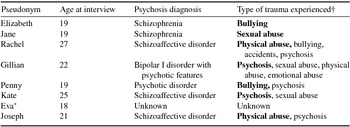
Following the baseline assessment, the intervention and the end of treatment assessment, the first 15 participants were invited to take part in a qualitative interview. Four (out of 15) young people were uncontactable after many attempts, leaving 11 individuals who consented and completed the interview. For the purposes of the current study, only those who fulfilled the PTSD trauma inclusion criteria were included to gain an understanding of reactions to talking about trauma from those who were experiencing both FEP and PTSD. This resulted in eight interviews being included in the analysis. Sample characteristics are presented in Table 1.
Participant characteristics

*Due to overwhelming levels of distress, Eva was unable to complete baseline and follow-up assessments; however, she still wanted to receive the intervention. †For participants with multiple traumas, the trauma in bold is the one considered most traumatic by participants and is the index trauma rated on the CAPS in Table 2.
All interviews were conducted by J.T.; J.T. had no prior relationship with the participants before conducting the research interviews. Interviews lasted between 15 and 75 minutes. Participants were reimbursed AUD$30 for their participation in the interview. All transcripts were audio recorded and transcribed in full by J.T.
Measures and semi-structured interview
The Structured Clinical Interview for DSM-IV (SCID-I; First et al., Reference First, Spitzer, Gibbon and Williams2002) was used to diagnose primary psychotic disorder at baseline. PTSD symptoms were measured at baseline and end of treatment using CAPS (Blake et al., Reference Blake, Weathers, Nagy, Kaloupek, Gusman, Charney and Keane1995); and psychotic symptom severity over the prior 2 weeks was measured at baseline and end of treatment using the Brief Psychiatric Rating Scale (BPRS; Ventura et al., Reference Ventura, Lukoff, Nuechterlein, Liberman, Green and Shaner1993).
The semi-structured interview was made up of open-ended questions to flexibly guide the interview. The opening question asked participants to reflect on their experience of the trauma intervention. Types of questions used to elicit responses were ‘Tell me about your experiences of. . .’. As much as possible, participants’ own words were used in subsequent questions. Participants were also asked to describe their experience of working through the timeline module with their case manager (e.g. ‘Tell me about doing the timeline’). Specifically, participants were asked to describe their experiences before (e.g. morning of), during (e.g. whilst in the room with case manager) and between treatment sessions (e.g. in the period between therapy appointments). Authors J.T., K.S. and S.B. contributed to the development of the interview questions. Interview questions were piloted on a young person (25 years) external to the study.
Coding process
An interpretative phenomenological approach (IPA) was used to analyse the data (Smith and Osborn, Reference Smith, Osborn and Smith2007). A phenomenological approach was chosen to keep the ‘voice’ of participants by focusing on their subjective psychological perspective. Each transcript was divided into units, with a new unit beginning when there was a spontaneous shift in the meaning of the narrative. Commonalities in the units and initial notes were clustered, forming emergent themes. This process was first completed for each transcript. Subsequently, emergent themes were identified and compared between transcripts. They were then redefined and renamed, and organized into a structure of superordinate and subordinate themes iteratively, guided by the data. All themes were critically examined by J.T., K.S. and S.B., and any disagreements were discussed until consensus was reached.
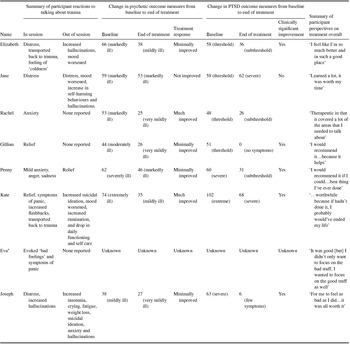
While other superordinate themes emerged from the data, only one (reactions to talking about trauma) will be presented in this paper. In order to generate a summary of each participant's reaction to talking about trauma (Table 2), relevant codes were extracted from each transcript, and key words were taken from participants’ accounts as summaries of their reactions (e.g. words such as ‘relieved’, ‘anxious’). Long sentences were condensed into concise phrases based on the essential meaning of the descriptive account (for example, ‘Sometimes it'd get pretty bad where I wouldn't do anything for a couple of days. . .I wouldn't even eat’ summarized as ‘drop in daily functioning and self care’).
Descriptive summary of participant reactions, their change in psychotic symptoms and PTSD symptoms from pre- to post-treatment, and their perspectives on treatment overall.

*Due to overwhelming levels of distress, Eva was unable to complete baseline and end of treatment assessments; however, she still wanted to receive the intervention.
Analysis was grounded in concrete, verbatim data extracts to illustrate the themes. Throughout the coding process, reflexivity within J.T. was encouraged via regular discussion with K.S. and S.B., and the use of a reflexive diary, allowing for any reactions, biases or assumptions to come to the foreground. Guidelines for publication of qualitative studies (Tong et al., Reference Tong, Sainsbury and Craig2007) were followed to ensure research credibility.
Treatment outcome
To measure treatment response, a 15-point change in the CAPS total severity score was used to mark clinically significant improvement (Weathers et al., Reference Weathers, Keane and Davidson2001). For the BPRS, response to treatment was defined as ‘minimally improved’ with a reduction of at least 25% from baseline scores, and as ‘much improved’ with a reduction of between 50 and 55% from baseline scores (Leucht et al., Reference Leucht, Kane, Kissling, Hamann, Etschel and Engel2005; Peuskens and Link, Reference Peuskens and Link1997). Participants’ perspectives on the overall intervention experience and/or outcome are presented in Table 2 to provide a general sense of how they viewed the intervention at completion.
Ethics
The study was approved by Melbourne Health Human Research Ethics Committee (reference number 2012.68) and Monash University Human Research Ethics Committee (reference number CF14/2035-2014001024). The authors assert that all procedures contributing to this work comply with the ethical standards of the Australian National Statement on Ethical Conduct in Human Research and the Helsinki Declaration of 1975, and its most recent revision. The interviewer was observant to signs of discomfort or distress during the interview, and participants were advised they did not have to answer any questions where they were not comfortable in responding.
Results
Pseudonyms are used to preserve the anonymity of participants. The use of dots in participants’ quotes indicates truncated text.
Half of the participants were under the age of 20, and seven of the eight participants were female. Of the seven participants who completed all assessments, six showed improvements in their psychosis symptoms as well as clinically significant improvements in their PTSD symptoms.
Participants described mixed reactions in response to talking about their trauma in session. Participants talked about reactions that occurred in session with their case manager, as well as after their session. Table 2 presents a summary of participant responses (both in session and immediately after session), their outcome scores and a brief description of their perspectives on the intervention overall.
Three subthemes formed the superordinate theme of ‘Reactions to talking about trauma’ (see Table 3).
Superordinate and subordinate themes arising from analysis of participants’ transcripts of their reactions to talking about trauma.

Distress in session
Seven participants (88%) described feelings of distress in session as an immediate reaction to talking about trauma. Distress in this case is an overarching term to encapsulate experiences of negative affect (use of words such as ‘bad’, ‘horrible’, felt ‘worse’), sadness, anxiety, and anger.
For two participants, their distress was due to the experience of being transported back to their trauma and subsequently experiencing similar emotions to what they felt at the time of the trauma.
‘I was just talking about it and all of a sudden I felt like I was there, and my anxiety shot up and I felt all this pain and misery.’ – Elizabeth
For a few participants, their distress was overwhelming and manifested as panic symptoms.
‘Sometimes I was actually doing good but talking at it would bring up bad feelings. . . physically my heart was beating so fast. . . I had a lump in my throat, I was sweating. My hands were sweating.’ – Eva
Feeling relieved in session and out of session
Three participants (38%) described feelings of relief in and out of session. This was largely due to participants feeling able to disclose the details of their trauma to their case manager, and the underlying emotions associated with doing so. Two of these three reported they felt they were a ‘better person’ after their therapy sessions, and attributed this to having a new understanding of past events.
For Kate, talking about trauma was a double-edged sword with initial feelings of relief in conjunction with distress in session, then subsequent symptom exacerbation.
‘The good part [about] telling [my case manager] was just, you know, someone else knows about it. It's like, I've been hiding something and letting it out feels just, good.’ – Kate
Symptom exacerbation out of session
Four participants (50%) described experiencing a range of symptoms outside of session; these included flashbacks, feelings of distress, insomnia, weight loss, suicidal ideation, self-harming behaviours, and hallucinations.
‘I spent a lot of nights, sleepless nights, crying and my psychosis did get worse [working through the timeline]. It did get worse. And I just had to, I had to deal with that. . .there's a rock bottom right and I think I hit it a couple of times in that patch’ – Joseph
Three participants (38%) described experiences of increased hallucinations outside of session. This was attributed to being a reaction to having talked about trauma in session or having ‘delved into an issue’ in more detail.
‘If [my case manager and I] talked about it for too long or too much or we dive into a painful thing then I would hear things or see things’ – Elizabeth
Elizabeth considered her hallucinations a ‘reaction to the pain and misery’ she was feeling. For Jane, her increased hallucinations were related to feelings of isolation during treatment. She also reported an increase in self-harming as a way of coping with ruminating over the trauma content discussed in therapy.
Participants described reacting to the associated emotions that arose after talking about their trauma. Kate experienced an increase in suicidal ideation and drop in her daily functioning outside of session and felt these changes were related to her feelings of guilt and stress, emotions that were evoked from discussions about her trauma in session.
Discussion
Summary of findings
Participants reported varied reactions in response to talking about trauma. These ranged from a cathartic experience, to temporary anxiety, distress and PTSD symptoms, and in some instances, to psychotic symptom exacerbation. All but one participant reported feeling distressed in session and during the process of talking about their trauma. Half of the participants experienced distress and/or symptom exacerbation outside of session. All participants described the intervention as having been beneficial and worthwhile, or that they would recommend it for other young people with FEP.
Relief
Three participants (38%) described feeling relieved in and out of session. Our findings demonstrate that relief can be experienced during the act of talking about trauma in session, as well as after the session. It has been suggested that relief can occur as part of the later phases of emotion processing, and may be associated with the ‘physical outpour’ of words (Bady, Reference Bady1985; Pascual-Leone, Reference Pascual-Leone2009). All participants who reported experiencing relief showed clinically significant improvement in their PTSD symptoms.
Distress, temporary anxiety and PTSD symptom exacerbation
Seven out of eight participants (88%) experienced distress and temporary anxiety in session. Of these seven, five showed clinically significant reductions in PTSD symptoms and improvement in psychotic symptoms over the course of treatment (one did not and the other's outcome scores are unknown). One participant (13%) experienced PTSD symptoms in and out of session. The exposure component of trauma treatment is designed to elicit and process distress in a safe therapeutic environment so distress, fear and self-perceived PTSD symptom worsening in the earlier stages of treatment must be expected and carefully managed (Foa et al., Reference Foa, Zoellner, Feeny, Hembree and Alvarez-Conrad2002; Hundt et al., Reference Hundt, Barrera, Arney and Stanley2016). This is supported by findings from primary PTSD studies where participants have shown or described initial worsening of PTSD symptoms and distress during and immediately after trauma therapy sessions but have then reported symptom improvement at the end of treatment (Foa et al., Reference Foa, Zoellner, Feeny, Hembree and Alvarez-Conrad2002; Hundt et al., Reference Hundt, Barrera, Arney and Stanley2016; Dittman and Jensen, Reference Dittmann and Jensen2014; Vincent et al., Reference Vincent, Jenkins, Larkin and Clohessy2013). Our findings show the same pattern of distress in session and PTSD symptom improvement in most cases of young people with FEP and PTSD as has been found in primary PTSD studies.
Psychotic symptom exacerbation
Three participants (38%) described psychotic symptom exacerbation during the course of their trauma-focused treatment. Two of those showed PTSD symptom reduction at the end of treatment (Table 2), demonstrating that in at least two participants, psychotic symptom worsening during treatment did not impede their improvement in PTSD symptoms. It is possible that psychotic symptoms may follow a similar pattern to PTSD symptoms, where studies have shown PTSD symptom exacerbation during treatment to be unrelated to post-treatment improvement and rate of PTSD diagnosis at end of treatment (Foa et al., Reference Foa, Zoellner, Feeny, Hembree and Alvarez-Conrad2002; Hundt et al., Reference Hundt, Barrera, Arney and Stanley2016), despite the recent non-replication of this finding in one study (Larsen et al., Reference Larsen, Wiltsey Stirman, Smith and Resick2016).
In contrast to studies in schizophrenia (de Bont et al., Reference de Bont, van den Berg, van der Vleugel, de Roos, de Jongh, van der Gaag and van Minnen2016; Frueh et al., Reference Frueh, Grubaugh, Cusack, Kimble, Elhai and Knapp2009; van den Berg et al., Reference van den Berg, de Bont, van der Vleugel, de Roos, de Jongh, Van Minnen and van der Gaag2015), we found indications of psychotic symptom exacerbation in young people with FEP and PTSD undergoing trauma treatment. There are three possible reasons for this. First, this may reflect differences in the FEP versus schizophrenia samples. The typical age of onset for FEP is in late adolescence or early adulthood (Kessler et al., Reference Kessler, Amminger, Aguilar-Gaxiola, Alonso, Lee and Ustun2007). Characteristics that may be more common in late adolescence such as unstable levels of motivation, rapid and intense mood fluctuations, and complex individuation from family structures, may add to treatment complications (Rosner et al., Reference Rosner, Konig, Neuner, Schmidt and Steil2014). Furthermore, individuals at EPPIC are on low-dose antipsychotics and may therefore be more reactive compared with those with schizophrenia generally receiving higher doses of medication with more stabilized symptoms. Thus, psychotic symptom exacerbation may be more likely when young people with FEP experience distress. Second, the current study measured psychotic symptom exacerbation by asking for retrospective descriptions over the course of the treatment allowing any such experiences to emerge. Other studies either did not assess for psychotic symptoms at all (Frueh et al., Reference Frueh, Grubaugh, Cusack, Kimble, Elhai and Knapp2009) or assessed them at certain time points (van den Berg et al., Reference van den Berg, de Bont, van der Vleugel, de Roos, de Jongh, van Minnen and van der Gaag2016), possibly resulting in missed psychotic symptom exacerbations. It is also possible that the unconventional strategy for talking about trauma (i.e. the timeline) did not induce the same psychological processes that reduce PTSD symptoms in traditional exposure-based treatments. However, the outcome data signalling improvements in PTSD and the process data described above suggest that the timeline did act as exposure. The safety and timeline modules together were specifically designed to deliver a much smaller ‘dose’ of exposure to traumatic memories than traditional exposure-based treatments, which would suggest the intervention would lead to less distress. However, this requires more research to clarify.
Suicidal ideation
The issue of suicidal ideation is an important one. Two participants (25%) experienced increased suicidal ideation during treatment. Both of these participants had a clinically significant reduction in their PTSD symptoms at the end of treatment (however, one still retained a PTSD diagnosis) and both described the intervention as having been ‘worthwhile’, despite experiencing increased suicidal ideation. In their subjective accounts, these young people viewed their increased suicidal ideation as partly related to the act of recounting their trauma memories. This is contrary to the findings of a recent study for PTSD in schizophrenia where no increases in suicidal ideation were reported in the first two sessions after exposure was introduced (van den Berg et al., Reference van den Berg, de Bont, van der Vleugel, de Roos, de Jongh, van Minnen and van der Gaag2016). Suicidal ideation was measured at baseline, post-intervention and immediately post-session in the first two active treatment sessions (e.g. sessions two and three); it is therefore not known if there were any increases in suicidal ideation immediately after exposure-based treatment sessions in the later weeks of treatment.
Surprisingly, investigations on the impact of exposure treatment on suicidality in primary PTSD have been minimal (van Minnen et al., Reference van Minnen, Zoellner, Harned and Mills2015). These results suggest that, when talking about trauma, clinicians should be vigilant for the possibility of worsening suicidality, employ safety planning, and furnish young people with strategies to combat suicidal ideation. More research is required in the area of suicidal ideation as part of the process of PTSD treatment in psychosis.
Limitations
Our study holds a number of limitations. Our sample size was small, thus limiting the generalizability of the findings. Furthermore, past research has evidenced that not receiving treatment (i.e. being on the waitlist control) has also led to symptom exacerbation, and as our parent study lacked a control condition, we are unable to compare the presence and rate of symptom exacerbation across treatment conditions. We were also unable to obtain further information about the four participants who were uncontactable, and it is possible these four participants had more challenging experiences compared with our sample.
Research implications
This small qualitative study was designed to detect clinically important subjective experiences that clinicians anecdotally report might be a feature of treatment for trauma in FEP. The finding of evidence of psychotic symptom exacerbation and suicidal ideation in this small group indicates a clear need for further research in this area. Moving forward, more clinical trials (with both qualitative and quantitative components) need to be undertaken to further investigate both outcome and psychotic symptom exacerbation in trauma treatments for FEP. While the majority of clients in this study may not have experienced psychotic symptom worsening during treatment, the experiences of those who do need to be researched further. Focusing on the experiences of individuals whose reactions deviate from the expected (e.g. individuals who drop out of treatment; individuals who do not exhibit symptom improvement; or individuals who report symptom exacerbation as part of trauma treatment in FEP) will provide insight into how treatments can be improved to enhance the safety and tolerability of trauma-focused treatments. Furthermore, clinicians and their clients will also be better informed about the risks of active treatment compared with no treatment, which also holds risks. Furthermore, research should also investigate the relationship between psychotic symptom exacerbations and treatment outcomes, to potentially identify individual characteristics that are associated with both these variables.
Clinical implications
Our results bring to light the complex relationship between the subjective experience of undertaking a trauma-focused treatment for PTSD as a young person with FEP, and the experiential and symptomatic outcomes of that trauma intervention. Without process and outcome data from a randomized clinical trial on an intervention for PTSD in FEP, it is difficult to make clinical recommendations at this time.
Our study highlights the clinical paradox of talking about trauma, where the process can be distressing (and in early psychosis may be related to temporary psychotic symptom worsening) but ultimately be experienced as beneficial. Our data also suggest that clinicians working with PTSD and FEP should expect their clients to present at times with increased distress and anxiety, and may report fluctuating PTSD and/or psychotic symptoms throughout the course of the trauma intervention. However, fluctuating symptoms and expressions of distress during treatment is not necessarily indicative of treatment non-response. Clinicians should, however, appropriately manage clients’ distress and symptoms before continuing the trauma narrative.
Clients need to be clearly informed of the potential side-effects of trauma treatments, which may present in the form of distress and/or worsening PTSD/psychotic symptoms and/or relief. Relief as a potential side-effect of talking about trauma for young people with PTSD and FEP may challenge clinicians’ concerns regarding the safety and tolerability of trauma-focused treatments for this group (Gairns et al., Reference Gairns, Alvarez-Jimenez, Hulbert, McGorry and Bendall2015).
It may be helpful to provide anecdotal examples of possible reactions to ensure that clients have a clear understanding of what the potential risks are. The nature of exposure-based treatments require a higher degree of vigilance to the processes of informed consent (Deacon, Reference Deacon, Neudeck and Wittchen2012). The emphasis should be placed on actively involving the client in a dialogue about autonomy and choice in every session of the intervention.
Our intervention was conducted within an early intervention service with ready access to in-patient and crisis services, assertive outreach and case management alongside therapy. It may be that until more is known about psychotic symptom exacerbation in trauma treatment, such interventions should be conducted within systems that have the resources to contain and manage symptom exacerbation.
Acknowledgements
We would like to thank Dr J. Sabura Allen for her contributions at the beginning of this project. We are grateful to all participants for speaking so openly about their experiences of therapy. This research was undertaken in partial fulfilment of the requirements of the Doctor of Psychology (Clinical) for Janet Tong, validated by Monash University.
Financial support: Sarah Bendall was supported by a fellowship from the Australian National Health and Medical Research Council (APP1036425). The research project was supported by a grant from Australian Rotary Health.
Conflicts of interest: None.




Comments
No Comments have been published for this article.