



1. Introduction
Let  $K$ be either a number field or
 $K = {\kappa }(C_K)$ the field of functions of a regular projective curve
 $C_K$ defined over an arbitrary field
 $k$. Equivalently,
 $K$ is a finite extension of
 $K_0$, where
 $K_0$ denotes either
 ${\mathbb {Q}}$ or
 $k(T)$. We let
 $\Sigma _K$ be the set of places of
 $K$ and we fix an algebraic closure
 $\bar {K}$ of
 $K$. Let
 $\pi \colon X \rightarrow \operatorname {\mathrm {Spec}} K$ be a geometrically integral and normal projective variety on
 $\operatorname {\mathrm {Spec}} K$ and let
 $d= \dim X$. We consider an adelic
 ${\mathbb {R}}$-Cartier divisor
 $\bar {D}$ on
 $X$ with continuous metrics, and we denote by
 $h_{\bar {D}} \colon X(\bar {K}) \rightarrow {\mathbb {R}}$ the height function associated to
 $\bar {D}$ (see § 3 for details). The notion of adelic
 ${\mathbb {R}}$-divisors is due to Moriwaki [Reference MoriwakiMor16], and generalizes that of adelic line bundles in the sense of Zhang [Reference ZhangZha95b]. The essential minimum of
 $\bar {D}$ is defined by
 \[ \zeta_{\mathrm{ess}}(\bar{D}) = \sup_{Y \subsetneq X} \inf_{x \in X(\bar{K}) {\setminus} Y} h_{\bar{D}}(x), \]
where the supremum is taken over the Zariski-closed proper subschemes  $Y \subsetneq X$. This invariant is of considerable importance in Diophantine geometry. The celebrated Bogomolov conjecture can be stated in terms of lower bounds for
 $\zeta _{\mathrm {ess}}(\bar {D})$, which are required to be explicit in the effective version of the conjecture. Such bounds have been studied extensively and have applications to other problems in Diophantine geometry and Arakelov geometry. A striking example is given by Zhang's inequalities on successive minima [Reference ZhangZha95a, Theorem 5.2] (see Theorem 1.4 below), which also play an important role in equidistribution problems. Indeed, classical equidistribution theorems (including those of Szpiro, Ullmo and Zhang [Reference Szpiro, Ullmo and ZhangSUZ97], Favre and Rivera-Letelier [Reference Favre and Rivera-LetelierFR06], Chambert-Loir [Reference Chambert-LoirCha06], Baker and Rumely [Reference Baker and RumelyBR06], Yuan [Reference YuanYua08] and Berman and Boucksom [Reference Berman and BoucksomBB10]) are applicable only when equality holds in Zhang's theorem (see [Reference Burgos Gil, Philippon, Rivera-Letelier and SombraBPRS19, Reference Burgos Gil, Philippon and SombraBPS15] and § 1.2 below). The invariant
 $\zeta _{\mathrm {ess}}(\bar {D})$ is also related to important problems in geometry of numbers. Indeed, when
 $X = {\mathbb {P}}^{d}_K$ is a projective space the essential minimum encodes crucial arithmetic information of euclidean lattices, or more generally hermitian
 $K$-vector spaces (see [Reference Gaudron and RémondGR13, Reference Gaudron and RémondGR17] and § 1.3 below).
In [Reference Burgos Gil, Philippon and SombraBPS15], Burgos Gil, Philippon and Sombra proposed an innovative study of the essential minimum for toric metrized divisors on toric varieties based on convex analysis, and showed that in this case  $\zeta _{\mathrm {ess}}(\bar {D})$ coincides with the maximum of a concave function defined on the (geometric) Okounkov body of
 $D$. In joint work with Rivera-Letelier [Reference Burgos Gil, Philippon, Rivera-Letelier and SombraBPRS19], they applied this result to investigate new situations in which equidistribution phenomena occur (in the toric setting). The results of [Reference Burgos Gil, Philippon and SombraBPS15] and [Reference Burgos Gil, Philippon, Rivera-Letelier and SombraBPRS19] give a completely new understanding of the essential minimum when
 $\bar {D}$ is a toric metrized divisor. However, the toric assumption on the metrics is rather restrictive (even in the case
 $X = {\mathbb {P}}_K^{d}$), and confers a very specific behaviour on the essential minimum. To give a better understanding of the invariant
 $\zeta _{\mathrm {ess}}(\bar {D})$ in the general case is an important topic of research, in which many interesting questions remain unanswered.
In [Reference ChenChe10b], Chen introduced an invariant measuring the asymptotic minimal size of global sections of a hermitian line bundle. For any integer  $n \geq 1$, the
 $K$-vector space
 $V_n:= H^{0}(X,nD)$ is equipped with a supremum norm
 $\|\cdot \|_{v,\sup }$ for each place
 $v$ of
 $K$. Let
 $v_0 \in \Sigma _{K_0}$ be a place of
 $K_0$. We denote by
 $\lambda _{\max ,n}(\bar {D})$ the supremum of the real numbers
 $t$ for which there exists a non-zero function
 $\phi \in V_n$ such that for every place
 $v \in \Sigma _K$,
 \[ \|\phi\|_{v,\sup} \leq \left\{\begin{array}{@{}ll} e^{{-}t} & \textrm{if}\ v | v_0,\\ 1 & \textrm{otherwise}. \end{array} \right. \]
When  $D$ is big, the sequence
 $(\lambda _{\max , n}(\bar {D})/n)_{n \in {\mathbb {N}}}$ converges in
 ${\mathbb {R}}$. Following [Reference ChenChe10b], we call its limit the asymptotic maximal slope of
 $\bar {D}$ and denote it by
 ${\hat {\mu }^{\mathrm {asy}}_\mathrm {max}}(\bar {D})$. The following conjecture of Chen relates this invariant to the essential minimum.
Conjecture 1 ((Chen)) Assume that  $\bar {D}$ is semi-positive and that the underlying divisor
 $D$ is big. Then
 $\zeta _{\mathrm {ess}}(\bar {D}) = {\hat {\mu }^{\mathrm {asy}}_\mathrm {max}}(\bar {D})$.
An explicit statement of this conjecture can be found in [Reference ChenChe19, Conjecture 4.1] and [Reference ChenChe18, § 5.3]. Although it appeared recently in the literature, Conjecture 1 has been known to experts in Arakelov geometry for some time and the potential relations between the essential minimum and the asymptotic slope were already discussed in the work of Chen on the differentiability of the arithmetic volume [Reference ChenChe11, § 5.2] (together with applications to equidistribution). In the particular case of a toric metrized divisor on a toric variety, Conjecture 1 is a consequence of the work of Burgos Gil, Philippon and Sombra [Reference Burgos Gil, Philippon and SombraBPS15] on the essential minimum (see [Reference Burgos Gil, Philippon and SombraBPS15, Corollary 3.10] and the discussion preceding Theorem 1.1 below). The behaviour of  $\zeta _{\mathrm {ess}}(\bar {D})$ is more subtle in the non-toric setting, and the conjecture remains open in general. The relevance of Conjecture 1 is to suggest a completely new approach to study the essential minimum, allowing one to compute
 $\zeta _{\mathrm {ess}}(\bar {D})$ only in terms of the arithmetic of the graded linear series
 $V_\bullet := \bigoplus _{n \in {\mathbb {N}}} V_n$. It also has deep applications in geometry of numbers, as we will see in § 1.3.
The main achievement of this paper is a proof of Conjecture 1 (see Theorem 1.2 below). Our approach starts with the equivalence
 \begin{equation} {\hat{\mu}^{\mathrm{asy}}_\mathrm{max}}(\bar{D}) > 0 \Longleftrightarrow \bar{D} \text{ is big} \end{equation}
due to Chen (see, for example, [Reference ChenChe10a, Proposition 3.11], or Proposition 5.5 below). Here the condition that  $\bar {D}$ is big means that it has a positive arithmetic volume
 $\widehat {\operatorname {\mathrm {vol}}}(\bar {D}) > 0$ (see § 3.3 for details). Using (1.1) and rescaling norms, we shall see that Conjecture 1 is equivalent to the following theorem, which is the key result of this paper. We say that
 $\bar {D}$ is pseudo-effective if
 $\bar {D} + \bar {B}$ is big for any big adelic
 ${\mathbb {R}}$-Cartier divisor
 $\bar {B}$.
Theorem 1.1 (Theorem 4.1)
Assume that  $\bar {D}$ is semi-positive and that
 $D$ is big. Then we have the equivalence
 \[ \zeta_{\mathrm{ess}}(\bar{D}) \geq 0 \Longleftrightarrow \bar{D} \text{ is pseudo-effective}. \]
When  $D$ is big and
 $\bar {D}$ is pseudo-effective, it is not hard to see that
 $\zeta _{\mathrm {ess}}(\bar {D})\geq 0$. The other implication in the theorem is more challenging. To outline the strategy of the proof, we consider the following simplified setting:
 $K= {\kappa }(C_K)$ is a function field and there exists a normal and proper model
 $\pi _{\mathcal {X}} \colon \mathcal {X} \rightarrow C_K$ of
 $X$, together with a relatively nef
 ${\mathbb {R}}$-Cartier divisor
 $\mathcal {D}$ on
 $\mathcal {X}$, such that for any
 $v \in \Sigma _K$ the metric on
 $D$ at the place
 $v$ is induced by
 $\mathcal {D}$. We have the following Cartesian diagram.

In this case, we can interpret the height function as an intersection number. More precisely, for any point  $x \in X(\bar {K})$ with residue field
 ${\kappa }(x)$, we have
 \[ h_{\bar{D}}(x) = \frac{\mathcal{D} \cdot C_x}{[ {\kappa}(x) : K_0]}, \]
where  $C_x$ is the Zariski closure of
 $x$ in
 $\mathcal {X}$. Note that
 $C_x \subset \mathcal {X}$ is an integral curve and
 $\pi _{\mathcal {X}}(C_x) = C_K$. The key ingredient of the proof is a deep theorem of Boucksom, Demailly, Păun and Peternell [Reference Boucksom, Demailly, Păun and PeternellBDPP13], which states that the pseudo-effective cone of
 $\mathcal {X}$ is dual to the cone of movable curves. If
 $\mathcal {D}$ is not pseudo-effective, this result implies the existence of a family of integral curves
 $(C_t)_{t \in T}$ covering a dense subset of
 $\mathcal {X}$ and such that
 $\mathcal {D}\cdot C_t < 0$ for any
 $t \in T$. Since
 $\mathcal {D}$ is relatively nef by assumption, all the curves
 $C_t$ are horizontal, that is,
 $\pi _{\mathcal {X}}(C_t) = C_K$ for every
 $t \in T$. If we denote by
 $\eta _t \in X(\bar {K})$ the generic point of
 $C_t$ for every
 $t \in T$, the set
 \[ \Lambda_T = \{\eta_t \mid t \in T\} \subset X(\bar{K}) \]
is dense and consists of points with negative height, hence  $\zeta _{\mathrm {ess}}(\bar {D}) \leq 0$. By contraposition, this proves the implication
 \[ \zeta_{\mathrm{ess}}(\bar{D}) > 0 \implies \bar{D} \text{ is pseudo-effective}. \]
If  $\zeta _{\mathrm {ess}}(\bar {D}) = 0$, the above implication together with a limit argument shows that
 $\bar {D}$ is also pseudo-effective. When
 $K$ is a number field, we use arithmetic intersection theory to adapt the above argument. We first reduce the problem to a fixed model and work with an arithmetic variety on
 $\operatorname {\mathrm {Spec}} {\mathcal {O}}_K$, and then apply an arithmetic analogue of Boucksom, Demailly, Păun and Peternell's theorem due to Ikoma [Reference IkomaIko15b]. To do so we also use an arithmetic Bertini-type theorem due to Moriwaki [Reference MoriwakiMor95].
One can interpret Theorem 1.1 as a numerical criterion for arithmetic pseudo-effectiveness. As mentioned before, it is equivalent to Conjecture 1 (see Remark 5.7). We will prove the following theorem, which also gives an analogue of Conjecture 1 relating the absolute minimum  $\zeta _{\mathrm {abs}}(\bar {D}) := \inf _{x \in X(\bar {K})}h_{\bar {D}}(x)$ and the asymptotic minimal slope
 ${\hat {\mu }^{\mathrm {asy}}_\mathrm {min}}(\bar {D})$ (see Definition 5.2). The latter relies on an arithmetic Nakai–Moishezon criterion due to Zhang [Reference ZhangZha95a], generalized by Chen and Moriwaki [Reference Chen and MoriwakiCM19].
Theorem 1.2 (Theorem 5.6)
Assume that  $\bar {D}$ is semi-positive and that
 $D$ is big. Then
 \[ \zeta_{\mathrm{ess}}(\bar{D}) = {\hat{\mu}^{\mathrm{asy}}_\mathrm{max}}(\bar{D}). \]
If, moreover,  $D$ is a semi-ample
 ${\mathbb {Q}}$-divisor, then
 \[ \zeta_{\mathrm{abs}}(\bar{D}) = {\hat{\mu}^{\mathrm{asy}}_\mathrm{min}}(\bar{D}). \]
We present applications of Theorem 1.2 in two directions. In the spirit of [Reference Burgos Gil, Philippon and SombraBPS15], we first give an interpretation of the essential minimum through convex analysis, and study some consequences for Zhang's theorem on minima. Secondly we apply Theorem 1.2 to projective spaces to study successive minima of hermitian vector spaces.
1.1 Essential minimum and Okounkov body
Assume that  $D$ is big. In [Reference Burgos Gil, Philippon and SombraBPS15], Burgos Gil, Philippon and Sombra proposed a systematic study of the essential minimum when
 $\bar {D}$ is a toric metrized divisor on a toric variety. The main theorem of [Reference Burgos Gil, Philippon and SombraBPS15] (Theorem A) relates
 $\zeta _{\mathrm {ess}}(\bar {D})$ to the maximum of the roof function
 $\vartheta _{\bar {D}} \colon \Delta \rightarrow {\mathbb {R}}$, which is a concave function encoding arithmetic data of
 $\bar {D}$ and defined on the Okounkov body
 $\Delta$ of
 $D$. The latter is a convex body in
 ${\mathbb {R}}^{d}$ and was introduced independently in the seminal papers of Lazarsfeld and Mustaţă [Reference Lazarsfeld and MustaţăLM09] and Kaveh and Khovanskii [Reference Kaveh and KhovanskiiKK12]. In the toric case, the Okounkov body is an intrinsic data of
 $D$. In general, the definition is more complicated and depends on the choice of a system of parameters
 $\mathbf {z}$ on
 $X_{\bar {K}}$ (see § 6.1 for details). However, using Theorem 1.2, we will be able to generalize [Reference Burgos Gil, Philippon and SombraBPS15, Theorem A] to the case where
 $X$ is not necessarily toric. Let
 $\Delta _{\mathbf {z}}(D)\subset {\mathbb {R}}^{d}$ be the Okounkov body of the divisor
 $D \in \operatorname {\mathrm {Div}}(X)_{\mathbb {R}}$ defined with respect to a given system
 $\mathbf {z}$. In [Reference Boucksom and ChenBC11], Boucksom and Chen introduced a function
 $G_{\bar {D},\mathbf {z}}\colon \Delta _{\mathbf {z}}(D) \rightarrow {\mathbb {R}} \cup \{-\infty \}$, called the concave transform of
 $\bar {D}$. The function
 $G_{\bar {D},\mathbf {z}}$ generalizes to the non-toric case the roof function
 $\vartheta _{\bar {D}}$ of Burgos Gil, Philippon and Sombra (see [Reference Burgos Gil, Moriwaki, Philippon and SombraBMPS16, Introduction]). It turns out that the maximum of the concave transform coincides with the asymptotic maximal slope. As a consequence of Theorem 1.2, we have the following corollary.
Corollary 1.3 (Proposition 7.1)
If  $D$ is big, then
 $\zeta _{\mathrm {ess}}(\bar {D}) \geq \max _{\alpha \in \Delta _{\mathbf {z}}(D)}G_{\bar {D},\mathbf {z}}(\alpha )$, with equality if
 $\bar {D}$ is semi-positive.
When  $\bar {D}$ is semi-positive and
 $D$ is big, this corollary allows us to read the essential minimum directly on the Okounkov body of
 $D$. In addition to the theoretical interest of this result, its relevance lies in the fact that several invariants associated to
 $\bar {D}$ can be easily computed using the concave transform [Reference Boucksom and ChenBC11, §§ 2.4 and 3.1]. For example, we have the following formula [Reference Boucksom and ChenBC11, Theorem 3.1] for the
 $\chi$-volume
 $\widehat {\operatorname {\mathrm {vol}}}_{\chi }(\bar {D})$ of
 $\bar {D}$ (under mild positivity assumptions on
 $\bar {D}$; see § 6.3 for details):
 \begin{equation} \widehat{\operatorname{\mathrm{vol}}}_{\chi}(\bar{D}) = [K:K_0](d+1)!\int_{\Delta_{\mathbf{z}}(D)} G_{\bar{D},\mathbf{z}}\,d\lambda. \end{equation}
We present an application of Corollary 1.3 to Zhang's theorem in the next subsection.
1.2 On Zhang's theorem on minima
The essential and absolute minima are part of a series of invariants associated to  $\bar {D}$, originally introduced by Zhang [Reference ZhangZha95a]. For all
 $\lambda \in {\mathbb {R}}$, we denote by
 $X_{\bar {D}}(\lambda )$ the Zariski closure in
 $X$ of the set
 \[ \{x \in X(\bar{K}) \mid h_{\bar{D}}(x) \leq \lambda\}. \]
For every integer  $i \in \{1, \ldots , d +1\}$, the
 $i$th Zhang minimum
 $\zeta _i(\bar {D})$ is defined by
 \[ \zeta_i(\bar{D}) = \inf \{\lambda \in {\mathbb{R}} \mid \dim X_{\bar{D}}(\lambda) \geq i-1 \}. \]
Note that  $\zeta _{d+1}(\bar {D}) = \zeta _{\mathrm {ess}}(\bar {D})$ and
 $\zeta _{\mathrm {abs}}(\bar {D}) = \zeta _1(\bar {D})$. We denote by
 $h_{\bar {D}}(X)$ the height of
 $X$ with respect to
 $\bar {D}$ (see [Reference Burgos Gil, Philippon and SombraBPS14, § 1.5] for a definition). A celebrated theorem of Zhang [Reference ZhangZha95a, Theorem 5.2] relates this invariant to the successive minima
 $\zeta _i(\bar {D})$. It was generalized by Gubler [Reference GublerGub08, Proposition 5.10] for global fields with weaker positivity assumptions on
 $\bar {D}$.
Theorem 1.4 (Zhang, Gubler) Assume that 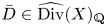 $\bar {D} \in \widehat {\operatorname {\mathrm {Div}}}(X)_{\mathbb {Q}}$ is semi-positive and that the underlying divisor
 $D$ is big and semi-ample. Then
 \[ (d+1)\zeta_{\mathrm{ess}}(\bar{D}) \geq \frac{h_{\bar{D}}(X) }{D^{d}} \geq \sum_{i=1}^{d+1} \zeta_i(\bar{D}). \]
The first inequality (referred to as the ‘fundamental inequality’ by Gubler [Reference GublerGub07, Reference GublerGub08]) is of particular interest in equidistribution problems and in proofs of the Bogomolov conjecture. Except from the recent results of [Reference Burgos Gil, Philippon, Rivera-Letelier and SombraBPRS19] concerning the toric case, all the equidistribution theorems in the literature apply only when the latter is an equality, that is, when
 \begin{equation} \zeta_{\mathrm{ess}}(\bar{D}) =\frac{h_{\bar{D}}(X) }{ (d+1)D^{d}}. \end{equation}
It is therefore of particular interest to characterize when this equality occurs. We refer the reader to the introductions of the papers [Reference Burgos Gil, Philippon, Rivera-Letelier and SombraBPRS19, Reference Burgos Gil, Philippon and SombraBPS15] for a complete discussion and more details on this problem. When  $X$ is a toric variety and
 $\bar {D}$ is a toric metrized divisor, Burgos Gil, Philippon and Sombra show that (1.3) holds if and only if the roof function
 $\vartheta _{\bar {D}}$ is constant [Reference Burgos Gil, Philippon and SombraBPS15, Corollary E]. Combining Corollary 1.3 with (1.2), we are able to generalize this result to the non-toric setting. We also obtain a straightforward proof of the first inequality in Theorem 1.4, valid for
 ${\mathbb {R}}$-divisors and without the semi-ampleness assumption.
Theorem 1.5 (Corollary 7.4)
If  $\bar {D}$ is semi-positive and
 $D$ is big, then
 \[ \zeta_{\mathrm{ess}}(\bar{D}) \geq \frac{h_{\bar{D}}(X) }{(d+1)D^{d}}, \]
with equality if and only if the following equivalent conditions are satisfied:
(i)
 $G_{\bar {D},\mathbf {z}}$ is constant for any $\mathbf {z}$;
(ii) the sequence
$(\lambda _{\max ,n}(\bar {D})/n)_{n \geq 1}$ converges to ${h_{\bar {D}}(X)}/((d+1)D^{d})$.


In that case,  $G_{\bar {D},\mathbf {z}}(\alpha ) = \zeta _{\mathrm {ess}}(\bar {D})$ for any
 $\mathbf {z}$ and any
 $\alpha \in \Delta _{\mathbf {z}}(D)$.
As in [Reference Burgos Gil, Philippon and SombraBPS15], we also prove analogues of this theorem when  $h_{\bar {D}}(X)$ is replaced by the
 $\chi$-volume
 $\widehat {\operatorname {\mathrm {vol}}}_{\chi }(\bar {D})$ or the arithmetic volume
 $\widehat {\operatorname {\mathrm {vol}}}(\bar {D})$ (see Theorem 7.2). Criterion (ii) in Theorem 1.5 has a nice interpretation through Gaudron's slope theory for adelic vector spaces [Reference GaudronGau08], and can be thought of as an ‘asymptotic semi-stability’ condition (Remark 7.5). We will study this approach further in § 9, restricting our attention to projective spaces
 $X = {\mathbb {P}}_K^{d}$.
1.3 Applications to geometry of numbers
In § 9 we apply Theorem 1.2 to the study of  $K$-hermitian vector spaces
 $\bar {E} = (E, (\|\cdot \|_v)_{v \in \Sigma _K})$, which generalize the notion of euclidean lattices to global fields (see § 8 for definitions). To clarify the exposition we assume that
 $K$ is a number field in the remainder of this introduction. In geometry of numbers, the central objects of study associated to a hermitian
 $K$-vector space
 $\bar {E}$ are its successive minima. Various definitions have been introduced by different authors, such as Bombieri and Vaaler [Reference Bombieri and VaalerBV83], Roy and Thunder [Reference Roy and ThunderRT96], and Zhang [Reference ZhangZha95a]. We shall focus on the two following definitions. Let
 $h_{\bar {E}} \colon E \otimes _K \bar {{\mathbb {Q}}} \rightarrow {\mathbb {R}}$ be the logarithmic height function associated to
 $\bar {E}$ and let
 $d= \dim E$. For any algebraic extension
 $K'$ of
 $K$ and any
 $\lambda \in {\mathbb {R}}$, we consider the ball
 \[ E(\lambda,K') = \{ s \in E \otimes_K K' \mid h_{\bar{E}}(s) \leq \lambda\}. \]
For  $i \in \{1,\ldots ,d \}$, we define the Roy–Thunder
 $i$th minimum with respect to
 $K'$ by
 \[ \lambda_i(\bar{E},K')= \inf \{ \lambda \in {\mathbb{R}} \mid \dim_{K'}(\operatorname{\mathrm{Vect}}_{K'} E(\lambda,K')) \geq i\}, \]
and the Zhang  $i$th minimum by
 \[ \zeta_i(\bar{E})= \inf \{ \lambda \in {\mathbb{R}} \mid \dim \mathrm{Zar}( E(\lambda,\bar{{\mathbb{Q}}})) \geq i\}, \]
where  $\mathrm {Zar}( E(\lambda ,\bar {{\mathbb {Q}}}))$ denotes the Zariski closure of
 $E(\lambda ,\bar {{\mathbb {Q}}})$ in
 $E \otimes _K \bar {{\mathbb {Q}}}$. Note that
 $\lambda _i(\bar {E}, \bar {{\mathbb {Q}}}) \leq \zeta _i(\bar {E})$ and
 $\lambda _i(\bar {E}, \bar {{\mathbb {Q}}}) \leq \lambda _i(\bar {E}, K')$.
As observed by Gaudron and Rémond [Reference Gaudron and RémondGR13, § 3], Zhang's Theorem 1.4 leads to important refinements of absolute Siegel's lemmas previously obtained by Roy and Thunder [Reference Roy and ThunderRT96]. From a similar point of view, Chen [Reference ChenChe18, Reference ChenChe19] presented some important consequences of Conjecture 1, especially towards the absolute transference problem (see § 1.3.1 below). In § 9 we slightly strengthen Chen's approach by combining the two parts of Theorem 1.2. The key result of § 9 is the following theorem, which relates Zhang's minima to the maximal and minimal slopes of the symmetric powers  $S^{n} (\bar {E}^{\vee })$.
Theorem 1.6 We have
 \[ \zeta_d(\bar{E}) = \lim_{n \rightarrow +\infty} \frac{{\hat{\mu}_\mathrm{max}}(S^{n} (\bar{E}^{{\vee}}))}{n} \quad\text{and}\quad \zeta_1(\bar{E}) = \lim_{n \rightarrow +\infty} \frac{{\hat{\mu}_\mathrm{min}}(S^{n} (\bar{E}^{{\vee}}))}{n}. \]
We shall present applications of this new interpretation of Zhang's minima to two classical problems in geometry of numbers.
1.3.1 An absolute transference theorem
An important concern about successive minima is their behaviour with respect to duality. It is well known and not difficult to see that
 \[ 0 \leq \lambda_{i}(\bar{E},K') + \lambda_{d+1-i}(\bar{E}^{{\vee}},K') \]
for any  $i \in \{1, \ldots , d\}$. The so-called transference problem asks for upper bounds for these sums, which are notoriously harder to obtain. When
 $K' = K = {\mathbb {Q}}$, a celebrated theorem of Banaszczyk [Reference BanaszczykBan93] gives the inequality
 \begin{equation} \lambda_{i}(\bar{E},{\mathbb{Q}}) + \lambda_{d+1-i}(\bar{E}^{{\vee}},{\mathbb{Q}}) \leq \ln(d), \end{equation}
which is highly non-trivial and optimal up to an additive constant. Transference theorems are famous for their applications in lattice-based cryptography, and are also important in Diophantine geometry and transcendental number theory (see, for example, [Reference Bosser and GaudronBG19, Reference Gaudron and RémondGR14]). It is natural and important to look for generalizations of (1.4) to other fields  $K, K'$. When
 $K' = K$, Gaudron [Reference GaudronGau20, Theorem 36] deduced from Banaszczyk's theorem the upper bound
 \[ \lambda_{i}(\bar{E},K) + \lambda_{d+1-i}(\bar{E}^{{\vee}},K) \leq \ln(d) + \frac{1}{[K:{\mathbb{Q}}]} \ln |\Delta_{K/{\mathbb{Q}}}|, \]
where  $\Delta _{K/{\mathbb {Q}}}$ is the discriminant of
 $K$. From a Diophantine geometry perspective, the dependence in the discriminant is rather unsatisfactory. In this context, an inequality with
 $K' = \bar {{\mathbb {Q}}}$ which is independent of the base field
 $K$ is often much more suitable. By analogy with Roy and Thunder's approach [Reference Roy and ThunderRT96], we call such a bound an absolute transference theorem. To our knowledge, the best result in this direction is a theorem of Pekker [Reference PekkerPek08], giving the inequality
 \[ \lambda_{i}(\bar{E},\bar{{\mathbb{Q}}}) + \lambda_{d+1-i}(\bar{E}^{{\vee}},\bar{{\mathbb{Q}}}) \leq \frac{d-1}{2}. \]
It is independent of  $K$, but very far from Banaszczyk's inequality when
 $K = {\mathbb {Q}}$. The following question was raised by Gaudron [Reference GaudronGau20, § 4.3].
Question 1 (Gaudron) Does there exist a polynomial  $f \in {\mathbb {Z}}[X]$ such that
 \[ \lambda_{i}(\bar{E},\bar{{\mathbb{Q}}}) + \lambda_{d+1-i}(\bar{E}^{{\vee}},\bar{{\mathbb{Q}}}) \leq \ln(f(d)) \quad \forall \, 1 \leq i \leq d = \dim E \]
for any number field  $K$ and any hermitian
 $K$-vector space
 $\bar {E}$?
Theorem 1.6 has immediate applications to this problem. The point is that the slopes of  $\bar {E}$ behave very well with respect to duality, namely
 ${\hat {\mu }_\mathrm {max}}(\bar {E}^{\vee }) = -{\hat {\mu }_\mathrm {min}}(\bar {E})$. Using techniques of Gaudron and Rémond [Reference Gaudron and RémondGR13] to estimate slopes of symmetric powers, we shall derive the following absolute transference theorem from Theorem 1.6. For any
 $N \in {\mathbb {N}}$, we denote by
 $H_N = 1 + 1/2 + \cdots + 1/N$ the
 $N$th harmonic number (
 $H_0 =0$ by convention).
Theorem 1.7 For any  $i \in \{1,\ldots ,d \}$, we have
 \[ \zeta_{i}(\bar{E}) + \zeta_{d+1-i}(\bar{E}^{{\vee}})\leq H_{i-1} + H_{d-i}. \]
Note that
 \[ \lambda_{i}(\bar{E},\bar{{\mathbb{Q}}}) + \lambda_{d+1-i}(\bar{E}^{{\vee}},\bar{{\mathbb{Q}}})\leq \zeta_{i}(\bar{E}) + \zeta_{d+1-i}(\bar{E}^{{\vee}}) \]
for any  $i \in \{1, \ldots , d\}$. Since
 $H_N \leq \ln (2N+1)$ for any
 $N \geq 0$ [Reference DetempleDet91], the upper bound in Theorem 1.7 for
 $i =1$ is essentially as good as Banaszczyk's. By the estimate
 $H_{i-1} + H_{d-i} \leq 2\ln (d)$, Theorem 1.7 answers Question 1 and shows that we can choose
 $f(d) = d^{2}$.
1.3.2 Comparison of successive slopes and minima
For  $i \in \{1, \ldots , d\}$, we denote by
 $\hat {\mu }_i(\bar {E})$ the
 $i$th successive slope of
 $\bar {E}$ (Definition 8.6). Finding upper bounds for the sums
 $\zeta _i(\bar {E}) + \hat {\mu }_i(\bar {E})$ is closely related to the absolute transference problem (see [Reference ChenChe18, Reference ChenChe19, Reference GaudronGau20]) and absolute Siegel's lemmas [Reference Gaudron and RémondGR13, § 3]. For
 $i = 1$, it follows from Zhang's Theorem 1.4 that
 \[ \zeta_1(\bar{E}) + \hat{\mu}_1(\bar{E}) \leq (H_d-1)/2 \]
as observed by Gaudron and Rémond [Reference Gaudron and RémondGR13, Lemma 3.2]. It is significantly harder to deal with the case  $i \geq 2$. As for the transference problem, Theorem 1.6 opens up a new approach to this question, leading to the following statement.
Theorem 1.8 For any  $i \in \{1, \ldots , d\}$, we have
 \[ \zeta_i(\bar{E}) + \hat{\mu}_i(\bar{E}) \leq H_{d-1}\leq \ln(2d-1). \]
Our methods remain valid when  $K$ is a function field, in which case we obtain
 \[ \zeta_i(\bar{E}) + \zeta_{d-i+1}(\bar{E}^{{\vee}}) = \zeta_i(\bar{E}) + \hat{\mu}_i(\bar{E}) = 0\quad \forall\, i \in \{1, \ldots, d\}. \]
1.4 Organization of the paper
We fix some notation and conventions in § 2. We then recall definitions and basic properties of adelic  ${\mathbb {R}}$-Cartier divisors, including a few facts on arithmetic divisors on arithmetic varieties and arithmetic intersection theory that we will need in the proof of Theorem 1.1 (§ 3). We also define Zhang's successive minima and give some elementary properties of the essential minimum (see § 3.8). Section 4 is devoted to the proof of Theorem 1.1. After defining asymptotic slopes, we prove Theorem 1.2 in § 5. We recall the definitions of Okounkov bodies and concave transform in § 6. In § 7 we prove Corollary 1.3, Theorem 1.5 and some variants. In § 8 we recall definitions and basic facts about hermitian vector spaces. Applications of Theorem 1.2 to geometry of numbers are discussed in § 9, with proofs of Theorems 1.6, 1.7 and 1.8.
2. Conventions and terminology
2.1
A scheme is integral if it is reduced and irreducible. By a variety over a field  $k$ we mean an integral scheme of finite type over
 $k$. If
 $X$ is a Noetherian integral scheme, we denote by
 $\operatorname {\mathrm {Div}}(X)$ or
 $\operatorname {\mathrm {Div}}(X)_{{\mathbb {Z}}}$ the group of Cartier divisors on
 $X$ and by
 ${ \kappa }(X)$ the field of rational functions on
 $X$. If
 $\mathbb {K}$ denotes
 ${\mathbb {Q}}$ or
 ${\mathbb {R}}$, we let
 $\operatorname {\mathrm {Div}}(X)_{\mathbb {K}} = \operatorname {\mathrm {Div}}(X) \otimes _{\mathbb {Z}} \mathbb {K}$ and
 ${ \kappa }(X)_{\mathbb {K}} = {{ \kappa }(X)^{\times }} \otimes _{\mathbb {Z}} \mathbb {K}$. The elements of
 $\operatorname {\mathrm {Div}}(X)_{{\mathbb {K}}}$ and
 ${ \kappa }(X)_{{\mathbb {K}}}$ are called
 ${\mathbb {K}}$-Cartier divisors and
 ${\mathbb {K}}$-rational functions, respectively. A
 ${\mathbb {K}}$-rational function
 $\phi \in { \kappa }(X)_{{\mathbb {K}}}$ defines a
 ${\mathbb {K}}$-Cartier divisor
 $(\phi )\in \operatorname {\mathrm {Div}}(X)_{\mathbb {K}}$. We denote by
 $\operatorname {\mathrm {Supp}} D$ the support of a
 ${\mathbb {K}}$-Cartier divisor
 $D$ (see [Reference MoriwakiMor16, § 1.2] for details). It is a Zariski-closed subset of
 $X$ [Reference MoriwakiMor16, Proposition 1.2.1].
2.2
Let  $K_0$ denote either the field
 ${\mathbb {Q}}$ of rational numbers or the field of functions
 $k(T)$, where
 $k$ is an arbitrary field. A global field is by definition a finite extension of
 $K_0$. It is either a number field or the field of functions of a regular projective curve
 $C_K$ over
 $k$ equipped with a finite morphism
 $\varphi _K \colon C_K \rightarrow C_0 = {\mathbb {P}}^{1}_k$, unique up to
 $k$-isomorphism.
2.3
Let  $K$ be a global field. Let
 $\Sigma _K$ be the set of places of
 $K$ and
 $\Sigma _{K,\infty } \subset K$ the set of archimedean places. Note that
 $\Sigma _{K,\infty } = \emptyset$ if
 $K_0 = k(T)$. For each
 $v \in \Sigma _K$, we denote by
 $K_v$ the completion of
 $K$ at the place
 $v$ and by
 $K_{0,v}$ the completion of
 $K_0$ with respect to the restriction of
 $v$ to
 $K_0$. We shall normalize absolute values associated to
 $v$.
Assume that  $K$ is a number field. For each place
 $v \in \Sigma _K$, we let
 $|\cdot |_v$ be the unique absolute value on
 $K_v$ extending the usual absolute value
 $|\cdot |_v$ on
 ${\mathbb {Q}}_v$:
 $|p|_v = p^{-1}$ if
 $v$ is a finite place over a prime number
 $p$, and
 $|\cdot |_v = |\cdot |$ is the usual absolute value on
 ${\mathbb {R}}$ if
 $v$ is archimedean. For each
 $v \in \Sigma _K$, we let
 $n_v(K) = [K_v:{\mathbb {Q}}_v]/[K:{\mathbb {Q}}]$. We now turn to the function field case, so that
 $K_0 = k(T)$. The set of places of
 $K$ is in one-to-one correspondence with the set of closed points of
 $C_K$. For each
 $v \in \Sigma _K$ and each
 $f \in K^{\times } = {\kappa }(C_K)^{\times }$, we denote by
 $\operatorname {\mathrm {ord}}_v(f)$ the order of
 $f$ in the discrete valuation ring
 ${\mathcal {O}}_{C_K,v}$ and by
 $e_v(\varphi _K)$ the ramification index of
 $\varphi _K\colon C_K \rightarrow {\mathbb {P}}^{1}_k$ at
 $v \in C_K$. We consider the absolute value
 $|\cdot |_v$ on
 $K$ given by
 $|f|_v = e^{-\operatorname {\mathrm {ord}}_v(f)/e_v(\varphi _K)}$ and we let
 \[ n_v(K) = \frac{e_v(\varphi_K) [\kappa(v):k]}{[K:K_0]}, \]
where  $\kappa (v)$ denotes the residue field of
 $v$ in
 $C_K$.
With these conventions, we have the following product formula:
 \begin{equation} \forall x \in K^{{\times}}, \sum_{v \in \Sigma_K}n_v(K)\ln |x|_v = 0. \end{equation}
2.4
Let  $X$ be a scheme on
 $\operatorname {\mathrm {Spec}} K$. For each
 $v \in \Sigma _K$, let
 $X_v$ be the fibre product
 $X \times _K \operatorname {\mathrm {Spec}} K_v$. If
 $v$ is non-archimedean, we denote by
 $X_v^{\mathrm {an}}$ the analytification of
 $X_v$ in the sense of Berkovich (see [Reference Burgos Gil, Philippon and SombraBPS14, § 1.2] for a short definition sufficient for our purposes). When
 $K$ is a number field and
 $v$ is archimedean, we denote by
 $\Sigma _v \subset K({\mathbb {C}})$ the set of embeddings
 $\sigma \colon K \hookrightarrow {\mathbb {C}}$ associated to
 $v$. Hence
 $\Sigma _v$ is a singleton if
 $v$ is real and
 $\Sigma _v$ consists of two conjugate embeddings if
 $v$ is complex. For each
 $\sigma \in \Sigma _v$, we let
 $K_\sigma = K \otimes _K^{\sigma } {\mathbb {C}}$ be the tensor product of
 $K$ with respect to
 $\sigma$ and
 $X_\sigma = X \times _K^{\sigma } \operatorname {\mathrm {Spec}} {\mathbb {C}}$. We define the analytification of
 $X_v$ by
 $X_v^{\mathrm {an}} = X_v({\mathbb {C}}) = \bigsqcup _{\sigma \in \Sigma _v} X_\sigma ({\mathbb {C}})$. The disjoint union
 \[ X_\infty^{\mathrm{an}} := \bigsqcup_{v \in \Sigma_K, \ v | \infty} X_v^{\mathrm{an}} = \bigsqcup_{\sigma \in K({\mathbb{C}})} X_\sigma({\mathbb{C}}) =X({\mathbb{C}}) \]
is the set of morphisms of  $\operatorname {\mathrm {Spec}} {\mathbb {Q}}$-schemes
 $x \colon \operatorname {\mathrm {Spec}} {\mathbb {C}} \rightarrow X$. We let
 $F_\infty \colon X_\infty ^{\mathrm {an}} \rightarrow X_\infty ^{\mathrm {an}}$ be the involution induced by the complex conjugation.
2.5
Let  $x \in X$ be a closed point and
 ${\kappa }(x)$ its residue field. For a place
 $v \in \Sigma _K$, we denote by
 $\Sigma _v(x)$ the set of
 $K_v$-algebra morphisms
 ${\kappa }(x) \otimes _K K_v \rightarrow {\mathbb {C}}_v$, where
 ${\mathbb {C}}_v$ is an algebraic closure of
 $K_v$. For each
 $\sigma \in \Sigma _v(x)$, we denote by
 $x_\sigma$ the closed point of
 $X_v$ given by composition
 \[ \operatorname{\mathrm{Spec}} {\mathbb{C}}_v \overset{\sigma}{\longrightarrow} \operatorname{\mathrm{Spec}} ({ \kappa}(x) \otimes_K K_v) \overset{x \times \mathrm{id}}{\longrightarrow} X_v. \]
We define the orbit  $O_v(x) \subset X_v$ of
 $x$ by
 \[ O_v(x) = \{ x_{\sigma} \mid \sigma \in \Sigma_v(x)\}. \]
Note that the cardinal of  $O_v(x)$ is
 $[{ \kappa }(x) : K]$. Moreover, for each
 $z \in X_v({\mathbb {C}}_v)$, we define a point
 $z^{\mathrm {an}} \in X_v^{\mathrm {an}}$ as follows. If
 $v | \infty$, we let
 $z^{\mathrm {an}} = z$. If
 $v$ is finite,
 $z^{\mathrm {an}}\in X_v^{\mathrm {an}}$ is the unique valuation on
 $K_v(z)$ extending
 $v$.
2.6
Assume that  $X$ is projective and geometrically integral. Let
 $D \in \operatorname {\mathrm {Div}}(X)_{\mathbb {R}}$,
 $v \in \Sigma _K$ and let
 $D_v \in \operatorname {\mathrm {Div}}(X_v)_{\mathbb {R}}$ be the pullback of
 $D$ to
 $X_v$. We consider an open covering
 $X_v = \cup _{i=1}^{\ell }U_i$ such that
 $D_v$ is defined by
 $f_i \in { { \kappa }(X_v)_{\mathbb {R}}}$ on
 $U_i$ for each
 $i \in \{1,\ldots , \ell \}$. A continuous (respectively, smooth)
 $D$-Green function on
 $X_v^{\mathrm {an}}$ is a function
 \[ g_v \colon X_v^{\mathrm{an}}{\setminus} (\operatorname{\mathrm{Supp}} D_v)^{\mathrm{an}} \rightarrow {\mathbb{R}} \]
such that  $g_v + \ln |f_i|^{2}_v$ extends to a continuous (respectively, smooth) function on the analytification
 $U_i^{\mathrm {an}}$ of
 $U_i$ for each
 $i \in \{1, \ldots , \ell \}$. We refer the reader to [Reference MoriwakiMor16, §§ 1.4 and 2.1] for more details on Green functions.
3. Adelic Cartier divisors
In this section we define adelic  ${\mathbb {R}}$-Cartier divisors and recall different notions of positivity. We mainly follow the book of Moriwaki [Reference MoriwakiMor16].
3.1 Notation
Throughout this section we fix a global field  $K$ and a projective, normal and geometrically integral variety
 $X$ on
 $\operatorname {\mathrm {Spec}} K$. We let
 $d := \dim X$ and we fix an algebraic closure
 $\bar {K}$ of
 $K$. We define a scheme
 $\mathcal {S}$ as follows.
(i) If
$K_0 = {\mathbb {Q}}$, $\mathcal {S} = \operatorname {\mathrm {Spec}} {\mathcal {O}}_K$ is the spectrum of the ring of integers ${\mathcal {O}}_K$ of $K$.(ii) If
$K_0 = k(T)$, $\mathcal {S} = C_K$ is a regular projective integral curve over $k$ with field of functions ${\kappa }(C_K)=K$. This implies the existence of a finite $k$-morphism $\varphi \colon C_K \rightarrow {\mathbb {P}}^{1}_k$. Moreover, the curve $C_K$ is unique up to $k$-isomorphism.


Throughout this section,  $\mathbb {K}$ denotes either
 ${\mathbb {Z}}$,
 ${\mathbb {Q}}$ or
 ${\mathbb {R}}$. Let
 $D \in \operatorname {\mathrm {Div}}(X)_{\mathbb {K}}$ and let
 $U \subset \mathcal {S}$ be a non-empty open subset. A model
 $\mathcal {X}$ of
 $X$ over
 $U$ is an integral scheme together with a projective dominant morphism
 $\pi _{\mathcal {X}} \colon \mathcal {X} \rightarrow U$ with generic fibre
 $X$. We will denote a model
 $(\mathcal {X}, \pi _{\mathcal {X}})$ if we need to specify the associated morphism. We say that
 $\mathcal {X}$ is a normal model if
 $\mathcal {X}$ is normal. If
 $\mathcal {D}$ is a
 ${\mathbb {K}}$-Cartier divisor on
 $\mathcal {X}$ such that the restriction of
 $\mathcal {D}$ to
 $X$ is equal to
 $D$, we say that
 $(\mathcal {X},\mathcal {D})$ is a model of
 $(X,D)$ over
 $U$. For each non-archimedean place
 $v \in U$, we denote by
 $g_{\mathcal {D},v}$ the
 $D$-Green function on
 $X_v^{\mathrm {an}}$ induced by
 $\mathcal {D}$ (see [Reference MoriwakiMor16, § 0.2] for details on this construction).
3.2 Definitions
Definition 3.1 A metrized  ${\mathbb {K}}$-Cartier divisor on
 $X$ is a pair
 $\bar {D} = (D, (g_v)_{v \in \Sigma _K})$ consisting of a
 ${\mathbb {K}}$-Cartier divisor
 $D$ on
 $X$ and a continuous
 $D$-Green function
 $g_v$ on
 $X_v^{\mathrm {an}}$ for each
 $v \in \Sigma _K$. We say that
 $\bar {D}$ is an adelic
 ${\mathbb {K}}$-Cartier divisor on
 $X$ if, moreover, the following conditions are satisfied.
(i) There exist a dense open subset
$U$ of $\mathcal {S}$ and a normal model $(\mathcal {X}_U,\mathcal {D}_U)$ of $(X,D)$ over $U$ such that $g_{v}=g_{\mathcal {D}_U,v}$ for all $v \in U$.(ii) If
$K$ is a number field, $g_v$ is invariant under the complex conjugation $F_\infty$ for each $v \in \Sigma _{K,\infty }$.


The set of adelic  ${\mathbb {K}}$-Cartier divisors on
 $X$ forms a group, denoted by
 $\widehat {\mathrm {Div}}(X)_{\mathbb {K}}$. Note that
 $\widehat {\mathrm {Div}}(X)_{\mathbb {Z}} \subset \widehat {\mathrm {Div}}(X)_{\mathbb {Q}} \subset \widehat {\mathrm {Div}}(X)_{\mathbb {R}}$. In the sequel, the elements of
 $\widehat {\operatorname {\mathrm {Div}}}(X)_{\mathbb {Z}}$ will sometimes be called adelic Cartier divisors for simplicity.
Remark 3.2 In [Reference MoriwakiMor16, Definition 4.1.1], adelic  ${\mathbb {K}}$-Cartier divisors are called adelic arithmetic
 ${\mathbb {K}}$-Cartier divisors of
 $C^{0}$-type.
Note that an adelic  ${\mathbb {R}}$-Cartier divisor
 $\bar {\xi }$ on
 $\operatorname {\mathrm {Spec}} K$ is just a collection of real numbers
 $\bar {\xi } = (\xi _v)_{v \in \Sigma _K}$ such that
 $\xi _v =0$ for all but finitely many
 $v \in \Sigma _K$. The normalized Arakelov degree of
 $\bar {\xi }$ is defined by
 \[ \widehat{\deg}(\bar{\xi}) = \frac{1}{2}\sum_{v \in \Sigma_K}n_v(K) \xi_v. \]
3.3 Arithmetic volume function
Let  $\bar {D} = (D, (g_v)_{v \in \Sigma _K})$ be an adelic
 ${\mathbb {R}}$-Cartier divisor on
 $X$. We consider the
 $K$-vector space
 \[ H^{0}(X,D) := \{ \phi \in { \kappa}(X)^{{\times}} \mid D + {(\phi)} \geq 0\} \cup \{0\}. \]
For any non-zero element  $\phi \in H^{0}(X,D)$ and any
 $v \in \Sigma _K$, the function
 $\|\phi \|_{v} := |\phi _v|_v\exp (-g_v/2)$ extends to a continuous function on
 $X_v^{\mathrm {an}}$, where
 $\phi _v$ is the function on
 $X_v^{\mathrm {an}}$ induced by
 $\phi$ (see [Reference MoriwakiMor16, Propositions 1.4.2 and 2.1.3]). We also define
 $\|\phi \|_{v,\sup } := \sup _{x \in { X_v^{\mathrm {an}}}} \|\phi \|_{v}(x)$ and
 \[ \hat{H}^{0}(X,\bar{D}) := \{ \phi \in H^{0}(X,D) \mid \|\phi\|_{v,\sup}\leq 1 \ \forall v \in \Sigma_K \}. \]
We let
 \[ \hat{h}^{0}(X,\bar{D}) = \left\{\begin{array}{@{}ll} \ln \# \hat{H}^{0}(X,\bar{D}) & \textrm{if}\ K_0 = {\mathbb{Q}},\\ \dim_k \hat{H}^{0}(X,\bar{D}) & \textrm{if}\ K_0 = k(T). \end{array} \right. \]
Definition 3.3 The arithmetic volume of  $\bar {D}$ is the quantity
 \[ \widehat{\operatorname{\mathrm{vol}}}(\bar{D}) := \limsup_{n \rightarrow +\infty} \frac{\hat{h}^{0}(X,n\bar{D})}{n^{d+1}/(d+1)!}. \]
Example 3.4 Assume that there exists a normal model  $(\mathcal {X},\mathcal {D})$ over
 $\mathcal {S}$ such that all the
 $D$-Green functions of
 $\bar {D}$ are induced by
 $\mathcal {D}$. By [Reference MoriwakiMor16, Proposition 4.3.1], we have
 \[ \hat{H}^{0}(X,D) = \Big\{ \phi\in H^{0}(\mathcal{X},\mathcal{D}) \mid \max_{v\in \Sigma_{K,\infty}}\|\phi\|_{v,\sup}\leq 1\Big\}. \]
In particular, if  $K_0 = k(T)$ then
 $\hat {H}^{0}(X,D) = H^{0}(\mathcal {X},\mathcal {D})$. It follows that
 $\widehat {\operatorname {\mathrm {vol}}}(\bar {D})=\operatorname {\mathrm {vol}}(\mathcal {D})$ is the (geometric) volume of
 $\mathcal {D}$ (see [Reference LazarsfeldLaz04a, § 2.2]):
 \[ \operatorname{\mathrm{vol}}(\mathcal{D})= \limsup_{n \rightarrow +\infty} \frac{\dim_k H^{0}(\mathcal{X}, n\mathcal{D})}{n^{d+1}/(d+1)!}. \]
We now recall a well-known continuity property of the volume function  $\widehat {\operatorname {\mathrm {vol}}}$ due to Moriwaki.
Theorem 3.5 Let  $\bar {D},\bar {D}_1, \ldots , \bar {D}_\ell$ be adelic
 $\mathbb {R}$-Cartier divisors on
 $X$. Then
 \[ \lim_{\varepsilon_1 \rightarrow 0, \ldots, \varepsilon_\ell \rightarrow 0} \widehat{\operatorname{\mathrm{vol}}}(\bar{D}+\varepsilon_1\bar{D}_1 + \cdots + \varepsilon_\ell\bar{D}_\ell) = \widehat{\operatorname{\mathrm{vol}}}(\bar{D}). \]
When  $K$ is a number field, this is a particular case of [Reference MoriwakiMor16, Theorem 5.2.1]. In the function field case, one can prove the result by using similar arguments and the continuity of the geometric volume function [Reference LazarsfeldLaz04a, Theorem 2.2.44]. Alternatively, Theorem 3.5 is a particular case of [Reference Chen and MoriwakiCM19, Theorem 6.4.24] due to Chen and Moriwaki, who recently established the continuity of the arithmetic volume in the much more general setting of adelic curves.
3.4 Height function
Let  $\bar {D} = (D, (g_v)_{v \in \Sigma _K})$ be an adelic
 ${\mathbb {R}}$-Cartier divisor on
 $X$ and let
 $x \in X(\bar {K})$ be a closed point with residue field
 ${ \kappa }(x)$. The height of
 $x$ with respect to
 $\bar {D}$ is defined to be
 \[ h_{\bar{D}}(x):={-}\frac{1}{[{ \kappa}(x) : K]}\sum_{v \in \Sigma_K}n_v(K) \sum_{z \in {O_v}(x)} \ln \|\phi\|_v({z^{\mathrm{an}}}), \]
where  $\phi \in H^{0}(X,D)$ is any function with
 $x \notin \operatorname {\mathrm {Supp}}(D+(\phi ))$. This definition does not depend on the choice of
 $\phi$ (see [Reference MoriwakiMor16, § 4.2] for details).
Remark 3.6 We mention an equivalent formula for the height of  $x$, which may be more usual. For each place
 $w \in \Sigma _{{ \kappa }(x)}$, we fix a
 $K$-embedding
 $\sigma _w \colon { \kappa }(x) \hookrightarrow {\mathbb {C}}_v$ associated to
 $w$, where
 $v$ denotes the restriction of
 $w$ to
 $K$ (note that there are exactly
 $[{ \kappa }(x)_w : K_v]$ such embeddings). The pair
 $(x,\sigma _w)$ uniquely determines a point
 $x_w \in X_v$, and the quantity
 $\|\phi \|_w(x) := \|\phi \|_v(x_w^{\mathrm {an}})$ does not depend on the choice of
 $\sigma _w$. With this notation, we have
 \[ h_{\bar{D}}(x) ={-}\sum_{w \in \Sigma_{{ \kappa}(x)}} n_w({ \kappa}(x)) \ln \|\phi\|_w(x). \]
If we denote by  $\pi \colon X \rightarrow \operatorname {\mathrm {Spec}} K$ the structural morphism, we have
 \begin{equation} h_{\bar{D} + \pi^{*}\bar{\xi}}(x) = h_{\bar{D}}(x) + \widehat{\deg}(\bar{\xi}) \end{equation}
for any  $\bar {\xi } \in \widehat {\operatorname {\mathrm {Div}}}(\operatorname {\mathrm {Spec}} K)_{\mathbb {R}}$ and
 $x \in X(\bar {K})$. In view of Example 3.7 below, this basic fact can be interpreted as a projection formula.
Example 3.7 Assume that  $K$ is a function field and that there exists a normal model
 $(\mathcal {X}, \mathcal {D})$ of
 $(X,D)$ over
 $\mathcal {S} = C_K$ such that for each
 $v \in \Sigma _K$, the
 $D$-Green function
 $g_v = g_{\mathcal {D},v}$ is induced by
 $\mathcal {D}$. Let
 $x \in X(\bar {K})$ be a closed point and let
 $C_x \subset \mathcal {X}$ be the Zariski closure of
 $x$ in
 $\mathcal {X}$. Note that
 $C_x$ is an integral projective curve, and that the restriction
 ${\pi _{\mathcal {X}}}_{|C_x} \colon C_x \rightarrow C_K$ is surjective. We have
 \[ h_{\bar{D}}(x) = \frac{\mathcal{D} \cdot C_x}{[{ \kappa}(x) : K_0]}, \]
where  ${ \kappa }(x)$ is the residue field of
 $X$ at
 $x$ and
 $\mathcal {D} \cdot C_x$ is the usual geometric intersection product of cycles. We will see that an analogue of this formula involving the arithmetic intersection product holds when
 $K$ is a number field (see § 3.7).
We end this subsection with the following well-known lemma, giving a lower bound for the height of points at which a small section does not vanish.
Lemma 3.8 Suppose there exists  $\phi \in {H}^{0}(X,D) {\setminus} \{0\}$ with
 $\|\phi \|_{v,\sup } \leq 1$ for all
 $v \in \Sigma _K$. For any
 $x \in X(\bar {K})$ not contained in the support of
 $D + (\phi )$, we have
 $h_{\bar {D}}(x) \geq 0$.
Proof. If  $x \in X(\bar {K})$ is not contained in the support of
 $D + {(\phi )}$, we have
 \[ h_{\bar{D}}(x) ={-} \frac{1}{[{ \kappa}(x):K]}\sum_{v \in \Sigma_K} n_v(K)\sum_{z \in O_v(x)} \ln \|\phi\|_v(z^{\mathrm{an}}) \geq 0 \]
since  $\|\phi \|_v(z^{\mathrm {an}}) \leq \|\phi \|_{v,\sup } \leq 1$ for every
 $v \in \Sigma _K$ and
 $z \in O_v(x)$.
3.5 Positivity of adelic ${\mathbb {R}}$-Cartier divisors

In this section we define several notions of arithmetic positivity, following [Reference MoriwakiMor16, § 4.4] and [Reference ZhangZha95b]. For the definition of plurisubharmonic functions we refer the reader to [Reference MoriwakiMor12b, § 2.1] and [Reference MoriwakiMor16, § 1.4].
Definition 3.9 Let  $\bar {D} = (D, (g_v)_{v \in \Sigma _K})$ be an adelic
 ${\mathbb {R}}$-Cartier divisor on
 $X$. We say that
 $\bar {D}$ is:
– big if
$\widehat {\operatorname {\mathrm {vol}}}(\bar {D}) > 0$;– pseudo-effective if
$\bar {D} + \bar {A}$ is big for any big adelic ${\mathbb {R}}$-Cartier divisor $\bar {A}$ on $X$;– semi-positive if there exists a sequence
$(\mathcal {X}_n, \mathcal {D}_n, (g_{n,v})_{v \in \Sigma _K})_{n \in {\mathbb {N}}}$ such that,
(i) for all
$n \in {\mathbb {N}}$, $(\mathcal {X}_n, \mathcal {D}_n)$ is a normal model for $(X,D)$ with $\mathcal {D}_n$ relatively nef,(ii) for all
$n \in {\mathbb {N}}$, $g_{n,v}$ is a smooth plurisubharmonic $D$-Green function invariant under $F_\infty$ if $v \in \Sigma _{K,\infty }$ and $g_{n,v}=g_{\mathcal {D}_n,v}$ for every non-archimedean $v \in \Sigma _K$,(iii) for every
$v \in \Sigma _K$, $(g_{n,v})_{n \in {\mathbb {N}}}$ converges uniformly to $g_v$;
– nef if
$\bar {D}$ is semi-positive and if $\inf _{x \in X(\bar {K})} h_{\bar {D}}(x) \geq 0$.


Remark 3.10 (1) In the definition of semi-positivity, the condition that  $\mathcal {D}_n$ is relatively nef is to be understood with respect to the morphism
 $\pi _{\mathcal {X}_n} \colon \mathcal {X}_n \rightarrow \mathcal {S}$ associated to the model
 $\mathcal {X}_n$: by definition,
 $\mathcal {D}_n$ is relatively nef if it has non-negative intersection with any curve contained in a fibre of
 $\pi _{\mathcal {X}_n}$ above a closed point.
(2) When  $\bar {D} \in \widehat {\operatorname {\mathrm {Div}}}(X)_{{\mathbb {Z}}}$ and
 $K$ is a number field, our definition of semi-positivity coincides with the notion of semi-positive adelic line bundles in the sense of Zhang [Reference ZhangZha95b] (see [Reference Burgos Gil, Moriwaki, Philippon and SombraBMPS16, (1), p. 229]). In [Reference MoriwakiMor16], Moriwaki introduced the more intrinsic notion of relatively nef adelic
 ${\mathbb {R}}$-Cartier divisors, which is closely related to semi-positivity in the sense of Definition 3.9. By [Reference MoriwakiMor16, Proposition 4.2.2], if
 $\bar {D}\in \widehat {\operatorname {\mathrm {Div}}}(X)_{{\mathbb {R}}}$ is relatively nef in the sense of [Reference MoriwakiMor16, Definition 4.4.1], then it is semi-positive (see also [Reference Burgos Gil, Moriwaki, Philippon and SombraBMPS16, (2) and (4), p. 229]).
Example 3.11 In the situation of Example 3.4 when  $K_0=k(T)$,
 $\bar {D}$ is big (respectively, pseudo-effective) if and only if
 $\mathcal {D}$ is big (respectively, pseudo-effective) in the sense of [Reference LazarsfeldLaz04a, § 2.2].
3.6 Arithmetic Cartier divisors
In this section we define arithmetic  ${\mathbb {K}}$-Cartier divisors on arithmetic varieties, which are special cases of adelic
 ${\mathbb {K}}$-Cartier divisors for which all the Green functions at the non-archimedean places are induced by the same model. In this subsection we assume that
 $K$ is a number field. Let
 $\mathcal {X}$ be a projective arithmetic variety over
 $\operatorname {\mathrm {Spec}} {\mathcal {O}}_K$, that is, an integral scheme projective and flat over
 $\operatorname {\mathrm {Spec}} {\mathcal {O}}_K$. We let
 $d+1$ be the Krull dimension of
 $\mathcal {X}$, so that the generic fibre
 $X := \mathcal {X}\times _{{\mathcal {O}}_K} \operatorname {\mathrm {Spec}} K$ of
 $\mathcal {X}$ has dimension
 $d$. We say that
 $\mathcal {X}$ is generically smooth if
 $X$ is smooth.
Definition 3.12 An arithmetic  ${\mathbb {K}}$-Cartier divisor
 $\bar {\mathcal {D}} = (\mathcal {D},(g_v)_{v \in \Sigma _{K,\infty }})$ on
 $\mathcal {X}$ is a pair consisting of a
 ${\mathbb {K}}$-Cartier divisor
 $\mathcal {D} \in \operatorname {\mathrm {Div}}(\mathcal {X})_{\mathbb {K}}$ and, for each archimedean place
 $v \in \Sigma _{K,\infty }$, a continuous
 $\mathcal {D}$-Green function
 $g_v$ on
 $X_v^{\mathrm {an}}$ invariant under the complex conjugation
 $F_\infty$. We say that
 $\bar {\mathcal {D}}$ is of
 $C^{\infty }$-type if
 $g_v$ is smooth for every
 $v \in \Sigma _{K,\infty }$.
Arithmetic  ${\mathbb {K}}$-Cartier divisors on
 $\mathcal {X}$ form a group, denoted by
 $\widehat {\operatorname {\mathrm {Div}}}(\mathcal {X})_{\mathbb {K}}$. Given an arithmetic
 ${\mathbb {K}}$-Cartier divisor
 $\bar {\mathcal {D}} = (\mathcal {D},(g_v)_{v \in \Sigma _{K,\infty }})$, we denote by
 $\bar {\mathcal {D}}^{\mathrm {ad}}$ the adelic
 ${\mathbb {K}}$-Cartier divisor on the generic fibre
 $X$ defined by
 $(D,(g_v)_{v \in \Sigma _K})$, where
 $D = \mathcal {D}_{|X}$ is the restriction of
 $\mathcal {D}$ and, for every non-archimedean place
 $v \in \Sigma _K$,
 $g_v = g_{\mathcal {D},v}$ is the
 $D$-Green function induced by
 $\mathcal {D}$.
Definition 3.13 An arithmetic  ${\mathbb {R}}$-Cartier divisor
 $\bar {\mathcal {D}}$ on
 $\mathcal {X}$ is said to be big (respectively, pseudo-effective) if
 $\bar {\mathcal {D}}^{\mathrm {ad}}$ is big (respectively, pseudo-effective). We say that
 $\bar {\mathcal {D}}$ is semi-positive if
 $\mathcal {D}$ is relatively nef and
 $g_v$ is plurisubharmonic for every
 $v \in \Sigma _{K,\infty }$, and that
 $\bar {\mathcal {D}}$ is nef if it is semi-positive with
 $h_{\bar {\mathcal {D}}^{\mathrm {ad}}}(x) \geq 0$ for every
 $x \in X(\bar {K})$.
We observe that our definitions of big, pseudo-effective and nef arithmetic  ${\mathbb {R}}$-divisor coincide with those of Ikoma [Reference IkomaIko15b]. We will also need the notion of ampleness used in [Reference IkomaIko15b]. We first recall the definition of the curvature current. Let
 $\bar {\mathcal {D}} = (\mathcal {D},(g_v)_{v}) \in \widehat {\operatorname {\mathrm {Div}}}(\mathcal {X})_{\mathbb {Z}}$. We assume that
 $\mathcal {X}$ is generically smooth. For
 $v \in \Sigma _{K, \infty }$, we denote by
 $D_v$ the divisor induced by
 $\mathcal {D}$ on
 $X_v$ and we consider the current
 $c_{1,v}(\bar{\mathcal{D}}) := ({\sqrt {-1}}/{2\pi })\partial \bar {\partial }[g_v] + \delta _{D_v}$ on
 $X_v^{\mathrm {an}}$. Note that
 $c_{1,v}(\bar {\mathcal {D}})$ is non-negative if the function
 $g_v$ is plurisubharmonic, and that it is a real
 $(1,1)$ form if
 $g_v$ is smooth. We let
 $c_1(\bar {\mathcal {D}})$ be the current on
 $X({\mathbb {C}})$ whose restriction to
 $X_v^{\mathrm {an}}$ is
 $c_{1,v}(\bar{\mathcal{D}})$ for each
 $v \in \Sigma _{K,\infty }$.
The following definition of ampleness is the one used by Ikoma in [Reference IkomaIko15b].
Definition 3.14 Let  $\mathcal {X}$ be a generically smooth arithmetic variety over
 $\operatorname {\mathrm {Spec}} {\mathcal {O}}_K$ and let
 $\bar {\mathcal {A}} = (\mathcal {A}, (g_v)_{v \in \Sigma _{K,\infty }}) \in \widehat {\operatorname {\mathrm {Div}}}(\mathcal {X})_{{\mathbb {Z}}}$. We say that
 $\bar {\mathcal {A}}$ is ample if it satisfies the following conditions:
(i)
$\mathcal {A}$ is ample;(ii) for each
$v \in \Sigma _{K,\infty }$, $g_v$ is smooth;(iii) the curvature form
$c_1(\mathcal {\bar {A}})$ is positive pointwise on $X({\mathbb {C}})$;(iv) for
$m\gg 1$, ${H}^{0}(\mathcal {X},{ m{\mathcal {A}}})$ is generated as an ${\mathcal {O}}_K$-module by sections $s$ with $\max _{v\in \Sigma _{K,\infty }}\|s\|_{v,\sup } < 1$.


An arithmetic  ${\mathbb {R}}$-divisor
 $\bar {\mathcal {D}}$ on
 $\mathcal {X}$ is ample if there exist ample arithmetic
 ${\mathbb {Z}}$-Cartier divisors
 $\bar {\mathcal {A}}_1, \ldots , \bar {\mathcal {A}}_\ell$ and positive real numbers
 $a_1, \ldots , a_\ell$ such that
 \[ \bar{\mathcal{D}} = a_1\bar{\mathcal{A}}_1+ \cdots + a_\ell\bar{\mathcal{A}}_\ell. \]
3.7 Reminder on arithmetic intersection theory
In this subsection we recall some properties of the arithmetic intersection product that we will need in the proof of Theorem 1.1. We assume that  $K$ is a number field and let
 $\mathcal {X}$ be a normal arithmetic variety over
 $\operatorname {\mathrm {Spec}} {\mathcal {O}}_K$.
We say that a divisor  $\bar {\mathcal {D}} \in \widehat {\operatorname {\mathrm {Div}}}(\mathcal {X})_{\mathbb {R}}$ is integrable if it belongs to the subgroup of
 $\widehat {\operatorname {\mathrm {Div}}}(\mathcal {X})_{\mathbb {R}}$ generated by nef arithmetic
 ${\mathbb {R}}$-Cartier divisors. In particular, a semi-positive arithmetic
 ${\mathbb {R}}$-Cartier divisor is integrable. Let
 $\bar {\mathcal {D}}_0,\bar {\mathcal {D}}_1, \ldots , \bar {\mathcal {D}}_d$ be integrable arithmetic
 ${\mathbb {R}}$-Cartier divisors on
 $\mathcal {X}$. In [Reference MoriwakiMor12b, § 6.4], Moriwaki defined a multilinear intersection product
 \begin{equation} \widehat{\deg}(\bar{\mathcal{D}}_0 \cdots \bar{\mathcal{D}}_d) \end{equation}
when  $\mathcal {X}$ generically smooth. In [Reference IkomaIko15b], Ikoma extended the intersection product (3.2) to the cases where
 $\mathcal {X}$ is not generically smooth and
 $\bar {\mathcal {D}}_0$ is not integrable. Let
 $\bar {\mathcal {D}} \in \widehat {\operatorname {\mathrm {Div}}}(\mathcal {X})_{\mathbb {R}}$ be an integrable arithmetic
 ${\mathbb {R}}$-Cartier divisor and
 $\bar {D} = \mathcal {\bar {D}}^{\mathrm {ad}}$ be the induced adelic divisor on
 $X$. Let
 $x \in X(\bar {K})$ be a closed point and let
 $C_x \subset \mathcal {X}$ be the Zariski closure of
 $x$ in
 $\mathcal {X}$. Then we have
 \begin{equation} h_{\bar{D}}(x) = \frac{\widehat{\deg}(\bar{\mathcal{D}}_{|C_x})}{[{ \kappa}(x): K_0]} \end{equation}
(see [Reference MoriwakiMor12b, § 5.3] for details). When  $\mathcal {X}$ is generically smooth and when the divisors
 $\bar {\mathcal {D}}_0,\bar {\mathcal {D}}_1, \ldots , \bar {\mathcal {D}}_d \in \widehat {\operatorname {\mathrm {Div}}}(\mathcal {X})_{\mathbb {Z}}$ are of
 $C^{\infty }$-type, the product (3.2) coincides with the usual one, used for example in [Reference ZhangZha95a, Reference ZhangZha95b]. In particular, for any non-zero function
 $\phi \in H^{0}(\mathcal {X}, \mathcal {D}_d)$ we have
 \[ \widehat{\deg}\left(\bar{\mathcal{D}}_0 \cdots \bar{\mathcal{D}}_d\right) = \sum_{i=1}^{\ell} a_i \widehat{\deg}\left(\bar{\mathcal{D}}_{0|\mathcal{Z}_i} \cdots \bar{\mathcal{D}}_{{d-1}|\mathcal{Z}_i}\right) - \sum_{v \in \Sigma_{K,\infty}} \int_{{X_v^{\mathrm{an}}}} \ln\|\phi\|_{v} c_{1,v}(\bar{\mathcal{D}}_0) \wedge \cdots c_{1,v}(\bar{\mathcal{D}}_{d-1}), \]
where  $(\phi ) +{\mathcal {D}}_d = \sum _{i=1}^{\ell } a_i \mathcal {Z}_i$ is the decomposition of the Weil divisor
 $(\phi )+{\mathcal {D}}_d$: for each
 $i \in \{1, \ldots , \ell \}$,
 $a_i \in {\mathbb {Z}}_{> 0}$ and
 $\mathcal {Z}_i \subset \mathcal {X}$ is a codimension
 $1$ integral subvariety.
3.8 Successive minima of an adelic ${\mathbb {R}}$-Cartier divisor

Let  $K$ be global field and let
 $X$ be a projective, normal and geometrically integral variety on
 $\operatorname {\mathrm {Spec}} K$ of dimension
 $d \geq 1$. Let
 $\bar {D} = (D, (g_v)_{v \in \Sigma _K})$ be an adelic
 ${\mathbb {R}}$-Cartier divisor on
 $X$. For all
 $\lambda \in {\mathbb {R}}$, we denote by
 $X_{\bar {D}}(\lambda )$ the Zariski closure in
 $X$ of the set
 \[ \{x \in X(\bar{K}) \mid h_{\bar{D}}(x) \leq \lambda\}. \]
For every integer  $i \in \{1, \ldots , d +1\}$, we define the
 $i$th minimum
 $\zeta _i(\bar {D})$ of
 $\bar {D}$ by
 \[ \zeta_i(\bar{D}) = \inf \{\lambda \in {\mathbb{R}} \mid \dim X_{\bar{D}}(\lambda) \geq i-1 \}. \]
These invariants were first introduced by Zhang in the number field setting [Reference ZhangZha95a]. We call  $\zeta _{\mathrm {abs}}(\bar {D}) = \zeta _1(\bar {D})$ the absolute minimum and
 $\zeta _{\mathrm {ess}}(\bar {D}) := \zeta _{d+1}(\bar {D})$ the essential minimum of
 $\bar {D}$. Note that
 $\zeta _{\mathrm {abs}}(\bar {D}) = \inf _{x \in X(\bar {K})} h_{\bar {D}}(x)$ and
 \[ \zeta_{\mathrm{ess}}(\bar{D}) = \inf \{\lambda \in {\mathbb{R}} \mid X_{\bar{D}}(\lambda) \text{ is dense} \} = \sup_{Y \subsetneq X}\inf_{x \in X(\bar{K}) {\setminus} Y} h_{\bar{D}}(x), \]
where the supremum is taken on the Zariski-closed proper subschemes  $Y$ of
 $X$.
We gather some basic properties of the essential minimum in the following lemma.
Lemma 3.15 Let  $\bar {D}_1$,
 $\bar {D}_2$ be two adelic
 ${\mathbb {R}}$-Cartier divisors on
 $X$.
(i) (Super-additivity) We have
\[ \zeta_{\mathrm{ess}}(\bar{D}_1+ \bar{D}_2) \geq \zeta_{\mathrm{ess}}(\bar{D}_1)+\zeta_{\mathrm{ess}}( \bar{D}_2). \](ii) (Non-decreasing) If
$\hat {H}^{0}(X,t(\bar {D}_1-\bar {D}_2)) \ne \{0\}$ for some real number $t > 0$, then $\zeta _{\mathrm {ess}}(\bar {D}_1)\geq \zeta _{\mathrm {ess}}( \bar {D}_2)$.(iii) (Continuity) If the underlying Cartier divisor
$D_1$ of $\bar {D}_1$ is big, we have
\[ \lim_{t \rightarrow 0} \zeta_{\mathrm{ess}}(\bar{D}_1 + t \bar{D}_2) = \zeta_{\mathrm{ess}}(\overline{D_1}). \]


Proof. (i) Without loss of generality, we assume that  $\zeta _{\mathrm {ess}}(\bar {D}_1),\zeta _{\mathrm {ess}}( \bar {D}_2) > -\infty$. Let
 $\lambda _1 < \zeta _{\mathrm {ess}}(\bar {D}_1)$ and
 $\lambda _2 < \zeta _{\mathrm {ess}}(\bar {D}_2)$ be real numbers. By definition of the essential minimum, there exist non-empty open subsets
 $U_1$,
 $U_2$ in
 $X$ such that for each
 $i \in \{1,2\}$,
 \[ \forall x \in U_i,\quad h_{\bar{D}_i}(x) \geq \lambda_i. \]
Since  $X$ is integral, the open subset
 $U = U_1 \cap U_2$ is non-empty. It follows that
 \[ \zeta_{\mathrm{ess}}(\bar{D}_1+ \bar{D}_2) \geq \inf_{x \in U(\bar{K})} (h_{\bar{D}_1}(x) +h_{\bar{D}_2}(x)) \geq \lambda_1 + \lambda_2, \]
and we conclude by letting  $\lambda _1$ and
 $\lambda _2$ tend to
 $\zeta _{\mathrm {ess}}(\bar {D}_1)$ and
 $\zeta _{\mathrm {ess}}(\bar {D}_2)$, respectively.
(ii) By (i), we have
 \[ \zeta_{\mathrm{ess}}(\bar{D}_1) =\zeta_{\mathrm{ess}}(\bar{D}_2 + \bar{D}_1 - \bar{D}_2) \geq \zeta_{\mathrm{ess}}(\bar{D}_2) + \zeta_{\mathrm{ess}}( \bar{D}_1-\bar{D}_2). \]
By Lemma 3.8, there exists a closed subset  $Z_t \subsetneq X$ such that
 $th_{\bar {D}_1-\bar {D}_2}(x) = h_{t(\bar {D}_1-\bar {D}_2)}(x) \geq 0$ for any
 $x \in X(\bar {K}){\setminus} Z_t$. Therefore
 \[ \zeta_{\mathrm{ess}}( \bar{D}_1-\bar{D}_2) \geq \inf_{x \in X(\bar{K}) {\setminus} Z_t} h_{\bar{D}_1-\bar{D}_2}(x) \geq 0. \]
(iii) Let  $\pi \colon X \rightarrow \operatorname {\mathrm {Spec}} K$ denote the structural morphism. If we replace
 $\bar {D}_1$ by
 $\bar {D}_1 + \pi ^{*}\bar {\xi }$ for some adelic
 ${\mathbb {R}}$-Cartier divisor
 $\bar {\xi }$ on
 $\operatorname {\mathrm {Spec}} K$, both sides of the inequality differ by
 $\widehat {\deg }(\bar {\xi })$ (see the projection formula for the height (3.1)). Hence we may assume that
 $\bar {D}_1$ is big. Let
 $\varepsilon > 0$ and
 $t$ be real numbers. By continuity of the volume function (Theorem 3.5), the divisors
 \[ (1+\varepsilon)\bar{D}_1 - (\bar{D}_1 + t\bar{D}_2) = \varepsilon\bar{D}_1 - t\bar{D}_2 \]
and
 \[ (\bar{D}_1 + t\bar{D}_2)-(1-\varepsilon)\bar{D}_1 = \varepsilon\bar{D}_1 + t\bar{D}_2 \]
are both big if  $t$ is sufficiently close to zero. By (ii), we have
 \[ (1+\varepsilon)\zeta_{\mathrm{ess}}(\bar{D}_1) \geq \zeta_{\mathrm{ess}}(\bar{D}_1 + t\bar{D}_2) \geq (1-\varepsilon)\zeta_{\mathrm{ess}}(\bar{D}_1) \]
and the result follows.
Lemma 3.16 If  $\bar {D}$ is pseudo-effective and
 $D$ is big, then
 $\zeta _{\mathrm {ess}} (\bar {D}) \geq 0$.


4. Pseudo-effectivity and essential minimum
Let  $K$ be a global field and let
 $\mathcal {S} = C_K$ or
 $\operatorname {\mathrm {Spec}} {\mathcal {O}}_K$ denote the corresponding scheme defined in § 3.1. Let
 $X$ be a projective, normal and geometrically integral variety
 $X$ on
 $\operatorname {\mathrm {Spec}} K$ and let
 $\bar {D} =(D,(g_v)_{v \in \Sigma _K})$ be an adelic
 ${\mathbb {R}}$-Cartier divisor on
 $X$. The purpose of this section is to prove Theorem 1.1 in the introduction. We reproduce the statement below.
Theorem 4.1 Suppose that  $\bar {D}$ is semi-positive and that
 $D$ is big. Then
 $\bar {D}$ is pseudo-effective if and only if
 $\zeta _{\mathrm {ess}}(\bar {D}) \geq 0$.
By Lemma 3.16, we only need to prove the implication
 \[ \zeta_{\mathrm{ess}}(\bar{D}) \geq 0 \implies \bar{D} \text{ is pseudo-effective.} \]
We first reduce the problem to the case  $\bar {D} = \bar {\mathcal {D}}^{\mathrm {ad}}$ (§ 4.1): we shall see that we may assume the existence of a normal model
 $(\mathcal {X},\mathcal {D})$ on
 $\mathcal {S}$ such that for every non-archimedean place
 $v \in \Sigma _K$, the
 $D$-Green function
 $g_v$ is induced by
 $\mathcal {D}$. In this case, we can interpret the height of a closed point as an intersection number on
 $\mathcal {X}$ (see Example 3.7 and § 3.7). When
 $\mathcal {S} = C_K$, we will deduce Theorem 4.1 from a deep theorem of Boucksom, Demailly, Păun and Peternell [Reference Boucksom, Demailly, Păun and PeternellBDPP13], characterizing pseudo-effectivity in terms of numerical positivity (see Theorem 4.4 below). When
 $\mathcal {S} = \operatorname {\mathrm {Spec}} {\mathcal {O}}_K$, we adopt the same strategy and use the arithmetic counterpart of Theorem 4.4, due to Ikoma [Reference IkomaIko15b]. To clarify the exposition, we shall distinguish the cases
 $\mathcal {S} = C_K$ (§ 4.2) and
 $\mathcal {S} = \operatorname {\mathrm {Spec}} {\mathcal {O}}_K$ (§ 4.3).
Before we start the proof, we mention a useful corollary of Theorem 4.1.
Corollary 4.2 Let  $\bar {\xi }$ be an adelic
 ${\mathbb {R}}$-Cartier divisor on
 $\operatorname {\mathrm {Spec}} K$ with
 $\widehat {\deg }(\bar {\xi }) = 1$ and let
 $\pi \colon X \rightarrow \operatorname {\mathrm {Spec}} K$ be the structural morphism. Suppose that
 $D$ is big. Then we have
 \[ \zeta_{\mathrm{ess}}(\bar{D}) \geq \sup\{t \in {\mathbb{R}}\ |\ \bar{D} - t\pi^{*}\bar{\xi} \text{ is pseudo-effective}\}, \]
with equality if  $\bar {D}$ is semi-positive.
Proof. For  $t \in {\mathbb {R}}$, we let
 $\bar {D}_t = \bar {D} - t \pi ^{*}\bar {\xi }$. By the projection formula for the height (3.1), we have
 $\zeta _{\mathrm {ess}}(\bar {D}_t) = \zeta _{\mathrm {ess}}(\bar {D}) - t$. By Lemma 3.16,
 $\zeta _{\mathrm {ess}}(\bar {D}) \geq t$ if
 $\bar {D}_t$ is pseudo-effective. It follows that
 \begin{equation} \zeta_{\mathrm{ess}}(\bar{D}) \geq \sup\{t \in {\mathbb{R}} \mid \bar{D}_t \text{ is pseudo-effective}\}. \end{equation}
Moreover, if  $\bar {D}$ is semi-positive, then
 $\bar {D}_t$ is semi-positive for any
 $t \in {\mathbb {R}}$. By Theorem 4.1,
 $\bar {D}_t$ is pseudo-effective for any
 $t \leq \zeta _{\mathrm {ess}}(\bar {D})$. Hence (4.1) is an equality.
4.1 Reduction to a fixed model
Lemma 4.3 Assume that  $\bar {D} = (D,(g_{v})_{v \in \Sigma _K})$ is semi-positive but not pseudo-effective. Then there exist a normal model
 $(\mathcal {X}, \mathcal {D})$ of
 $(X,D)$ on
 $\mathcal {S}$ together with a collection
 $(g_{\mathcal {D},v})_{v \in \Sigma _{K,\infty }}$ such that
–
$\mathcal {D}$ is relatively nef,– for all
$v \in \Sigma _{K,\infty }$, $g_{\mathcal {D},v}$ is a smooth $D$-Green function invariant by $F_\infty$,–
$\bar {\mathcal {D}}$ is not pseudo-effective,–
$\zeta _{\mathrm {ess}}(\bar {\mathcal {D}}^{\mathrm {ad}}) > \zeta _{\mathrm {ess}} (\bar {D})$,


where  $\bar {\mathcal {D}}^{\mathrm {ad}} \in \widehat {\operatorname {\mathrm {Div}}}(X)_{\mathbb {R}}$ is the adelic
 ${\mathbb {R}}$-Cartier divisor on
 $X$ induced by
 $\bar {\mathcal {D}} = (\mathcal {D}, (g_{\mathcal {D},v})_{v \in \Sigma _{K,\infty }})$.
Proof. Since  $\bar {D}$ is semi-positive, there exists a sequence
 $(\mathcal {X}_n, \mathcal {D}_n, (g_{n,v})_{v \in \Sigma _K})_{n \in {\mathbb {N}}}$ such that:
(i) for all
$n \in {\mathbb {N}}$, $(\mathcal {X}_n, \mathcal {D}_n)$ is a normal model for $(X,D)$ with $\mathcal {D}_n$ relatively nef;(ii) for all
$n \in {\mathbb {N}}$, $g_{n,v}$ is a smooth plurisubharmonic $D$-Green function invariant under $F_\infty$ if $v \in \Sigma _{K,\infty }$ and $g_{n,v}=g_{\mathcal {D}_n,v}$ for every non-archimedean $v \in \Sigma _K$;(iii)
$\lim _{n \rightarrow +\infty } \|g_{n,v}-g_v\|_{v, \sup } = 0$ for every $v \in \Sigma _K$.


For each  $n \in {\mathbb {N}}$, we denote by
 $\pi _n \colon \mathcal {X}_n \rightarrow \mathcal {S}$ the morphism given by the model
 $\mathcal {X}_n$. Let
 $M \in \operatorname {\mathrm {Div}}(\mathcal {S})_{\mathbb {R}}$ be an effective
 ${\mathbb {R}}$-Cartier divisor such that
 $\widehat {\deg }(\bar {\xi }_M)=1$, where
 $\bar {\xi }_M$ is the adelic
 ${\mathbb {R}}$-Cartier divisor on
 $\operatorname {\mathrm {Spec}} K$ induced by
 $M$. Let
 $\varepsilon > 0$ be a real number. We let
 $\mathcal {D}_{n,\varepsilon }:= \mathcal {D}_n+\varepsilon \pi ^{*}_nM$,
 $\bar {\mathcal {D}}_{n,\varepsilon } = (\mathcal {D}_{n,\varepsilon }, (g_{n,v})_{v \in \Sigma _{K,\infty }})$ and
 $\bar {\mathcal {D}}_{n} = (\mathcal {D}_{n}, (g_{n,v})_{v \in \Sigma _{K,\infty }})$.
By (iii) above and by the projection formula (3.1), there exists an integer  $n_{\varepsilon } \geq 1$ such that
 \[ h_{\bar{\mathcal{D}}^{\mathrm{ad}}_{n,\varepsilon}}(x) = h_{\bar{\mathcal{D}}^{\mathrm{ad}}_n}(x) + \varepsilon \geq h_{\bar{D}}(x) + \varepsilon/2 \]
for every  $x \in X(\bar {K})$ and
 $n \geq n_{\varepsilon }$. It follows that
 $\zeta _{\mathrm {ess}}(\bar {\mathcal {D}}^{\mathrm {ad}}_{n,\varepsilon })> \zeta _{\mathrm {ess}} (\bar {D})$ for all
 $\varepsilon > 0$ and
 $n \geq n_{\varepsilon }$. Moreover,
 $\mathcal {D}_{n,\varepsilon }$ is relatively nef for all
 $n \in {\mathbb {N}}$ and
 $\varepsilon > 0$. All that remains is to check that we can choose
 $\varepsilon$ and
 $n \geq n_{\varepsilon }$ so that
 $\bar {\mathcal {D}}_{n,\varepsilon }$ is not pseudo-effective. Since
 $\bar {D}$ is not pseudo-effective, there exists a big adelic
 ${\mathbb {R}}$-divisor
 $\bar {B}$ on
 $X$ such that
 $\bar {D} + \bar {B}$ is not big. For all
 $n \in {\mathbb {N}}$,
 $\varepsilon > 0$ and
 $v \in \Sigma _K$, we let
 $s_{v,n,\varepsilon } = \|g_{\mathcal {D}_{n,\varepsilon },v}-g_v\|_{v,\sup }$. By construction, we can choose
 $n$ and
 $\varepsilon$ so that
 $\max _{v \in \Sigma _K}s_{v,n,\varepsilon }$ is arbitrarily small. By continuity of
 $\widehat {\operatorname {\mathrm {vol}}}$ (Theorem 3.5), it follows that there exist
 $\varepsilon _0>0$ and
 $m \geq n_{\varepsilon _0}$ such that
 $\bar {B}_{m, \varepsilon _0} := \bar {B} - (0, (s_{v,m,\varepsilon _0})_{v \in \Sigma _K})$ is big. If
 $\bar {\mathcal {D}}_{m, \varepsilon _0}$ is pseudo-effective, then
 \[ \widehat{\operatorname{\mathrm{vol}}}(\bar{D}+\bar{B}) \geq \widehat{\operatorname{\mathrm{vol}}}(\bar{\mathcal{D}}^{\mathrm{ad}}_{m,\varepsilon_0} + \bar{B}_{m, \varepsilon_0})>0, \]
which is absurd. Hence  $\bar {\mathcal {D}}_{m, \varepsilon _0}$ is not pseudo-effective, and we obtain the lemma with
 $\bar {\mathcal {D}} = \bar {\mathcal {D}}_{m, \varepsilon _0}$.
4.2 The function field case
The goal of this subsection is to prove Theorem 4.1 when  $K$ is a function field, that is, when
 $\mathcal {S} = C_K$ is a regular integral projective curve on a field
 $k$. We will see that in this case, Theorem 4.1 is a consequence of the following theorem of Boucksom, Demailly, Păun and Perternell, describing the dual of the pseudo-effective cone of a projective variety.
Theorem 4.4 [Reference Boucksom, Demailly, Păun and PeternellBDPP13, Theorem 2.2]
Let  $Z$ be an integral projective variety over a field and let
 $\ell = \dim Z -1$. A divisor
 $E$ on
 $Z$ is pseudo-effective if and only if for every birational morphism
 $\varphi \colon Z' \rightarrow Z$ and for all ample divisors
 $A_1, \ldots , A_\ell$ on
 $\mathcal {X'}$,
 \[ E \cdot \varphi_*(A_1 \cdots A_\ell) \geq 0, \]
where  $\varphi _*$ denotes the proper pushforward of cycles.
In [Reference Boucksom, Demailly, Păun and PeternellBDPP13, Theorem 2.2], this theorem is stated and proved over  ${\mathbb {C}}$. Recently, Das [Reference DasDas20] observed that the proof given by Lazarsfeld in [Reference LazarsfeldLaz04b, § 11.4.C] (following [Reference Boucksom, Demailly, Păun and PeternellBDPP13]) works over an algebraically closed field of arbitrary characteristic. By the work of Cutkosky [Reference CutkoskyCut15], it turns out that the proof given in [Reference LazarsfeldLaz04b] remains valid without any assumption on the base field. More precisely, the key point in the proof of [Reference LazarsfeldLaz04b, Theorem 11.4.19] is the ‘asymptotic orthogonality of Fujita approximation’ [Reference LazarsfeldLaz04b, Theorem 11.4.21]. The latter holds for any field
 $k$ by [Reference CutkoskyCut15, Corollary 5.5].Footnote 1 The rest of the proof of [Reference LazarsfeldLaz04b, Theorem 11.4.19] does not make any use of the algebraically closed or characteristic zero assumption on
 $k$.
We will use the following classical consequence of Theorem 4.4 (see [Reference LazarsfeldLaz04b, Lemma 11.4.18]).
Corollary 4.5 Let  $Z$ be an integral projective variety over a field and let
 $E$ be a divisor
 $Z$ which is not pseudo-effective. Then for any Zariski-closed proper subscheme
 $Y \subsetneq Z$, there exists an integral curve
 $C \subset Z$ not contained in
 $Y$ such that
 $E\cdot C <0$.
We are now ready to prove Theorem 4.1 when  $K$ is a function field.
Proof Proof of Theorem 4.1 ( ${ K_0} = k(T$))
By Lemma 3.16, it suffices to prove the implication
 \[ \zeta_{\mathrm{ess}}(\bar{D}) \geq 0 \implies \bar{D} \text{ is pseudo-effective.} \]
Assume that  $\bar {D}$ is not pseudo-effective. By Lemma 4.3 (see also Example 3.11), there exist a normal model
 $(\mathcal {X},\pi _{\mathcal {X}})$ of
 $X$ on
 $C_K$ and a
 ${\mathbb {R}}$-Cartier divisor
 $\mathcal {D}$ on
 $\mathcal {X}$ such that
(i)
$\mathcal {D}$ is relatively nef,(ii)
$\mathcal {D}$ is not pseudo-effective,(iii)
$\zeta _{\mathrm {ess}}(\bar {\mathcal {D}}^{\mathrm {ad}}) > \zeta _{\mathrm {ess}} (\bar {D})$.


We only need to show that  $\zeta _{\mathrm {ess}}(\bar {\mathcal {D}}^{\mathrm {ad}}) \leq 0$. Let
 $\mathcal {Y} \subsetneq \mathcal {X}$ be a proper closed subscheme. By Corollary 4.5, there exists an integral curve
 $C_{\mathcal {Y}} \in \mathcal {X}$ not contained in
 $\mathcal {Y}$ such that
 $\mathcal {D} \cdot C_{\mathcal {Y}} < 0$. Since
 $\mathcal {D}$ is relatively nef, we have
 $\mathcal {D} \cdot C \geq 0$ for any curve contained in a fibre of
 $\pi _{\mathcal {X}}$ above a closed point. It follows that the curve
 $C_{\mathcal {Y}}$ is horizontal, in the sense that the restriction
 ${\pi _{\mathcal {X}}}_{|C_{\mathcal {Y}}}$ is a surjective morphism. The generic point
 $P_{\mathcal {Y}} \in X(\bar {K})$ of
 $C_{\mathcal {Y}}$ satisfies
 \[ h_{\bar{\mathcal{D}}^{\mathrm{ad}}}(P_{\mathcal{Y}}) = \frac{\mathcal{D}\cdot C_{\mathcal{Y}}}{[ {\kappa}(C_{\mathcal{Y}}) : K_0]} < 0. \]
We infer that
 \[ \sup_{\mathcal{Y} \varsubsetneq \mathcal{X}} \inf\{h_{\bar{\mathcal{D}}^{\mathrm{ad}}}(P) \mid P \in X(\bar{K}), \ C_P \nsubseteq \mathcal{Y}\} \leq 0, \]
where, for any  $P \in X(\bar {K})$,
 $C_P$ denotes the Zariski closure of
 $P$ in
 $\mathcal {X}$. Now the supremum on the left-hand side is the essential minimum
 $\zeta _{\mathrm {ess}}(\bar {\mathcal {D}}^{\mathrm {ad}})$, so the theorem is proved.
4.3 The number field case
We now assume that  $K$ is a number field, that is,
 $\mathcal {S} = \operatorname {\mathrm {Spec}} {\mathcal {O}}_K$. The following arithmetic analogue of Theorem 4.4 is due to Ikoma.
Theorem 4.6 [Reference IkomaIko15b, Theorem 6.4]
Let  $\mathcal {X}$ be a normal projective arithmetic variety on
 $\operatorname {\mathrm {Spec}} {\mathcal {O}}_K$ of dimension
 $d+1$. Let
 $\bar {\mathcal {D}} = (\mathcal {D}, (g_v)_{v \in \Sigma _{K,\infty }})$ be an arithmetic
 ${\mathbb {R}}$-divisor on
 $\mathcal {X}$. The following are equivalent.
(i)
$\bar {\mathcal {D}}$ is pseudo-effective.(ii) For any blow-up
$\varphi \colon \mathcal {X}' \rightarrow \mathcal {X}$ such that $\mathcal {X}'$ is normal and generically smooth, and for any ample arithmetic ${\mathbb {Q}}$-divisor $\bar {\mathcal {H}}$ on $\mathcal {X}'$, we have
\[ \widehat{\deg}(\varphi^{*}\bar{\mathcal{D}} \cdot \bar{\mathcal{H}}^{d}) \geq 0. \]


We shall derive Theorem 4.1 from Ikoma's theorem by applying a method similar to the one we used in the function field case. In order to deduce an analogue of Corollary 4.5 from Theorem 4.6, we use an arithmetic Bertini-type theorem due to Moriwaki [Reference MoriwakiMor95, Theorem 5.3]. The latter was extended by Ikoma [Reference IkomaIko15a], and more recently by Charles [Reference CharlesCha17].
Proof of Theorem 4.1 By Lemma 3.16, it is sufficient to assume that  $\bar {D}$ is not pseudo-effective and to show that
 $\zeta _{\mathrm {ess}}(\bar {D}) < 0$. By Lemma 4.3, there exist a normal projective arithmetic variety
 $\mathcal {X}$ on
 $\operatorname {\mathrm {Spec}} {\mathcal {O}}_K$ and an arithmetic
 ${\mathbb {R}}$-Cartier divisor
 $\bar {\mathcal {D}} = (\mathcal {D},(g_{v})_{v \in \Sigma _{K,\infty }})$ such that:
(i)
$\bar {\mathcal {D}}$ is semi-positive of $C^{\infty }$-type;(ii)
$\bar {\mathcal {D}}$ is not pseudo-effective;(iii)
$\zeta _{\mathrm {ess}}(\bar {\mathcal {D}}^{\mathrm {ad}}) > \zeta _{\mathrm {ess}} (\bar {D})$.


It is enough to show that  $\zeta _{\mathrm {ess}}(\bar {\mathcal {D}}^{\mathrm {ad}}) \leq 0$. By homogeneity and continuity of the essential minimum (Lemma 3.15(iii)), we may assume that
 $\bar {\mathcal {D}}^{\mathrm {ad}} \in \widehat {\operatorname {\mathrm {Div}}}(\mathcal {X})_{{\mathbb {Z}}}$. Since
 $\bar {\mathcal {D}}$ is not pseudo-effective, by Theorem 4.6 there exist a birational morphism
 $\varphi \colon \mathcal {X}' \rightarrow \mathcal {X}$, with
 $\mathcal {X}'$ normal and generically smooth, and an ample arithmetic
 ${\mathbb {Q}}$-divisor
 $\bar {\mathcal {H}}$ on
 $\mathcal {X}'$ such that
 \[ \widehat{\deg}(\varphi^{*}\bar{\mathcal{D}} \cdot \bar{\mathcal{H}}^{d}) <0, \]
where  $d = \dim X$. Without loss of generality, we assume that
 $\mathcal {H} \in \operatorname {\mathrm {Div}}(\mathcal {X}^{\prime})_{{\mathbb {Z}}}$. Let
 $\mathcal {Y} \subsetneq \mathcal {X}$ be a closed subscheme. Since
 $\bar {\mathcal {H}}$ is ample, [Reference IkomaIko15a, Theorem A] implies the existence of an integer
 $n\geq 1$ and a non-zero function
 $\phi \in H(\mathcal {X}',n\mathcal {H})$ with
 $\max _{v \in \Sigma _{K,\infty }}\|\phi \|_{v,\sup } <1$ such that the divisor
 $(\phi )+n\mathcal {H}$ is generically smooth and intersects
 $\mathcal {Y}':=\varphi ^{-1}(\mathcal {Y})$ properly. We write
 \[ (\phi) + n\mathcal{H}= \sum_{i=1}^{\ell} a_i \mathcal{Z}_i \]
for the decomposition of  $(\phi ) +n\mathcal {H}$ as a cycle: for each
 $i \in \{1,\ldots , \ell \}$,
 $a_i> 0$ is an integer and
 $\mathcal {Z}_i \subset \mathcal {X}'$ is a generically smooth subvariety of codimension
 $1$ not contained in
 $\mathcal {Y}'$. We have
 \begin{equation} \widehat{\deg}(\varphi^{*}\bar{\mathcal{D}} \cdot (n\bar{\mathcal{H}})^{d}) = \sum_{i=1}^{\ell} a_i\widehat{\deg}(\bar{\mathcal{D}}_{|\mathcal{Z}_i} \cdot (n\bar{\mathcal{H}}_{|\mathcal{Z}_i})^{d-1}) -\sum_{v \in \Sigma_{K,\infty}}\int_{X_v^{\mathrm{an}}} \ln \|\phi\|_v c_{1,v}(\varphi^{*}\bar{\mathcal{D}})\wedge c_{1,v}(n\bar{\mathcal{H}})^{d-1}. \end{equation}
Since  $\varphi ^{*}\bar {\mathcal {D}}$ is semi-positive and
 $\bar {\mathcal {H}}$ is ample, the current
 $c_{1,v}(\varphi ^{*}\bar {\mathcal {D}})\wedge c_{1,v}(n\bar {\mathcal {H}})^{d-1}$ is non-negative for each
 $v \in \Sigma _{K,\infty }$. On the other hand,
 $\|\phi \|_{v, \sup } \leq 1$, hence we have
 \[ -\int_{X_v^{\mathrm{an}}} \ln \|\phi\|_v c_{1,v}(\varphi^{*}\bar{\mathcal{D}})\wedge c_{1,v}(\overline{n\mathcal{H}})^{d-1} \geq 0 \]
for each  $v \in \Sigma _{K,\infty }$. It follows from (4.2) that
 \[ \sum_{i=1}^{\ell} a_i\widehat{\deg}(\bar{\mathcal{D}}_{|\mathcal{Z}_i} \cdot (n\bar{\mathcal{H}}_{|\mathcal{Z}_i})^{d-1}) \leq \widehat{\deg}(\varphi^{*}\bar{\mathcal{D}} \cdot (n\bar{\mathcal{H}})^{d}) = n^{d}\widehat{\deg}(\varphi^{*}\bar{\mathcal{D}} \cdot \bar{\mathcal{H}}^{d}) < 0. \]
Since  $a_i > 0$ for all
 $1 \leq i \leq \ell$, there exists a codimension
 $1$ generically smooth subvariety
 $\mathcal {Z} \subset \mathcal {X}'$ not contained in
 $\mathcal {Y}'$ such that
 \[ \widehat{\deg}(\varphi^{*}\bar{\mathcal{D}}_{|\mathcal{Z}} \cdot \bar{\mathcal{H}}_{|\mathcal{Z}}^{d-1})<0. \]
Since  $\bar {\mathcal {H}}_{|\mathcal {Z}}$ is ample, we can iterate this process. Eventually we obtain an integral curve
 $\mathcal {C}' \subset \mathcal {X}'$ not contained in
 $\mathcal {Y}'$ such that
 \[ \widehat{\deg}(\varphi^{*}\bar{\mathcal{D}}_{|\mathcal{C}'}) < 0. \]
We denote by  $\pi _{\mathcal {X}} \colon \mathcal {X} \rightarrow \mathcal {S} = \operatorname {\mathrm {Spec}} {\mathcal {O}}_K$ the morphism defining the model
 $\mathcal {X}$, and we let
 $\pi _{\mathcal {X}'} = \pi _{\mathcal {X}}\circ \varphi$. Assume that
 $\pi _{\mathcal {X}'}(\mathcal {C}') \in \mathcal {S}$ is a closed point, and let
 $p$ be its image in
 $\operatorname {\mathrm {Spec}} {\mathbb {Z}}$. In this case we have
 \[ \widehat{\deg}(\varphi^{*}\bar{\mathcal{D}}_{|\mathcal{C}'}) = \ln(p)\deg(\varphi^{*}\mathcal{D} \cdot \mathcal{C}') < 0, \]
which is absurd since  $\varphi ^{*}\mathcal {D}$ is relatively nef. It follows that
 $\mathcal {C}'$ is horizontal, that is,
 $\pi _{\mathcal {X}'}(\mathcal {C}') = \mathcal {S}$. The image
 $\varphi (\eta _{\mathcal {C}'})$ of the generic point of
 $\mathcal {C}'$ by
 $\varphi$ defines a closed point
 $x \in X(\bar {K}){\setminus} \mathcal {Y}$ of height
 $h_{\bar {\mathcal {D}}^{\mathrm {ad}}}(x) < 0$. It follows that
 \[ \inf \{h_{\bar{\mathcal{D}}^{\mathrm{ad}}}(x) \mid x \in X(\bar{K}),\ x \notin \mathcal{Y}\} < 0. \]
By taking the supremum on the Zariski-closed proper subschemes  $\mathcal {Y} \subset \mathcal {X}$ we find
 $\zeta _{\mathrm {ess}}(\bar {\mathcal {D}}^{\mathrm {ad}}) \leq 0$, which concludes the proof.
5. Asymptotic slopes and proof of Conjecture 1
We recall definitions and known facts about asymptotic slopes in § 5.1. These invariants were first introduced by Chen in [Reference ChenChe10b] for arithmetic divisors (see also [Reference ChenChe10a]), and extended to adelic  ${\mathbb {R}}$-Cartier divisors by Chen and Moriwaki [Reference Chen and MoriwakiCM15, Reference Chen and MoriwakiCM19]. In § 5.2 we prove Theorem 1.2. Let
 $K$ be a global field and let
 $\pi \colon X \rightarrow \operatorname {\mathrm {Spec}} K$ be a projective, normal and geometrically integral variety of dimension
 $d := \dim X$. We fix a place
 $v_0$ of
 $K_0$, and we assume that
 $\kappa (v_0) = k$ if
 $K_0=k(T)$ (e.g.
 $v_0 = (1:0) \in \mathbb {P}^{1}_k$).
5.1 Definitions and properties
Let  $\bar {D} \in \widehat {\operatorname {\mathrm {Div}}}(X)_{\mathbb {R}}$. For any real number
 $t$ and any integer
 $n \geq 1$, we consider the
 $K$-linear subspace
 $V_n^{t}$ of
 $V_n = H^{0}(X,nD)$ generated by functions
 $\phi \in V_n$ such that for each place
 $v \in \Sigma _K$,
 \[ \|\phi\|_{v,\sup} \leq \left\{\begin{array}{@{}ll} e^{{-}t} & \textrm{if}\ v | v_0,\\ 1 & \textrm{otherwise}. \end{array} \right. \]
We let
 \[ \lambda_{\max,n}(\bar{D}) := \sup \{t \in {\mathbb{R}} \mid V_n^{t} \ne 0\}\quad\text{and}\quad \lambda_{\min,n}(\bar{D}) := \sup \{t \in {\mathbb{R}} \mid V_n^{t} = V_n\}. \]
Example 5.1 (1) Suppose that  $K$ is a number field and that
 $\bar {D} = \bar {\mathcal {D}}^{\mathrm {ad}}$ for some arithmetic
 ${\mathbb {R}}$-Cartier divisor
 $\bar {\mathcal {D}}$ on a normal model
 $\mathcal {X}$ of
 $X$. Then for any
 $n \geq 1$ and
 $t \in {\mathbb {R}}$,
 $V_n^{t}$ identifies with the set
 \[ \Big\{\phi \in H^{0}(\mathcal{X}, n \mathcal{D}) \mid \max_{v \in \Sigma_{K,\infty}}\|\phi\|_{v, \sup} \leq e^{{-}t}\Big\}. \]
(2) Suppose that  $K$ is a number field and let
 $n \geq 1$ be an integer. Then
 $\exp (-\lambda _{\max ,n}(\bar {D}))$ and
 $\exp (-\lambda _{\min ,n}(\bar {D}))$ are respectively the first and last minima of
 $(V_n, ({ \|\cdot \|_{v,\sup }})_{v \in \Sigma _K})$ in the sense of Bombieri and Vaaler [Reference Bombieri and VaalerBV83, § III.1].
Definition 5.2 The asymptotic maximal slope of  $\bar {D}$ is the quantity
 \[ {\hat{\mu}^{\mathrm{asy}}_\mathrm{max}} (\bar{D}) = \limsup_{n \rightarrow +\infty} \frac{\lambda_{\max,n}(\bar{D})}{n}. \]
The asymptotic minimal slope of  $\bar {D}$ is
 \[ {\hat{\mu}^{\mathrm{asy}}_\mathrm{min}} (\bar{D}) = \liminf_{n \rightarrow +\infty} \frac{\lambda_{\min,n}(\bar{D})}{n}. \]
Remark 5.3 For any integer  $n \geq 1$ the
 $K$-vector space
 $V_n$ equipped with the collections of norms
 $(\|\cdot \|_{v,\sup })_{v \in \Sigma _K}$ is an adelic
 $K$-vector space in the sense of Gaudron [Reference GaudronGau08], and we let
 ${\hat {\mu }_\mathrm {max}}(\bar {V}_n)$ be its maximal slope as defined in [Reference GaudronGau08, § 5.1]. By [Reference GaudronGau08, Theorem 5.20], we have
 ${\hat {\mu }_\mathrm {max}}(\bar {V}_n) = \lambda _{\max ,n}(\bar {D}) + o(n)$. Therefore
 \[ {\hat{\mu}^{\mathrm{asy}}_\mathrm{max}} (\bar{D}) = \limsup_{n \rightarrow +\infty} \frac{{\hat{\mu}_\mathrm{max}}(\bar{V}_n)}{n}. \]
In particular, Definition 5.2 of  ${\hat {\mu }^{\mathrm {asy}}_\mathrm {max}} (\bar {D})$ is consistent with that of [Reference ChenChe10b]. The same is true for the asymptotic minimal slope.
The asymptotic slopes of  $\bar {D}$ are actually limits under suitable positivity conditions on
 $D$.
Proposition 5.4 [Reference ChenChe10b, Theorem 4.1.2]
If  $D$ is big, the sequence
 $(\lambda _{\max ,n}(\bar {D})/n)_{n \in {\mathbb {N}}}$ converges in
 ${\mathbb {R}}$:
 ${\hat {\mu }^{\mathrm {asy}}_\mathrm {max}} (\bar {D}) = \lim _{n \rightarrow +\infty } \lambda _{\max ,n}(\bar {D})/n$. Moreover, if the graded
 $K$-algebra
 \[ V_\bullet{=} \bigoplus_{n \in {\mathbb{N}}} V_n \]
is finitely generated, the sequence  $(\lambda _{\min ,n}(\bar {D})/n)_{n \in {\mathbb {N}}}$ converges in
 ${\mathbb {R}}$:
 \[ {\hat{\mu}^{\mathrm{asy}}_\mathrm{min}} (\bar{D}) = \lim_{n \rightarrow +\infty} \lambda_{\min,n}(\bar{D})/n. \]
The following result of Chen [Reference ChenChe10a, Proposition 3.11] characterizes the positivity of the asymptotic maximal slope in terms of the bigness of  $\bar {D}$. It holds in the more general setting of adelic curves by Chen and Moriwaki [Reference Chen and MoriwakiCM19].
Proposition 5.5 [Reference Chen and MoriwakiCM19, Proposition 6.4.18]
The following conditions are equivalent:
(i)
$\bar {D}$ is big;(ii)
$D$ is big and ${\hat {\mu }^{\mathrm {asy}}_\mathrm {max}}(\bar {D}) > 0$.


5.2 Proof of Theorem 1.2
The goal of this subsection is to prove the following theorem, which is a slightly more precise version of Theorem 1.2 in the introduction. We say that a divisor  $D \in \operatorname {\mathrm {Div}}(X)_{\mathbb {Q}}$ is semi-ample if there exists an integer
 $n \geq 1$ such that
 $nD \in \operatorname {\mathrm {Div}}(X)_{\mathbb {Z}}$ and
 ${\mathcal {O}}_X(nD)$ is generated by global sections.
Theorem 5.6 Let  $\bar {D} \in \widehat {\operatorname {\mathrm {Div}}}(X)_{\mathbb {R}}$.
(i) Suppose that
$D$ is big. Then
with equality if\[ \zeta_{\mathrm{ess}}(\bar{D}) \geq {\hat{\mu}^{\mathrm{asy}}_\mathrm{max}}(\bar{D}), \]$\bar {D}$ is semi-positive.(ii) Suppose that
$D \in \operatorname {\mathrm {Div}}(X)_{\mathbb {Q}}$ is big and semi-ample. Then
with equality if\[ \zeta_{\mathrm{abs}}(\bar{D}) \geq {\hat{\mu}^{\mathrm{asy}}_\mathrm{min}}(\bar{D}), \]$\bar {D}$ is semi-positive.


Note that the first assertion of this theorem implies Conjecture 1. As we will see, it is an immediate consequence of Corollary 4.2 and Proposition 5.5. We shall derive Theorem 5.6(ii) from an arithmetic Nakai–Moishezon criterion for ampleness, originally proved by Zhang when  $K$ is a number field [Reference ZhangZha95a, Theorem 4.2] and extended to the much wider setting of adelic curves by Chen and Moriwaki [Reference Chen and MoriwakiCM19], under weaker positivity assumptions.
Proof. (i) Assume that  $D$ is big. Let
 $\bar {\xi }_0 = (\xi _{0,v})_{v \in \Sigma _K}$ be the adelic divisor on
 $\operatorname {\mathrm {Spec}} K$ given by
 \[ \xi_{0,v} = \left\{\begin{array}{@{}ll} 2 & \textrm{if}\ v | v_0,\\ 0 & \textrm{otherwise}. \end{array} \right. \]
It follows from the definitions that  ${\hat {\mu }^{\mathrm {asy}}_\mathrm {max}}(\bar {D} - t\pi ^{*}\bar {\xi }_0) = {\hat {\mu }^{\mathrm {asy}}_\mathrm {max}}(\bar {D}) -t$ for any
 $t \in {\mathbb {R}}$. Applying Proposition 5.5 to
 ${\hat {\mu }^{\mathrm {asy}}_\mathrm {max}}(\bar {D} - t\pi ^{*}\bar {\xi }_0)$ when
 $t \in {\mathbb {R}}$ varies, we find
 \begin{align*} {\hat{\mu}^{\mathrm{asy}}_\mathrm{max}}(\bar{D}) & = \sup\{t \in {\mathbb{R}} \mid \bar{D} - t\pi^{*}\bar{\xi}_0 \text{ is big}\}\\ & = \sup\{t \in {\mathbb{R}} \mid \bar{D} - t\pi^{*}\bar{\xi}_0 \text{ is pseudo-effective}\}, \end{align*}
where the second equality follows from the definition of pseudo-effectivity. We conclude with Corollary 4.2 (note that  $\widehat {\deg }(\bar {\xi }_0)=1$).
(ii) For  $t \in {\mathbb {R}}$, we let
 $\bar {D}_t := \bar {D} - t\pi ^{*}\bar {\xi }_0$. It follows from the projection formula for the height (3.1) and the definition of
 $\zeta _{\mathrm {abs}}(\bar {D})$ that
 \[ \zeta_{\mathrm{abs}}(\bar{D}) = \sup \{t \in {\mathbb{R}} \mid \bar{D}_t \text{ is nef}\}. \]
Let  $n \geq 1$ be an integer and let
 $(\phi _1, \ldots , \phi _{\ell _n})$ be a basis for
 $H^{0}(X,nD)$. Let
 $x \in X(\bar {K})$ be a point with residue field
 ${ \kappa }(x)$. Since
 $D$ is semi-ample, there exists
 $i \in \{1, \ldots , \ell _n\}$ such that
 $x\notin \operatorname {\mathrm {Supp}} ({ nD + (\phi _i)})$ provided that
 $n$ is sufficiently large and divisible. It follows that
 \[ nh_{\bar{D}}(x) ={-}\sum_{w \in \Sigma_{{ \kappa}(x)}}n_w({ \kappa}(x)) \ln\|\phi_i\|_w(x) \geq{-}\sum_{w \in \Sigma_{{ \kappa}(x)}}n_w({ \kappa}(x)) \ln\|\phi_i\|_{w,\sup}. \]
We infer that  $h_{\bar {D}}(x) \geq \lambda _{\min , n}(\bar {D})/n$ for every
 $x \in X(\bar {K})$ and
 $n \gg 1$ sufficiently divisible. By the projection formula (3.1),
 $D_t = \bar {D} -t\pi ^{*}\bar {\xi }_0$ is nef for every
 $t \leq {\hat {\mu }^{\mathrm {asy}}_\mathrm {min}}(\bar {D})$, so that
 \[ {\hat{\mu}^{\mathrm{asy}}_\mathrm{min}}(\bar{D}) \leq \sup\{t \in {\mathbb{R}} \mid \bar{D}_t \text{ is nef}\} = \zeta_{\mathrm{abs}}(\bar{D}). \]
We now assume that  $\bar {D}$ is semi-positive to prove the converse inequality. By definition,
 ${\hat {\mu }^{\mathrm {asy}}_\mathrm {min}}(\bar {D}_t) = {\hat {\mu }^{\mathrm {asy}}_\mathrm {min}}(\bar {D})-t$ for any
 $t \in {\mathbb {R}}$. By the above, there exists
 $t_0 \in {\mathbb {R}}$ such that
 $\bar {D}_t$ is nef for every
 $t \leq t_0$. Let
 $t < t_0$ be a rational number and let
 $Y \subset X$ be an irreducible subvariety. We have
 \[ {\hat{\mu}^{\mathrm{asy}}_\mathrm{max}}(\bar{D}_{t|Y}) = \zeta_{\mathrm{ess}}({\bar{D}_{t|Y}}) \geq \zeta_{\mathrm{abs}}({\bar{D}_{t|Y}}) > \zeta_{\mathrm{abs}}(\bar{D}_{t_0}) \geq 0. \]
By definition of  ${\hat {\mu }^{\mathrm {asy}}_\mathrm {max}}({\bar {D}_{t|Y}})$ there exists an integer
 $n_Y\geq 1$ such that
 $\hat {H}^{0}(Y,n{\bar {D}_{t|Y}}) \ne 0$ for every
 $n \geq n_Y$. By the arithmetic Nakai–Moishezon criterion [Reference Chen and MoriwakiCM19, Theorem 7.4.1], we have
 ${\hat {\mu }^{\mathrm {asy}}_\mathrm {min}}(\bar {D})-t = {\hat {\mu }^{\mathrm {asy}}_\mathrm {min}}(\bar {D}_t) \geq 0$, and finally
 \[ {\hat{\mu}^{\mathrm{asy}}_\mathrm{min}}(\bar{D}) \geq \sup\{t \in {\mathbb{R}} \mid \bar{D}_t \text{ is nef}\} = \zeta_{\mathrm{abs}}(\bar{D}). \]
Remark 5.7 When  $D$ is big, we proved that
 \begin{equation} {\hat{\mu}^{\mathrm{asy}}_\mathrm{max}}(\bar{D}) = \sup\{t \in {\mathbb{R}} \mid \bar{D} - t\pi^{*}\bar{\xi}_0 \text{ is pseudo-effective}\}, \end{equation}
where  $\bar {\xi }_0 = (\xi _{0,v})_{v \in \Sigma _K} \in \widehat {\operatorname {\mathrm {Div}}}(\operatorname {\mathrm {Spec}} K)_{\mathbb {R}}$ is defined by
 $\xi _{0,v} = 2$ if
 $v |v_0$ and
 $\xi _{0,v} = 0$ otherwise. This equality actually holds for any
 $\bar {\xi } \in \widehat {\operatorname {\mathrm {Div}}}(\operatorname {\mathrm {Spec}} K)_{\mathbb {R}}$ with
 $\widehat {\deg }(\bar {\xi }) = 1$ (see [Reference Chen and MoriwakiCM15]). Note that (5.1) shows that Theorem 4.1 is actually equivalent to Conjecture 1.
6. The Boucksom–Chen concave transform
The purpose of this section is to recall the definition and some known properties of the concave transform introduced by Boucksom and Chen [Reference Boucksom and ChenBC11]. We closely follow Moriwaki [Reference MoriwakiMor12a, § 1.1], who extended this construction to the case of  ${\mathbb {R}}$-Cartier divisors.
6.1 Okounkov bodies
We briefly recall the construction of an Okounkov body attached to a graded linear series of a divisor, following [Reference Lazarsfeld and MustaţăLM09] and [Reference MoriwakiMor12a]. Let  $K$ be a global field and
 $X \rightarrow \operatorname {\mathrm {Spec}} K$ be a projective, normal and geometrically integral variety of dimension
 $d := \dim X$. Let
 $D\in{\rm Div}(X)_{\mathbb{R}}$, and let
 $D_{\bar {K}}$ be the pullback of
 $D$ to
 $X_{\bar {K}} = X\times _K \operatorname {\mathrm {Spec}} \bar {K}$. The choice of a system of parameters
 $\mathbf {z}$ centred at a regular point
 $P \in X(\bar {K})$ defines a function
 \[ \nu_{\mathbf{z}} \colon H^{0}(X_{\bar{K}},D_{\bar{K}}){\setminus} \{0\} \rightarrow {\mathbb{R}}^{d} \]
satisfying the following conditions (see [Reference MoriwakiMor12a, § 1] for details):
– for every
$a \in F^{\times }$ and $\phi \in H^{0}(X_{\bar {K}},D_{\bar {K}}){\setminus} \{0\}$, $\nu _{\mathbf {z}}(a\phi ) = \nu _{\mathbf {z}}(\phi )$;– for all
$\phi _1,\phi _2 \in H^{0}(X_{\bar {K}},D_{\bar {K}}){\setminus} \{0\}$,
\[ \nu_{\mathbf{z}}(\phi_1\phi_2) = \nu_{\mathbf{z}}(\phi_1) + \nu_{\mathbf{z}}(\phi_2) \text{ and } \nu_{\mathbf{z}}(\phi_1 +\phi_2) \geq_{\mathrm{lex}} \min\{\nu_{\mathbf{z}}(\phi_1),\nu_{\mathbf{z}}(\phi_2)\}, \]


where  $\geq _{\mathrm {lex}}$ denotes the lexicographic order on
 ${\mathbb {R}}^{d}$. Given a graded
 $K$-subalgebra
 $W_\bullet = \bigoplus _{n \in {\mathbb {N}}}W_n$ of
 $V_\bullet (D):= \bigoplus _{n \in {\mathbb {N}}} H^{0}(X,nD)$, we consider the subset of
 ${\mathbb {R}}^{d}$ defined by
 \[ \Gamma_{\mathbf{z}}(W_\bullet) = \bigcup_{n \geq 1} \frac{1}{n}\nu_{\mathbf{z}}(W_n \otimes_K \bar{K} {\setminus} \{0\}) = \biggl\{ \frac{\nu_{\mathbf{z}}(\phi)}{n} \biggm| n \geq 1, \ 0 \ne \phi \in W_n \otimes_K \bar{K} \biggr\}. \]
Definition 6.1 The Okounkov body of  $W_\bullet$ with respect to the system of parameters
 $\mathbf {z}$ is defined to be the closure
 \[ \Delta_{\mathbf{z}}(W_\bullet) = \overline{\Gamma_{\mathbf{z}}(W_\bullet)} \]
of  $\Gamma _{\mathbf {z}}(W_\bullet )$ in
 ${\mathbb {R}}^{d}$ for the euclidean topology. We call
 $\Delta _{\mathbf {z}}(D) = \Delta _{\mathbf {z}}(V_\bullet (D))$ the Okounkov body of
 $D$ with respect to
 $\mathbf {z}$.
When  $D$ is big,
 $\Delta _{\mathbf {z}}(D) \subset {\mathbb {R}}^{d}$ is a convex body (see [Reference Lazarsfeld and MustaţăLM09, Proposition 2.1]), and we have
 $\operatorname {\mathrm {vol}}(D) = d!\operatorname {\mathrm {vol}}(\Delta _{\mathbf {z}}(D))$.
6.2 The concave transform
Let  $\bar {D} = (D,(g_v)_{v \in \Sigma _K})$ be an adelic
 ${\mathbb {R}}$-Cartier divisor on
 $X$ with
 $D$ big. For any
 $t \in {\mathbb {R}}$ and
 $n\in {\mathbb {N}}$, let
 $V_n^{t}$ be the
 $K$-linear subspace of
 $V_n = H^{0}(X,nD)$ defined in § 5. We consider the graded
 $K$-subalgebra
 $V_\bullet ^{t} \subset V_\bullet (D)$ defined by
 $V_\bullet ^{t} = \bigoplus _{n \in {\mathbb {N}}} V_n^{nt}$.
Definition 6.2 The concave transform of  $\bar {D}$ with respect to
 $\mathbf {z}$ is the function
 $G_{\bar {D},\mathbf {z}}\colon \Delta _{\mathbf {z}}(D) \rightarrow {\mathbb {R}} \cup \{-\infty \}$ defined by
 \[ G_{\bar{D},\mathbf{z}}(\alpha) = \sup \{t \mid \alpha \in \Delta_{\mathbf{z}}(V_\bullet^{t})\} \]
for every  $\alpha \in \Delta _{\mathbf {z}}(D)$.
By [Reference Boucksom and ChenBC11, § 1.3],  $G_{\bar {D},\mathbf {z}}$ is an upper-semicontinuous concave function and we have
 \[ {\hat{\mu}^{\mathrm{asy}}_\mathrm{min}}(\bar{D}) \leq G_{\bar{D},\mathbf{z}}(\alpha) \leq {\hat{\mu}^{\mathrm{asy}}_\mathrm{max}}(\bar{D}) \]
for any  $\alpha \in \Delta _{\mathbf {z}}(D)$. The maximal asymptotic slope actually coincides with the maximum of
 $G_{\bar {D},\mathbf {z}}$.
Lemma 6.3 Assume that  $D$ is big. Then we have
 \[ {\hat{\mu}^{\mathrm{asy}}_\mathrm{max}}(\bar{D}) = \max_{\alpha \in \Delta_{\mathbf{z}}(D)}G_{\bar{D},\mathbf{z}}(\alpha) . \]
Proof. We have already seen that  $G_{\bar {D},\mathbf {z}}(\alpha ) \leq {\hat {\mu }^{\mathrm {asy}}_\mathrm {max}}(\bar {D})$ for any
 $\alpha \in \Delta _{\mathbf {z}}(D)$. For the reverse inequality, let
 $\bar {\xi }_0 \in \widehat {\operatorname {\mathrm {Div}}}(\operatorname {\mathrm {Spec}} K)_{\mathbb {R}}$ be the
 ${\mathbb {R}}$-adelic divisor defined in Remark 5.7. Let
 $t \in {\mathbb {R}}$ be such that
 $\bar {D} - t\pi ^{*}\bar {\xi }_0$ is big. For
 $n \geq 1$ sufficiently large, there exists a non-zero
 $\phi \in \hat {H}^{0}(X,n\bar {D}-nt\pi ^{*}\bar {\xi }_0) \subset V^{nt}_n$. It follows that
 $\alpha _\phi := ({1}/{n})\nu _{\mathbf {z}}(s) \in \Delta _{\mathbf {z}}(V_\bullet ^{t})$, hence
 $G_{\bar {D},\mathbf {z}}(\alpha _\phi ) \geq t$. Therefore
 \begin{align*} G_{\bar{D},\mathbf{z}}(\alpha_\phi)& \geq \sup\{t \in {\mathbb{R}} \mid \bar{D} - t\pi^{*}\bar{\xi}_0 \text{ is big}\}\\ & = \sup\{t \in {\mathbb{R}} \mid \bar{D} - t\pi^{*}\bar{\xi}_0 \text{ is pseudo-effective}\}={\hat{\mu}^{\mathrm{asy}}_\mathrm{max}}(\bar{D}), \end{align*}
so that  $\max _{\alpha \in \Delta _{\mathbf {z}}(D)}G_{\bar {D},\mathbf {z}}(\alpha )\geq {\hat {\mu }^{\mathrm {asy}}_\mathrm {max}}(\bar {D})$.
6.3 Concave transform and volume functions
Theorem 6.4 below gives two useful formulae due to Boucksom and Chen [Reference Boucksom and ChenBC11], expressing the volumes  $\widehat {\operatorname {\mathrm {vol}}}(\bar {D})$ and
 $\widehat {\operatorname {\mathrm {vol}}}_{\chi }(\bar {D})$ in terms of the concave transform. We first recall the definition of
 $\widehat {\operatorname {\mathrm {vol}}}_{\chi }(\bar {D})$ for an adelic
 ${\mathbb {R}}$-Cartier divisor
 $\bar {D}$ on
 $X$. Let
 $\mathbb {A}_K$ be the ring of adèles of
 $K$. For any integer
 $n \geq 1$, we let
 $V_n= H^{0}(X,nD)$ and we consider the adelic unit ball
 $\mathbb {B}(V_n) \subset V_n\otimes _K \mathbb {A}_K$ defined by
 \[ \mathbb{B}(V_n) = \{(\phi_v) \in V_n \otimes_K \mathbb{A}_K\mid \|\phi_v\|_{v,\text{sup}} \leq 1\ \forall v \in \Sigma_K\}. \]
We denote by  $\nu$ the Haar measure on
 $V_n \otimes _K \mathbb {A}_K$ with
 $\nu ((V_n \otimes _K \mathbb {A}_K)/V_n)=1$. We define the
 $\chi$-volume of
 $\bar {D}$ by
 \[ \widehat{\operatorname{\mathrm{vol}}}_{\chi}(\bar{D}) = \limsup_{n \rightarrow +\infty} \frac{\nu(\mathbb{B}(V_n))}{n^{d+1}/(d+1)!}. \]
Theorem 6.4 (Boucksom and Chen [Reference Boucksom and ChenBC11])
Let  $\bar {D}$ be an adelic
 ${\mathbb {R}}$-Cartier divisor on
 $X$ such that
 $D$ is big. Then
 \[ \widehat{\operatorname{\mathrm{vol}}}(\bar{D}) = (d+1)![K:K_0] \int_{\Delta_{\mathbf{z}}(D)} \max\{0,G_{\bar{D},\mathbf{z}}\} \,d\lambda \]
and
 \[ \widehat{\operatorname{\mathrm{vol}}}_{\chi}(\bar{D}) \leq (d+1)! [K:K_0]\int_{\Delta_{\mathbf{z}}(D)} G_{\bar{D},\mathbf{z}} \,d\lambda, \]
with equality if  $\inf _{\alpha \in \Delta _{\mathbf {z}}(D)} G_{\bar {D},\mathbf {z}}(\alpha ) > -\infty$.
Proof. The result follows from [Reference Boucksom and ChenBC11, Theorem 1.11] as in [Reference Boucksom and ChenBC11, Theorems 2.8 and 3.1] (see also [Reference MoriwakiMor12a, Theorem 1.2.1]). In the function field case, one should replace Gillet and Soulé's result used in the proof of [Reference Boucksom and ChenBC11, Theorem 2.8] by its geometric analogue; see, for example, [Reference ChenChe15, Theorem 2.4]. Alternatively, one can see Theorem 6.4 as a corollary of [Reference Chen and MoriwakiCM19, Theorem 6.4.9], which is a much more general statement valid for adelic curves.
7. Application to Zhang's theorem
Let  $K$ be a global field and let
 $X \rightarrow \operatorname {\mathrm {Spec}} K$ be a projective, normal and geometrically integral variety of dimension
 $d := \dim X \geq 1$. Let
 $\bar {D} = (D,(g_v)_{v \in \Sigma _K})$ be an adelic
 ${\mathbb {R}}$-Cartier divisor on
 $X$. Our goal in this section is to prove Theorem 1.5 in the introduction. We will derive it from Boucksom and Chen's Theorem 6.4 and the following proposition, which follows immediately from Theorem 5.6(i) and Lemma 6.3. We fix a choice of parameters
 $\mathbf {z}$ centred at a regular point
 $P \in X(\bar {K})$.
Proposition 7.1 If  $D$ is big, then
 \[ \zeta_{\mathrm{ess}}(\bar{D}) \geq \max_{\alpha \in \Delta_{\mathbf{z}}(D)}G_{\bar{D},\mathbf{z}}(\alpha) = {\hat{\mu}^{\mathrm{asy}}_\mathrm{max}}(\bar{D}), \]
with equality if  $\bar {D}$ is semi-positive.
We begin with a variant of Theorem 1.5 involving the arithmetic volumes  $\widehat {\operatorname {\mathrm {vol}}}(\bar {D})$ and
 $\widehat {\operatorname {\mathrm {vol}}}_{\chi }(\bar {D})$.
Theorem 7.2 Assume that  $D$ is big.
(i) We have
with equality if and only if\[ (d+1)[K:K_0]\zeta_{\mathrm{ess}}(\bar{D}) \geq \frac{\widehat{\operatorname{\mathrm{vol}}}_{\chi}(\bar{D})}{\operatorname{\mathrm{vol}}(D)}, \]$G_{\bar {D},\mathbf {z}}(\alpha ) = \zeta _{\mathrm {ess}}(\bar {D})$ for every $\alpha \in \Delta _{\mathbf {z}}(D)$.(ii) Assume that
$\bar {D}$ is pseudo-effective. Then
with equality if and only if\[ (d+1)[K:K_0]\zeta_{\mathrm{ess}}(\bar{D}) \geq \frac{\widehat{\operatorname{\mathrm{vol}}}(\bar{D})}{\operatorname{\mathrm{vol}}(D)}, \]$\max \{0,G_{\bar {D},\mathbf {z}}(\alpha )\} = \zeta _{\mathrm {ess}}(\bar {D})$ for every $\alpha \in \Delta _{\mathbf {z}}(D)$.


In the special case when  $\bar {D}$ is a toric metrized divisor on a toric variety, this theorem was proved by Burgos Gil, Philippon and Sombra [Reference Burgos Gil, Philippon and SombraBPS15]. One warning: the definitions of the volumes
 $\widehat {\operatorname {\mathrm {vol}}}(\bar {D})$ and
 $\widehat {\operatorname {\mathrm {vol}}}_{\chi }(\bar {D})$ used in [Reference Burgos Gil, Philippon and SombraBPS15] are normalized by the degree
 $[K:K_0]$.
Proof. Assume that  $D$ is big. By Proposition 7.1 and Theorem 6.4, we have
 \[ \zeta_{\mathrm{ess}}(\bar{D}) \geq \max_{\alpha \in \Delta_{\mathbf{z}}(D)}G_{\bar{D},\mathbf{z}}(\alpha) \geq \frac{d!}{\operatorname{\mathrm{vol}}(D)} \int_{\Delta_{\mathbf{z}}(D)} G_{\bar{D},\mathbf{z}} \,d\lambda \geq \frac{\widehat{\operatorname{\mathrm{vol}}}_{\chi}(\bar{D})}{(d+1)[K:K_0]\operatorname{\mathrm{vol}}(D)}. \]
If  $(d+1)[K:K_0]\zeta _{\mathrm {ess}}(\bar {D}) = {\widehat {\operatorname {\mathrm {vol}}}_{\chi }(\bar {D})}/{\operatorname {\mathrm {vol}}(D)}$, then by the above we have
 \[ \zeta_{\mathrm{ess}}(\bar{D}) = \max_{\alpha \in \Delta_{\mathbf{z}}(D)}G_{\bar{D},\mathbf{z}}(\alpha) = \frac{1}{\operatorname{\mathrm{vol}}(\Delta_{\mathbf{z}}(D))}\int_{\Delta_{\mathbf{z}}(D)} G_{\bar{D},\mathbf{z}} \,d\lambda, \]
so  $G_{\bar {D},\mathbf {z}}=\zeta _{\mathrm {ess}}(\bar {D})$ is constant. Conversely, if
 $G_{\bar {D},\mathbf {z}}$ is constant equal to
 $\zeta _{\mathrm {ess}}(\bar {D})$ then, applying Proposition 7.1 and Theorem 6.4 again, we obtain
 \[ \frac{\widehat{\operatorname{\mathrm{vol}}}_{\chi}(\bar{D})}{[K:K_0]\operatorname{\mathrm{vol}}(D)} = \frac{(d+1)!}{\operatorname{\mathrm{vol}}(D)}\operatorname{\mathrm{vol}}(\Delta_{\mathbf{z}}(D)) \max_{\alpha \in \Delta_{\mathbf{z}}(D)}G_{\bar{D},\mathbf{z}} (\alpha) = (d+1)\zeta_{\mathrm{ess}}(\bar{D}). \]
If  $\bar {D}$ is pseudo-effective, then
 $\max _{\alpha \in \Delta _{\mathbf {z}}(D)}G_{\bar {D},\mathbf {z}}(\alpha ) \geq 0$ by Remark 5.7 and Lemma 6.3. The proof of (ii) is the exact analogue of (i) when the function
 $G_{\bar {D},\mathbf {z}}$ is replaced by
 $\max \{0,G_{\bar {D},\mathbf {z}}\}$.
We will deduce Theorem 1.5 from Theorem 7.2 by comparing the  $\chi$-volume
 $\widehat {\operatorname {\mathrm {vol}}}_{\chi }(\bar {D})$ with the height
 $h_{\bar {D}}(X)$ of
 $X$. We refer the reader to [Reference Burgos Gil, Philippon and SombraBPS14, § 1.5] for the definition of the height
 $h_{\bar {D}}(X)$ of
 $X$. When
 $K$ is a number field and
 $\bar {D}$ is integrable (see § 3.7),
 $[K:{\mathbb {Q}}]h_{\bar {D}}(X) = \widehat {\deg }(\bar {D}^{d+1})$. If
 $K$ is a function field and the
 $D$-Green functions of
 $\bar {D}$ are all induced by a divisor
 $\mathcal {D} \in \operatorname {\mathrm {Div}}(\mathcal {X})_{{\mathbb {R}}}$ on a normal model
 $\mathcal {X}$ of
 $X$, then
 $[K:k(T)]h_{\bar {D}}(X) = \mathcal {D}^{d+1}$ is the top self-intersection number of
 $\mathcal {D}$. When
 $\bar {D}$ is semi-positive, it turns out that
 $h_{\bar {D}}(X)$ coincides with
 $\widehat {\operatorname {\mathrm {vol}}}_{\chi }(\bar {D})$ up to normalization, by the following theorem of Moriwaki [Reference MoriwakiMor16].
Theorem 7.3 (Moriwaki) If  $\bar {D}$ is semi-positive, then
 $\widehat {\operatorname {\mathrm {vol}}}_{\chi }(\bar {D}) = [K:K_0]h_{\bar {D}}(X)$.
Proof. In the number field case, this result is proved in [Reference MoriwakiMor16, proof of Theorem 5.3.2]. We briefly explain how to adapt the proof of [Reference MoriwakiMor16] when  $K$ is a function field. By a continuity argument as in [Reference MoriwakiMor16], we reduce the problem to the case where all the
 $D$-Green functions of
 $\bar {D}$ are induced by a normal model
 $(\mathcal {X}, \mathcal {D})$ of
 $(X,D)$ with
 $\mathcal {D} \in \operatorname {\mathrm {Div}}(\mathcal {X})_{\mathbb {Z}}$ relatively ample with respect to the corresponding morphism
 $\pi \colon \mathcal {X} \rightarrow C_K$. Let
 $\mathcal {L} = {\mathcal {O}}_{\mathcal {X}}(\mathcal {D})$. In this case,
 \[ [K:k(T)]h_{\bar{D}}(X) = \mathcal{L}^{d+1} \quad \text{and}\quad \widehat{\operatorname{\mathrm{vol}}}_{\chi}(\bar{D}) = \limsup_{n \rightarrow + \infty} \frac{\deg(\pi_*(\mathcal{L}^{{\otimes} n}))}{n^{d+1}/(d+1)!}, \]
where  $\deg (\pi _*(\mathcal {L}^{\otimes n}))$ is the geometric degree of the vector bundle
 $\pi _*(\mathcal {L}^{\otimes n}))$ on
 $C_K$. By the Riemann–Roch formula, we have
 \[ \deg(\pi_*(\mathcal{L}^{{\otimes} n})) = h^{0}(C_K,\pi_*(\mathcal{L}^{{\otimes} n})) - h^{1}(C_K,\pi_*(\mathcal{L}^{{\otimes} n})) + O(n^{d}). \]
Since  $\mathcal {L}$ is relatively ample, we have
 $H^{i}(C_K,\pi _*(\mathcal {L}^{\otimes n})) = H^{i}(\mathcal {X},\mathcal {L}^{\otimes n})$ for all
 $i \geq 0$ and
 $n \gg 1$. In particular,
 $H^{i}(\mathcal {X},\mathcal {L}^{\otimes n}) = 0$ for all
 $n \gg 1$ and
 $i > 1 = \dim C_K$. We conclude that
 $\widehat {\operatorname {\mathrm {vol}}}_{\chi }(\bar {D}) =\mathcal {L}^{d}$ by the asymptotic Riemann–Roch theorem.
Combining Proposition 7.1 with Theorems 7.2 and 7.3, we obtain Theorem 1.5 in the introduction. We reproduce the statement below.
Corollary 7.4 If  $\bar {D}$ is semi-positive and
 $D$ is big, then
 \[ \zeta_{\mathrm{ess}}(\bar{D}) \geq \frac{h_{\bar{D}}(X) }{(d+1)D^{d}}, \]
with equality if and only if the following equivalent conditions are satisfied:
(i)
$G_{\bar {D},\mathbf {z}}$ is constant;(ii) the sequence
$(\lambda _{\max ,n}(\bar {D})/n)_{n \geq 1}$ converges to ${h_{\bar {D}}(X) }/{((d+1)D^{d})}$.


In that case,  $G_{\bar {D},\mathbf {z}}(\alpha ) = \zeta _{\mathrm {ess}}(\bar {D})$ for any
 $\alpha \in \Delta _{\mathbf {z}}(D)$.
Proof. Assume that  $D$ is big and
 $\bar {D}$ is semi-positive. In particular,
 $D$ is nef and big, so that
 $D^{d} = \operatorname {\mathrm {vol}}(D)> 0$. By Proposition 7.1 and Theorem 7.2, the following three conditions are equivalent:
(i)
$G_{\bar {D},\mathbf {z}}$ is constant and equal to $\zeta _{\mathrm {ess}}(\bar {D})$;(ii)
$G_{\bar {D},\mathbf {z}}$ is constant;(iii)
$\lim _{n\rightarrow + \infty }(\lambda _{\max ,n}(\bar {D})/n)={\widehat {\operatorname {\mathrm {vol}}}_{\chi }(\bar {D})}/([K:K_0](d+1)D^{d})$.


By Theorem 7.3,  $\widehat {\operatorname {\mathrm {vol}}}_{\chi }(\bar {D}) = [K:K_0]h_{\bar {D}}(X)$. Therefore the result follows from Theorem 7.2.
Remark 7.5 Theorem 5.6(i) gives another approach to prove criterion (ii) in Corollary 7.4, based on the theory of adelic vector spaces of Gaudron [Reference GaudronGau08] and without using the concave transform. Assume that  $D$ is big. We retain the notation of Remark 5.3, so that for any
 $n \geq 1$,
 $\bar {V}_n = (V_n, (\|\cdot \|_{v,\sup })_{v \in \Sigma _K})$ denotes the adelic vector space [Reference GaudronGau08] given by the
 $K$-vector space
 $V_n = H^{0}(X,nD)$ equipped with the supremum norms. Since
 $D$ is big,
 $V_n \ne \{0\}$ for
 $n$ large enough. Let
 $\widehat {\deg }(\bar {V}_n)$ be the normalized adelic degree of
 $\bar {V}_n$ as defined in [Reference GaudronGau08, Definition 4.1] and let
 $\hat {\mu }(\bar {V}_n) := \widehat {\deg }(\bar {V}_n)/\dim V_n$ be its slope. It follows from the definitions that
 \begin{equation} \frac{\widehat{\operatorname{\mathrm{vol}}}_{\chi}(\bar{D})}{[K:K_0]\operatorname{\mathrm{vol}}(D)} = (d+1)\limsup_{n \rightarrow +\infty} \frac{\widehat{\deg}(\bar{V}_n)}{n\dim(V_n)} = (d+1)\limsup_{n \rightarrow +\infty}\frac{\hat{\mu}(\bar{V}_n)}{n}. \end{equation}
On the other hand, we saw in Remark 5.3 that  ${\hat {\mu }^{\mathrm {asy}}_\mathrm {max}}(\bar {D}) = \lim _{n \rightarrow +\infty }{\hat {\mu }_\mathrm {max}}(\bar {V}_n)/n$, where
 ${\hat {\mu }_\mathrm {max}}(\bar {V}_n)$ denotes the maximal slope of
 $\bar {V}_n$ [Reference GaudronGau08, Definition 5.4], which by definition satisfies
 ${\hat {\mu }_\mathrm {max}}(\bar {V}_n) \geq \hat {\mu }(\bar {V}_n)$ for any
 $n \geq 1$. It immediately follows from Theorem 5.6 and (7.1) that
 \[ (d+1)\zeta_{\mathrm{ess}}(\bar{D}) \geq (d+1)\lim_{n \rightarrow +\infty}\frac{{\hat{\mu}_\mathrm{max}}(\bar{V}_n)}{n} \geq \frac{\widehat{\operatorname{\mathrm{vol}}}_{\chi}(\bar{D})}{[K:K_0]\operatorname{\mathrm{vol}}(D)}. \]
If  $\bar {D}$ is semi-positive, then the first inequality is actually an equality by Theorem 5.6 and
 $\widehat {\operatorname {\mathrm {vol}}}_{\chi }(\bar {D}) = [K:K_0]h_{\bar {D}}(X)$ by Theorem 7.3. Therefore we have the equivalence
 \[ (d+1)\zeta_{\mathrm{ess}}(\bar{D})= \frac{h_{\bar{D}}(X)}{\operatorname{\mathrm{vol}}(D)} \Longleftrightarrow \lim_{n \rightarrow +\infty}\frac{{\hat{\mu}_\mathrm{max}}(\bar{V}_n)}{n} = \limsup_{n \rightarrow +\infty}\frac{\hat{\mu}(\bar{V}_n)}{n}. \]
The equality on the right-hand side can be interpreted as an ‘asymptotic semi-stability’ condition (see [Reference GaudronGau08, § 5.3] for the classical notion of semi-stability). This gives another interesting criterion for equality to hold in Zhang's Theorem 1.4. We will investigate this approach further in the next two sections, restricting our attention to projective spaces.
8. Hermitian vector spaces
Let  $K$ be a global field and let
 $\bar {K}$ be an algebraic closure of
 $K$. In this section we recall the definitions of hermitian vector spaces on
 $K$, following Gaudron [Reference GaudronGau08, Reference GaudronGau20] and Gaudron and Rémond [Reference Gaudron and RémondGR13]. Successive minima and slopes are defined in §§ 8.3 and 8.4.
8.1 Definitions
Given a place  $v \in \Sigma _K$ and an integer
 $d \geq 1$, we fix an algebraic closure
 ${\mathbb {C}}_v$ of the completion
 $K_v$ of
 $K$ at
 $v$. We define a norm
 $\|\cdot \|_{2,v}$ on
 ${\mathbb {C}}_v^{d}$ by
 \[ \forall \ \mathbf{x} = (x_1, \ldots, x_d) \in {\mathbb{C}}_v^{d}, \quad \|\mathbf{x}\|_{2,v} = \left\{\begin{array}{@{}ll} \bigg(\displaystyle\sum_{i = 1}^{d} |x_i|_v^{2}\bigg)^{1/2} & \textrm{if}\ v | \infty,\\ \max_{1 \leq i \leq d} |x_i|_v & \textrm{if}\ v \nmid \infty. \end{array} \right. \]
We denote by  $\mathbb {A}_K$ the ring of adèles of
 $K$.
Definition 8.1 A hermitian  $K$-vector space is the data
 $\bar {E} = (E, (\|\cdot \|_{\bar {E},v})_{v \in \Sigma _K})$ of a finite-dimensional
 $K$-vector space
 $E$ and for each place
 $v \in \Sigma _K$, a norm
 $\|\cdot \|_{\bar {E},v}$ on
 $E \otimes _K {\mathbb {C}}_v$ such that the following condition holds. There exist a
 $K$-basis
 $(e_1, \ldots , e_d)$ of
 $E$ and an adelic matrix
 $A = (A_v)_{v \in \Sigma _K} \in \mathrm {GL}_d(\mathbb {A}_K)$ such that for any
 $v \in \Sigma _K$ and
 $\mathbf {x} = (x_1, \ldots , x_d) \in {\mathbb {C}}_v^{d}$, we have
 \[ \|x_1e_1+ \cdots + x_de_d\|_{\bar{E},v} = \|A_v \mathbf{x}\|_{2,v}. \]
A hermitian  $\bar {K}$-vector space is a hermitian vector space defined on some finite extension of
 $K_0={\mathbb {Q}}$ or
 $k(T)$.
Remark 8.2 If  $K'$ is an algebraic extension of
 ${\mathbb {Q}}$, the notion of
 $K'$-hermitian vector space coincides with that of rigid adelic space on
 $K'$ introduced by Gaudron and Rémond [Reference Gaudron and RémondGR17].
Let  $\bar {E} = (E,(\|\cdot \|_{\bar {E},v})_{v \in \Sigma _K})$ and
 $\bar {E}' = (E',(\|\cdot \|_{\bar {E}',v})_{v \in \Sigma _K})$ be two hermitian vector spaces on
 $K$ of dimension
 $d,d'\geq 1$, respectively. Given a place
 $v \in \Sigma _K$, we say that a basis
 $(f_1, \ldots , f_d)$ of
 $E\otimes _K {\mathbb {C}}_v$ is orthonormal if
 \[ \|x_1f_1 + \cdots + x_df_d\|_{\bar{E},v} = \|\mathbf{x}\|_{2,v} \]
for any  $\mathbf {x} = (x_1, \ldots , x_d) \in {\mathbb {C}}_v^{d}$. By definition, such a basis exists for any
 $v \in \Sigma _K$.
8.2 Operations
We briefly recall some basic operations on hermitian vector spaces. We refer the reader to [Reference GaudronGau08, § 3.3] for details.
8.2.1 Subspace and quotient
We say that  $\bar {E}' \subset \bar {E}$ is a hermitian subspace of
 $\bar {E}$ if
 $E' \subset E$ and if for every place
 $v \in \Sigma _K$,
 $\|\cdot \|_{\bar {E}',v}$ is the restriction of
 $\|\cdot \|_{\bar {E},v}$ to
 $E' \otimes _K {\mathbb {C}}_v$. We define the quotient hermitian space
 $\bar {E}/\bar {E}'$ by considering the quotient norms.
8.2.2 Dual space
The dual  $\bar {E}^{\vee } = (E^{\vee },(\|\cdot \|_{\bar {E}^{\vee },v})_{v \in \Sigma _K})$ of
 $\bar {E}$ is the hermitian vector space given by the dual vector space
 $E^{\vee } = \operatorname {\mathrm {Hom}}_K(E,K)$ equipped with the usual dual norms on
 $E^{\vee } \otimes _K {\mathbb {C}}_v$. The bidual
 ${(\bar {E}^{\vee })}^{\vee }$ is isometrically isomorphic to
 $\bar {E}$ by [Reference GaudronGau08, Remark 3.6]. This observation will be important in the sequel.
8.2.3 Tensor product and symmetric power
For each  $v \in \Sigma _K$, we define a norm
 $\|\cdot \|_{\bar {E}\otimes \bar {E}',v}$ on
 $E\otimes _K E' \otimes _K {\mathbb {C}}_v$ as follows. Let
 $(e_1, \ldots , e_d)$ and
 $(e'_1, \ldots , e'_{d'})$ be orthonormal bases for
 $E \otimes _K {\mathbb {C}}_v$ and
 $E'\otimes _K {\mathbb {C}}_v$. Then
 $\|\cdot \|_{\bar {E}\otimes \bar {E}',v}$ is defined to be the unique norm such that the basis
 $(e_i \otimes e'_j)_{1 \leq i \leq d, 1 \leq j \leq d'}$ is orthonormal. The hermitian tensor product is the hermitian vector space
 $\bar {E}\otimes _K \bar {E}' =(E \otimes _K E', (\|\cdot \|_{\bar {E}\otimes \bar {E}',v})_{v \in \Sigma _K})$. For any integer
 $n \geq 1$, the symmetric power
 $S^{n}\bar {E}$ is the hermitian vector space
 $(S^{n}E, (\|\cdot \|_{S^{n}\bar {E},v})_{v \in \Sigma _K})$ given by the quotient hermitian structure of
 $\bar {E}^{\otimes n}$.
8.2.4 Wedge product
Let  $r \in \{1, \ldots , d\}$. We define the
 $r$th wedge product
 $\wedge ^{r} \bar {E}$ of
 $\bar {E}$ to be the hermitian vector space
 $(\wedge ^{r} E, (\|\cdot \|_{\wedge ^{r}\bar {E},v})_{v \in \Sigma _K})$, where for each
 $v \in \Sigma _K$,
 $\|\cdot \|_{\wedge ^{r}\bar {E},v}$ is the norm on
 $\wedge ^{r}E \otimes _K {\mathbb {C}}_v$ such that
 \[ \|\eta\|_{{\wedge}^{r}\bar{E},v} = \inf \{ \|x_1\|_{\bar{E},v} \cdots \|x_r\|_{\bar{E},v} \mid x_1, \ldots, x_r \in E \otimes_K {\mathbb{C}}_v, \ \eta = x_1 \wedge \cdots \wedge x_d \} \]
for all decomposable  $\eta \in \wedge ^{r}E \otimes _K {\mathbb {C}}_v$. One warning: as opposed to the symmetric power, the wedge product is not exactly the quotient of
 $\bar {E}^{\otimes r}$ (see [Reference Gaudron and RémondGR13, § 2.7]). The determinant
 $\det \bar {E}$ of
 $\bar {E}$ is by definition the hermitian vector space
 $\det \bar {E} = \wedge ^{d} \bar {E}$.
8.2.5 Scalar extension
For any finite extension  $K'$ of
 $K$ and for any place
 $w \in \Sigma _{K'}$ above a place
 $v \in \Sigma _K$, we define a norm
 $\|\cdot \|_{w}$ on
 $E \otimes _{K} {\mathbb {C}}_v$ as follows: if
 $\sigma _v \colon K \hookrightarrow {\mathbb {C}}_v$ and
 $\sigma _w \colon K' \hookrightarrow {\mathbb {C}}_v$ are embeddings associated to
 $v$ and
 $w$ respectively, we let
 \[ \biggl\| \sum_i (e_i \otimes_K x_i) \otimes_K^{\sigma_w} y_i \biggr\|_w = \biggl\| \sum_i e_i \otimes_K^{\sigma_v}( \sigma_w(x_i)y_i)\biggr\|_v \]
for any finite families of elements  $e_i \in E$,
 $x_i \in K'$,
 $y_i \in {\mathbb {C}}_v$. This gives
 $E_{K'} = E\otimes _K K '$ the structure of a hermitian vector space on
 $K'$, denoted by
 $\bar {E}_{K'} = (E_{K'}, (\|\cdot \|_{w})_{w \in \Sigma _{K'}})$.
Any  $\bar {K}$-vector subspace
 $F$ of
 $E_{\bar {K}} = E \otimes _K \bar {K}$ is a
 $K'$-vector subspace of
 $E_{K'} = E \otimes _K K'$ for some finite extension
 $K'$ of
 $K$. Hence
 $F$ has a natural structure of
 $\bar {K}$-hermitian vector space
 $\bar {F} \subset \bar {E}_{K'}$.
8.3 Height function and successive minima
Let  $\bar {E}=(E, (\|\cdot \|_v)_{v \in \Sigma _K})$ be
 $K$-hermitian of dimension
 $d \geq 1$. For any non-zero vector
 ${s \in E \otimes _K \bar {K}}$, we define the height of
 $s$ by
 \[ h_{\bar{E}}(s) = \sum_{w \in \Sigma_{K'}} n_w(K') \ln \|s\|_w, \]
where  $K'$ is a finite extension of
 $K$ such that
 $s \in E\otimes _K K'$ (see § 2 for the definition of
 $n_w(K')$). This definition does not depend on the choice of the field
 $K'$. Moreover, we have
 $h_{\bar {E}}(\lambda s)=h_{\bar {E}}(s)$ for any
 $\lambda \in \bar {K}^{\times }$ by the product formula (2.1).
Definition 8.3 Let  $i \in \{1, \ldots , d\}$. For all
 $\lambda \in {\mathbb {R}}$, we consider the set
 \[ E(\lambda, \bar{K}) = \{s \in E\otimes_K \bar{K}{\setminus} \{0\} \mid h_{\bar{E}}(s) \leq \lambda\}. \]
The Zhang  $i$th minimum of
 $\bar {E}$ is defined by
 \[ \zeta_i(\bar{E}) = \inf \{\lambda \in {\mathbb{R}} \mid \dim \mathrm{Zar}(E(\lambda, \bar{K})) \geq i\}, \]
where  $\mathrm {Zar}(E(\lambda , \bar {K}))$ denotes the Zariski closure of
 $E(\lambda , \bar {K})$ in
 $E \otimes _K \bar {K}$ (for any choice of basis
 $E \otimes _K \bar {K} \simeq \bar {K}^{d}$).
This terminology is justified by the following remark.
Remark 8.4 We denote by  ${\mathbb {P}}_K(E^{\vee }) = \mathrm {Proj}_K (\mathrm {Sym} E^{\vee })$ the projective space associated to
 $E^{\vee }$. Let
 $\phi \in E^{\vee }$ be a non-zero vector and let
 $D = (\phi ) \in \operatorname {\mathrm {Div}}({\mathbb {P}}_K(E^{\vee }))$. For any
 $v \in \Sigma _K$, we consider the
 $D$-Green function
 \[ g_v \colon {\mathbb{P}}_{K_v}(E^{{\vee}} \otimes_K K_v) {\setminus} \operatorname{\mathrm{Supp}}(D_v) \rightarrow {\mathbb{R}} \]
defined by  $g_v(x) = 2\ln \|x_\phi \|_v$, where
 $x_\phi \in E \otimes _K K_v$ is the unique representative of
 $x\in {\mathbb {P}}_{K_v}(E^{\vee } \otimes _K K_v)$ with
 $\phi (x) =1$. We denote by
 $\bar {D}$ the adelic Cartier divisor
 $(D, (g_v)_{v \in \Sigma _K})$. It follows from the definitions that the Zhang minima of
 $\bar {E}$ coincide with the successive minima of
 $\bar {D}$ defined in § 3.8, namely
 $\zeta _i(\bar {E}) = \zeta _i(\bar {D})$ for any
 $i \in \{1, \ldots , d\}$.
8.4 Successive slopes
Let  $\bar {E}=(E, (\|\cdot \|_v)_{v \in \Sigma _K})$ be a hermitian vector space on
 $K$ of dimension
 $d\geq 1$.
Definition 8.5 The degree of  $\bar {E}$ is the quantity
 \[ \widehat{\deg} (\bar{E}) ={-}h_{\det \bar{E}}(s), \]
where  $s \in \det (E) \otimes _K \bar {K}$ is any non-zero vector. We put
 $\widehat {\deg }(\{0\}) = 0$. The slope of
 $\bar {E}$ is defined by
 $\hat {\mu }(\bar {E}) = \widehat {\deg }(\bar {E})/\dim (E)$.
Note that by the product formula, this definition does not depend on the choice of  $s \in \det E {\setminus} \{0\}$. Moreover,
 $\widehat {\deg } (\bar {E}_{K'})=\widehat {\deg } (\bar {E})$ for any finite extension
 $K'$ of
 $K$. In particular, Definition 8.5 naturally extends to
 $\bar {K}$-hermitian vector spaces. Let
 $F \subset E_{\bar {K}}$ be a
 $\bar {K}$-vector subspace of dimension
 $r \geq 1$. The degree of
 $\bar {F}$ is given by
 \[ \widehat{\deg}(\bar{F}) ={-} h_{{\wedge}^{r}\bar{E}}(\eta_F), \]
where  $\eta _F$ is any non-zero vector in
 $\det (F) \subset \wedge ^{r}E$. In particular, we have
 $\widehat {\deg }(\bar {F}) \leq -\zeta _1(\wedge ^{r} \bar {E}) < \infty$. It follows that the convex hull of the set
 \[ \{(\dim F, \widehat{\deg}\bar{F}) \mid F \subset E_{\bar{K}}\}\subset {\mathbb{R}}^{2} \]
is delimited from above by a concave and piecewise affine function  $P_{\bar {E}} \colon [0,d] \rightarrow {\mathbb {R}}$.
Definition 8.6 For any  $i \in \{1, \ldots , d\}$, the
 $i$th slope of
 $\bar {E}$ is defined by
 $\hat {\mu }_i(\bar {E}) = P_{\bar {E}}(i) - P_{\bar {E}} (i-1)$.
Note that  $\widehat {\deg } (\bar {E}) =\sum _{i=1}^{d} \hat {\mu }_i (\bar {E})$ and
 $\hat {\mu }_{d} (\bar {E}) \leq \cdots \leq \hat {\mu }_1 (\bar {E})$ by concavity of
 $P_{\bar {E}}$. We now recall some classical properties of the successive slopes.
Proposition 8.7 For all  $i \in \{1,\ldots , d\}$, we have:
(i)
$\hat {\mu }_{i}(\bar {E}) =-\hat {\mu }_{d -i+1} (\bar {E}^{\vee })$;(ii)
$\hat {\mu }_{i}(\bar {E}) = \max _{E_1} \min _{E_2} \hat {\mu }(\bar {E}_1/\bar {E}_2) = \min _{E_2} \max _{E_1} \hat {\mu }(\bar {E}_1/\bar {E}_2)$, where $E_2 \subset E_1$ run over the subspaces of $E_{\bar {K}}$ with $\dim E_2 < i \leq \dim E_1$.


Proof. When  $K$ is a number field, this is [Reference GaudronGau20, Propositions 18 and 19(2)]. The proofs remain valid when
 $K$ is a function field.
We define the maximal slope of  $\bar {E}$ by
 ${\hat {\mu }_\mathrm {max}}(\bar {E}) = \hat {\mu }_1(\bar {E})$, and the minimal slope by
 ${\hat {\mu }_\mathrm {min}}(\bar {E})= \hat {\mu }_{d}(\bar {E})$. By Proposition 8.7(ii), we have
 \begin{align*} {\hat{\mu}_\mathrm{max}}(\bar{E}) &= \max \{\hat{\mu}(\bar{F})\mid 0 \ne F \subset E_{\bar{K}}\},\\ {\hat{\mu}_\mathrm{min}}(\bar{E}) &= \min \{\hat{\mu}(\bar{G})\mid 0 \ne G \text{ quotient of } E_{\bar{K}}\}. \end{align*}
Remark 8.8 When  $K$ is a number field, our definition of successive slopes coincides with those of [Reference GaudronGau08], as one can see by using a classical Galois descent argument (see, for example, [Reference GaudronGau20, Proposition 19(3)]). In particular, we have
 \[ {\hat{\mu}_\mathrm{max}}(\bar{E}) = \max \{\hat{\mu}(\bar{F})\mid 0 \ne F \subset E\} \quad \text{and} \quad {\hat{\mu}_\mathrm{min}}(\bar{E}) = \min \{\hat{\mu}(\bar{E}/\bar{F})\mid F\subsetneqq E\}. \]
In the next section we will compare successive slopes and minima of hermitian vector spaces. For this purpose we need the following proposition due to Gaudron.
Proposition 8.9 For every  $i \in \{1, \ldots , d\}$, we have
 \[ 0 \leq \hat{\mu}_i(\bar{E})+ \zeta_i(\bar{E}) \leq \sup_{\dim E' = d}\bigl( \hat{\mu}_{d}(\bar{E}')+ \zeta_{d}(\bar{E}')\bigr), \]
where the supremum is over all  $\bar {K}$-hermitian vector spaces
 $\bar {E}'$ with
 $\dim E' = d$.
Proof. In the number field case, this is [Reference GaudronGau20, Corollary 23 and Proposition 29]. The proofs remain valid when  $K$ is a function field.
9. Proof of Theorem 1.6 and applications
In this section we work over a number field  $K$. We shall explain how to adapt the arguments for function fields in § 9.5.
9.1 Proof of Theorem 1.6
Let  $\bar {E}$ be a hermitian
 $K$-vector space of dimension
 $d \geq 1$. We want to prove the equalities
 \[ \zeta_d(\bar{E}) = \lim_{n \rightarrow +\infty} \frac{{\hat{\mu}_\mathrm{max}}(S^{n} (\bar{E}^{{\vee}}))}{n}\quad\text{and}\quad \zeta_1(\bar{E}) = \lim_{n \rightarrow +\infty} \frac{{\hat{\mu}_\mathrm{min}}(S^{n} (\bar{E}^{{\vee}}))}{n}. \]
To do so we apply Theorem 5.6 to the divisor  $\bar {D}$ of Remark 8.4. We then compare the quantities
 $\lambda _{\max ,n}(\bar {D})$,
 $\lambda _{\min ,n}(\bar {D})$ with the maximal and minimal slopes of
 $S^{n} (\bar {E}^{\vee })$, closely following Chen [Reference ChenChe19, § 4.2]. The reader more familiar with the formalism of adelic line bundles can replace
 $\bar {D}$ by
 ${\mathcal {O}}_{{\mathbb {P}}(E^{\vee })}(1)$ equipped with Fubini–Study norms coming from
 $\bar {E}$.
Let  $\bar {D}$ be the adelic Cartier divisor on
 $X = {\mathbb {P}}_K(E^{\vee })$ constructed in Remark 8.4. In particular, we have
 $\zeta _d(\bar {E}) = \zeta _{\mathrm {ess}}(\bar {D})$,
 $\zeta _1(\bar {E}) = \zeta _{\mathrm {abs}}(\bar {D})$ and
 $V_n:= H^{0}(X,nD) = S^{n} E^{\vee }$ for all
 $n \geq 1$. Moreover,
 $\bar {D}$ is semi-positive and the underlying divisor
 $D$ is ample. By Theorem 5.6, we have
 \begin{equation} \zeta_d(\bar{E}) = {\hat{\mu}^{\mathrm{asy}}_\mathrm{max}}(\bar{D}) \quad\text{and}\quad \zeta_1(\bar{E}) = {\hat{\mu}^{\mathrm{asy}}_\mathrm{min}}(\bar{D}). \end{equation}
We can equip the  $K$-vector space
 $V_n = S^{n} E^{\vee }$ with two different families of norms
 $(\|\cdot \|_{1,v})_v$,
 $(\|\cdot \|_{2,v})_v$ defined as follows: for each
 $v \in \Sigma _K$,
–
$\|\cdot \|_{1,v}=\|\cdot \|_{v,\sup }$ is the supremum norm associated to $\bar {D}$,–
$\|\cdot \|_{2,v}=\|\cdot \|_{S^{n}(\bar {E}^{\vee }),v}$ is the norm induced by $\bar {E}$ constructed in §§ 8.2.2 and 8.2.3.


For any  $i \in \{1,2\}$ and
 $t \in {\mathbb {R}}$, we denote by
 $V_{i,n}^{t}$ the
 $K$-linear subspace of
 $V_n$ generated by vectors
 $\phi \in V_n$ such that
 $\|\phi \|_{i,v}\leq e^{-t}$ for all
 $v | v_0$ and
 $\|\phi \|_{i,v}\leq 1$ for all
 $v \nmid v_0$. We let
 \[ \lambda_{\max}(V_n, \|\cdot\|_i) = \sup \{t \in {\mathbb{R}} \mid V_{i,n}^{t} \ne \{0\}\}, \quad \lambda_{\min}(V_n, \|\cdot\|_i) = \sup \{t \in {\mathbb{R}} \mid V_{i,n}^{t} = V_n\}. \]
By definition, we have
 \[ {\hat{\mu}^{\mathrm{asy}}_\mathrm{max}}(\bar{D}) = \lim_{n \rightarrow +\infty} \frac{\lambda_{\max}(V_n, \|\cdot\|_1)}{n} \quad\text{and}\quad {\hat{\mu}^{\mathrm{asy}}_\mathrm{min}}(\bar{D}) =\lim_{n \rightarrow +\infty} \frac{\lambda_{\min}(V_n,\|\cdot\|_1)}{n} \]
(the limits exist by Proposition 5.4). Let  $v \in \Sigma _K$ be a place. We let
 $\delta (v) = 1$ if
 $v$ is archimedean and
 $\delta (v)=0$ otherwise. By the classical inequalities of norms [Reference GaudronGau08, Lemma 7.6]
 \[ \|\cdot\|_{1,v} \leq \|\cdot\|_{2,v} \leq \binom{n+d-1}{d-1}^{\delta(v)/2}\|\cdot\|_{1,v}, \]
we have
 \[ \lambda_{\max}(V_n, \|\cdot\|_1) =\lambda_{\max}(V_n, \|\cdot\|_2) +o(n), \ \lambda_{\min}(V_n, \|\cdot\|_1) = \lambda_{\min}(V_n, \|\cdot\|_2) + o(n). \]
On the other hand,
 \[ \lambda_{\max}(V_n, \|\cdot\|_2) ={\hat{\mu}_\mathrm{max}}(S^{n}(\bar{E}^{{\vee}})) +o(n)\quad \text{and}\quad \lambda_{\min}(V_n, \|\cdot\|_2) = {\hat{\mu}_\mathrm{min}}(S^{n}(\bar{E}^{{\vee}}))+ o(n) \]
by [Reference ChenChe18, Theorem 1.1]. It follows that
 \[ {\hat{\mu}^{\mathrm{asy}}_\mathrm{max}}(\bar{D}) = \lim_{n \rightarrow +\infty} \frac{{\hat{\mu}_\mathrm{max}}(S^{n} (\bar{E}^{{\vee}}))}{n} \quad \text{and} \quad {\hat{\mu}^{\mathrm{asy}}_\mathrm{min}}(\bar{D}) = \lim_{n \rightarrow +\infty} \frac{{\hat{\mu}_\mathrm{min}}(S^{n} (\bar{E}^{{\vee}}))}{n}, \]
and we conclude with (9.1).
9.2 Symmetry defects
Let  $\bar {E}$ be a hermitian
 $K$-vector space of dimension
 $d \geq 1$. In view of Theorem 1.6, we introduce two invariants controlling the behaviour of the maximal slope with respect to symmetric products.
Definition 9.1 The strong symmetry defect of  $\bar {E}$ is the quantity
 \[ \alpha_{\mathrm{s}}(\bar{E}) = \lim_{n \rightarrow +\infty} \frac{1}{n}\big(\hat{\mu}_{\max}(S^{n}(\bar{E}^{{\vee}})) - \hat{\mu}_{\max}((S^{n}\bar{E})^{{\vee}})\big), \]
and the symmetry defect of  $\bar {E}$ is defined by
 \[ \alpha(\bar{E}) = \lim_{n \rightarrow +\infty} \frac{1}{n}\big({\hat{\mu}_\mathrm{max}}(S^{n}(\bar{E}^{{\vee}})) - n{\hat{\mu}_\mathrm{max}}(\bar{E}^{{\vee}})\big). \]
Let  $\alpha _{\sharp }$ denote either
 $\alpha _s$ or
 $\alpha$. For any integer
 $d \geq 1$, we define
 \[ \alpha_{\sharp}(d) = \sup \{\alpha_{\sharp}(\bar{F}) \mid \bar{F} \text{ hermitian } \bar{K}\text{-vector space of dimension } \leq d\} \]
and we put  $\alpha _{\sharp }(0)=0$.
For any integer  $N \in {\mathbb {N}}$, we denote by
 $H_N = 1 + 1/2 + \cdots + 1/N$ the
 $N$th harmonic number (with the convention
 $H_0=0$).
Proposition 9.2 For any positive integer  $d$, we have
 \[ \ln(d)/2 \leq \alpha(d) \leq \alpha_{\mathrm{s}}(d) \leq H_{d - 1}. \]
Proof. The first inequality follows from the identity  $\alpha (({\mathbb {Q}}^{d}, (\|\cdot \|_{2,v})_v)) = \ln (d)/2$ (see [Reference Gaudron and RémondGR13, p. 585] for an explicit calculation). Let
 $\bar {E}$ be a hermitian
 $K$-vector space of dimension
 $d\geq 1$. By Proposition 8.9 and Theorem 1.6, we have
 \[ {\hat{\mu}_\mathrm{min}}(\bar{E}) ={-}\hat{\mu}_1(\bar{E}^{{\vee}}) \leq \zeta_1(\bar{E}^{{\vee}}) = \lim_{n\rightarrow +\infty}\frac{\hat{\mu}_{\min}(S^{n}\bar{E})}{n}. \]
Therefore,
 \begin{align*} 0\leq \alpha(\bar{E}) & = \lim_{n \rightarrow +\infty} \frac{1}{n}\big(\hat{\mu}_{\max}(S^{n}(\bar{E}^{{\vee}})) + n\hat{\mu}_{\min}(\bar{E})\big)\\ & \leq \lim_{n \rightarrow +\infty} \frac{1}{n}\big(\hat{\mu}_{\max}(S^{n}(\bar{E}^{{\vee}})) + \hat{\mu}_{\min}(S^{n}\bar{E})\big) = \alpha_s(\bar{E}). \end{align*}
To give an upper bound for  $\alpha _s(\bar {E})$, we follow [Reference Gaudron and RémondGR13, proof of Lemma 6.2]. For all
 $n \in {\mathbb {N}}$, we consider the isomorphism
 $\theta _n \colon S^{n}(E^{\vee }) \rightarrow (S^{n}E)^{\vee }$ defined as follows: for
 $\varphi _1\cdots \varphi _n \in S^{n}(E^{\vee })$ and
 $x_1 \cdots x_n \in S^{n} E$, we let
 \[ \theta_n(\varphi_1\cdots \varphi_n)(x_1\cdots x_n) = \sum_{\sigma \in \mathfrak{S}_n}\prod_{i=1}^{n} \varphi_i(x_{\sigma(i)}), \]
where  $\mathfrak {S}_n$ denotes the symmetric group of
 $\{1, \ldots , n\}$. By [Reference GaudronGau08, Lemma 6.4], we have
 \[ \hat{\mu}_{\max}(S^{n}(\bar{E}^{{\vee}})) \leq \hat{\mu}_{\max}((S^{n}\bar{E})^{{\vee}}) + \sum_{v \in \Sigma_K}n_v(K) \ln\|\theta_n\|_v, \]
where  $\|\theta _n\|_v$ denotes the operator norm of the induced map
 $\theta _n \colon S^{n}(E^{\vee }) \otimes _K {\mathbb {C}}_v \rightarrow (S^{n}E)^{\vee }\otimes _K {\mathbb {C}}_v$ for each
 $v \in \Sigma _K$. By [Reference Gaudron and RémondGR13, pp. 583 and 589], the sum on the right-hand side is of the form
 $nH_{d-1} + o(n)$. The result follows.
9.3 Comparison of slopes and minima
Let  $\bar {E}$ be a hermitian adelic vector space on
 $K$ of dimension
 $d \geq 1$. As an application of Theorem 1.6, we now give upper bounds for the quantities
 $\hat {\mu }_i(\bar {E}) + \zeta _i(\bar {E})$ in terms of symmetry defects.
Corollary 9.3 For any  $i \in \{1,\ldots , d\}$, we have
 \[ \hat{\mu}_i(\bar{E}) + \zeta_i(\bar{E}) \leq \alpha(d) \leq H_{d-1}. \]
Proof. It is enough to consider the case  $i=d$ by Proposition 8.9, and we have
 \[ \hat{\mu}_d(\bar{E}) + \zeta_d(\bar{E}) = \hat{\mu}_d(\bar{E}) + \lim_{n \rightarrow +\infty} \frac{{\hat{\mu}_\mathrm{max}}(S^{n}(\bar{E}^{{\vee}}))}{n} = \alpha(\bar{E})\leq \alpha(d) \leq H_{d-1} \]
9.4 An absolute transference theorem
Let  $\bar {E}$ be a hermitian
 $K$-vector space of dimension
 $d \geq 1$. The following theorem gives upper bounds for the transference problem in terms of symmetry defects. By Proposition 9.2, it implies Theorem 1.7 in the introduction.
Theorem 9.4 For any  $i \in \{1, \ldots d\}$, we have
 \[ \zeta_i(\bar{E}) + \zeta_{d-i+1}(\bar{E}^{{\vee}}) \leq \min\{2\alpha(d),\alpha_{\mathrm{s}}(i) + \alpha_{\mathrm{s}}(d-i+1) \}. \]
Proof. Let  $i \in \{1, \ldots d\}$. By Proposition 8.7 and Corollary 9.3, we have
 \[ \zeta_i(\bar{E}) + \zeta_{d-i+1}(\bar{E}^{{\vee}}) \leq{-} \hat{\mu}_{i}(\bar{E}) - \hat{\mu}_{d-i+1}(\bar{E}^{{\vee}}) + 2\alpha(d) = 2\alpha(d). \]
It only remains to prove that
 \begin{equation} \zeta_i(\bar{E}) + \zeta_{d-i+1}(\bar{E}^{{\vee}}) \leq \alpha_{\mathrm{s}}(i) + \alpha_{\mathrm{s}}(d-i+1). \end{equation}
For every  $j \in \{0, \ldots d\}$, we consider the real number
 \[ \sigma_j(\bar{E}) ={-}\sup \{\widehat{\deg}(\bar{F}) \mid F \subset E_{\bar{K}}, \ \dim F = j\}. \]
Then  $\sigma _1(\bar {E}) = \zeta _1(\bar {E})$ and
 $\sigma _j(\bar {E}) = \sigma _{d-j}(\bar {E}^{\vee }) - \widehat {\deg }(\bar {E})$ (see [Reference Roy and ThunderRT96, Theorem 1.1]). Let
 $\varepsilon > 0$ be a real number and let
 $G \subset E_{\bar {K}}$ be a vector subspace of dimension
 $i$ such that
 $-\widehat {\deg }(\bar {G}) \leq \sigma _i(\bar {E}) + \varepsilon$. We have
 \[ \zeta_i(\bar{E})+\sigma_{i-1}(\bar{E}) \leq \zeta_i(\bar{G}) + \sigma_{i-1}(\bar{G})=\zeta_i(\bar{G}) + \zeta_{1}(\bar{G}^{{\vee}})-\widehat{\deg}(\bar{G}). \]
Moreover, Theorem 1.6 implies
 \[ \zeta_1(\bar{G}^{{\vee}}) + \zeta_{i}(\bar{G}) = \lim_{n \rightarrow +\infty}\frac{1}{n}({\hat{\mu}_\mathrm{min}}(S^{n}\bar{G}) + {\hat{\mu}_\mathrm{max}}(S^{n} (\bar{G}^{{\vee}}))) = \alpha_s(\bar{G}) \leq \alpha_s(i), \]
so that
 \begin{align*} \zeta_i(\bar{E})+\sigma_{i-1}(\bar{E}) \leq \alpha_s(i)-\widehat{\deg}(\bar{G}) &\leq \alpha_s(i)+\sigma_i(\bar{E}) + \varepsilon\\ & = \alpha_s(i) +\sigma_{d-i}(\bar{E}^{{\vee}})-\deg(\bar{E})+\varepsilon. \end{align*}
Similarly, we have
 \begin{align*} \zeta_{d+1-i}(\bar{E}^{{\vee}})+\sigma_{d-i}(\bar{E}^{{\vee}}) &\leq \alpha_s(d-i+1) + \sigma_{i-1}(\bar{E}) -\deg(\bar{E}^{{\vee}})+ \varepsilon\\ & = \alpha_s(d-i+1) + \sigma_{i-1}(\bar{E}) +\deg(\bar{E})+ \varepsilon. \end{align*}
Summing up, we find  $\zeta _i(\bar {E}) + \zeta _{d+1-i}(\bar {E}^{\vee }) \leq \alpha _s(i) + \alpha _s(d-i+1) +2\varepsilon$, and we conclude by letting
 $\varepsilon$ tend to zero.
9.5 The function field case
We assume now that  $K= {\kappa }(C_K)$ is the function field of a regular projective integral curve over a field
 $k$ and we let
 $\bar {E}$ be a hermitian
 $K$-vector space of dimension
 $d\geq 1$. Consider the vector bundle
 $\mathcal {E}$ on
 $C_K$ defined by
 \[ \mathcal{E}(U) = \{x \in E \mid \|x\|_v \leq 1 \ \forall v \in U\} \]
for any non-empty open subset  $U$ of
 $C_K$. By construction, we have
 \[ {\hat{\mu}_\mathrm{max}}(\bar{E}) = \sup_{\varphi \colon C' \rightarrow C_K} \sup\{\deg (\mathcal{F})/\mathrm{rk}(\mathcal{F}) \mid 0\ne \mathcal{F} \subset \varphi^{*} \mathcal{E} \text{ subbundle}\}, \]
where  $\varphi$ runs over all finite surjective morphisms of regular projective integral curves
 $\varphi \colon C' \rightarrow C_K$ on
 $k$. It follows from [Reference MoriwakiMor98, Theorem 7.2] that
 ${\hat {\mu }_\mathrm {max}}(S^{n}\bar {E}) = n{\hat {\mu }_\mathrm {max}}(\bar {E})$ for any
 $n\geq 1$. Arguing as in § 9.1, we find that
 $\zeta _{d}(\bar {E}) = {\hat {\mu }_\mathrm {max}}(\bar {E}^{\vee }) = -\hat {\mu }_d(\bar {E})$ (one can replace [Reference ChenChe18, Theorem 1.1] by [Reference GaudronGau08, Theorem 5.20], which holds for function fields in arbitrary characteristic). By Proposition 8.9, we have
 $\zeta _i(\bar {E})=-\hat {\mu }_i(\bar {E})$ for all
 $1\leq i \leq d$.
Acknowledgements
I am very grateful to H. Chen for many useful discussions and for communicating to me his article [Reference ChenChe19]. I am also indebted to J. I. Burgos Gil for drawing my attention to the potential links between the essential minimum and the concave transform function. I warmly thank P. Autissier, E. Gaudron and G. Rémond for their careful reading of the text and their very helpful remarks. I would also like to thank the organizers of the 2019 Intercity Seminar on Arakelov Geometry in Kyoto for giving me the opportunity to present this work. Finally, I thank the anonymous referee for precious and detailed suggestions.



