Introduction
According to Beck's cognitive theory of depression (Beck, Reference Beck1979), persons with unipolar major depressive disorder (MDD) have dysfunctional attitudes and assumptions that lead to a depressed mood. For instance, they suffer from a ‘negativity bias’, focusing more on negative information than on positive information. This negativity bias is reflected in the way depressed patients interpret social situations, which may lead to social dysfunction. It is therefore of interest to investigate how people with MDD process external feedback. It has been reported that errors and negative feedback disrupt their subsequent performance (Beats et al. Reference Beats, Sahakian and Levy1996; Elliott et al. Reference Elliott, Sahakian, McKay, Herrod, Robbins and Paykel1996, Reference Elliott, Sahakian, Herrod, Robbins and Paykel1997; Steffens et al. Reference Steffens, Wagner, Levy, Horn and Krishnan2001; Douglas et al. Reference Douglas, Porter, Frampton, Gallagher and Young2009; Fladung et al. Reference Fladung, Baron, Gunst and Kiefer2010). This maladaptive response to negative feedback has been suggested to be a key deficit linking the negative affect and the cognitive impairments associated with depression (Elliott et al. Reference Elliott, Sahakian, Herrod, Robbins and Paykel1997).
Patients' maladaptive response to negative feedback can be interpreted in two ways: depressed individuals are either hyper- or hyposensitive to feedback in comparison with non-depressed individuals (Eshel & Roiser, Reference Eshel and Roiser2010). In the case of hypersensitivity, perceived failure due to negative feedback might lead to more negative thoughts, which interfere with subsequent performance. This is in line with Beck's cognitive theory of depression (Beck, Reference Beck1979). In the case of hyposensitivity, patients simply do not use the negative feedback to adjust behavior, possibly because they are less motivated to obtain positive feedback than others (e.g. Elliott et al. Reference Elliott, Sahakian, Herrod, Robbins and Paykel1997; Eshel & Roiser, Reference Eshel and Roiser2010).
Attempts have been made to understand the neural mechanisms underlying the maladaptive response to negative feedback in depression (Tucker et al. Reference Tucker, Luu, Frishkoff, Quiring and Poulsen2003; Ruchsow et al. Reference Ruchsow, Herrnberger, Wiesend, Gron, Spitzer and Kiefer2004, Reference Ruchsow, Herrnberger, Beschoner, Gron, Spitzer and Kiefer2006; Steele et al. Reference Steele, Kumar and Ebmeier2007; Santesso et al. Reference Santesso, Steele, Bogdan, Holmes, Deveney, Meites and Pizzagalli2008; Taylor Tavares et al. Reference Taylor Tavares, Clark, Furey, Williams, Sahakian and Drevets2008). The feedback-related negativity (FRN) can be used as an electrophysiological index for responses to feedback. The FRN is a negative component in the event-related brain potential (ERP) occurring around 200–350 ms after feedback onset (Miltner et al. Reference Miltner, Braun and Coles1997). The few studies that have investigated the FRN in depressed individuals reported increased FRN amplitudes in patients compared to controls (Tucker et al. Reference Tucker, Luu, Frishkoff, Quiring and Poulsen2003; Santesso et al. Reference Santesso, Steele, Bogdan, Holmes, Deveney, Meites and Pizzagalli2008).
In these ERP studies, the neural responses to negative feedback differed between patients and controls. However, no differences in behavioral responses were found, which is surprising, given the increasing number of performance studies reporting maladaptive behavioral responses. An abnormal behavioral response to negative feedback, however, seems not to be a default reaction but to depend on the type of feedback. In a study by Murphy et al. (Reference Murphy, Michael, Robbins and Sahakian2003), patients responded normally to accurate negative feedback in a spatial working memory task, but they responded differently to misleading negative feedback in a probabilistic reversal learning task. The patients with MDD were more likely to switch their behavior after misleading negative feedback than the healthy controls. This effect was replicated more recently by Taylor Tavares et al. (Reference Taylor Tavares, Clark, Furey, Williams, Sahakian and Drevets2008). Murphy et al. (Reference Murphy, Michael, Robbins and Sahakian2003) suggested that negative feedback that is more affective in nature might disrupt performance, whereas negative feedback that is more informational might not.
This interesting finding demands further examination. It suggests that the information value or validity of feedback and the valence of feedback (positive or negative) are processed differently by MDD patients than by healthy persons. The aim of the current study was therefore to investigate the behavioral response of patients to valid and invalid feedback, using a classical paradigm to investigate feedback processing, that is a time-estimation task. Valid positive and negative feedback was related to actual performance, and invalid feedback was unrelated, random positive and negative feedback. In each trial the feedback stimulus signaled to participants whether the valence of the feedback was valid or not. If patients are indeed unable to ignore misleading negative feedback because of its affective value (Murphy et al. Reference Murphy, Michael, Robbins and Sahakian2003), they will make more unnecessary adjustments after invalid negative feedback than non-depressed controls. In addition, we investigated the FRN response. In line with previous studies (Tucker et al. Reference Tucker, Luu, Frishkoff, Quiring and Poulsen2003; Santesso et al. Reference Santesso, Steele, Bogdan, Holmes, Deveney, Meites and Pizzagalli2008), we expected increased FRN responses in patients after both valid and invalid feedback. Importantly, in contrast to these previous FRN studies, the patients included were depressed (not in remission) and drug free at the time of testing.
Method
Participants
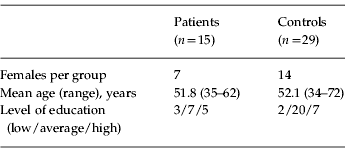
Data were obtained from 15 patients with MDD and 30 demographically matched non-depressed control participants; their demographic characteristics are presented in Table 1. Patients were in-patients at the Depression Unit of the Department of Psychiatry at the Erasmus MC, University Medical Center Rotterdam. After admission, it is routine practice to discontinue all psychotropic drugs. During the drug-free period, the diagnosis of unipolar MDD was confirmed with a semi-structured clinical interview (SCID-I) and the severity of depression was assessed with the 17-item Hamilton Rating Scale for Depression (HAMD; Hamilton, Reference Hamilton1960). All patients suffered from depression with melancholic features and none of them suffered from depression with psychotic features. Excluded were patients with schizophrenia, schizo-affective disorder, bipolar disorder, organic brain syndrome, a clinically relevant somatic illness, and patients who were pregnant. Patients were excluded when they scored below 18 on the HAMD. Furthermore, patients were excluded when they used medication affecting the central nervous system, including beta-blocking agents, or received electro-convulsive therapy (ECT). On average, they were drug free for 9.3 days (s.d.=4.5) prior to the experiment, with a minimum of 4 days. Two patients were medication naïve. The others had, prior to the drug-free period, received benzodiazepines (n=10), tricyclic antidepressants (TCAs; n=5), selective serotonin reuptake inhibitors (SSRIs; n=4), lithium (n=4), antipsychotics (n=5), duloxetine (n=1), or a combination of these drugs. None of them had used fluoxetine during the past month. Two other patients had received ECT during a previous depressive episode, 8 and 14 years ago respectively. Thirteen patients suffered from recurrent depression, and for six patients the index depressive episode lasted for over a year.
Demographic characteristics
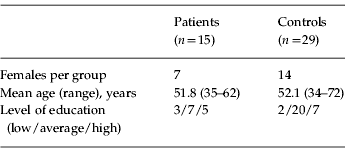
Level of education was divided into three groups (see van der Elst et al. Reference van der Elst, van Boxtel, van Breukelen and Jolles2008): low refers to participants with only primary education, average refers to those with at most junior vocational training or high school, and high refers to those with at most senior vocational or academic training.
Non-depressed controls were recruited by means of advertisements throughout the hospital and the medical and psychology faculties. All control participants were found on interview (SCID-I) to have no past history of, or evidence for, current psychiatric disorder. Similar to the patients, the controls were excluded when they used medication affecting the central nervous system, suffered from a clinically relevant somatic illness, or were pregnant. Non-depressed volunteers with a first-degree relative with depressive disorder were also excluded from participation. All participants gave written informed consent and the study was approved by the local medical ethics committee. The non-depressed participants received €25 for participation.
Time-estimation task
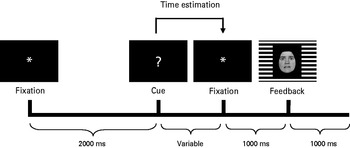
The time-estimation task was a modified version (Mies et al.,Reference Mies, van der Veen, Tulen, Hengeveld and van der Molenin press) of the original paradigm developed by Miltner et al. (Reference Miltner, Braun and Coles1997) . Participants had to produce a 1-s interval by pressing the button of a response device. Each trial started with the presentation of an asterisk (‘*’) in the center of a black screen for 2 s. This asterisk was followed by the cue for estimation, a question mark (‘?’), which was replaced with another asterisk at 1 s after the button press. This second asterisk was followed by the feedback stimulus (1 s) (see Fig. 1). If the response fell within a certain window around the target of 1 s, a happy male or female face was presented (positive feedback). If the estimation did not fall within this window, a fearful face was presented (negative feedback), indicating that the interval produced was either too long (e.g. a male fearful face) or too short (e.g. a female fearful face) (2×4 male and 2×4 female pictures were selected from Ekman & Friesen (Reference Ekman and Friesen1978) with 100% fearful and happy expressions). Without the participants knowing, the window was dynamically adjusted to ensure an equal amount of positive and negative feedback stimuli (see Miltner et al. Reference Miltner, Braun and Coles1997). The face stimuli were presented against a horizontal or vertical background grid that informed participants about the validity of the feedback. Valid feedback was based on the participant's performance whereas invalid feedback was determined randomly by the computer. Participants received invalid feedback in 50% of the trials. Four versions of the task were counterbalanced across participants to correct for possible effects of the gender of the face stimuli and background grid.
Trial sequence with an example of the feedback stimulus. Happy facial expressions indicated positive feedback, fearful expressions indicated negative feedback. The gender (male/female) of the face indicated whether the estimation was too short or too long (counterbalanced across participants). The background grid (horizontal/vertical) indicated whether feedback was valid or invalid (counterbalanced across participants).

Procedure
Prior to participation, patients and controls had to fill out a self-developed questionnaire to assess their health, including questions about medication use in the past 3 months, possible brain injury due to concussion, and psychiatric illness in first-degree relatives.
The patients were presented with the diagnostic interview and several standardized neuropsychological tasks, and undertook the electroencephalography (EEG) measurements on two separate, usually consecutive, days. For the control participants, all assessments were on the same day. After the electrodes had been attached for the EEG recordings, participants were instructed on how to perform on the time-estimation task and given 24 practice trials. Each trial lasted about 5 s. Stimuli were presented in four blocks of 120 stimuli. The task duration was therefore 40 min in total. Between the four blocks, participants took self-paced breaks. Participants were asked to restrain from coffee and tobacco at least 2 h before the EEG measurements.
Electrophysiological measures
The EEG was derived from five electrodes placed at Fz, Cz, Pz, C3 and C4 according to the 10–20 system (e.g. Sharbrough et al. Reference Sharbrough, Chatrian, Lesser, Luders, Nuwer and Picton1991). Linked mastoids were used as a reference. An electro-oculogram (EOG) was derived from two electrodes placed above and below the right eye, and one each on the outer canthi of the eyes. A ground electrode was placed at the sternum. EEG and EOG were recorded using a Vitaport 3 recorder (Temec Instruments BV, The Netherlands). The EEG was sampled at 256 Hz, low-pass filtered at 30 Hz, and high-pass filtered with a time constant of 0.33 s. The electrode impedance was kept below 8 kΩ.
Data were analyzed using locally developed software implemented in Vitascore (Temec Instruments BV). ERPs were locked to the onset of the feedback stimulus, and epochs were extracted between 100 ms preceding and 700 ms following feedback onset. The method of Gratton et al. (Reference Gratton, Coles and Donchin1983) was used to correct EEG traces for vertical EOG only (criteria for blinks: EOG signal exceeding 40 μV within a 20-ms time interval). Epochs were checked manually for artifacts and excluded from analysis when necessary.
Each ERP was baseline corrected by averaging the first 100 ms before feedback onset and subtracting this average from the ERP.
Statistical analyses
Patients and controls were compared on the number of correct adjustments they made after valid and invalid negative feedback by means of an ANOVA. Adjustments were considered ‘correct’ whenever a negative feedback stimulus indicating that the estimate was too short or too long was followed by, respectively, a lengthening or shortening of the time estimate on the subsequent trial. Adjustments were considered ‘incorrect’ when negative feedback was followed by a lengthening or shortening of the estimate whereas the feedback stimulus indicated that the estimate was too long or too short respectively.
To define the FRN, difference waves were created by subtracting the ERPs associated with positive feedback from the ERPs associated with negative feedback. This was done separately for valid and invalid feedback. For each participant and each channel, the most negative peak of this difference wave within 200 and 350 ms after feedback onset was measured, which is the time window in which the FRN is usually found (e.g. Nieuwenhuis et al. Reference Nieuwenhuis, Slagter, von Geusau, Heslenfeld and Holroyd2005). ERP data were analyzed by using channel (Fz, Cz, Pz, C3 and C4) and validity (valid versus invalid) as within-subjects factors and group (depressed versus non-depressed) as the between-subjects factor.
When necessary, degrees of freedom were corrected using the method of Huyn–Feldt. Corrected p values, but uncorrected degrees of freedom, are reported.
Results
The patients had a mean HAMD score of 23.9±3.1 (range 18–28). There were three patients who did not complete the total of 480 trials (4×10 min) because of increasing fatigue, restlessness or anxiety, but we had sufficient data to include them in the analyses (at least three time-estimation blocks). In one of the patients, the Fz channel showed too many artifacts, and therefore this patient could not be included in the ERP analyses, but was included in the behavioral analyses.
A box-plot analysis revealed that one of the control participants was an extreme outlier; this person had a mean estimation time of 539 ms and was therefore excluded from all analyses. No outliers were found within the MDD group.
Behavioral results
Despite the dynamic time window, participants received slightly more negative feedback (54%) than positive feedback (46%). The percentage of negative feedback received by patients differed slightly from that received by controls [55% v. 53%, t(42)=2.29, p=0.027]. The mean estimation time did not differ between the patients and controls [1163±259 v. 1085±118 ms, t(42)=1.1, p=0.289], nor did the variation in time estimates, as indicated by the standard deviation [373 v. 294 ms, t(42)=1.78, p=0.083].
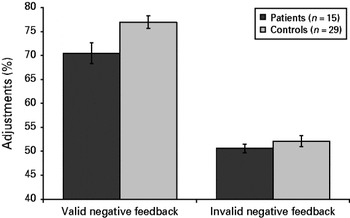
Both patients and controls adjusted their estimates more often after valid negative feedback than after invalid negative feedback [F(1, 42)=224.5, p<0.001]. The interaction between validity and group did not reach significance [F(1, 42)=2.8, p=0.104] but there was a main effect of group [F(1, 42)=7.0, p=0.012], indicating that patients had lower adjustment rates than controls. Patients adjusted their estimates in 50.6±3.4% of the invalid negative feedback trials, and controls in 52.1±6.2% of the trials [t(42)=1.04, p=0.305], both of which are close to the chance level (50%). After valid negative feedback, however, the proportion of correct adjustments was slightly lower in patients than in controls [70.5±8.5% v. 76.9±7.3%, t(42)=2.64, p=0.012] (see Fig. 2).
Mean percentage of correct adjustments after valid negative feedback and mean percentage of adjustments in accordance with the valence of the invalid negative feedback for patients and controls. Error bars show standard error of the mean (s.e.m.).

To assess whether this performance difference was due to neuropsychological dysfunction, we investigated whether patients differed from controls on two neuropsychological tests assessing sustained attention [the Continuous Performance Task (CPT); e.g. van den Bosch et al. Reference van den Bosch, Rombouts and van Asma1996] and working memory (Digit Span; Wechsler, Reference Wechsler1997), and if so, whether these test scores correlated with performance on the time-estimation task. Patients performed slightly worse on the CPT than controls (Mann–Whitney U test: Z=1.9, p=0.058), but did not differ in performance on the Digit Span (Z=1.2, p=0.24). Subsequent analyses revealed no significant correlations between CPT score and percentage adjustments within the patient group (Spearman r=0.29, p=0.32; r=0.18, p=0.35 for valid and invalid feedback respectively). Within the control group, CPT scores also did not correlate with performance. Non-parametric tests were used because the CPT and Digit Span scores were not normally distributed.
We also investigated whether severity of depression influenced adjustment rates of patients by means of two regression analyses, including the HAMD score and age as predictors. Age was added because it also might affect performance. We found no influence of severity of depression [R=0.12, F(2, 12)=0.09, p=0.92, and R=0.11, F(2, 12)=0.07, p=0.93, for valid and invalid feedback respectively].
Electrophysiological results
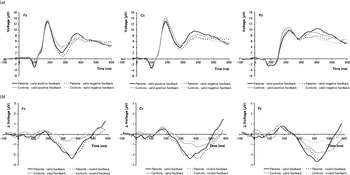
Figure 3 shows the grand-average ERPs and difference waves at channels Fz, Cz and Pz for patients and controls. Patients had significantly larger FRNs than controls [F(1, 41)=7.94, p=0.007; −3.8±2.7 v. –1.8±1.4 μV at Fz after valid feedback for patients versus controls]. The FRN was significantly different from zero in both groups (all p's <0.001). We also found a main effect of channel [F(4, 164)=4.64, p=0.003], indicating that the FRN was largest at frontocentral electrode sites (−2.4±2.1, −2.3±1.9, −2.3±1.9 and −2.4±1.8 μV, for valid and invalid feedback at Fz and Cz respectively and, for comparison, these values were –2.1±1.5 and −2.0±1.6 μV at Pz). We also found a three-way interaction between validity, channel and group [F(4, 164)=2.65, p=0.046]. Patients showed a slightly, but not significantly, larger response to valid feedback than to invalid feedback at Fz, whereas control participants showed this effect at Pz (both p's >0.1 in follow-up analyses for the patients and controls separately).
(a) Grand-average event-related brain potentials (ERPs) from the midline electrodes Fz, Cz and Pz evoked by positive and negative feedback in the valid condition only for patients and controls. (b) The corresponding difference waves (negative minus positive feedback) for valid and invalid feedback for patients and controls.

To evaluate whether the increased FRN in patients was caused primarily by a difference in response to negative feedback or to positive feedback, we calculated the peak negativity at Fz between 200 and 350 ms in the baseline-corrected ERPs associated with positive and negative feedback separately. A repeated-measures ANOVA with valence and validity as the within-subject factor and group as the between-subjects factor revealed a main effect of valence [F(1, 41)=12.9, p=0.001] and a marginal interaction between valence and group [F(1, 41)=3.4, p=0.074]. Subsequent t tests comparing patients and controls on these peak values revealed no significant effects for either positive or negative feedback. This suggests that the patients' differential FRN response was caused by a combination of differential responses to both negative and positive feedback.
We performed another analysis for a later time window corresponding to the feedback P3, a positive-going ERP component that is thought to reflect the evaluation of feedback outcome (e.g. Mathewson et al. Reference Mathewson, Dywan, Snyder, Tays and Segalowitz2008; Wu & Zhou, Reference Wu and Zhou2009). For this purpose we calculated the mean amplitude of the baseline-corrected ERP waveforms between 350 and 500 ms after feedback onset for each of the four feedback conditions. Valence, validity and channel were used as within-subjects factors, and group as the between-subjects factor in a repeated-measures analysis.
The results were similar to the FRN findings. We found a main effect of valence [F(1, 41)=26.1, p<0.001], a main effect of channel [F(4, 164)=10.0, p<0.001] and an interaction between valence and channel [F(4, 164)=11.2, p<0.001]. As shown in Fig. 3, this indicates that participants had larger P3 amplitudes for positive feedback than for negative feedback, and this effect was larger at posterior-central recording sites. Importantly, there was a marginally significant interaction between valence and group [F(1, 41)=4.0, p=0.053]. Patients had a slightly larger difference between positive and negative feedback in this time window than controls. This was not specifically due to either a larger response to positive feedback or a smaller response to negative feedback, as follow-up tests for positive and negative feedback, separately, showed no significant group differences (all p's >0.1).
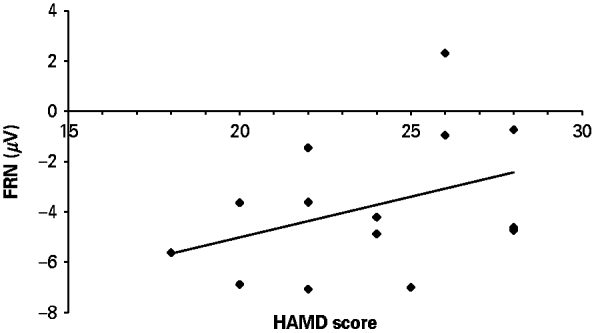
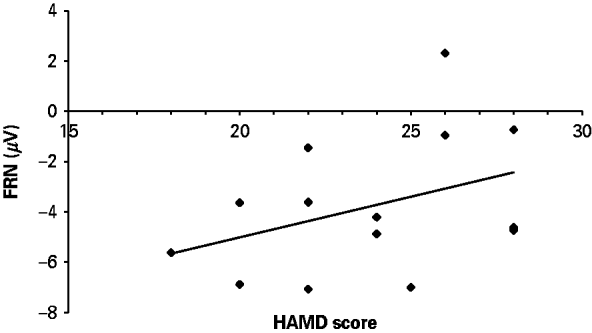
We also investigated whether severity of depression had an influence on the FRN by means of two regression analyses, including the FRN at Fz for valid and invalid feedback as dependent variables, and HAMD score and age as predictors. Age was added in these analyses because it has been found to affect FRN size (Eppinger et al. Reference Eppinger, Kray, Mock and Mecklinger2008; Wild-Wall et al. Reference Wild-Wall, Willemssen and Falkenstein2009; Mies et al.,Reference Mies, van der Veen, Tulen, Hengeveld and van der Molenin press). Severity of depression was found to have no influence on the FRN in response to invalid feedback [R=0.3, F(2, 11)=0.56, p=0.59]. Although the analysis on valid feedback did not reach significance, the FRN response was found to decrease with symptom severity [R=0.54, F(2, 11)=2.22, p=0.16, HAMD: standardized β=0.53, t(11)=1.94, p=0.079; see Fig. 4]. This latter result is probably due to a lack of power (power=0.45; Cohen, Reference Cohen1988).
Feedback-related negativity (FRN) of patients at electrode position Fz for valid feedback as a function of the Hamilton Rating Scale for Depression (HAMD) score (severity of depression).
Discussion
The aim of our study was to investigate behavioral and electrophysiological responses to valid and invalid feedback in patients with MDD. A major strength of this study is that we included patients with a relatively high HAMD score who were drug free at the time of testing. The behavioral results show that patients were just as capable as non-depressed controls of ignoring invalid negative feedback. When feedback was valid, however, patients made fewer correct adjustments than controls. The electrophysiological results show, in line with expectations, that patients had larger FRNs than controls, independent of the validity of the feedback.
In line with most studies (Beats et al. Reference Beats, Sahakian and Levy1996; Elliott et al. Reference Elliott, Sahakian, McKay, Herrod, Robbins and Paykel1996, Reference Elliott, Sahakian, Herrod, Robbins and Paykel1997; Steffens et al. Reference Steffens, Wagner, Levy, Horn and Krishnan2001; Douglas et al. Reference Douglas, Porter, Frampton, Gallagher and Young2009; Fladung et al. Reference Fladung, Baron, Gunst and Kiefer2010), patients tended to make fewer correct adjustments after valid negative feedback than controls. In contrast with previous reports, however, patients did not adjust their behavior after invalid negative feedback. This difference compared with the studies by Murphy et al. (Reference Murphy, Michael, Robbins and Sahakian2003) and Taylor Tavares et al. (Reference Taylor Tavares, Clark, Furey, Williams, Sahakian and Drevets2008), in which patients changed their behavior after misleading negative feedback, is most probably due to paradigmatic differences. In our time-estimation paradigm, feedback validity was explicitly communicated to patients. In the probabilistic reversal learning paradigm used in the previous reports, patients might have experienced uncertainty about the validity of the feedback, because negative feedback sometimes indicated a rule reversal. Therefore, the misleading negative feedback was ambiguous, and might have induced negative emotion, in line with the negativity bias from which patients are known to suffer.
The electrophysiological results show that patients had larger FRN responses than controls, which is in line with other studies (Tucker et al. Reference Tucker, Luu, Frishkoff, Quiring and Poulsen2003; Santesso et al. Reference Santesso, Steele, Bogdan, Holmes, Deveney, Meites and Pizzagalli2008), and this effect extended into the feedback P3. This larger FRN was due to the combined effect of a somewhat larger response to negative feedback and a smaller response to positive feedback. To our knowledge, we are the first to show this effect in drug-free in-patients. The larger FRN was not limited to valid feedback signals. Invalid feedback also led to larger FRNs. Importantly, patients did not differ from controls in this regard: both groups showed a similar-sized FRN to valid and invalid feedback, but in patients the FRN was larger in both conditions.
The FRN is thought to be generated in the anterior cingulate cortex (ACC). Imaging studies have shown structural alterations, that is reductions in gray matter (Koolschijn et al. Reference Koolschijn, van Haren, Lensvelt-Mulders, Hulshoff Pol and Kahn2009; van Tol et al. Reference van Tol, van der Wee, van den Heuvel, Nielen, Demenescu, Aleman, Renken, van Buchem, Zitman and Veltman2010) and functional alterations in this brain region in patients with MDD. The dorsal ACC (dACC), known for its involvement in cognitive control (Bush et al. Reference Bush, Luu and Posner2000), has been found to be hypoactive in depression, whereas the rostral/ventral ACC (rACC), known for its involvement in emotion processing, has fairly consistently been found to be hyperactive (Mayberg, Reference Mayberg1997; Davidson et al. Reference Davidson, Pizzagalli, Nitschke and Putnam2002; Mayberg, Reference Mayberg2003; Pizzagalli, Reference Pizzagalli2011). The present FRN and behavioral results are in line with a previous functional magnetic resonance imaging (fMRI) study in which we used the same task (Mies et al. Reference Mies, van der Molen, Smits, Hengeveld and van der Veen2011). In this latter study we found the rACC primarily sensitive to valence whereas the dACC was sensitive to validity. In time-estimation tasks, the rACC is likely to be the generator of the FRN (Nieuwenhuis et al. Reference Nieuwenhuis, Slagter, von Geusau, Heslenfeld and Holroyd2005). Atypical valence processing in this region might account for the increased FRN responses found in the MDD group. As the rACC is less sensitive to the validity of the feedback, this might explain why the FRN response did not distinguish between valid and invalid feedback. The validity of the feedback is, however, also being evaluated, as both patients and controls adjusted their performance after valid, but not after invalid, negative feedback. This evaluation probably involves the dACC, a possibility that is consistent with a recent study by van der Veen et al. (Reference van der Veen, Roder, Mies, van der Lugt and Smits2011), showing that activity in the dACC was related to behavioral adjustments in a time-estimation task. As the dACC is mainly active in response to valid feedback (Mies et al. Reference Mies, van der Molen, Smits, Hengeveld and van der Veen2011), impaired performance after valid negative feedback in our study and those of others might be related to a decreased dACC response in patients.
In accordance with previous studies, our results show that MDD patients have increased FRN responses, probably due to atypical rACC activity. However, studies on a similar component, the error-related negativity (ERN), show inconsistent results. The ERN occurs after a self-detected error, and is in many aspects similar to the FRN. They are considered to be reflections of the same general performance monitoring system, and are both manifestations of activity in the ACC. The ERN, however, is thought to be generated in the dACC (Ridderinkhof et al. Reference Ridderinkhof, Ullsperger, Crone and Nieuwenhuis2004). Several studies have reported larger ERNs in depressed or otherwise affectively distressed individuals compared to controls (Gehring et al. Reference Gehring, Himle and Nisenson2000; Luu et al. Reference Luu, Collins and Tucker2000; Johannes et al. Reference Johannes, Wieringa, Nager, Rada, Dengler, Emrich, Munte and Dietrich2001b; Hajcak et al. Reference Hajcak, McDonald and Simons2003, Reference Hajcak, McDonald and Simons2004; Chiu & Deldin, Reference Chiu and Deldin2007; Holmes & Pizzagalli, Reference Holmes and Pizzagalli2008, Reference Holmes and Pizzagalli2010), whereas others have found equivalent or smaller ERNs (Ruchsow et al. Reference Ruchsow, Herrnberger, Wiesend, Gron, Spitzer and Kiefer2004, Reference Ruchsow, Herrnberger, Beschoner, Gron, Spitzer and Kiefer2006; Compton et al. Reference Compton, Lin, Vargas, Carp, Fineman and Quandt2008; Schrijvers et al. Reference Schrijvers, de Bruijn, Maas, De Grave, Sabbe and Hulstijn2008, Reference Schrijvers, De Bruijn, Maas, Vancoillie, Hulstijn and Sabbe2009; Olvet et al. Reference Olvet, Klein and Hajcak2010). Discrepant results might be caused by different contributions from the dorsal and rostral ACC because error and feedback processing encompass both cognitive and affective processing. In addition, the FRN is reported to be the sum of several components from different sources (Foti et al. Reference Foti, Weinberg, Dien and Hajcak2010). It is therefore possible that both ACC subdivisions play a role in the generation of the ERN and FRN, but, depending on the specific paradigm used, which may be more affective or more informational, the rostral or dorsal part may prevail.
In contrast to our present study, almost all patients in the above-mentioned ERN studies used medication. The use of different types of medication might play an important role in the discrepancies between studies. The patients included in the studies by Schrijvers et al. (Reference Schrijvers, de Bruijn, Maas, De Grave, Sabbe and Hulstijn2008, Reference Schrijvers, De Bruijn, Maas, Vancoillie, Hulstijn and Sabbe2009) are the most comparable to our patients with respect to symptom severity, but they found no difference in ERN response between patients and controls. Half of the patients in the Schrijvers et al. (Reference Schrijvers, de Bruijn, Maas, De Grave, Sabbe and Hulstijn2008) study, however, used benzodiazepines and the authors showed that this subgroup had attenuated ERN responses compared to controls. This attenuating effect of benzodiazepines has also been found in healthy volunteers (Johannes et al. Reference Johannes, Wieringa, Nager, Dengler and Munte2001a; De Bruijn et al. Reference De Bruijn, Hulstijn, Verkes, Ruigt and Sabbe2004), and has been explained by γ-aminobutyric acid (GABA)ergic pathways directly inhibiting ACC activity (De Bruijn et al. Reference De Bruijn, Hulstijn, Verkes, Ruigt and Sabbe2004). The serotonin system is also thought to play a role in performance monitoring and feedback processing (Fallgatter et al. Reference Fallgatter, Herrmann, Roemmler, Ehlis, Wagener, Heidrich, Ortega, Zeng and Lesch2004; Evers et al. Reference Evers, Cools, Clark, van der Veen, Jolles, Sahakian and Robbins2005; van der Veen et al. Reference van der Veen, Mies, van der Molen and Evers2008, Reference van der Veen, Evers, Mies, Vuurman and Jolles2009; Jocham & Ullsperger, Reference Jocham and Ullsperger2009), although SSRIs do not seem to affect ERN size (De Bruijn et al. Reference De Bruijn, Sabbe, Hulstijn, Ruigt and Verkes2006; Stern et al. Reference Stern, Liu, Gehring, Lister, Yin, Zhang, Fitzgerald, Himle, Abelson and Taylor2010). Norepinephrine reuptake inhibitors (NRIs), by contrast, are found to increase the ERN (Riba et al. Reference Riba, Rodriguez-Fornells, Morte, Munte and Barbanoj2005; Jocham & Ullsperger, Reference Jocham and Ullsperger2009). These neurotransmitter systems at the source of antidepressant action might therefore lead to differences in ERN and FRN responses through their influence on the subdivisions of the ACC.
Finally, it should be noted that this study has some limitations. Although we only included patients who were drug free, there might have been long-lasting effects of previous medication on the brain, such as altered number and sensitivity of receptors, and perhaps some withdrawal effects. Co-morbidity such as an anxiety disorder might also have had an influence on the response to feedback because most patients suffered to some degree from co-morbid anxiety. In addition, we failed to observe a significant relationship between severity of depression and FRN size. This is probably due to a lack of statistical power, but might be due to the selection of a homogeneous group of patients with severe depression. Our patients are therefore difficult to compare with the less severely depressed patients of Tucker et al. (Reference Tucker, Luu, Frishkoff, Quiring and Poulsen2003), who found increased FRN responses in moderately depressed, but not in more severely depressed, patients. It should be noted, however, that our results, although statistically not significant, do point in the same direction.
In conclusion, we have shown that patients with MDD did not change their behavior in response to invalid negative feedback. When feedback was valid, however, patients performed slightly worse than controls. These results support the idea postulated by Murphy et al. (Reference Murphy, Michael, Robbins and Sahakian2003) that depressed patients' responses to negative feedback are context dependent. In addition, patients had larger FRN responses than controls, irrespective of the information communicated by the feedback (valid or invalid). This implies that drug-free in-patients have an atypical rACC response to feedback that is independent of context. If this atypical response can be normalized, with the use of antidepressants and/or cognitive therapy, perhaps the patients' sensitivity to a relapse would decrease. Future studies should therefore focus on the effects of chronic medication use and cognitive therapy on feedback processing in homogeneous groups of depressed patients.
Acknowledgments
This work was supported by a grant from the Netherlands Organization for Scientific Research (NWO 400-05-186). We thank H. van Steenis for the development of the custom-made software for the ERP analyses, W. van den Broek for his advice and contribution to patient interviews, and B. van der Steldt, Y.-S. Hong and J. Schook for their help in data collection.
Declaration of Interest
T. K. Birkenhäger has received speakers' fees from Wyeth Pharmaceuticals, Servier and AstraZeneca, and grants from Wyeth Pharmaceuticals and Lundbeck.