

Introduction
The production of insects, for either research or control purposes, requires protein sources, which usually account for a large proportion of the rearing budget (Chang et al., Reference Chang, Kurashima and Albrecht2001; Nestel and Nemny-Lavy, Reference Nestel and Nemny-Lavy2008). Facilities for mass-rearing fruit flies, e.g. the Mediterranean fruit fly Ceratitis capitata (Wiedemann), spend approximately half, or even more, of the diet budget on protein sources (I. Shouster-Dagan, personal communication). High levels of protein in a fruit fly diet have, in many cases, been empirically established and derived from the concept that protein enhances sexual performance and other quality parameters of mass-produced fruit flies (Blay and Yuval, Reference Blay and Yuval1997; Kaspi et al., Reference Kaspi, Mossinson, Drezner, Kamensky and Yuval2002; Maor et al., Reference Maor, Kamensky, Shloush and Yuval2004; Yuval et al., Reference Yuval, Maor, Levy, Kaspi, Taylor and Shelly2007). Certainly, protein is essential for fruit fly development and reproduction, but the amount required to maintain balanced nutrition is controversial (Lee et al., Reference Lee, Simpson, Clissold, Brooks, Ballard, Taylor, Soran and Raubenheimer2008). Moreover, recent studies have suggested that large amounts of protein may have detrimental effects on the flies and could be a waste of money (Economopoulos et al., Reference Economopoulos, Al-Taweel and Bruzzone1990; Nestel et al., Reference Nestel, Nemny-Lavy and Chang2004; Nestel and Nemny-Lavy, Reference Nestel and Nemny-Lavy2008; Fanson et al., Reference Fanson, Weldon, Pérez-Staples, Simpson and Taylor2009; Zur et al., Reference Zur, Nemny-Lavy, Papadopoulos and Nestel2009). In addition, requirements may vary between the sexes.
The proportion of sugar and protein in fruit fly adult diets usually ranges between 2:1 and 3:1 (sugar: protein) (Tsitsipis, Reference Tsitsipis, Robinson and Hooper1989). Although this has been common practice in the mass-rearing industry and in rearing laboratory colonies, evidently there are no experimental studies that have verified the suitability of this relationship between these two diet components, except for the recent work of Prabhu et al. (Reference Prabhu, Perez-Staples and Taylor2008) on the Queensland fruit fly Bactrocera tryoni (Froggatt). Yeast protein hydrolysate (YPH), commonly used for adult maintenance, is an extremely expensive component of the diet. YPH constitutes up to 90% of the cost of the adult diet, and thus even a small reduction in the amount used would save money and resources, especially in mass-rearing facilities. To investigate this aspect, in this study, we manipulated the constitution of the adult diet of the Ethiopian fruit fly Dacus ciliatus Loew with respect to the YPH: sucrose ratio; we then investigated the effect of various diets on fly survival and pupal production. In addition, as an indication of the ability of flies to acquire and accumulate metabolites, we monitored over time the protein and lipid loads of flies maintained on the various diets. Our hypothesis was that, within certain ranges, the YPH: sugar ratio in the adult diet will not affect survival and pupal production, thus allowing a reduction in the cost of YPH.
Materials and methods
General procedures
The flies (D. ciliatus) were derived from a laboratory colony maintained under quarantine conditions in the ARO of Israel for more than 7 years on zucchini fruit, as the larval development substrate, and on brewers' YPH: sugar (1:3), as the adult diet. Periodically, wild material was introduced into the colony to refresh its genetic make-up. To conduct feeding experiments and reduce adult fly manipulations, flies were collected as pupae and placed into Perspex cages (20 × 20 × 20 cm) for adult emergence. Cages were loaded with the experimental diet, water and wrinkled paper (to increase resting surface). Emerged flies were monitored throughout the experimental period, and dead flies were counted and removed on almost a daily basis. At the end of the experimental period, food and water were removed from the cages to kill the remaining flies, and the dead flies were counted to calculate the total number of adult insects present in the cages at the onset of an experiment. We conducted two series of experiments, varying the relative humidity (RH) to which flies were exposed (>65% RH in the first series and < 45% RH in the second series). Besides survival trends, in the first series, we followed pupal production patterns per cage and endogenous loads of protein and lipid estimated from samples of flies taken at various time points throughout the experimental period. During the second series, we concentrated on fewer food treatments and followed survival and pupal production trends.
First experimental series (high humidity)
We introduced 100 pupae (c. 90% adult emergence) into each of the cages. The adult food regimens evaluated were as follows: 1:0, 1:1, 1:2, 1:3, 1:4, 1:5 and 0:1 YPH (yeast hydrolysate enzymatic; MP Biomedicals, Solon, OH, USA): sucrose. The experiment was replicated three times. To maintain high levels of RH, cages were placed inside closed large plastic aquaria in which a beaker with 1 litre of saturated solution of sodium chloride was introduced to keep the level of humidity high. We constantly measured temperature and RH, which remained almost constant throughout the experimental period at 25°C and 65–70% RH. Mortality was recorded almost daily until the end of the experimental period in all the three replicates, which lasted for up to 40 days. Survival curves were constructed with data obtained from the three experiments, adjusting logarithmic functions. Inferences on survival were made using the Kaplan–Meier analysis (SPSS User Manual, 1999; SPSS Inc., Chicago, IL, USA).
Pupal production and endogenous protein and lipid loads were investigated only in the last two experiments. Pupal production was studied by introducing fresh zucchini fruit into the cages for egg-laying (24 h) and then the fruit were removed and incubated until the larvae jumped out and pupated. Pupal production was measured after flies were sexually mature (7 days old). We exposed the fruit three to four times during the study period – at ages 7–8, 10–11, 14–15 and 17–20 days. The production of pupae per female was standardized by the number of female flies alive at the time of exposure.
Protein and lipid contents were measured using individual flies removed alive from the experimental cages at various ages (0, 7, 11, 15 and 18 days). For each age, we processed five males and five females per treatment cage and experiment (last two experiments). Immediately after removal for protein and lipid quantification, the flies were stored at − 20°C until the start of processing. Flies were individually homogenized in 1 ml of phosphate-buffered saline. After centrifugation, an aliquot (25 μl) was removed for protein quantification. Protein content was colorimetrically quantified using the Bradford reaction and reading absorbance in an ELISA reader spectrophotometer at 595 nm (Zur et al., Reference Zur, Nemny-Lavy, Papadopoulos and Nestel2009). To extract and quantify lipids, an aliquot of 100 μl was taken from the homogenate, mixed with 900 μl chloroform:methanol (1:2), dried and reacted with sulphuric acid. Lipids were developed using the vanillin reagent and quantified at 490 nm (Zur et al., Reference Zur, Nemny-Lavy, Papadopoulos and Nestel2009). The results of the two experiments were combined and analysed using the generalized linear model with treatment and age as sources of variation (Statgraphics, 2000; Manugistics Inc., Rockville, MD, USA).
Second experimental series (low humidity)
During the second series of experiments, flies were exposed to the lower ambient humidity ( < 45% RH) prevailing at room temperature in the rearing room. The temperature was constant at approximately 25°C. In this series, we investigated the following food treatments: 1:1, 1:3, 1:5 and 0:1 YPH: sucrose. We introduced half the number of flies, i.e. 50 pupae, into each of the cages. For each treatment, we set up a total of five replicate cages on two different dates (e.g. two cohorts); however, for sucrose treatment, we set up only three replicates in the second cohort. Mortality and pupal production were investigated according to the protocol used in the first series. Pupal production was investigated at various fly ages (7–8, 10–11, 14–15, 21–23 and 30 days). Differences in pupal production per female as affected by food treatment were inferred from a one-way ANOVA. Survival curves were obtained by combining the data from the two cohorts and adjusting logarithmic functions to the data. Inferences on survival were made using the Kaplan–Meier analysis (SPSS User Manual, 1999; SPSS Inc., Chicago, IL, USA).
Results
First experimental series (high humidity)
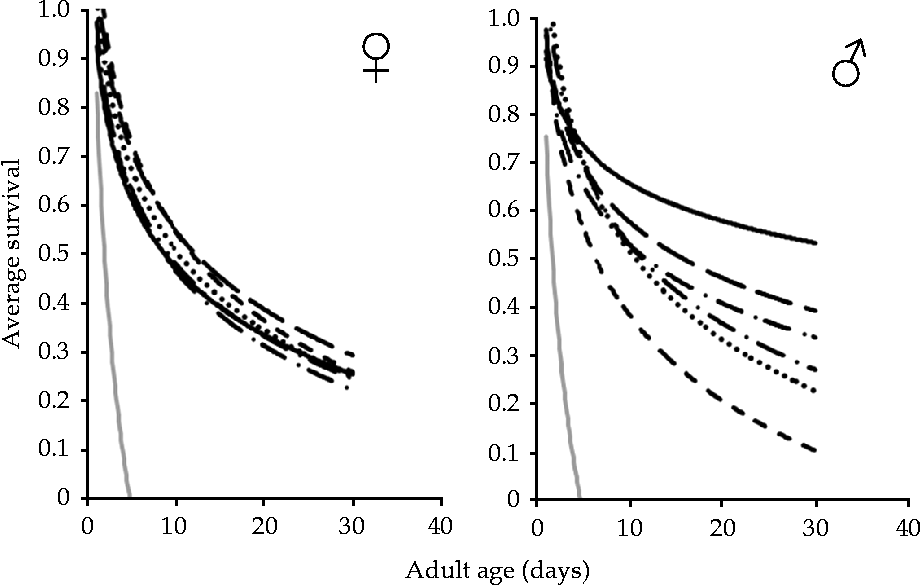
In both female and male flies maintained on the diet containing only YPH, mortality occurred rapidly, and the survival trends were significantly different from those of flies maintained on the diets containing sucrose (χ2= 226.3, P< 0.01 for females; χ2= 289.2, P< 0.01 for males) (Fig. 1). The survival trends of female flies maintained on diets containing various proportions of sucrose, or only sucrose, did not differ statistically (Fig. 1). By contrast, the survival trends of male flies, in general, decreased with decreasing proportions of sucrose in the diet (Fig. 1). Significantly lower male survival was found in flies maintained on the 1:2 YPH: sucrose diet than in those maintained on the sucrose-only (χ2= 16.1, P< 0.01), 1:5 YPH: sucrose (χ2= 11.1, P< 0.01) and 1:4 YPH: sucrose (χ2= 8.9, P< 0.01) diets.
Average survival trends (three cohorts) of Dacus ciliatus female and male flies maintained under high-humidity conditions (>65% relative humidity) throughout the experimental period and fed diets containing various proportions of brewer's yeast hydrolysate and sugar.  , Only sugar;
 , 1:5 brewers' yeast:sugar;
 , 1:4 brewers' yeast:sugar;
 , 1:3 brewers' yeast:sugar;
 , 1:2 brewers' yeast:sugar;
 , 1:1 brewers' yeast:sugar;
 , only yeast hydrolysate.

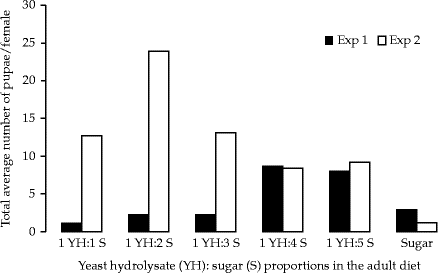
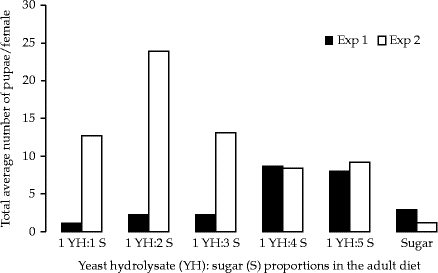
Average pupal production per female in the two cohorts as affected by diet type followed different patterns. In cohort 1, production was higher in flies maintained on diets containing a higher proportion of YPH, while in cohort 2 pupal production increased inversely to the proportion of YPH in the diet (Fig. 2). In both cohorts, pupal production was relatively low in the sucrose-fed flies. Due to the different patterns in the two cohorts, we were unable to combine them and infer differences among the flies subjected to various treatments.
Total average number of pupae produced per female Dacus ciliatus fly maintained under high-humidity conditions (>65% relative humidity) throughout the experimental period and fed diets containing various proportions of brewers' yeast and sugar. Black and white bars represent the results of two separate experiments.
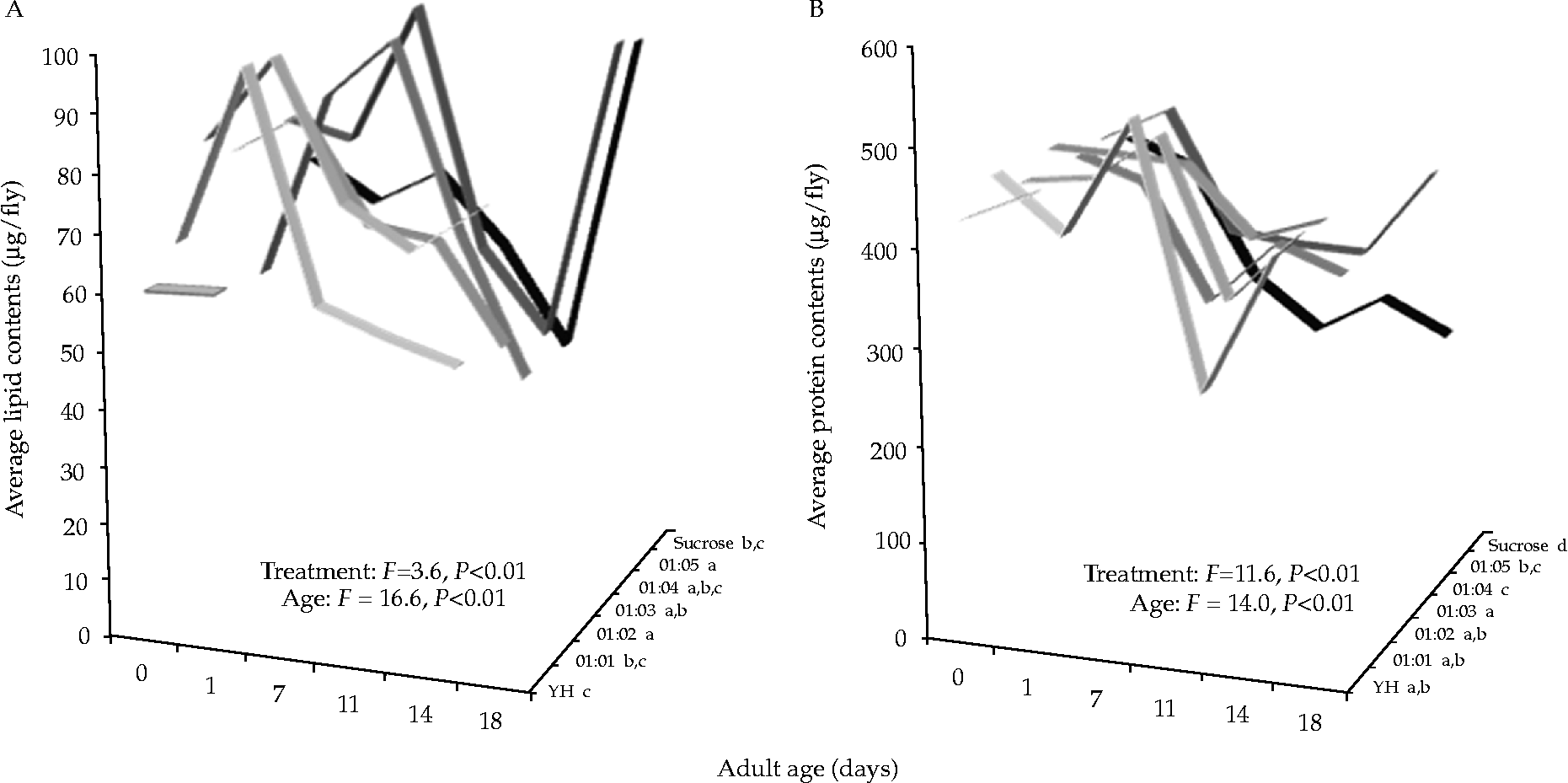
Average lipid and protein contents per sampling date in female flies maintained on various diet regimens differed significantly (F= 3.6, P< 0.01 for lipids and F= 11.6, P< 0.01 for proteins) (Fig. 3A). Protein content was proportional to the proportion of YPH in the diet, i.e. the higher the YPH proportion, the higher the protein content (Fig. 3B). Lipid content did not exhibit a clear pattern, but there was a lower content in flies maintained on the YPH-only diet. Both protein and lipid contents in female flies also differed significantly with age (F= 16.6, P< 0.01 for lipids and F= 14.0, P< 0.01 for proteins). Under all treatment regimens, a tendency for both protein and lipid contents to increase during the first few days of adult life and then decrease at the reproductive age (about 8–10 days of age) was observed. In flies maintained on the sucrose-only and 1:5 YPH: sucrose diets, lipid content increased after the age of 15 days (we did not follow the trends in flies maintained on the other diets). Protein content also increased in all flies maintained on various diets after the initial decrease during the early reproductive age, except in flies maintained on the sucrose-only diet, in which the content continued to drop throughout the experimental period (Fig. 3).
Average lipid (A) and protein (B) content trends throughout adult age (lifespan) of individual female flies maintained on diets containing various proportions of brewers' yeast hydrolysate (YH) and sugar. Data for flies fed the sugar-only and 1:5 YH: sugar diets extended to 18 days due to better survival (see Fig. 1), while results obtained for flies maintained on the diet containing only YH are those for early adult life due to premature death on this diet. The two-way ANOVA results for food treatment and age are shown in the figure. Differences in lipid and protein contents as affected by treatment are indicated by different letters (see z-axis showing treatments).
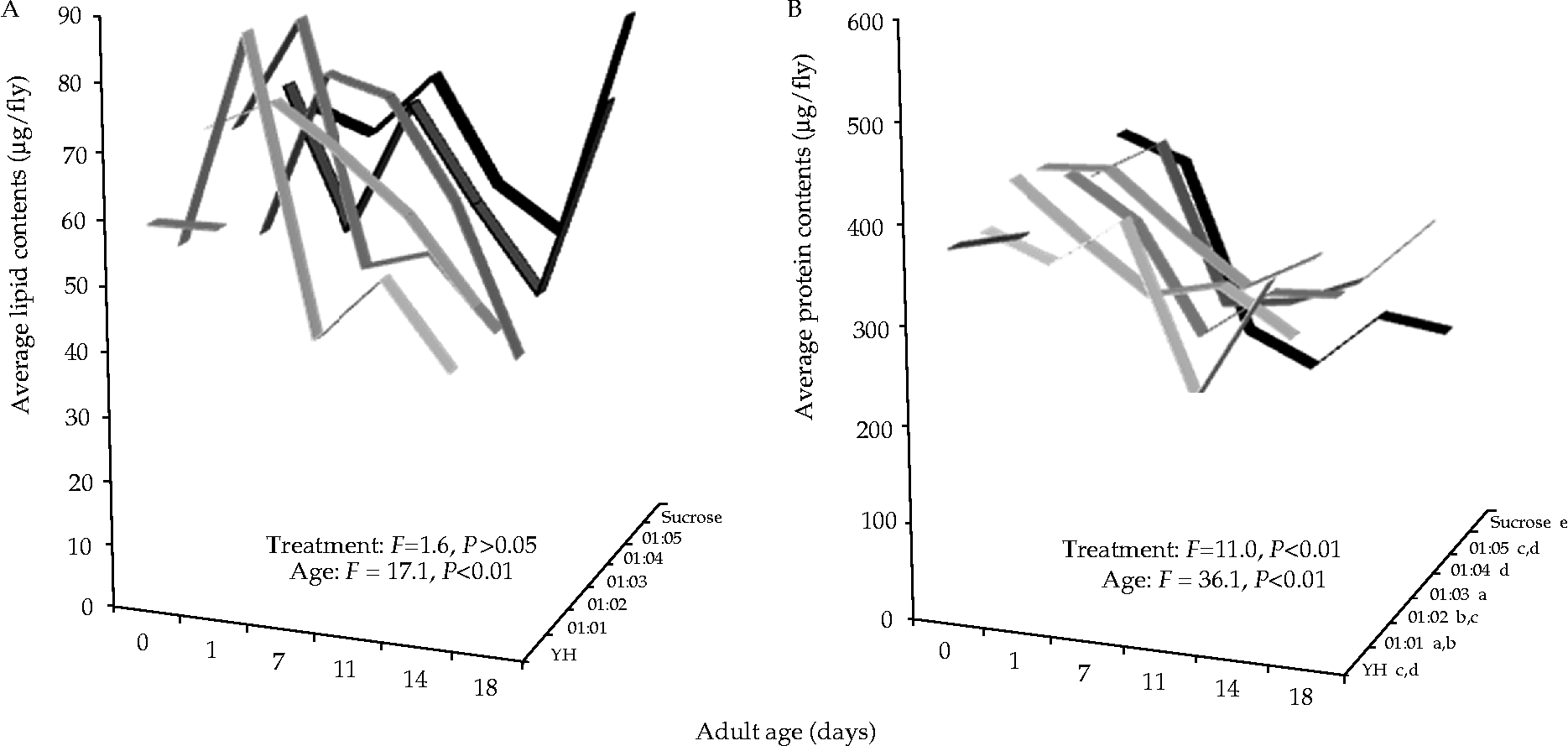
The lipid and protein patterns for males as affected by diet type were similar to those observed for females (Fig. 4). In contrast to that in females, the average lipid content per sampling date in males maintained on various diets did not differ significantly (F= 1.6, P>0.05). On the other hand, protein content was significantly affected by diet type (F= 11.0, P< 0.01). Males fed diets with a high proportion of YPH had higher protein content than those fed diets with a low proportion of YPH (Fig. 4). As in females, lipid and protein contents oscillated significantly with age (F= 17.1, P< 0.01 for lipids and F= 36.1, P< 0.01 for proteins) (Fig. 4). After adult emergence, the lipid load tended to increase initially, peaking before the reproductive maturity stage, and then dropped after sexual maturation. In flies maintained on the sucrose-only and 1:5 YPH: sucrose diets that were followed at later ages, the lipid content in males tended to increase again. As in females, the protein content in males increased again, except in males fed the diet containing only sugar (Fig. 4).
Average lipid (A) and protein (B) content trends throughout adult age (life span) of individual male flies maintained on diets containing various proportions of brewers' yeast hydrolysate (YH) and sugar. Data for flies fed the sugar-only and 1:5 YH: sugar diets extended to 18 days due to better survival (see Fig. 1), while results obtained for flies maintained on the diet containing only YH are those for early adult life due to premature death on this diet. The two-way ANOVA results for food treatment and age are shown in the figure. Differences in lipid and protein contents as affected by treatment are indicated by different letters (see z-axis showing treatments).
Second experimental series (low humidity)
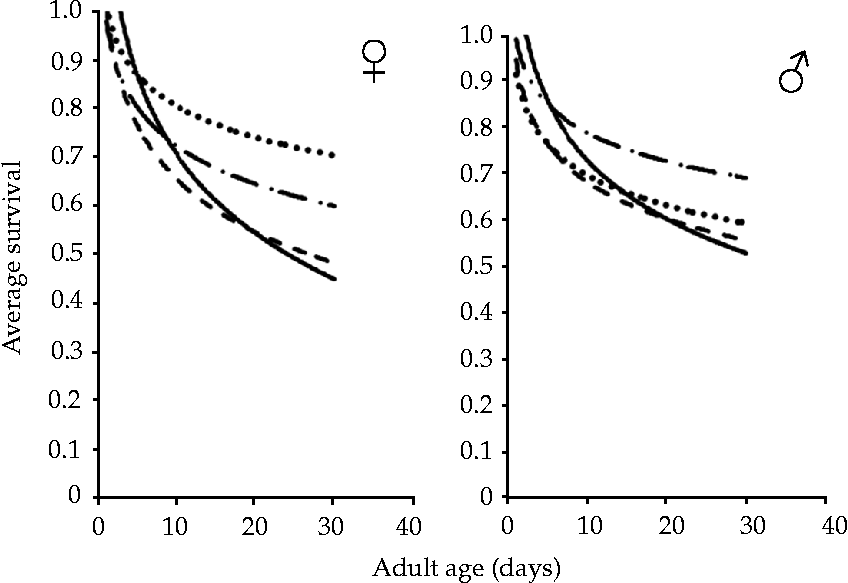
Survival patterns observed under low-humidity conditions differed from those observed under high-humidity conditions. Under low-humidity conditions, the higher the proportion of protein in the diet was, the higher the survival was (Fig. 5). Females maintained on the 1:1 or 1:3 YPH: sucrose diets survived for significantly longer time periods than those maintained on the sucrose-only diet (χ2= 39.5, P< 0.01 and χ2= 17.9, P< 0.05, respectively). Similarly, females maintained on the 1:1 YPH: sucrose diet lived for significantly longer time periods than those maintained on the 1:5 YPH: sucrose diet (χ2= 9.8, P< 0.05). No differences were found between females maintained on the 1:3 YPH: sucrose diet and those maintained on the 1:5 YPH: sucrose diet (χ2= 4.2, P>0.05) and between females maintained on the sucrose-only diet and those maintained on the 1:5 YPH: sucrose diet (χ2= 3.1, P>0.05). Similarly, no differences were found between flies maintained on the 1:1 YPH: sucrose diet and those maintained on the 1:3 YPH: sucrose diet (χ2= 0.2, P>0.05). For males, a similar but not significant (χ2= 1.3, P>0.05) pattern was observed: males maintained on diets with a higher proportion of YPH lived for longer time periods.
Average survival trends of Dacus ciliatus female and male flies maintained under low-humidity conditions ( < 45% relative humidity) throughout the experimental period and fed diets containing various proportions of brewers' yeast hydrolysate and sugar: , only sugar; , 1:5 brewers' yeast:sugar; , 1:3 brewers' yeast:sugar; , 1:1 brewers' yeast:sugar.
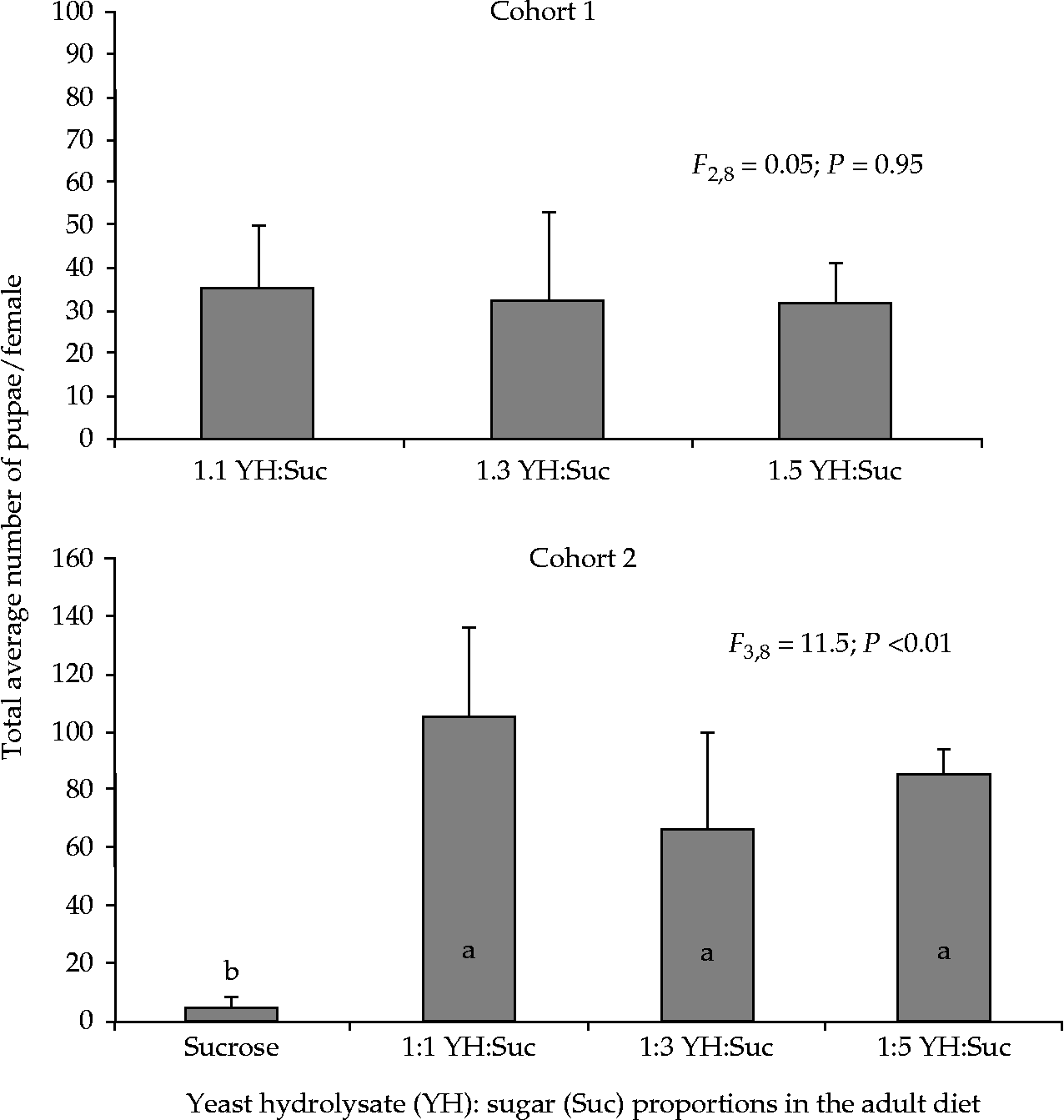
Under low-humidity conditions, the average pupal production per female was not significantly affected by the proportion of YPH in the diet (Fig. 6). Differences in pupal production were found only between females maintained on the YPH-only diet and those maintained on the sucrose-only diet (cohort 2; Fig. 6).
Total average number of pupae produced per female Dacus ciliatus fly maintained under low-humidity conditions ( < 45% relative humidity) throughout the experimental period and fed diets containing various proportions of brewer's yeast hydrolysate and sugar. Results are separated by cohort (two separate experiments). In cohort 2, differences in pupal production as affected by treatment are indicated by different letters.
Discussion
The various proportions of protein and sugar in the adult diet of D. ciliatus affected survival, pupal production, and endogenous lipid and protein contents in male and female flies.
Besides the possible effect of the protein: sucrose ratio on the metabolism of flies, another source of mortality under high-humidity conditions (which is also linked to the relationship between the two nutrient sources) was the stickiness of the diet for feeding flies. Throughout the study period, we observed many dead flies on the feeding plates. These flies were stuck to the sticky food mix (resulting from the high-humidity conditions in the rearing chamber). Visually, the degree of stickiness of the adult diet mix was associated with increases in the proportion of YPH, which is known to be highly hygroscopic. Therefore, although not significantly different for females, the resulting survival patterns under these environmental conditions, i.e. higher mortality if the proportion of protein in the diet was higher, may have been caused partly by the effect of humidity on the diet and the resulting stickiness for feeding flies.
Under low-humidity conditions, the diet mix did not become sticky, and the observed mortality caused by sticking of the flies to the diet mix was insignificant. Moreover, flies were observed to be separating grains of sugar from the mix, thus possibly selecting required nutrients, a situation that was not possible with the sticky semi-liquid mixed diet in a high-humidity environment. Under low-humidity conditions, survival patterns were positively associated with the proportion of YPH in the diet, i.e. the higher the YPH proportion, the longer the survival. YPH alone drastically shortened the survival period (also reported by Teal et al. (Reference Teal, Gavilanez-Slone and Dueben2004) for Anastrepha suspensa (Loew)), while sugar alone decreased the survival period in contrast to that in flies fed the diet mixes.
Reports on the survival of Tephritidae fruit flies on diets containing only sugar, in contrast to that of flies on diet mixes containing both sugar and YPH, are controversial. Some studies, e.g. that carried out by Carey et al. (Reference Carey, Liedo, Müller, Wang and Vaupel1998, Reference Carey, Liedo, Harshman, Liu, Müller, Partridge and Wang2002), have shown that both the life expectancy at adult emergence and the lifespan of Mediterranean fruit flies maintained on a sugar-only diet are significantly higher than those of flies maintained on a diet containing both sugar and YPH. By contrast, Nestel et al. (Reference Nestel, Papadopoulos, Liedo, Gonzales-Ceron and Carey2005) found that, in comparison with a full diet, a sucrose-alone diet significantly shortened the expected lifespan at emergence of adult female Mediterranean fruit flies (cohort lifespan was similar for flies on the two diet types). The reasons for these differences are not clear, but, as suggested by Yuval et al. (Reference Yuval, Maor, Levy, Kaspi, Taylor and Shelly2007), they may result from differences in strains, experimental settings and environmental conditions (as evidenced in this study).
Recent studies have approached these controversial findings, and the discussion regarding longevity and caloric restriction, i.e. expansion of lifespan as a result of a reduction in caloric intake, from another perspective: survival patterns are not directly affected by diets and caloric intake, but are affected by the ingestion of specific nutrients such as proteins and amino acids (Lee et al., Reference Lee, Simpson, Clissold, Brooks, Ballard, Taylor, Soran and Raubenheimer2008). In this context, several recent studies have suggested that the consumption of high levels of protein may be detrimental to both the performance and the longevity of insects (Lee et al., Reference Lee, Simpson, Clissold, Brooks, Ballard, Taylor, Soran and Raubenheimer2008; Fanson et al., Reference Fanson, Weldon, Pérez-Staples, Simpson and Taylor2009; Zur et al., Reference Zur, Nemny-Lavy, Papadopoulos and Nestel2009). Moreover, recent studies have shown that the South American fruit fly Anastrepha fraterculus (Wiedemann) can regulate the ingestion of protein if it is provided separately (Prabhu et al., Reference Prabhu, Perez-Staples and Taylor2008; Oviedo et al., 2011). Prabhu et al. (Reference Prabhu, Perez-Staples and Taylor2008) recognized the important applications of this concept to fruit fly rearing and investigated the best proportions of protein and carbohydrates required to optimize sexual activity and longevity in the Queensland fruit fly. The results of their study suggested that high levels of YPH (above 50%) in the mixed diet had a detrimental effect on longevity and reproduction. By contrast, flies maintained on diets containing low proportions of YPH (between 9 and 25%) performed well and were able to regulate ingestion and there were no statistical differences in longevity (Prabhu et al., Reference Prabhu, Perez-Staples and Taylor2008). These findings in the Queensland fruit fly in some respects are not only similar to the results of our study obtained under high-humidity conditions, but also in contrast to those obtained when D. ciliatus flies were maintained under low-humidity conditions. As in our study, under high-humidity conditions, Prabhu et al. (Reference Prabhu, Perez-Staples and Taylor2008) found reduced longevity in flies when they were maintained on diet mixes with a high proportion of YPH. The results of their study contrast with those of our study under low-humidity conditions – we found higher longevity with a higher proportion of YPH and also significant differences with diets containing 33 and 20% YPH (the highest proportion of YPH used in our study was 50%). Although the similarities and differences may be a function of the different species involved, the divergence between the two studies may be related to the environmental conditions under which Prabhu et al. (Reference Prabhu, Perez-Staples and Taylor2008) carried out their study – their experiment was conducted under 65–75% RH. Therefore, the results of their study may have been affected by the prevailing environmental conditions; this strengthens the observations made in our experiments conducted under high-humidity conditions.
The ability of D. ciliatus to produce offspring when fed diets containing various proportions of YPH and sucrose is not clearly understood. Similar to that in other Tephritidae fruit flies (Yuval et al., Reference Yuval, Maor, Levy, Kaspi, Taylor and Shelly2007), which are known to be anautogenous, i.e. unable to produce offspring, or produce few offspring, without a protein meal, sucrose alone does not promote pupal production in D. ciliatus. On the other hand, the results obtained for the two cohorts maintained under high-humidity conditions were distinct and do not reveal a clear production pattern. By contrast, under low-humidity conditions, there were no significant differences in pupal production among flies maintained on diets containing YPH content ranging between 20 and 50%, probably indicating that this range is optimal for pupal production under these environmental conditions.
The results obtained for lipid and protein loads of flies derived from the two cohorts maintained under high-humidity conditions are also not completely clear. While, as expected, endogenous protein content increased with increments in the proportion of YPH in the adult diet, lipid patterns did not exhibit a clear relationship. The protein content in flies maintained on diets containing various proportions of YPH and sucrose is probably related to the inability of the flies to select the required amount of nutrients from the sticky semi-liquid diet mix, thus being forced to ingest more protein than probably required. The inability of flies to regulate the ingestion of protein when food is given in a liquid or a semi-liquid form has recently been shown for A. fraterculus when given the option of selecting food (Oviedo et al., 2011). Moreover, it has also been shown that flies given only a mixed diet without the ability to select their nutrients from a separate carbohydrate food source appear to die earlier than those given a choice. In any case, the endogenous protein content in the flies may not necessarily be linked to their reproductive potential and may be a wasted resource, as was also suggested for larval diets of the Mediterranean fruit fly (Nestel and Nemny-Lavy, Reference Nestel and Nemny-Lavy2008). Endogenous lipid content, while required for egg maturation, also fluctuated largely in response to food content and did not appear to indicate reproductive ability, at least at the proportions investigated in this study.
Protein is a vital resource for the development and reproduction of fruit flies. However, at high concentrations, it appears to be detrimental and even lethal to the flies. The results of this study, and the evidence emerging from other studies (Prabhu et al., Reference Prabhu, Perez-Staples and Taylor2008; Fanson et al., Reference Fanson, Weldon, Pérez-Staples, Simpson and Taylor2009; Oviedo et al., 2011), suggest that YPH content can be significantly reduced in Tephritidae mass-rearing diets. Moreover, the evidence reported by Oviedo et al., 2011 and Prabhu et al. (Reference Prabhu, Perez-Staples and Taylor2008) suggests that flies can select their nutrients when provided with food in different containers, e.g. YPH–sucrose mix on one dish and sucrose alone on another dish, improving longevity and reproduction. All these novel results should stimulate the personnel in mass-rearing facilities to investigate and adopt separate food-delivery systems and lower YPH proportions so as to enhance rearing and production and also reduce costs. However, the reduction of the amount of YPH used in mass-rearing facilities (and therefore the level of savings) should be individually tailored, taking into consideration the species, the environmental conditions in the facility, and the local experience and experimental results.
Acknowledgements
The authors thank Polychronis Rempoulakis (University of Crete) for his help in conducting demographic analysis of the data. This study was partially supported by IAEA Research Contract No. 13021.