I. INTRODUCTION
As important connecting pieces, thin-walled rectangular bent tubes have been widely applied in fields of aerospace, aviation, and automotive for its lower cutoff frequency and smaller loss signal.Reference Hashmi1 Rotary draw bending (RDB) is a versatile and cost-effective method in tube bending area in response to the diverse demands of bent tube specification, shapes, and forming tolerance. However, RDB of thin-walled tube is a complicated physical process with multifactor interactive effects and complex nonlinear contact conditions.Reference Li, Yang, Zhan and Gu2 Cross-sectional deformation of rectangular tube in RDB process inevitably occurs and it seriously affects the forming accuracy. Material parameters, such as Young's module E, initial yield stress σS, strength coefficient K, strain hardening exponent n, and thickness anisotropy exponent γ, have a significant impact on cross-sectional deformation. And material parameters easily fluctuate in a certain range with the change of heat treatment methods, batches, and manufacturing processes of thin-walled rectangular tubes. What's more, there also exists coupling effects among material parameters. Therefore, it's vital to study the sensitivity of material parameters and coupling effects of material parameters to cross-sectional deformation for improving the forming quality of rectangular tube in RDB process.
In recent years, aiming at improving the cross-sectional deformation of tubes in bending process, numerous scholars have researched the impact of material properties on cross-sectional deformation of bent tube by utilizing experimental method, theory analysis method, and numerical simulation method. Yang et al.Reference Yang, Yan, Wang, Chen and Li3 researched the effect of initial yield strength σS on cross-sectional deformation of aluminum rectangular tube in RDB combining experiments with theoretical analysis, and it was found that cross-sectional deformation enlarges with the increase of σS. Cross-sectional distortion rules of single- and double-chamber aluminum alloy AA6060 tubes with different hardening properties were obtained through pure bending tests by Welo et al.,Reference Paulsen and Welo4 and results showed that the smaller the hardening exponent was, the larger the cross-sectional deformation was. Based on numerical simulation method, Clausen et al.Reference Clausen, Hopperstad and Langseth5 found that the strain hardening exponent obviously influences cross-sectional distortion of the curved specimen in stretch bending. Zhang et al.Reference Zhang, Liu and Yang6 used the single-factor method to analyze the effects of material mechanical properties on cross-sectional deformation of 3A21 aluminum rectangular tube in RDB process. The results showed that cross-sectional deformation became more and more serious accompanying with the increase of σS and K. These studies identified that material mechanical properties, such as σS, E, K, n, and γ, have great influence on cross-sectional deformation of bent tubes. Nevertheless, all the researches above are only concentrated on the effects of single material parameter on cross-sectional deformation in bending process and lack the systematical analysis about the coupling effects of material mechanical properties.
The global sensitivity analysis (GSA)Reference Xu, Hu, Chang, Jiang, Li, Bu and He7 is a method to evaluate the influence degree of parameter uncertainty on the model results and it can be used to analyze the sensitivities of coupling effect of multiple parameters to the system outputs excellently. Therefore, GSA method has been widely used to study interactive effects in population variability analysis,Reference McCarthy, Burgman and Ferson8 flood forecasting,Reference Crosetto and Tarantola9 ecological model stability analysis,Reference Tarantola, Giglioli, Jesinghans and Saltelli10 and thin-walled structure stability analysisReference Kala11 and so on. For solving the time-consuming and costly problems in running a complicated computer program with too many inputs which influence system output ambiguously, Morris' GSA methodReference Morris12 was proposed in 1991. In the last few decades, Morris' GSA method has been extensively used in different fields and all the researchers proved that it’s an effective method to splendidly study the sensitivities of single parameter and parameter combinations on the system output results. Meng et al.Reference Meng and Tian13 used local sensitivity analysis and Morris' GSA to research the sensitivities of model parameters to confined aquifer specific vulnerability assessment in leakage area, which pointed out that Morris' GSA method realizes to study coupling effects of parameters on the system output results successfully. Li et al.Reference Li, Liu, Zhu and Yang14 investigated the sensitive forming parameters to cross-sectional distortion and wall thinning of thin-walled rectangular tube in RDB process based on Morris' GSA model, finding that the coupling effect of the clearance of cores-tube and the booster velocity significantly influences on wall thinning, while the interaction of the clearance of pressure die and tube, the core number, and the booster velocity is the most sensitive to cross-sectional distortion.
Above all, Morris' GSA is a valid method to study the sensitivities of the coupling effects of material parameters on cross-sectional deformation of rectangular tube. Therefore, based on Morris' method and finite element (FE) simulation, the GSA system for thin-walled rectangular tube in RDB process was established. Not only were the interactive effects of material parameters studied, but also the sensitivity values of material parameters were analyzed.
II. ESTABLISHMENT OF MORRIS' GSA SYSTEM FOR THIN-WALLED RECTANGULAR TUBE IN RDB PROCESS
A. Morris' GSA method
The main steps of Morris' GSA method are shown as followingReference Morris12:
(1) Assume that there are m input parameters and let D be m-dimensional diagonal matrix in which each diagonal element is equal to +1 or −1 with the same probability. Let J (m+1),m be the (m + 1) × m matrix of 1's and B 0 be the rigid lower triangular matrix of 1's. Then note that J* = (1/2)[(2B 0 − J (m+1),m) D + J (m+1),m] is a (m + 1) × m matrix in which each column is set to equal corresponding column of B 0 or is obtained by replacing 1 for 0 and 0 for 1 in the corresponding column of B 0.
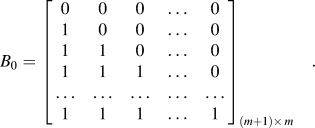 $${B_0} = {\left[ {\matrix{ 0 & 0 & 0 & \ldots & 0 \cr 1 & 0 & 0 & \ldots & 0 \cr 1 & 1 & 0 & \ldots & 0 \cr 1 & 1 & 1 & \ldots & 0 \cr \ldots & \ldots & \ldots & \ldots & \ldots \cr 1 & 1 & 1 & \ldots & 1 \cr} } \right]_{\left( {m + 1} \right) \times \,m}}\quad .$$
(2) Let X* = {x 1, x 2, …, x m} be the vector composed of the m input parameters and each element is randomly chosen from {0, 1/(p − 1), 2/(p − 1), …, 1 − Δ} with equal probability. Where, p is the level of parameters chosen in the system and Δ equals 1/(p − 1).
(3) Let P* be a m × m random permutation matrix and each column of P* contains one element equal to 1 while the left columns equal to 0. What's more, no two columns of P* have 1's in the same position, and each permutation matrix has been selected equiprobably. Let J (m+1),1 be (m + 1) × 1 matrix of 1's. Note that
 $B_0^ *$ equals (J (m+1),1X* + Δ/2J*) P*. Then the random orientation matrix $B_0^ *$ is obtained. Each column in matrix $B_0^ *$ represents a parameter, and values 1 and 0 represent that the value of the parameter is changed or not, respectively. Obviously, any two adjacent rows in matrix $B_0^ *$ have only one pair different parameters.
(4) Once a random orientation matrix
$B_0^ *$ as system input is obtained, Y = [y 1, …, y h, …, y k, …, y (m+1)]T defined as the corresponding system output results of each row in matrix $B_0^ *$ is acquired. Comparing the outputs of two adjacent rows, the sensitivity value of single-parameter combination to the system, S i, is obtained. And comparing the results of the first row and the third row, the sensitivity value of the interactive effect of two-parameter combination is gotten. Similarly, impact of random two or multiple parameters can be gotten, respectively. S i reflects the influence degree of slight fluctuation of single or multiple parameters on the output results and is expressed as Eq. (1),


 $${S_i} = {y_k} - {y_h}\,\left( {m > k > h > 0} \right)\quad,$$
where i is the sequence number of the parameter combinations.
(5) Finally, many different matrixes
$B_0^ *$ are generated randomly. By repeating the above steps, the sensitivities of the combinations of the different random orientation matrixes $B_0^ *$ are obtained. The global sensitivity value $S_{\rm{i}}^ *$ is defined as the average of those sensitivities, shown as Eq. (2). When calculating $S_{\rm{i}}^ *$, the absolute values of S i are used to avoid minus or plus results caused by different meanings of the parameters. It is known that the larger the value of $S_i^ *$ is, the higher the sensitivity.


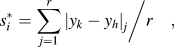 $$s_i^ * = {{\sum\limits_{j = 1}^r {{{\left| {{y_k} - {y_h}} \right|}_j}} } \mathord{\left {\vphantom {{\sum\limits_{j = 1}^r {{{\left| {{y_k} - {y_h}} \right|}_j}} } r}} \right. \kern-\nulldelimiterspace} {\bigg/} r}\quad ,$$
where r is the number of random orientation matrix  $B_0^ *$, and j is the sequence number of
 $B_0^ *$.
B. Determination of material parameters fluctuation range
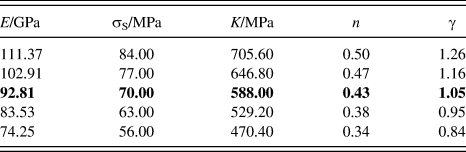
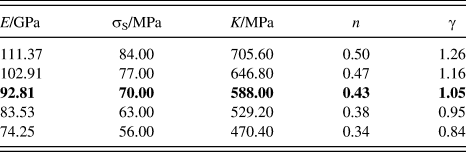
H96 brass rectangular tube is taken as the research object and its mechanical properties shown as the bold row in Table I are obtained by uniaxial tensile experiments. To conduct GSA, the material parameter fluctuation range is obtained by floating up and down 20% of each material parameter, as shown in Table I. The values of each parameter are mapped into the set of {0, 1/(p − 1), 2/(p − 1), …, 1 − Δ}, respectively, where p equals 5 in this research. And picking randomly from the above intervals for each parameter, one input vector X* can be obtained and then one  $B_0^ *$ can be gotten. To study the sensitivities of material parameters to cross-sectional deformation of rectangular tube in RDB process, exponential elastic and plastic hardening model was chosen, as shown in Eq. (3),
 $${\rm{\sigma }} = {{\rm{\sigma }}_{\rm{S}}} + K{\left( {{\rm{\varepsilon }} - {{{{\rm{\sigma }}_{\rm{S}}}} \mathord{\left/ {\vphantom {{{{\rm{\sigma }}_{\rm{S}}}} E}} \right. \kern-\nulldelimiterspace} E}} \right)^n}\quad ,$$
where σ and ε are true stress and strain, respectively.
Material parameters' fluctuation range of H96 brass rectangular tube in GSA system.
C. Description of cross-sectional deformation of rectangular tube in RDB process
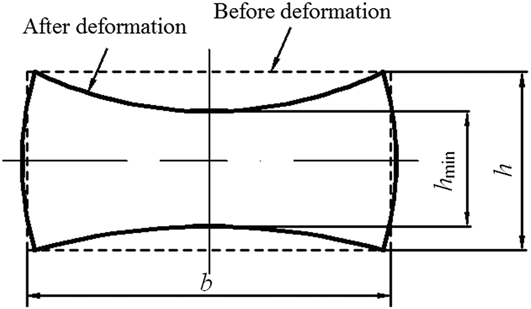
The schematic diagram of rectangular tube's cross sections before and after bending is shown as Fig. 1. According to Ref. Reference Liu, Liu and Yang15, the width deformation of rectangular tube is small and the maximum height deformation δh expressed as Eq. (4) is taken as the maximum cross-sectional deformation of rectangular tube.
 $${{\rm{\delta }}_h} = {{\left( {h - {h_{{\rm{min}}}}} \right)} \mathord{\left/ {\vphantom {{\left( {h - {h_{{\rm{min}}}}} \right)} h}} \right. \kern-\nulldelimiterspace} h} \times 100{\rm{\% }}\quad {\rm{,}}$$
where h and h min are the initial height and the minimum height after bending process of rectangular tube, respectively.
Cross-section of rectangular tube before and after RDB process.

D. Establishment and validation of Morris' GSA system model
For purpose of the sensitivity analysis of coupling effects of material parameters to cross-sectional deformation of thin-walled rectangular tube in RDB process, the GSA system model, that is, the relationship between random orientation matrix  $B_0^ *$ and the system output results Y = [y 1, …, y h, …, y k, …, y (m+1)]T, should be built firstly. According to Sec. II. A, the system output y k (k = 1, 2, …, m + 1) corresponding to the kth row input of
 $B_0^ *$ refers to the maximum cross-sectional deformation ratio of rectangular tube, and x m (m = 1, 2, …, 5) refers to material parameter E, K, σS, n or γ of rectangular tube. So the FE model of RDB process for thin-walled rectangular tube is established as the GSA system model. In the FE model of RDB process, rectangular tube is defined as deformable body and the linear four-node shell elements (S4R element) with reduced integration and hourglass control is selected to describe the rectangular tube. While dies including clamp die, pressure die, bend die, wiper die, and mandrel (contains mandrel shank and three flexible cores) are defined as discrete rigid body and the four-node 3-D bilinear quadrilateral rigid element (R3D4 element) is applied to rigid dies to reduce computing time and improve computational accuracy. The material parameters of H96 brass rectangular tube are shown as Table I. And the hardening model is expressed as Eq. (3). Finally, a three-dimensional FE model of RDB process for thin-walled rectangular H96 brass tube is built, as shown in Fig. 2.
3D FE model of RDB process for rectangular tube.
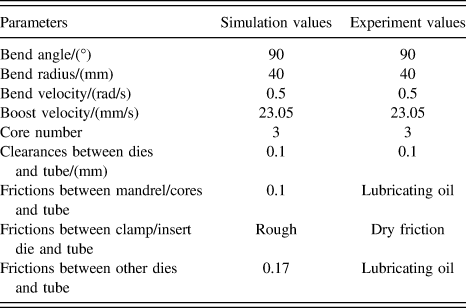
To validate the reliability of the FE model of RDB process for thin-walled rectangular tube, the PLC controlling hydraulic bender W27YPC-63NC (Shanghai Gouqing Machinery Co., Ltd., Shanghai, China) and bender dies are used, as shown in Fig. 3. The rectangular H96 brass tube with 24.86(b) × 12.2(h) × 1(t) mm is applied as the research object. The experimental and simulation conditions are shown in Table II. Figure 4 shows the comparison of simulation results of bent thin-walled rectangular tube with the experimental ones. From Fig. 4(a), it can be seen that the profiles of simulation bent tubes show a good agreement with the experimental ones. Also it can be found that the simulation values of δh are very close to the experimental ones as shown in Fig. 4(b). Moreover, the maximum relative error of δh is about 9% and the average error is less than 8%. From the above analysis, it is concluded that the FE model of RDB process is reliable and it can be used to study the sensitivity of material parameters to cross-sectional deformation of thin-walled rectangular tube.
Tube bender and dies: (a) W27YPC-63 PLC controlled hydraulic tube bender and (b) dies for RDB process of rectangular tube.
Simulation and experimental parameters in RDB process.
The comparison between experimental and simulation results: (a) profiles of rectangular tube and (b) the maximum cross-sectional deformation ratio δh along bending direction.
III. RESULTS AND DISCUSSION
A. Coupling effects of material parameters on cross-sectional deformation
To study the effects of material parameters on the maximum cross-sectional deformation δh, the reference sets A = {E = 92.81 GPa, K = 705.6 MPa, σS = 56 MPa, n = 0.50, γ = 1.05} and B = {E = 111.37 GPa, K = 470.4 MPa, σS = 70 MPa, n = 0.43, γ = 0.84} are selected randomly based on Table I. The effects of material parameters on δh are studied by using the single factor analysis method according to reference sets A and B, respectively. Through the comparison of the values of δh in reference sets A and B, the coupling effects of material parameters on δh can be qualitatively obtained.
1. Effect of strain hardening exponent n
Figure 5 shows the influence of strain hardening exponent n on maximum cross-sectional deformation ratio δh with reference sets A = {E = 92.81 GPa, K = 705.6 MPa, σS = 56 MPa, γ = 1.05} and B = {E = 111.37 GPa, K = 470.4 MPa, σS = 70 MPa, γ = 0.84}, respectively. δh decreases with the increase of n, as shown in reference sets A and B. This is because the larger n of rectangular tube means the better ability to resist uneven deformation, which is beneficial to reduce cross-sectional distortion. So the larger n means smaller cross-sectional deformation.
Effects of n on cross-sectional deformation of rectangular tube with reference sets A and B.
It's noted in Fig. 5 that δh in reference set A is apparently larger than that in reference set B and the effect of n on δh in reference set A is more obvious than that in reference set B, which can be summarized that the interactive effect of the larger E, the larger σS, the smaller γ and the smaller K strengthens the ability of rectangular tube to resist cross-sectional deformation.
2. Effect of initial yield stress σS
The effect of initial yield stress σS on maximum cross-sectional deformation ratio δh with reference sets A = {E = 92.81 GPa, K = 705.6 MPa, n = 0.50, γ = 1.05} and B = {E = 111.37 GPa, K = 470.4 MPa, n = 0.43, γ = 0.84}, respectively is depicted in Fig. 6. It can be seen that the effects of σS on δh in both reference sets A and B present the same trend. And the larger the value of σS is, the larger the cross-sectional deformation δh. This is because that, when the value of σS is small, the material of rectangular tube is easy to yield and the resistance to deformation of rectangular tube is small, which makes the rectangular tube endure small plastic deformation energy in RDB process, thus, the cross-sectional deformation is small. Hence the increase of σS leads to the increase of δh.
Effects of σS on cross-sectional deformation of rectangular tube with reference sets A and B.
In brief, σS is one of the major material parameters influencing δh apparently. However, owing to the coupling effect of smaller E, larger K, larger n, and γ, the values of cross-sectional deformation shown in reference set A are apparently larger than those in reference set B.
3. Effect of the thickness anisotropy exponent γ
Figure 7 shows the effect of the thickness anisotropy exponent γ on maximum cross-sectional deformation ratio δh with reference sets A = {E = 92.81 GPa, K = 705.6 MPa, σS = 56 MPa, n = 0.50} and B = {E = 111.37 GPa, K = 470.4 MPa, σS = 70 MPa, n = 0.43}, respectively. From the figure, it can be obtained that the effect of γ on δh in both reference sets A and B is remarkable and the larger value of γ causes greater δh, which means that γ significantly influences cross-sectional deformation. It is known that γ equals the ratio of width strain to thickness strain. And raising the value of γ implies a more severe deformation along width direction. However the deformation along width direction is constrained by dies. So, according to the volume invariance principle, the deformation of rectangular tube is manifested as cross-sectional collapse. Based on the above analysis, it can be known that δh largely increases with the increase of γ.
Effects of γ on cross-sectional deformation of rectangular tube with reference sets A and B.
Different from the phenomena shown in Figs. 5 and 6 that values of δh under reference sets A and B exist big differences, curves in Fig. 7 are almost coincident. This is because that γ is the dominant material parameter of effect on δh and the coupling effect of other parameters only plays a minor role.
4. Effect of Young's module E
Figure 8 reveals the impact of Young's module E on maximum cross-sectional deformation ratio δh with reference sets A = {K = 705.6 MPa, σS = 56 MPa, n = 0.5, γ = 1.05} and B = {K = 470.4 MPa, σS = 70 MPa, n = 0.43, γ = 0.84}, respectively. It can be seen from the figure that δh decreases obviously with the increase of E both in reference set A and reference set B. This is because the larger value of E means the larger stiffness which enhances the resistance to cross-sectional deformation of rectangular tube in RDB process.
Effects of E on cross-sectional deformation of rectangular tube with reference sets A and B.
On the whole, the effect of E on δh shows the similar trend under reference sets A and B according to Fig. 8. But on the account of the coupling effect of the smaller γ, the smaller K, the smaller n, and the larger σS in reference set B causing the rectangular tube to endure smaller stress, so δh in reference set B is evidently smaller than that in reference set A.
5. Effect of strength coefficient K
The impact of strength coefficient K on maximum cross-sectional deformation ratio δh with reference sets A = {E = 92.81 GPa, σS = 56 MPa, n = 0.50, γ = 1.05} and B = {E = 111.37 GPa, σS = 70 MPa, n = 0.43, γ = 0.84}, respectively is plotted in Fig. 9. From the figure, it can be seen that the maximum deformation δh rises with the increase of K no matter in reference set A or in reference set B. The reason is that rectangular tube suffers larger stress with larger K in RDB process which can be explained by Eq. (3), and the larger stress results in more remarkable cross-sectional deformation of rectangular tube in RDB process.
Effects of K on cross-sectional deformation of rectangular tube with reference sets A and B.
Comparing the effect of K between reference sets A and B in Fig. 9, it can also be found that the trend of the latter is more outstanding than the former while the values of δh of the latter are prominently lower than those of the former. All the phenomena above are owing to the coupling effect of the larger E, the larger n, the smaller σS, and the smaller γ, as increasing of E and n, and decreasing of σS and γ are positive to reduce the cross-sectional deformation of rectangular tube.
Based on the above analysis, it's known that the effect of γ to δh is the most notable. As material parameters are sensitive to heat treatment methods, reasonable heat treatment regime should be chosen for getting superior cross-section of rectangular tube. According to Ref. Reference Zhen16, recrystallization annealing heat treatment is an advisable choice, for the orientation texture formed in cold forming process is removed and the orthoscopic and equiaxed grains are generated in this process which make the value of γ reduce significantly. Besides, the annealing temperature and holding time should be strictly controlled. Otherwise, the formation of preferred orientation texture in recrystallization grains will cause the thickness anisotropy exponent γ to increase again.
In short, the trend of effect of E on δh is the same as that of n, while the trends of effect of K, σS, and γ on δh are opposite to that of E and n. What's more, the effects of E and γ on δh are remarkable. Owing to the complex coupling effect of different parameters, not only is δh under condition of reference set A always larger than that of reference set B, but also the differences of trends exist under reference sets A and B. Obviously, the interactive effects of material parameters seriously influence the maximum cross-sectional deformation ration δh. Therefore, the further analysis of the coupling effects of material parameters on δh is necessary.
B. GSA of material parameters on cross-sectional deformation
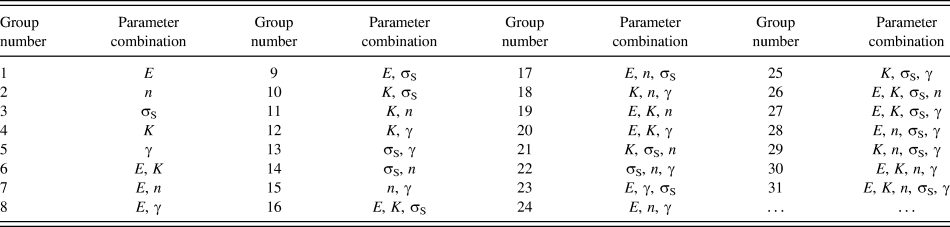
For GSA of effects of material parameters on cross-sectional deformation, 31 groups of material parameter combinations are formed based on the permutation and combination of the material parameters E, K, σS, n, and γ in Table I, and they are noted by the group number of 1, 2, 3, …, 29, 30, and 31, respectively, as shown in Table III.
31 groups of material parameter combinations used in the GSA system.
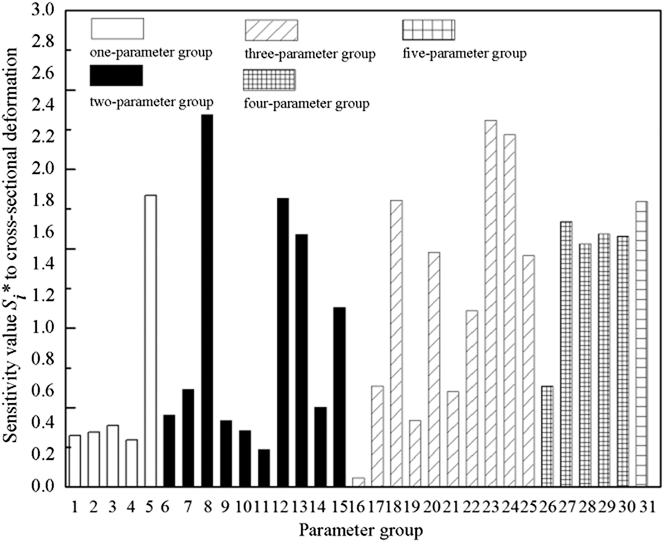
Dealing with the results of all random orientation matrices, the sensitivity values of all the groups are obtained according to Eq. (2). And the global sensitivity values of the 31 groups are shown by column diagram in Fig. 10. From the figure, it can be seen that the order of sensitivity values from the largest to the smallest in turn is: 8, 23, 24, 5, 12, 18, 31, 27, 29, 13, 30, 28, 20, 25, 15, 22, 17, 26, 7, 21, 14, 6, 9, 19, 3, 10, 2, 1, 4, 11, and 16.
Global sensitivity values of material parameters to cross-sectional deformation.
Firstly, observing the one-parameter groups of 1, 2, 3, 4, and 5, it can be found that thickness anisotropy exponent γ (as group 5) is the most sensitive material parameter to δh which agrees well with the result in Sec. III. A. 3, while the sensitivity values of the left one-parameter groups (groups 1, 2, 3, and 4) are small. Hence, for the sake of improving cross-sectional deformation of rectangular tube, it's necessary to control the thickness anisotropy exponent γ.
Then, seeing from the two-parameter groups of 6, 7, …, 14 and 15, it can be found that almost all the sensitive values of the two-parameter combination groups are larger than those of one-parameter groups. What's more, comparing the ten groups, it can be seen that the combination groups containing γ (groups 8, 12, 13, and 15) are with larger sensitivity values. And the sensitivities of the groups without γ (groups 6, 7, 9, 10, 11, and 14) are insignificant, namely the coupling effects of material parameters of these two-parameter combination groups are positive to the cross-sectional deformation of rectangular tube in RDB. Undoubtedly, γ is a major material parameter influencing the cross-sectional deformation of rectangular tube in RDB. Meanwhile, analyzing the sensitivity values of the remaining multiparameter combination groups, it's obvious that the sensitivity values of most of the groups, especially groups (groups 20, 23, 24, 27, 28, 30, and 31) that contain γ and E simultaneously, are larger than those of the one-parameter groups.
In general, it can be seen that the most sensitive groups are 8(E, γ), 23(E, σS, γ), 24(E, n, γ), 5(γ), 12(K, γ), 18(K, n, γ), and 31(E, K, σS, n, γ), respectively. Among the above groups, it's evident to find that the groups which contain γ and E simultaneously, especially the former three groups, show greater sensitivities. So, it's obvious that the coupling effect of E and γ is negative to cross-sectional deformation δh. The reason can be concluded that E and γ are the most remarkable parameters on δh according to Sec. III. A, thus a slight fluctuation of both E and γ causes larger cross-sectional deformation.
The most insensitive group of each parameter combination is 4(K), 11(K, n), 16(E, K, σS), and 26(E, K, n, σS), respectively. And all the groups contain K, which means that K is an insensitive material parameter to δh.
It is found that the sensitivity values of most coupling groups are larger than those of one-parameter groups. Thus the coupling effects of material parameters on δh should be considered all the time.
IV. CONCLUSIONS
(1) The effects of E and γ on δh are remarkable compared with the other material parameters. With the increase of E or n, the cross-sectional deformation decreases, while σS, K, and γ have the opposite effects on cross-sectional deformation compared with E and n.
(2) The sensitivity values of the 31 groups to the maximum cross-sectional deformation ratio δh are obtained. All the groups with higher sensitivity contain γ, and the most insensitive group in different combinations contains K. The effect of γ on cross-sectional deformation of rectangular tube in RDB process should be taken into consideration.
(3) The sensitivity values of the groups which contain γ and E simultaneously are always larger than those of other groups, and the group only containing γ and E shows the greatest sensitivity to cross-sectional deformation. Obviously, coupling effect of E and γ is negative to cross-sectional deformation δh.
(4) Mostly, the sensitivity values of coupling groups to cross-sectional deformation are larger than those of one-parameter groups. And the coupling effects of material parameters should be taken into account for obtaining thin-walled rectangular tube with good quality in RDB process.
ACKNOWLEDGMENT
The authors would like to thank the National Natural Science Foundation of China (No. 51375392 and 50975235) for the support given to this research.