INTRODUCTION
Commercially important tropical reef fish stocks are being steadily overfished worldwide (Jennings & Polunin, Reference Jennings and Polunin1996; Edgar et al., Reference Edgar, Stuart-Smith, Willis, Kininmonth, Baker, Banks, Barrett, Becerro, Bernard, Berkhout, Buxton, Campbell, Cooper, Davey, Edgar, Försterra, Galván, Irigoyen, Kushner, Moura, Parnell, Shears, Soler, Strain and Thomson2014). Although successful strategies for managing these resources depend on interactions among highly heterogeneous social, political and economic factors, ecological data is essential to guide decision making (McClanahan & Castilla, Reference McClanahan and Castilla2007; Edgar et al., Reference Edgar, Stuart-Smith, Willis, Kininmonth, Baker, Banks, Barrett, Becerro, Bernard, Berkhout, Buxton, Campbell, Cooper, Davey, Edgar, Försterra, Galván, Irigoyen, Kushner, Moura, Parnell, Shears, Soler, Strain and Thomson2014). Small-scale artisanal fisheries are particularly difficult to assess and manage, yet they can severely impact reef ecosystems by depleting populations of target species and affecting ecological processes (Roberts, Reference Roberts1995; Hawkins & Roberts, Reference Hawkins and Roberts2004). For example, overfishing of piscivorous fish can lead to changes in the benthic community structure though trophic cascading (Estes et al., Reference Estes, Terborgh, Brashares, Power, Berger, Bond and Carpenter2011).
In reef fish assemblages, the species of families Lutjanidae (snappers) and Epinephelidae (groupers), long-lived large fish that generally grow slowly and reach maturity relatively late, are often the primary targets of fisheries (Morris et al., Reference Morris, Roberts and Hawkins2000; Sadovy, Reference Sadovy2001). Several lutjanids and epinephelids are also known to form spawning aggregations at specific locations and times, a critical feature in the management of their fisheries (Colin et al., Reference Colin, Sadovy and Domeier2003; Sadovy de Mitcheson et al., Reference Sadovy de Mitcheson, Cornish, Domeier, Colin, Russell and Lindeman2008). Due to their important roles in the ecosystem and their vulnerability to overfishing, snappers and groupers represent good indicators for ecological monitoring (Russ & Alcala, Reference Russ and Alcala1996).
The lane snapper, Lutjanus synagris (Linnaeus, 1758), inhabits coastal reefs and adjacent habitats throughout the tropical and subtropical western Atlantic, from North Carolina to south-eastern Brazil, including the Caribbean and the Gulf of Mexico (Allen, Reference Allen1985). In Brazil, the species is reported to reach up to 50 cm (Menezes & Figueiredo, Reference Menezes and Figueiredo1980), with juveniles being common in nearshore habitats including estuaries, vegetated banks and coralline and rocky reefs (Pimentel & Joyeux, Reference Pimentel and Joyeux2010). Most biological information has been derived from studies in the Northern Hemisphere (e.g. Manickchand-Dass, Reference Manickchand-Dass1980; Rivera-Arriaga et al., Reference Rivera-Arriaga, Lara-Dominguez, Ramos-Miranda, Sanchez-Gil and Yanez-Arancibia1996; Luckhurst et al., Reference Luckhurst, Dean and Reichert2000; Gómez et al., Reference Gómez, Guzmán and Chacón2001), but there is a growing database emerging from the tropical south-western Atlantic (Brazil), where snappers are the main fishery resource caught by hand line (Costa et al., Reference Costa, Braga and Rocha2003; Rezende et al., Reference Rezende, Ferreira and Frédou2003; Olavo et al., Reference Olavo, Costa, Martins, Costa, Martins and Olavo2005; Freitas, Reference Freitas2009). Although some information is available concerning ovarian development from the northern Brazilian coast (State of Ceará) (Sousa-Junior et al., Reference Sousa-Junior, Silva and Salles2008) and general reproductive patterns from eastern Brazil (Freitas et al., Reference Freitas, Moura, Francini-Filho and Minte-Vera2011), reproduction is still one of the least-known life history aspects that is relevant to the management of lane snapper fisheries. Understanding the reproductive traits of reef fish is of paramount importance to establish minimum catch sizes, fishing seasons and locations of marine reserves to ensure the viability of fish populations (Carr & Reed, Reference Carr and Reed1993; Dayton et al., Reference Dayton, Sala, Tegner and Thrush2000).
In this study, we present new information about the reproduction of L. synagris in eastern Brazil, with an emphasis on the macroscopic and microscopic characterization of oogenesis and fecundity. This information can be readily used to improve regional-level management measures (see Freitas et al., Reference Freitas, Moura, Francini-Filho and Minte-Vera2011), complementing the arrays of regulations proposed by Frédou et al. (Reference Frédou, Ferreira and Letourneur2009a, Reference Frédou, Ferreira and Letourneurb).
MATERIALS AND METHODS
Study area
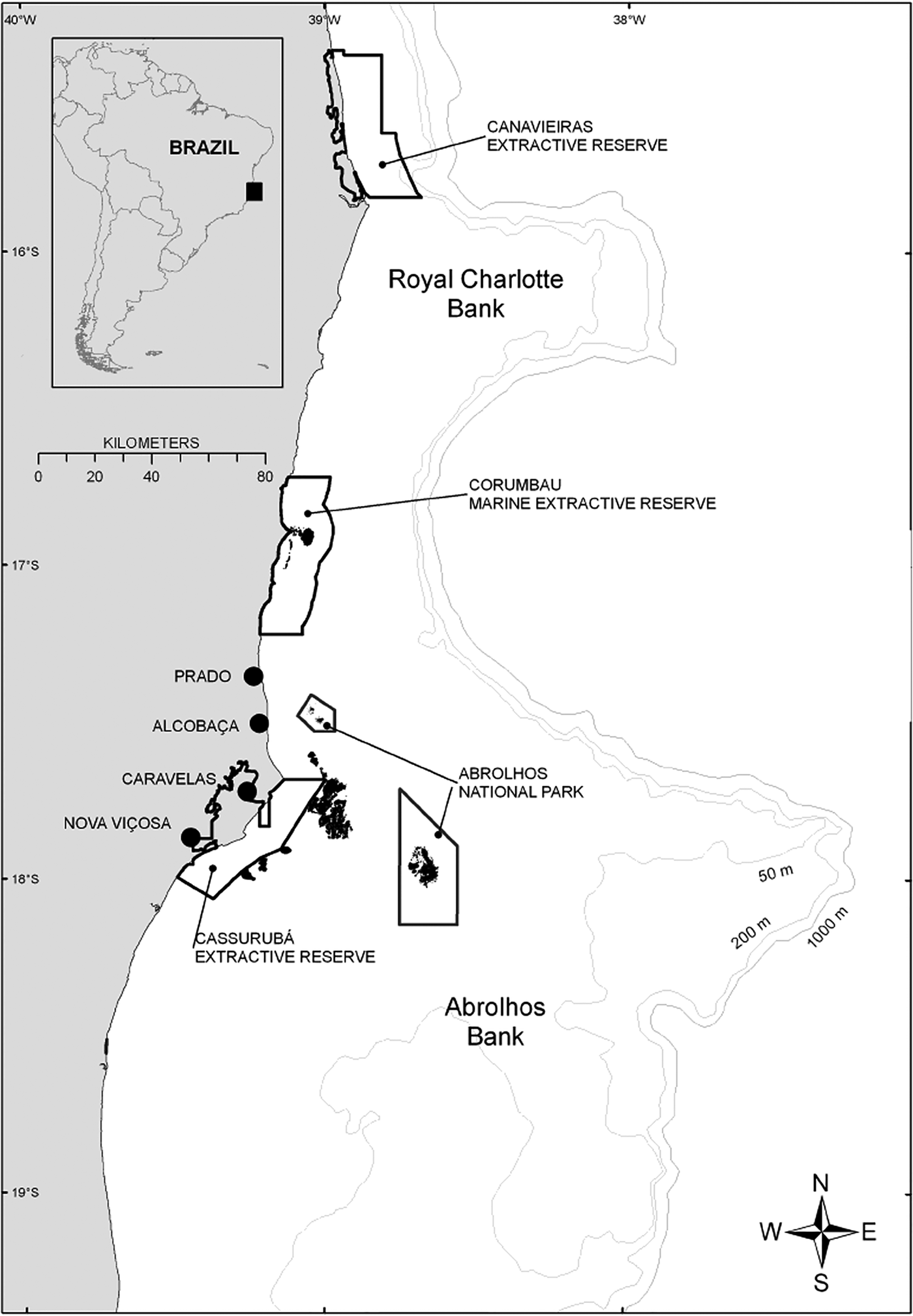
The study area is located on the central Brazilian coast, the region between Cabo de São Tomé (State of Rio de Janeiro; 22°S) and Salvador (State of Bahia; 13°S) (Ekau & Knoppers, Reference Ekau and Knoppers1999). This area is dominated by the south-flowing saline and oligotrophic Brazil Current and characterized by a complex topography and variable shelf width (15–200 km) derived from volcanic and tectonic activity followed by sediment accumulation between volcanic hills and the continental margin (Martins et al., Reference Martins, Olavo, Costa, Costa, Martins and Olavo2005). Sampling was performed in the Abrolhos Bank (16°40′–19°40′S 39°10′–37°20′W), which is a wide portion (46,000 km2) of the shelf with depths rarely exceeding 30 m and a shelf edge at about a 70 m depth (Figure 1). This region comprises the largest and richest coralline reefs and rhodolith beds in the South Atlantic (Amado-Filho et al., Reference Amado-Filho, Moura, Bastos, Salgado, Sumida, Guth, Francini-Filho, Pereira-Filho, Abrantes, Brasileiro, Bahia, Leal, Kaufman, Kleypas, Farina and Thompson2012), with nearly 300 species of fish and 20 species of reef-building corals, as well as an extensive mosaic of algal bottoms, mangrove forests, beaches and vegetated sandbanks (Moura & Francini-Filho, Reference Moura, Francini-Filho, Dutra, Allen, Werner and McKenna2006; Moura et al., Reference Moura, Secchin, Amado-Filho, Francini-Filho, Freitas, Minte-Vera, Teixeira, Thompson, Dutra, Sumida, Guth, Lopes and Bastos2013). Coastal and fisheries management in the region is centred on marine protected areas (MPAs) under no-take (~890 km2) and multiple-use regimes (~2908 km2). Nearly 20,000 artisanal fishermen operate in the Abrolhos Bank, but the region's reef fisheries are not well known in terms of fleet size, effort and landings (Frédou et al., Reference Frédou, Ferreira and Letourneur2009a, Reference Frédou, Ferreira and Letourneurb; Freitas et al., Reference Freitas, Moura, Francini-Filho and Minte-Vera2011).
Map of the Abrolhos Bank, with circles representing the municipalities where samples were collected. Emerging coralline reefs are shown in black and polygons correspond to the boundaries of marine protected areas.

Sampling and data analyses
Monthly surveys of hand line and gillnet landings were performed at the four main coastal municipalities within the study region (Prado, Alcobaça, Caravelas and Nova Viçosa; Figure 1) between May 2005 and June 2007. Specimens were measured to the nearest mm (total length (TL)), sexed, and weighed to the nearest 0.1 g for total weight (TW) and gonad weight (W g).
Sex-ratio was calculated monthly and for each 3 cm TL class following Sturge's method (Scherrer, Reference Scherrer1984), with significant differences determined by a χ2 test (1 df; α = 0.05; χ2 < 3.840). The Kruskal–Wallis (KW) test was applied to compare the median TL between males and females. Before analysing the data with the KW test, basic assumptions of normality (Shapiro–Wilk test) and variance homogeneity (Cochran C-test) were verified. Size–frequency distributions of males and females were compared by use of the Kolmogorov–Smirnov non-parametric test.
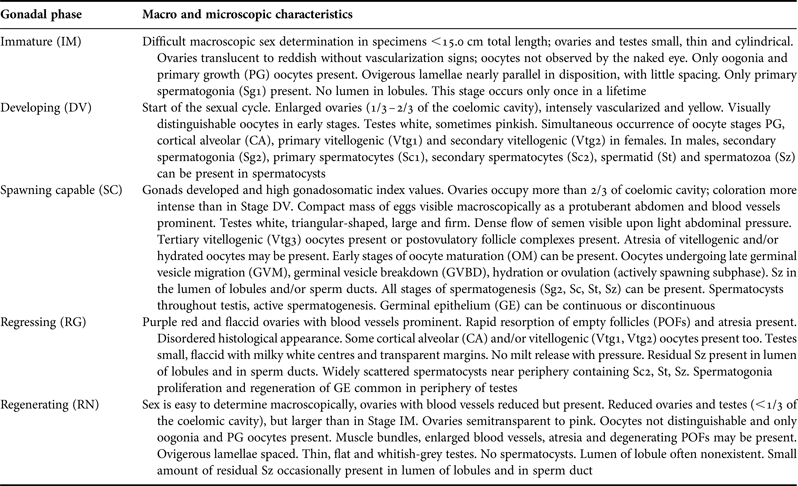
Maturity was macroscopically determined based on gonad size, consistency, colour, vascularization, presence of lateral sperm sinuses, ovarian cavity, ovarian lamellae and identifiable oocytes (García-Cagide et al., Reference García-Cagide, Claro, Koshelev, Claro, Lindeman and Parenti2001; Colin et al., Reference Colin, Sadovy and Domeier2003). Five developmental phases were used, as described by Brown-Peterson et al. (Reference Brown-Peterson, Wyansky, Saborido-Rey, Macewicz and Lowerre-Barbieri2011): Immature (IM); Developing (DV); Spawning Capable (SC); Regressing (RG); and Regenerating (RT). IM corresponds to a never-spawned fish. In females IM individuals are histologically characterized by the presence of oogonia and primary growth oocytes through the perinuclear stage (Grier et al., Reference Grier, Uribe-Aranzábal, Patiño and Jamieson2009), little space among oocytes in the lamellae and a generally thin ovarian wall. Males present primary spermatogonia (Sg1) in the germinal epithelium (GE) and an early formation of testis lobules that contain only spermatogonia (Sg). In the DV stage the ovary is beginning to develop in females but not yet ready to spawn, and spermatogenesis is beginning in males. SC fish are developmentally and physiologically able to spawn, whereas for RG fish, spawning has ceased. RT fish are sexually mature but reproductively inactive (see Table 1). After macroscopic classification, the gonads were fixed in 4% formaldehyde for 24 h, preserved in 70% alcohol, and then dehydrated in an increasing alcohol concentration series, cleared in xylene and embedded in histological paraffin (Beçak & Paulete, Reference Beçak and Paulete1976). Histological sections with 4–6 µm were stained with Harris haematoxylin and eosin.
Size and sex composition of Lutjanus synagris individuals sampled between May 2005 and June 2007 on the Abrolhos Bank.
Macro and microscopic characteristics used to characterize gonadal phases of Lutjanus synagris, adapted from Brown-Peterson et al. (Reference Brown-Peterson, Wyansky, Saborido-Rey, Macewicz and Lowerre-Barbieri2011) and García-Cagide et al. (Reference García-Cagide, Claro, Koshelev, Claro, Lindeman and Parenti2001).
The reproductive cycles of sexually mature males and females were also assessed by recording monthly changes in the gonadosomatic index (GSI), calculated as
 $$\hbox{GSI} = \lpar {W_g}/\lpar \hbox{TW} - {W_g}\rpar \rpar \times 100.$$
The minimum size at which females and males became sexually mature (L min) was recorded. The TL at which 50% (L 50) of females or males were mature was calculated using a logistic regression model:
 $$P= 100/\lpar 1 + \exp\lpar - r{\rm \lpar }L - {L_{\rm m}}{\rm \rpar \rpar }$$
where P is the percentage of mature fish on length-class L, r is the width of the maturity curve and L m is the length at 50% maturity, by the method of maximum likelihood (King, Reference King1995). For this analysis, DV, SC, RG and RT individuals were considered sexually mature (adults).
Batch fecundity was assessed by the volumetric method (Vazzoler, Reference Vazzoler1996), with a small fraction of the ovaries weighed for correcting gonad volume. For SC gonads, confirmation of macroscopically-determined and without occurrence of post-ovulatory follicles (which would lead to underestimation of fecundity) were dissociated in Gilson solution and kept in 70% alcohol (Bagenal, Reference Bagenal and Gerking1978). Three 500 µl subsamples of this suspension were photographed under a stereomicroscope in a Petri dish with 36 visual fields. The relative fecundity was calculated by dividing the number of tertiary vitellogenic (Vtg3) or hydrated oocytes by TW. The diameter of IM and DV oocytes was measured to determine the size of exclusion of these in the counts.
RESULTS
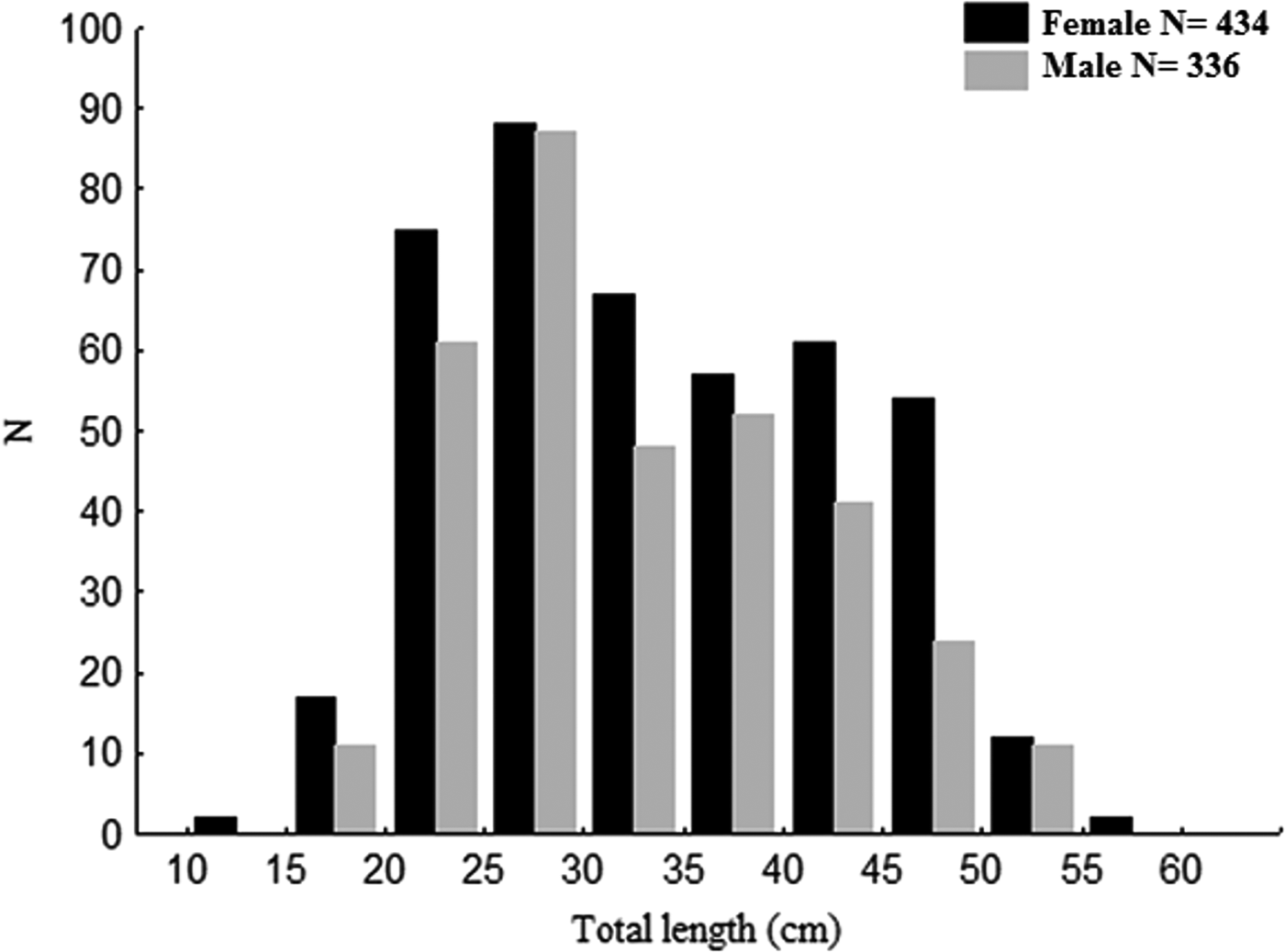
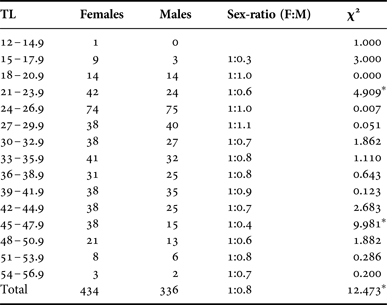
Histological examinations confirmed that 62% of the fish were females (N = 434) and 38% were males (N = 336). Females ranged from 14.7 to 56.0 cm TL and males from 16.5 to 54.3 cm TL (Figure 2). Sexual differentiation was visible to the naked eye in gonads of individuals >14.7 cm TL. The TL of males (median = 32.8 cm) did not differ significantly from that of females (median = 33.8 cm) (Cochran C-test, P > 0.05; Kruskal–Wallis, P = 0.1689; N = 770). The overall size composition did not vary significantly between sexes (P > 0.05, N = 770). Significant sex-ratio differences, more females than males, were found only in TL classes 21–23.9 cm (χ2 = 4.909) and 45–47.9 (χ2 = 9.981) cm (Table 2). A female predominance was only observed in March 2006 (χ2 = 7.410). No significant predominance of males was observed.
Size-classes and sex-ratios of Lutjanus synagris on the Abrolhos Bank (* significant difference from 1:1; α < 0.05).
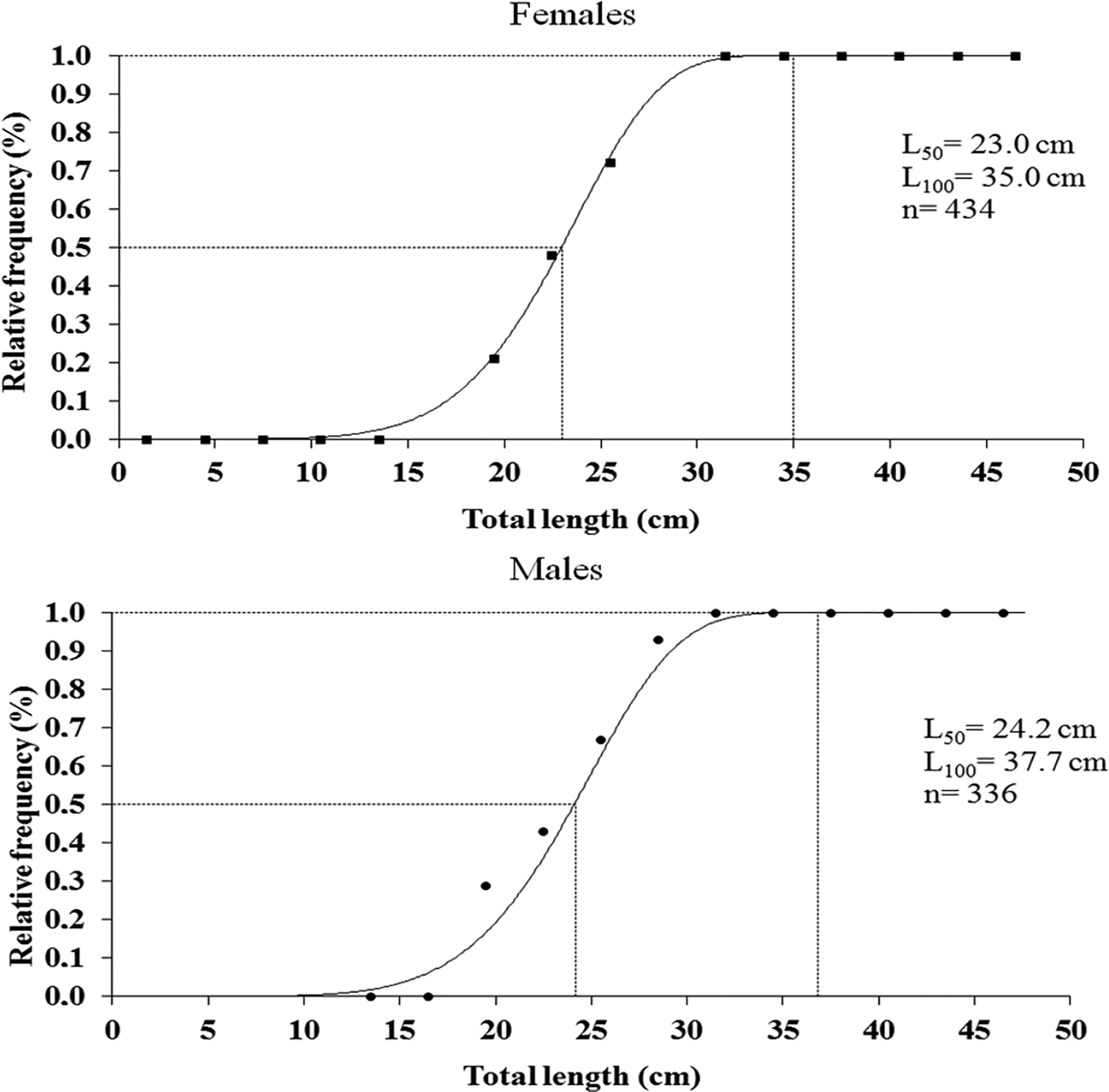
The L 50 for females was 23.0 cm. Females > 35.0 cm TL were all mature (L 100) (Figure 3). The shortest mature female was 18.9 cm, and the longest mature female was 56.0 cm. The L 50 for males was 24.2 cm, and males > 37.7 cm TL were all mature (Figure 3). The shortest mature male was 19.5 cm TL, and the longest mature male was 54.3 cm.
Logistic regression of percentage mature, female and male Lutjanus synagris, in relation to total length, from the Abrolhos Bank (May 2005–June 2007). Dashed lines indicate length at which 50% (L 50) and 100% (L 100) of females and males were mature.
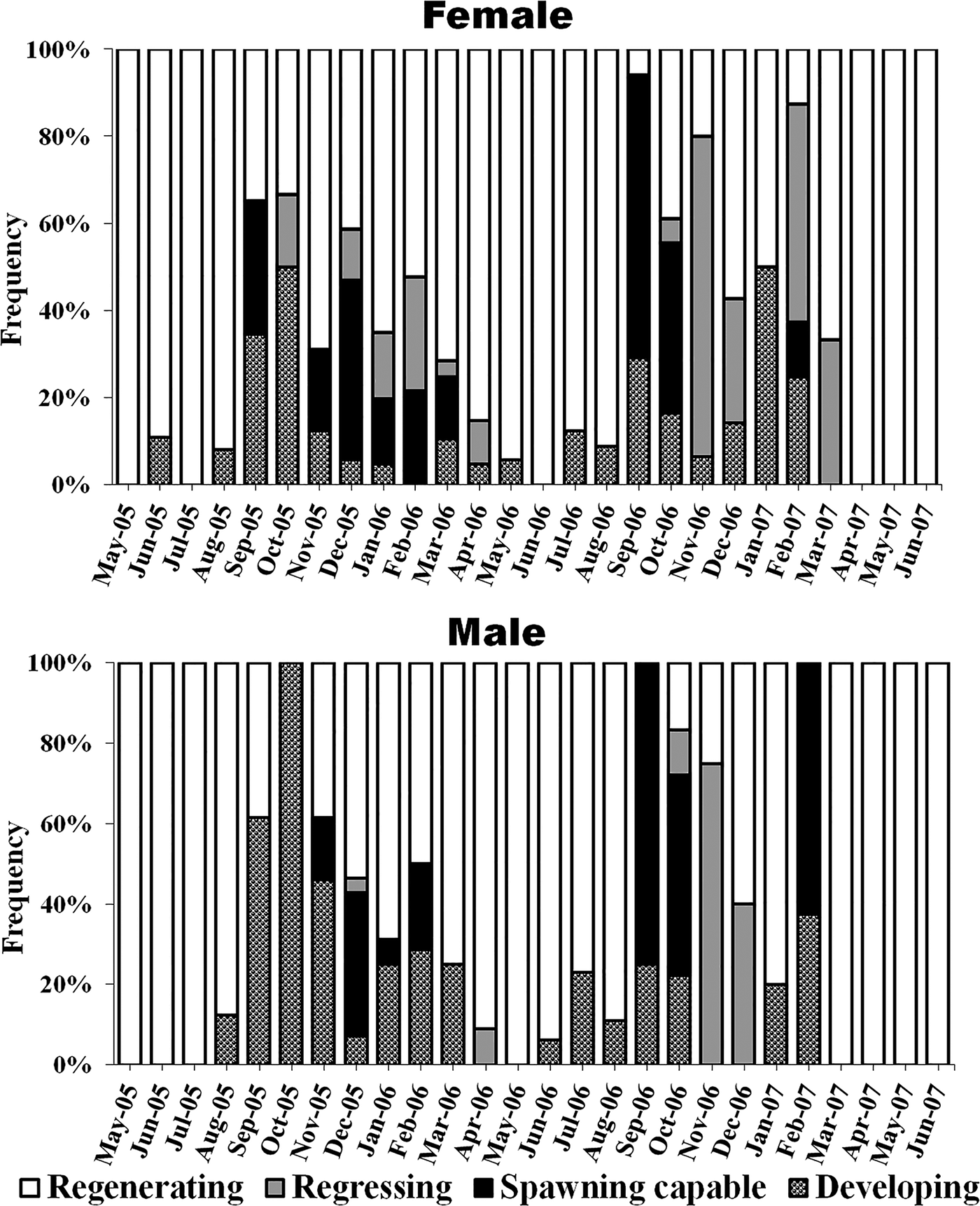
In 2005, GSI values for females increased in September and peaked in October, whereas in 2006, the peak was recorded in September (Figure 4). Mean GSI values for females were consistently higher in spring (September–October), with a secondary summer peak (February–March). Sexually active females in DV or SC phases were found all year round (Figure 5). SC females were observed from September to December 2005, from January to March 2006, from September to October 2006 and in February 2007, but were most abundant in September and October 2006. Females in the RG phase were present in October and December 2005, between January and April 2006, between October and December 2006 and in February and March 2007, with the highest percentages occurring in November and December 2006 and February and March 2007. Regenerating females were observed all year round, with the highest percentages occurring from April to June and the lowest between August and March. Sexually active males in DV or SC phases were found all year round, except from May to July 2005, in May 2006 and between March and June 2007 (Figure 5). Regressing males were present all year round, with the highest percentages occurring in November and December 2006. Males in the RT phase were observed year round, except in October 2005, September 2006 and February 2007, with the highest percentages occurring from May to July 2005, in May 2006 and between March and June 2007.
Individual GSI values for females and males of Lutjanus synagris sampled between May 2005 and June 2007 on the Abrolhos Bank.
Relative frequency of reproductive stages for females (above) and males of Lutjanus synagris sampled between May 2005 and June 2007 on the Abrolhos Bank.
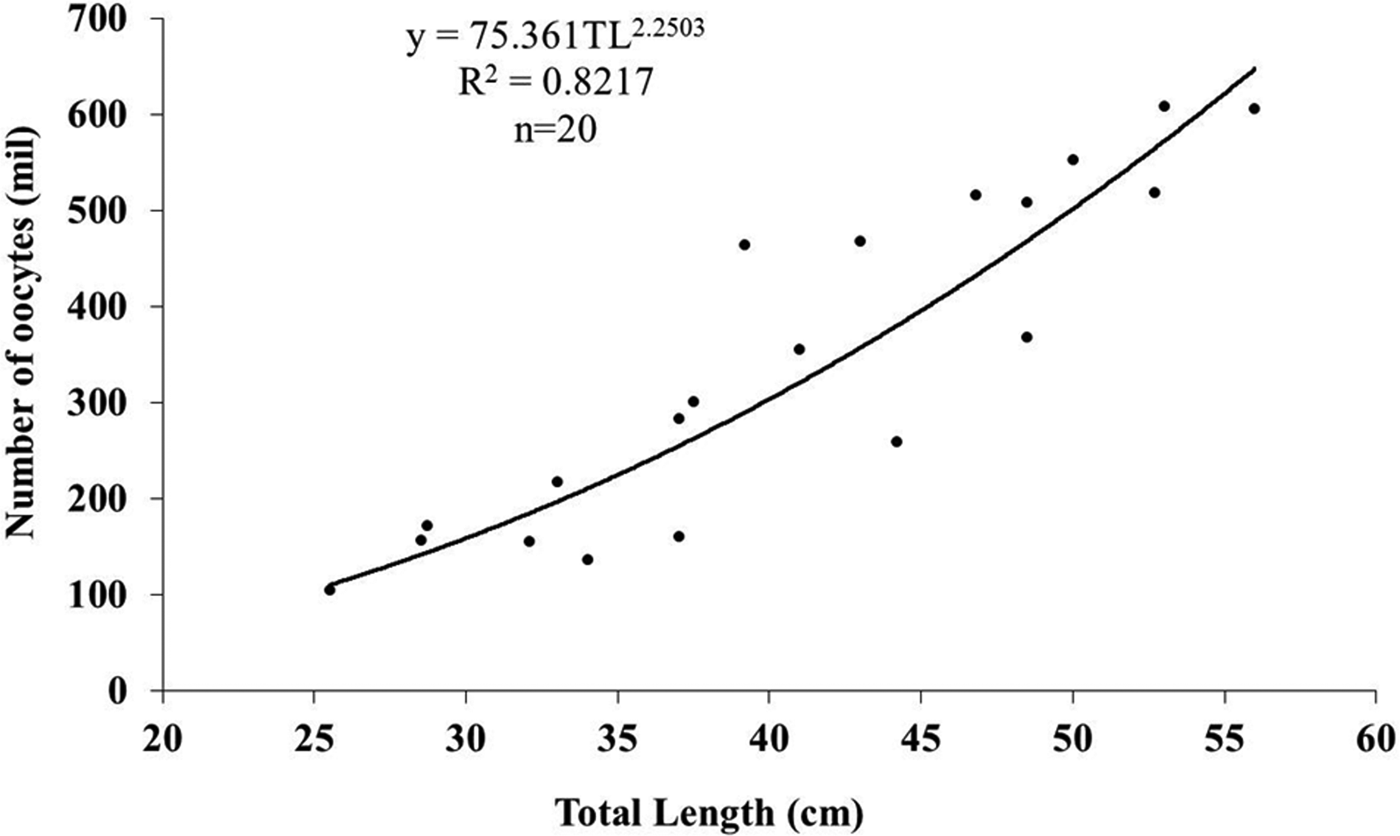
Asynchronous oocyte development was observed. During the spawning season, January to March and August to December, ovaries of females in the SC phase contained primary growth oocytes (PG), cortical alveolar (CA) oocytes, oocytes in Vtg2 and Vtg3 and germinal vesicle germination (GVM) (Figure 6A), while CA, Vtg1, Vtg2 and Vtg3 co-occurred with POFs in ovaries of actively spawning females (Figure 6B). Batch fecundity ranged from 104,743 (25.5 cm TL) to 568,400 oocytes (56.0 cm TL). Batch fecundity (F ab) in relation to TL is described by y = 75.361 × 2.25 (N = 20, r 2 = 0.8217) (Figure 7).
Photomicrographs of histological sections from female Lutjanus synagris gonads collected from the Abrolhos Bank, Brazil: (A) section of spawning capable female, showing cortical alveolar and vitellogenic oocytes; (B) section of spawning capable female, showing cortical alveolar and vitellogenic oocytes, germinal vesicle migration and postovulatory follicle. PG, primary growth; CA, cortical alveolar; Vtg1, primary vitellogenic; Vtg2, secondary vitellogenic; Vtg3, tertiary vitellogenic; POF, postovulatory follicle; GVM, germinal vesicle migration (100× + 2.0.Opitical Zoom); scale bar: 500 µm.
Relation between batch fecundity and total length for Lutjanus synagris females sampled between May 2005 and June 2007 on the Abrolhos Bank.
DISCUSSION
We found higher maximum body sizes (56.0 cm TL) than those reported for the lane snapper in the Central Atlantic, where it ranged from 20.0 to 31.8 cm (Cervigón & Fisher, Reference Cervigón and Fisher1979; Gómez et al., Reference Gómez, Guzmán, Chacón and Márquez1999, Reference Gómez, Guzmán and Chacón2001). In addition to possible effects of fisheries exploitation on body size, such size differences may be related to the ecological characteristics of each region and/or fishing gear type and selectivity (Frédou & Ferreira, Reference Frédou and Ferreira2005). Overfishing is frequently linked to declines in body size and ensuing early maturation (e.g. Sadovy de Mitcheson et al., Reference Sadovy de Mitcheson, Cornish, Domeier, Colin, Russell and Lindeman2008). Grimes (Reference Grimes, Polovina and Ralston1987) suggested that lane snappers mature when they reach 40–50% of their maximum size and proposed that island populations present a larger minimum size at maturation (L 50) than populations in heavily exploited continental coasts. This pattern was observed at Abrolhos Bank, where fish of both sexes reached the onset of sexual maturity at a similar 24.0 cm TL, which corresponds to 40% of the maximum registered size, 60 cm TL (Froese & Pauly, Reference Froese and Pauly2011). Sexual maturation for L. synagris from the Abrolhos Bank occurred at a smaller size in females than in males, in contrast to what is known from other lutjanids (Trejo-Martínez et al., Reference Trejo-Martínez, Brulé, Mena-Loría, Colás-Marrufo and Sánchez-Crespo2011; Fernandes et al., Reference Fernandes, Oliveira, Travassos and Hazin2012). Thus, the size range over which sexual maturation of females occurred (23.0 cm) was slightly smaller than that of males (24.2 cm). Lengths at maturity observed in the present study correspond to the ranges reported from the broader Caribbean (e.g. Thompson & Munro, Reference Thompson, Munro and Munro1974; Claro et al., Reference Claro, Lindeman and Parenti2001) and northern Brazil (Sousa-Junior et al., Reference Sousa-Junior, Silva and Salles2008), but were slightly smaller than L 50 ranges reported from Bermuda (Luckhurst et al., Reference Luckhurst, Dean and Reichert2000) and Venezuela (Gómez et al., Reference Gómez, Guzmán and Chacón2001), where 69% of the individuals captured in the Golfo de Paria were smaller than the L 50. It is unclear whether these regional differences reflect fishing pressure or if they can be attributed to other factors that control the size structure of local populations.
The smallest fish that we could macroscopically sex was 14.7 cm TL, similar to the observation of García-Cagide et al. (Reference García-Cagide, Claro, Koshelev, Claro, Lindeman and Parenti2001) in Cuba, where specimens longer than 13 cm could also be macroscopically sexed. Deviations from unity in lutjanid sex-ratios are frequent (Trejo-Martínez et al., Reference Trejo-Martínez, Brulé, Mena-Loría, Colás-Marrufo and Sánchez-Crespo2011), and may be caused by a greater proportion of females among larger fish (Claro, Reference Claro1981, Reference Claro1982; García-Cagide et al., Reference García-Cagide, Claro, Koshelev, Claro, Lindeman and Parenti2001) or by variations in the number of males and females over time, particularly during the course of a spawning season (Grimes, Reference Grimes, Polovina and Ralston1987; Sadovy, Reference Sadovy, Polunin and Roberts1996). Starck (Reference Starck1970) observed that among gray snappers (Lutjanus griseus Linnaeus, 1758) in the Florida Keys, males were typically more abundant nearshore, whereas females preferred deeper reefs, but such cross-shelf patterns were not observed for the L. synagris population on the Abrolhos Bank.
At Abrolhos, the largest catches of lane snapper coincide with spawning season peaks, from September to March (Freitas, Reference Freitas2009), indicating that fishing effort is partially directed at reproductive aggregations. A similar situation was reported in northern Brazil, where spawning peaks were reported between August and December (secondary peak) and January and April (main peak) (Sousa-Junior et al., Reference Sousa-Junior, Silva and Salles2008), and also on the Cuban and Central American shelves, where the reproductive period extends across the spring (Rodriguez, Reference Rodriguez1962; Claro, Reference Claro1982; Rivera-Arriaga et al., Reference Rivera-Arriaga, Lara-Dominguez, Ramos-Miranda, Sanchez-Gil and Yanez-Arancibia1996; Gómez et al., Reference Gómez, Guzmán, Chacón and Márquez1999, Reference Gómez, Guzmán and Chacón2001; Luckhurst et al., Reference Luckhurst, Dean and Reichert2000). For example, in Venezuela, Gómez et al. (Reference Gómez, Guzmán and Chacón2001) found spawning-capable females between July and November, and spawning peaks in August, September and November.
Asynchronous gametogenesis is well documented for L. synagris, with individual spawners exhibiting large variations in daily GSI and gonad sagging, which suggests recent spawning (Claro, Reference Claro1982). However, hydrated individuals are rarely observed. Claro (Reference Claro1982) proposed that final maturation occurs within the few hours when fish migrate from shallow to deeper waters to spawn, a process that seems to be related to increased water temperatures. On the Abrolhos Bank, late oocyte development (germinal vesicle migration (GVM) and germinal vesicle breakdown (GVBD)), POFs and highest GSI values also coincided with increased water temperature in the spring and summer (Freitas et al., Reference Freitas, Moura, Francini-Filho and Minte-Vera2011), but cross-shelf migration in a few hours may not occur in most of this region, as distances from the coast to the shelf edge may reach more than 200 km (Moura et al., Reference Moura, Francini-Filho, Chaves, Minte-Vera and Lindeman2011).
Our batch fecundity estimates (104,743–568,400 oocytes) are consistent with those reported for North Atlantic populations (Rodriguez, Reference Rodriguez1962; Claro, Reference Claro1982; Carrillo & Grillo, Reference Carrillo and Grillo1993; Gómez et al., Reference Gómez, Guzmán and Chacón2001). Batch fecundity increased exponentially with fish size (TL), and smaller mature females contributed up to 4.5 times fewer oocytes than larger females. Therefore, fisheries management based only on minimum size restrictions is limited, and the protection of larger individuals should also be considered as a management target (Birkeland & Dayton, Reference Birkeland and Dayton2005).
The reproductive success of a population largely depends on the fecundity of females and on the survival rate of progeny (Barbieri & Lowerre-Barbieri, Reference Barbieri, Lowerre-Barbieri, Saborido-Rey, Murua and Macchi2011). In a commercially-exploited fish population, larger fractions of large and more fecund individuals may be achieved through both no-take zoning and maximum size limits. While no-take zones may be an important component of fisheries management, their effectiveness is compromised if reserves are not embedded in broader multisector management plans that are able to address stressors and critical habitats at broader spatial scales (Halpern et al., Reference Halpern, Lester and McLeod2010; Moura et al., Reference Moura, Secchin, Amado-Filho, Francini-Filho, Freitas, Minte-Vera, Teixeira, Thompson, Dutra, Sumida, Guth, Lopes and Bastos2013).
Cochrane & Garcia (Reference Cochrane and Garcia2009) and many others have encouraged the delimitation of maximum size of capture in order to preserve the higher fecundity breeders, but actual maximum size regulations are unusual. Indeed, fishing should ideally be carried out in a ‘slot limit’ between minimum and maximum recommended sizes. In Brazil, this strategy has been recently put into effect through recreational fishing regulation (Brasil, 2012). Freire et al. (Reference Freire, Machado and Crepaldi2012) reported a successful experience in the management of Cichla piquiti, a Brazilian ‘freshwater bass’, in which sports fishermen were encouraged to retain only specimens between 35 and 50 cm in length. On the other hand, slot limit management may be more difficult to implement within commercial fisheries, particularly those involving traditional communities that depend on catches below L 50, such as those on the Abrolhos Bank and along most of the tropical Brazilian coast. Successful implementation of management arrangements in traditional communities ultimately depends on the socio-cultural conditions of the communities and their understanding of, and adherence to, the rules (Moura et al., Reference Moura, Dutra, Francini-Filho, Minte-Vera, Curado, Guimarães, Oliveira, Alves, Prates and Blanc2007, Reference Moura, Secchin, Amado-Filho, Francini-Filho, Freitas, Minte-Vera, Teixeira, Thompson, Dutra, Sumida, Guth, Lopes and Bastos2013; Freitas et al., Reference Freitas, Moura, Francini-Filho and Minte-Vera2011; Busilacchi et al., Reference Busilacchi, Williams, Russ and Begg2012). For L. synagris at Abrolhos, the protection of larger individuals may be partially achieved by fisheries closures during spawning peaks.
Steeply declining spawning aggregations have been reported for L. synagris on the Cuban shelf (Claro & Lindeman, Reference Claro and Lindeman2003). Despite evidence that such a rapid decline is directly related to fisheries operating in reproductive aggregations (Claro & Lindeman, Reference Claro and Lindeman2003; Graham et al., Reference Graham, Carcamo, Rhodes, Roberts and Requena2008), spawning sites are hard to locate and protect, especially when located in deeper areas near the shelf break, and have often received little attention from managers. As a result, more than 50% of reef fish spawning aggregations have declined or have been eliminated in the western tropical Atlantic (Sadovy de Mitcheson et al., Reference Sadovy de Mitcheson, Cornish, Domeier, Colin, Russell and Lindeman2008).
At Abrolhos, no-take zoning within MPAs has led to increased snapper abundance both inside and outside the reserve's limits (Francini-Filho & Moura, Reference Francini-Filho and Moura2008a, Reference Francini-Filho and Mourab), the latter through spill-over of adults across relatively small spatial scales (a few thousand metres). The lack of information about the location and exact timing of reproductive aggregations still hinders the establishment of marine reserves at spawning sites (Sale et al., Reference Sale, Cowen, Danilowicz, Jones, Kritzer, Lindeman, Planes, Polunin, Russ, Sadovy and Steneck2005; Harrison et al., Reference Harrison, Williamson, Evans, Almany, Thorrold, Russ, Feldheim, Van Herwerden, Planes, Srinivasan, Berumen and Jones2012). The current Abrolhos’ MPA network is clearly insufficient to ensure long term biodiversity conservation and fisheries sustainability (Moura et al., Reference Moura, Francini-Filho, Chaves, Minte-Vera and Lindeman2011, Reference Moura, Secchin, Amado-Filho, Francini-Filho, Freitas, Minte-Vera, Teixeira, Thompson, Dutra, Sumida, Guth, Lopes and Bastos2013), especially if it remains uncoupled to off-MPA fisheries and coastal management (Roberts & Polunin, Reference Roberts and Polunin1994; Hilborn et al., Reference Hilborn, Stokes, Maguire, Smith, Botsford, Mangel, Parma, Rice, Bell, Cochrane, Garcia, Hall, Kirkwood, Sainsbury, Stefansson and Walters2004; Bruce et al., Reference Bruce, Meirelles, Garcia, Paranhos, Rezende, Moura, Francini-Filho, Coni, Vasconcelos, Amado-Filho, Hatay, Schmieder, Edwards, Dinsdale and Thompson2012). Moreover, there are several knowledge and socio-political gaps to be filled before a coherent MPA system can be implemented (Moura et al., Reference Moura, Secchin, Amado-Filho, Francini-Filho, Freitas, Minte-Vera, Teixeira, Thompson, Dutra, Sumida, Guth, Lopes and Bastos2013). While the knowledge database is steadily increasing, the engagement of fisher folk in MPA planning and other levels of fisheries-related decision making is still incipient and should receive increased attention and continued support from institutions such as the National Protected Areas Agency (ICMBio), the Environmental Agency (IBAMA), the Fisheries Ministry (MPA), and non-governmental organizations. For instance, in a recent public consultation to discuss a ten-fold increase in the no-take area of the Abrolhos National Park, fishing communities were engaged just a few days before the decree was to be published, resulting in a massive rejection of the proposal.
Length at initial sexual maturity can be readily incorporated into regional fisheries management plans as the minimum size limit for lane snapper captures at Abrolhos. In addition, seasonal closures during spawning peaks (September–November and February–March) can be instituted since our GSI and POF analyses confirmed that fisheries target reproductive aggregations. There is an overall perception that groupers and snappers suffered massive declines in the last two decades, and a ‘slot limit’ may be more readily implemented than closures of artisanal fishing grounds.
ACKNOWLEDGEMENTS
We thank Juliane Cebola, Carolina Minte-Vera (UEM), Ronaldo Francini-Filho (UFPB), Guilherme Dutra, Danilo Araújo (CI), João Batista Teixeira (UESC), Beatrice Ferreira and Sergio Rezende (UFPE), Juliana Fonseca (UNESP) and Mauricio Hostim-Silva (UFES) for their help in the field, advice and criticism. Conservation International provided logistic support.
FINANCIAL SUPPORT
This project benefited from grants from Conservation Leadership Programme (CLP), SISBIOTA/Rede Abrolhos (CNPq/CAPES/FAPES) and PELD-Abrolhos (CNPq), as well as from a FAPESB and CNPq (Process 151102/2014-7) grants to MOF and CNPq and FAPERJ grants to R.L.M.