Introduction
The apolipoprotein E ε4 allele (ApoE4) is a well-established genetic risk factor for late-onset Alzheimer's disease (AD) (Cosentino et al. Reference Cosentino, Scarmeas, Helzner, Glymour, Brandt, Albert, Blacker and Stern2008). The gene for ApoE is in a single locus on the long arm of chromosome 19. Three alleles (ε2, ε3 and ε4) constitute the three major ApoE isoforms (ApoE2, ApoE3, ApoE4) (Bu, Reference Bu2009). The ε3 allele is the most common (77%), followed by the ε4 (15%) and the ε2 allele (8%) (Bu, Reference Bu2009). ApoE4 homozygotes are 14 times more likely to develop AD than non-carriers. Subjects heterozygous for ApoE4 have a three-fold increased risk over non-carriers to convert to AD (Bu, Reference Bu2009). Multiple pathways potentially underlying the association of ApoE4 with AD have been explored. These include amyloid-ß production, cholesterol homeostasis, neuronal toxicity, synaptic plasticity and repair. Despite extensive research, the underlying biological pathways for increased AD-risk by ApoE4 are not resolved (Bu, Reference Bu2009; Zhong & Weisgraber, Reference Zhong and Weisgraber2009).
The ApoE4 genotype has been associated with poorer memory performance and faster cognitive decline in AD patients (Cosentino et al. Reference Cosentino, Scarmeas, Helzner, Glymour, Brandt, Albert, Blacker and Stern2008). In parallel, several neuroimaging studies have revealed severe brain atrophy in ApoE4 carriers with AD (Cherbuin et al. Reference Cherbuin, Leach, Christensen and Anstey2007), including more pronounced atrophy of the hippocampus (Boccardi et al. Reference Boccardi, Sabattoli, Testa, Beltramello, Soininen and Frisoni2004; Agosta et al. Reference Agosta, Vossel, Miller, Migliaccion, Bonasera, Filippi, Boxer, Karydas, Possin and Gorno-Tempini2009).
Mild cognitive impairment (MCI) is an at-risk condition for dementia (Petersen et al. Reference Petersen, Doody, Kurz, Mohs, Morris, Rabins, Ritchie, Rossor, Thal and Winblad2001a, Reference Petersen, Stevens, Ganguli, Tangalos, Cummings and DeKoskyb; Kornhuber et al. Reference Kornhuber, Schmidtke, Frölich, Perneczky, Wolf, Hampel, Jessen, Heuser, Peters, Weih, Jahn, Luckhaus, Hüll, Gertz, Schörder, Pantel, Rienhoff, Seuchter, Rüther, Henn, Maier and Wiltfang2009; Petersen Reference Petersen2009). It is defined by cognitive decline, evidenced by neuropsychological testing and largely intact capability for activities of daily living (Winblad et al. Reference Winblad, Palmer, Kivipelto, Jelic, Fratiglioni, Wahlund, Nordberg, Bäckman, Albert, Almkvist, Arai, Basun, Blennow, deLeon, DeCarli, Erkinjuntti, Giacobini, Graff, Hardy, Jack, Jorm, Ritchie, van Duijn, Visser and Petersen2004). ApoE4 is associated with poorer memory performance in subjects with MCI (Farlow et al. Reference Farlow, He, Tekin, Xu, Lane and Charles2004; Wang et al. Reference Wang, Liu and Lin2006). An association between the ApoE4 genotype and small hippocampal volumes in individuals with MCI has also been reported (Killiany et al. Reference Killiany, Hyman, Gomez-Isla, Moss, Kikinis, Jolesz, Tanzi, Jones and Albert2002; Fleisher et al. Reference Fleisher, Grundman, Jack, Petersen, Taylor, Kim, Schiller, Bagwell, Sencakova, Weiner, DeCarli, DeKosky, van Dyck and Thal2005; Wang et al. Reference Wang, Liu and Lin2006; Cherbuin et al. Reference Cherbuin, Leach, Christensen and Anstey2007; Agosta et al. Reference Agosta, Vossel, Miller, Migliaccion, Bonasera, Filippi, Boxer, Karydas, Possin and Gorno-Tempini2009). Additionally, it has been shown that the ApoE4 genotype is associated with accelerated hippocampal volume reduction in MCI subjects longitudinally (Wang et al. Reference Wang, Liu, Ling, Lin and Wu2009).
Subjective memory impairment (SMI) is defined by the subjective impression of memory worsening while the objective age, education and gender adjusted performance on neuropsychological tests is normal (Jonker et al. Reference Jonker, Geerlings and Schmand2000; Reisberg & Shulman, Reference Reisberg and Shulman2009). Epidemiological studies have shown that SMI is a risk factor for AD and precedes MCI in the course of disease manifestation (Jessen et al. Reference Jessen, Wiese, Bachmann, Eifflaender-Gorfer, Haller, Kölsch, Luck, Mösch, van den Bussche, Wagner, Wollny, Zimmermann, Pentzek, Riedel-Heller, Romberg, Weyerer, Kaduszkiewicz, Maier and Bickel2010; Reisberg et al. Reference Reisberg, Shulman, Torossian, Leng and Zhu2010). Neuroimaging studies have revealed evidence for brain volume reduction in SMI, resembling those of early AD (Jessen et al. Reference Jessen, Feyen, Freymann, Tepest, Maier, Heun, Schild and Scheef2006; Saykin et al. Reference Saykin, Wishart, Rabin, Santulli, Flashman, West, McHugh and Mamourian2006; Striepens et al. Reference Striepens, Scheef, Wind, Popp, Spottke, Cooper-Mahkorn, Suliman, Wagner, Schild and Jessen2010). Regarding the ApoE4 genotype, two studies have reported an over-representation of the ApoE4 allele in subjects with SMI compared with individuals without SMI (Small et al. Reference Small, Chen, Komo, Ercoli, Bookheimer, Miller, Lavretsky, Saxena, Kaplan, Dorsey, Scott, Saunders, Haines, Roses and Pericak-Vance1999; Laws et al. Reference Laws, Clarnette, Taddei, Martins, Paton, Hallmayer, Almeida, Groth, Gandy, Förstl and Martins2002), while one study did not confirm this finding (Harwood et al. Reference Harwood, Barker, Ownby, Mullan and Duara2004). The effect of the ApoE4 genotype on cognitive performance and brain volumes within SMI individuals has not yet been investigated.
The effects of ApoE4 on cognitive performance in healthy individuals are complex. In a recent meta-analysis, Luciano et al. (Reference Luciano, Gow, Taylor, Hayward, Harris, Campell, Porteous, Starr, Visscher and Deary2009) reported a negative effect of the ApoE4 allele particularly on episodic memory, which increases with age. The study included samples up to an average age of around 80 years.
In the oldest old individuals, however, there is increasing evidence for better memory performance (Smith et al. Reference Smith, Bohac, Waring, Kokmen, Tangalos, Ivnik and Petersen1998) and overall cognition (Carrión-Baralt et al. Reference Carrión-Baralt, Meléndez-Cabrero, Schnaider Beeri, Sano and Silverman2009) in ApoE4 carriers compared with non-carriers. Also, studies in young healthy individuals found a beneficial effect of the ApoE4 allele on memory (Mondadori et al. Reference Mondadori, deQuervain, Buchmann, Mustovic, Wollmer, Schmidt, Boesiger, Hock, Nitsch, Papassotiropoulos and Henke2007) and global cognitive ability (Schultz et al. Reference Schultz, Lyons, Franz, Grant, Boake, Jacobson, Xian, Schellenberg, Eisen and Kremen2008).
Regarding the association of the ApoE4 genotype with brain volumes in healthy individuals, the reported data are inconsistent. Some studies found that carriers of ApoE4 have significantly smaller volumes of medial temporal lobe structures, including the hippocampus, compared with ApoE4-non-carriers (Lind et al. Reference Lind, Larson, Petersson, Ingvar, Nilson, Backma, Adolfsson, Cruts, Sieeers, van Broeckhoven and Nyberg2006; Cherbuin et al. Reference Cherbuin, Leach, Christensen and Anstey2007; Mueller & Weiner, Reference Mueller and Weiner2009), while others showed no effect of ApoE4 allele on brain volumes (Lemaitre et al. Reference Lemaitre, Crivello, Dufouil, Grassiot, Tzourio, Alperovitch and Mazoyer2005; Tupler et al. Reference Tupler, Krishnan, Greenberg, Marcovina, Payne, Macfall, Charles and Doraiswamy2006; Adamson et al. Reference Adamson, Landy, Duong, Fox-Bosetti, Ashford, Murphy, Weiner and Taylor2010).
The aim of the present study was two-fold. First, we tested the association of the ApoE4 genotype with cognitive performance and with volumes of the medial temporal structures in subjects with SMI. Here, we expected negative effects of ApoE4, particularly on episodic memory and an association with smaller brain volumes in parallel to findings in AD and MCI. Second, we tested the effects of the ApoE 4 allele on cognitive performance and medial temporal lobe structures in young elderly without impairment of cognition on tests and without SMI. Finally, we tested the interaction effects of the ApoE4 genotype and the presence of SMI within these two groups on cognitive performance and brain volumes. The pure group comparison of medial temporal lobe volumes between the SMI subjects and the control group in this study has been reported earlier (Striepens et al. Reference Striepens, Scheef, Wind, Popp, Spottke, Cooper-Mahkorn, Suliman, Wagner, Schild and Jessen2010).
Methods
Subjects
All participants with SMI (n=40, age 67.2±6.62 years, 11 female, 29 male, years of education 13.86±3.28) were referrals to the memory clinic of the Department of Psychiatry of the University of Bonn for the diagnostic work-up of suspected memory impairment. We only included subjects with informant confirmation of memory decline. The consensus of self and informant responses increases the validity of reports of memory impairment (Carr et al. Reference Carr, Gray and Morris2000). To be included, the onset of memory impairment had to be within the last 10 years. The time criterion was introduced to exclude individuals with chronic memory complaints.
The group without SMI (n=72, age 67.22±7.59 years, 27 female, 45 male, years of education 14.54±3.01) were recruited from the general population. The central inclusion criterion was the absence of any relevant memory decline as judged by the individual and an informant.
Both groups did not differ significantly with regard to age, gender and years of education.
Normal cognitive function in all participants was defined by the Consortium to establish a registry for Alzheimer's disease (CERAD) neuropsychological battery (Morris et al. Reference Morris, Heyman, Mohs, Hughes, van Belle, Fillenbaum, Mellits and Clark1989) for which German age-, gender- and education-adjusted norms are available (www.memoryclinic.ch). All subjects with SMI and all non-complaining controls scored within s.d.=1.5 on all subtests of the CERAD battery.
All participants underwent the Structured Clinical Interview for DSM-IV (Wittchen et al. Reference Wittchen, Zhao, Abelson, Abelson and Kessler1996) to identify current and lifetime psychiatric diagnoses. Subjects with any psychiatric disorder at present or in the past were excluded. Only a single depressive episode >10 years ago, which was reported by two patients with SMI and by four subjects in the control group, was not considered an exclusion criterion. Current subthreshold depressive symptoms were additionally assessed with the Beck's Depression Inventory (BDI). This self-rating scale contains 21 questions, with each item being scored on a scale of 0 to 3. A total score >12 indicates a clinically relevant depression. The BDI score differed between the SMI group and the comparison subjects (p<0.001). However, the mean BDI score within the SMI group was below the threshold for suspective depression.
Additional exclusion criteria for both groups were any significant past or present neurological or medical diseases. Patients with medication that is known to affect brain function were not included.
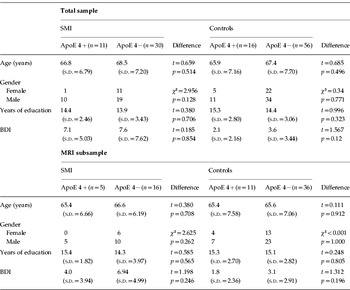
ApoE genotype was determined in all subjects. The SMI group included 11 ApoE4 carriers (3/4:10; 2/4:1) and 29 non-carriers (3/3:24; 2/3:2; 2/2:3). In the control group, there were 16 ApoE4 carriers (3/4:14; 2/4:1, 4/4:1) and 56 non-carriers (3/3:46; 2/3:10). In the magnetic resonance imaging (MRI) subsample, the SMI group included five ApoE4 carriers (3/4:4; 2/4:1) and 16 non-carriers (3/3:12; 2/3:1; 2/2:3), while the control group included 11 ApoE4 carriers (3/4:9; 2/4:1; 4/4:1) and 36 non-carriers (3/3:28; 2/3:8).
All participants gave written informed consent prior to their inclusion in the study. The local ethical committee approved all procedures used in this study. Participants' characteristics are listed in Table 1.
Neuropsychological test battery
The neuropsychological test battery contained the German version of the Rey Auditory Verbal Learning Test (AVLT), the Rey–Osterrieth Complex Figure Test (RCFT), the Trial Making Test (TMT) and the Regensburger Word Fluency Test (RWT).
In the AVLT (Müller et al. Reference Müller, Hasse-Sander, Horn, Helmstadter and Elger1997), a list (A) of 15 nouns is presented five times, with immediate recall after each trial (trials 1–5). After the fifth trial, a second word list (B) with 15 different nouns is presented for immediate recall (interference trial=trial B). This is followed by a trial of free recall of list A (trial 6). Another free recall trial of list A is performed after a 30-min delay (delayed recall=trial 7). Finally, a list (C) that contains the words on lists A and B, together with 20 novel words, is presented for recognition.
Non-verbal memory was measured by the RCFT. The test consists of a copy trial of a complex figure, followed by a recall trial 3 min later. The RCFT copy score is a parameter of the amount of information retained over time and was scored with the reference of Strauss & Spreen (Reference Strauss and Spreen1990).
The RWT measures lexical and verbal fluency. The subject is asked to produce as many words as possible beginning with the letter ‘S’ in a 2-min period.
To test the psychomotoric speed we used the TMT, in which 25 consecutive targets have to be connected. In the version TMT-A the targets are all numbers (1, 2, 3, etc.); in the version TMT-B, numbers and letters alternate (1, A, 2, B, etc.).
A composite score for episodic memory was created from z-transformed and averaged scores on AVLT trials 1–5 (verbal immediate recall), AVLT trial 7 (verbal delayed recall) and the delayed recall score of the Rey Figure.
A speed and executive functioning composite score was computed from z-transformed and averaged scores of verbal fluency (RWT), TMT-A and TMT–B, respectively.
The internal consistency of these two composite scales was sufficiently high (Cronbach's α: memory scale, 0.80, speed/executive functioning 0.70) to justify the aggregation of the included variables into these composite scales.
MRI
A subsample containing 21 SMI individuals and 47 control subjects received MRI scans, which were obtained on a 3-T MR-scanner (Philips Achieva; Philips, The Netherlands), equipped with an eight-channel sense head coil. Four high resolution T1-weighted datasets of each participant were acquired consecutively. The sequence parameters were as follows: T1-weighted 3D turbo field echo; sense factor 2.5 in AP direction, 1.5 in RL direction; TE/TR/Flip=3.6 ms/7.6 ms/8°; field of view 256×256 mm2; matrix size 320×320; number of slice 170; spatial resolution 0.8×0.8×0.8 mm3. The loss in signal:noise ratio due to the high resolution and the application of sensitivity encoding was compensated by acquiring four independent datasets, which were averaged post hoc after applying a motion correction algorithm as provided by SPM5 (Wellcome Department of Cognitive Neurology, London).
Magnetic resonance analyses
All volumetric measures were performed by one blinded rater (A.W.). Prior to the measurement of the target regions, the rater performed a blinded double measure of all regions in 10 subjects. These data were used to calculate the intra-rater variability, which was measured by means of the Pearson correlation coefficient. Total brain volumes were obtained by automated tissue segmentation with SPM5 and adding of grey and white matter tissue probability maps. To correct for overall brain atrophy, all volumes were divided by whole brain volume.
Hippocampus
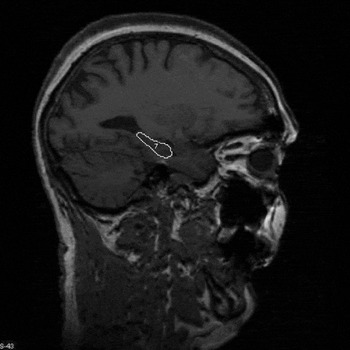
The right and left hippocampi were manually traced on sagittal MRI-slices, starting on a midsagittal slice throughout the hippocampus (Fig. 1). The anterior border was defined by the alveus, which separated the hippocampus from the amygdala. The lateral ventricle served as the posterior border. The fimbria as well as the lateral ventricle and the alveus defined the superior border. Inferiorly the uncus separated the hippocampus from the parahippocampal gyrus. On further medial slices the hippocampus is divided into two separate structures by thalamic nuclei. The head of the hippocampus borders the temporal horn of the lateral ventricle from ventral, while the tail borders the same structure from dorsal. Accordingly, the hippocampus was delineated. The intra-rater reliability of this protocol was r=0.98.
Example of hippocampal tracing in the sagittal plane.

Entorhinal cortex
The entorhinal cortex protocol was adopted from Insausti et al. (Reference Insausti, Juottonen, Soininen, Insausti, Partanen, Vainio, Laakso and Pitkänen1998) and Goncharova et al. (Reference Goncharova, Dickerson, Stoub and deToledo-Morell2001). The entorhinal cortex was measured from the level where the ambiens gyrus, the amygdala and the white matter of the parahippocampal gyrus were first visible to the section preceding the lateral geniculate nucleus. The superior boundary was defined as the sulcus semianularis and in more caudal sections the inferior border of the subiculum. The lateral border was defined as the most inferior-medial point of the medial bank of the collateral sulcus. The intra-rater reliability of the entorhinal cortex volume according to this protocol was r=0.97.
Amygdala
The volumes of the amygdalae were defined according to Pruessner et al. (Reference Pruessner, Li, Series, Pruessner, Collins, Kabani, Lupien and Evans2000). They were traced manually on coronal slices. The posterior end of the amygdala was defined as the point where grey matter first appeared superior to the alveus, lateral of the hippocampus. A horizontal line between the superolateral part of the optic tract and the fundus of the inferior portion of the circular sulcus of the insula was employed as the superior border. Defining the tentorial indentation as the inferior border allowed a separation between amygdala and entorhinal cortex. Anteriorly, the border was set by the closure of the lateral sulcus. To define the medial and lateral borders of the amygdala, transverse slices were used. Medial posterior–superiorly, the ambient cistern was separated from the amygdala, while further anterior and inferior it had to be distinguished from the entorhinal cortex. Laterally, the inferior horn of the lateral ventricle marked the border. The intra-rater reliability of the protocol was r=0.98.
Description of the total sample and magnetic resonance imaging (MRI) subsample

SMI, Subjective memory impairment; BDI, Beck's Depression Inventory.
Statistics
The data were analysed with SPSS for Windows (Version 16.0 German; SPSS Inc., USA).
Within each diagnostic group, t tests were applied to determine the ApoE4 genotype effect on the neuropsychological test data and MRI volumes. To evaluate the interaction of SMI and ApoE4 genotype regarding neuropsychological performance and brain volume measures, an analysis of variance with diagnostic group and ApoE4 genotype as factors was computed. The BDI score was included as covariate as the both diagnostic groups differed significantly on the BDI.
Results
Cognitive test performance
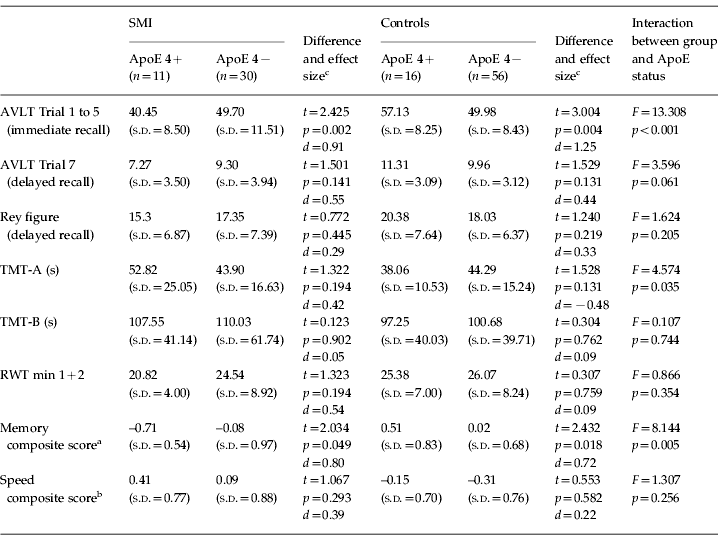
The neuropsychological test results are listed in Table 2. To limit the number of statistical tests, the comparisons are primarily restricted to the composite scores. Comparisons of individual cognitive measures were added only for purposes of completeness.
Neuropsychological test scores
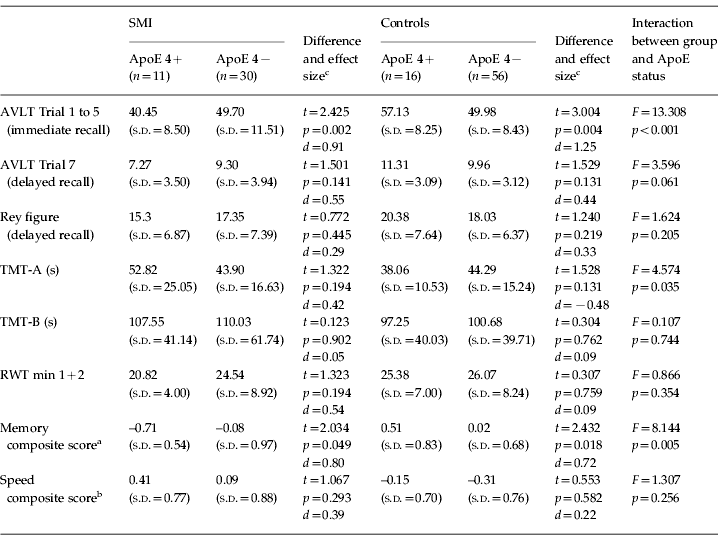
SMI, Subjective memory impairment; AVLT, Rey Auditory Verbal Learning Test; TMT-A, Trial Making Test A; TMT-B, Trial Making Test B; RWT, Regensburger Word Fluency Test.
The primary analyses focussed on the composite scores only. The additional comparisons are listed for completeness.
a Memory composite score containing z-transformed AVLT trial 1 to 5, delayed recall (AVLT), delayed Rey score.
b Speed composite score containing z-transformed RWT min 1+2, TMT-A and TMT-B.
c Effect size calculated by Cohen's definition.
In the SMI group there was a significant ApoE4 effect on the episodic memory composite score with ApoE4 carriers performing worse than ApoE4 non-carriers. There was no ApoE4 effect on the speed/executive function composite score.
In the group without SMI, the ApoE4 carriers performed significantly better on the episodic memory composite score than the non-carriers. There was no ApoE4 effect on the speed/executive function composite score in this group.
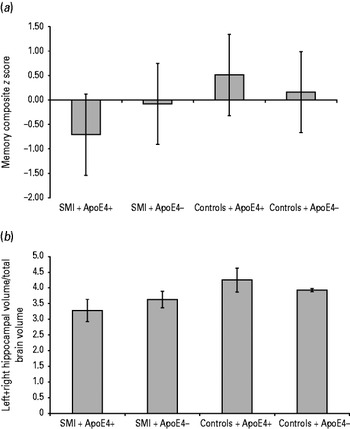
We observed a significant interaction of diagnostic group and ApoE4 carrier status on the episodic memory score with ApoE4 carriers in the non-SMI group performing best and the ApoE4 carriers in the SMI group performing worst (Fig. 2a). There was no such effect on the speed/executive function composite score.
Interaction of diagnostic group and ApoE4 genotype regarding memory performance and hippocampal volume. (a) Memory performance (memory composite z-score, mean ± s.d.). The interaction of diagnostic group and ApoE4 genotype is significant (p=0.005) with Beck's Depression Inventory (BDI) as covariate; (b) summed (right+left) hippocampal volume (mm3) divided by total brain volume (mm3) (mean ± s.d.). The interaction of diagnostic group and ApoE4 genotype is significant (p=0.028) with BDI as covariate. SMI, subjective memory impairment.

Brain volume measures
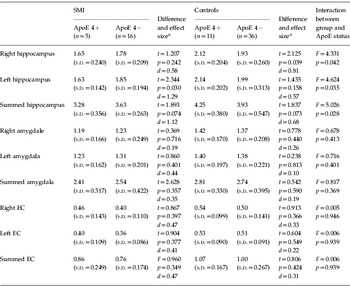
ApoE4 carriers in the SMI group had smaller left hippocampal volumes than ApoE4 non-carriers. There was no difference regarding right hippocampal volume, the combined hippocampal volume, the amygdala or the entorhinal cortex volumes. All volumetric measures are listed in Table 3.
Volumetric measures

SMI, Subjective memory impairment; EC, entorhinal cortex.
Listed are left, right and summed (right+left) hippocampus, amygdala and EC normalized to total brain volume.
a Effect size calculated by Cohen's definition.
ApoE4 carriers in the non-SMI group showed significantly bigger right hippocampal volumes than ApoE4 non-carriers. There was no difference between ApoE4 carriers and ApoE4 non-carriers in this group regarding the left and the combined hippocampal volumes or regarding the amygdala or the entorhinal cortex volumes.
A significant interaction of ApoE4 genotype and diagnostic group on the left, right and combined hippocampal volumes was observed (Fig. 2b). SMI subjects with ApoE4 genotype had the smallest hippocampal volume. SMI individuals without the ApoE4 allele and non-SMI subjects without the ApoE4 allele showed intermediate hippocampal volumes. Non-SMI ApoE4 carriers had the biggest hippocampal volumes.
There was no significant interaction effect of ApoE4 genotype and diagnostic group on amygdala or entorhinal cortex volume.
Discussion
The aim of our study was to investigate the effect of ApoE4 genotype in individuals with SMI and non-complaining subjects on cognitive performance and medial temporal lobe volumes. We also analysed the interaction of the ApoE4 genotype and the presence of SMI on those measures.
We observed an ApoE4 effect in individuals with SMI. Carriers of the ApoE4 allele performed worse than non-carriers in episodic memory, while measures of speed/executive function were not ApoE genotype dependent in this group. The volume of the left hippocampus was smaller in ApoE4 carriers as compared with non-carriers in the SMI group. These results are in parallel with studies in individuals with MCI and AD, also showing poorer memory performance and smaller hippocampal volumes in ApoE4 carriers as compared with non-carriers (Wang et al. Reference Wang, Liu and Lin2006; Cherbuin et al. Reference Cherbuin, Leach, Christensen and Anstey2007; Agosta et al. Reference Agosta, Vossel, Miller, Migliaccion, Bonasera, Filippi, Boxer, Karydas, Possin and Gorno-Tempini2009). The particularly small hippocampal volumes and slightly reduced memory performance in the SMI subjects at genetically enriched risk (ApoE4 carriers) in our study further supports the concept of SMI as an at-risk or prodromal syndrome of AD. They extend earlier reports of slightly lower memory performance (Jessen et al. Reference Jessen, Wiese, Cvetanovska, Fuchs, Kaduszkiewicz, Kölsch, Luck, Mösch, Pentzek, Riedel-Heller, Werle, Weyerer, Zimmermann, Maier and Bickel2007; Luciano et al. Reference Luciano, Gow, Taylor, Hayward, Harris, Campell, Porteous, Starr, Visscher and Deary2009) and slight volume decreases of medial temporal lobe volumes in comparison with individuals without SMI (van der Flier et al. Reference van der Flier, van der Vlies, Weverling-Rijnsburger, de Boer, Admiraal-Behloul, Bollern, Westendorp, van Buchem and Middelkoop2005; Jessen et al. Reference Jessen, Feyen, Freymann, Tepest, Maier, Heun, Schild and Scheef2006; Saykin et al. Reference Saykin, Wishart, Rabin, Santulli, Flashman, West, McHugh and Mamourian2006).
In the group without SMI, we observed the opposite ApoE effect. Subjects with the ApoE4 genotype showed the best memory performance and largest hippocampal volumes. These finding were also restricted to episodic memory and hippocampal volumes and did not extend to speed/executive function and other medial temporal lobe volumes.
In a recent meta-analysis, a negative ApoE4 effect, particularly on episodic memory function, which increases between middle and old age, has been reported (Luciano et al. Reference Luciano, Gow, Taylor, Hayward, Harris, Campell, Porteous, Starr, Visscher and Deary2009). This is flanked by reports on superior cognitive and memory performance in young ApoE4 carriers (Mondadori et al. Reference Mondadori, deQuervain, Buchmann, Mustovic, Wollmer, Schmidt, Boesiger, Hock, Nitsch, Papassotiropoulos and Henke2007; Schultz et al. Reference Schultz, Lyons, Franz, Grant, Boake, Jacobson, Xian, Schellenberg, Eisen and Kremen2008) and in ApoE4 carriers in the highest age range (Smith et al. Reference Smith, Bohac, Waring, Kokmen, Tangalos, Ivnik and Petersen1998). A recent post-mortem study demonstrated that AD pathology is more prevalent in ApoE4 carriers in old age, but less prevalent in the highest age group, >90 years (Kok et al. Reference Kok, Haikonen, Luoto, Huhtala, Goebeler, Haapasalo and Karhunen2009). Post-mortem investigations also showed that the negative effect of ApoE4 on cognition acts only in the presence of AD pathology (Bennett et al. Reference Bennett, Schneider, Wilson, Bienias, Berry-Kravis and Arnold2005). Combined, these data suggest that individuals with ApoE4 are at increased risk for AD pathology and, as demonstrated numerous times, are at increased risk to develop dementia. However, ApoE4 may also have positive effects. In young subjects (in the absence of AD pathology), ApoE4 is associated with better cognitive performance. This positive ApoE effect is again detectable in those subjects who largely escape AD pathology and dementia up to the oldest age. Here, ApoE4 carriers again perform cognitively superior compared with non-carriers.
We found positive ApoE4 effects in young elderly, the group in which negative ApoE4 effects are usually reported. One reason may be the selection of ‘super healthy’ individuals in our control group, as we did not only use normal cognitive performance, but also the absence of SMI as an inclusion criterion in this group. SMI is only recently becoming more recognized as an at-risk or prodromal condition of AD. The majority of studies that tested the effects of ApoE4 on cognition in healthy individuals did not particularly stratify with regard to the presence of SMI. Note that in our data the ApoE4 effect on memory disappears if the group of individuals with SMI and without SMI are combined. The assumption of a highly selected ApoE4 carrier group with high resilience towards AD is supported by the largest hippocampal volumes in this group.
The sample size of our study is limited. However, the ApoE effect in the SMI group is in agreement with the a priori hypothesis, suggesting that SMI may be an early AD manifestation. The positive ApoE4 effect in the group without SMI is supported in two domains (episodic memory, hippocampal volume) and does not generalize to all cognitive task or all brain volumes. Both support the validity of the data. Finally, the sizes of the observed significant effects are medium to large. Despite this, however, the ApoE4 effects in highly selected healthy subjects in middle age and in young elderly needs to be studied in extended samples. Replication of our data, which need to be considered exploratory, will bridge the gap between the observation of beneficial ApoE4 effects in young and very old individuals.
Acknowledgements
The study was supported by the Alzheimer Forschungsinitiative (AFI), by the German Competence Network on Dementia funded by the German Federal Ministry for Education and Research (grant O1GI 0102) and by the seventh framework programme of the European Union (ADAMS project, HEALTH-F4-2009-242257).
Declaration of Interest
None.