
Introduction
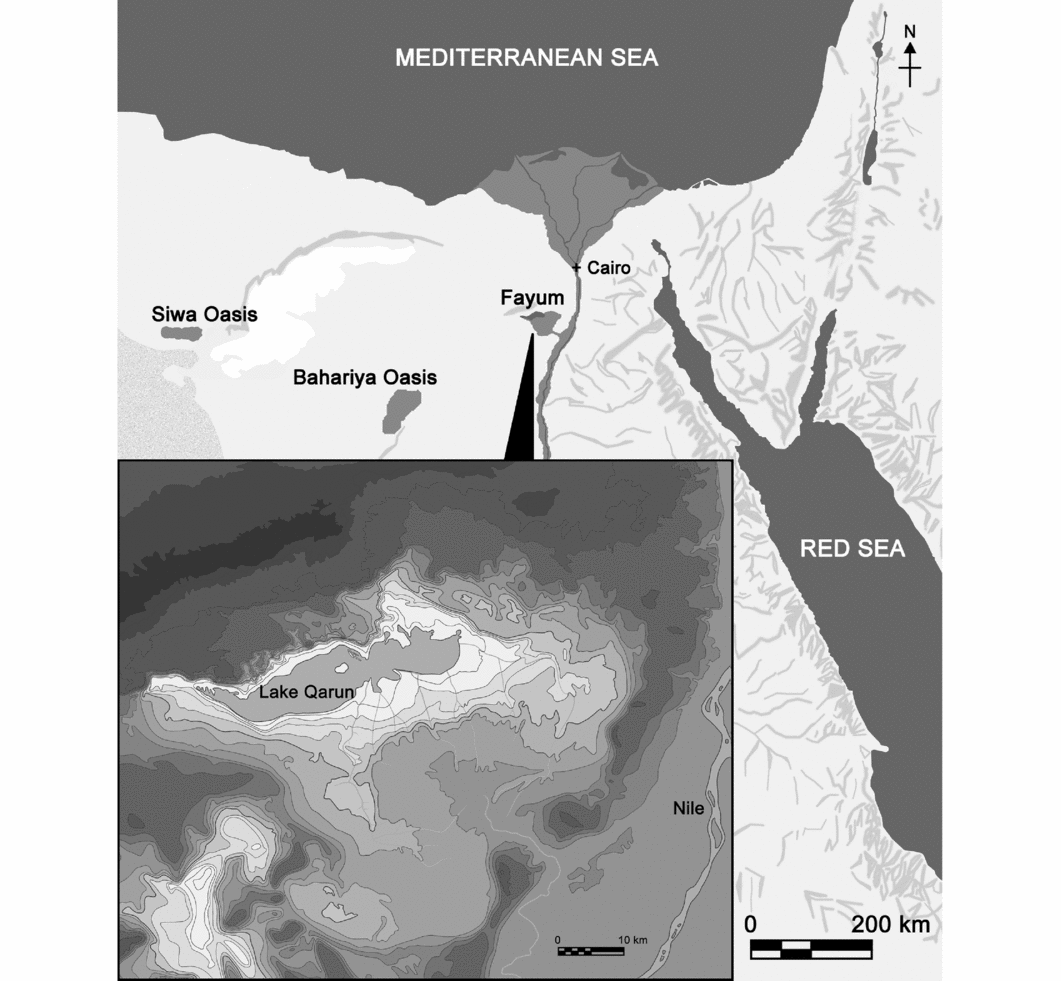
The Desert Fayum, published by the British archaeologist Gertrude Caton-Thompson and British geologist Elinor Gardner in 1934, is a milestone in the history of archaeology. Not only was this a report of the discovery of the earliest Neolithic farming culture in a desert oasis of Egypt (Figure 1), it also greatly inspired Gordon Childe when he was developing the Oasis Theory of the origin of farming, and popularising the idea of the Neolithic Revolution. No earlier Neolithic farming culture has since been found anywhere else in Egypt, and the Fayum hence remains of essential importance in the study of the origins of the Neolithic in the region, although it is now known that domesticated cereals (emmer wheat and barley) and animals (taurine cattle, pig, goat and sheep) were introduced to Egypt from south-west Asia.
Location of the Fayum in Egypt.

Since this pioneering publication, several field projects have augmented the information about the prehistory of the Fayum, particularly in terms of its geology, archaeozoology and radiocarbon chronology (Wendorf & Schild Reference Wendorf and Schild1976; Kozlowski Reference Kozlowski1983; Hassan Reference Hassan1986; Brewer Reference Brewer1989; Kozlowski & Ginter Reference Kozlowski, Ginter, Krzyzaniak, Kobusiewicz and Alexander1993). On the other hand, our knowledge of Fayum Neolithic stone tools has not been significantly improved. The Fayum has been well known for many scatters of bifacially flaked and ground stone tools on the desert surface since the late nineteenth century. As a considerable number of elaborate formal stone tools had already been taken from the field by Caton-Thompson and her predecessors, recent lithic studies had no other choice but to focus on informal flake tools with only marginal retouch and debitage, which previous visitors had left in the field as less interesting artefacts. One such lithic study concerns Kom W, the type site of the Fayum Neolithic, and has gained important information about the toolmaking techniques and lithic assemblage of this culture (Kozlowski & Ginter Reference Kozlowski, Ginter, Krzyzaniak and Kobusiewicz1989). The predominance in the lithic assemblage of small informal flake tools such as notches, denticulates and scrapers over elaborate formal tools such as axes, sickle blades and arrowheads, however, was stressed to such an extent that the role of formal tools in the life of the Kom W inhabitants was underestimated. Moreover, one recent lithic study labelled Fayum Neolithic people as ‘low-level food producers’ without presenting any direct lithic evidence for food production. This study relied mainly on debitage collected from the surface of the backfill of Caton-Thompson's excavation trenches at Kom W to relate the use of lithic raw materials to the mobility of the toolmakers (Holdaway et al. Reference Holdaway, Wendrich and Phillipps2010). These studies have produced a distorted image of Fayum Neolithic people as unskilled toolmakers, constantly on the move, who invested the least effort possible in toolmaking and did not place much importance on farming.
As previously discussed (Shirai Reference Shirai2010: 81–104 & 241–310; Shirai Reference Shirai and Shirai2013), lithic technology is subject to the availability of suitable raw materials, and is optimised in the light of subsistence needs and cost-benefit considerations. Fieldwork by the present author has revealed that elaborate formal stone tools for farming-related tasks in the Fayum Neolithic were made using raw materials that had to be transported from distant sources and stockpiled. This suggests that for Fayum Neolithic toolmakers it was worth investing much time and energy in procuring raw materials from distant sources, and making elaborate formal tools to perform farming-related tasks most efficiently and achieve the best results. The predominance of small informal flake tools at Kom W must be viewed in terms of the toolmakers’ decisions about the extent to which they could afford to waste, or needed to conserve, raw materials, and the time and energy that they would like to spend or save for toolmaking for specific tasks. Debitage from the production of elaborate formal tools could have been used to make small informal tools for less demanding tasks as part of an economising strategy within the lithic technology as a whole.
This article will shed new light on the underestimated Neolithic assemblage of formal stone tools from Caton-Thompson's excavation at Kom W, which has been insufficiently published and is presently held in the Petrie Museum of Egyptian Archaeology at University College London. It will also reconsider the role of the formal stone tools in the life of the Kom W inhabitants, and reassess the outstanding importance of the site as the settlement of a sedentary farming community.
The controversial status of Kom W
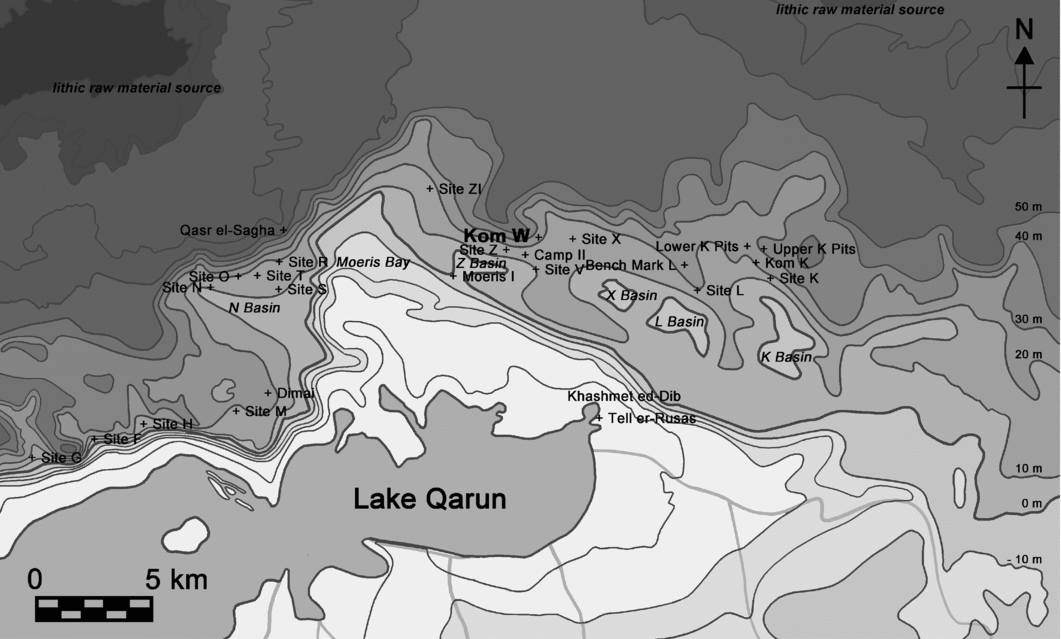
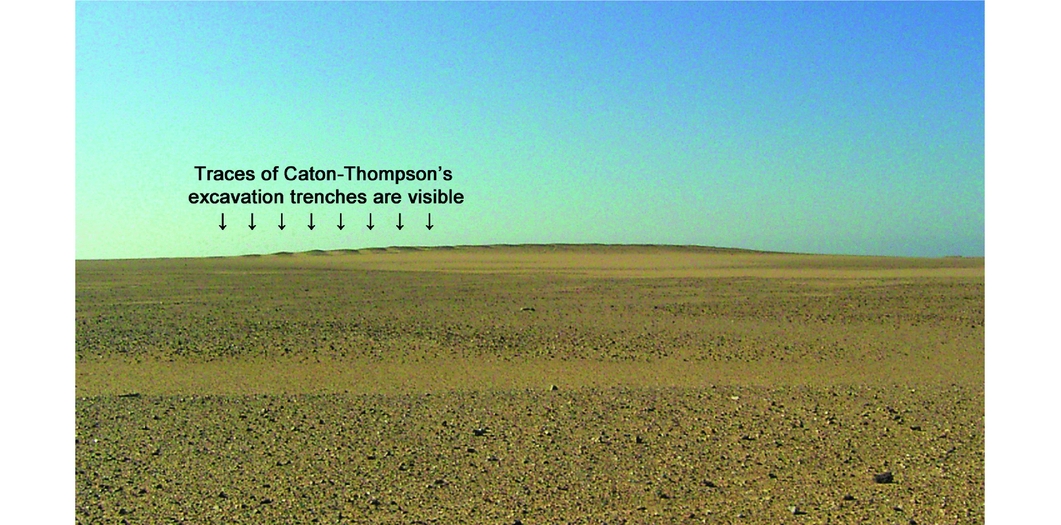
The Fayum is a large area, with many sites on the shore of Lake Qarun (Figure 2). Among them, Kom W is the largest: a natural mound approximately 90 × 150m (Figure 3). Kom W was thoroughly excavated by Caton-Thompson in the 1920s. She discovered a remarkable concentration of Neolithic remains including lithic artefacts, pottery vessels, miscellaneous items such as stone maceheads, stone palettes, stone and shell ornaments, bone projectile points and faunal remains, as well as 248 hearths (Caton-Thompson & Gardner Reference Caton-Thompson and Gardner1934: 22–37). Kom W was partially re-excavated by the Combined Prehistoric Expedition in the 1960s, and by the UCLA-RUG project more recently (Shirai Reference Shirai2010: 37–43). Radiocarbon dates indicate that the site was occupied for a few hundred years in the mid fifth millennium BC (Shirai Reference Shirai2010: tabs 3.2 & 5.1; Wendrich et al. Reference Wendrich, Taylor and Southon2010: tab. 1).
Caton-Thompson's sites on the northern shore of Lake Qarun.

A view of Kom W.

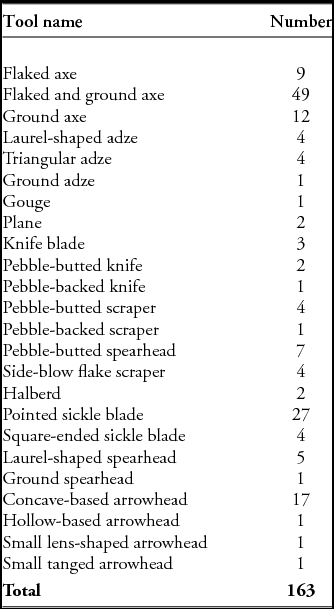
The Neolithic formal stone tool assemblage at Kom W.

The mobility and sedentariness of the Kom W inhabitants have been controversial because of their seemingly heavy reliance on seasonal wild food resources, and due to the lack of substantial dwelling remains at the site. It has been mentioned that Kom W was more than just a seasonal encampment (Hassan Reference Hassan1988: 149–50), and that the people were not necessarily absent during lean seasons but were moving within the Fayum (Linseele et al. Reference Linseele, Van Neer, Thys, Phillipps, Cappers, Wendrich and Holdaway2014). Such reluctance to describe the occupation as sedentary arises from a mistaken assumption that sedentism is a static state in which all members in a residential group remain at one location all year round. As previously argued (Shirai Reference Shirai2010: 86–88 & 339–40), mobility must be viewed as a continuum between moving resources exploited at distant locations to residential bases, and moving residential bases close to resource locations. In addition, we must distinguish between individual mobility and the movement of the entire group. These two extremes are not mutually exclusive, and decreasing movement at a group level normally requires increased movement by individuals. The problem in the Fayum is that individual movement as part of a logistical mobility strategy for resource exploitation has been confused with group movement as part of a residential mobility strategy. All postulated movements have been regarded as the relocation of a whole community. This confusion has led to the simplistic conclusion that Fayum Neolithic communities followed a mobile lifestyle.
The subsistence scheduling available in a resource-rich lacustrine environment and the necessity to remain close to drinking water in an arid environment strongly suggest that the Kom W inhabitants would neither have needed nor wanted to move their residential base long distances to other places away from lakeshores, even seasonally (Caton-Thompson & Gardner Reference Caton-Thompson and Gardner1934: 89; Shirai Reference Shirai2010: 63–79 & 101–103). In addition, the exceptionally high concentration of material remains at Kom W (occupied for a few hundred years) clearly indicates the inhabitants’ recognition of this as a geographically and strategically advantageous location. Moreover, the long-distance transport and stockpiling of lithic raw materials, as well as the formal stone tool assemblage (discussed below), suggest that farming certainly occupied an important position in the subsistence of the Kom W inhabitants. They were sedentary in the sense that at least part of the community remained there all year round, while routinely sending working parties to obtain necessary resources from distant locations.
The Neolithic formal stone tool assemblage of Kom W
After the official division of all archaeological finds from the Fayum between the Department of Antiquities in Egypt and Caton-Thompson, her Fayum lithic collection was brought to the UK in the late 1920s, divided further into small portions and distributed among many museums in and outside the UK. The Petrie Museum houses the largest portion, consisting of approximately 1400 artefacts. Few debitage products, preforms and informal flake tools with only marginal retouch are included, as she selectively collected formal stone tools in the field.
Caton-Thompson recognised that the majority of stone tools at Kom W were Neolithic, although there were atypical tools from later periods (Caton-Thompson & Gardner Reference Caton-Thompson and Gardner1934: 23 & 25–31). She described the quantity and types of Neolithic stone tools that were collected at Kom W, but the actual number and types of stone tools housed in the Petrie Museum do not match what she described. This is not merely because some stone tools were given to other museums, but also because she did not count those stone tools that were hard to classify. According to her description, at least 156 Neolithic stone tools came from Kom W, but the number in the Petrie Museum is 163 (Table 1). Among 83 stone tools that have been published as Neolithic in plates VIII–XI of The Desert Fayum, only two (pls X-13 & X-36) are absent from the Petrie Museum. As far as could be ascertained, one flaked axe (JE49131) and one knife blade or heavily abraded sickle blade (JE49120) from Kom W are presently housed in the Egyptian Museum in Cairo. It is uncertain how many other stone tools from Kom W were given to other museums, but it seems that most Neolithic formal stone tools from Kom W are held in the Petrie Museum.
As Caton-Thompson observed (Table 1), axes, sickle blades and concave-based arrowheads dominate the formal stone tool assemblage from Kom W. In particular, the number of axes and sickle blades from Kom W is the largest from a single site of the Fayum Neolithic. There is little doubt, therefore, that these tools were essential to the life of the Kom W community. This formal stone tool assemblage contradicts the image formed from archaeozoological studies. The most recent study of the faunal remains from Kom W revealed a large quantity of fish bones, whereas wild and domesticated mammal bones were relatively scarce. It suggested that the Kom W inhabitants depended mainly on fishing and supplementarily on hunting and livestock keeping on a seasonal basis (Linseele et al. Reference Linseele, Van Neer, Thys, Phillipps, Cappers, Wendrich and Holdaway2014). It is hard, however, to imagine such a lifeway for the Kom W inhabitants when examining the formal stone tool assemblage. Given that there seem to be no formal stone tools for scaling and cutting such a large quantity of fish, fish processing was probably performed using informal flake tools. On the other hand, as laurel-shaped spearheads and concave-based arrowheads of various sizes and forms predominate over the small arrowheads that had been common for hunting small-/medium-sized animals in Egypt since the mid seventh millennium BC, there must have been a radical shift in the target of hunting towards large-sized and thick-skinned animals that should be shot at close quarters. Such a shift is not reflected in the faunal data. The formal stone tool assemblage at Kom W hence represents a different aspect of the inhabitants’ life, one that cannot be revealed by archaeozoological studies alone, and which was, furthermore, apparently related to farming.
From shrub clearing to cereal harvesting: a farming way of life at Kom W
The Neolithic axes and sickle blades from Kom W are remarkable not only for their large number but also for their excellent preservation. While stone tools collected from the desert surface in the Fayum are normally abraded by sand blasting or water rolling, many of the axes and sickle blades from Kom W look fresh, as they were recovered from excavation trenches. The edges and ridges of these excavated tools are sharp. Striations from the grinding of the working edges of the axes and so-called sickle gloss on the serrated working edges of the sickle blades are visible to the naked eye, as mentioned by Caton-Thompson (Caton-Thompson & Gardner Reference Caton-Thompson and Gardner1934: 25–29). These give important clues as to how these tools were made and used.
Neolithic axes from Kom W are made of four different raw materials (flint, limestone, quartz and basalt), but flint axes predominate (Table S1 in online supplementary material). As flint axes often retain patches of cortex on their butt and/or body surface, it is obvious that they were made from rounded flint cobbles of palm size. As previously demonstrated (Shirai Reference Shirai2010: 241–310), such large flint cobbles do not occur naturally in the surroundings of Kom W, although there is a scatter of small flint pebbles of finger size. Large flint cobbles are found in abundance at Pliocene deposits in gravel areas of the Fayum Depression, which are, however, more than 15km distant from Kom W. Limestone and quartz cobbles are also found there. Basalt is available from Oligocene deposits that are more than 15km from Kom W in a different direction. These gravel areas are devoid of vegetation and natural resources other than rocks, and apparently not suitable for long-term settlement. Visits to these areas by members of Neolithic communities were hence not residential moves but routine trips for lithic raw material procurement.
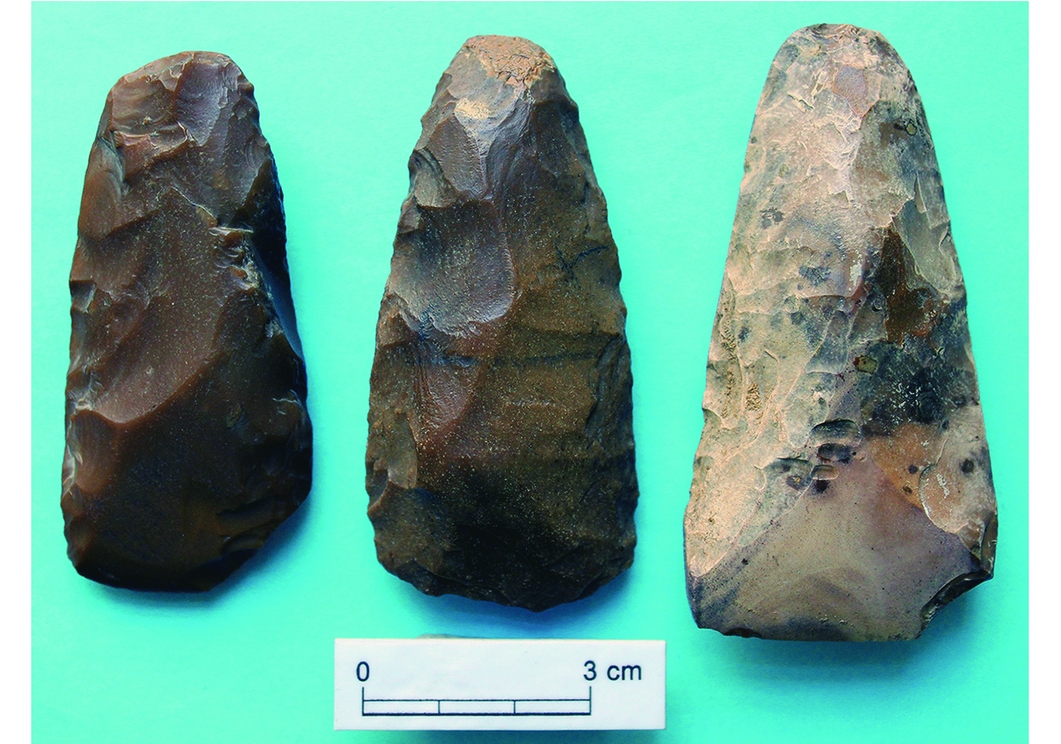
At Kom W, Caton-Thompson found a heap of unused large flint cobbles as well as hundreds of flint, limestone and quartz cobbles, which have battered areas indicating that they have been used as hammers (Caton-Thompson & Gardner Reference Caton-Thompson and Gardner1934: 32). There is no doubt that the Kom W inhabitants strategically transported cobbles from such distant sources and stockpiled them. It is most probable that the whole process of axe manufacture from the initial decortication of flint cobbles took place at Kom W. Limestone, quartz and basalt axes were normally produced by grinding only because of the unflakable nature of these rocks, yet flint axes were often made by the combination of flaking and grinding (Figure 4). Abraded flake scars on the body surface show that the axe body was first roughly shaped by bifacial flaking, and then the working edge and the body of the axe, and sometimes the sides too were thoroughly ground. Besides aesthetic values, there seems to be no functional reason for grinding the body and sides of flint axes, but the ground working edge was a functional asset. It is more difficult and more time-consuming to grind a working edge, but the result is more durable than a flaked working edge. Toolmakers at Kom W chose to spend more time making durable axes to increase the efficiency of chopping tasks, rather than spending less time making more fragile axes that would have been less efficient in use.
Flaked and ground axes from Kom W (UC2651, UC2633 and UC2586 from left to right); taken by the author by courtesy of the Petrie Museum of Egyptian Archaeology, University College London.

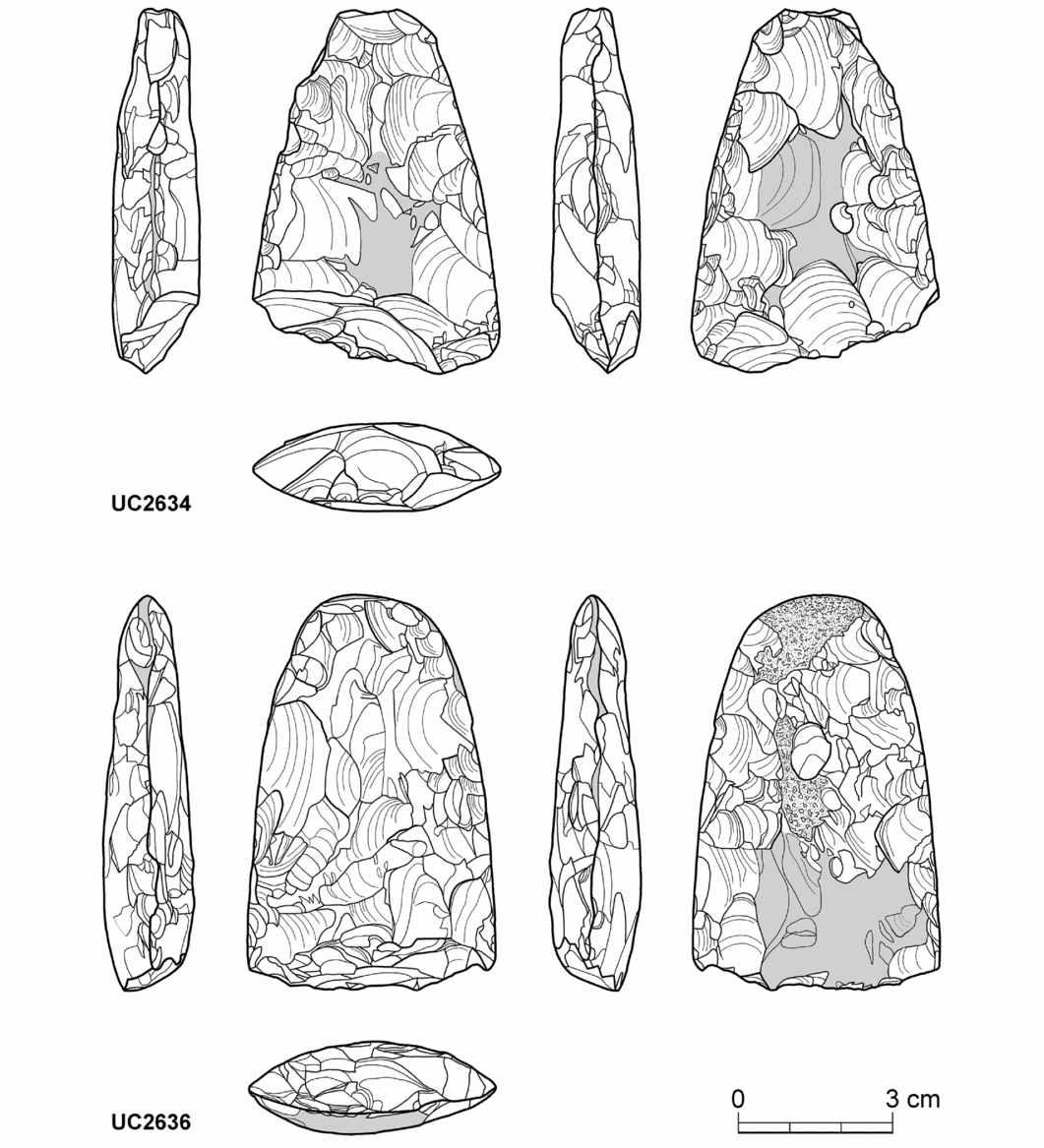
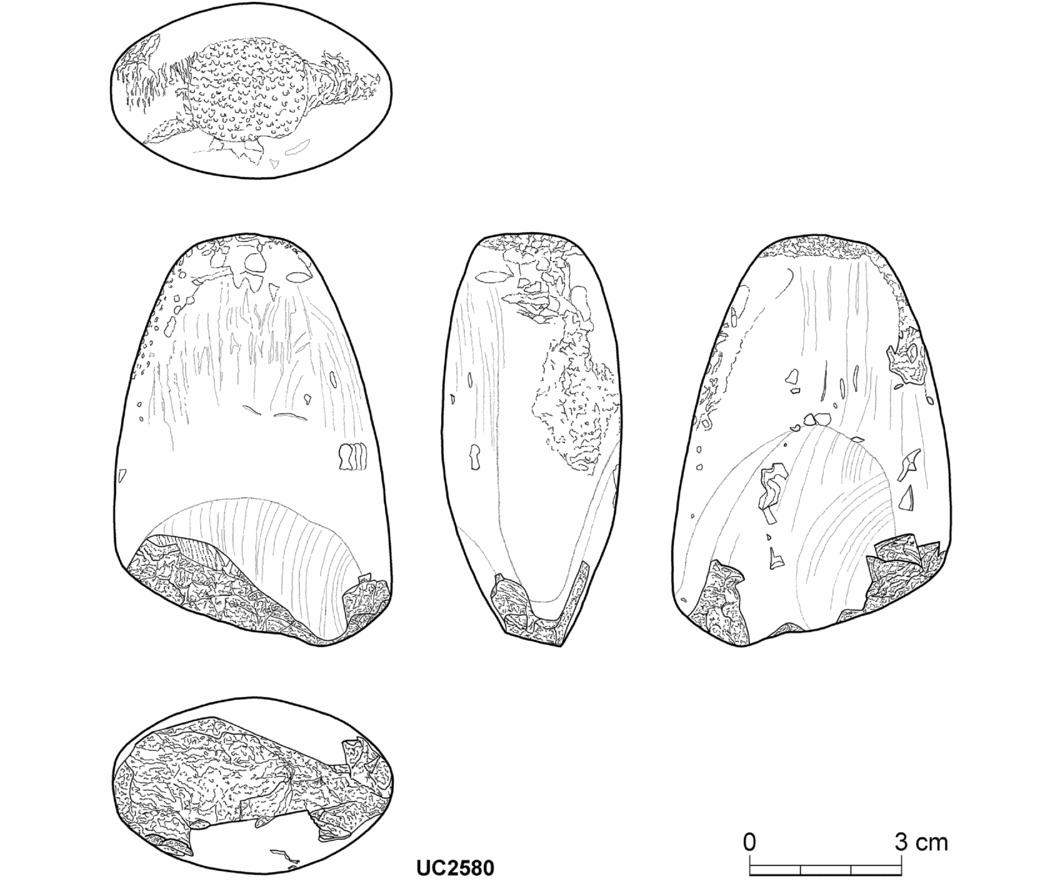
Although not highlighted by Caton-Thompson, it must be stressed that more than half of all axes found at Kom W have been damaged by heavy use, despite the toolmakers’ pursuit of durability. Relatively thin axes are snapped, and the ground working edges of thick axes are fractured. In some examples, it is clear that the makers or users of axes tried to repair the fractured working edges, but the results were unusable as chopping tools due to the defective edge angles formed by poor flaking (Figure 5, upper). In one successful example of recycling, a fractured axe edge has been transformed into a gouge (Figure 5, lower). One damaged ground axe shows no sign of repair but its butt is battered (Figure 6), suggesting that it was brought to Kom W in its damaged state and reused as a hammer.
Flaked and ground axes from Kom W (UC2634 and UC2636). Shaded areas are ground; drawn by the author by courtesy of the Petrie Museum of Egyptian Archaeology, University College London.

Ground axe from Kom W (UC2580); drawn by the author by courtesy of the Petrie Museum of Egyptian Archaeology, University College London.

The presence of many elaborate axes at Kom W and the signs of heavy use demonstrate that the inhabitants made, repaired and stored these tools there, and must have had great need for cutting down trees. Caton-Thompson found hundreds of hearths at Kom W and observed that only wood had been used for burning, and that there were no instances of dung fuel, suggesting that domesticated animals were so few that the dung was precious and retained as manure (Caton-Thompson & Gardner Reference Caton-Thompson and Gardner1934: 25). It can be argued therefore that the area around Kom W was covered by woody vegetation (although this remains to be substantiated by botanical data), and that tree-felling was essentially for obtaining firewood. Whether the hearths at Kom W were for smoke-drying large quantities of fish, as at the Late Palaeolithic site of Makhadma in the Nile Valley (Vermeersch et al. Reference Vermeersch, Paulissen, Huyge and Vermeersch2000), has not been discussed. In the Fayum, however, tree-felling may have had another aim. It seems certain that Fayum Neolithic axes were connected with farming because an axe and a complete sickle were found in grain storage pits near Kom K, another type site of the Fayum Neolithic (Caton-Thompson & Gardner Reference Caton-Thompson and Gardner1934: 43 & 89–90). It is probable that Neolithic farmers at Kom W were not merely sowing seeds in naturally empty areas such as receding lakeshores where fertile soils were readily available, but also actively making cultivation plots by felling trees in shrubland. Firewood could have been a by-product of the seasonal clearance of shrubs for cultivation plots, and stockpiled for later use.
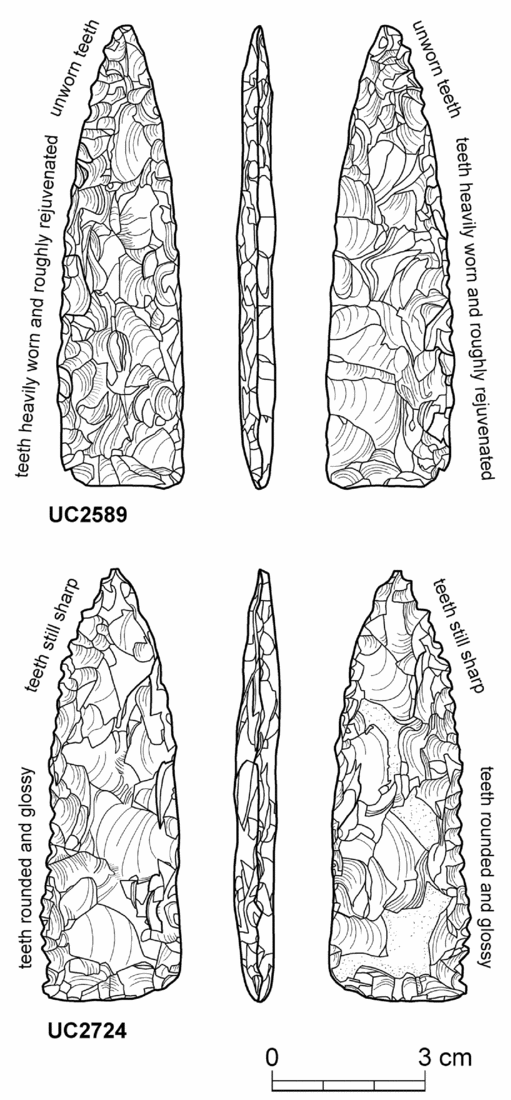
Neolithic sickle blades from Kom W are made from flint flakes. The blade is thoroughly flaked bifacially and the entire surface is normally covered by flake scars. A few examples have cortical or patinated patches on the blade surface (Figure 7, lower). The patinated patches are cut by flake scars, indicating that the toolmakers did not always use fresh flakes that had just been knapped from a cobble but picked up already patinated flakes, which had been split naturally and scattered for a length of time. This type of raw material use is seen in other classes of formal stone tools from Kom W, and suggests that not only cobbles but also naturally split flakes ready for toolmaking were transported from distant sources.
Sickle blades from Kom W (UC2589 and UC2724); drawn by the author by courtesy of the Petrie Museum of Egyptian Archaeology, University College London.

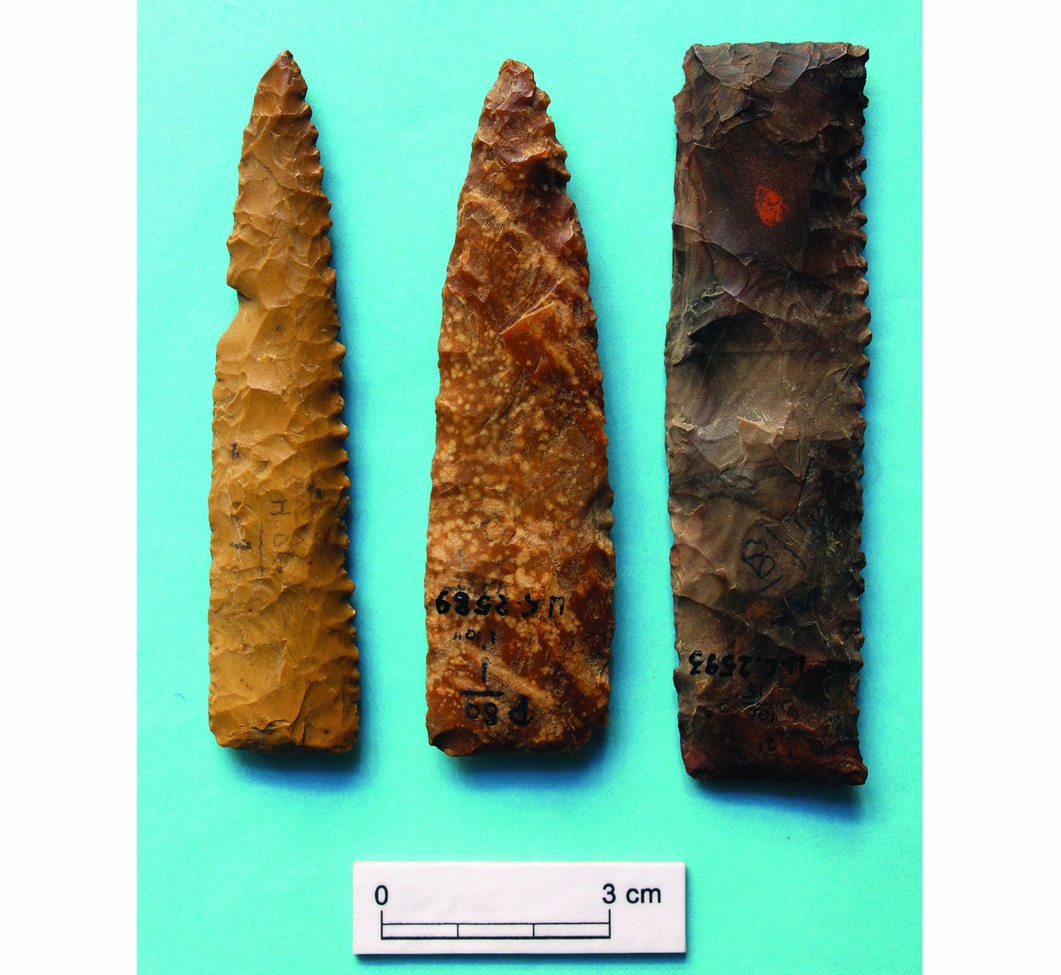
As for the form of sickle blade, pointed predominates over rectangular (Figure 8). One side of the blade is coarsely or finely serrated. These are common features of Neolithic sickleblades, not only at Kom W but also at other sites of the Fayum Neolithic. As the most important part of a sickle blade is a sharp and durable working edge, thorough bifacial flaking of the blade body seems to be an unnecessary waste of time and labour. Such time-consuming toolmaking only makes sense if the aim is to minimise tool-using time, or where high returns from tool-using tasks are expected. It is assumed that Fayum Neolithic farmers were very successful in this regard.
Sickle blades from Kom W (UC2588, UC2589 and UC2593 from left to right); taken by the author by courtesy of the Petrie Museum of Egyptian Archaeology, University College London.

As exemplified by a complete sickle found in a grain storage pit near Kom K (Caton-Thompson & Gardner Reference Caton-Thompson and Gardner1934: 45 & pl. XXX-1), it seems that three blades were usually set in a groove in a straight wooden handle using resin. Caton-Thompson mentioned only one burnt sickle blade found in a hearth at Kom W (Caton-Thompson & Gardner Reference Caton-Thompson and Gardner1934: 29), but there are more examples. It is probable that the sickle blades dropped into the fire accidentally while resin was being melted by heat. This method of attachment would have made it difficult for sickle users to replace worn blades with new ones during harvesting, even though rapid rejuvenation of the working edge could have been attempted without detaching blades during use. It is most probable that sickle blades were normally made and replaced at Kom W.
Half of all the sickle blades from Kom W have glossed working edges (see Table S2 in online supplementary material), and thereis hence no doubt that they were used for cutting siliceous cereal culms. The serrated working edges of sickle blades are not only glossed but also heavily worn and rounded, although the degree of gloss and wear is not always the same across the entire working edge. Some examples show that the teeth on the tapered part of the pointed blade are still sharp and not clearly glossed, while the teeth on the straight part of the pointed blade are rounded and heavily glossed (Figure 7). In the case of rectangular sickle blades, however, the entire length of the straight working edge is equally glossed. This means that the teeth on the tapered part of pointed blades came into contact with the culms being cut less frequently than the teeth on the straight part. It is obvious that the tapered part of the pointed blade is useless, and that the blade should be made rectangular so that the entire working edge can be in equal contact with the culms being cut. Nonetheless, pointed sickle blades predominate over rectangular sickle blades at Kom W, and it is unclear why pointed blades were common. It may have been a cultural convention that cannot be explained from a functional point of view.
In the absence of experimental studies, it is hard to estimate how many hours of use caused such heavy gloss and wear as that seen on the sickle blades from Kom W. One experiment has revealed that cutting half-green cereal culms causes heavier gloss much faster than cutting dry cereal culms (Quintero et al. Reference Quintero, Wilke, Waines, Gebel, Kafafi and Rollefson1997). Depending on the state of the cereal culms and the size of the cultivation plots, sickle blades could have become unusable after only a single harvesting season, or might have lasted over several years. Some examples show heavily glossed and worn working edges rejuvenated by rough flaking that cut the glossed surface (Figure 7, upper). This suggests that sickle blades were indeed curated tools and were not newly made and replaced every year.
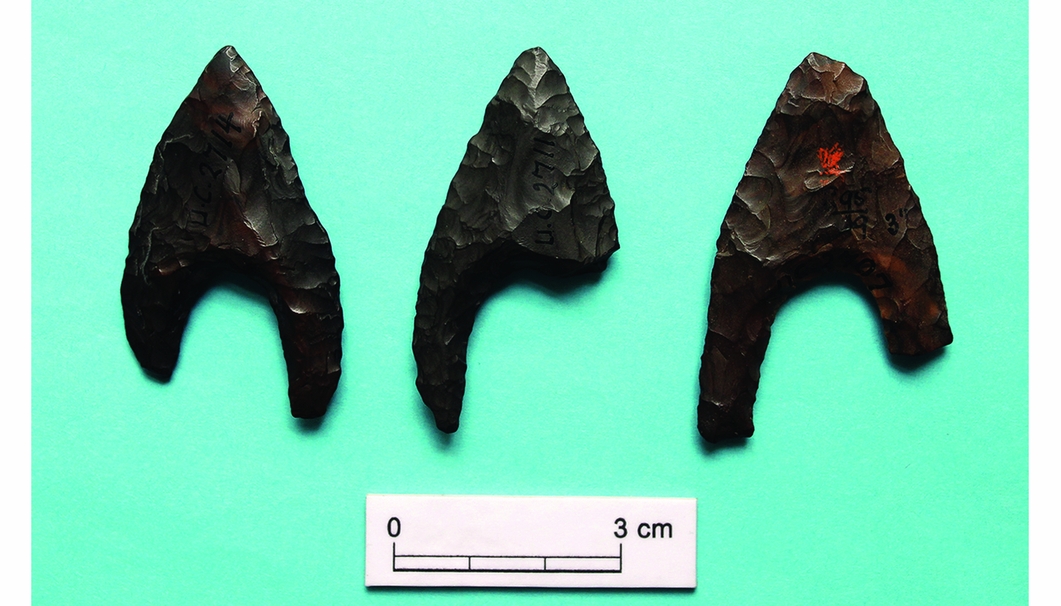
Neolithic concave-based arrowheads found at Kom W are made from flint flakes. They are extensively flaked bifacially, and no cortical patches are left on the surface. It is notable that many of the concave-based arrowheads at Kom W are abraded and broken even though they were found in the excavation trenches (see Table S3 in online supplementary material). This suggests that they were brought to Kom W in an abraded and broken state for recycling. One unusual example shows that one leg is shorter than the other (Figure 9, far left), suggesting that the broken leg had somehow been modified.
Concave-based arrowheads from Kom W (UC2714, UC2711 and UC2707 from left to right); taken by the author by courtesy of the Petrie Museum of Egyptian Archaeology, University College London.

These arrowheads are most suitable for shooting large-sized and thick-skinned animals from close quarters. A concave-based arrowhead has been found among the ribs of a hippopotamus skeleton at another Neolithic site in the Fayum (Caton-Thompson & Gardner Reference Caton-Thompson and Gardner1934: 84), and there is little doubt that this type of weapon was invented for hunting hippopotami. A question arises as to why the Kom W inhabitants had to hunt such dangerous animals at the risk of their lives, although Fayum hunters had been used to hunting smaller mammals such as dorcas gazelle and hartebeest with much smaller arrowheads since the Epipalaeolithic period. When farming was introduced in the Neolithic, Fayum farmers must have realised the threat posed by hippopotami. Hippopotami leave the water at night to eat grasses on land, and could devastate cultivation plots. It must hence have been difficult for Fayum Neolithic farmers to continue farming without eliminating these predators. The concave-based arrowheads of the Fayum Neolithic might be evidence of the conflict between early farmers and these cereal predators. Cultivation plots on lakeshores could easily be raided by hippopotami, and this may be one reason why the Kom W inhabitants had to fell trees to open up cultivation plots farther away from lakeshores (Shirai Reference Shirai2010: 149–54 & 178–82).
Conclusion
How formal stone tools for farming-related tasks were made, used and maintained at Kom W demonstrates that this community chose this location not only for catching and consuming fish but also for clearing shrubs, tending cultivation plots and harvesting cereals. In other words, Kom W was a hub for various activities, where tools, resources and wastes were accumulated. Shrub clearance in autumn and cereal harvesting in spring would not have clashed with the high season of fishing in summer, as revealed by archaeozoological studies, and have created an ideal annual cycle of subsistence activities. Moreover, given threats from predators, Neolithic farmers based at Kom W would not have been able to leave their cultivation plots unattended at any time while the cereals were growing. In short, it is hard to believe that there was any moment in the year when Kom W became completely abandoned as its entire community left for another place in an annual subsistence schedule. Neolithic formal stone tools at Kom W strongly suggest that the Kom W inhabitants were indeed skilled toolmakers who optimised their toolmaking and their mobility strategy according to local needs and possibilities, and that they placed great emphasis on farming. From a technological point of view, Kom W must be considered as a relatively developed farming community. The effort required to make farming feasible and efficient in a challenging natural environment through technology remains a neglected area in the study of the Neolithic transition in Egypt. Further analysis of lithic technology in the Fayum prior to the period of Kom W will provide greater insights into the origins and development of a farming way of life in Egypt.
Acknowledgements
I would like to thank all of the staff of the Petrie Museum of Egyptian Archaeology at University College London for accommodating my research on Gertrude Caton-Thompson's Fayum lithic collection. My research based in the Institute of Archaeology at University College London was made possible by the Marie Curie post-doctoral fellowship of the Gerda Henkel Foundation's M4HUMAN Programme (AZ45/EU/12): I sincerely appreciate their support. I am also grateful to the two reviewers for commenting on a draft of this article.
Supplementary material
To view supplementary material for this article, please visit http://dx.doi.org/10.15184/aqy.2016.133