Introduction
Common mental disorders, such as depression and anxiety disorders, are a growing cause of work disability and impaired quality of life among working-age populations (Thomas & Morris, Reference Thomas and Morris2003; Ormel et al. Reference Ormel, Oldehinkel, Nolen and Vollebergh2004; Mathers & Loncar, Reference Mathers and Loncar2006). The number of employees who work long hours is substantial (Vaguer & Van Bastelaer, Reference Vaguer and Van Bastelaer2004) and it has been hypothesized that this might contribute to symptoms of anxiety and depression among employees (Sparks et al. Reference Sparks, Cooper, Fried and Shirom1997; Spurgeon et al. Reference Spurgeon, Harrington and Cooper1997; Shields, Reference Shields1999; Park et al. Reference Park, Kim, Chung and Hisanaga2001; Bildt & Michelsen, Reference Bildt and Michelsen2002; Michelsen & Bildt, Reference Michelsen and Bildt2003; van der Hulst, Reference van der Hulst2003; Caruso et al. Reference Caruso, Hitchcock, Dick, Russo and Schmit2004; Fujino et al. Reference Fujino, Horie, Hoshuyama, Tsutsui and Tanaka2006; Yamazaki et al. Reference Yamazaki, Fukuhara, Suzukamo, Morita, Okamura, Tanaka and Ueshima2007; Kleppa et al. Reference Kleppa, Sanne and Tell2008).
To date, several cross-sectional studies have shown an association between long working hours and mental ill health and fatigue symptoms, but prospective evidence is scarce and inconsistent (Steptoe et al. Reference Steptoe, Wardle, Lipsey, Mills, Oliver, Jarvis and Kirschbaum1998; Shields, Reference Shields1999; Bildt & Michelsen, Reference Bildt and Michelsen2002; Michelsen & Bildt, Reference Michelsen and Bildt2003). One longitudinal study reported no association between long working hours and depression (Bildt & Michelsen, Reference Bildt and Michelsen2002; Michelsen & Bildt, Reference Michelsen and Bildt2003) whereas another reported an association only for women (Shields, Reference Shields1999). In one study (Steptoe et al. Reference Steptoe, Wardle, Lipsey, Mills, Oliver, Jarvis and Kirschbaum1998), 71 participants were followed for 6 months and a within-subjects analysis of four assessments showed no change in psychological distress in relation to overtime work periods. Another experimental field study of 16 subjects found that overtime work was associated with increased exhaustion and irritation (Dahlgren et al. Reference Dahlgren, Kecklund and Akerstedt2006). Studies from Japan using the 12-item General Health Questionnaire (GHQ-12) score (Suwazono et al. Reference Suwazono, Okubo, Kobayashi, Kido and Nogawa2003) and records of diagnosed mental disorders from the employees' insurance company (Tarumi et al. Reference Tarumi, Hagihara and Morimoto2003) found no association between long working hours and mental disorders. None of the earlier prospective studies examined anxiety as an outcome.
Several factors may have contributed to the mixed findings on the relationship between long working hours and mental health, including heterogeneity in the assessment of exposure, outcome and potential confounding factors; the small sample size in some studies; and insufficient control for bias. For example, the thresholds selected for long working hours have ranged from 41 h/week to as high as 70 h/week, and, in some studies, part-time employees have been included in the reference group. However, this creates a potential source of reverse causation bias because part-time work may be a response to health problems rather than a risk factor. Indeed, part-time work has been found to be associated with morbidity and mortality (Sokejima & Kagamimori, Reference Sokejima and Kagamimori1998; Nylen et al. Reference Nylen, Voss and Floderus2001), and psychological distress in one study predicted a shift from ⩾36 to <36 h/week (De Raeve et al. Reference De Raeve, Kant, Jansen, Vasse and van den Brandt2009). In addition, given that mental health problems tend to fluctuate over time, the predictive value of working hours for mental health may have been underestimated in these studies as they were based on only one assessment of symptoms at follow-up.
Further issues relate to controlling for relevant confounders and mediators. The mechanisms for the associations between long working hours and mental ill health may be related to unhealthy lifestyles and stress-related physical diseases, such as cardiovascular disease (Sparks et al. Reference Sparks, Cooper, Fried and Shirom1997; Caruso et al. Reference Caruso, Bushnell, Eggerth, Heitmann, Kojola, Newman, Rosa, Sauter and Vila2006; Virtanen et al. Reference Virtanen, Ferrie, Singh-Manoux, Shipley, Vahtera, Marmot and Kivimäki2010). It is therefore important to take into account these factors in the analysis, alongside more conventional risk factors such as age, sex, socio-economic position and marital status. Furthermore, the association may be sex specific, as women who are employed full time may be at higher risk of work-related health problems than men because of the combined load from paid and unpaid work (Alfredsson et al. Reference Alfredsson, Spetz and Theorell1985; Gjerdingen et al. Reference Gjerdingen, McGovern, Bekker, Lundberg and Willemsen2000; Lundberg & Parr, Reference Lundberg, Parr, Eisler and Hersen2000; Artazcoz et al. Reference Artazcoz, Borrell and Benach2001; Lundberg & Hellström, Reference Lundberg and Hellström2002; Matthews & Power, Reference Matthews and Power2002).
In this study of British civil servants, we therefore examined the associations between working hours and symptoms of anxiety and depression using a prospective study design with three repeat measurements of anxiety and depressive symptoms and controlling for important potential mediators and confounding factors. Our aim was to determine whether long working hours predict future symptoms of depression and anxiety in a cohort of middle-aged full-time employees without these symptoms at baseline. To take into account reverse causation, we also examined whether pre-existing depressive or anxiety symptoms predict a transfer from shorter to longer working hours or from longer to shorter working hours.
Method
Participants and study design
Recruitment to the Whitehall II study (phase 1) took place between late 1985 and early 1988 among all office staff, aged 35–55 years, from 20 London-based Civil Service departments (Marmot & Brunner, Reference Marmot and Brunner2005). The response rate was 73% (6895 men and 3413 women) and, since recruitment, there have been seven further data collection phases. Informed consent was gained from all participants and the University College London Medical School Committee on the Ethics of Human Research approved the protocol.
Data for the exposure and outcome measures for the present study were drawn from three survey phases: phase 5, 1997–1999 (the baseline for these analyses), when working hours were measured comprehensively for the first time in the Whitehall II study. The assessment of depression and anxiety symptoms was repeated at two subsequent phases (phase 6, 2001 and phase 7, 2002–2004). Participants were followed up until phase 7, or if these data were missing, until phase 6. Those with missing data at phase 6 were excluded from all analyses. Covariates were assessed at baseline.
The number of participants who worked full time (⩾35 h/week) with complete data on covariates at baseline was 3536 [2678 (76%) men, 858 (24%) women, mean age at time of survey 52.4 years, s.d.=4.3]. Of those, 2960 (84%) responded to the first follow-up survey [2248 (76%) men, 712 (24%) women, mean age at time of survey 55.3 years, s.d.=4.3]. Altogether, 2764 (78%) responded to both follow-up surveys [2096 (76%) men, 668 (24%) women, mean age at time of survey 57.7 years, s.d.=4.3]. Of the study sample, 85% were employed at the time of the first follow-up, and 75% at the second follow-up. Participants with no depressive symptoms (n=2549) and those free of anxiety symptoms (n=2618) at baseline formed the analytic samples for the study.
Measures
Working hours were ascertained from the following two questions: ‘How many hours do you work in an average week in your main job, including work brought home?’ and ‘How many hours do you work in an average week in your additional employment?’ Response alternatives to these questions ranged from 0 to ⩾100 and 0 to 99 respectively. As there is no consensus on the definition of long working hours, we chose to follow a definition used in two studies that reported an association between long working hours and poor sleep quality (Sekine et al. Reference Sekine, Chandola, Martikainen, Marmot and Kagamimori2006), and myocardial infarction (Sokejima & Kagamimori, Reference Sokejima and Kagamimori1998). Based on the reported number of hours worked, the participants were divided into three groups: 1=35–40 h/week; 2=41–55 h/week; and 3=more than 55 h/week.
Depressive symptom score (Stansfeld et al. Reference Stansfeld, Head and Marmot1998) was drawn from the 30-item General Health Questionnaire (GHQ-30; Goldberg, Reference Goldberg1972) and included the following four items: ‘been thinking of yourself as a worthless person’, ‘felt that life is entirely hopeless’, ‘felt that life isn't worth living’, and ‘found at times you couldn't do anything because your nerves were too bad’ (Cronbach's α=0.88). These four items, assessed on a four-point Likert scale, range 0–3, are a subset of the seven items in the depression subscale of the GHQ-28 (Goldberg, Reference Goldberg1972). A sum score was calculated and, as previously, a total score of 4 or more was used to define the presence of depressive symptoms (Stansfeld et al. Reference Stansfeld, Head, Fuhrer, Wardle and Cattell2003; Stafford et al. Reference Stafford, Chandola and Marmot2007; Hamer et al. Reference Hamer, Kivimaki, Lahiri, Marmot and Steptoe2010; Singh-Manoux et al. Reference Singh-Manoux, Akbaraly, Marmot, Melchior, Ankri, Sabia and Ferrie2010).
A five-item anxiety symptom score (‘lost much sleep over worry’, ‘felt constantly under strain’, ‘been getting scared or panicky for no good reason’, ‘found everything getting on top of you’, ‘been feeling nervous and strung up all the time’; Cronbach's α=0.86) was also drawn from the GHQ. These five items, which are a subset of the seven items of the GHQ-28 anxiety scale, were rated on a four-point scale (range 0–3) and scores in the top decile (8 or more points of the total of 15 points) used to define anxiety cases (Virtanen et al. Reference Virtanen, Singh-Manoux, Ferrie, Gimeno, Marmot, Elovainio, Jokela, Vahtera and Kivimäki2009); this classification leads to a prevalence rate that closely matches that of anxiety disorders in the general UK population (Jenkins et al. Reference Jenkins, Lewis, Bebbington, Brugha, Farrell, Gill and Meltzer1997).
Data on sociodemographic factors, health-related behaviours and physical health at baseline were used as covariates in the analyses. Sociodemographic factors included sex, age, marital status (married/cohabiting versus not married/not cohabiting) and occupational grade which was grouped into six levels. Alcohol consumption was classified as 0, 1–14 and >14 units/week for women and 0, 1–21 and >21 units/week for men (the last category for each sex representing alcohol consumption over the recommended limit) (White et al. Reference White, Altmann and Nanchahal2004). Smoking was assessed by a single question on whether the respondent was a current smoker. Chronic disease was indicated by the presence of at least one of the following conditions: (1) report of long-standing illness, disease, or medical condition for which the participant had sought treatment in the 12 months before the survey; (2) presence of coronary heart disease (CHD), as defined previously (Kivimaki et al. Reference Kivimaki, Head, Ferrie, Shipley, Steptoe, Vahtera and Marmot2007), at phase 5. Employment status at follow-up (employed versus not employed) was derived from the last follow-up questionnaire.
To examine whether individuals with anxiety or depressive symptoms are more likely to be selected for, or remain in, jobs with long working hours (i.e. reverse causality), we ran additional analyses among participants who responded to the questionnaire at phase 3 in addition to phase 5 (n=3416). Assessment of working hours at phase 3 was not as accurate as at phase 5 including hours worked only on an average weekday. However, using these data we examined whether depressive and anxiety symptoms predicted a shift from shorter to longer working hours or from longer to shorter working hours. We used three different definitions for change in working hours as follows: increased working hours (shift from 7–8 h/day to >40 h/week; shift from 7–8 h/day to >55 h/week; shift from 7–10 h/day to >55 h/week) and decreased working hours (shift from >8 h/day to <40 h/week; shift from ⩾11 h/day to <40 h/week; and shift from ⩾11 h/day to 35–54 h/week. The reference group in all analyses comprised those who stayed in the baseline category in question.
Statistical analysis
For dichotomous measures, we tested for a trend in the prevalence of the baseline characteristic across the working hours categories using a χ2 test. We used Cox proportional hazard models with follow-up period as the time scale to examine the relationship between working hours and incident depressive and anxiety symptoms among participants free from symptoms at baseline. Those working 35–40 h/week formed the reference category against which the hazard ratio (HR) was calculated. To examine the linear trend in the association between working hours and new-onset depressive or anxiety symptoms, we repeated the analysis treating working hours as a continuous variable and expressed as the effect per 10-h increase in weekly working hours.
The models were serially adjusted for covariates (sociodemographic factors and health and health behaviours) to examine the effect of covariates on the association. Interaction terms between sex and categories of working hours were used to assess whether the effect of working hours on mental health was dependent on sex. In a sensitivity analysis, we restricted the sample to those who were employed during the whole follow-up period and therefore were not misclassified in relation to working hours due to non-employment during the follow-up (n=1924 for depression analysis; n=1988 for anxiety analysis). We used binary logistic regression analysis to assess reverse causality (shift from shorter to longer hours and shift from longer to shorter hours). SAS version 9.2 (SAS Institute, USA) was used for all analyses.
Results
Participants in the first and second follow-up did not differ markedly from all 3536 baseline participants in terms of working hours: 40% of those who responded to the first follow-up survey only and 39% of those who responded to both follow-up surveys versus 40% of all the respondents in the baseline survey worked 35–40 h/week at baseline. The proportion of employees working 41–55 h/week was 52% for both follow-up groups versus 51% at baseline, and for those working >55 h 9% at baseline and both follow-up groups. Thus, there were no major differences in drop-out between the groups defined by working hours.
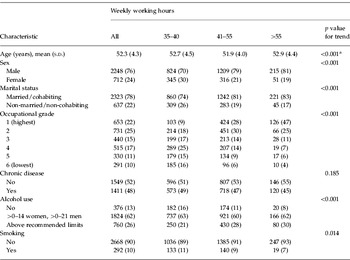
Table 1 presents the association between working hours and covariates among the participants at baseline. Employees working long hours (>55 h/week) were more often men, married or cohabiting, were in higher occupational grades, more likely to drink over the recommended limit and less often current smokers. Employees working 41–55 h were slightly younger than the other two groups.
Characteristics of the participants by working hours at baseline

All values given as n (%) unless stated otherwise.
a Paired test of difference between 41–55 v. 35–40 h and >55 h significant (p<0.001). Difference between 35–40 h and >55 h non-significant (p=0.508).
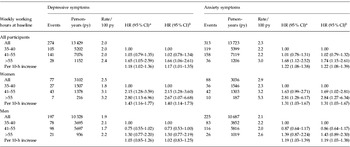
During the mean follow-up period of 5.3 (s.d.=0.9) years, 274 new-onset depressive symptom cases were identified. The mean follow-up time for anxiety symptoms was 5.2 (s.d.=0.9) years, during which 313 new-onset cases were recorded. Associations between working hours at baseline and onset of depressive and anxiety symptoms at follow-up are presented in Table 2. In the model adjusted for sociodemographic factors, working more than 55 h/week was related to a 1.65-fold risk of symptoms of depression and a 1.68-fold risk of symptoms of anxiety in those without those symptoms at baseline. The HR for depressive symptoms for each 10-h increase in working hours was 1.18, and the HR for anxiety symptoms was 1.22. The HRs were all robust to further adjustment for baseline health and health behaviours.
Association between working hours at baseline and incident anxiety and depressive symptoms at follow-up

HR, Hazard ratio; CI, confidence interval.
a Adjusted for age, sex, occupational grade, and marital status at baseline, and employment status at follow-up.
b Additionally adjusted for chronic illness, smoking, and alcohol use at baseline.
We found a significant interaction between working hours and sex predicting onset of depressive and anxiety symptoms (p values for interaction <0.001 and 0.016 respectively). Therefore, the results are presented separately for women and men in Table 2. The fully adjusted HR for depressive symptoms in the group with the longest working hours was 2.67 among women and 1.30 (non-significant) among men. The corresponding HRs for each 10-h increase in working hours were 1.40 and 1.02 among women and men respectively. The HR for anxiety symptoms in the longest working hours group was 2.84 among women and 1.43 (non-significant) among men. The corresponding HRs for each 10-h increase in working hours predicting anxiety symptoms were 1.31 and 1.19 among women and men respectively.
Sensitivity analysis
In this analysis we restricted the sample to those who were employed during the whole follow-up period (n=1924 for depression analysis and n=1988 for anxiety analysis) and found an HR of 1.71 [95% confidence interval (CI) 1.03–2.84] for new-onset depressive symptoms among employees who worked >55 h at baseline (HR 1.20, 95% CI 1.01–1.43 for each 10-h increase), and an HR of 1.95 (95% CI 1.24–3.07) for new-onset anxiety symptoms (HR 1.30, 95% CI 1.11–1.52 for each 10-h increase). There was also a clear sex interaction in these subsamples (p<0.001 for depression, p = 0.003 for anxiety). Sex-stratified analyses showed an HR of 2.13 (95% CI 0.66–6.91) for depression among women working >55 h and an HR of 1.48 (95% CI 0.84–2.61) among men. The middle group (41–55 h/week) among women had an HR of 2.66 (95% CI 1.45–4.85) for depression. The corresponding figures regarding depression for each 10-h increase among women and men were HR 1.35 (95% CI 1.04–1.75) and HR 1.10 (95% CI 0.87–1.39) respectively. Regarding anxiety, working >55 h compared to 35–40 h was related to an HR of 4.09 (95% CI 1.65–10.11) among women and an HR of 1.51 (95% CI 0.89–2.56) among men. The middle group (41–55 h/week) among women had an HR of 2.26 (95% CI 1.24–4.12) for anxiety. The corresponding figures for anxiety for each 10-h increase among women and men were HR 1.47 (95% CI 1.10–1.97) and HR 1.24 (95% CI 1.03–1.50) respectively.
Test of reverse causality
To examine whether individuals with anxiety or depressive symptoms are more likely to change their working hours, we ran additional analyses among participants (n=3416) who responded to questionnaires at phase 3 (1991–1994) and phase 5 (1997–1999). We examined whether depressive and anxiety symptoms at phase 3 predicted selection into, or reduced selection out of, jobs with long working hours between phases 3 and 5. We used three definitions of change in working hours and adjusted the analyses for sex, age, marital status and occupational grade. Among the 12 tests performed, the only association that was close to statistical significance was a decreased, although non-significant, probability for employees with anxiety symptoms to reduce their working hours from more than 10 h/day to less than 55 h/week (OR 0.53, 95% CI 0.27–1.05).
Discussion
We examined long working hours as a predictor of depressive and anxiety symptoms in a sample of middle-aged British civil servants. Among participants free from such symptoms at baseline followed up over 5 years, working more than 55 h/week predicted subsequent depressive and anxiety symptoms. In the fully adjusted models, each 10-h increase was related to a 17% and 22% increase in risk of depressive and anxiety symptoms respectively. Sex-stratified analyses revealed that, in women, working more than 55 h/week was related to a 2.67-fold risk of depression and a 2.84-fold risk of anxiety, and each 10-h increase in working hours was associated with 40% and 31% increase in risk of depression and anxiety respectively. Among men, the associations were weaker and the only significant association we found was a linear association between each 10-h increase in working hours and the onset of anxiety symptoms. By contrast, among women, even moderate overtime work (41–55 h/week) seemed to increase the probability of mental health problems. Our findings are in line with those of an earlier cross-sectional study showing a relationship between overtime work and anxiety symptoms (Kleppa et al. Reference Kleppa, Sanne and Tell2008), and a prospective study showing overtime work to be a risk factor for new-onset depressive disorder among women but not among men whose weekly working hours exceeded 40 h (Shields, Reference Shields1999).
Several factors may underlie these findings. One mechanism suggested to explain the association between long working hours and mental health symptoms is the behavioural pathway, such as unhealthy alcohol consumption or smoking (van der Hulst, Reference van der Hulst2003). We found that participants working long hours used more alcohol but were less often current smokers than other participants. Their alcohol use, however, did not explain the association between long working hours and onset of depressive and anxiety symptoms.
Long working hours may indicate the adverse effects of work exposure and stress. There is some evidence that, for example, work overload is specifically related to anxiety symptoms whereas low decision latitude, implying loss of or insufficient control over work, is more often associated with depression (Broadbent, Reference Broadbent1985; Warr, Reference Warr1990). Our findings indicating that long working hours are a greater risk for anxiety and depression in women may reflect the fact that women often also have an extra burden due to extended hours of work and domestic chores (Gjerdingen et al. Reference Gjerdingen, McGovern, Bekker, Lundberg and Willemsen2000; Lundberg & Parr, Reference Lundberg, Parr, Eisler and Hersen2000; Artazcoz et al. Reference Artazcoz, Borrell and Benach2001; Lundberg & Hellström, Reference Lundberg and Hellström2002; Matthews & Power, Reference Matthews and Power2002). In addition, for women, working long hours is less normative and may therefore be more stressful, for example, in terms of work–family conflicts (Jansen et al. Reference Jansen, Kant, Kristensen and Nijhuis2003). More women than men also work in monotonous jobs and have less control over the content and pace of work (Lundberg, Reference Lundberg, Wamala and Lynch2002; Virtanen et al. Reference Virtanen, Honkonen, Kivimaki, Ahola, Vahtera, Aromaa and Lönnqvist2007) and also less control over work time (Ala-Mursula et al. Reference Ala-Mursula, Vahtera, Pentti and Kivimaki2004).
There is also some evidence of increased myocardial infarction in women but not in men who work overtime (Alfredsson et al. Reference Alfredsson, Spetz and Theorell1985). Myocardial infarction is associated with depression (Blumenthal, Reference Blumenthal2008), although in an earlier report from the Whitehall II study, no significant sex differences were observed in the association between long working hours and increased risk of coronary heart disease (Virtanen et al. Reference Virtanen, Ferrie, Singh-Manoux, Shipley, Vahtera, Marmot and Kivimäki2010). Long working hours have been associated with elevated salivary cortisol levels, particularly among women (Lundberg & Hellström, Reference Lundberg and Hellström2002), and other studies suggest that elevated cortisol levels may be related to the development of depression (Handwerger, Reference Handwerger2009). However, our sex-specific findings may more simply reflect well-known sex differences in responses to external stressors; symptoms of depression and anxiety are more common among women and alcohol use disorders are more prevalent among men (Jenkins et al. Reference Jenkins, Lewis, Bebbington, Brugha, Farrell, Gill and Meltzer1997; Batty et al. Reference Batty, Hunt, Emslie, Lewars and Gale2009). Future studies should therefore extend the investigation of long working hours to include alcohol use disorders.
There is some discussion in the literature on whether the association between long working hours and mental ill health is due to selection; that is, employees with pre-existing mental disorders tend to work or have to work longer; or employees with mental disorders are forced to stay in unsatisfactory jobs, including those with longer working hours, because their potential for finding alternative employment is limited (Waghorn & Chant, Reference Waghorn and Chant2005; Kleppa et al. Reference Kleppa, Sanne and Tell2008). Alternatively, employees with mental health problems may reduce their working hours to enable recovery (De Raeve et al. Reference De Raeve, Kant, Jansen, Vasse and van den Brandt2009). However, we did not find evidence of reverse causality in our analysis. We excluded part-time employees from our main analysis because people with health problems may choose part-time work and therefore be selected for poorer health (Ettner et al. Reference Ettner, Frank and Kessler1997; De Raeve et al. Reference De Raeve, Kant, Jansen, Vasse and van den Brandt2009). However, future studies should examine whether working part-time has implications for employee mental health.
We found similar associations of long working hours with depressive and anxiety symptoms. As these mental health problems are highly co-morbid in the general population (Prince et al. Reference Prince, Patel, Saxena, Maj, Maselko, Phillips and Rahman2007) and also exhibited a considerable degree of correlation in our sample (r=0.64, p<0.001), it is possible that there are common pathways, such as occupational burnout, explaining the association between work exposures and various forms of common mental disorders (Ahola et al. Reference Ahola, Honkonen, Isometsa, Kalimo, Nykyri, Aromaa and Lönnqvist2005; Ahola & Hakanen, Reference Ahola and Hakanen2007; Peterson et al. Reference Peterson, Demerouti, Bergstrom, Samuelsson, Asberg and Nygren2008).
Some limitations of the study are noteworthy. Cohorts such as the Whitehall II study that follow the same individuals over an extended time period are subject to a ‘healthy survivor’ effect as participants with severe illnesses are more prone to drop out of the study over time (Ferrie et al. Reference Ferrie, Kivimaki, Singh-Manoux, Shortt, Martikainen, Head, Marmot, Gimeno, De Vogli, Elovainio and Shipley2009). However, work exposures such as working hours cannot be examined reliably among participants who are no longer exposed to work. Thus, in our study, the loss of unhealthy participants may result in an underestimation rather than an overestimation of the true effect. Our sensitivity analyses suggested similar results when the study samples were restricted to those who were employed over the whole follow-up period.
Another limitation relates to our measures of depressive and anxiety symptoms not being validated against clinical diagnoses. The present results should therefore be confirmed using standardized measures of depressive and anxiety disorders. Furthermore, we were not able to assess how long a person was exposed to long hours before the baseline and over the follow-up period. Finally, although our cohort of civil servants included several occupational grades, it did not include blue-collar workers. Thus, it remains unclear whether our findings are generalizable to blue-collar workers and employees in the private sector.
In conclusion, a follow-up of approximately 5 years suggests an association of long working hours with subsequent depressive and anxiety symptoms, particularly among women. If these associations are causal, the findings of the present study suggest that long of working hours should be recognized as a potential risk factor for the development of anxiety and depression in women.
Acknowledgements
The Whitehall II study was supported by grants from the Medical Research Council (MRC); the British Heart Foundation; the Health and Safety Executive; the Department of Health; the National Heart Lung and Blood Institute (HL36310), USA, NIH: National Institute on Aging (AG13196), USA, NIH: National Institute on Aging (AG13196, AG34454); the Agency for Health Care Policy Research (HS06516); and the John D. and Catherine T. MacArthur Foundation Research Networks on Successful Midlife Development and Socioeconomic Status and Health. M.K. and J.V. are supported by the Academy of Finland (Project nos 124271, 124322 and 129264) and the Finnish Work Environment Foundation; M.K. is also supported by the BUPA Foundation and the EU New OSH ERA research programme; A.S.-M. is supported by a ‘EURYI’ award from the European Science Foundation and M.G.M. is supported by an MRC Research Professorship. J.E.F. is supported by the MRC (Grant no. G8802774) and M.J.S. is supported by the British Heart Foundation.
Declaration of Interest
None.