Introduction
In his book General Psychopathology, after introducing time as primary, un-derivative, universal, and real only through its contents, Karl Jaspers basically distinguished between knowledge of time and experience of time (Jaspers, Reference Jaspers, Hoenig and Hamilton1963). The former, related to objective time, its modes of measure and symbolizing, and the correct judgment of time-intervals (Jaspers, Reference Jaspers, Hoenig and Hamilton1963), is also referred to as chronological, quantifiable time (Sims, Reference Sims2002). The latter, related to the subjective experience of time, is not the estimation of any particular span of time but a total awareness of time, hence a subjective phenomena of psychic (Jaspers, Reference Jaspers, Hoenig and Hamilton1963) and personal life (Sims, Reference Sims2002), studied mainly by means of case-reports. Although the exact demarcation line between the two is at times difficult to draw, both might be affected in psychopathological states, such as psychoses (Bonnot et al., Reference Bonnot, de Mentalembert and Coulon2011), depression (Kitamura and Kumar, Reference Kitamura and Kumar1984), organic, and other conditions (Berrios, Reference Berrios1982). However, while orientation in time, an element of knowledge of time, and clock tasks utilizing time symbols constitute important features of mental state and cognitive evaluation (e.g. the time orientation items in the Mini-Mental State Examination (MMSE; Folstein et al., Reference Folstein, Folstein and McHugh1975), the clock drawing test), accuracy of estimation of time-intervals (e.g. “How long do you think we have been talking?”) has received marginal attention in contemporary assessment, diagnosis, and research in psychogeriatrics.
Experimental psychology, on the other hand, has seen the proliferation of models, paradigms, research methods, and laboratory experiments conducted in younger and older individuals, healthy or diseased, concerning the subject of “time perception,” “passage of time estimation,” and “subjective time estimation,” just to mention a few synonyms (Nichelli et al., Reference Nichelli, Venneri, Molinari, Tavani and Grafman1993; Grewal, Reference Grewal1995; Damasceno, Reference Damasceno1996; Levy and Dreier, Reference Levy and Dreier1997; Carrasco et al., Reference Carrasco, Guillem and Redolat2000; Mimura et al., Reference Mimura, Kinsbourne and O'Connor2000; Papagno et al., Reference Papagno, Allegra and Cardaci2004). Research protocols use a variety of sophisticated designs and methods over very short time periods (usually milliseconds to a few seconds) whether related to fundamental adaptive behaviors such as speech processing, motor coordination, or music perception (Grondin, Reference Grondin2010) or from a neuroscientific perspective designed to elicit “automatic” or “cognitive” responses. Less than one second is “short,” sensory, or benefits from some automatic processing, whereas the processing of intervals of a few seconds requires the support of cognitive resources (Coslett et al., Reference Coslett, Shenton, Dyer and Wiener2009; Grondin, Reference Grondin2010; Bonnot et al., Reference Bonnot, de Mentalembert and Coulon2011), both thus circumventing other factors (e.g. mood states) that might interfere over longer time periods.
Levy and Dreier (Reference Levy and Dreier1997) selected three types of time skills: (1) socialized (conventional) time, which originates in one's culture and refers to the information and norms transmitted by language and habits (e.g. meal times, holidays) to the individual by the society. It includes the ability to read time from the position of a clock's hands and the knowledge that there are 60 seconds in a minute; (2) intuitive time, which includes judging the length of various intervals and keeping track of time without a watch. This time skill draws on automatic processes rather than deliberate thought, and might rely on one's internal clock (Page, Reference Page1994); and (3) logical time, which involves controlled thought and manipulating several pieces of information at once, e.g. “What is the month after the next?”
Foley and Matlin (Reference Foley and Matlin2010) in their review identified several factors that provide a context within which psychological time is perceived: (1) characteristics of the individual experiencing time, for whom external cues such as light/dark cycle of the day, circadian rhythms, internal cues (a biological internal clock (Church, Reference Church, Gibbon and Allan1984; Gibbon et al., Reference Gibbon, Church, Meck, Gibbon and Allan1984), physiological state, knowledge/experience (a cognitive component), personality, etc., all play a role; (2) time-related behaviors and judgments, which refer to the variants of estimation procedures (verbal and other modalities, estimation of time passage, production method, reproduction of a given time, and comparison procedure). A fundamental characteristic is whether the participants are questioned as to their time judgments with a knowledge that they are expected to make time judgments (a prospective paradigm), or are surprised by being asked to make time judgments (a retrospective time estimation design), and whether judgments are regarded as underestimation or overestimation (Rueda and Schmitter-Edgecombe, Reference Rueda and Schmitter-Edgecombe2009); and (3) contents and activities of a time period refer to events and activities that occur during the interval being judged and which have a major influence on duration estimation (e.g. empty versus filled time-intervals).
Within a cognitive paradigm, time estimation is considered an unclear cognitive construct (Papagno et al., Reference Papagno, Allegra and Cardaci2004) for which several mechanisms are potentially responsible (Meck, Reference Meck1983; Gibbon et al., Reference Gibbon, Church, Meck, Gibbon and Allan1984; Page, Reference Page1994; Grondin, Reference Grondin2010). It is thought that the ability to estimate the passage of time is related to cognitive processes and to the interaction between cognitive and biological mechanisms (Carrasco et al., Reference Carrasco, Guillem and Redolat2000), whether in the framework of an internal clock (Dynamic Attending Theory; Scalar Expectancy Theory) or as time-dependent changes in the state of neural networks (Grondin, Reference Grondin2010). Memory processes, attention, frontal executive functioning, and perceiving number symbols seem to be important determinants (Chaston and Kingstone, Reference Chaston and Kingstone2004; Papagno et al., Reference Papagno, Allegra and Cardaci2004; Gunstad et al., Reference Gunstad, Cohen, Paul, Luster and Gordon2006; Cappelletti et al., Reference Cappelletti, Freeman and Cipolotti2009). As a cognitive estimation test, it would involve the activation of many complex cognitive functions including sets of semantic memories, retrieval of specific semantic memories, planning, working memory and mental control, self-monitoring, and self-correction (Bullard et al., Reference Bullard, Fein, Glesson, Tiscler, Mapou and Kaplan2004). Neuroscience findings underline time estimation correlations with frontal and parietal cortices (arguably right parietal), the supplementary motor area, basal ganglia and cerebellum (Cappelletti et al., Reference Cappelletti, Freeman and Cipolotti2009; Coslett et al., Reference Coslett, Shenton, Dyer and Wiener2009; Grondin, Reference Grondin2010; Bonnot et al., Reference Bonnot, de Mentalembert and Coulon2011), as well as dopaminergic and cholinergic pathways (Caselli et al., Reference Caselli, Iaboli and Nichelli2009; Grondin, Reference Grondin2010).
Consequently, impairments in time estimation have been found in different types of pathology such as dementia of the Alzheimer's type (DAT; Nichelli et al., Reference Nichelli, Venneri, Molinari, Tavani and Grafman1993; Grewal, Reference Grewal1995; Carrasco et al., Reference Carrasco, Guillem and Redolat2000; Papagno et al., Reference Papagno, Allegra and Cardaci2004; Rueda and Schmitter-Edgecombe, Reference Rueda and Schmitter-Edgecombe2009), amnesic patients (Nichelli et al., Reference Nichelli, Venneri, Molinari, Tavani and Grafman1993), frontal-damaged and alcoholic Korsakoff (Mimura et al., Reference Mimura, Kinsbourne and O'Connor2000), probable frontotemporal dementia (Wiener and Coslett, Reference Wiener and Coslett2008), parietal lobe lesions (Coslett et al., Reference Coslett, Shenton, Dyer and Wiener2009), and brain damaged patients (Damasceno, Reference Damasceno1996), to mention just a few.
There is no consensus regarding the level of impairment in time estimation in dementia patients. Given the various samples recruited, diverse settings, different perspectives, research questions, and methodologies used, results are difficult to compare. Whereas some studies reported impaired time estimation in individuals with Alzheimer's disease (AD) (Nichelli et al., Reference Nichelli, Venneri, Molinari, Tavani and Grafman1993; Grewal, Reference Grewal1995; Carassco et al., Reference Carrasco, Guillem and Redolat2000; Papagno et al., Reference Papagno, Allegra and Cardaci2004; Caselli et al., Reference Caselli, Iaboli and Nichelli2009; Rueda and Schmitter-Edgecombe, Reference Rueda and Schmitter-Edgecombe2009), other studies arrived at different conclusions.
In a group of 11 individuals who met the criteria for possible AD and a comparison group of 19 psychiatric patients, Levy and Dreier (Reference Levy and Dreier1997) showed that temporal skills, such as intuitive time (i.e. the ability to estimate time-interval duration) and socialized time, may be relatively preserved in patients with AD. In Grewal's (Reference Grewal1995) prospective study of 35 patients with moderate or mild DAT, only those classified as moderate but not those with mild dementia showed significant loss of awareness of time. Even in Rueda and Schmitter-Edgecombe's (Reference Rueda and Schmitter-Edgecombe2009) study in which 17 individuals with AD demonstrated greater error and variability in their time estimates compared with age-matched controls, one of the time-measures studied – the duration judgment ratio score calculated by dividing the participants’ estimates by the actual time – showed no significant differences between the dementia group and normal controls. Similarly, in Caselli et al.s (Reference Caselli, Iaboli and Nichelli2009) study, long time (1,000–3,000 milliseconds) bisection scores of 12 AD patients were not significantly different from age-matched and young controls. The participants, however, showed increased variability in timing shorter (100–600 milliseconds) durations and a generalized inconsistency of responses over the same interval in both the short and long bisection tasks.
Heinik and Ayalon (Reference Heinik and Ayalon2010) recently investigated the ability of individuals with suspected mild cognitive impairment (MCI) to evaluate the passage of time in a group of 102 patients evaluated in a psychogeriatric outpatient setting. Final cognitive diagnoses in this sample were: mild dementia, MCI, and no cognitive impairment. It was found that although there were significant group differences on all cognitive measures and on functional impairment, there were no significant group differences on the three time measures (actual performance time, subjective estimation of performance time, and accuracy of estimation of performance time) studied. In addition, with the exception of age, estimation of the accuracy of performance time was not associated with any of the demographic, clinical, and cognitive variables studied.
In a further attempt to investigate absolute accuracy of estimation of time-intervals, with a special reference to its potential diagnostic value, we examined presumed differences in this time measure between two major groups of individuals that vary in terms of their cognitive diagnosis seen in a psychogeriatric setting: participants with dementia (PWD) versus participants without dementia (PWoutD), consequently further subdivided into specific diagnoses and, when feasible, performance groups (relatively better performance vs. worse performance). Our major classification and subclassification of the sample follows the differential diagnosis steps undertaken in the psychogeriatric clinic. The absolute error measure, without regard to sign, was found a more sensitive indicator of time estimation deficits in the dementia population (Rueda and Schmitter-Edgecombe, Reference Rueda and Schmitter-Edgecombe2009). It was hypothesized that PWD, not limited to mild dementia, will be less accurate than PWoutD. Another objective was to study the demographic, clinical, and cognitive correlates of the diagnoses groups and predictors of the accuracy of estimation of time-intervals for the entire sample. In fact in complex real clinical situations, a variety of factors – demographic, clinical, and cognitive – might operate, interact, and influence the accuracy of time estimation.
Methods
Participants, procedure, and measures
Participants were outpatients of a psychogeriatric clinic who underwent a comprehensive multidisciplinary (geriatric psychiatrist, geriatrician, social worker, and nurse) assessment process as well as laboratory and imaging investigations, and a small normal group that consisted of elderly volunteers (Heinik and Solomesh, Reference Heinik and Solomesh2007). Consecutive patients fluent both in oral and written Hebrew who had resided in Israel for more than 40 years at the time of the study and with a reliable information provider and who fulfilled Diagnostic and Statistical Manual of Mental Disorders – IV (DSM-IV; American Psychiatric Association, 1994) criteria for DAT, VaD, or MDD were approached as part of a validation study of the Hebrew version of CAMDEX-R (Roth et al., Reference Roth, Huppert, Mountjoy and Tym1998). DSM-IV diagnoses were established at the end of the comprehensive assessment, blind to the patients’ scores on the measures described consequently, except the MMSE. The preliminary inclusion criteria (Hebrew fluency skills, length of stay in Israel, a reliable information provider) were the same for both the patient group and the normal participants. In addition, all were currently healthy with no history of serious physical illness, had no significant psychiatric history, and were not on medications that would interfere with brain function, with MMSE (Folstein et al., Reference Folstein, Folstein and McHugh1975) score >24 and Geriatric Depression Score (GDS; Yesavage et al., Reference Yesavage1983) <4/5.
Patients, normal participants, and their information providers were interviewed with the CAMDEX-R (Roth et al., Reference Roth, Huppert, Mountjoy and Tym1998). CAMDEX-R is a standardized, structured interview and examination for diagnosing common mental disorders in later life. In its A to I sections, CAMDEX-R incorporates interview with subject, interview with informant, clinical diagnosis, incorporated scales (e.g. the MMSE), the Hachinski Ischemic Score (HIS; Hachinski et al., Reference Hachinski1975), and diagnostic scales (e.g. the Depression Diagnostic Scale, DDS). All interviews were conducted by experienced psychiatrists, who passed a special training course for that purpose, within four weeks of completing the assessment/recruiting process.
For the purposes of the present study, we reviewed the medical files and the CAMDEX-R interviews of those individuals for whom all A to I sections of the CAMDEX-R were complete with special reference to the completion of Section A (interview with patient/subject) and Section B (Cambridge Cognitive Examination – Revised (CAMCOG-R); in fact, Section A dictates skipping to Section B if any two of the initial three questions (name, age at last birthday, date of birth) show error; we excluded patients for whom Section A was not administered). A total of 43 individuals were eligible: 27 PWD (DAT 16; VaD 11) and 16 PWoutD (MDD 10; normal 6).
In order to study accuracy of estimation of time-intervals, we took advantage of the fact that in CAMDEX-R the interviewer is instructed to record time of commencement of interview with subjects at the beginning of Section A and then at the end of Section B, under “passage of time,” to record finishing time of interview with the patient and the actual duration of interview, in minutes. The patient is asked at the end of Section B: “Without looking at your watch, can you tell me what the time is now (to the nearest hour)?” Next, the patient is asked: “Without looking at your watch, can you tell me how long you think we have been talking together?” Thus, for each study participant, one knowledge-of-time measure (nearest hour estimation) and three time-interval estimation measures were established: actual duration of the interview (objectively verified), subjective estimation of the duration of interview, and accuracy of estimation of the duration of interview. The latter was expressed in absolute value, i.e. the differences between actual duration and estimated duration of the interview without regard to sign (higher scores on this variable represent higher inaccuracy).
In addition, for each participant the following data and measures were derived from the medical files and the CAMDEX-R interviews:
• Demographic data: age, gender, and years of education.
• Clinical data: (i) Severity/functioning – the Clinical Dementia Rating (CDR; Hughes et al., Reference Hughes, Berg, Danziger, Coben and Martin1982) score, range 0–3; (ii) Physical/somatic – CAMDEX-R derived HIS, range 0–18; number of somatic prescription medications taken; and (iii) Psychiatric – CAMDEX-R derived DDS, range 0–26; CAMDEX-R derived presence of psychosis (delusions and/or hallucinations); CAMDEX-R derived sum of marked psychiatric observations in Section C (interviewer observations, e.g. self-neglect, uncooperative behavior, hostile or irritable, restless, etc.), range 0–27; CAMDEX-R derived personality change items in Section H (questions 258–265; e.g. “Have you noticed any changes in his/her personality, such as the way he/she behaves socially?”), range 0–15; CAMDEX-R derived impaired judgment (and insight) items in Section C (questions 225, 230; e.g. “Impaired judgment of situations and/or persons”) and Section H (questions 268, 277, 292, and 316; e.g. “Do you think he/she is aware of the . . . problem?”), range 0–9; number of prescription psychotropic medications taken.
• Cognitive data: CAMCOG-R derived MMSE score, range 0–30; CAMCOG-R total score, range 0–105; CAMCOG-R subscales of orientation (range 0–10), language (range 0–30), memory (range 0–27), attention/calculation (range 0–9), praxis (range 0–12), abstract thinking (range 0–8), and perception (range 0–9); CAMCOG-R executive function score (EFS), range 0–28. In addition, CAMCOG-R subscale components presumably more specifically associated with accuracy of estimation of time-intervals: orientation in time items (questions 139–143, range 0–5), language/expression items (questions 159–162, 157, 158, 163, and 190, range 0–21), memory/learning items (questions 164, 165, and 196, range 0–17), attention/calculation, serial sevens item (question 179, range 0–5), praxis/clock drawing task (question, 186, range 0–3) and EFS/visual reasoning items (questions 200b, range 0–6). For the statistical analyses we also computed COG 1, a sum of all the above cognitive scores minus CAMCOG-R total score (range 0–240).
In all the clinical variables, higher scores indicate greater disease severity and impairment. In all the cognitive variables, higher scores represent better cognitive performance. The study protocol was approved by the local internal review board.
Statistical analyses
Statistical analyses were performed using the SAS system. We conducted descriptive analyses evaluating group (PWD, PWoutD, specific diagnosis, and performance) differences on the demographic (age, male (%), years of education), clinical (CDR, HIS, number of somatic medications, DDS, presence of psychosis, marked psychiatric observations, personality change, impaired judgment, number of psychotropic medications), and cognitive (MMSE, CAMCOG-R total, orientation, language, memory, attention/calculation, praxis, abstract thinking, perception, EFS, orientation/time, language/expression, memory/learning, attention/calculation/serial sevens, praxis/clock drawing, EFS/visual reasoning, COG 1) variables and time measures (correct nearest hour estimation, actual duration of interview, estimation of duration interview, absolute accuracy of estimation of duration of interview). The t-test procedure was used for the continuous variables normally distributed (age, COG 1), Wilcoxon two-sample test for the continuous variables not normally distributed (years of education, CDR, HIS, number of somatic medications, DDS, marked psychiatric observations, personality change, impaired judgment, number of psychotropic medications, all cognitive measures, actual duration of interview, estimation of duration of interview, absolute accuracy of estimation of duration of interview), and χ2 test or Fisher's exact test for the categorical variables (male (%), presence of psychosis, correct nearest hour estimation). Since our main variable of interest, the absolute accuracy of estimation of duration of interview, was not normally distributed, and a condition of linear regression analysis is a normal distribution, we applied the log (logarithm) transformation, consisting of taking the log of each observation, to make the data more normal. Correlations of log of absolute accuracy of estimation of duration of interview were studied with the Pearson correlation coefficients for the continuous variables, and t-test procedure for the categorical variables. Linear regression to predict log of absolute accuracy of estimation of duration of interview was used. In one model with log absolute accuracy as the dependent variable, all the demographic, clinical, and cognitive variables were included, followed by a second model with full backward elimination of the variables.
Results
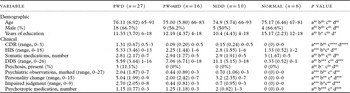
Table 1 shows the demographic and clinical characteristics of the two major groups (PWD and PWoutD), the MDD and normal groups. No significant differences were observed between PWD and PWoutD concerning age, gender, and years of education. Since demographic variables were similar for DAT and VaD, they are reported not-separated under PWD. Similarly, MDD and normal groups, and both compared with PWD, did not differ in age and gender. Normal participants had significantly more years of education than those in depression and PWD. The latter two did not differ on this variable.
Demographic and clinical characteristics of the sample

*p < 0.05; **p < 0.01; ***p < 0.001; ****p < 0.0001; ns not significant
PWD = participants with dementia; PWoutD = participants without dementia; MDD = major depressive disorder; CDR = Clinical Dementia Rating; HIS = Hachinski Ischemic Score; DDS = Depression Diagnosis Scale
a = PWD vs. PWoutD; b = MDD vs. normal; c = PWD vs. MDD; d = PWD vs. normal.
All data: mean (SD) and range except Male and Psychosis, present – n (%).
Clinically, PWD were significantly more impaired than PWoutD on the severity/functioning-CDR, and obtained a significantly higher score on HIS, a measure of vascular compromise. As for the psychiatric measures, although the DDS and presence of psychosis were not different between groups, other psychiatric measures (marked psychiatric observations, personality changes, impaired judgment) were more compromised in the PWD group. There were no between-group differences in the number of somatic and psychiatric prescription medications.
DAT did not differ from VaD participants on most clinical variables (except for HIS score understandably higher in VaD: 7.64 (2.46), range 2–12, vs. 3.75 (3.19), range 0–13, p = 0.0001; number of somatic medications higher in VaD: 4.18 (2.04), range 1–7, vs. 1.88 (1.75), range 0–5, p = 0.008; and presence of psychosis: all three (27.27%) cases in VaD group, p = 0.05), and are therefore not reported separately under PWD.
MDD participants were significantly more compromised than normal participants on the clinical measures of HIS, DDS, personality changes, impaired judgment, and psychotropic medications, but not on CDR and psychiatric observations (hence, good functioning and lack of marked psychiatric signs in both). PWD were more compromised than normal on all but two (somatic medications and psychosis: three participants in PWD, none in normal group) clinical measures. Number of somatic medications taken was not different for PWD, MDD, and normal participants.
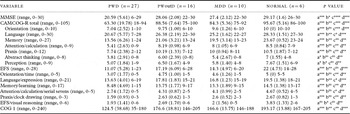
Table 2 shows the cognitive characteristics of PWD, PWoutD, MDD, and normal participants. With one exception (EFS/visual reasoning task), there were significant group differences between PWD and PWoutD in all the cognitive measures used. DAT did not differ from VaD participants on all cognitive measures and were therefore not reported separately under PWD. MDD participants, on the contrary, were significantly more impaired than normal on a wide range of cognitive measures (MMSE, CAMCOG-R total, language, memory, perception, EFS, language/expression, EFS/visual reasoning, and COG 1) but not on others (orientation, attention/calculation, praxis, abstract thinking, orientation/time, memory/learning, attention/calculation/serial sevens and praxis/clock drawing). MDD participants were as impaired as PWD on abstract thinking, perception, EFS, and EFS/visual reasoning. PWD were significantly more impaired than normal participants on all the cognitive measures studied.
Cognitive characteristics of the sample

*p < 0.05; **p < 0.01; ***p < 0.001; ****p < 0.0001; ns not significant
PWD = participants with dementia; PWoutD = participants without dementia; MDD = major depressive disorder; MMSE = Mini-Mental State Examination; HIS = Hachinski Ischemic Score; CAMCOG-R = Cambridge Cognitive Examination – Revised; EFS = Executive Function Score; COG = cognitive.
a = PWD vs. PWoutD; b = MDD vs. normal; c = PWD vs. MDD; d = PWD vs. normal.
All data: mean (SD) and range
Table 3 demonstrates the time measures studied in PWD, PWoutD, MDD, and normal participants. Only actual duration of interview was different between PWD and PWoutD, as it took a significantly longer time for PWD to complete the interview. Estimation of duration of interview, absolute accuracy of estimation of duration, and its log did not differ between these two major groups. Means of absolute accuracy of estimation of duration in minutes (and its log) were higher, even though not significantly, in PWD (30.67 (30.25), range 0–130) compared with PWoutD (15.56 (17.04), range 0–53; p = 0.08).
Time measures

*p < 0.05; **p < 0.01; ***p < 0.001; ****p < 0.0001; ns not significant
PWD = participants with dementia; PWoutD = participants without dementia; MDD = major depressive disorder; Log = logarithm
a = PWD vs. PWoutD; b = MDD vs. normal; c = PWD vs. MDD; d = PWD vs. normal.
All data: mean (SD) and range except Correct nearest hour estimation – n (%)
With one exception, DAT and VaD participants did not differ on the above time measures and therefore are reported not-differentiated under PWD. Actual duration of interview was longer for VaD participants (p = 0.01).
MDD participants did not differ from normal participants regarding actual duration and estimation of duration of interview. These diagnostic groups however differed significantly concerning absolute accuracy of estimation and its log. Mean absolute accuracy in minutes for normal participants was 1.5 (2.35), range 0–5, and for those in depression was 24 (16.42), range 10–53. On the other hand, MDD participants were not significantly different from PWD concerning absolute accuracy of estimation in minutes (30.67 (30.25), range 0–130) and its log. Normal participants were significantly more accurate than PWD on absolute accuracy of estimation and its log, but not on the other two time measures.
Most individuals in all groups were correct (70 to 100%) in their nearest hour estimations without significant differences among the groups.
Given the wide standard deviation (SD) and range of absolute accuracy of estimation in PWD suggesting the existence of performance subgroups, PWD were subdivided into those with the worst performance on this measure (ranging 54–130 minutes, n = 7: 5 DAT, 2 VaD) and those with relatively better performance (range 0–53 minutes, upper range of MDD group, 53/54, serving as cut-point, n = 20: 11 DAT, 9 VaD). These two subgroups did not differ on the actual duration of the interview, but differed significantly on all other time measures (estimated duration of interview, p = 0.004; absolute accuracy of estimation in minutes, 71.14 (26.59), range 55–130 vs. 16.5 (14.62), range 0–50, p = 0.0001; log of absolute accuracy of estimation, 4.22 (0.3), range 4.01–4.87 vs. 2.32 (1.16), range 0–3.91, p = 0.0001), and even on correct nearest hour estimation (only 48% the worst performing subgroup vs. 85% in other PWD, p = 0.04). Comparisons of all the variables used in this work showed that there were no differences on all the demographic variables, and most clinical and cognitive variables. The worst performing subgroup was significantly more impaired on the clinical measures of CDR (p = 0.04) and judgment (p = 0.02), and on the cognitive measures of attention/calculation (p = 0.03) and EFS/reasoning (p = 0.003).
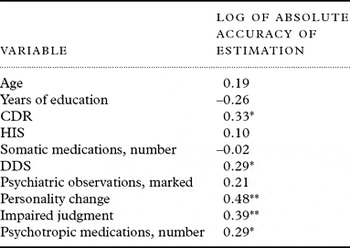
Tables 4 and 5 show the correlations between the log of absolute accuracy of estimation and the demographic, clinical, and cognitive variables of the entire sample studied. No significant correlations were found between log of absolute accuracy and age, gender (p = 0.13), and years of education.
Correlations between log of absolute accuracy of estimation and demographic and clinical variables

*p < 0.05; **p < 0.001.
CDR = Clinical Dementia Rating; HIS = Hachinski Ischemic Score; DDS = Depression Diagnosis Scale; Log = Logarithm.
Correlations for Male (%) and Psychosis, present, are reported in Results section.
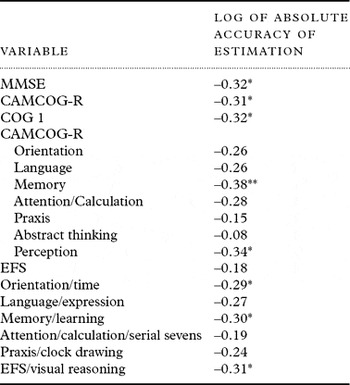
Correlation between log of absolute accuracy of estimation and the cognitive variables

*p< 0.05; **p < 0.001.
MMSE = Mini-Mental State Examination; CAMCOG-R =Cambridge Cognitive Examination – Revised; COG = Cognitive; EFS = Executive Function Score; Log = logarithm.
Log of absolute accuracy was associated with the severity/functioning impairment-CDR, but not with the physical variables (HIS score, number of somatic medications) studied. As for the psychiatric variables, positive and significant correlations were found with the measures of personality change and impaired judgment. Moderate but significant correlations were found with DDS and number of psychiatric medications taken. No correlations were found with marked psychiatric observations and presence of psychosis (p = 0.19; only 3/43 had the latter).
In the cognitive realm, log of absolute accuracy of estimation was negatively associated with several cognitive measures (the higher the cognitive score, the lower the inaccuracy). Moderate but significant correlations were found with the three general measures of cognition (MMSE, CAMCOG-R, COG 1). Fairly good correlations were revealed with the memory subscale, and this was maintained with the memory/learning component. Moderate correlations were found with orientation/time (not with the total subscale orientation, that also includes orientation in place items), with perception, and with EFS/visual reasoning task. Log of absolute accuracy of estimation was not correlated with the language measures (language and language/expression), with attention/calculation and serial sevens, with praxis and praxis/clock drawing, with abstract thinking, and with the EFS.
No significant correlations were yielded between log of absolute accuracy and actual duration of the interview (r = −0.6, p = 0.08).
With one exception, subsequently reported, no meaningful correlations were found between log of absolute accuracy of estimation of interview and all the demographic, clinical, and cognitive variables studied in the two major groups, as well as the diagnosis and performance subgroups. In the worst performance subgroup of PWD, log of absolute accuracy was correlated only with memory/learning (r = 0.74, p = 0.05).
With the first linear regression model, none of the variables studied could significantly predict the log of absolute accuracy of estimation. With the second model, only the variables impaired judgment (b = 0.30, F = 10.71, p = 0.002) and DDS (b = 0.10, F = 7.08, p = 0.011) could significantly predict absolute accuracy of estimation of duration of interview. The greater the impairment, the greater the inaccuracy of the estimation of time-intervals studied.
Discussion
We investigated the absolute accuracy of estimation of time-intervals in the main diagnoses groups encountered in a psychogeriatric practice, with dementia (DAT, VaD) and without dementia (MDD, normal) participants, and delineated a subgroup of PWD most impaired on this time measure.
Methodologically, a retrospective verbal time estimation design was used covering time-intervals that were not predetermined and were of a longer duration compared to other studies described that generally used a predetermined time span of fractions of a second to a few seconds, exceptionally to several minutes (e.g. Levy and Dreier, Reference Levy and Dreier1997; Carrasco et al., Reference Carrasco, Guillem and Redolat2000; Papagno et al., Reference Papagno, Allegra and Cardaci2004; Caselli et al., Reference Caselli, Iaboli and Nichelli2009; Rueda and Schmitter-Edgecombe, Reference Rueda and Schmitter-Edgecombe2009). Contents of the time-interval consisted of a structured interview with the patient and included a cognitive examination. This design, however, is more consistent with a clinical situation. If time-interval estimations of milliseconds to one second are considered “automatic” (Grondin, Reference Grondin2010), and one second to a few seconds regarded as “cognitive” (Coslett et al., Reference Coslett, Shenton, Dyer and Wiener2009; Grondin, Reference Grondin2010), then the time-intervals we studied are definitely “clinical,” as they facilitate the expression of a variety of factors present in clinical situations and are associated with the time measure studied.
PWD degenerative and vascular subgroups did not differ on most variables studied and therefore were reported and analyzed as one group – PWD. A CDR mean score of 1.31 and an MMSE mean score of 20.59 suggest that the present group was of mild to moderate severity – i.e. more impaired cognitively than the previous group with mild dementia (MMSE mean score of 24) that we studied previously (Heinik and Ayalon, Reference Heinik and Ayalon2010). PWoutD subgroups, those in depression and normal, differed as expected on several clinical measures, though also on several cognitive measures to be discussed later.
While on most clinical (CDR, somatic, psychiatric) measures PWD were more compromised than PWoutD, and in all but one of the cognitive scores they were significantly more impaired, the absolute accuracy of the estimation of time-intervals, either expressed as mean value or its log, was not statistically different between the PWD (inaccuracy mean of 30.67 minutes) and PWoutD (inaccuracy mean of 15.56 minutes), even though the former needed significantly more time to complete the interview. No correlation, however, was found between actual duration of interview and accuracy of estimation. Subdividing PWoutD into those in depression and normal might provide a clue to what constitutes “gold standard” values of accuracy/inaccuracy of time-interval estimation in clinical situations, and might explain the lack of difference found between PWD and PWoutD. In fact, a normal group inaccuracy mean of 1.5 minutes (SD 2.32, range 0–5) against a background of a mean actual duration of 53.17 minutes (a clinical interview approaching one hour) would seem reasonable. Those in depression did less well. Their 24-minute inaccuracy mean (SD 16.42, range 10–53, not overlapping with normal), was not different either from the PWD group – 30.67 minutes inaccuracy mean (SD 30.25, range 0–130) – or from the 16.5 minutes inaccuracy mean (SD 14.62, range 0–50) of the PWD subgroup with relatively better performance on this time measure. The latter is similar to the 12.75-minute inaccuracy mean (out of 43.95 minutes actual duration) for the mild dementia group previously reported (Heinik and Ayalon, Reference Heinik and Ayalon2010). Therefore, contrary to previous suggestions (Carrasco et al., Reference Carrasco, Guillem and Redolat2000), accuracy of estimation of time-intervals is questionable as a diagnostic aid for mild dementia (Heinik and Ayalon, Reference Heinik and Ayalon2010), and for mild to moderate dementia in the present study, in a psychogeriatric clinic when dementia is to be differentiated from MCI, MDD, and other types of psychopathology. Given the performance of the normal group, we hypothesized that it might do so when dementia and/or major depression are to be differentiated from normal individuals. Thus, it might play a role in screening the “worried well” who attend the psychogeriatric clinic (Wahlund et al., Reference Wahlund, Pihlstrand and Jönhagen2003) as well as the cognitively and psychiatrically non-impaired individuals encountered in primary care and community surveys.
However, means of absolute accuracy and SD in the above described realm of minutes error, which do not differ for MDD non-dementia participants, may suggest a relative preservation of this measure of passage-of-time perception in the mild to moderate PWD relatively well performing majority subgroup, which is strengthened by our findings that correct nearest hour estimation was found in the vast majority of the participants and did not differ between the groups. These findings are in accordance with Grewal (Reference Grewal1995), Levy and Dreier (Reference Levy and Dreier1997), and with our previous study conducted in the same setting though with a different sample. These relatively preserved temporal skills can be used by caregivers and clinicians therapeutically to enhance feelings of competence among patients (Levy and Dreier, Reference Levy and Dreier1997).
Within mild to moderate PWD, a worst performing minority subgroup on the time measure studied could be delineated. Its participants functioned worse than other PWD, demonstrated less judgment, and were more impaired on the attention/calculation scale and EFS/visual reasoning subscale. Their performance on our time estimation main measure was the only one among the diagnosis and performance subgroups to correlate with memory/learning. Traditional parietal lobe dysfunction measures (praxis, praxis/clock drawing) were not more impaired in this subgroup and did not correlate with its log of absolute accuracy, thus indirectly refuting relationships between this group and parietal lobe dysfunction (Coslett et al., Reference Coslett, Shenton, Dyer and Wiener2009).
The accuracy of estimation of the time-intervals was not associated with the demographic and somatic characteristics of our sample. These are important determinants of cognitive performance in clinical practice, though probably less implicated with the above time measure. The accuracy of estimation of the time-intervals, however, was associated with the severity/functioning-CDR and with most psychiatric measures (depression, personality change, impaired judgment, number of psychotropic medications taken). Thus, the greater the severity in the impairment of functioning and the more severe the psychiatric profile, the greater the inaccuracy in time passage evaluation.
The accuracy of estimation of the time-intervals was associated with general cognitive measures (MMSE, CAMCOG-R, COG 1) and with the more specific cognitive functions of memory and memory/learning, perception, time orientation, and EFS/visual reasoning, but not with the other cognitive variables studied. In the Levy and Dreier (Reference Levy and Dreier1997) study, neither the MMSE (orientation in time items excluded) nor the short-term memory were correlated with the intuitive time measure (corresponding to our time-interval measure). In the Rueda and Schmitter-Edgecombe (Reference Rueda and Schmitter-Edgecombe2009) study, the findings did not suggest a noteworthy role for episodic memory impairment in time perception. However, correlations were observed for Alzheimer's patients between the measure of absolute error score and the Trail Making Test A, a measure of sustained attention. We found memory and memory/learning, but not attention/calculation or the serial sevens task, associated with the accuracy of estimation in the total sample. Similar to our study, no significant correlations were found between the executive and language (word finding, fluency) tests and the time estimation variables for the dementia and the control groups. In the Papagno et al. (Reference Papagno, Allegra and Cardaci2004) study, a role was suggested for attentional-executive functions, which is contrary to our findings. The lack of association we found between the accuracy of estimation and the EFS might be attributed to the fact that CAMCOG-R EFS is mainly composed of verbal items (language/expression and abstract thinking). Since these were not associated with accuracy, the total EFS was also not associated. Another possible explanation could be that our PWoutD group was composed mostly of MDD patients. Impairments in executive functioning were described in some patients with late-life depression (Alexopolous et al., Reference Alexopolous, Kiosses, Klimstra, Kalayam and Bruce2002). Mean EFS in our PWoutD group was 17.0, slightly under the suggested cut-off of 18/28 for dementia individuals (Heinik and Solomesh, Reference Heinik and Solomesh2007), and EFS/visual reasoning was the only cognitive measure that was not different between the two groups.
Lack of associations between the time measure studied and attention/calculation and serial sevens tasks might contradict the suggested model (A Theory of Magnitude; ATOM) according to which a single, partly or fully shared, representational mechanism may underline time perception, numbers processing, and even space, operating on an innately shared internal accumulator localized presumably in the right parietal lobe (Cappelletti et al., Reference Cappelletti, Freeman and Cipolotti2009). The subscale of praxis and the clock drawing task (a time symbol as well as a cognitive test) were also not associated with accuracy of time-interval estimation, thus indirectly working against associations of the latter with parietal dysfunction (Coslett et al., Reference Coslett, Shenton, Dyer and Wiener2009). The CAMCOG-R clock drawing task is simply scored (range 0–3). It is mostly a test of executive and visual-spatial deficiency and is presumably not connected with accuracy of estimation of time-intervals. On the other hand, the subscale of perception (CAMCOG's equivalent of a visual-perceptual measure) was negatively but significantly associated with the time measure we studied, which might be in accordance with a visual modality perspective of time perception (Grondin, Reference Grondin2010) or as an index of parietal dysfunction (Coslett et al., Reference Coslett, Shenton, Dyer and Wiener2009) for the entire sample. Cognitive or neuropsychological lesion approaches (e.g. Weiner and Coslett, Reference Wiener and Coslett2008; Coslett et al., Reference Coslett, Shenton, Dyer and Wiener2009) may be more useful for studying the PWD worst performance subgroup and the above associations than the methodology used in this study.
With models of linear regression where many variables are considered, as is the case in actual clinical situations where many variables of several categories are involved, only two composite structures – impaired judgment and a diagnostic measure of the magnitude of depression – were predictive of the accuracy of estimation of time-intervals. None of the other demographic, clinical, or cognitive variables studied was predictive. As to why a composite sum of clinically rated (categorically, information-provider based and assessing clinician-dependent) impaired judgment items would predict the studied time measure is currently a matter for speculation. It would suggest associations with conceptual constructs such as time judgment, internal clock, or the automatic processes of socialized and intuitive time (Meck, Reference Meck1983; Gibbon et al., Reference Gibbon, Church, Meck, Gibbon and Allan1984; Page, Reference Page1994; Levy and Dreier, Reference Levy and Dreier1997), which are supposedly relatively spared at the early stages of cognitive impairment (Levy and Dreier, Reference Levy and Dreier1997).
There have been conflicting reports about the influence of depression on temporal skills. Whereas some authors reported a detrimental effect of depression on time experience (Mezey and Cohen, Reference Mezey and Cohen1961; Bech, Reference Bech1975), no evidence was found for the effect of depression on the estimation of the passage of time (Mezey and Cohen Reference Mezey and Cohen1961; Kitamura and Kumar, Reference Kitamura and Kumar1984; Hawkins et al., Reference Hawkins, French, Crawford and Enzle1988; Levy and Dreier, Reference Levy and Dreier1997). In Levy and Dreier (Reference Levy and Dreier1997), the intuitive time measures did not correlate with the Hamilton Depression Rating Scale. Findings from our previous study concur with the latter and demonstrate that there is no difference in estimation of performance time in individuals with psychiatric diagnosis (mostly with depression) versus individuals with no psychiatric diagnosis. However, in this study we used a more specific scale for the diagnosis of depression, and even though the average scores in both groups were under the cut-off value of 11/26 suggested by Roth et al. (Reference Roth, Huppert, Mountjoy and Tym1998) for a diagnosis of depressive illness, thus indicating a mild degree of depression, it was nonetheless predictive of the accuracy of time-intervals.
Our MDD participants were more impaired than normal participants on many of the cognitive measures (attention/calculation excluded), and not distinguished from PWD on the executive measures, though not significantly impaired on some clinical (good CDR/functioning, preventing a dementia diagnosis, no marked observable psychiatric signs) measures. We would suggest that the inaccuracy of time estimation intervals in MDD is more attributable to its inherent cognitive impairment (Alexopolous et al., Reference Alexopolous, Kiosses, Klimstra, Kalayam and Bruce2002) than to the overt clinical state (e.g. depressed affect, impaired attention).
This study is not without limitations. First, the number of participants in the total sample and in each diagnostic group and subgroups was relatively small. Hence, a larger sample is needed to affirm negative results. Second, VaD individuals assumed a larger proportion (40%) than generally described in memory clinics (Wahlund et al., Reference Wahlund, Pihlstrand and Jönhagen2003), and other etiologies for dementia were not included. In addition, the PWoutD group was composed of psychogeriatric clinic referrals with MDD but not with the other non-dementia psychopathologies. We also included six normal volunteers because the epidemiological structure of people referred to our clinic and other memory clinics is changing (Wahlund et al., Reference Wahlund, Pihlstrand and Jönhagen2003). Many “worried well” individuals or individuals with subjective complaints of cognitive impairment, and hence with no cognitive impairment as a final cognitive diagnosis, are being evaluated. The generalization of our findings to the entire clinic population would require further research and confirmation.
Conflict of interest
None.
Acknowledgments
Thanks to Drs. Anda Mendel, Clara Mordel, and Boris Raikher for interviewing with the CAMDEX-R, to Dana Fruchter for performing statistical analyses, and to Rena Kurs for assistance in preparation of the manuscript. This work was partially supported by grant No. 01250311, Nelly Horwitz Foundation, Tel Aviv University, Israel, given to Dr. Jeremia Heinik.