


Introduction: The problem of definitions
Anxiety: What feelings mean and cultures teach
Contemporary philosophy shows a marked interest in emotions and affects. The term ‘affects’ regroups bodily sensation and cognitively enriched emotions. Both are dynamic states, which affect something that we call ‘ego’ or the I. When philosophers use the term ‘feelings’, the distinction between affects like pleasure, pain, or even a tickle and affects like jealousy, or the sense of inspiration, may become blurred. In fact, they coexist, much the way that an emotion like jealousy can be accompanied by displeasure. With this in mind, I propose to define anxiety as an indeterminate affect capable of moving between sensations and emotions. Anxiety has its unique dual quality of being a feeling, like pleasure, pain, or even an itch, and an emotion understood as cognitively rich, that is, as carrying judgements, notably implicit. That is why it is often not like emotions that already have a clearly defined object. That is also why anxiety can persist as a private baseline affect, only to attach itself to emotions like envy, resentment, and clearly defined fears. Let us hold sensation and emotion apart for now and turn to the language we have available to us and with which we speak about our feelings.
These are long-standing discussions, which concern us as embodied beings and socialized persons. Both having a body and being educated imply acculturation. This raises my first, semantic question: How do we know what we are talking about in speaking of affects, much less in dividing them between sensations and emotions? Or, from a more anthropological angle: Are not these classifications very western? Guided in advance by our philosophical traditions?
Answer to question 1: No, we do not always know what we are talking about. Answer to question 2: Yes, this is all quite western, and even Aristotelian.
Second difficulty: the unresolved debate about the universality of affects. One of the earliest empirical projects to argue for the cross-cultural universality of ‘emotions’ was Charles Darwin’s (Reference Darwin and Ekman1872) Expression of Emotions in Man and Animals. Recall the colonial origins of this study, which grew out of his correspondence with clerics and colonial officials in India, British African colonies, and parts of Asia. Darwin asked his correspondents to administer recognition tests of emotions based on oral and graphic material, from drawings to descriptions of social situations. He used other evidence, from photographs of children crying and laughing to domestic animals in postures of fear and hostility, to human subjects grimacing when electrical shocks stimulated their subcutaneous facial muscles. Darwin’s conclusion was that six emotions – sorrow, joy, anger, disgust, surprise, and shame – were basic to all humans, cross-culturally. He demonstrated this through their recognition from drawings, photographs, and short narratives. In so doing, his objective was to justify the British moral philosophy of his time. Thinkers like Adam Smith had argued that social ethics was possible for every society, thanks to humans’ shared affective make up. This has been repeatedly contested by cultural anthropology, starting with Margaret Mead and Paul Ekman. I call this the cultural semiotics debate, given its reliance on words and images. I will return to it shortly.
There is, finally, the psycho-physical difficulty attaching to our ‘awareness’ of our affects. I mean the possibility of feeling something, though not all, of what we feel. This too is an old problem. It concerns the bodily sources of emotions and our varying degrees of consciousness of them. (We find this in the famous William James–Carl Lange thesis that behaviour and emotions precede our consciousness of them; it is still held by some philosophers today [Prinz, Reference Prinz2012]. Thus, if I see a lion and flee spontaneously, I realize, while running, that I feel fear. Acts often precede our affective awareness of what they mean.) As we will see, this question also has implications for groups and politics. When it is social or political, it can be about the aforementioned ‘feeling of being historical’, that is, the feeling of being at a point in time when it is imperative to slow down and to think before acting further. I will come back to this disquieting feeling of anxiety in a moment.
Anxiety in groups
The second part of this article responds to my final question: What can anxiety teach us about affects in groups? If we focus on events the past hundred years, we find that affects like anxiety and fear drove people into mass movements, often enough into authoritarian ones. Many of these movements stirred up the indeterminate affects, awakening memories and shifting anxiety towards object-oriented emotions like resentment and fear, thereby eliciting further anxiety. For example and even before the advent of pictorial mass media, we might think not only of Italian fascism, German National-Socialism but also of populisms like Peronism in Argentina, of Father Coughlin and his radio audience of 30 million, of the religious nationalism of Action Française, and more recently of Christian nationalism and ‘MAGA’ (Make America Great Again). In a related vein, we should keep in mind that most all 19th century psychological research into crowds and crowd behaviour perceived them as mobs, as rioters, or as like the Paris Commune – assemblages to be broken up and policed. A deeper fear about an emerging mass society underlay this 19th century research. Are we beyond such fear today?
Judging from the protest movements in 2025–2026, it is unlikely that we are beyond fear. We have many objects today to give direction to our anxiety. Nevertheless we have at least realized, beyond the stark pessimism of Gustave Le Bon – and Freud – that group affects and group behaviours need not be fearsome mob-rampaging. For better or for worse, these affects and behaviours can grow highly informed and self-disciplined, comparable to self-organizing systems like the Black Lives Matter movement, the No Kings rallies, and the growing resistance to ICE deportations in L.A., Chicago, and Minneapolis. In short, the relationship between individual affects and those of groups, notably in ‘mass society’, needs reassessing. Before doing so, let me refine the meaning of anxiety as an affect.
Definitions and their difficulties
My basic argument defines anxiety as an ‘affect’ because it affects ‘me’ or my ‘ego’. Like some other affects, anxiety is contagious, that is, it is relative both to other affects and passes between people. As Nutsa Batiashvili has argued, anxiety can ‘leak’ into more determinate affects like fear (Batiashvili Reference Batiashvili2022). In such cases, anxiety identifies an object and contributes to acting. When anxiety becomes cognitively enriched in this way, it works like an intensifier for other emotions from resentment to jealousy. My point is that anxiety, though not necessarily paralysing anguish, is both a sensation and an emotion. It runs this gamut uniquely, according to circumstances and individuals. Metaphorically speaking, anxiety’s ‘gamut’ is one of the ‘bridges’ between the mind–body duality; the bridge which some cognitive science now situates in basic affects arising within our ‘primitive’ brainstem rather than in the neocortex. (Solms and Friston [Reference Solms and Friston2018, 206] argue that decorticated animals and infants born without a cerebral cortex are conscious and often strongly emotional. Consequently, it is misguided to attribute consciousness to the cortex alone, which appears to organize consciousness relative to language and perception. However they add, ‘if consciousness is [thus, at base] feeling, then attended mental images when they are felt…which is what usually happens when they are salient [or prominent in consciousness]. The conventional focus on the cortical manifestation of conscious images (traditionally, visual ones) – as a model example of the neural correlates of consciousness [Crick Reference Crick1994] – may therefore have led us astray, because their consciousness is derivative. We would have done better to focus on the brain mechanisms of more basic forms of consciousness, like the feelings associated with thermoregulation say, or hunger’. Referring to Francis Crick’s cortico-centric explanation of consciousness in his The Astonishing Hypothesis [Reference Crick1994, emphasis added].)
A core property of anxiety is not to be intentional, when intentionality means ‘having a mental object’, that is, when it denotes ‘the aboutness of consciousness’. That implies that anxiety has a unique relationship with other emotions like fear, grief, and envy. As indicated, it works like sensations of pleasure or displeasure to intensify higher level emotions. I can feel anxiously hopeful or anxious about some memory or some resentment that I (simultaneously) feel. The point demands a brief step outside our western psychological framework.
Cultural semantics
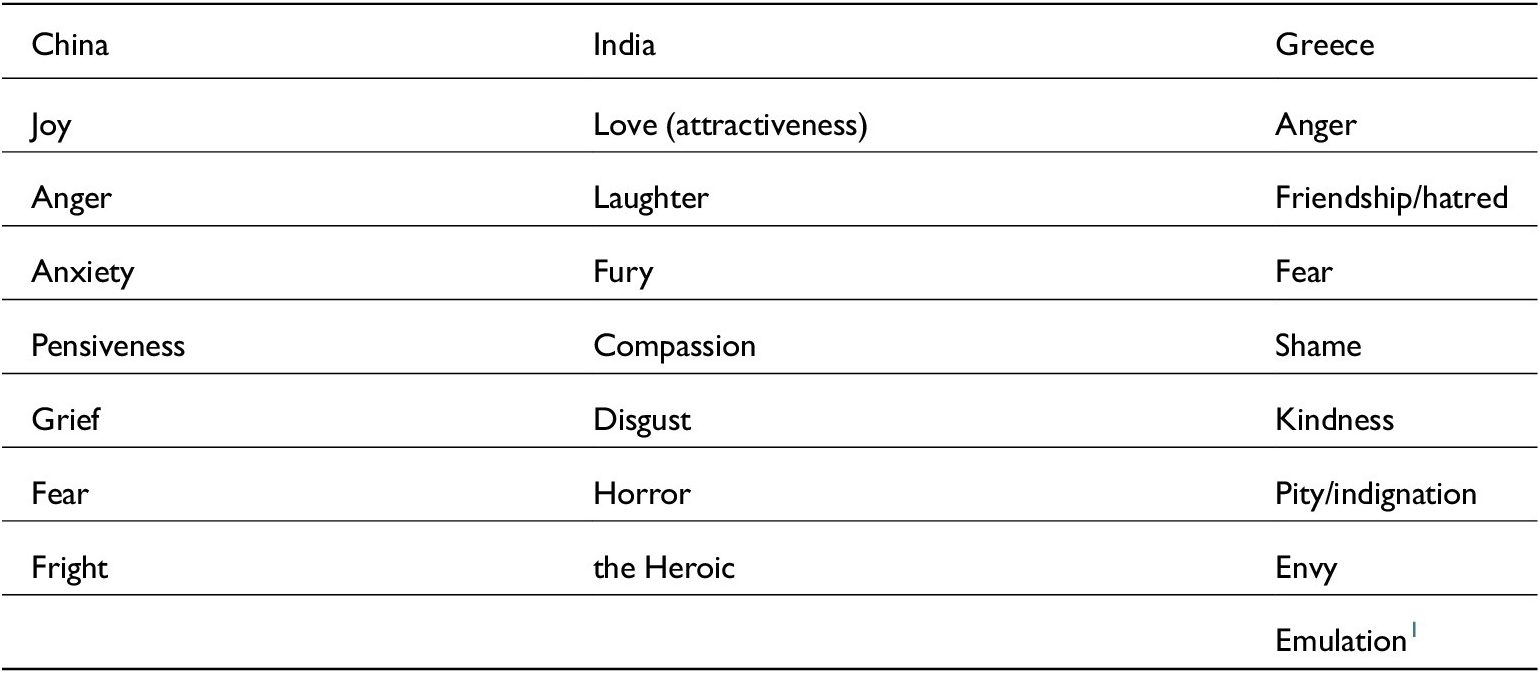
Non-western taxonomies of affects contain classifications that might surprise us. For one thing, our distinction between sensation (or feeling) and emotion is anything but universal. Consequently, it is hard to argue that anxiety in other cultures moves between sensation and emotion. While most classifications of affects serve medical, psychiatric, or other ‘hygienic’ purposes in western cultures, other cultures perform different regroupings that are based on distinct paradigms, including the history of wars (India) or reflective inwardness (China). We glimpse these different logics when we analyse the following table. (Jameson [Reference Jameson2019] observes that naming objects or emotions fixes, identifies, even does violence to what is felt: ‘…a phenomenon becomes visible which we can speculatively theorize; and that is what we have been calling nomination or the naming of a thing: the latter thereby becoming distinguished from others…and acquiring that identity of its own which the possession of a name presumably guarantees….For emotions…we might think of what Proust called the “intermittencies of the heart”, in which the name comes loose from the experience it is supposed to identify, and…the emotion-word fails to designate a plenitude of feeling, or else…it changes everything’, p. 57.)

Table 1. Long description
The table consists of three columns representing different cultural or philosophical systems of emotion.
Column 1, China: Lists Joy, Anger, Anxiety, Pensiveness, Grief, Fear, and Fright.
Column 2, India: Lists Love attractiveness, Laughter, Fury, Compassion, Disgust, Horror, and the Heroic.
Column 3, Greece: Lists Anger, Friendship or hatred, Fear, Shame, Kindness, Pity or indignation, Envy, and Emulation.
A footnote indicates these lists correspond to the classical Chinese view of Q I, the Hindu system of rasas, and Aristotle’s Rhetoric Book 2.
1 Jameson (Reference Jameson2019, 60) presents this table, stating that it ‘lists the classical Chinese view of emotions, as determined by the vital force (breath) or qi; then the classical Hindu system of rasas or ‘flavors’ (Bharata); and finally, the sequence laid out by Aristotle in Book II of the Rhetoric’. He notes the absence of joy or grief in Aristotle’s list; the inhabituality of the Chinese ‘pensiveness’, and the fact that sometimes, ‘laughter’ accompanies the Indian rasa of the heroic. He remarks on the sheer challenge of translating the terms.
As Fredric Jameson argues, an emotion, or even an identity trait, becomes ‘visible’ when we name it. (Jameson [Reference Jameson2019, 60]. An inventory of the Christian metamorphosis of Aristotelian affects into sin-affects is found on page 63.) That does not mean that, according to this table, anxiety did not exist in Greece or India. It means that, lacking a name and thus a concept, it is hard, if not impossible, to think about it.
As we can see, anxiety figures only in the classical Chinese table. But that table makes no distinction between sensations and emotions. This may be due to hesitations about distinguishing between ‘interoceptive’ versus ‘exteroceptive’ affects. Otherwise, why feature both fright and fear together when the second abides within and fright comes from without? This may be an example of translation difficulties, but the words available to us determine, directly and indirectly, how we can think about things. Since no universal translation-language exists, and since there is no standard to which we might refer to say, ‘Well, this culture seems unaware of this thing’, we must take the tables at face value. It is interesting that many traditions in western modernity, that is, from the 17th century onwards, sought a host of bodily anchors for affects, like pineal glands or other ways of justifying psychophysical parallelism. The question of linguistic and conceptual variations points us towards the history of attempts at naming anxiety, up to the present time.
For reasons of terminology, like those just mentioned, we also cannot say how old the famous ‘Age of Anxiety’ might be. There is simply no ‘meta-’ position that would allow us to step out of our historical context to compare that of another culture or time. Robert Burton’s 1621 study of melancholia is certainly related to what we might call profound anguish. Yet, it belongs to a paradigm to which we no longer recur. That is, our contemporary notion of anxiety stands outside Galen’s taxonomy of bodily humours (black bile, yellow bile, blood, lymph) on which Burton relied. That does not imply that anxiety is primarily a modern phenomenon. It suggests that the concept is in greater use today and consonant with the evolution of psychiatry over the past 150 years. (On the basis of Jameson’s important point that, if we have no name for an affect or for actions attaching to it [and the same applies to our possibilities for approaching certain memories; recall the cynical remark made by Hitler: ‘Who remembers the Armenians?’], then we cannot conceptually ponder its basic aspects and manifestations. We may be aware of something lacking names, but awareness will either engender concept-creation or stall at this basic state. That is why I both agree and disagree with Greenfeld’s [Reference Greenfeld2013]. Greenfeld’s important research into nationalisms and their evolution urges that anxiety is above all a condition of the modern age that emerges thanks to the unique linkage that modernity forges between an individual psyche and the collective existence. To be sure; but the notion of Angst arises with Romanticism and reaches back philosophically to the mid-19th century existentialism of Kierkegaard [Reference Kierkegaard1981/1844]. A better approach to the ‘age’ of anxiety would have to recognize its circular character: able to ‘communicate’ with other affects and judgements, anxiety’s ‘plasticity’, and cultural rootedness often precisely intensifies it.) Note, for instance, that the British-American playwright, W. H. Auden, composed his multi-voiced poem ‘The Age of Anxiety’ in the 1940s, during the War. Again, we cannot compare the anxiety elicited by a world war with anxiety over climate change; they are qualitatively too different. A half-century later, in 2016, the New York Times ‘diagnosed’ a new age of anxiety. The author argued that if we use psychotropic drugs’ sales as our index, then North Americans will have passed from an age of depression, from ‘Prozac Nation’, to that of the ‘United States of Xanax’ (Williams Reference Williams2017).
Certainly some have claimed that anxiety today has reached unprecedented levels. It is easy to see the lure of such a claim. It is epistemologically unsustainable, and for the same reasons I just mentioned. As to the ‘United States of Xanax’, who determined this, and why did it change? In all banality: psychiatric diagnoses and the sale of pharmaceuticals. As in the Chinese and the Indian tables, we see here a circle between ‘mental hygiene’, psychiatric concepts, and the normalization of therapies with their related taxa: Prozac for depression and Xanax for anxiety disorder. None of this is far from two other historical narratives: a ‘religious’ one about what we should do and may hope for, and a collective-teleological story about the destiny of our communities. (For a clear and comprehensive discussion of the relationship between memory, ‘collective memory’, and historical narratives, see Wertsch [Reference Wertsch2002], Chapters 3 and 6, notably.) Like the New York Times’ article, these narratives orient – or used to orient – groups and communities. But therein lies a question to which I will return at the end: Was Plato right, and are individual affects just writ large in human groups? (James Wertsch argues that any cut and dried separation between individual and collective memory neglects processes like internalized social memories flowing out of narrative memories with their ‘function of … forming goals of the self or personality’, not to mention mediation obtained through ‘linguistic and cultural categories … regardless of the degree of their mediation’ [Wertsch 2002, 38–39]. This accords well with the work, discussed later, of Hermann Broch.) Does that mean that a group generally acts like an individual? At times, yes, and we tend then to speak of groups-in-fusion (Sartre) and sometimes of mobs. Despite this, some social scientists have recently observed that even ‘mobs’ are capable of acting strategically and of increasing their ‘intelligence’ through communication (Stephen Reicher).
Let me repeat that anxiety is not just an emotion. It can become an emotion when it intentionalizes, when it becomes ‘aboutness’, when it has an object. The conception of consciousness as ‘aboutness’ is found as much in philosophy as in cognitive sciences. That means that we generally define consciousness in terms of some object, whether internal or external. Here, my point remains to avoid ‘cognitivizing’ a highly indeterminate affect like anxiety. (On the other hand, if we say that anxiety lies close to implicit judgement – whether it accompanies explicit knowledge or belongs to unremarked memory contexts, then I readily agree. Implicit knowledge itself has gained a lot of attention recently in cognitive science. See Merleau-Ponty [Reference Merleau-Ponty2012; first published by Gallimard in 1945 as the companion and extension of his The Structure of Behavior, 1942].) Let us grant that anxiety is both sensation or feeling and an emotion. You might object that all emotions have a bodily aspect to them and are, therefore, similarly dual. But many emotions are less obviously bodily. Anxiety easily expresses itself in trembling, sweating, a sense of nowhere to run, perhaps desperation. Beyond that, it takes hold of objects and joins more cognitive emotions including envy, vengeance, and resentment.
If we add to this that between sensation and emotion, there lies a spectrum of intensities, and that they ‘leak’ into each other, as Batiashvili argues, then we may get past traditional dualisms. (Some of my remarks on states of mind, mental states, dispositions, and attitudes come from Wollheim [Reference Wollheim1999]. Wollheim starts from a temporal distinction between states of mind and mental dispositions; he argues that emotions arise with desire and ‘instrumental beliefs’, only thereafter to introduce a dialectic between emotions, attitudes, and desire.)
Metaphors and the feeling of being historical
We know since the work of George Lakoff that metaphors exert powerful attraction on whole domains of thought (Lakoff and Johnson Reference Lakoff and Johnson1980). Lakoff argued that they actually make certain concepts possible. In so doing, metaphors add an implicit or unconscious knowledge to a culture’s reservoir of concepts – here, concepts for affects. Moreover, our concepts can tie unremarked judgements to some metaphors, and we need to be aware of this. My 2020 study, Anxiety: A Philosophical History, multiplies perspectives on philosophical hypotheses about reason, nature, and bodies – and what these could and could not think in their time. I tried to construct a kind of gemstone with facets to characterize the respective philosophical positions. Of course, we would also be justified in ironizing that the cut-stone approach to the concept of anxiety is a working hypothesis itself flowing out of a metaphor. (Two other points are useful when we ponder anxiety. Sensation and what used to be called ‘sensibility’ or emotion can and do flow together, they interweave. But they do not have match up or strictly correspond to each other, and therefore ‘parallelist’ definitions are insufficient, as are the two approaches that Merleau-Ponty called the ‘intellectualist’ versus the ‘empiricist’ paradigms. The sensation-emotion interweave certainly concerns the body although it is an open question whether anxiety, fear, and grief are similarly bodily.)
I would like to make one last point about affects, implicit knowledge, and intersubjectivity (including media). I posed the question about individual versus group consciousness. I mentioned that social psychology gives us a window onto groups that are like self-organizing systems, rather than mere mobs. I maintain throughout that both individuals’ and groups’ affects have a looping interaction with what one could call a pre-consciousness or a social imaginary. Sometimes we can read this pre-consciousness from bodily attitudes. The late Lauren Berlant, an innovator in affect theory, shed light on what she called the ‘feeling of being historical’. (Berlant [Reference Berlant2008]. For an expanded version, see the chapter by the same title in Staiger et al. [Reference Staiger, Cvetkovich and Reynolds2010].) This is more than some historians’ debates over what facts are historical. This is the paradoxical affect besetting our intentions in changing times and emerging circumstances. I call the feeling of being historical ‘paradoxical’ because it points towards tensions arising between conscious and preconscious affects. Such a tension can stop us in our tracks, or it may float along with us like an unremarked atmosphere. As we will see, the feeling of being historical highlights the disparity between conscious feelings and not-conscious feelings tied to memories and phantasies. One implication of the gap between what we are persuaded we are feeling and those other affects to which we may be subject is that what we say we are feeling is rarely the last word on all that we are precisely ‘feeling’.
This has to do with unattended memory and phantasy, and it is eminently the case of anxiety, which itself underlies and may crowd out or mask other affects, memories, and phantasies. The example of Berlant’s ‘feeling of being historical’ comes picturesquely from George W. Bush’s 20 June 2005, press conference, in which he said, ‘I think about Iraq every day’. The statement came 2 years after the American invasion and Bush’s hyperbolic proclamation of ‘mission accomplished’. As indicated, when we recall the film ‘Broadcast News’, we can understand what the TV viewers saw with Bush. In the film, the anchor’s profuse sweating hardly matched the words he uttered. The context thus shapes our lived present as dense, often as contradictory. Bush’s emotion expressing attentiveness to U.S. troops, their families, and his voting base began to look superficial. Television spectators observed his body holding itself uncomfortably, his face oddly indefinite, as though his thinking floated in an anxiety that escaped his direct awareness and hampered his effort to communicate his ‘feelings’. Berlant captures this well:
Being forced to think these things [Iraq] as part of an unfolding historic moment exemplifies the affective experience not of a break or a traumatic present, but of a crisis lived within ordinariness. Amidst the rise and fall of quotidian intensities a situation arises that provokes the need to think and adjust, to slow things down and… to find things out and to wonder…: What’s going on? [W]hy do things feel on the verge – of something (dissolving, snapping, wearing out, overwhelming and underwhelming, or just unpredictably different)? (Berlant Reference Berlant2008, 231)
The ‘crisis within ordinariness’ for the United States, as ‘Xanax Nation’, is what Berlant means by the ‘feeling of being historical’. This anxious feeling belies the layered quality of sensation and emotions, so often mingling with sedimented memories, and producing a feeling that something is off, that ‘I’ cannot seem to coincide with what I am trying to say.
As media consumers, we often come to feel that we know the image subjects implicitly. Even if they differ from the person or thing that we meet directly, a pervasive atmosphere of memory and imagination surrounds the images. Televised one way or another, they are larger than life. They make up what sociologists call a social imaginary, and it comes gradually to belong to our collective memory and symbols. We often neglect this because it is more readily felt than thought (cf. Wertsch Reference Wertsch2002). Hence, George Bush’s ‘feeling of being historical’ breaks through like the cross-waves of a consciousness surrounded by implicit and unacknowledged horizons.
The relationship between unremarked versus public affects, present in our perceptual present which is haloed by a mnemonic horizon, applies both to individuals and to groups. This is why many political movements in the 20th century strove to create new public aesthetics, resting on visual and sonorous building blocks, to remodel social imaginaries. All this becomes urgent in times of crisis, or when political actors try to manipulate public affects to consolidate their authority (Topçu and Hirst Reference Topçu and Hirst2022).
Private and public affective baselines
Berlant’s feeling of being historical thus suggests that we have private and public baseline affects. In fact, one baseline affect, say a private one, may stand at odds with the other or a public one. Bush’s sober expression of concern for Iraq stood in tension with his restless traits and shifting postures. Consequently, our behaviour in groups may or may not reflect our personal affective baseline. Is one of these the true baseline? That is not a question easy to decide because it involves us in other questions like that of context, intersubjective influence, and temporal duration. I do believe that, in everyday public spaces, an apparently neutral affect is indispensable to carrying out our routines and responsibilities. A neutral affect nevertheless covers what Merleau-Ponty once called the fantasy dimension of subjectivity, especially in regard to other people. (In his 1955 course on Passivity, Merleau-Ponty re-pondered the relationship between phantasy and environment. He wrote ‘The ‘science’ of the world and the ‘science’ of the dream. Being and oneirism. Investment and disinvestment [engagement] – it is in this form that we pose the problem of the imaginary and the real [cf. Lacan];’ ie, it cannot be a question: 1. Of distinguishing them absolutely (our ‘real’ life is oneiric for everything that touches the other person [autrui] [all investment is at the same time a counter-investment and an over-investment, ie, ambiguous]; 2. nor, to be sure, of confusing them: narcissism, the egoism of the dream…. Simply, we must understand that they communicate: the fundamental function: desire and the fecundity of desire [Merleau-Ponty Reference Merleau-Ponty, Darmaillacq, Lefort and Ménasé2003, 204–205, my translation].) Indeed, if we pursue this implicit consciousness farther, then the public baseline casts a veil over what psychoanalyst Sandor Ferenczi called the ‘psychotic kernel of consciousness’. (See the discussion of Green and Ferenczi [Reference Green, Ferenczi, Levine, Reed and Scarfone2014]. Analyst André Green’s clinical discovery of patients’ experience of ‘intolerable absences’ in the place of what might be bodily memories of conflict or trauma, ‘une psychose blanche [blank psychosis] on the part of the patient who seeks to attain a state of emptiness’ and ‘the fundamental psychotic kernel’ (Levine, Reed, and Scarfone Reference Levine, Reed and Scarfone2013). By this, Ferenczi meant the affective psychotic kernel, including paranoia, shifting jealousy, various desires, and hatreds. As Batiashvili argues, suffering tsqena – that strange hybrid of embitterment and resignation – would be a social version of this. (See Batiashvili [Reference Batiashvili2022]. The author weaves the affect of tsqena with anxiety, the way embittered resignation may overtake anxiety. She relates it to the painful absence of a dominant narrative in the Caucasus. Ethnic disparities in part contribute to this general absence and while not directly the cause of tsqena, it is tied to what she calls ‘identity anxiety[, that is] rooted in the region where crisis is not a temporary condition but is the order of life’ [p. 10]. This is one instance of the ‘leaky’ quality of anxiety, which has become as if normalized. Compare this with Berlant’s ‘feeling of being historical’.) We should keep this in mind for when we turn to the psychology of crowds and movements, whether guided by leaders or operating autonomously with practical, and public, discernment. (This seems straightforward. But how and when do we emerge from our private baseline? When we leave our homes, drink coffee, or are addressed by someone? Do we ever fully ‘leave’ it? Is it more like a dynamic, a flowing in and out? The best answer I conceive is that we sometimes abide in a private, sometimes in a more public baseline. The degrees of restfulness of either are open to debate. Merleau-Ponty was correct in observing the invasive presence of fantasy in almost everything to do with the other person. He drew his examples from Freud’s ‘Dora’ case and from Freud’s commentary on Jensen’s novel Gradiva, which presented a ‘psychosis without delirium’; something Merleau-Ponty renamed as a ‘modality of corporeity, ie, desire repressed’ [Merleau-Ponty Reference Merleau-Ponty, Darmaillacq, Lefort and Ménasé2003].)
Let me focus first on the implications of a ‘private baseline’ for consciousness and its affective modes. Recent cognitive science has argued that it is basic to consciousness to ‘chillax’, to zone out, go with the flow, as opposed to concentrating strenuously on arguments or texts. (See Espie [Nuffield Department of Clinical Neuroscience, Oxford University]: ‘In a sense, sleep is the preferred state of the brain. The brain does some of its most important work during sleep: repairing, regulating, laying down memory and managing growth. Sleep is a varied and productive time’ [2018]. By extension, states between complete wakefulness and sleep may play an important and ‘adaptive’ role as well. I return to this in my discussion of Broch’s Massenwahntheorie [Reference Broch and Lützeler1979].) This claim, while likely true, overlooks what is our continued sensuous receptivity while in our tuned-out states. Why so? In part, because it misconceives chillax consciousness in thinking, it has no affective baseline and certainly not one that moves between affect-laden passivity and activities, including routine ones. On the contrary, this supposedly unresponsive consciousness admits states of varying degrees of memory, or phantasy-absorption, and all of these carry affective intensities. These degrees are implicit, flowing in and out of the present moment. In public circumstances, that implies that ‘zoning out’ or ‘going with the flow’ remains complex, even as it mechanically follows routines, ‘tunes out’ in cellphone scrolling, and so forth. All of this unfolds thanks to preset gestures requiring no particular initiative of us. This state, therefore, has its variable private-affective baselines. These are vulnerable to anxiogenic forces, whether coming from others, from our own bodily states, or from both. That point will serve later as my bridge to anxiety in groups and in politics.
In my research on the relationship between anxiety and political life, I came to examine group affects and behaviours. This was an inquiry very different from philosophical history. It was more empirical, more sociological. Having started from some contemporary approaches, I often felt crestfallen. For example, a promising book entitled Anxious Politics came out in 2015 (Albertson and Gadarian Reference Albertson and Kushner Gadarian2015). It argued that anxiety motivated people to seek out information about the social and political questions that they believed lay at the source of their anxiety (understood here as their private baseline). Yet, in speaking of anxiety’s power to motivate, the authors immediately gave anxiety an object, making it into fear – say, fear of political events at hand or yet to-come. This obscured the dynamic indeterminacy of anxiety, which is not firstly fear because anxiety really has no ‘object’. Yes, it often binds with other emotions or goes in search of an object to which to attach itself. As an unremarked, private baseline, however, anxiety first either drives us or immobilizes us. That was the philosopher Kierkegaard’s great insight, because awareness of possibility, which is also awareness of freedom, is anxiogenic. (‘Anxiety may be compared with dizziness. He whose eye happens to look down into the yawning abyss becomes dizzy. But what is the reason for this? It is just as much in his own eye as in the abyss, for suppose he had not looked down. Hence anxiety is the dizziness of freedom, which emerges when…freedom looks down into its own possibility, laying hold of finiteness to support itself. Freedom succumbs in this dizziness. Further than this, psychology cannot and will not go’ [Kierkegaard Reference Kierkegaard1981].) In short, the authors of Political Anxiety had jumped a stage by equating anxiety with fear, which may imply a misguided sense of intellectual control over it. (Nutsa Batiashvili observes, on the basis of Joseph Ledoux’s study, Anxious, that assigning anxiety an object may be ‘the only way for psychologists to study anxiety experimentally under laboratory conditions’. That is why assimilating anxiety and fear misses an important aspect of anxiety. Yet the tendency ‘has persisted in the field’ of psychology in this form. Personal conversation with Batiashvili, February 2025. See Ledoux [Reference Le Doux2016].)
Anxiety versus fear, and giving anxiety an object
Some 10 months after their book appeared, the same authors published an article entitled ‘Anxiety over Terrorism Advantages Hillary Clinton over Donald Trump’. (Albertson and Gadarian [Reference Albertson and Kushner Gadarian2016] write in their later article, ‘Based on our 2015 book, Anxious Politics…we expect that worries about terrorism will benefit Hillary Clinton, not Donald Trump, despite the traditional advantage the Republican Party has on national security issues. While terrorism fears generally benefit the Republican Party, this advantage does not necessarily extend to Donald Trump because he has less expertise on foreign policy than Democratic nominee Hillary Clinton and anxious citizens want expertise’.) In 2016, the authors revised their earlier arguments. They now insisted that while anxiety motivates us to inform ourselves, we often seek information of a kind with which we already agree. Yet, while terrorism was clearly anxiogenic during the G. W. Bush presidency and the invasion of Iraq, we might wonder if anxiety over foreign terrorism really was motivating Americans to vote for Hillary in 2016. If a large part of the public baseline was anxiously in search of an object, was the object not healthcare, jobs, or the future of people’s communities? Even then, these were the points on which two other candidates, Bernie Sanders and Trump, spoke at length.
Despite the fact that anxiety clearly arouses and may motivate us to act – something that led Kierkegaard to conclude that we often actually relish it (Kierkegaard [Reference Kierkegaard1981, 44–45]. Interpreting the biblical Adam’s ‘situation’ in the Garden, Kierkegaard writes, ‘What passed by innocence as the nothing of anxiety has now entered into Adam, and here again it is a nothing – the anxious possibility of being able. He has no conception of what he is able to do… Only the possibility of being able is present as a…higher expression of anxiety, because in a higher sense, it both is and is not, because…he both loves it and flees from it’.) I found more profound resources in two groups of scholars: those intimately familiar with the rise of fascism and those who studied crowd consciousness with reference to historic crowd movements (respectively, Neumann [Reference Neumann and Marcuse1957] and Broch [Reference Broch and Lützeler1979/Reference Broch, Pierre Rusch and Renault2008]). In the first group, we have Franz Neumann, whose 1943 study Behemoth: The Structure and Practice of National Socialism, preceded Hannah Arendt’s Origins of Totalitarianism by 8 years, and Hermann Broch, the Viennese novelist and theorist of Massenwahn, or mass mania (Neumann Reference Neumann2009 [reprint]). In the other group of scholars, which has recourse to a more recent archive, we find Stephen Reicher, author of ‘The Psychology of Crowd Dynamics’, and other works (Reicher Reference Reicher, Hogg and Tindale2001, 182–208). Valuable in Reicher is his approach to group consciousness as part of self-organizing systems rather than as mere mobs. Reicher shows that groups have an extensive capacity for discernment due to intersubjective communication. I will address each group in succession.
Franz Neumann and ‘cæsaristic movements’
Franz Neumann was mainly concerned with anxiety’s power to demotivate us, indeed, to paralyse us. (Neumann argues: ‘…wherever affective [ie, cæsaristic] leader-identifications occur in politics, masses and leader have this view of history: that the distress which has befallen the masses has been brought about exclusively by a conspiracy of certain persons or groups against the people’. See Neumann [Reference Neumann and Marcuse1957].) Thus, when our private affective baseline is anxiety, we may withdraw from political life, explaining our choices sceptically or cynically. Such retractive responses might be: ‘there is nothing that we can do really to bring about change’ or, cynically: ‘the entire system is corrupt and would require nothing short of a revolution’. Here, our anxiety has surreptitiously leached into political judgements. Neumann did note that anxiety often gave itself an object thanks to what he called ‘false concreteness’. He argued this already in 1954, before the explosion of television, cable, and social media. Defined as the ‘kernel of truth’ in anxiogenic narratives, false concreteness mobilizes memories, phantasies, and projective aggression in response to a perceived or imagined threat.
False concreteness draws its energy from anxiety. When a narrative offers a reason behind our anxiety, it provides it with an object, usually human, onto which groups then direct inchoate affects from nervousness to resentful angst or from rage to vengefulness. False concreteness is thus what supports conspiracy narratives and, in extreme cases, crowd panic. In the latter case, anxiety’s previous withdrawal – which bespoke the presence of conflicting emotions or drives – is discharged as acting out, and sometimes the emotional investment of some leader, whom Neumann called ‘cæsaristic’.
One of his most striking examples of cæsaristic leaders was the populist before populism’s time, the 14th century Cola di Rienzo. Cola rose to power as ‘Rector’ (dictator) of Rome in 1347 by rousing the commercial and trades classes against the oppressive barons. On Petrarch’s account, Cola urged
These barons in whose defense you (working Romans) have so often shed your blood, whom you have nourished with your own substance […] these barons have judged you unworthy of freedom. They have gathered the mangled remnants of the state in the caverns and abominable retreats of bandits […]. They have been restrained neither by pity for their unhappy country, nor by love for it […]. Do not suffer any of the rapacious wolves whom you have driven from the fold to rush again into your midst. Even now they are prowling restlessly around, endeavoring through fraud and deceit […] to regain entrance to the city whence they were violently expelled (see Cosenza [Reference Cosenza2007, 1931], discussed by Neumann [Reference Neumann and Marcuse1957, 619–620]).
This narrative fragment neglects the all too familiar trajectory of populists-become-dictators: Cola’s rise to power; his expulsion; his return with the aid of the Church, and his ultimate assassination by a member of the noble Colonna family at age 41 in 1354. Cola’s case is marginal, argues Neumann, partly because it predates the ‘right–left’ distinction. It remains that his populism could have led to the liquidation of Rome’s nobles. But Cola ultimately backed away from this option and was expelled 7 years later, when the nobles retook power in Rome. His clerically backed return was followed shortly thereafter by his assassination. The kernel of truth in Cola’s exploitation of false concreteness lay in the city’s real corruption and the progressive impoverishment of his native Rome. The confluence of interests among the barons became, in Cola’s rhetoric, a fatal conspiracy, against which he offered his services as a cæsaristic messiah.
Neumann enumerated six landmark conspiracy narrative phantasies: the Huguenot, the Jesuit, the Freemason, the Bolshevik, the Jewish, and the capitalist. We can imagine more today and, when animated by social media, they orient anxiety even if the narrative is only partial. Batiashvili et al. explore what they call the ‘narrative condition of collective anxiety’, which they urge is ‘the closest equivalent to studying the “symptoms” of anxiety disorders in the case of individuals’. Moreover, our mentioning social media gossip is so important to collective political imaginaries that their periodic eruption and spread correspond to Schacter et al.’s ‘constructive episodic simulation hypothesis’ (Schacter et al. Reference Schacter, Benoit and Szpunar2017). This is simply the integration of gossip into both individuals’ personal past and existing community narratives.
To this, Neumann adds that the greater the truth content in the false concreteness deployed in such phantasies, the less regressive the movement will be. When false concreteness is groundless and phantasmatic, however, the movement will be reactionary, imagining itself beset by a dangerous, fantasy adversary. Further solidarity obtained, if needed, when a ‘crime [was] committed in common’ (Neuman Reference Neumann2017) – whether that crime was spontaneous or committed in the name of the leader. Of course, ‘spontaneous’ crimes can occur under the sway of the leader or the movement’s promulgated narrative. (In summarizing his results, Neumann [Reference Neumann and Marcuse1957, Reference Neumann2017] made three points: ‘The intensification of anxiety into persecutory anxiety is successful when a group [class, religion, race] is threatened by loss of status, without understanding the process which leads to its degradation. Generally, this leads to political alienation, ie, the conscious rejection of the rules of the game of a political system. The regressive mass movement, once it has come to power must, in order to maintain the leader-identification, institutionalize anxiety. The three methods are terror, propaganda, and, for the followers of the leader, the crime committed in common’.) This is where Neumann left off. His study of anxiety and politics never became the larger work it might have been, as his life was cut short by a car accident in 1954.
Hermann Broch’s Theory of Mass Mania ( Massenwahntheorie , 1936–1951)
I turn now to Hermann Broch, who constructed a comprehensive philosophy of resistance to autocracy – along with a psychological analysis of anxiety in individuals and groups. For Broch, and whatever its sources, anxiety elicited a retractive dreaming state in individuals, like the lowest level of operational consciousness. However, beyond that, he explored what motivated individuals to reflect and leave groups in the throes of anxiety. His political philosophy explored the reciprocal relationship between human rights and social responsibilities.
Broch is known generally as a novelist. But his foremost preoccupation, in his novels and his social philosophy, is with values and value change. In both works, he traces the political and psychological impacts of value change through economic circumstances and war. He analyses the rise of new social ethics and that of the new secular ‘religions’ of the Duce and of Blut und Boden. Broch’s great philosophical work, The Theory of Mass Mania (penned from 1936 to 1951), should be read in light of his antifascist project. The short-lived ‘Red’ Vienna of his time (1918–1934) was caught up in the value conflicts that arose with the ‘massification’ of society and the conflict of ideologies. (The double legacy of 1848: revolution and repression, the crumbling of the Austrian Empire, Red Vienna [1918–1932], and the 1932 rise of the authoritarian Dolfuss, assassinated by a Nazi in 1934.) With his 19th century sensibility, he was starting from grounds similar to thinkers like Freud and Ortega y Gasset (Reference Gasset1957). Nevertheless, Broch’s depiction of political value conflicts is justified when we consider the history of the ‘fasci’ movement, that little band officialized in the Piazza San Sepolcro after the War in March 1919. Like many secular religions, it flowered thanks to the structure provided by Mussolini’s synthesis of religious ritual, modernist architecture, and the condensed symbol-system that consecrated his ersatz of Italian papal Catholicism – his eye ever fixed on how to ‘make Rome great again’.
For Broch, as for Franz Neumann, his contemporary, 20th century mass society was different from crowd-formations in city-states like the Rome in which Cola di Rienzo rose to power. This was not just a matter of population size. The style of the instrumentalization of crowd consciousness was crucial, as was the control of populations and the spill-over of public into private affective baselines. Another difference lay in the fetishization of the corporatist state, which stepped into the void left by the demise of traditional religious beliefs. All of this grew obvious in the anxious aftermath of World War I. (See Mann [Reference Mann2021/1914], Betrachtungen eines Unpolitischen [Observations of an Unpolitical Person], begun during the War [1915] and completed after it [1918]. With the demise of a largely ‘Christian’ Europe, traditional conservatisms, in the line of Burke, had been swept away, he argued.) In that sense, Broch’s study of ‘mass mania’ explores the impacts of authoritarianism on what might be called ‘ego-structure’ during periods of value disintegration and competition, as well as leaders’ promises of security and a new normalcy – which armed themselves with their doses of Neumann’s ‘false concreteness’, as we also see flowing out of xenophobic movements today.
However, we appraise the pre-globalist modern State, Broch’s concern is with forms of autocratic regimes and with the question of their birth as movements, their institution, and their persistence thanks to social anxiety, ideology, to states of exception, and ultimately to war. Broch’s concern thus required that he unfold a conception of human nature, that is, a study of embodied values and concrete existence in the world. For his existential ground level, Broch developed a conception of the incarnate ego as a dynamic psycho-physical field always interwoven with its environment. Rather like Freud’s perceptual consciousness, which Freud conceived as the projection of the conscious ego into the world, Broch’s ego is similarly a site of pleasure and unpleasure in that world, and of the values flowing out of these affects. He argued that thinking (cogito) and embodied life (sum) amounted to communicating sides of a common coin, where the embodied ego encounters the contours of the world, experiencing what it can assimilate to itself as enhancements. The basic drives of self-preservation and desire can be compared to movements of expansion and contraction. When the ego draws parts of its environment into itself, whether through knowledge or through action, well-being ensues – as an affective baseline. When the ego encounters resistance or resistant others, its state of well-being is interrupted and anxiety wells up with a sense of frustration and isolation.
The clustering and intensification of affects, from anxiety to fear to terror, grows more defined over the course of repeated experiences and memory. According to Broch, this cluster will acquire a negative value following a spectrum of intensities, running from incapacitation all the way to the fear of dying. All of this contrasts with those positive values accruing to ego enhancement. Both groups of values, the positive and the negative, attach to the reflective ego in its quest for knowledge. Both groups attach, moreover, to our active bodies, whether as well-being or as anxiety and give rise to positive and negative attitudes. Both knowledge-pursuit and embodied values thus constitute the ego’s baseline affects up to its encounters with its community, at which point social values and a public baseline take over, supplementing the individual’s psycho-physical ones (Broch Reference Broch and Lützeler1979 German/2008 French).
Broch further argued that unlike individual values, sociopolitical ones follow historic cycles – of emergence, competition with other values, implantation, and exclusion of alternative value systems. Ultimately, value systems will decay and decline (Broch Reference Broch and Lützeler1979/Reference Broch, Pierre Rusch and Renault2008). There is no preordained length of time during which a given value system endures. Much depends on the survival of narrative credibility and collective memory, on cultural upheavals, and on the presence or absence of effective leaders. For example, the spread of Roman Christianity depended on its incorporating local gods as saints, before reactively making them taboo. The Medieval Church itself passed from absolutism to a sclerotic frailty that motivated its search for scapegoats, resulting in the Inquisition.
In light of social anxiety, a value system gives its members the security of a universe ‘safe’ for ego-enhancement. And, insofar as a value system is open to change, it may expand. But when parts of its nested values grow rigid, a dogmatism of values results, spurred on by economic, doctrinal, and social-mediatic forces. Certainly, such dogmatism will be contested – with varying outcomes. Periods of value transition – like ours – evince fragile relativisms, and these last until one of the systems finds an effective way to ‘devalue’ the system to be converted’ or abolished (Broch Reference Broch and Lützeler1979/Reference Broch, Pierre Rusch and Renault2008). To illustrate this, let me take an example from Broch’s observations. We can see the possibility of drawing parallels today:
The smaller the group within the complex edifice of society, the more numerous the overarching groups to which it must or can belong. As the minimal unit of the social group, the individual must install and socialize himself within a maximal number of higher groups – family, nation, generation, religion, profession, State, social class, club, political party, etc.
Despite increasing fragmentation in western institutions today, the question of adhering to groups whose values express and reinforce each other is more challenging than in the 1950s. This is due to factors such as the complexification of identities, including gender and sexual identity, not to mention intersectionalities that have revealed the complexity of questions of culture (with their accompanying myths of homogeneity and replacement). Broch offers the nostalgic example of the erstwhile bourgeois American family and youth in the 1950s:
The individual [like the subgroups]… ‘naturally’ integrates, as it were, the Protestant church, a university like Yale, the business world, the Chamber of Commerce, the Rotary Club, the Republican Party.
This behaviour is no longer so predictable (Kabaservice Reference Kabaservice2020), in part, because of changes in the Republican Party itself (Bellamy Foster Reference Bellamy Foster2017), but more importantly the demise of the ‘Ivy League’ bourgeois ethos, its replacement by the new tech entrepreneurs, and the decentring of class markers and attitudes (cf. Bourdieu Reference Bourdieu and Nice1984, 468–471). Even Broch sensed the imminence of social and symbolic change. ‘It remains that…supposedly compatible value registers have significantly diverged…to such an extent that the individual…is in permanent danger of falling into the most serious moral conflicts’ (Broch Reference Broch and Lützeler1979/Reference Broch, Pierre Rusch and Renault2008, emphasis added).
With the atomization of norms and contestation of values, our erstwhile Yalee experiences the fragmentation of the narrative that held his parents’ values together. Anxiously, he experiences conflicts of conscience and ‘the terrifying axiological insecurity…that makes him the authentic subject of the present world’ (Broch Reference Broch and Lützeler1979/Reference Broch, Pierre Rusch and Renault2008). In the 1950s, the young Brahmin may also become the ‘subject of a generalized madness that escapes him as an individual’, yet to which he has little choice but to adapt. This dilemma is vaster, geographically and politically, than Broch’s illustration suggests. As Batiashvili has argued, anxiety intensifies, as ‘incompatible but overlapping narrative schemas…inform’ or destabilize both our identity and the possibility of ego-enhancement (Batiashvili Reference Batiashvili2026). Such incompatibilities prove finally untenable, as we can also see in the tensions recently surfacing in the MAGA movement (Ogorzalek et al. Reference Ogorzalek, Piston and Godinez Puig2019). Note the structural parallels here: whether we are discussing European states or North America, values and norms grow atomized, and reciprocally, the legitimating narratives that also orient states’ symbol systems and stabilize socio-political anxieties. It remains that the most surprising socio-economic change in North America is the ‘revenge’ of the petite-bourgeoisie , having stepped into the place of the bourgeoisie, thanks to the digital revolution.
Ludwig Wittgenstein observed in the 1940s that language is like an ancient, sprawling city, replete with its avenues and alleyways (Wittgenstein Reference Wittgenstein2009). The question then arises: starting at what point in the accumulation or destruction of ‘houses’ or ‘streets’ does a city begin or cease to be a ‘city?’ Like value-atomization and the disintegration of their grounding narratives, the conflicts will be experienced as readily by individuals as by groups (Wittgenstein Reference Wittgenstein2009, ¶ 18). Moreover, because what Broch calls ‘values’ are rooted from the outset in our dual passion for knowledge and embodied, affective conviction, and because values orient both desire and anxiety, a sense of anomie motivates our retreating into our aforementioned ‘doomscrolling’ states – as well as our quest for replacement communities to compensate wounds to our values and offer new narratives (Broch Reference Broch and Lützeler1979/Reference Broch, Pierre Rusch and Renault2008). It is when this situation extends to large numbers of persons and groups that ‘redeemers’ arise, with their promises and stories. This accounts for the power, both imaginary and real, of authoritarian movements.
Forging a collective memory requires narratives that promote what Wertsch has called a ‘usable past’ (2002). (Working with Maurice Halbwachs [The Collective Memory, Reference Halbwachs1980 ], Wertsch emphasizes the distinction between the past of the historian, with its attention to positivism, and collective memory, characterized by cyclicality and the conception of the group as both stable and sometimes tragic.) This task depends on a multifaceted aesthetic, including rituals, consecrated figures and spaces, film production, television, and social media. To take up my previous example, Mussolini’s prodigious creation of halls, altars, and statues to Roman heroes, martyrs and fighters for the Fatherland, his youth organizations, parades, marches, and the vast set of their supporting symbols together argue in favour of Broch’s claim that all largescale movements carry a religious dimension, including in the absence of a ‘god’ other than the consecrated leader.
Slogans like ‘MAGA’ are pale replicas of the national mobilization that the fascisti brought about – although, given the power of social media, Trump may not need additional symbols. Arguably, social and conspirationist media today fill the symbolic gap, with one implication for fascist semiology that we cannot ignore: electronic media expands our ‘twilight consciousness’ (Broch), itself like the ‘chillax’ or the doomscrolling consciousness I described earlier. Franz Neumann’s ‘compensatory enemy’ is clearly also present in Trumpism, and Broch’s cult of phantasmatic victory is endemic. (Broch Reference Broch and Lützeler1979/Reference Broch, Pierre Rusch and Renault2008 writes of a cult of victory and of the manipulation of drives for satisfaction as participating in ‘the ecstasy of victory’ in light of authoritarian-type narratives. Of national socialism, he adds ‘The…conversion [of rational values]…carries all the characteristic signs of paganism, for example, idolatry, ritualism, the judgment of God, etc., and finally the deification of victory’ [p. 91]. These enacted values, which directly or indirectly promise ego-enhancement, pose an inordinate challenge to democracy and its values. As a result, somehow, democracy must attempt ‘to transform itself into a central system of values as, up to now, it was not ready to grasp itself as such’ [p. 92].)
The promise of a community of the likeminded, of a solution to our fears of others, and of unemployment, the various symbols – which ‘Unite the Right’ identified in Confederate statues, against ‘you’ and ‘Jews’ (‘You will not replace us’; ‘Jews will not replace us’) – seem to be a thin rival to Mussolini. Again, they may be all that is needed or they are a dress rehearsal for violence to come. Still, beneath the symbolics, the promise assures a return to an environment of diminished anxiety and safe for ego-enhancement. Broch also referred to this as the possibility of expansion of self or ‘ecstases’. But that too may entail a promise of compensation; to wit: ‘we have gone unrespected too long; we’ll fix that now!’ A promised ecstasis dispels anxieties of psycho-physical retraction, dispersion, even of a sense of dying. Of course, Broch recognized that there were also authentic ecstases, found in various spiritual practices. Whereas the inauthentic ecstases consist in reducing the world or other people to things (‘I own the world, so I determine what people can do’), authentic ecstases entail identification with the environment (‘I am the world, I need not own it’).
So much for the three factors at work in the creation of a movement: phantasy satisfaction of (or compensation for) desires, penetrating symbols, and unshakable ‘convictions’, operating together (Broch Reference Broch and Lützeler1979/Reference Broch, Pierre Rusch and Renault2008). While the direction they take can seem ambiguous at first, they acquire concreteness – through executive fiat, through legislation, but also through practices like rallies, and finally through symbols. (Note Timothy Snyder’s remarks on the 2020 Portland protests and Federal police in his interview with Meghna Chakrabarti, ‘On Point’, 23 July 2020. https://www.npr.org/podcasts/510053/on-point. We will see shortly the fate of the anti-ICE protests in Los Angeles in June 2025.) In short, they institute themselves in competition with alternate value systems and organizations (Broch Reference Broch and Lützeler1979/Reference Broch, Pierre Rusch and Renault2008). Shorter-term movements, from demonstrations to groups limited in space and time, may not have the expansionist tendencies of the ones I just mentioned. They may decline due to being illegalized (Antifa), to forcible repression, or to inner disorder. But the ground-level remains value anomie and anxiety for the individual with its private affective baseline which mutates in the publicness of mass movements.
To anomie belongs a desire for stability and normality. Add to this our tendency to retreat into our twilight or chillax states, which mask underlying drive activity and the fantasy-dimensions of our consciousness. Past a certain point, the anxiety of the group proves irreversible. In fact, only one thing stops a group caught up in the quest for normalcy or for over-compensation (Broch spoke here of lynch mobs): fear of death or significant harm. This fear strikes individual members of the group. It sobers them up – and some may withdraw from the gathering. Little else gets changed and the group itself may carry on. That is why Broch had to develop a philosophy of human rights and responsibilities to forestall the formation of groups striving to quell their anxiety. Human responsibilities were his supplement to constitutions like that of the United States, which were more concerned with the obligations of citizens vis-à-vis their governments, and less so, relative to one another.
Broch’s is the only philosophy I know that strove to develop an encompassing theory that would portray individual and collective consciousness in action, lay the grounds for a theory of rights, and provide tools for enhancing the conviction requisite to defending democratic institutions. Like Freud, Broch recognized that group activity could be heroic or villainous. He viewed groups as assemblies of persons, without Le Bon’s reified ‘collective soul’ but rather from an individualist perspective. What Broch could not foresee was the ongoing transformation of twilight consciousness in digital groups and social media.
Stephen Reicher and the social psychology of intelligent crowds
Broch’s ultimate vision – along with the fact of mass societies and their 20th to 21st century evolution – is why Stephen Reicher’s social psychology is valuable to us here. Broch’s crowd psychology was influenced by the whole tradition of individualism and collective loss-of-self that began with Scipio Sighele (1868–1913) and was passed to Gustave Le Bon (1841–1931) just in time to study the Paris Commune (1871) and finally on to Freud. Stephen Reicher is working in a different paradigm, focused on groups as forces of social change and as ‘bearers of new ideas’ (Reicher Reference Reicher, Hogg and Tindale2001, 183). This is important because Broch’s 19th century vision is not sufficient to reckon with the positive impact of groups and their actions on society, ideology, even on science.
Reicher’s examples of intelligent crowds include the Czechoslovak Velvet Revolution and confrontations with police in East Germany and Romania. We could easily include the ‘Black Lives Matter’ movement, the ‘Arab Spring’, Britain’s ‘Just Stop Oil’, and the recent ‘No Kings’ rallies. The problem of 19th century group psychology was that it decontextualized and dis-identified group members. As a result, its theories rested on abstractions and were often oblivious to forces like the police, the national guard, the marines, ICE, and other forms of class and ethnic control. As Reicher argues, such ‘decontextualization leads to reification, to generalization, and to pathologization’, thereby depicting groups as mindless and uprooted, or even as prisoners of their own ‘racial unconscious’, as Le Bon had put it (Reicher Reference Reicher, Hogg and Tindale2001). While Broch’s idea of a twilight consciousness is clearly true for the massification and routines of modern life, his paradigmatic example, drawn from the Nazi rise, unwittingly resembles Le Bon’s reactive characterization of movements like the Paris Commune (Reicher Reference Reicher, Hogg and Tindale2001).
The value of Stephen Reicher’s social psychology lies in his developing a model in which ongoing awareness of social identity, including the judicious use of self-categorization and the recognition of one’s social world, operates together. Joining a group need not entail the sacrifice of our identity so much as the decision about what our identity in the group should be. Collective action leads to an awareness of group power, though not necessarily in the disorderly sense that Le Bon attributed to crowd formations, but instead in light of the ‘transformatory potential’ of the group (Reicher Reference Reicher, Hogg and Tindale2001).
What Reicher calls ‘the elaborated social identity model’ (Reicher Reference Reicher1984, 18–19) thus reintroduces social identity, awareness, and dissemination of norms within the group, as well as respect for ‘category salience’ (his term for groups’ action priorities). All of this draws a portrait of groups and even masses as dynamically intelligent, self-organizing systems. This implies that there is, today, an alternative model to the old anxious crowd-as-mob paradigm. With that, I will draw my remarks to a close, having first defined anxiety psychologically and anthropologically, having examined anxiety in groups, and having argued for the importance of individuals within the group, no matter how fusional their behaviour may be for a time.
The Saint Paul’s riot of 1980: How an intelligent crowd takes shape
A final example from Reicher will illustrate the combined forces of what Broch deemed the cognitive and the passional dimensions of each personality. In April 1980, in Bristol, England, there occurred the now-famous ‘Saint Paul’s riot’. This uprising was precursive to similar such ‘riots’ affecting British cities under the neo-liberal Prime Minister, Margaret Thatcher. The moving cause was a police raid on a Black-owned café in the Saint Paul’s district, which led to 5 hours of conflict, followed by attacks on some property. State media depicted the event as irrational and stirred up fears of rampage and disorder. But the intelligence of the group was obvious from the outset. At the beginning of the conflict, ‘only the police constituted targets of attacks’ (Reicher Reference Reicher1984). Once the police were obliged to withdraw, ‘only financial institutions and shops owned by [community] outsiders were subjected to collective attack and looting’ (Reicher Reference Reicher1984). The principal aims of the rioters were to expel the police, pursue them to the boundaries of Saint Paul’s, and then light symbolic bonfires at the district’s limits. They did this even as they directed traffic through the district itself.
Reicher now points out something surprising that recalls recent events in Minneapolis: only a minority of group members were black. Being a member of the Saint Paul’s community was nevertheless ‘defined in terms of the black experience’ (Reicher Reference Reicher1984). A new identity was being formed that oriented collective action in the name of a new narrative: one was a Saint Paul’s resident and by implication, its defender. The sense of power developed in the group served new demands for a change in police practices. As the narrative evolved, social categories like Black, Asian, West Indian, White needed not match up with ethnic allegiance. Instead, people undertook actions in terms of the suffering of a given group.
It is not hard to see that memory, imagination, and an affective dimension are all crucial here for the passage of private affective baselines into a shared public baseline: solidarity. For example, some of the people who initially went to the demonstration intending to show disapproval of the police suddenly found themselves the direct objects of police attacks. Despite their legitimate activities (Reicher Reference Reicher1984), they were violently lumped in with the ‘agitators’, which thereby shifted their personal affective baseline towards a shared public baseline. This brought about changes in their own consciousness. What occurred was an expansion of one of the in-group’s categories (black) and the transformation of disparate collections of persons into a group moved by a new, better-informed unity. As Reicher says, ‘in subjects’ sense of themselves (from “moderate” to “oppositional”), to a change in their sense of identification with others’, the demonstrators experienced a new sense of empowerment and potential. This is the transformative power of group actions in contemporary society – something that no Third French Republic observer like Gustave Le Bon had effectively anticipated. And something that students of authoritarianism like Broch and Neumann had tended to interpret negatively. This renewed interpretation of groups’ self-organization amounts to an innovation in social psychological research, one whose relevance to our current situations cannot be underestimated.
Conclusion
My extended argument has the following organization: first, I define anxiety as both sensation and as emotion. I distinguish between sensation and emotion, arguing that emotions tend to be cognitively richer than sensations. The two often occur together, of course. Anxiety’s uniqueness lies in the way that it combines sensations and can drive us to enhance or to quell its presence through some projective object. The object thereby carries anxiety towards emotional enrichment like fear, resentment, or envy.
From these initial definitions, I reflect on the language we use to define emotions and sensations. I urge what amounts to a point familiar to anthropology; namely, that the cultural construction of emotions varies and will be tied to other concerns, such as social hygiene, medicine, and the respective values of a given culture. I use the example of three taxonomies of emotions distilled from Chinese, Indian, and Greek cultures. My point is that, if we lack a name for a given affect, then we also lack a concept for it, which makes it hard for us to think clearly about it.
From these initial considerations, I argue that what is called the ‘Age of anxiety’ is older than what we tend to imagine today. I do not espouse the claim that our age is more anxious than previous times. This is because it is simply impossible to devise a meta-historic evaluation of the anxiety typical to a given epoch. That does not mean that my argument is relativistic. It is, rather, my refusal to apply a ‘metaphysical’ epistemology to history.
From the question of the history of affects and cultures, I turn to the images and metaphors prevalent in a given culture at a given time. I urge that some affects carry implicit knowledge and can be found in individual and group consciousness. Social psychology has today given us a fairly clear sense of affects in groups, especially in groups acting towards some social or political objective. Here, I turn to affect theory and to what one scholar has called the ‘feeling of being historical’, which is also the anxiety redounding to a sense of ‘a crisis within ordinariness’. Discussion of individual versus collective anxiety allows me to distinguish between a public versus a private, affective baseline. The occasion for such a distinction is a New York Times article from 2017, entitled ‘Prozac Nation Is Now The United States of Xanax’. The shift that the article identifies is from collective depression to group anxiety. The justification for the claim is, above all, the widespread diagnosis of anxiety and pharmaceuticals’ sales.
Recent work on anxiety and politics is then discussed in light of a 2015 work, Anxious politics. From there, I turn to the period of the rise of fascism in Italy, for insights into the relationship between group anxiety and authoritarian movements. I use the detailed study of what a Viennese scholar called Massenwahn or mass mania. Given the relative pessimism of theorists whose works date from the 1930s and 1940s, I conclude with recent social psychological studies that have adopted more optimistic arguments. These urge that socio-political anxiety, when combined with communication within a given group, can actually enhance the coordination and orientation of groups, as well as their power. I contrast this with the impact of social media and close with a famous example from 1980, called the ‘Saint Paul’s Riot’ in Bristol, England.
Throughout the article, I pay close attention to contemporary movements, to the relationship between private affective baselines and public ones, notably as found in movements like ‘MAGA’ and in group formations including the ‘Black Lives Matter’ and the ‘No Kings’ rallies. In all these cases, anxiety is understood as an ambivalent force – both towards disorder and towards self-ordering. Throughout the argument, I attend to the changing world of media in shaping attitudes and minds.
Competing interests
The authors declare none.
Bettina Bergo (Université de Montréal) is full professor of philosophy. Author of fifty articles on phenomenology and psychology, Bergo is the author of Levinas between Ethics and Politics (Kluwer/Nijhoff 1999); Anxiety: A Philosophical History (Oxford 2021); Emmanuel Levinas: Phenomenology, Hermeneutics, and Jewish Thought (Brill 2025), as well as The Missed Conversation: Husserl, Freud, and Cognitive Sciences (Oxford 2025). She has translated three works of Levinas and many other books. Her research interests at the Université de Montréal include phenomenology, critical theory, and the history of psychology.

 Open access

