Sexual abuse in the form of unwanted sexual contact or related sexual experiences (e.g., child pornography) during childhood and adolescence is common (Murray, Nguyen, & Cohen, Reference Murray, Nguyen and Cohen2014; World Health Organization, 1999), and globally affects between 18–19.7% of girls and 7.6–7.9% of boys (Stoltenborgh, Van Ijzendoorn, Euser, & Bakermans-Kranenburg, Reference Stoltenborgh, Van Ijzendoorn, Euser and Bakermans-Kranenburg2011). These rates mirror those observed in the US (Merrick, Ford, Ports, & Guinn, Reference Merrick, Ford, Ports and Guinn2018) and likely underestimate the prevalence of child sexual abuse (CSA), given its stigmatizing nature and the reticence of those affected to report its occurrence (Katzenstein & Fontes, Reference Katzenstein and Fontes2017). Importantly, the adverse effects of CSA are far reaching and are associated with academic underachievement (Boden, Horwood, & Fergusson, Reference Boden, Horwood and Fergusson2007), underemployment (Gilbert et al., Reference Gilbert, Widom, Browne, Fergusson, Webb and Janson2009), and with difficulty forming and maintaining fulfilling social and romantic relationships (DiLillo & Long, Reference Dililio and Long1999; Finkelhor, Hotaling, Lewis, & Smith, Reference Finkelhor, Hotaling, Lewis and Smith1990; Richards, Tillyer, & Wright, Reference Richards, Tillyer and Wright2017). Further, histories of CSA are linked to many adverse mental health outcomes across development (Gilbert et al., Reference Gilbert, Widom, Browne, Fergusson, Webb and Janson2009; Turner, Taillieu, Cheung, & Afifi, Reference Turner, Taillieu, Cheung and Afifi2017), of which depressive disorders are one common endpoint (Lindert et al., Reference Lindert, von Ehrenstein, Grashow, Gal, Braehler and Weisskopf2014). Indeed, CSA confers a three-to-eight fold increase in risk for developing depression before adulthood (Brown, Cohen, Johnson, & Smailes, Reference Brown, Cohen, Johnson and Smailes1999; Fergusson, Horwood, & Lynskey, Reference Fergusson, Horwood and Lynskey1996), and predicts more cumulative lifetime depressive episodes than histories of physical abuse (Gladstone et al., Reference Gladstone, Parker, Mitchell, Malhi, Wilhelm and Austin2004; Lindert et al., Reference Lindert, von Ehrenstein, Grashow, Gal, Braehler and Weisskopf2014). As functional impairment increases with the accumulation of depressive episodes (Lewinsohn, Rohde, & Seeley, Reference Lewinsohn, Rohde and Seeley1998), clarifying mechanisms that confer risk for depression among those with CSA may offset the far-reaching consequences of this recurrent disorder.
Mechanisms for depression risk among those with CSA
Though the relationship between CSA and depression is multiply determined, an increased sensitivity to stress (stress sensitization) (Heim et al., Reference Heim, Newport, Heit, Graham, Wilcox, Bonsall and Nemeroff2000; Luthar & Zigler, Reference Luthar and Zigler1991) and difficulty managing distressing emotions (emotion regulation) (Chang, Kaczkurkin, McLean, & Foa, Reference Chang, Kaczkurkin, McLean and Foa2018; Ullman, Peter-Hagene, & Relyea, Reference Ullman, Peter-Hagene and Relyea2014) may reflect two pathways by which depression risk arises for those with histories of CSA. Further, as emotion regulation deficits exacerbate adverse effects of stress (Extremera & Rey, Reference Extremera and Rey2015; Humbel et al., Reference Humbel, Messerli-Bürgy, Schuck, Wyssen, Garcia-Burgos, Biedert and Milos2018; Richardson, Reference Richardson2017), it is also feasible that the stress-sensitizing effects of CSA may in part be mediated by emotion regulation (ER) deficits. In the following sections, we examine the evidence for stress sensitization and ER deficits as key mechanisms for depression-related outcomes among individuals reporting CSA, and potential for the relationship between CSA and stress sensitization to be in part mediated by ER problems.
Stress sensitization
A diathesis for the adverse effects of stress is a component of many depression models (Hammen, Reference Hammen2005; Hankin, Reference Hankin2008), and has strong support in the empirical literature (Hammen, Reference Hammen2005; Kessler, Reference Kessler1997; Monroe & Harkness, Reference Monroe and Harkness2005). CSA may serve as one diathesis that sensitizes those with such histories to experience stress more keenly than their peers (Andersen & Teicher, Reference Andersen and Teicher2008; Lupien, McEwen, Gunnar, & Heim, Reference Lupien, McEwen, Gunnar and Heim2009), with stress sensitization evident across physiological (Heim et al., Reference Heim, Newport, Heit, Graham, Wilcox, Bonsall and Nemeroff2000) and subjective levels (Glaser, Van Os, Portegijs, & Myin-Germeys, Reference Glaser, Van Os, Portegijs and Myin-Germeys2006). For instance, studies link trauma during childhood, including CSA, with dysregulation in the hypothalamic–pituitary–adrenal (HPA) axis, a system in the neuroendocrine stress response (Chida & Hamer, Reference Chida and Hamer2008; Ulrich-Lai & Herman, Reference Ulrich-Lai and Herman2009) that serves as a diathesis for stress in predicting suicidal ideation and self-harm behaviors (Eisenlohr-Moul et al., Reference Eisenlohr-Moul, Miller, Giletta, Hastings, Rudolph, Nock and Prinstein2018) and is associated with depression risk (Goodyer, Herbert, Tamplin, & Altham, Reference Goodyer, Herbert, Tamplin and Altham2000). In a similar vein, adults with histories of CSA demonstrate greater affective reactivity, worse health outcomes, and risk for depressive disorders than their peers at comparable stress levels (Glaser et al., Reference Glaser, Van Os, Portegijs and Myin-Germeys2006; Thakkar & McCanne, Reference Thakkar and McCanne2000). For example, adults who experienced unwanted sexual contact during childhood endorsed higher levels of negative affect (NA) in their daily lives when exposed to minor stressors than those without histories of CSA (Glaser et al., Reference Glaser, Van Os, Portegijs and Myin-Germeys2006) or when they perceived the day as stressful (Weltz, Armeli, Ford, & Tennen, Reference Weltz, Armeli, Ford and Tennen2016). In parallel, Thakkar and McCanne (Reference Thakkar and McCanne2000) observed a sensitivity to stress concerning self-reported symptoms of physical illness among women with histories of CSA whose daily hassles were monitored during a 1-month period. Though those with and without CSA reported similar levels of daily life hassles, somatic consequences were more severe for participants reporting CSA (Thakkar & McCanne, Reference Thakkar and McCanne2000). Importantly, findings also show that adults reporting CSA are at an increased risk for major depression than their peers when exposed to negative life events (Bandoli et al., Reference Bandoli, Campbell-Sills, Kessler, Heeringa, Nock, Rosellini and Stein2017). Taken together, these results, along with those from physiological studies, suggest that CSA may serve as a diathesis for stress, although the mechanisms by which CSA stress sensitization occurs are not entirely clear.
Emotion regulation
Considerable evidence suggests that unsuccessful efforts to downregulate distress are mechanisms for depression risk (Joormann & Gotlib, Reference Joormann and Gotlib2010). Such failures may arise from the insufficient or ineffective use of strategies that reduce distress in the short- and long-term (adaptive ER) and the abundant use of those that paradoxically exacerbate it (maladaptive ER) (Kovacs & Lopez-Duran, Reference Kovacs and Lopez-Duran2010; Kovacs, Rottenberg, & George, Reference Kovacs, Rottenberg and George2009). Abuse disrupts ER development that is believed to follow a maturational course (Heleniak, Jenness, Vander Stoep, McCauley, & McLaughlin, Reference Heleniak, Jenness, Vander Stoep, McCauley and McLaughlin2016; Kim-Spoon, Cicchetti, & Rogosch, Reference Kim-Spoon, Cicchetti and Rogosch2013; Kovacs et al., Reference Kovacs, Lopez-Duran, George, Mayer, Baji, Kiss and Kapornai2019; Thompson, Reference Thompson2011). In support, CSA is associated with less effective ER repertoires across development (Kim-Spoon et al., Reference Kim-Spoon, Cicchetti and Rogosch2013; Séguin-Lemire, Hébert, Cossette, & Langevin, Reference Séguin-Lemire, Hébert, Cossette and Langevin2017; Ullman et al., Reference Ullman, Peter-Hagene and Relyea2014), including the frequent use of such maladaptive ER responses as rumination (Heleniak et al., Reference Heleniak, Jenness, Vander Stoep, McCauley and McLaughlin2016), avoidance (Hyman, Paliwal, & Sinha, Reference Hyman, Paliwal and Sinha2007; O'Mahen, Karl, Moberly, & Fedock, Reference O'Mahen, Karl, Moberly and Fedock2015), and substance use (Ullman et al., Reference Ullman, Peter-Hagene and Relyea2014). A small section of available literature also links CSA with the reduced use of adaptive ER responses (e.g., cognitive reappraisal, Carvalho Fernando et al., Reference Carvalho Fernando, Beblo, Schlosser, Terfehr, Otte, Löwe and Wingenfeld2014; but see Esposito & Clum, Reference Esposito and Clum2002) and deficits in processes that support adaptive ER (Kim & Cicchetti, Reference Kim and Cicchetti2010; Klanecky, Woolman, & Becker, Reference Klanecky, Woolman and Becker2015). In summary, a corpus of work associates CSA with ER deficits that may serve an intervening role between CSA and depression risk.
Stress sensitization via emotion regulation deficits
Though not examined in the literature, conceptual and empirical works support the possibility for ER deficits to mediate effects of CSA on stress sensitization. Like CSA, ER deficits have been put forward as a diathesis (Deater-Deckard, Li, & Bell, Reference Deater-Deckard, Li and Bell2016), with maladaptive ER responses exacerbating the adverse effects of stress (Extremera & Rey, Reference Extremera and Rey2015; Humbel et al., Reference Humbel, Messerli-Bürgy, Schuck, Wyssen, Garcia-Burgos, Biedert and Milos2018; Richardson, Reference Richardson2017) and adaptive responses reducing them (Troy, Wilhelm, Shallcross, & Mauss, Reference Troy, Wilhelm, Shallcross and Mauss2010). For example, those who frequently engage in emotional suppression report lower levels of positive affect (PA) when confronted with stressors in everyday life as compared to those who infrequently suppress their emotions (Richardson, Reference Richardson2017). Others found similar negative associations between state PA and emotional nonacceptance, low emotional clarity, and poor emotional awareness (Humbel et al., Reference Humbel, Messerli-Bürgy, Schuck, Wyssen, Garcia-Burgos, Biedert and Milos2018). Conversely, those who frequently engage in cognitive reappraisal have been shown to report less stress-related NA (Troy & Mauss, Reference Troy and Mauss2011) and to be protected against a reduction in PA (Deater-Deckard et al., Reference Deater-Deckard, Li and Bell2016). Such buffering effects were also noted for depression symptoms (Deater-Deckard et al., Reference Deater-Deckard, Li and Bell2016; Troy et al., Reference Troy, Wilhelm, Shallcross and Mauss2010). Therefore, as CSA is tied to ER deficits that, in turn, exacerbate the effects of stress, it is feasible that ER deficits and stress sensitization relate CSA to depression risk in a sequential manner. However, most studies that examine the relationship between CSA and depression risk focus on either stress sensitization or ER deficits, employ cross-sectional designs, and rely on self-report methods that are susceptible to reporting biases and limited self-knowledge (Simonich et al., Reference Simonich, Wonderlich, Crosby, Smyth, Thompson, Redlin and Haseltine2004).
Current study
The present study examined two conceptual models by which stress sensitization and ER deficits intervene between histories of CSA and two depression-related outcomes, contemporaneous depression symptoms and depressive affects marked by low PA and high NA (Clark & Watson, Reference Clark and Watson1991) across a week-long ecological momentary assessment (EMA). For each outcome, we investigated whether stress sensitization and ER deficits serve as independent, multiple mediators of CSA effects. Then, we tested a sequential mediation between CSA, ER deficits, stress sensitization, and depression-related outcomes.Footnote 1 Based on the extant literature, we hypothesized that histories of CSA would: (a) exacerbate the effects of stress on depression symptoms and depressive affects (i.e., stress sensitization), and (b) predict the reduced dispositional use of adaptive ER responses and the frequent use of maladaptive responses that, in turn, would mediate the relationship between CSA and depression-related outcomes. We also hypothesized that the effects of CSA on depression-related outcomes would be sequentially mediated via ER deficits and stress sensitization.
Method
Participants
Participants were 142 community-dwelling adults and undergraduate students (71% female, M = 26.63 years, SD = 10.81) who were recruited through online advertisements, referrals from outpatient treatment facilities, and from an undergraduate psychology student subject pool; 32 (23%) reported histories of sexual abuse before the age of 18 years. Participants’ racial composition was predominantly Caucasian (58%) and African American (23%), with some endorsing Middle Eastern (5%), multi-racial (4%), and “other” backgrounds (2%), and the remaining participants self-identifying as South Asian, South-East Asian, Native American, and Hawaiian. Of these participants, 109 (29 with histories of CSA) took part in the EMA protocol that is described later in this section; those who did not participate did not have access to cellular phones or had phones that were incompatible with our EMA software.
Seventy-one participants (50%) reported lifetime histories of depressive disorders (45% major depressive disorder, 4% dysthymic disorder, 1% depressive disorder nos), of whom 26 were in a major depressive episode at the time of the study. Participants also evidenced lifetime histories of generalized anxiety disorder (23%), social anxiety (14%), panic disorder (12%), specific phobia (12%) and posttraumatic stress disorder (PTSD) (6%). Twenty-three participants’ (16%) histories were free of lifetime psychiatric disorders.
Psychosocial and clinical evaluation
Current and lifetime histories of psychiatric disorders were assessed using the Structured Clinical Interview for DSM-IV (fourth edition of Diagnostic and Statistical Manual of Mental Disorders) Disorders (SCID-I) (First, Spitzer, Gibbon, & Williams, Reference First, Spitzer, Gibbon and Williams1994) by advanced graduate students and one of the authors (IY). The SCID-I is a well-validated measure of psychiatric disorders that evidenced good inter-rater reliability in this study (SCID-I, Fleiss’ κ = .91). Histories of “sexual abuse or rape” were ascertained during the clinical interview, as were the age and circumstance of their experience. A positive history of CSA reflects unwanted sexual contact from an adult that occurred before the participant reached the age of majority. All mandated reporting procedures were followed when instances of CSA were disclosed.
Measures
Depression symptoms
The Center for Epidemiological Depression Scale (CES-D; Radloff, Reference Radloff1977) was used to measure participants’ depression levels during the prior week. The CES-D is a well-validated 20-item scale that demonstrated good psychometric properties in this study (α = .90).
Perceived stress
The Perceived Stress Scale (PSS; Cohen, Kamarck, & Mermelstein, Reference Cohen, Kamarck and Mermelstein1983) is a well-validated 10-item survey that measures the degree to which respondents appraise events during the prior month as unpredictable, uncontrollable, and stressful. The PSS had good psychometric properties in this study (α = .93).
Emotion regulation
The Feelings and Me (FAM; Kovacs et al., Reference Kovacs, Rottenberg and George2009) questionnaire is a 54-item survey of adaptive and maladaptive cognitive, behavioral, and interpersonal responses that are dispositionally deployed in order to attenuate sadness and upset feelings. These responses measure mood repair, a component of ER dealing with downregulation of distress and dysphoria (Kovacs et al., Reference Kovacs, Rottenberg and George2009). Response repertoires are aggregated into adaptive and maladaptive ER indices that have shown excellent clinical validity in predicting incidents of depressive episodes and their recurrence (Kovacs et al., Reference Kovacs, Rottenberg and George2009, Reference Kovacs, Yaroslavsky, Rottenberg, George, Kiss, Halas and Makai2016). Both adaptive and maladaptive ER indices showed strong internal consistency in this study (α = .88–.89).
Depressive affects
EMA indices of PA and NA were measured using items drawn in part from the Positive Affect and Negative Affect Schedule (Watson, Clark, & Tellegen, Reference Watson, Clark and Tellegen1988). Participants responded via a 5-point Likert scale (0 = very slightly/not at all and 4 = extremely) to adjectives indexing PA (happy & excited) and NA (sad & upset) concerning how they “feel at this moment.” Item pairs were aggregated to form PA and NA indices that evidenced good internal consistency at each EMA assessment across the measurement period (PA average α = .83; NA average α = .78).
Daily life stress
Stress in daily life reflected the degree to which respondents perceived stress at the time of the EMA prompt. Participants responded via a 5-point Likert scale (0 = very slightly/not at all and 4 = extremely) concerning how “stressed” they “feel at this moment.”
Overall proceduresFootnote 2
Study procedures were approved by the Institutional Review Board and executed in two parts: a laboratory visit and an EMA protocol. During the laboratory visit, participants completed psychosocial and clinical evaluations, survey measures, and experimental procedures, the data from which are not included in this study. Participants were then oriented to the EMA protocol, familiarized with the EMA questions, and signed up to receive text messaged links for the EMA survey on their cell phones using the SurveySignal software (Hofmann & Patel, Reference Hofmann and Patel2015) or software akin to SurveySignal that was developed for one of the authors (IY). Participants were compensated for their time following their lab visit and EMA completion.
EMA sampling generally occurred five times between 9 a.m. and 9 p.m. during the 7–8 contiguous days following the laboratory visit via fixed prompts that sampled participants’ affective states evenly across the morning, afternoon, and evening hours. Following best practices (Mehl & Conner, Reference Mehl and Conner2012), participants were sent a reminder prompt 15 min after receiving the initial text message within a given sampling period and were allowed a 30-min window to complete a given EMA survey before its deactivation.
Statistical analyses
Data analyses were conducted using SAS version 9.4 software. Missing values comprised less than 9% of cross-sectional survey data, with the exception of the PSS for which data were missing by design for 8% of respondents, and was partially completed by 8% of those who received the measure. Participants responded on average to 78% of EMA prompts (3,016 of the possible 3,870), which reflects a high level of compliance (Courvoisier, Eid, & Lischetzke, Reference Courvoisier, Eid and Lischetzke2012), and less than 2% of data were missing from incomplete or skipped responses. Missing value analyses revealed that cross-sectional and EMA data were missing completely at random, Little's χ2 (16–18) = 12.95–21.22, p = .17–.28. Following best practices (Enders, Reference Enders2010), we employed multiple imputation to recover missing values in order to reduce the analytic bias that is associated with their presence. Specifically, we imputed 200 data sets via the estimation–maximization (EM) algorithm that were then used in hypothesis testing: statistical models were fit to each data set, and the resulting parameter estimates were pooled across imputations (Enders, Reference Enders2010).
Depression symptoms models
We employed moderation, mediation, and moderated-mediation models using cross-sectional data from the full sample (N = 142) to test (a) stress sensitization effect of sexual abuse histories on depression symptoms, (b) the mediation of sexual abuse history effect on depression symptoms by adaptive and maladaptive emotion regulation repertoires, and (c) the sequential mediation of sexual abuse effect on depression symptoms via emotion regulation deficits and stress sensitization. In these models, stress sensitization reflects the CSA moderation of perceived stress effect on depression symptoms, a common methodological approach to modeling diathesis–stress relationships (e.g., Monroe & Harkness, Reference Monroe and Harkness2005; Morris, Ciesla, & Garber, Reference Morris, Ciesla and Garber2010).
First, we tested the effects of CSA on stress sensitization and the two ER indices to establish relationships between our predictor of interest and intervening variables. Then, akin to multiple mediation, we regressed depression symptoms on CSA, stress sensitization, and ER, and, where appropriate, calculated simple slopes and indirect effects of CSA onto our outcome of interest. Finally, akin to sequential mediation, we tested the indirect effects of CSA on stress sensitization and subsequent depression symptoms via adaptive and maladaptive ER indices. This model is mathematically equivalent to the moderated-mediation model, wherein the indirect effects of sexual abuse via ER are conditional (Preacher, Rucker, & Hayes, Reference Preacher, Rucker and Hayes2007; K. Preacher, personal communication, October 26, Reference Preacher2018).
Following best practices, asymmetric confidence intervals (CIs) around indirect effects were estimated using the PRODCLIN method (Tofighi & Thoemmes, Reference Tofighi and Thoemmes2014) in the RMediation package (Tofighi & MacKinnon, Reference Tofighi and MacKinnon2011), as were the CIs for the conditional indirect effects that were modeled at the uncentered values of CSA, and at one standard deviation above and below the means of the ER indices.
Depressive affects models
Our general approach to testing our hypotheses with EMA data from the reduced sample (n = 109) mirrored that of the depression symptom models; we first tested the effects of CSA on stress sensitization and ER indices, as well as the multiple and sequential intervening effects of stress sensitization and ER between CSA and depressive affects. However, these models were conducted in a multilevel framework to accommodate the nesting of EMA responses (Level 1) within observation days (Level 2) and participants (Level 3), as well as the notable within-person stability of affective states (Level 3 ICCNA = .50 and ICCPA = .46, ps < .001) and the influence of observation days on both affects (Level 2 ICCNA = .09 and ICCPA = .21, ps < .001). Also, we tested our hypothesized associations between sexual abuse, ER and stress sensitization with respect to the contemporaneous effects of stress on NA and PA at the time of the EMA prompt (contemporaneous models), as well as their prospective effects on both affective outcomes (prospective models); separate models were fit for each affective outcome.
Following best practices, EMA-based stress measurements were decomposed into their time-invariant (participant's average stress level over the measurement period) and time-varying components (deviation from participant's average stress levels at a given EMA observation) (Algina & Swaminathan, Reference Algina, Swaminathan, Hox and Roberts2011; Enders & Tofighi, Reference Enders and Tofighi2007). Continuous Level 3 predictors were grand mean centered (i.e., age and ER indices) (Enders & Tofighi, Reference Enders and Tofighi2007) while dichotomous categorical variables (i.e., gender and CSA) retained their original metric (Singer & Willett, Reference Singer and Willett2003).
In contemporaneous models, stress sensitization effects reflect the Level 3 interaction between CSA and participants’ average stress levels and the cross-level interaction between CSA and within-person deviation from their average stress level at the time of the EMA prompt. In prospective models, stress sensitization is indicated by the previously described Level 3 interaction and cross-level interaction between CSA and within-person deviation from a given participant's average stress level at the prior EMA prompt. In these models, the effects of affective state at the prior EMA prompt, time since the prior EMA prompt, and their interaction were covaried to accommodate the unequal temporal distance between affect measurements. Random intercept and slopes were estimated for Level 1 variables as warranted (see Supplemental material for model equations).
Results
Sample characteristics
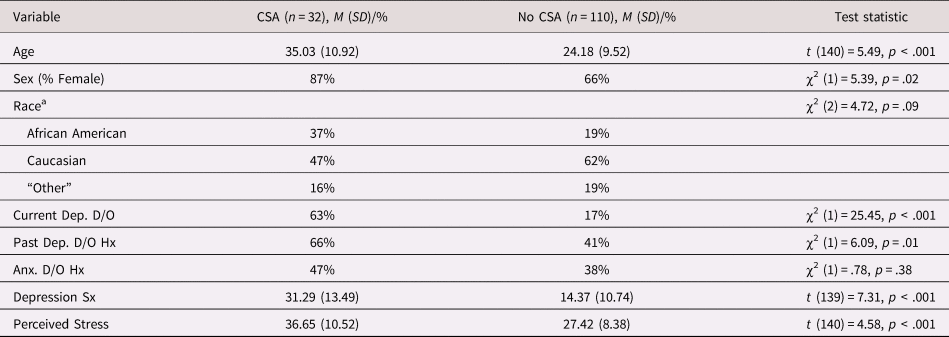
Demographic, psychiatric, and psychosocial characteristics of those with and without histories of CSA are presented in Table 1. Those who experienced CSA were approximately 11 years older and more likely to be women. They also reported higher levels of perceived stress and depression symptoms and were overrepresented among those with depression histories and those in the midst of a depressive episode. Those with CSA did not significantly differ from their peers in their racial distributions, nor histories of anxiety disorders. To account for differences in demographic characteristics, the effects of age and gender were statistically covaried in models.
Demographic characteristics, psychiatric parameters, and perceived stress levels of those with and without childhood sexual abuse (CSA) histories

Note. Dep. D/O = depressive disorder (major depression, dysthymic disorder, or depressive disorder NOS), Anx. D/O = anxiety disorder (generalized anxiety disorder, social anxiety disorder, panic disorder, specific phobia, and posttraumatic stress disorder), Depression Sx = Center for Epidemiologic Studies Depression Scale, Perceived Stress = Perceived Stress Scale.
a “Other” reflects aggregated racial categories to accommodate 0 frequency cells.
Do emotion regulation deficits and stress sensitization mediate effects of CSA on depression symptoms?
Stress sensitization
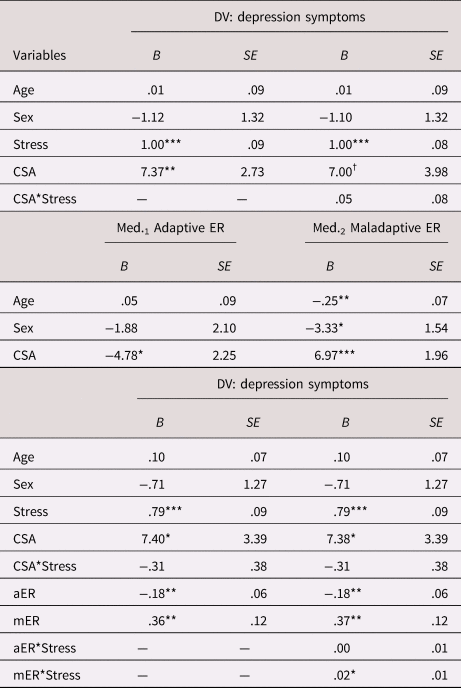
As hypothesized, our results showed that, independent of demographic characteristics, histories of CSA and high levels of perceived stress were associated with concurrent elevation in depression symptoms, BCSA = 7.37, t (137) = 2.70, p = .008, BPSS = 10.73, t (137) = 3.56, p < .001. However, the association between perceived stress and depression symptoms did not vary as a function of abuse histories, as indicated by the nonsignificant second-order effect of the two variables (see Table 2).
Multiple and sequential mediation of child sexual abuse history's effect on depression symptoms via stress sensitization and emotion regulation

Note. Sex (0 = female, 1 = male), Stress = Perceived Stress Scale, CSA = child sexual abuse (0 = absent, 1 = present), aER = Feeling and Me Scale, adaptive subscale, mER = Feeling and Me Scale, maladaptive subscale, Depression Symptoms = Center for Epidemiologic Studies Depression Scale.
***p ≤ .001, **p ≤ .01, *p ≤ .05, †p ≤ .10.
Emotion regulation
Next, we tested whether ER deficits could serve as mediators of CSA by regressing dispositional adaptive and maladaptive ER repertoires on abuse group membership, and then adding both emotion regulation indices to the stress sensitization model described above (see Table 2). In support of their potential mediation effects, those with histories of sexual abuse reported deploying maladaptive ER responses more readily, BCSA = 6.97, t (138) = 3.56, p < .001, and engaging in adaptive ER responses less frequently during times of distress than their abuse-free peers, BCSA = - 4.78, t (138) = 2.13, p = .04. In turn, the frequent use of maladaptive ER responses predicted elevation in depression symptoms, BmER = .36, t (134) = 8.37, p < .001, while adaptive ER reduced depression symptoms, BaER = −.18, t (134) = 2.95, p = .004. Both ER indices mediated the direct effects of CSA on depression symptoms, BindmER = 2.54, 95% CI .70–5.01, BindaER = .84 95% CI .04–1.99.
Do emotion regulation deficits and stress sensitization sequentially mediate effects of CSA on depression symptoms?
To test this possibility, second-order effects between each emotion regulation index and perceived stress were added to the previously described “multiple mediation” models in order to test the conditional indirect effects of abuse on depression symptoms via ER deficits and stress sensitization (see Table 2). Because stress sensitization reflects a moderation effect, indirect effects were examined via simple slopes at one standard deviation above and below the mean of a given ER index (Cohen, Cohen, West, & Aiken, Reference Cohen, Cohen, West and Aiken2003).
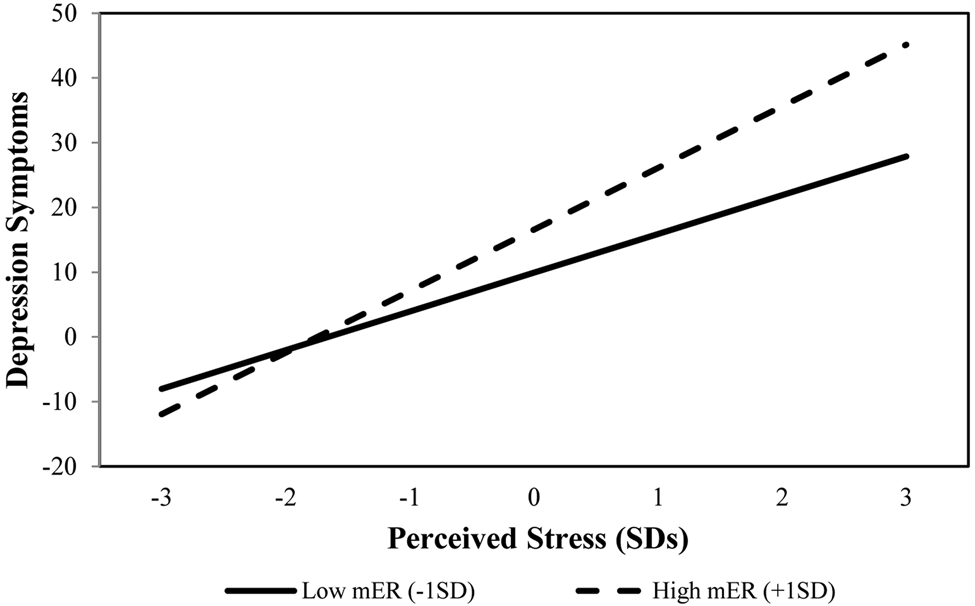
As hypothesized, maladaptive ER repertoires significantly moderated the effect of perceived stress on depression, BmERxPSS = .02, t (132) = 1.99, p = .05 (see Figure 1). Simple slopes analyses that probed the interaction revealed greater depression severity as a function of stress for those with elevated maladaptive ER levels, BmER,+1SD = .97, t (134) = 7.57, p < .001, relative to those with low maladaptive ER repertoires, BmER,−1SD = .61, t (134) = 4.84, p < .001. Tests of conditional indirect effects revealed significant mediation of CSA on depression via the moderation of perceived stress by maladaptive ER, BindmER,+1SD = 6.79, 95% CI 2.90–11.22, BindmER,−1SD = 4.27, 95% CI 1.66–7.54. In contrast to expectation, adaptive ER repertoires did not attenuate the adverse effect of perceived stress on depression, and therefore did not sequentially mediate the effects of CSA on depression via stress sensitization.
Maladaptive emotion regulation (mER) moderation of perceived stress effects on depression symptoms.

Do emotion regulation deficits and stress sensitization mediate effects of CSA on depressive affects in daily life?
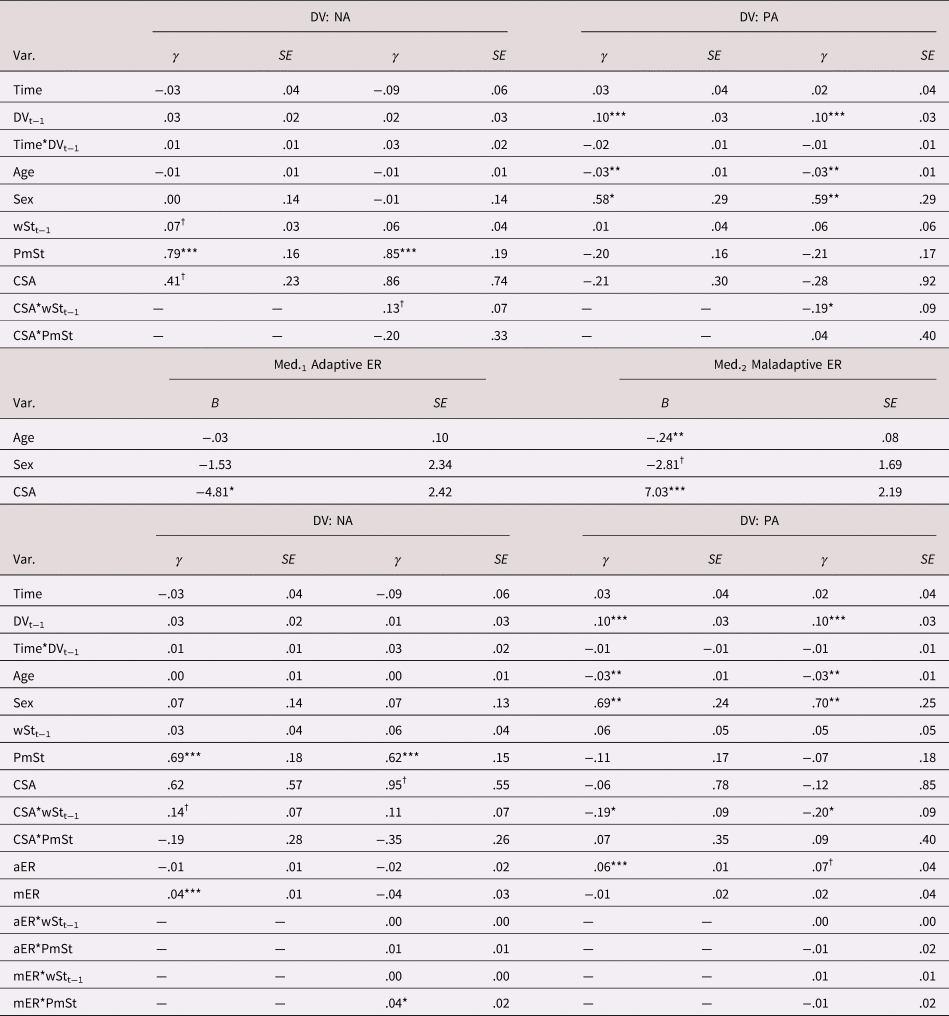
We examined this question in two ways, by testing the effects of CSA, stress sensitization, and ER repertoires on contemporaneous and prospective associations between stress and depressive affects (see Tables 3 and 4).
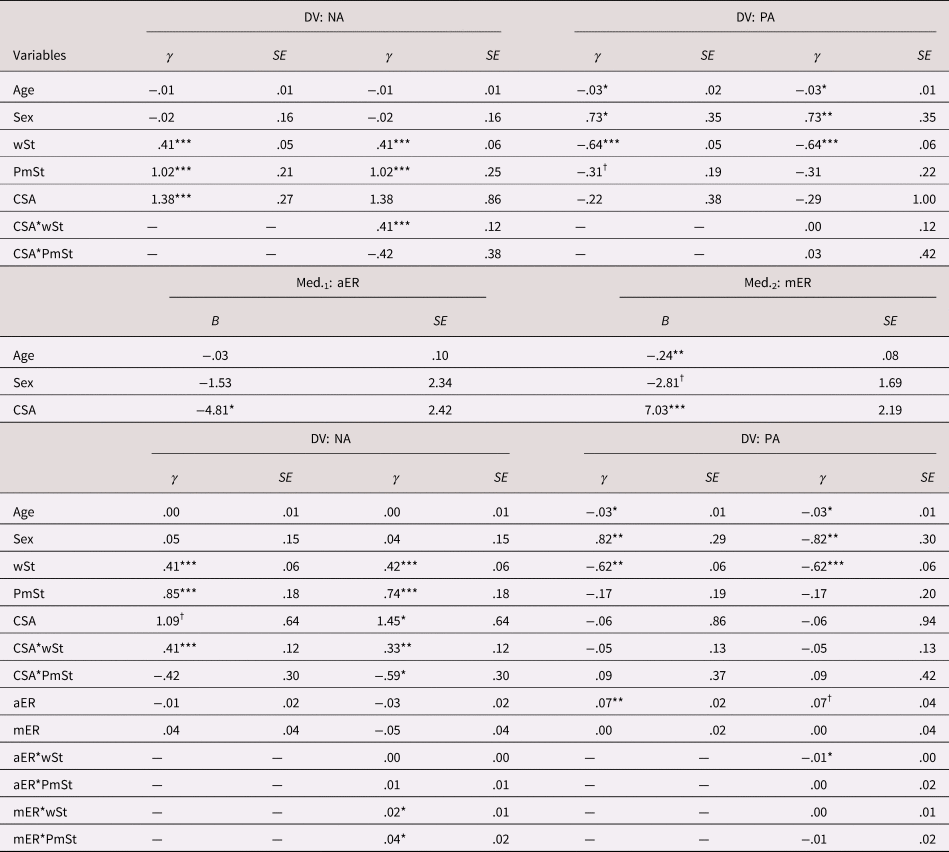
Multiple and sequential mediation of child sexual abuse history's effects on contemporaneous negative and positive affects in daily life via stress sensitization and emotion regulation

Note. NA = negative affect, PA = positive affect, Sex (0 = female, 1 = male), wSt = deviation in average stress level at EMA prompt, PmSt = average stress level across EMA period, CSA = childhood sexual abuse (0 = absent, 1 = present), aER = Feeling and Me Scale, adaptive subscale, mER = Feeling and Me Scale, maladaptive subscale.
***p ≤ .001, **p ≤ .01, *p ≤ .05, †p ≤ .10
Multiple and sequential mediation of child sexual abuse history's effects on prospective negative and positive affects in daily life via stress sensitization and emotion regulation.

Note. NA = negative affect, PA = positive affect, Time = interval between current and prior EMA prompt, DVt−1 = NA or PA level at prior EMA prompt, Sex (0 = female, 1 = male), wStt−1 = deviation in average stress level at prior EMA prompt, PmSt = average stress level across EMA period, CSA = childhood sexual abuse (0 = absent, 1 = present), aER = Feeling and Me Scale, adaptive subscale, mER = Feeling and Me Scale, maladaptive subscale.
***p ≤ .001, **p ≤ .01, *p ≤ .05, †p ≤ .10
In the contemporaneous models, CSA predicted NA elevation, γCSA = 1.38, t (103) = 5.07, p < .001), but was unrelated to PA. In a similar vein, participants’ average stress level during the measurement period predicted elevation in NA, γPmStress = 1.02, t (103) = 4.79, p < .001, and reduction in PA at a trend level, γPmStress = −.31, t (103) = 1.66, p = .10, as did momentary increases in stress at the time of the EMA prompt that significantly predicted both NA elevation, γwStress = .41, t (103) = 7.08, p < .001, and PA reduction, γwStress = −.64, t (103) = 11.81, p < .001.
In the prospective models, sexual abuse histories evidenced a trend for worsening NA over time, γCSA = .41, t (100) = 1.75, p = .08. Participants’ average stress level during the measurement period also predicted elevation in NA, γPmStress = .79, t (100) = 4.89, p < .001, as did momentary increases in stress at the time of the prior EMA prompt at a trend level, γwStress = .07, t (100) = 1.88, p = .06. Neither CSA nor the two stress indices predicted change in PA levels over time.
Stress sensitization
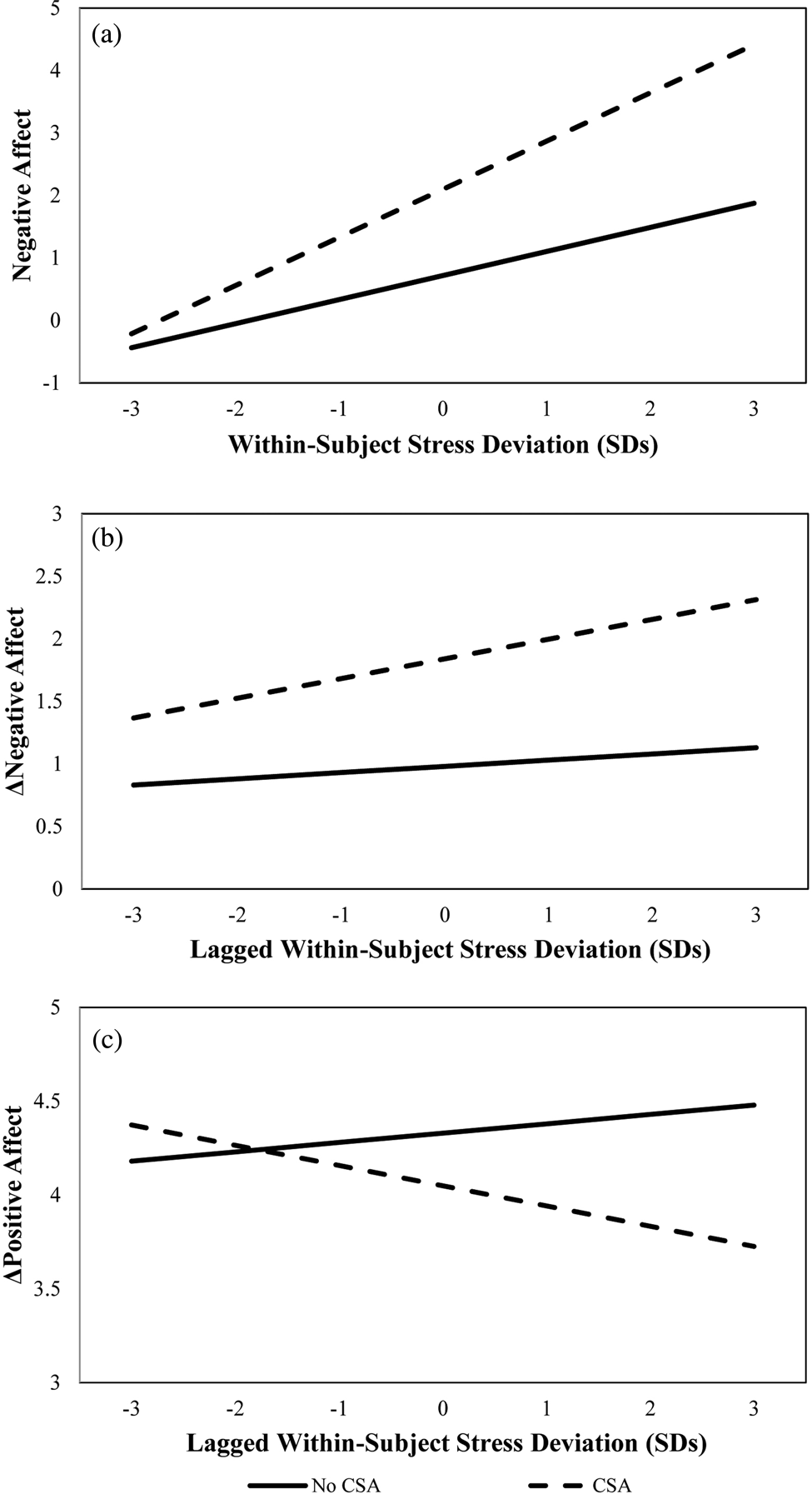
In support of their stress sensitization effect, sexual abuse histories evidenced a cross-level interaction with participants’ momentary deviations from their average stress levels to predict contemporaneous NA, γCSAxwStress = .41, t (103) = 3.42, p < .001 (see Figure 2, Panel A). Simple slopes analysis revealed a stronger association between stress and concurrent NA levels for those with sexual abuse histories, γCSA = .82, t (103) = 3.78, p < .001, than for their peers, γNoCSA = .41, t (103) = 6.83, p < .001. Sexual abuse histories did not moderate the relationship between participants’ average stress levels and NA, nor between both stress indices and PA.
Childhood sexual abuse moderation of within-subject stress fluctuations on contemporaneous negative affect (NA) (Panel A), and change (Δ) in NA (Panel B) and positive affect (Panel C) across successive ecological momentary assessment (EMA) prompts.

In the prospective models, sexual abuse histories and deviations from participants’ average stress levels during the prior EMA prompt jointly predicted significant change in subsequent PA, γCSAxwStress = −.19, t (98) = 2.13, p = .03, as well as change in NA at a trend level, BCSAxwStress = .13, t (98) = 1.74, p = .08 (see Figure 2, Panels B and C). Consistent with stress sensitization, CSA was associated with reduced PA across successive EMA observations, γwStress = −.13, t (98) = 1.98, p = .05, and increased NA, γwStress = .19, t (98) = 2.89, p = .005. Increased stress relative to average levels was unrelated to change in PA and NA for those without sexual abuse histories, γs = .06, t (98) = 1.09–1.40, ps = .17–.28.
Emotion regulation
In support of emotion regulation's role in distress among those with CSA, sexual abuse histories predicted elevated maladaptive, B = 7.03, t (105) = 3.21, p = .002, and reduced adaptive repertoires, B = −4.81, t (105) = 1.99, p = .05, across contemporaneous and prospective models. In turn, adaptive ER repertoires predicted elevations in contemporaneous PA levels, γ = .07, t (96) = 3.41, p = .002, that increased over successive EMA prompts, γ = .06, t (96) = 4.55, p < .001, as well as mediated the effects of CSA on PA contemporaneously γindaER = −.35 95% CI −.81–−.003, and prospectively, γindaER = −.29 95% CI −.65–−.002. Adaptive ER repertoires were unrelated to NA indices. Though unrelated in contemporaneous models, maladaptive ER repertoires predicted NA in the prospective model, γmER = .04, t (96) = 3.61, p < .001, and mediated the effect of CSA on increased NA across successive EMA observations, γindbER = .25 95% CI .11–.49. Maladaptive repertoires were unrelated to indices of PA.
Do emotion regulation deficits and stress sensitization sequentially mediate effects of CSA on depression affects in daily life?
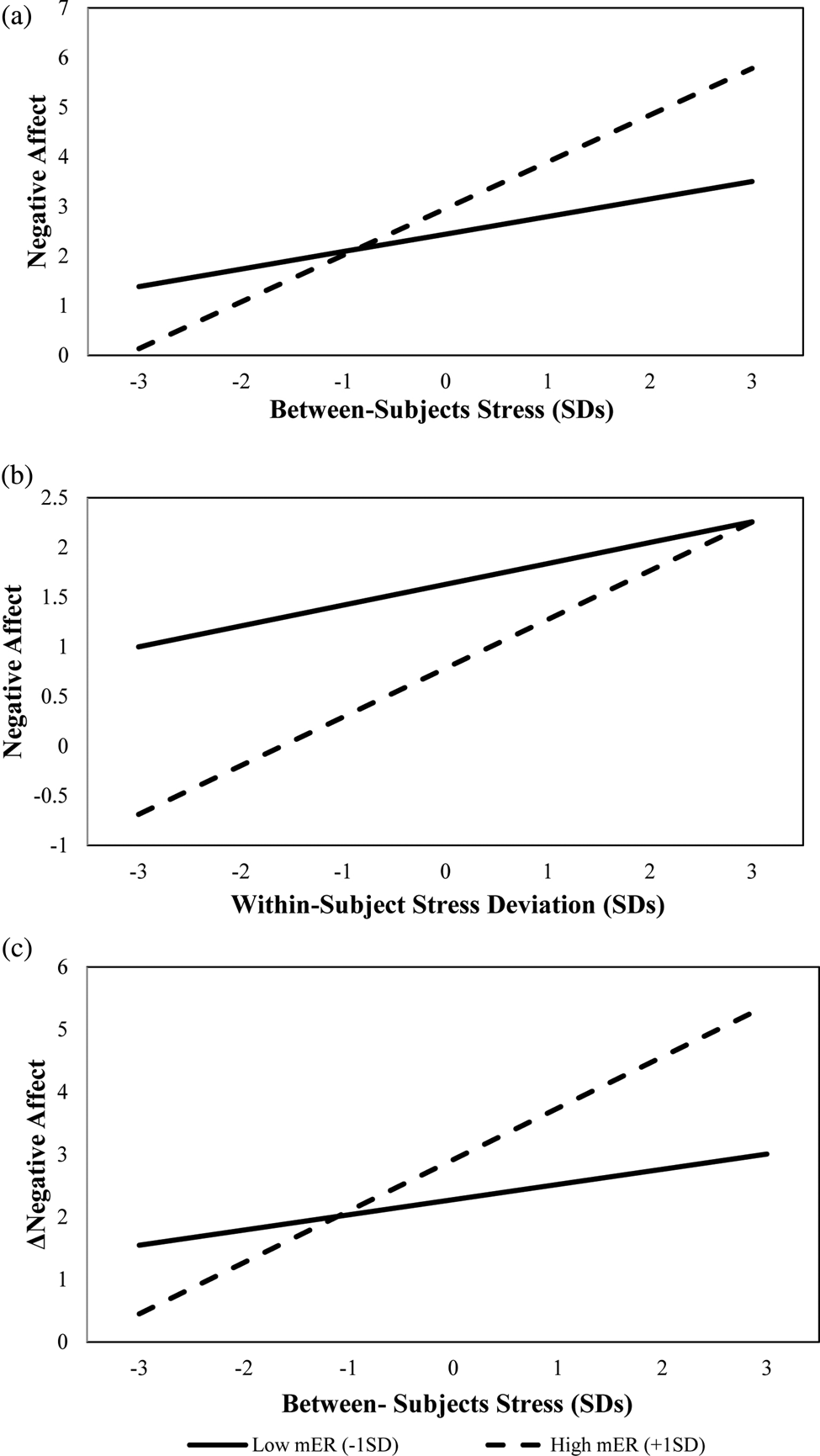
We tested this possibility by adding second-order effects of the adaptive and maladaptive ER repertoires with indices of stress in the contemporaneous and prospective models. In support of sequential mediation, maladaptive ER moderated contemporaneous effects of participants’ average stress levels and their momentary deviations on NA, γmERxPmStress = .04, t (95) = 2.08, p = .04, γmERxwStress = .02, t (95) = 2.44, p = .02, (see Figure 3, Panels A and B), and the effects of participants’ average stress levels in the prospective NA model, γmER = .04, t (92) = 2.18, p = .03 (see Figure 3, Panel C). Post hoc probes of the interaction terms revealed that tendencies to deploy maladaptive ER responses exacerbated the effects of stress on contemporaneous NA across participants’ average stress levels, γPmStress,+1SD = 1.08, t (95) = 4.25, p < .001, γPmStress, −1SD = .41, t (95) = 1.73, p = .09, and momentary deviations from those levels γwStress,+1SD = .59, t (95) = 5.78, p < .001, γwStress, −1SD = .25, t (95) = 4.08, p < .001. Similar effects emerged in the prospective model, whereby maladaptive ER potentiated the adverse effects of participants’ average stress levels on NA over time, BPmStress,+1SD = .94, t (92) = 4.29, p < .001, γPmStress, −1SD = .28, t (92) = 1.22, p = .22. Importantly, and as hypothesized, the frequent use of maladaptive ER responses mediated stress-sensitization effects of CSA on contemporaneous NA levels, PmStress: γindmER,+1SD = 7.60, 95% CI 2.46–14.22, γindmER,−1SD = 2.85, 95% CI −.34–7.20; wStress γindmER,+1SD = 4.15, 95% CI 1.49–7.35; γindmER,−1SD = 1.78, 95% CI .56–3.35, and their change over time, γmStress : γmER+1SD = 6.64, 95% CI 2.16–12.40; γmER−1SD = 1.96, 95% CI −1.16–5.93.
Maladaptive emotion regulation (mER) moderation of average stress level (Panel A) and within-subject stress fluctuations (Panel B) on concurrent negative affect (NA), and average stress levels on change (Δ) in NA (Panel C) across successive ecological momentary assessment prompts.

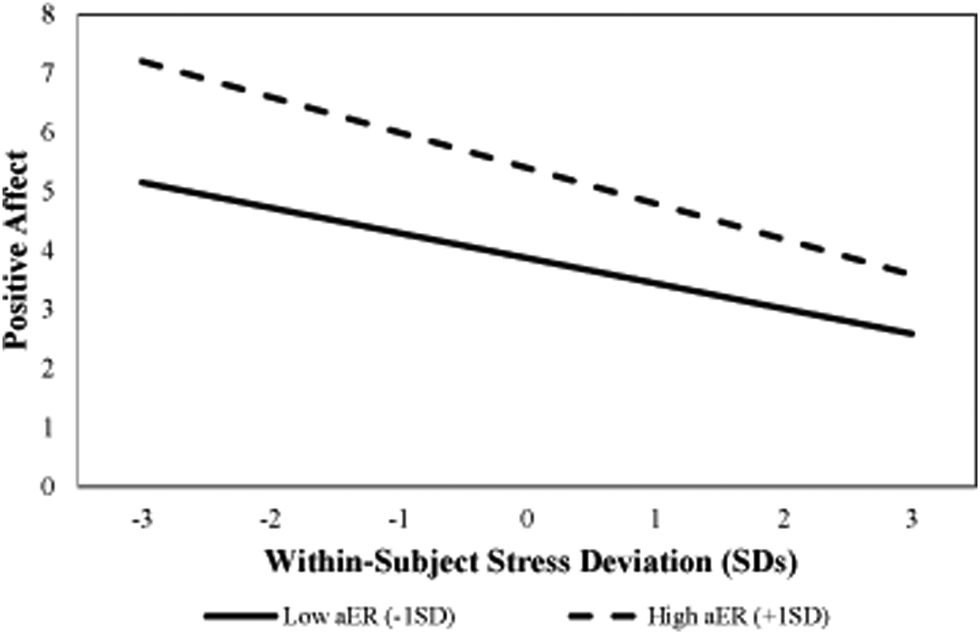
Surprisingly, though adaptive ER repertoires moderated the effects of within-participant stress fluctuations on PA, γaERxwStress = −.01, t (95) = 2.00, p = .05, the frequent use of adaptive responses was paradoxically associated with a reduction in PA as participants’ stress increased relative to average levels, γaER, +1SD = −.73, t (95) = 8.84, p < .001, γaER, −1SD = −.51, t (95) = 6.87, p < .001 (see Figure 4), and mediated stress-sensitization effects of sexual abuse on concurrent PA via contemporaneous stress fluctuations, wStress γindaER,+1SD = 3.49, 95% CI .05–7.18; γindaER,−1SD = 2.47, 95% CI .03–5.18. Adaptive ER did not moderate effects of either stress index on NA across contemporaneous or prospective models.
Adaptive emotion regulation (aER) moderation of within-subject stress fluctuations on contemporaneous hedonic affect.

Discussion
CSA confers a considerable risk across the life span for developing depressive disorders (Lindert et al., Reference Lindert, von Ehrenstein, Grashow, Gal, Braehler and Weisskopf2014; Turner et al., Reference Turner, Taillieu, Cheung and Afifi2017), with stress sensitization and emotion regulation deficits put forth as plausible mechanisms through which such risk is conferred (Heim et al., Reference Heim, Newport, Heit, Graham, Wilcox, Bonsall and Nemeroff2000; Ullman et al., Reference Ullman, Peter-Hagene and Relyea2014). Yet, though both are associated with CSA and depression (Andersen & Teicher, Reference Andersen and Teicher2008; Lupien et al., Reference Lupien, McEwen, Gunnar and Heim2009), it remains unclear whether stress sensitization and emotion regulation deficits contribute to depression risk independently or sequentially. We fit multiple and sequential mediation models to test whether stress sensitization and emotion regulation deficits mediate associations between histories of CSA and depression outcomes independently of one another, or whether the more pronounced effects of stress for those with CSA arise from a reliance on maladaptive responses and insufficient use of adaptive strategies.
Overall, results supported a sequential mediation between CSA and depression outcomes: histories of CSA predicted greater tendencies to deploy maladaptive emotion regulation responses that, in turn, exacerbated the effects of stress on depression severity. Further, maladaptive emotion regulation repertoires mediated the contemporaneous effects of daily life stress on NA levels and their increase across successive EMA observations. Though the reduction in adaptive emotion regulation repertoires mediated the direct effects of CSA on depression symptoms and PA in prospective EMA models, their intervening role between CSA and stress sensitization were inconsistent and paradoxical, as evidenced by the reduced PA in response to stress among those with CSA who frequently deployed adaptive responses.
Our results suggest that the relationship between CSA, stress, and depression is nuanced, as stress may have both transient and enduring components. Regarding the latter, we found higher perceived stress levels among those with CSA, for whom exploratory analyses also revealed higher average stress in daily life relative to their peers (M CSA = 2.17 vs. M NoCSA = 1.75, p = .03).Footnote 3 In turn, with few exceptions, elevation in stress levels predicted parallel increases in depression symptoms and depressive affects. These findings are in accord with results from a number of survey, laboratory, and experience sampling studies that connect CSA to elevated stress levels (Bandoli et al., Reference Bandoli, Campbell-Sills, Kessler, Heeringa, Nock, Rosellini and Stein2017; Glaser et al., Reference Glaser, Van Os, Portegijs and Myin-Germeys2006; Luthar & Zigler, Reference Luthar and Zigler1991), and with a large body of work associating stress withdepression (Hammen, Reference Hammen2005; Hankin, Reference Hankin2008). Though not of primary interest in this study, the strong relationship between CSA, stress, and depression outcomes may suggest that stress serves an intervening role between CSA and depression.
In contrast, and of primary importance, CSA-linked stress sensitization emerged only in response to fluctuations in participants’ stress levels. That is, as compared to their peers, those with CSA whose stress increased relative to their average levels reported more NA and less PA that worsened over time. Importantly, some CSA stress-sensitization effects were maintained when the emotion regulation indices were added to the model, suggesting that the vulnerability for depression conferred by a history of CSA exceeds that which is accounted for by dispositional emotion regulation repertoires.
The distinct pattern of associations between CSA and stress has both substantive and methodological implications. Our findings imply that mechanisms predisposing those with CSA to experience ongoing stress may be distinct from those that potentiate transient stress responses. Consistent with this possibility, empirical findings differentiate basal stress levels and their reactivity across physiological and subjective dimensions (Henckens et al., Reference Henckens, Klumpers, Everaerd, Kooijman, van Wingen and Fernández2016; Sliwinski, Almeida, Stawski, & Smyth, Reference Sliwinski, Almeida, Stawski and Smyth2009). For example, at the physiological level, resting cortisol, a neuroendocrine marker of perceived stress (van Eck & Nicolson, Reference van Eck and Nicolson1994), evidenced an inverse pattern of amygdala activity and emotion processing relative to cortisol reactivity in response to a psychological stress (Henckens et al., Reference Henckens, Klumpers, Everaerd, Kooijman, van Wingen and Fernández2016). Further, the two physiological stress indices were shown to be orthogonal and differed in associations with personality dimensions (Henckens et al., Reference Henckens, Klumpers, Everaerd, Kooijman, van Wingen and Fernández2016). In a similar vein, day-to-day fluctuations in perceived stress levels have been shown to differentially predict dysphoric states in daily life from more enduring indices of perceived stress (Sliwinski et al., Reference Sliwinski, Almeida, Stawski and Smyth2009). Given the complexity of the stress response, our results echo the call to take a multiple-levels-of-analyses perspective (Cicchetti & Dawson, Reference Cicchetti and Dawson2002) to study shared and specific processes that underpin the stress experience of those with histories of CSA, both with respect to stress levels and their fluctuations.
Our findings also suggest that emotion regulation deficits play seminal, but complicated roles in the relationship between CSA and risk for depression. As in our study, CSA has been associated with the infrequent use of adaptive responses and reliance on maladaptive strategies and (Carvalho Fernando et al., Reference Carvalho Fernando, Beblo, Schlosser, Terfehr, Otte, Löwe and Wingenfeld2014; Heleniak et al., Reference Heleniak, Jenness, Vander Stoep, McCauley and McLaughlin2016) that prognosticate new incidence of depression (Kovacs et al., Reference Kovacs, Rottenberg and George2009, Reference Kovacs, Yaroslavsky, Rottenberg, George, Kiss, Halas and Makai2016), and that meta-analytic reviews tie to depression severity (Aldao, Nolen-Hoeksema, & Schweizer, Reference Aldao, Nolen-Hoeksema and Schweizer2010; Webb, Miles, & Sheeran, Reference Webb, Miles and Sheeran2012) and depression status (Visted, Vøllestad, Nielsen, & Schanche, Reference Visted, Vøllestad, Nielsen and Schanche2018). However, as depression at the affective level may reflect a combination of high NA and low PA (Clark & Watson, Reference Clark and Watson1991), global measures of depression symptoms feasibly obscure the unique ties between emotion regulation deficits and the two affective domains. Indeed, our results and those of others suggest some specificity between emotion regulation repertoires and affective states, with adaptive responses linked to PA (Brans, Koval, Verduyn, Lim, & Kuppens, Reference Brans, Koval, Verduyn, Lim and Kuppens2013) and maladaptive ones with NA (Chaudhury et al., Reference Chaudhury, Galfalvy, Biggs, Choo, Mann and Stanley2017).
As in our study, deploying adaptive strategies in response to distress predicted increased PA in the daily lives of healthy adults (Brans et al., Reference Brans, Koval, Verduyn, Lim and Kuppens2013, Study 2; Brockman, Ciarrochi, Parker, & Kashdan, Reference Brockman, Ciarrochi, Parker and Kashdan2017) and patients with borderline personality disorder (BPD) (Chaudhury et al., Reference Chaudhury, Galfalvy, Biggs, Choo, Mann and Stanley2017), but was less or unrelated with NA downregulation (Brockman et al., Reference Brockman, Ciarrochi, Parker and Kashdan2017; Chaudhury et al., Reference Chaudhury, Galfalvy, Biggs, Choo, Mann and Stanley2017; but see Blalock, Kashdan, & Farmer, Reference Blalock, Kashdan and Farmer2016 and Nezlek & Kuppens, Reference Nezlek and Kuppens2008). Conversely, efforts to “find perspective,” a strategy akin to rumination, and to suppress NA predicted NA upregulation (Chaudhury et al., Reference Chaudhury, Galfalvy, Biggs, Choo, Mann and Stanley2017; Nezlek & Kuppens, Reference Nezlek and Kuppens2008; but see Blalock et al., Reference Blalock, Kashdan and Farmer2016 and Brockman et al., Reference Brockman, Ciarrochi, Parker and Kashdan2017), but not PA (Chaudhury et al., Reference Chaudhury, Galfalvy, Biggs, Choo, Mann and Stanley2017).
We do not imply a strong specificity between emotion regulation repertoires and affective domains. Rather, as sadness and dysphoria are more commonly observed symptom in depression than anhedonia (Baji et al., Reference Baji, Lopez-Duran, Kovacs, George, Mayer, Kapornai and Vetró2009; Smith, Joiner, Pettit, Lewinsohn, & Schmidt, Reference Smith, Joiner, Pettit, Lewinsohn and Schmidt2008), we believe that further inquiry into the link between adaptive strategies and PA may shed light on findings that suggest a weak and inconsistent association between adaptive emotion regulation repertoires and depression (Kovacs & Yaroslavsky, Reference Kovacs and Yaroslavsky2014; Kovacs et al., Reference Kovacs, Rottenberg and George2009, Reference Kovacs, Yaroslavsky, Rottenberg, George, Kiss, Halas and Makai2016; Yaroslavsky, Bylsma, Rottenberg, & Kovacs, Reference Yaroslavsky, Bylsma, Rottenberg and Kovacs2013).
Of consequence, our results suggest that emotion regulation repertoires play a critical role in stress sensitization that is observed among those with sexual abuse histories. In particular, the consistent and pernicious effects of maladaptive repertoires on the relationship between stress and depression outcomes across reporting methods, along with their direct effects, signals their key role in depression risk (Aldao et al., Reference Aldao, Nolen-Hoeksema and Schweizer2010; Extremera & Rey, Reference Extremera and Rey2015). This observation is aligned with literature that ties maladaptive emotion regulation to concurrent and prospective depression symptom elevation (Aldao et al., Reference Aldao, Nolen-Hoeksema and Schweizer2010; Just & Alloy, Reference Just and Alloy1997) and risk for incidents of depressive episodes (Nolen-Hoeksema, Reference Nolen-Hoeksema2000) and their recurrence (Kovacs et al., Reference Kovacs, Rottenberg and George2009, Reference Kovacs, Yaroslavsky, Rottenberg, George, Kiss, Halas and Makai2016). These associations do not appreciably attenuate when the use of adaptive emotion regulation responses is statistically controlled.
The key mechanistic role of maladaptive repertoires is further bolstered by the limited and inconsistent predictive value of adaptive response repertoires that, though associated with depression severity (Aldao et al., Reference Aldao, Nolen-Hoeksema and Schweizer2010), are markedly weakened or drop below a level of significance in the presence of maladaptive responses. Our finding stress-potentiating effects of adaptive emotion regulation repertoires on concurrently measured PA adds to the uncertain role of adaptive responses in depression risk. How may stress-sensitizing effects of adaptive emotion regulation repertoires be understood? It is feasible that the observed effect masks a higher-order interaction wherein adaptive responses are iatrogenic rather than salubrious for those with CSA. For example, results from laboratory studies show that some vulnerable groups (e.g., depressed participants) experience worsening moods after deploying a putatively adaptive response (e.g., Joormann, Siemer, & Gotlib, Reference Joormann, Siemer and Gotlib2007). The same may be true for individuals with CSA. Future works that examine whether CSA moderates the effects of adaptive emotion regulation on affective outcomes would shed light on our findings.
Our results should be interpreted in the context of several limitations. There is evidence that sexual abuse during the childhood years can vary in intensity, frequency, source, and developmental timing, parameters that may affect stress sensitization, emotion regulation development, and depression risk. For example, age of onset, severity, source, and frequency of sexual abuse differentially predict difficulties in emotional (Clemmons, Walsh, Dilillo, & Messman-moore, Reference Clemmons, Walsh, Dilillo and Messman-moore2007; Kaplow & Widom, Reference Kaplow and Widom2007) and behavioral difficulties (Ruggiero, McLeer, & Dixon, Reference Ruggiero, McLeer and Dixon2000) across adulthood. Therefore, it is feasible that those whose abuse began early in life, was more severe, and chronic would evidence greater stress sensitization and emotion regulation deficits than those who experienced a single instance of abuse in late adolescence. Though detailed accounts of trauma were collected during the clinical interview, some participants were circumspect in their disclosure, thereby precluding an examination of several important CSA parameters in this study. Further, as those with CSA frequently experience other forms of abuse (Finkelhor, Turner, Shattuck, & Hamby, Reference Finkelhor, Turner, Shattuck and Hamby2015), it is feasible that accompanying histories of physical violence and neglect may have contributed to our results.
There is also some evidence that gender differences exist in the long-term consequences of CSA (Gray & Rarick, Reference Gray and Rarick2018), and in the stress response across physiological (Kudielka & Kirschbaum, Reference Kudielka and Kirschbaum2005) and subjective levels (Kelly, Tyrka, Anderson, Price, & Carpenter, Reference Kelly, Tyrka, Anderson, Price and Carpenter2008). Although our analyses controlled for gender, it is feasible that the relationship between CSA, emotion regulation, stress sensitization, and depression-related outcomes may vary between men and women, a possibility that we could not examine due to our small sample size of participants reporting CSA. Relatedly, emotion regulation outcomes are known to be contextual (Aldao, Sheppes, & Gross, Reference Aldao, Sheppes and Gross2015) and it is feasible that measuring state emotion regulation responses during EMA would have provided greater insights into the relationship between CSA and stress sensitization.
Although we proposed a sequential relationship between emotion regulation deficits and stress sensitization, a reverse effect is possible; CSA stress sensitization may lead to emotion regulation deficits by undermining normative emotion regulation development. We did not test this possibility because emotion regulation repertoires appear to slow in their development by mid-adolescence (see Kovacs et al., Reference Kovacs, Lopez-Duran, George, Mayer, Baji, Kiss and Kapornai2019), and we used an adult sample in this study.
Finally, though not uncommon in EMA studies, our single-item measure of stress may have contributed to greater measurement error than what could be expected from the use of a longer survey. Future works that via longitudinal designs examine the effects of CSA parameters, co-occurring physical abuse and neglect histories, contextual effects of gender on emotion regulation across development, and measure stress during experience sampling via multiple items would do much to clarify the mechanisms through which CSA confers risk for depressive disorders.
Nevertheless, this study has a number of strengths. First, the use of mixed methodology enabled us to test concurrent and prospective effects of stress sensitization in the daily lives of adults with histories of CSA as they encountered ideographic stressors, which increased the generalizability of our findings beyond that offered through cross-sectional designs that are commonly seen in the literature. Second, by disambiguating daily life stress into its stable and time-varying components, we were able to show distinct ties between emotion regulation and stress sensitization, in particular, that stress sensitization emerges in response to perturbations in stress levels rather than the absolute stress magnitudes. Finally, to our knowledge, this study is the first to test the roles of putative adaptive and maladaptive emotion regulation response repertoires in stress sensitization among those with histories of CSA.
Conclusion
In summary, our results have methodological and clinical implications as they point to emotion regulation deficits as key mechanisms for stress sensitization and depression-related outcomes, as well as a need to measure stress as a dynamic process that may precipitate depressive states differently depending on the nature of said deficits. Further, our findings may generalize to other disorders as CSA, stress sensitization, and emotion regulation deficits are transdiagnostic risk factors. This, in particular, may be the case for PTSD, which is associated with all three risk factors and depression (Chang et al., Reference Chang, Kaczkurkin, McLean and Foa2018; John, Cisler, & Sigel, Reference John, Cisler and Sigel2017; McLaughlin, Conron, Koenen, & Gilman, Reference McLaughlin, Conron, Koenen and Gilman2010). Experience sampling methods may therefore provide clinicians with an inexpensive means to detect and target specific emotion regulation deficits that likely differ across those with CSA. Such innovations may prove efficacious for treating PTSD and other emotional disorders that are associated with CSA.
Supplementary Material
The supplementary material for this article can be found at https://doi.org/10.1017/S095457942000098X.
Financial Support
This research was supported by Cleveland State University's Undergraduate Summer Research Award (PI: Yaroslavsky) and Faculty Research Development Award (PI: Yaroslavsky).