

Healthcare providers (HCPs) can play an important role in the return to work (RTW) of injured workers (IWs) and in disability management processes. As part of the workers compensation process, HCPs are often asked to give information about an IW's condition, determine the work-relatedness of injury, determine a course of treatment and provide recommendations about a worker's ability to RTW.
Studies (Brijnath et al., Reference Brijnath, Mazza, Singh, Kosny, Ruseckaite and Collie2014; Kilgour, Kosny, McKenzie, & Collie, Reference Kilgour, Kosny, McKenzie and Collie2015; Kosny, MacEachen, Ferrier, & Chambers, Reference Kosny, MacEachen, Ferrier and Chambers2011; Mazza et al., Reference Mazza, Brijnath, Singh, Kosny, Ruseckaite and Collie2015) suggest that HCPs can experience difficulties providing patient care within the context of workers compensation. Time pressures, administrative burdens and limited knowledge about a patient's workplace can thwart active engagement. This study focused on HCPs’ experiences with the workers compensation system and their role in RTW after injury or illness. In this article we examine how HCPs can come to be removed and disengaged from the workers compensation system when they treat patients who have complex and prolonged claims.
Literature Review
Earlier research on the RTW process has suggested that when HCPs provide support for RTW and communicate with other stakeholders in the workers compensation system, RTW after injury is hastened (Kosny et al., Reference Kosny, Franche, Pole, Krause, Cote and Mustard2006; Pransky, Shaw, Franche, & Clarke, Reference Pransky, Shaw, Franche and Clarke2004). Patients also look to HCPs not only for illness certification but advice about the RTW process (O'Brien, Cadbury, Rollnick, & Wood, Reference O'Brien, Cadbury, Rollnick and Wood2008; Verbeek, Reference Verbeek2006).
Dealing with RTW issues, however, can be a challenge for many HCPs. This is due to a number of factors. HCPs, particularly general practitioners, do not receive a great deal of training in disability management, occupational health and safety (OHS) or RTW after injury (Wickizer, Franklin, Plaeger-Brockway, & Mootz, Reference Wickizer, Franklin, Plaeger-Brockway and Mootz2001). HCPs may also not know a great deal about a workers’ employment conditions and HCPs may not receive compensation for visiting the workplace or communicating with an employer (Wickizer et al., Reference Wickizer, Franklin, Plaeger-Brockway and Mootz2001). This can result in confusion about what a patient does at work and make RTW conversations difficult (Kosny et al., Reference Kosny, MacEachen, Ferrier and Chambers2011). A lack of communication between the specialists, who have experience in occupational health, and the treating HCPs has also been identified as a barrier to successful RTW planning (Anema, Van Der Giezen, Buijs, & Van Mechelen, Reference Anema, Van Der Giezen, Buijs and Van Mechelen2002; Guzman, Yassi, Cooper, & Khokhar, Reference Guzman, Yassi, Cooper and Khokhar2002). The assessment of functional abilities, a key part of the HCP role in many jurisdictions, can also be challenging since HCPs are trained to focus on assessing and treating symptoms rather than determining the ability to return to employment (Soklaridis, Tang, Cartmill, Cassidy, & Andersen, Reference Soklaridis, Tang, Cartmill, Cassidy and Andersen2011). The bureaucracy of workers compensation systems can be viewed by HCPs as cumbersome and an unwelcome addition to their workload. Further, it is possible that workers compensation decision-makers doubt HCPs’ ability to accurately assess patients’ capabilities and their RTW capacity. A recent study examining disability support programs found that the decision-makers did not trust treating doctors’ opinions, particularly around complex conditions such as mental health (McAllister & Leeder, Reference McAllister and Leeder2017).
A systematic review focusing on workers compensation and HCPs found that HCPs can play both healing and harming roles for IWs. While patients often depend on HCPs to help them navigate the RTW process and provide support, the compensation system can complicate relationships between patients and HCPs by putting the HCP in a gatekeeper role (Kilgour et al., Reference Kilgour, Kosny, McKenzie and Collie2015), where their recommendations can determine access to income replacement and medical treatment (Lippel, Eakin, Holness, & Howse, Reference Lippel, Eakin, Holness and Howse2016). When the administrative demands placed on HCPs become onerous or when relations between HCPs and workers compensation decision-makers are adversarial, HCPs can avoid participating in the RTW process, and even decline to provide services to IWs (Brijnath et al., Reference Brijnath, Mazza, Kosny, Bunzli, Singh, Ruseckaite and Collie2016).
This article examines the circumstances that can lead to some HCPs becoming removed from the workers compensation system and the RTW process. We identify systemic factors that can promote HCP engagement and benefit IWs.
Workers Compensation: The Canadian Context
In Canada each province and territory has its own workers compensation board (WCB) or commission. Canadian workers compensation systems are based on a ‘historical compromise’ where IWs gave up the right to sue their employers in exchange for benefits (wage replacement, health care, etc.) and employers pay for the system (via premiums based on a certain dollar amount per $100 of payroll) in exchange for protection against lawsuits. Workers compensation systems in Canada are no-fault and publicly administered. In order to receive benefits, a worker's injury or condition must arise out of or in the course of the employment. Jurisdictions vary in the policies that are in place regarding what is and is not a compensable condition. For example, in some provinces gradual onset work-related mental health claims are permitted, while other jurisdictions only permit mental health claims for conditions that arise due to a sudden and unexpected traumatic event (e.g., posttraumatic stress disorder). Each of the jurisdictions has a strong focus on RTW and recovery at work after an injury. Specifically relevant to this study on HCPs, each jurisdiction uses medical evidence and advice to help with decision-making and claim management. However, only in the province of Quebec is the decision of the HCP binding (Lippel et al., Reference Lippel, Eakin, Holness and Howse2016). In the four provinces where this study took place, the ultimate decision-maker regarding issues such as RTW is the workers compensation decision-maker, typically the case manager (CM).
Methods
An exploratory, qualitative approach was taken to understand HCPs’ experience with the WCB in their provinces and their role in the RTW process. One-on-one, interviews were conducted with different types of HCPs and CMs in British Columbia, Manitoba, Newfoundland and Labrador, and Ontario. Trained interviewers, who were hired in each province, participated in study-specific training. The principal investigator (PI) and research coordinator, both trained in qualitative methods, also conducted interviews as needed. Ethics approval was received from the University of Toronto.
HCPs were recruited through provincial medical associations, clinics and healthcare centres, as well as through the researchers’ pre-existing contacts within professional networks. Recruitment advertisements were mailed and e-mailed to members, placed in medical newsletters, and on social media. Sampling of participants was analytically driven. Recruitment continued until saturation was reached and no new themes were forthcoming.
In order to be eligible, HCPs had to have seen at least one patient with a work injury in the previous year. Those interested in being interviewed contacted the research team and were interviewed by telephone or in person, depending on their preference. In person interviews were typically conducted in the office of the study participant. HCPs were also asked if they knew professional peers who might be interested in participating and, if so and with the consent of their peers, were asked to provide contact details to the researchers. A number of HCPs and CMs were also recruited through the WCBs in British Columbia and Manitoba. All participants were offered an honorarium to thank them for their time. Due to rules at the WCBs, some participants declined the honorarium.
Interview questions focused on the HCP's experience working with patients who had been injured at work (or, in the case of the CM interviews, their experience managing IW files and working with both IWs and HCPs), interactions with the WCB, including successes and challenges, and interactions with other stakeholders (e.g., CMs, employers, allied HCPs). CMs were asked about their experiences interacting with HCPs, IWs and employers. The interview schedule allowed for follow-up questions, probes and new avenues of inquiry. Informed, written consent was obtained from all participants. Interviews lasted between 30 and 60 minutes. All interviews were audio-recorded and transcribed verbatim.
Participants
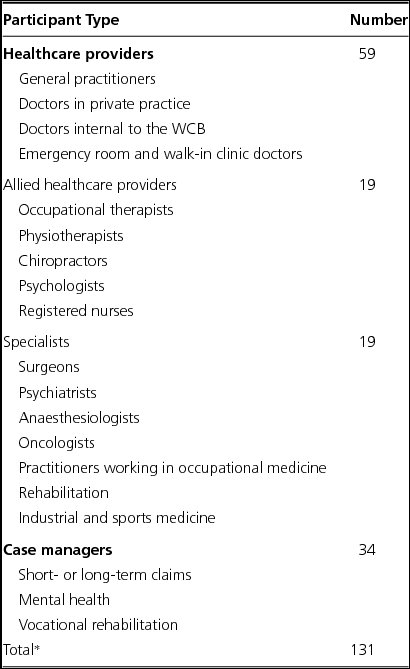
Ninety-seven HCPs and 34 CMs were interviewed. Forty-one per cent (n = 40) of the HCPs and 38% (n = 13) of CMs were women. The HCP sample included 59 general practitioners (GPs; of which nine practised internally for a WCB at the time of data collection), 19 HCP-allied and 19 HCP specialists (see Table 1). Of the 97 HCPs, 34% (n = 33) were from Ontario (ON), 29% (n = 28) from British Columbia (BC), 21% (n = 20) from Manitoba (MB), and 16% (n = 16) from Newfoundland and Labrador.
Type and Number of Healthcare Providers and Case Managers

Note:* Some participants had more than one role.
Some participants had more than one role or experience in different work settings; for example, GPs who went on to specialise in occupational health or chronic pain. This ensured diverse perspectives on workers compensation processes and RTW. Almost half of the HCPs had over 15 years of tenure, whereas 20% had been practising less than five years. More than half of the HCPs (67%) practised in large city centres (> 100,000); the rest were from medium-sized centres and small cities and towns.
Of the 34 total CMs, none were from Newfoundland and Labrador (due to recruitment restrictions) and those from Ontario were employed by private organisations (albeit some with former WCB experience). Thirty-three per cent of the CMs had over 15 years of experience (within or outside of WCBs). Twenty-two per cent had less than five. Case managers worked in a range of roles including vocational rehabilitation, adjudication of long-term claims and adjudication of mental health claims.
Data Analysis
Qualitative data analysis software was used (NVivo; QSR International Pty Ltd, 2012), and transcripts were entered into NVivo for data storage and coding. Three researchers (the PI and two research assistants) read a sample of interview transcripts and established a preliminary list of codes. The researchers reviewed the content assigned to the codes, and then developed a coding manual containing a definition for each code and an explanation for how its content would apply to the research objectives. Transcripts were then coded in two rounds by two researchers. Common themes and concepts across codes that captured key insights were identified. Any discrepancies in coding and interpretative differences were discussed and resolved by the research team.
Data pertaining to each of the codes were then analysed and common themes identified. The focus was not strictly on prevalence, but also on whether or not the theme captured key insights in relation to the research question. Analysis and interpretation examined core experiences, underlying assumptions, shared and divergent perspectives, contradictions, silences and gaps (Poland & Pederson, Reference Poland and Pederson1998) in the data. A constant review of data and moving back and forth between the data and developing themes led to a deeper understanding of HCPs’ experiences, challenges and strategies regarding compensation processes and RTW (Glaser & Strauss, Reference Glaser and Strauss1967). Throughout the data collection and analysis process, the broader research team, consisting of researchers from each of the provinces included in the study, was consulted about recruitment challenges, code development and the analytic process.
Findings
A key part of the study was to examine the experience of HCPs treating workers compensation patients, and during the RTW process. Most HCPs did not have any major problems with the workers compensation and RTW process when they treated patients with acute, physical injuries that were clearly work-related and supported by ‘objective’ evidence. In these instances, typically the worker sought and received treatment, the HCP provided evidence of the injury and its work-relatedness to the WCB; the worker then returned to work quickly without much intervention or necessary accommodation. In such circumstances, the level of knowledge that the HCP had about the workers compensation system was adequate. The nature of contact and interaction with the WCB was described as appropriate. When injuries were ‘straightforward’, HCPs generally found the forms easy to fill out and the reimbursement process straightforward.
Challenges came to the forefront when HCPs encountered patients with multiple injuries, gradual onset or complex conditions (e.g., concussions, certain musculoskeletal injuries), chronic pain and mental health conditions (either as a primary or secondary diagnosis). We identified six challenges encountered by HCPs, arising primarily when they treated IWs with complicated injuries and prolonged claims. While, arguably, coordination among stakeholders and greater engagement of the HCP is required in these complex cases, we found that the challenges identified in this study contributed to frustration, disengagement and distancing of HCPs from the workers compensation process. Our study sheds lights on this process.
Challenge 1: Misaligned Perspectives Between Case Managers and Healthcare Providers on the Timing and Appropriateness of RTW
The CMs and HCPs interviewed as part of this study often had misaligned views about early RTW. CMs typically had strong views about the benefits of early RTW and focused on the necessity and benefits of RTW, during or before recovery:
I always want to know, what is the next step? . . . So, we are at four hours. Can we go to six after two weeks? Are we at eight after two weeks? Can I go five pounds to fifteen to thirty pounds? [. . .] I look at a return to work as not as much an employment program, but an extension of your rehab program. So, basically, you're going to work to exercise. (P#66, CM, MB)
While HCPs also believed strongly in the benefits of RTW, they were clear that there were instances when the patient needed time off to recover. For example, a number of HCPs noted that when patients suffered from complex injuries such as concussions or serious mental health conditions, early RTW could do more harm than good. Ignoring symptoms such as persistent pain or severe depression and pushing workers into an unsustainable RTW situation could set a worker up for failure and, ultimately, delay recovery:
This person is going to be reintegrated before she's ready and go into a noisy, busy, fast-paced environment. I think she's going to fail. I think she's going to have a setback, but I feel that my hands are tied because a [WCB] specialist said that this should be done [. . .] Each time you put someone back and it's unsuccessful, then that actually complicates things and makes it even less likely that they'll return to work successfully down the road. (P#8, HCP, specialist, ON)
Many interviewed HCPs felt that they had important background knowledge about the IW, including factors that may impede or facilitate RTW. Treating HCPs noted that they would continue to have involvement with the patient long after the WCB was ‘done with them’. Thus, HCPs tended to be concerned with patient recovery and consider what was best for the patient in the long term, beyond an initial RTW attempt.
However, some CMs saw this long-term relationship as potentially problematic, and they were wary of HCP involvement in RTW planning. It was believed that, in some cases, HCPs inappropriately advocate for their patients and make decisions about RTW that are not based on availability of jobs or patient limitations.
These somewhat divergent views on RTW created tension and suspicion among HCPs and CM. On the one hand, CMs sometimes felt that HCPs were suggesting delayed RTW because that was what the patient wanted, they did not appreciate the benefits of RTW, or they were too busy to design a comprehensive RTW plan. On the other hand, HCPs sometimes felt that CMs did not have the best interests of their patients in mind, were predominantly concerned with cost containment, and did not consider individual situations that might necessitate a delay in RTW. Such distrust decreased collaboration and problem-solving needed to help IWs with complex claims.
Challenge 2: Not Understanding the Workers Compensation System
A key issue raised by many study participants related to HCPs’ lack of understanding and training in the area of occupational injury and workers compensation. With the exception of occupational health and chronic pain specialists, most HCPs had a limited understanding of how the compensation system operated and their role within it. It was noted by many participants that HCPs (GPs, specifically) received almost no training in medical school related to workers compensation, occupational health, disability management, functional assessment and RTW. Physicians rarely had a good understanding of a patient's work demands or work environment. Yet, physicians were asked about IWs’ readiness to return to their job. In most cases, HCPs did not understand key entitlements and rules of the workers compensation system in their jurisdiction, how decisions were made, who made them, and what happened to information and reports when they were submitted to the board. Many did not know how to get help when they needed it with the RTW process or entitlement questions, for example:
I'm really curious to know what the plan looks like from [the WCB]. Like understanding where they're coming from . . . Understanding the bigger picture would help us be able to facilitate [RTW] better, because we're only coming from a point of functionality for our patient. To understand what the [WCB] is actually all about, and who they're serving, and what their goals are, would help us facilitate those goals. (P#109, HCP-allied, BC)
In each of the jurisdictions included in this study, forms require HCPs to comment on a worker's ability to RTW and recommend certain accommodations (reduced work hours, lifting restrictions, etc.). When HCPs provided this information but the WCB made a different decision, this often led to frustration on the part of the HCP. While communication issues contributed to this frustration (discussed later), an unclear understanding of system processes was also to blame. Some HCPs assumed they were the decision-makers about RTW issues and, as such, were confused and frustrated when their recommendations were not followed:
I have been frustrated when I've requested an imaging, and then [it's] rejected. It's hard to get it rejected from someone who isn't a physician, and of course it doesn't stop you from ordering it through the [provincial] system, but it's frustrating when you're trying to expedite an MRI and it's refused by a case manager [who] isn't a physician. (P#115, HCP, BC)
A lack of system understanding had a number of consequences. It left some HCPs unsure about how to best help their workers compensation patients. For example, some HCPs were not sure what to do when a RTW plan was unsuccessful or when a patient's treatment was stopped. They were sometimes unsure how information sent to the WCB might affect a patient's claim or treatment. Confusion about policies, procedures and decision-making processes also led to frustration on the part of both HCPs and CMs. This, in turn, led to HCP disengagement from the process and made collaboration difficult.
Challenge 3: System Rigidity
One of the problems identified by HCPs in this study relates to perceived system rigidity. HCPs described several instances where workers compensation rules and procedures lacked the flexibility to accommodate the circumstances of workers with complex conditions and this made working within the system challenging. A number of HCPs described workers compensation recovery guidelines that governed how long workers with a particular injury or illness should take to recover. They explained that once a patient's recovery period extended beyond the standard time, often there were consequences for the patient. For example, payments for treatment would cease or the patient would be instructed to RTW and their benefits would be cut. It was noted that the guidelines failed to consider individual circumstances and comorbid conditions, and were generally not suitable for multicausal, complex injuries:
If someone fractures their elbow, yes we understand the healing time is six to eight weeks. The cast is removed, and they should be progressing. That's a benchmark. That doesn't necessarily mean everybody is going to heal the same way, but they'd rather make determinations on entitlement using those independent guidelines versus the doctor's specific medical opinion. (P#12, CM, ON)
One HCP explained that interruptions in treatment were particularly problematic for individuals with mental health conditions who would experience setbacks in recovery as they went through appeals and then, sometimes, had to change HCPs:
Clients with mental health, they all have four to five different psychologists, because what happens, is there would be approved 10 sessions, and then it's done. Then they go down the line, they go to someone else, and then they have to start all over again. So there's no continuity, and that is also part of getting distrust in the system. People don't trust the system. Because they know that's going to happen. (P#112, HCP-allied, BC)
Many HCPs felt that it was counter-therapeutic to treat mental health conditions in the same way as physical health conditions. Mental health conditions required a different approach, one that recognised the variability of recovery trajectories.
Another issue raised by HCPs related to the adequacy of forms for complicated conditions. While most HCPs felt WCB forms were adequate for straightforward claims, form-related problems were identified when HCPs tried to convey information to the WCB about complex injuries and prolonged claims. Many of these issues were related to form design. For example, forms in Newfoundland and Labrador necessitate that HCPs pick codes that correspond to ‘subjective reports’, ‘objective findings’, ‘diagnoses’, and so on. Healthcare providers in that province described encountering difficulties when their patient had multiple injuries, complicated restrictions or episodic symptoms. In British Columbia, HCPs described electronic forms with character limits that cut off descriptions of injuries or symptoms:
You only have a few lines. If someone has been in a major accident, or major work injury and has had lots of treatment, or been admitted to hospital with surgery . . . it's really hard to get all that in there . . . you're only allowed 250 characters. So if you want to start really trying to give the workers compensation board, you know I want to do a good job for them, and tell them that this guy has done this . . . he's having pain here now and seems to be getting depressed . . . and it'll say ‘out of characters’. (P#120, HCP, BC)
Some HCPs also noted that they were not able to look up information on forms they had submitted previously and that they had to re-enter information repeatedly, even when a diagnosis or treatment path remained unchanged. This became tedious and time consuming when dealing with complex and prolonged claims. Generally speaking, when faced with complex claims and difficult RTW situations, HCPs found workers compensation forms to lack the flexibility to allow for a full explanation of the situation facing the worker. This, in turn, meant that CMs were not receiving complete information about a patient's situation.
Another issue raised by HCPs related to the strict requirements for objective evidence of disability. HCPs noted that for conditions such as depression, anxiety, chronic pain and some musculoskeletal conditions, it was not possible to provide objective proof of disability or its work-relatedness. A physician from British Columbia described the challenge with subjective issues such as fatigue when considering the appropriateness and timing of RTW:
For some of the oral drugs that cause fatigue, even for that it's a bit murkier about how to gauge . . . how tiring is it to do a particular job, relative to the fatigue they're already experiencing. Sometimes, it's a short-term side effect but maybe it's a chronic one if they're still on maintenance . . . They're just continuing on an oral medication for a period of time . . . How much fatigue can you objectively demonstrate that says that that correlates with the inability to do a particular job is much more difficult. (P#100, HCP specialist, BC)
Conflict occurred when HCPs indicated on forms that a worker needed time off because of fatigue or pain, yet from the perspective of CMs, these were not appropriate reasons to delay RTW. A number of CMs noted that pain was subjective and, as such, was not an appropriate form of evidence.
HCPs reported that, when a patient's condition did not ‘fit’ workers compensation system criteria and policies, this resulted in claim denials, adversarial relationships between IWs and CMs, and stigmatisation of the IW. Patients whose recoveries exceeded standard guidelines set by the WCB or whose conditions lacked ‘objective’ evidence were sometimes viewed as malingerers by CMs (and occasionally by HCPs). This ultimately had a negative effect on IWs’ mental health and recovery, and became an additional issue that HCPs had to confront during the treatment process.
Challenge 4: Communication
Communication challenges were identified as a barrier to effective collaboration and HCP engagement. Case managers explained that they often had difficulty getting information from HCPs. Forms that they received were not complete, contained scant information or were delayed. When CMs received forms that were lacking detail, calls for clarification or to discuss a patient's progress were often not successful:
I tried to contact a GP multiple times . . . I was brushed off by the MOA [medical office assistant] saying he's too busy, put it in writing and send it to me. I said, ‘Really, I can't, I need an answer’. So they brushed me off and never did call me. (P#96, CM, BC)
HCPs also described difficulties reaching CMs when they had questions or needed information. Several HCPs reported leaving messages on answering machines that were never returned and delays in decisions about their patients:
They are not always very quick to give us information regarding accepting files. I've actually had situations where I've seen somebody because there's a condition that needed treatment, assumed that the claim was accepted for months . . . like two months, even. Then got a rejection letter saying the claim was not accepted and anything beyond the initial report would not be covered, and it's a little bit ridiculous to put somebody in that situation where you have such a long period of time with no response. (P#90, HCP-allied, MB)
HPCs also said they were sometimes frustrated when they spoke to CMs who had limited medical knowledge. Explaining medical evidence, the background to a particular condition or recommended treatment to a CM without medical training sometimes resulted in frustration and confusion:
I actually had a situation where a patient had a cervical, like a neck, cervical spine problem. And for some reason they had requested records, and there was something in the patient's chart about cervical dysplasia, like, of your cervix, the female genital organ. And [the WCB] said that she wasn't covered because she had a pre-existing condition, which is completely ridiculous. And then I had to spend hours sorting this out. (P#29, HCP, ON)
Issues also arose when IWs saw multiple HCPs (e.g., a physiotherapist and a family physician) for treatment. HCPs reported that they rarely received information about the treatments and recommendations that the patient was receiving from each HCP. While most HCPs said that ideally there would be collaboration and a sharing of information among all the health professionals seeing the IW, this rarely seemed to occur. Communication shortcomings between HCPs were due to different communication styles (e.g., length and detail of reports), and practical issues (e.g., hours of availability). Some HCPs also reported that they did not have a good understanding of the treatment modalities used by allied HCPs and this impeded communication and collaboration.
Communication breakdowns could have a significant impact on HCPs’ involvement in the system as one HCP explained:
HCP: The communication is very, very important. The physicians who are treating the patients, I think that lack of engagement is a big problem . . . I think there should be a note sent to the physician and to the specialist of the patient, saying we are sending this patient to the hand clinic. I don't think that happens and I think that creates distrust.
Interviewer: Distrust on whose part?
HCP: On the physician's part. If your patient is going places that you have no control of where they're going, it feels very bad. You feel like a bad doctor. You feel like you're not treating your patient well. And then it encourages a lack of responsibility and engaging of the physician. So, think about it. You get your patient and he comes to you and he says, ‘Oh, I have this appointment to go here’ and the physician doesn't know anything about it and it's just arranged for him . . . The physician will just throw up his arms and say, ‘Okay, well, if that's what they're doing, okay I guess’. And then you can imagine that he sort of feels like, ‘Well, I guess I'm not involved’. (P#9, HCP specialist, ON)
One outcome of the communication difficulties between HCPs and CMs was a delay in decision-making that could have negative consequences for IWs in terms of treatment approvals, decision-making and vocational rehabilitation. A CM gave an example:
I wanted something done really quickly, because I had wanted a functional assessment for a job target for a person I wanted to get in school. Well we missed the date, and I said, ‘We really need it done within three days’. Well there wasn't a provider who could do it in three days. So he didn't get into school . . . we still haven't done anything, I think he's stalled now because that was that one program which started a few months ago; we missed it. (P#96, CM, BC)
Communication challenges also sometimes resulted in CMs and HCPs using the IW as a go-between among all stakeholders. When some CMs, for example, did not receive needed documentation, they described telling IWs to get information and forms from their doctor. HCPs sometimes described only receiving information about what another HCP was doing via their patients:
The patients go to the physiotherapists who tell them something . . . that the patient then communicates to me and I have no direct communication with the physiotherapist so I don't know . . . Did the physiotherapist say this? Did they make it up? . . . The physiotherapist says I need another four weeks of physio . . . I need you to approve . . . I should be getting that directly from the physio . . . I think it would be helpful if the physio saw my notes, and if I could see the physio notes . . . So we all know what's going on . . . to have more coordinated care. And also so that we're giving the same message to the patient. (P#113, HCP, BC)
The use of the patient as ‘go-between’ seemed like a direct consequence of a lack of effective communication between key stakeholders in the system (CMs, employers, HCPs). A number of participants noted that using IWs to relay information often resulted in problems. For example, workers who were in pain or taking strong medication were not always able to remember or understand details of what their HCP or CM said. This could lead to misunderstandings, delays and incorrect information being conveyed to key decision-makers.
Challenge 5: The Use of Internal Medical Consultants
Many interviewed CMs described a heavy reliance on internal medical consultants — typically medical doctors who were hired by the workers compensation board — to help make decisions and interpret medical evidence, particularly for complex cases. Case managers described having easy and regular access to internal medical consultants. They accessed the consultants’ expertise when they did not understand a HCP's report, to check whether a proposed treatment or recommendation was ‘correct’ and to help them make a claim-related decision. CMs also tended to view internal medical consultants as being ‘independent’ and not influenced by the pre-existing doctor–patient relationship.
Not all some HCPs interviewed as part of this study knew that internal medical consultants were used by WCBs. Those that did tended to view them with mixed feelings. In some instances, the consultants helped connect treating HCPs with the WCB. There were instances when HCPs spoke with consultants and were able to communicate in the ‘same language’ and not have to explain medical terminology. This made discussions more fruitful and efficient. There were HCPs, in British Columbia and Manitoba predominantly, who used internal medical consultants as a resource — to find out about entitlements or fundable treatment options, for example. Other HCPs, however, were critical of the use of internal medical consultants by WCBs. In part this was due to the perception that internal consultants reviewed claim files and medical charts and made decisions on the basis of these ‘paper reviews’ without actually seeing the patient.
HCPs became frustrated when their medical recommendations were overturned by case managers or internal medical consultants, particularly when these individuals had never seen the patient and did not know their history:
The bottom line is it's the medical advisor's opinion that counts, not necessarily the treating physician or the specialist that may know the patient better. But the internal decision within the workers compensation board trumps, even, multiple care providers sharing the same concern. That's been my experience. (P#62, HCP specialist, MB)
While many CMs stressed that internal medical consultants were not the ones who made decisions on a claim, their opinion seemed to matter a great deal. For example, one CM explained:
I cannot make a decision on the entitlement to benefits without input from a WCB medical advisor, chiropractic advisor, physio advisor, psychological advisor, it goes on and on. I need their input because that's not what I do for a living. I'm not a doctor, I'm not any of those things. I need their input in order to move forward and 99.999% of the time, I will go — assuming it's a good opinion — I will go with their opinion. They are a key, they are paramount to what we do, vitally important. (P#63, CM, MB)
A number of HCPs were concerned that internal medical consultants, given that they were located at and paid by the WCB, were not independent, and having them provide opinions related to work-relatedness, treatment or benefit entitlement was problematic. Some HCPs believed that CMs may cherry pick opinions offered by internal consultants, choosing those that were favourable to the WCB (e.g., ones that reduced costs):
I think there should be a policy where WCB takes the recommendations of the treating clinicians and not rely on the recommendations of the medical advisors who work for the WCB. I believe there's a conflict of interest in relying only on the medical advisors who work for the WCB in terms of approving funding for treatments that WCB has to pay for. (P#76, HCP specialist, MB)
While CMs were clearly able to articulate the benefits of independent medical consultants to their decision-making, HCPs who had their opinions disregarded or overturned became further alienated from the workers compensation system and the RTW process.
Challenge 6: Issues Related to the Broader Healthcare System
A number of CMs and HCPs described how broader issues related to patients’ access to healthcare services affected the treating HCPs involvement in the RTW process. Participants noted that many IWs, particularly in northern and remote communities, did not have family doctors. As a result, these patients depended on walk-in clinics or emergency rooms as their primary source of health care. This situation was especially problematic for workers with complex conditions. Treating workers compensation patients in walk-in clinics and emergency rooms was challenging; having meaningful involvement in the RTW process, even more so:
The most recent one I can think of is probably depression and chronic back pain . . . I'm seeing them for 10 to 15 minutes out of their life and so, me, doing a [WCB] form is probably not appropriate except for those patients when someone breaks their arm or some major trauma . . . we deal with a lot of long-term issues, but they're not appropriate in the emergency department, that's my frustration. (P#28, HCP, ON)
When IWs went to emergency rooms or walk-in clinics for treatment, there was little continuity of care. The doctor treating them did not know their previous medical history and were unlikely to see them again if the patient returned for a follow-up visit. This made the workers compensation process more challenging for the HCP and patient. HCPs in these settings were not well positioned to participate in RTW planning with their patients.
Discussion
While the social science literature on the RTW process has a focus on collaboration and enhanced HCP involvement in RTW, we found many factors alienated HCPs from the workers compensation system, particularly when they were treating patients with complex conditions that were chronic, episodic, invisible and multicausal.
This study suggests that workers compensation decision-makers and HCPs may have different views related to early RTW. While the HCPs we interviewed recognised that RTW is important, they suggested there were instances when early RTW was not appropriate. HCPs described instances when they felt that early RTW might ultimately delay recovery and have a negative impact on long-term RTW outcomes. Issues such as pain were viewed by some HCPs as reasons to delay RTW. In the last several years, critiques have emerged about the stance of workers compensation decision-makers that early RTW is (virtually) always indicated and that pain is not an appropriate reason to delay RTW (Beaton, Reference Beaton2000; Carroll, Jones, Ozegovic, & Cassidy, Reference Carroll, Jones, Ozegovic and Cassidy2012; MacEachen, Ferrier, Kosny, & Chambers, Reference MacEachen, Ferrier, Kosny and Chambers2007; Reid, Ewan, & Lowy, Reference Reid, Ewan and Lowy1991). Such critiques were aligned with the views of many HCPs who recognised that some patients will require time off work to recover and that there is a need to consider individual factors (e.g., comorbid conditions, mental health, pain, etc.) and work-related circumstances (e.g., the removal of the cause of injury, appropriately accommodated work, etc.) before sending someone back to work. Collaboration is more challenging when views about key issues, such as RTW readiness, are contested. Blanket messages about the appropriateness of early RTW may not resonate with HCPs who, through their practice, see how medication side effects, pain or mental health issues can make early RTW challenging or inappropriate. While early RTW and recovery at work can be beneficial for many IWs, it is important that workers compensation decision-makers recognise instances when early RTW is not appropriate and develop resources for HCPs to deal with RTW problems if they occur.
HCPs identified systemic rigidity as a cause of frustration when they were treating IWs with complex conditions. Systemic rigidity is manifested in forms that do not allow HCPs to tell the ‘whole story’ of an IW's situation or the requirement for ‘objective evidence’ to confirm an injury or illness. We argue that systemic rigidity pushes HCPs to the margins of the workers compensation system and RTW process. For example, the requirement for ‘objective evidence’ may lead to workers being sent for other assessments and tests, while the treating HCP's insight into causation or work-limiting symptomology is discarded. Seing, MacEachen, Ekberg, and Stahl (Reference Seing, MacEachen, Ekberg and Stahl2015), in their study of disability management practices, discuss the need for flexibility rather than procedural correctness when it comes to dealing with RTW situations. Similarly, a number of HCPs in this study felt that WCBs need a more flexible approach when it comes to dealing with complex and prolonged claims. When a worker's recovery is not aligned with published recovery guidelines, this may be an opportunity to offer additional resources to that IW and HCP (rather than ceasing treatment or benefits). A recognition that recovery trajectories vary may be particularly important when it comes to multicausal, gradual onset and ‘invisible’ conditions. In these circumstances, it is important to work with the treating HCP to determine what factors may hinder or facilitate recovery and RTW. ‘Flexibility’ might also mean designing forms that are adaptable to complex medical issues and difficult RTW situations. This, in turn, may help HCPs provide comprehensive, high quality information that CMs can use for decision-making.
While internal medical consultants are an important part of the workers compensation system, their use in decision-making could also alienate the treating HCP. When treating HCPs feel like their opinion does not matter, and this is coupled with an unclear understanding of their role or the workers compensation system, a lack of engagement is not surprising. However, when HCPs do not fill in forms correctly, do not provide adequate information or do not return calls, CMs need the expertise of internal medical consultants to make timely decisions.
One recommendation is to give the treating HCP a number of opportunities to participate in the process and, if these attempts are not successful, then to turn to an independent medical consultant. In British Columbia, for example, HCPs can tick a box on their form to indicate that they would like support with RTW, and this initiates a call from the CM or independent medical consultant. As we found in this study, HCPs in emergency rooms or walk-in clinics may not feel well equipped to manage the RTW process, and it is important for them to communicate the need for support (or a complete transfer of responsibility for RTW) efficiently and directly.
Importantly, process transparency across workers compensation systems is needed, including what role independent medical consultants play and why they are used in decision-making. There is some promise in the stories of collaboration, particularly in Manitoba and British Columbia, between treating HCPs and independent medical consultants. As was described by some participants, independent medical consultants can have open discussions with treating HCPs about treatment options and RTW, and these can sometimes lead to better outcomes for IWs.
It is necessary for workers compensation decision-makers to investigate and work to rectify conditions that may impede meaningful participation of HCPs. For example, forms may not be filled in correctly or completely because they are not well suited to describing complicated and difficult situations. Calls may not be returned when HCPs only have access to a general WCB number or do not know how to reach someone with medical training. A number of practical changes can also help build collaborative interactions between HCPs and WCBs. Messaging around the HCP role and RTW involvement should be consistent across materials and clearly outlined. Most WCBs have a section on their website aimed at HCPs, and this area could be used to clearly define agreed-upon roles, provide information about what to do if a problem is encountered, and identify individuals to contact if the HCP requires assistance. This area can also have a section clearly describing how the workers compensation system operates, systemic requirements (e.g., regarding reporting), information about who makes decisions, and so on. While not every HCP will want to have a comprehensive understanding of the workers compensation system, the information should be readily available for those who need it. Further, a secure central portal or repository that can house treatment notes, recommendations and CM decisions would allow the treating HCP involved in the care of an IW to view information pertaining to their patient. This would also help make decision-making more transparent and facilitate communication.
Study Limitations and Strengths
This was a large qualitative study in four provinces, and we were able to gain valuable information from HCPs who had different levels of involvement with the workers compensation system and the RTW process. In-depth, semistructured interviews elicited rich data about how different HCPs managed work-related injuries, their rationale for particular approaches, their views and beliefs. As part of the study, we were also able to access CMs who provided us with insight into their jobs and into how they use medical evidence. Interviewing both HCPs and CMs in Manitoba and British Columbia allowed us to understand more clearly how and why certain dynamics develop and how these two key workers compensation stakeholders interact. Unfortunately, we did not gain permission to interview CMs (or independent medical consultants) in Ontario and Newfoundland and Labrador, and this is a shortcoming of the study. We also did not interview IWs or employers, who interact with HCPs and may have different perspectives about the role of HCPs in the RTW process. As with all qualitative studies, this research does not tell us about the prevalence of particular events or about the percentage of HCPs experiencing certain problems. Rather, the study provides insight into why and how certain situations and difficulties can develop. The fact that many of the themes discussed in this article were repeated across jurisdictions and by different types of HCPs lends confidence to our findings.
Conclusion
RTW can be an important part of recovery. Most HCPs in this study were supportive of efforts to return their patients to work after injury or illness. When injuries were visible, straightforward and acute, this process was often not problematic. Yet, HCPs encountered difficulties when patients had complex conditions and claims became prolonged. This study suggests ways in which HCPs can become removed and alienated from the workers compensation system and RTW process; a process that has a profound impact on their patients. Systemic and procedural changes are needed to address issues that arise when HCPs treat workers with complex injuries and interact with the WCB during these claims. These changes include measures to increase flexibility, incorporate knowledge about complex conditions into decision-making, and reduce barriers to effective collaboration.
Acknowledgement
The authors acknowledge the financial support of the Workers Compensation Board of Manitoba through the Research and Workplace Innovation Program. The content of this manuscript is the sole responsibility of the Institute for Work & Health and the views expressed in it are those of the authors.