1. Introduction
This study addresses a confusing anomaly. In the 2000s, Russia managed to attract large-scale FDI despite having weak institutions. By 2013 Russia became the world's third-largest FDI destination country with US$ 94 billion inflow.Footnote 1 And yet, there was little progress in Russia's institutional development over these years: Russia ranks 92 of 189 economies with respect to the ease of doing business (World Bank, 2013). A comparable puzzle is observed in China, where weak institutions coexist with the strong FDI inflow (Du et al., Reference Du, Lu and Tao2008; Lu et al., Reference Lu, Png and Tao2013). However, unlike China, Russia has not set up economic zones for foreign investors or drafted strong policies to promote export-oriented FDI, which could serve as an international substitute for weak institutions. Investments into Russia's extraction industries are tightly regulated and do not account for the mass entry of foreign firms (Gonchar and Marek, Reference Gonchar and Marek2014).
Does FDI growth in spite of weak institutions mean that the Russian case contradicts the ‘Lucas paradox’ (Lucas, Reference Lucas1990) and that poor institutions do not, in fact, explain capital flows? Or maybe FDI tends to concentrate in regions of the country where institutions are reasonably good? Or institutional weakness matters for some multinationals, but is ignored by others?
The results of the present article confirm the earlier findings in the literature that weak institutions reduce the likelihood of FDI entry, and the Lucas paradox is not denied if we take account of the heterogeneity of investors and diversity between institutions in different subnational regions. It is found that geography, infrastructure and human capital explain FDI location across Russian regions better than other institution-related determinants. Answering our main research question, it is shown that multinationals choose to enter the Russian market when host regions manage to offer a combination of relatively high economic performance, good human capital and reasonably strong institutions in the absence of political conflict. So, regional institutional and economic heterogeneity explain why FDI inflow grew in spite of a generally weak institutional environment. The second explanation refers to the nature of multinationals themselves. Our study proved that investors from source countries with a comparable institutional regime are less sensitive to some institutional weaknesses in Russian regions, than investors from countries with stronger institutions. This refers to political conflict in particular and, to a lesser extent, to corruption. Contrary to expectations, investors based in offshore financial hubs (Russian round-trip investors) are not less sensitive to institutional weaknesses compared with other multinationals, except for their tolerance to labor market imperfections and particular sensitivity to governor change.
The rest of the article is structured as follows. The next section presents the literature overview. Data and econometric models are described in Sections 3 and 4. The empirical findings are reported in detail in Section 5. Section 6 concludes.
2. Literature overview
It is established in the literature that institutions may affect propensity to invest abroad through their impact on risks, costs and profits, particularly as concerns costs associated with uncertainties and transactions (North, Reference North1991). The literature on growth maintains that institutions can be important for attracting FDI due to the productivity and growth prospects, which they offer (Acemoglu et al., Reference Acemoglu, Johnson, Robinson, Aghion and Durlauf2005).
Developed physical infrastructure also increases capital productivity and the attractiveness of regions to investors (Barro, Reference Barro1991). Good infrastructure depends on good institutions initiating the collective actions, which are crucial for creating physical and organizational infrastructure (Dixit, Reference Dixit2009). The level of skills also depends on collective action and functionality of institutions, and multinationals invest in skill-intensive sectors when the quality of human capital is sufficiently high (Yeaple, Reference Yeaple2003).
To summarize, good institutions increase the probability that multinationals will obtain return on invested capital. Blonigen (Reference Blonigen2005) in his overview of the literature showed that the quality of institutions determine FDI activity for at least three reasons: poor protection of property rights increases the chance of expropriation; poor quality of institutions increases the cost of doing business; and profitability of FDI falls to the extent that poor institutions lead to poor infrastructure.
Less discussed in the literature is the question whether and how weak national institutions in some subnational locations may be offset by relatively more efficient regional institutions in other parts of the country or by improvements in regional dynamic economic capabilities. In this study, we rely on two strands in the literature. The first highlights significant heterogeneity of the interregional institutional context (Acemoglu and Robinson (Reference Acemoglu and Robinson2008) model of the formal and informal institutional differences between regions; Acemoglu and Dell (Reference Acemoglu and Dell2010) model, explaining income disparity within a country by local institutional variation). The second points to the possibility of counterbalancing inefficient institutions (Acemoglu et al., Reference Acemoglu, Aghion and Zilibotti2006; Rodrik, Reference Rodrik2008), showing that when formal institutions are weak, the business environment can still be conductive to growth in the presence of informal substitutes to weak institutions or improvements in dynamic incentives, which compensate for the efficiency losses from institutional weaknesses.
Intra-national variety of institutions in large emerging economies such as Russia is attributed in the literature not only to geography, size and path dependence, but also to a territorially uneven transition process and regional differences in the gap between de facto and de jure regulations (Yakovlev and Zhuravskaya, Reference Yakovlev and Zhuravskaya2013). In addition, multinationality results in institutional asymmetry when the federal state provides greater autonomy to ethnic regions (Zuber, Reference Zuber2011).
Most empirical studies have found evidence that institutional improvements – protection of property rights, low corruption and political stability, in particular – lead to increased inward FDI (Daude and Stein, Reference Daude and Stein2007; Du et al., 2008; Hayakawa et al., Reference Hayakawa, Kimura and Lee2013), with some evidence that the effect is larger for less developed and transition countries. Irrelevance of various institutional weaknesses as an impediment to FDI was reported by Noorbakhsh et al. (Reference Noorbakhsh, Paloni and Youssef2001) and Fan et al. (Reference Fan, Xu and Yeung2009).
Physical infrastructure seems to have the largest influence on choice of location by foreign direct investors. Its importance for FDI decisions in developing countries was reported by Asiedu (Reference Asiedu2002), Kinda (Reference Kinda2010) and Wheeler and Mody (Reference Wheeler and Mody1992). The same effect was demonstrated on country data by Cheng and Kwan (Reference Cheng and Kwan2000) for China, Deichmann et al. (Reference Deichmann, Karidis and Sayek2003) for Turkey, Joshi and Dadibhavi (Reference Joshi and Dadibhavi2008) for India and Mina (Reference Mina2012) for the MENA region. The empirical literature also points to the positive role of local financial systems in making locations attractive to foreign affiliates through the mechanism of financial transactions and intermediation between the affiliates and their customers and suppliers, and also by reducing information asymmetry and offering better business opportunities (Alfaro et al., Reference Alfaro, Kalemli-Ozcan and Sayek2009).
Corruption is probably the institutional weakness that is most actively discussed as an institutional barrier to investment. Two competing strands of the literature have studied the impact of corruption on decisions where to locate foreign affiliates. The first argued that corruption reduced the likelihood of entry (Cuervo-Cazurra, Reference Cuervo-Cazurra2006; Javorcik and Wei, Reference Javorcik and Wei2009; Smarzynska and Wei, Reference Smarzynska and Wei2000; Wei, Reference Wei2000). The second discussed the ‘helping hand’ aspect of corruption and reported possible positive association between FDI and corruption (Helmy (Reference Helmy2013) for MENA countries). Wheeler and Mody (Reference Wheeler and Mody1992) stated that institutional risk factors, including political instability and corruption, did not have negative impact on the location of US foreign affiliates. In a more recent paper, Mody et al. (Reference Mody, Razin and Sadka2003) showed that the FDI may even be lower in countries with more transparent institutions due to certain advantages enjoyed by multinationals that decrease when institutions converge. Barassi and Zhou (Reference Barassi and Zhou2012) wrote that a higher-level of corruption would initially deter FDI from taking place, but also that, once a country is selected as an FDI host, a higher-level of corruption in that country may increases FDI stock rather than reducing it.
Incentives may also be shaped by the regulatory framework (Williamson, Reference Williamson2000), particularly by the degree of government activism. The size of the government in the region may have contrary effects. On the one hand, greater government activity may discourage FDI by crowding out and restricting entrepreneurship and space for private decision-making (Parker, Reference Parker2009). On the other hand, larger government in the region may provide resources to maintain infrastructure and functional institutions, or offer opportunities for future privatization of valuable assets, thus providing positive incentives.
An extensive empirical literature has concluded that the decision to invest is not only affected by the quality of institutions in the host territory but also by the institutional distance between the source and destination country: the smaller the distance, the higher the propensity of foreign firms to invest (Bénassy-Quéré et al., Reference Bénassy-Quéré, Coupet and Mayer2007). The thinking is that the previous experience with weak institutions at home may ease entry into countries and regions with similar institutional environments. The new multinationals from emerging economies can rely on established networks and are less vulnerable to information asymmetry (Witt and Lewin, Reference Witt and Lewin2007). They can use their experience of operating with underdeveloped institutions and weak governance, thus gaining an advantage over multinationals from developed economies (Cuervo-Cazurra and Genc, Reference Cuervo-Cazurra and Genc2008). The desire to escape from an environment of higher risk and weaker institutions in the home country may also be a motivation (Dreher et al., Reference Dreher, Nunnenkamp and Vadlamannati2013). On the other hand, investors from developed countries may be less affected by institutional deficiencies if they have better access to capital or have support from their home governments to protect their property rights (Fan et al., Reference Fan, Xu and Yeung2009).
The empirical literature reported asymmetric impact of corruption on foreign investors, firms from more corrupt countries being less concerned by the negative impact of corruption in the host destinations (Claessens and Van Horen, Reference Claessens and Van Horen2008; Wu, Reference Wu2006). Other authors (Aleksynska and Havrylchyk, Reference Aleksynska and Havrylchyk2013) explained the recent rise in South-South FDI by the propensity of firms from emerging economies to invest in countries with relatively similar or only marginally worse institutions than at home. The present paper contributes to the empirical literature by testing the hypothesis of the asymmetric impact of institutions on a subsample of firms in two groups of countries, classified according to their institutional distance from Russia, and studies the special case of round-trip investors, who may use different criteria when choosing an investment location.
Empirical support for the institutional bypassing argument in a large country with heterogeneous subnational institutions comes mainly from Chinese data. Thus, Lu et al. (Reference Lu, Png and Tao2013) report that although Chinese national institutions did not until recently provide any protection of private property, cities with better protection of property rights and lower entry barriers than are found at national level are more likely to host productive firms. Du et al. (Reference Du, Lu and Tao2008) found that US multinationals invest in those regions in China that have better protection of intellectual property rights, lower degree of government intervention in business operations, lower-level of government corruption and better contract enforcement.
Empirical works on the Russian data, which seek to explain FDI by institutional conditions, show contradictory results. Early works, which use Russian data from the 1990s or early 2000s, when FDI was scarce and more spatially concentrated than in subsequent periods, reported definite negative impact of various institutional weaknesses on FDI. For example, Brock (Reference Brock1998) showed that the market size and the crime rate provide a good explanation of location choice by foreign investors in Russia. Iwasaki and Suganuma (Reference Iwasaki and Suganuma2005) linked regional disparity of FDI flows in Russia to the failure of policy for promoting FDI in less developed regions. Kuzmina et al. (Reference Kuzmina, Volchkova and Zueva2014) explain the cross-regional variation of FDI stock in half of Russian regions by governance quality, measured by illegal payments and by regulatory and criminal pressure.
The results of studies, which employ composite measurements of country or regional institutional risks as a barrier to FDI, are less conclusive, showing that an approach, which summates various institutions into a composite concept, may be questionable (Chang, Reference Chang2011). Levels of political risk, as measured by the Russian business magazine, Expert, were found to be significant in distribution of FDI across Russian regions by Ledyaeva (Reference Ledyaeva2009), but irrelevant by Castiglione et al. (Reference Castiglione, Gorbunova and Smirnova2012).
Most recent works have started to employ firm-level data and report that most foreign investors locate their firms in less corrupt regions, but find that investors from ‘corrupt’ countries prefer to invest in more corrupt Russian regions (Ledyaeva et al., Reference Ledyaeva, Karhunen and Kosonen2013a).
3. Data
The study uses the micro dataset on greenfield FDI in Russia from 2001 to 2010. The dataset covers FDI from 92 source countries creating new firms in 78 Russian host regions. In most specifications, the sample is restricted to plants established by ‘genuine’ foreign investors and excludes round-trip Russian capital from the analysis. The data comes from the 2012 version of the RUSLANA database from Bureau van Dijk. For each investment, the database reports the accounting statistics of the established plant, its address, sector, the date of incorporation and the source country. The number of entries in each year ranges from 352 plants in 2010 to 1049 plants in 2006. It is assumed that the location decision was taken one year prior to incorporation. Apart from anything else, this approach helps to reduce endogeneity problems related to the investment itself.
To cope with the difficult problem of the measurement of institutions (Chang, Reference Chang2011), we run two sets of regressions. In one set, we include explanatory variables based on direct measurements of formal institutions available in official statistics. The statistics allow estimation of the influence of proximity and the state of physical and financial infrastructure, crime situation, labor market and the size of the government. Since information about the regional distribution of banking infrastructure is only available for the period since 2005, we have to run regressions for two periods of observation – for the full sample, when banking infrastructure is not considered, and for the 2005–2010 samples, when banks are included in the list of predictors. The data does not have a severe multicollinearity problem – only two predictors among statistical indicators of institutions are correlated (railways and roads), suggesting linear relationship between these variables. However, we do not observe changes in the estimated regression results when one of the correlated predictors is dropped.
In the second set of regressions, we add perception-based measurements of institutional weaknesses that are statistically unobservable and take account of important informal institutions (corruption, in particular). In addition, perception-based variables make it possible to test robustness of our baseline results, measuring formal institutions in a different way. Data is provided by the World Bank's BEEPS project, and is based on the enterprise survey conducted in 37 Russian regions in 2011. The survey is representative at the regional level, allowing comparisons across regions. This provides averages by region for constraints relating to economic infrastructure, human capital, crime, theft and disorder, access to finance, political instability and corruption. Some of perception-based predictors are highly correlated, and it is therefore misleading to include all predictors simultaneously in the regression. To address this problem, we have estimated the model for each indicator of constraints separately.
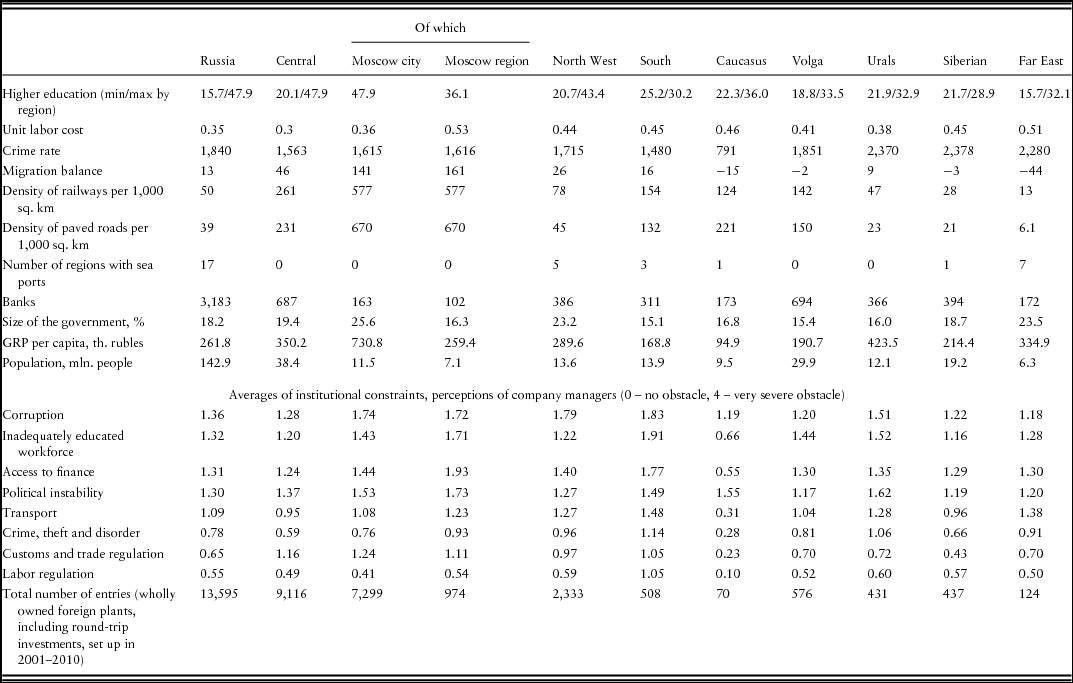
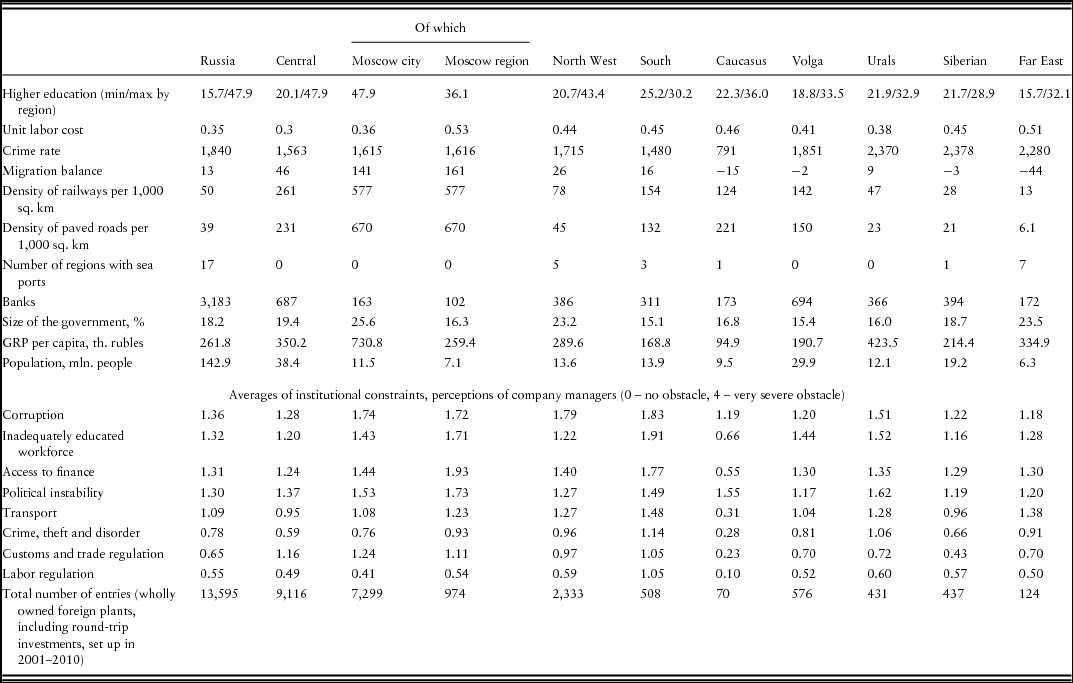
Regional variation of institutions, captured by statistical and BEEPS indicators, are summarized in Table 1. It reports significant diversity between institutions in Russia across macro regions, which range from weak to less weak and even good, raising the possibility that regions are more or less attractive to multinationals depending on quality of their institutions. Variations are particularly marked between indicators for infrastructure quality, crime rates and labor quality. As regards perception-based indicators, corruption is ranked as the most serious constraint in Russia, followed by an inadequately educated workforce, though the order and magnitude of problems are different in various locations, suggesting variation of perceived constraints across regions.
Institutional variation across territorial units within Russia (federal districts), 2010
Sources: sample data, Rosstat, Russian Regions 2011. EBRD-World Bank Business Environment and Enterprise Performance Survey (BEEPS), 2011.
A macro region may rank high on certain business climate and institutional indicators and rank low on others. For example, the Central federal district, which hosts the highest number of multinationals, reports the highest GDP per capita and best transport infrastructure, but confronts serious challenges from political instability. The North West, the second largest FDI host, reports best human capital, but confronts severe corruption problems and a relatively high crime rate. The Southern district, well positioned as regards infrastructure and labor quality, is challenged by the worst business climate constraints of any Russian macro region.
The Moscow agglomeration (city and region), located in the Central district, is distinguished by the best economic institutions, especially gate-away transportation, banking infrastructure and labor market, which provide significant advantage to the region in combination with its large market and high level of development. It remains to be seen if these advantages offset a high crime rate and corruption problems, which are also typical of this location.
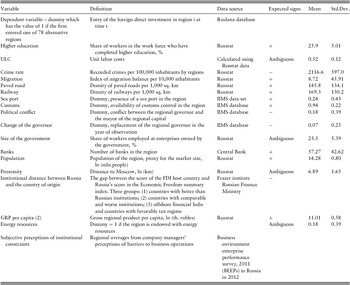
Table 2 reviews the variables used in the analysis, their definition, data sources and the expected sign in the model.
Overview of main variables

(1) Note: summary statistics for 2010, sample data. Averages and standard deviations over regions.
(2) In 2000 prices.
(3) IIMS — Institute for Industrial and Market Studies in the Higher School of Economics (Moscow).
Sources: sample data.
In the first set of regressions with statistical data, the regional labor market is described by three indicators: the share of workers with higher education; unit labor costs; and migration balance. We use unit labor costs rather than wages because, when choosing locations, multinational firms would take into account that the advantages of lower wages may be outweighed by disadvantages of low labor productivity and low skills. In order to take account of the potential effects of political instability, we include an indicator for change of the governor and the existence of conflict between the governor and the mayor of the regional capital. All regressions take account of control for horizontal and vertical types of FDI, including indicators of production costs and trade costs, natural resource endowment, measured by availability of energy resources in the region, and the market size of the host region measured by total population, as well as development level and economic density measured by GDP per capita.
The study uses the economic freedom index compiled by the Fraser Institute (Gwartney et al., Reference Gwartney, Lawson and Hall2012) to measure the institutional distance of Russia from FDI source countries. Among the other indicators, the summary index includes security of property rights, regulation of markets and trade conditions. In our sample the entries from countries with better institutions account for 5,095 plants (of which 12.3% from the US, 12.1% from Germany, 9.6% from the UK). Entries from source countries with same and worse levels of institutional development amount to 1,351 plants (of which 40.2% from Belarus, 26.9% from China and 19.9% from Ukraine).
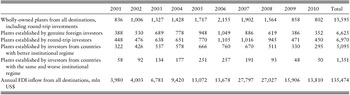
Simple breakdown by these two groups indicates that we cannot explain the recent rise in the number of foreign affiliates by the growth of South-South investments. It remains to be seen whether investments originating from countries with the same or worse institutions are more resistant to weak institutions. We also account for the possible differences in location decisions by round-trip investors, who account for 45%–60% of the total number of entries depending on the time period (Table 3).
Distribution of wholly-owned foreign plants by time of entry and institutional distance of Russia to the country of origin

Sources: sample data, Rosstat, Russian Regions 2011.
Note: Round-trip investors were identified by the source country according to the list of offshore financial hubs, generated by the Russian Finance Ministry in 2012. Those are: Andorra, Anguilla, Antigua and Barbados, Barbuda, Aruba, Bahamas, Bahrain, Belize, Bermuda, British Virgin Islands, Brunei Darussalam, Cayman Islands, Cape Verde, Comoros (Anjouan Island), Cook Islands, Cyprus, Dominica, Dominican Republic, Gibraltar, Grenada, Gurnsey, Hong Kong (China), the Isle of Man, Jersey, Liberia, Liechtenstein, Macao (China), Maldives, Malta, Marshall Islands, Mauritius, Monaco, Montserrat, Nauru, Netherlands Antilles, Niue, Palau, Panama, Saint Kitts and Nevis, Saint Lucia, Saint Vincent and the Grenadines, Samoa, San Marino, Seychelles, Timor-Leste, Turks and Caicos Islands, United Arab Emirates, Vanuatu.
It is possible that round-trip investors have more bargaining power in negotiations with local authorities compared to other investors, are more immune to corruption, suffer less from information asymmetry and are less sensitive to political conflict. On the other hand, the origin of round-trip investors is not homogeneous: while safety of the investment was the prime criterion for the first generation of round-trip investors, more recent round-trippers are more interested in finding investments, which will complement an existing value chain (Kalotay and Sulstarova, Reference Kalotay and Sulstarova2010). Available empirical analysis (Ledyaeva et al., Reference Ledyaeva, Karhunen and Kosonen2013b) reported evidence that round-trip investments to Russia (Cyprus and BVI were selected for benchmarking) could not be explained within traditional international investment theory and that location strategies of round-trip and genuine affiliates differ, the first being motivated by access to natural resources and immune to high levels of corruption.
In this paper, round-trip investors were identified according to the full list of offshore financial hubs, published by the Russian Finance Ministry in mid-2012. Obviously, source countries with a favorable tax regime generate both round-trip and genuine foreign investors, and specific countries may be more or less attractive to the former and the latter. But we think that risk of distortion outweighs any possible gains from being selective about the countries with favorable tax regimes, which we use to count round-trippers.
We are particularly interested in the effects of corruption. The match between theory and empirical results in the estimation of corruption as a barrier to foreign investors is complicated by imperfect measurement of subnational corruption. The findings of existing literature on Russia depend on the data source and type of corruption measured. The Moscow Carnegie Center has measured the intervention of business elites in the political decision-making process. This measurement was employed by Ledyaeva et al. (Reference Ledyaeva, Karhunen and Kosonen2013a) to assess the impact of corruption on FDI location, and led the authors to the conclusion that regional corruption had a negative impact on the location decision by foreign investors. Brock (Reference Brock2005), in turn, used the corruption index compiled by Transparency International in Russia, based on interviews with entrepreneurs measuring the respondent's personal experience of corruption, though this experience was mainly acquired in such situations as medical treatment, policing of road traffic and higher education. Brock reported that regional corruption does not put a brake on growth, but influences the way in which FDI has impact on regional economies.
An ideal corruption index should probably consider all types of corruption, including impact on and perceptions of all social groups (Dininio and Orrtung, Reference Dininio and Orttung2005), and be measured annually to capture time variations. Such an ideal index is not currently available. In the present paper we assume that everyday corruption, measured by personal experience of bribery, or distortions in the local political process, causes less damage to location decisions of multinationals than bribes paid by firms in their dealings with government officials, which may affect the fixed and operational costs of doing business. Given the available data and the specificity of our research task, we rely on the perceptions of corruption by company managers.
4. Model
Our model employs data about location decisions by foreign firms across Russian regions, assuming that the decision to invest in Russia had already been taken prior to the decision on where exactly to place the investment within Russia. Each investment decision may be understood as a discrete choice made from 78 alternatives. So each of the investments is counted in the database 78 times (representing 78 regions covered by the research), taking the value of 1 for the region, which received the investment, and 0 for other regions.
More than half of total entries of multinationals to Russia between 2001 and 2010 were directed to the city of Moscow and Moscow Region. Therefore, we may assume that not all alternatives can be interchangeable and that the location choices are most likely to have a nested structure. The assumption that location choice by foreign investors may have a nested structure is made in such papers as Disdier and Mayer (Reference Disdier and Mayer2004) for the choice by French multinationals between location in Western or Eastern Europe and Lee and Hwang (Reference Lee and Hwang2014) for the decisions by foreign investors between the Seoul metropolitan area and the rest of Korea.
Thus, a foreign investor chooses from among 78 locations in Russia in two steps. In the first step, the company chooses between two nests – the Moscow agglomeration (the city of Moscow and Moscow Region) and all other Russian regions. The status of Moscow and Moscow Region as first choices for investors may reflect their superior institutions (financial, physical and gateway infrastructure, access to regulatory and fiscal authorities), as well as their advantages of market size and level of development. In the second step, the investor chooses a particular location within the nest.
The choice is determined by the profit, which firm i could receive in region j
 \begin{equation*}
{\rm \pi }_{{\rm ij}} = {\rm V}_{{\rm ij}} + {\rm \varepsilon }_{{\rm ij}} = {\rm \alpha x}_{{\rm ij}} + {\rm \varepsilon }_{{\rm ij}} ,\end{equation*}
where xij is the vector of regional and company attributes, α is the vector of estimated coefficients and εij is unobserved region-specific or company-specific characteristics.
We denote by K the number of alternatives at the top level of the decision tree (in our case K = 2) and by J the number of alternatives at the bottom level. The set of errors εi1 . . . εiJ are assumed to follow the generalized extreme-value distribution. This type of distribution allows for correlation within each nest. In the nested logit approach it is assumed that for any two alternatives within one nest εij are correlated, but for any two alternatives from different nests εij are not correlated. In this case, the independence of irrelevant alternatives (IIA) assumption is assumed to hold within the subgroup but not across subgroups. Let ρk denote the correlation within nest k (k = 1. . . K) and define 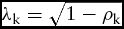 ${\rm \lambda }_{\rm k} = \sqrt {1 - {\rm \rho }_{\rm k} } $.
The subgroups of regions belonging to the two different nests are mutually exclusive. Thus the probability that the firm i chose the alternative j could be written as a production of marginal and conditional probabilities
 \begin{equation*}
\Pr \left( {\rm j} \right) = \Pr \left( {{\rm j|B}_{\rm k} } \right){\rm Pr}\left( {{\rm B}_{\rm k} } \right),\end{equation*}
where Bk is the set of alternatives in nest K.
If we decompose Vij into two components, Wik (which depends only on characteristics that differ over nests) and Yij (which depends on characteristics that describe alternative j), i.e. πij = Vij + εij = Wik + Yij + εij, then probability that the firm i chose the alternative j is expressed (see Train, Reference Train2009) as
 \begin{equation*}
\Pr \left( {\rm j} \right) = \frac{{{\rm e}^{{\rm Y}_{{\rm in}} /{\rm \lambda }_{\rm k} } }}{{\mathop \sum \nolimits_{{\rm j} \in {\rm B}_{\rm k} } {\rm e}^{{\rm Y}_{{\rm ij}} /{\rm \lambda }_{\rm k} } }}\frac{{{\rm e}^{{\rm W}_{{\rm ik}} + {\rm \lambda }_{\rm k} {\rm I}_{{\rm ik}} } }}{{\mathop \sum \nolimits_{{\rm k} = 1}^{\rm K} {\rm e}^{{\rm W}_{{\rm ik}} + {\rm \lambda }_{\rm k} {\rm I}_{{\rm ik}} } }},\end{equation*}
and 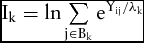 ${\rm I}_{\rm k} = \ln \mathop \sum \limits_{{\rm j} \in {\rm B}_{\rm k} } {\rm e}^{{\rm Y}_{{\rm ij}} /{\rm \lambda }_{\rm k} } $ is the inclusive value.
This nested logit (NL) model is estimated by the maximum likelihood method. After estimating the baseline model, we check the relevance of the NL model and the existence of a systematic difference between estimators in the Moscow agglomeration and in the other regions, using the test statistics. Dissimilarity parameters (λk,) which are based on the estimations of correlation between nests, and the results of the LR (the likelihood ratio) test for IIA confirm the nested structure of the decision-making process and suitability of the NL model.
5. Results
The first explanation of the puzzle: regional heterogeneity of institutions
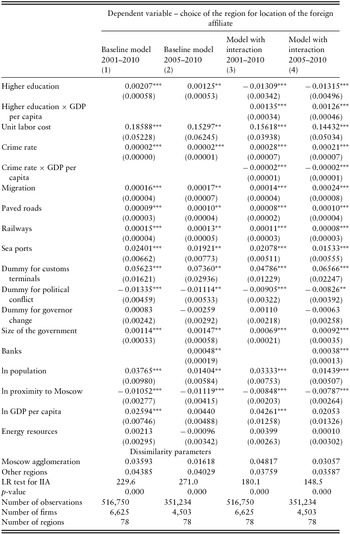
Firstly, we estimate the impact of formal institutions, physical and financial infrastructure and human capital on the probability of a region receiving a wholly-owned foreign affiliate. The intention is to check the hypothesis that some regions have developed fairly good institutions, which outperform national levels and compete successfully for FDI. It can be seen that all significant variables of interest, except for the crime rate, are signed as expected (columns 1 and 2 in Table 4). We see that foreign investors prefer geographically close regions, which offer a combination of relatively large and developed markets with reasonably good transportation, financial and gateway infrastructure. Regions with ports host many more foreign firms. Restricting the sample to 65% of the total number of observations for the time period 2005–2010 does not change the basic results for the full period of analysis.
Institutional barriers to FDI entry: full sample baseline model and model with interaction

Nested logit estimations; Standard errors in parentheses; *** coefficient significant at 1% level. **significant at 5% level. *significant at 10% level.
Round-trip investors are excluded.
As regards labor costs and education, we see that investors prioritize regions that have a highly educated and skilled labor force. A positive sign for the variable of unit labor costs also reflects interest in skill and productivity rather than low costs, thus rejecting the vertical FDI concept, which supposes that multinationals look for low labor cost locations in developing countries.
Different types of political instability have different impacts on location decisions: if the region is characterized by acute political conflict between the mayor of the regional capital and the regional governor, investors are discouraged, but rotation of the governor does not affect the decision on entry.
The size of the government has strong positive impact on the likelihood of entry, thus proving that functional institutions guaranteed by government activism are more important for multinationals than possible crowding out and suppression of local entrepreneurship by the oversized state. We cannot exclude that possible future privatization of large state-owned assets operates as an FDI incentive, if expansion is planned.
The finding that investors are unconcerned by the crime rate in the region conflicts with earlier works (for instance, Brock, Reference Brock1998). The possible reason for this ‘counter-intuitive’ result might be that the baseline model masks potential heterogeneity in the relationship between the regional crime situation and FDI entries. Criminality may matter more for poorer regions, while opportunities in highly developed territories substitute for this weakness. We therefore suppose that the impact of the crime rate may vary across regions with different development levels, testing for difference in the reaction of multinationals to the risks associated with criminality. We test the hypothesis by checking the sign and significance of the coefficient for an interaction constructed by the indicator variable for regional standards of living and a measure of the crime rate. The standard of living would be effective in making multinationals less deterred by regional criminality if the coefficient for the cross term is found to be negative and significant. The results in columns 3 and 4 of Table 4 proved that this assumption is correct. The higher the development level of the region, the less multinationals are deterred by criminality, and for 59% of entries impact of the crime rate on the probability of entry is significantly negative. This provides evidence that the impact of criminality on the decision where to locate affiliates is not homogenous, and should take local development levels into account. Given that, our model foresees a hierarchical two-level decision-making process with the Moscow agglomeration at the upper nest level, the results reflect the specificity of the capital region, where most institutions outperform national averages. When institutions of the capital district are weak (the high crime rate is an obvious example), this weakness is counterbalanced by a relatively high development level.
Interaction between education and the regional development level proved that the positive effects of higher education grow with increase of the regional development level. The finding also confirms that a high-skill level is insufficient to outweigh a weak economic situation and make a region attractive for multinationals.
Breakdown by institutional distance to the home country
Next we test the hypothesis about possible FDI-stimulating effects due to lower sensitivity of investors from countries with similar or worse institutional environments to the weaknesses of infrastructure and institutions in the host region. We split the sample into two subsamples of origin countries with institutions better than Russia and with institutions of the same or worse quality than Russia.
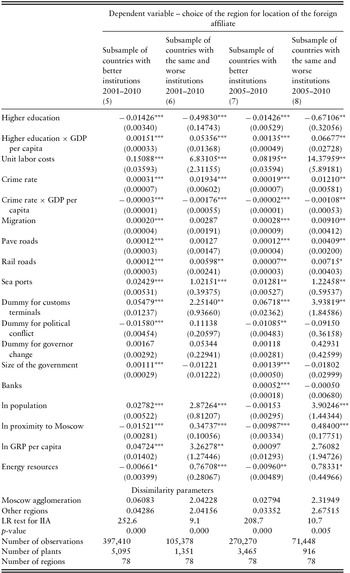
Table 5 shows that location strategies of multinationals may be explained by their country of origin and that some difference in sensitivity to institutional weaknesses on the part of distanced and close multinationals does exist. The results prove that multinationals from source countries with the same or worse quality of institutions are more immune to political conflict, less dependent on weak physical infrastructure, do not depend on the size of the government and are ready to invest in remote regions. Financing opportunities for local firms, customers and consumers encourage investors from developed countries more than other multinationals, suggesting that the former are more likely to localize production and expand. Regions, which attract labor migrants appear preferable for affiliates of foreign investors from institutionally superior home countries, although the difference in preferences changes over time and becomes smaller in the late 2000s than earlier.
The influence of regional institutions on FDI entries depending on the institutional distance to the home country

Nested logit estimations. Standard errors in parentheses; ***coefficient significant at 1% level, **significant at 5% level, *significant at 10% level.
Round-trip investors are excluded.
However, the findings from the present study do not provide sufficient evidence to support the notion that multinationals always prefer to invest in locations with minimal institutional distance to the home country. This refers particularly to the differences found in the effects of size of government. The finding that multinationals from institutionally superior countries are strongly attracted to regions with a more activist state suggest that the expropriation risk in state-dominated regions is outweighed by the functionality of the state in codifying and protecting foreign property, running infrastructure and overseeing other collective actions relevant to investors. Thus the Russian data are consistent with the previous political economy literature, which states that property rights depend on the state to a greater extent than on the formal legal system (Djankov et al., Reference Djankov, La Porta, Lopez-de-Silanes and Shleifer2002) and that the size of government is strongly associated with the rule of law and political stability (Holcombe and Rodet, Reference Holcombe and Rodet2012). This finding also may demonstrate that mature multinationals from developed countries are more effective in seeking help from the host state through political connections than their peers from new source countries having the same or worse institutions than Russia. As Dreher et al. (Reference Dreher, Nunnenkamp and Vadlamannati2013) suggest, this effectiveness may be attributed to the bargaining position of the investor vis-à-vis the host location, which in turn depends on superior technological and managerial knowledge, access to capital, the size of operations and international experience.
Accounting for round-trip investors
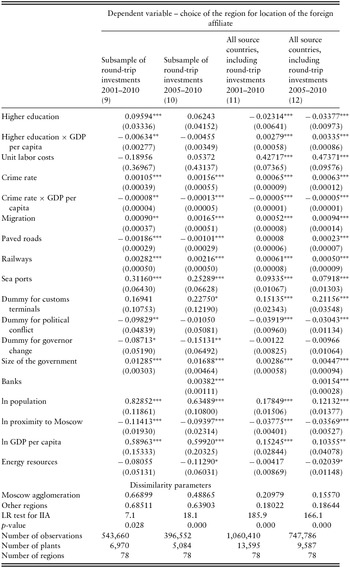
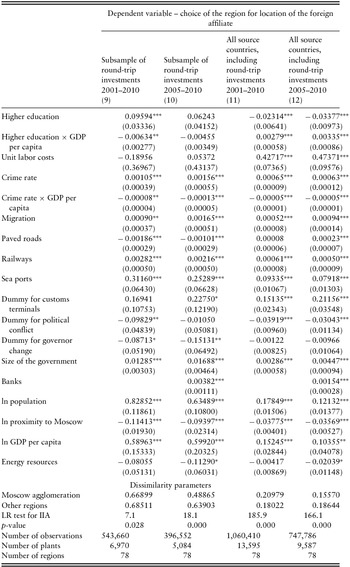
We have included round-trip investors in the database in two specifications (Tables 6 and 7), suggesting that their decision to establish a new plant in Russia could be regarded as the decision of investors with the least institutional distance to the host. If round-trip investors are less sensitive to weak institutions than genuine foreign investors, then in at least half of cases the overall growth of FDI to Russia may be attributed to this immunity, which would go far to explain the puzzle that the present article is addressing.
The influence of regional institutions on round-trip investors
Nested logit estimations. Standard errors in parentheses; ***coefficient significant at 1% level, **significant at 5% level, *significant at 10% level
Alternative measurements of regional institutions – perceived institutional constraints depending on the institutional distance to the source country

Nested logit estimations. Standard errors in parentheses; ***coefficient significant at 1% level, **significant at 5% level, *significant at 10% level.
Note: Because of the high correlation between perceptions of constraints, each coefficient was estimated in a separate regression. All regressions include controls for the region's population, proximity, GDP per capita and human capital (not reported for conciseness). Results for controls and post-regression LR test for IIA, are available upon request.
In fact, this hypothesis does not stand up, and the pattern of location decisions by round-trip investors does not fully correspond to our expectation, appearing to be less dependent on some weaknesses and more dependent on others. The findings imply that factors, which facilitate entry by round-trip and genuine foreign investors, are in general much more similar than we might have expected to be the case. Both groups prioritize large and wealthy regions, which are located closer to Russia's western border, benefit from good transportation, financial and trade infrastructure, and have large-sized government. When genuine and round-trip investors are merged in one sample (columns 11 and 12 of Table 6) most results remain unchanged, proving that differences between the location decisions of round-trip and genuine investors are minimal.
The major differences between genuine and round-trip investors relate to labor markets and political instability, measured by governor change. While genuine investors locate in regions supplied with educated, productive and skilled labor (see columns 1 and 3 in Table 4) round-trip investors choose locations with low costs and low skills, suggesting their greater involvement in vertical projects that are not skill-intensive (columns 9 and 10 in Table 6). The same result is reported by Dreher et al. (Reference Dreher, Nunnenkamp and Vadlamannati2013) for India, where non-resident Indians, roughly comparable to round-trip Russian investors, are less reliant on skilled local labor than FDI from other sources. In addition, governor change in the regions significantly discourages round-trip investors, a factor which is completely irrelevant for genuine investors. We suggest that the competitive advantages of round-trip investors are more dependent on bargaining power in negotiations with regional administrations. When the governor is changed, this bargaining power diminishes, de-motivating entry. However, between 2005–2010 (the period when financial infrastructure is included in the model), the effect of political instability for round-trip investors stays negative, but becomes insignificant.
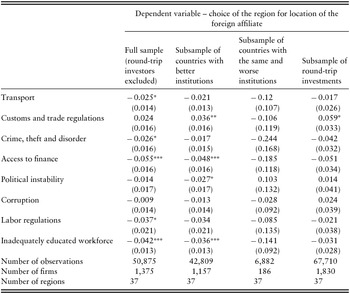
It is interesting that almost the same result is achieved when we use the perceptions of managers as measurements of institutional constraints (Table 7). Round-trip investors are not disturbed by perceptions of political instability in the regions, low labor skills and problems with labor market regulation, while investors from countries with better institutions react negatively to these constraints.
Accounting for corruption and other subjective perceptions of institutions
Table 7 reports the regression results of the model, in which we specifically address corruption as a location determinant and check the robustness of our previous results. In these specification institutions, human capital and infrastructure are measured by the regional averages of the subjective perceptions of company managers rather than aggregated statistical data. To account for the institutional distance hypothesis, we run a regression on the full sample of genuine investors and subsamples of plants, including the subsample of round-trip investors, by institutional distance to Russia.
Change of measurements and restricting regressions to the smaller number of regions and shorter time period generates almost identical results to the baseline specification. In the full sample, almost all indicators of perceived constraints show the expected coefficient signs, while inadequacies of financial infrastructure and labor skills bother investors more than any other institutional problems. In addition, transportation problems, crime, theft and disorder, as well as labor regulation, significantly de-motivate FDI entries. Contrary to expectations, problems with customs regulation increases FDI. This result is similar to that reported by Kinda (Reference Kinda2010) for the sample of firms in 77 developing countries. He explained the inverse sign by the prevalence of horizontal motives, when trade barriers motivate the switch from trade to investment.
Some regional institutional constraints matter more for firms from institutionally better source countries than for the full sample or countries with the same of worse institutions than Russia. These results confirm relative immunity of multinationals from countries with the same and worse institutions to political instability and problems with financial infrastructure. The only difference in the results refers to the effects of skills, which prove to be positively important for both groups of investors if measured by statistics, but only show a significant importance for the decision to enter by distant multinationals when subjective perception of skill constraints are estimated. We might link this difference to the measurement and time problem: the significance of human capital as measured by the share of workers with higher education reduces in time for multinationals from institutionally similar or worse home countries, proving that they are less likely to be engaged in skill-intensive production and services.
The insignificance of corruption, contrary to our expectation and previous results on Russian data, presents a puzzle. The sign is negative but insignificant for genuine investments and positive but insignificant for round-trip investors, suggesting slightly higher immunity of round-trip investors to corrupt locations. Following Fan et al. (Reference Fan, Xu and Yeung2009), who also reported insignificance of freedom from corruption as a determinant of FDI location, we suggest that when foreign investors regard bribery as a cost of doing business, and these costs are recouped, FDI might proceed in spite of this barrier. Moreover, the finding implies that subnational distribution of the level of corruption is less important in a country, which exhibits overall high levels of corruption, and that, if this impediment did not prevent the initial decision to enter Russia, the subnational variation becomes less important.
6. Conclusions
The present study attempts to explain why foreign investors entered the Russian market en masse in the 2000s, despite weak institutions. Our empirical tests identify at least two reasons. First, foreign investors responded positively to improved quality of institutions, infrastructure and human capital in specific regions, which offer a combination of wealth, reasonably good institutions, consumer demand and political stability. So it is reasonable to suggest that a higher development level can outweigh some institutional inadequacies, notably the crime rate and corruption. This compensation (‘bypassing’ as we put it in the title) is especially typical for the relatively developed Moscow agglomeration, which hosts more than half of foreign plants in spite of problems with crime and corruption. The second explanation lies in the geographical structure of inward investments: investors from source countries exhibiting comparable institutional environments appear to be more immune to some institutional inadequacies, particularly political instability. Contrary to the finding of Ledyaeva et al. (Reference Ledyaeva, Karhunen and Kosonen2013b), we did not find strong evidence to suggest that round-trip investors from Russia ignore corruption when making location decisions. On the other hand, we have used a different measure of corruption and a much larger list of home countries for round-trip investments, and our results suggest only slight difference in attitudes. In most cases, investors originating from offshore financial hubs follow the behavior pattern of genuine foreign investors, except that the former pay less regard to skill levels and labor costs. Round-trip investors are more sensitive to governor change in the regions.
These empirical findings have important policy implications. The government could use policies that promote desirable FDI (technologically advanced, targeting activities with more value added) by improving regional institutions, at least those aspects of regional institutions to which such most-wanted investments are particularly sensitive. There is not much that government can do, when designing policy to attract foreign investors, about geography and climate, but it can have impact on political conflict, local physical and financial infrastructure and human capital. Also, it seems misguided to erect barriers to round-trip investors or investors from countries with the same and worse institutional environment, since they are willing to work in regions, which will remain unattractive to multinational majors for quite a long time to come, and to contribute to the development and wealth of such regions. And, finally, given that political conflict is the biggest disincentive to investors from institutionally superior countries, it is not hard to predict severe reduction of entries in response to the political conflicts of 2014–2015. Combination of increased political risk, sanctions imposed by source countries with superior institutions and discrimination against certain multinationals imposed by the Russian government in response to sanctions will tend to accelerate the disinvestment process.
This study has some limitations and could be improved by means of various extensions. Firstly, we have not looked at the cross-regional variation of institutional distance to source countries, mostly because of data limitations. Secondly, we still do not know much about the role of institutions in the round-tripping phenomenon. We showed some differences in sensitivity of genuine and round-trip investors to regional institutions, but it would be interesting to investigate why capital of Russian origin came home in the 2000s in the absence of preferential tax incentives granted to foreign investors, while such incentives have been highly important for Chinese round-trippers. Introducing firm-level heterogeneity into the model would also enrich our understanding of the role of subnational institutions in FDI location decisions.
Acknowledgements
We thank the Basic Research Programme at the National Research University–Higher School of Economics (Moscow) for funding support and participants of the 25th Annual Conference of the European Association for Evolutionary Political Economy (EAEPE) for valuable comments and suggestions.