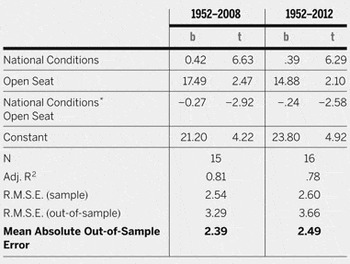
The Incumbency and National Conditions (presidential approval and aggregated personal finances) Model predicted President Obama would garner 47.9% of the two-party vote, whereas he ended up with 51.8% (based on available information on December 3, 2012). The error in this forecast (3.9 points) is somewhat higher than the average out-of-sample error from 1952 to 2008 (2.4 points). Although the forecast was off the mark, the addition of the 2012 result to the data set does little to change the slope estimates, and the overall fit of the model is only slightly worse (table 1).
Incumbency-Based Forecasting Model for US Presidential Elections

Note: The dependent variable is the percent of the two-party vote won by the incumbent presidential party.
The updated model still points to the importance of incumbency as a conditioning variable: incumbents are given more blame or credit for existing national conditions. In 2012, President Obama did not bear the full brunt of tepid approval ratings and generally negative evaluations of personal finances. There are a number of plausible explanations for this—including differences in campaign strategies—and they all may have played some role. From the perspective of a forecasting model, however, the 2012 election represents another useful data point to add to the pool of experiences from which we can generate future predictions.