

Introduction
The former Italian Prime Minister Matteo Renzi declared, in June 2017, that ‘we have to decrease the flow of asylum-seekers landing in Italy, because the system cannot cope with these unsustainable numbers’ (La Stampa, 2017). It is a common understanding that asylum-seeking migration represented a significant challenge and threat to the Italian political system between 2014 and 2018. This article questions this idea of asylum as a mere exogenous shock to the governance system and, rather than examining the constitutive effects of asylum-seeking migration on governance, shows how the Italian governance system has also contributed to constitute asylum-seeking migration as a social and political problem.
The main purpose of this article is, indeed, to identify the operational and constitutive effects of governance systems on the asylum issue. To do this, it elaborates an actor-centred approach, using qualitative and quantitative methods, which leads to an investigation of who the key actors are, how they frame and make sense of the issue, produce meanings and understandings of problems, and develop actions or inactions based on these understandings. The approach developed is applied to the empirical case of the Veneto region, characterized by high levels of political contention around asylum, the dominant presence of the populist right-wing Lega Nord, and a weak and contested reception system for asylum-seekers. The region represents a powerful heuristic case that enables to illustrate the value of the approach and the wider conceptual claims.
The article investigates three key questions:
First, how do actors understand and make sense of asylum-seeking migration and how do they elaborate policy strategies and act upon these understandings? Addressing this question means investigating the often-neglected cognitive dimension of governance. The impact of anti-migrant attitudes on the strategic preferences of political parties and policy-makers, for instance, is often taken for granted (Gianfreda, Reference Gianfreda2018, 7), but how do political actors really understand, during the asylum crisis, ‘what is going on around them’ and how do they decide ‘what to do next’? How do they make sense of the effects of asylum-seeking flows and the challenges around them? To what extent and how do anti-immigrant attitudes influence their strategies and decisions? The first part of this article tackles these questions by investigating actors' perceptions and ‘sensemaking’, and the social context within which their understandings emerge and have effects.
Second, this article examines the role of politics in asylum governance and asks: How did actors' strategies influence asylum policy-making processes? The widely recognized failures of Italian authorities in attempting to cope with migrant reception are often considered to be the outcome of structural inefficiencies (D'Angelo, Reference D'Angelo2018). But how have these failures been influenced by political dynamics or the ‘politics of policy-making’ (Baldwin-Edwards et al., Reference Baldwin-Edwards, Blitz and Crawley2018) that is by the ideological profile of the actors involved, their power, positioning and behaviours? To answer this question, social network analysis (SNA) is used, to investigate actors' interactions and power dynamics.
Third, how did policy-making, politics and public contestation interact in shaping asylum governance? The ‘regulatory dimension’ and the ‘public reaction dimension’ of the Italian asylum crisis are often analysed separately and independently from each other (Castelli Gattinara, Reference Castelli Gattinara2017: 319), but what are the interconnections between the two? What is the interplay between anti-immigration attitudes and anti-refugee campaigning, asylum policy-making, and politics in the active constitution of the Italian asylum crisis? By dealing with these questions this article will reveal the effects of the politicization of asylum governance.
The article is organized as follows. The first section describes the analytical framework and explains its potential to fill gaps in the existing literature. The second and third sections focus on case selection and methods. The fourth section investigates actors' understandings and sensemaking based on insights from 43 interviews conducted in the Veneto region in late 2017, while the fifth section develops a SNA elaborating data collected through structured questionnaires.
Opening the ‘black box’ of asylum governance
This article complements and challenges the existing literature on asylum governance in Italy. While many scholarly works have produced important insights on the outcomes of the asylum crisis (Castelli Gattinara, Reference Castelli Gattinara2017; D'Angelo, Reference D'Angelo2018; Gianfreda, Reference Gianfreda2018) they share at least two common features. First, in line with most migration governance research, these works tend to neglect the endogenous processes whereby policy actors shape asylum-seeking migration as a policy problem,. Second, they almost exclusively focus on (and tend to judge asylum governance by) the observed ‘outputs’ of the governance process, such as the inefficiencies of asylum management and the political contestation over migration. Some contributions extrapolate back from these ‘outputs’ some assumptions about how actors understand migration, how they elaborate their strategies and make their decisions, but fail to specifically address these elements. Anti-migrant public attitudes, for instance, are often assumed to influence both asylum politics (Gianfreda, Reference Gianfreda2018: 8) and asylum policies (Castelli Gattinara, Reference Castelli Gattinara2017: 328). The link between anti-migrant attitudes and actors' strategies, however, has not been properly investigated so far.
Conversely, this article, first, aims to correct the tendency to treat asylum-seeking migration as a purely external shock to governance systems. It applies the perspective specified by Zolberg (Reference Zolberg1989), according to which migration is made visible as a social and political issue by how the political system is organized, who the actors are, and how they play a role in defining the issue. I thus place more emphasis on endogeneity, by analysing the extent to which asylum-seeking migration is dependent on the operational effects of the governance system. To do so, I adopt an actor-centred perspective – considering the role played by all the actors involved in asylum governance (Table 1) – and analyse how asylum governance is constituted and operates through their actions and inactions.
Actors involved in Asylum Governance in Veneto

Second, this article focuses specifically on the context of decision and on actors' perceptions and strategies. This analysis seems relevant in the context analysed. Brunsson (Reference Brunsson1985), indeed, showed the potential decoupling of ideas and actions in the political process. This is particularly true in situations of crisis when interpretations of the effects of external environments powerfully drive decision-making preferences. I will specifically focus on actors' understandings of the effects of asylum-seeking migration, which, following Pierre (Reference Pierre2000), form the basis for an answer to the two key questions that actors face when they have to take decisions in situations of crisis that is ‘what is going on?’ and ‘what should be done next?’.
I will thus pay attention to actors' understandings and actions, but also to the social and relational context in which they operate. Such context is assumed to play a key role in influencing how these understandings are developed and processed to shape actions (Bevir and Rhodes, Reference Bevir and Rhodes2003: 4) but also to be significantly shaped by actors' decisions (Hay, Reference Hay2002: 128).
To open the ‘black box’ of asylum governance, this article develops a ‘macro-micro-macro’ approach (illustrated in Figure 1) inspired by Coleman's theory of the behaviour of social systems (Reference Coleman1990: 19). The approach is based on three components: a micro component, which investigates individual actions and their cognitive foundations; a micro-to-macro component, which – assuming that it is possible to explain the behaviour of social systems by looking at the behaviour of its parts – assesses the impact of these micro-foundations on ‘policy outputs’, that is the macro characteristics of the system; and a macro-to-micro component, which aims to investigate the impact of macro policy outputs on micro-level understandings.
The analytical framework.

To assess the micro-level component, I draw concepts and ideas from two largely separate literatures that have addressed the process by which the meaning of events is constructed and translated into action: the framing perspective and the sensemaking approach. Framing theories are often applied in political science, although most of the literature examines ‘frames of communication’ (Gianfreda, Reference Gianfreda2018; Urso Reference Urso2018), and largely neglects ‘frames in thought’ that is the ‘micro’ cognitive dimension of the framing process (Scheufele, Reference Scheufele1999: 106). Conversely, I focus on ‘cognitive frames’ to extrapolate the set of dimensions that drive individuals' processing of information and understanding of events.
The sensemaking approach has been mostly developed in organizational studies (Weick, Reference Weick1995, Reference Weick2001) and emphasizes how actors form an understanding of the situations they find themselves in and assign meaning to novel, unexpected or confusing events. Applying concepts and ideas from this approach seems particularly relevant to study asylum governance in the context of the Italian refugee crisis: sensemaking, indeed, is specifically salient in situations of ambiguity or uncertainty, when individuals must develop some sort of sense regarding what they are up against, what their own position is relative to what they sense, and what they need to do (Helms Mills et al., Reference Helms Mills, Thurlow and Mills2010: 184).
Fiss and Hirsch (Reference Fiss and Hirsh2005: 30) explain that the framing and sensemaking perspectives are ontologically, methodologically and ‘conceptually compatible’. Following Bird and Osland (Reference Bird and Osland2005: 125), I will investigate framing and sensemaking together, analysing in sequence: (a) how political actors in Veneto frame the situation; (b) how they make attributions or assign meaning to this situation; and (c) the script they select, based on these understandings, to guide their actions. Importantly, while most of the literature in organizational studies tend to focus on decisions as the main output of the sensemaking process, I will also focus on indecisions and strategic issue-avoidance.
Assessing the implications of these micro-level mechanisms at the macro level requires investigating actors' relations, power and influence. In the second part of my analysis I will thus adopt a quasi-sociological approach to SNA, focused on actors' roles and understandings, to specify the composition of the asylum governance network, identify some of its key features and ‘relational aspects’ (Geddes and Taylor, Reference Geddes and Taylor2016: 590) and analyse how beliefs and actions of individuals within networks are located within the social and political context of network relations. Assuming that power within the governance network is associated with actors' capacity to direct and control flows of information and understandings (Castells, Reference Castells2009), I will explore the different forms of power that actors exert within the network and the extent to which actors mobilize to activate the network's relational potential.
Examining the macro-micro transition, finally, requires assessing the impact of macro policy outputs (asylum policies, political and public contestation) on actors' frames. While an in-depth assessment of frame emergence goes beyond the scope of this article, I use insights from framing theories (Druckman, Reference Druckman and Keren2011), to draw some plausible conclusions on these processes.
The Veneto region
While the claim made by this article is primarily conceptual and methodological, the approach developed is applied to the case of Veneto, a powerful ‘heuristic case’ (Eckstein, Reference Eckstein, Greenstein and Polsby1975), selected for its high explanatory value, which allows to illustrate the value of the conceptual and methodological claim made, showing how the strategies of political actors constituted asylum governance and contributed to shape the asylum crisis there.
Veneto represents an ideal case for at least three reasons.
First, it is a great case for its political tradition and the party actors involved in the asylum governance system. One of the wealthiest regions in Italy, it is characterized by a strong sense of regional identity and, since the early 1990s, its small and medium-sized towns, characterized by relatively high levels of migration, represent the strongholds of the Lega Nord (LN), which became the dominant party of the region after it gained the governorship in 2010 and progressively relegated Berlusconi's Forza Italia to a marginal position in the ‘centre-right’ coalition which governs the region since the 1990s. While the LN's ideology is traditionally best defined as ‘regionalist populist’ (McDonnell, Reference McDonnell2006) and ‘anti-system’ (Hepburn, Reference Hepburn2009), since the early 2000s its leaders radicalized the party's position on immigration, increasingly framed as a threat to the survival of the culture and identity of northern Italians. These anti-immigration stances became even more central in the LN's propaganda under the recent leadership of Matteo Salvini, who dismissed the regionalist element of the LN's ideology turning it to ‘an empty form of nativist nationalism’ (Albertazzi et al., Reference Albertazzi, Giovannini and Seddone2018: 645). Politicians from the LN are expected to use securitized and nativist frames while describing the effects of asylum-seeking migration, and to oppose asylum-seekers' reception.
The heuristic value of the case is increased by the significant political variation within the region (Figure 2). The dominant presence of the LN in Veneto, indeed, was partially contrasted by the centre-left Partito Democratico (PD), which in 2017 controlled a significant number of municipalities, its leader Renzi being particularly appealing to moderate northern middle-class during the first half of his mandate (Pasquino and Valbruzzi, Reference Pasquino and Valbruzzi2017). The party controlled the national government until 2018 and its mayors are therefore expected to support asylum-seekers' reception and actively cooperate with national authorities. Furthermore, a significant number of municipalities in the region was governed, in 2017, by independent Mayors, supported by so-called ‘liste civiche’, not affiliated to any of the dominant parties. These mayors are fringe actors, which can be distinguished from traditional party actors for their different eligibility to government that is for not having any aspiration to govern at the national level. Overall, this significant political variation within the region is expected to shape a very polarized governance network and to increase the importance of political and/or symbolic considerations in the decision-making process.
Number of Venetian municipalities led by the different parties in early 2017 (source: www.comuniverso.it).

The second reason why Veneto is a great case is related to the exposure of the region to the asylum issueFootnote 1 and the high levels of opposition to asylum-seekers' reception. Extreme right street-based movements such as Forza Nuova and Casapound, during the asylum crisis, were particularly active in anti-refugee campaigning (Lunaria, 2017), and many anti-migrant local committees were constituted throughout the region by private citizens. As shown in Figure 3, the region was characterized, in 2016, by the highest number of anti-migrant protests of the country. While opinion polls available suggest that public attitudes on immigration do not vary significantly across Italy (Genovese et al., Reference Genovese, Belgioioso and Kern2016: 9), data from the Flash Eurobarometer 2018 suggest that the immigration issue is more salient in Veneto then in the rest of the country (for 32% of Venetians this is the first issue of concern). Importantly, 10 interviews conducted, as part of a wider study, with high-level officials in the Ministry of Interior and other national decision-makers in 2018 revealed that this high level of political contestation in Veneto powerfully influenced their understandings of the asylum crisis and their policy choices. The former Interior Minister Minniti himself declared to ‘La Repubblica’ in 2017 that it was the raising pressure coming from Mayors and their concerns over asylum management that made him conclude that new restrictive policies on immigration were necessary (La Repubblica, 2017). The many anti-refugee protests organized around the region are thus expected to influence actors' perceptions and to largely constrain actors' agency.
Number of anti-migrant protests in the nine biggest Italian regions in 2016 (source: Lunaria 2017).

The third reason, finally, is related to the weakness of the regional reception system, compared to those of other Italian regions. In 2017, indeed, Veneto was characterized by a very unequal dispersal model: only 290 out of 571 municipalities were hosting asylum-seekers, while 121 of them hosted a share which was higher than the target threshold established by the National Association of Italian Municipalities (ANCI) and the Ministry of Interior. In the same year, among the nine biggest Italian regions, Veneto also had the lowest percentage of asylum-seekers hosted in the SPRAR system – the structured national reception system organized around small reception structures directly managed by local authorities – while most of them were hosted in emergency centres, under the control of the prefectures (the local representatives of the Minister of Interior). These centres included the so-called Centres of Extraordinary Reception (CAS), managed by private actors, and the so-called ‘regional hubs’, huge first reception centres permanently hosting hundreds or, in some cases, more than a thousand asylum-seekers (Figure 4).
Asylum-seekers in different types of reception centres, in the nine biggest Italian regions (2017).

These reasons make Veneto a case with a very high heuristic value, with the potential to show the illustrative value of the approach developed, offering real insights into the politics of governance. While the case is not representative of the entire country, a cross-regional comparison goes beyond the scope of this single article. The study, however, is replicable in other contexts. More broadly, despite its relevance, no studies on asylum governance have been conducted so far for the specific case of Veneto, a gap that this article aims to fill.
Methods
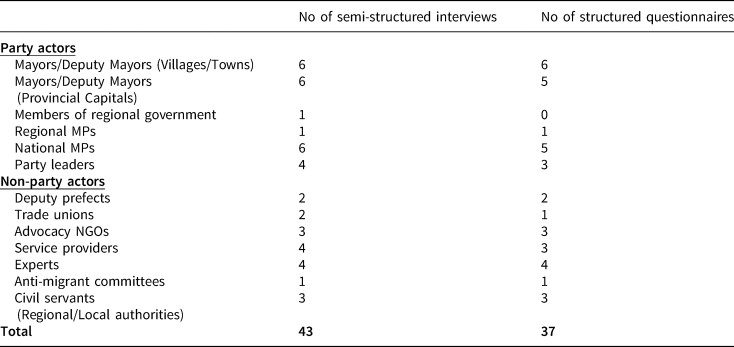
The article draws on an extensive document analysis and on 43 semi-structured interviews conducted in Veneto in November 2017, with actors from all the categories mentioned in Table 1 (the sample is detailed in Table A1 in Appendix). The subsample of party actors include: (1) five actors affiliated to the LN; (2) seven actors from the PD; (3) eight fringe centre-left and centre-right actors; (4) four fringe right-wing actors. These four groups of interviewees all include mayors (or deputy mayors) from at least one provincial capital, one town and one village, and one or more national MPs, with the only exception of the fourth group, which includes the independent mayor of a small village, one independent regional MP, and two local leaders of the extreme-right Forza Nuova. The categorization of fringe actors as ‘centre-left’, ‘centre-right’ or ‘right-wing’ is established using, as criteria: the definition of actors themselves as such; the past membership to a party; the external support received by parties at local elections.
The interviews included a structured questionnaire for the SNA, which asked respondents to identify the actors with whom they interact and to estimate the frequency and intensity of these interactions. Insights from other sources – such as available data on mobilizations (Lunaria, 2017) and on the role of local media in shaping narratives on asylum (Tronchin and Di Pasquale, Reference Tronchin and Di Pasquale2017) – have been used to assess the macro-micro component of the analysis.
Passive, defensive and proactive approaches to ‘public opinion’ in the Veneto region
This section focuses on the micro-level component of the analysis, examining how political actors frame the effects of asylum-seeking flows, how they make attributions on how they should deal with such effects, the script they select to guide their actions during the asylum crisis, and how these scripts shape their actions.
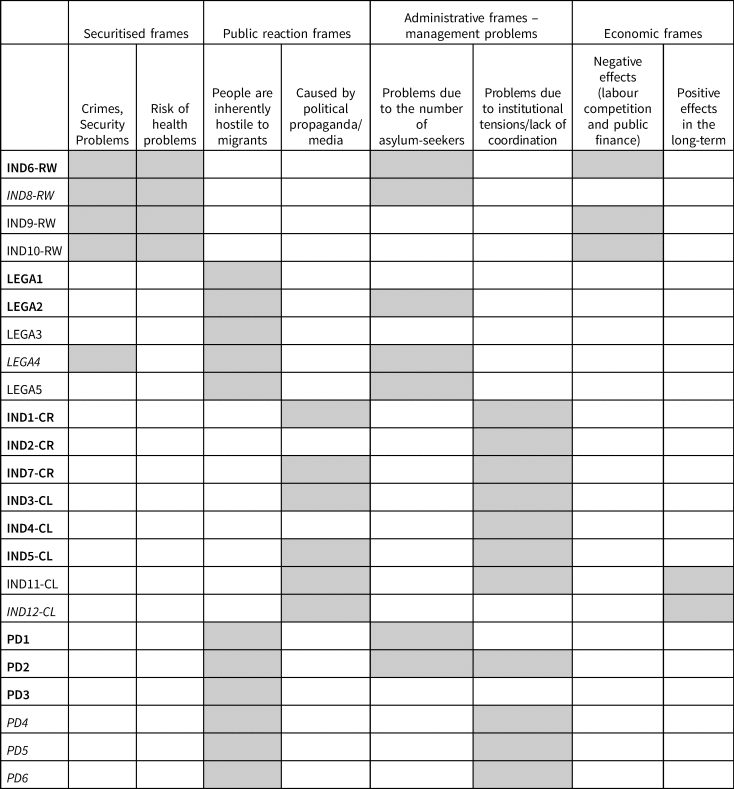
Importantly, when asked about their perceptions of the effects of asylum-seeking flows in their region, almost all interviewees focused on their (negative) effects on local public opinion. A detailed frame analysis of actors' responses is illustrated in Table A2 in Appendix. The analysis suggests, first, that actors' perceptions of public attitudes to immigration act as a key driving force of political actors' strategies and actions in Veneto, as expected. Second, it reveals that actors with the same political affiliation frame the effects of asylum-seeking migration in strikingly similar ways.
The following paragraphs examine how different groups of party actors make sense of (and responded to) local anti-migrant attitudes.
The PD and fringe centre-left and centre-right actors
It is interesting to first focus on actors who decided not to oppose the creation of reception centres for asylum-seekers: PD politicians and independent centre-left or centre-right politicians. Interestingly, although these actors all agree that the local population opposed the dispersal of asylum-seekers, they frame the situation very differently (Figure 5).
How PD actors and independent centre-left/centre-right actors make sense of public attitudes to asylum.

All the PD actors interviewed, indeed, provide very tense accounts of the anti-migrant demonstrations that took place in Veneto since 2015. An MP explains that:
In early 2017 the phenomenon was exploding in our hands, because the population in this region was hostile and could not be kept under control anymore (…). The entire regional community was rebelling and organizing demonstrations against the asylum-seekers (PD MP).
Importantly, most of the PD interviewees are ‘very pessimist’ about any possible change in this trend because, as a Deputy Mayor explained, ‘people have a really innate fear of migrants’. Another MP explains that ‘this is an unequal battle against the worst ideas ever’ while a Mayor admits that ‘people's perceptions do represent a problem of great magnitude, for which it is hard to find any solution’.
All centre-left or centre-right independent actors, conversely, put less emphasis on these anti-migrant demonstrations, mostly perceived by them as the initiative of marginalized far-right groups. More importantly, they seem to think that anti-migrant attitudes are the outcome of contingent issues, such as ignorance, misinformation, unawareness of the complexity of the phenomenon or the influence of anti-migrant propaganda campaigns by local and national media.
These different understandings of the situation seem to have significantly influenced the attributions that these two groups of actors make and the script that they select to guide their actions during the refugee crisis.
PD mayors and MPs tend to perceive public opinion as a harsh constraint to their actions. An MP admits that public opinion has been ‘breathing down her neck’, preventing her from freely expressing her thoughts. Three PD MPs refer to their participation in local talk shows as destabilizing experiences, mainly due to ‘violent’ comments by the audience. A Mayor explains that ‘it is hard to provide concrete responses to [people's] perceptions’.
These evaluations, thus, produce decision-making preferences that are powerfully driven by this understanding of the effects of anti-immigration sentiments and ultimately lead PD politicians to adopt a passive stance towards public opinion. An MP explains:
Because of the fear to be unpopular we have been really passive in front of the phenomenon (…). It was the summer 2015, the number of asylum-seekers was significantly increasing, and I could breathe this atmosphere of intolerance, of very strong rejection, everywhere. I stopped going to public events because it was a massacre for us. I was really impressed that we were all passive in front of such a wrong cultural message (…). But it was not easy, because as a politician you are often influenced by consensus and popularity (PD MP).
In the few instances in which PD actors have to act – because the situation requires their intervention or because the passive stance adopted clashes with their values – this same script requires them to act adopting the lowest possible profile. A Deputy Mayor thus admitted that despite the Mayor telling her to ‘stay away from the reception centres’, she decided to provide some help ‘under the table’.
The sensemaking process described above seems to produce an enduring tension between, on the one hand, the willingness of PD actors to cooperate with national authorities and welcome asylum-seekers (which, as a Deputy Mayor puts it, ‘is the mission of a centre-left administration’) and, on the other hand, the fear of the negative reaction of the population. Such tension produces ‘ambiguity’ in their actions (Ansell et al., Reference Ansell, Trondal and Ogard2017: 45) and lead to decoupled or loosely coupled links between problems and choices. Therefore, most local authorities controlled by the PD, during the refugee crisis, decided not to oppose Prefects' decisions to send asylum-seekers to their municipalities but refused to take any direct responsibility on the issue and to be involved by any means in the decisions taken. They were also very keen to inform the population that any decision on the matter could only be attributed to the Prefectures and, often, publicly complained about Prefects' decisions. A PD Mayor, who explains during the interview that the arrival of ‘a small number’ of asylum-seekers in his town ‘had not had any significant impact’, had declared to a local newspaper, just a few months before, that he would have fiercely opposed the arrival of other asylum-seekers because the town could not have borne more migrants.
Finally, this ambiguity also means that political and symbolic considerations play a key role in decision-making, characterized by an emphasis on being seen doing something, rather than on actions necessarily achieving their intended effects. The involvement of asylum-seekers in voluntary, socially useful, unpaid activities by many PD local administrations in the region is a key example of this. Initiatives of this kind have been developed in most of the PD-led municipalities (but also by some independent and LN mayors), designed to be highly visible to the population, and with the explicit aim to respond to the harsh social tensions perceived.
Independent centre-left and centre-right actors, conversely, convinced that anti-migrant attitudes are the product of ignorance and misperceptions, think that, as such, these misperceptions can be contrasted and modified and that the local population must be properly informed. These actors, therefore, adopt a proactive approach towards public opinion, acting in various ways to inform citizens and counter their misperceptions, through the organization of public meetings, the involvement of experts, the distribution of pamphlets with information on the local reception system, and the organization of events to introduce the asylum-seekers to the local population. This involved both centre-left and centre-right independent mayors of small villages and big cities, and municipalities with different types of reception centres. As a Deputy Mayor explains, ‘we moved from platitudes and destroyed them one by one’.
Importantly, coherently with this approach, these mayors also decided to be actively involved in the organization of the reception system and to closely cooperate with the Prefects to improve the efficiency of the dispersal scheme. They promoted networks and burden-sharing measures, organized meetings for the discussion of good practices, and tried to launch innovative solutions to improve the asylum system. The administration of Belluno decided to actively coordinate the asylum-seekers' dispersal and reception in the entire province, going beyond its formal competences. The Mayor of Santorso involved other villages of the province in an innovative network of municipalities affiliated to the SPRAR system, which inspired the dispersal model adopted by the Minister of Interior in 2016.
The LN and fringe right-wing actors
On the other side of the political spectrum, actors affiliated to the LN and independent right-wing actors both frame migration in terms of law and order. However, again, their analyses of the effects of asylum-seeking flows on the local population significantly differ (Figure 6).
How LN actors and independent right-wing/far-right actors make sense of public attitudes to asylum.

All LN interviewees explain that the main effect of the arrival of asylum-seekers in Veneto has been – more than a real increase in crimes – an increased perception of insecurity of the population, which resulted in social tensions and a widespread hostility towards asylum-seekers. Differently from what expected, they only rarely used nativist or securitized frames and largely focused on public perceptions. Independent right-wing and far-right politicians, conversely, are convinced that the local population (and the identity of the region) is ‘under threat’ because of the arrival of the asylum-seekers. Unlike LN politicians, they do not refer to mere perceptions but to real events, real crimes (drug deal, thefts, prostitution, murders, rapes…) and public health issues. Some of these actors underline that the population, under threat, is unable to appropriately react to what is happening.
The attributions that LN politicians make about the situation are strongly influenced by the signals and cues about citizens' perceptions of insecurity that they pick up from the environment. Their actions, therefore, seem to be mainly aimed at giving voice to these widespread concerns. All LN interviewees agree, indeed, that public attitudes do influence their actions: as a member of the regional government puts it, ‘undoubtedly, the feelings of the population have an influence on our mood and considerations’. In addition to that, they are eager to state that their main aim is to give representation to citizens' perceptions and to bring them ‘within the institutions’.
These attributions create scope for decision-making preferences that are powerfully driven by such understanding of the effects of anti-immigration sentiments, but also for a strategic approach to actions and a defensive rather than proactive stance towards public opinion. This strategic approach requires them to take different courses of action in different situations.
In politically salient situations, LN politicians tend to steer into what they perceive to be the citizens' will. In most cases, this leads to inactions. All the institutions controlled by the Lega, indeed, tried to avoid any direct involvement in the organization of the regional reception system. The party intimated to its mayors not to take part in the working tables organized by the Prefectures that should have coordinated the dispersal of asylum-seekers within each province, and to withdraw their affiliation with the ANCI, thus preventing its regional branch to play any significant role in these processes. The regional government also decided not to take any responsibility in the organization of the reception system, unlike other regional governments in Italy. The LN Governor of the region declared, during an audition at the Chamber of Deputies that ‘Veneto is not willing to contribute to the organization of the reception system’ because the regional government ‘is concerned that identifying solutions downstream [at the local level] would prevent any solution of the problem upstream [i.e. stopping the flows in Africa].’Footnote 2
In other cases, this strategic attitude seems to require LN politicians to take action in order to distance themselves from situations that risk undermining people's support. Most LN interviewees explain that they keep informing the population that they are not responsible for the arrival of asylum-seekers and that their institutional position does not allow them to have any impact on these matters.
Finally, when the stakes are high, this strategic approach seems to require LN politicians to take action with the aim to give voice to people's concerns and prove their empathy for the local population. Crucially, when mayors become aware that the Prefecture is considering the possibility to send some asylum-seekers to their village, they organize demonstrations against the creation of the new reception centre, release threatening interviews to local newspapers, and put pressure on the Prefect, the service provider or the private individuals willing to rent their properties for that purpose. Many LN actors, thus, supported, participated in or (sometimes) organized anti-migrant demonstrations. The interview material suggests, however, that the decision to join or organize these demonstrations is a defensive or strategic – that is aimed at maintaining consensus – rather than a proactive, ideologically driven, action.
In situations which, conversely, are not perceived as politically salient, LN politicians seem to behave differently. LN mayors, for instance, never withdrew from the SPRAR system, if the municipality had joined the system during a previous centre-left administration. Most city and regional officials explained, moreover, that the regional government did not refuse to provide health care to asylum-seekers. Overall, therefore, again, political and symbolic considerations play a key role in decision-making, which leads to an emphasis on being seen doing something, rather than on actions necessarily achieving their intended effects. And this is the reason why independent right-wing politicians in the region harshly criticised the LN for not having organized a proper opposition to national asylum policies and for not having provided any support to local administrations that tried to develop anti-migrant local policies. According to a local leader of Forza Nuova, the active involvement of the LN in local anti-migrant committees undermined their success.
In line with their perception that the population is under threat, conversely, independent right-wing actors seem to be convinced that, through their political activities, they must ‘protect’ public opinion, taking action for the sake of their people. In the village of Albettone, for instance, the local Council adopted in 2015 a resolution aimed to empower the Mayor – an independent politician recently affiliated to the far-right Fratelli d'Italia – to adopt ‘any measure to protect the community’ against ‘risks connected to the security and the possible spread of diseases or plagues.’Footnote 3
Interestingly, all the actors interviewed in this fourth group explain that their harsh anti-immigration stances are not influenced by public opinion and that, had the issue been less politically relevant, they would have acted in the same way. This suggests that their actions are more ideology-driven than consensus-driven: even potential negative feedbacks from the citizens do not have an impact on these actors' strategies.
Coherently, with this proactive ideology-driven stance, all these actors actively developed initiatives aimed at providing concrete responses to the population – for example by opposing the creation of new reception centres – but also, more broadly, at countering national asylum policies. A group of independent right-wing regional MPs promoted some regional resolutionsFootnote 4 aimed at pushing the regional government to adopt a much tougher stance on asylum-related issues. The right-wing Mayor of Albettone declared that, had the Prefect dared to turn some unused public buildings in his village into a reception centre, he would have ‘blocked the windows to make the buildings be condemned’ (Berizzi, Reference Berizzi2015). The independent mayor of Pastrengo launched a network of local authorities to protest against the incentives granted to those municipalities that decided to join the SPRAR system: the initiative aimed, as an interviewee explains, at ‘making the reception system explode’ and catching the government's attention, but its promoters failed to involve enough local authorities and to get the support of the LN. Forza Nuova and other extreme-right movements promoted regular security patrols around reception centres and organized several anti-migrant protests.
The impact of sensemaking processes and actors' strategies on policy outcomes and responses
This section builds on findings from the previous paragraphs to explore the micro-macro and macro-micro components of the analysis. The micro-level component of the analysis, in sum, has outlined how actors affiliated to the two dominant parties adopted a more strategic and consensus-oriented approach, while fringe actors adopted a more ideological and/or pragmatic approach.Footnote 5 Actors, and their understandings and strategies, however, are not equally powerful: framing and sensemaking processes in multi-institutional settings are subject to power relations and associated inequalities, with the effect that some understandings are far more powerful than others (Helms Mills et al., Reference Helms Mills, Thurlow and Mills2010: 183). The following paragraphs will, therefore, examine actors' relations and power. I will, first, specify the composition of the regional asylum governance network and explore power relations therein. I will then assess the impact of actors' actions and relations on broader asylum policy responses and, finally, draw some plausible conclusions on the impact of these outputs on processes of frame emergence.
SNA – networks
Figure 7 shows the asylum governance network in Veneto, elaborated with the Gephi software. More precisely, the graph shows a condensed visualization of the network, where all nodes of the same type have been collapsed into a single node representing the actors' group. In this figure, ties indicate the existence of discussions between the two groups of actors on asylum-related issues, while the strength of ties depends on the frequency of exchanges: the more intense the communication flow, the bolder the tie in the network illustration.Footnote 6 The overall network features suggest that the conversation is rather fragmented. Indeed, the density value (0.135), which indicates the proportion of existing ties in comparison to the total number of possible ties in a network, shows that less than 14 percent of possible ties are activated. Hence, interactions in the network tend to be carried on in a selective way.
Asylum Governance Network in Veneto.

SNA is a particularly useful tool to investigate power relations within the network. According to Castells (Reference Castells2009: 45) the ability of actors within networks to exercise control over others depends on two basic mechanisms: first, ‘the ability to constitute network(s), and to program/reprogram the network(s) in terms of the goals assigned to it’; and, second, ‘the ability to connect and ensure the cooperation of different networks by sharing common goals and combining resources, while fending off competition from other networks by setting up strategic cooperation’. He calls the holders of the first power position programmers and the holders of the second power position the switchers.
The size of nodes in Figure 7 highlights switchers, the more central and relevant actors in the network, that have the ‘power to coordinate’ and exert a function of intermediation between groups (measured by the betweenness centrality, that is, the number of shortest paths from all the vertices to all the other vertices in the network that pass through the node in consideration). The figure suggests that the main switchers in the network are service providers and anti-migrant committees (and, to a minor extent, the Prefecture). Importantly, those institutions that could have taken a leading role in coordinating and organizing the regional reception system, such as the regional government, the ANCI, the Prefecture of Venice and the Ministry of Interior, occupy a marginal position in the network.
Figure 8, instead, highlights programmers in the governance network, that is those actors that enjoy the broader recognition within the network, measured by the in-degree (the number of ingoing relations of the nodes). These are the actors that are potentially ‘capable of defining the substantive framework of the conversation’ (Padovani and Pavan, Reference Padovani and Pavan2016: 360) and of influencing other actors' decisions. The software identifies seven programmers: the Ministry of Interior and its local branches, the Prefectures and the Questure; service providers; mayors; the regional government and local journalists. While service providers and local journalists are broad and heterogeneous groups of actors, it is important to underline, here, that 46 of the 61 cities/towns in 2016–2017 were controlled by either the LN (which also controlled the regional government) or the PD. These two parties, together with the Prefectures, are thus the main programmers of the regional asylum governance system.
Programmers in the governance network.

Figure 9, finally – where the size of nodes is proportional to their weighted out-degree centrality that is the number of outgoing relations of the nodes – shows the so-called mobilizers, that is, actors that implement the network's relational potential by reaching out in different directions. These are the actors that operate with a broad understanding of both the actors involved and the issues at stake and that contribute ‘to interested actors’ perception and understanding of existing challenges and available solutions’ (Padovani and Pavan, Reference Padovani and Pavan2016: 360). The list of mobilizers mostly includes independent or fringe party actors – a finding which is coherent with the analysis conducted in the previous paragraph. Importantly, most of these mobilizers are neither switchers nor programmers, which means that, despite attempting to activate the network's relational potential, they lack the power to have a real impact on understandings and the identification of solutions. The only mobilizers that are also programmers and switchers are the Prefectures and service providers (which, however, form a heterogeneous group of actors with loose and sometimes conflicting relationships among them).
Mobilisers in the governance network.

Before assessing the implications of these findings on asylum policy responses, it is important to analyse and illustrate conflicts and alliances within the governance network. While Figure 7 above shows the existence and frequency of exchanges between actors and is blind to any divergence of views, Figure 10 shows the degree of similarity of the perspectives of actors that relate to one another (the bolder the tie, the higher the similarity of views). It illustrates that the network can be compartmentalized into five sub-networks (identified through the ‘community detection’ algorithm of the Gephi softwareFootnote 7). Interestingly, four of these clusters correspond to the groups of actors identified in the previous section: a blue cluster with actors affiliated to the PD; a green cluster with independent centre-left and centre-right mayors and a number of advocates of migrant reception (left-wing politicians, local NGOs, and the Catholic Church); a purple cluster with actors affiliated to the LN, the regional government and anti-migrant committees; and a dark green cluster formed by the extreme-right Forza Nuova (the software places independent right-wing actors in the LN subnetwork, despite the different approaches to action identified above). A fifth, orange cluster groups most of non-party actors, such as international and national organizations, experts, trade unions, and service providers. Overall, as expected, Figure 10 shows that the network is significantly polarized between those groups of actors that accept the reception of migrants – and thus interact with service providers – and those groups of actors that refuse reception and form coalitions with anti-migrant local committees.
Asylum Governance Network in Veneto.

The many thin ties in the graph suggest a high divergence of views between (but also, sometimes, within) these clusters of actors. Figure 11 better illustrates conflicting views in the network and highlights those actors that engage in the highest number of conflicting interactions. Overall, the figure suggests the existence of harsh political and institutional tensions between/towards institutions at all levels, including regional and national institutions, prefectures, and mayors (mostly: PD and LN Mayors). In particular, the central and active role of Prefectures in the governance system is harshly contested by actors from all clusters, with the only exception of PD actors (who, as mentioned above, tend to passively accept Prefects' decisions). This high level of institutional conflict seems consistent with the interview material. As an MP interviewed explains, ‘in Veneto [on this issue] there has been a crazy contention between different institutions, something I had never seen before’. The centre-right mayor of a village hosting one of the huge hubs explained that these have been the outcome of ‘the betrayal of some Veneto people by other Veneto people’. A leader of Forza Nuova complained about the disproportional burden imposed on the southern side of his province, pointing to a plot supposedly organized by the local administrators of the provincial capital (controlled by the LN).
Conflicting Views in the Venetian Governance System.

Impact on policy responses
The analyses conducted so far has revealed five key features of the Venetian asylum governance network. The network is very fragmented and polarized between actors that accept and oppose asylum-seekers' reception. No institution took the lead in coordinating the governance system, with the role of switchers being left to service providers and anti-migrant committees. The most powerful actors (particularly, members of the two dominant parties) were very passive and did not activate the network's relational potential. The responsibility to organize and coordinate the reception system was delegated to the Prefectures, the only powerful actor that acted as mobilizer. However, their active role is harshly contested. Overall, the network is characterized by very high levels of conflict.
These features provide useful insights to understand why the regional reception system in Veneto is so fractured, weak and contested.
First, they clarify why the dispersal of asylum-seekers throughout the region is so unbalanced. Most local authorities, indeed, either did not actively cooperate with the Prefects in the organization of the dispersal system (the PD's approach) or actively opposed any dispersal plan that involved their municipality (the LN's approach). As an independent centre-left Mayor puts it: ‘local authorities in this region played the Russian roulette, hoping that the asylum-seekers would have been sent to other municipalities’. The regional branch of the ANCI, weakened by the decision of LN mayors to leave the Association, also refused to take an active role in this process. As its President (the PD Mayor of Mirano) declared in 2017:
We are very sceptical about the dispersal scheme proposed in the agreement between the Minister of Interior and the National ANCI (…). This dispersal model could avoid huge concentrations of asylum-seekers, but it would lead to social tensions in the municipalities where the rationale behind the dispersal itself is hardly accepted (Mariarosa Pavanello, President of ANCI Veneto).Footnote 8
Without any significant cooperation of mayors, the regional government and the ANCI, the entire responsibility to organize the dispersal and reception of asylum-seekers was delegated to the Prefects, who had to carry out this job in a prevalently hostile environment. As two Deputy Prefects interviewed explain, the widespread opposition of the local and regional authorities prevented the prefectures from shaping an efficient reception system.
Second, the passive or defensive stances adopted by most actors towards public opinion clearly impacted on Mayors' decisions to join the SPRAR system, which requires a direct and visible involvement of the municipality. The few municipalities that joined the system are mostly led by independent centre-left and centre-right mayors while – despite all PD members interviewed praising the SPRAR system as the best reception model available – most PD administrations in Veneto did not join the programme. When they joined, it was the outcome of pressures from catholic NGOs and of a long process – a ‘painful delivery’ as explained by a PD Deputy Major. No LN administration decided to join the SPRAR system, harshly contested by independent right-wing actors.
Third, the non-cooperation or fierce opposition towards any dispersal measure of so many municipalities forced the prefects to organize the reception system around emergency centres (CAS) and to create – mostly in small villages in the countryside – huge hubs hosting, in some cases, more than a thousand asylum-seekers and described by interviewees across the whole political spectrum as ‘concentration camps’. The presence of these centres imposed a disproportional burden to the municipalities involved – mostly led by independent mayors – and generated tensions between Prefects and local administrations and between the asylum-seekers and the local population, often pushed by anti-migrant entrepreneurs.
The imbalanced dispersion of asylum-seekers and the organization of the reception system around emergency centres often contested by local administrations, finally, led to an increasing political contestation around asylum and to widespread anti-refugee protests. Lunaria (2017) identifies 43 anti-refugee protests in Veneto in 2016, of which 10 were organized by the LN, one by an independent right-wing mayor, five by extreme-right movements and 26 by anti-migrant committees (two protests had mixed organizers). Importantly, an analysis of the 43 protests reveals that 28 of them were aimed against the creation of hubs or big CAS centres in former hotels, while only six of them were aimed against small reception structures (CAS or SPRAR).Footnote 9 This suggests the existence of a causal relationship between the inefficiencies of the reception system and the protests. Importantly, these inefficiencies also led to mobilizations of left-wing actors and asylum-seekers themselves, particularly within the hubs or in opposition to anti-refugee protests (Ambrosini, Reference Ambrosini2018: 122). The creation of the hubs seems to have been a crucial event that created turbulence in the regional governance system and was indeed mentioned by several interviewees – both from the far right and the left – as the key event that pushed them to take action. Both the semi-structured interviews and the SNA seem to suggest that, conversely, pro-migrant mobilisations had a very limited impact on actors' perceptions (with the only exception of fringe political actors) and were mostly perceived as the initiative of narrow leftist or catholic groups, not representative of the broader population.
While more research is needed to assess frame emergence, the analysis clearly suggests a key role of anti-migrant protests in this process. The framing literature explains that frame emergence is strictly linked to the availability and accessibility of frames and that ‘accessibility increases with chronic or frequent use of a consideration over time or from temporary contextual cues – including communications – that regularly or recently bring the consideration to mind’ (Druckman, Reference Druckman and Keren2011: 10). Repeated exposure to a frame, in other words, induces frequent processing, which in turn increases the accessibility of the frame. This calls into question the role of local media which, as underlined by all the four experts interviewed, instrumentally contributed to raising the salience of asylum in the region by reporting extensively on tensions between asylum-seekers and local citizens in areas hosting temporary settlements (Castelli Gattinara, Reference Castelli Gattinara2017: 325). In fact, a detailed report by Tronchin and Di Pasquale (Reference Tronchin and Di Pasquale2017) which analyses frames and narratives promoted by local media in Veneto in 2017 concludes that most of the news on immigration in these newspapers focus on local protests against asylum-seekers. Also, the report finds that reactions from local politicians, anti-migrant committees, and citizens are given much more space compared to the one dedicated to data and information on the functioning of the reception system, interviews with experts or neutral explanations of the phenomenon.
These considerations and the material collected through semi-structured interviews seem to suggest, therefore, that anti-migrant protests by the local population played a key role in shaping actors' perceptions of the hostility of the local population. These widespread anti-migrant protests, in other words, have been both the cause and the effect of political actors' passive or defensive/strategic stances towards public opinion: as described in Figure 12, this dynamic feeds on itself.
Veneto's response to the refugee crisis.

Conclusion
This article has developed an innovative micro-macro-micro approach to study asylum governance and has applied it to the case of Veneto, chosen for its powerful heuristic value. Mostly relying on insights from framing and sensemaking theories and accounts of power within networks, this approach allowed me to open the ‘black box’ of asylum governance in Veneto during the asylum crisis. Without denying that the regional reception system was under the pressure of an increasing number of asylum-seekers, the article has shown how the governance system itself has contributed to constitute asylum-seeking migration as a social and political problem. Further research should broaden the analysis to examine the extent to which the dynamics identified in Veneto could be generalized for other Italian regions.
Three key findings emerge from the analysis:
First, the article has shown how actors frame and make sense of asylum-seeking migration, how they develop their strategies and how they act upon these understandings. This cognitive dimension has often been neglected in the literature on the Italian refugee crisis. The existing scholarship focused on the extent to which party positions are ideology-driven or strategically driven but has mostly ignored that these ideological or strategic positions are driven by actors' conceptualizations and understandings of the effects of change in underlying social systems. Furthermore, this article has shown that, in a politicized asylum governance system such as the Venetian one, what really drives political actors' strategies is not really their understandings of the causes and effects of asylum-seeking flows but, rather, their understandings of the causes and consequences of public attitudes on immigration. The analysis conducted has also revealed that different groups of party actors frame and make sense of these attitudes in very different ways and that interpretations of (the drivers of) public reactions to asylum-seeking migration largely influenced actors' strategies and decisions.
Second, this article has revealed the often-neglected role of politics in asylum policy-making and governance, which corrects a tendency of the existing literature to see the asylum crisis as the mere outcome of structural inefficiencies. By applying SNA, this article demonstrates that what really shapes policy outputs is the ideological profile of the political actors involved, their capacity to mobilize their different understandings, their power, positioning, and behaviours. In the very fragmented and polarized Venetian governance network, characterized by very high levels of conflict between the different institutions and levels of governance, the most powerful actors did not mobilize to activate the network's relational potential. In such a context, the political competition between the main parties and the political contestation by anti-immigration political entrepreneurs constrained policy-making and prevented the development of efficient policy responses while, rather, producing a fractured, weak, and contested reception system.
Finally, the article has provided important insights on the interplay between policy-making, politics, and political contestation in shaping asylum governance and contributing to constitute the Italian refugee crisis. Crucially, it has illustrated the politicization of asylum governance in Veneto, by showing the circular relationship between public attitudes on migration, frame emergence, asylum policy-making, asylum politics, and anti-refugee campaigning. The analysis has indeed highlighted not only that anti-refugee protests have significantly influenced actors' understandings of public attitudes on immigration, their strategies and policy responses, but also that these anti-migrant mobilizations have been largely shaped by these very policy responses and the inefficiencies of the regional reception system.
Data
The replication dataset is available at http://thedata.harvard.edu/dvn/dv/ipsr-risp
Financial support
The research has been funded by: European Research Council (ERC), European Union's Seven Framework Programme (FP-7/2007-2013), Grant Agreement No 340430 (‘Prospects for International Migration Governance’) awarded to Professor Andrew Geddes.
Appendix
Sample of interviewees
Frame analysis of interviewees' responses to questions about their perceptions of the effects of asylum-seeking migration in Veneto (IND-RW, independent (right-wing); IND-CR, independent (centre-right); IND-CL, independent (centre-left); in bold: mayors or deputy mayors; in italics: MPs)