INTRODUCTION
In 2008, our group described a cluster of families with frontotemporal dementia (FTD) harboring the c.709-1G>A mutation in the progranulin gene (GRN; MIM 138945), a mutation unique to individuals in the Basque country (López de Munain et al., Reference López de Munain, Alzualde, Gorostidi, Otaegui, Ruiz-Martínez, Indakoetxea and Martí Massó2008). The clinical phenotype of the Basque GRN carriers is variable even within families, as has been described for other GRN mutations (Chen-Plotkin et al., Reference Chen-Plotkin, Martinez-Lage, Sleiman, Hu, Greene, Wood and Van Deerlin2011; Rademakers et al., Reference Rademakers, Baker, Gass, Adamson, Huey, Momeni and Hutton2007; Le Ber et al., Reference Le Ber, Camuzat, Hannequin, Pasquier, Guedj, Rovelet-Lecrux and Bakchine2008; van Swieten & Heutink, Reference van Swieten and Heutink2008). In these Basque GRN carriers, the most common presenting clinical syndrome is behavioral variant FTD, followed by nonfluent/agrammatic variant primary progressive aphasia (nfvPPA), and, although less common in the initial stages, approximately half of these patients develop features of corticobasal syndrome (CBS) at some point in the course of their disease (Moreno et al., Reference Moreno, Indakoetxea, Barandiaran, Alzualde, Gabilondo, Estanga and López de Munain2009).
Neuropsychological assessment has revealed executive dysfunction in most patients, but also language, memory, and other neuropsychological deficits, depending on clinical presentation. Language involvement comprised two different patterns of dysfunction: (i) nfvPPA; and (ii) dynamic aphasia with reduced language output and difficulty generating spontaneous speech. With progression of the disease, other features like dysgraphia, dyscalculia, visuospatial dysfunction, ideomotor apraxia, graphic constructional apraxia and hemineglect were detected in more than 80% of individuals.
The finding of this cluster of families has allowed us to study asymptomatic at-risk family members for early disease markers. In the first cross-sectional studies, we found that presymptomatic c.709-1G>A GRN mutation carriers had subtle neuropsychological differences in executive (Trail Making Test, Parts A and B, TMT-A and TMT-B) and language (Boston Naming Test) tests (Barandiaran et al., Reference Barandiaran, Estanga, Moreno, Indakoetxea, Alzualde, Balluerka and Lopez de Munain2012), and differential age-related cortical thinning in the lateral temporal cortex compared to non-carrier family members (Moreno et al., Reference Moreno, Sala-Llonch, Barandiaran, Sánchez-Valle, Estanga, Bartrés-Faz and Indakoetxea2013). The aim of this study was to determine and characterize a potential pre-diagnosis cognitive phase in presymptomatic GRN mutation carriers based on a 4-year longitudinal evaluation.
METHODS
Study Population and Design
Twenty-three patients with FTD carrying the c.709-1G>A mutation in GRN were identified between 1995 and 2008 at Donostia University Hospital, a tertiary referral center. At-risk first-degree relatives of these patients were invited to participate in a prospective longitudinal study to investigate early markers of the disease. Exclusion criteria were: (i) history of any neurological or major psychiatric illness (stroke or any other neurological disease, schizophrenia, major depression and bipolar disorder); and (ii) use of drugs or toxic substances that might interfere with cognitive function.
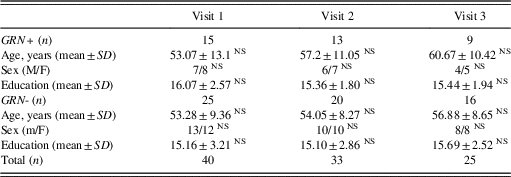
The study population was composed of individuals from one of seven families: 15 members of family 1, 13 members of family 2, and 12 individuals from five other smaller families. All 40 took part in the first assessment (2010), 15 being presymptomatic GRN mutation carriers and 25 non-carriers. In the second assessment 2 years later (2012), we assessed 14 presymptomatic carriers and 20 non-carriers. Finally, at the third visit (2014), we assessed 9 presymptomatic carriers and 16 non-carriers. Participants were lost to follow-up for personal reasons and only one individual’s status converted from presymptomatic to symptomatic FTD during follow-up. Another participant from the non-carrier group complained of memory decline 1 year after the first visit. He was clinically assessed and diagnosed with Alzheimer’s disease. Results from the cross-sectional study of the first neuropsychological assessment have been published elsewhere (Barandiaran et al., Reference Barandiaran, Estanga, Moreno, Indakoetxea, Alzualde, Balluerka and Lopez de Munain2012).
Neuropsychological Assessment
The cognitive tests were administered by an experienced neuropsychologist blind to the genetic status of participants. Cognitive tests were grouped into different established domains (Lezak, Reference Lezak2004). Attention was tested using the TMT-A (Reitan, Reference Reitan1958) and inattention, impulsivity, and vigilance measures of the Continuous Performance Test (CPT) (Conners & Staff, Reference Conners and Staff2000). Executive function was subdivided into (i) cognitive set-shifting: TMT-B and number of perseverations in the 64-card Wisconsin Card Sorting Test (WCST-64) (Heaton, Reference Heaton1981), (ii) reasoning/concept formation: Similarities and Arithmetic subtests from the Wechsler Adult Intelligence Scale - Third Edition (WAIS-III) (Wechsler, Reference Wechsler1997), conceptual level responses of the WCST-64 and phonemic verbal fluency; and (iii) decision-making: Iowa Gambling Test (Bechara, Reference Bechara2007).
Social cognition was evaluated assessing facial affect recognition with 28 pictures taken from the Picture of Facial Affect (POFA) (Ekman, Reference Ekman1993; Winblad, Hellström, Lindberg & Hansen, Reference Winblad, Hellström, Lindberg and Hansen2006). Language was assessed with the Boston Naming Test (Kaplan, Goodglass, & Weintraub, Reference Kaplan, Goodglass and Weintraub1983), the WAIS-III Vocabulary subtest and semantic verbal fluency (naming animals in 1 min). To assess episodic verbal memory, we used the Verbal Learning Test from the Consortium to Establish a Registry for Alzheimer’s Disease (CERAD) (Morris, Mohs, Rogers, Fillenbaum, & Heyman, Reference Morris, Mohs, Rogers, Fillenbaum and Heyman1988). Finally, we used the WAIS-III Block Design and Object Assembly subtests to assess visuospatial skills (Wechsler, Reference Wechsler1997).
Statistical Analysis
The statistical analysis was carried out using R Statistical Software environment for Windows, Version x64 3.4.3. Individual neuropsychological test scores were transformed into Z scores using published normative data from NEURONORMA Study Team (Peña-Casanova et al., Reference Peña-Casanova, Blesa, Aguilar, Gramunt-Fombuena, Gómez-Ansón, Oliva and Sol2009) and from tests manuals (Conners & Staff, Reference Conners and Staff2000; Fisher, Tierney, Snow, & Szalai, Reference Fisher, Tierney, Snow and Szalai1999; Heaton, Reference Heaton1981; Morris et al., Reference Morris, Mohs, Rogers, Fillenbaum and Heyman1988; Wechsler, Reference Wechsler1997). For the Picture of Facial Affect Recognition test, we used raw data because there are no normative data for s Spanish population. Composite scores for each domain were computed by averaging the mean Z scores from the individual tests within each domain.
Two types of analysis were used for the longitudinal study. The first was between-group analysis (GRN carriers vs. non-carriers across the three assessments), testing for differences in the mean. Given the sample size (<30), if the observations within each group are normally distributed, and variances in the two groups are equal (homoscedasticity), the parametric Student’s t test was chosen along with a bootstrap procedure consisting of the computationally simulation of K=1000 replicate samples that are similar in size to the original sample. In the presence of a normal distribution and heteroscedasticity, Welch’s test was chosen. If the data did not meet the assumption of normality, we decided to use the non-parametric Mann-Whitney U test. The test selected for the assessment of normality and homoscedasticity were Saphiro-Wilk and F test, respectively.
The second type of analysis was a within-group study, based on case monitoring (comparisons of the differences among assessments in neuropsychological variables for each subject for both GRN carriers and non-carriers). Paired-sample tests were used: Student’s t test if the observations were normally distributed and variances among analyzed assessments were equal; Welch’s test in the presence of heteroscedasticity and normally distributed data. If the data were not normally distributed, we selected the non-parametric Wilcoxon signed-rank test. Again, given the sample size, we used Student’s t test along with a bootstrap procedure. In all of the analyses, bootstrapping was carried out with 1000 bootstrap samples, identical in size to the original sample, taken by stratified sampling with replacement, for each factor under consideration. The analysis was completed with estimation of the effect size with Cohen’s d. A d value near 0.2 was considered small, 0.5 was considered medium, and values above 0.8 were considered large. With the aim to reduce the false positive results, the Bonferroni correction for multiple comparisons was applied in both analyses.
Protocol Approval and Consent from participants
The study was approved by the Donostia University Hospital Ethics Committee. Written informed consent was obtained from all participants.
RESULTS
Age, sex, and years of education were similar in presymptomatic GRN mutation carriers and asymptomatic non-carrier family members. Demographic characteristics at the first visit (v1) and at each follow-up visit (v2 and v3) are summarized in Table 1.
Demographic characteristics of GRN+ and GRN– participants

F=female; M=male; NS=not significant; SD=standard deviation.
Cross-sectional Between-Group Comparisons for Each Visit (“Between-Group” Analysis)
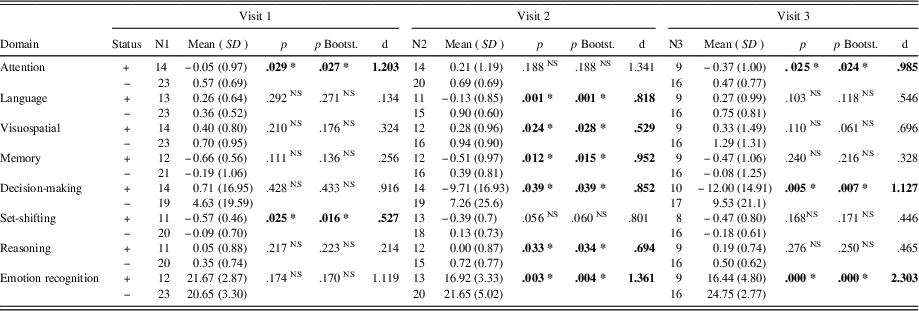
Results of the comparison between GRN mutation carriers and non-carriers at each visit are listed in Table 2. At the first visit, we detected differences in attention and set-shifting, carriers showing a poorer performance, with a large (d=1.203) and medium (d=0.527) effect size, respectively. At the second visit, we detected differences between groups, performance being poorer among GRN mutation carriers, with a large effect size in emotion recognition (d=1.361), memory (d=0.952), decision-making (d=0.852), and the language domain (d=0.818), and medium effect size in reasoning/concept formation (d=0.694) and visuospatial (d=0.529) domains. At the third visit, the GRN mutation carrier group performed markedly less well than the non-carrier group in facial affect recognition (d=2.303), decision-making (d=1.127), and attention (d=0.985), with a large effect size.
Cross-sectional between-group comparison of GRN+ and GRN– participants for each visit

Note.
Bootst.=bootstrapping; NS=not significant. *= p<0.05
d=Cohen’s d effect size; N1, N2, and N3=number of participants that completed the tests at visits 1, 2, and 3 respectively; p=p value after Bonferroni correction; P Bootst.=p with the bootstrap procedure; SD=standard deviation; +=GRN mutation carriers; -=Non-carriers. Statistically significant comparisons are presented in bold type.
Longitudinal Neuropsychological Performance (“Within-Group” Analysis)
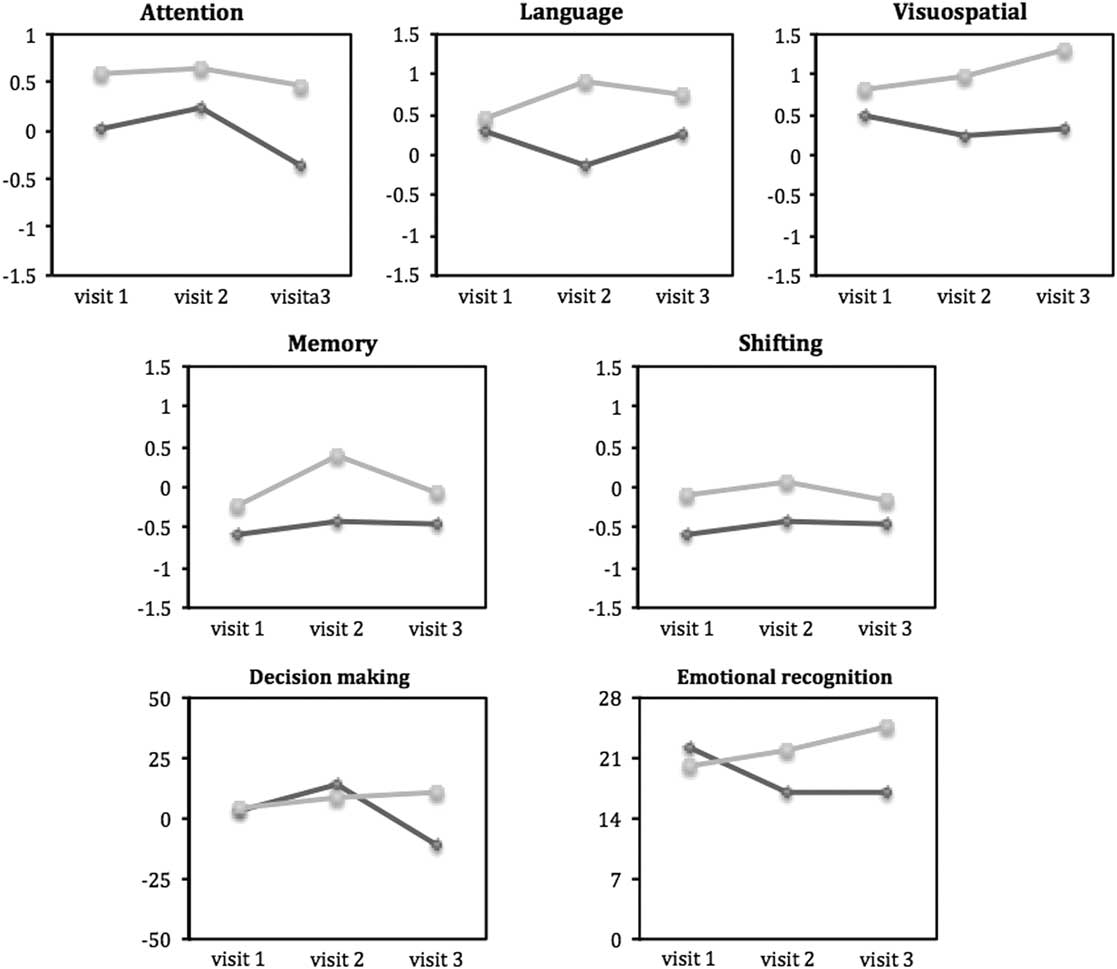
These results are shown in Figure 1 and Supplementary Table 1.
Profile plots for the eight different cognitive domains across the three visits in GRN mutation carriers (dark gray) and non-carrier relatives (light gray).

Visit 1 versus Visit 2
Comparing visit 1 and 2 scores, we observed improvements in the non-carrier group in language (d=1.96) and reasoning/concept formation (d=1.05) with large effect sizes and in visuospatial skills, with a medium effect size (d=0718). In contrast, in the GRN mutation carrier group, we observed a decline in affect recognition with large effect size (d=−1.35), and in decision-making (d=0.452), language (d=0.381), and reasoning/concept formation (d=0.215) with small effect sizes.
Visit 2 versus Visit 3
Comparing these two visits, we observed in the non-carrier group an improvement in facial affect recognition with medium effect size (d=0.614), and declines in reasoning/concept formation with large effect size (d=−0.95) and memory with small effect size (d=−0.16). In the GRN mutation carrier group, we observed declines in language with large effect size (d=1.181) and in attention (d=0.745) and facial affect recognition (d=0.745) with medium effect sizes.
Visit 1 versus Visit 3
In this comparison, we observed improvements in the non-carrier group in facial affect recognition (d=1.084), language (d=0.861), visuospatial function (d=0.801) with large effect sizes, and in reasoning/concept formation with medium effect size (d=0.603). In contrast, in the GRN mutation carrier group, we observed a decline in facial affect recognition (d=1.067) and attention (d=0.914) with large effect sizes.
Facial Affect Recognition
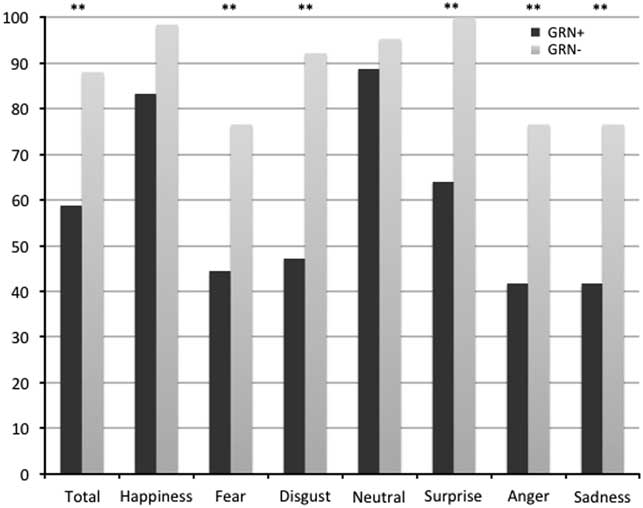
The differences between groups were most marked in the facial affect recognition test, with improvement in the non-carrier group and decline in the GRN mutation carrier group, with very large effect sizes. Therefore, we decided to investigate differences in facial affect recognition in depth and we analyzed differences in the percentages of achievement for each affect for each group in visit 3. The non-carrier group performed better in recognizing anger, fear, disgust, sadness and surprise than the GRN mutation carrier group, while there were no differences between groups for recognizing happiness and neutral affect. Results are presented in Figure 2.
Performance of the GRN mutation carriers group (dark gray) and non-carrier relatives (light gray) on the adapted version of the Picture of Facial Affect on visit 3. Bars represent percentage of achievement for each affect.

Individual Analysis
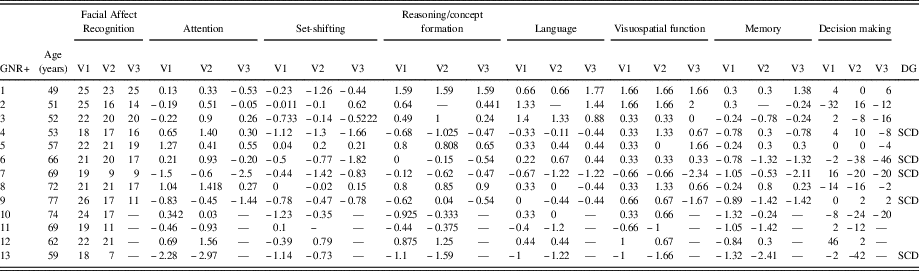
Of the nine GRN mutation carriers that completed all three assessments, five met criteria for what we defined as subtle cognitive impairment, with performance 1.5 standard deviations (SDs) below the mean in at least one domain and no cognitive or behavioral complaints. We did not include in this definition subjects with isolated impairment in facial affect recognition, since we could not estimate the standard deviation in the absence of normative data. Two of them had isolated impairment in executive function, one in visuospatial function, and the other two had a multi-domain cognitive impairment. Ages of these individuals with subtle cognitive impairment ranged from 53 to 77 years. Individual performance of GRN mutation carriers is reported in Table 3.
Performance of individual carriers who completed at least two neuropsychological assessments

Note. Numbers indicate Z-scores for attention, set-shifting, reasoning/concept formation, language, visuospatial function, and memory; and raw scores for facial affect recognition and decision-making. Values 1.5 SDs below the mean are presented in bold type.
V1, V2, and V3=Visits 1, 2, and 3, respectively; DG=diagnostic category; SCD=subtle cognitive decline.
DISCUSSION
In this study, we assessed longitudinal neuropsychological performance in a group of presymptomatic c.709-1G>A GRN carriers and non-carrier relatives from seven FTD families and found that GRN mutation carriers showed decline across longitudinal evaluations in several domains (namely, attention, facial affect recognition, decision-making, language, and memory) reinforcing the idea of a pre-diagnosis cognitive phase in GRN mutation carriers.
The existence of a pre-diagnosis stage in neurodegenerative diseases has been better studied for autosomal dominant Alzheimer’s disease (Acosta-Baena et al., Reference Acosta-Baena, Sepulveda-Falla, Lopera-Gómez, Jaramillo-Elorza, Moreno, Aguirre-Acevedo and Lopera2011; Ardila et al., Reference Ardila, Lopera, Rosselli, Moreno, Madrigal, Arango-Lasprilla and Ossa2000; Bateman et al., Reference Bateman, Xiong, Benzinger, Fagan, Goate, Fox and Blazey2012; Tirado, Muñoz, Aguirre, Pineda, & Lopera, Reference Tirado, Muñoz, Aguirre, Pineda and Lopera2004). In frontotemporal dementia, there are a few previous studies analyzing neuropsychological performance in at-risk individuals carrying other pathogenic mutations. Specifically, presymptomatic MAPT mutation carriers have shown frontal-executive and attention dysfunction (Geschwind et al., 2001), and a decline in the domains language, social cognition, and memory, years before estimated symptom onset (Jiskoot et al., Reference Jiskoot, Dopper, Heijer, Timman, van Minkelen, van Swieten and Papma2016, Rohrer et al., Reference Rohrer, Nicholas, Cash, van Swieten, Dopper, Jiskoot and Rossor2015). Papma et al. (Reference Papma, Jiskoot, Panman, Dopper, den Heijer, Donker Kaat and van Swieten2017) demonstrated lower cognitive performance for test of language (letter fluency), attention (Stroop I), and executive function (Stroop III) in presymptomatic C9orf72 repeat expansion carriers compared with healthy controls, although this finding did not survive correction for multiple comparisons (Papma et al., Reference Papma, Jiskoot, Panman, Dopper, den Heijer, Donker Kaat and van Swieten2017).
Finally, CHMP2B mutation carriers showed cognitive changes dominated by executive dysfunctions years before they fulfill diagnostic criteria of FTD (Stokholm et al., Reference Stokholm, Teasdale, Johannsen, Nielsen, Nielsen and Isaacs2013). For GRN mutations, other cross-sectional studies in presymptomatic individuals have shown a poorer neuropsychological performance in GRN mutation carriers than non-carriers before clinical diagnosis in various tests of attention, executive function, language, and visuospatial skills (Barandiaran et al., Reference Barandiaran, Estanga, Moreno, Indakoetxea, Alzualde, Balluerka and Lopez de Munain2012; Hallam et al., Reference Hallam, Jacova, Hsiung, Wittenberg, Sengdy, Bouchard-Kerr and Mackenzie2014; Jiskoot et al., Reference Jiskoot, Dopper, Heijer, Timman, van Minkelen, van Swieten and Papma2016; Rohrer et al., Reference Rohrer, Nicholas, Cash, van Swieten, Dopper, Jiskoot and Rossor2015), although there are also studies with small sample sizes in which no differences were found (Borroni et al. 2012; Dopper et al., 2013; Pievani et al., 2014).
To our knowledge, there is only one previous longitudinal study assessing neuropsychological performance in presymptomatic GRN mutation carriers. In this study, authors detected no significant deterioration over time in GRN mutation carriers compared to healthy controls in a longitudinal assessment. They found that neuropsychological performance was correlated with age, while older age was significantly correlated with cognitive decline in some individual tests in GRN mutation carriers (Jiskoot et al., Reference Jiskoot, Dopper, Heijer, Timman, van Minkelen, van Swieten and Papma2016).
In our study, the variable that showed the most robust longitudinal decline in GRN mutation carriers was facial affect recognition, contrasting with the improvement seen in this domain in non-carriers. Facial affect recognition is necessary for appropriate social behavior (Diehl-Schmid et al., Reference Diehl-Schmid, Pohl, Ruprecht, Wagenpfeil, Foerstl and Kurz2007) and is known to be impaired in FTD patients (Bertoux et al., Reference Bertoux, de Souza, Sarazin, Funkiewiez, Dubois and Hornberger2015; Fernandez-Duque & Black, Reference Fernandez-Duque and Black2005; Hornberger et al., Reference Hornberger, Yew, Gilardoni, Mioshi, Gleichgerrcht, Manes and Hodges2014). Bertoux et al. (Reference Bertoux, de Souza, Sarazin, Funkiewiez, Dubois and Hornberger2015) showed that patients with behavioral variant FTD presented a characteristic pattern of emotion recognition with negative emotions (anger, fear, disgust, sadness) being more affected, a similar pattern to that we found in our presymptomatic GRN mutation carriers.
One crucial anatomical substrate for this facial affect recognition deficit is the temporal lobe, an important structure involved in facial recognition and emotional processing (Allison, Puce, & McCarthy, Reference Allison, Puce and McCarthy2000, Fusar-Poli et al., Reference Fusar-Poli, Placentino, Carletti, Landi, Allen, Surguladze and Politi2009, Sabatinelli et al., Reference Sabatinelli, Fortune, Li, Siddiqui, Krafft, Oliver and Jeffries2011). Some previous studies with various different neuroimaging approaches, including one by our own group, have highlighted the early and disease-specific involvement of the temporal lobe and the insula in presymptomatic GRN mutation carriers (Caroppo et al., Reference Caroppo, Habert, Durrleman, Funkiewiez, Perlbarg, Hahn and Le Ber2015; Moreno et al., Reference Moreno, Sala-Llonch, Barandiaran, Sánchez-Valle, Estanga, Bartrés-Faz and Indakoetxea2013, Rohrer et al., Reference Rohrer, Nicholas, Cash, van Swieten, Dopper, Jiskoot and Rossor2015). The presence of this deficit for emotion recognition before overt clinical symptoms appear in GRN mutation carriers, along with a plausible anatomical correlate for this deficit, suggests that facial affect recognition may constitute an early neuropsychological biomarker of GRN-associated frontotemporal dementia.
When analyzing individual performance for each GRN mutation carrier, 5 of 13 patients who were assessed at least twice showed subtle cognitive impairment. Those with a multi-domain subtle cognitive impairment had poorer performance in attention, visuospatial function and memory. This finding could be related to early parietal dysfunction which was also a nearly constant finding in our series of patients with GRN-associated FTD (Moreno et al., Reference Moreno, Indakoetxea, Barandiaran, Alzualde, Gabilondo, Estanga and López de Munain2009). On the other hand, the subtle cognitive decline observed in GRN mutation carriers in this study does not have a well-defined pattern and further follow-up is warranted to determine whether individuals with subtle cognitive impairment are in the pre-diagnosis phase of the disease and nearer to overt symptom complaints than those without this subtle cognitive decline. This undefined pattern of poorer neuropsychological performance was expected, given the heterogeneity already described in subjects carrying the same GRN mutation (Redemakers et al., Reference Rademakers, Baker, Gass, Adamson, Huey, Momeni and Hutton2007).
We acknowledge that our study has some limitations. First, although this is a relatively large sample of presymptomatic GRN mutation carriers and their relatives, it is fairly small in terms of statistical power; to overcome this problem we performed bootstrapping techniques that allow more robust statistical inferences. Second, follow-up was not complete, and we lost six participants between the first and second visit and a further nine between the second and the third visit. Third, in GRN mutation carriers, the age of clinical onset varies widely, even within the same family, and it is not currently possible to predict the age of disease onset in a presymptomatic individual. This individual variability makes it challenging to infer the amount of time by which this observed neuropsychological decline precedes clinical diagnosis.
In conclusion, we have demonstrated subtle longitudinal neuropsychological deficits in a group of GRN mutation carriers, which reinforces the idea that neurodegenerative diseases have a pre-diagnosis stage before overt clinical symptoms appear. Alternatively, this dysfunction may reflect premorbid cognitive impairment, suggesting a developmental predisposition that makes some brain regions or networks more vulnerable to neurodegeneration. This study expands on the knowledge of disease-related changes in presymptomatic GRN mutation carriers; however, we should be cautious regarding the generalization of these results to the entire population of sporadic or familial FTD. The combination of different approaches (neuroimaging, neuropsychology, and other biomarkers) will help us to improve our understanding of the early stages of these diseases and evaluate potential upcoming therapies with disease-modifying agents.
ACKNOWLEDGMENTS
We are grateful for the generous contribution of the families who participated in the study. This study was partially supported by the Tau Consortium and the Center for Networked Biomedical Research on Neurodegenerative Disease (CIBERNED). The authors disclose no conflicts of interest.
SUPPLEMENTARY MATERIAL
To view supplementary material for this article, please visit https://doi.org/10.1017/S1355617718000735