1. Introduction
At what point does an oar become a winnowing fan? This is what the hero in Homer's Odyssey has to find out, travelling inland carrying an oar on his shoulder, until he reaches a place where one of its inhabitants will ask him why he is carrying a winnowing fan on his shoulder. There, he is to fix the oar in the ground and make sacrifices to the gods in order to appease them. Thus, the idea that the way we conceptualise reality and the world around us is tightly linked to language and culture is indeed ancient, as this example from classical literature demonstrates. Related to this observation is the classic issue of the linguistic relativity hypothesis: do speakers of different languages think differently as a result of encoding and using different concepts?
A popular misinterpretation of the linguistic relativity hypothesis is to assume that there is a “strong” version, which holds that our thought is constrained by our language, and a “weak” version, which holds that our thought is not limited by our linguistic concepts, but we pay more attention to those aspects of the world that are encoded in our language than to those that are not (see e.g. Hunt and Agnoli, Reference Hunt and Agnoli1991; Carroll, Reference Carroll2008). This distinction neither reflects Sapir's (Reference Sapir1921) and Whorf's (Reference Whorf and Carroll1956) original arguments, who never actually claimed that language constrains a speaker's worldview, nor their recent revival by Lucy (Reference Lucy1992), Levinson (Reference Levinson, Gumperz and Levinson1996), Roberson (Reference Roberson2005) and others. The only possible version that faithfully reflects the original Whorfian arguments is the so-called “weak” one – that language acts as an attention-directing mechanism to specific perceptual attributes of reality.
In fact, there is a wealth of recent empirical evidence to support this view, most notably from the fields of spatial cognition (Levinson, Reference Levinson, Gumperz and Levinson1996; Levinson, Kita, Haun and Rasch, Reference Levinson, Kita, Haun and Rasch2002; Majid, Bowerman, Kita, Haun and Levinson, Reference Majid, Bowerman, Kita, Haun and Levinson2004), grammatical number and object classification (Lucy, Reference Lucy1992; Imai and Gentner, Reference Imai and Gentner1997; Lucy and Gaskins, Reference Lucy, Gaskins, Bowerman and Levinson2001, Reference Lucy, Gaskins, Gentner and Goldin-Meadow2003; Imai and Mazuka, Reference Imai, Mazuka, Gentner and Goldin-Meadow2003), and colour categorisation (Davidoff, Davies and Roberson, Reference Davidoff, Davies and Roberson1999; Roberson, Davies and Davidoff, Reference Roberson, Davies and Davidoff2000; Roberson, Davidoff, Davies and Shapiro, Reference Roberson, Davidoff, Davies and Shapiro2005; Roberson, Reference Roberson2005).
If language-specific concepts direct attention to certain features of stimuli more than others, then it is central to the investigation of human cognition to know how attention is modulated in bilinguals whose languages partition reality in different ways (Green, Reference Green1998; Pavlenko, Reference Pavlenko, De Groot and Kroll2005a). The current paper takes the first steps towards examining bilingual cognition in the domain of colour, thus complementing the recent investigation of linguistic relativity and bilingualism in a range of other domains (e.g. grammatical number and object classification: Athanasopoulos, Reference Athanasopoulos2006, Reference Athanasopoulos2007; Cook, Bassetti, Kasai, Sasaki and Takahashi, Reference Cook, Bassetti, Kasai, Sasaki and Takahashi2006; emotion: Pavlenko, Reference Pavlenko2005b, Reference Pavlenko and Pavlenko2006; time: Boroditsky, Reference Boroditsky2001; gender: Boroditsky, Schmidt and Phillips, Reference Boroditsky, Schmidt, Phillips, Gentner and Goldin-Meadow2003; artefact naming and categorisation: Malt and Sloman, Reference Malt and Sloman2003; Ameel, Storms, Malt and Sloman, Reference Ameel, Storms, Malt and Sloman2005; note also earlier work on person cognition by Hoffman, Lau and Johnson, Reference Hoffman, Lau and Johnson1986).
The paper is organised as follows. In the next two sections, the issue of linguistic relativity in relation to colour cognition is discussed, presenting past and recent evidence to bear on the debate, as well as the emerging issue of linguistic relativity in relation to bilingualism. Then the paper will examine naming behaviour and categorical perception of colour in bilinguals with languages that differ in their lexical division of the blue region of colour space. Finally, results are discussed, focusing on the impact of several variables that may affect bilingual cognition, and that may in turn have more general implications for conceptual representation and for the way linguistic categories influence human cognition.
1.1 Linguistic relativity and colour categorisation
The field of colour categorisation has been a classic scientific battleground for the linguistic relativity hypothesis. Until the 1970s, the prevalent view was that there were no constraints on the way languages encoded colour (see e.g. Gleason, Reference Gleason1961). Consequently, colour categorisation was viewed as one of the most important fields where the influence of linguistic diversity on cognition was manifested. For example, Brown and Lenneberg (Reference Brown and Lenneberg1954) observed that Zuni does not separate lexically the colours “orange” and “yellow”, and instead uses a single term to describe them. In a recognition memory task, Zuni speakers did not distinguish between the two colours as accurately or as frequently as English speakers did.
In the 1970s, the tide changed in the opposite direction, mainly because of the influential studies by Berlin and Kay (Reference Berlin and Kay1969) and Rosch-Heider (Reference Rosch-Heider1972). Berlin and Kay (Reference Berlin and Kay1969) obtained samples of colour areas and category foci (best exemplars) from native speakers of 20 different languages, including English. The researchers found no differences between the participants as a function of language background, concluding that colour categorisation is not language-specific and that the foci of colour terms are universal. Explicit in their account is the assumption that languages should have between two and eleven basic colour terms, the number determined by a specific evolutionary path each language may take when adding new colour categories. Rosch-Heider's (Reference Rosch-Heider1972) study found no differences in memory for colour between speakers of English and speakers of a language with only two basic colour terms, Dani. Both groups of speakers showed better recognition memory for focal stimuli (i.e. near the focus of each of the basic categories reported in Berlin and Kay, Reference Berlin and Kay1969) than non-focal stimuli. These results, in conjunction with Berlin and Kay's (Reference Berlin and Kay1969) findings, seriously undermined the scientific basis of the linguistic relativity hypothesis.
However, subsequent studies by Davidoff et al. (Reference Davidoff, Davies and Roberson1999) and Roberson et al. (Reference Roberson, Davies and Davidoff2000) did not replicate Rosch-Heider's (Reference Rosch-Heider1972) results with speakers of English and speakers of the Berinmo tribe in Papua New Guinea. In fact, the researchers found that linguistic categories for colour influenced cognitive representation of colour. Both Berinmo and English speakers judged two colours to be more similar if they shared the same name in their respective languages. The researchers concluded that the way we judge the similarity or the difference between two items is determined by how our language carves the world into nameable parts (Roberson et al., Reference Roberson, Davies and Davidoff2000).
These findings do not mean that there are no physiological and perceptual constraints common to all humans. For example, there are no attested languages which have terms for “blue” and “yellow”, but not for the intermediate category of “green” (Roberson, Reference Roberson2005). Nevertheless, language influences colour categorisation by directing our attention to those categories that are encoded in it. For example, a recent study by Roberson et al. (Reference Roberson, Davidoff, Davies and Shapiro2005) found that speakers of a language with only five basic colour terms showed differential cognitive representation of colour from speakers of another language which also had five basic colour terms. Participants showed categorical perception (judging two stimuli to be more similar if they fall within a category boundary than if they cut across the boundary) for the specific colour areas encoded in their respective language, suggesting that even if languages have the same number of basic colour terms, their precise boundaries in colour space may differ, and yield differential cognitive patterns.
More recently, the debate has moved beyond the traditional universality vs. relativity views to a more mediating position (see e.g. Kay and Regier, Reference Kay and Regier2006). Regier, Kay and Khetarpal (Reference Regier, Kay and Khetarpal2007), based on a proposal by Jameson and D'Andrade (Reference Jameson, D'Andrade, Hardin and Maffi1997), empirically demonstrated that colour naming is determined by universal perceptual constraints, such that focal colours are indeed linguistically and perceptually more salient than non-focal colours across cultures. On the other hand, there also exists considerable cross-linguistic variation at the demarcation of category boundaries, i.e. linguistic convention influences where speakers of different languages partition colour space. This view accommodates the existence of BOTH universal constraints on colour naming AND the influence of cross-linguistic differences on colour cognition (Kay and Regier, Reference Kay and Regier2007).
1.2 Linguistic relativity and bilingualism
Since there is now a range of converging evidence to suggest the tight relationship between linguistic concepts and cognition, the issue of bilingualism becomes increasingly important. For example, in Berlin and Kay's (Reference Berlin and Kay1969) seminal study the majority of participants were in fact bilingual in English and were living in the US. However, if bilingualism affects cognitive representation of categories, it is difficult to interpret the behaviour of bilingual individuals in their study: is their English-like behaviour a sign of universality of categories and foci, or the result of semantic shift of their first language (L1)-specific categories and foci towards the second language (L2)? (For criticisms of Berlin and Kay, Reference Berlin and Kay1969, see Ratner, Reference Ratner1989; Saunders and van Brackel, Reference Saunders and van Brackel1997; Lucy, Reference Lucy, Hardin and Maffi1997; Pavlenko, Reference Pavlenko, De Groot and Kroll2005a, Reference Pavlenko2005b. Berlin and Kay subsequently acknowledged some of these shortcomings and modified their claims, see e.g. Kay, Berlin and Merrifield, Reference Kay, Berlin and Merrifield1991; Kay and Berlin, Reference Kay and Berlin1997.)
The problem is compounded by the fact that the majority of the world's population is bilingual anyway, a large proportion in English (Cook, Reference Cook1999). “Pure” monolingual populations are more likely to be found in agricultural, usually uneducated communities, or tribes inhabiting remote parts of the world (see e.g. the studies by Rosch-Heider, Reference Rosch-Heider1972; Lucy, Reference Lucy1992; Davidoff et al., Reference Davidoff, Davies and Roberson1999; Gordon, Reference Gordon2004, and others). However, a serious caveat in interpreting results from studies of this kind is that the stimuli and tasks used may be unwittingly culturally biased, suited to the cultural background and cognitive demands of university-educated Westerners (Levinson, Reference Levinson2001).
On the other hand, bilingualism still tends to be routinely overlooked in many studies in the field. Laws, Davies and Andrews (Reference Laws, Davies and Andrews1995) found no differences in colour cognition between Russian and English speakers, despite the fact that Russian partitions the blue region of colour space into two areas varying in lightness. More recently, a study by Winawer, Witthoft, Frank, Wu, Wade and Boroditsky (Reference Winawer, Witthoft, Frank, Wu, Wade and Boroditsky2007) did find significant differences between Russian- and English-speaking populations on essentially the same task. In both studies, the Russian participants were bilingual in English, with varying degrees of L2 proficiency, and in many cases living and studying in the L2-speaking country. Yet no methodological measures were taken to control for the possibility that their bilingualism may have influenced the results. An earlier study (Andrews, Reference Andrews1994) did show L2 influence on L1 in colour categorisation by Russian–English bilinguals. Therefore, variables such as L2 proficiency, acculturation, and age of L2 acquisition, to name a few, may be crucial in determining the way bilinguals operate in cognitive tasks that aim to investigate the degree of linguistic influence on cognition.
Indeed recent studies have demonstrated the effects of these variables on the way bilinguals behave in cross-cultural cognitive tasks. Cook et al. (Reference Cook, Bassetti, Kasai, Sasaki and Takahashi2006) showed effects of acculturation on the way Japanese–English bilinguals extended the novel name for a target object or substance to a shape or material alternate. The behaviour of bilinguals living in the L2-speaking country for more than three years had shifted towards that of monolingual speakers of their L2, and was significantly different from that of bilinguals who had lived in the L2 country for shorter periods of time. Athanasopoulos (Reference Athanasopoulos2006, Reference Athanasopoulos2007) showed robust effects of L2 proficiency on the way Japanese–English bilinguals perceived the similarity between countable objects and non-countable substances. Bilingual speakers shifted with L2 proficiency towards the cognitive pattern of monolingual speakers of their L2. More recently, Athanasopoulos and Kasai (Reference Athanasopoulos and Kasai2008) showed that knowledge of specific grammatical properties of the L2 was a better predictor of bilingual cognitive behaviour than length of stay in the L2 country and age of L2 acquisition were. The way bilinguals categorised novel objects as units or substances depended strongly on their performance on an oral production task specifically assessing grammatical number marking in the L2.
Boroditsky (Reference Boroditsky2001) showed effects of age of L2 acquisition on Chinese–English bilinguals' perception of time. Younger learners were less likely to follow the L1 pattern than older learners (see however Chen, Reference Chen2007, and January and Kako, Reference January and Kako2007, for criticisms and counter-evidence to Boroditsky's, Reference Boroditsky2001, findings). A study of grammatical gender and picture similarity judgments in a group of Spanish–German bilinguals revealed a strong relationship between similarity scores and language proficiency, age of acquisition, and length of language use (Boroditksy et al., Reference Boroditsky, Schmidt, Phillips, Gentner and Goldin-Meadow2003).
Pavlenko (Reference Pavlenko and Pavlenko2006) showed that bilinguals perceive themselves as different persons when using their different languages as a function of linguistic and cultural differences between their languages, the language-learning context, the degree of language emotionality, and the level of language proficiency. Hoffman et al. (Reference Hoffman, Lau and Johnson1986) found that the way Chinese–English bilinguals judged character traits in people depended on the language they were addressed in. Addressed in Chinese, the bilinguals' judgements were in line with Chinese stereotypes; addressed in English, the bilinguals' judgements were very similar to those of English monolinguals and conformed to English stereotypes. Studies by Malt and Sloman (Reference Malt and Sloman2003) and Ameel et al. (Reference Ameel, Storms, Malt and Sloman2005) showed that bilinguals have an integrated naming pattern for artifacts like bottles and dishes, influenced by both languages, but did not find effects on non-linguistic categorisation. This suggests that the way lexical or grammatical categories influence different cognitive or perceptual domains may vary (Roberson et al., Reference Roberson, Davidoff, Davies and Shapiro2005).
1.3 Aims of the current study
The current study extends the issue of linguistic relativity and bilingualism to the domain of colour cognition. Specifically, the aim is to examine whether cognitive representation of colour will be affected by knowledge of two languages that differ in their coding of the colour space. Earlier work had investigated “semantic shifts” in bilinguals, showing L2 influence on use and prototypes of L1 colour terms. For example, Ervin (Reference Ervin1961) showed that Navajo–English bilinguals used their L1 colour terms differently from Navajo monolinguals. Caskey-Sirmons and Hickerson (Reference Caskey-Sirmons and Hickerson1977) showed that individuals from five different language backgrounds who were all bilingual in English had shifted their prototypes (foci) for a range of L1 colour terms towards the English prototypes. This led the researchers to claim that “the worldview of bilinguals, whatever their first language, comes to resemble, to some degree, that of monolingual speakers of their second” (Caskey-Sirmons and Hickerson Reference Caskey-Sirmons and Hickerson1977, p. 365). A study by Zollinger (Reference Zollinger1988) showed that Japanese children living in Germany used certain L1 colour terms significantly less frequently than Japanese children living in Japan. Jameson and Alvarado (Reference Jameson and Alvarado2003) found that bilingual speakers whose L1 (Vietnamese) has fewer colour terms than their L2 (English) tended to modify their colour naming behaviour according to the distinctions made in their L2, suggesting that bilinguals use whichever system is maximally informative.
Although these studies did not investigate non-linguistic cognitive behaviour, their results suggest that bilinguals may differ from monolinguals in the way they use their colour terms and in the way they represent them on colour space. However, no study has systematically investigated the consequences of bilingualism on perception and cognitive representation of colour categories. The current study opens up that investigation, in order to address a crucial question in the field of L2 acquisition and bilingualism: does learning a second set of categorical divisions lead to cognitive restructuring in the mind of the bilingual person and, if so, to what extent, and why (Cook, Reference Cook, De Groot and Kroll1997, Reference Cook and Cook2002, Reference Cook and Cook2003; Green, Reference Green1998; Pavlenko, Reference Pavlenko1999, Reference Pavlenko, De Groot and Kroll2005a)? The pursuit of this question in the domain of colour is particularly important due to the centrality of that domain in the language and thought debate. If categorical perception of colour is intrinsically derived from language, then the colour domain is an ideal tool to test the question of how contrasting categorical aspects are represented in the bilingual mind.
The bilinguals under investigation will be native speakers of Greek who have English as an L2. Greek divides the blue region of colour space into two distinct regions, a darker shade called ble, and a lighter shade called ghalazio (Androulaki, Pestaña, Lillo and Davies, Reference Androulaki, Pestaña, Lillo and Davies2001). A similar distinction between two monolexemic terms that divide the blue region of colour space has also been documented in a range of other languages such as Japanese (Uchikawa and Boynton, Reference Uchikawa and Boynton1987), Turkish (Özgen and Davies, Reference Özgen and Davies1998), and Russian (Davies and Corbett, Reference Davies and Corbett1997). If cognitive representation of colour is affected by the L2, then the blue vs. light blue distinction will become less salient in the cognition of Greek–English bilinguals as a result of using a second language that does not mark the contrast between these categories. This would suggest that learning new conceptual dimensions leads to some (potentially quantifiable) extent of cognitive reorganisation.
The current study investigates these issues in two experiments. Experiment 1 will obtain naming patterns for chips that lie in the blue area of colour space, as well as the best examples (foci) of the two categories. The aim is to calculate precise category boundaries of ble and ghalazio which will be used for the subsequent cognitive experiment, to compare bilinguals' naming behaviour to that of English monolinguals reported in previous studies, and to investigate whether bilinguals exhibit shift of category foci on the colour space, as was previously shown by Caskey-Sirmons and Hickerson (Reference Caskey-Sirmons and Hickerson1977). To this end, bilinguals will be separated into two groups based on L2 proficiency, an Intermediate and an Advanced group, since it is extremely difficult to find individuals who are completely monolingual in Greek and who match the bilinguals in socio-educational background at the same time.Footnote 1
Experiment 2 will then examine cognitive representation of the ble/ghalazio distinction in Greek–English bilinguals who have not taken part in Experiment 1, by asking them to make perceptual similarity ratings of pairs of stimuli that fall within the ble or ghalazio boundary, and pairs of stimuli that cross-cut the boundary. Bilinguals' ratings will be compared to those of English monolinguals, and will then be correlated with their level of L2 proficiency as measured by a general English proficiency test, their length of stay in the L2 speaking country, the age at which they started to learn English, and the extent to which they use English in their everyday lives. In addition, correlations will be made with semantic memory for specific colour terms in English and Greek, given that recent evidence suggests a strong relationship between specific L2 proficiency and cognitive behaviour (Athanasopoulos and Kasai, Reference Athanasopoulos and Kasai2008). These measures are necessary since it is nearly impossible to obtain comparable monolingual Greek behaviour, as mentioned earlier. Furthermore, such measures will determine the degree to which bilingualism affects cognitive representation of colour, by identifying the potential impact of a range of variables, which previous studies have shown may influence bilingual cognition.
2. Experiment 1: Foci and areas of Greek blues
2.1 Method
2.1.1 Participants
Participants were 20 native speakers of Greek who were separated into two groups based on their proficiency in English. The group with advanced English proficiency consisted of 10 adult individuals who were tested in the UK and selected on the basis of them attending a postgraduate course (MA or PhD) in Linguistics or English Language at a UK university. This would ensure that they had high proficiency in English. Their proficiency was measured by the Nation vocabulary test (Nation, Reference Nation1990), which measures vocabulary at five levels, ranging from the 2,000-word level up to the 10,000-word level. Their mean score was 85/90 (SD = 3, range 80–90), i.e. around the 10,000-word level. Their age-range was 21–31 years, 7 female, 3 male. The mean age at which they started to learn English was 8 years old (SD = 3), ranging from 5 to 13 years old. Their mean length of stay in the UK was 30 months (SD = 14), ranging from 9 to 48 months. The group with intermediate English proficiency were tested in Greece and consisted of individuals who were attending non-English related university courses in Greece and had not previously visited the UK or any other English-speaking country for more than one month. Their mean score in the Nation test was 64 (SD = 4, range = 60–69), i.e. around the 6,000-word level. Their age-range was 19–26 years old, 8 female 2 male. Their mean age of L2 acquisition was 9 years old (SD = 2, range 5–13). All of the participants reported that they had normal colour vision. Table 1 provides a summary of the participants' details.
Summary of advanced and intermediate level bilinguals' details in Experiment 1.

2.1.2 Materials
The stimuli used for elicitation of category foci were identical to the ones used by Heider and Olivier (Reference Heider and Olivier1972) and Roberson et al. (Reference Roberson, Davies and Davidoff2000, Reference Roberson, Davidoff, Davies and Shapiro2005). These comprised of 160 fully saturated Munsell colour chips varying in hue and lightness. They were mounted on a sheet of stiff white cardboard and were arranged to represent hue levels 5 and 10 of ten equally spaced steps around the Munsell circle (Munsell dimension Hue R, YR, Y, YG, G, BG, B, PB, P, RP) each at eight lightness levels (Munsell dimension Value 9/, 8/, 7/, 6/, 5/, 4/, 3/, 2/). Since the focus is only on the blue region of colour space, stimuli used for name elicitation were a subset of the full array described above, ranging in Munsell Hue from 5BG to 10PB, and in lightness (Munsell Value) from 2 to 9. These were also fully saturated. They were 10 × 20 mm glossy finish chips individually mounted on 40 mm square pieces of white card.
2.1.3 Procedure
Each participant was seated at a table next to a window and was shown each colour chip one at a time, in random order, and asked to indicate its name in their native language. Each response was recorded by the administrator of the experiment and gathered for analysis. After completion of the naming task, participants were shown the full array of Munsell chips. They were asked to indicate which chip is the best example of ble and which chip is the best example of ghalazio (counter-balanced within each group, such that half of the participants were asked to identify the ble focus first, and half were asked to identify the ghalazio focus first). Participants received instructions in Greek by a Greek native speaker. Each testing session lasted for about 40 minutes. The order of tasks was as follows: first participants conducted the naming and focus placement tasks (20 minutes), then they completed a personal information questionnaire (5 minutes), and then the Nation test was administered (15 minutes).
2.2 Results
Figure 1 represents the area of Munsell colour space that was used for naming. It shows the modal naming data as well as best exemplar placement for ble and ghalazio by advanced- and intermediate-level bilinguals, alongside naming data and focus placement for blue in English native speakers reported in the studies by Roberson et al. (Reference Roberson, Davies and Davidoff2000, Reference Roberson, Davidoff, Davies and Shapiro2005). A chip was completely shaded ble or ghalazio on the basis of at least 80% of participants naming it so. Otherwise, boundaries drawn through an individual chip represent the proportion of participants that named the particular chip ble or ghalazio. Within-group naming agreement for intermediate bilinguals was 77% for ble and 67% for ghalazio, while for advanced bilinguals naming agreement was 82% for ble and 65% for ghalazio. The chips with lowest agreement were the chips located between Hue levels 5B–5PB at lightness Value 5. These were named ble by 57% of advanced bilinguals (the rest naming them ghalazio), compared to 33% of intermediate bilinguals, who in turn tended to use ghalazio to name them. The difference between the two groups was specifically located at the 5B/5 chip, which was ambiguous for advanced-level bilinguals (see the top part of Figure 1), but not for intermediate-level bilinguals, who consistently named it ghalazio (see the middle part of Figure 1). Thus, the naming data show that both groups treat the chips located at 10B/5 and 5PB/5 as ambiguous with regards to their status as members of either category, while 5B/5 is ambiguous only for advanced-level bilinguals. Overall, these data allow us to place the category boundary between ble and ghalazio at those particular chips.
Distribution of advanced- and intermediate-level bilingual naming and choices of best exemplar for ble and ghalazio, and English naming distribution for blue adapted from Roberson et al. (Reference Roberson, Davies and Davidoff2000, Reference Roberson, Davidoff, Davies and Shapiro2005). The three-dimensional Munsell system is shown as a two-dimensional projection of hue (horizontal axis) against lightness (vertical axis). Numbers represent the number of individuals choosing an exemplar as best example of the category. Dots represent the English best example of blue reported in Roberson et al. (Reference Roberson, Davies and Davidoff2000, Reference Roberson, Davidoff, Davies and Shapiro2005).

Turning now to category foci placement, it is clear from Figure 1 that the majority of intermediate bilinguals place the best example of ble one step away from the blue focus, both in lightness and hue. On the other hand, the majority of advanced bilinguals tend to shift the ble focus towards blue. This semantic shift toward the L2 is in line with Caskey-Sirmons and Hickerson's (Reference Caskey-Sirmons and Hickerson1977) results. The case of ghalazio is interesting. Advanced bilinguals exhibit focus shift for this category as well, but in the opposite direction of the L2 category. Thus, the distance in colour space between ble and ghalazio foci is similar for both bilingual groups, with advanced bilinguals shifting their foci symmetrically. This suggests that bilingual semantic shift of colour foci need not always occur in the direction of the L2. In this particular case, advanced bilinguals shift their prototypes for ble towards blue, but they also maintain the perceptual distance between ble and ghalazio foci by shifting the latter category's prototypes away from blue. At the same time, there are minimal differences between the groups in where they place the boundary between the two categories in the naming task. Does this mean that despite bilinguals shifting their category foci they still perceive the distinction between ble and ghalazio in the same way? Previous research shows that participants rate two colours to be more similar if they fall within a category boundary than if they cut across the boundary. (Roberson et al., Reference Roberson, Davies and Davidoff2000, Reference Roberson, Davidoff, Davies and Shapiro2005). In the case of Greek speakers, Experiment 2 will attempt to investigate cognitive sensitivity to the ble/ghalazio distinction by asking participants to rate the perceptual similarity between pairs of stimuli that are within the ble or ghalazio boundary, and pairs of stimuli that cross-cut the boundary. The aim is to identify potential changes in bilinguals' perception of stimuli corresponding to ble and ghalazio by correlating cognitive performance with semantic memory for specific colour terms, general L2 proficiency, length of stay in the L2-speaking country, age of acquisition, and degree of L2 use. These correlations will help to elucidate the precise impact of each of these variables on bilingual cognition.
3. Experiment 2: Similarity judgements of Greek blues
3.1 Method
3.1.1 Participants
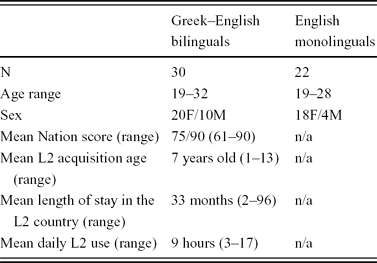
Participants were 30 adult native speakers of Greek who had not taken part in the previous experiment (20 female, 10 male, age-range 19–32 years old). They were all bilingual in English and were studying at a UK university. Their proficiency in English was measured by the Nation vocabulary test (Nation, Reference Nation1990). Their mean score was 75/90 (SD = 9), i.e. around the 8,000-word level. Their scores ranged from 61 (around the 6,000-word level) to 90 (10,000-word level). Their mean length of stay in the UK was 33 months (SD = 27 months), ranging from 2 to 96 months. Their mean age of L2 acquisition was 7 years old (SD = 3 years), ranging from 1 to 13 years old. They reported that they used English for 9 hours per day on average (SD = 4), ranging from 3 to 17 hours.
In addition to all the measures above, elicited by means of a questionnaire, semantic saliency of ble, ghalazio and blue was measured by asking participants to write down all the colour names they could think, first in one language and then in the other. To minimise the possibility of back-translation, participants were given the Nation test to complete in-between. The order of languages was counter-balanced across the whole sample. Elicitation of colour lists is a standard task used to establish the basicness of colour terms in a language (Corbett and Davies, Reference Corbett and Davies1995). Basic colour terms should be more available in semantic memory than non-basic terms, and thus appear higher in the list. Here, it is used to measure the saliency of blue, ble and ghalazio. The aim is to correlate the semantic saliency of each term (i.e. how high it appears in the list) with participants' similarity judgments. On average, ble was placed 6th on the list (SD = 4, range 1–17), ghalazio was placed 12th (SD = 7, range 2–28), and blue was placed 5th (SD = 3, range 1–13).
The similarity judgement task was also given to 22 adult English monolingual participants who were all university students. Their mean age was 21 years, age-range 19–28, 18 female, 4 male. Since English generally uses a single term to refer to the blue area of colour space, English speakers are expected to treat pairs of stimuli that cut across the ble/ghalazio boundary no differently from pairs that fall within each category boundary. All participants reported that they had normal colour vision. Table 2 provides a summary of the participants' details.
Summary of Greek–English bilinguals' and English monolinguals' details in Experiment 2.

3.1.2 Materials
The stimuli were individual 10 × 20 mm glossy Munsell chips, mounted on 40 mm square pieces of white card. Five pairs of within-category stimuli and three pairs of cross-category stimuli were created from the ble and ghalazio areas obtained in Experiment 1. Pairs were constructed so that either both members were within the same category (e.g. Hue level 10B/Lightness level 4 – Hue level 10B/Lightness level 2), or the pair cut across the ble/ghalazio boundary (e.g. Hue level 10B/Lightness level 4 – Hue level 10B/Lightness level 6). A full list of pairs can be found in the Appendix.
3.1.3 Procedure
Each participant was seated at a table next to a window and pairs were presented, one at a time, in random order. Participants were asked to judge “how different or similar these two colours are” using a 10-point scale where 10 represents maximum dissimilarity and 1 represents maximum similarity. Each pair was shown twice, counterbalancing the position of each individual chip in the pair. All participants were tested in the UK and each testing session lasted for about 40 minutes for bilinguals, and about 15 minutes for English monolinguals. The order of tasks for bilinguals was as follows: first participants conducted the similarity judgment task (10 minutes), then they completed the personal information questionnaire (5 minutes), then the colour list for one language was elicited (5 minutes), then the Nation test was administered (15 minutes), and finally the colour list for the other language was elicited (5 minutes). The English monolinguals were given the similarity judgement task, followed by the personal information questionnaire. Instructions were given to all participants in their native language by a Greek–English bilingual speaker.
3.2 Results
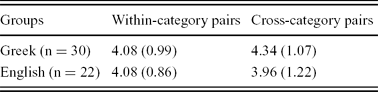
Table 3 shows the mean similarity judgments of cross-category and within-category pairs of stimuli for the two groups. A 2 (Group: English vs. Greek) × 2 (Pair type: Within vs. Cross) mixed ANOVA showed that the main effects of Group and Pair type were not significant, F(1,50) = 0.513, p > .05, and F(1,50) = 0.448, p > .05 respectively. The Group × Pair type interaction approached significance, F(1,50) = 3.247, p = .08. This nearly significant interaction does not readily reveal whether Greek speakers differ from English speakers in their cognitive representation of the blue area of colour space. However, we now turn to examine whether the cognitive behaviour of Greek speakers is modulated by any of the variables that were measured and which previous research has shown may affect the way bilinguals perform in non-linguistic similarity judgment tasks.
Mean similarity judgements (and standard deviations) of ble and ghalazio within and cross-category pairs. Figures are rounded to the nearest two decimal places.

3.2.1 Identifying the variables that may predict bilingual behaviour
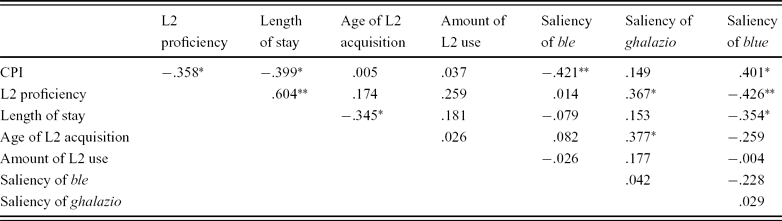
In order to identify the variables that may affect bilingual cognition, the data were initially going to be analysed by a multiple regression analysis. The independent variables were general L2 proficiency as measured by the Nation test, length of stay in the L2 country, age of L2 acquisition, amount of L2 use, and semantic saliency of ble, blue and ghalazio, as measured by the position of each term on each participant's list of colour terms. The dependent variable, hereafter called the Categorical Perception Index (CPI), was calculated by subtracting each participant's mean similarity judgment score for within-category pairs from their mean similarity judgement score for cross-category pairs. Table 4 shows the correlation matrix between all variables.
Correlation matrix showing Pearson's r for the eight variables.

*p < .05, **p < .01
As Table 4 shows, several independent variables significantly correlate with each other, as well as with CPI. Because of this multi-collinearity problem (Howell, Reference Howell2002), the multiple regression analysis was not performed.Footnote 2 Instead, CPI was correlated with each independent variable, partialling out all the other variables. Table 5 gives a summary of these correlations.
Pearson's r for partial correlations between CPI and each independent variable, controlling for all the other variables.

*p < .05, **p < .01
As Table 5 shows, the strongest significant correlation was obtained for semantic saliency of ble. This means that the further down ble appears on the colour list (and thus the greater its number on the list), the less bilinguals distinguish between within- and cross-category pairs. There was also a moderate correlation with semantic saliency of blue, such that the higher blue appears in each participant's colour list (and thus the smaller its number on the list), the less distinction is made between within- and cross-category pairs. Finally, the weakest significant correlation was obtained for length of stay in the UK, such that the more bilinguals have stayed in the L2 country, the less they distinguish between within- and cross-category pairs. None of the rest of the variables correlated significantly with CPI. To sum up, these results show that when controlling for a range of variables that may influence bilingual cognition, semantic saliency of specific colour terms is most strongly correlated with bilingual cognition, with length of stay having a weaker but significant effect.
3.2.2 Dissecting memory and length of stay
Since memory for specific colour terms and length of stay in the L2 country were statistically significant predictors of CPI, further analyses were carried out in order to examine whether there is a discernible threshold in memory and/or length of stay at which participants shift their representations, or whether these shift progressively. To this end, bilinguals were split into two groups based on their memory for the relevant colour terms and their length of stay in the UK. Using CPI as the dependent variable, their behaviour was compared against each other and against that of the English monolingual group (mean CPI = −.12, see Table 3) in separate one-way ANOVAs.
Memory for ble and blue were examined first. Bilinguals were evenly distributed into High and Low groups, based on the position of each term in each participant's list. For ble, the split yielded a High group (N = 15, mean CPI = .57), who placed the term between first and fourth place, and a Low group (N = 15, mean CPI = −.03), who placed the term between fifth and seventeenth place. A one-way ANOVA showed a significant main effect of Group, F(2,49) = 4.212, p < .05. Post-hoc Bonferroni tests showed that the only significant difference was between the High group and the English monolinguals (p < .05). This means that those bilinguals that tended to place ble in the first four places on their list distinguished significantly more between within- and cross-category pairs than the English monolinguals did. Thus, cognitive behaviour begins to shift towards the L2 pattern once ble is placed consistently below fourth place on the list.
The groups that were formed on the basis of memory for blue were a High group (N = 17, mean CPI = −.07), who placed the term between first and fourth place (because many participants placed the term fourth it was impossible for the groups in this case to have exactly the same number of participants; this division is as close to even as possible), and a Low group (N = 13, mean CPI = .71), who placed the term between fifth and thirteenth place. A one-way ANOVA showed a significant main effect of Group, F(2,49) = 6.221, p < .01. Post-hoc Bonferroni tests showed that the Low group differed significantly both from the High group (p < .05) and the English monolingual group (p < .01), while there was no significant difference between the High group and the English group (p > .05). This means that those bilinguals who tended to place blue between fifth and thirteenth place on the list distinguished significantly more between within- and cross-category pairs than the High group and the English monolinguals did. Thus, cognitive behaviour shifts completely towards the L2 pattern once blue is placed consistently above fifth place on the list.
For length of stay in the L2 country, the split yielded a Long stay group (N = 16, mean CPI = −.02), who had stayed in the UK between 24 and 96 months, and a Short stay group (N = 14, mean CPI = .59), with length of stay ranging between 2 and 22 months (again the sizes of the groups could not be exactly the same for similar reasons to those mentioned earlier). A one-way ANOVA showed a significant main effect of group, F(2,49) = 4.269, p < .05. Post-hoc Bonferroni tests showed that the only significant difference was between the Short stay group and the English monolinguals (p < .05). This means that once individuals have spent 24 months in the L2-speaking country their colour cognition begins to shift towards the L2 pattern.
4. Discussion
Empirical evidence is accruing to suggest that bilingual speakers with languages that differ in their lexical or grammatical concepts and categories differ from monolingual speakers of their L1, and shift towards monolingual speakers of their L2, in their cognitive representation of those categories. The present study addressed the issue by asking whether, and to what degree, L2 colour categories influence the representation of L1 colour categories on the colour space, and the cognitive discrimination of L1 colour categories in a similarity judgment task.
The data from naming and prototype placement (Experiment 1) showed that the majority of advanced-level bilinguals shift the focus of one of their L1 categories towards the L2 category focus, as did the earlier study by Caskey-Sirmons and Hickerson (Reference Caskey-Sirmons and Hickerson1977). However, they also shift the focus of the other L1 category away from the L2 focus, thus maintaining the perceptual distance between their native category foci. Furthermore, there were minimal differences between advanced and intermediate bilinguals in naming stimuli ble or ghalazio. The data from the similarity judgment task (Experiment 2) showed that straightforward comparisons do not provide a conclusive answer as to whether English and Greek speakers differ in their cognitive representation of the blue area of colour space. However, a rigorous examination of a range of variables that previous studies have shown to influence bilingual cognition revealed that semantic memory for specific colour terms strongly correlated with the way Greek–English bilinguals perceived the ble/ghalazio distinction, while there was a weaker but significant effect of length of stay in the L2 country.
Thus, although bilinguals are able to observe the perceptual distance between their native category foci on the colour space, and “know” which stimuli correspond to their native colour terms, their underlying perception of the difference between these categories appears to have been distorted as a function of the saliency of specific colour terms in semantic memory, and the amount of time spent in the L2 country. Further analyses revealed specific thresholds in semantic memory and length of stay where bilingual cognition begins to shift toward that of monolingual speakers of the L2. While it is not claimed that these thresholds may apply generally in all cases, they may be useful in predicting behaviour in future similar studies. In any case, these findings add an important new dimension to investigations of bilingual cognition, which thus far have rarely looked at the link between specific L2 knowledge and cognition (but see Athanasopoulos and Kasai, Reference Athanasopoulos and Kasai2008), and certainly have not looked at the link between specific L1 knowledge and cognition. The current findings show that it is not just acquisition of novel linguistic categories that may influence the way bilinguals behave in cognitive tasks, but also attrition of the original L1 term in memory.
The current findings also show a weak but significant effect of length of stay in the L2 country. The basis of that effect is likely to be fundamentally a matter of use of linguistic categories. The more bilinguals stay in the L2 country, the less opportunity they have to use their L1 colour terms to refer to their visual environment, either because their L1 colour categories are not visually as salient as in their native country, and/or because they are not systematically attended to by native speakers of their L2. This would neatly explain both the strong effect of memory for specific colour terms, and the weaker effect of length of stay, suggesting an indirect relationship between the two.
Whatever the case may be, the current study sheds light on an important question in the field, namely whether it is language per se or non-linguistic cultural aspects that drive the cognitive effect. The current finding of both influence of stay in the L2 country AND semantic saliency of specific colour terms shows that focusing the debate on linguistic OR cultural influence may obscure an interestingly complex situation. It appears that BOTH culture and language may influence the way bilinguals perceive categorical divisions, but to different degrees and in different ways.
These findings, in conjunction with previous recent findings, have important implications for conceptual representation in bilinguals (Francis, Reference Francis1999; Pavlenko, Reference Pavlenko1999; De Groot, Reference De Groot2000; Cook, Reference Cook and Cook2002) as well as broader implications for the conceptualisation component of speech production models (Levelt, Reference Levelt1989; Levelt, Roelofs and Meyer, Reference Levelt, Roelofs and Meyer1999). Recent developmental findings (Roberson, Davidoff, Davies and Shapiro, Reference Roberson, Davidoff, Davies and Shapiro2004) show that both Himba and English children initially make similarity judgements on perceptual grounds only. However, after acquisition of their respective colour vocabulary, similarity judgements shift towards language-specific patterns. The current study suggests that conceptual representation is not permanently fixed by the L1, but changes with the acquisition of specific L2 properties and attrition of pre-existing L1 properties. This provides direct empirical support to Pavlenko's (Reference Pavlenko1999) argument that concepts are not represented in the form of clearly defined separate entities, characterised by a set of stable features. Rather, the evidence suggests that they are dynamic and flexible, susceptible to influence by a range of variables that characterise the bilingual person, and tightly linked to the semantic saliency of specific L1 and L2 linguistic categories.
This tight link between specific linguistic knowledge and cognitive behaviour demonstrates that bilingualism offers a unique insight into the study of the relationship between language and thought. Not only can we investigate cognitive differences and similarities between groups based on their language background, but we can also explore the precise linguistic elements, as well as a range of other variables, that may drive these cognitive differences between speakers of different languages. This methodological advantage is particularly important in the context of cross-cultural research, given that comparisons between seemingly “monolingual” speakers of different languages may mask important cross-linguistic differences, or lead to conflicting results between studies that do not take into account their participants' bilingualism.
Since the current study is the first to directly address cognitive representation of colour in bilinguals, there are several issues that warrant further examination. A question arises as to why semantic saliency of ghalazio did not correlate significantly with the categorical perception behaviour of bilinguals. One explanation for this finding may be offered by Berlin and Kay's (Reference Berlin and Kay1969) theory of basic colour terms. According to the theory, basic colour terms should be monolexemic, not subsumed within the meaning of any other colour term, and used frequently and consistently. Ghalazio satisfies the first criterion, but fails to fulfil the other two criteria. When asked at the end of the experiment whether they considered ble and ghalazio to be different colours, most participants pointed out that they considered ghalazio to be a kind of ble. Furthermore, although ghalazio was used with reasonably good agreement amongst speakers in Experiment 1, the colour lists obtained for Experiment 2 showed that it was placed, on average, outside of the top eleven colour terms (recall that eleven was the maximal number of basic colour terms that Berlin and Kay, Reference Berlin and Kay1969, reported), and its position on the list varied widely amongst participants. All this evidence converges to suggest that only semantically salient linguistic properties may influence cognition, and that secondary and less salient terms may not.
An additional explanation may be that ble, but not ghalazio, is the translation equivalent of blue, sharing not only semantic elements but also morpho-phonological properties. Certainly, research using the semantic priming paradigm has shown that a target word is processed faster when it is preceded by a semantically related prime than an unrelated word, not only when the target and prime come from the same language, but also when the prime comes from one language and the target from the other language of bilingual participants (Altarriba, Reference Altarriba and Harris1992; De Groot, Reference De Groot and Cook2002). This finding shows that semantic representations are shared between the bilingual's languages. In this particular case, the similarities between ble and blue not only in meaning but also in form could be the reason why bilingual cognition is influenced by these specific terms and not by ghalazio. Further research could investigate this matter more closely by comparing cognitive performance for basic colour terms that are similar in form with cognitive performance for basic colour terms that do not share any morpho-phonological properties.
Future research may also address the issue of typological distance between the languages of bilinguals. The differences between English and Greek in how they partition the colour space into categories are subtler than differences between English and languages with considerably less basic colour terms, say Himba or Berinmo. A cross-cultural investigation of native speakers of these languages who are bilingual in English would determine whether typological distance between languages might also play a role in the degree to which bilinguals shift their cognition towards the L2.
5. Conclusion
The current study examined cognitive representation of colour categories in bilinguals with languages that differ in the way they code the colour space. Results showed a shift in focus placement with level of bilingualism, but minimal differences in the extension of colour terms on colour space. On the other hand, the way bilinguals perceived the distinction between their native colour categories depended on the availability of specific L1 and L2 colour terms in semantic memory, suggesting that semantic saliency as well as similarities in surface linguistic form may account for bilingual cognitive behaviour in this case. The implications of these findings for conceptual representation were discussed, suggesting that concepts in the human mind are not stable and fixed but flexible and changing, susceptible to both linguistic and cultural influence.
Finally, the current study also demonstrated that bilingualism is an ideal testing ground for the linguistic relativity hypothesis (as suggested by Hunt and Agnoli, Reference Hunt and Agnoli1991, but never empirically realised until recently). In the increasing absence of pure monolingual populations, bilingualism may not simply be the “next best thing”, but may offer a genuine methodological advantage in that we are able to correlate a range of linguistic and non-linguistic variables with cognitive behaviour. This type of analysis can reveal important interactions and patterns that would not be readily revealed by directly comparing the behaviour of native speakers of different languages whilst ignoring the fact that they are bilingual.
Appendix A: Stimulus pairs used in Experiment 2
Munsell designations are expressed in the form of Hue/Lightness. The stimuli were fully saturated.
Within-category:
10B/2–10B/4, 5PB/2–5PB/4, 5B/6–5B/8, 10B/6–10B/8, 5PB/6–5PB/8
Cross-category:
5B/4–5B/6, 10B/4–10B/6, 5PB/4–5PB/6