Introduction
The two-spotted spider mite, Tetranychus urticae Koch (Acari: Tetranychidae), has a worldwide distribution attacking more than 900 type of host plant, including perennial and annual crops (Han et al., Reference Han, Jung and Lee2003; Pakyari et al., Reference Pakyari, Fathipour and Enkegaard2011a). T. urticae is difficult to control with insecticides (Naher et al., Reference Naher, Islam and Haque2005), due to short life cycle, unavailability of lower leaf surface, capacity to develop resistance to pesticides, and high reproductive capacity (Cranham and Helle, Reference Cranham, Helle, Helle and Sabelis1985; Pakyari and Enkegaard, Reference Pakyari and Enkegaard2012). Biological control plays a major role in managing spider mite populations, and comprise a range of taxa including predatory anthocorids (Heteroptera: Anthocoridae) (Cocuzza et al., Reference Cocuzza, De Clercq, Lizzio, Van De Veire, Tirry, Degheele and Vacante1997), acarophagous ladybird beetles (Coleoptera: Coccinellidae), (Mori et al., Reference Mori, Nozawa, Arai and Gotoh2005), predatory mites (Acari: Phytoseiidae) (Gotoh et al., Reference Gotoh, Nozawa and Yamaguchi2004a), and acarophagous thrips (Thysanoptera: Phlaeothripidae, Aeolothripidae, Thripidae) (Sabelis, Reference Sabelis1985; McMurtry and Croft, Reference McMurtry and Croft1997).
Thrips can be predacious, mycophagous, phytophagous, pollinophagous or generalist feeders (Lewis, Reference Lewis1973). Only three families (Aeolothripidae, Thripidae, and Phlaeothripidae) include predator species (Sabelis, Reference Sabelis1985), with various degrees of specialization on mites, however all species of Scolothrips (Thripidae) appear to be specialized predators of tetranychid mites (Lewis, Reference Lewis1973; Gilstrap and Oatman, Reference Gilstrap and Oatman1976).
Several Scolothrips species have been shown to provide effective mite control, especially Scolothrips indicus Priesner (Ho and Chen, Reference Ho and Chen2001a, Reference Ho and Chen2001b), Scolothrips takahashii Priesner (Yamasaki, Reference Yamasaki1983; Kishimoto, Reference Kishimoto2003; Gotoh et al., Reference Gotoh, Yamaguchi, Fukazawa and Mori2004b), S. sexmaculatus (Authority) (Mori, Reference Mori1967; Huffaker et al., Reference Huffaker, Van de Vrie and McMurtry1970; Gilstrap and Oatman, Reference Gilstrap and Oatman1976), and Scolothrips longicornis Priesner (Pakyari et al., Reference Pakyari, Fathipour and Enkegaard2011a, Reference Pakyari, Fathipour and Enkegaard2011b).
Scolothrips longicornis is found in India, North America, Middle East, and many European countries (Priesner, Reference Priesner1950; Gilstrap and Oatman, Reference Gilstrap and Oatman1976; Zur Strassen, Reference Zur Strassen2003). In Iran, this species is frequently found in crops infested with spider mite damage, such as bean, eggplant, and cucumber (Pakyari et al., Reference Pakyari, Fathipour and Enkegaard2011a, Reference Pakyari, Fathipour and Enkegaard2011b). Scolothrips longicornis shows all the life stages common to terebrantian thrips: the egg, two larval stages, prepupa, pupa and adult, with longevity varying according to temperature, photoperiod, and prey species. The prey consumption rate of this predator in their lifetime is about 300 eggs of T. urticae (Pakyari and Enkegaard, Reference Pakyari and Enkegaard2012). Some aspects of the biology of S. longicornis (life table characteristics, mutual interference, functional response, and prey consumption) have been established (Gerlach and Sengonca, Reference Gerlach and Sengonca1986; Sengonca, Reference Sengonca1988; Pakyari et al., Reference Pakyari, Fathipour, Rezapanah and Kamali2009; Pakyari and Enkegaard, Reference Pakyari and Enkegaard2012), but to date, the effect of photoperiod on development and life table has not been examined.
Diapause is a predetermined period of dormancy that allows an insect to survive through periods of unfavorable environmental conditions and allows for synchronization of the life cycle to take advantage of favorable conditions for reproduction and population growth (Ishihara, Reference Ishihara2000; Zhou, Reference Zhou2001; Omkar and Pathak, Reference Omkar and Pathak2006). Diapause is induced or terminated in response to a range of environmental cues, including changing day length (photoperiod), food quality or temperature. Changes in the duration of day length and the associated cues that induce or terminate diapause are one of the principal regulators of diapause (Omkar and Pathak, Reference Omkar and Pathak2006). Photoperiod is a predictable pattern during the year and acts as the main signal for seasonal changes (Tauber et al., Reference Tauber, Tauber and Masaki1986). This present study examined the effect of photoperiod on development and life table parameters on the predatory thrip S. longicornis in addition to determine the appropriability of this species for use in biocontrol programs targeting tetranychid mites. This information would allow us to determine the optimal photoperiod for mass rearing of S. longicornis and to define the favorable conditions favorable for its augmentative release in greenhouse crops along with conservation strategies that could be developed to allow for tetranychid mites control in outdoor horticultural production systems.
Material and methods
Mite and thrips colony rearing
Tetranychus urticae were originally gathered from insecticide-free bean crops in the Karaj Tehran province (35.8400° N, 50.9391° E) in June 2017, at a time when the photoperiod was ~14:10 (L:D). Scolothrips longicornis individuals were also collected from the same bean fields. The two spotted spider mites were kept on detached bean leaves which were placed upside down on a thin layer of moist cotton pads in a Petri dish (10 mm deep × 150 mm diameter). A ventilation hole (15 mm dia.) was cut into the lid of the dish and replaced with a fine nylon mesh and the lid of each Petri dish protected with parafilm to prevent escape of mites. The Petri dishes were maintained in a controlled environment chamber (Binder KBWS 240, Germany) at 25 ± 1 °C, 60 ± 10% RH, and a photoperiod of 16:8 (L:D). To maintain a laboratory culture of S. longicornis, a single bean leaf infested with mites was placed in a Petri dish (10 mm deep × 180 mm diameter) as described above. Adult thrips were moved to a new mite-infested bean leaf every two days. The S. longicornis culture was maintained for 3 months on T. urticae before been utilized for the tests during which some generations were completed. These cultures were established in a separate controlled environment chamber (Binder KBWS 240), set at the same temperature, humidity, and photoperiod as described above.
Test arena
Bean plants (Phaseolus vulgaris L. cv. Goli) were grown in potting mix of peat and soil. The peat was mixed with washed crusher dust and fertilizers to which was added the soil under laboratory conditions, at 16:8 (L:D) photoperiod and temperature of 25°C. The plants did not receive any insecticide treatments. When approximately 5 weeks old, a leaf disc (30 mm diameter), and avoiding the major veins, was removed using a hole punch. The disc provided the test arena for the experiments, with each Petri dish was put above water saturated cotton pads inside a Petri dish (60 mm diameter × 10 mm deep). The cotton was moistened with sterilized water. The lids had a 15 mm diameter mesh to allow ventilation.
Experimental design
The laboratory tests were conducted at five photoperiods (0:24, 6:18; 12:12, 18:6, and 24:0 light:dark (L:D)), 60 ± 10% RH and temperature of 25°C and conducted simultaneously in five environment chambers (Binder KBWS 240).
To estimate the influence of photoperiod on the development time of S. longicornis, 20 mated adult females were initially placed at 25°C and 16:8 (L:D) in an environment chambers on bean leaf discs. To obtain mated females, newly emerged females (<24 h old) were placed with males in a Petri dish for 48 hours at 25°C and L:D 12:12 and allowed to mate.
Females lay eggs singly in an incision made in the leaf disc with their ovipositor, with eggs recognized as whitish ellipses floating on a greenish background when viewed under a stereomicroscope (×20). Thirty one-day-old S. longicornis eggs were maintained in a growth chamber at each photoperiod, and each treatment had 60 replications. Newly hatched 1st instar larvae were moved individually to fresh leaf discs using what paintbrush. The larvae were fed every day with a surplus of spider mite eggs (about 100 prey items offered daily for each larva); the number of offered eggs was higher than the utilization capacity (Pakyari and Enkegaard, Reference Pakyari and Enkegaard2012). The leaf discs were renewed every 2 or 3 days until appearance of the last adult of S. longicornis. Various larval instars were defined based on the presence of larval exuviae and on larval size. Following emergence of adult female's one male was placed in the dishes for 48 h to allow for mating. The females were monitored every day to determine commencement of egg production.
Life table analysis
The life table data for development, longevity, survival rate, and female daily fecundity of S. longicornis was analyzed using the age-stage, two-sex life table (Chi and Liu, Reference Chi and Liu1985; Chi, Reference Chi1988) and utilizing the computer program TWOSEX-MSChart (Chi, Reference Chi2016). The age-specific survival rate (lx), age-specific oviposition rate (mx), age-stage-specific fecundity (fxj), the age-stage-specific survival rate (sxj), intrinsic rate of natural increase (r), net reproductive rate (R 0), finite rate of increase (λ), and mean generation time (T) were estimated. Life expectancy (exj) was estimated according to Chi and Su (Reference Chi and Su2006) and Wang et al. (Reference Wang, Song, Sun and Zhu2016), and the reproductive value (vxj) was estimated using methods from Huang and Chi (Reference Huang and Chi2011); Tuan et al. (Reference Tuan, Yeh, Atlihan and Chi2015); and Wang et al. (Reference Wang, Song, Sun and Zhu2016). The reproductive value is defined as the contribution of an individual at age x and stage j to the future population. The adult preoviposition period (APOP) and total preoviposition period (TPOP) were also determined. The APOP is calculated from the time of adult female emergence to the start of its egg laying, while the TPOP is the time from emergence of an adult, production of offspring through to emergence and first occurrence of oviposition by an adult female. To take both sexes into consideration, the age-specific survival rate (lx) in the age-stage, two-sex life table was estimated as:
 $$l_x = \sum\limits_{\,j = 1}^k {s_{xj}} $$
where k is the number of life stages. The age-specific oviposition rate (mx) was described by the equation:
 $$m_x = \displaystyle{{\sum\nolimits_{\,j = 1}^k {s_{xj}f_{xj}} } \over {\sum\nolimits_{\,j = 1}^k {s_{xj}} }}$$
The net reproductive rate (R 0) is described as the mean number of eggs laid per female can produce during its life history. It was estimated as
 $$R_0 = \sum\limits_{x = 0}^\infty {l_xm_x} $$
The intrinsic rate of natural increase (r) was determined using the following equation:
 $$\sum\limits_{x = 0}^\infty {e^{{-}r\lpar x + 1\rpar }l_xm_x = 1} $$
with age indexed from 0 (Goodman, Reference Goodman1982). The finite rate of increase (λ) was estimated as
 $${\rm \lambda } = e^r$$
The mean generation time (T) is determined as the length of time that is needed by a population to increase to R 0-fold of its size at the stable age-stage distribution, and was estimated as
 $$T = \displaystyle{{\ln R_0} \over r}$$
The age-stage specific life expectancy (exj) is the lifespan that an individual of age x and stage j, is expected to survive was estimated as:
 $$e_{xj} = \sum\limits_{i = x}^\infty {\sum\limits_{y = j}^k {{{s}^{\prime}}_{iy}} } $$
where  ${s}^{\prime}_{iy}$ is the probability that an individual of age x and stage j will survive to age i and stage y and was estimated by assuming
 ${s}^{\prime}_{iy} = 1$, following the procedure defined in Chi and Su (Reference Chi and Su2006). The reproductive value (vxj) is described as the contribution of an individual of age x and stage j to the future population (Fisher, Reference Fisher1999) and it was estimated as:
 $$v_{xj} = \displaystyle{{e^{r\lpar {x + 1} \rpar }} \over {s_{xj}}}\mathop \sum \limits_{i = x}^\infty e^{{-}r\lpar {i + 1} \rpar }\mathop \sum \limits_{y = i}^k {s}^{\prime}_{iy}f_{iy}$$
The variances of the life table parameters and standard errors (±SE) were calculated using the bootstrap method (Efron and Tibshirani, Reference Efron and Tibshirani1994) with 100,000 resampling to obtain a stable calculation (Akca et al., Reference Akca, Ayvaz, Yazici, Smith and Chi2015). The paired bootstrap test was then carried out to establish differences between photoperiod treatments.
Results
Development at different photoperiods
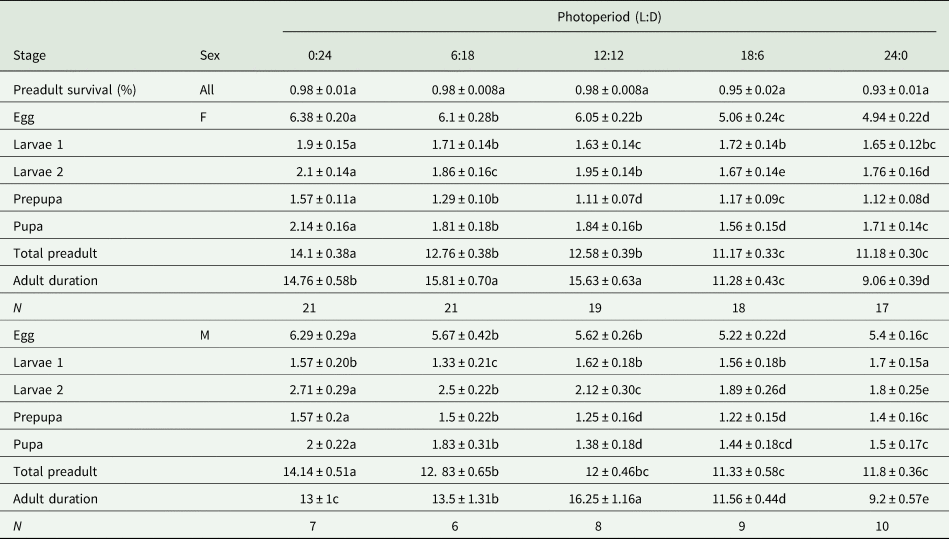
Overall, survival from the egg to pupal stage was above 90% with no difference across all photoperiod treatments (table 1). Photoperiods significantly affected the development durations of both male and female S. longicornis at the egg, larvae, prepupa, pupa, and total preadult longevity, with a 0:24 L:D photoperiod having a significant effect in delaying the development of all life stages for both sexes (table 1). Longevity of both females and males showed significant differences across photoperiods with highest at 12:12 L:D (15.63 ± 0.63 and 16.25 ± 1.16 days for females and males, respectively) and lowest at 24:0 L:D (9.06 ± 0.39 and 9.2 ± 0.57 days for females and males, respectively) (table 1).
Mean (± SE) development time (days) of immature stages of Scolothrips longicornis reared on eggs of Tetranychus urticae at five photoperiods

N, number of individuals survived to the adult stage.
Values followed by small different letters within the same row are significantly different (paired bootstrap test, P < 0.05).
Longevity and reproduction
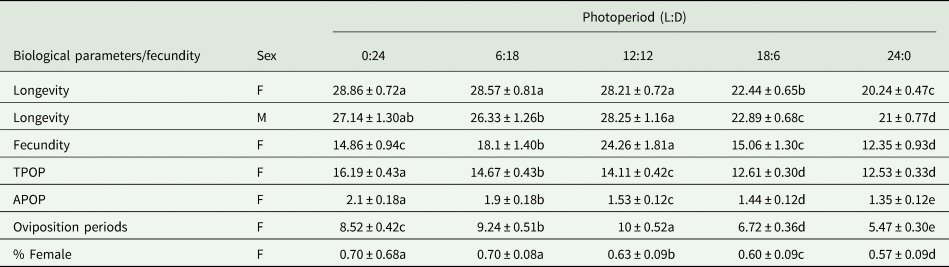
Generally, longevity of both sexes increased with decreasing light length (table 2). In addition, both the adult preoviposition period (APOP) and total preoviposition period (TPOP), decreased with increasing light length. Oviposition period increased with increasing photoperiod length from 0:24 to 12:12 L:D, but declined sharply at the 18:6 and 24:0 L:D treatments. Mean total fecundity (eggs/female) varied from 12.35 eggs/female at 24 h photoperiod length to 24.26 egg/female at 12:12 L:D photoperiod. The sex ratio of offspring was influenced by photoperiod with the proportion of female offspring decreasing with increasing light length from 0.70 ± 0.683 at 0:24 L:D to 0.57 ± 0.09 at 24:0 L:D photoperiod (table 2).
Mean (± SE) longevity, fecundity, total preoviposition period (TPOP), adult preoviposition period (APOP), and oviposition periods of Scolothrips longicornis reared on eggs of Tetranychus urticae at five photoperiods

Values followed by small different letters within the same row are significantly different (paired bootstrap test, P < 0.05).
Age-stage, two-sex life table
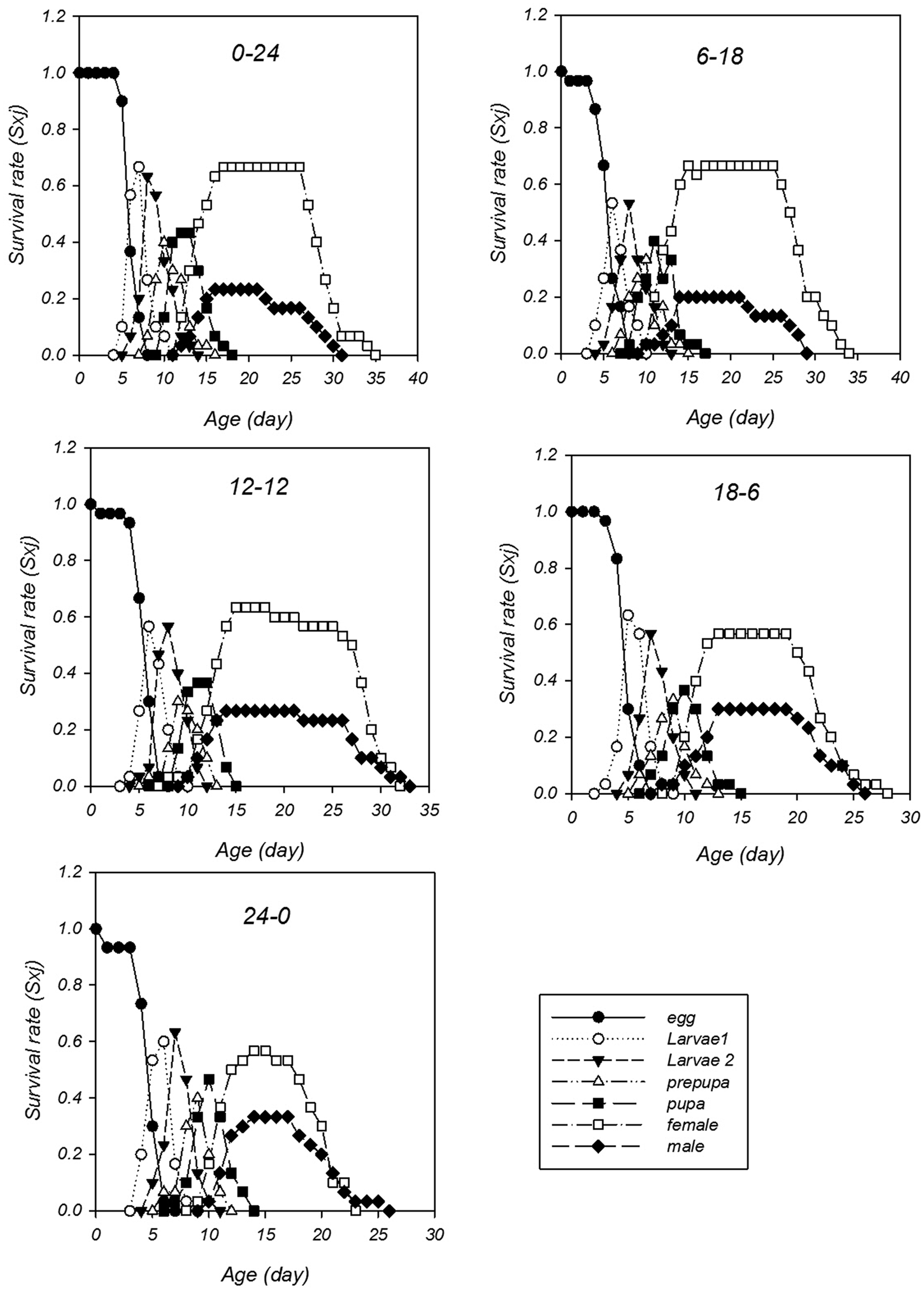
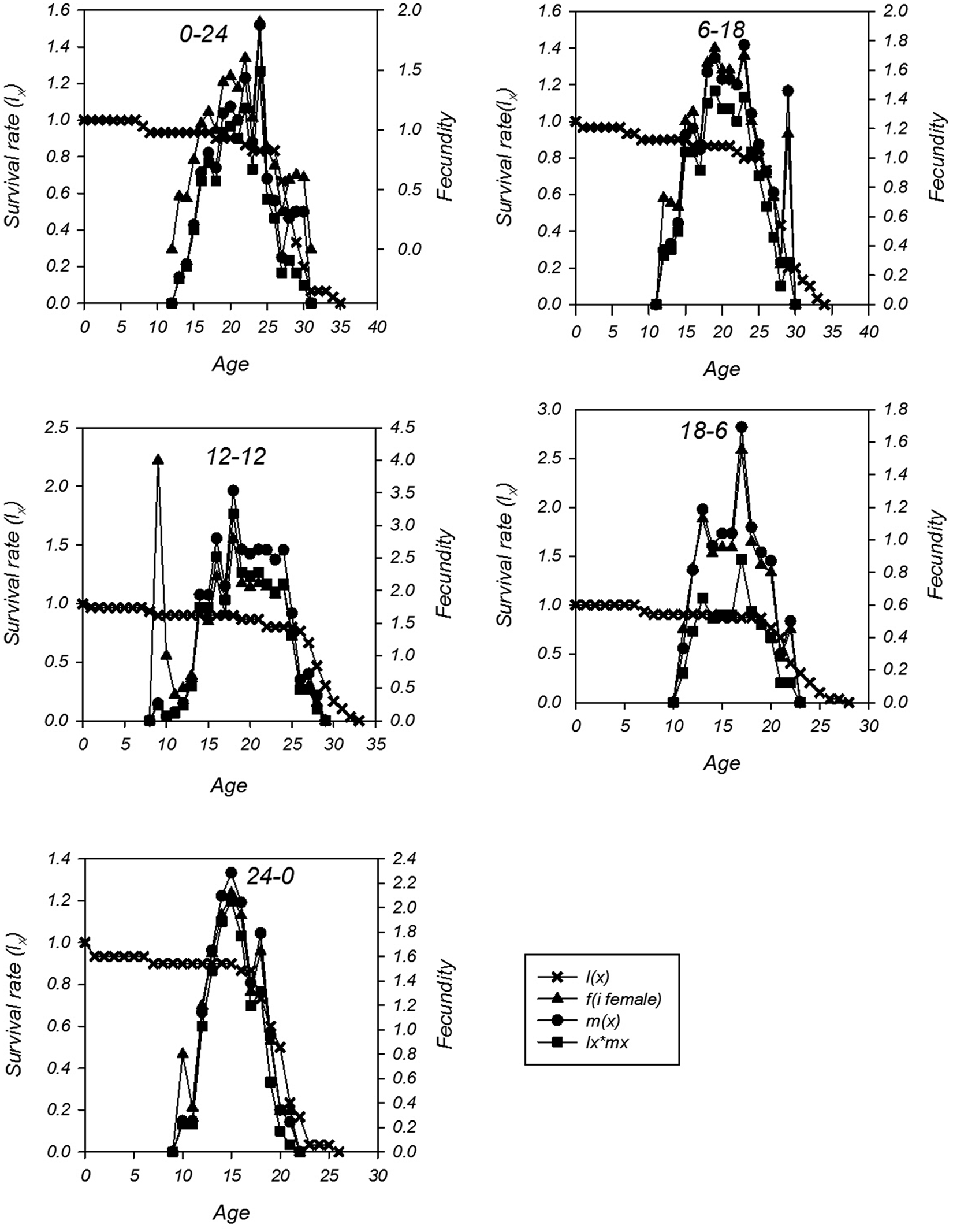
The stage-specific survival curves for S. longicornis at each photoperiod overlapped, demonstrating variation in development rates within and between stages (fig. 1). The sxj depicts the probability of a newly laid egg surviving to age x and stage j. The age-specific survival rate (lx), age-specific oviposition rate (mx), age-specific maternity (lxmx), and age-stage-specific fecundity (fxj) for each photoperiod treatment are shown in fig. 2. The oviposition period increased with increasing light length to 12:12 L:D. S. longicornis took longer time to reach its peak age-specific fecundity (mx) as the light length to 12:12 L:D (fig. 2).
Survival rate (Sxj) of Scolothrips longicornis reared on eggs of Tetranychus urticae at five photoperiods for eggs, larvae, prepupa, pupae, and adults (female and male). The Sxj depicts the probability that an individual can survive to age x and stage j. The overlaps between different stages during development are the result of variable developmental rates among individuals.

Age-specific survival rate (lx), age-specific fecundity (mx), age-specific maternity (lxmx), and age-stage-specific fecundity (fxj) of Scolothrips longicornis reared on eggs of Tetranychus urticae at five photoperiods. Note: Y axis scale for photoperiods 0:24, 6:18, and 24:0 different from 12:12 and 18:6 L:D.

Life expectancy
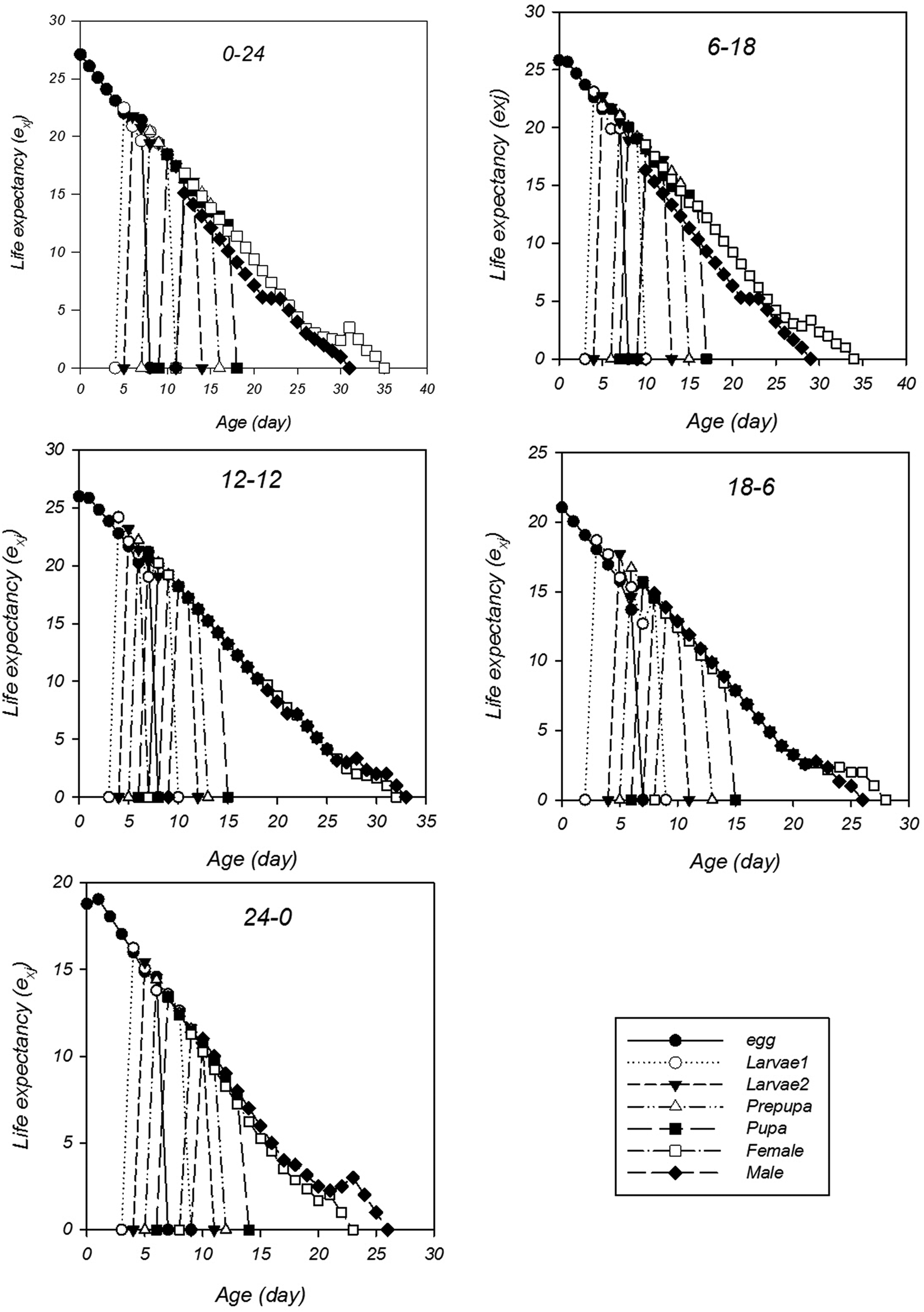
The age-stage specific life expectancy (exj) of S. longicornis estimated the lifespan remaining for individuals of age x and stage j was anticipated to live after age x at the different photoperiods. Life expectancy for both females and males of S. longicornis was shown to decrease with increasing light length (fig. 3). For example, longevity was greatest at 12:12 L:D with a mean longevity of 28.21 ± 0.72 days and 28.25 ± 1.16 days for female and male adults, respectively, but at 24:0 L:D was shortest with a mean longevity of 20.24 ± 0.47 days and 21 ± 0.77 days for female and male adults, respectively.
Age-stage-specific life expectancy (exj) of Scolothrips longicornis reared on eggs of Tetranychus urticae at five photoperiods.

Reproductive values
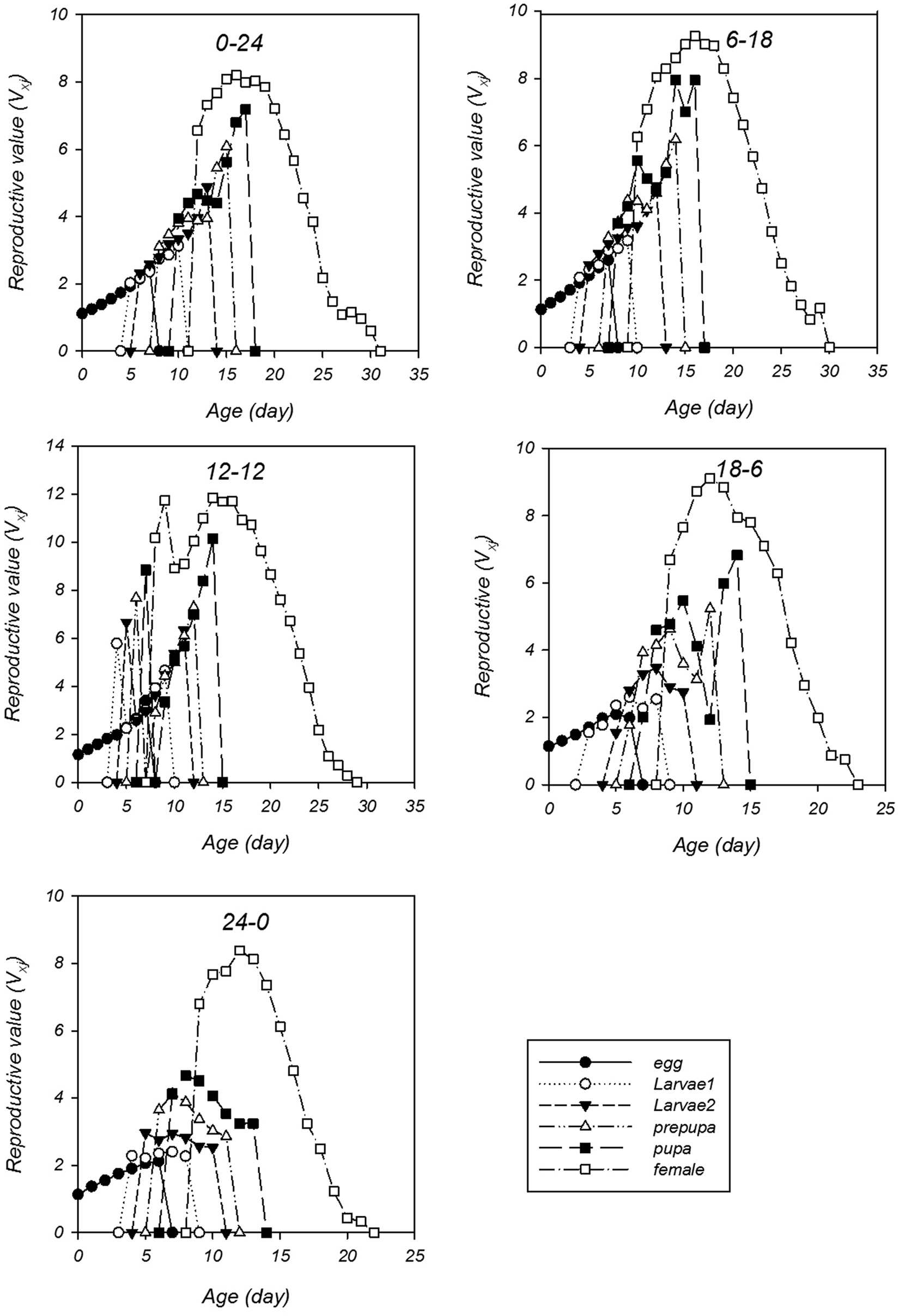
The reproductive values vxj are presented in fig. 4. Reproductive values increased significantly, once S. longicornis commenced oviposition, with a peak reproductive value tending to be higher with increasing light length (fig. 4). At 0:24 L:D the peak reproductive value was ~8.2 at age 16, but increased to twice reach a peak of 12 at ages 10 and 15, respectively at 12:12 L:D. At 18:6 L:D the reproductive value reached a peak of 9 at day 12, and at 24:0 L:D the peak was 8.3 at age 12.5.
Age-stage-specific reproductive values (vxj) for Scolothrips longicornis reared on eggs of Tetranychus urticae at five photoperiods. The reproductive value is defined as the contribution of an individual at age x and stage j to the future population.

Life table parameters
The life table parameters of S. longicornis across at five photoperiod treatments are shown in table 3. The net reproductive rate (R 0) for S. longicornis increased with increasing light length from 0:24 to 12:12 L:D and subsequently decreased, attaining the minimum value at 24:0 L:D (7 ± 1.23). The finite rate of increase (λ) and the intrinsic rate of natural increase (r) of S. longicornis were significantly different amongst the different photoperiods, increasing almost linearly with light length at 12:12 L:D and then decreasing from the 18:6 L:D treatment. Mean generation time (T) significantly decreased with increasing light length, with a mean generation time of 21.22 ± 0.45 at 0:24 L:D declining to 15.81 ± 0.34 at 24:0 L:D (table 3).
Mean (± SE) intrinsic rate of natural increase (r), finite rate of increase (λ), net reproductive rate (R 0), and mean generation time (T) of Scolothrips longicornis reared on eggs of Tetranychus urticae at five photoperiods

Values followed by small different letters within the same column are significantly different (paired bootstrap test, P < 0.05).
Discussion
This research shows and compares the life table parameters and development rate of S. longicornis fed on eggs of T. urticae at a wide range of photoperiod length. However, there is no studies that have investigated the effect of photoperiod on life table parameters and development of S. longicornis. As anticipated, both fecundity and survival of S. longicornis were greatly influenced by photoperiod, appearing photoperiod-dependent patterns. Scolothrips longicornis individuals were capable of producing progeny across a range of photoperiods from 0:24 to 24:0 L:D. The age-stage, two sex life table analyses demonstrated that this species is sensitive to photoperiods as well. The life table parameters for the λ and r significantly increased for a 0:24 to 12:12 L:D, but T showed a significant decrease with increasing light photo phase. Mean development times of S. longicornis decreased with increasing light length up to 18:6 L:D photoperiods and then increased at 0 light lengths. Other research studies have indicated that the development of predatory thrips is affected by temperature (Pakyari et al., Reference Pakyari, Fathipour and Enkegaard2011a).
It is well known that the organism's photoperiodicity can be out looked as an expectant response to changes in light length associated with seasonal changes. In environmental conditions, various generations were recounted in the same arthropod species of different geographical areas, could be assigned to the replies to different environmental conditions (Wang et al., Reference Wang, Tan, Guo and Zhang2013). Scolothrips longicornis showed increased rates of reproductive efficiency and oviposition under light lengths up to 12 h. Photoperiod is an effective environmental signal for many mites and insects, with the significantly effect on facultative reproductive diapause (Denlinger, Reference Denlinger2002; Saunders, Reference Saunders2010). Scolothrips longicornis did not indicate obligate diapause behavior in the current research and the strain we utilized should be non-diapausing after numerous generations in the laboratory. Similar results were reported with the phytoseiid mite, Neoseiulus barkeri (Hughes) (Zou et al., Reference Zou, Min, Xiao, Xin and Xia2016).
The development periods for all immature stages of Tetranychus kanzawai Kishida were shown to increase as light length decreased (Shah et al., Reference Shah, Suzuki, Ghazy, Amano and Ohyama2011) and the research reported here demonstrates that the S. longicornis development rate is dependent of photoperiod. However, there are no studies available on the influence of photoperiod on development and life table parameters of T. urticae. By understanding these interactions, we will be able to develop appropriate tactics for the biocontrol of T. urticae in outdoor and indoor crops. In similar research studies conduced with other predatory insect, the influence of photoperiod on the duration of pre-imaginal development is also very variable. For example, Lopatina et al. (Reference Lopatina, Balashov and Kipyatkov2007) reported that the development of Pyrrhocoris apterus Firebug (Het: Pyrrhocoridae), varied between at long and short days. Aksit et al. (Reference Aksit, Cakmak and Ozer2007) demonstrated that development of Stethorus gilvifrons Mulsant (Coleoptera: Coccinellidae), different significantly between long and short day photoperiods. However, the development of Chrysoperla carnea (Stephens) (Neuro: Chrysopidae) was showed to be faster under long period than under short photoperiod conditions (Ahmed et al., Reference Ahmed, Muhammad, Ahmad, Ahmed, Naz, Ali and Suleman2012). Generally, the influence of photoperiod on the insect's development time can vary from slight changes to a sharp increase, even though in the last case not protracted development but induction of diapause can occur (Saunders, Reference Saunders2002; Reznik and Vaghina, Reference Reznik and Vaghina2011).
The results of the present research show that S. longicornis can continue to reproduce even under short day conditions, thus, S. longicornis appears to be a good candidate to T. urticae control under short-day conditions (from autumn to spring, in greenhouse). At all photoperiod treatments there were more females than males produced, although the % females were significantly lower under longer light lengths (60 and 57% at 18:6 and 24:0 L:D, respectively) compared to shorter light lengths (70% at both 0:24 and 6:18 L:D). Photoperiod was shown to influence oviposition by S. longicornis, with more eggs were produced at a photoperiod of 12:12 L:D and lowest under 24:0 L:D.
The life table's application to the investigation of insect populations for accurate IPM has been underutilized and underemphasized owing to the difficulties involved in collection of data and the variability of life tables generated under different host plants and different environmental conditions. The tedious estimations inherent in life table analyses may contribute to errors in population parameters and subsequently their interpretation (Sugawara et al., Reference Sugawara, Ullah, Ho, Gökçe, Chi and Gotoh2017). However, because traditional life tables are female age-specific (Birch, Reference Birch1948; Carey, Reference Carey1993) they ignore the male component of the population and are incapable of properly differentiating among the varying development rates across stages, an aspect unique to mites and insect, their application causes certain problems (Huang and Chi, Reference Huang and Chi2012). Because sex ratio plays a necessary role in rate of life tables and population growth is generally focused on female parameters, we suggest that the age-stage, two-sex life table should be utilized in future life table research.
Regulation of photoperiod could assist promote the effectiveness of the mass rearing of benefit insect agents. The consequences of the present research demonstrate that photoperiod has an important role in optimizing the development and reproductive performance for mass rearing of S. longicornis, with a 12:12 L:D regimen identified as the optimum light regime for mass rearing in culture.
Acknowledgements
The authors are very grateful to the Islamic Azad University, Takestan Branch, Iran for providing support in conducting this research. We would also like to thank anonymous reviewers for their valuable comments and suggestions on this manuscript.