In a great variety of complex congenital heart diseases with a single ventricle physiology, the Fontan circulation constitutes the only definitive surgical palliation. The Fontan procedureReference Fontan, Mounicot, Baudet, Simonneau, Gordo and Gouffrant 1 significantly improves the survival rate of these patients and enables an increasing number of the patients to survive until adulthood.Reference de Leval, Kilner, Gewillig and Bull 2 Fontan patients represent a heterogeneous population based on the underlying disease, specific type of Fontan procedure, and age at total cavopulmonary connection.
Despite recent advances in surgical techniques, Fontan patients exhibit the highest 5-years risk of death across the heterogeneous group of adults with congenital heart disease.Reference Diller, Kempny and Alonso-Gonzalez 3 Additionally, the presence of a palliative Fontan circulation is associated with numerous complications, such as ventricular dysfunction, arrhythmias, thromboembolic events, atrioventricular valve regurgitation, Fontan pathway obstruction, exercise intolerance, protein-losing enteropathy, and sudden cardiac death.Reference Khairy, Fernandes and Mayer 4 – Reference Diller, Dimopoulos and Okonko 7 Thus, there is an unmet clinical need to identify and modify risk factors, which may impact the clinical outcome in these patients.
Late Fontan survivors are prone to develop progressive failure of the morphometric single ventricle. Importantly, echocardiographic assessment of ventricular function is technically difficult. It requires special training and may provide a challenge to the examiner. As an advantage, cardiac magnet resonance imaging offers an unrestricted view on the ventricle. However, evaluation of ventricular function requires a standardized protocol, which respects numerous anatomical variations observed in this heterogeneous patient cohort.Reference Glatz, Rome and Small 8
In non-congenital heart disease, the treatment of symptomatic heart failure improves the outcome.Reference Ponikowski, Voors and Anker 9 In patients with Fontan circulation, the impact of ventricular function on heart failure and death and the indication for standard heart failure drug treatment are still a matter of debate. Therefore, the aim of this study was to evaluate the prognostic value of cardiac magnetic resonance imaging parameters, cardiopulmonary exercise testing, severity of valvular regurgitation, and biomarkers in a cohort of adult Fontan patients. The primary endpoint included decompensated heart failure with symptoms at rest, peripheral and/or pulmonary edema, and/or death. The results of our study may help to improve risk stratification and long-term management of patients with Fontan procedure.
Methods
Patient population
This retrospective, longitudinal observational study was conducted in accordance with the Declaration of Helsinki. The study was approved by the local ethics committee of Hannover Medical School (#2449/2014). Patients were recruited by screening the outpatient clinics database for adults with congenital heart disease. The following inclusion criteria were applied: patients with univentricular heart defects following Fontan procedure with total cavopulmonary connection and documentation of previously performed cardiac magnetic resonance imaging and cardiopulmonary exercise testing. All patients had a minimum follow-up of 24 months after cardiac magnetic resonance imaging. Therefore, we considered for the primary endpoint a time period of 24 months following cardiac magnetic resonance imaging for each patient. Demographic data, physical examination, surgical reports, electrocardiogram, and reports on laboratory testing (N-terminal pro brain natriuretic peptide, albumin, gamma-glutamyltransferase, aspartate transaminase, creatinine, glomerular filtration rate) were derived from medical records of the outpatient clinic for adults with congenital heart disease. Echocardiographic examination, cardiopulmonary exercise testing, and cardiac magnetic resonance imaging were performed at Hannover Medical School. Subsequently, cardiac magnetic resonance imaging parameters were determined by one experienced investigator blinded to the patients` outcome data. Atrioventricular valve regurgitation was graded by echocardiography. The patients’ cohort was divided into groups based on the morphologically dominant systemic ventricle.
Clinical follow-up
All patients were enrolled between July 2005 and July 2015 at the outpatient clinic for adults with congenital heart disease at Hannover Medical School, and their status was determined from medical records. The primary endpoint was defined as follows: death and/or decompensated heart failure with symptoms at rest, peripheral, and/or pulmonary edema.
Cardiac magnetic resonance imaging
Cardiac magnetic resonance imaging was performed with a commercially available 1.5 Tesla magnetic resonance system (Avanto; Siemens Healthcare, Erlangen, Germany). Cardiac parameters were investigated by electrocardiographically gated steady-state free precession technique during short inspiratory breath holds. Subsequently, an offline analysis was performed using certified cardiac magnetic resonance imaging evaluation software (CVI 42; Circle Cardiovascular Imaging Inc., Calgary, Alberta, Canada). Volumes were normalized to body surface area. Ventricular function was evaluated in short axis cine magnetic resonance images. Endo- and epicardial contours were manually drawn in a standardized method, both in end-diastole and end-systole. Papillary muscles and trabeculae were excluded from the ventricular mass.
In Fontan patients, afterload and contractility assessed by cardiac magnetic resonance imaging were previously described with the following approximations: contractility = mean arterial pressure/end-systolic volume index and afterload = mean arterial pressure/cardiac index.Reference Robbers-Visser, Jan Ten Harkel and Kapusta 10 , Reference Bossers, Kapusta and Kuipers 11 Afterload determined by cardiac magnetic resonance imaging is defined as mean arterial pressure/cardiac index, whereas cardiac index is defined as cardiac output indexed to body surface area. Cardiac output was determined by the multiplication of stroke volume and heart rate. Stroke volume and end-systolic volume was evaluated in short axis cine images. Therefore, a potential limitation of this protocol is the quality of the images obtained and the subsequent identification of endo- and epicardial contours.
Echocardiography
All patients were subjected to transthoracic echocardiography (iE33 or EPIQ 7 echocardiography system, Philips Medical Systems, Bothell, Washington). Echocardiographic examination was performed during brief breath hold. Evaluation of left atrial size and left ventricular geometry and function was performed according to the American Society of Echocardiography guidelines.Reference Cheitlin, Armstrong and Aurigemma 12 Conventional doppler echocardiography was used to determine regurgitation of the atrio-ventricular valve.
Cardiopulmonary exercise testing
Cardiopulmonary exercise testing was performed on an electronically braked ergometer cycle using an incremental protocol. The protocol was symptom limited, and all patients were encouraged to exercise until the development of first signs of exhaustion. Twelve-lead electrocardiogram and transcutaneous oxygen saturation were continuously recorded. Ventilatory parameters were measured using a computerized analyzer. In accordance with previous publications, peak VO2 was expressed as percentage of the predicted value using standard equations for predicted values of peak exercise parameters. 13 , Reference Diller, Giardini and Dimopoulos 14
Statistical analysis
Categorical variables are presented as n(%). Normally distributed variables are presented as mean value ± standard deviation (SD) or median and interquartile range (IQR) for non-normally distributed variables. Statistical analysis for comparison between subgroups was performed using unpaired t-tests as parametric tests and Mann–Whitney tests as non-parametric tests.
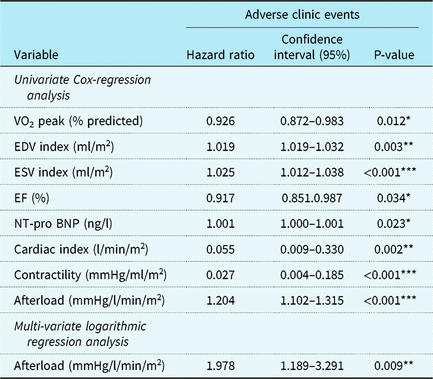
Chi-square test was applied to compare the patient characteristics. Cardiac magnetic resonance imaging parameters, parameters of cardiopulmonary exercise testing, electrocardiogram-findings, and echocardiographic parameters related to mortality or symptomatic heart failure were identified by Cox regression analysis. Multi-variate regression analysis was performed using variables related to endpoints, which were identified by univariate Cox regression analysis (p < 0.05). Ejection fraction represents a function of both endsystolic and enddiastolic function. Therefore, these parameters were excluded from the multi-variate analysis performed. The cut-off value for afterload was generated from receiver operating characteristic curves using Youden`s Index. Meier–Kaplan curves were created with GraphPad Prism 6.0 (GraphPad Software, Inc., La Jolla, CA), and statistical analysis was performed with SPSS Statistics 24 (IBM SPSS Statistics 24). A two-sided p-value of <0.05 was considered statistically significant.
Results
Baseline characteristics
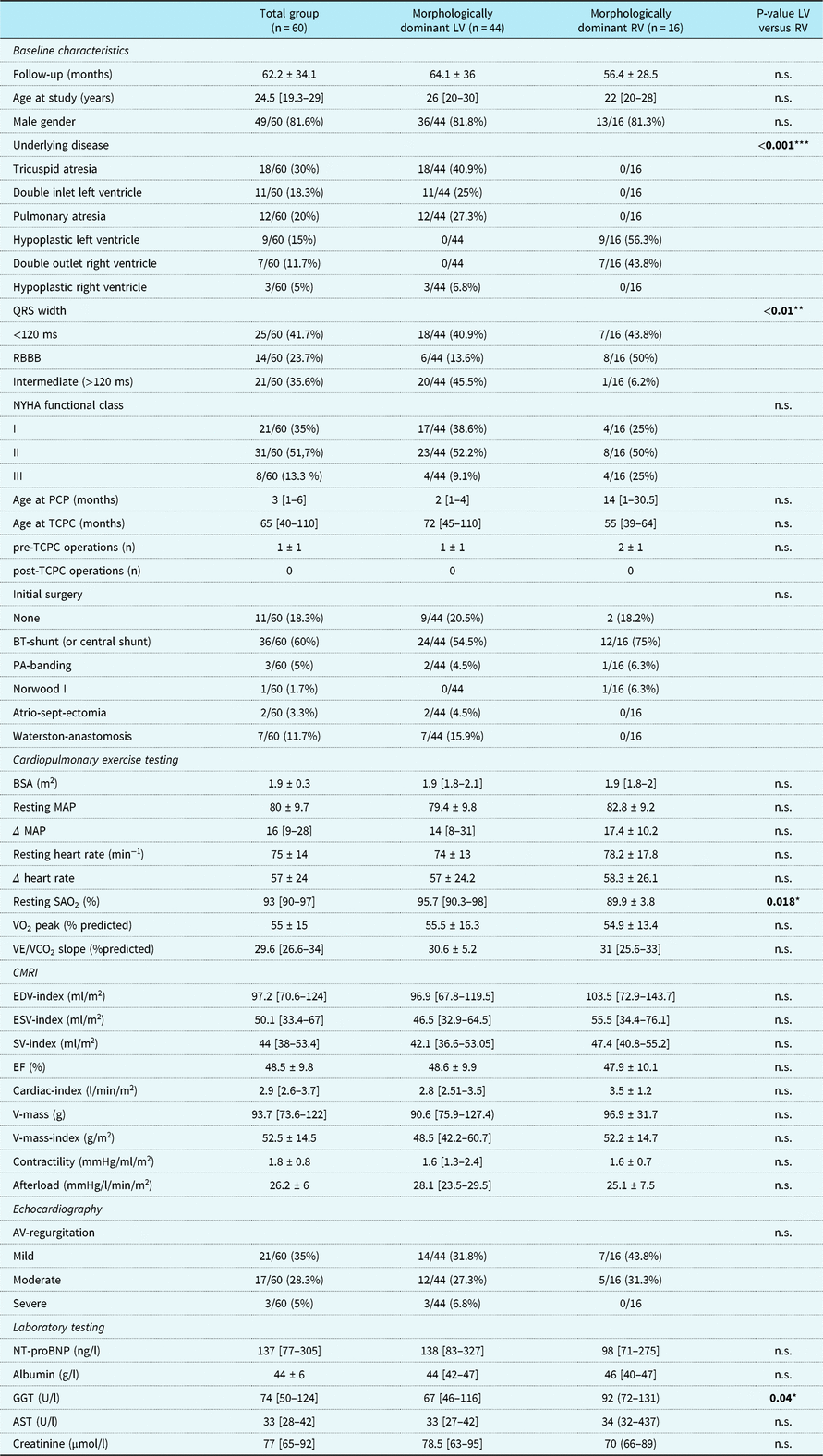
A total of 60 patients with a mean follow-up of 62 ± 34 months, who visited the outpatient clinic for adults with congenital heart disease between July 2005 and July 2015, were eligible for the study. The patients had a median age of 24.5 years [19–29] and 11 (18%) were women. Cardiac magnetic resonance imaging analysis showed that total cavopulmonary connection was realized with an intra-atrial lateral tunnel in 48 (80%) patients or with an extracardiac conduit in 12 (20%) patients. A morphologic dominant left ventricle (n = 44, 73%) was most frequent. At baseline, all patients had stable symptoms of heart failure (NYHA I n = 21 (35%), NYHA II n = 31 (52%), NYHA III n = 8 (13%)). However, none of the patients included in the study was acutely decompensated, i.e., presenting with lower extremity or pulmonary edema. NYHA class was not significantly different in patients with a morphologic dominant left ventricle when compared with patients with a morphologic dominant right ventricle. Baseline characteristics are summarized in Table 1.
Patient baseline characteristics, cardiopulmonary exercise testing, cardiac magnetic resonance imaging, and laboratory statistics

AST = aspartate transaminase; AV = atrioventricular; BT-Shunt = Blalock Taussig shunt; BSA = body surface area; Δ = delta; EF = ejection fraction; EDV = end diastolic volume; ESV = endsystolic volume; GGT = gamma-glutamyltransferase; LV= morphologic dominant left ventricle; MAP = mean arterial pressure; RV = morphologic dominant right ventricle; LBBB = left bundle branch block; RBBB = right bundle branch block; NT-proBNP = N-terminal pro brain natriuretic peptide; NYHA = New York Heart Association; PA-Banding= pulmonary artery banding; PCP = partial cavopulmonary connection; SAO2 = arterial oxygen saturation; SV = stroke volume; TCPC = total cavopulmonary connection; V = ventricular; VE/VCO2 slope = ventilator efficiency; VO2 peak = maximum oxygen uptake.
Data are presented as mean ± SD, median [IQR], n/total (%).
*p<0.05, **p<0.01, ***p<0.001
Decompensated heart failure and death
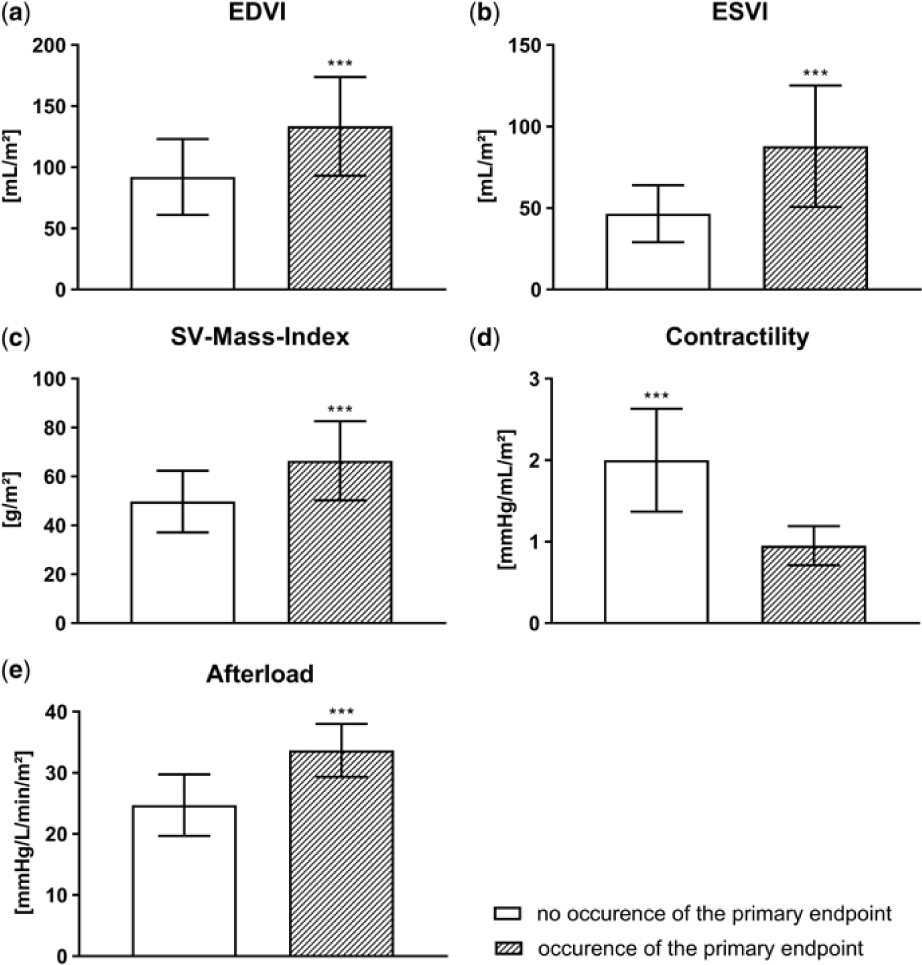
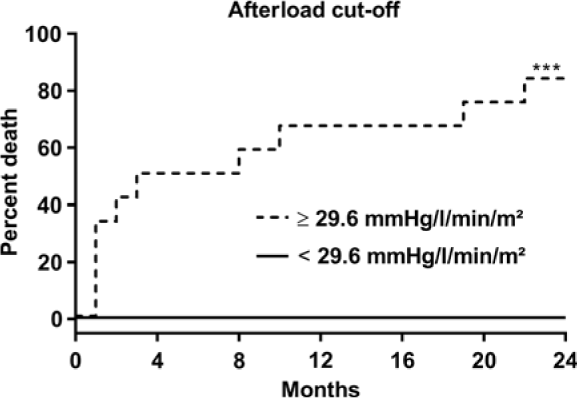
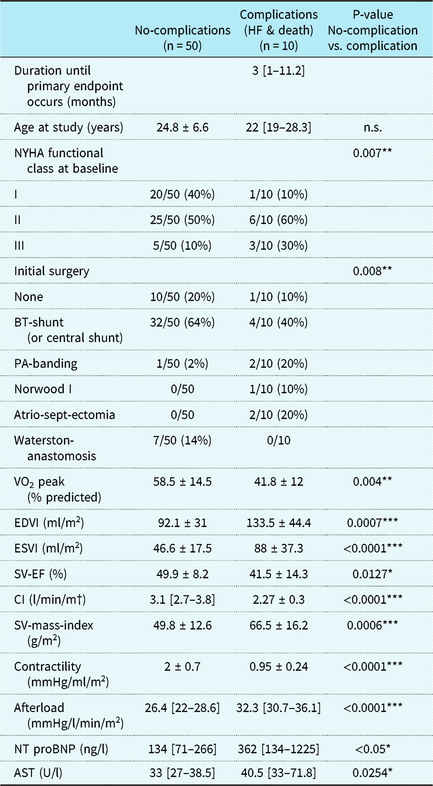
The primary endpoint occurred in 10 (16.7%) patients after a median follow-up of 3 months [1–11]. Five patients died following systolic deterioration of the systemic ventricle and 5 patients suffered from progressive symptomatic heart failure. Neither the type of total cavopulmonary connection nor the morphology of the dominant ventricle affected the outcome. In contrast, complications were associated with alterations in dimension and function of the systemic ventricle, i.e., mass, ejection fraction, and cardiac index assessed with cardiac magnetic resonance imaging (Fig 1a–c). Patients with adverse outcome exhibited significantly impaired contractility and increased afterload (Fig 1d–e). Furthermore, peak VO2, N-terminal probrain natriuretic peptide, and aspartate transaminase serum levels were significantly altered (Table 2). Using multi-variate analyses, only afterload (p = 0.009) was independently associated with the presence of the predefined endpoint (Table 3). A cut-off of <29.6 mmHg/l/min/m2 ruled out complications within 24 months of follow-up (Fig 2).
Cardiac magnetic resonance imaging parameters significantly altered in patients with future occurrence of the primary endpoint. ***p < 0.001.

Afterload cut-off predicting cardiac complications within 24 month of follow-up. ***p < 0.001.

Parameters of complication in total group

AV= atrioventricular; CI= cardiac index; ESV= endsystolic volume; MAP= mean arterial pressure; Δ = delta; VO2 peak= maximum oxygen uptake; EF= Ejection fraction; NYHA= New York Heart Association; BT-Shunt= Blalock Taussig shunt; PA-Banding= pulmonary artery banding; NT-proBNP= N-terminal pro brain natriuretic peptide; GGT= gamma-glutamyltransferase; AST= aspartate transaminase; V= ventricular.
Data are presented as mean ± SD, median [IQR], n/total (%).
*p<0.05, **p<0.01, ***p<0.001
Regression-analysis for death or heart failure events

CI = cardiac index; EDV = enddiastolic volume; ESV = endsystolic volume; EF = ejection fraction; ESV = end systolic volume; MAP = mean arterial pressure; NT-proBNP = N-terminal pro brain natriuretic peptide; VO2 peak = maximum oxygen uptake.
*p<0.05, **p<0.01, ***p<0.001
Cardiopulmonary exercise testing
Cardiopulmonary exercise testing with an incremental protocol revealed a significant higher resting heart rate in patients with extracardiac conduit in comparison with patients with an intra-atrial lateral tunnel. Resting oxygen saturation was significant lower in patients with morphologic right ventricle. Parameters of cardiopulmonary exercise testing are shown in Table 1.
Cardiac magnetic resonance imaging, echocardiography, and blood testing
Analysis of cardiac magnetic resonance imaging parameters in respect to total cavopulmonary connection techniques revealed no statistical significance between the groups. Furthermore, at baseline, the cardiac magnetic resonance imaging parameters were not significantly different in respect to the morphologically dominant ventricle. The severity of mitral valve regurgitation assessed by echocardiography was not significantly different. Blood testing showed that patients with morphologic right ventricle had significantly higher gamma-glutamyltransferase levels. No statistical significant difference for N-terminal probrain natriuretic peptide and albumin levels was observed. Cardiac magnetic resonance imaging, echocardiography, and laboratory parameters are summarized in Table 1.
Discussion
The current investigation assesses potential parameters to predict death and/or decompensated heart failure in adult Fontan patients. It provides several important observations: (i) total cavopulmonary connection techniques and the morphology of the dominant ventricle were not associated with a worse outcome. (ii) A number of clinical (NYHA class, initial surgery), functional (VO2 peak, ejection fraction, cardiac index), blood-based (N-terminal pro brain natriuretic peptide), and imaging parameters (end diastolic volume index, end systolic volume index, mass-index, contractility, afterload) were significantly related to an increased rate of decompensated heart failure and death. (iii) Cardiac magnetic resonance imaging-based afterload was the only parameter to serve as an independent predictor for death and decompensated heart failure.
The Fontan procedure is a palliative surgical approach for patients with a functional single ventricular circulation. Fontan circulation is associated with several major complications including heart failure and increased mortality.Reference Ohuchi 15 Hemodynamics of patients with chronic heart failure and Fontan circulation are characterized by high central venous pressure, hypoxia, and reduced cardiac output. This can result from an increase in cardiac preload and systemic arterial resistance.Reference Ohuchi 15 Systemic arterial resistance in adult patients with Fontan circulation is associated with increased sympathetic nerve activity and endothelial dysfunction.Reference Lambert, d’Udekem and Cheung 16 In this regard, adult patients with a limited prognosis exhibit elevated plasma levels of norepinephrine and natriuretic peptides.Reference Ohuchi, Yasuda and Miyazaki 17
The cardiovascular system adapts to increased systemic arterial resistance with increased stroke work of cardiomyocytes, which originate afterload
The prognostic value of afterload is supported by the finding of the present study demonstrating cardiac magnetic resonance imaging-based afterload as an independent predictor of death following systolic deterioration of the systemic ventricle or decompensated heart failure.
Importantly, a cut-off value of 29.6 mmHg/l/min/m² (sensitivity 95.5%, specificity 90%) ruled out the incidence of these complications within a follow-up of 24 months (Fig 2).
To evaluate the cardiac performance of Fontan patients, knowledge of pressure-volume relations, in particular ventricular volume, are indispensable. Paying attention to hemodynamic state based on difficulties of measurement of ventricular volume in clinical situations, Tanoue et al.Reference Tanoue, Sese, Ueno, Joh and Hijii 18 described approximations of contractility and afterload measured by conductance catheter. Hence, the authors were enabled to precisely evaluate hemodynamic state of Fontan patients and evaluate the underlying hemodynamic mechanisms of the favorable outcome after staged total cavopulmonary connection techniques in high-risk Fontan candidates.
Cardiac magnetic resonance imaging represents a powerful diagnostic tool for patients with Fontan circulation.Reference Festa, Ait Ali, Bernabei and De Marchi 19 Parameters associated with ventricular dilation in patients with protein loosing enteropathy are independent predictors of future heart transplantation and death in Fontan patients.Reference Rathod, Prakash and Kim 20 In our investigation, end diastolic volume index, end systolic volume index, ejection fraction, cardiac index, mass-index, contractility, and afterload were related to adverse events.
In the clinical follow-up of adults with congenital heart disease, reduced cardiopulmonary exercise testing has been associated with impaired clinical outcome.Reference Warnes, Williams and Bashore 21 This is supported by several studies, which identified specific parameters of cardiopulmonary exercise testing that differ between Fontan patients and patients with biventricular circulation. These parameters are also associated with increased morbidity in Fontan patients.Reference Giardini, Hager, Pace Napoleone and Picchio 22 – Reference Driscoll 24 Patients with Fontan circulation frequently exhibit exercise intolerance;Reference Weipert, Koch, Haehnel and Meisner 25 however, young patients with extracardiac conduit might have increased exercise capacity.Reference Bossers, Helbing and Duppen 26 Of note, only limited data on the prognostic impact of cardiopulmonary exercise testing are available. A previous study showed that cardiopulmonary exercise testing parameters are associated with hospitalization of cardiac cause.Reference Diller, Giardini and Dimopoulos 14 In a recently published study of 145 Fontan patients, a predicted decrease of peak VO2 >3%/year was an independent predictor of death or cardiac surgery during a 5 year follow-up.Reference Egbe, Driscoll and Khan 27 In our investigation, predicted peak VO2 was significantly altered in patients with worsening heart failure symptoms or future death. However, cardiopulmonary exercise testing parameters were inferior regarding risk assessment in the present investigation.
In our investigation, N-terminal pro brain natriuretic peptide levels were significantly elevated in patients afflicted with future death and/or decompensated heart failure. N-terminal probrain natriuretic peptide has a prognostic value in congenital heart disease and correlates with ventricular dysfunction.Reference Westhoff-Bleck, Kornau and Haghikia 28 , Reference Law, Keller, Feingold and Boyle 29 However, increased N-terminal probrain natriuretic peptide levels in patients with Fontan-type circulation may also result from both ventricular dysfunction and increased wall stress of in atriopulmonary connection or lateral tunnels.Reference Heck, Muller, Weber and Hager 30
Despite recent improvements in the treatment of late complications, mortality rates of adult patients with Fontan circulation remain high.Reference Diller, Kempny and Alonso-Gonzalez 3 Current American Heart Association guidelines recommend using angiotensin-converting enzyme inhibitors and diuretics for the pharmacological treatment of impaired contractility of the systemic ventricle or heart transplantation in case of severe dysfunction and end-stage heart failure (class IIa, level of evidence: C).Reference Warnes, Williams and Bashore 21 In conclusion, the present study suggests cardiac magnetic resonance imaging-based afterload as a strong and independent predictor of adverse events and indicates the clinical and prognostic value of assessing this parameter in the management of patients with Fontan circulation. It is tempting to speculate that increased afterload might be an important parameter for establishing failure treatment, which also impacts systemic artery resistance. Further studies are required to test this intriguing hypothesis.
Limitations
The present investigation represents a single center longitudinal observational study. Therefore, no control group is available. Although the number of patients was limited due to the rarity of disease, this study includes one of the largest cohorts of adult patients with Fontan palliation reported so far.
Moreover, clinical status influenced the initiation of further diagnostic procedures such as cardiac magnetic resonance imaging. Therefore, a potential selection bias cannot be excluded. Cardiopulmonary exercise testing and echocardiography were performed as a part of routine follow-up of Fontan patients at a tertiary adult congenital heart disease center. It is important to highlight that the included patients represent the positive selection of long-time survivors. These patients are critical to test and verify current diagnostic and therapeutic approaches.
Conclusion
In adult Fontan patients, parameters derived from cardiac magnetic resonance imaging, cardiopulmonary exercise testing, and laboratory examination are associated with decompensated heart failure and/or death. Afterload assessed by cardiac magnetic resonance imaging seems to be a promising parameter to identify patients at risk of heart failure and death. Thereby, afterload may offer additional valuable information in the decision-making process for medical and surgical treatment strategies.
Author ORCIDs
Jan Thorben Sieweke 0000-0003-3215-7734
Financial Support
This research received no specific grant from any funding agency, commercial or not-for-profit sectors.
Author Contributions
J.T.S, A.H., C.R., and C.K. collected analyzed and interpreted data. J.T.S., A.H., C.R., M.A., A.S., J.B., and M.W.-B. wrote the manuscript. All authors revised the manuscript critically. J.B. and M.W.-B. accurately approved the manuscript.
Disclosure
J.T.S., A.H., C.R., C.K., M.A., T.K., C.Z., J.T., A.S., J.B., and M.W-B have no disclosures regarding this article.
Conflict of interest
The authors have no conflict of interest to declare.