Introduction
Background
Every year, prehospital hemorrhagic shock accounts for approximately 25,000 civilian deaths in the United States.Reference Spinella and Cap1 Numerous thought leaders now see hemorrhagic shock as a pathway to “blood failure.”Reference Bjerkvig, Strandenes and Eliassen2,Reference White, Ward, Pati, Strandenes and Cap3 Blood failure is a state of severe oxygen debt, endotheliopathy, platelet dysfunction, and coagulopathy.Reference Bjerkvig, Strandenes and Eliassen2,Reference White, Ward, Pati, Strandenes and Cap3 In conjunction with permissive hypotension, a prehospital-balanced, blood-based resuscitation strategy is hypothesized to be the optimal treatment for these patients.Reference Spinella and Cap1,Reference Woolley, Thompson and Kirkman4 Unfortunately, providing a balanced blood-based resuscitation on a ground ambulance has proven to be challenging.
To mitigate this capability gap, the relevant stakeholders in the greater Houston (Texas USA) metropolitan area collaborated to incorporate cold-stored, low-titer ORhD-positive whole blood (LTO+WB) into portions of their prehospital system. In September 2017, Harris County Emergency Service District 48 Fire Department (HCESD 48; Harris County, Texas USA) and Cypress Creek Emergency Medical Services ([EMS] CCEMS; Harris County, Texas USA) became the first ground ambulance systems in the United States to carry whole blood. During the initial portion of the program, the supporting blood bank was only able to provide low-titer ORhD-negative whole blood, but it quickly began supplying these agencies with LTO+WB. At the same time, a separate performance improvement initiative was underway in the greater San Antonio (Texas USA) metropolitan area that culminated with the San Antonio Fire Department (SAFD; San Antonio, Texas USA) EMS stocking cold-stored LTO+WB in October 2018.Reference McGinity, Zhu and Greebon5
Importance
After CCEMS, HCESD 48, and SAFD EMS began to administer prehospital whole blood, numerous EMS agencies inquired about starting a whole blood program of their own. However, to date, there are no published data on the epidemiology of prehospital whole blood transfusion recipients or the cost of such a program.
Goals of this Investigation
The purpose of this analysis was to describe the epidemiology of ground ambulance patients that receive prehospital whole blood transfusions. The secondary aim of this project was to report an accounting analysis of these ground ambulance prehospital whole blood programs. The tertiary aim was to inform regional partners about the practicality of expanding ground ambulance LTO+WB programs in the Houston and San Antonio metropolitan areas.
Materials and Methods
Design and Setting
This project was a retrospective analysis derived from prospectively collected Quality Assurance/Quality Improvement (QA/QI) data. The dataset came from the HCESD 48 and SAFD QA/QI databases from September 2017 through December 2018. The University of Texas Health Science Center at San Antonio (UTHSCSA; San Antonio, Texas USA) Institutional Review Board approved this project as part of an on-going performance improvement initiative.
The HCESD 48 Fire-EMS is a 9-1-1 provider for a suburban community just west of Houston, Texas. Their response territory covers 50 square miles, serving a population of 150,000 residents. This rapidly growing suburban community contains a large number of skilled nursing, memory care, and assisted living facilities. The EMS division averages 8,000 calls per year, responding with five paramedic-staffed ambulances, Basic Life Support Fire Department First Response, and a Paramedic EMS Supervisor. The department uses evidence-based medical guidelines, as well as 24/7 online medical control with EMS physicians to provide care and treatment. Because of distance and traffic time delays, HCESD 48 began a component therapy prehospital transfusion program in February 2016. This program evolved into an LTO+WB program in September 2017. Blood products are carried on the EMS Supervisors’ vehicle for optimal deployment and stewardship for the program and allowing patients to receive blood at the point of injury.
The HCESD 48 utilizes LTO+WB to resuscitate both medical and trauma patients that are displaying early signs of hemorrhagic shock. The protocol includes male patients 12 years of age or older, and female patients over the age of 50, who meet one of the following criteria: a mechanism of penetrating or blunt trauma with an associated heart rate (HR) >120 beats per minute (BPM) and/or systolic blood pressure (SBP) <90 mmHg; or a patient with obvious signs of non-traumatic hemorrhage (ie, upper gastrointestinal bleed or postpartum hemorrhage) with an associated HR >120 BPM and/or SBP <90 mmHg. When available, a hemoglobin of <6.0 g/dL is used as an adjunct in assessing the complex medical patient for criteria for transfusion. For those patients that do not meet criteria based on age or sex alone, online medical control is available to consult for potential approval of LTO+WB transfusion. These criteria are similar in design to the Assessment of Blood Consumption (ABC) Score described by Cotton, et al in their description and validation of an early prediction tool for trauma patients who will require massive transfusion.Reference Cotton, Dossett and Haut6,Reference Nunez, Voskresensky, Dossett, Shinall, Dutton and Cotton7
The SAFD is the sole 9-1-1 provider for a population of 1.5 million people spread over a 460 square mile area surrounding San Antonio. The UTHSCSA, Department of Emergency Health Services, Office of the Medical Director provides medical direction for the SAFD. Five roving medical officers (MOFs) provide operational oversight to the SAFD EMS. Additionally, two medical special operations units (MSOUs) are available to provide medical support for law enforcement agencies. The SAFD EMS operational plan to deliver LTO+WB includes carrying 500mL of LTO+WB on EMS physician response vehicles, MOF vehicles, and MSOU mobile intensive care ambulances. If LTO+WB arrives on the scene before SAFD EMS departure, the EMS physician, MOF, or MSOU medic transitions the whole blood and infusion equipment to the ambulance for transport. The patient will receive the whole blood en route to the trauma facility.
The SAFD EMS transfuses LTO+WB to medical and trauma patients with massive hemorrhage and signs of significant hypoperfusion. This EMS system defines significant hypoperfusion as SBP <70 or SBP 90 mmHg with a pulse over 110 BPM or end-tidal carbon dioxide (ETCO2) <25 mmHg. The SBP and pulse criteria are based on two recent trials of prehospital plasma transfusion which found mortality ranging from 10% to 33% in their control arms.Reference Sperry, Guyette and Brown8,Reference Moore, Moore and Chapman9 However, previous data suggest clinically significant hypoperfusion may occur before a patient’s SBP reaches 90 mm Hg.Reference Eastridge, Salinas, Wade and Blackbourne10–Reference Eastridge, Salinas and McManus14 The SAFD EMS included ETCO2 <25 mmHg in the criteria to identify these patients. Due to its relationship with pulmonary blood flow and cardiac output, ETCO2 falls during shock states.Reference Shibutani, Muraoka, Shirasaki, Kubal, Sanchala and Gupte15–Reference Trillo, von Planta and Kette17 The relationship between abnormally low ETCO2 and trauma patient outcomes is present in numerous prehospital, emergency department, and operating-room-based studies.Reference Williams, Guirgis and Morrissey18–Reference Deakin, Sado, Coats and Davies26
Selection of Participants
The cohort includes all patients that received prehospital whole blood from September 2017 through December 2018. The team excluded patients with incomplete relevant data, prisoners, and individuals younger than 18 years of age from the analysis.
Methods of Measurement
Each EMS agency utilized a separate internal database as part of their on-going prehospital whole blood QA/QI program. One author (JM) extracted the relevant data from the databases. A second author (CW) independently verified that the extraction was accurate. One author (JM) performed the data analysis.
Outcomes
The primary outcome was the indication for prehospital whole blood transfusion. The secondary objective was to forecast the average cost per life saved during the first 10 years of the prehospital whole blood initiative.
Statistical and Accounting Analysis
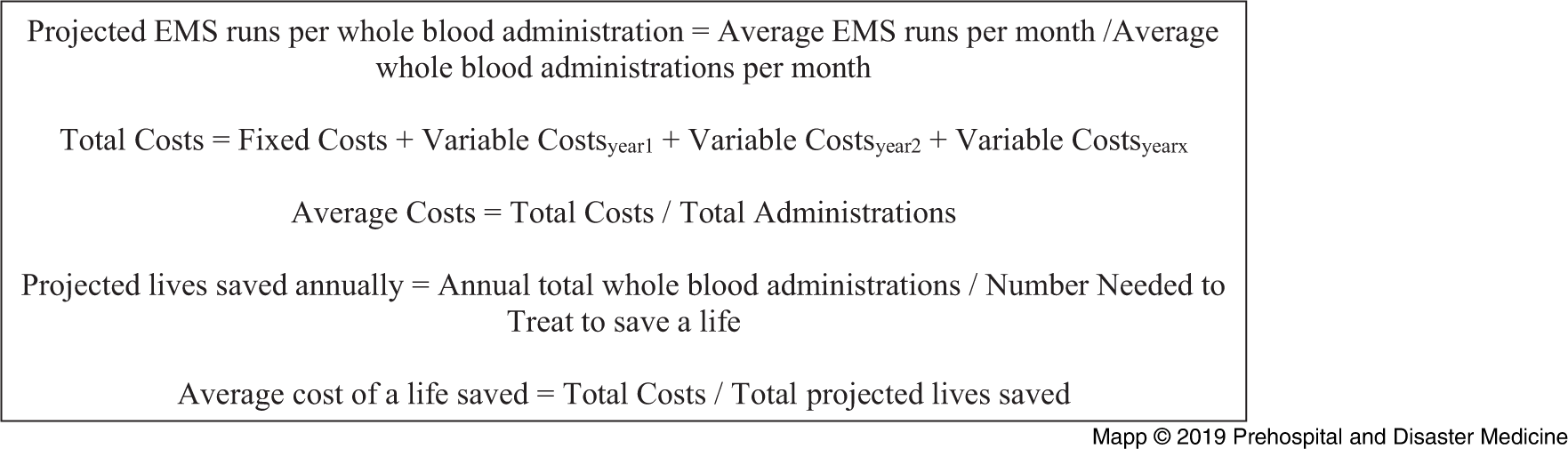
The team reports the rates of prehospital whole blood transfusion by indication, with 95% confidence intervals (CIs), using the Wilson/Brown method. The accounting analysis estimated the number needed to treat (NNT) to save one life as 10.2. The investigators derived this number from an analysis of two prehospital transfusion studies where a substantial portion of the exposure cohorts received prehospital red blood cells and plasma.Reference Sperry, Guyette and Brown8,Reference Shackelford, Del Junco and Powell-Dunford27 The team opted to apply the more conservative NNT of 10.2 instead of the more optimistic NNT of 7.1. Ultimately, the team utilized the NNT of 10.2 because it came from a cohort of civilian patients. All equations used in the accounting analysis are displayed in Figure 1. The team used Microsoft Excel (Microsoft Corp.; Redmond, Washington USA) to manage the data. The team analyzed the data with GraphPad Prism 8 (GraphPad Software, Inc.; La Jolla, California USA).
Accounting Equations.

Results
Epidemiology of Prehospital Transfusion Recipients
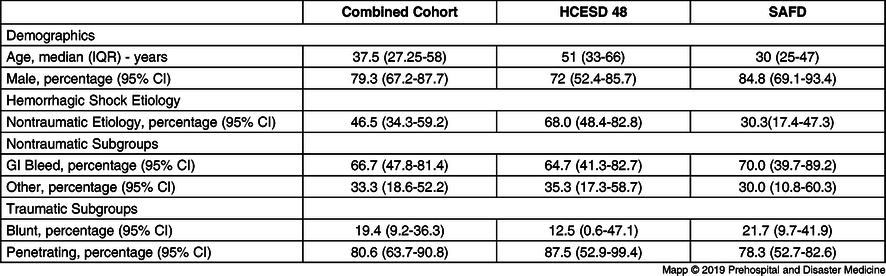
Of 58 consecutive prehospital whole blood administrations, the team included all 58 cases. Hemorrhagic shock from a non-traumatic etiology accounted for 46.5% (95% CI, 34.3%-59.2%) of prehospital whole blood recipients. In the non-traumatic hemorrhagic shock cohort, gastrointestinal hemorrhage was the underlying etiology of hemorrhagic shock in 66.7% (95% CI, 47.8%-81.4%) of prehospital whole blood transfusion recipients. In the traumatic hemorrhagic shock cohort, penetrating trauma was the underlying etiology of hemorrhagic shock in 80.6% (95% CI, 63.7%-90.8%) of prehospital whole blood transfusion recipients. A breakdown of prehospital whole blood transfusion recipients can be found in Table 1.
Epidemiology of Ground Ambulance Prehospital Whole Blood Transfusion

Abbreviations: HCESD 48, Harris County Emergency Service District 48 Fire Department; SAFD, San Antonio Fire Department.
Accounting Analysis
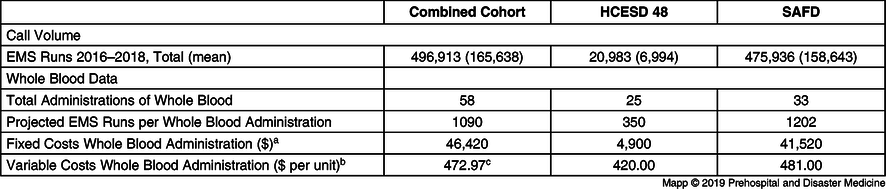
Fixed costs consist of items that are used to support multiple administrations of prehospital LTO+WB. For example, all the items purchased that facilitate whole blood storage are a fixed cost. The fixed costs of starting a prehospital whole blood program were US$41,520 for SAFD EMS and US$4,900 for HCESD 48. Variable costs consist of items that are used to support a single administration of prehospital whole blood. For example, the cost of a single unit of whole blood is included in the variable cost. The variable cost for transfusing a single unit of LTO+WB was US$481 for SAFD EMS and US$420 for HCESD 48. Table 2 provides a more detailed breakdown of each EMS systems operational and financial data.
EMS System Operational and Financial Data

Abbreviations: EMS, Emergency Medical Services; HCESD 48, Harris County Emergency Service District 48 Fire Department; SAFD, San Antonio Fire Department.
a Medical supplies that supports multiple administrations for the entire EMS system (ie, blood storage).
b Medical supplies consumed with every administration (ie, unit of whole blood or blood tubing).
c Weighted average.
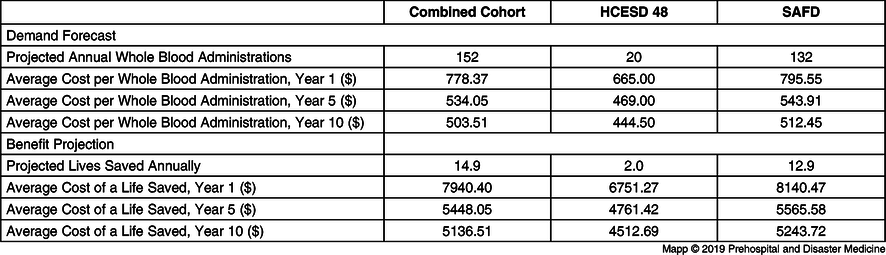
This analysis found that the average cost per LTO+WB administration was US$795.55 in Year 1, and was projected to fall to US$512.45 by Year 10 for SAFD EMS. For HCESD 48, this analysis found that the average cost per whole blood administration was US$665.00 in Year 1, and was projected to fall to US$440.50 by Year 10. The projected average cost to save a life in Year 10 was US$5,136.51 for the combined cohort, US$4,512.69 for HCESD 48, and US$5,243.72 for SAFD EMS. Equations used in the accounting analysis can be found in Figure 1. Table 3 provides a more detailed breakdown of each EMS system’s forecasted whole blood demand and cost-benefit analysis.
Forecasted Whole Blood Demand and Cost Benefit Analysis

Abbreviations: HCESD 48, Harris County Emergency Service District 48 Fire Department; SAFD, San Antonio Fire Department.
Discussion
Concerning the primary outcome, 46.5% (95% CI, 34.3%-59.2%) of prehospital whole blood administrations were for hemorrhagic shock caused by a non-traumatic etiology. Additionally, this analysis projects that by Year 10 of a ground ambulance whole blood transfusion program, the average cost to save a life will be approximately US$5,136.51.
Successfully transfusing whole blood in the prehospital setting is heavily dependent on emergency medical dispatch. Responding supervisors must self-deploy based off of the initial patient information provided by EMS dispatch to maximize their chances of arriving on the scene before the ambulance departs for the hospital. Because of this constraint, it is easy to see why penetrating trauma makes up a plurality of whole blood recipients when one considers all diagnoses. However, the team did not anticipate that gastrointestinal hemorrhage would be as conspicuous for a patient at-risk for hemorrhagic shock as penetrating trauma. While the clarity of a patient with a gastrointestinal hemorrhage potentially needing whole blood is evident in hindsight, the authors did not consider it because they failed to consider medical patients with hemorrhagic shock adequately. The whole blood programs at both HCESD 48 and SAFD EMS were initially constructed with the purpose of improving prehospital resuscitation of trauma patients. Furthermore, the existing whole blood data primarily come from military trauma data. This fact further anchored the authors thinking when they considered the impact of a ground ambulance whole blood transfusion program in a civilian setting.
Without proper context, it is hard to interpret the estimated US$5,136.51 average cost to save a life in Year 10. For comparison, the team conducted a thought experiment by performing an accounting analysis of one of the most potent prehospital interventions, defibrillation. For the simplicity of the thought experiment, the authors did not consider the value generated by the other functions of the monitor/defibrillators. A typical SAFD EMS monitor/defibrillator costs approximately US$40,000 each, lasts approximately 10 years, and requires little maintenance. With these data, the authors estimated the fixed cost to the SAFD EMS system to be US$1,720,000 for a 10-year period. The variable cost of each defibrillation is primarily the defibrillator pads. Pricing varies between adult and pediatric defibrillation pads, but the team assumed a cost of US$54 per set. Based on historical data, the team estimated that SAFD EMS personnel will defibrillate 273 patients annually (does not include automated external defibrillator usage by firefighters). The total costs to the system at Year 10 will equal the fixed costs plus the total variable costs. The projected total costs are US$1,867,420. The team used an NNT of 2.5 to save a life based on data that examined the outcomes of rapid defibrillation by security officers after cardiac arrest.Reference Valenzuela, Roe, Nichol, Clark, Spaite and Hardman28 Utilizing this assumption, the authors expect to save 1,092 lives from defibrillation. Dividing the total costs by the total lives saved equals US$1,710.09 to save a life with defibrillation. This additional context hopefully allows EMS leaders to evaluate the financial prudence of a ground ambulance prehospital whole blood transfusion program.
These data suggest that if an EMS agency only considers trauma patients with hemorrhagic shock when assessing the demand for a prehospital whole blood transfusion program, they will only be considering two-thirds of their potential patient population. If an EMS agency plans to use a roving vehicle model to dispense whole blood for prehospital transfusion, then determining the annual numbers of patients with hemorrhagic shock from penetrating trauma and gastrointestinal hemorrhage is a reasonable starting place for a conservative estimate of demand for prehospital whole blood. The team shared this finding with other EMS agencies in the region as they debated the merits of joining a regional prehospital whole blood program.
Future studies into ground ambulance whole blood transfusion programs should evaluate the effect of these initiatives. Until an adequately powered, randomized control trial can be conducted, EMS agencies with whole blood should continue to report on their experiences. However, these observational studies should not be used to justify the wide-spread adoption of whole blood programs.
Limitations
This analysis has limitations. First, the sample size of this analysis is small. To mitigate this shortcoming of the analysis, the authors chose to display the 95% CIs of proportions to highlight the uncertainty in these observations. Second, the team assumes an NNT of 10.2 as the basis of the accounting analysis. To date, there are no published data on outcomes related to a ground ambulance whole blood transfusion program. This lack of explicitly relevant data creates more uncertainty in the accounting forecasts. Third, both prehospital whole blood initiatives are early in their deployment. Therefore, the authors do not have an accurate estimate of the expected maintenance cost per transfusion in an EMS system and are unable to include this variable cost in the accounting analysis. Fourth, the authors did not attempt to conduct an economic analysis of these initiatives. Given the novelty of the ground ambulance whole blood transfusion programs, the team determined that attempting to adjust for the opportunity cost of starting a prehospital whole blood program was impractical. For example, the team does not have a reliable way to project the opportunity cost created by training supervisors and specialized paramedics to administer whole blood to appropriate patients. Furthermore, without more robust whole blood outcome data, conducting a quality-adjusted life year analysis is premature. Finally, this project is part of a regional performance improvement initiative to better inform local ground EMS agencies on the viability of starting a whole blood transfusion program. These findings are specific to the South Texas region and are not generalizable.
Conclusion
This retrospective analysis of ground ambulance patients that receive prehospital whole blood transfusion found that non-traumatic etiology accounted for 46.5% (95% CI, 34.3%-59.2%) of prehospital whole blood recipients. Additionally, the accounting analysis suggests that by Year 10 of a ground ambulance whole blood transfusion program, the average cost to save a life will be approximately US$5,136.51.
Author Contributions
JM, EB, MS, and CW were responsible for the project design. EB, LO, and DR were responsible for HCESD 48 data abstraction. MS and CW were responsible for SAFD EMS data abstraction. JM and CW were responsible for data analysis and interpretation. JM, EB, and LO drafted the original manuscript. All authors critically reviewed the article. JM takes responsibility for the paper as a whole.
Conflicts of interest/disclaimer
The views expressed in this article are those of the author(s) and do not reflect the official policy or position of Harris County, the city of San Antonio, the US Army Medical Department, Department of the Army, DoD, or the US Government. The authors have no conflicts of interest to declare.
Acknowledgements
The authors would like to thank the medics of the SAFD and the HCESD 48 who make the performance improvement initiatives possible.