Introduction
Black pepper (Piper nigrum L.) originated in the Western Ghats of South India. This region is endowed with many landraces besides the progenitors of cultivated black pepper. Landraces, natural mutants, improved varieties and even true seedlings constitute the primary gene pool of this tropical vine (Sasikumar et al., Reference Sasikumar, Krishnamoorthy, Johnson George, Saji, Ravindran and Peter1999, Reference Sasikumar, Saji and Johnson George2007; Ravindran et al., Reference Ravindran, Nirmal Babu, Sasikumar, Krishnamurthy and Ravindran2000). The Indian Institute of Spices Research (Kozhikode, Kerala, India), the apex organization for black pepper research, has been involved in the mapping, collection, characterization and conservation of the diversity of black pepper from its centres of domestication/origin in the country.
Experimental
Recently, in a trait-specific survey, two unique black pepper accessions with very long spikes, though with a poor setting, were collected from Coottanadu Estate, Wyanadu, Kerala, bordering the evergreen forest of the Western Ghats (latitude: 11°34′42″N; longitude: 76°06′70″E; altitude: 800 m mean sea level; Fig. S1 (available online)) and characterized. Accession numbers 7547 and 7548 were assigned to the specimens and conserved in the genebank of the Institute. The estate is predominantly a tea plantation where different cultivars (approximately 8000 vines of about 25 years old) are grown under different standards (shade trees).
Results and discussion
Spike length is an important yield-contributing trait in black pepper and thus amenable to selection (Pillai et al., Reference Pillai, Saraswathy and Thomas1979; Sujatha and Namboodiri, Reference Sujatha and Namboodiri1995). In an attempt to describe the crop ideotype for black pepper, spike length was found to have good correlation with number of berries per spike indicating its importance in trait selection (Krishnamurthy et al., Reference Krishnamurthy, Parthasarathy, Saji and Krishnamoorthy2010). The variability (range and distribution) of spike length in black pepper is shown in Fig. S2 (available online). Spike length exceeding 26 cm is extremely rare in the primary gene pool of black pepper, except for the lone accession reported recently by Saji et al., (Reference Saji, Sasikumar, Anke Gowda, Senthil Kumar, Zachariah and Krishnamoorthy2013).
Black pepper is blessed with the advantages of viable sexual reproduction and excellent vegetative multiplication. Thus, any new variation that arises out of sexual reproduction, naturally or consciously, can be fixed by the asexual propagation method, accounting for new variability in a clonally propagated crop such as black pepper. Self-grown seedlings from seeds dispersed by birds or ripe seeds fallen from the vines are a normal process in black pepper, contributing to the evolution of the species. The unique long-spiked accessions, reported herein, might have been self-grown true seedlings consciously propagated by the planter or survived on their own. Self-grown seedlings have been reported to be a source of diversity in the centre of diversity of black pepper (Sasikumar et al., Reference Sasikumar, Saji and Anilkumar2011).
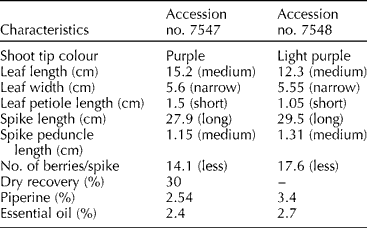
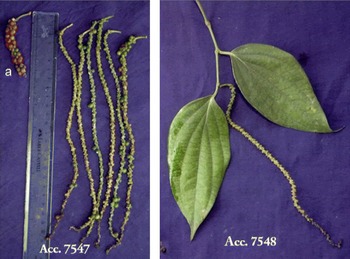
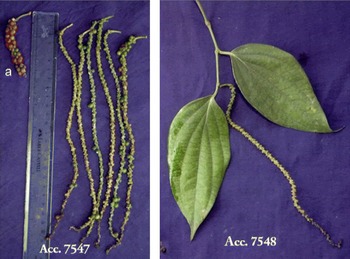
The two unique accessions had the following characteristics: very long spikes with a loose setting; purple to light purple shoot tips; drooping/hanging lateral branches; ovate–lanceolate to ovate leaves with acuminate tips; medium-quality, round, small berries (Table 1 and Fig. 1). The fresh yield per vine was 2–3 kg. Even though the spikes were very long, hitherto unreported in the world gene pool of cultivated black pepper, the number of berries per spike was rather less. In black pepper, the number of berries usually ranges from approximately 30 to >100, depending upon the varieties or hybrids (Ravindran et al., Reference Ravindran, Nirmal Babu, Sasikumar, Krishnamurthy and Ravindran2000).
Morphological and quality characteristics of the long-spiked accessions

Two unique black pepper accessions with very long spikes. ‘a’ is the spike of the popular cultivar ‘Karimunda’.
The loose setting of the accession need not be a deterrent in breeding program, as this trait can be modified by appropriate breeding methods /as a donor in hybridization.
Supplementary material
To view supplementary material for this article, please visit http://dx.doi.org/10.1017/S147926211400080X
Acknowledgements
The authors sincerely thank Mr N. C. Bopaiah, Manager, Coottanadu Plantations Ltd, Meppadi, Wyanadu, Kerala for providing assistance and access to the estate. The authors also thank the Director, Indian Institute of Spices Research, Kozhikode for encouragement and support.