INTRODUCTION
Only sporadic records of leucosiid crabs from the Persian Gulf have appeared since the initial contributions by Alcock (Reference Alcock1896), MacGilchrist (Reference MacGilchrist1905) and Stephensen (Reference Stephensen, Jessen and Spärck1946). Recent surveys of the regional brachyuran fauna and revisional work by Apel (Reference Apel2001), Naderloo & Sari (Reference Naderloo and Sari2005), Galil (Reference Galil2009) and Naderloo & Apel (Reference Naderloo and Apel2012) have increased the number of reported leucosiid species to 37. Most of the Persian Gulf surveys have taken place along the Iranian coast.
The present contribution reports several new records of leucosiid crabs for Qatar, with three species recorded for the first time from the Persian Gulf.
MATERIALS AND METHODS
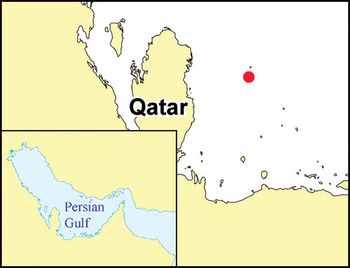
As part of an impact assessment related to oil production, several surveys of the Al'Idd Ash Sharqi oilfield, Qatar, were conducted between 1995 and 2003 (Figure 1). Environmental Resources Management Ltd (ERM) designed the sampling programme and carried out the fieldwork, whilst Thomson Unicomarine Ltd undertook the macrofaunal sample analysis. Surveys in May 1995 and April 1998 concentrated on the northern and southern sectors of the oilfield respectively with the entire area being appraised in August 2003. The sites sampled were mostly situated close to (<1 km) active platforms or drilling rigs. Samples were collected with a 0.1 m2 Day grab. All samples were initially fixed in 4% buffered formaldehyde solution, washed over a 500 µm sieve, transferred to 70% ethanol and sorted under a stereomicroscope. Carapace width × length in millimetres is used as the standard measurement. No leucosiids were obtained in the 1995 survey and many of those obtained in the 1998 and 2003 surveys lacked pereiopods. The use of formaldehyde as a preservative probably caused many of the pereiopods to fall off the material examined. Material is deposited in the Natural History Museum, London.
The location of the Al'Idd Ash Sharqi oilfield, Qatar, ~52°20′56.076″N 25°19′42.096″E.

SYSTEMATICS
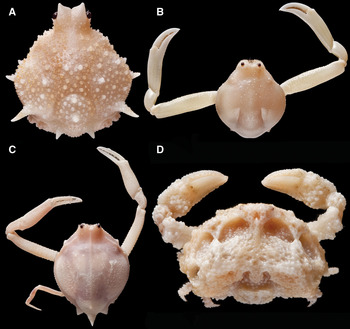
Dorsal carapace view; (A) Arcania tuberculata Bell, Reference Bell1855, 1♀ (8.04 × 8.49 mm), Al'Idd Ash Sharqī, east of Qatar, 52°22′55.128″N 25°27′17.716″E, 35.90 m, 27 August 2003, NHM reg. 2011. 8903; (B) Hiplyra sagitta Galil, Reference Galil2009, 1♂ (11.70 × 13.05 mm), Al'Idd Ash Sharqī, east of Qatar, 52°22′23.520″N 25° 19′57.612″E, 32.07m, 22 April 1998, NHM reg. 2011. 8904; (C) Myra subgranulata Kossmann, Reference Kossmann and Kossmann1877, 1♂ (10.77 × 14.45 mm), Al'Idd Ash Sharqī, east of Qatar, 52°22′25.9320″N 25°19′18.586″E, ~30 m, 27 August 2003, NHM reg. 2011. 8907–8908; (D) Oreophorus horridus Rüppell, Reference Rüppell1830, 1♀ (11.78 × 8.06 mm), Al'Idd Ash Sharqī, east of Qatar, 52°20′56.076″N 25°19′42.096″E, 32.07 m, 23 April 1998, NHM reg. 2011. 8909. Photographs by Harry Taylor, NHM Photo Unit.

MATERIAL EXAMINED
1♀ (8.04 × 8.49 mm), Al'Idd Ash Sharqī, east of Qatar, 52°22′55.128″N 25°27′17.716″E, 35.90 m, 27 August 2003, NHM reg. 2011. 8903.
TYPE LOCALITY
Borneo.
REMARKS
The single specimen agrees closely with the description of Galil (Reference Galil2001). The species has a widespread distribution in the Indo-West Pacific being previously recorded from New Caledonia, Australia, Indonesia, Philippines, South China Sea, Andaman Islands, Sri Lanka, Maldives, Seychelles and Madagascar (Galil, Reference Galil2001). This is a new record for the Persian Gulf.
MATERIAL EXAMINED
1♂ (11.70 × 13.05 mm), 1♀ (12.08 × 13.18 mm), Al'Idd Ash Sharqī, east of Qatar, 52°22′23.520″N 25°19′57.612″E, 32.07 m, 22 April 1998, NHM reg. 2011. 8904.
TYPE LOCALITY
Near Bushehr, Iran.
REMARKS
The present specimens agree closely with the description in Galil (Reference Galil2009), with the anterior margin of efferent channel separated from lateral margin by triangular incision, and the margins of the fused male abdominal somites 2–6 distally carinate, forming an arrow-shaped groove, this being a diagnostic character. This is the first record of the species from Qatar but it has previously been recorded from the Persian Gulf (Iran, Kuwait), India and the Andaman Sea (Galil, Reference Galil2009).
MATERIAL EXAMINED
1♂ (10.46 × 13.10 mm), Al'Idd Ash Sharqī, east of Qatar, 52°22′23.520″N 25°19′57.612″E, 33.50 m, 27 August 2003, NHM reg. 2011. 8905; 1 juvenile Al'Idd Ash Sharqī, east of Qatar, 52°22′55.128″N 25°19′17.716″E, 35.90 m, 27 August 2003, NHM reg. 2011. 8906; 2♂ (10.56 × 13.74, 10.77 × 14.45 mm), Al'Idd Ash Sharqī, east of Qatar, 52°22′25.9320″N 25°19′18.586″E, ~30 m, 27 August 2003, NHM reg. 2011. 8907-8908.
TYPE LOCALITY
Red Sea.
REMARKS
Myra subgranulata was described by Kossmann (Reference Kossmann and Kossmann1877) from a juvenile specimen, collected in the Red Sea, similar in size to the specimens collected during the present study. The species had been recorded from South Africa, Mauritius, Madagascar and Mozambique (Galil, Reference Galil2001). It was recorded in the Suez Canal, Egypt (Calman, Reference Calman1927; Fox, Reference Fox1927) and has subsequently established populations in the Mediterranean Sea (see Galil et al., Reference Galil, Froglia, Noël and Briand2002). It was collected off Israel and Turkey (Monod, Reference Monod1930), Egypt (Balss, Reference Balss1936), Lebanon (Shiber, Reference Shiber1981), Syria (Saker & Farah, 1994 cited in Hasan et al., Reference Hasan, Zeini and Noël2008), Rhodes Island, Greece (Corsini-Foka & Kondilatos, Reference Corsini-Foka and Kondilatos2006). The present material constitutes a new record for the Persian Gulf.
MATERIAL EXAMINED
1♀ (11.78 × 8.06 mm), Al'Idd Ash Sharqī, east of Qatar, 52°20′56.076″N 25°19′42.096″E, 32.07 m, 23 April 1998, NHM reg. 2011. 8909.
TYPE LOCALITY
Tor, Red Sea.
REMARKS
The present specimen agrees closely with the description of Tan & Ng (Reference Tan, Ng and Richer de Forges1995) and Galil & Innocenti (Reference Galil and Innocenti2002). This rubble mimetic species has been previously recorded from the Red Sea (Rüppell, Reference Rüppell1830), Gulf of Aden (Nobili, Reference Nobili1906), Kenya (Galil & Innocenti, Reference Galil and Innocenti2002) and Mayotte (Poupin, Reference Poupin2010) and is now recorded from the Persian Gulf for the first time.
ACKNOWLEDGEMENTS
Occidental Petroleum of Qatar Limited is kindly acknowledged for permission to use the data presented in this paper. In particular Dr Joe Jarrah (formerly of ERM) and Ali Jassim Al-Saigel (OPQL) negotiated the release of the material for further study. We thank staff from Thomson Unicomarine for the initial sample processing. Reza Naderloo (Frankfurt Research Institute and Natural Museum of Senckenberg) and Michael Apel (Museum Mensch und Natur, Schloss Nymphenburg) for giving us access to their submitted ‘Hiplyra from the Persian Gulf and Gulf of Oman' manuscript. The photographs reproduced in this paper were taken by Harry Taylor, NHM Photo Unit.