





Introduction
Volunteers have been instrumental in advancing societal well-being throughout history (Musick & Wilson, Reference Musick and Wilson2007). Among them, community health volunteers stand out for their substantial contributions to public health and community welfare (Kowitt et al., Reference Kowitt, Emmerling, Fisher and Tanasugarn2015). According to the World Health Organization (WHO), these volunteers are vital in disseminating knowledge and delivering primary health services to underserved rural areas (Treerutkuarkul, Reference Treerutkuarkul2008). As street-level bureaucrats (Sudhipongpracha & Poocharoen, Reference Sudhipongpracha and Poocharoen2021), their contributions were especially evident during the COVID-19 pandemic, where they educated communities, distributed essential supplies, conducted health screenings, and supported contact tracing efforts (Krassanairawiwong et al., Reference Krassanairawiwong, Suvannit, Pongpirul and Tungsanga2021; Tantrakarnapa et al., Reference Tantrakarnapa, Bhopdhornangkul and Nakhaapakorn2022). Yet, despite their essential labor, community health volunteers remain largely invisible in nonprofit accounting systems (Mook et al., Reference Mook, Handy and Quarter2007), and their recognition often falls short compared to formally trained medical personnel (Ankomah et al., Reference Ankomah, Fusheini and Derrett2024). Such conditions add to the broader challenges that can threaten volunteers’ well-being and continued engagement (Kowitt et al., Reference Kowitt, Emmerling, Fisher and Tanasugarn2015; Ndu et al., Reference Ndu, Andoniou, McNally, Olea Popelka, Tippett and Nouvet2022; Tetui et al., Reference Tetui, Tennant, Patten, Giilck, Burns, Waite and Grindrod2023).
Prior research has identified several factors associated with volunteer burnout, including extrinsic motivation (Moreno-Jiménez & Hidalgo Villodres, Reference Moreno-Jiménez and Hidalgo Villodres2010), service hours (Gau et al., Reference Gau, Buettner, Usher and Stewart2013), and family disapproval as well as social stigma (Ndu et al., Reference Ndu, Andoniou, McNally, Olea Popelka, Tippett and Nouvet2022). Much less attention, however, has been given to whether recognition from those surrounding volunteers can serve as a meaningful signal that their contributions are valued. One such form of recognition is perceived gratitude, which refers to the extent to which individuals feel that their efforts and contributions are appreciated by beneficiaries and stakeholders (Grant & Gino, Reference Grant and Gino2010; Naqshbandi et al., Reference Naqshbandi, Liu, Taylor, Lim, Ahmadpour and Calvo2020). Prior research has linked gratitude expressions to greater willingness to help (Grant & Gino, Reference Grant and Gino2010), sustained volunteering (Naqshbandi et al., Reference Naqshbandi, Liu, Taylor, Lim, Ahmadpour and Calvo2020), public service behavior (Qin et al., Reference Qin, Zhang and Dou2026), lower turnover intentions (Davis et al., Reference Davis, Stazyk and Dickman2021), and improved psychological well-being (Waters, Reference Waters2012). However, despite widespread recognition of its importance, perceived gratitude has received relatively limited attention as a distinct factor in volunteer management (e.g., Kowitt et al., Reference Kowitt, Emmerling, Fisher and Tanasugarn2015; Ndu et al., Reference Ndu, Andoniou, McNally, Olea Popelka, Tippett and Nouvet2022; Prince & Piatak, Reference Prince and Piatak2023). More importantly, few studies have directly examined whether perceived gratitude can alleviate volunteer burnout, and even fewer have investigated which sources of gratitude are most effective in doing so.
This study addresses this research void by examining three distinct sources of perceived gratitude—citizens, supervisors, and the government—and their respective roles in alleviating job burnout among community health volunteers. As the most immediate and visible stakeholders, citizens often serve as the primary source of interpersonal recognition (Lee et al., Reference Lee, Kim, Bae, Kim, Shin, Yoon and Kim2018; Naqshbandi et al., Reference Naqshbandi, Liu, Taylor, Lim, Ahmadpour and Calvo2020). Their gratitude provides direct feedback about the social impact of volunteers’ efforts, making it a particularly salient form of appreciation. Supervisors, though less proximate beneficiaries, interact regularly with volunteers and shape the work environment (Ndu et al., Reference Ndu, Andoniou, McNally, Olea Popelka, Tippett and Nouvet2022; Tetui et al., Reference Tetui, Tennant, Patten, Giilck, Burns, Waite and Grindrod2023; Tsai et al., Reference Tsai, Newstead, Lewis and Chuah2024), thereby making their expressions of gratitude an important source of motivational reinforcement (Grant & Gino, Reference Grant and Gino2010). Meanwhile, government actors—although their expressions of appreciation may be less frequent or less direct (Ndu et al., Reference Ndu, Andoniou, McNally, Olea Popelka, Tippett and Nouvet2022)—possess the symbolic authority to legitimize volunteer labor (Kowitt et al., Reference Kowitt, Emmerling, Fisher and Tanasugarn2015; Mook et al., Reference Mook, Handy and Quarter2007; Ndu et al., Reference Ndu, Andoniou, McNally, Olea Popelka, Tippett and Nouvet2022). When expressed publicly, government gratitude may serve as an important institutional signal of recognition that reinforces the legitimacy and social value of volunteers’ contributions.
Grounded in self-determination theory (SDT) (Deci & Ryan, Reference Deci and Ryan1985), this study proposes that the role of perceived gratitude in mitigating job burnout can be explained by public service motivation (PSM)—the desire to contribute to societal well-being (Perry & Hondeghem, Reference Perry and Hondeghem2008). Although PSM has been recognized as a critical factor in sustaining volunteers’ motivation, reducing job burnout, and enhancing well-being (e.g., Nencini et al., Reference Nencini, Romaioli and Meneghini2016; Potipiroon & Faerman, Reference Potipiroon and Faerman2020; Stukas et al., Reference Stukas, Hoye, Nicholson, Brown and Aisbett2016), little is known about how specific sources of gratitude can shape its development. This study argues that expressions of gratitude from citizens, supervisors, and the government serve as signals that volunteers’ efforts and contributions are valued. Such signals can strengthen PSM by satisfying core psychological needs, particularly those for relatedness and competence, as well as autonomy (Deci et al., Reference Deci, Koestner and Ryan1999; Deci & Ryan, Reference Deci and Ryan2000; Gagné & Deci, Reference Gagné and Deci2005). By communicating that their contributions matter to others, gratitude can reinforce volunteers’ sense of connection, effectiveness, and volition in public service. This need fulfillment, in turn, reinforces a sense of purpose and public service commitment, thereby strengthening PSM and reducing burnout among community health volunteers.
This study makes several contributions to the community health and well-being literature. First, it clarifies the under-researched relationship between perceived gratitude and job burnout. While prior research indicates that individuals’ well-being can be shaped by dispositional gratitude (Guan & Jepsen, Reference Guan and Jepsen2020) and by expressing gratitude toward others (Jiang et al., Reference Jiang, Chiu and Liu2022; Lanham et al., Reference Lanham, Rye, Rimsky and Weill2012; Lee et al., Reference Lee, Kim, Bae, Kim, Shin, Yoon and Kim2018), far less is known about whether receiving gratitude—particularly in the context of community health volunteers—can mitigate burnout. Secondly, this study examines multiple sources of perceived gratitude within a unified framework, allowing their relative importance to be assessed directly. While previous studies have established the importance of gratitude in both public and nonprofit settings, many do not explicitly specify its sources (Davis et al., Reference Davis, Stazyk and Dickman2021; Henderson & Sowa, Reference Henderson and Sowa2019; Qin et al., Reference Qin, Zhang and Dou2026) or only examine specific sources in isolation—such as supervisors (Beck, Reference Beck2016; Grant & Gino, Reference Grant and Gino2010; Zhu & Du, Reference Zhu and Du2024), patients (Converso et al., Reference Converso, Loera, Viotti and Martini2015), citizens (Cohen & Headley, Reference Cohen and Headley2024) and the government (Kowitt et al., Reference Kowitt, Emmerling, Fisher and Tanasugarn2015; Ndu et al., Reference Ndu, Andoniou, McNally, Olea Popelka, Tippett and Nouvet2022)—without accounting for their combined or interactive effects. Third, this study advances understanding of the motivational mechanisms linking gratitude and burnout by highlighting the role of PSM. Prior research has examined antecedents of PSM across multiple levels—ranging from citizen interactions (Prysmakova, Reference Prysmakova2021; Taylor, Reference Taylor2014), citizens’ negative feedback (Pratama et al., Reference Pratama, Ahsani and Wulandari2025), citizen criticism (Jahan & Shahan, Reference Jahan and Shahan2012), citizen incivility (Lee & Youm, Reference Lee and Youm2024), and perceived corruption (Potipiroon, Reference Potipiroon2026a) to leadership styles (Huang & Liu, Reference Huang and Liu2023; Wongpreedee & Sudhipongpracha, Reference Wongpreedee and Sudhipongpracha2024), and the broader policy environment (Anderfuhren-Biget et al., Reference Anderfuhren-Biget, Varone and Giauque2014). However, despite this growing body of work, the role of perceived gratitude across multiple stakeholder levels—as a potential driver of PSM—has received little empirical attention. By systematically examining gratitude from multiple sources, this study identifies a previously overlooked, yet psychologically meaningful, pathway through which PSM may be cultivated and sustained.
This study focuses on community health volunteers in Thailand, commonly known as village health volunteers (VHVs). According to the WHO, the success of Thailand’s primary health care program over the last three decades could be attributed to the crucial role played by these volunteers (Kowitt et al., Reference Kowitt, Emmerling, Fisher and Tanasugarn2015; Treerutkuarkul, Reference Treerutkuarkul2008). Yet, their contributions often go unnoticed (Ankomah et al., Reference Ankomah, Fusheini and Derrett2024). Treerutkuarkul (Reference Treerutkuarkul2008) aptly describes these VHVs as the “unsung heroes” of the nation’s health care system. Compounding this lack of recognition is a broader skepticism about VHVs’ competence in primary health care (Kowitt et al., Reference Kowitt, Emmerling, Fisher and Tanasugarn2015). Given these circumstances, it is unsurprising that VHVs often face significant stress and burnout in their roles (Ndu et al., Reference Ndu, Andoniou, McNally, Olea Popelka, Tippett and Nouvet2022). Accordingly, it is imperative to examine factors that can help VHVs to relieve the fatigue of their daily commitment and restore meaning to their work.
Theory and hypotheses
The role of village health volunteers (VHVs) as street-level quasi-bureaucrats
In Thailand, VHVs play a pivotal role in implementing the Ministry of Public Health’s policies, acting as intermediaries between the government and local communities (Kowitt et al., Reference Kowitt, Emmerling, Fisher and Tanasugarn2015; Sudhipongpracha & Poocharoen, Reference Sudhipongpracha and Poocharoen2021; Tantrakarnapa et al., Reference Tantrakarnapa, Bhopdhornangkul and Nakhaapakorn2022). According to Sudhipongpracha and Poocharoen (Reference Sudhipongpracha and Poocharoen2021), VHVs are “private” citizens on the front line, who deliver vital health services to citizens through their everyday interactions, thereby acting as “street-level quasi-bureaucrats.” The term “bureaucrats” does not imply formal employment in the civil service but refers to their function as state agents who help implement public policy (Sager et al., Reference Sager, Thomann, Zollinger, van der Heiden and Mavrot2014). VHVs thus navigate the demands of the state and the needs of citizens, often at the expense of their own well-being (Kowitt et al., Reference Kowitt, Emmerling, Fisher and Tanasugarn2015; Ndu et al., Reference Ndu, Andoniou, McNally, Olea Popelka, Tippett and Nouvet2022; Tetui et al., Reference Tetui, Tennant, Patten, Giilck, Burns, Waite and Grindrod2023).
The aim of the VHV program, which dates back to the 1960s, is for every village in Thailand to have at least one health volunteer, each responsible for approximately ten households (Singweratham et al., Reference Singweratham, Nawsuwan, Suriya, Oupra and Lillahkul2024). Currently, over 1,000,000 VHVs provide primary health care to 23 million households across 75,032 villages nationwide (Krassanairawiwong et al., Reference Krassanairawiwong, Suvannit, Pongpirul and Tungsanga2021). VHVs operate within a broad hierarchical structure, working under the general supervision of district, subdistrict, and village VHV leaders. They also work closely with public health officials, who provide guidance on technical medical issues (Kowitt et al., Reference Kowitt, Emmerling, Fisher and Tanasugarn2015). Initially, VHVs served without financial compensation. However, since 2010, they have received a government allowance of 600 Baht per month (approximately 20 USD), which not only supports them in carrying out their duties (e.g., gas for transportation), but also provides a sense of pride (Kowitt et al., Reference Kowitt, Emmerling, Fisher and Tanasugarn2015).
VHVs have played a critical role in advancing Thailand’s primary health care system, which has set the country apart (Kowitt et al., Reference Kowitt, Emmerling, Fisher and Tanasugarn2015; Treerutkuarkul, Reference Treerutkuarkul2008). These VHVs have helped combat communicable diseases such as HIV/AIDS as well as emerging diseases such as SARS, avian flu, and COVID-19 (Krassanairawiwong et al., Reference Krassanairawiwong, Suvannit, Pongpirul and Tungsanga2021; Singweratham et al., Reference Singweratham, Nawsuwan, Suriya, Oupra and Lillahkul2024; Treerutkuarkul, Reference Treerutkuarkul2008). During the COVID-19 pandemic, VHVs visited households, offered hygiene advice, participated in public health campaigns, made cloth masks, identified high-risk individuals, and monitored quarantined cases (Krassanairawiwong et al., Reference Krassanairawiwong, Suvannit, Pongpirul and Tungsanga2021). Beyond these, VHVs also advocate for broader health initiatives such as dengue fever surveillance and prevention, maternal and child health, mental health, the management of non-communicable diseases (e.g., diabetes, obesity), food safety, and elderly care (Kowitt et al., Reference Kowitt, Emmerling, Fisher and Tanasugarn2015).
Job burnout among community health volunteers
Job burnout, a key indicator of an individual’s well-being, is characterized by a persistent drain on mental, physical, and emotional energy, which typically arises from prolonged and intense exposure to job-related stress (Maslach & Jackson, Reference Maslach and Jackson1981). While burnout comprises various components, this research focuses specifically on emotional exhaustion, a core component of burnout (Leiter & Maslach, Reference Leiter and Maslach1988), which refers to feelings of being emotionally overextended and drained by one’s work (Maslach et al., Reference Maslach, Schaufeli and Leiter2001; Maslach & Jackson, Reference Maslach and Jackson1986). Emotional exhaustion is widely regarded as the most central and often the earliest manifestation of burnout.
Previous research indicates that several factors, for example, role overload, role conflict, value conflict, insufficient rewards and recognition, lack of social support, and injustice, can deprive individuals of psychological resources to fulfill their job requirements (Cordes & Dougherty, Reference Cordes and Dougherty1993; Maslach & Leiter, Reference Maslach and Leiter2008). In the volunteer context, similar patterns emerge. Moreno-Jiménez and Hidalgo Villodres (Reference Moreno-Jiménez and Hidalgo Villodres2010) found that burnout among volunteers was positively associated with extrinsic motivation and time commitment, but negatively associated with intrinsic motivation, life satisfaction, and organizational integration. Gau et al. (Reference Gau, Buettner, Usher and Stewart2013) also reported that the number of individuals served and weekly service hours predicted feelings of burden among community health volunteers. Expanding on this, Ndu et al. (Reference Ndu, Andoniou, McNally, Olea Popelka, Tippett and Nouvet2022) identified several contextual and interpersonal stressors specific to community health volunteers, such as family disapproval, social stigma, lack of respect, and dismissive treatment by public health professionals—conditions linked to their informal status and absence of formal health care credentials. These findings point to a complex ecology of risk factors for volunteer burnout.
Multiple sources of gratitude and job burnout
Various forms of gratitude have been examined in the extant literature (see Cortini et al., Reference Cortini, Converso, Galanti, Di Fiore, Di Domenico and Fantinelli2019 for further details). This research focuses on perceived gratitude, which involves individuals’ perceptions that they are the recipients of appreciation and thanks from those who have benefited from their actions or support (Grant & Gino, Reference Grant and Gino2010; Naqshbandi et al., Reference Naqshbandi, Liu, Taylor, Lim, Ahmadpour and Calvo2020). Expressions of gratitude can manifest in both verbal forms (e.g., saying “thank you”) and nonverbal forms (e.g., writing a “thank-you” note) (Grant & Gino, Reference Grant and Gino2010). While gratitude is predominantly studied in organizational contexts (Beck, Reference Beck2016)—including among call center workers (Grant & Gino, Reference Grant and Gino2010), nurses (Aparicio et al., Reference Aparicio, Centeno, Robinson and Arantzamendi2019; Converso et al., Reference Converso, Loera, Viotti and Martini2015; Jun et al., Reference Jun, Lee and Lee2015) and firefighters (Lee et al., Reference Lee, Kim, Bae, Kim, Shin, Yoon and Kim2018)—its effects extend beyond the workplace setting to the broader public sphere, such as personal relationships (Jiang et al., Reference Jiang, Chiu and Liu2022; Kindt et al., Reference Kindt, Vansteenkiste, Cano and Goubert2017). Accordingly, sources of gratitude tend to vary considerably across specific contexts. To illustrate, medical professionals feel appreciated when thanked by patients and their families, whereas peer reviewers experience recognition through expressions of gratitude from journal editors, authors, and readers.
This study proposes that three sources of perceived gratitude—citizens, supervisors, and the government—are particularly influential in reducing job burnout among community health volunteers. Gratitude from citizens is most relevant as they are direct beneficiaries of their services. According to Maynard-Moody and Musheno (Reference Maynard-Moody and Musheno2000), contact with citizens is a defining characteristic of street-level work, which can influence perceptions and attitudes of those on the front line (Homberg et al., Reference Homberg, McCarthy and Tabvuma2015; Potipiroon, Reference Potipiroon2022; Prysmakova, Reference Prysmakova2021). Grant and Gino (Reference Grant and Gino2010) showed that gratitude expressions from service beneficiaries lead to helpers’ perceptions of social worth, in turn leading to further helping. Converso et al. (Reference Converso, Loera, Viotti and Martini2015) also found that patient gratitude can reduce nurses’ burnout. Kim et al. (Reference Kim, Kim, Howell, Doyle, Pettit and Bizzarro2023) further reported that public gratitude is negatively associated with maladaptive recovery activities (e.g., overdrinking), which can be explained by two sequential mechanisms: (a) reduction in feelings of invisibility and (b) the experience of positive affect.
Gratitude from supervisors also holds significant importance for volunteers (Ndu et al., Reference Ndu, Andoniou, McNally, Olea Popelka, Tippett and Nouvet2022; Tetui et al., Reference Tetui, Tennant, Patten, Giilck, Burns, Waite and Grindrod2023). The most common medium used and desired for expressing gratitude by managers is oral, one-to-one communication (Beck, Reference Beck2016). According to Tyler and Lind (Reference Tyler and Lind1992), the way individuals are treated by those in positions of power serves as a key social signal, reinforcing their sense of social standing and respect. While individuals assess their status based on a variety of information sources, the direct experience of feeling (un)appreciated by the supervisor can be particularly salient (Potipiroon & Ford, Reference Potipiroon and Ford2019). Grant and Gino (Reference Grant and Gino2010) found that a simple expression of appreciation from a manager had a significant impact on employee performance. When a single manager visited a call center to personally thank employees for their efforts, the number of calls made by these employees increased by more than 50% in the following week. Eldor (Reference Eldor2018) also showed that when employees receive compassion from their supervisors, they exhibit higher work engagement and lower burnout.
Gratitude from the government—though more institutionally distant—represents a distinct form of recognition. In this study, government gratitude refers to volunteers’ perception that governmental authorities recognize and value their efforts and contributions. Unlike gratitude from citizens and supervisors, whose significance largely derives from direct interpersonal relationships, government gratitude carries the symbolic authority of the state. Its distinctiveness therefore lies less in how gratitude is communicated than in the institutional source to which that recognition is attributed. Government gratitude can consequently function not only as appreciation but also as a signal that volunteers’ contributions are formally recognized and socially legitimate.
Such gratitude may be communicated through formal channels, such as official commendations and public statements, or through direct interactions with government officials. Because government actors are generally more institutionally distant and less involved in volunteers’ day-to-day work than citizens or supervisors, these expressions of gratitude are likely to be less frequent and less immediate. Their relative rarity, however, may also enhance their symbolic significance when they do occur (see also Lynn, Reference Lynn1991). Although these volunteers are not formally employed by the government (Kowitt et al., Reference Kowitt, Emmerling, Fisher and Tanasugarn2015; Sudhipongpracha & Poocharoen, Reference Sudhipongpracha and Poocharoen2021), recognition from state authorities can carry particular weight by signaling that their role and contributions are institutionally legitimate (Deephouse & Suchman, Reference Deephouse, Suchman, Greenwood, Oliver, Sahlin and Suddaby2008). Such recognition may therefore affirm volunteers’ sense that their work is socially valued and meaningful, potentially helping to reduce burnout.
Based on the above arguments and rationale, this study proposes that perceived gratitude from the three sources can independently mitigate community health volunteers’ job burnout. Thus, this study hypothesizes the following:
H1: Citizen gratitude is negatively related to volunteers’ job burnout.
H2: Supervisor gratitude is negatively related to volunteers’ job burnout.
H3: Government gratitude is negatively related to volunteers’ job burnout.
The mediating role of PSM
The theoretical development of PSM proposed by Perry and Wise (Reference Perry and Wise1990) is grounded in the notion that individuals are motivated toward public service by three core motives: rational (i.e., seeking to influence public policies), affective (i.e., seeking to advance social causes), and normative (i.e., driven by a sense of duty or moral obligation to serve the public good). However, there has been a shift toward a more general and broader view of PSM (Wright et al., Reference Wright, Christensen and Pandey2013), conceptualizing it as “an individual’s orientation to delivering services to people with a purpose to do good for others and society” (Perry & Hondeghem, Reference Perry and Hondeghem2008, vii). While volunteers are motivated by various factors such as career-related goals (e.g., the desire for recognition) and self-enhancement (e.g., the desire to feel important) (Clary et al., Reference Clary, Snyder, Ridge, Copeland, Stukas, Haugen and Miene1998; Ndu et al., Reference Ndu, Andoniou, McNally, Olea Popelka, Tippett and Nouvet2022), PSM, reflected in the desire to assist those in need, represents an important motive for volunteering (Clary et al., Reference Clary, Snyder, Ridge, Copeland, Stukas, Haugen and Miene1998; Kowitt et al., Reference Kowitt, Emmerling, Fisher and Tanasugarn2015; Ndu et al., Reference Ndu, Andoniou, McNally, Olea Popelka, Tippett and Nouvet2022).
According to SDT (Ryan & Deci, Reference Ryan and Deci2000), individuals’ motivation exists along a continuum, ranging from externally driven motivation to fully self-determined motivation. At the least autonomous end, motivation is driven by external rewards and punishments (external regulation) or self-imposed pressures such as guilt (introjected regulation). Moving toward greater autonomy, individuals may engage in behaviors aligned with personally meaningful values (identified regulation) or fully integrate these values into their identity (integrated regulation). The most autonomous form of motivation—intrinsic motivation—occurs when an activity is perceived as inherently enjoyable and fulfilling. This nuanced perspective suggests that PSM aligns with identified or integrated motivation as prosocial values are perceived as personally significant or deeply internalized into one’s personal identity (Potipiroon & Ford, Reference Potipiroon and Ford2017; Xu et al., Reference Xu, Mussagulova, Chen and Kuo2023). Thus, unlike hedonic motivation, which focuses on pleasure and enjoyment, PSM is eudaimonic, meaning it is driven by a sense of meaning and purpose (Grant, Reference Grant2008). A core principle of SDT is that for individuals to shift from external regulation to autonomous regulation, three fundamental psychological needs must be satisfied, namely, the need for autonomy, the need for competence, and the need for relatedness. When these needs are thwarted, intrinsic motivation tends to decline, which can lead to maladaptive outcomes such as reduced well-being (Deci & Ryan, Reference Deci and Ryan1985, Reference Deci and Ryan2000, Reference Deci and Ryan2002; Ryan & Deci, Reference Ryan and Deci2000).
This study proposes that perceived gratitude can enhance PSM by fulfilling the three fundamental psychological needs identified by SDT. First, gratitude can satisfy the need for relatedness—the desire to feel connected to and valued by others (Deci & Ryan, Reference Deci and Ryan2002)—by signaling that volunteers’ contributions matter to the people they serve. Such recognition fosters social connection and a sense of social worth, which Grant and Gino (Reference Grant and Gino2010) identify as a key mechanism through which gratitude motivates prosocial behavior (see also Naqshbandi et al., Reference Naqshbandi, Liu, Taylor, Lim, Ahmadpour and Calvo2020). Second, gratitude can reinforce the need for competence, or the desire to feel effective and capable (Deci & Ryan, Reference Deci and Ryan2002), because appreciation provides feedback that volunteers’ efforts have produced meaningful results. Consistent with this reasoning, Cohen and Headley (Reference Cohen and Headley2024) found that police officers interpret citizens’ gratitude as evidence of their trustworthiness and capability, whereas distrust in health volunteers’ competence can be demotivating and stressful (Kowitt et al., Reference Kowitt, Emmerling, Fisher and Tanasugarn2015). Finally, gratitude may also signal support for autonomy by affirming volunteers’ self-endorsed decision to contribute their time and effort. When beneficiaries recognize their contributions, volunteers may experience their service less as an obligation and more as a personally meaningful choice. Together, fulfillment of these needs can strengthen the internalization of public service values and, consequently, PSM.
In this respect, prior studies have shed light on the positive effects of PSM on volunteers’ well-being. For instance, in a study of Italian volunteers, Nencini et al. (Reference Nencini, Romaioli and Meneghini2016) found that volunteers’ autonomous motivation (conceptually similar to PSM) is positively related to increased satisfaction and reduced turnover intentions. In another study conducted in Australia, Stukas et al. (Reference Stukas, Hoye, Nicholson, Brown and Aisbett2016) found that other-oriented volunteers tend to experience higher levels of well-being. Meta-analyses (Hui et al., Reference Hui, Ng, Berzaghi, Cunningham-Amos and Kogan2020; Righetti et al., Reference Righetti, Sakaluk, Faure and Impett2020) also confirmed positive relationships between prosociality and well-being. Accordingly, this study proposes that expressions of gratitude from these distinct sources can independently reinforce PSM among community health volunteers, in turn reducing burnout. In this spirit, this study hypothesizes the following:
H4: PSM negatively mediates the relationship between citizen gratitude and volunteers’ job burnout.
H5: PSM negatively mediates the relationship between supervisor gratitude and volunteers’ job burnout.
H6: PSM negatively mediates the relationship between government gratitude and volunteers’ job burnout.
The moderating role of government gratitude
This study further proposes that government gratitude may serve as a contextual amplifier of gratitude received from more proximate actors. Gratitude from citizens and supervisors provides direct interpersonal affirmation that volunteers’ efforts are valued and can thereby satisfy needs for relatedness and competence (Gagné & Deci, Reference Gagné and Deci2005). Government gratitude, by contrast, carries institutional rather than merely interpersonal significance (Fehr et al., Reference Fehr, Fulmer, Awtrey and Miller2017; Ng, Reference Ng2016). Because it originates from state authorities, it can signal that volunteers’ contributions are recognized as legitimate and valuable within the broader public service system (Bitektine & Haack, Reference Bitektine and Haack2015; Deephouse & Suchman, Reference Deephouse, Suchman, Greenwood, Oliver, Sahlin and Suddaby2008).
This institutional recognition may strengthen the meaning attached to gratitude from citizens and supervisors. Appreciation from a citizen, for example, indicates that a volunteer has made a difference to an individual or community member; when the volunteer also perceives recognition from the government, that same contribution is validated at a broader institutional level. Similarly, appreciation from a supervisor may affirm the volunteer’s contribution within an immediate working relationship, whereas government recognition can signal that the contribution is valued beyond that relationship. Government gratitude may therefore increase the perceived significance of proximal appreciation by aligning interpersonal recognition with institutional validation. Such alignment should strengthen the extent to which gratitude from citizens and supervisors reinforces volunteers’ identification with the value of their public service. Put differently, when appreciation from proximal actors is accompanied by recognition from the government, volunteers receive mutually reinforcing signals that their contributions matter both to those they serve and to the broader system within which they serve.
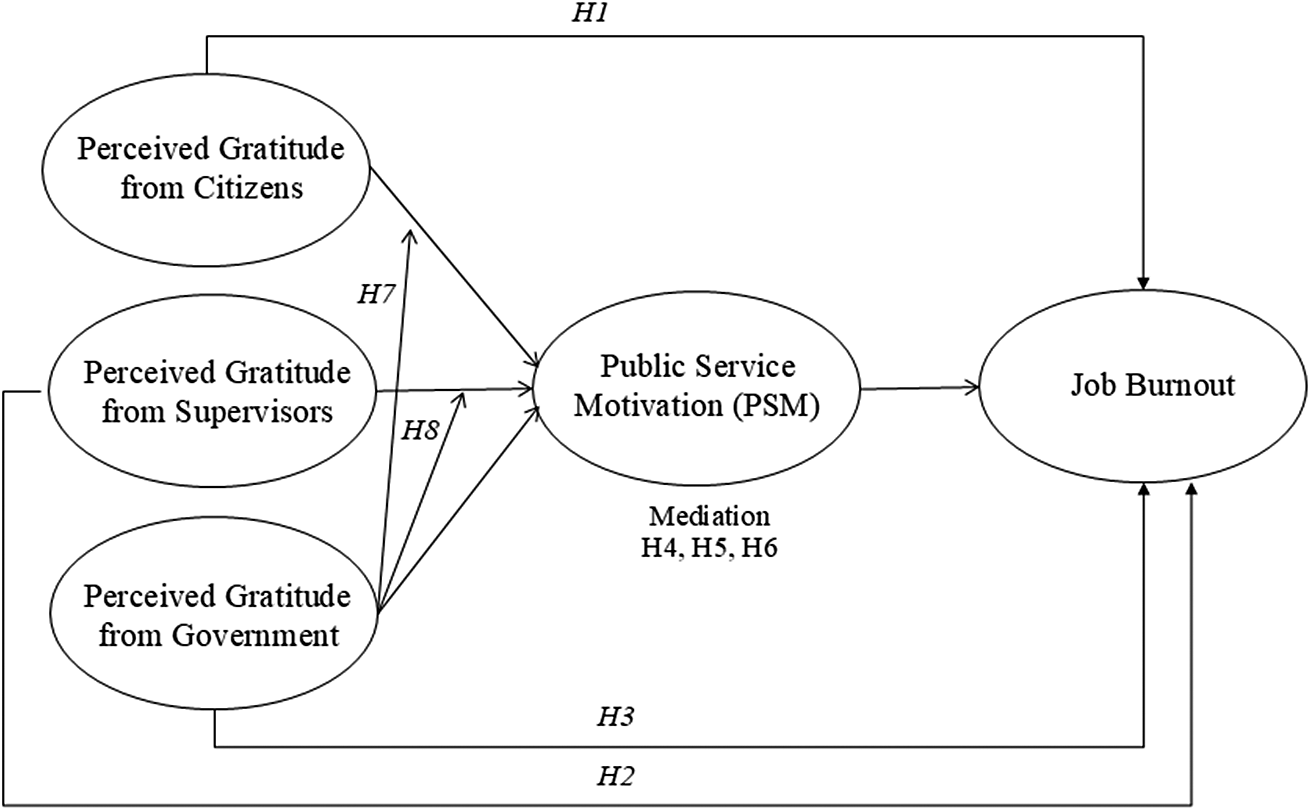
Prior research suggests that gratitude’s effects are not fixed properties of an isolated exchange but are instead shaped by the broader context in which they occur: perceived norms of gratitude within a workplace have been shown to condition how strongly gratitude translates into downstream outcomes (Locklear et al., Reference Locklear, Taylor and Ambrose2021). This raises the possibility that one source of perceived gratitude may similarly condition the effects of another. To date, however, this possibility has not been tested for institutionally sourced gratitude specifically, nor has any study examined whether gratitude from the state interacts with gratitude from proximate actors such as citizens or supervisors. Accordingly, this study proposes the following (Figure 1):
H7: Government gratitude enhances the indirect effect of citizen gratitude on volunteers’ job burnout via PSM.
H8: Government gratitude enhances the indirect effect of supervisor gratitude on volunteers’ job burnout via PSM.
Conceptual model.

Fig. 1 Long description
The diagram consists of five oval nodes connected by arrows representing hypothesized relationships.
On the left, three independent variables are stacked vertically:
- Top: Perceived Gratitude from Citizens.
- Middle: Perceived Gratitude from Supervisors.
- Bottom: Perceived Gratitude from Government.
In the center is the mediating variable: Public Service Motivation PSM. Below this node is the text Mediation H 4, H 5, H 6.
On the far right is the dependent variable: Job Burnout.
Structural relationships are indicated by arrows:
- A direct path labeled H 1 connects Perceived Gratitude from Citizens to Job Burnout.
- Direct paths labeled H 2 and H 3 connect Perceived Gratitude from Government and Perceived Gratitude from Supervisors to Job Burnout.
- Three arrows point from the left-side variables to PSM.
- Two vertical arrows labeled H 7 and H 8 point from the Perceived Gratitude from Government path toward the paths of the other two gratitude variables, indicating moderation.
- A final arrow connects PSM to Job Burnout.
Research methodology
Sample and data collection
This research was funded by Thailand’s National Science, Research, and Innovation Fund (NSRF) in 2024 (Grant No. MAN6801136S) and received the institution’s ethics approval. To test the hypotheses outlined above, survey data were collected from VHVs in a large province in Thailand. According to Thailand Public Health Care (ThaiPHC)—an online information system that supports the work of the Bureau of Community Health Promotion under the Ministry of Public Health of Thailand—there are a total of 30,545 VHVs in this specific province. This serves as the population frame for the study. The survey questionnaire was distributed online, using a snowball sampling approach (Parker et al., Reference Parker, Scott, Geddes, Atkinson, Delamont, Cernat, Sakshaug and Williams2019), whereby initial VHV contacts were asked to forward the survey to other VHVs. Recruitment was seeded across all 22 districts rather than through a single entry point, reducing reliance on any single referral chain. This method facilitated access to a geographically dispersed VHV network, a population that is typically difficult to reach through hand-distributed surveys.
Considering sample-size conventions in comparable research (Neumann & Schott, Reference Neumann and Schott2023) and the resources available under the research grant, the initial target was set at approximately 2,000 completed surveys. After 2 months of data collection (February–March, 2025), 1,692 complete responses were obtained from VHVs across 22 districts. A sensitivity analysis using G*Power indicated that, with N = 1,692, alpha = .05, and power of .80, the minimum detectable incremental effect was f 2 = .005 in a regression equation with nine predictors, suggesting that insufficient power was unlikely to account for the null effect of government gratitude, which will be discussed further below.
Measurements
The questionnaire was administered in Thai. All measures, originally developed in English, were translated into Thai by the author. To assess the content validity and accuracy of the translated items, three external reviewers independently evaluated the correspondence between the original and translated items using the Index of Item-Objective Congruence approach. Items were revised where necessary based on their evaluations before the questionnaire was administered. Unless stated otherwise, the scales used for the present research were based on a five-point format where 1 = strongly disagree and 5 = strongly agree.
Perceived gratitude from each distinct source—citizens, supervisors, and the government—was assessed using measures adapted from established gratitude measures in previous research (Grant & Gino, Reference Grant and Gino2010; Naqshbandi et al., Reference Naqshbandi, Liu, Taylor, Lim, Ahmadpour and Calvo2020). Each source of gratitude was measured with three items, yielding a total of nine items across the three sources. The referents used in the items for each measure were adjusted to reflect the specific sources of perceived gratitude. These items include “[source omitted] have expressed thanks to me in a meaningful way,” “I believe [source omitted] genuinely values the effort I have put into my volunteer work,” and “I sense a sincere appreciation from [source omitted] for the contributions I have made.” PSM was measured using the five-item global measure adapted from Perry’s (Reference Perry1996) 24-item scale. This shortened scale has been used successfully in several PSM studies (Davis et al., Reference Davis, Stazyk and Dickman2021; Potipiroon & Faerman, Reference Potipiroon and Faerman2020; Potipiroon & Wongpreedee, Reference Potipiroon and Wongpreedee2021; Wright et al., Reference Wright, Christensen and Pandey2013). Emotional exhaustion was measured using five items derived from the Maslach Burnout Inventory (Maslach & Jackson, Reference Maslach and Jackson1981). In line with previous research, several control variables were also considered, including gender (1 = female), age (in years), education, job tenure (in years), and income (in Thai Baht).
Data analyses
This study employed Structural Equation Modeling (SEM) in Mplus (Muthén & Muthén, 1998–Reference Muthén and Muthén2017) to test the hypotheses. Given that data were drawn from 22 districts, the TYPE = COMPLEX option in Mplus was used to adjust for clustered standard errors. This adjustment accounts for non-independence at the district level, while it cannot fully capture dependence arising within the informal referral networks through which the survey was distributed. The analysis followed a two-step approach: (1) evaluating the measurement model through confirmatory factor analysis (CFA) and (2) assessing the hypothesized structural model. Model fit was determined using multiple indices, including chi-square (χ2), the relative chi-square ratio (χ2/df), the Tucker-Lewis Index (TLI), the Comparative Fit Index (CFI), the Standardized Root Mean Squared Residual (SRMR), and the Root Mean Square Error of Approximation (RMSEA) (Kline, Reference Kline2011). Once the measurement model demonstrated acceptable fit, the structural models (mediation and moderated mediation) were then examined within a latent framework. Manifest indicators of the independent variables were standardized in Mplus before creating latent interaction terms: citizen gratitude x government gratitude and supervisor gratitude x government gratitude. To assess the statistical significance of including the latent interaction terms, a log-likelihood ratio test was used to compare the fit of the mediation model (the simpler model) with the moderated mediation models (the more complex models), following the approach recommended by Maslowsky et al. (Reference Maslowsky, Jager and Hemken2015).
Results
Descriptive statistics
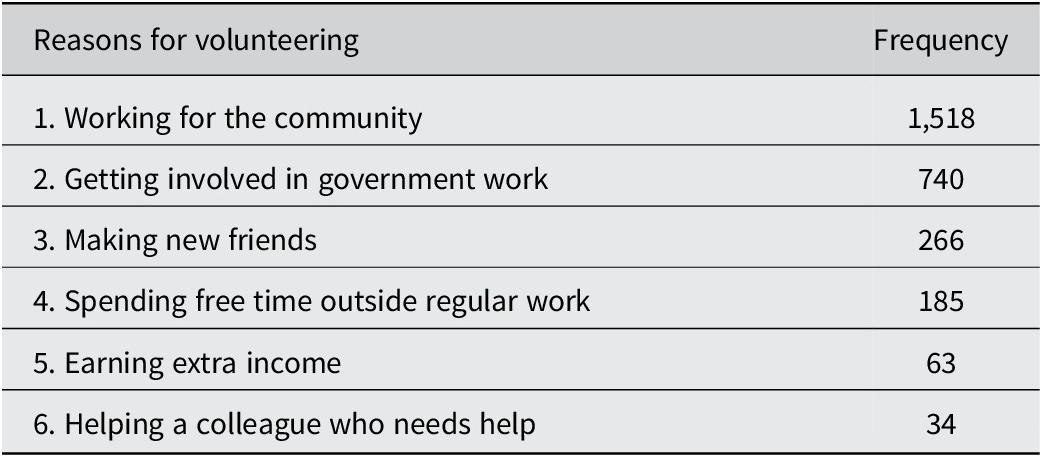
As shown in Table 1, 89.7% of participants were female, 36.8% were aged 41–50, and 87.2% had less than a bachelor’s degree. Most had volunteered for 1–10 years (44.3%), worked primarily in agriculture (49.1%), and earned between 5,001 and 10,000 Baht per month (49.5%). As shown in Table 2, the most frequently cited reason for becoming a VHV was a desire to work for the community (89.8%), followed by involvement in government work (43.7%) and making new friends (15.7%). To assess sample representativeness, the sample was compared with the provincial VHV population using chi-square goodness-of-fit tests. The sample did not differ significantly from the population in gender, χ2(1) = 1.92, p = .165, but differed in age, χ2(5) = 311.09, p < .001, and education, χ2(2) = 53.54, p < .001. Respondents were somewhat younger and better educated than the population.
Sample and population characteristics

Table 1 Long description
The table contains five main columns: Characteristics, Sample Frequency, Sample Percent, Population Frequency, and Population Percent.
* Gender: Male accounts for 10.30 percent of the sample (174) and 11.35 percent of the population (3,468). Female accounts for 89.70 percent of the sample (1,518) and 88.65 percent of the population (27,077).
* Age (years): The largest sample group is 41 to 50 years (36.80 percent), while the largest population group is 51 to 60 years (34.72 percent). Other brackets include 20 to 30, 31 to 40, 61 to 70, and 71 and above. Unspecified age accounts for 3.72 percent of the population.
* Education: Below bachelor’s degree is the majority in both sample (87.20 percent) and population (91.15 percent). Bachelor’s degree represents 12.10 percent of the sample and 8.70 percent of the population. Postgraduate represents 0.70 percent of the sample and 0.15 percent of the population.
* Tenure (years): Data only provided for the sample. 1 to 10 years (44.30 percent), 11 to 20 years (34.30 percent), 21 to 30 years (14.20 percent), 31 and above (4.00 percent), and less than 1 year (3.30 percent).
* Income (monthly) (Baht): Data only provided for the sample. 5,001 to 10,000 (49.50 percent), 5,000 or below (35.90 percent), 10,001 to 15,000 (10.80 percent), 15,001 to 20,000 (2.50 percent), and above 20,000 (1.20 percent).
* Total: Sample size is 1,692 and Population size is 30,545.
Note: Population cases with unspecified age were excluded from the age chi-square comparison.
Reasons for volunteering

Table 2. Long description
The table consists of two columns: Reasons for volunteering and Frequency.
1. Working for the community: 1,518.
2. Getting involved in government work: 740.
3. Making new friends: 266.
4. Spending free time outside regular work: 185.
5. Earning extra income: 63.
6. Helping a colleague who needs help: 34.
A note below the table explains that the count exceeds the sample size because respondents could select more than one reason for volunteering.
Note: The count exceeds the sample size because respondents could select more than one reason for volunteering.
Bivariate correlations
Table 3 presents the bivariate correlations among the variables. Job burnout was negatively correlated with gratitude from citizens (r = −.21, p < .01), supervisor (r = −.18, p < .01), and the government (r = −.14, p < .01), indicating that higher levels of perceived gratitude from these sources were associated with lower levels of job burnout. PSM was also negatively correlated with job burnout (r = −.30, p < .01). Furthermore, PSM showed moderate positive correlations with gratitude from citizens (r = .33, p < .01), supervisors (r = .27, p < .01), and the government (r = .24, p < .01). The bivariate correlations among the three sources of gratitude ranged from .54 to .65, suggesting that multicollinearity was unlikely to be a problem.
Bivariate correlations

Table 3. Long description
The table consists of 10 rows representing variables and 11 columns for Mean, S D, and numbered correlation coefficients.
* Variable 1: Job Burnout. Mean 2.20, S D .74, Cronbach’s alpha .90.
* Variable 2: Gratitude from Citizens. Mean 3.60, S D .65, correlation with variable 1 is minus .21.
* Variable 3: Gratitude from Supervisor. Mean 3.63, S D .66, correlation with variable 1 is minus .18, with variable 2 is .54.
* Variable 4: Gratitude from Government. Mean 3.45, S D .77, correlation with variable 1 is minus .14, with variable 2 is .55, with variable 3 is .65.
* Variable 5: P S M. Mean 4.05, S D .53, correlation with variable 1 is minus .30, with variable 2 is .33, with variable 3 is .27, with variable 4 is .24.
* Variable 6: Gender. Mean and S D not provided. Correlation with variable 1 is minus .02.
* Variable 7: Age. Mean 50.23, S D 9.43, correlation with variable 2 is .05, with variable 4 is .07, with variable 6 is minus .11.
* Variable 8: Education. Mean and S D not provided. Correlation with variable 7 is minus .14.
* Variable 9: Tenure. Mean 12.59, S D 8.72, correlation with variable 1 is .05, with variable 2 is .05, with variable 3 is .06, with variable 4 is .10, with variable 5 is .06, with variable 6 is minus .10, with variable 7 is .57, with variable 8 is minus .19.
* Variable 10: Income. Mean and S D not provided. Correlation with variable 6 is minus .01, with variable 7 is minus .10, with variable 8 is .32, with variable 9 is minus .09.
Note: Single asterisk indicates p less than .05. Double asterisk indicates p less than .01. Values in parentheses on the diagonal are Cronbach’s alphas.
Note: *p < .05; **p < .01; Values in the parentheses on the diagonal are Cronbach’s alphas.
Confirmatory factor analysis (CFA)
The CFA results indicated a strong fit for the proposed five-factor model (χ2 = 677.97, df = 142, p < .001, RMSEA = .04; CFI = .97; TLI = .96; SRMR = .02). In contrast, combining the three sources of perceived gratitude into a single latent factor resulted in a significantly poorer fit (Δχ2 = 3341.34, Δ df = 7, p < .001), supporting the distinctiveness of the three gratitude constructs. To assess convergent validity, the standardized factor loadings, average variance extracted (AVE), and composite reliability (CR) were examined (Bagozzi & Yi, Reference Bagozzi and Yi1988; Fornell & Larcker, Reference Fornell and Larcker1981; Hulland, Reference Hulland1999). As reported in Supplementary Table 1S in the online supplemental materials, standardized factor loadings ranged from .586 to .948. Most loadings exceeded .70, although two PSM items had somewhat lower loadings (.586 and .655). Nevertheless, all constructs demonstrated acceptable convergent validity, with AVE values ranging from .504 to .847 and CRs ranging from .834 to .943. As shown in Table 3, Cronbach’s alpha coefficients likewise indicated satisfactory internal consistency, ranging from .82 to .94. Discriminant validity was assessed using the Fornell–Larcker criterion. The square roots of the AVEs, ranging from .710 to .920, exceeded the corresponding interconstruct correlations, providing evidence of discriminant validity.
Because all focal variables were reported by the same respondents, Harman’s single-factor test was also conducted as a diagnostic for common method bias (Podsakoff et al., Reference Podsakoff, MacKenzie, Lee and Podsakoff2003). The logic of the test is that, if responses are driven largely by a common method rather than by the distinct constructs being measured, a single general factor should account for a substantial share of the covariance among the items. An unrotated principal component analysis extracted five factors accounting for 75.42% of the total variance, with the largest factor accounting for 35.20%, below the conventional 50% threshold. Thus, no single factor dominated the covariance among the measurement items.
Hypothesis testing
Latent mediation analysis
Before introducing the control variables and PSM as a mediator, a baseline model examined the associations of the three sources of gratitude with PSM and job burnout. As shown in Table 4 (Model 0), citizen gratitude was positively associated with PSM (β = .34, p < .001) and negatively associated with burnout (β = −.19, p < .001). Supervisor gratitude was likewise positively associated with PSM (β = .10, p < .01) and negatively associated with burnout (β = −.11, p < .05). Government gratitude was associated with neither PSM nor burnout. Importantly, this baseline pattern shows that the central associations were already present before the introduction of control variables and the mediating pathway, indicating that the subsequent results are not artifacts of those model specifications.
Latent SEM results

Table 4. Long description
The table presents results for Model 0 (baseline), Model 1 (mediation), Model 2 (moderated mediation), and Model 3 (moderated mediation). Each model reports coefficients for P S M and Job burnout.
* Controls: Gender shows a significant negative effect on P S M across Models 1, 2, and 3 (ranging from -.03 to -.04). Age, Education, and Income are generally non-significant. Tenure shows a marginal positive effect on Job burnout (.07) across Models 1 to 3.
* Predictors: Citizen (1) has a strong positive effect on P S M (.31 to .35) and a significant negative effect on Job burnout (-.08 to -.19). Supervisor (2) has a positive effect on P S M (.10 to .14) and a negative effect on Job burnout (-.08 to -.11). Government (3) is non-significant.
* Mediator: P S M has a consistent significant negative effect on Job burnout (-.31) in Models 1, 2, and 3.
* Interaction: Model 2 shows a significant interaction between Citizen (1) and Government (3) on P S M (.10). Model 3 shows a significant interaction between Supervisor (2) and Government (3) on P S M (.11).
* Model Fit: R-squared for P S M increases from .17 in Model 0 to .20 in Model 3. R-squared for Job burnout increases from .06 in Model 0 to .15 in Models 1 through 3. Log (L) values range from -26,419.59 to -26,392.06.
Note: N = 1,692. †p < .10; *p < .05; **p < .01; ***p < .001. Each model was run simultaneously in Mplus in a latent SEM framework. ΔR 2 indicates the change in the variance explained by the interaction term when compared to the mediation (more parsimonious) model.
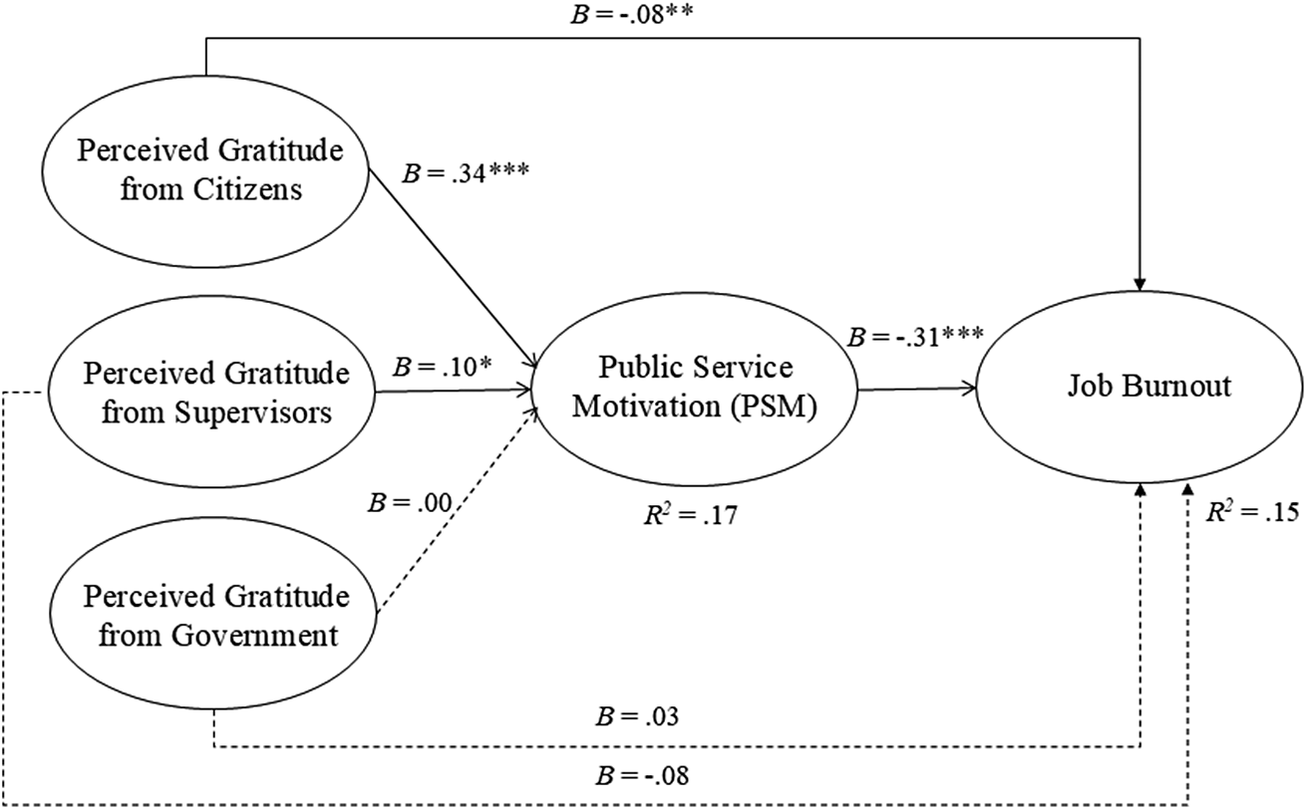
Table 4 (Model 1) and Figure 2 then present the results of the mediation analyses, whereby all the paths in the model were freely estimated in Mplus. As expected, gratitude from citizens had a significant positive association with PSM (B = .34, p < .001) and a negative association with job burnout (B = −.08, p < .05). Gratitude from supervisors also had a positive association with PSM (B = .10, p < .05), but its direct association with job burnout was not significant (B = −.08, p = .15). However, gratitude from the government was not associated with PSM (B = .00, p = .99) nor was it directly associated with job burnout (B = .03, p = .58). Nonetheless, PSM was significantly and negatively associated with job burnout as expected (B = −.31, p < .001). These findings provide support for Hypothesis 1, but not Hypotheses 2 and 3. As for the demographic variables, gender had a negative effect on PSM (B = −.04, p < .05), indicating that women reported lower PSM compared to men. Tenure also showed a marginally significant effect on PSM (B = .04, p < .10) and job burnout (B = .07, p < .10), suggesting that longer-tenured volunteers may have greater PSM but also greater burnout. The proposed model explained 17% and 15% of the variance in PSM and job burnout, respectively.
Latent mediation results.

Fig. 2 Long description
A structural equation model diagram with five oval nodes and directed arrows.
On the left, three independent variable nodes are stacked vertically.
- Top: Perceived Gratitude from Citizens.
- Middle: Perceived Gratitude from Supervisors.
- Bottom: Perceived Gratitude from Government.
In the center is the mediator node: Public Service Motivation (P S M). Below this node is the value R squared equals .17.
On the far right is the dependent variable node: Job Burnout. Below this node is the value R squared equals .15.
Pathways and coefficients:
- A solid line from Perceived Gratitude from Citizens to P S M has a coefficient B equals .34 with three asterisks.
- A solid line from Perceived Gratitude from Citizens to Job Burnout has a coefficient B equals minus .08 with two asterisks.
- A solid line from Perceived Gratitude from Supervisors to P S M has a coefficient B equals .10 with one asterisk.
- A dashed line from Perceived Gratitude from Government to P S M has a coefficient B equals .00.
- A solid line from P S M to Job Burnout has a coefficient B equals minus .31 with three asterisks.
- A dashed line from Perceived Gratitude from Supervisors to Job Burnout has a coefficient B equals .03.
- A dashed line from Perceived Gratitude from Government to Job Burnout has a coefficient B equals minus .08.
Table 5 presents results regarding the indirect effects. First, the indirect association between gratitude from citizens and job burnout through PSM was significant (B = −.13, p < .001; 95% CI: −.19, −.08). This suggests that gratitude from citizens significantly reduced job burnout via the increase in PSM. The indirect association between gratitude from supervisors and job burnout through PSM was also significant (B = −.04, p < .05; 95% CI: −.06, −.01), although statistically smaller in magnitude than that of gratitude from citizens (B = −.09, p < .001: 95% CI: −.16, −.04). However, the indirect association between gratitude from government and job burnout through PSM was not significant (B = .00, p = .967; 95% CI: −.04, .02). These findings provide support for Hypotheses 4 and 5, but not Hypothesis 6.
Indirect effects

Table 5 Long description
The table consists of six columns: Mediated paths, Est, S E, p-value, and 95% C I (divided into L L C I and U L C I).
* Path 1: Citizen Gratitude to P S M to Burnout. Est: minus .13, S E: .03, p-value: .000, L L C I: minus .19, U L C I: minus .08.
* Path 2: Supervisor Gratitude to P S M to Burnout. Est: minus .04, S E: .01, p-value: .012, L L C I: minus .06, U L C I: minus .01.
* Path 3: Government Gratitude to P S M to Burnout. Est: .00, S E: .02, p-value: .967, L L C I: minus .04, U L C I: .02.
* Difference between 1 and 2: Est: minus .09, S E: .03, p-value: .001, L L C I: minus .16, U L C I: minus .04.
* Difference between 1 and 3: Est: minus .13, S E: .04, p-value: .000, L L C I: minus .21, U L C I: minus .07.
* Difference between 2 and 3: Est: minus .04, S E: .03, p-value: .203, L L C I: minus .09, U L C I: .02.
Note: C I s are 95% bootstrap confidence intervals based on 10,000 samples. L L C I stands for lower limit confidence interval and U L C I stands for upper limit confidence interval.
Note: CIs, 95% bootstrap confidence intervals (10,000 samples). LLCI, lower limit confidence interval; ULCI, upper limit confidence interval.
Latent moderated mediation analysis
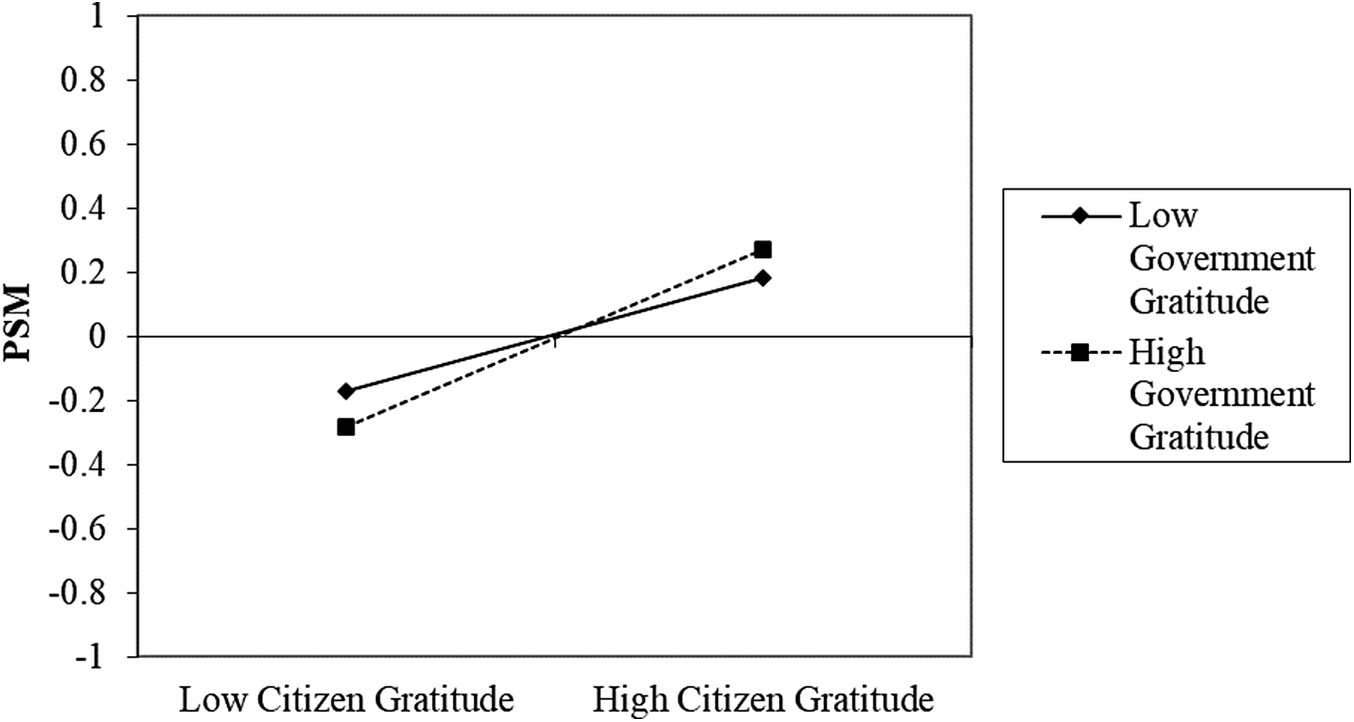
As shown in Table 4 (Model 2), government gratitude enhanced the positive association between citizen gratitude and PSM, in turn reducing job burnout. Specifically, the interaction term was significant in the expected direction (B = .10, p < .001). The simple slope test, as shown in Figure 3, indicated the association between citizen gratitude and PSM was significantly stronger when government gratitude was high (B = .52, p < .001) than when it was low (B = .30, p < .001). The log-likelihood for the simpler mediation model was −26,408.65, while the log-likelihood for the more complex moderated mediation model was −26,396.83, resulting in a log-likelihood difference of 11.82. The corresponding likelihood-ratio test yielded a chi-square statistic of 23.64 with 1 df, which was highly significant (p < .001), indicating that inclusion of the interaction term significantly improved model fit. Thus, the inclusion of the interaction term is statistically meaningful, which led to a 2% increase in the variance of PSM. This provides support for Hypothesis 7.
Interaction plot (citizen gratitude × government gratitude).

Fig. 3 Long description
The graph features a vertical Y axis labeled P S M with a scale from negative 1 to 1 in increments of 0.2. A horizontal X axis represents Citizen Gratitude with two categorical points: Low Citizen Gratitude on the left and High Citizen Gratitude on the right. A horizontal baseline is drawn at P S M equals 0.
A legend on the right identifies two data series:
1. Low Government Gratitude represented by a solid line with diamond markers.
2. High Government Gratitude represented by a dashed line with square markers.
Data trends:
* Both lines show a linear increase as Citizen Gratitude moves from Low to High.
* At Low Citizen Gratitude, both groups are below the 0 baseline. The High Government Gratitude group starts lower (approximately negative 0.3) than the Low Government Gratitude group (approximately negative 0.2).
* Both lines intersect at the 0 baseline midway between the X axis categories.
* At High Citizen Gratitude, both groups are above the 0 baseline. The High Government Gratitude group reaches a higher P M S value (approximately 0.3) compared to the Low Government Gratitude group (approximately 0.2).
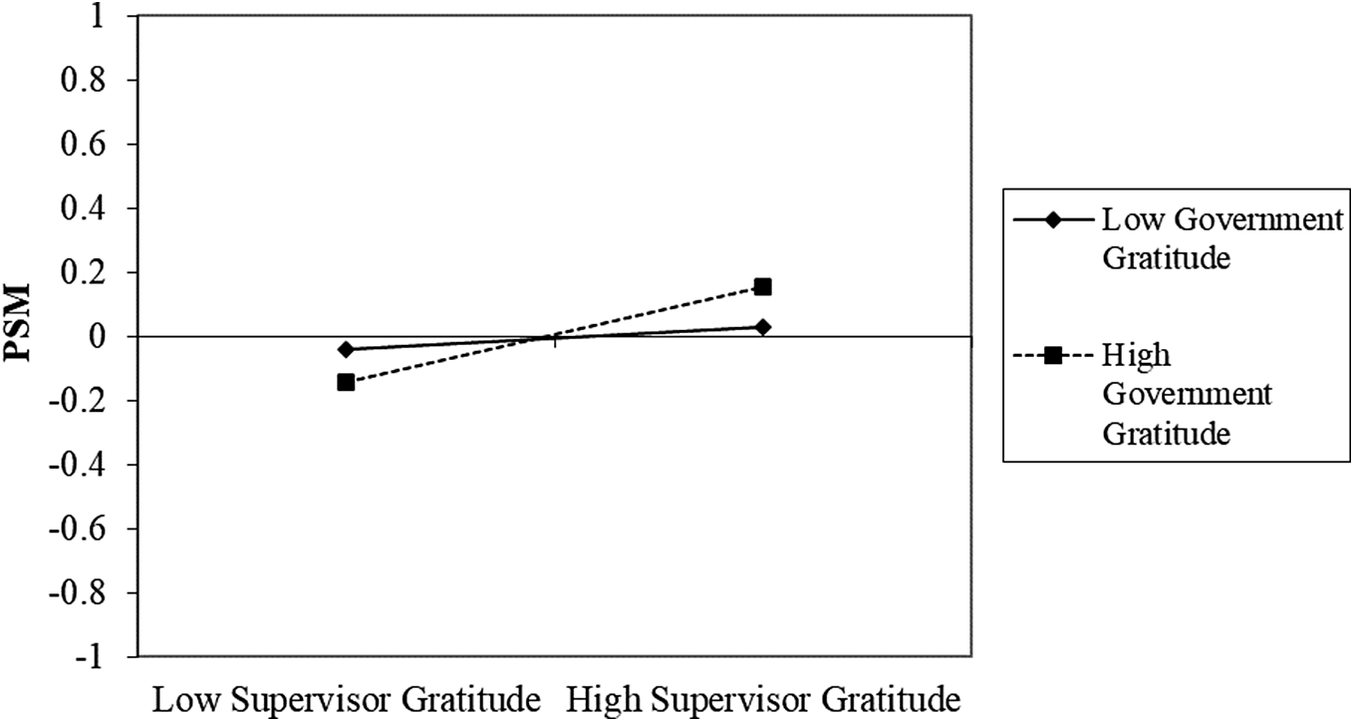
Likewise, as shown in Table 4 (Model 3), the results showed that government gratitude enhanced the positive association between supervisor gratitude and PSM, in turn reducing job burnout. Specifically, the interaction term was significant in the expected direction (B = .11, p < .001). The simple slope test shown in Figure 4 indicated that the association between supervisor gratitude and PSM was significantly stronger when government gratitude was high (B = .29, p < .001) than when it was low (B = .06, p > .20). The log-likelihood of this model was −26,392.06, compared with −26,408.65 for the mediation model, resulting in a log-likelihood difference of 16.59. The corresponding likelihood-ratio test yielded a chi-square statistic of 33.18 with 1 df, which was highly significant (p < .001). Thus, the inclusion of the interaction term is statistically meaningful, which led to a 3% increase in the variance of PSM. This provides support for Hypothesis 8.
Interaction plot (supervisor gratitude × government gratitude).

Furthermore, as shown in Table 6, in terms of conditional indirect effects, the negative indirect association between citizen gratitude and job burnout via PSM was significantly stronger when government gratitude was high (B = −.11, p < .001; 95% CI: −.125, −.067) than when it was low (B = −.06, p < .001; 95% CI: −.074, −.032). Likewise, the indirect negative association between supervisor gratitude and job burnout via PSM was significantly stronger when government gratitude was high (B = −.10, p < .001; 95% CI: −.114, −.052) than when it was low (B = −.05, p < .001; 95% CI: −.061, −.031).
Conditional indirect effects (moderated mediation)

Table 6 Long description
The table presents moderated mediation results across seven columns: Mediated path, Levels of government gratitude, Indirect effects (Est, S E, p-value), and 95% C Is (L L C I s, U L C I s).
* Path 1: Citizen gratitude yields P S M yields burnout.
- At Low government gratitude: Est is minus .06, S E is .01, p-value is .000, L L C I s is minus .074, U L C I s is minus .032.
- At High government gratitude: Est is minus .11, S E is .02, p-value is .000, L L C I s is minus .125, U L C I s is minus .067.
* Path 2: Supervisor gratitude yields P S M yields burnout.
- At Low government gratitude: Est is minus .05, S E is .01, p-value is .000, L L C I s is minus .061, U L C I s is minus .031.
- At High government gratitude: Est is minus .10, S E is .02, p-value is .000, L L C I s is minus .114, U L C I s is minus .052.
Note: S E s refers to standard errors; C I s refers to 95% confidence intervals; L L C I refers to lower limit C I s; U L C I s refers to upper limit C I s.
Note: SEs, standard errors; CIs, 95% confidence intervals; LLCI, lower limit CIs; ULCIs, upper limit CIs.
Discussion
Theoretical implications
Returning to the original research question—which source of gratitude most effectively sustains PSM and mitigates job burnout among community health volunteers?—the results revealed that gratitude from citizens holds the greatest significance both for PSM and job burnout. This can be expected as citizens form a central part of the immediate social environment in which volunteers operate daily, providing direct and tangible feedback that reinforces the value of their prosocial efforts (Lee et al., Reference Lee, Kim, Bae, Kim, Shin, Yoon and Kim2018; Naqshbandi et al., Reference Naqshbandi, Liu, Taylor, Lim, Ahmadpour and Calvo2020). This finding aligns with prior research in other occupational settings, where gratitude from recipients of service can enhance well-being (Converso et al., Reference Converso, Loera, Viotti and Martini2015; Kim et al., Reference Kim, Kim, Howell, Doyle, Pettit and Bizzarro2023). While gratitude from supervisors also had a significant effect, its impact was less pronounced. This could be due to the relatively unstructured nature of health volunteer work, where formal organizational hierarchies are less salient. Nonetheless, the significant role of supervisor gratitude still lends credence to the instrumental role of supervisors in fostering work motivation in the volunteer context (Kowitt et al., Reference Kowitt, Emmerling, Fisher and Tanasugarn2015; Ndu et al., Reference Ndu, Andoniou, McNally, Olea Popelka, Tippett and Nouvet2022; Tetui et al., Reference Tetui, Tennant, Patten, Giilck, Burns, Waite and Grindrod2023; Tsai et al., Reference Tsai, Newstead, Lewis and Chuah2024).
Notably, the direct associations of government gratitude with PSM and burnout were not significant. This finding is somewhat unexpected, given that involvement in government work was frequently cited as a reason for becoming a community health volunteer (see also Clary et al., Reference Clary, Snyder, Ridge, Copeland, Stukas, Haugen and Miene1998; Cnaan & Goldberg-Glen, Reference Cnaan and Goldberg-Glen1991). Two explanations warrant consideration. The first is methodological. The referent for government gratitude was broader than the referents for citizen and supervisor gratitude, and health volunteers may have associated “government” with different levels or actors. Such heterogeneity could attenuate the estimated direct effects. The second explanation concerns the distinct functions that gratitude can perform. Central to the SDT-based framework is the signaling function of gratitude: expressions of appreciation communicate information about the value and significance of a recipient’s contribution (Deci et al., Reference Deci, Koestner and Ryan1999). The strength and content of that signal, however, depend on its source. Citizen gratitude provides relatively immediate information about social impact, while supervisor gratitude provides proximal feedback about effectiveness within the working relationship. Government gratitude, by contrast, is more institutionally distant and less embedded in volunteers’ everyday activities. Consequently, government recognition may constitute a comparatively weak standalone signal for psychological need satisfaction and PSM. This interpretation is consistent with SDT, which emphasizes the informational meaning of feedback in shaping autonomous motivation (Deci et al., Reference Deci, Koestner and Ryan1999).
Nonetheless, even when such an institutional signal is insufficient to motivate volunteers directly, government recognition can still function as a contextual psychological resource by validating and reinforcing contributions already recognized by more proximal actors. Appreciation from citizens or supervisors signals that a contribution matters within an immediate social or working relationship, whereas concurrent recognition from government authorities adds institutional validation to that message. Government gratitude may therefore strengthen the motivational value of proximal gratitude without exerting a substantial independent effect. The resulting pattern—a null direct effect accompanied by significant moderation—is consistent with government gratitude operating as a relatively weak standalone signal but a potentially valuable reinforcing resource when combined with more immediate forms of recognition. Because the original hypotheses anticipated direct effects from all three sources, this interpretation is advanced as an explanation suggested by the observed findings rather than as an ex ante prediction. While prior studies have examined individual sources of gratitude largely in isolation (Beck, Reference Beck2016; Cohen & Headley, Reference Cohen and Headley2024; Grant & Gino, Reference Grant and Gino2010; Kowitt et al., Reference Kowitt, Emmerling, Fisher and Tanasugarn2015; Ndu et al., Reference Ndu, Andoniou, McNally, Olea Popelka, Tippett and Nouvet2022; Zhu & Du, Reference Zhu and Du2024), how recognition from different sources may reinforce or amplify one another remains comparatively underexplored (Locklear et al., Reference Locklear, Taylor and Ambrose2021).
Moreover, this study contributes to research on PSM by demonstrating that perceived gratitude from multiple sources can shape PSM through both direct and interactive pathways. These findings reinforce growing evidence that PSM is malleable and can be cultivated through individuals’ social and organizational experiences (e.g., Florczak et al., Reference Florczak, Rasmussen, Jensen, Stritch, Christensen, Nørgaard and Klemmensen2023; Moynihan & Pandey, Reference Moynihan and Pandey2007; Pandey & Stazyk, Reference Pandey, Stazyk, Perry and Hondeghem2008; Potipiroon & Wongpreedee, Reference Potipiroon and Wongpreedee2021; Vandenabeele, Reference Vandenabeele2011). While past research has highlighted social worth (Grant & Gino, Reference Grant and Gino2010), perceived visibility and positive affect (Kim et al., Reference Kim, Kim, Howell, Doyle, Pettit and Bizzarro2023), and self-control resources (Locklear et al., Reference Locklear, Taylor and Ambrose2021) as psychological mechanisms underlying the effects of gratitude, this study extends this literature by identifying PSM as an additional motivational pathway through which perceived gratitude may influence individual outcomes. Although previous research suggests that PSM is influenced by negative rhetoric from the public (Jahan & Shahan, Reference Jahan and Shahan2012) and citizen feedback (Pratama et al., Reference Pratama, Ahsani and Wulandari2025), little research has examined whether positive signals of appreciation from external stakeholders can cultivate PSM or whether PSM, in turn, transmits its beneficial effects to individual well-being.
Practical implications
The practical implications of this study are especially relevant for public health agencies that rely on volunteer labor for enhancing community well-being. Fostering a culture of gratitude should be recognized as a low-cost, high-impact strategy for sustaining volunteer engagement and reducing burnout. These organizations can facilitate this by building structured mechanisms for recognition into their volunteer management practices (Grant & Gino, Reference Grant and Gino2010). For instance, creating community-facing channels—such as storytelling campaigns, testimonial spaces, or public appreciation events—can allow citizens to visibly acknowledge volunteer contributions. Supervisors and program coordinators can also adopt small but meaningful practices: personalized thank-you messages, recognition during team meetings, or informal check-ins that communicate appreciation. At the institutional level, government recognition need not be limited to symbolic gestures; it can take the form of sustained policy support, better infrastructure, and more predictable resource allocation for volunteer programs (Kowitt et al., Reference Kowitt, Emmerling, Fisher and Tanasugarn2015; Ndu et al., Reference Ndu, Andoniou, McNally, Olea Popelka, Tippett and Nouvet2022). These efforts would be especially meaningful given that community health volunteers dedicate substantial time and effort while receiving minimal financial compensation from the government (Kowitt et al., Reference Kowitt, Emmerling, Fisher and Tanasugarn2015; Ndu et al., Reference Ndu, Andoniou, McNally, Olea Popelka, Tippett and Nouvet2022). Establishing an annual day of recognition for community health volunteers would further formalize this appreciation, reinforcing their sense of social legitimacy and collective value.
Study limitations and future research
Despite these notable findings, there are several limitations that warrant consideration. First, one potentially influential source of perceived gratitude that was not examined in this study is that from family members (Hu et al., Reference Hu, Kim and Lanaj2024), whose disapproval of community health volunteers’ work efforts and sacrifice can be a crucial source of stress (Kowitt et al., Reference Kowitt, Emmerling, Fisher and Tanasugarn2015). Secondly, the cross-sectional design precludes definitive conclusions regarding temporal ordering. Individuals with high PSM may hold stronger expectations about how their public service contributions should be recognized and valued—a pattern described as the expectancy sensitivity effect (Potipiroon, Reference Potipiroon2026b)—which may shape how expressions of gratitude are interpreted. Because the present data cannot distinguish between these temporal orderings, longitudinal or experimental research is needed to establish whether perceived gratitude cultivates PSM, PSM shapes perceptions of gratitude, or the relationship is reciprocal.
Thirdly, because all focal variables were collected from the same respondents, common method bias remains a potential concern. Although Harman’s single-factor test did not indicate a dominant common factor, the test has limited sensitivity and therefore cannot rule out common method bias entirely (Jordan & Troth, Reference Jordan and Troth2020). Nonetheless, it is important to recognize that interaction effects tend to be robust against this potential issue (Jakobsen & Jensen, Reference Jakobsen and Jensen2015). Fourthly, although the government-gratitude measure demonstrated satisfactory psychometric properties, the survey did not distinguish among specific governmental actors or levels. Respondents may therefore have associated the term “government” with different entities, such as local, provincial, or national authorities. Such variation in the referent could have attenuated the direct effects of government gratitude. Future research should specify the governmental source of gratitude more precisely and examine whether recognition from different levels of government produces distinct effects.
Finally, the use of snowball sampling may limit the generalizability of the findings. Although the sample closely matched the provincial VHV population in gender, it differed in age and education, with respondents tending to be younger and somewhat better educated. Snowball recruitment may also have introduced self-selection beyond these observable demographic differences. Volunteers who were more engaged, better connected to VHV networks, or more willing to participate may have been disproportionately represented, and the direction of any resulting bias cannot be determined from the present data. In addition, the effects of gratitude may vary across demographic and cultural groups; for example, women have been found to benefit more from perceived gratitude (Vishkin et al., Reference Vishkin, Kim, Solak, Szymaniak, White and Kitayama2025), while in collectivistic cultures such as Thailand, gratitude may be more closely tied to obligation and indebtedness (Vishkin et al., Reference Vishkin, Kim, Solak, Szymaniak, White and Kitayama2025). Future research using probability-based samples and other cultural contexts would therefore provide a stronger test of the generalizability of these findings.
Conclusion
Community health volunteers are often described as “unsung heroes,” working tirelessly behind the scenes of public health systems. This study sheds light on how perceived gratitude from multiple sources—citizens, supervisors, and the government—can help sustain their motivation and reduce job burnout. The findings show that gratitude from citizens and supervisors is associated with lower burnout through the mediating role of PSM. Government gratitude, by contrast, showed no significant direct effects but played an important moderating role, strengthening the positive associations of both citizen and supervisor gratitude with PSM. This pattern suggests that government recognition may matter less as a standalone motivational signal than as an institutional form of validation that reinforces appreciation received from more proximal actors. When volunteers perceive that their contributions are recognized by governmental authorities, gratitude from citizens and supervisors may carry greater motivational significance because interpersonal appreciation is accompanied by broader institutional validation. By bringing together these interpersonal and institutional sources of recognition, this study advances research on volunteer motivation by showing not only that the source of gratitude matters, but also that different sources of gratitude can work together in shaping PSM and well-being among street-level quasi-bureaucrats.
Supplementary material
The supplementary material for this article can be found at http://doi.org/10.1017/S0957876526000963.
Data availability statement
Data are available upon request.
Funding statement
This research was supported by the National Science, Research and Innovation Fund (NSRF) and Prince of Songkla University (Fundamental Fund [FF] 2024: Grant No. MAN6801136S).
Competing interests
The author whose name is listed above certifies that he has NO affiliations with or involvement in any organization or entity with any financial interest or non-financial interest in the subject matter or materials discussed in this manuscript.







 Open access

