INTRODUCTION
The most commercially-important lobster species in Brazil belong to the family Palinuridae and genus Panulirus White, 1847. They are: Caribbean spiny lobster, Panulirus argus (Latreille, 1804), smooth-tail spiny lobster, Panulirus laevicauda (Latreille, 1817) and spotted lobster, Panulirus echinatus Smith, 1869 (Paiva, Reference Paiva1997).
According to an early report by the Lobster Study Group of IBAMA (Instituto Brasileiro do Meio Ambiente e dos Recursos Naturais Renováveis), in the beginning of commercial exploitation of the lobsters in the middle 1950s, fisheries were almost exclusively targeting P. argus and P. laevicauda, and in the area described as the ‘inner continental shelf’ off Ceará and Pernambuco States. However, the increasing world-wide demand for lobster tail, especially from the USA, called for a quick expansion of the catches, and thus of the exploitation area. Therefore, fishing grounds farther away from Fortaleza and Recife homeports began to be exploited and by the end of the 1980s, the overall fishing area covered a surface of the continental shelves from the states of Pará, in northern Brazil, down to Espírito Santo, south-eastern Brazil. Perhaps as an outcome of the overexploitation of those two main lobster stocks, a new species, P. echinatus, gradually appeared in the catches, despite not yet having a very significant participation in the overall lobster catch (IBAMA, 2000). With the decline in catches of P. argus, the fishing fleets have turned their attention to P. laevicauda and P. echinatus. Biological information for P. echinatus is sadly lacking (Pinheiro et al., Reference Pinheiro, Freire and Oliveira2003) and much needed for stock management. Thus a study of this tropical species is of interest to a broader audience. All these three species are heavily harvested in north-eastern Brazil, and is one of the main economic resources for the regional fisheries industry. However, this resource has been dramatically depleted in the last decades as a result of overfishing and illegal fishery activities. Throughout the north-eastern region, lobster catch is greatly decreasing due to the reasons outlined above, and in addition, because of the landing of specimens below the minimum legal size. Barreto et al. (Reference Barreto, Ivo and Katsuragawa2003) estimated that at the onset of sexual maturity of the male P. echinatus, the carapace length was approximately 7.0 mm in average. The development of the gonads of both genders of P. echinatus is described in detail by Barreto & Katsuragawa (Reference Barreto and Katsuragawa2008) and Barreto et al. (Reference Barreto, Silva, Katsuragawa and Raposo2008).
The decapod crustaceans change anatomically as they grow (Hartnoll, Reference Hartnoll and Bliss1982) and, since they have a two-part (carapace and abdomen) segmented body and a number of appendices, allometric growth patterns in different size proportions may occur, leading to a growth-related dimorphism that usually occurs with the onset of sexual maturity (Ivo et al., Reference Ivo, Vasconcelos and Magalhães1995).
Morphometric data are widely utilized in the crustacean literature for the study of relative growth (Hartnoll, Reference Hartnoll1974, Reference Hartnoll and Bliss1982), especially to detect changes in the level of allometry. Likewise in lobster, morphometric observations have been widely utilized to illustrate relative growth. In brachyuran crabs, examinations of the dimensions (carapace, abdomen and chelipeds) have shown distinctive changes in these structures between sexes (Hirose & Negreiros-Fransozo, Reference Hirose and Negeiros-Fransozo2007).
Biometric relationships are recognized as important tools for identifying stock units and for estimating the size of different parts of the lobster's body when certain other measurements are not readily available (Silva et al., Reference Silva, Campos, Targino and de Melo2001). Moreover, fisheries impact may bring about relative changes in body proportions that have a bearing on management action, especially those that deal with setting up minimum legal sizes. Biometric measurements can be a powerful tool for setting guidelines to regulate the fishing activities on P. echinatus.
The present work proposes to obtain the equations that describe the biometric relationships in length and weight of different parts of the body of P. echinatus as well as to make comparisons of differential relative growth between sexes.
MATERIALS AND METHODS
The sampling area was located in Tamandaré, a fishing outlet on the southern coast of Pernambuco State, which is known for its richness in rocky and coral substrates where the spotted lobster is quite abundant. It is about 110 km southwards from Recife city, Pernambuco State, at a mean 7.0 m depth which trails off down to a 10.0 m depth (Rebouças, Reference Rebouças1966; Mabessone & Coutinho, Reference Mabessone and Coutinho1970).
Monthly samples were taken from November, 1999 to October, 2000, in four collecting stations: 1 (08°45′31.2″S 35°05′07.7″W) and 2 (08°46′57.2″S 35°05′48.9″W), located on above-water reefs during low tide, known as ‘inshore reefs’: 3 (08°45′35.0″S 35°04′57.5″W) and 4 (08°47′01.2″S 35°05′42.0″W) located on underwater reefs known as ‘offshore reefs’, which are 330 and 250 m away, respectively, from the inshore reefs. Collecting was conducted from local fishery vessels by gill-nets (bottom net) of 40 to 65 mm mesh size, to collected lobster with varied sizes. Net deployments were performed in the late afternoon, so that the nets could operate all night long, since lobsters are nocturnal animals (Holthuis, Reference Holthuis1991).
The following variables were recorded: sex—easily distinguished through external characters; carapace length (CL)—straight line distance between the anterior edge of the supraorbital ridge and the posterior edge of the carapace along the dorsal midline; carapace width (CW)—straight line distance taken across the carapace at the level of the third pereiopod; total length (TL)—straight line distance between the anterior edge of the supraorbital ridge and the posterior edge of telson; abdomen length (AL)—straight line distance between the anterior edge of the first abdominal somite and the posterior edge of telson; abdomen width (AW)—straight line distance taken across the abdomen on the second somite; and third and fifth pereiopods length (TPL) and (FPL)—distance between the coxae and the distal end of dactylus, legs completely stretched. The lengths were measured with Vernier calipers on the specimen totally stretched out in a dorsal position on an even surface. Total weight (TWg), cephalothorax weight (CWg) and abdomen (AWg) weight, including the appendices, were also measured. Lobsters were handled in fresh conditions.
The following relationships were investigated: TL/CL, AL/CL, CW/CL, AW/CL, TPL/CL, FPL/CL, AL/TL, CWg/Cl, TWg/CL, AWg/CL, TWg/TL and AWg/AL. In the weight/length analysis, egg-bearing females were excluded and only specimens with all appendices and without regenerated legs were considered. The data were adjusted to a power function Y = aXb where length (CL, TL or AL) was considered as an independent variable. Log-transformation data were employed to obtain the estimate of the relationship parameters. Differences between sexes were evaluated through Student's t-distribution, considering a 5% significance level. An analysis of covariance was applied to test the equality among slopes and intercepts of straight lines of males and females (Zar, Reference Zar1996), considering a 5% significance level. The slope ‘b’ of the equation is the allometric constant that expresses the analogy between two variables and is used as a growth coefficient. In length/length relationship, the growth is positive allometric when b > 1, negative allometric when b < 1 and isometric when b = 1 (Huxley, Reference Huxley1950). In length/weight relationships, growth could be characterized as positive allometric when b > 3; negative allometric, when b < 3 or isometric when b = 3. The ‘b’ value was tested by Student's t test (Ho: b = 1 or b = 3; α = 0.05).
RESULTS
A total of 2431 specimens of P. echinatus were analysed, 1720 males with CL 26.0–84.0 mm and TL 71.5–206.4 mm; 711 females with CL 31.0–66.0 mm and TL 86.3–182.2 mm. The number of observations for the various relationships differs from the overall above-mentioned, except CWg/CL, according to previously exposed.
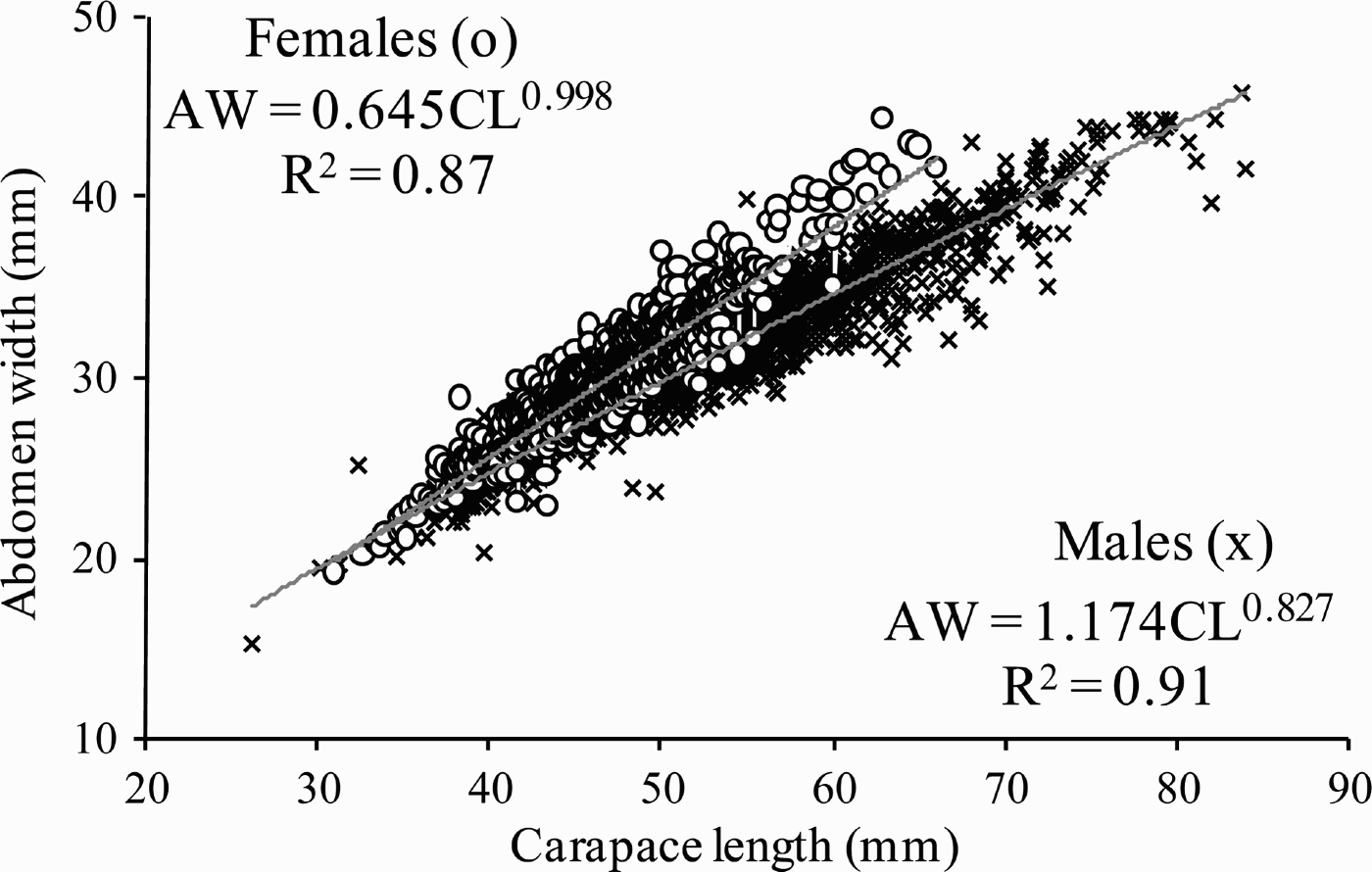
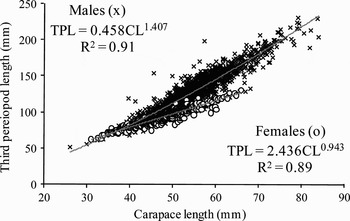
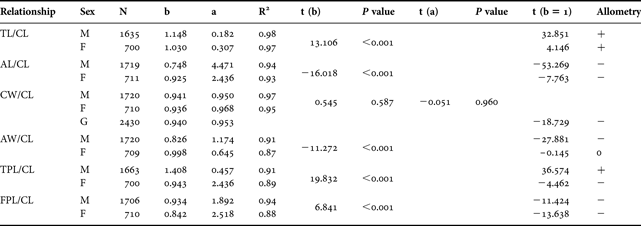
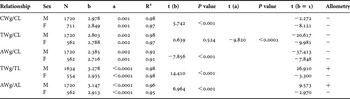
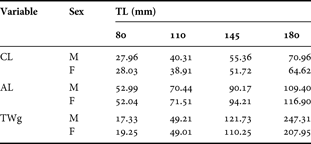
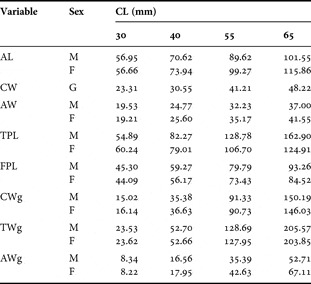
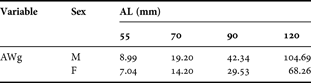
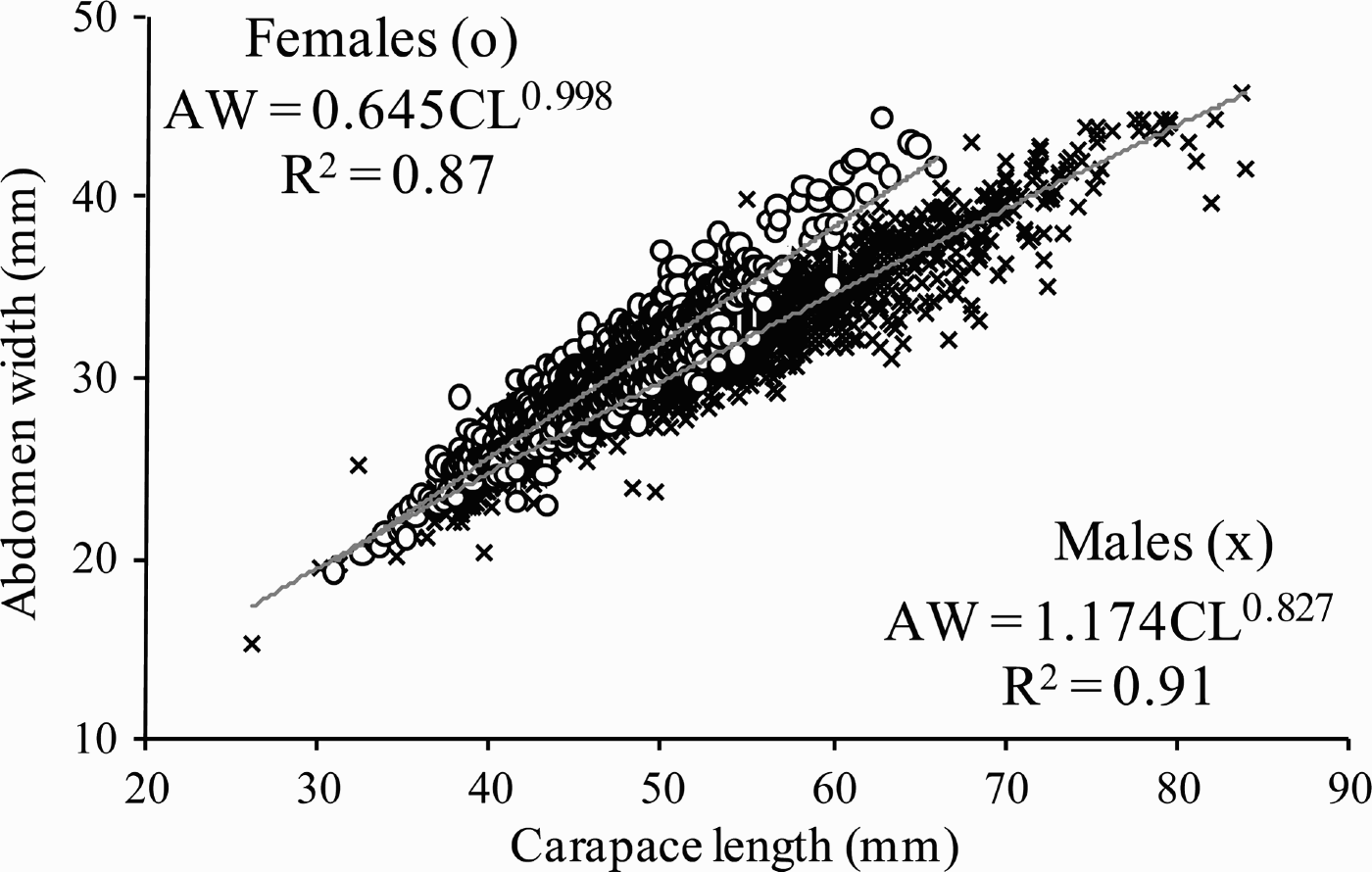
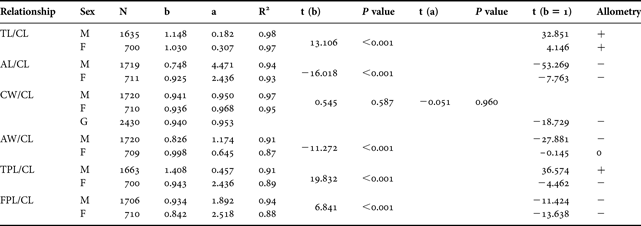
With the exception of the CW/CL relationship, all the other ones showed significant difference between females and males. For that, a common regression equation was computed (Figures 1 & 2; Tables 1 & 2). In Tables 3, 4 & 5 are listed the expected values of the dependent variable at stated values independent of one of the different relationships. The ‘x’ values are inside of the observed range for the females and males.
Abdomen width/carapace length relationships of males and females of spotted lobster, Panulirus echinatus, from Tamandaré coastal reefs, Brazil.
Third pereiopod length/carapace length relationships of males and females of spotted lobster, Panulirus echinatus, from Tamandaré coastal reefs, Brazil.

Comparison among males and females of length/length relationships of spotted lobster, Panulirus echinatus, from Tamandaré coastal reefs, Brazil (CL, carapace length; TL, total length; AL, abdomen length; CW, carapace width; AW, abdomen width; TPL, third pereiopod length; FPL, fifth pereiopod length; N, number of pairs (x, y) for male (M) and female (F) or grouped sex (G); R2, coefficient of determination).
Comparison among males and females of weight/length relationships of spotted lobster, Panulirus echinatus, from Tamandaré coastal reefs, Brazil (CL, carapace length; TL, total length; AL, abdomen length; CWg, cephalothorax weight; TWg, total weight; AWg, abdomen weight; N, number of pairs (x, y) for male (M) and female (F); R2, coefficient of determination).

Estimated values of the dependent variable at stated values of total length for spotted lobster Panulirus echinatus relationships from Tamandaré coastal reefs, Brazil.
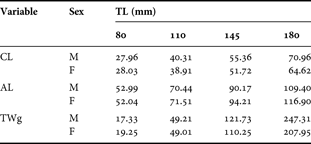
TL, CL, total and carapace length; AL, abdomen length; TWg, total weight; M, F, male and female.
Estimated values of the dependent variable at stated values of carapace length for spotted lobster Panulirus echinatus relationships from Tamandaré coastal reefs, Brazil.

CL, AL, carapace and abdomen length; CW, AW, carapace and abdomen width; TPL, FPL, third and fifth pereiopod length; CWg, TWg, AWg, cephalothorax, total and abdomen weight; M, F, male and female.
Estimated values of the dependent variable at stated values of abdomen length for spotted lobster Panulirus echinatus relationships from Tamandaré coastal reefs, Brazil.
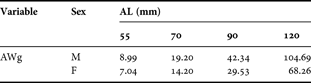
AL, abdomen length; AWg, abdomen weight; M, F, male and female.
The relationship CL/TL showed positive allometric growth for the two sexes, while AL/CL indicated negative allometric growth. The relationship AL/TL presents negative allometry for the males and isometry for the females. The growth of the carapace, in length, in the females and more intensely in the males was larger than of the abdomen. The CW/CL relationship presented no difference between males and females, presenting negative allometric growth (b = 0.940). The males showed negative allometry in the AW/CL relationship, whereas the females presented isometric growth. While the FPL/CL relationship presents negative allometric growth for males and females, the TPL/CL relationship showed negative allometry for the females but showed highly positive allometry for the males (b = 1.4077). Except the TWg/TL and AWg/AL relationships that showed only positive allometric growth for the males, all the other relationships involving weight presented negative allometric growth for both sexes.
DISCUSSION
In Tamandaré costal reefs, the maximum total lengths of males (206.4 mm) and females (182.2 mm) were inferior to those obtained by Silva et al. (Reference Silva, Campos, Targino and de Melo2001) in the biological reservation of the Rocas Atoll, 257 mm and 228 mm respectively, and by Pinheiro et al. (Reference Pinheiro, Freire and Oliveira2003) in the São Pedro and São Paulo Archipelago, 250 mm for grouped sexes. The latter two areas are oceanic islands with little or no human interference. The collection at the Rocas Atoll was conducted in reef pools by diving and in the São Pedro and São Paulo Archipelago with artisanal traps distributed from 10 to 50 m of depth. Vasconcelos et al. (Reference Vasconcelos and Vasconcelos1994) studied the collection of P. argus and P. laevicauda-conducted with gill-nets, diving and artisanal traps in Rio Grande do Norte, north-eastern Brazil. Vasconcelos & Vasconcelos (Reference Vasconcelos and Vasconcelos1994) verified that the largest individuals were captured by the gill-nets from between 25 and 60 m depths, while collections by diving were effective between 10 and 20 m, and the artisanal traps placed between 10 and 30 m of depth. The mesh-size of the gill-nets mentioned by Vasconcelos et al. (Reference Vasconcelos and Vasconcelos1994), was 6.5 cm (13 cm of stretched mesh), equal or larger than those used in Tamandaré. This indicates that larger individuals do not occur in this area.
By ascribing values to the independent variables in the morphometric regression equations, it is noticeable that, as the individual's length (CL, TL or AL) in spotted lobster increased, the differences between sexes became more pronounced in eleven out of twelve relationships submitted to statistical analysis, all except for the CW/CL ratio.
The growth of the abdomen, not only in species of Panulirus (Borges, Reference Borges1964, Reference Borges1965; Fonteles-Filho, Reference Fonteles-Filho1979; Nascimento et al., Reference Nascimento, Araújo, Travassos, Borges, Borba and Araújo1984; Jayakody, Reference Jayakody1989; Silva et al., Reference Silva, Gesteira and Rocha1994, Reference Silva, Campos, Targino and de Melo2001; Vasconcelos & Vasconcelos, Reference Vasconcelos and Vasconcelos1994; Ivo et al., Reference Ivo, Vasconcelos and Magalhães1995; Pinheiro et al., Reference Pinheiro, Freire and Oliveira2003) but in other lobsters and brachyurans as well (Templeman, Reference Templeman1948; Negreiros-Fransozo et al., Reference Negreiros-Fransozo, Colpo and Costa2003), is distinct between males and females. In relation to carapace length, the growth of the abdomen is isometric for width in females and negatively allometric in males. The length of the abdomen presents negative allometry in both sexes being much more negative in males (b = 0.748) than females (b = 0.925). In regards to total length, the abdomen length presents negative allometry in males and isometric growth in females. There is a consensus that the females maintain a relatively larger abdomen due to production and incubation of eggs (Paiva, Reference Paiva1997). The stronger negative allometry found in male lobsters, could be attributed to the fact that larger males need to escape less often than smaller males as they are less vulnerable to predators, as described for crayfish (Fricke, Reference Fricke1986). It has also been shown (Nauen & Shadwick, Reference Nauen and Shadwick1999) that the velocity of the shortening of the abdominal muscle, decreases with growth in Panulirus interruptus, which thus suggests, that there are no evolutionary advantages for isometric growth. Furthermore, there are indications that muscle force output may increase at a greater rate than predicted by isometry (Nauen & Shadwick, Reference Nauen and Shadwick1999). The animal muscles thus simply becoming stronger with age and thus not need to increase in size. In this study of females and males of P. echinatus with the same carapace length, the females were shown to be longer than the males, a finding corroborated by the AW/CL, AL/CL, AWg/CL and AL/TL relationships analysed. Similar results were observed for P. echinatus in oceanic islands (Silva et al., Reference Silva, Campos, Targino and de Melo2001; Pinheiro et al., Reference Pinheiro, Freire and Oliveira2003), and also for P. argus and P. laevicauda (Borges, Reference Borges1964, Reference Borges1965; Fonteles-Filho, Reference Fonteles-Filho1979; Nascimento et al., Reference Nascimento, Araújo, Travassos, Borges, Borba and Araújo1984; Silva et al., Reference Silva, Gesteira and Rocha1994; Vasconcelos & Vasconcelos, Reference Vasconcelos and Vasconcelos1994; Ivo et al., Reference Ivo, Vasconcelos and Magalhães1995), as well as for P. homarus (Jayakody, Reference Jayakody1989).
Previous research by Ivo et al. (Reference Ivo, Vasconcelos and Magalhães1995) on P. argus and P. laevicauda, and by Pinheiro et al. (Reference Pinheiro, Freire and Oliveira2003) on P. echinatus populations from São Pedro and São Paulo Archipelago, showed that the carapace length represents about one-third of the individual's total length, while the abdomen corresponds to about two-thirds, the reverse being true of the weight, as of data provided by mean proportions estimated from CL/TL, AL/TL and CL/AL morphometric relationships. This way, comparing male and female lobsters with a same total length, the males possess a larger carapace length and total weight, while the females have larger abdomen length and weight.
The total weight/total length regression equation shows males heavier than females, with an upward trend along (throughout) the size-range. Pinheiro et al. (Reference Pinheiro, Freire and Oliveira2003) obtained similar results for P. echinatus from São Pedro and São Paulo Archipelago. This was also the conclusion of Coelho & Moura (Reference Coelho and Moura1963), Borges (Reference Borges1964), Fonteles-Filho (Reference Fonteles-Filho1979), Nascimento et al. (Reference Nascimento, Araújo, Travassos, Borges, Borba and Araújo1984) and Ivo et al. (Reference Ivo, Vasconcelos and Magalhães1995) regarding P. argus and/or P. laevicauda.
Divergent trends were found when the carapace width (CW/CL) and the abdomen width (AW/CL) were measured as proportions of the carapace length. The former relationship showed no sexual dimorphism whereas for the latter, the abdomen is relatively wider in females than in males. Again, this finding highlights the physiological relevance of the female's abdomen in egg production, but the carapace seems to be equally important in both sexes because, as Silva et al. (Reference Silva, Gesteira and Rocha1994) have suggested, there would probably be a similar demand of available space in the carapace cavity for development of the vasa deferentia and of the ovaries. This feature must have also accounted for the absence of sexual dimorphism in the CW/CL relationship in P. laevicauda (Nascimento et al., Reference Nascimento, Araújo, Travassos, Borges, Borba and Araújo1984; Silva et al., Reference Silva, Gesteira and Rocha1994) and in P. homarus (Heydorn, Reference Heydorn1969).
Likewise, the abdomen width/carapace length relationship can be used to characterize a sexual dimorphism that takes place through a differentiation in the enlargement of the second abdominal somite in females. This enlargement provides the function of the abdomen as egg-bearer. Similar results were found by Nascimento et al. (Reference Nascimento, Araújo, Travassos, Borges, Borba and Araújo1984) for P. laevicauda. Herrick (Reference Herrick1909) and Berry (Reference Berry1971) also observed such an enlargement in Homarus americanus and P. homarus, respectively. Aiken & Waddy (Reference Aiken, Waddy, Cobb and Phillips1980) stated that abdomen enlargement begins before the first brood.
The results obtained for the TPL/CL relationships indicate a difference in growth proportion of the third pereiopods between sexes getting more evident as the lobster's size increases. The remarkable growth of the foremost pereiopods in males is probably the most striking evidence of sexual dimorphism to have been reported for a number of species of Panulirus (Gordon, Reference Gordon1960; Berry, Reference Berry1970; George & Morgan, Reference George and Morgan1979; Silva et al., Reference Silva, Gesteira and Rocha1994). Berry (Reference Berry1970, Reference Berry1971) noticed that at the onset of sexual maturity, the second and third pereiopods in males become larger than those in females, a trait which is seemingly an adaptation to establish the hierarchy among individuals of the same sex by maximizing their breeding capacity through the ability to hold the female during the mating act. Moreover, this development can be thought of as a strong indicator of functional maturity, as suggested by Grey (Reference Grey1979) and George & Morgan (Reference George and Morgan1979). In summary, P. echinatus males presented a larger increment than females in the TPL/CL, TWg/TL and AWg/AL relationships, the reverse being true for the TL/CL, AL/CL, AW/CL, AL/CT and AWg/CL relationships. It is worth mentioning that seven out of the twelve relationships analysed, namely TPL/CL, FPL/CL, AW/CL, CW/CL, TWg/CL, AWg/CL and AWg/AL have so far not been subjected to biometric studies.
Females of P. echinatus carry eggs adhered to pleopods and the abdomen thus develop differently than in males. During the reproductive period, females tend to hide to protect themselves from predators which results in less activity and consequently reduces foraging time. Conversely, foraging behaviour in males seems to be constant during the reproductive season. Another explanation could be that males allocate energetic resources mainly to somatic growth, whereas females have to allocate a great amount of energy towards gonad production so that less is available for somatic growth (Hartnoll & Gould, Reference Hartnoll and Gould1988).
CONCLUSIONS
Sexual dimorphism was found to be mainly displayed in the foremost pereiopods (larger in males), a morphometric feature that makes them heavier than females and also has a bearing on reproductive activity. In this regard, the hierarchic position among breeding males is maintained, including the ability to retrieve the female out of her hiding places and to hold her during the mating act. On the other hand, the female needs to have a larger and wider abdomen because it is where egg incubation occurs and whereby a maximized larvae hatching rate is made possible.
ACKNOWLEDGEMENTS
Special thanks are extended to Nildo José dos Santos, who helped to obtain samples and to Efraim Silva Barreto who helped to obtain biological data. Funding for this work was supported by CAPES/UFPE. Thanks are also extended to IBAMA for laboratory support to this project. This paper is part of the Doctorate thesis of the first author. We extend our thanks to Dr Kim Larsen (UFPE) for help with the English.