Introduction
In the absence of any cure for dementia, quality of life (QoL) is becoming increasingly recognized as a meaningful outcome measure when assessing the clinical course of the illness and evaluating the effectiveness of interventions. Actually, QoL assessment has been progressively included among the recommendations of several clinical guidelines for the treatment of patients with dementia (e.g. International Group for Harmonization of Dementia Drug Guidelines and Alzheimer's Society, Mack and Whitehouse, Reference Mack and Whitehouse2001; International Psychogeriatric Association, Katona et al., Reference Katona2007; or European Consensus on Outcome Measures for Psychosocial Intervention Research in Dementia Care, Moniz-Cook et al., Reference Moniz-Cook2008). In the case of dementia patients living in long-term care facilities, QoL is “the central goal of professional activity” (Whitehouse and Rabins, Reference Whitehouse and Rabins1992). According to Edelman et al. (Reference Edelman, Fulton, Kuhn and Chang2005), although good care may be a necessary condition for a good QoL, it is possible to provide good care without residents experiencing good QoL. Consequently, the assessment of residents’ QoL should be a high priority in order to address unmet needs.
The concept of QoL has a subjective nature, and depends heavily on the person's own sense of well-being, which makes its assessment extremely complex. This complexity increases in the case of people with dementia, where assessment may be affected by the patient's cognitive impairment (memory, attention, reasoning) related to their ability to understand and communicate how they are, as well as by non-cognitive symptoms (e.g. depression, agitation, and psychosis) often found in this population (Méndez et al., Reference Méndez, Martin, Smith and Whitehouse1990). Consequently, several dementia-specific QoL measures developed over recent years take into account the views of both the patients and proxies.
Among these instruments, one of the most widely used is the Quality of Life-Alzheimer's Disease (QOL-AD; Logsdon et al., Reference Logsdon, Gibbons, McCurry and Teri1999, Reference Logsdon, Gibbons, McCurry and Teri2002), in which items were selected to reflect Lawton's (Reference Lawton, Birren, Lubben, Rowe and Deutchman1991) four domains of QoL in older adults: behavioral competence (i.e. the ability to function in adaptive and socially appropriate ways), objective environment (including physical and interpersonal factors), psychological well-being (i.e. mental health and emotional status), and the individuals’ subjective satisfaction with their overall QoL. The instrument was designed to provide both a patient report and a caregiver report of the patient's QoL, and can be used with people with mild/moderate and severe dementia. Edelman et al. (Reference Edelman, Fulton, Kuhn and Chang2005) developed a version of the QOL-AD specifically for people in residential settings.
Both the original version and the residential version have proven to have satisfactory psychometric properties. So, the study by Logsdon et al. (Reference Logsdon, Gibbons, McCurry and Teri2002) suggests that the original version has good internal consistency, construct validity, and test–retest reliability; the internal consistency (Cronbach's α) of the adaptation by Edelman ranges from 0.94 (resident's version) to 0.90 (staff proxy reports; Edelman et al., Reference Edelman, Fulton, Kuhn and Chang2005). Recently, León-Salas et al. (Reference León-Salas, Logsdon, Olazarán, Martínez-Martín and The2011a) have reported the psychometric properties of the Spanish QOL-AD with institutionalized dementia patients and their family caregivers. Results showed that both the QOL-AD patient version and the QOL-AD caregiver version lacked significant floor and ceiling effects, and Cronbach's α indexes were 0.90 and 0.86, respectively. Stability was satisfactory for the patient version, but low for the caregiver one, while construct validity was moderate/high for caregiver's QOL-AD but lower for the patient version. All in all, their data show that both versions (i.e. patient and family caregiver) differ regarding their psychometric properties.
According to Logsdon et al. (Reference Logsdon, Gibbons, McCurry and Teri2002), the QOL-AD can be applied to individuals with mild to moderate dementia; moreover, they found that no participant who scored over 10 on the Mini-Mental State Examination (MMSE) was unable or refused to complete the QOL-AD. Other authors claim that it can be used with people with MMSE scores up to 3 (Thorgrimsen et al., Reference Thorgrimsen2003; Hoe et al., Reference Hoe, Katona, Roch and Livingston2005), although the rate of non-completers increases among individuals with higher cognitive impairment (Logsdon et al., Reference Logsdon, Gibbons, McCurry and Teri2002; León-Salas et al., Reference León-Salas, Logsdon, Olazarán, Martínez-Martín and The2011a, Reference León-Salas, Olazarán, Muñiz, González- Salvador and Martínez-Martín2011b). Nevertheless, previous studies have not determined how many individuals with severe cognitive impairment are able to complete the QOL-AD. Furthermore, when they are unable to complete it, would the proxies’ account be an accurate estimation of patients’ QoL?
The present paper reports on a feasibility study of the Spanish adaptation of the QOL-AD residential version in institutionalized patients diagnosed with dementia, where three rating sources were taken into account (the residents themselves, a close relative, and the key staff member in charge of their care). Specifically, the main goals of the study were (1) to compare individuals who can self-report about their QoL with those unable to do so; (2) to find out the proportion of individuals with severe cognitive impairment who can answer the QOL-AD; and (3) to find out the level of cognitive impairment below which their report is not reliable any longer.
Based on data from previous studies with both the original and residential versions of the QOL-AD, we propose the following hypotheses: (1) around half of dementia residents with mild to moderate cognitive impairment (i.e. scores over 10 in the MMSE) will be able to assess their own QoL, with decreasing ability as the cognitive impairment increases; (2) patients who do not complete the questionnaire will show higher cognitive impairment, lower level of autonomy for activities of daily living (ADL), and more disruptive behaviors than patients who complete it; and (3) internal consistency reliability will be adequate for patients’ and proxies’ reports at all levels of cognitive functioning. Since there are no previous data about the percentage of individuals with severe cognitive impairment that are able to answer the QOL-AD, there are no specific hypotheses about this issue.
Methods
Participants
Data were collected from 11 nursing homes in five Spanish cities (Madrid, Córdoba, León, Murcia, and Soria). For every city, a fixed number of residents (50) were set; then, for each city, each nursing home was surveyed for a proportional number of residents, depending on its size. Residents were randomly selected among those who (a) were aged over 60 years, (b) lived permanently in the center and had been living there for at least three months, (c) met criteria of the American Psychiatric Association (DSM-IV) for “probable” or “possible” dementia, and (d) had an MMSE score under 27.
For every selected resident, a close relative and a member of staff were also chosen. The inclusion criteria for family members were (a) first degree relatives or the patient's next of kin and (b) paying regular visits to the resident (at least one visit weekly for two or more hours). For the staff members, following Hoe et al. (Reference Hoe, Hancock, Livingston and Orrell2006), who recommend taking the reports of the “key” person in the resident's care, we focused on the worker that provided direct attention and care to the selected resident. Consequently, one member of the staff could assess the QoL of several residents.
Design and measures
The present paper describes a cross-sectional study of different perspectives on QoL in residents with dementia in nursing homes.
The QOL-AD (Logsdon et al., Reference Logsdon, Gibbons, McCurry and Teri1999, Reference Logsdon, Gibbons, McCurry and Teri2002) was selected since it is a brief instrument, it has shown sensitivity to change with psychosocial interventions, and it relates to health measures. The QOL-AD is a 13-item questionnaire covering the domains of physical health, energy, mood, living situation, memory, family, marriage, friends, chores, fun, money, self, and life as a whole. The adaptation by Edelman et al. (Reference Edelman, Fulton, Kuhn and Chang2005) for people in residential settings drops two items (money and marriage) and adds four items (people who work here, ability to take care of oneself, ability to live with others, and ability to make choices in one's life). In this 15-item adaptation, the original four-point rating system was maintained (poor, fair, good, excellent). According to Logsdon et al. (Reference Logsdon, Gibbons, McCurry and Teri2002), up to two missing values were replaced with the mean score of the remaining items, but if more than two items were missing, the entire measure was discarded. Overall scores were computed separately for the patient, the family member, and the staff caregiver reports by adding the 15 items, thus resulting in three sets of scores: self-rated QoL (QOL-ADp), family-rated QoL (QOL-ADf), and staff-rated QoL (QOL-ADs). The range of the total possible score is 15–60, with higher scores indicating higher QoL. Since there was no Spanish translation of the QOL-AD, one of the authors of the study translated and adapted the scale and the instructions for its administration. This version was later revised and edited by two other member of the research team. The final draft was finally proofread by Spanish-speaking people with no knowledge of the English version to ascertain that the meaning in Spanish of several items was close enough to the original version.
Additionally, the following instruments were applied to the residents and the staff members:
Patients’ battery. (a) Sociodemographic data, (b) MMSE to verify the inclusion criteria and also to obtain an overall level of current cognitive profile (scores range 0–30; higher score indicates less cognitive impairment), and (c) the Cornell Scale for depression in dementia (patient version; Alexopoulos et al., Reference Alexopoulos, Abrams, Young and Shamoian1988), a quantitative measure of depressive symptoms in dementia patients (range 0–38; scores greater than 12 indicate probable depression).
Staff members’ battery. It focused on resident-related variables as assessed by the staff member, including (a) Barthel index of activities of daily living (Mahoney and Barthel, Reference Mahoney and Barthel1965), to measure residents’ functional abilities, ranging from 0 (completely dependent) to 100 (completely independent); (b) the Global Deterioration Scale, GDS (Reisberg et al., Reference Reisberg, Ferris, de Leon and Crook1982), to measure the level of cognitive impairment and severity of dementia, ranging from 1 (no cognitive impairment) to 7 (severe cognitive impairment); (c) Cohen-Mansfield Agitation Inventory (CMAI; Cohen-Mansfield, Reference Cohen-Mansfield1986), to assess agitation and other disturbing behaviors in elderly people, including aggressive behavior, physically non-aggressive behavior, and verbally agitated behavior, higher scores indicate higher frequency of these behaviors; and (d) the Cornell Scale for depression in dementia (informant version; Alexopoulos et al., Reference Alexopoulos, Abrams, Young and Shamoian1988) that assesses frequency of signs and symptoms of major depression (range 0–38; scores greater than 12 indicate probable depression).
Procedure
Consent was directly obtained from residents. For those who were too cognitively impaired to give consent, a guardian or responsible party was approached for consent. Then the residents were interviewed individually in a quiet room. Once the residents had been selected and interviewed, the manager was asked to identify the key family member and the key worker. Subsequently, the resident's key worker and the family member completed the assessment battery.
Data analysis
A descriptive analysis was carried out of the clinical and socio-demographic characteristics of patients and proxies, using absolute and relative frequencies for qualitative variables and measures of central trend and dispersion for quantitative variables.
Comparisons of QoL scores among the three different sources were carried out by means of repeated measures ANOVA. Moreover, to assess pairwise agreement of scale scores, the intraclass correlation coefficient (ICC), using one-way random effects analysis of variance, was calculated.
To analyze the QOL-AD reliability for its three versions and for different cognitive impairment levels, Cronbach's α internal consistency coefficients were calculated. Coefficient over 0.70 was specified as the criterion for acceptable internal consistency.
Percentage of completion rate was calculated, and differences between completers and non-completers were analyzed by χ2 tests for qualitative variables, and by Mann–Whitney U or t-tests for quantitative variables (non-normal or normal distributions, respectively). Goodness-of-fit to normal distribution was tested using the Kolgomorov–Smirnov test.
Results
Characteristics of facilities and participants
The 11 nursing homes in the study sample had a mean of 119 beds (range 39–220). The majority (63.6%) were for-profit facilities, and half (54.5%) had dementia special care units. Nearly half (45.5%) had been opened for more than ten years, whereas 18.1% had been operating from five to ten years, and 36.4% less than five years.
We selected 209 residents, whose mean age was 86.07 years (SD = 6.46) with a range from 67 to 100 years. These were mostly women (79.4%). The mean MMSE score was 13.3 (SD = 5.88) indicating moderate dementia, with a range from 0 (severe dementia) to 25 (mild dementia). Additionally, 184 measures from relatives and 197 from staff members were collected. Family participants had an average age of 58.85 years (SD = 12.22). The majority were also female (62%), and were residents’ sons or daughters (67%), spouses (10.8%), and nephews or nieces (10.3%). They visited the resident daily (34.8%), more than once a week (35.9%) or once a week (22.3%). Finally, the QOL-AD staff version was completed by 92 staff members with a mean age of 39.8 years (SD = 9.96). They were mainly female (96.7%) and worked as care or nursing assistants (88.1%). The mean duration of working in the home was 47.34 months (SD = 49.52).
Residents’ QoL
Internal consistency for the different versions of the QOL-AD was as follows: residents 0.89, family 0.88, and staff 0.86, all of them in the excellent range. Residents’ self-rated QoL scores (M = 2.51; SD = 0.71) were higher than those made by proxies, independently of these being family (M = 1.95; SD = 0.82) or staff members (M = 2.06; SD = 0.83) (F(2, 132) = 21.86 p < 0.001). More specifically, significant differences were found between residents’ and family members’ ratings, and between residents’ and staff members’ ratings (in both cases, p < 0.001), both showing higher QoL levels in residents’ ratings. There were no significant differences between both proxies’ groups.
Correlation among the three total scores was low, reaching statistical significance only in the family–staff pair, ICC = 0.331 (95% CI 0.097–0.505), F(171) = 1.495, p = 0.004. Further information about inter-rater reliability of the QOL-AD in this sample has been described previously (cf. Crespo et al., Reference Crespo, Bernaldo de Quirós, Gómez and Hornillos2012).
Feasibility and acceptability of QOL-AD
Completion rate for the QOL-AD – resident version (i.e. at least 13 items) was 48.8% (i.e. 102 out of 209 contacted residents), whereas close to 100% of participants had care-provider versions completed (99.46% and 98% for family and staff, respectively). According to the interviewers’ report, patients’ non-completion was due to cognitive impairment (83.6%), lack of cooperation (6.8%), fatigue (1.4%), or a combination of two or more of the former reasons (8.2%).
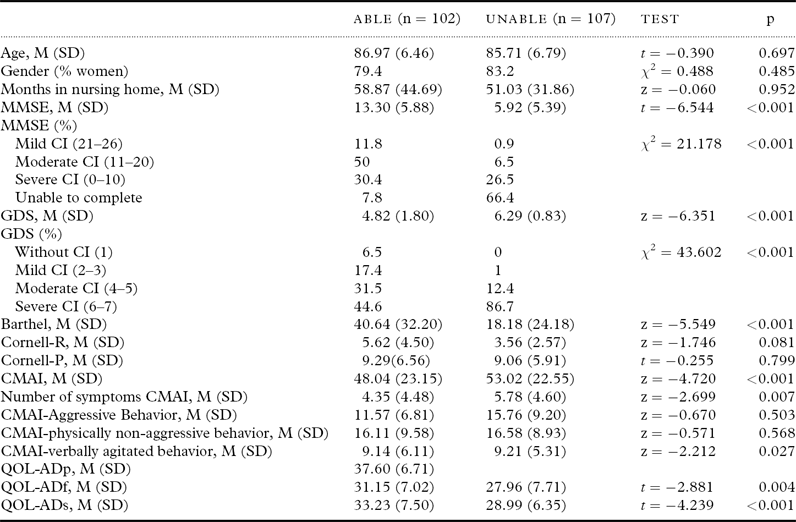
As shown in Table 1, residents who were not able to complete the QOL-AD showed greater cognitive impairment than those who completed it, both considering MMSE and GDS scores; moreover, the percentage of MMSE completion was greater among QOL-AD completers (92.16% vs. 33.64% in QOL-AD non-completers). It is noteworthy that 7.8% of the residents that were not able to complete the MMSE could complete the QOL-AD.
Differences between patients who were able and unable to complete the QOL-AD

CI = Cognitive Impairment; MMSE = Mini-Mental State Examination; GDS = Global Deterioration Scale; CMAI = Cohen-Mansfield Agitation Inventory; QOL-AD = Quality of Life-Alzheimer's Disease.
Furthermore, staff members reported significant higher autonomy for basic ADL (Barthel scores), less disruptive or disturbing behaviors (CMAI total score and number of symptoms endorsed), and particularly less verbally agitated behaviors (CMAI subscale) in patients who could complete the QOL-AD. It is noteworthy that non-completers, in comparison to completers, received significantly lower QoL rating when assessed by proxies, both family and staff members. On the contrary, there were no significant differences between completers and non-completers in age, gender, time in the nursing home, depression (Cornell Patient and Proxy versions), aggressive behaviors, or physically non-aggressive behaviors (CMAI subscales).
Since differences between QOL-AD completers versus non-completers seem to relate with functional and mostly cognitive impairment, further analyses were carried out considering mild–moderate and severe cognitive impairment separately. First, we compared completers and non-completers among residents with mild or moderate cognitive impairment (i.e. scores under 6 in GDS). The only significant difference found between completers and non-completers in this subgroup was for staff-rated QOL-AD scores (lower for non-completers; z = −2.579, p = 0.01). Among these patients, the main reason for non-completion was lack of cooperation (50%), although non-completion was quite infrequent anyway (n = 14).
For patients with severe cognitive impairment (i.e. GDS greater or equal to 6), on the other hand, differences between completers and non-completers were found in cognitive function and aggressive behaviors (CMAI subscale). Specifically, non-completers showed lower cognitive function MMSE scores (z = −3.585, p < 0.001) and more frequent aggressive behaviors (z = −2.905, p = 0.004). In this severe cognitive impairment subgroup, the number of non-completers amounts to 91 (68.9%), and non-completion relates mostly with cognitive impairment (87.5%), and only occasionally with fatigue (2.5%) or lack of cooperation (2.5%).
Feasibility of QOL-AD by cognitive impairment level
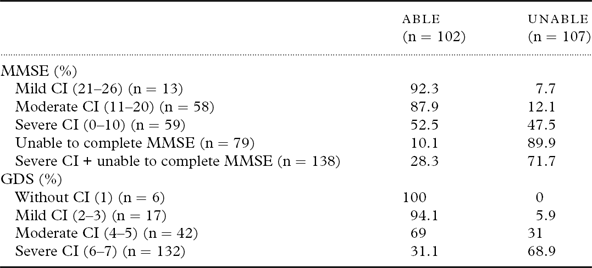
The range of MMSE scores was 0–25 for patients who could complete the QOL-AD (inclusion criterion was to score under 27), and 0–24 for non-completers. For GDS scores, completers ranged 1–7, while non-completers ranged 4–7. Table 2 shows percentages of patients who did and did not complete the QOL-AD classified by cognitive impairment level. All in all data show that completion rate decreased as cognitive impairment increased, although 11.3% of residents with MMSE scores over 10 were not able to complete the QOL-AD (reasons reported were cognitive impairment: 57.1%; lack of cooperation: 28.6%; and fatigue: 14.3%).
Percentage of patients who were able and unable to complete the QOL-AD by cognitive impairment level
CI = Cognitive Impairment; MMSE = Mini-Mental State Examination.
Up to 31.1% of patients with severe cognitive impairment, according to the GDS scores, were able to complete the QOL-AD. When the MMSE scores are used as a reference, on the other hand, 52.2% of patients with severe cognitive impairment succeeded in completing the test. As 37.8% of the patients could not complete the MMSE, mainly due to severe cognitive impairment, we kept these patients together with those who had not finished the MMSE. Considered as one single group, 28.3% of these patients did complete the AD-QOL.
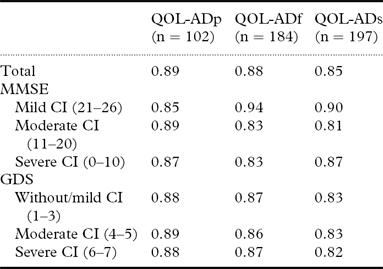
Internal consistency reliability was computed for each of the groups to evaluate whether cognitive status influenced α coefficients. As can be seen in Table 3, Cronbach's αs on the QOL-AD were adequate for the three reports at all levels of cognitive functioning. All α coefficients remain over the acceptable level of 0.70 (range 0.81–0.95).
Cronbach's αs on the QOL-AD by impairment level
CI = Cognitive Impairment; QOL-AD = Quality of Life-Alzheimer's Disease.
Discussion
The present study provides further information about the assessment of QoL in patients with dementia in long-term care facilities. First, as it has been debated elsewhere (Crespo et al., Reference Crespo, Bernaldo de Quirós, Gómez and Hornillos2012, Reference Crespo, Hornillos and Bernaldo de Quirós2013), data show that people with dementia are aware of and able to report their own QoL. Almost a half of the residents (49%) were able to provide information about their own QoL. Completion rate in the present study comes near the one found by Hoe et al. (Reference Hoe, Katona, Roch and Livingston2005) with the original 13-item version of the QOL-AD (around 52%) and corroborates these authors’ indications about the adequacy of this questionnaire for people with mild and moderate cognitive impairment. Furthermore, this study widens the application range since we found that people with severe dementia and cognitive impairment (i.e. MMSE scores up to 0 here vs. up to 3 in Thorgrimsen et al. (Reference Thorgrimsen2003) or Hoe et al. (Reference Hoe, Katona, Roch and Livingston2005)) were able to complete the QOL-AD; even more, almost 8% of residents that were not able to complete the MMSE could respond to the QOL-AD. Thus, and in accordance with previous studies (e.g. Logsdon et al., Reference Logsdon, Gibbons, McCurry and Teri1999, Reference Logsdon, Gibbons, McCurry and Teri2002; Thorgrimsen et al., Reference Thorgrimsen2003; Edelman et al., Reference Edelman, Fulton, Kuhn and Chang2005; Winzelberg et al., Reference Winzelberg, Williams, Preisser, Zimmerman and Sloane2005; Zimmerman et al., Reference Zimmerman2005; Hoe et al., Reference Hoe, Hancock, Livingston and Orrell2006, Reference Hoe, Katona, Orrell and Livingston2007; Spector and Orrell, Reference Spector and Orrell2006; or in Spain, Conde-Sala et al., Reference Conde-Sala, Garre-Olmo, Turró-Garriga, López-Pousa and Vilalta-Franch2009, Reference Conde-Sala2013; León-Salas et al., Reference León-Salas, Logsdon, Olazarán, Martínez-Martín and The2011a, Reference León-Salas, Olazarán, Muñiz, González- Salvador and Martínez-Martín2011b), data in the present study support the possibility of direct assessment through self-report of the QoL of people with dementia, even at levels of severe cognitive impairment that were not included in other studies (e.g. Edelman et al., Reference Edelman, Fulton, Kuhn and Chang2005). However, it should be kept in mind that giving an answer does not necessarily imply a full understanding of the question.
Nevertheless, the probability of non-completing measures increases among individuals with higher cognitive impairment as it has been reported by several authors (e.g. Logsdon et al., Reference Logsdon, Gibbons, McCurry and Teri2002; Hoe et al., Reference Hoe, Katona, Roch and Livingston2005; León-Salas et al., Reference León-Salas, Logsdon, Olazarán, Martínez-Martín and The2011a, Reference León-Salas, Olazarán, Muñiz, González- Salvador and Martínez-Martín2011b). Actually, cognitive impairment or severity of their dementia was the most frequent reason for non-completion, as it was also found by León-Salas et al. (Reference León-Salas, Logsdon, Olazarán, Martínez-Martín and The2011a). All in all, patients who did not respond the questionnaire were more cognitively, functionally, and behaviorally impaired, as was also reported by Logsdon et al. (Reference Logsdon, Gibbons, McCurry and Teri2002) in community-dwelling patients and by León-Salas et al. (Reference León-Salas, Logsdon, Olazarán, Martínez-Martín and The2011a) in institutionalized ones. On the other hand, depressive symptoms were similar in individuals who could and could not complete the QOL-AD, in line with results by Logsdon et al. (Reference Logsdon, Gibbons, McCurry and Teri2002) in community patients whose depressive symptoms were reported by their family caregivers, and by León-Salas et al. (Reference León-Salas, Logsdon, Olazarán, Martínez-Martín and The2011a). This finding is somewhat surprising because depressive symptoms are strongly associated with self-report measures of QoL (Hoe et al., Reference Hoe, Hancock, Livingston and Orrell2006, Reference Hoe, Katona, Orrell and Livingston2007); nevertheless, data show no significant differences between completers and non-completers, neither when depression was reported by a proxy (a staff member), nor when it was scored directly by the interviewer. Consequently, Hoe's data seem to point that depressive symptoms would be inversely related with QoL self-ratings in patients with dementia, but according to the present findings they would not affect their capacity for providing this rating.
Proxies’ ratings of QoL (both family and staff) were significantly lower for non-completers than for completers. This result is at odds with Logsdon et al.'s (Reference Logsdon, Gibbons, McCurry and Teri2002), who surprisingly found no differences between family caregivers’ ratings of patients who were and were not able to complete the QOL-AD. Our results, in line with León-Salas et al. (Reference León-Salas, Logsdon, Olazarán, Martínez-Martín and The2011a), were expected since non-completers have shown higher functional and cognitive impairment, which is frequently associated with poorer QoL scores. It could be assumed that residents with greater cognitive impairment could be less able to make accurate judgments about their QoL, but it would also be possible that proxies have difficulties to make accurate estimates of residents’ QoL as they become less communicative (Edelman et al., Reference Edelman, Fulton, Kuhn and Chang2005).
All in all, the comparison between completers and non-completers corroborates the finding by Logsdon et al. (Reference Logsdon, Gibbons, McCurry and Teri2002) and León-Salas et al. (Reference León-Salas, Logsdon, Olazarán, Martínez-Martín and The2011a), though the present study has a greater sample size, particularly in the completers group: 155 completers and 22 non-completers in Logsdon et al.; and 40 and 61, respectively, in León-Salas et al. (Reference León-Salas, Logsdon, Olazarán, Martínez-Martín and The2011a). In addition, it incorporates staff members’ reports while previous studies focused only on patients’ and family caregivers’ ratings.
It is worth mentioning that, while Logsdon et al. (Reference Logsdon, Gibbons, McCurry and Teri2002) found that no participant who scored 11 or higher on the MMSE was unable to complete the QOL-AD, results here show that about 11% in that range were not able to complete the QOL-AD (27% when considering participants who scored under 6 on the GDS). This discrepancy could be explained by differences between community-dwelling patients and residents, or by differences in procedure: QOL-AD is applied here as part of a longer battery, which could cause fatigue in the residents or elicit their lack of cooperation, these being the reasons for non-completion reported by the interviewers. Consequently, it will be essential to establish optimal conditions for QoL assessment in order to avoid tiredness and rejection by the residents. In this sense, QoL assessment in residential settings might require additional or different proceedings to those used in this study.
More interestingly, data reveal that about 30% of residents’ with dementia and severe cognitive impairment are able to complete the QOL-AD, that is, to self-rate their QoL by means of direct request by trained interviewers. In those patients to whom it was administered, the QOL-AD presents good reliability, in accordance with Logsdon et al. (Reference Logsdon, Gibbons, McCurry and Teri2002) who found α coefficients over 0.80 in both patient and caregiver reports at all levels of cognitive functioning. Moreover, though all reliability values are high, QOL-ADp showed greater reliability than QOL-ADf and QOL-ADs. Patients with severe cognitive impairment that are unable to report their QoL are those that show more aggressive behaviors, which could impose additional challenges to the assessment.
As a whole, our results agree to a great extent with previous research and show that (1) people with dementia in long-term care are able to self-report about their QoL (by means of the QOL-AD); (2) the QOL-AD completion rate decreases as the cognitive impairment level increases, and non-completion is associated with a greater overall impairment; (3) about 30% of residents with dementia and severe cognitive impairment can rate their own QoL; and (4) these patients provide accurate and reliable information about their QoL. Additionally, this study further supports the feasibility and utility of the QOL-AD Spanish residential version. Nevertheless, future research should explore the generalizability of the results in other samples and settings.
These findings highlight several practical implications for the assessment of QoL in persons with dementia, particularly those with severe cognitive impairment, in nursing homes. First, QoL self-rating should be the first-line option when assessing those residents with severe cognitive impairment (especially when they do not show aggressive behaviors). For those who are not able to complete self-report measures, proxies’ report could be a choice since it has shown good reliability; nevertheless, data have repeatedly shown significant differences between self and proxies’ reports of patients’ QoL (Selai et al., Reference Selai, Trimble, Rossor and Harvey2001; Logsdon et al., Reference Logsdon, Gibbons, McCurry and Teri2002; Edelman et al., Reference Edelman, Fulton, Kuhn and Chang2005; Conde-Sala et al., Reference Conde-Sala, Garre-Olmo, Turró-Garriga, López-Pousa and Vilalta-Franch2009) and the factors associated with them (e.g. Hoe et al., Reference Hoe, Hancock, Livingston and Orrell2006, Reference Hoe, Katona, Orrell and Livingston2007, Reference Hoe2009; Beer et al., Reference Beer2010). Even more, recently Conde-Sala et al. (Reference Conde-Sala2013) have reported that severity of dementia is associated with greater discrepancies between patients and caregivers (family) ratings of patients’ QoL. Consequently, different approaches should be required for QoL assessment in the 70% of patients that cannot self-rate it. One viable option in this case might be the observational procedures developed in the last years specifically to assess QoL of people with advanced dementia residing in nursing home facilities, where observation could be carried out by trained staff (cf. Edelman et al., Reference Edelman, Fulton, Kuhn, Gallager, Dougherty and Long2007).
Conflict of interest
This research was sponsored by AFALcontigo (Alzheimer's Association of Spain) and was supported by a grant from the Foundation Centre for Research on Neurological Diseases (Fundación Centro Investigación Enfermedades Neurológicas – Fundación CIEN) in their program 2008–2010.
Description of authors’ role
M. Crespo led the research project, designed the present study, and carried out the redaction of the text and the data analysis. C. Hornillos assisted with the study design, the database and the data analysis, and the English translation of the text. M. M. Gómez supervised the data collection.
Acknowledgments
The authors thank the following Alzheimer's associations in Spain for their help and support for this study: AFALcontigo, AFA Córdoba, AFA León, ALZHEIMUR Murcia, and AFA Soria.