Implications
The present study explains the implications of increasing cadmium (Cd) levels in poultry diets (Japanese quail diets). Cd arises from different industrial systems. Cd has harmful effects on poultry (growth performance, carcass traits and blood biochemical components). The present work is a trial to overcome or decrease it’s toxicity by using certain feed additives like vitamin (Vit) E or clay. Dietary addition of natural clay (100 mg) or Vit E (250 mg)to growing Japanese quail caused beneficial effects. Moreover, clay or Vit E supplementation diminished the toxic effect of Cd on growth results during the treatment period.
Introduction
Contamination of the environment with heavy metals remains a problem for poultry industry, food safety regulatory agencies and concerned consumers. Heavy metals cause reductions in growth rate, feed efficiency, egg production and increase mortality, which leads to economic loss for poultry breeders (Sant’Ana et al., Reference Sant’Ana, Moraes and Bernardi2005; Rahman et al., Reference Rahman, Sasanami and Mori2007; Abduljaleel and Shuhaimi-Othman, Reference Abou-Kassem2013) and causes severe consequences to human health (Bertin and Averbeck, Reference Bertin and Averbeck2006). Cadmium (Cd) is known to be one of the major environmental pollutants and is unique among other metals because of its toxicity at a very low dosage and its low rate of excretion from the body (Agency for Toxic Substances and Disease Registry, 2012; Kour et al., Reference Kour, Rahman, Azmi, Hussain, Raghuwanshi and Dutta2014; Olgun, Reference Olgun2015). It is found widely in nature and present in air, all soils and aquatic systems and mainly released from the burning of fossil fuels, regional wastes and metals refining (Chen et al., Reference Chen, Liu and Huang2008; Kour et al., Reference Kour, Rahman, Azmi, Hussain, Raghuwanshi and Dutta2014). Raised levels of Cd in soil may be found as a result of agricultural activities (e.g. sewage sludge, phosphate fertilizers, and pesticides) containing high concentrations of Cd (Abdo and Abdulla, Reference Abdo and Abdulla2013). Cd was classified as a category one carcinogen (International Agency for Research on Cancer, 1993) and its half-life in the human kidney is 18 to 33 years (Gail et al., Reference Gail, Baker and Baker1982). Once Cd absorbed by animals or humans, it is poorly excreted, and increasing efforts are being made to limit its entry into the human food-chain. Maximum tolerable levels of dietary Cd for avian species were set at 0.5 mg/kg diet (El-Deek et al., Reference El-Deek, El-Sayed, Kandeel, Al-jasass and Mahmoud2010). Dietary Cd concentration in excess of 2 mg/kg induced increasing synthesis of metallothionein, accumulation of Cd and zinc, and possible disturbance of the metabolism of Fe, Zn and Ca (Chakraborty et al., Reference Chakraborty, Maiti and Biswas1987). Toxic effects of Cd induced altered behavioral responses, kidney damage, altered energy metabolism, anemia, cardiac and adrenal hypertrophy. Some studies concluded that bone disease occurred independent of kidney changes, while others suggest that skeletal deterioration resulted as a secondary response to Cd induced renal dysfunction (Whelton et al., Reference Whelton, Peterson, Moretti, Mauser and Bhattacharyya1997a and 1997Reference Whelton, Peterson, Moretti, Mauser and Bhattacharyyab). Vitamin (Vit) E has a number of different biological functions and one of the most important functions is its intercellular antioxidant action (Yu, Reference Yu1994). Vit E was shown to exert protective effects against metal induced toxicity (Cinar et al., Reference Cinar, Yigit, Yalcinkaya, Oruc, Duru and Arslan2011). Gore and Qureshi (Reference Gore and Qureshi1997) and Mahrose et al. (Reference Mahrose, Sonbol and Abd El-Hack2012) speculated that Vit E prevents oxidation of unsaturated lipid within cells, thus protecting the cell membrane from oxidative damage induced by free radicals. Supplementation of poultry diets with natural clays enhances growth rate. Which may be due to improvement in feed conversion, digestibility of nutrients, ability to bind metallic rations rendering them more available to the birds, nitrogen retention in bird’s body, and due to retarded absorption of toxic products of digestion that reduce toxicity (Lotfy, Reference Lotfy2000; Abou-Kassem, Reference Abduljaleel and Shuhaimi-Othman2010). Due to its adsorbent capability and lack of primary toxicity, clay is considered a simple and effective means to ameliorate or prevent the adverse effects exerted by many toxic agents, not only those from the environment, but also those from the living organisms (Trckova et al., Reference Trckova, Matlova, Dvorska and Pavlik2004). Clay, given to the animals in the diet, firmly and selectively binds compounds present in the diets which are noxious to the intestine and thus decreases their absorption through intestinal mucosa into the organism and subsequently prevents their toxic mode of action (Phillips, Reference Phillips1999). A number of studies confirmed clay capability to decontaminate aflatoxins (Abdel-Wahhab et al., Reference Abdel-Wahhab, Nada and Amra1999) plant metabolites (alkaloids, tannins), diarrhea causing enterotoxins (Dominy et al., Reference Dominy, Davoust and Minekus2004) and heavy metals (Katsumata et al., Reference Katsumata, Kaneco, Inomata, Itoh, Funasaka, Masuyama, Suzuki and Ohta2003). The present study aimed to investigate the role of Vit E or natural clay on growth performance, carcass traits, some blood biochemical components and Cd residues in muscles and liver of growing Japanese quail fed diets polluted by Cd at various levels.
Material and methods
Experimental design, birds, diets and husbandry
This work was carried out at Poultry Research Farm, Poultry Department, Faculty of Agriculture, Zagazig University, Zagazig, Egypt. All experimental procedures were carried according to the Local Experimental Animal Care Committee, and approved by the ethics of the institutional committee of the Department of Poultry, Faculty of Agriculture, Zagazig University, Zagazig, Egypt. Birds were randomly assigned to evaluate the effects of dietary Cd (0, 40, 80 and 120 mg/kg diet) and two levels of Vit E (0, 250 mg/kg diet) or two levels of natural clay (0 and 100 mg/kg diet) to study the influences of Cd, Vit E, clay or their different combinations on growth performance, carcass traits, some blood biochemical components, and Cd residues in muscles and liver of growing Japanese quail reared under controlled conditions.
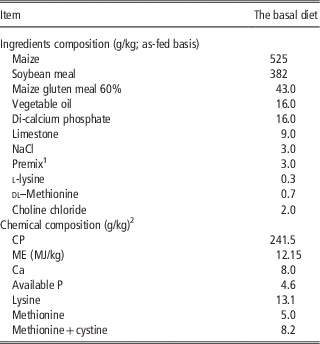
A total of 648 Japanese quail chicks at 1 week of age were randomly divided into 12 groups (54 birds/each group), each group of birds was sub-divided into three replicates (18 chicks/replicate). Each replicate was housed in one 50×60 cm cage. Quail chicks were reared during the experimental period in conventional type cages and kept under the same managerial, hygienic and environmental conditions. Birds were exposed to 23 h light : 1 h dark, fed ad libitum and feed and fresh water were available during all the experimental period. Drinkers and feeding troughs were daily cleaned. The birds’ health status was monitored throughout the trial. The basal experimental diet was formulated to cover the nutrient requirements of growing Japanese quail chicks as recommended by National Research Council (1994) and shown in Table 1. Clay analysis as soluble cations and anions (Meq/100 g dry matter soil) were Ca++ 0.75, Mg++ 0.25, Na+ 0.05, K+ 0.10, Cl- 0.55, So4 − 0.30 and HCO3 0.75. Exchangeable cations (Meq/100 g DM soil) were 2.65 and available nutrients (mg/100 g dry matter soil) were P 5.0, K 1.2, Mn 2.4, Zn 0.74, Cu 0.30 and Fe 0.55 mg (Marai et al., Reference Marai, Ayyat, Gaber and Abdel-Monem1996).
The ingredients and basal diet of growing Japanese quail

1 Growth vitamin and mineral premix, each 1 kg consists of: Vit A 12000, 000 IU; Vit D3, 2000, 000 IU; Vit. E. 10 g; Vit k3 2 g; Vit B1, 1000 mg; Vit B2, 49 g; Vit B6, 105 g; Vit B12, 10 mg; Pantothenic acid, 10 g; Niacin, 20 g, Folic acid, 1000 mg; Biotin, 50 g; Choline Chloride, 500 mg, Fe, 30 g; Mn, 40 g; Cu, 3 g; Co, 200 mg; Si, 100 mg and Zn, 45 g.
2 Calculated according to NRC (1994).
Data collection and calculations
BW was obtained at 1, 3 and 6 weeks of age. BW gain was calculated as the difference between the initial and the final BW. Feed consumption was recorded at 1, 3 and 6 weeks of age; the feed conversion ratio (g feed/g gain) was calculated. At the end of the growing period (6 weeks of age), five birds from each replicate were randomly selected, fasted overnight, weighed and slaughtered by sharp knife to complete bleeding, then weighed, followed by plucking the feather and final weight recording. The slaughter traits studied were carcass giblets (liver, gizzard and heart), and dressing percentages ((carcass weight plus giblets weight)×100/pre-slaughter g).
At the end of the experimental period, blood samples were collected from sacrificed quails into sterilized tubes with heparin. Samples were centrifuged at 3500 rpm for 15 min and serum was separated and stored at −20°C till assayed. The following serum biochemical parameters were determined: total protein, albumin, creatinine, urea-N and uric acid, alanine transaminase, aspartate transaminase andalkaline-phosphatase activities were estimated in plasma using commercial biodiagnostic kits provided from Biodiagnostic Company (29 El-Tahrir St. Dokki, Giza, Egypt) and a spectrophotometer (Shimadzu). To determine the A/G ratio and globulin concentrations were calculated from the difference between the total protein and albumin concentrations.
Cd residues were estimated in muscle and liver collected from slaughtered birds (µg/g wet weight, ppm) in the Central Laboratory of the Faculty of Veterinary Medicine, Zagazig University. One gram of each tissue sample was placed in a clean screw capped glass bottle and digested with a 4 ml of digesting solution (nitric/per chloric acid, 1 : 1). Initial digestion was carried out for 24 h at room temperature followed by heating at 110°C for 2 h. After cooling, deionized water was added, then the solutions were warmed in water bath for 1 h to expel nitrous gases. Digests were then filtered (Whatman No. I), and diluted to 25 ml deionized water (Julshman, Reference Julshman1983). The obtained solutions were analyzed by flame atomic absorption spectrophotometer (FAAS).
Statistical analysis
The experimental design used in the present work was completely randomized design with Cd, Vit E, and clay as the main effects. The experimental unit differed according to the parameter measured. For growth performance traits, the experimental unit was cage, whereas individual chick data were used for carcass, blood and residual parameters. The statistical model for the ANOVA was as follows:
 $$Y_{{ijk}} \,{=}\,\mu {\plus}C_{i} {\plus}V_{j} {\plus}T_{K} {\plus}CV_{{ij}} {\plus}CT_{{IK}} {\plus}e_{{ijk}} $$
where Y ijk is the an observation, µ the overall mean, C i the main effect of Cd, V j the main effect of Vit E, T K the main effect of clay, CV ij the effect of the interaction between Cd levels and Vit E, CT IK the effect of the interaction between Cd levels and clay and e ijk the random error.
Data of growth performance, carcass traits, some blood biochemical components and Cd residues in muscles and liver were analyzed by ANOVA using the procedure described by the SAS Institute (2008). All percentage data were subjected to arcsin transformation before analysis (2008). Data were also subjected to orthogonal polynomial analysis (linear and quadratic trends) using SAS software (2008). Orthogonal polynomial contrast was used to test the linear and quadratic effects of dietary treatments and their interactions. All means were tested for significant differences using Duncan’s multiple range procedure at the 5% a level (Duncan 1955).
Results
Effect of dietary Cd concentration
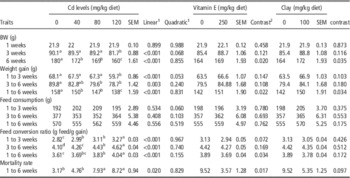
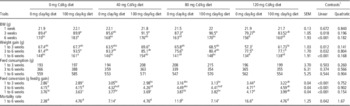
Results of growth performance of Japanese quail as affected by Cd levels are found in Table 2. Live BW and weight gain of quails were linearly (P=0.003) decreased with increasing dietary Cd level at all ages. Moreover, feed utilization expressed as feed conversion of quails was significantly (linear, P<0.001) worsened with increasing Cd level. On the other hand, there were no linearly and quadratically differences in feed consumption due to Cd treatments at different ages. Mortality percentage of quail chicks was linearly (P=0.020) increased as dietary Cd level increased up to 120 mg/kg diet (Table 2).
Growth performance of growing Japanese quail as affected by dietary Cd, vitamin E and clay levels

a,b,cMeans with different superscripts in the same raw are significantly different (P<0.05).
1 Linear and quadratic effects of Cd treatments.
2 Overall vitamin E and clay treatments P-value.
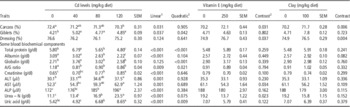
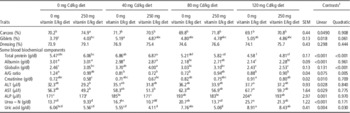
Results of carcass traits studied as affected by dietary Cd levels are shown in Table 3. It was found that carcass percentage was linearly (P=0.031) decreased as dietary Cd level increased. While, giblets percentage were linearly and quadratically (P=0.031) differed as dietary Cd level increased, although the group of quail fed dietary level of 40 mg Cd/kg had the higher percentage of giblets. Data presented in Table 3 clearly indicate that Cd caused significant (P⩽0.01) changes in total plasma protein, albumin, globulin, A/G ratio, creatinine, urea-N and uric acid concentrations as well as ALT, AST and ALP activities. Increasing Cd levels led to a linear or quadratic decrease in total plasma protein, albumin, globulin and A/G ratio and a linear increase in creatinine (P⩽0.001), urea-N (P⩽0.001), and uric acid (P⩽0.001 or=0.009, quadratically) levels as well as hepatic enzymes activities (P⩽0.001 or=0.001).Table 3 shows Cd residues in the muscles and liver of quail as affected by dietary Cd levels. Increasing dietary Cd level was associated with its increase (P⩽0.001) in the muscles and liver of quail.
Carcass traits and some blood biochemical components of growing Japanese quail as affected by dietary Cd, vitamin E and clay levels

a,b,cMeans with different superscripts in the same raw are significantly different (P<0.05).
1 Linear and quadratic effects of Cd treatments.
2 Overall vitamin E and clay treatments P-value.
Effect of dietary Vit E supplementation
Regarding the effect of Vit E supplementation on growth performance (Table 2), dietary supplementation with 250 mg of Vit E/kg diet improved live BW at 6 weeks of age, weight gain and feed conversion at 1 to 6 weeks of age when compared with the un-supplemented diet. Mortality rate of quails was significantly (P=0.017) decreased with Vit E supplementation compared with the un-supplemented diet (Table 2). In the present study, the group of quails fed diet contained 250 mg Vit E/kg had the highest percentages of carcass and dressing than those fed the un-supplemented diet. Blood plasma biochemical components studied were better when birds received 250 mg of Vit E/kg diet. Cd residues in the muscles and liver were significantly less in the birds had 250 mg of Vit E/kg diet than those un-supplemented with Vit E.
Effect of dietary clay supplementation
Results of the effect of clay supplementation on growth performance are presented in Table 2. Dietary supplementation with 100 mg/kg of clay improved live BW at 6 weeks of age, weight gain and feed conversion at 1 to 6 weeks of age when compared with the un-supplemented diet. In our study, the group of quails fed diet contained 100 mg/kg of clay had the highest percentages of carcass and dressing than those fed the un-supplemented diet. Blood plasma biochemical components studied were better when birds received 100 mg/kg diet (Table 3). Cd residues in the muscles and liver were significantly less in the birds had 100 mg/kg diet than those un-supplemented with clay (Table 4).
Cadmium residues in muscles and liver of growing Japanese quail as affected by dietary Cd, vitamin E and clay levels

a,b,cMeans with different superscripts in the same raw are significantly different (P<0.05).
1 Linear and quadratic effects of Cd treatments.
2 Overall vitamin E and clay treatments P-value.
Interaction effect of dietary Cd and Vit E supplementation
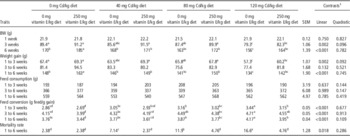
Growth performance and carcass traits were significantly affected linearly by the interactions among Cd levels and Vit E, except feed consumption and dressing percentage (Tables 5 and 6). The best values of BW, weight gain, feed conversion and carcass (74.9%) were achieved when the birds fed diet contained 0.0 mg Cd/kg and 250 mg Vit E/kg. Blood plasma biochemical components studied were linearly and/or quadratically affected by the interaction among Cd levels and Vit E levels in this study (Table 6).Table 7 shows Cd residues in the muscles and liver of quail as affected by the interactions among Cd levels and Vit E. However, adding 250 mg Vit E/kg in the polluted diet led to a decrease (P⩽0.01) in Cd concentration in the muscles and liver.
Growth performance of growing Japanese quail as affected by the interaction between Cd and vitamin E treatments

a,b,c,dMeans with different superscripts in the same raw are significantly different (P<0.05).
1 Linear and quadratic interaction between Cd and vitamin E treatments.
Carcass traits and some blood biochemical components of growing Japanese quail as affected by the interaction between Cd and vitamin E treatments

a,b,c,d,e,fMeans with different superscripts in the same raw are significantly different (P<0.05).
1 Linear and quadratic interaction between Cd and vitamin E treatments.
Cadmium residues in muscles and liver of growing Japanese quail as affected by the interaction between Cd and vitamin E treatments

a,b,c,d,eMeans with different superscripts in the same raw are significantly different (P<0.05).
1 Linear and quadratic interaction between Cd and vitamin E treatments.
Interaction effect of dietary Cd and clay supplementation
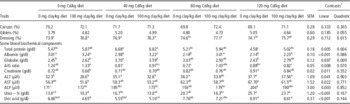
As shown in Table 8, Growth performance traits were significantly affected linearly by the interactions among Cd and clay levels, except feed consumption. The preferable values of BW (183 g), weight gain (161 g) and feed conversion (3.63 g feed/g gain) were recorded by the birds fed diet contained 0.0 mg Cd/kg and 100 mg clay/kg during the experimental period. The interactions among Cd and carcass traits were not significantly changed (Table 9). Blood parameters including total protein, albumin, A/G ratio, creatinine, ALT, AST, ALP, urea-N and uric acid were linearly changed by the interaction among Cd levels and clay. However, total protein and globulin were quadratically (P=0.009 and 0.004, respectively) affected by the same interaction in the present study. Table 10 shows Cd residues in the muscles and liver of quail as affected by the interaction among Cd and clay levels. However, adding 100 mg clay/kg in the polluted diet led to a decrease (P⩽0.01) in Cd concentration in the muscles and liver.
Growth performance of growing Japanese quail as affected by the interaction between Cd and clay treatments

a,b,c,dMeans with different superscripts in the same raw are significantly different (P<0.05).
1 Linear and quadratic interaction between Cd and vitamin E treatments.
Carcass traits and some blood biochemical components of growing Japanese quail as affected by the interaction between Cd and clay treatments

a,b,c,dMeans with different superscripts in the same raw are significantly different (P<0.05).
1 Linear and quadratic interaction between Cd and vitamin E treatments.
Cadmium residues in muscles and liver of growing Japanese quail as affected by the interaction between Cd and clay treatments

a,b,c,d,eMeans with different superscripts in the same raw are significantly different (P<0.05).
1 Linear and quadratic interaction between Cd and vitamin E treatments.
Discussion
The BW loss observed in this study by the Cd polluted diets might be the result of wide toxic effect by Cd on the whole body processes of the bird which agreed with Sant’Ana et al. (Reference Sant’Ana, Moraes and Bernardi2005) who claimed that the BW of birds was decreased after Cd exposure and this might be associated with the action of metallothionein. The major function of metallothionein in Cd exposure is associated with increased retention of Cd in the tissues, resulting in a protective mechanism (Liu and Klaassen, Reference Liu and Klaassen1996). Decreased BW was also recorded in Japanese quail layers exposed to dietary Cd concentration of 60 ppm (Sell, Reference Sell1975). Erdogan et al. (Reference Erdogan, Erdogan, Celik and Unlu2005) indicated that oxidative stress, induced by Cd, plays a role in decreasing the performance of broiler chicks. The later author attributed the adverse effect on feed conversion ratio to the toxic effects of Cd on every organ systems in animal body. Similar results were obtained by Gail et al. (Reference Gail, Baker and Baker1982); Abdo and Abdulla (Reference Abdo and Abdulla2013). In this respect, El-Deek et al. (Reference El-Deek, El-Sayed, Kandeel, Al-jasass and Mahmoud2010) pointed out that the average live BW, weight gain, feed intake and feed efficiency of broiler chicks showed neither linear nor quadratic responses from 5 to 7 weeks, they tended to decrease non significantly with increased Cd supplementation. Al-Waeli et al. (Reference Al-Waeli, Zoidis, Pappas, Demiris, Zervas and Fegeros2013) claimed that the addition of 100 mg/kg of Cd significantly (P⩽0.001) reduced broilers’ body mass and feed consumption compared with that of broilers fed no added Cd, at day 7 and day 42 of the age. Our results disagree with those of Abduljaleel and Shuhaimi-Othman (Reference Abou-Kassem2013) who reported that BW of broiler chicks were not significantly affect by Cd levels.
The improvement occurred due to the antioxidant power of the Vit E is that Vit E protects critical cellular structures against damage caused by oxygen free radicals and reactive products of lipid peroxidation. It has been reported that lipid peroxidation is prevented by Vit E (Kanter et al., Reference Kanter, Aksu, Akpolat, Tarladacalisir, Aktas and Uysal2009; Mahrose et al., Reference Mahrose, Sonbol and Abd El-Hack2012). Vit E inhibits peroxidation of membrane lipids by scavenging lipid peroxyl radicals, as a consequence of which it is converted into a tocopheroxyl radical. In fact, α-tocopherylquinone may act as a potent anticoagulant and as an antioxidant through its reduction to hydroquinone (Hassan et al., Reference Hassan, Amin, Rahmy, Hatem and Dessouky2012). The improvement in live BW by clay may be due to the delayed transit time of digesta through the digestive tract by 2 to 2.5 h and promoted absorption of nutrients. In addition, clay binds toxins and heavy metals to a degree that far outperforms charcoal and other filter products (Mahrous et al., Reference Mahrous, Khalil and Mahmoud2006). As well as, clay has peculiar adsorption arising from its layered structure, charged layers and active edges. The layered structure provides inter-layer space to host guest molecules and ions. Charged layers and ‘broken edge’ sites attract varieties with opposite charges through Van der Waals force. Such features allow clay to be used as adsorbent for the removal of heavy metal ions (Mahrous et al., Reference Mahrous, Hassan, Radwan and Mahmoud2015). Digestibility of organic matter, fat and nitrogen free extract and the nitrogen utilization were shown to be increased by supplementary zeolite (Andronikashvili et al., Reference Andronikashvili, Tsereteli, Dolidze and Iremashvili1994). Long-term Cd exposure caused depletion of liver and muscular glycogen, and this effect might have reduce nutrient metabolism and feed utilization (Rahman et al., Reference Rahman, Sasanami and Mori2007).Yamani et al. (Reference Yamani, Rashwan and Magdy1997) reported that Arbor-Acres broiler chicks fed diet supplemented with 5% clay showed significantly (P⩽0.05) increased live BW at 7 weeks of age compared to the un-supplemented control group. Conversely, Biswas et al. (Reference Biswas, Mohan and Sastry2010) found insignificant differences in BW of native Indian hen between the control and both dietary treated groups supplemented with 150 or 300 mg Vit E/kg. Mahrose et al. (Reference Mahrose, Sonbol and Abd El-Hack2012) showed that live BW and change in live BW of Bovans laying hens, at 42 and 54 weeks of age, did not significantly differ after dietary supplementation of Vit E (0, 250 and 500 mg/kg), whereas, the highest level of Vit E improved (P⩽0.01) feed conversion. At any Cd level, quail chicks groups supplemented with Vit E or clay, had higher BW than the un-supplemented one though statistically not significant. The results may show that Cd poisoning could be partially reduced by providing supplementary Vit E and natural clay especially under commercial conditions.
Abduljaleel and Shuhaimi-Othman (Reference Abou-Kassem2013) pointed out that liver, gizzard and heart weights in broiler chicks treated with Cd were decreased when compared with the control treatment. In the present study, the group of quails fed diet contained 250 mg Vit E/kg had the higher (P⩽0.01) percentage of carcass followed by those received 100 mg clay/kg and then those fed the un-supplemented diet.
The activity of AST and ALT enzymes in blood may be used as stress indicators. AST and ALT are the most often measured for evaluation of liver damage (Hayes, Reference Hayes1989). The significant changes in the activities of these enzymes in blood plasma indicate tissue impairment in the liver caused by stress (Cinar et al., Reference Cinar, Yigit, Yalcinkaya, Oruc, Duru and Arslan2011; Abdo and Abdulla, Reference Abdo and Abdulla2013). Moreover, the increase in plasma AST and ALT activities may be attributed to the hepatotoxic effect, hepatocellular damage or cellular degradation by Cd, perhaps in liver, heart or muscles (El-Demerdash et al., Reference El-Demerdash, Yousef, Kedwany and Baghdadi2004). Navarro et al. (Reference Navarro, Montilla, Martin, Jimenez and Utrilla1993) attributed the elevated activities of ALT and AST to the outflow of these enzymes from the liver cytosol to the blood. The present results are in agreement with those of Abdo and Abdulla (Reference Abdo and Abdulla2013). On the other hand, Erdogan et al. (Reference Erdogan, Erdogan, Celik and Unlu2005) found that liver function enzymes (AST and ALT) activities were not changed by Cd levels. In the present study, kidney function tests showed elevation in creatinine level in the treated groups indicating the toxic effect of Cd. The elevation in the creatinine was presumably due to nephrotoxic effect of Cd on renal tubules and glomeruli (Abdo and Abdulla, Reference Abdo and Abdulla2013). In support of these findings, it was reported that long- term Cd exposure causes depletion of liver and muscular glycogen, due to its action on the enzymes involved in glycogenesis and energy metabolism (Toury et al., Reference Toury, Boissonneau, Stelly, Dupuis, Berville and Perasso1985) and induces oxidative stress in the liver and kidney (Yiin et al., Reference Yiin, Chern, Sheu, Tseng and Lin1999). Our results agreed with those of Abdo and Abdulla (Reference Abdo and Abdulla2013) and partially agreed with those of Cinar et al. (Reference Cinar, Yigit, Yalcinkaya, Oruc, Duru and Arslan2011). El-Deek et al. (Reference El-Deek, El-Sayed, Kandeel and Mahmoud2011) and Al-Waeli et al. (Reference Al-Waeli, Zoidis, Pappas, Demiris, Zervas and Fegeros2013) revealed that increasing Cd levels decreased serum total protein. Dietary feed additives increased (P=0.030) plasma albumin and decreased (P=0.045 and 0.036) AST and urea-Nin supplemented groups compared to the un-supplemented one as seen in Table 8.
In the present study, all levels of dietary Cd resulted in significant increases in the Cd concentration of muscles and liver in comparison with control. The distribution of Cd among organs of animals differs depending on the chemical form of administered Cd and the duration of exposure (Zídková et al., Reference Zídková, Melčová, Batošová, Šestáková, Zídek, Száková, Miholová and Tlustoš2014). Cd mainly accumulates in the liver and sometimes in the kidney (Cinar et al., Reference Cinar, Yigit, Yalcinkaya, Oruc, Duru and Arslan2011; Karmakar et al., Reference Karmakar, Bhattacharya and Chatterjee2000) due to the binding of Cd to metallothionein (Hardej and Trombetta, Reference Hardej and Trombetta2004). Absorption and in turn tissue accumulation of dietary Cd is mainly influenced by dose, age, gender, species, length of the application and nutritional status, as well as by dietary intake of other elements that may interact with Cd (Al-Waeli et al., Reference Al-Waeli, Zoidis, Pappas, Demiris, Zervas and Fegeros2013; Zídková et al., Reference Zídková, Melčová, Batošová, Šestáková, Zídek, Száková, Miholová and Tlustoš2014). In agreement with our results, Leach et al. (Reference Leach, Wang and Baker1979) revealed that liver in the treated chicken with dietary Cd was accumulated by higher concentration of Cd than muscles. Bilal and Erçag (Reference Bilal and Erçag2003) proved that adding Cd to a diet affects the accumulation of this element in the different organs in a significant rate. Rambeck and Kollmer (Reference Rambeck and Kollmer1990) found that Vit E supplementation did not decrease the concentration of Cd in the kidney. The present results are compatible with those showed by Bilal and Erçag (Reference Bilal and Erçag2003); Herzig et al. (Reference Herzig, Navratilova, Suchy, Vecerek and Totusek2007).
Conclusion
It can be concluded that polluted diets with heavy metals such as Cd caused deleterious effects on growth performance of Japanese quail and induced Cd accumulation in the muscles and liver, while natural clay or Vit E supplementation to the diet may be useful in partly alleviating the adverse effects of Cd on the performance, carcass traits and meat quality of growing quails. Moreover, clay or Vit E supplementation diminished the toxic effect of Cd on growth results during the treatment period.