


1. Introduction
The third and last duty of the sovereign or commonwealth is that of erecting and maintaining those public institutions and those public works, which, though may be in the highest degree advantageous to a great society, are, however, of such a nature, that the profit could never repay the expense to any individual or small number of individuals.
(Adam Smith, 1776, Book 5, Part 3)Reference Smith and Sutherland1The discovery of penicillin by Fleming in 1928 heralded a revolution in human society that went far beyond the medical sphere. Suddenly, infectious diseases, the major cause of death at all ages in the pre-antibiotic era, appeared to be conquerable. Prevention and treatment of infections associated with surgery, intensive care, and cancer treatment enabled spectacular medical advances, increasing both quantity and quality of life. Use by farmers and veterinary practitioners to prevent and treat infections in livestock has facilitated the increased production of meat, fish, and dairy products. Consequently, penicillin, along with other antimicrobials introduced over the next half-century, added an average of 20 years to life expectancy.Reference Davies and Sugden2 This increased longevity changed perspectives and created opportunities to enrich social, cultural, and economic capital. The post-World War Two productivity boom arguably owed much to the increased output of workforces kept healthy through antibiotics.
However, nearly 100 years after Fleming’s groundbreaking discovery, the global spread of antimicrobial resistance (AMR) threatens to upend these gains. In his 1945 Nobel lecture, Fleming cautioned against the overuse and misuse of antibiotics, highlighting the potential for microbes to develop resistance: “the ignorant man may easily underdose himself and by exposing his microbes to non-lethal quantities of the drug make them resistant.”Reference Fleming3 Unfortunately, his warning has largely gone unheeded; overuse and misuse of antibiotics have become widespread globally, leading to the very resistance Fleming foresaw.Reference Aslam and Jamshed4 Growing resistance coupled with insufficient innovation in novel antimicrobials, diagnostics, and alternative therapies has resulted in AMR becoming a global permacrisis, impacting health, food security, and environmental discharges, undermining biosecurity and defence efforts, and threatening economic stability.Reference Herron5 Notably, no new broad-spectrum antimicrobial has been developed since the 1980s,Reference Durand6 underscoring not only the urgent need for renewed research and development but also the critical importance of infection prevention, universal access, stewardship, surveillance, and investment in a broader arsenal of strategies to address AMR. With 4.95 million deaths associated with bacterial AMR in 2019, of which 1.27 million were directly attributable to AMR,Reference Murray7 its impact is already catastrophic. Projections suggest that without intervention, AMR could lead to up to 10 million deaths per year by 2050 and US$100 trillion in lost global economic output.Reference O’Neill8
In low- and middle-income countries (LMICs), inadequate access to appropriate antimicrobials means that the health and economic benefits enjoyed by high-income countries (HICs) remain out of reach. Inadequate access results in higher disease burdens in places where medication is unavailable, greater antimicrobial misuse where inappropriate antimicrobials are prescribed or purchased over the counter, and thus, amplified resistance levels. Together, lack of access and growing AMR impede progress toward the United Nations’ Sustainable Development Goals.Reference Aslam, Mantegazza and Gajdács9 The ubiquity of AMR does not respect borders; it transcends humans, animals, and the ecosystem, posing a global collective action problem,Reference Brown, Layton and Weldon10 requiring global cooperation and a One HealthReference James11 approach to coordination.Reference McEwen, Collignon, White, Hughes and Flowers12
This paper argues that the unique nature and dynamics of antimicrobials and AMR require a novel public health and economic framework. We define antimicrobial effectiveness (AME) to incorporate both the efficacy and accessibility of antimicrobials. We propose that AME should be considered a critical economic infrastructure. Drawing on Frischmann’sReference Frischmann13 functional definition of infrastructure, we develop a theory of AME infrastructure. This theory justifies the need for investment, innovation, and coordination to maximize health benefits, agricultural and economic productivity, biosecurity and defence, and sustainable economic development. Such framing helps to draw analogies with similar economic dilemmas, identify key challenges, and design novel policy approaches to conserve AME. We build on the concept of antimicrobial efficacy as a common-pool resource (CPR) subject to various, interdependent collective action problems.Reference Weldon14 An important lesson from game-theoretical conceptualization of such collective action dilemmas is that identifying the many different types of players, their roles, and the stakes involved (payoff structures) is critical to effective governance and enabling long-term coordination. Recognizing the critical role of AME across the economy and understanding the synergies between efficacy and access is crucial to motivating various players to cooperate.
A language that reflects AME, its systemic value, and the urgent need to conserve it, is more likely to promote lasting change, greater public understanding, and to translate across scales and sectors. The 2024 United Nations General Assembly High-Level Meeting on AMR highlights the growing momentum for addressing AMR; now is an opportune time to move with optimism and frame AME as the highly investible issue that it is, shifting our collective mindset to the concept of AME as infrastructure. This paper introduces the key concepts of AME and infrastructure, demonstrating their congruence; explores how infrastructure framing shapes a sustainable management approach consisting of infection prevention, universal access, stewardship, surveillance, and innovation; and consolidates these insights, presenting AME infrastructure as an investible solution.
2. Key Concepts
2.1. Key Antimicrobial Principles and AMR
Antimicrobials represent a unique class of medicines that target and attenuate/kill the microorganisms responsible for causing disease, rather than directly treating the patient. Antibiotics, a subtype of antimicrobials, function by inhibiting or killing bacteria through a broad range of different targets and processes.Reference Etebu, Arikekpar and Wright15 Narrow-spectrum antibiotics target specific bacterial types, whilst broad-spectrum antibiotics are effective against a wider array. Through careful experimentation, antibiotics are selected to be toxic to bacteria while minimizing harm to human cells. It can take 10–15 years and over US$1 billion to develop a new antibiotic.16
Bacteria acquire resistance through random mutations in their genes, leading to diverse mechanisms of resistance. This genetic resistance is then propagated through vertical gene transfer to offspring and horizontal gene transfer to neighbouring bacteria.Reference Olesen, Lau, van Hoek and Boto17 The administration of antibiotics creates selective pressure, killing susceptible bacteria and creating an environment which favours resistant strains. The emergence of antibiotic resistance, as well as broader antimicrobial resistance, presents the critical challenge of diminishing the efficacy of available treatments and thus reducing our ability to treat life-threatening infections. Inadequate access can contribute to AMR through inappropriate antimicrobial use (AMU) and exacerbate AMR through excess contagion of untreated resistant microbes. This evolving resistance changes the dynamics of the antimicrobial product landscape. Since the effectiveness of antimicrobials is depletable, it must be conserved through stewardship and renewed through innovation.
2.2. Antimicrobial Effectiveness (AME)
We define AME as an environment in which antimicrobials are:
-
1. clinically and microbiologically efficacious against infectious pathogens, and
-
2. accessible for appropriate use.
A conceptual formula may be represented as:

Note that efficacy refers to the degree to which antimicrobials work under ideal and controlled circumstances, whilst effectiveness refers to how well antimicrobials perform in the real world. Efficacy of antimicrobials has been defined as a CPRReference Brown, Layton, Tarrant, Padiyara, Timmermann and Weldon18 due to its non-excludible yet rivalrous nature. No one can be excluded from deriving benefits from efficacious antimicrobials (non-excludible), yet AMR implies that the benefits derived by one individual may diminish benefits derived by all others (rivalrous). Such characteristics give rise to collective action dilemmas, whereby the rational short-term interests of individuals conflict with collective long-term social welfare, resulting in overuse, misuse, and underinvestment in antimicrobials, which harms the CPR. For example, commons dilemmasReference Hardin, Baquero, Campos, Foster, Grundmann and Giubilini19 in AMU and stewardship, volunteer dilemmasReference Weldon20 in antimicrobial innovation funding, weakest link dilemmasReference Weldon21 in infection prevention and antimicrobial access, and pure coordination and stag hunt dilemmasReference Weldon22 in antimicrobial surveillance.
Conceptualizing the structure of overlapping collective action dilemmas helps to design appropriate incentives and coordination mechanisms to optimize long-term social welfare. However, the efficacy of antimicrobials in isolation does not capture the whole picture and fails to adequately address the joint problems of efficacy and access. Antimicrobial access is vital to maximize the benefits that can be derived from antimicrobials globally through combating infectious disease and promoting sustainable economic development. It is also vital to ensure that there are no weak links that facilitate reservoirs of infection caused by AMR microbes, which may grow and cause global pandemics. To frame AME as an investible issue, it is important to understand the fundamental role both efficacy and access play in the economy, and the substantial value that AME generates for stakeholders across diverse settings.
2.3. AME as Infrastructure
AME should be considered a key economic infrastructure due to the functional and enabling role it plays in public health, food systems, and economic development and stability.Reference Chandler23 Infrastructure resources are commonly understood to refer to the foundational structures supporting economic, political and, social functioning. Frischmann presents a functional description of the demand-side characteristics of infrastructure, identifying three key properties:Reference Frischmann24
-
1. The resource may be consumed non-rivalrously for some appreciable range of demand.
-
2. Social demand for the resource is driven primarily by downstream productive activities that require the resource as an input.
-
3. The resource may be used as an input into a wide range of goods and services, which may include private goods, public goods, and social goods.
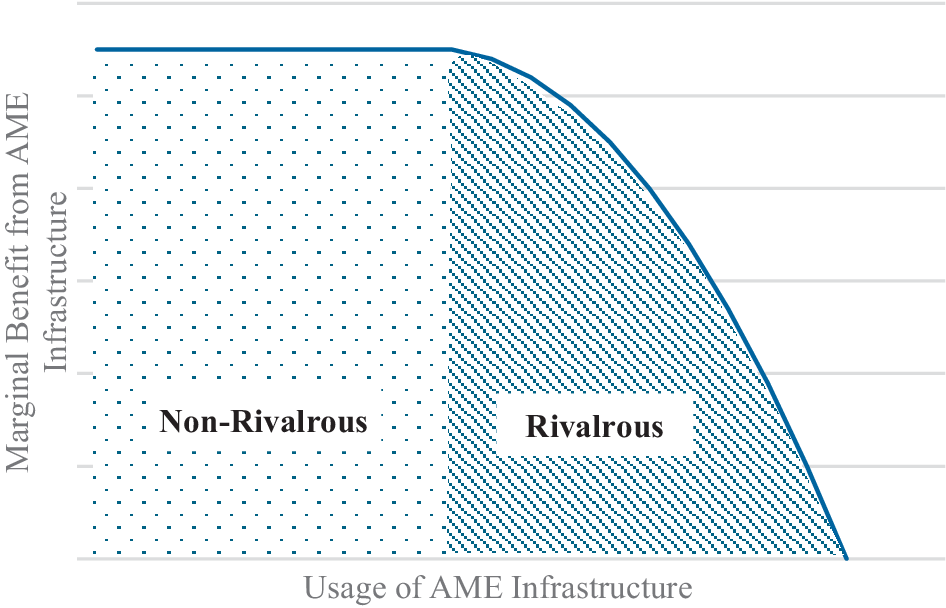
Firstly, AME is non-rivalrous over an appreciable range of its demand, up until the point where inappropriate use drives resistance in target microbes. Above this threshold, AME and the marginal benefit that can be derived from an additional unit of use diminish for all users, as demonstrated by Figure 1. Thus, the marginal cost of using AME infrastructure resources is zero until resistance arises, whereby the marginal cost rises with additional consumption. This is analogous to traffic causing road congestion when the number of cars exceeds the capacity constraint of the road. Partially nonrival resources have finite but potentially renewable and potentially shareable capacity; they are congestible but not necessarily congested. While the efficacy of antimicrobials as a CPR emphasizes a rivalrous nature, AME as infrastructure emphasizes potential non-rivalry. This shift in focus suggests that if we can manage the threshold for non-rivalry, the conservation of efficacy need not conflict with the promotion of universal access. Rivalrous consumption is not inevitable; sharing is technologically feasible. In this context, governance plays a key role.
Relationship between use of AME infrastructure and marginal benefit, illustrating that AME is non-rivalrous below a threshold level, while above the threshold, it is rivalrous, with marginal benefit (the additional benefit arising from a unit increase in AME use) diminishing with aggregate use.

Secondly, demand for AME is driven by downstream productive resources. AME is an important input to an effective health care system, a productive farming and agricultural sector, and robust biosecurity and defense systems, which are key to sustaining the health and productivity of the workforce and promoting economic and social well-being. Antimicrobials not only cure illnesses that were once considered fatal, but they have also become the backbone of modern medicine, enabling invasive health procedures and many other interventions, including cancer treatment and transplants. Nearly every procedure performed at nearly every hospital depends directly or indirectly on AME.
Health itself is an essential input to social well-being, worker productivity, and economic stability. As such, it is difficult to fully capture the range of different social and economic activities which rely on AME, and this accounting and measurement difficulty too easily leads to a public discounting of the immense social and economic value of AME. This leads to the third and equally important point that (and confounding to easy explanation or summary) many of these activities generate positive externalities. Two examples help to illustrate the nature of these positive externalities. First, treating a contagious illness in one person prevents them from infecting and harming others; this transmissibility value also has vital biosecurity and defence benefits. Second, AME is vital for safe caesarean sections and generates significant value for the mother undergoing the operation, but also considerable spillovers to other women who are reassured by the fact that there are safe procedures available should there be a complication in their pregnancy. Given the degree of positive health, social, and economic externalities arising from the multitude of downstream productive activities relying on AME, it is complex to quantitatively capture the true social benefit AME delivers. Thus, an infrastructural approach that emphasizes robust, sustained provisioning and non-discriminatory sharing to maximize these positive spillovers, alongside antimicrobial stewardship to ensure appropriate use, is socially optimal.
Similar logic has been successfully applied to the Internet, which has come to be viewed as a vital public infrastructure whose value depends on non-discriminatory access and whose benefits spill over across the economy and society.Reference Frischmann25 In the U.S., regulators explicitly drew on this framing in the Open Internet Order when reclassifying broadband as a telecommunications service to preserve open access.26 The policy rationale was that non-discriminatory connectivity supports a “virtuous cycle” of downstream innovation and investment, enabling the flourishing of new services and industries at the network’s edge. While the U.S. rules were rolled back, similar net neutrality principles remain a policy staple internationally.27 This precedent illustrates how infrastructure framing can guide governance choices toward maximizing positive spillovers — a lesson directly applicable to AME.
Conceptualizing AME as a key global infrastructure resource highlights the importance of AME to a huge diversity of stakeholders, presenting it as an investible resource that delivers system-wide economic and social benefits. Ensuring global access to, and non-discriminatory sharing of, AME infrastructure is crucial for maximizing the public and social gains derived from its downstream uses. This, in turn, supports improved health outcomes, fosters economic development and prosperity, and advances progress toward the Sustainable Development Goals. Infrastructure framing goes one step further than CPR models, which highlight the collective action dilemmas involved in antimicrobial provision and use; it supports and motivates a coordinated global policy approach across different sectors and scales. The AME framework may function as an axis to orient actors to conserve and enhance AME according to their capabilities, situation, and interests. Linking the value of an antimicrobial to its holistic role within AME infrastructure and the wider system-level value of AME, rather than to the antimicrobial’s individual market value, helps to orient the actions of individual doctors, veterinarians, and farmers to adhere to strict stewardship principles, encourages health systems and food systems to commit to infection prevention, stewardship and surveillance standards, and guides governments, investors, and philanthropists to address innovation and access challenges.
3. A Sustainable Management Approach for AME Infrastructure
Given the characteristics of AME as infrastructure, it is essential to design a sustainable management approach which resolves our current predicaments without compromising the ability of future generations to meet their needs. Sustainable management of the AME resource requires promoting universal access to maximize the health, social and economic benefits derived from it in the present, whilst conserving the efficacy of antimicrobials through stewardship of existing antimicrobials and innovative development of novel antimicrobials.
Sustainable and efficient management of AME involves five interdependent components: infection prevention, universal access, stewardship, surveillance, and innovation. Coordination across these components is critical to support a resilient and equitable AME infrastructure. Meanwhile, internalizing the costs imposed on AME and subsequently on social welfare by charging internalized overheads on predictable infections in hospital settings and hypothecated taxes on antimicrobial sales (as discussed in section 4) can reduce AME depletion, whilst revenues can be allocated towards its sustainable management.
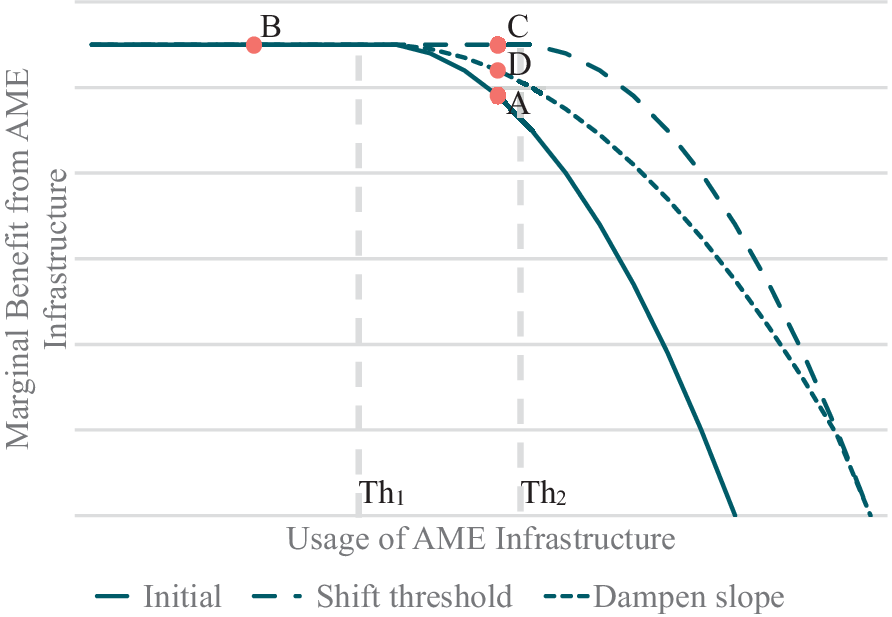
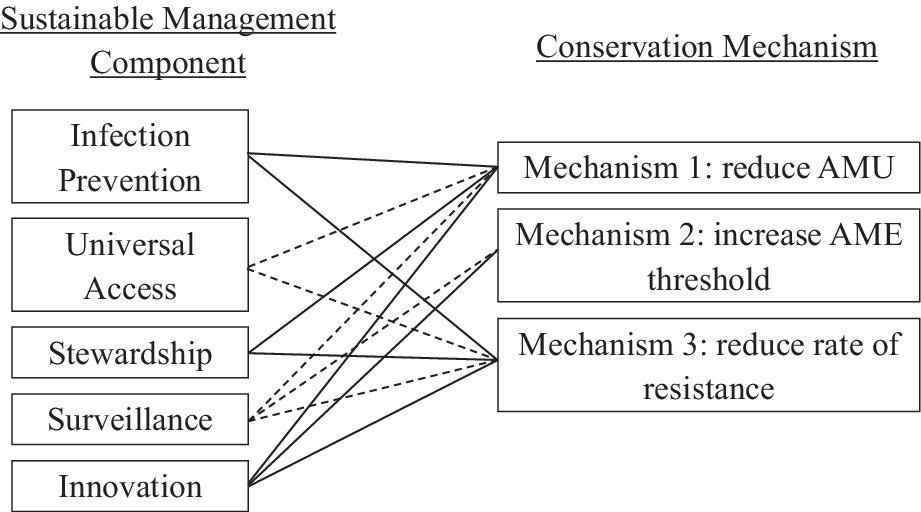
The five components of the sustainable management approach work to conserve AME infrastructure and the marginal benefit derived from it, through three key mechanisms, as represented in Figure 2. Suppose that we are at point A on the initial user benefit curve. Mechanism 1 conserves AME by reducing the use of antimicrobials, moving left along the initial curve towards B. Mechanism 2 shifts the threshold at which AME becomes rivalrous (Th1 to Th2), shifting to point C for a given usage level. Mechanism 3 reduces the rate at which resistance develops, dampening the slope beyond the rivalrous threshold, shifting to point D for a given usage level. In this section, we outline the role of each component, highlighting how they contribute to the conservation of AME (Figure 3).
The influence of different policy interventions on the relationship between the use of AME infrastructure and marginal benefit. Mechanism 1, reducing antimicrobial use, is represented by a movement from A to B along the initial curve. Mechanism 2, increasing the AME threshold, is represented by a shift in the threshold value from Th1 to Th2, whereby, for a given usage level, marginal benefit rises from A to C. Mechanism 3, reducing the rate of resistance, is represented by a dampening of the slope of the initial curve, whereby marginal benefit rises from A to D for a given usage level.

Figure 2. Long description
The x-axis is labeled Usage of A M E Infrastructure and the y-axis is labeled Marginal Benefit from A M E Infrastructure. A legend at the bottom identifies three curves. Initial is a solid teal line. Shift threshold is a dashed teal line. Dampen slope is a dotted teal line.
All three curves begin at the same high y-intercept and remain horizontal and overlapping until they reach a vertical dashed line labeled T h sub 1. At this point, the Initial solid line begins a concave downward decline. Point B is marked on the horizontal section before T h sub 1.
Further to the right, a second vertical dashed line is labeled T h sub 2. Between T h sub 1 and T h sub 2, the curves diverge.
* The Initial solid line continues its steep downward curve, passing through point A at the T h sub 2 intersection.
* The Shift threshold dashed line remains horizontal until T h sub 2, where it passes through point C and then begins its downward curve.
* The Dampen slope dotted line begins its decline at T h sub 1 but at a less steep rate than the Initial line, passing through point D at the T h sub 2 intersection.
To the right of T h sub 2, all three lines continue to decline toward the x-axis, with the Shift threshold line being the uppermost, followed by the Dampen slope line, and the Initial line being the steepest and lowest.
Schematic illustrating the mechanisms through which components of a sustainable management approach conserve AME infrastructure. Solid lines indicate direct relationships between sustainable management components and conservation mechanisms; dashed lines indicate indirect, facilitating relationships.

Figure 3. Long description
The flowchart consists of two columns.
The left column is titled Sustainable Management Component and contains five boxes stacked vertically from top to bottom
* Infection Prevention
* Universal Access
* Stewardship
* Surveillance
* Innovation
The right column is titled Conservation Mechanism and contains three boxes stacked vertically from top to bottom
* Mechanism 1 reduce A M U
* Mechanism 2 increase A M E threshold
* Mechanism 3 reduce rate of resistance
Connections are as follows
* Infection Prevention connects to Mechanism 1 and Mechanism 3 with solid lines.
* Universal Access connects to Mechanism 1 and Mechanism 3 with dashed lines.
* Stewardship connects to Mechanism 1 and Mechanism 3 with solid lines.
* Surveillance connects to Mechanism 1, Mechanism 2, and Mechanism 3 with dashed lines.
* Innovation connects to Mechanism 1, Mechanism 2, and Mechanism 3 with solid lines.
3.1. Infection prevention
Preventing infection reduces demand for antimicrobials and thus relieves selective pressure on pathogenic and non-pathogenic microbes, protecting the efficacy of existing antimicrobials (mechanism 1). Infection prevention is particularly important to prevent the spread of multi-drug-resistant pathogens, which require broad-spectrum antimicrobials, placing greater selective pressure on microbes, thus triggering a vicious spiral of escalating resistance (mechanism 3).
Water, sanitation, and hygiene (WASH) in community settings, infection prevention and control in health care settings, and appropriate biosecurity measures in animal and environmental settings are essential to reducing the spread of disease. Due to the global nature of disease and transmission patterns, a comprehensive, global One Health approach to infection prevention is necessary to support a sustainable global AME infrastructure. Weldon et al.Reference Weldon28 characterize this as a “weakest link” collective action dilemma, since neglect of infection prevention in one location can create reservoirs for AMR, which compromise global AME.
To internalize this payoff structure, it may be optimal for some countries to help enhance the capacity of other countries through shared knowledge commons, technology transfer, surveillance, and financial aid. Within the framing of infrastructure, the number of players with a vested interest in AME, and thus infection prevention, expands to include downstream economic agents. Supporting robust global infection prevention efforts thus requires behavioural change supported by investments in capacity and capability.
3.2. Universal access
Universal access to antimicrobials is important to maximize the health, economic, and social benefits derived from AME infrastructure, supporting the attainment of sustainable development goals. Furthermore, when combined with robust stewardship practices, access can play an important role in conserving the efficacy of antimicrobials. Access to appropriate antimicrobials can reduce the spread of infection (mechanism 1), facilitate accurate prescription whilst conserving Watch and Reserve antimicrobials (mechanism 3),29 and reduce use of substandard and falsified alternatives (mechanism 3).Reference Baraldi30 To realize these benefits, it is important to build stewardship principles into access arrangements, as in the UK de-linkage model,Reference Pandey31 which separates revenue from volume sales, removing the incentive for overuse and thus preventing access leading to excess.
In this context, access is also subject to “weakest link” collective action dilemmas,Reference Weldon32 since lack of access in one location can compromise global AME infrastructure. Supporting robust, universal access requires careful consideration of the physical and clinical properties of antimicrobials and diagnostics, which influence their ease of access, administration, and stewardship, alongside attention to the market and regulatory forces shaping international drug markets.
3.3. Stewardship
Antimicrobial stewardship (AMS) is the strategic and responsible management of AMU to conserve AME. Stewardship is important to ensure that the right antimicrobial is prescribed in the right dose for the right duration for a given infection, minimizing the selective pressure on microbes (mechanisms 1 and 3). Prospective AMS across health care settings with high infection risk is also important to minimize infection risks and optimize antimicrobial prescription when infection arises.Reference Agrawal33 This could be supported by internalized overheads for predictable infection to compensate for the potential impact of invasive health procedures on AME.
Effective stewardship relies on diagnostic capacity to identify appropriate treatments, and on universal access to facilitate prescription of appropriate antimicrobials.
Whilst AMS measures bring direct benefits to health care systems and public health, they also generate diffuse benefits through contributing to global AME. Such positive spillovers can result in a commons dilemma, with individual countries, industries and organizations underproviding stewardship measures relative to the global social optimum. Comprehensive global stewardship requires global coordination and robust regulation.Reference James34
3.4. Surveillance
Surveillance of AMU and AMR is important both for public policy and the pharmaceutical industry. Surveillance helps policymakers to understand the nature of global health problems, map disease burdens, and identify disease outbreaks and global health threats, enabling early interventions and thus minimizing social and economic impacts. Surveillance data can be used to predict the social value of antimicrobials and the social cost of inaction, thus incentivizing policy action and providing reliable evidence for policy appraisal and optimization over time. Global surveillance facilitates global cooperation by generating accountability and facilitating incentive compatibility for international commitments. Surveillance is also necessary for pharmaceutical firms to fulfil their post-approval regulatory requirements, to track efficacy and resistance trends, and to support pharmacovigilance and medicine label expansion. It helps industry to identify unmet clinical needs and patterns of disease prevalence, guiding their R&D efforts and informing their marketing strategies. Absence of appropriate surveillance generates uncertainty regarding the AME non-rivalry threshold and our current consumption position relative to it in Figure 1; this may result in the threshold becoming suddenly apparent and hence too late to mitigate.
3.5. Innovation
Innovation in new antimicrobials is key to supporting the long-term sustainability of AME infrastructure by ensuring that effective antimicrobials are available when older antimicrobials become ineffective (mechanism 2). Meanwhile, innovation in diagnostics, vaccines, and alternative treatments, e.g., bacteriophages, is important to promote the efficacy of existing antimicrobials by improving the accuracy of AMU and reducing the need for AMU (mechanisms 1 and 3). The R&D pipeline is currently insufficient to support a robust global AME infrastructure.35 Innovation faces scientific, regulatory and economic challenges; it is important to distinguish these and the unique barriers they pose.
Infection prevention, universal access, surveillance, stewardship, and innovation are all vital, multifaceted and interdependent elements of a sustainable management approach. An axis of AME infrastructure, revolving around the joint and complementary goals of efficacy and access, will advance these initiatives further through highlighting complementarities and conflicts between approaches and emphasizing the shared global gains of non-discriminatory sharing of a global AME infrastructure.
4. Implications of AME as Infrastructure
Framing AME as a global economic infrastructure highlights the fundamental role AME plays throughout the economy. Building upon theories that conceptualize antimicrobials as a common-pool resource, this framework identifies not only the collective action dilemmas, but also the relevant economic actors and the pervasive health, social, and economic payoffs characterizing these dilemmas. Subsequently, AME may be positioned as an investable asset — one in which all stakeholders have both an incentive and a responsibility to conserve.
The degradation of AME undermines system-wide productivity and drives up public expenditure, making its conservation not just a public health concern, but a systemic economic imperative.Reference Jonas36 This logic is increasingly recognized in emerging valuation approaches, such as the health technology assessment STEDI (Spectrum, Transmission, Enablement, Diversity, Insurance) framework, which captures the enablement and insurance value of antimicrobials, Reference Rothery37 and broader macroeconomic analyses such as the Centre for Global Development’s “Forecasting the Fallout from AMR,” which estimates the downstream labor market and tourism impacts of AMR.Reference McDonnell38
De-linkage funding models are a salient illustration of holistic policy approaches that seek to sustainably manage AME infrastructure. Alongside incentivizing R&D in novel antimicrobials through promising financial return, de-linkage models can be designed to guarantee access whilst facilitating stewardship. The UK’s subscription model, the EU’s proposals for transferable exclusivity vouchers, and Sweden’s revenue guarantee pilot demonstrate meaningful progress made by governments to pursue a holistic, sustainable management approach for AME.
Yet these initiatives remain limited in scale and scope, with efforts largely confined to government-led models that leave markets and private actors under-engaged in internalizing AME’s value. Sustainable management requires extending financial responsibility to investors, pharmaceutical firms, health care providers, and patients, embedding AME within broader economic and financial systems rather than treating it solely as a matter of public expenditure or health policy.
4.1. Aligning Contribution with Benefit
4.1.1. Hypothecated Taxes
Recognizing that demand for AME is derived from demand for downstream productive activities, and that these activities often generate positive external benefits, highlights the need to understand the nature and patterns of such payoffs. Given that society as a whole benefits from AME through improved health and living standards, public provision of AME infrastructure through general taxation is justified. However, closer scrutiny of chains of dependency and patterns of payoffs suggests that some individuals and sectors derive disproportionately higher private benefits from AME, while contributing greater resistance-related externalities.
This creates a rationale for targeted fiscal interventions aimed at internalizing the resistance-related social costs associated with AMU. Pigouvian taxation sets the tax equal to the external social cost of the activity, thereby aligning private and social incentives. When such a tax is hypothecated, revenues are earmarked for a specific purpose; in this case, revenues would be dedicated to the conservation and sustainable management of AME.
When designing this tax, it is important to consider the holistic value of AME infrastructure, to respect the balance between ensuring appropriate use to conserve efficacy and maintaining equitable access, and to consider the possibility of unintended consequences. The literature suggests that taxes should be set at a national level, rather than a global level, to reflect local epidemiological, economic, and institutional conditions.Reference O’Neill39 Further, exemptions and multi-tiered rates may be required at the patient level to protect equity.Reference O’Neill40 Differential rates could also be introduced at the drug level based on the spectrum of activity or the WHO AWaRe classification (which classifies drugs into Aware-Watch-Reserve categories based on their spectrum of activity, potential to develop AMR, and importance to human medicine).41 This would allow for higher taxes to be placed on drugs which present higher resistance pressure, thus, taxes would more closely reflect the external cost of AMU, whilst also encouraging switching from broad-spectrum to narrow-spectrum antimicrobials where clinically appropriate.Reference Bokhari and Alex42
It is important to consider how taxes change market incentives and how pharmaceutical companies, health care systems, prescribers, and patients may respond. Pharmaceutical companies may see a decline in profitability and thus reduce marketing of existing antimicrobials or reduce investment into new ones, whilst in health care systems, prescribers and patients may adjust behaviours in ways that counter public health goals. Understanding these potential unintended consequences is critical to ensuring a sustainable supply of antimicrobials and maintaining equitable provision of health care. Carefully designed taxes would deter low-value AMU and internalize the costs of necessary use whilst balancing the incentives of stakeholders.
4.1.2. Internalized Overheads
Beyond direct treatment of infection, AME functions as a critical enabler of high-value medical procedures, including invasive surgery and immunosuppressive cancer therapies, for which effective infection prevention and treatment are essential.43 These procedures, however, impose a cost on AME through increasing AMU and thus raising resistance pressure. Applying the “polluter pays” principle, procedures that both depend on and deplete AME could contribute overhead fees proportionate to the costs they impose. Internalized overheads for predictable infection could incorporate infection risk and AME conservation into the economic calculus of health care delivery. This principle can be operationalized at multiple levels.
Pharmaceutical producers introducing therapies that rely upon or erode AME could be mandated to quantify the anticipated impact on AMR, define an infection management program to minimize the impact, and contribute proportionally to AME conservation funds. This approach parallels environmental regulatory regimes in which firms bear financial responsibility for ecological externalities.
Clinical procedures could integrate risk-adjusted levies reflecting their predictable infection burden, associated health care costs, and AME impact. For example, prosthetic hip and knee joint replacement carry a 0.62% and 0.75% risk,Reference Blom44 respectively, of deep wound infection, with treatment costs of up to £100,000Reference Briggs45 and further impacts on AME. A surcharge of up to £800 per procedure, dedicated to treating consequent infections and conserving AME, would represent a rational internalization of this externality.
Health systems could introduce internalized overheads for predictable infections across hospital settings linked to the estimated burden on AME and tethered to AME conservation. McDonnell et al. estimate that the global cost of AME will be US$159 billion by 2050.Reference McDonnell46 Taxing procedures that harm AME is one step towards internalizing this cost. AME overheads generate a pot of money that can be allocated to sustainable management of AME, whilst also incentivizing infection control and responsible AMU.
4.1.3. Internalized Investment
A similar principle could apply to investors in health care or food systems. Pharmaceutical companies that develop cancer treatments depend on the existence of antimicrobials to administer their treatments and earn a return,Reference Shimabukuro-Vornhagen and Williams47 whilst animal husbandry relies on antimicrobials to treat sick animals and control outbreaks.48 In turn, both impose a cost on AME through efficacy depletion. Thus, investors with an interest in long-term returns have an interest in the preservation of AME infrastructure. Re-investing profits from health care or food system investments to conserve necessary AME infrastructure helps to internalize the costs that such investments impose.
4.2. Mobilizing Capital Markets for Systemic Risk Reduction
Infrastructure framing can also enable strategic engagement with global capital markets. Given that economic growth and sectoral returns are increasingly contingent on robust health systems and food systems, AME plays an important role in building resilience against systemic risk. Large, institutional investors with diversified portfolios have a principal interest in the performance of the global economy and in managing exposure to systemic risks that could undermine it, since this is a core determinant of their portfolio performance.
This logic underpins the work of the Shareholder Commons, an independent non-profit organization that seeks to address social and environmental risks from the perspective of diversified shareholders who aim to optimize risk-adjusted returns across the market as a whole. The Shareholder Commons recognizes the divergence between a company’s incentive to maximize individual cash flows and shareholders’ broader interest to optimize overall market performance. They seek to catalyze shareholder-created “guardrails” which specify coordinated minimum rules of conduct designed to prevent companies from externalizing social and environmental costs, which may optimize company cashflows but ultimately undermine systemic value.
Their case study on AMRReference Bugden49 focuses on AMU in the food industry and recognizes the harm caused by antimicrobial overuse. They propose the imposition of “guardrails,” which set coordinated standards on AMU to level the playing field and potentially accelerate the adoption of comprehensive regulation. This idea should be explored further; reducing systemic risk can be achieved both by reducing harmful behaviour, such as antimicrobial overuse and inappropriate use, and by consciously engaging in beneficial behaviours, such as investing in WASH infrastructure. It is important to consider how system-level investment can achieve risk reduction through both channels.
Employing a similar reasoning, the Investor Action on AMR (IAAMR) initiative seeks to safeguard society, economies and the long-term value of investment portfolios by encouraging investors to formally assess and integrate AMR risks, opportunities and impacts using a One Health approach. IAAMR investor partners engage with investee companies regarding AMU and AMS practices, raise public awareness of AMR, advocate for regulatory changes, engage with ESG (Environmental, Social, and Governance) data providers to develop key performance indicators for AMR, and develop guidelines on how investors can adopt an AMR lens.Reference Davies50
Whilst investors are uniquely placed to contribute to AME, the Shareholder Commons suggests the need for a Commons approach to coordinate action, whilst IAAMR suggests the need for complementary changes to regulation and policy to overcome the incentivization challenge.
4.3. AME as an Axis Across Scales and Systems
A theory of AME infrastructure establishes a central axis for polycentric decision-making across different scales, inviting systems thinking to promote global health and economic well-being.
4.3.1. Global
At the global scale, infrastructure framing highlights the interdependence of nations and emphasizes the necessity of cooperative and coordinated action. This is a vital message to HICs, which have a significant role to play in supporting LMICs through knowledge sharing, capacity building, and investment. Whilst assistance in infection prevention, universal access, stewardship, and surveillance structures are important for the sustainable development of the recipient nation, it also benefits the donor countries through strengthening the weakest link of global AME infrastructure and thus reducing global systemic risks.
4.3.2. National
At the national scale, governments and regulators are responsible for setting regulations and guidelines and for determining their involvement in global affairs. An axis of AME infrastructure highlights the responsibility of a nation within the global framework, whilst also recognizing the opportunity for interdependent and synergistic action across nations.
4.3.3. Local
At the local scale, clinicians, veterinarians, pharmacists, individual health care facilities, and patients exercise decision-making capacity that can have cascading effects on global AME. While many of these actors operate within national or transnational regulatory and institutional frameworks, their day-to-day choices regarding antimicrobial use are enacted in specific local contexts and aggregate into global resistance dynamics.
A narrow, homo economicus view of decision making may suggest that, where the decision of a single actor to misuse antibiotics has negligible effects on global systems, they should do so if it maximizes their material gain. However, recognition of the polycentric and synergistic nature of decision-making and the potential for complex, non-linear, system-wide consequences across interconnected AME infrastructures highlights the responsibility of agents operating at the local level.
Many interdependent AME infrastructures operate at different scales and in different contexts, coalescing into a global AME infrastructure. Protecting the AME infrastructure within an individual’s immune system, within a hospital, within a nation, and within a continental region all contribute to conserving AME globally and protecting the health and economic benefits it delivers.
By recharacterizing AME as critical economic infrastructure, policymakers and funders are better positioned to justify ambitious, coordinated, and economically sound investments in its conservation.
5. Conclusion
Adam Smith recognized the importance of public works that support the well-being and productivity of society. In this spirit, AME can be seen as a form of public infrastructure that underpins a modern and productive society and economy. Contemporary debate has progressed beyond viewing AMR as a siloed public health issue, towards recognizing the systemic risks and economic impacts it poses. Framing AME as a global economic infrastructure builds on this progress, offering a coherent framework to structure action, align incentives and mobilize investment. This framing formalizes the intuition that efficacy of, and equitable access to, antimicrobials underpin system-wide productivity and resilience, and that the degradation of efficacy and access threatens not only health outcomes but economic stability across sectors and borders.
This enlightened understanding of AME guides a more strategic approach to conserve it, highlighting policy tools and responsible stakeholders, while providing an organizing axis for multi-scalar coordination. An infrastructure framing of AME highlights how resources can be mobilized from a broader set of stakeholders to internalize externalities, aligning contribution with benefit through engagement with tax policy, institutional practice, and capital markets, through hypothecated taxes, internalized health care overheads, and internalized investment models. It provides the logic for embedding AME within ESG investment frameworks and systemic risk reduction agendas and offers justification for the prioritization of AME by policymakers, industry, and health care providers.
Local actors — patients, prescribers, individual health care facilities, investors — interact with AME through behaviours and norms that influence global trends. National governments shape both domestic and international stewardship capacity. International institutions manage interdependencies and vulnerabilities that span borders. Recognizing AME as infrastructure formalizes the principle that decisions at any one level have cascading effects across the whole system — and, crucially, that this interdependence can be harnessed for the collective good.
Many of the ideas proposed here are not new in substance — elements of them are already in motion through stewardship programs, valuation models, and cross-border initiatives. However, they remain dispersed, often lacking the unifying logic that infrastructure framing can provide. By formalizing this framing, we improve our ability to coordinate across sectors and scales and support sustained, strategic, and properly resourced action.
Acknowledgements
We thank the attendees of the inaugural Panmure House Dialogue on Antimicrobial Effectiveness for their engagement and discussion of the key topics addressed in this paper. We are also grateful to Maria Souza (Baillie Gifford) and Prof. Ana Santos Rutschman (Villanova University) for their thoughtful comments on earlier drafts of the manuscript.
Disclosure of funding
This research received no external funding.

 Open access

