It is now widely believed that being the teacher figure in class involves more than giving students activities to do, that is in light of the fact that certain personal aspects of students, like their development of a sense of autonomy, seem to be influenced by everything teachers say and do. For over a decade, research has suggested that the type of personal and instructional support teachers provide to their pupils conditions pupils’ learning intentions and level of academic commitment (Ames, Reference Ames and Roberts1992; Stipek & Gralinski, Reference Stipek and Gralinski1996; Turner et al., Reference Turner, Midgley, Meyer, Gheen, Anderman, Kang and Patrick2002). Teachers’ interpersonal behavior style can be categorized as either autonomous or controlling, and the importance of those dimensions lies precisely in their direct impact on students’ motivation during activities (Reeve, Reference Reeve, Deci and Ryan2002, Reference Reeve2009; Ryan & Deci, Reference Ryan and Deci2000). Teachers who often support their pupils’ autonomy are receptive, praise them for their achievements, explain tasks clearly, and provide them with opportunities to take personal initiative and work independently. This interactive style is positively correlated with students’ intrinsic motivation to do an activity (Balaguer, Castillo, Duda, Quested, & Morales, Reference Balaguer, Castillo, Duda, Quested and Morales2011; Reeve, Reference Reeve, Deci and Ryan2002). Conversely, a controlling teacher takes charge of every task, quickly answers every problem him or herself, and pressures students with a critical, threatening style, all of which negatively affect students’ intrinsic motivation (Mageau & Vallerand, Reference Mageau and Vallerand2003).
Within the physical education sphere, the research suggests creating a context where students feel effective and actively participate in decision-making will yield higher levels of satisfaction with, and appraisal of, the activity by increasing self-determined motivation (Balaguer, Castillo, Duda, & Tomás, Reference Balaguer, Castillo, Duda and Tomás2009; Joesaar, Hein, & Hagger, Reference Joesaar, Hein and Hagger2012; Weiss, Amorose, & Wilko, Reference Weiss, Amorose and Wilko2009). Furthermore, in addition to these factors that have to do with fomenting autonomy and motivational climate, other more social aspects also condition students’ behavior in physical education class, and the state of the art in research recommends taking them into account given their potential role in motivation (e.g. Allen, Reference Allen2003). These motivations for behavior, termed “social goals” (Urdan & Maehr, Reference Urdan and Maehr1995), have been compiled recently in the latest studies within the field of physical education (Moreno, Hernández, & González-Cutre, Reference Moreno, Hernández and González-Cutre2009). However, the existing body of research remains scant and some authors recommend further clarifying the delineations currently drawn between certain concepts. Along those lines, Guan, McBride, and Xiang (Reference Guan, McBride and Xiang2006) consider the goals of responsibility and relationship with others among the most important to physical education. The responsibility goal reflects the desire to respect social norms and established roles (Wentzel, Reference Wentzel1991), while the relationship with others goal refers to the desire to maintain good relations with one’s peers (Ryan, Hicks, & Midgley, Reference Ryan, Hicks and Midgley1997). Although, as mentioned above, only few studies have analyzed social goals in physical education and sport classes to date, relationship with others and responsibility goals are linked to positive outcomes like persistence in the activity and enjoyment of it (Allen, Reference Allen2003; Cecchini et al., Reference Cecchini, González, Méndez, Fernández, Contreras and Romero2008; Guan, Xiang, McBride, & Bruene, Reference Guan, McBride and Xiang2006).
According to Vallerand’s (Reference Vallerand and Roberts2001) hierarchical model of intrinsic and extrinsic self-determined motivation (HMIEM) applied to physical education, these social factors are precursors to satisfaction of the basic psychological needs for competence, autonomy, and relatedness, which foment motivation in students. In addition, the social factors’ impact on motivation is mediated by students’ perceptions of their own competence, autonomy, and relatedness. If one of the three basic psychological needs is thwarted, however, the student could exhibit amotivation as a result (Ryan & Deci, Reference Ryan and Deci2000). Recently, Moreno, Parra, and González-Cutre (Reference Moreno, Parra and González-Cutre2008), in a sample of 399 physical education students ranging in age from 14 to 16 years-old, found that the social goals of responsibility and relationship with others positively predict satisfaction of the need for relatedness, but in the case of autonomy support, the association was not statistically significant. Meanwhile, satisfying the need for relatedness negatively predicted amotivation. Clearly, encouraging social relationships plays an important role in physical education; that is one of physical education’s main functions. Standage, Duda, and Ntoumanis (Reference Standage, Duda and Ntoumanis2006), using a structural equations model, reported that perceived autonomy support in teachers positively predicted satisfaction of the needs for competence, autonomy, and relatedness, which in turn positively predicted self-determined motivation. Furthermore, self-determined motivation was found to positively predict students’ effort and persistence in class.
Therefore, creating a class environment that favors supervised freedom and positive feedback and encourages relationship and personal triumph will help students attain greater intrinsic motivation (Deci & Ryan, Reference Deci and Ryan1985; Ryan & Deci, Reference Ryan and Deci2000). In addition, when it comes to physical exercise practice, an array of studies has suggested possessing a high level of intrinsic motivation favors creating and maintaining more positive behavioral patterns, for example, intention to keep training in sport (Vallerand, Reference Vallerand, Tenenbaum and Eklund2007). Nevertheless, although numerous studies have used self-determination theory as a frame of reference to demonstrate that basic psychological needs, by mediating social factors, positively predict students’ intrinsic motivation (e.g., Moreno et al., Reference Moreno, Parra and González-Cutre2008; Standage et al., Reference Standage, Duda and Ntoumanis2006), and that intrinsic motivation is positively linked to other desirable behavioral outcomes (García-Calvo, Sánchez, Leo, Sánchez, & Amado, Reference García-Calvo, Sánchez, Leo, Sánchez and Amado2011; Lim & Wang, Reference Lim and Wang2009), very few studies have combined these variables’ inter-relationships into a single explanatory model. Along those lines, Almagro, Sáenz-López, González-Cutre, and Moreno-Murcia (Reference Almagro, Sáenz-López, González-Cutre and Moreno-Murcia2011), in a sample of 580 athletes with an average age of 14 years, recently tested a sequence from self-determination theory. They posited ego climate (focused on results and competitiveness) and task climate (focused on the learning process) as social factors, and intention to keep practicing physical exercise in the future as an outcome. Using a structural equations model, they found that satisfying the three basic psychological needs is positively associated with task climate, which positively predicts intrinsic motivation, and that in turn predicts intention to be physically active in the future. Other studies that have included social goals (e.g. Moreno et al., Reference Moreno, Parra and González-Cutre2008, Reference Moreno, Hernández and González-Cutre2009), autonomy education (Almagro, Sáenz-López, & Moreno, Reference Almagro, Sáenz-López and Moreno2010), and autonomy support (Moreno et al., Reference Moreno, Parra and González-Cutre2008; Vansteenkiste, Lens, & Deci, Reference Vansteenkiste, Lens and Deci2006) as social factors have reported them to be positively correlated with satisfaction of a basic psychological need, or with intrinsic motivation. Yet no study to date has considered these social factors in combination as precursors to the basic psychological needs for autonomy, competence, and relatedness. For that reason, and due to our interest in examining these variables’ influence on intrinsic motivation and students’ intention to continue practicing physical exercise in the future, and also given the distressing rates of quitting sport during adolescence (Granda, Montilla, Barbero, Mingorance, & Alemany, Reference Granda, Montilla, Barbero, Mingorance and Alemani2010), this study for the first time proposes an integrative model of motivation based on fomenting autonomy that, in contrast to the isolationist model made up of separate relationships (autonomy-motivation, goals-motivation), aims to respond to social, cognitive, and behavioral aspects involved in physical exercise practice. Toward that end, we present a structural equations model that hypothesizes that a class climate marked by autonomy education and support, and social goals of relationship with others and responsibility, will positively predict satisfaction of the three basic psychological needs. Meanwhile, the needs for competence, autonomy, and relatedness will positively predict intrinsic motivation, which will in turn predict intention to keep training in sport (Almagro et al., Reference Almagro, Sáenz-López and Moreno2010). Last, to complete the model so it can be applied to physical education in the future, we hypothesize that intention to keep training in sport will be positively correlated with the students’ rates of physical exercise.
Method
Participants
This study’s sample was comprised of 698 physical education students (331 boys and 367 girls) ranging in age from 12 to 16 years-old (M = 14.15, SD = 1.44) and attending ten public high schools in the Spanish territory.
Instruments
Autonomy-supportive Coaching Questionnaire (ASCQ) The Spanish translation by Conde et al. (Reference Conde, Sáenz-López, Carmona, González-Cutre, Martínez and Moreno2010) of the original questionnaire (Conroy & Coatsworth, Reference Conroy and Coatsworth2007) was employed. It evaluates the autonomy education in physical education classes via two forms of autonomy support: Interest in the athlete’s opinion (five items, e.g. “My coaches ask for my opinion about what I want to do in practice”) and praising autonomous behavior (four items, e.g. “My coaches praise me for the things that I choose to do in practice”). It utilizes a Likert-type scale spanning 1 (not at all true) to 7 (very true). Each sentence starts with “In my physical education classes….” The Cronbach’s alpha values obtained were .88 and .81, respectively.
Perceived Autonomy Support Scale for Exercise Settings (PASSES) The Spanish translation (Moreno et al., Reference Moreno, Parra and González-Cutre2008) of the original scale (Hagger et al., Reference Hagger, Chatzisarantis, Hein, Pihu, Soós and Karsai2007) was employed. It consists of a total of 12 items grouped into a single factor (autonomy support) that measure physical education students’ perceptions of the autonomy their coach grants them. It stands apart from the ASCQ described above in that it evaluates how much encouraging autonomy in physical exercise practice within a class context transcends into leisure time. Each sentence begins “In my physical education classes…” and items (e.g. “My PE teacher cares about the active sports and/or vigorous exercise I do in my free time”) are answered on a Likert-type scale from 1 (strongly disagree) to 7 (strongly agree). This questionnaire’s internal consistency was found to be Cronbach’s alpha = .92.
Social Goals in Physical Education The Spanish version (Moreno, González-Cutre, & Sicilia, Reference Moreno, González-Cutre and Sicilia2007) of the Social Goal Scale-Physical Education (SGS-PE) by Guan et al. (Reference Guan, McBride and Xiang2006) was utilized. It includes a total of 11 items grouped into two factors: relationship goal (six items) (e.g. “I would like to get to know my school friends really well”) and responsibility goal (five items) (e.g. “I try to do what the teacher asks me to do”). Each item begins “In my physical education class…” and questions are answered on a Likert-type scale ranging from 1 (not at all true for me) to 7 (very true for me). The questionnaire yielded Cronbach’s alpha values of .78 on the relationship goal factor and .85 on the responsibility goal factor.
Basic Psychological Need Satisfaction The Psychological Need Satisfaction in Exercise Scale (PNSE) by Wilson, Rogers, Rodgers, and Wild (Reference Wilson, Rogers, Rodgers and Wild2006) was used. It was validated in the Spanish context by Moreno-Murcia, Huéscar, and Cervelló (Reference Moreno-Murcia, Huéscar and Cervelló2012). The PNSE consists of 18 items, six to assess each need: competence (e.g. “I am confident about doing the most challenging exercises”), autonomy (e.g. “I believe I can make decisions in my training sessions”), and relatedness (e.g. “I feel I can relate to my training companions because they accept me for who I am”). All statements begin with the phrase “In my physical education classes…” and responses are given on a Likert-type scale with scores ranging from 1 (false) to 6 (true). The Cronbach’s alpha values obtained were .74 on the competence sub-scale and .70 on autonomy and relatedness.
Intrinsic Motivation The general intrinsic motivation factor from the Spanish translation (Moreno-Murcia, Marzo, Martínez-Galindo, & Conte, Reference Moreno-Murcia, Marzo, Martínez-Galindo and Conte2011) of the Behavioral Regulation in Sport Questionnaire (BRSQ) by Lonsdale, Hodge, and Rose (Reference Lonsdale, Hodge and Rose2008) was used. The factor is made up of four items (e.g. “because I enjoy it”) preceded by the stem phrase “I practice physical exercise in my classes….” Responses are given on a Likert-type scale ranging from 1 “not at all true” to 7 “very true.” This factor’s Cronbach alpha value was found to be .93.
Intention The intention factor from the Cuestionario de la Teoría de la Conducta planeada (TCP) [Theory of Planned Behavior Questionnaire] by Tirado, Neipp, Quiles, and Rodríguez-Marín (Reference Tirado, Neipp, Quiles and Rodríguez-Marín2012) was utilized. It includes four items (e.g. “I plan to exercise at least 6 times in the next two weeks”), all of which are answered on a Likert-type scale from 1 (strongly disagree) to 7 (strongly agree). The Cronbach alpha value obtained was .87.
Habitual Physical Activity To measure participants’ normal physical activity, the Spanish version (Sarria et al., Reference Sarria, Selles, Cañedo-Arguelles, Fleta, Blasco and Bueno1987) of the Habitual Physical Activity Questionnaire by Baecke, Burema, and Frijters (Reference Baecke, Burema and Frijters1982) was used. This questionnaire covers the last 12 months and generates three habitual physical activity scores: physical activity at work, sport during leisure time (SLT), and physical activity during leisure time excluding sport (ALTES). Since this study was conducted in students, only SLT and ALTES were applied. The sum of the two produced a total score (TS) on habitual physical activity. The SLT score was calculated by means of four questions. The first covers the type of sport or sports practiced, their weekly frequency, and how many months out of the year they are practiced. Scores on this first question were calculated by applying the following formula: Modality 1 (Intensity x Time x Proportion) + Modality 2 (Intensity x Time x Proportion). Different coefficients were assigned to compute using this formula according to the sport practiced, hours weekly, and months of the year practiced (see Ainsworth et al., Reference Ainsworth, Haskell, Whitt, Irwin, Swartz, Strath and Leon2000; Florindo & Latorre, Reference Florindo and Latorre2003). The other three questions tapped level of physical activity during leisure time (e.g. “During leisure time I play sport”) on a Likert-type scale ranging from 1 (never) to 5 (very often). To calculate an SLT score, the score on the first question is converted to a scale from 1 to 5, then the mean score across the four questions is calculated. To compute an ALTES score, the mean of the other four questions, which asses level of physical activity during leisure time other than sport (e.g. “During leisure time I walk”), was taken on a Likert-type scale from 1 (never) to 5 (very often).
Procedure
Schools were selected in accordance with a random sampling technique with clustering (Azorín & Sánchez Crespo, 1986). To collect data, we contacted ten high schools that offer compulsory secondary education, informing them of our research objectives and requesting their collaboration. After obtaining the necessary authorization from students’ parents, questionnaires were administered under the supervision of the study’s primary investigator. The questionnaires took approximately 25 minutes to complete.
Data Analysis
First, a descriptive and correlational analysis was carried out on all the study’s variables. Second, to determine the relationships among the proposed variables, the two-step approach proposed by Anderson and Gerbing (Reference Anderson and Gerbin1988) was employed. In the first step, the measurement model’s construct validity was tested through confirmatory factor analysis. Items comprising the latent factors were randomly divided into two groups and we conducted an analysis of the 16 measures taken and 9 latent constructs, which freely correlate (Anderson & Gerbing, Reference Anderson and Gerbin1988). In the second step, a structural model was created to analyze the predictive relationships among the variables being examined. All analyses were performed using the SPSS 19.0 statistical package and AMOS 19.0.
Descriptive and Correlational Analysis of All Variables
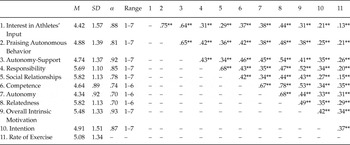
With regard to autonomy education, praising autonomous behavior was the variable most highly rated by students. As for social goals, students rated the relationship goal the highest. Of the three psychological mediators, the competence variable was scored the highest, followed by relatedness and perceived autonomy (Table 1). The correlational analysis, on the other hand, revealed that autonomy education, autonomy support, social goals, the psychological mediators, overall intrinsic motivation, intention to be physically active, and rate of exercise were all positively, significantly correlated with one another.
Means, Standard Deviations, Alpha Coefficient, and the Variables’ Correlations

*p < .05; ** p < .01
Measurement Model
To enable us to analyze the measurement model and test the structural equations model (SEM), the number of latent variables was reduced by factor. This is advisable especially when the sample size is not particularly large compared to the number of variables in the model (Marsh, Richards, Jonson, Roche, & Tremayne, Reference Marsh, Richard, Johnson, Roche and Tremayne1994; Vallerand, Reference Vallerand1997). This reduction was achieved by pairing off items. Thus, the first two items in each sub-scale were averaged, making them the first item pair, the next two items were averaged, making them the second item pair, and so on and so forth to the last pair. Marsh et al. (Reference Marsh, Richard, Johnson, Roche and Tremayne1994) proposed using item pairs because their results would be more reliable, tend to be normally distributed, and would cut in half the ratio between the number of measured variables in the model and the number of study participants.
Due to the fact that Mardia’s coefficient was found to be high (80.2), our analysis utilized the maximum likelihood method of estimation as well as a bootstrapping procedure, allowing us to assume the data were robust despite any non-normal distribution (Byrne, Reference Byrne2001). Thus, a series of fit coefficients were taken into account in assessing the measurement models’ goodness of fit to the empirical data collected. Based on what various authors have suggested (Bentler, Reference Bentler1990; Bollen & Long, Reference Bollen and Long1993; McDonald & Marsh, Reference McDonald and Marsh1990; Mulaik et al. Reference Mulaik, James, Van Astine, Bennett, Lind and Stilwell1989), the following goodness of fit indices were considered in evaluating the measurement model’s fit: χ2, χ2/df, RMSEA (Root Mean Square Error of Approximation), RMSR (Root Mean Square Residual), and incremental fit indices (CFI, IFI, and TLI). The goodness of fit indices are considered acceptable when χ2/df is less than 5, while the incremental fit indices (CFI, IFI, and TLI) must be greater than .90, and the error measures (RMSEA and RMSR) should be less than .08 (Browne & Cudeck, Reference Browne, Cudeck, Bollen and Long1993; Hu & Bentler, Reference Hu and Bentler1999). This analysis yielded the following indices: χ2 (84, N = 698) = 273.6, p < .001; χ2/df = 3.25; CFI = .97; NFI = .95; TLI = .95; RMSEA = .05; RMSR = .02. The model’s discriminant validity was also examined, requiring that the correlation between latent variables, attenuated by measurement error (+/– 2 times measurement error), be less than 1.0. According to all the indicators described above, the results indicate the measurement model was adequate.
Structural Equations Model
In order to analyze the relationships between the variables belonging to the proposed model (autonomy education, autonomy support, social goals, psychological mediators, intrinsic motivation, intention to stay active, and rate of exercise), a Structural Equations Model was utilized. Given that Mardia’s coefficient was high (80.2), our analysis utilized the maximum likelihood method of estimation as well as a bootstrapping procedure, allowing us to assume the data were robust despite any non-normal distribution (Byrne, Reference Byrne2001). A test of the model’s goodness of fit generated the following indices: χ2 (105, N = 698) = 592.1, p < .001, χ2/df = 5.63, CFI = .92, NFI = .91, TLI = .90, RMSEA = .08, RMSR = .07. These data fall within the established parameters, so we were able to accept the proposed model as adequate (Hu & Bentler, Reference Hu and Bentler1999). Likewise, each factor’s contribution to predicting other variables was examined using standardized regression coefficients. The “t” value associated with each coefficient was taken as a measure of the factor’s contribution, so values over 1.96 were considered significant.
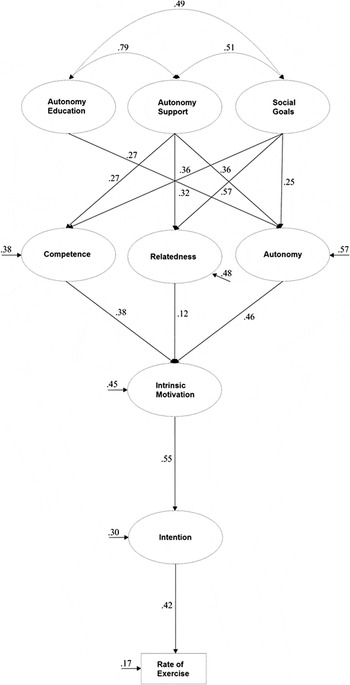
Figure 1 conveys that autonomy education, autonomy support, and social goals positively predicted autonomy, while autonomy support and social goals also positively predicted competence and relatedness. In addition, the three psychological mediators were positively correlated with one another and predicted intrinsic motivation very closely (explaining 45% of total variance) and positively. On that note, intrinsic motivation positively predicted intention to continue training (explaining 30% of variance), which in turn predicted students’ rate of exercise (explaining 17% of variance).
Structural equations model of the link between autonomy, social goals, psychological mediators, intrinsic motivation, intention, and rate of exercise. All parameters were standardized and significant where p < .05.

Discussion
This study’s objective was, within the context of physical education, to provide an integrative model of the relationship between creating a class climate where the instructor fosters students’ sense of autonomy and social goals, and rate of physical exercise practiced, using self-determination theory as a theoretical framework (Deci & Ryan, Reference Deci and Ryan1985; Ryan & Deci, Reference Ryan and Deci2000). That objective was chosen because it is so important to improve our understanding of educational contexts’ impact on physical-sport activity in young people. Toward that aim, we analyzed the influence of autonomy support, autonomy education, and social goals (responsibility and relationship with others) on basic psychological needs (competence, autonomy, and relatedness) and intrinsic motivation. Finally, we were interested in intrinsic motivation’s effect on intention to keep practicing physical exercise and on rate of physical exercise practiced. Though relationships among some of these variables were studied separately in recent years (e.g., Moreno et al., Reference Moreno, Parra and González-Cutre2008, Reference Moreno, Hernández and González-Cutre2009), no study to date had analyzed them in conjunction using a motivational model, so this study is in that sense pioneering.
The results of the proposed structural equations model support our hypotheses, reflecting positive associations between autonomy education, autonomy support, and social goals, and students’ intrinsic motivation, which itself was positively linked to intention to keep practicing physical exercise after graduation. Last, that intention was positively correlated with rate of physical exercise practiced.
Regarding the positive correlations between variables pertaining to autonomy support and intrinsic motivation, one of the main postulates of self-determination theory is that supporting people’s autonomy is among the most important social factors in motivational processes (Deci & Ryan, Reference Deci and Ryan1985), such that an autonomy–supportive style where the teacher minimizes extrinsic pressures and demands, provides opportunities, and takes students’ perspectives into account, eases autonomy controls. These variables have likewise been analyzed in recent studies in the area of physical education (Hagger et al., Reference Hagger, Chatzisarantis, Hein, Pihu, Soós and Karsai2007; Moreno, Gómez, & Cervelló, Reference Moreno, Gómez and Cervelló2010; Standage et al., Reference Standage, Duda and Ntoumanis2006), revealing a close relationship between autonomy and self-determined motivation. For example, an experimental study conducted by Moreno et al. (Reference Moreno, Gómez and Cervelló2010) in adolescents from different physical education classes reported significant increases in the group that was granted the autonomy to choose activities out of self-determined motivation. In the context of dance, Balaguer et al. (Reference Balaguer, Castillo, Duda, Quested and Morales2011) also reported positive correlations between students’ perceived autonomy support and self-determined motivation.
The model also revealed that, together with autonomy education and support, social goals positively predict intrinsic motivation in students. So far, very few studies have included social goals (responsibility and relationship with others) in the study of self-determination theory (e.g., Allen, Reference Allen2003; Guan et al., Reference Guan, McBride and Xiang2006). They tend to address achievement goals instead (e.g., Lukwu & Guzmán, Reference Lukwu and Guzmán2011; Nien & Duda, Reference Nien and Duda2008). Furthermore, while some physical education studies have reported an association between social goals and positive outcomes like effort, persistence, and fun (Cecchini et al., Reference Cecchini, González, Méndez, Fernández, Contreras and Romero2008; Papaioannou, Tsigilis, Kosmidou, & Milosis, Reference Papaioannou, Tsigilis, Kosmidou and Milosis2007), only one that we know of proposed an explanatory model of the relationships among those variables (Moreno et al., Reference Moreno, Parra and González-Cutre2008). The majority of studies have instead proposed links between specific, isolated variables. For example, in a preliminary study by Moreno et al. (Reference Moreno, Parra and González-Cutre2008), the results of a structural equations model showed that relationship with others and responsibility goals predict the basic psychological need for relatedness and correlate negatively with amotivation. The present study takes a vital step in our understanding of the SDT paradigm in finding that, in addition to creating a climate that promotes autonomy, satisfying the goals (responsibility and relationship with others) students set for themselves also determines what results they will achieve. Teachers are advised to bear that in mind in order to maximize learning results. Adolescence, then, is a critical stage of human development where respecting the established norms and hierarchy (responsibility goal) and maintaining good social relationships (relationship with others goal) are especially important needs (Urdan & Maehr, Reference Urdan and Maehr1995).
Another of this study’s findings was the positive correlation between, on the one hand, autonomy education, autonomy support, and social goals, and on the other, the basic needs posited by SDT. That theory’s postulates defend the notion that the basic psychological needs can be satisfied by a series of social factors that act as antecedents to, among other things, encourage a sense of autonomy and social goals. Other studies in the past have demonstrated a link between these variables and one of the basic psychological needs (Moreno et al., Reference Moreno, Parra and González-Cutre2008, Reference Moreno, Hernández and González-Cutre2009), but this study is the first to report a positive, significant correlation with all three.
The proposed model also led to the finding that the three basic psychological needs are positively correlated with students’ intrinsic motivation, which in turn positively predicts intention to practice physical exercise. With that in mind, and based on the postulates of SDT, it is only logical to expect that creating a class climate that encourages autonomy and social goals of responsibility and relationship with others will satisfy students’ need to feel they are autonomous, competent, and have adequate social ties, which is, furthermore, an ideal scenario to promote intrinsic motivation. Also consider that an important part of intrinsic motivation’s potential lies in its relation to some of the most desirable, positive behaviors one can experience, like fun (Vallerand, Reference Vallerand, Tenenbaum and Eklund2007). However, given the high rates of quitting physical activity during adolescence, one of the variables of greatest interest to researchers currently is intention to continue exercising after graduation (Balaguer et al., Reference Balaguer, Castillo, Duda, Quested and Morales2011; Ntoumanis, Reference Ntoumanis2001; Standage, Duda, & Ntoumanis, Reference Standage, Duda and Ntoumanis2003). That is because it has been found that the most self-determined form of motivation (intrinsic motivation) is positively linked to intention to participate in the future.
Finally, with the objective of better understanding these relationships, given their future applications in the educational context, and knowing how strongly intention predicts behavior (Ajzen & Fishbein, Reference Ajzen and Fishbein1980), the hypothesized model posited that intention would positively correlate with students’ rate of physical exercise. The results obtained support that hypothesis, telling us that students who exhibit a higher level of intention to keep practicing physical exercise after graduation also report a higher rate of exercise. If we understand intention as a person’s potential to carry out an activity, rate of exercise takes it a step further, into action, a finding that would advance the study of motivation. Therefore, this study is pioneering a line of research, providing new clues to understanding the relationships involved in the SDT paradigm, all in the context of physical education. Nevertheless, it would be best for other studies, in addition to further delving into the social factors that determine motivation and its outcomes, to examine the relationship between these variables experimentally, and also to propose longitudinal studies to determine whether the rate of exercise adolescents report still applies at later ages.
In summary, by setting forth a theoretical model that relates autonomy climate and social goals to rate of exercise, we have shown that if physical education teachers plan adequately, they can play a determinant role. It is highly important to provide pupils with experiences that instill in them, and lead them to maintain, norms that improve quality of life.