Introduction
Laryngeal cancer can be treated by radiotherapy or surgery. The goal of partial laryngectomy is to achieve a maximal cure rate while retaining nearly normal laryngeal function. In 1959, subtotal supracricoid reconstructive laryngectomy was reported by Majer and Rieder.Reference Chevalier and Piquet1, Reference Laccourreye, Laccourreye, Weinstein, Menard and Brasnu2 Subtotal laryngectomy with cricohyoidopexy resulted in a satisfactory cure rate in selected supraglottic and glottic cancer patients. In our department, we have previously used various surgical procedures such as hemilaryngectomy or supraglottic horizontal laryngectomy with or without one arytenoid- or tracheohyoidopexy, according to the extent of the tumour, and we have attained good oncological and functional outcomes. However, avoidance of aspiration is an essential concern when undertaking such surgical procedures. Therefore, we proposed a method of using a sternohyoid myofascial flap to reconstruct both the laryngeal and pharyngeal defect, in order to improve post-operative laryngeal function. From 2000 to 2006, we treated 39 patients with supraglottic carcinoma and pyriform sinus cancer by subtotal supraglottic laryngectomy, with subsequent laryngopharyngeal reconstruction using a sternohyoid myofascial flap.
This study aimed to analyse our experience of using sternohyoid muscle fascia for immediate reconstruction of partial laryngopharyngeal defects, in order to determine whether such reconstruction represented a reliable means of preserving speaking, swallowing and breathing function in patients with advanced-stage laryngeal cancer.
Materials and methods
Thirty-nine patients (37 men and two women) aged from 45 to 76 years (mean, 61.5 years) were included in this study. Fifteen patients had supraglottic carcinoma and 24 had pyriform sinus carcinoma. All patients underwent subtotal laryngectomy with subsequent laryngopharyngeal reconstruction using a sternohyoid myofascial flap. Patients' tumour–node–metastasis (TNM) stages were determined based on their clinical data and histopathological examination results, according to the 2002 International Union Against Cancer (UICC) TNM classification. Patients with supraglottic cancers were staged as follows: T2 N0 M0, five cases; T2 N1 M0, two cases; T3 N0 M0, three cases; T3 N1 M0, four cases; and T3 N2 M0, one case. Patients with pyriform sinus carcinomas near the aryepiglottic fold were staged as: T2 N0 M0, five cases; T2 N1 M0, seven cases; T3 N0 M0, five cases; T3 N1 M0, six cases; and T4 N0 M0, one case.
All patients underwent pre-operative endoscopy in order to assess possible involvement of the ventricles, the anterior commissure, the infraglottic regions and the pyriform sinus, as well to assess arytenoid motility. A computed tomography (CT) scan was performed in order to assess involvement of the paraglottic space. Barium swallow and chest radiograph studies were done before surgery.
Indications for surgery
Indications for surgery were as follows: selected T2, T3 or T4 supraglottic cancer involving the epiglottis, vestibule and aryepiglottic fold and one vocal fold; supraglottic cancer involving the medial wall of the pyriform sinus; and pyriform sinus cancer of the medial wall involving the aryepiglottic fold.
Contraindications
Surgery was considered to be contraindicated in the presence of: tumour involving the pyriform apex, interarytenoid area, postcricoid area, anterior commissure or tongue base; or any pulmonary insufficiency.
Surgical procedure
A short vertical tracheotomy was first performed between the second and third tracheal rings, and a tracheal tube was inserted for general anaesthesia. A horizontal skin incision was made along the midportion of the cricoid cartilage extending bilaterally to the line of the sternomastoid muscle. A subplatysmal flap was then elevated to the suprahyoid level and stabilised with a gauze pad.
Neck dissection was performed when metastatic lymph nodes were detected. A ‘|-’ or ‘H’ shaped skin incision was made from the mastoid to the midpoint of the clavicle, and connected with the horizontal incision. The posterior and inferior skin was raised to the anterior margin of the trapezius muscle posteriorly and to the level of the clavicle inferiorly. The neck dissection specimen was attached to the lateral wall of the pyriform sinus and to the posterior border of the thyroid cartilage.
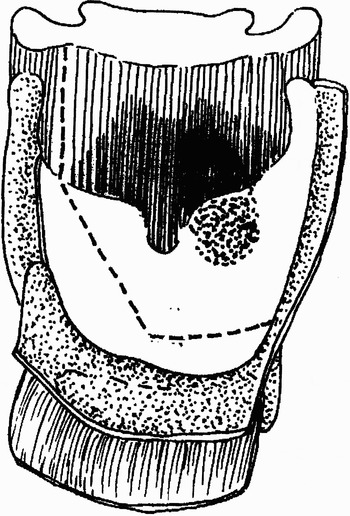
A horizontal incision was made transecting the strap muscles along the inferior margin of the hyoid bone. If the arytenoid cartilage was invaded by the tumour, part of the hyoid bone was attached to the strap muscle. The strap muscle was turned down to the level of the thyroid cartilage. A horizontal incision was made over the superior margin of the thyroid cartilage perichondrium. An inferiorly based muscle and perichondrium flap was elevated (Figure 1). The pharynx was entered at the vallecula by cutting the suprahyoid muscles. The epiglottis was grasped with a single hook and inspected for tumour, then retracted superiorly and anteriorly to enable better visualisation of the tumour. The larynx was opened by incising vertically through the lateral pre-epiglottic space (with the external scissors blade under the free contralateral inferior hyoid cornu and the lower blade lateral to the free margin of the epiglottis). The superior cornus of right thyroid ala was skeletonised. The cartilage incision was then marked with methylenophil blue. The line proceeded from the midline at the junction of the superior two-thirds and the inferior one-third, and extended obliquely, laterally to the base of the right inferior cornu. The ipsilateral horizontal cartilage cut was made directly posterior. On the contralateral side, the cut was completed from the posterosuperior margin of the thyroid ala, extending obliquely and superiorly toward the anterior midline at the superior one-third of the thyroid ala, just at the level of the ventricle sinus. Cartilage cuts were completed by Stryker saw or strong scissors.
Diagram showing perichondrium with strap muscle incision and cartilage cuts.

On the contralateral tumour site, the aryepiglottic fold was transected, connecting the cut with one blade on the posterosuperior thyroid ala cartilage cut and the other blade on the ventricle, avoiding touching the true vocal fold. The larynx was opened just superior to the anterior commissure by cutting above and parallel to the true vocal fold. Retracting the specimen laterally, the inferior laryngeal margin was obtained with one scissors blade in the subglottic area and the other in the inferior oblique cartilage cut (Figure 2). The superior incision across the vallecula was extended laterally to give a 2-cm margin in the pyriform sinus superiorly. The vallecula incision was extended inferiorly along the lateral wall of the pyriform sinus and medially below the inferior margin at the arytenoid cartilage. The cut was extended into the interarytenoid area and connected with the subglottic cut and the pyriform sinus cut. If the subglottic area was involved, part of the cricoid was removed. The remainder of the supraglottic and ipsilateral larynx was removed from anterior to posterior. The cut was extended posteriorly to give a 15-mm margin to the tumour in the pyriform sinus, and the specimen was removed (Figure 3). Excision of the arytenoid cartilage and vocal fold en bloc with the specimen was completed. The excised specimen included the entire epiglottis and pre-epiglottic space, false vocal folds, right true vocal fold, arytenoid cartilage and part of the pyriform sinus. Homeostasis was achieved. The specimen was examined grossly to ensure that the margins appeared adequate.
Diagram showing excision continued at the level of the ventricle; the ipsilateral arytenoid cartilage body is removed.

Diagram showing the defect ready for repair.

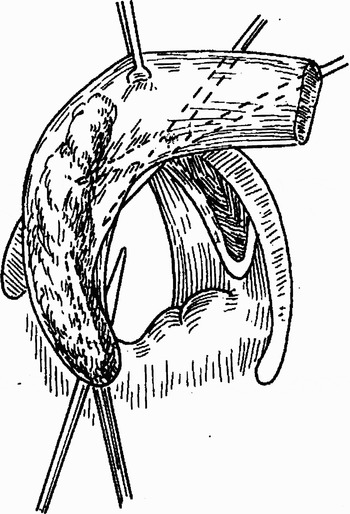
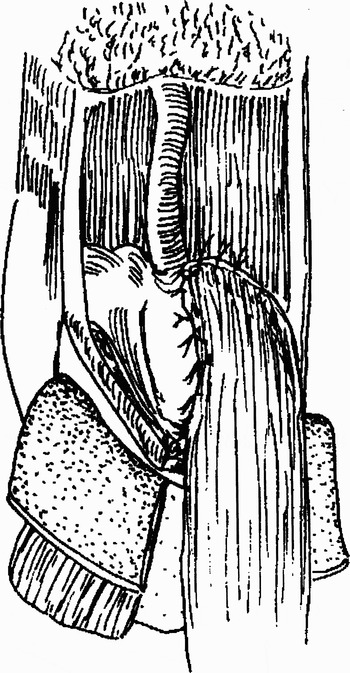
On the ipsilateral side, a vertical myofascial flap was fashioned, 1.5–2 cm wide and based inferiorly. Retracting the upended sternohyoid muscle, a vertical incision was made, cutting the entire muscle, 2-cm lateral to the medial margin of the sternohyoid muscle. A vertical slit was made extending to the inferior margin of the thyroid cartilage (Figure 4). The flap was freed from the hyoid bone or attached by part of hyoid so a hyoid-myofascial flap was made.
Diagram showing inferiorly based sternohyoid flap cut and retracted towards defect.

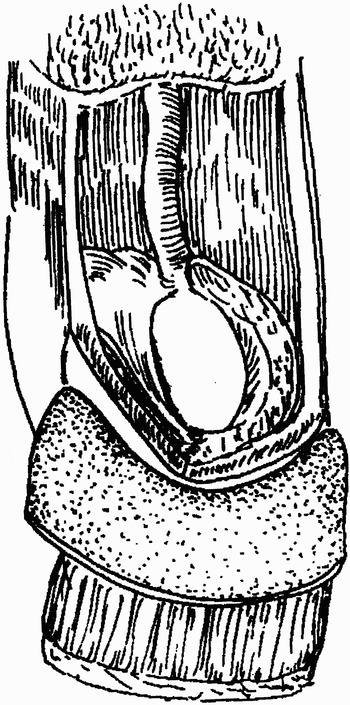
The distal end of the flap was inserted into the resected area. The fascia was sutured to the margin of the postcricoid mucosa, subglottic mucosa and pyriform fossa (Figure 5). The myofascial flap was formed into a band to take the shape of the glottis. If a hyoid–myofascial flap was used, the hyoid bone was fixed with cricoid bone first.
Diagram showing sternohyoid myofascial flap sutured to the posterior cricoid cartilage and subglottic margin.

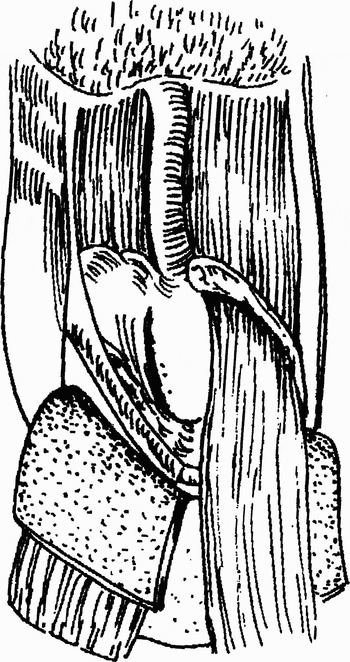
If the pyriform sinus was removed, the pedicle of the myofascial flap was drawn in towards the pyriform sinus and sutured at apex level to the posterior pharyngeal wall and then to the postcricoid wall mucosa. A pyriform sinus like structure was thus formed (Figure 6).
Diagram showing sternohyoid myofascial flap sutured to the pyriform sinus margin.

In order to reduce aspiration, the larynx was pulled up. Three rough sutures were placed through the cricoid cartilage, the hyoid bone and the suprahyoid muscle, at mid-level and in two side areas.
On the affected side, pharyngeal closure was begun laterally, suturing the lateral pharyngeal wall to the myofascia and the tongue base to the myofascia. On the contralateral side, closure was performed from lateral pharyngeal wall to lateral pharyngeal wall and from the tongue base to the thyroid perichondrium. Prior to suturing, the shoulder roll providing neck extension was removed and bleeding was controlled by bipolar diathermy. After the sutures had been sequentially placed and tied, the three rough sutures were tightened.
A second layer of 3-0 interrupted sutures was placed from the tongue muscle to the fascia of the residual strap muscles, and rubber drains were placed beneath the platysma. The subcutaneous tissue was closed with interrupted sutures, and the skin was closed. A cuffed tracheotomy tube was substituted for the anaesthesia tube, tied and sutured in place.
Results
During subtotal laryngectomy, the extent of arytenoid resection varies depending on the extent of the tumour. In our patients, the whole of the arytenoid on the affected side was removed. In three patients with subglottic extension, the lower part of the resection was more radical, including part of the cricoid cartilage, and two of these patients underwent reconstruction using a hyoid-sternohyoid myofascial flap. In 34 cases, modified radical neck dissection was carried out simultaneously.
No operative morbidity or mortality developed in this group of patients. All our patients received post-operative antibiotic therapy and were fed nasogastrically for the first two post-operative weeks. When swallowing was satisfactory, the nasogastric feeding tube was removed. A few patients experienced tolerable aspiration for 20 days post-operatively and then recovered gradually. Drains were removed on the third post-operative day. Decannulation was achieved by progressive plugging of the tracheostomy tube until it could be removed. Thirteen patients had stenosis of the airway and breathing problems, and their tracheostomy was therefore retained permanently. Twenty-six patients (66.7 per cent) were decannulated. The post-operative period was otherwise uneventful. Most patients were satisfied with their voice, although hoarseness and weakness remained. Post-operatively, 34 patients received radiotherapy.
Local recurrence had occurred in three patients by 18 months post-operatively, salvaged by total laryngectomy; however, all three patients had died with neck metastases by two years post-operatively. Eight patients developed recurrent cervical metastases, seven following unilateral modified radical neck dissection and one following bilateral radical neck dissection. Twelve patients developed distant metastases and died within a year of the operation. The overall three-year survival rate was 46.1 per cent.
Discussion
A considerable diversity of opinion exists regarding optimal treatment of T2 and T3 laryngeal carcinoma. Some believe such patients require total laryngectomy, while others propose partial laryngectomy as the first choice of treatment. Several techniques have been described for varying tumour extents;Reference DeSanto, Pearson and Olsen3–Reference Crampette, Garrel and Gardiner5 the surgeon should select the appropriate procedure depending upon the extent of disease, as estimated pre-operatively by laryngoscopy and CT scanning.
If the arytenoid cartilage is preserved during subtotal laryngectomy, post-operative aspiration does not occur. If the arytenoid is removed, aspiration may occur. Although this situation may be tolerated by some younger patients, most patients require glottic reconstruction in order to avoid aspiration.Reference Gavilán, Herranz, Prim and Rabanal6–Reference Dong, Jiang and Wang8 Various reconstructive tissue may be used, e.g. neck skin flap or sternohyoid muscle perichondrium.Reference Rojananin, Suphaphongs and Ballantyne9–Reference Lu and Dong11 The arterial supply of the sternohyoid muscle, upper sternohyoid muscle and upper belly of the omohyoid consistently arises from a branch of the superior thyroid artery most commonly terminating at the cricothyroid membrane. The arterial supply of the inferior sternohyoid muscle is supplied by the inferior thyroid artery. The ansa cervicalis innervates the sternohyoid muscle inferiorly with a branch below the loop. Each arterial branch supplying the muscles had an accompanying venous tributary. A corrosion cast specimen demonstrated that arterial lumen diameters were almost threefold larger in branches entering the upper sternohyoid muscle, compared with the lower sternohyoid and omohyoid muscles. Small intramuscular arteries without axial supply were found within the middle third of the upper sternohyoid muscle, the lower sternohyoid muscle and the upper omohyoid muscle.Reference Wang, Puig and Brown12
The infrahyoid myocutaneous flap was first described by Wang in 1986.Reference Majoufre and Faucher13 Its blood supply comes from the superior thyroid artery. This flap consists of sternohyoid muscle, sternothyroid muscle, the superior belly of the omohyoid muscle and a skin pad from the medial infrahyoid area. Thanks to its arc of rotation, this flap is appropriate for repair of mucosal defects of the tongue, floor of the mouth, retromolar region, interior cheek, oropharynx, hypopharynx, and, in the face, skin defects of the exterior cheek, parotid region and lower lip. The infrahyoid myocutaneous flap is of obvious interest in head and neck reconstruction surgery, given its versatility and the quality of its cosmetic results.
The key to achieving improved function and cure rates following supraglottic laryngectomy is appropriate patient selection. Before surgery, indirect laryngoscopy, fibre-optic laryngoscopy, CT scanning and other examinations should be performed in order to assess tumour location and extension. If the tumour involves the ventricle and vocal fold, the vertical hemilaryngectomy should be performed, as in our patients. The cricoid defect could be replaced by hyoid bone. In our patient series, the complications of subtotal supraglottic laryngectomy were wound slough, aspiration during swallowing and difficulty in decannulation. A few patients had tolerable aspiration and recovered gradually. Most patients were able to be decannulated, with satisfactory results. Subtotal supraglottic laryngectomy with sternohyoid myofascial reconstruction was found to be a useable method which achieved good results.
Thus, we propose subtotal supraglottic laryngectomy for the surgical treatment of supraglottic carcinoma involving one vocal fold, together with sternohyoid muscle fascia reconstruction, as a method of retaining almost normal laryngeal function.
In order to reduce aspiration, we used sternohyoid muscle fascia to restore laryngeal function. We describe our experience of using a sternohyoid muscle flap for primary, one-stage reconstruction of laryngopharyngeal defects following resection of advanced-stage lesions, in order to reconstruct both the laryngeal and pharyngeal defects.
Our preliminary data, and a review of the medical literature, suggest that the use of a sternohyoid myocutaneous flap constitutes a relatively safe, simple and useful rehabilitation method for laryngeal defects.
Acknowledgements
This study was undertaken as a testament to the friendship between the Department of Otolaryngology-Head and Neck Surgery, Shanghai First People's Hospital, Shanghai Jiao Tong University, PR China, and the Department of Otolaryngology-Head and Neck Surgery, Kurume University School of Medicine, Japan. It was supported by the Shanghai Science Committee Fund, (No. 044024), PR China, and the National Nature Science Foundation of China (NSFC-Grant-30572031).