Introduction
More than 500,000 earthquakes are documented every year; 3,000 are perceived by human beings, and only from seven to 11 result in the loss of life.Reference Bambarén, Uyen and Rodriguez 1 Populations of areas where the tectonic plates collide are the most likely to suffer casualties because of seismic activity, especially those located on the Pacific “ring of fire,” where 81% of the world’s earthquakes take place. Earthquakes produce more casualties in the urban populations of these zones due to the higher population density, and even more so in countries (such as Peru) where some houses are constructed informally, without following building codes.
Therefore, there would be a high rate of mortality and many injuries, especially traumas, caused by mechanical effects and multi-organ damage which require intensive treatment and surgery.Reference Ramirez and Peek-Roast 2 Contusions, lacerations, and fractures, especially in thoraxReference Bartels and VanRooyen 3 and thoracolumbar medulla,Reference Mulvey, Awan, Qadri and Maqsood 4 are the most frequent injuries in cases of earthquakes. Many less-serious injuries are caused by the detachment and falling of objects. Fatal injuries usually are due to the collapse of buildings. While lesions to the head and thorax frequently are fatal, those to the extremities are the principal reason for hospitalization.Reference Karamouzian, Saeed, Ashraf-Ganjouei, Ebrahiminejad, Dehghani and Asadi 5
The coastal region of Peru is a high-risk area with high-magnitude earthquakes often accompanied by tsunamis. Over the last 500 years, all the cities in the coastal region have suffered earthquakes, including Lima, the capital of Peru. These earthquakes are generated by the convergence and subduction of the Nazca (oceanic) plate below the continental plate.Reference Peek-Roast, Ramirez, Seligson and Shoaf 6 Scientific studies have found that along the coast, there are seismic lagunas, areas which in the past experienced powerful earthquakes, and which to date, several decades or centuries later, have yet to be repeated.Reference Tavera 7 One of these lagunas is in the central region, where the cities of Lima and Callao are located, which has been accumulating energy since 1746. The earthquakes in 1940, 1966, 1970, and 1974 with magnitudes at or below 8.0 Mw did not release all the accumulated energy.Reference Tavera 7 Therefore, there is a risk of high-magnitude earthquake along the central coast of Peru, similar in size to previous ones, with a devastating effect on the population, housing, social, and productive infrastructure.
The model prepared by the National Civil Defense (INDECI; Lima, Peru) is based on the premise that an 8.0 Mw earthquake occurs at a depth of 33km in front of the central coast of Peru, which is accompanied by a tsunami with waves of a height of around six meters.Reference Tavera 8 This model includes the 41 districts of metropolitan Lima and Callao and estimates the destruction of 200,347 houses with another 348,328 rendered uninhabitable. There would be 51,019 deaths and 686,105 injured.
The objective of this study was to estimate the requirements for medical care for the injured which could be generated by the model established by Civil Defense, as well as the shortfalls in medical care in the hours immediately after the event, based on the main necessities and the supply of care in Metropolitan Lima and Callao.
Methods
The demand for care was based upon the estimated 686,105 injured after a major earthquake in Lima and Callao.Reference Tavera 8 Requirements generated by serious, non-transmissible illnesses, which also generally occur in earthquakes, including stress, hypertension, and intestinal disorders, were not considered. 9
A model was designed to estimate the characteristics of the needs and shortfalls in care. Demand was determined by taking into consideration the following variables: the need for care in hospitals; the time of arrival at the hospitals; reason for admission; and the requirement for specialized treatment such as hemodialysis, blood transfusions, and surgical procedures. The values for these variables were obtained from a bibliographical search in the databases of the MEDLINE (US National Library of Medicine, National Institutes of Health; Bethesda, Maryland USA) medical bibliography, the Cochrane (The Cochrane Collaboration; Oxford, United Kingdom) and SciELO (Scientific Electronic Library Online; São Paulo, Brazil) libraries, and Google Scholar (Google Inc.; Mountain View, California USA). This search included revisions and scientific articles about earthquakes over the last 30 years of magnitudes of over 6.0 on the moment magnitude scale. Earthquakes in Peru were excluded.
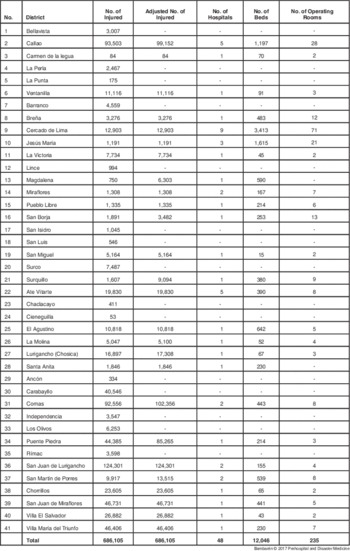
Deficits in care were estimated from the differences between the necessities and existing supply of strategic resources such as hospital beds and operating rooms. The resources of the 48 hospitals of the Ministry of Health and Social Security (EsSalud) located in the 41 districts of Metropolitan Lima and Callao were taken into consideration, a total of 12,046 beds and 235 operating rooms. It is assumed that the injured in the districts which do not have a hospital will go to the nearest hospital in another district, as shown in Table 1.
Number of Injured and Hospital Resources in the Districts of Metropolitan Lima and Callao

The hospital resources available in the first 24 hours after the earthquake assumed a 90% utilization of hospital beds and the probability of services being operational based on the results of Hospital Safe Index. No difference was made between general and intensive care beds. It is estimated that the 19 hospitals in Category C will have a probability of being operational of 0%, 50% for the 20 hospitals in Category B, and 100% for the nine hospitals in Category A. The quantity of operating rooms operational assumes an average operating time of four hours per patient. Thus, differences between the necessities and hospital resources were calculated, considering different scenarios.
Results
Twenty-four articles were found on eight earthquakes worldwide which fit the established criteria: Gujarat, India (8.1 Mw); Wenchuan, China (8.0 Mw); Kashmir, Pakistan (7.6 Mw); Kobe, Japan (7.6 Mw); Marmara, Turkey (7.5 Mw); Armenia, Soviet Union (6.8 Mw); Bam, Iran (6.6 Mw); and Northridge, Los Angeles, California USA (6.3 Mw). Two articles about models simulating major earthquakes in Granada, Spain and California were added.
Based on the information available, the values adopted for the model were established:
-
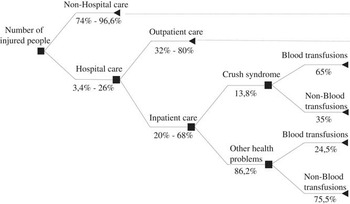
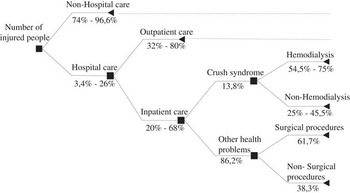
∙ Necessity for Hospital Care: 3.4% of the total number of injured required hospital care in the earthquake in Northridge.Reference Peleg, Reuveni and Stein 10 This value reached 26% in the earthquake in Wenchuan.Reference Spence and So 11
-
∙ Time of Arrival at Hospitals: In the first 24 hours, 42% of the injured arrived, up to 65% in 48 hours, and up to 77% in the 72 hours following the earthquake in Marmara, Turkey.Reference Yao, Zhang, Cheng, Shen and He 12
-
∙ Type of Medical Care: The reports of the injured treated in a hospital after the earthquake in Wenchuan showed that 68% were admitted and 32% were given outpatient care.Reference Bulut, Fedakar, Akkose, Akgoz, Ozguc and Tokyay 13 A model used to simulate a major earthquake in California estimated that at least 20% of the injured would require in-patient care.Reference Xie, Du, Xia, Wang, Diao and Li 14
-
∙ Reason for Hospital Admission: Crush syndrome was one of the most frequent reasons for hospital care after an earthquake. This condition was present in 13.8% of the patients admitted after the Kobe earthquake.Reference Koehler, Foley and Jones 15 Other reasons for admission were fractures and traumatic brain injury.Reference Oda, Tanaka and Yoshioka 16
-
∙ Need for Specialized Care (in Cases of Crush Syndrome): Between 54.5% and 75% of the patients required hemodialysis,Reference Yao, Zhang, Cheng, Shen and He 12 , Reference Li, Wang and Chen 17 from six to 15 sessions per patient.Reference Richards, Tattersall, McCann, Samson, Mathias and Johnson 18 These patients also required blood transfusions. After the earthquake in Marmara, 65% of these cases required transfusions during the first week of in-patient care,Reference Sever, Erek and Vanholder 19 needing between 8.3 and 10.7 units of blood per case.Reference Kazancioglu, Pinarbasi, Esen, Turkmen and Sever 20
-
∙ Requirements for Specialized Care (Involving Other Health Issues): 61.7% of the victims needed surgical procedures, the most frequent of which were the cleaning and removal of foreign objects from contaminated injuries and the reduction of open fractures by fixation.Reference Sever, Vanholder and Lameire 21 Another requirement was for blood transfusions, which were required by 24.5% of the patients after the earthquake in Wenchuan due to fractures and other pathologies; the volume of blood needed ranged from one to 14 units with an average of three units per patient.Reference Oda, Tanaka and Yoshioka 16
Figure 1 and Figure 2 show the resume of information of articles about earthquakes worldwide, including percentages of demand of health care and needs for specialized medical care in case of crush syndrome and other health problems.
Resume of Collected Information about Hospital Demand in Case of an Earthquake, Including Needs of Blood Transfusions.

Resume of Collected Information about Hospital Demand in Case of an Earthquake, Including Needs of Surgical Procedures and Hemodialysis.

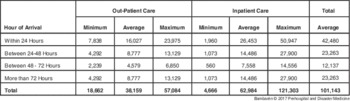
These values were inputted into the model, which then indicated that between 23,328 and 178,387 injured would arrive at the hospitals, of which between 4,666 and 121,303 would be admitted. On the other hand, between 18,662 and 57,084 would only require out-patient care and could return to their homes. Table 2 shows that the majority of cases occurred in the first 24 hours after the disaster.
Number of Injured Treated in Hospitals According to the Type of Treatment and Hour of Arrival

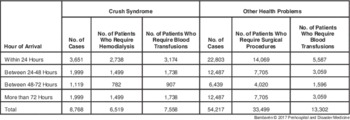
Table 3 shows the average number of cases admitted, of which 8,768 correspond to crush syndrome and 54,217 to other health problems. In terms of crush syndrome, an estimated average of 6,519 (in the range from 483 to 12,555) would require hemodialysis due to acute renal failure, requiring an estimated total of between 39,113 and 97,783 sessions to take care of all the cases. While an average of 7,558 cases (in the range from 560 to 14,556) would need transfusions, requiring a total supply of from 62,733 to 80,872 units of blood for the average number of cases. Treating the other health problems would require an average of 33,499 surgical procedures (in the range of 4,022 to 104,563) as well as blood transfusions for 13,302 people (in the range from 985 to 25,618), which would represent an average total consumption of 39,905 (in the range from 2,956 to 76,854) units of blood.
Average Number of Cases of Crush Syndrome and Other Health Problems Admitted by Hospitals and their Need for Specialized Care According to the Hour of Arrival

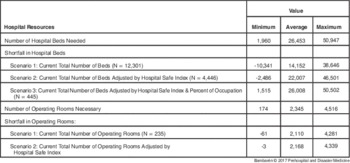
It was estimated that in the first 24 hours after an earthquake, enough blood would be required to treat 8,761 injured. Furthermore, there would be a deficit of hospital beds and operating rooms needed to satisfy the demand in the hours immediately after the earthquake. As can be seen in Table 4, the size of the shortfall varies according to the operational level of hospital resources, and whether they were in operation prior to the event, so that they could be rapidly utilized for the injured arriving at hospitals. With the currently available resources, without amplifying the capacity for care of hospitals, the minimum estimated demand for beds and operating rooms would be satisfied in the majority of expected scenarios. For other values (average and maximum), there would be a market shortfall in beds and operating rooms to face an earthquake.
The Number of Hospital Beds and Operating Rooms Needed in the First 24 Hours after the Disaster and the Shortfall in Resources

Discussion
While the city of Lima is located in a seismically active region, it does not suffer as many earthquakes as other parts of the world. A great many people live in structures which are relatively unsafe, which is a critical factor in determining how catastrophic an earthquake could be,Reference Phalkey, Reinhardt and Marx 22 and can result in a large number of injured who will require prompt and specialized care given the complexity of their lesions. Care also is required for serious cases of chronic illnesses, such as hypertension and heart attacks. Furthermore, there is the challenge of satisfying the demand for treatment of patients who have pre-planned surgeries, dialysis sessions, and other types of routine specialized care.
Estimating the number of casualties of an earthquake is a very complex process. However, it is necessary to be able to plan the actions to be taken to deal with the increase in demand, especially in the first 24 hours after the event, which will see the greatest increase. Nevertheless, the injured will continue to arrive over the first three to five days, after which, the number of consultations will return to normality.Reference Ferris 23 Methodologies such as Coburn and Spence 24 and the ATC-13Reference Coburn, Spence and Pomonis 25 take into consideration the population per collapsed building and the number of occupants according to the time when establishing the number of seriously injured, supposing that these cases will be admitted by hospitals. The National Civil Defense model indicated 70% fewer seriously injured than the ATC-13 model. Furthermore, the total number of injured would reach over 1.5 million in Lima according to the ATC-13 model, more than double the number estimated by the National Civil Defense model.
In some cases, the values estimated by the model are less than those registered in earthquakes which occurred in other regions; for example, the estimated maximum number of hospital in-patients (121,303) would be lower than the 173,585 registered in the Wenchuan earthquake. 26 In terms of crush syndrome, it was calculated that 8,768 would be admitted to hospitals, which is less than the 10,292 cases registered in the earthquake in Marmara 26 or the 34,305 in Wenchuan.Reference Shinar and Magen 27
Conclusion
Sudden and violent disasters, such as earthquakes, represent significant challenges for health systems and services. In large cities where the density of population is higher and which have precarious infrastructure, there is an increase in the number of wounded, especially seriously injured. The ranges of estimated values that characterize the demand for care are important for the elaboration and adjustment of health action plans, especially to identify beforehand which hospital resources must be protected or considered in a potential request for international humanitarian assistance. The resources available to care for the victims will always be insufficient if work isn’t carried out in parallel to reduce the vulnerability of the population and the infrastructure of the health sector.