




No CrossRef data available.
Article contents
- Abstract
- Introduction
- Review of Research
- A Project on Martin Luther's Word Formation
- Nominal Word Formation Constructions
- Excursus on the Forms of the Diminutive
- Functions of Nominal Affixes
- Comparison of Luther's Usage within Early Modern German
- Comparison of Luther's Usage with Modern German
- APPENDICES
- References
Nominalization in Martin Luther's Word Formation
Published online by Cambridge University Press: 01 September 2004
Article contents
- Abstract
- Introduction
- Review of Research
- A Project on Martin Luther's Word Formation
- Nominal Word Formation Constructions
- Excursus on the Forms of the Diminutive
- Functions of Nominal Affixes
- Comparison of Luther's Usage within Early Modern German
- Comparison of Luther's Usage with Modern German
- APPENDICES
- References
Abstract
Martin Luther is universally acknowledged as an important figure in the history of German. Although the study of his language has been broadly covered in research, the study of his word formation is rather meager. This article gives an account of Luther's nominal word formation, excluding compounds. The material comprises three corpora: samples of his main works, extracts from the 1545 Bible, and a selection of his letters. The most frequent suffixes are: -er, infinitival -en, -ung, -ϕ, and -heit. The most frequent prefixes are un- and heubt-. The class-maintaining functions show the diminutive as the most frequent overall, whereas it is the abstract that is the most frequent among the class-changing functions. A comparison of Luther's usage with that of his contemporary Dürer shows agreement in the most frequent suffixes as well as in the most frequent function of both the class-maintaining and class-changing functions. Modern (New High) German shows a similar agreement in most frequent suffixes and functions although there are new prefixes and suffixes. Word formation changes, albeit slowly. Luther's word formation fits into his linguistic context and shows the same main features as Modern German.
Information
- Type
- ARTICLES
- Information
- Copyright
- © 2004 Society for Germanic Linguistics
Introduction
Martin Luther has been hailed as many things, from the Schöpfer der nhd. Schriftsprache (creator of the modern standard German language) to a mere Nachzügler (latecomer/straggler) (Russ 1984:1), but there is no doubt as to his importance in the development of Modern (New High) German. At one extreme Jacob Grimm (1870:xi) wrote: “Luthers sprache…muss ihrer edlen, fast wunderbaren reinheit, auch ihres gewaltigen einflusses halber für kern und grundlage der nhd. sprachniedersetzung gehalten werden. Man darf das nhd. in der that als den protestantischen dialect bezeichnen.” (Luther's language must be regarded as the center and basis of the Modern German linguistic standard because of its noble, almost wonderful purity and also because of its powerful influence. One can indeed regard Modern German as the Protestant dialect/variety). At the other extreme there is Konrad Burdach, the student of Prague humanism, who said of Luther and Modern German that he was “nicht der Führer, der Bahnbrecher der sprachlichen Bewegung, sondern eher Nachzügler” (not the leader, not even a pioneer of the linguistic movement but rather a straggler) (Burdach 1925:273–274). At the moment, Luther's position in the formation of Modern German and its implementation is being viewed very positively (Besch 1999, 2000). What has, however, become more apparent over recent years is that Luther has to be seen within the linguistic context of his time.
One of the reasons that Luther is such an important figure is that he produced an enormous amount of written work. At present his output in the Weimarer Ausgabe comprises well over 110 volumes. He wrote not only in German but also in Latin, in which language most of his correspondence with theologians and scholars was carried out. His German output alone in 1519–1520 amounted to about half of all works published in German (Tschirch 1969:100)! He is, perhaps, best known as a translator of the Bible, but his works covered such diverse areas as theological treatises, polemic pamphlets against his many opponents, versions of Aesop's fables, hymns, catechisms, and, of course, copious correspondence with the great and the good—and the not so good—as well as intimate letters to his wife and family. In addition his conversations with students and colleagues at table have been written down, as well as transcripts and summaries of his sermons. In some instances there are manuscripts of his works, but none of the 1522 New Testament. He was also involved in the production of his works and oversaw in many cases their publication.
Review of Research
Most linguistic studies of Luther's language, of which Wolf 1985 lists a large number, concern themselves with his orthography, grammatical inflection and lexis, as well as style and syntax. The study of his word formation, however, is much more meager. Franke (1913–1922), especially volume 2, pp. 89–186, gives a wide range of material but is not easy to consult or make out general trends. On the other hand, Erben (1974:460–467) and Arndt and Brandt (1983:207–210) deal with Luther's word formation within the framework of the development of his vocabulary. Older, more general, works on German word formation, for example, Wilmanns 1899:321, Kluge 1925:68, and Henzen 1965:25, do have some comments tucked away inside them, which will surface in some of our illustrations, while the fifth volume of Hermann Paul's (1920) grammar does not seem to mention Luther at all. Bach 1985 has the bonus of dealing, albeit indirectly, but in great detail with the form of unstressed affixes, for example, variation between -nis and -n u s. Fleischer 1996 is the most systematic and linguistically focused, but at the same time limited, treatment of this area of Luther's language. Fleischer lists several areas to be investigated, including: 1. the inventory of affixes, which ones have become lost, and how new ones have come into being; 2. changes in the distribution of the affixes, their allomorphic variation, as well as variation and competition between affixes; and 3. the expansion of nominal compounds, their linking morphemes, whether they are occasional or nonce formations or whether they belong to the language norm. Besch, in his survey (2000:1725), states unequivocally: “Eine umfassende Darstellung der Wortbildung bei Luther steht noch aus” (A comprehensive presentation/account of Luther's word formation is still lacking).
A Project on Martin Luther's Word Formation
In view of this limited number of publications and in order to remedy this gap in research we have started a project on Martin Luther's word formation in the Department of Language and Linguistic Science at the University of York (UK), and the present paper incorporates some of the findings of Pibworth 2002 and Scott 2002, two recently completed master's theses, as well as other ongoing research.
Part of an initial problem was to decide what could properly be regarded as Luther's language. Three general questions are pertinent here. First, is it the language of the printed page that has been through the hands of the compositor and proofreader or of the manuscript? Second, is it the language of 1520, 1530, or 1540? Luther's language undergoes changes in the course of time. Franke (1913:§ 10) divides Luther's linguistic output into three periods: I. 1516–1520, when there are more Middle High German and dialectal elements; II. 1521–1531, when there is a development away from Middle High German and the local dialects; and III. 1532–1546, when a plateau is reached and those Middle High German elements that remain are carried through to the end. The years of 1524–1526 show the quickest rate of change. Finally, is Luther's language the language of the Bible translation, or the broadsheet, or the theological treatise or his letters, all of which show differences in linguistic usage? For instance, the use of relative pronouns shows variation between text types with der/die/das + da being mostly used in the Bible and the particle so being quite frequent in letters (Baldauf 1982:478–479). There is thus no monolithic language of Luther, Lutherdeutsch, but rather a collection of fluctuating forms and words whose constellation changes over time and varies according to situation and addressee. This has been amply illustrated with regard to graphemic usage, grammar, and syntax. The hypothesis is that, quite probably it would be reflected to some extent in word formation as well. There are some pointers in the research already carried out, particularly in the use of pejorative forms in Luther's polemic works.
Scholars have not always made these differentiations among text types. Heinrich Bach (1954), however, made some very precise observations about Luther's works. He distinguished between:
- those writings that do not derive directly from Luther, for example, Tischreden (Table Talk), Predigtnachschriften (transcripts of his sermons);
- the language of his letters where we find evidence of dialect and colloquial speech;
- the language of his manuscripts with corrections and reformulations; and
- the language of his writings, printed in Wittenberg, which include:
- 4a. the early writings, showing a great deal of variation, as well as,
- 4b. the more regular language of his later works,
- 4c. and finally, the thoroughly normalized, carefully edited language of the Bible translation of 1545.
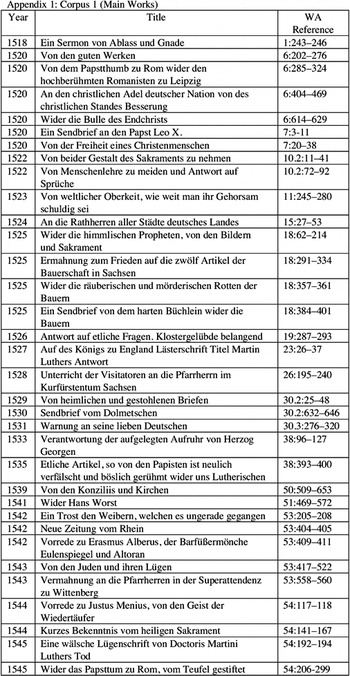
The overall plan is to produce a description of all aspects of Luther's word formation. This will comprise nominal formations, including compounding as well as adjectival and verbal formations. As stated above, two master's theses have been recently completed at York on nominalization in Luther's word formation. The material, which can also be used for other aspects of word formation, comprises: Corpus 1, 34 programmatic and polemic works by Luther dating from 1518 to 1545, and Corpus 2, excerpts from the 1545 Bible. Each corpus comprised about 500,000 words, yielding one million words overall. A third, smaller, corpus (Corpus 3), consists of about 28,000 words from 93 of Luther's Letters (Rückert 1955). More details of the corpora are given in appendices 1–3. The choice of texts reflects the demand to deal with providing representatives of three different text types.
Nominal Word Formation Constructions
Inventory of Forms
We take nominalization to include not only explicit derivation by means of the addition of an affix to a base but also a type of word formation pattern called zero-derivation, when only the stem of the verb is used as a noun, for example, fang+en ‘catch-inf.’>der Fang ‘the catch’. In this instance there is no overt suffix, but in some cases there is also a change in the stem vowel, for example, beiß+en ‘bite-inf.’>der Biss ‘the bite’, or a change in the stem-final consonant as well, for example, zieh+en ‘pull-inf.’>der Zug ‘draft; train’. In the presentation of our data we do not distinguish between these two subtypes. Fleischer uses the term “implicit derivation” but we call this pattern zero-derivation, symbolizing it by “ϕ.” Conversion, the categorial change of an infinitive to a noun, for example, sing+en ‘sing-inf.’>das Singen ‘the singing’ with no addition of an affix, would seem to be another instance of zeroderivation. Wellmann (1975:237–238), however, regards conversion as the addition of a suffix -en to a verbal base. Following his interpretation enables this type of word formation pattern also to be fit into normal explicit derivation. Here, however, we exclude nominal compounding. In sections 4.1 to 4.3 we consider the nominal suffixes, and in 4.4 the nominal prefixes. There is one instance of a combination of a suffix and a prefix, compare Modern German das Gebirge ‘mountain range’, which is treated with the suffixes.
In two instances, -werk and heubt-, the forms involved are sometimes classified as semiaffixes or affixoids in Modern German (Wellmann 1975:21; 1995:488–495). Unlike ordinary affixes these have a formally homonymic form. This means that they are similar to elements in compounds. These semiaffixes or affixoids can be divided into semiprefixes, for example, Haupt-, and semisuffixes, for example, -werk, as in Laubwerk ‘foliage’. In an earlier paper (Russ 1994), I identified the main features of these semiaffixes as follows: “(1) they are the basis for new formations; (2) their meaning is more generalized and abstract than the formally identical free morpheme; (3) there has been a shift of meaning in the relationship between the two parts of the word so that first component determines the basic meaning; and (4) the use of the free homonymic form becomes more limited' (1994:230). Stevens (2000:58–60) sets up ten criteria for distinguishing affixes and affixoids. In a synchronic analysis of Luther's word formation -werk can be regarded as a suffix since the words containing it cannot be analyzed as 250 Russ compounds, for example, blumwerg ‘flowers’, holzwerck ‘woodwork’. This is also true of some of the words with heubt- (e.g., heubtlüge ‘main lie/untruth’, heubtquelle ‘primary source’). We regard -werk and heubtas affixes. The terms semiprefix/prefixoid and semisuffix/suffixoid are applicable to the analysis of German morphology throughout its history.
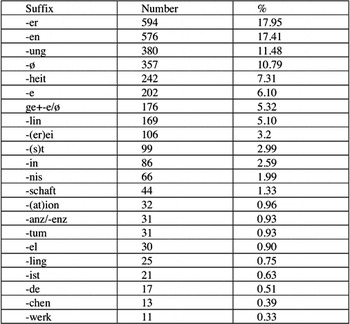
In our description of the suffixes we distinguish between the number of types or individual lexemes that are combined with each suffix (for example, bildnis ‘image’ occurs 11 times, whereas ergernis ‘consternation’ occurs 73 times) and the frequency of each lexeme in all three corpora. Table 1 gives an overview of the nominal suffixes found in all three corpora according to the types of lexemes. It illustrates the totals and percentages for all the types, or lexemes, that occurred more than ten times in all three corpora taken together.

In all there are 22 suffixes, including zero-derivation and the prefix/suffix combination ge+ϕ/e, that occur with more than ten lexemes. Over 58 percent of all lexemes is represented by four suffixes, -er, -en, -ung, and zero. Nine suffixes, -(at)ion, -anz/-enz, -tum, -el, -ling, -ist, -de, -chen, and -werk, occur with values of under one percent. These include three foreign suffixes, -(at)ion, -anz/-enz, -ist, the suffix -werk, and the regional diminutive -chen. The remaining four, -de, -el, -ling, -tum, are not very frequent, even in Modern German.
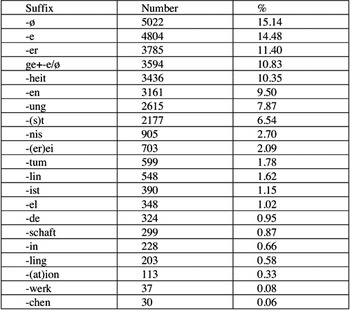
A complementary approach is to look at the frequency of the tokens, individual occurrences, of each suffix showing the frequency of the forms in the texts. As seen in Table 2, the ranking of the suffixes remains similar to that in Table 1, where they are listed by type or lexeme. Table 2 shows the overall totals and percentages of the total attestations of the tokens of the lexemes in all three corpora taken together.

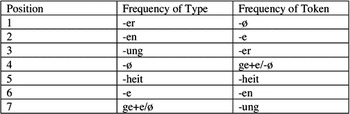
Comparing type and token frequencies in tables 1 and 2, the same seven suffixes come out as the most frequent but in a different order, which is summarized in Table 3.

These seven suffixes account for almost 80 percent (78.65%) of the total occurrences of both types and tokens.
Similarities and Differences between the Corpora
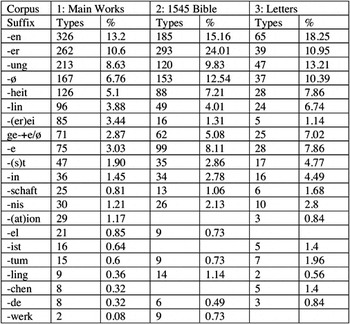
The next step in the analysis is to see how the frequency of the different types and tokens of suffixes that we have ascertained for the three corpora as a whole is reflected in the three individual corpora. Table 4 shows the order of suffixes according to types or lexemes in the individual corpora.

Two suffixes occur in Corpus 1 that do not occur in Corpus 2, namely -(at)ion and -ist. Both are foreign suffixes, which reflect a more natural use of such forms in the topical programmatic and polemic writings rather than in the more conservative language of the Bible. Also missing from Corpus 2, the Bible, is the diminutive suffix -chen. This reflects the whole problem area of the diminutive that is dealt with in section 5. The suffixes -el and -werk do not occur in Corpus 3, the Letters.
The relative ranking of the suffixes in their occurrence according to types and tokens is virtually the same in all three corpora. The suffixes -ling and -werk, have slightly more types and tokens in Corpus 2.
The Forms of the Suffixes
The majority of suffixes show only a minimum variation in form (for examples, -schaft/-schafft; -thum, -tum, -thumb, and -tum), which is purely orthographic. Other variations reflect regional or historical development. The diminutive suffix, for instance, is invariably -lin in the 1545 Bible (Corpus 2), but occurs 4 times as -le in Corpus 1, Luther's Main Works, while the Modern German form -lein with the diphthong does not appear at all. The form -chen for the diminutive occurs eight times in Corpus 1, Luther's Main Works. We deal in more detail with the whole question of the forms of the diminutive in section 5. The suffix -nis occurs three times as -nus, the Upper German form, in Corpus 1, Luther's Main Works, otherwise it occurs as -nis. Corpus 2 and 3 have only -nis. In Corpus 2 there are nine forms for -werk, ending in -g or -ck, whereas Corpus 1 has only two and Corpus 3 none. The prefix ge- is combined either with the suffix -e or else with zero derivation.
Nominal Prefixes
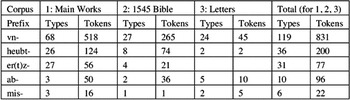
To a lesser extent prefixation is also involved in nominal derivation. Compare data for the five most frequent prefixes in Table 5 below. Examples: vn-, vn-christen ‘non-Christians’; heubt-, heubt-stad ‘capital’; ertz-, ertz-bösewicht ‘arch-villain’ ab-, ab-gott ‘idol’; mis(s)-, misglauben ‘false doctrine’.

The most frequent prefix is un-, followed by heupt- and ertz-. The two prefixes ab- and mis- are infrequent. In Corpus 1 heubt- is the sole form and the two forms in Corpus 3 also have heubt-, whereas Corpus 2 has two haupt- forms. In Modern German the Upper German form with au has ousted Luther's Central German form. The beginning of the development of haupt from free morpheme to prefixoid can be seen already in Middle High German with forms such as houbet-sache ‘main issue’, houbet-sterke ‘main strength’ (Lexer 1:1352–1353). It continued to advance in Luther's works to become completed by Modern German. The prefix erz- was only used in Middle High German for higher ranks of officials (erz-kamerer ‘arch-chamberlain’ [Lexer 1:706]), but, being combined with other nouns designating persons, developed pejorative meanings in Luther and Early Modern German where it is also spelled ertz-. Some of these pejorative forms have remained until today: Erzlügner ‘arch-liar, Erzlump ‘arch-lazybones’, Erzschelm ‘arrant rogue’, Erzübel ‘arch-evil’.
Excursus on the Forms of the Diminutive
The diminutive in Modern German presents a wide range of phonetic variants in the dialects from the two main forms of the written standard, -chen and -lein. Since the originally regionally restricted form -chen has become the main form in the standard it seems worth looking at the development in a wider context.
Bach (1985:§ 69), in his discussion of unstressed syllables, treats the various forms of the diminutive suffix. In the main Luther has forms with -l but there are further interesting variations aside from the ones attested in the three corpora.
Variation between -lein and -lin
Until 1519 the diphthongal form -lein predominates, which Bach sees as being one of the many South German features that appear in the Thuringian/Upper Saxon written language Luther follows. In Corpus 1 there is only one pre-1519 work, but it contains no diminutive forms. From 1520 on the form -lin takes over, with -lein being sporadic. All three of our corpora show predominantly -lin.
The Variant Forms -len, -le, and -el
These forms appear in the printed works of the 1520s. The variant -le is the more frequent and it can often take on an ironic, derogatory nuance of meaning or, on the other hand, it can simply be a neutral diminutive. There are a few words with -el, some of which have lost their diminutive meaning. One form that Luther coined was meister klügel ‘master clever one; know-it-all’.
Satirical Use of South German -el
In his dispute with the Swiss reformer Zwingli, particularly about the Last Supper, Luther uses forms with -el in a satirical way to characterize Zwingli's language, although Zwingli himself uses -ly, -li, or, less frequently, -le. The form -lin does appear, however, in the dative singular and genitive/dative plural (Betzén 1921:18–19).
Avoidance of -chen in General
Bach maintains that -chen is the natural form in Luther's dialect and colloquial language, and that he normally avoids it. Luther does, however, use it pejoratively with reference to some of his opponents, but more significantly he also uses it positively in letters to his wife and family, referring to her as Liebchen ‘darling’ as well as to himself when signing off. When his children are young he refers to them as Hänschen ‘little Hans’, Lenchen ‘little Lene’, or to his sons as Sohnchen ‘little sons’.
Summing Remarks on Diminutive Forms
With hindsight at the other end of the historical development we see now how the suffix -chen has become the main diminutive form in Modern German. Through the influence of the incipient literary standard -chen becomes the favored form in the written language of all dialect regions by the end of the eighteenth century (Schebben-Schmidt 1990). Luther's usage deviates here from what is to become standard.
Henzen (1965:148) ascribes the retention of -lin/-lein in biblical and literary language for a long time to Luther: “Seinem [= Luther's] Einfluß wird es zuzuschreiben sein, wenn -lein in der Literatur noch lange das Übergewicht behauptet” (It is to be ascribed to Luther's influence, if -lein still maintains its predominance for a long time in literature). In the 1671 edition of the Luther Bible published in Wittenberg the diphthongized form -lein has increased over the nondiphthongized form -lin. Shumway (1930:262) found 63 lexemes with -lein as against 21 with -lin but none with -chen.
Functions of Nominal Affixes
Having sketched out the inventory of affixes we now deal with the functions of these affixes. Instead of asking the question, what does affix X mean?, we ask the question, what affixes are used to express function Y? The result is sometimes that a particular function may be expressed by both prefix(es) and suffix(es). The description of the semantic functions of the affixes will be based on those of Wellmann (1975) and Müller (1993), who use paraphrases to describe them.
We further divide the description of the derivational functions into those whose affixes are class-maintaining and those that are classchanging.
Class-maintaining Functions
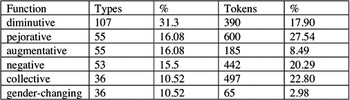
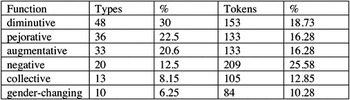
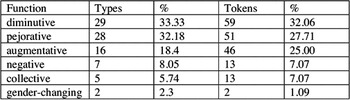
The designations for the functions are self-explanatory. ‘Genderchanging’ renders the German terms Movierung, Motion. Examples: diminutive: Esel-chen ‘little donkey’; pejorative: pap-ist ‘papist’, misglaube ‘false doctrine’; augmentative: heubt-stadt ‘capital’, heubt-lüge ‘main lie’; negative: un-dank ‘ingratitude’; collective: ge-stein ‘stones’; Nominalization in Martin Luther's Word Formation 257 gender changing: fürst-in ‘princess’. Tables 6a–c show the totals for types and tokens as well as percentages for the individual corpora.


The most frequent function of nominal derivation in all three corpora is that of the diminutive. In Corpus 1 -lin is the main form with 93 types, but -el occurs with 6 types, -chen has 7 and -ling has 1. In Corpus 2 -lin is also the main form but with 44 types, while -ling has 2 and -el also has 2. In Corpus 3 the main form is again -lin, 24 types, while the only other suffix, -chen, is represented by 5 types.
A comparison of the order of frequency for the individual functions in the separate corpora shows a difference in the case of the function “pejorative.” In Corpus 1 it is the second most frequent function with respect to type, whereas in Corpus 2 it is the least frequent and in Corpus 3 it is second to last, just above augmentative. Indeed, pejorative is by far the most frequent function with respect to the number of tokens. This prominence of the function pejorative in Corpus 1 is probably due to the polemical nature of many of the works. In the cut and thrust of debate Luther was not averse to dealing sharply with his opponents (Edwards 2003).
Class-changing Functions
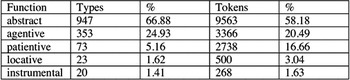
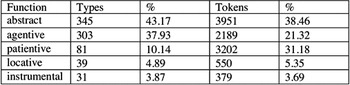
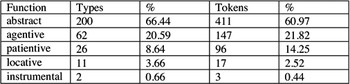
Again, the designations for the functions are largely self-explanatory. atientive has been taken over from Müller (1993:448) who derives it from the paraphrase ‘jemand/etwas, der/das [verb stem (CR)] wird’ (someone/something who/that becomes a verb stem); that is, it is a passive construction. Examples: abstract: -heit, boß-heit ‘evil’; agentive: -er, verreth-er ‘traitor’; patientive: ge-, ge-ruch ‘smell’; locative: -tum, fürsten-tum ‘principality’; instrumental: -el, deck-el ‘cover, lid’. Tables 7a–c show the totals for types and tokens as well as percentages for the individual corpora.


Tables 7a–c show the abstract and agentive being far and away the most frequent functions for all three corpora. Indeed, in Corpora 1 and 3 the individual lexemes expressing an abstract function amount to twothirds of the total number of types for their respective corpus. The relative order of the functions is the same for all three corpora. The main abstract suffixes were -ung and -heit, followed by -ion, -(er)ei, -t, and -e. Adding -en to the verbal stem is the main pattern for forming deverbal abstracts in Corpus 2.
Comparison of Luther's Usage within Early Modern German
An obvious comparison is with Müller's (1993) description of Albrecht Dürer's (1471–1528) nominal word formation, a smaller corpus, but analyzed in a similar way. The inventories and the frequencies of the affixes show obvious similarities. Luther has exactly the same prefixes in the same order of frequency (see Table 5 and Müller 1993:88–89). Six of Dürer's suffixes, -ung, -ϕ, -lein, -er, -(e), and -heit, account for almost 80 percent of all derived forms (Müller 1993:381), while Luther's most frequent suffixes are -er, infinitival -en, -ung, -ϕ, -heit, and -e, which account for 68 percent of derived forms (Table 1). However, Müller does not treat infinitival -en as a separate suffix. Differences are that in Luther -(er)ei is much more frequent while -lin is less frequent. Similarities also exist with regard to the frequencies of the functions. The classmaintaining functions of the suffixes agree in showing the diminutive as being the most frequent function while the others differ in order of frequency. Pejorative comes second in Luther (Corpus 1, Main Works) and fourth in Dürer, but Luther was involved in polemical debate (tables 6a–c and Müller 1993:410). The class-changing functions of the suffixes show the same order for the frequency of the functions in both Luther and Dürer (tables 7a–c and Müller 1993:463). Thus Luther does not differ much from his contemporary Dürer in the inventory of affixes, 260 Russ their frequency, and the distribution of the functions. More studies of other authors and texts would probably confirm this picture. There are some different variants of form in the case of the diminutive suffix and -nis. The diminutive suffix in Dürer has the chief variant -lein (384 types), -len (247), -lin (1), -le (326), and -l(3), whereas Luther has mainly -lin. This clearly reflects Upper German usage. The suffix -nis in Dürer occurs mostly in the Upper German form -nus (89 tokens), 3 with -nüs and only one occurrence of -nis, the main form in Luther!
Comparison of Luther's Usage with Modern German
For a comparison with Modern German we use Wellmann 1975. Modern German shows 10 additional suffixes. These are the foreign suffixes -(at)or, -ent/-ant, -eur, -ie, -ik, -ismus, -ität; the original variants, now full suffixes, -ler and -ner; the extended form -iker; and the suffixoids, -gut and -zeug (Wellmann 1975:56–102). Of these suffixes, -ie and -ität already occurred in borrowings in Middle High German, for example, astronomie ‘astronomy’, solempnitêt ‘solemnity’ (Bachofer et al. 1984:102–106, 503), although they were probably not yet part of a productive pattern. The semi-suffixes/suffixoids -gut and -zeug are also attested by a few forms in Middle High German: waltguot ‘forest’ (Lexer 2:516) and schrîpziuc ‘writing implement’ (Lexer 2:801). Bachofer et al. (1984:40–41; 549–550) give a list of forms. It may be just chance that they are not attested in our Luther corpora. Of Luther's suffixes the diminutive -lin has been overtaken by -chen (Wellmann 1975:127–135) and -(s)t and -de are regarded as no longer productive (Wellmann 1975:236). The four most frequent suffixes in the Luther corpora are -er, -ung, -ϕ and -heit, which are also the most frequent suffixes in Modern German. Wellmann does not give any figures for the frequency of infinitival -en, so the Luther frequency cannot be compared with Modern German in Wellmann's study. Many of the middle- and lower-ranking suffixes in Luther such as -schaft, -tum, -ling, -nis, -werk, -enz/-anz, and -el (Table 1) have similar percentages in Modern German. The classmaintaining functions of the suffixes show that the diminutive is still the most frequent function. Müller helpfully summarizes Wellmann's data (1993:413). After that, the order of class-maintaining functions differs, with negative coming last, preceded by pejorative 5, collective 4, augmentative 3, and gender-changing 2. The reason for this drop in the frequency of the number of negative forms awaits explanation. Among the class-changing functions, the abstract is still the most frequent Nominalization in Martin Luther's Word Formation 261 function in Modern German (Müller 1993:463), and the order of the frequency of occurrence of the other functions, agentive, patientive, instrumental, and locative, is the same as in Luther (tables 7a–c).
The prefixes in Modern German show the development of a number of new prefixoids for the augmentative function. Wellmann lists eleven (1975:152–153): Affen-, Blitz-, Bomben-, Heiden-, Höllen-, Mords-, Pfunds-, Riesen-, Spitzen-, Super-, and Über-. There are traces of possible usage in Middle High German for Höllen-, for example, helleheiz ‘hellishly hot’, helle-hitze ‘hellish heat’ (Lexer 1:152–153) where helle- could be interpreted literally and as an augmentative, and also for Über-, for example, über-dôn (übermäßiger dôn) ‘great noise’, über-drô (über-drohung) ‘exaggerated threat’, and other examples (Lexer 2:1612ff.). There is a new negative prefixoid, Nicht-, although again there are traces of it in Middle High German already, for example, nihtgot ‘non-god’ (Lexer 2:84–85).
Accordingly, Luther's usage is similar to Modern German. This article is thus an initial study that can point the way to further investigations, especially those of the adjective and verb. The following quotations testify to the need for an examination of Luther's word formation as well as a study of the history of German word formation in general. “Der Anteil einzelner literarischer Strömungen und Schulen an unserer Wortbildung—auch der Luthers…—bleibt noch zu untersuchen” (Henzen 1965:25) (The contribution of individual literary movements and schools—as well of Luther's … to our word formation remains to be investigated). “Dabei ist allerdings in Rechnung zu stellen, daß uns heute weder eine umfassende Geschichte der deutschen Wortbildung noch eine gründliche Aufarbeitung von Luthers Wortbildungssystem zur Verfügung steht…” (Fleischer 1983:161) (Thus in fact we have to take into consideration that today we have neither a complete history of German word formation nor a thorough appraisal of Luther's system of word formation at our disposal).
APPENDICES
Details of Individual Corpora

Appendix 2: Corpus 2 (1545 edition of the Bible)
The following books were excerpted:
Old Testament: Genesis; Leviticus; Deuteronomy; Judges; 1 and 2 Kings;
Nehemiah; Zephaniah; Zechariah
New Testament: Gospel according to St. Mark; Gospel according to St. John;
Acts of the Apostles; Romans; 1 and 2 Corinthians; Philippians; Colossians;
Hebrews; 1, 2, and 3 John; Revelation
Appendix 3: Corpus 3 (Letters; from Rückert 1955)
The corpus comprises 93 letters, nearly all of which are written to laypeople.
- Frederick the Wise, 6.11.1517
- Frederick the Wise, 15.5.1519
- Cardinal Archbishop of Mainz, 1.12.1521
- Frederick the Wise, 24.2.1522
- Frederick the Wise, 5.3.1522
- Johann Rühel, 4.5.1525
- Johann Rühel 3.6.1525
- Johan Rühel, Johann Thür and Caspar Müller, 15.6.1525
- Leonhard Koppe in Torgau, 17.6.1525
- Hans von Dolzig, 21.6.1525
- Leonhard Koppe, 21.6.1525
- Elector John, 31.10.1525
- Elector John, 30.11.1525
- Landgraf Philip of Hesse, 28.11.1526
- Elector John, 31.12.1527
- Landgraf Philip of Hesse, 7.1.1527
- Mayor and Council of Zerbst, 17.1.1527
- Elector John, 1.3.1527
- Hans Ottensaß in Spangenberg, 5.2.1527
- Elector John, 28.4.1527
- Hans von Dolzig, 17.3.1527
- Nikolaus von Hausmann in Zwickau, 29.3.1527
- Town Council in Krossen, 13.4.1527
- Elector John, 28.4.1527
- Elizabeth Agricola in Eisleben, 10.6.1527
- Mayor and Council of Coburg, 14.6.1527
- Elector John, 16.6.1527
- Elector John, 16.6.1527
- Elector John, 26.7.1527
- Else von Kanitz in Eiche near Leipzig, 27.8.1527
- Joachim von Weißbach in Ramsdorf, 23.8.1527
- Johann Rühel, 26.8.1527
- Elector John, 10.9.1527
- Elector John, 16.9.1527
- Elector John, 30.9.1527
- Elector John, 9.10.1527
- Elector John, 12.10.1527
- Elector John, 18.10.1527
- Elector John, 27.10.1527
- Elector John, 12.11.1527
- Elector John, 2.12.1527
- Mayor and Council in Zerbst, 5.12.1527
- Mayor and Council in Zerbst, 13.12.1527
- Johann Walther in Torgau, 21.12.1527
- Mayor and Council in Zerbst, 24.12.1527
- Abraham and Heinrich von Einsiedel, 28.12.1527
- Katharina Luther, 4.10.1529
- Hans Luther in Mansfeld, 15.2.1530
- Elector John, 20.4.1530
- Katharina Jonas in Wittenberg, 23.4.1530
- His “Table Companions” in Wittenberg, end April/beginning May 1530
- Elector John, 15.5.1530
- Elector John, 20.5.1530
- Katharina Luther, 5.6.1530
- Caspar von Teutleben in Wittenberg, 19.6.1530
- His son, Hänschen, 19.6.1530
- Philip of Hesse in Augsburg, 20.6.1530
- Prince John Frederick in Augsburg, 30.6.1530
- Spengler in Nuremberg, 8.7.1530
- Elector John, 9.7.1530
- Johann Rühel in Augsburg, 13.7.1530
- Chancellor Brück in Augsburg, 5.8.1530
- Katharina Luther, 14.8.1530
- Katharina Luther, 15.8.1530
- Lazarus Spengler in Nuremberg, 24.8.1530
- Elector John, 26.8.1530
- Spengler in Nuremberg, 28.8.1530
- Katharina Luther, 8.9.1530
- Philip of Hesse, 11.9.1530
- Katharina Luther, 24.9.1530
- Spengler in Nuremberg, 28.9.1530
- Spengler in Nuremberg, 1.10.1530
- Hans Honold in Augsburg, 2.10.1530
- Elector John, 3.10.1530
- Katharina Luther, 27.2.1532
- Katharina Luther, 29.7.1534
- Katharina Luther, 27.2.1537
- Josel the Jew, 11.6.1537
- Georg Buchholzer in Berlin, 4.12.1539
- Katharina Luther, 2.7.1540
- Katharina Luther, 10.7.1540
- Katharina Luther, 16.7.1540
- Katharina Luther, 26.7.1540
- Katharina Luther, 18.9.1541
- Katharina Luther, 28.7.1545
- Count Albert of Mansfeld, 6.12.1545
- Katharina Luther, 25.1.1546
- Katharina Luther, 1.2.1546
- Katharina Luther, 6.2.1546
- Katharina Luther, 7.2.1546
- Katharina Luther, 10.2.1546
- Katharina Luther, 14.2.1546
References
Arndt Erwin, and
Gisela Brandt.
1983.
Luther und die deutsche Sprache.
Leipzig:
Bibliographisches Institut.
Bach Heinrich.
1954.
Kritische Bemerkungen zu einigen Lutherformen.
Festschrift Öhmann.
Annales academiae scientiarum fennicae,
ser. B,
84.9–
98.
Bach Heinrich.
1985.
Handbuch der Luthersprache. Laut- und formenlehre in Luthers Wittenberger drucken bis 1545. Teil 2: Druckschwache silben. Konsonantismus.
Copenhagen:
Gad.
Bachofer Wolfgang,
Walther von Hahn, and
Dieter Möhn.
1984.
Rückläufiges Wörterbuch der Mittelhochdeutschen Sprache.
Stuttgart:
Hirzel.
Baldauf Kunibert.
1982.
Die Relativsatzeinleitung in der Luthersprache.
Sprachwissenschaft
7.
448–
480.Google Scholar
Besch Werner.
1999.
Die Rolle Luthers in der deutschen Sprachgeschichte.
(Schriften der philosophisch-historischen Klasse der Heidelberger Akademie der Wissenschaften, 12.)
Heidelberg:
Carl Winter.
Besch Werner.
2000.
Die Rolle Luthers für die deutsche Sprachgeschichte.
In Besch et al. (eds.),
1713–
1745.
Besch Werner,
Anne Betten,
Oskar Reichmann, and
Stefan Sonderegger.
2000.
Sprachgeschichte.
Ein Handbuch zur Geschichte der deutschen Sprache und ihrer Erforschung. 2nd edn. 2 vols.
Berlin:
Mouton de Gruyter.
Bebermeyer Renate, and
Gustav Bebermeyer.
1993–.
Wortmonographien zum Lutherwortschatz. Wörterbuch zu Martin Luthers deutschen Schriften. Halsherrlich. 3 vols. Anknüpfend an Philipp Dietz, Wörterbuch zu Dr. Martin Luthers Deutschen Schriften, erster Band und zweiter Band, Lieferung 1 (AHals, 1870–1872)
Hildesheim:
Olms.
Betzén Ture.
1921.
Formenlehre der Sprache Zwinglis.
Greifswald:
Abel.
Burdach Konrad.
1891.
Luthers Bedeutung für die Ausbildung der neuhochdeutschen Schriftsprache.
Literarisches Zentralblatt 28. Januar, cols.
134–
136.
(Also in Burdach, Konrad. 1925. Gesammelte Schriften zur Geschichte des deutschen Geistes. Erster Band. 2. Teil: Reformation und Renaissance. Deutsche Vierteljahresschrift für Literaturwissenschaft und Geistesgeschichte. Buchreihe. 2. Band. Halle: Niemeyer, 271–274. Reprinted in Luthers Deutsch: Sprachliche Leistung und Wirkung. 1990. Ed. by Herbert Wolf, 42–44. Frankfurt: Peter Lang.)
Dietz Philipp. 1870–1872
1997.
Wörterbuch zu Dr. Martin Luthers Deutschen Schriften, erster Band und zweiter Band, Lieferung 1 (A-Hals),
Hildesheim:
Olms.
Edwards Mark U.
2003.
Luther's polemical controversies.
The Cambridge Companion to Martin Luther,
ed. by Donald K. McKim,
192–
205.
Cambridge:
Cambridge University Press.
Erben Johannes.
1974.
Luther und die neuhochdeutsche Schriftsprache.
Deutsche Wortgeschichte,
ed. by Friedrich Maurer and
Heinz Rupp, vol. 1,
439–
492.
Berlin:
Mouton de Gruyter.
Fleischer Wolfgang.
1996.
Zur Entwicklung des Systems der Wortbildung in der deutschen Literatursprache unter dem Blickpunkt von Luthers Sprachgebrauch.
Luthers Deutsch: Sprachliche Leistung und Wirkung,
ed. by Herbert Wolf,
160–
176.
Frankfurt:
Peter Lang.
Franke Carl. 1913–1922
1973.
Gründzüge der Schriftsprache Luthers. 3 vols.
Hildesheim:
Olms.
Grimm Jacob. 1870
1967.
Deutsche Grammatik I,
ed. by Wilhelm Scherer.
Hildesheim:
Olms.
Henzen Walther.
1965.
Deutsche Wortbildung. 3rd edn.
Tübingen:
Max Niemeyer.
Kluge Friedrich.
1925.
Abriß der deutschen Wortbildungslehre. 2nd edn.
Halle:
Max Niemeyer.
Lexer Matthias. 1872–1878
1979.
Mittelhochdeutsches Handwörterbuch. 3 vols.
Stuttgart:
Hirzel.
Müller Peter O.
1993.
Substantiv-Derivation in den Schriften Albrecht Dürers.
Berlin:
Mouton de Gruyter.
Paul Hermann.
1920.
Deutsche Grammatik. V. Wortbildungslehre. 4th edn.
Halle:
Max Niemeyer.
Pibworth Clare.
2002.
Nominalisation in the 1545 edition of Luther's translation of the Bible: A comparison with Early New High German and Modern German word formation.
Master's thesis,
University of York (UK).
Rückert Hanns (ed.).
1955.
Luthers Briefe. Luthers Werke in Auswahl. 2nd edn.
Berlin:
Mouton de Gruyter.
Russ Charles V. J.
1984.
Martin Luther and the development of the German language.
New German Studies
12.
1–
20.Google Scholar
Russ Charles V. J.
1994.
The German language today.
London:
Routledge.
Schebben-Schmidt Mariatheres.
1990.
Studien zur Diminution in der deutschen Schriftsprache des 18. Jahrhunderts. Deutsche Sprachgeschichte. Grundlagen, Methoden, Perspektiven.
Festschrift für Johannes Erben zum 65. Geburtstag,
ed. by Werner Besch,
313–
321.
Bern:
Peter Lang.
Scott Alan K.
2002.
Nominal derivation in Early High German. An investigation based on a corpus of Martin Luther's writings.
Master's thesis,
University of York (UK).
Shumway D. B.
1930.
The language of the Luther Bible of 1671.
Germanic Review
5.
247–
287;
345–
377.Google Scholar
Stevens Christopher M.
2000.
The derivational suffixes and suffixoids of Old Saxon: A panchronic approach to a linguistic category.
American Journal of Germanic Linguistics and Literatures
12.
53–
79.Google Scholar
Tschirch Fritz.
1969.
Geschichte der deutschen Sprache II.
Entwicklung und Wandlungen der deutschen Sprachgestalt vom Hochmittelalter bis zur Gegenwart.
Berlin:
Erich Schmidt.
Wellmann Hans.
1975.
Deutsche Wortbildung.
Typen und Tendenzen in der Gegenwartssprache. 2. Das Substantiv. (Sprache der Gegenwart, 32.)
Düsseldorf:
Schwann.
Wellmann Hans.
1995.
Die Wortbildung. Duden Grammatik. 5th edn.,
ed. by Günther Drosdowski,
399–
539.
Mannheim:
Dudenverlag.
Wilmanns Wilhelm. 1899
1930.
Deutsche Grammatik. II. Wortbildung. 2nd edition.
Berlin and Leipzig:
Walter de Gruyter.
Wolf Herbert.
1985.
Germanistische Luther-Bibliographie. Martin Luthers deutsches Sprachschaffen im Spiegel des Internationalen Schrifttums der Jahre 1880–1980.
Heidelberg:
Carl Winter.
Wolf Herbert.
1987.
Zum Stand der sprachlichen Lutherforschung. Frühneuhochdeutsch. Zum Stand der sprachwissenschaftlichen Forschung.
Zeitschrift für deutsche Philologie (Sonderheft)
106.
246–
272.Google Scholar
Nominal Suffixes by Lexeme Type (Corpora 1, 2, 3).
Nominal Suffixes by Token (Corpora 1, 2, 3).
Comparison of Top Seven Suffixes According to Type and Token.
The Order of Suffixes According to Types or Lexemes in the Three Corpora.
Nominal Prefixes.
Class-maintaining Functions: Corpus 1 (Main Works).
Class-maintaining Functions: Corpus 2 (1545 Bible).
Class-maintaining Functions: Corpus 3 (Letters).
Class-changing Functions: Corpus 1 (Main Works).
Class-changing Functions: Corpus 2 (1545 Bible).
Class-changing Functions: Corpus 3 (Letters).
 You have Access