Chemical, biological, radiological, and nuclear (CBRN) emergencies involve agents like toxic and hazardous chemicals, biological warfare agents, toxic radiological or nuclear materials, and weapons of mass destruction (WMD). They can be caused either accidentally (Bhopal gas tragedy in India, Chernobyl nuclear accident in Ukraine) or intentionally (nuclear bombing of Hiroshima and Nagasaki in Japan during World War II). Reference Lorin and Kulling1–Reference Harris and Paxman3
Moreover, CBRN events can result in mass causalities and create hazardous environments within a very short time span. Reference Chemical4,Reference Keim and Kaufmann5 Hospitals play a vital role in providing emergency care during such disasters and act as a focal point in mounting an emergency response. 6 Hospitals in the United States have been found to be inadequately prepared to handle WMD events. Reference Treat, Williams and Furbee7,Reference Hsu, Casani and Romanosky8 Similar results have also been reported for other Western countries like Australia and Belgium. Reference Edwards, Caldicott and Aitken9,Reference Mortelmans, Van Boxstael and De Cauwer10
In the Middle East, a lack of CBRN preparedness was highlighted during the chemical attacks that Syria experienced in 2013. Reference Hakeem and Jabri11,Reference Eisenkraft, Gilburd and Kassirer12 The need to create awareness and provide disaster training to the masses was underscored by a Saudi study that was conducted in 2012. Specifically, it found that there was a substantial lack of awareness about disasters among the general population. Reference Alshehri, Rezgui and Li13 In 2014, a study that was conducted in Mecca found that there were major deficiencies in emergency nurses’ knowledge about disaster plans. Reference Alzahrani and Kyratsis14 Furthermore, studies that have examined the disaster preparedness of hospitals in Mecca and Riyadh have reported the following: substantially inadequate education, training, and monitoring of hospital staff, a lack of exercises and drills that promote disaster preparedness, and suboptimal hospital disaster preparedness plans. Reference Al-Shareef, Alsulimani and Bojan15,Reference Bin Shalhoub, Khan and Alaska16
Saudi Arabia is at a risk for attacks that involve WMD. The ongoing war in neighboring countries, namely, Syria, Yemen, Israel, and Palestine, and emergence of terrorist groups in this region have increased the risk of attacks. 17 In addition, the government of Saudi Arabia plans to construct several nuclear power reactors over the next few years, and they carry the risk of accidental emergencies. 18 The emergence of terrorist groups such as the so-called Islamic State in Iraq and Syria, Al-Qaeda, and Hezbollah has also increased the chances of attacks on Saudi Arabia because it vehemently opposes their terrorist activities. The constant barrage of rockets and missiles that have been launched from Houthi-held Yemeni territories over Saudi Arabia, especially Riyadh city, highlights the need for disaster preparedness among Saudi institutions and society. Reference Al-Haddad, Siddiqi and Al-Zaid19
Preparedness for the consequential risks of WMDs begins with assessing the local hospitals’ ability in mitigating and minimizing the effect of any disaster. Several research initiatives that are related to hospital preparedness for CBRN events have been implemented around the world, but such studies have not yet been widely conducted in Saudi Arabia. Hence, this study aimed to assess the CBRN preparedness of government hospitals in Riyadh. The objective is to conclude whether current disaster preparedness is sufficient and on par with global indicators using the CBRN defense standards as precedence of comparison. Based on similar past studies, this article hypothesizes comparable results with previous studies conducted in various regions.
Methods
A descriptive cross-sectional study was conducted across government hospitals in Riyadh. Any government hospital in Riyadh that had been included in the national disaster plan, had 100 inpatient beds, and had an emergency department met inclusion criteria. Hospitals that were specialized entities (eg, King Khalid Eye Hospital) and had fewer than 100 inpatient beds were excluded.
The CBRNE (chemical, biological, radiological, nuclear, or explosive event) Plan Checklist, which has been developed by The Centre for Excellence in Emergence Preparedness in Canada, was adapted and used in the present study. 20 This checklist was considered to be most relevant to the objectives of the current study due to its universal nature. The checklist was designed so that facilities can use it to conduct assessments and initiate dialogues with key stakeholders within their respective facilities. Furthermore, the tool measures input data by extensively and substantially capturing the broad context of CBRN preparedness; thus, establishing content validity. The tool has 7 sections: (i) foundational considerations pertaining to general policies and procedures addressing the hospitals’ readiness and mitigation measures; (ii) planning with regard to coordination of policies and procedures implementation; (iii) training and awareness of common knowledge and preparedness for ongoing staff and current established training policies for longevity; (iv) procedures concerning staff communication during emergencies, baseline characteristics, and patient evaluation plans for in hospital units and contamination measures; (v-vii) modules for CBRN incidents where hospital planning and mitigation is assessed. The incident commander of each hospital responded to the checklist. If such a position did not exist in a hospital, the head of the emergency department or medical director completed the checklist.
Data collection began on October 15, 2018, spanning for a period of 10 wk from 10 preauthorized hospitals. Initial data collection included in person interviews with designated personnel, in the form of a manual questionnaire checklist. The checklist included more than 100 questions divided into the 7 aforementioned sections. Manual data were electronically entered and imported into Microsoft Excel. Descriptive statistics, namely, frequencies and percentages, were computed for categorical variables, and they were graphically presented using simple bar graphs. All analyses were conducted using SPSS version 21 (IBM Corp, Armonk, NY).
Written informed consent was obtained from all participants. This study was conducted in accordance with the principles of the Helsinki Declaration. Ethical approval for this study was granted by the Clinical Research Ethics Committee of the Faculty of Medicine, King Saud University, Riyadh, Saudi Arabia, and permission to conduct the study was granted by the hospital’s administrations.
Results
Eleven public hospitals in Riyadh were invited to participate in the study, but 1 of them refused to participate (response rate = 91%).
Regarding the foundational considerations of CBRN preparedness, all hospitals had a disaster committee, but only 2 of them had a CBRN planning committee. Furthermore, CBRN considerations were included in the disaster plans of 7 hospitals. More than half of the hospitals did not share a collaborative relationship regarding preparedness for CBRN incidents with local response teams. A detailed disaster action plan was available in all hospitals, but it had been widely distributed and was readily available in only half of them.
Regarding planning activities and personnel in-charge, only half of the hospitals had a designated CBRN coordinator responsible for day-to-day operations of CBRN activities concerning drills, surveillance, staff training, assessing policies and procedures, and submitting recommendations, whereas 7 hospitals had a medical director who oversaw CBRN preparedness activities in addition to their other duties.
Regarding training and awareness to promote CBRN preparedness, fewer than half of the hospitals reported that their emergency personnel were aware of the signs and symptoms of CBRN exposure. This claim, however, could not substantiated by surveying and testing the personnel’s actual knowledge and training on that matter. Furthermore, only 4 hospitals had provided continuous training which was initiated bi-yearly to personnel who were responsible for responding to CBRN incidents. Six of the hospitals reported that not all the members of their CBRN response team had received CBRN preparedness training.
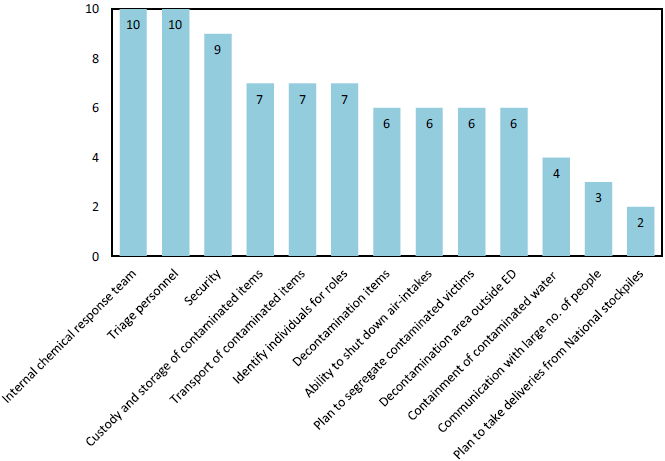
With respect to the procedures that pertained to CBRN preparedness, only 3 hospitals had a disease surveillance plan that could be implemented after a CBRN incident. However, 8 of them had procedures that had to be followed to collect and protect evidence in the event of a criminal CBRN emergency. Eight hospitals had procedures that had to be followed to receive patients who have been exposed to CBRN agents before their treatment. A portable decontamination device was available in only half of the hospitals. Seven of the hospitals reported that they would have ready access to necessary equipment, dosage requirements for CBRN treatments, drug administering equipment, and antidotes in the event of a CBRN emergency (Figure 1).
Availability of inventories, equipment, and logistics for chemical, biological, radiological, and nuclear preparedness in public hospitals in Riyadh between 2018 and 2019.

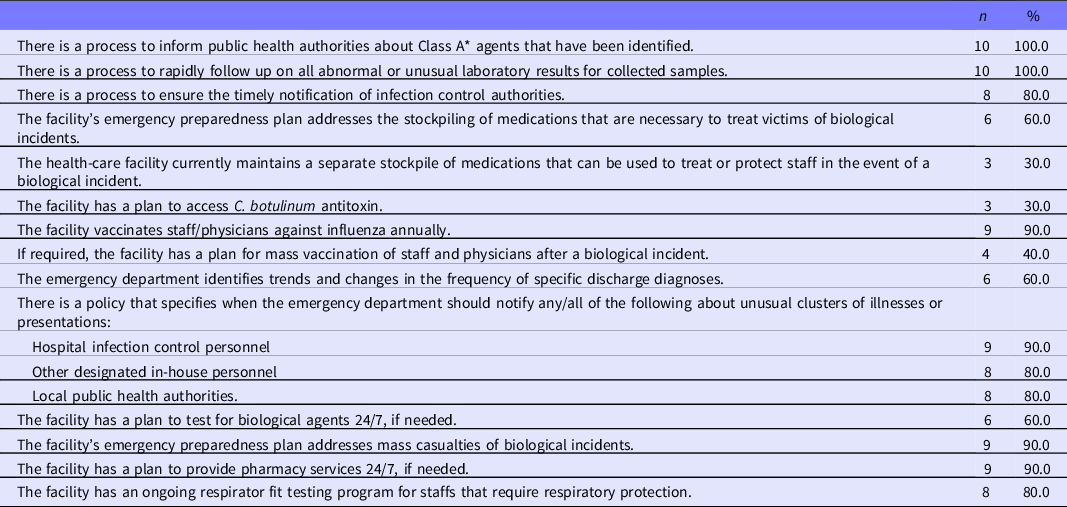
Regarding preparedness for biological incidents, all hospitals had policies and procedures for the management of Class A agents. However, the staff had been trained to recognize the signs and symptoms of exposure to these agents in fewer than half of the hospitals. A stockpile of common medications that will be needed during biological incidents was available in most of the hospitals, but a plan to access municipal or regional government stockpiles was available in only half of them. Many of the hospitals had laboratory facilities that could be used to diagnose exposure to biological agents and protocols to identify and report the increased consumption of drugs. Similarly, an internal surveillance system named the Health Electronic Surveillance Network (HESN) was used as an integrated Public Health Information System (PHIS). HESN acts as a 1-stop platform that encompasses all public health aspects; enabling public health professionals to better detect, respond, prevent, and control diseases and injuries in addition to monitoring the population’s health status through the process of continuous collection of hospital internal data. In this study, the system was used to identify illnesses such as gastrointestinal, influenza-like, and febrile respiratory illnesses which was available in all of the hospitals. Personal protective equipment (PPE) and plans to obtain additional PPE were available in all hospitals. Biosafety level (BSL) 2 laboratories were present in hospitals, and BSL 3 laboratories were present in 6 hospitals (Table 1).
Distribution of responses to the items of a checklist on preparedness for biological incidents among public hospitals in Riyadh between 2018 and 2019

Note: *Class A agents include anthrax, plague, smallpox, botulism, viral hemorrhagic fevers (filoviruses like Ebola and Marburg and arena viruses like Lassa and Machupo), and tularemia.
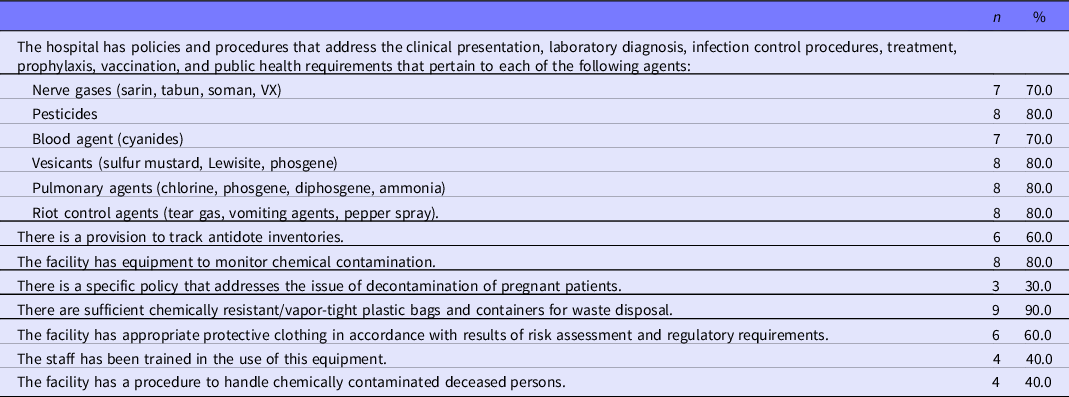
With respect to preparedness for chemical incidents, 6 of the hospitals had access to agents like pralidoxime, tropicamide, pyridostigmine, cyanide antidote kit, dimercaprol, and acetylcysteine. However, a rapid access to stockpiles was available in only half of the hospitals. All the hospitals had an internal chemical response team, and many of them had access to trained responders like the hazmat team (Table 2).
Distribution of responses to the items of a checklist on preparedness for chemical incidents among public hospitals in Riyadh between 2018 and 2019

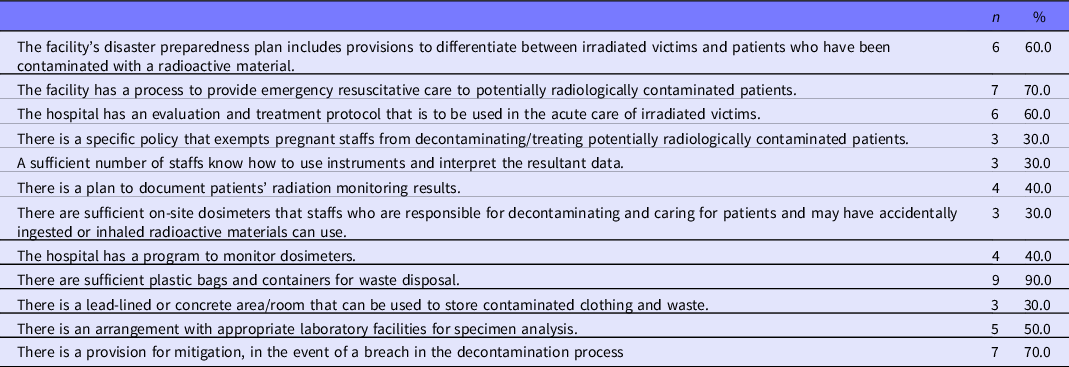
Regarding preparedness for radiological or nuclear incidents, 6 of the hospitals had a radiation safety officer, an internal radiation incident plan, and a plan for the evaluation and management of irradiated victims. Half of the hospitals had a radiation detection instrument. Six hospitals had a ready contact list of in-facility radiation experts. However, a contact list of external radiation experts was available in fewer than half of the hospitals. A sufficient stock of antiemetics and fluids to manage irradiated victims was available in 8 of the hospitals. However, stocks of antidiarrheal agents and potassium iodide were sufficient in fewer than half of the hospitals (Table 3).
Distribution of responses to the items of a checklist on preparedness for radiological or nuclear incidents among public hospitals in Riyadh between 2018 and 2019

Discussion
This study examined the CBRN preparedness of government hospitals in Riyadh. These findings are important because these unexpected events can wreak havoc if they are not handled appropriately. The study has also provided general assessment indicators about health-care providers’ competence in handling such situations, these indicators may need partial third-party testing. The availability of supplies, equipment, and logistics in a hospital is necessary but insufficient to manage disasters; adequately trained health-care professionals play an equally important role. Hence, the present findings can be used to improve conditions that foster the CBRN preparedness of government hospitals in Riyadh. The overall response rate of the present study (91%) was higher than what has been reported in similar studies that have been conducted in Belgium, Australia, the United States, and Mecca. Reference Edwards, Caldicott and Aitken9,Reference Mortelmans, Van Boxstael and De Cauwer10,Reference Al-Shareef, Alsulimani and Bojan15,Reference Wetter, Daniell and Treser21
Without clearly defined objective criteria and key performance indicators of minimum requirements for staff preparedness, it is not possible to assess hospital preparedness. Reference Alexander22 Many measures of disaster preparedness exist, Reference Al-Shareef, Alsulimani and Bojan15,23 one of which assesses 3 associated competencies: general competencies, specific competencies of emergency nurses, and rapid response competencies of first-line health-care providers. Reference Mitchell, Kernohan and Higginson24 However, the CBRNE Plan Checklist was adapted and used in the present study because we found it to be the most universal form of testing and appropriate to the Saudi context due to its detailed and sectionalized format. Furthermore, the close ended method in framing most of the checklist’s questions is more efficient and offers a practical form of research through comparative analysis.
All the participating hospitals had disaster committees and detailed disaster action plans. However, only a few of them had disaster units and CBRN planning committees. Similarly, very few hospitals had conducted combined drills in collaboration with local agencies. This finding shows a broad interest in CBRN planning rather than a fully comprehensive one, it further shows a lack of established ongoing collaboration with local stakeholders to address ways of mitigating the effects of disasters and the need to initiate plans that pertain to combined drills and specific disaster units and strengthen CBRN planning by constituting CBRN planning committees. This finding is similar to the finding of Bin Shalhoub et al. that all their participating private hospitals in Riyadh had a hospital disaster plan and committee but were inadequately prepared for emergency drills. Reference Bin Shalhoub, Khan and Alaska16
In this study, the disaster plans of 7 hospitals included CBRN considerations. This figure is higher than what was reported in a Belgian study (53%). Reference Mortelmans, Van Boxstael and De Cauwer10 Combined drills were conducted in collaboration with local agencies in very few hospitals, and this finding concurs with those of Al-Shareef et al. and Wetter et al. Reference Al-Shareef, Alsulimani and Bojan15,Reference Wetter, Daniell and Treser21
In the present study, only half of the hospitals had a designated CBRN coordinator. A CBRN coordinator oversees CBRN preparedness activities. Therefore, their presence can facilitate the planning and execution of preparedness activities. Data show having a CBRN coordinator overseen by a medical director produced a more well-rounded CBRN preparedness program. CBRN coordinators are essential in handling the standard day to day activities and insuring the efficiency and effectiveness of current measures through periodic drills and improved quality assurance tests. CBRN coordinators are also more able to be detail oriented and delegate smaller tasks to different personnel as necessary, which ensures a comprehensive CBRN program matching the hospital’s capacity. In many of the participating hospitals, the medical director oversaw CBRN preparedness activities. Furthermore, hospital personnel had received inadequate CBRN preparedness training. Hospital personnel’s knowledge about the signs and symptoms of CBRN exposure was poor. Frontline health-care workers play a crucial role in treating victims of disasters within a hospital. Poor training and a lack of knowledge can adversely affect the effectiveness of CBRN preparedness. Health-care workers in Australia, the United States, and Mecca receive advanced training in disaster management. Reference Edwards, Caldicott and Aitken9,Reference Al-Shareef, Alsulimani and Bojan15,Reference Wetter, Daniell and Treser21 The hospitals were found to have satisfactorily assigned roles and responsibilities that pertain to the overall management of CBRN events to different personnel. Responsibilities that pertain to issues such as triage, security, chain of custody, storage of contaminated items, and transportation of contaminated items and deceased persons had been assigned in most of the hospitals in this study. This is an important component of CBRN preparedness because it is difficult to assign such responsibilities during disasters. However, the responsibility of procuring equipment had not been assigned in most of the hospitals.
Mass communication systems disseminate important messages to all staff members and the general population during disasters. Therefore, it is an important component of disaster management. However, this system was present in fewer than half of the participating hospitals. A lack of a well-planned communication system poses a risk for staff in recognizing a CBRN event and being able to respond in a timely manner. It further hinders the prompt activation of a CBRN program in time of crises, which increases the risk of mass causality.
Decontamination devices help prevent the spread of hazardous CBRN materials from contaminated bodies or objects to other individuals, equipment, and facilities. Encouragingly, facilities to isolate contaminated victims were available in 80% of the hospitals. However, decontamination devices were available in only half of them, and contaminated items could be contained in only 40% of them. Thus, there is an urgent need to improve the availability of decontamination devices in hospitals, because they can prevent mass contamination and mitigate the health impact of incidents that involve contaminants. The availability of decontamination facilities in the participating hospitals of the present study was poorer than what has been reported for some western countries Reference Wetter, Daniell and Treser21,Reference Bennett25 but better than what has been reported for Australia and Mecca. Similarly, systems that can contain contaminated fluid were found to be available in only 40% of the government facilities in Mecca. Reference Al-Shareef, Alsulimani and Bojan15
Regarding preparedness for biological incidents, most hospitals had policies and procedures to diagnose and manage Class A agents. However, only half of them had trained their staff in these policies and procedures. Similarly, fewer than half of the hospitals had trained their staff to recognize the signs and symptoms of exposure to Class A agents. Hospitals who trained their personnel did not showcase established training quality standards; thus, the effectiveness of such measures could not be clearly assessed. Furthermore, the mere availability of policies and procedures is insufficient to manage the aftermath of disasters. Hence, there is a greater need to focus on the education and training of health-care workers to improve hospital preparedness. Medications are an important component of emergency and disaster management. It is necessary to stockpile them so that they can be used whenever there is a high demand. Nevertheless, only 6 hospitals had plans to stockpile medications. Furthermore, only 3 hospitals had a separate stockpile for staff. Half of the hospitals did not plan to procure medicines from municipal or regional stockpiles during an emergency. All these factors can seriously affect the availability of drugs during disasters and compromise the quality of services that need to be provided. The availability of antibiotics was satisfactory across hospitals, but the antitoxin for C. botulinum was available in fewer than half of the hospitals. Such organisms can be used in bioterrorist attacks. These findings are like those of a study that was conducted in Mecca. Reference Al-Shareef, Alsulimani and Bojan15 Similarly, only 56% of the hospitals in the Unites States were found to have adequate supplies to handle chemical or biological attacks. Reference Bennett25
Nine hospitals had conducted an annual vaccination program against influenza for their staff. Most hospitals had policies to identify unusual surges in the rates of particular types of illnesses and facilities to diagnose illnesses that are caused by organisms that can be used in bioterrorist attacks (anthrax, brucellosis, plague). Similarly, most hospitals had emergency preparedness plans to manage mass casualties of biological agents. All hospitals had adequate on-site PPE. The availability of vaccination programs in hospitals was similar to what was reported in a Belgian study, Reference Mortelmans, Van Boxstael and De Cauwer10 and the availability of PPE was similar to what has been reported in studies that have been conducted in countries other than Saudi Arabia. Reference Edwards, Caldicott and Aitken9,Reference Mortelmans, Van Boxstael and De Cauwer10
Most hospitals had policies and procedures to treat individuals who have been affected by nerve gases, pesticides, vesicants, pulmonary agents, and other substances. Similarly, in many of the hospitals, antidotes like atropine, diazepam, pralidoxime, and tropicamide were available. A study that was conducted among private hospitals in Riyadh also found that a stockpile of antidotes for organophosphate and cyanide poisoning was available in most hospitals. Reference Bin Shalhoub, Khan and Alaska16 However, almost half of the hospitals did not have rapid access to stockpiles of drugs and facilities to track antidote inventories. This merits attention because victims of disasters require urgent care, and delays in procuring medicines and equipment can delay effective responses. Keim et al. found that hospitals in a major city in the United States were insufficiently prepared to address emergencies that involve nerve agents and cyanide poisoning. Reference Keim, Pesik and Twum-Danso26 Similar to the present findings, the availability of adequate amounts of antidotes like atropine, pralidoxime, and diazepam in hospitals have also been reported by studies that have been conducted in the United States and Belgium. Reference Mortelmans, Van Boxstael and De Cauwer10,Reference Greenberg, Jurgens and Gracely27 However, Eliseo et al. found that these compounds were unavailable in hospitals. Reference Edwards, Caldicott and Aitken9 In the present study, a majority of the hospitals had facilities to monitor chemical contamination and bags and containers to discard chemical waste. Protective clothing was also available in more than half of the hospitals, but 6 hospitals had not trained their staff to use such equipment. The present findings about the availability of facilities to manage contaminated water are like those of a British study. Reference Williams, Walter and Challen28
Many of the participating hospitals had a radiation safety officer and plans to manage internal radiation incidents and irradiated victims. More than half of the hospitals did not have dosimeters that staff could use. This is an important finding because radiation detection instruments can be used to estimate the risk of a nuclear incident. Furthermore, they are essential to the safety of staff members. The inadequate availability of radiation detection measures in hospitals was also reported in another Belgian study. Reference Mortelmans, Van Boxstael and De Cauwer10 In a study that was conducted in the United States, the availability of equipment, protection, and treatment that pertain to radiation trauma was found to be inadequate. Reference Jasper, Miller and Sweeney29 In the present study, most hospitals had a contact list of in-facility radiation experts, but only a very few of them had access to external experts. In a study that was conducted in Australia, most hospitals were found to have access to specialist advice in the event of a CBRN incident; these findings are like the present results. Reference Edwards, Caldicott and Aitken9 This finding is significant because external experts serve as important sources of information during an emergency. Although most of the participating hospitals had adequate facilities, equipment, and logistics to handle radiation-related incidents, they varied in the extent to which these resources were available.
Strengths and Limitations of the Study
The present study has several strengths. First, the current study was one of the first to examine the CBRN preparedness of public hospitals in Riyadh. The present findings are likely to serve as an indispensable source of empirical evidence in future disaster planning and management in public hospitals. Second, the use of the CBRNE Plan Checklist ensured that a comprehensive and valid set of information about the CBRN preparedness of hospitals were collected and examined. Third, all the hospital heads were interviewed by a single researcher. This enhanced the reliability of the findings and eliminated the possibility of inter-observer variations. Fourth, the high response rate (> 90%) that emerged in the present study permits the results to be generalized to other similar cities within the Kingdom of Saudi Arabia. Finally, the hospital heads who oversaw disaster preparedness are likely to have been made aware of several lacunae in their facilities over the course of the interview, and this may have stimulated them to conduct an internal assessment and improve their preparedness.
A few limitations of the present study must be borne in mind when its findings are interpreted. The incident commanders or heads of emergency departments of the participating hospitals provided all the data. Thus, respondents’ reluctance to disclose the inadequacies of their hospitals may have biased the data that were collected. Indeed, respondents’ reports about the availability of inventories, equipment, and logistics were not crosschecked through first-hand observations. Similarly, the knowledge and skills of health-care workers were not directly assessed; instead, they were indirectly assessed based on the reports of persons in-charge. This may have resulted in the under- or overestimation of their abilities.
Conclusions
The CBRN preparedness of government hospitals in Riyadh was found to be less than satisfactory. Many encouraging findings, such as the following, also emerged: availability of a disaster committee, triage personnel, and plans to manage internal and external disasters, inclusion of considerations that are related to CBRN events in disaster plans, ability to provide medical care in response to CBRN incidents, collaboration with police to manage decontamination sites, availability of drug administration equipment, collaboration with public health authorities, implementation of staff vaccination programs, laboratory facilities to test for biological agents, and availability of antibiotics, PPE, and major drugs that are needed to treat victims of chemical and radiological events. However, we also found that there was considerable scope for improvement in several other areas such as the training of health-care workers, assignment of appropriate personnel to roles that are required during emergencies, stockpiling of appropriate medications, implementation of drills, and management of contaminated deceased persons.
Recommendations and Future Directions
All hospitals that currently do not have a CBRN coordinator should immediately appoint or designate an experienced official as a CBRN coordinator and establish disaster management units. All hospitals should prepare plans to regularly conduct drills in collaboration with local emergency response units. All staffs that are designated to handle equipment that are related to CBRN events should be sufficiently trained to identify and use them. Hospital management should take immediate steps to identify personnel who can occupy vacant positions that are related to CBRN planning. Furthermore, the roles and responsibilities of these personnel should be clearly defined, and they must be provided with appropriate training. Hospital management should identify mechanisms and pathways to access local, regional, and national stockpiles and appoint an official who can organize these activities. All hospitals should develop clear plans and standard operating procedures to handle deceased persons who may have been contaminated with CBRN materials. Guidelines, protocols, and training manuals should be developed by the Ministry of Health and widely distributed to all hospitals so that they are better equipped to respond to CBRN emergencies. Similar studies on CBRN preparedness should be conducted among hospitals in other cities within the Kingdom of Saudi Arabia, in a temporal order that corresponds to their relative risk of experiencing CBRN events.
Acknowledgments
The authors thank the study participants for their valuable time and patience.
Author contributions
A.A. and A.K. conceived the study. A.A. prepared the questionnaire and collected data. A.K. provided critical inputs that shaped the study design and development of the checklist. A.A. conducted data analysis and wrote the first draft of the manuscript with critical inputs from A.K. All authors have reviewed and approved the final manuscript.
Funding
None.