





Introduction
The Russo-Ukrainian war is marked not only by military confrontation but also by a significant informational and ideological struggle, in which historical narratives have become a powerful weapon. The Kremlin actively employs “historical” arguments to justify and legitimize its aggression against Ukraine. In his speeches, Vladimir Putin frequently reiterates that Ukraine lacks a tradition of statehood, asserts that Ukrainians and Russians are “one people,” and accuses Ukraine of sympathizing with Nazism (Putin Reference Putin2021). Ukraine’s attempts to reinterpret or revise its historical narratives are perceived by the Kremlin as a hostile act that challenges the “historical truth” and, therefore, must be punished (Putin Reference Putin2022).
In the temporarily occupied territories, these ideas are implemented through the destruction of Ukrainian cultural heritage, changes to the demographic and symbolic landscape, and the imposition of Russian historical narratives (Rossiyskoe istoricheskoe obschestvo Reference obschestvo2022; Kolebakina-Usmanova and Kazakova Reference Kolebakina-Usmanova and Kazakova2023; Pervomaisk. Info 2022; Zhuk Reference Zhuk2022).
Ukraine’s response has manifested itself in the radicalization and intensification of the process of ridding itself of Russia’s imperial and communist legacy. This process aligns with a political and media rhetoric of decolonization and is legitimized by relevant legislation (for example, the “Law of Ukraine on the Condemnation and Prohibition of Propaganda of Russian Imperial Policy in Ukraine and the Decolonization of Toponymy,” adopted in 2023) (Verkhovna Rada of Ukraine 2023).
On one hand, the discourse of decolonization is particularly relevant in the context of the Russo-Ukrainian war, as it offers a deeper understanding of the historical roots of the conflict and its contemporary manifestations. It reflects the existential nature of Ukraine’s resistance to aggression — as a struggle for the survival of the nation, the state, and its identity. On the other hand, the sharp rhetoric of the Ukrainian media, the radicalisation of historical policy, and practices of decolonization create conditions for the dominance of a single official narrative. This creates a risk of marginalizing elements of historical memory that do not correspond to the official vision, which may provoke resistance from local communities characterized by a specific and ambiguous historical heritage.
The aim of this article is to explore the nature and challenges of Ukraine’s decolonization policy during the full-scale war with Russia, focusing on the case of Odesa — a space with a unique historical and cultural context where imperial, Ukrainian, Soviet, and post-Soviet legacies intersect. I seek to understand how the war has actualized practices of decolonization, transforming them into a component of a broader security strategy and identity politics. I focus specifically on decolonization as a normatively regulated memory policy, enshrined in legislation and implemented through state institutions and local self-government bodies. In practice, this policy is primarily implemented in the field of toponymy and the symbolic redefinition of public space, focusing on ridding it of its Russian imperial and Soviet heritage, and is carried out with the involvement of the public, which participates in consultations, initiatives, and public discussions. My analysis draws on a combination of three theoretical frameworks: postcolonial theory, securitization theory, and discourse theory. This interdisciplinary approach allows not only for an understanding of decolonization as the dismantling of imperial and Soviet legacies but also for an examination of how, in the process of consolidating a hegemonic Ukrainian-centric narrative, it interacts with security logic, becoming a tool of mobilization and political reordering of the past.
Within this analytical framework, I adopt the concept of mnemonic ambivalence proposed by Barbara Törnquist-Plewa and Yulia Yurchuk, who demonstrated the coexistence of anticolonial nationalism and hybridity in Ukraine’s memory politics from 2015 to 2019 (Törnquist-Plewa and Yurchuk Reference Törnquist-Plewa and Yurchuk2019). I extend this framework to the current decolonization policy that has emerged after 2022, when questions of national identity and historical memory acquired a tangible existential dimension. I aim to show how decolonization shifts the balance of ambivalent elements in favor of anticolonialism. I analyze how nationwide efforts in decommunization and decolonization, supported by legal instruments and civic initiatives, are implemented at the local level in Odesa, and what sociocultural challenges arise in the course of their adaptation — how national and local memory approaches clash, and which elements of ambivalence or resistance persist in the city’s mnemonic landscape.
In this context, this article engages with Vera Skvirskaja’s study (Skvirskaja Reference Skvirskaja2025), which addresses the same debates surrounding decolonization in Odesa. Skvirskaja argues that the post-Soviet paradigm remains necessary from an analytical perspective: both supporters and opponents of decolonization reproduce post-Soviet political habits and allegiances, and the Russian invasion has merely exposed the resilience of this “post-Soviet condition,” but has not destroyed it.
This article offers a different perspective. I argue that since 2022, the politics of decolonization in Ukraine have undergone a structural shift — from ambivalence to anticolonialism — which the post-Soviet framework struggles to encompass. The post-Soviet legacy is not denied, but is viewed as one layer within a broader postcolonial field, rather than as its organising principle.
Methodology
Methodologically, this study is grounded in qualitative discourse analysis, which makes it possible to conceptualize decolonization not merely as a set of administrative decisions but as a field of struggle over symbols, narratives, and meanings within Ukraine’s mnemonic space. The structure of the article follows a movement from the general to the particular: after examining the legal foundations of decolonization and its political and ideological motivations at the national level, the analysis shifts its focus to Odesa. The choice of this city as a case study is determined by the fact that it most clearly reveals the central dichotomy of the research — namely, the confrontation between anti-colonialism and the historical ambivalence of local memory.
To analyze these processes, the study draws on the post-structuralist theory of Ernesto Laclau and Chantal Mouffe, which conceptualizes discourse as a field of hegemonic struggle over meaning (Laclau and Mouffe Reference Laclau and Mouffe2001). The combination of postcolonial theory with the concept of securitization allows decolonization to be interpreted as an instrument of “mnemonic security” — a strategic means of protecting Ukrainian identity from Russia’s aggressive influence in the context of war. At the same time, this framework explains the emergence of an anti-colonial logic of exclusion from the mnemonic landscape of everything that may be associated with imperial or Soviet legacies.
The empirical base of the study consists of materials covering the period from the beginning of legally regulated decommunisation in 2015 to 2024, when decolonization policy acquired a systematic and consistent character. This timeframe makes it possible to trace the transformation of state policy from the selective removal of Soviet heritage to the radical derussification of public space. The analysis includes national legislation on decolonization, documents and statements of the Ukrainian Institute of National Remembrance, materials produced by regional authorities, as well as publications and media content generated by civic initiatives in the field of memory politics. In addition, educational and media projects that mediate between official policy and public debate are examined. Media projects and journalistic publications occupy a particularly important place in the analysis, as they function as platforms for public discussion. Sources were selected on the principle of discursive salience, as they most clearly demonstrate the antagonism between the “national” and the “imperial.”
At the local level, Odesa serves as a case study for analyzing the policies of regional authorities in the sphere of decolonization and the related public and intellectual discourses. The study examines decisions and statements by local government bodies, regulatory documents concerning toponymic changes and commemorative practices, as well as materials from regional media, civic initiatives, and public intellectuals. Particular attention is paid to discourses aimed at deconstructing the “Odesa myth” and rethinking urban identity.
An important methodological dimension of the research is the consideration of positionality and reflexivity on the part of a Ukrainian scholar, which is especially critical in the context of war. As Viktoria Sereda and Oksana Mikheieva note, there is a tension between the defensive reaction of certain social groups to the ongoing war — leading to demands that particular topics be classified as sensitive, potentially dangerous to the population or state security, or unacceptable for public discussion — and the necessity for scholars to engage with the situation in all its complexity (Sereda and Mikheieva Reference Sereda and Mikheieva2025).
My own position is based on an understanding of decolonization as a legitimate step toward safeguarding sovereignty; at the same time, I analyze the risks of marginalizing local specificity. In this context, discourse analysis is aimed at examining how war radicalizes historical narratives and narrows the space for ambivalence, demanding unequivocal answers to complex historical questions. The main limitation of the study lies in the unfinished nature of these processes as they unfold in real time, which makes the conclusions relevant to the present moment but open to further revision as Ukraine’s new memorial landscape stabilizes.
Theoretical discourses of securitization and anticolonialism
The issue of decolonizing historical memory in the Ukrainian context is directly linked to securitization theory, as the understanding of the past in times of conflict becomes a politically charged security discourse. Securitization and decolonization, under conditions of the Russo-Ukrainian war, function as parallel yet interdependent processes — links in the same chain that mutually reinforce each other.
Securitization theory, initiated by the Copenhagen School, posits that an issue becomes a matter of security not because it is inherently a threat, but because it is publicly framed as one. This act is performative and allows the issue to be moved beyond the bounds of ordinary political discourse, granting it the status of an “existential threat” that requires urgent and exceptional measures (Wæver Reference Wæver and Lipschutz1995). Within this framework, Ukrainian narratives of historical memory — and Ukrainian identity more broadly — are depicted by the Kremlin as threats to the legitimacy of a “shared” history and the idea of Ukrainian-Russian unity, thus justifying policies of intervention and dominance.
The securitized Russian narrative reproduces colonial logic akin to Edward Said’s concept of “Orientalism” — a portrayal of the colonized as a threatening “Other” in need of subjugation (Said Reference Said1978; Barkawi and Laffey Reference Barkawi and Laffey2006). In this context, Ukrainians are perceived as adversaries of imperial identity, and their efforts to preserve their own history are framed as threats to the “natural order” of things. From this perspective, Russia’s full-scale invasion in 2022 can be interpreted as a securitized response to Ukraine’s pursuit of identity affirmation.
Ukraine’s reaction to the aggression has been a counter-securitization — this time from the Ukrainian side. At its core lies the idea that memory “must be protected” (Mälksoo Reference Mälksoo2015). According to Maria Mälksoo, such instrumentalization of memory can be described as “mnemonic security,” whereby legislative initiatives codifying a particular version of historical “truth” function as tools of state control over memory. Their goal is to ensure the establishment of “correct” versions of historical narratives. These “correct” versions are artificially constructed depending on the nature of the existential threat. Each defensive narrative emerges as a counter-narrative to those put forth by the adversarial discourse (Mälksoo Reference Mälksoo2015). On this basis, the securitization of national historical narratives, myths, heroes, and symbols that have been delegitimized by the enemy is formed.
However, I argue that this process is not merely a defensive reaction. It simultaneously constitutes an act of decolonization, as the securitized narrative deliberately removes elements of the imperial and Soviet past, increasingly recognized as colonial legacies. Securitization and decolonization thus become mutually reinforcing: the more aggressively the Russian discourse delegitimizes Ukrainian identity, the more assertively Ukraine responds — through a radical cleansing of historical memory from Russian imperial and Soviet legacy. This response operates within the framework of anticolonialism, functioning as a form of self-defense (Törnquist-Plewa and Yurchuk Reference Törnquist-Plewa and Yurchuk2019)
In this light, securitization theory gains new heuristic value when combined with postcolonial analysis — understood not merely as a defensive tool against external threat, but also as a mechanism for dismantling colonial hierarchies in the cultural and symbolic spheres.
Nevertheless, the application of postcolonial theory to Ukraine remains contested — even within Ukrainian intellectual discourse. There is ongoing debate, particularly among academic historians, about whether Ukraine can be considered a colony of the Russian Empire and the USSR (Hrytsak Reference Hrytsak2015; Velychenko Reference Velychenko2004; Hryt͡sak and Shapoval Reference Hryt͡sak and Shapoval2023). Without delving deeply into this debate, I outline two opposing positions. On the one hand, Ukraine held a central role within imperial structures and economic modernization, and Ukrainians actively participated in shaping imperial and Soviet elites (Hrytsak Reference Hrytsak2015; Hryt͡sak and Shapoval Reference Hryt͡sak and Shapoval2023; Kasianov Reference Kasianov2023). On the other hand, the Russian center imposed a cultural hierarchy that marginalized the Ukrainian language and identity (Riabchuk Reference Riabchuk2013). Thus, the question of Ukraine’s colonial status depends on which dimension — political, cultural, or social — is prioritized in the analysis.
If one accepts the legitimacy of a postcolonial perspective — especially considering the current political and legal framework officially termed as “decolonization” — then one encounters a certain terminological ambiguity regarding “decolonization,” “anticolonialism,” and “postcolonialism,” as well as their often-flexible interpretations. However, this is not unique to Ukrainian debates. As Gianmaria Colpani emphasizes, such terminological diversity is inherent to decolonial discourse. According to him, categories like “decolonial,” “anticolonial,” and “postcolonial” are united not by a concrete definition of colonialism, but by a shared spirit of resistance and challenge to hegemony (Colpani et al. Reference Colpani, Jamila and Smiet2022). This pluralism, on one hand, reflects the complexity and multifaceted nature of colonial structures and the diversity of paths to their dismantling. On the other hand, it creates the risk of reducing postcolonial reflection to a mere removal of Russian markers from cultural and public space and the securitization or even “canonization” of a singular national narrative.
This coexistence of two approaches can be interpreted through the lens of postcolonial ambivalence, as discussed by scholars such as Leela Gandhi (Gandhi Reference Gandhi1998). This involves, on the one hand, an anticolonial nationalist model, and on the other, elements of hybridity and the emergence of new subjectivities and transcultural expressions (Törnquist-Plewa and Yurchuk, Reference Törnquist-Plewa and Yurchuk2019. Anticolonialism entails not merely resistance to colonialism, but the elevation of national values over universal imperial ones; it is not simply a negation of colonialism but an affirmation of its opposite. A key feature of anticolonialism is its mimetic reproduction of colonial structures of thought and writing. It attains polemical expressiveness and political commitment by directly inheriting the structural logic of colonialism (Kolesnyk Reference Kolesnyk2024).
“Anticolonialism” or “anticolonial nationalism,” on the one hand, is a natural and important feature of the struggle for decolonization (Fanon Reference Fanon1963), yet on the other, it seeks to replace the colonial discourse with a new hegemonic narrative, securitizing memory and rigidly excluding difference to legitimize the marginalization of alternative voices that may interfere with the national project (Kolesnyk Reference Kolesnyk2024). It is from this perspective that Törnquist-Plewa and Yurchuk identified the ambivalence of memory politics in Ukraine following the Revolution of Dignity (2013–2014 and prior to the full-scale invasion). Analyzing two central topics of memory politics—World War II and the activity of Ukrainian nationalist organizations such as the Organisation of Ukrainian Nationalists (OUN) and the Ukrainian Insurgent Army (UPA) — the authors identify both anticolonial elements (promotion of a nationalist vision) and hybrid ones (remnants of the Soviet narrative), a so-called “third space” (Törnquist-Plewa and Yurchuk Reference Törnquist-Plewa and Yurchuk2019).
Drawing on the poststructuralist discourse theory of Laclau and Mouffe (Romaško and Gurova Reference Romaško and Gurova2022), the process of decolonization can be interpreted as a hegemonic articulation of a new national order seeking to displace the colonial discourse and form a new chain of equivalence — that is, a set of elements united around a common struggle (for example, cultural decolonization, historical rethinking, dismantling imperial symbols) to establish a new “national” meaning. In this process, the colonizer becomes the constitutive “Other,” whose opposition is foundational to the emergence of a new hegemony. The colonial discourse, in this context, is delegitimized and displaced through mechanisms of antagonistic politics, where the enemy “Other” (the colonizer) is not merely an alternative position but a threat to the very existence of the new order — thus also resonating with the principles of securitization theory.
Even before postcolonial terminology entered the Ukrainian intellectual mainstream, a few Ukrainian scholars had warned of these risks, describing anticolonialism as a mere inversion of signs — from plus to minus — in which a national myth, with equal certainty and exclusivity, replaces the imperial one (Pavlyshyn Reference Pavlyshyn2006). In this framework, imperial interpretations of history are declared false and mythological, and are replaced by allegedly true myths of national liberation.
Ukrainian historian Serhii Yekelchyk, already in the 1990s, applied the term “subaltern” from postcolonial studies to the Ukrainian context, viewing Ukrainian history as one that constantly functions within external narratives — first imperial, then national — which continue to reproduce imperial structures of silence or subordination. In the imperial narrative, Ukraine does not exist. Yet even within the national narrative, Ukrainian history remains subordinated, as national intellectual elites create or reproduce their own myths and interpret them through their own ideological lens (Yekelchyk Reference Yekelchyk1997).
Instead, the hybrid model of historical memory implies overcoming polarities and creating new forms of identity, rejecting the rigid boundaries of nationalist thinking, and allowing for dialogue between new and old historical narratives. This aligns with Marko Pavlyshyn’s definition of postcolonialism (Pavlyshyn Reference Pavlyshyn2006). Unlike anticolonialism, postcolonialism does not deny the existence of empire but studies and reinterprets its legacy, taking into account both colonial and anticolonial experiences. It acknowledges the hybridity and ambivalence of identification, as well as the coexistence of multiple versions of the past. Given the ongoing Russian aggression (which at that time was limited to the annexation of Crimea and the conflict in Donbas), Törnquist-Plewa and Yurchuk identified the discourse of anticolonial nationalism as dominant in the near future (Törnquist-Plewa and Yurchuk Reference Törnquist-Plewa and Yurchuk2019).
Thus, the postcolonial theoretical framework proposed by Törnqvist-Pleva and Yurchuk appears promising for studying the decolonization of historical memory in the aftermath of a full-scale invasion. This concept is applied in this study to the case of Odesa, where the transformation of historical memory after 2022 can be examined empirically. This conceptual framework is particularly well-suited to this context for two reasons. Firstly, the phase of historical memory policy that unfolded after 2022 was no longer defined primarily by decommunization — the dynamic that characterized the preceding period. Secondly, and this is linked to the first point, this phase took on a distinct ethno-national aspect: unlike the earlier decommunization, which targeted Soviet symbols in general, decolonization after 2022 was directed specifically at objects, figures, and narratives associated with Russian ethnic, national, and geographical origins of an imperial nature. These characteristics make the postcolonial concept more empirically appropriate than concepts focused exclusively on decommunization. By supplementing it with the theory of securitization and, to a lesser extent, discourse theory, one can trace how — through securitization and the discursive “exclusion” of the Other — the balance within the ambivalence of historical memory policy shifts in favor of anticolonialism, and what space remains for hybridity.
Ukrainian realities of decolonization: Legislative discourse and memory actors
The systematic securitization of Ukraine’s national historical narrative began in response to Russia’s hybrid aggression in 2014, which involved the annexation of Crimea and armed conflict in the Donbas. This aggression was not solely military in nature but was accompanied by a large-scale propaganda campaign in which Russia actively employed Soviet and imperial symbols — such as red flags,Footnote 1 the St. George ribbon,Footnote 2 and the rhetoric of the “Great Patriotic War.”Footnote 3 (Bazhenova Reference Bazhenova and Bazhenova2023). Within this campaign, the Kremlin promoted the glorification of the Soviet past while accusing contemporary Ukraine of “neo-Nazism” and of devaluing the shared Soviet historical legacy (Latysh Reference Latysh and Bazhenova2023). Thus, Soviet symbolism was instrumentalized as an ideological weapon in the hybrid war, serving to legitimize aggression and delegitimize Ukrainian identity.
Against this backdrop, the adoption in 2015 of a package of “decommunization” laws constituted a direct response to security threats posed by Russia’s aggressive use of Soviet narratives. These four legislative acts outlined the main directions of the decommunization process: 1) Renaming toponyms and physical objects associated with Soviet ideology; 2) Criminalization of the Nazi and Soviet regimes and the prohibition of their symbols, including Soviet-era memorials and monuments to Soviet figures; 3) Official recognition of the Ukrainian liberation movement as the primary agent of Ukraine’s independence. This expanded the circle of actors acknowledged as fighters for independence to include members of the Ukrainian nationalist underground during World War II; 4) Opening the archives of Soviet security and repressive institutions (Pakhomenko and Hedo Reference Pakhomenko and Hedo2020).
The content of the laws — especially the Law “On the Condemnation of the Communist and National-Socialist (Nazi) Totalitarian Regimes in Ukraine and the Prohibition of Propaganda of Their Symbols” — clearly reflected the securitization of historical memory (Verkhovna Rada of Ukraine 2023b). The Soviet legacy was declared a potential threat in light of Russia’s expansionist ambitions, while sympathies for the USSR were equated with sympathies for Russia and pro-Russian political forces (Shevel Reference Shevel2016). Although these laws were framed almost exclusively as tools of decommunization at the time, they are now retrospectively interpreted as the initial stage of a broader process of decolonization (Ukrainian Institute of National Remembrance 2025b).
From a postcolonial perspective, although the laws promoted a strongly securitized anti-communist narrative, the landscape of historical memory they helped construct nevertheless retained certain elements of hybridity. This hybridity led Törnquist-Plewa and Yurchuk to describe the historical politics of the period as ambivalent (Törnquist-Plewa and Yurchuk Reference Törnquist-Plewa and Yurchuk2019). Indicators of this ambivalence included widespread public and expert debate surrounding the laws (albeit after their adoption),Footnote 4 the coexistence of national and Soviet narratives in official commemorative practices, and references to European legal and cultural frameworks (Törnquist-Plewa and Yurchuk Reference Törnquist-Plewa and Yurchuk2019).
However, in my view, examining this exclusively anti-communist phase of historical policy (2015–2022) through a postcolonial lens reveals certain limitations. First, neither the legislative documents nor the political discourse accompanying them included, with few exceptions, decolonial rhetoric. In other words, while the USSR and communist ideology were described as hostile, they were not framed as colonial. Second, identifying the threat primarily in communist ideology, rather than in the broader cultural marginalization of Ukrainian national identity, leaves researchers little room for the application of anticolonial nationalism as a conceptual framework. The securitized anti-communist narrative clearly identified the “Other” — the USSR — whose symbols and monuments were erased from public space. However, national narrative hegemony had not yet been established, and the legacy of the Russian Empire and broader imperial influence remained outside the scope of the prohibitive legislation.Footnote 5
Russia’s full-scale invasion of Ukraine in 2022 catalyzed the expansion of historical and political programs aimed at further dismantling Ukraine’s imperial legacy, particularly through the lens of Russian colonialism. Even before the official legalisation of the relevant regulations in 2023, many local communities in Ukraine had already begun to remove symbols associated with Russian or Soviet history, culture, and geography from their public spaces. This movement was largely initiated by the residents themselves, from below, rather than from above (Cabinet of Ministers of Ukraine 2023)
Most often, the motives for such actions were twofold: the desire to get rid of cultural elements that had been imposed by the Soviet-Russian regime for the purpose of cultural and political domination, and to replace them with symbols that better reflect Ukrainian identity and the achievements of their own historical figures; and a strong emotional aversion to Russian cultural markers as symbols of power and a society at war with Ukraine (Gnatiuk and Melnychuk Reference Gnatiuk and Melnychuk2023). For this reason, the process of decolonization can be seen not only as a legal or political change, but also as a form of emotional geopolitics (Pain Reference Pain2009).
In this context, the 2023 Ukrainian law “On the Condemnation and Prohibition of Propaganda of Russian Imperial Policy in Ukraine and on the Decolonization of Toponymy” marked the first legislative act to explicitly position itself within a broader decolonization discourse. It signaled a shift from limited opposition to Soviet heritage toward a more systematic dismantling of the symbolic presence of Russian imperialism in Ukrainian public spaces (Verkhovna Rada of Ukraine 2023a).
The law’s central theme is a conceptual opposition between a national, Ukrainian-centered narrative and “Russian imperial policy” in both historical and contemporary forms. In contrast to the decommunization laws, the decolonization law not only securitizes the national narrative but also delegitimizes Russian cultural influence in terms of anti-colonial nationalism. The law and its accompanying explanations use terms such as “elimination,” “condemnation,” and “prohibition,” which indicate ideological confrontation within the framework of anti-colonial struggle, rather than postcolonial reflection (Ukrainian Institute of National Remembrance 2023).
In other words, decolonization is framed not as a critical rethinking of imperial legacy, but as the cleansing of public space from Russian markers. The prohibition extends beyond state symbols of Russian entities — from the Tsardom of Muscovy to the contemporary Russian Federation — to include commemorative objects related to individuals who held leadership positions in state, military, or party structures, including those imposed on occupied territories; individuals involved in or supportive of Russian imperial policy; Soviet state security officials; those who publicly glorified, justified, or supported imperial policy in art or media; those who advocated Russification or expressed Ukrainophobia; and toponyms bearing their names. Meanwhile, the primary criterion for commemorating a historical figure is now their contribution to the idea or practice of Ukrainian statehood, culture, or independence (Verkhovna Rada of Ukraine 2023a).
It is notable that the law avoids generalized terms such as “colonialism” or “empire,” instead introducing the more specific concept of “Russian imperial policy,” defined in the preamble as a “system of actions carried out by institutions and individuals aimed at subjugation, exploitation, and assimilation of the Ukrainian people.” This terminology enables the law’s authors to present Russia as a distinct historical agent of colonial expansion toward Ukraine, deliberately separating it from other former empires, whose influence on Ukrainian lands remains largely confined to academic discourse. In essence, this approach equates decolonization with derussification — the systematic removal of Russian and Russian-imperial symbols from Ukrainian culture, society, and geographical nomenclature (Verkhovna Rada of Ukraine 2023a).
The anticolonial nationalist logic and its anti-Russian orientation are explained not only by the ongoing war but also by its ideological framing: the Kremlin’s denial of Ukrainian statehood, identity, and culture. In Ukraine’s case, Russia is perceived not merely as a historical colonizer but as a modern imperial structure that continues its policy of domination — militarily and symbolically. It embodies a chain of equivalences — “imperial,” “colonial,” “totalitarian,” “Soviet,” etc. In this sense, “Russia” is not merely a geopolitical adversary but a hegemonic symbol through which the national project is consolidated via negative articulation. Under the influence of war and aggressive rhetoric, the meaning of “Russia” increasingly ceases to denote a concrete subject and instead assumes the symbolic role of the absolute Other — the embodiment of everything Ukrainian society seeks to free itself from. By contrast, other former empires — Austria-Hungary, Poland, the Ottoman Empire — do not play a comparable role in the decolonial discourse. This is because antagonistic logic toward these entities is not activated in the current political field. They pose no threat to Ukraine’s sovereignty, make no claims to ideological or cultural dominance, and thus do not function as nodal figures of negative identification.
This antagonistic approach, therefore, reduces the potential for hybridity in memory politics and undermines the balance that previously allowed for ambivalence. Beyond its general anti-Russian orientation — forming the core of anticolonial nationalism — decolonization entails a more decisive rupture with Soviet symbols, including those that had earlier coexisted in hybrid form with the national narrative. For instance, considering that in Russia, Victory Day (May 9) has been sacralized and militarized, becoming a symbol of imperial aggression (like the St. George ribbon), and that the war against Ukraine is framed by Russian propaganda as a continuation of the Great Patriotic War, Ukraine has abolished the May 9 holiday.Footnote 6 Only May 8 remains as a commemorative date (Vox Check 2023).
Russia’s large-scale aggression has also led to the radicalization of the Ukrainian Institute of National Remembrance (UINP), which functions both as a research and governmental institution. As such, the professional views of its leadership may be perceived as the official position of the ruling elite, scientifically legitimized by the Institute’s expertise. Anton Drobovych, who headed the UINP from 2019 to 2024, was initially known for his liberal approach to memory politics and had criticized the radical methods of his predecessor, Volodymyr Viatrovych — the ideological architect of decommunization (Kondrat′êva Reference Kondrat′êva2024).
However, following Russia’s invasion, Drobovych acknowledged the necessity and effectiveness of Viatrovych’s policies, becoming one of the key advocates of decolonization legislation (Ukrainian Institute of National Remembrance 2025). This indicates that the securitization of history and the shift to an anticolonial platform occurred not only at the legislative level but also in the mindset of memory actors themselves.
Despite the radicalization of historical policy along anticolonial lines — largely driven by Russian aggression — the law preserves elements of hybridity. Several examples illustrate this heterogeneity. First, decolonization does not apply to monuments related to the fight against Nazism, including those dedicated to Soviet soldiers or bearing associated toponyms. The UINP issued a special clarification stating that such objects are not subject to removal, although Soviet symbols must be stripped from them (Ukrainian Institute of National Remembrance 2023). A notable symbolic example of this selective but meaningful approach is the replacement of the Soviet coat of arms on the shield of the “Motherland” statue in Kyiv with the Ukrainian state coat of arms (Migal′ Reference Migal′2024).
Second, the removal of figures associated with imperial policy from public spaces is not necessarily accompanied by a total negation of their artistic or professional achievements. Third, there has been growing attention to the memory of national minorities, which had long been marginalized in the official narrative (Ukrainian Institute of National Remembrance 2023). On one hand, this reflects an attempt to reconcile purposeful decolonization with principles of pluralism, inclusivity, and democratic engagement — but within a Ukrainian-centric narrative.
The new head of the Institute of National Remembrance (as of July 2025), Oleksandr Alf’orov, proposed five guiding principles for the Institute’s work: inclusivity of national memory, argumentation, dialogue, critical thinking — instead of propaganda — and, notably, a call to ignore Russian historical narratives “as if Russia never existed.” (Ukrainian Institute of National Remembrance 2025a). This statement borders on populism and appears detached from historical reality. It also contradicts another of Alf’orov’s declared principles: supporting the state in effectively countering Russian propaganda and disinformation.
In practice, the limited mnemonic pluralism prescribed by law and recommended by the UINP often faces implementation challenges. For example, public discussions at the local government level regarding the public space objects ostensibly demonstrate diverse approaches to heritage. Similarly, the fact that decisions on renaming or dismantling are made by local communities suggests a commitment to democratic mechanisms (Butko et al. Reference Butko, Gorobec′, Karetnìkov, Korolenko and Majorov2015). However, in the current decision-making framework, public consultations and local council positions have limited capacity to alter outcomes. If a local councilFootnote 7 does not decide on the renaming of a street or the fate of a monument within six months, its powers in the matter are transferred to the regional state (military) administrationFootnote 8 (Butko et al. Reference Butko, Gorobec′, Karetnìkov, Korolenko and Majorov2015). The act of decolonization is carried out as a deliberate political decision, despite potential public objections. Moreover, public consultations occur unevenly, encompassing communities with varying levels of engagement and depth of involvement. At the national level, there has been neither broad public debate nor expert discussion concerning the decolonization legislation itself — something that is evidently conditioned by the realities of wartime. At the same time, certain communities managed to preserve cultural markers that were important to them, even if they contradicted the strictly decolonial narrative (Ukraїner.net. 2025a).
The preservation and commemoration of those who fought against Nazism during the Second World War is also interpreted in diverse ways. Some communities choose to retain monuments to Soviet soldiers while dismantling monuments or renaming streets named after officers and generals. These decisions are based on the legal provision stipulating that decolonization applies to commemorative objects honoring individuals who held commanding positions within the Soviet hierarchy (Rayon Reference Rayon2023). Thus, the law itself contains only an apparent ambivalence, while in practice, it shifts the focus decisively toward anticolonialism and securitization.
Since 2022, decolonization initiatives have increasingly originated from civil society, particularly through grassroots projects such as “Decolonization. Ukraine.” The aim of this project is to create a database of objects subject to decolonization. It operates alongside a Telegram channel with over eight thousand unique users (DecolonizationUkraine 2025). Following Russia’s full-scale invasion of Ukraine, the initiative expanded its scope to include all toponyms associated with Russia. The project’s sole and explicit mission is the decolonization of toponymy, as reflected in its slogan: “A project for cleansing our country of occupation markers and street names” (DecolonizationUkraine 2025). In practice, the activists focus predominantly on Soviet and Russian toponymic elements. Notably, search queries regarding markers of other imperial legacies (for example, the Austro-Hungarian Empire or the Polish-Lithuanian Commonwealth) returned only three and ten results, respectively — none of which were relevant. By contrast, queries related to Russia (the Russian Empire, the USSR, etc.) yielded more than 1 600 relevant results.
Terminology used by the project “Decolonization. Ukraine”

Table 1. Long description
The table consists of three columns: Source, Search query, and Number of results. The Source column contains a single entry for all rows: Decolonization. Ukraine, with the link h t t p s forward slash forward slash t dot me forward slash DecolonizationUkraine. The Search query and Number of results columns contain seven rows of data:
* Soviet: 1656 results.
* U S S R: 181 results.
* Imperial: 114 results.
* Russia: 43 results.
* Poland: 10 results.
* Empire: 10 results.
* Austro-Hungary: 3 results.
Activists identify monuments, plaques, and street names containing Soviet or Russian symbols across various cities and villages in Ukraine and submit official requests to the appropriate governmental bodies responsible for enforcing the decolonization law — from local councils to the Ministry of Culture or the Institute of National Remembrance. These bodies then determine how to respond. As such, the decolonization project activists function as typical agents within the field of memory politics. Securitization manifests not only at the level of discourse but also through action. By publicly articulating a threat (in this case, the imperial legacy of the Russian Federation), the activists compel official institutions to respond within a security-oriented framework. Consequently, this civic initiative operates as a para-institutional actor in memory policy, institutionalizing its own vision of security through symbolic anticolonial “cleansing of public space.”
Civic initiatives that frame decolonization in its broadest sense also include educational projects, many of which have gained popularity on various streaming platforms since 2014 and have subsequently evolved into recognizable “brands” of national historical counter-propaganda. Nearly all such projects address the theme of decolonizing the historical landscape of Ukraine in general and Odesa in particular. By analyzing the global streaming platform YouTube, one can identify key Ukrainian educational initiatives that are not directly funded by the state and are thus, by definition, civic in nature. History Without Myths, a project by historian Vladlen Maraiev, hosts discussions on a wide range of historical topics (Istoriya Bez Mifiv Reference Mifiv2025b). Although it does not focus exclusively on countering Russian imperial narratives, the creators’ strong interest in deconstructing Russian historical propaganda is evident in the dedicated section titled “Hybrid Empire,” which contains nearly 150 videos. In comparison, traditional themes of the Ukrainian national narrative — such as the Cossacks or the Ukrainian Revolution — receive significantly less attention, with only 29 and 49 videos, respectively (Istoriya Bez Mifiv Reference Mifiv2025b).
The streaming project by Oleksandr Alf’orov, who also presents a professional historian’s perspective, had a distinctly local historical focus prior to Russia’s full-scale invasion. Since 2022, however, it has shifted toward topics such as the heritage of Kyivan Rus, the Cossacks as a national elite, and historical commentary on current events in the Russia-Ukraine war (Oleksandr Alf’orov Reference Alf’orov2025c). Both channels contain content that actively debunks myths about Odesa’s alleged “Russian nature” and instead present the city’s history — as well as that of southern Ukraine more broadly — as an essential part of Ukrainian national memory (Oleksandr Alf’orov Reference Alf’orov2025a and Reference Alf’orov2025b; Istoriya Bez Mifiv Reference Mifiv2025a)
Leading educational civic initiatives aimed at countering Russian imperial narratives

Table 2. Long description
The table consists of six columns: Source, Year of publication, Location, Audience, Views, and Update frequency.
* Row 1: Istoriya Bez Mifiv (Vladlen Marayev), 2020, YouTube/Instagram/Telegram, 906 000 audience, 182,143,636 views, 2 issues weekly.
* Row 2: Alexander Alf’yorov, 2019, YouTube/ Facebook, 490 000 audience, 111,586, 511 views, No periodicity, approximately 1 issue per week.
* Row 3: AzovSeaNews, 2022, YouTube/Instagram/Telegram/Facebook/Viber/Tik-Tok/official portal, 132 000 audience, 88,990,734 views, No periodicity, approximately 1 issue per month.
The program De-Occupied History, aired by Radio Svoboda: News from the Azov Region, exemplifies a pronounced anti-colonial stance (Novyny Pryazovya Reference Pryazovy2025b). The program focuses on southern Ukraine and features contributions from professional historians and local scholars. Episodes typically center on individual cities or regional national minorities, presenting a hybrid memory format that integrates the Ukrainian ethnic narrative with those of local communities. However, Russia is consistently portrayed as a colonizer and oppressor — both of Ukrainians and of other ethnic groups in the region (Novyny Pryazovya Reference Pryazovy2025a).
An analysis of these streaming channels reveals the predominance of a logic of differentiation (Laclau and Mouffe 1985) — constructing clear oppositions between Ukrainian and Russian historical traditions, between colonizer and colonized, and between “false” imperial memory and “authentic” national memory. In postcolonial theory terms, this corresponds to a destabilization of imperial discourse and the production of a counter-narrative rooted in anti-colonialism. It reflects an effort to overcome a subaltern position through the popularization of a national “We,” while simultaneously establishing and rejecting the image of the “Other.”
The anticolonial narrative is frequently supplemented by the narratives of national minorities. In the case of Odesa, for example, we observe efforts to represent the city’s history not as a product of the imperial myth of the “Southern Palmira,” but as a multiethnic space with a pre-imperial legacy — thus deconstructing colonial uniformity. On one hand, these educational programs foster hybridization of historical memory from a postcolonial perspective by highlighting the histories of various ethnic communities rather than fixating solely on the Ukrainian ethnic dimension. On the other hand, by aligning the histories of national minorities as allies and opposing them to the Russian narrative, the anti-colonial character of these initiatives is further reinforced through a more explicit rejection of the Russian imperial and Soviet legacy.
Odesa: The traps of decolonization
The city of Odesa serves as an illustrative example of the contested understandings of decolonization, both from the perspective of the state and that of society. On the one hand, the city has been a target of Russian missile attacks since the outset of the full-scale invasion. On the other hand, in the 19th and early 20th centuries, Odesa functioned as one of the key centers of the Russian imperial economy and culture (Herlihy Reference Herlihy1986; Sunderland Reference Sunderland2004). It is precisely this imperial culture that permeates the city’s public spaces and continues to be perceived by part of the local population as the historical “face” of the city (Richardson Reference Richardson2008).
Odesa’s history is a crucial component not only of Ukrainian national memory but also of the broader post-imperial historical discourse. Since its formal foundation in 1794, Odesa has been the subject of ideological reinterpretation, with central points of contention being the interpretation of its origins, its role in shaping imperial space, and its place within the national history of Ukraine. The traditionally accepted founding date — September 2, 1794, when construction of the port began by decree of Russian Empress Catherine II — is now challenged by contemporary Ukrainian historians, including Yevhen Matsyborko (UACrisis 2023). They argue that this date represents an imperial myth constructed in the 19th century to legitimize Russian control over the region. In this vein, historian Apollon Skalkovsky intentionally linked the city’s founding date with the coronation of Emperor Nikolay I, thereby establishing a symbolic connection to the dynastic continuity of imperial authority (Pivtorak Reference Pivtorak2022).
In reality, the territory of modern Odesa was inhabited long before 1794. As early as the 15th century, the port of Khadjibey existed in the area and was mentioned in archival documents from 1415 (Honcharuk Reference Honcharuk, Khmarskyi and Popova2014). In the 18th century, it functioned as an Ottoman outpost before being captured by Russian forces under the command of José de Ribas during the Russo-Turkish War in 1789. The name “Odesa” only appeared on official maps in 1795, which, according to Ukrainian scholars, further indicates the constructed nature of the imperial “birth” of the city (Bachyns′ka et al. Reference Bachyns′ka, Veherchuk and Samoĭlov2012). From this perspective, the Russian narrative of Odesa’s foundation aimed to symbolically erase the region’s pre-imperial past and present the city as a blank slate for the imperial project.
Nevertheless, one must acknowledge that the economic and socio-cultural identity of Odesa was significantly shaped under the influence of the Russian Empire. The city quickly became a strategic and cultural-economic hub. In 1819, it was granted free-port (porto-franco) status, stimulating trade and attracting foreign capital (Natkovich Reference Natkovich2016). The city’s administrative elite primarily came from Western Europe, such as the Duke de Richelieu and Count Langeron, who contributed to the modernization of Odesa along Western European lines. This bolstered the image of Odesa as a “window to Europe” on the empire’s southern frontier. Russian authorities heavily invested in the city’s infrastructure, architecture, education, and cultural institutions, positioning it as a key site for imperial expansion. In the imperial discourse, Odesa was framed as a model space of Russia’s “civilizing mission,” wherein modernity could be achieved only through imperial presence (Richardson Reference Richardson2019).
At the same time, a substantial body of scholarship points to the stereotypical nature of this perspective and revises — or even refutes it — both in specific historical aspects and more generally. Thus, the Odesa-based historian Taras Honcharuk argues that Odesa’s prosperity during the imperial period was linked not only, and not primarily, to its porto-franco status, but rather to maritime trade in Ukrainian grain, a sphere to which this status was largely unrelated (Honcharuk Reference Honcharuk2005). Odesa has always functioned as a gateway for grain exports, and, according to Oksana Dovgopolova,Footnote 9 grain export constitutes an integral component of Odesa’s identity. This thesis has acquired renewed significance in the context of the full-scale Russian invasion, when the resumption of port operations — closely tied to the restoration of grain exports — has been emotionally perceived by Odesa residents as a return to life (Dovgopolova Reference Dovgopolova2023). It was precisely due to its function as a grain hub that Odesa not only experienced economic growth, but also maintained an inseparable connection with the surrounding steppe and rural hinterland.
Meanwhile, the steppe — as a crucial image of Odesa, as a component of its economic mechanism, and as an element of the unified sociocultural space of “steppe and sea” — is entirely absent from the imperial myth. Within this myth, the steppe is represented as an uncivilized and uncultivated territory, contrasted with the urban environment. Oleksandr Zabirko argues that the downgrading of the steppe landscape along the northern coast of the Black Sea to the status of a province or imperial backwater is linked to the imperial aspiration to colonize and transform vast spaces by conceptualizing their pre-imperial condition as endlessly monotonous or, at the very least, unremarkable (Zabirko Reference Zabirko, Lecke and Sicher2023, 4). From this logic emerges the notion that prior to the arrival of the empire, nothing existed in the region, leading to the erasure of entire layers of pre-Russian history from the imperial narrative.
The imperial narrative is further challenged by the city’s ethnocultural diversity. From its inception, Odesa was a mosaic of nationalities — Ukrainians, Jews, Russians, Greeks, Bulgarians, Italians, Germans, Poles, Armenians, and Tatars (Horodylov and Hromovych Reference Horodylov and Hromovych2023). This ethno-confessional diversity produced a distinctive type of city characterized by a unique linguistic, cultural, and everyday tradition. Drawing on representations of Odesa in nineteenth-century Russian literature, Dovgopolova suggests that at least until the mid-nineteenth century, Odesa was not always perceived as a Russian city. Rather, it appeared as foreign and other — a “space of commerce and sin” that could potentially return to Ottoman control. As she notes, “later, this perception was somehow smoothed over and incorporated into the appealing image of a warm, friendly Russian Odesa” (De tvoja liniia?: Shcho znachyt zhyty na frontyri … 2025.)
According to Pivtorak, the intensive integration of the city into a unified imperial identity space began only in the late nineteenth century and was connected to the need to reinforce the ideological construct of the unity and indivisibility of the Russian Empire. This process manifested itself in the installation of commemorative markers and monuments to Russian emperors and in the formation of a vision that emphasized their decisive role in the founding and development of Odesa (Pivtorak Reference Pivtorak2022).
In Dovgopolova’s view, the successful development and prosperity of Odesa, although they unfolded within the framework of the empire and under the influence of its legal, political, and cultural norms, were in many respects possible not so much because of these structures as due to the activity and pragmatism of local communities (Dovgopolova Reference Dovgopolova2025b).
In the context of such a multi-layered palimpsest, the image of the city as a space of freedom, entrepreneurship, humour, joy, and self-irony has been formed (Kabanen Reference Kabanen2023). This myth was actively promoted in literature, theatre, and cinema; although often exported through Soviet cultural policy, it grew out of the authentic fabric of urban life.
A considerable number of Odesa-born individuals played a prominent role in the development of the so-called “myth of Odessa” in Russian imperial and later Soviet literature and music art (Kravchenko et. al. Reference Kravchenko and Jessica2022). Among them were Isaac Babel,Footnote 10 Leonid Utyosov,Footnote 11 Konstantin Paustovsky,Footnote 12 Ilya Ilf, Yevgeny Petrov,Footnote 13 and Mikhail Zhvanetsky.Footnote 14 Their creative output was formed under the dominance of the Russian language and culture, and they often identified themselves within the broader Russian or Soviet cultural space. Many residents of Odesa continue to view these figures as intrinsic to the city’s local identity, representing a quintessential “Odesan intelligentsia” — witty, cosmopolitan, and eccentric (Odessa Journal 2021). Yet in today’s Ukrainian historical-cultural discourse, this legacy is increasingly interpreted as a manifestation of Russian colonial influence. Odesa, rather than developing as a fully Ukrainian city, was absorbed into imperial culture, contributing to its expansion and cultural hegemony. This tension fuels the current conflict between the nostalgic image of “old Odesa” and the need to revise the historical narrative within a postcolonial framework.
Moreover, this “nostalgic image” has to a large extent been shaped not by actual historical figures, but by literary characters (Dovgopolova Reference Dovgopolova2025d). In particular, the works of Isaac Babel entrenched for Odesa an image of a criminal city imbued with a certain romantic flair. As Rebecca Stanton argues, Odesan identity encompasses fraud, playfulness, and resistance to the laws of logic, physics, and official aesthetics that characterize this identity. It was precisely writers — the ones discussed in this book (Babel, Paustovsky, and Kataev) — who invented this identity. This fact has largely been forgotten, yet Odesan identity is a literary myth. Through a combination of “lies,” “bad writing,” and literary dexterity, these literary tricksters managed to create a looking-glass version of themselves and their milieu, which allows the reader both “to see them where they are not” and “to detect their absence where they are” (Stanton Reference Stanton2012, 143–145).
At the level of everyday perception, screen adaptations of works by Odesa-based writers and the presence of “Odesan” characters in Soviet cinema also played a significant role. These include film adaptations of Ilf and Petrov, as well as films based on Babel’s Odessa Stories produced during the Perestroika period, which emphasized adventurous lives on the far side of the law. The Green Van refers to post-revolutionary Odesa. Over the past decade, in the post-Soviet space, the “Odessa theme” has been revitalized by television through series such as Liquidation and The Life and Adventures of Mishka Yaponchik, among others (Dovgopolova Reference Dovgopolova2018).
The imperial narrative ignored the Ukrainian cultural component of Odesa. Meanwhile, despite imperial efforts at Russification, Ukrainian intellectuals had been active in Odesa since the late 19th century.
In 1905, the first Ukrainian “Prosvita”Footnote 15 (educational society) was established there; Ukrainian-language newspapers were published, and theatrical performances were staged (Herlihy et al. 2019, 74–82). Odesa was never simply a “Russian city” on the Black Sea, but rather a site where Ukrainian national ideas were expressed and developed (Pivtorak Reference Pivtorak2022). The lives and work of major figures in the Ukrainian national narrative are closely tied to the city. Lesia UkrainkaFootnote 16 regularly visited Odesa, and during the early Soviet period, filmmaker Oleksandr Dovzhenko,Footnote 17 writer Yurii Yanovsky,Footnote 18 and director Les KurbasFootnote 19 worked there. Nevertheless, both during the Soviet era and throughout the first decades of Ukrainian independence, the Ukrainian vision of Odesa remained marginalized. Ukrainian historical and cultural figures were scarcely represented in the mnemonic landscape of a city dominated by imperial and Soviet sentiment (Bol′šakova Reference Bol′šakova2025).
The intricate entanglement of historical narratives is further complicated by the city’s distinct ethnolinguistic structure. Odesa is a vivid example of the non-alignment between ethnic and linguistic identity. According to the 2001 census (the most recent official census in Ukraine), Ukrainians comprised approximately 62 percent of the population, while Russians made up about 29 percent. The remainder included Jews, Bulgarians, Moldovans, Armenians, Greeks, Gagauz, and others (Odesa v Cifrah 2023). However, over 85 percent of residents identified Russian as their mother tongue (Odesa v Cifrah 2023). Research by Svitlana L′nyavskiy proves that even in the period 2015–2019, Odesa was distinguished by a strong Russian-speaking linguistic identity (L′nyavskiy Reference L′nyavskiy2022)
After Russia’s full-scale invasion in 2022 — the Ukrainian language has significantly strengthened its presence in education, media, culture, and public life (Zubar and Golda Reference Zubar and Golda2023). While language policy is not the focus of this study, it is worth noting that Ukrainian language promotion is viewed by advocates of decolonization as key to reorienting Odesa’s identity toward a Ukraine-centered framework.
Nonetheless, this policy encounters a powerful counter-narrative wherein not all aspects of Russian or Soviet heritage are viewed as foreign or other. Some elements of the imperial narrative are seen as integral to Odesa’s specific local identity. Notably, Odesa began shedding its communist markers in the 1990s. In this respect, the city surprisingly mirrored western Ukraine. The authors of the guidebook Heroes of Odesa’s Streets explain this phenomenon by arguing that communism never fully penetrated the consciousness of the city’s population, which has been primarily oriented toward private property and commerce (Pêtkov et al. Reference Pêtkov, Kartašov, Muzičko, Gončaruk, Rìznikova and Šiško2025). I consider this explanation to be overly simplistic and not entirely accurate. First, such indifference toward the Soviet symbolic imprint of public space corresponded to broader societal moods of the early 1990s. Second, the influence of the Soviet legacy on the social practices of Odesa’s residents should not be underestimated. Analyzing contemporary decolonization policy in Odesa, Vera Skvirskaja argues that post-Soviet dynamics manifest themselves among both supporters and opponents of decolonization (Skvirskaja Reference Skvirskaja2025). The former often act through administrative means, while the latter perceive the removal of memory of the Soviet past as an erasure of Odesa’s history. At the same time, the mobilization of Soviet idioms in contemporary political conflict is itself a symptom of the anti-colonial hegemonic struggle described by Laclau and Mouffe (Reference Laclau and Mouffe2001) — an attempt to delegitimize the opponent by associating them with the very colonial/totalitarian past that both sides claim to oppose. The post-Soviet vocabulary thus functions as a discursive weapon within a postcolonial antagonism, rather than as evidence that postcolonial frameworks are insufficient.
Importantly, the Soviet narrative is closely intertwined with the imperial one. As a result, the limited dismantling of communist monuments and renaming practices in the 1990s and 2000s proceeded without significant social tension, because it was accompanied by the restoration of Russian imperial monuments. This process was presented as a return to the city’s “authentic” history — an initiative that was often supported or even led by local authorities. Even representatives of national-democratic parties promoted such steps. For example, ethnic Jew Eduard Hurvits — Odesa’s mayor during 1994–1998 and 2005–2010, affiliated with the Narodnyi Rukh Ukrainy ( People’s Movement of Ukraine) — initiated the erection of a monument to Catherine II (Pêtkov et al. Reference Pêtkov, Kartašov, Muzičko, Gončaruk, Rìznikova and Šiško2025)
Although the policy of decommunisation, which was systematically implemented after the adoption of relevant legislation in 2015, functioned more as a substitute for political conflict between the elected city council and the regional administration appointed by the central government (HORNET-INFO. n.d.), one cannot underestimate the deep-rooted Soviet sentiment in the consciousness of some Odesans. The article of Deborah Jones, dedicated to the tragic events of 2 May 2014 in Odesa,Footnote 20 convincingly show that the symbolic and ideological colouring of the pro-Russian movement was based on Soviet resentment, or more precisely, on the cult of the “Great Patriotic War” — St. George’s ribbons as the main marker, red flags, the venue for rallies — Kulikovo Pole (Field), which was traditionally the place for celebrating Victory Day on 9 May, and the formulation of their own mission as opposition to “fascists.”(Jones Reference Jones2023)
After the full-scale invasion and the passage of the 2023 “decolonization” law, mnemonic conflict has become central to competing visions of Odesa’s identity. The city now faces a critical crossroads: whether its identity will be redefined within a securitized, anti-colonial, Ukraine-centric narrative, or retain certain elements of ambivalence.
The first vision is promoted by state institutions such as the Ukrainian Institute of National Remembrance, the regional civic-military administration, and NGO including “Odesa 600,” “Don’t Get on My Nerves,” and “Decolonization. Odesa.” The latter, established by the Odessa Business Club, is particularly active in reformatting Odesa’s image, removing its “gangster” connotations and emphasizing the city’s entrepreneurial traditions and history (Skvirskaja Reference Skvirskaja2025).
Very quickly, however, the NGO went beyond this rather narrow area and directed its efforts towards eliminating the Russian heritage in the symbolic space of the city. The main motivation is rooted in security issues.
As activist and lawyer Artem Kartashov states: “In a time when Russia officially declares that its borders extend ‘where Russian language and culture are,’ the identity of every Ukrainian city ceases to be symbolic. It becomes a matter of national security. Russian language, culture, memory, and tradition are no longer just elements of soft power — they are markers of territories that the Kremlin claims in its neo-imperial project” (Kartašov Reference Kartašov2025).
In fact, the justification for decolonization among local Odesa advocates tends to be even more strongly grounded in securitization and anticolonialism than at the national level, although it remains within legal bounds. This likely reflects the deep-rooted presence of imperial historical memory, which — according to the logic of anti-colonial nationalism — requires radical cleansing. Repeated declarations from the Kremlin describing Odesa as “historically Russian” have further intensified anticolonial rhetoric and action (Harward et al. Reference Harward, Evans, Olmsted, Sobieski and Kagan2025).
A telling example is the explanatory guide Heroes of Odesa’s Streets, compiled by the regional civic-military administration (Pêtkov et al. Reference Pêtkov, Kartašov, Muzičko, Gončaruk, Rìznikova and Šiško2025). It provides detailed justifications for each renaming. First, the authors label both the imperial and Soviet periods of Odesa’s history not only as colonial but also as occupational — a characterization absent from Ukrainian legislation and national-level discourse. Second, the guide connects Ukrainian decolonization to the global anticolonial movement, referencing the struggles of Asia and Africa. Third, the individuals selected for commemorative naming are explicitly tied to Ukrainian statehood, independence, culture, national consciousness, or resistance to imperial or Soviet orders (Pêtkov et al. Reference Pêtkov, Kartašov, Muzičko, Gončaruk, Rìznikova and Šiško2025).
“Decolonization is a total reformatting of Ukrainian consciousness away from Little Russian inferiority toward profound Ukrainian meanings,” says historian Oleksandr Muzychko, one of the guides’ authors and a member of the Odesa regional toponymic commission (Fìlìppova Reference Fìlìppova2025).
There is particular emphasis on commemorating contemporary Ukrainian soldiers from Odesa or connected to the city who died in the fight against Russian aggression (Pêtkov et al. Reference Pêtkov, Kartašov, Muzičko, Gončaruk, Rìznikova and Šiško2025). This both reinforces the moral legitimacy of decolonization and displaces the dominant Soviet heroic narrative of World War II. Within this anticolonial framework, streets and monuments named after Soviet military leaders — despite their role in liberating Odesa from Nazi occupiers — are subject to renaming or removal due to their positions within the Soviet military-political hierarchy, in accordance with the 2023 law. In other cases, monuments to Soviet soldiers are retained but stripped of communist symbols — most commonly, the removal of the red star (Intent 2025).
According to the logic of local actors of decolonization — guided by the relevant legislation — the background of involvement with Soviet intelligence services or glorification of the Soviet regime serves as grounds for the removal of a number of figures from the public space who hold a prominent place in the cultural matrix of 20th-century Odesa, such as Babel, Paustovsky, Zhvanetsky, and others (Plenčuk and Strel′cova Reference Plenčuk and Strel′cova2025). Within this same logic, the promotion of imperial policies and symbolic association with colonial influence render it unacceptable for the Russian poet Alexander PushkinFootnote 21 to remain part of the city’s commemorative landscape. Although Pushkin’s monument was legally protected as an object of cultural heritage and therefore exempt from decolonization under the law, activists succeeded in having it — along with the monument to Prince Vorontsov — removed from the State Register of Immovable Monuments of National Significance (Kušnìr Reference Kušnìr2023).
In explaining their determination, activists of decolonization insist that toponymy and monuments represent the highest form of public honor. They argue that literary achievements or historical contributions connected to Odesa cannot outweigh an individual’s role in promoting imperial policy, opposing Ukrainian independence in the early 20th century, or glorifying and justifying totalitarian regimes (Pêtkov et al. Reference Pêtkov, Kartašov, Muzičko, Gončaruk, Rìznikova and Šiško2025) Therefore, while figures such as Catherine II, Vorontsov, or Zhvanetsky are acknowledged as part of Odesa’s history, their legacy should be preserved not in toponymy or memorialization, but in libraries, museums, and textbooks. As one activist put it: “We are building a Ukraine that defends Ukrainian interests and language. While our toponymy includes representatives of non-Ukrainian ethnic groups, their loyalty to Ukraine is essential” (Golda and Gavrilova Reference Golda and Gavrilova2024).
At the same time, decolonization has not affected certain foreign-born figures who held administrative posts in the imperial bodies and implemented imperial policies. The most notable example is the monument to the Duke de Richelieu.Footnote 22 Despite his connection to the Russian Empire, decolonization proponents claim he can be integrated into the contemporary Ukrainian narrative, emphasizing his contributions to the development of European culture in Odesa and suggesting that, in this case, the law can be interpreted more freely. In addition, since 2014, the monument has been associated with Odessa’s European choice, thanks to the fact that it has become a kind of “place of memory” of the present time. It was here that supporters of Euromaidan and the Revolution of Dignity gathered, and several Odesa artists jointly created the anthem of Odesa Euromaidan, which mentioned Richelieu (Richardson Reference Richardson2019).
Actually, the monument to Richelieu is considered an emblem of the city — so iconic that even if his real-life counterpart engaged in Russification, strict adherence to the letter of the law would seem excessive. Furthermore, at the outset of the full-scale war, local volunteers swiftly raised funds to protect the monument, calling him “our Duke” (The Economist 2024). For many Odesans, he ceased to symbolize Russian imperialism and instead became a marker of local identity. This case exemplifies how elements of imperial heritage can be integrated into a Ukrainian local discourse without sacrificing historical depth. Still, the Richelieu case is an exception, explained by his unique status in local memory and his non-Russian origins.
Indicators of the implementation of “decolonization” laws in the context of Odesa’s urban space (as of July 2024)

Table 3. Long description
The table consists of three columns: Renamed or dismantled, Imperial symbol (Russian Empire), and Soviet symbol.
* The first data row for Streets, alleys, and squares shows a total of 84 items, split evenly with 42 attributed to Imperial symbols and 42 to Soviet symbols.
* The second data row for Monuments shows a total of 19 items, with 3 attributed to Imperial symbols and 16 to Soviet symbols.
The source is cited as Odes’ka oblasna derzhavna administratsiya 2024 a and 2024 b.
The broader issue is that not only Richelieu, but other figures of the imperial narrative — and indeed the entire Russian imperial mythos constructed over two centuries — are perceived by some Odesans as a natural foundation of local identity. Thus, resistance to the anti-colonial project in Odesa appears stronger than in other cities and involves reverse securitization of its own vision of the past. Key actors in this counternarrative include the Odesa City Council and a number of local activists. The City Council has pursued a policy of ambivalence: on the one hand, in accordance with the law, it renamed two city districts, 210 streets and alleys, and ten commemorative sites — including avenues, parks, squares, and memorials. Eighteen monuments were dismantled, including those dedicated to the Soviet regime, Russian historical and cultural figures — such as the “Founders of Odesa,” Lenin, Frunze, Dmitry Donskoy, Pushkin, and, in duplicate cases, Gorky and Karl Marx, and monuments to Suvorov (Pletenčuk Reference Pletenčuk2024).
However, the Council proposed assigning neutral names to streets and sought to preserve elements of the imperial-Soviet narrative in the public space, which it deemed significant for Odesa’s cultural heritage. This drew criticism from advocates of full decolonization, who viewed it as a deliberate stalling of the process and an attempt to retain colonial elements in a disguised form — thus ignoring the Ukrainian-centric narrative. Such “neutral” renaming is not unique and is common practice in post-communist countries. Scientific literature describes strategies for avoiding clear breaks with the Soviet past, including semi-neutral decisions and interpretations of ‘soft’ forms of decommunisation and symbolic compromises (Marples Reference Marples2018). Yaroslava Riznykova, a representative of the Odesa regional civic-military administration, expressed disappointment at such proposals from local authorities. In her view, the processes of derussification and decolonization are a unique opportunity to honor Ukrainian figures, but instead, the authorities suggest numerous generic names like “Forest,” “Sea,” “Sunny,” or “Cozy” (Odesa Regional State Administration 2024). Decolonial actors explain their position as follows: “Any abstraction creates an essential void, which will inevitably be filled — and given the centuries-long history of Russian-Ukrainian relations, even after our victory, Russia will continue attempts to influence our environment, including its monumental and toponymic spaces” (Pêtkov et al. Reference Pêtkov, Kartašov, Muzičko, Gončaruk, Rìznikova and Šiško2025).
It is worth noting that the procedure for dismantling the monument to Catherine II went quite smoothly, as it did not affect the daily lives of city residents, and also because it had not been in the city space for a long time. This monument was erected in 2007, meaning it had been absent from 1920 to 2007. It was a newly made figure that had no historical value. (Dovgopolova Reference Dovgopolova2025b).
The situation escalated when the question arose of demolishing other monumental objects that were more significant to the people of Odesa, and control over changes to the public space was transferred to the Odesa Regional State (Military) Administration, which operated firmly within an anti-colonial framework. This commission did not conduct public discussions, and its decisions to dismantle monuments to Pushkin and Babel became key triggers of confrontation between two opposing “parties.” Opposition to decolonization was led by a cultural and intellectual collective called Ukrainian Cosmopolis, whose strategies included rejecting decolonization and discrediting it as an opaque, undemocratic, and unconstitutional set of procedures (Skvirskaja Reference Skvirskaja2025).
A group of activists with quite diverse views on the historical memory of Odesa wrote an open letter to UNESCO and the President of Ukraine, urging a halt to what they called the “premature dismantling of cultural heritage” (Piliavsky et al. Reference Piliavsky2024). They argued these actions should be postponed until peacetime, when expert discussions and civic oversight could be properly implemented — particularly given that the Pushkin and Babel monuments are located in Odesa’s historic center, which is inscribed on the UNESCO World Heritage List (UNESCO 2023).
This position implies that Pushkin is as vital to Odesa as Duke Richelieu. It was in Odesa that Pushkin began work on Eugene Onegin and identified with the Roman poet Ovid, who had been exiled to Pontus (Lecke Reference Lecke2017). Thus, his legacy in the city’s cultural landscape belongs not only to Russian heritage but to the very cultural matrix of Odesa (Gusêv Reference Gusêv2025).
This controversy has reached the international media. The Economist, for instance, published a detailed article on the pitfalls of Odesa’s decolonization, portraying the two sides as “ultranationalists” and “cosmopolitans” — a simplified and inaccurate characterization, as the positions are far more complex (The Economist 2024). The debates over Odesa’s monuments and street renamings cannot be reduced to a clash between Ukrainian nationalism and cosmopolitanism, or even between Ukrainian identity and Russian imperialism. Many diverse groups are engaged in these discussions. Even among pro-Ukrainian Odesa residents, there are varied interpretations of the national narrative. Some emphasize the constitutional right of local communities to choose their own heroes (Gusêv Reference Gusêv2025).
The disputes over the Pushkin and Babel monuments in Odesa reveal a deeper incompatibility in how different groups understand the function of public space. Defenders of the Pushkin monument ground their arguments in the monument’s pre-revolutionary origins (it was erected in 1889) and in its local character — funded and crafted by Odesans themselves, it embodies the city’s self-image as built by its people rather than by state decree. Yet opponents counter that historical origin is irrelevant: under wartime conditions, any monument associated with Russian culture inevitably operates as a marker of imperial presence, regardless of when or how it was installed. The two positions are not simply in disagreement — they rest on incommensurable assumptions about what monuments do and mean.
The Babel case exposes a different but related tension. The Ukrainian Institute of National Memory has ruled renamings linked to Babel unlawful, finding no documented evidence of his NKVD collaboration — the most common justification for removal. Yet pressure for his removal persists, and carries an additional charge unrelated to Soviet institutions: the longstanding accusation that Babel’s writing helped construct and romanticize the myth of Odesa as a city of gangsters and criminal culture (Dovgopolova Reference Dovgopolova2025b).
Moderate opponents of total decolonization call for the preservation of the city’s “cultural code” — symbols of its multiethnic past and literary heritage — and advocate relocating monuments to museum spaces rather than destroying them. Historian Kyrylo Lipatov is among those who support the concept of an “uncomfortable past.” He references problematic aspects of urban history that exist in every city and cannot always be reconciled with the new national narrative. In his public remarks and expert commentary, Lipatov expresses critical views of the current decolonization process in Odesa, highlighting its fragmentation, exclusivity, and reactive nature. He emphasizes that significant architectural objects, integral to the historical ensemble, should not be dismantled without understanding their cultural significance. While acknowledging the importance of decolonial initiatives, he warns against “presentism” — the historiographical tendency to interpret the past solely through the lens of contemporary values (Bol′šakova Reference Bol′šakova2025).
More radical opposition — among them Odessa’s former Mayor Gennadiy Trukhanov and journalist Leonid Shtekel — accuses decolonization advocates of initiating a cultural revolution. Shtekel expressed outrage over the renaming of streets dedicated to writers from the Odesa literary school: Kataev,Footnote 23 Babel, Paustovsky, Ilf, and Petrov. “Of course, they were controversial. But the entire Ukrainian Writers’ Union consists of individuals with such skeletons in their closets you could build a whole cemetery out of them,” he remarked (Stasûk Reference Stasûk2025).
In this discourse, imperial heritage is often romanticized, while the actions of decolonizers are reduced to “cancellation” of culture, destruction of Odesa’s international image, and loss of its tourist appeal — summarized in Mayor Trukhanov’s dramatic statement that decolonization “annuls” Odesa (Korsak Reference Koršak2024).
Thus, the case of Odesa illustrates the inherent complexities of applying anticolonial practices. On one hand, contemporary Ukraine is witnessing a reversal of hegemonies: the formerly subaltern Ukrainian-centric narrative is becoming dominant, while the imperial (and more broadly, Russian) discourse is now defensive and marginalized. Yet in Odesa, the imperial narrative remains deeply rooted in local memory — especially among residents for whom figures like Pushkin or Babel represent cultural identity rather than colonial oppression. The Odesa case exemplifies a transformation of politics into antagonism — where differing views are not perceived as legitimate, but as hostile. The project of decolonization outlines strict boundaries of what is acceptable and “ours,” casting Russian and imperial legacies as “other” to be excised. In response, anti-decolonization actors construct a counter-hegemonic discourse that also claims authenticity, seeking to preserve the “true” Odesa as a multiethnic, cosmopolitan entity. This creates a situation in which no neutral center exists — both sides compete for hegemony and deny each other legitimacy in shaping the historical narrative.
Notably, both camps invoke the myth of Odesa’s multiculturalism as central to their arguments. Divergent interpretations of this myth are accompanied by a shared desire to appeal to national minorities and present themselves as representatives of their commemorative interests. Decolonization opponents argue that it will erase memory of the city’s multiethnic character — often citing figures like Babel, Zhvanetsky, Ilf, and Petrov as Jewish authors who celebrated Odesa’s Jewish color. As journalist Antonina Poletti points out, Babel’s writings made Odesa famous worldwide as a center of multicultural life, portraying Jewish ghettos, rough smugglers, and an artistic bohemia in which people of various languages and faiths coexisted. In her view, rejecting this cultural code risks simplifying history and diminishing the city’s tourist appeal (Tiravs′kij Reference Tiravs′kij2025).
Their opponents argue that behind appeals to multiculturalism often lies a desire to preserve the dominance of Russian culture, entrenched during the Soviet era. Actors of decolonization contend that they are the ones truly promoting a multicultural narrative — tracing the city’s history back to the Ottoman port of Khadjibey (Odesa’s precursor), and renaming toponymic objects after Odesans of diverse ethnic backgrounds: Crimean Tatars like Noman Çelebicikhan, founder of the Crimean Tatar Republic; Reshat Umerov, a hero of the current war; Jews such as Sholem Aleichem, Karavansky, Jabotinsky, and Roitbrot Stasûk Reference Stasûk2025).
Serhiy Hutsalyuk, a representative of the Ukrainian Institute of National, Remembrance contrasts Soviet-imperial and Ukrainian identities, asserting — perhaps too categorically — that the Ukrainian identity naturally encompasses the identities of other peoples living in Ukraine (Fìlìppova Reference Fìlìppova2025).
The myth of multiculturalism, while potentially unifying, also presents contradictions. It can offer a framework for postcolonial reflection and hybrid mnemonic policies. However, the essential contradiction between the goals of actors of decolonization — to integrate regional memory into a national grand narrative (Bol′šakova Reference Bol′šakova2025) — and those of their opponents—to preserve regional memory’s ties to the imperial past — often results in the myth being used to reinforce antagonistic narratives on both sides.
Dovgopolova underlines a central paradox: the myth of Odesa’s multicultural exceptionalism gains force precisely at the moment when real multiculturality has already disappeared. Historical Odesa — with its Greeks, Jews, Germans, Armenians, Moldovans, and others living without enforced residential segregation — was genuinely multicultural, though not harmoniously so. It was a space of negotiated coexistence, marked by tension and conflict as much as by proximity (Dovgopolova Reference Dovgopolova2025a). This condition was destroyed in the mid-twentieth century: Soviet repressions, the Holocaust, and postwar antisemitic policies dismantled the institutional and linguistic foundations of most of these communities, producing a monolingual, monocultural urban space (De tvoja liniia?: Shcho znachyt zhyty na frontyri … 2025).
What survived was not multiculturality but its memory — or rather, its myth. Today, appeals to Odesa’s “special character” function as a symbolic defense of the linguistic status quo. The argument “we are multicultural, don’t interfere” is made, Dovgopolova notes, in a city whose actual linguistic landscape is largely reduced to one or two languages (Dovgopolova Reference Dovgopolova2025c). Multiculturalism, in this usage, has become an ideology that obscures rather than describes — substituting a mythologized past for any serious analysis of what the city actually is.
A factor fueling this antagonism is the primary domain of practice of decolonization: toponymy. Ukrainian literary scholar Tamara Hundorova has ironically referred to this as “toponymic decolonization” — a process that does not engage with essential questions about Ukraine’s future, nor help to imagine it (Ukraїner Q. Reference Ukraïner2025).
This criticism reflects the views of the most balanced members of Odessa’s intellectual community, including Oksana Dolgopolova and the historian Kyrylo Lipatov. Simply removing markers from public space does not change public consciousness; decolonization must be an interpretive and constructive project rather than a cleansing operation (Dovgopolova Reference Dovgopolova2022). Working through the imperial legacy requires critical analysis and honest reckoning. What this might look like in practice is something like a city museum capable of showing how the empire attempted to impose its project on Odesa and produced, despite itself, something different: a city shaped by the agency of its inhabitants. New symbolic resources are already available — the myth of Snake Island, connecting ancient narratives with the experience of 2022, and the emerging solidarity among southern Ukrainian cities both point toward a revised urban identity (Dovgopolova Reference Dovgopolova2023).
But none of this is possible without opening a dialogue: as both Dovgopolova and Lipatov argue, meaningful engagement with collective memory must take the form of discussion and cultural re-evaluation rather than the “sanitization” of public space without alternatives or platforms for reinterpretation (Dovgopolova Reference Dovgopolova2022, Reference Dovgopolova2023; Kurs 2024).
In August 2024, the Ukrainian NGO Decolonization of Odesa conducted a large-scale sociological survey among the residents of Odesa to assess public attitudes toward the central government’s decolonization initiatives (Odesa Business Club 2024). The survey revealed a sense of confusion within the Odesa community in response to the challenges of decolonization, despite the city’s strong support for Ukrainian unity and national sovereignty. As of 2024, the people of Odesa still struggled to determine how to relate to the legacy of the Soviet era. Only 7.5 percent of Odesa residents explicitly supported the decolonization movement. At the same time, imperial symbols were equally unpopular — just over 8 percent recognized the Russian Empire as important in the founding of the city. The position of the majority, although not dominant, is indicative: more than 58 percent of Odesa’s residents consider all historical periods equally significant for the city’s identity (Odesa Business Club 2024).
Thus, Odesa exemplifies the clash between the state’s anticolonial strategy and local contexts. While the state seeks to remove imperial and Soviet narratives from public space, the city’s hybrid history — interwoven with Ukrainian, imperial, Soviet, and multicultural influences spanning centuries — produces internal contradictions.
Conclusion
The analysis of Ukraine’s decolonization of memory politics since 2022 reveals a shift from decommunization — accompanied by a degree of ambivalence — toward a more consistent decolonization strategy aimed at eliminating Russian imperial and Soviet legacies. This process is grounded in the logic of anticolonial nationalism and securitization. The growing threat from Russia has contributed to the transformation of historical memory into a security resource, where the symbolic struggle over space and narrative becomes a form of identity defense. In this context, decolonization often takes on the characteristics of a project aimed at erasing traces of Russian imperial and Soviet presence from public spaces, in which the “Other” — defined as Russian, Soviet, or imperial — is not merely marginalized but delegitimized as a threat to the nation.
Legislative initiatives in recent years demonstrate a firm commitment to dismantling the imperial legacy. At the same time, official rhetoric and the law nominally preserve elements of mnemonic hybridity — acknowledging the heritage of national minorities, adopting a selective approach to Soviet-era monuments, and maintaining memory of participation in the struggle against Nazism, among other examples. In practice, however, this ambivalence is significantly reduced due to the logic of security, which imposes a dominant model of exclusion. The state’s decolonization discourse is reinforced by civic and educational initiatives that play a dual role: on one hand, they facilitate the deconstruction of imperial myths and manipulations; on the other, embedded within the anticolonial narrative, they nourish national myths and contribute to the construction of a new historical hegemony based on the total exclusion of Russian imperial and Soviet markers.
The empirical example of Odesa demonstrates that, in local contexts, decolonization occurs within a tense interaction between the central anti-colonial, Ukrainian-centric discourse and the city’s mnemonic specificities. On one hand, Odesa is actively involved in the decolonization agenda, accompanied by renamings, removals of monuments, and securitized arguments regarding the safety of public space. On the other hand, part of the local community does not equate the imperial past with colonialism and regards it as an integral part of local identity. Imperial imagery — particularly that associated with the local myth of Odesa — retains symbolic legitimacy for a segment of the population. In the case of Odesa, decolonization reveals a more complex and contradictory character, one that does not always lead to linear exclusion, and at times triggers a reverse securitization of the local narrative, in which imperial elements, though no longer hegemonic, are defended under new circumstances. This contradiction between top-down normative decolonization and local perceptions of heritage creates a tension that should not merely be interpreted as resistance but as an expression of mnemonic ambivalence that persists in contexts where the imperial past is part of local identity.
Overall, decolonization in Ukraine after 2022 is both inevitable and problematic. It performs a crucial function in safeguarding national identity in wartime conditions, but also risks transforming into a new form of symbolic domination. The way out of this paradox, I believe, lies in combining securitization with postcolonial critical reflection and dialogue with local contexts. This would allow decolonization to evolve from a rigid tool of purification into a nuanced practice of re-interpretation — one that acknowledges not only threats but also the cultural potential of hybridity, mnemonic pluralism, and local self-expression.
However, the complex political situation during wartime, with its security requirements, efforts to counter Russian propaganda currently make such dialogue problematic.
Acknowledgments
This article was written with the support of the Fundamental and Applied Research Project by the Latvian Council of Science “Re-storying the Victory Square in Riga” (ReVi) (Izp–2023/1–0237) as well as during the Visiting Fellowship Program at the Aleksanteri Institute of the University of Helsinki.
Disclosure
The author has no competing interests to declare.
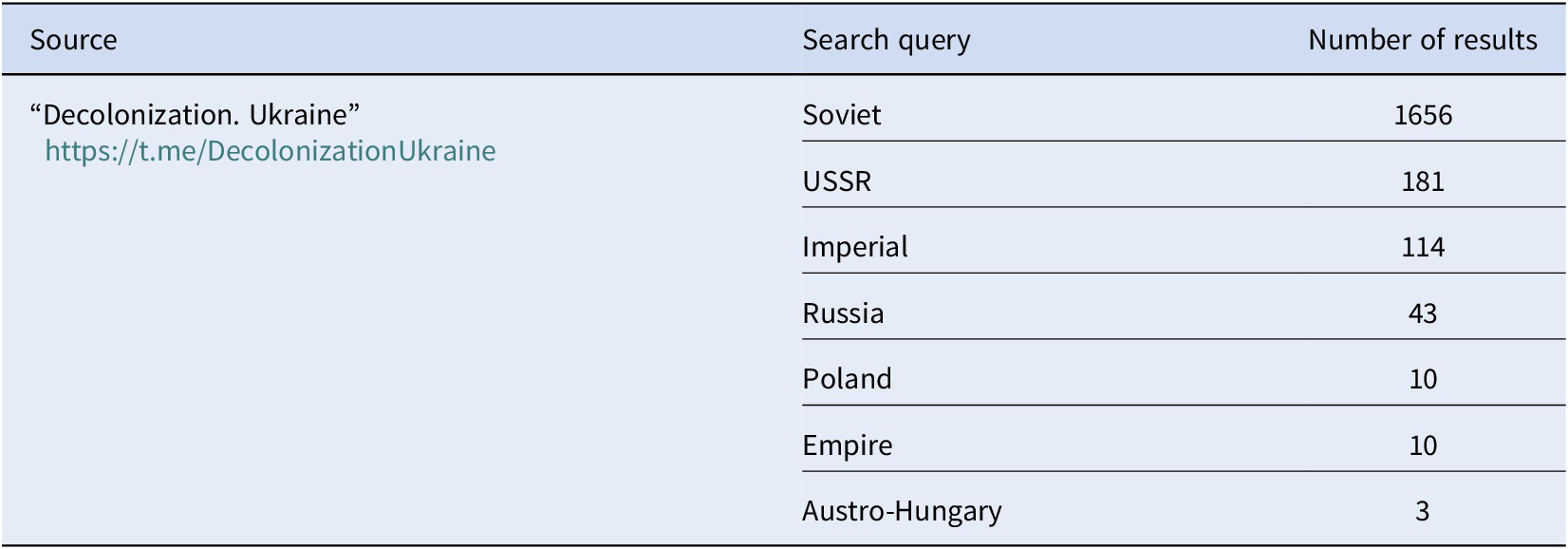



 Open access

