



1 Introduction
Let
 $\mathfrak {g}$
be a complex Lie algebra equipped with a non-degenerate, symmetric, invariant bilinear form
 $(\cdot , \cdot ):\mathfrak {g}\times \mathfrak {g}\to \mathbb {C}$
. Then, we can associate to
 $\mathfrak {g}$
an infinite-dimensional Lie algebra
 $\widehat {\mathfrak {g}}$
, which is called the affine Lie algebra [Reference Lepowsky and Li31]. The underlying vector space of
 $\widehat {\mathfrak {g}}$
is
 $$\begin{align*}\widehat{\mathfrak{g}}=\mathfrak{g}\otimes\mathbb{C}[t^{\pm1}]\oplus\mathbb{C}\mathbf{k}, \end{align*}$$
and the Lie brackets are
 $$\begin{align*}[x\otimes t^m, y\otimes t^n]=[x,y]\otimes t^{m+n}+m(x,y)\delta_{m+n,0}\mathbf{k},\quad\quad[\widehat{\mathfrak{g}},\mathbf{k}]=0, \end{align*}$$
where
 $x,y\in \mathfrak {g}$
and
 $m,n\in \mathbb {Z}$
.
The Virasoro algebra
 $\mathfrak {Vir}$
is another infinite-dimensional Lie algebra appearing in both mathematics and physics. It is generated by a basis
 $\left \{L_i,\mathbf {k}\mid i\in \mathbb {Z} \right \} $
and the Lie brackets are given by
 $$\begin{align*}[L_i,L_j]=(j-i)L_{i+j}+\delta_{i+j,0}\frac{i^3-i}{12}\mathbf{k},\quad\quad[\mathfrak{Vir},\mathbf{k}]=0. \end{align*}$$
Since the Virasoro algebra
 $\mathfrak {Vir}$
is the universal central extension of the derivation algebra of the Laurent polynomial algebra
 $\mathbb {C}[t^{\pm 1}]$
, there exists a Lie algebra homomorphism from
 $\mathfrak {Vir}$
to the derivation algebra of
 $\widehat {\mathfrak {g}}$
. This allows us to construct the semi-direct product Lie algebra
 $\mathfrak {Vir}\ltimes \widehat {\mathfrak {g}}$
, often referred to as the affine-Virasoro algebra [Reference Kuroki30]. This algebra plays a crucial role in conformal field theory. For example, the even part of the
 $N=3$
super-conformal algebra [Reference Cheng and Lam12] is
 $\mathfrak {Vir}\ltimes \widehat {\mathfrak {sl}_2}$
, which corresponds to the affine-Virasoro algebra of type
 $A_1$
. The affine-Virasoro algebras have been extensively studied, with numerous research papers exploring their properties and applications. (See [Reference Chen and Han9]–[Reference Chen and Yao11], [Reference Gao, Hu and Liu17], [Reference Jiang and You26], [Reference Kac27], [Reference Liu, Pei and Xia35], [Reference Liu and Qian36], [Reference Rao and Jiang44], [Reference Tan45], [Reference Wu and Yue48] and the references therein.)
The classification of simple modules over a Lie algebra is a central theme in representation theory. However, achieving a complete classification of simple modules remains a formidable challenge. Only a few Lie algebras, such as the simple Lie algebra
 $\mathfrak {sl}_2$
and the diamond Lie algebra, have a fully classified set of simple modules [Reference Block2], [Reference Liu, Pei and Xia34]. Despite these classifications, they are predominantly ring-theoretical and do not always provide explicit constructions of simple modules. Given this gap, it becomes particularly interesting to construct some simple modules explicitly. In [Reference Nilsson41], [Reference Nilsson42], J. Nilsson initiated a systematic study on the classifications of
 $U(\mathfrak {h})$
-free modules over the complex simple Lie algebras. These modules are characterized by being free of rank one when restricted to the universal enveloping algebra of the Cartan subalgebra. Since then, this idea has been developed to construct simple modules for many other algebras, such as the basic Lie superalgebras, quantum groups of finite types and so on [Reference Cai, Chen, Guo, Ma and Zhu3]–[Reference Chen and Han9], [Reference Chen and Yao11], [Reference Guo, Liu, Lü and Zhao19], [Reference Guo, Liu and Zhang20], [Reference Han, Chen and Su22], [Reference Li, Qin and Guo33], [Reference Nilsson43], [Reference Tan and Zhao46], [Reference Tan and Zhao47].
In the present article, we follow J. Nilsson’s ideas to construct and classify families of modules over the affine Lie algebra
 $\widehat {\mathfrak {sl}_2}$
, the affine Kac–Moody algebra
 $\widetilde {\mathfrak {sl}_2}$
, and the affine-Virasoro algebra
 $\mathfrak {Vir}\ltimes \widehat {\mathfrak {sl}_2}$
respectively. In Section 2, we recall some definitions and enumerate basic facts that will be useful in this article. In Section 3, we first classify all the
 $\widehat {\mathfrak {sl}_2}$
-modules on which
 $f_0\in \widehat {\mathfrak {sl}_2}$
acts regularly. These modules can provide large families of
 $U(\mathbb {C} h_0)$
-free modules of arbitrary finite rank. Additionally, we provide a necessary and sufficient condition for the tensor products of finitely many rank one
 $U(\mathbb {C} f_0)$
-free simple modules with an arbitrary simple restricted module to remain simple. Section 4 focuses on modules over the affine Kac–Moody algebra
 $\widetilde {\mathfrak {sl}_2}$
. We first classify all the
 $\widetilde {\mathfrak {sl}_2}$
-modules that are free of rank one when restricted to
 $U(\mathbb {C} L_0\oplus \mathbb {C} f_0)$
. Subsequently, we explore the properties of these modules, including criteria for simplicity, submodule structures, and comparisons with other known simple
 $\widetilde {\mathfrak {sl}_2}$
-modules. In Section 5, we study modules over the affine-Virasoro algebra
 $\mathfrak {Vir}\ltimes \widehat {\mathfrak {sl}_2}$
that are free of rank one when restricted to
 $U(\mathbb {C} L_0\oplus \mathbb {C} f_0)$
. These modules are shown to have connection with modules over the Weyl algebra [Reference Coutinho14]. Finally, Section 6 investigates the tensor product modules for the affine-Virasoro algebra
 $\mathfrak {Vir}\ltimes \widehat {\mathfrak {sl}_2}$
. Specifically, we analyze the simplicity of the tensor products of a finite number of
 $U(\mathbb {C} L_0\oplus \mathbb {C} f_0)$
-free simple modules with an arbitrary simple restricted
 $\mathfrak {Vir}\ltimes \widehat {\mathfrak {sl}_2}$
-module. We also establish necessary and sufficient conditions for two such simple modules to be isomorphic.
2 Preliminaries
Throughout this article, we use
 $\mathbb {Z}$
,
 $\mathbb {N}$
,
 $\mathbb {C}$
, and
 $\mathbb {C}^{*}$
to denote the sets of integers, non-negative integers, complex numbers, and non-zero complex numbers, respectively. We use
 $S_n$
to denote the symmetric group on n letters. For an arbitrary Lie algebra
 $\mathfrak {g}$
, we use
 $U(\mathfrak {g})$
to denote its universal enveloping algebra. For
 $p(t)\in \mathbb {C}[t]$
, we use
 $p'(t)$
to denote the derivative of
 $p(t)$
. For
 $g(s,t)\in \mathbb {C}[s,t]$
, we use
 $\partial _tg(s,t)$
to denote the partial derivative with respect to t. Unless otherwise stated, all tensor products
 $\otimes $
are assumed to be over
 $\mathbb {C}$
.
Let
 $\mathbb {C}[t]$
be the polynomial algebra. Denote by
 $\partial =\dfrac {\mathrm {d}}{\mathrm {d}t}$
the differential operator on
 $\mathbb {C}[t]$
. Then we have the (associative) Weyl algebra
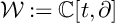 $\mathcal {W}:=\mathbb {C}[t,\partial ]$
, where
 $t\in \mathcal {W}$
is interpreted as the map that maps each
 $f(t)\in \mathbb {C}[t]$
to
 $tf(t)$
. One can easily verify for every
 $k\in \mathbb {N}$
, the identity
 $$ \begin{align} \partial t^k=t^k\partial+kt^{k-1} \end{align} $$
holds in
 $\mathcal {W}$
.
For an arbitrary Lie algebra
 $\mathfrak {g}$
, suppose
 $M_1,\ldots ,M_n$
are
 $\mathfrak {g}$
-modules, then the tensor product of vector spaces
 $$\begin{align*}M_1\otimes\cdots\otimes M_n \end{align*}$$
is a
 $\mathfrak {g}$
-module with the
 $\mathfrak {g}$
-actions as
 $$ \begin{align} x(m_1\otimes\cdots\otimes m_n):=\sum_{k=1}^{n}m_1\otimes\cdots\otimes xm_k\otimes\cdots\otimes m_n, \end{align} $$
where
 $x\in \mathfrak {g}$
and
 $m_i\in M_i$
. It is apparent that
 $M_1\otimes \cdots \otimes M_n\cong M_{\sigma (1)}\otimes \cdots \otimes M_{\sigma (n)}$
as
 $\mathfrak {g}$
-modules for each
 $\sigma \in S_n$
. Let
 $\mathbb {C}$
be the one-dimensional trivial
 $\mathfrak {g}$
-module, that is,
 $\mathfrak {g}\mathbb {C}=0$
. Then, for any
 $\mathfrak {g}$
-module M, it is clear that there is a
 $\mathfrak {g}$
-module isomorphism
 $M\otimes \mathbb {C}\cong M$
.
The Lie algebra
 $\mathfrak {sl}_2$
is a three-dimensional simple Lie algebra with a basis
 $\left \{ h,e,f \right \}$
and the following Lie brackets
 $$\begin{align*}[h,e]=2e,\quad\quad[h,f]=-2f,\quad\quad[e,f]=h. \end{align*}$$
Let
 $$ \begin{align} c:=4fe+h^2+2h\in U(\mathfrak{sl}_2) \end{align} $$
be the Casimir element of
 $\mathfrak {sl}_2$
. Then, it is well-known that the element c belongs to the center of
 $U(\mathfrak {sl}_2)$
(see the book [Reference Mazorchuk38] for details).
Recall that for
 $i\in \mathbb {N}$
, we have a simple
 $\mathfrak {sl}_2$
-module of dimension
 $i+1$
as follows:
 $$ \begin{align} V_i=\bigoplus_{k=0}^{i}\mathbb{C} v_k,\quad hv_k=(i-2k)v_k,\quad ev_k=k(i-k+1)v_{k-1},\quad fv_k=v_{k+1}, \end{align} $$
where we define
 $v_{-1}=v_{i+1}=0$
. It is well-known that each simple
 $\mathfrak {sl}_2$
-module of dimension
 $i+1$
is isomorphic to
 $V_i$
. A detailed discussion of this fact can be found in [Reference Humphreys24].
Moreover, let us introduce the Verma module for
 $\mathfrak {sl}_2$
. For
 $\xi \in \mathbb {C}$
, the Verma module of
 $\mathfrak {sl}_2$
is defined as follows:
 $$ \begin{align} V_\xi=\bigoplus_{k\in\mathbb{N}}\mathbb{C} v_k,\quad hv_k=(\xi-2k)v_k,\quad ev_k=k(\xi-k+1)v_{k-1},\quad fv_k=v_{k+1}, \end{align} $$
where we define
 $v_{-1}=0$
. An elementary fact is that
 $V_\xi $
is simple if and only if
 $\xi \notin \mathbb {N}$
(see the book [Reference Mazorchuk38] for details).
There is a non-degenerate, symmetric, invariant bilinear form on
 $\mathfrak {sl}_2$
defined as
 $$\begin{align*}(x_1h+x_2e+x_3f,y_1h+y_2e+y_3f)=2x_1y_1+x_2y_3+x_3y_2, \end{align*}$$
where
 $x_i,y_i\in \mathbb {C}$
for
 $i=1,2,3$
. Thus, one can construct the affine Lie algebra
 $\widehat {\mathfrak {sl}_2}$
. For
 $x\in \mathfrak {sl}_2$
and
 $i\in \mathbb {Z}$
, we denote
 $x \otimes t^i$
by
 $x_i$
. Then, the algebra
 $\widehat {\mathfrak {sl}_2}$
has a basis
 $\left \{ h_i,e_i,f_i,\mathbf {k}\mid i\in \mathbb {Z}\right \}$
with the following non-trivial Lie brackets:
 $$ \begin{align*} [h_i,e_j]&=2e_{i+j},\quad\quad[h_i,f_j]=-2f_{i+j},\\ [e_i,f_j]&=h_{i+j}+i\delta_{i+j,0}\mathbf{k},\quad\quad[h_i,h_j]=2i\delta_{i+j,0}\mathbf{k}. \end{align*} $$
Note that the subalgebra
 $\mathbb {C} h_0\oplus \mathbb {C} e_0\oplus \mathbb {C} f_0$
is isomorphic to the algebra
 $\mathfrak {sl}_2$
.
Recall that in the previous section, we have introduced the Virasoro algebra
 $\mathfrak {Vir}$
. It is generated by a basis
 $\left \{L_i,\mathbf {k}\mid i\in \mathbb {Z} \right \}$
, and the Lie brackets are given by
 $$\begin{align*}[L_i,L_j]=(j-i)L_{i+j}+\delta_{i+j,0}\frac{i^3-i}{12}\mathbf{k},\quad\quad[\mathfrak{Vir},\mathbf{k}]=0. \end{align*}$$
In [Reference Lü and Zhao37], the authors constructed a class of
 $\mathfrak {Vir}$
-modules in the following manner. For
 $\alpha \in \mathbb {C}^{*}$
and
 $\gamma \in \mathbb {C}$
, denote by
 $\Omega (\alpha ,\gamma ):=\mathbb {C}[s]$
, the
 $\mathfrak {Vir}$
-actions are then given by
 $$ \begin{align} L_ip(s)=\alpha^i(s+i\gamma)p(s-i),\quad\quad\mathbf{k}p(s)=0. \end{align} $$
It was proved that
 $\Omega (\alpha ,\gamma )$
is simple if and only if
 $\gamma \ne 0$
.
Definition 2.1. Let
 $\mathfrak {g}$
be a Lie algebra equipped with a non-degenerate, symmetric, invariant bilinear form
 $(\cdot ,\cdot ):\mathfrak {g}\times \mathfrak {g}\to \mathbb {C}$
. The underlying vector space of the affine-Virasoro algebra is
 $$\begin{align*}\mathfrak{Vir}\ltimes\widehat{\mathfrak{g}}= \mathfrak{g}\otimes\mathbb{C}[t^{\pm1}]\oplus\mathbb{C}\mathbf{k}\oplus\bigoplus_{i\in\mathbb{Z}}\mathbb{C} L_i, \end{align*}$$
and the Lie brackets are defined as follows:
 $$ \begin{align*} [x\otimes t^m, y\otimes t^n]&=[x,y]\otimes t^{m+n}+m(x,y)\delta_{m+n,0}\mathbf{k},\\ [L_i, L_j]&=(j-i)L_{i+j}+\delta_{i+j,0}\frac{i^3-i}{12}\mathbf{k},\\ [L_i, x\otimes t^m]&=mx\otimes t^{m+i},\quad\quad[\mathfrak{Vir}\ltimes\widehat{\mathfrak{g}}, \mathbf{k}]=0, \end{align*} $$
where
 $x,y\in \mathfrak {g}$
and
 $i,j,m,n\in \mathbb {Z}$
.
Remark 2.2. For every
 $\mathfrak {Vir}$
-module M with
 $\mathbf {k}M=0$
, by defining
 $\widehat {\mathfrak {g}}M=0$
, M becomes a module over
 $\mathfrak {Vir}\ltimes \widehat {\mathfrak {g}}$
.
In this article, we are concerned with the case
 $\mathfrak {g}=\mathfrak {sl}_2$
, that is, the affine-Virasoro algebra of type
 $A_1$
. The algebra
 $\mathfrak {Vir}\ltimes \widehat {\mathfrak {sl}_2}$
has a basis
 $\left \{ L_i,h_i,e_i,f_i,\mathbf {k}\mid i\in \mathbb {Z} \right \}$
and the Lie brackets are
 $$ \begin{align*} [L_i,L_j]&=(j-i)L_{i+j}+\delta_{i+j,0}\frac{i^3-i}{12}\mathbf{k},\\ [L_i,x_j]&=jx_{i+j},\quad\quad[h_i,e_j]=2e_{i+j},\\ [h_i,f_j]&=-2f_{i+j},\quad\quad[e_i,f_j]=h_{i+j}+i\delta_{i+j,0}\mathbf{k},\\ [h_i,h_j]&=2i\delta_{i+j,0}\mathbf{k},\quad\quad[\mathfrak{Vir}\ltimes\widehat{\mathfrak{sl}_2},\mathbf{k}]=0, \end{align*} $$
where
 $x_j\in \left \{ h_j,e_j,f_j \right \} $
. For the rest of this article, we denote the Lie algebra
 $\mathfrak {Vir}\ltimes \widehat {\mathfrak {sl}_2}$
as L. Note that the subalgebra spanned by
 $\left \{ h_i,e_i,f_i,\mathbf {k}\mid i\in \mathbb {Z}\right \}$
is the affine Lie algebra
 $\widehat {\mathfrak {sl}_2}$
. The subalgebra spanned by
 $\left \{L_0,h_i,e_i,f_i,\mathbf {k}\mid i\in \mathbb {Z}\right \}$
is the affine Kac–Moody algebra [Reference Kac28] of type
 $A^{(1)}_{1}$
, which will be denoted by
 $\widetilde {\mathfrak {sl}_2}$
in the following.
Now, we enumerate some basic facts that will be useful in this article.
Lemma 2.3. For
 $i\in \mathbb {Z}$
,
 $k\in \mathbb {N}$
and
 $x_i\in \left \{h_i,e_i,f_i\right \}$
, the following identities hold in
 $U(\widetilde {\mathfrak {sl}_2})$
:
 $$ \begin{align*} x_iL_0^k&=(L_0-i)^kx_i,\\ h_if_0^k&=f_0^kh_i-2kf_0^{k-1}f_i,\\ e_if_0^k&=f_0^ke_i+kf_0^{k-1}h_i-k(k-1)f_0^{k-2}f_i. \end{align*} $$
Let U be an
 $\mathfrak {sl}_2$
-module. For
 $\alpha \in \mathbb {C}^{*}$
, define the actions of
 $\widehat {\mathfrak {sl}_2}$
on U as
 $$ \begin{align} x_iu=\alpha^i(xu),\quad\quad\mathbf{k}u=0 \end{align} $$
for
 $i\in \mathbb {Z}$
and
 $x_i\in \left \{h_i,e_i,f_i\right \}$
. Then, U becomes an
 $\widehat {\mathfrak {sl}_2}$
-module, which will be denoted by
 $U(\alpha )$
. Moreover, the
 $\widehat {\mathfrak {sl}_2}$
-module
 $U(\alpha )$
is simple if and only if U is a simple
 $\mathfrak {sl}_2$
-module. In particular, the simple finite-dimensional
 $\mathfrak {sl}_2$
-module
 $V_i$
in (2.4), and the Verma module
 $V_\xi $
in (2.5) can be extended to
 $\widehat {\mathfrak {sl}_2}$
-modules, which will be useful in Remark 3.7 and Theorem 4.3.
Let
 $\mathbb {C}[t]$
be the polynomial algebra. Define a linear map
 $$ \begin{align} \begin{aligned} \Theta :\mathbb{C}[t]&\to\mathbb{C}[t]\\ p(t)&\mapsto 2p(t)+2tp'(t), \end{aligned} \end{align} $$
where
 $p'(t)$
is the derivative of
 $p(t)$
. One can check
 $\Theta $
is bijective.
For a vector space V, we have the space of V-valued polynomials
 $\mathbb {C}[x_1,\ldots ,x_m]\otimes V.$
For each
 $1\le k\le m$
, every non-zero element
 $g\in \mathbb {C}[x_1,\ldots ,x_m]\otimes V$
can be written as
 $$ \begin{align*} g=\sum_{j=0}^{d}x_k^jg_j(x_1,\ldots,\widehat{x_k},\ldots,x_m), \end{align*} $$
where
 $g_j(x_1,\ldots ,\widehat {x_k},\ldots ,x_m)\in \mathbb {C}[x_1,\ldots ,\widehat {x_k},\ldots ,x_m]\otimes V$
and
 $g_d(x_1,\ldots ,\widehat {x_k},\ldots ,x_m)\ne 0$
. Here, we define
 $\mathbb {C}[x_1,\ldots ,\widehat {x_k},\ldots ,x_m]:=\mathbb {C}[x_1,\ldots ,x_{k-1},x_{k+1},\ldots ,x_m]$
.
Recall the lexicographical order on
 $\mathbb {N}^{m}$
, defined as
 $$\begin{align*}(a_1,\ldots,a_{m})\succ (b_1,\ldots,b_{m})\Leftrightarrow \exists\; 1\le k\le m\;\mbox{such that }a_1=b_1,\ldots,a_{k-1}=b_{k-1}\mbox{ and }a_k>b_k. \end{align*}$$
For a non-zero element
 $g\in \mathbb {C}[x_1,\ldots ,x_m]\otimes V$
, assume that
 $$\begin{align*}g=\sum_{\mathbf{s}\in S}x_1^{s_1}\cdots x_m^{s_m}\otimes v_{\mathbf{s}}, \end{align*}$$
where
 $\mathbf {s}=(s_1,\ldots ,s_m)$
,
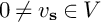 $0\ne v_{\mathbf {s}}\in V$
and
 $S\subseteq \mathbb {N}^m$
is a finite set, we define the degree of g, denoted by
 $\deg (g)$
, to be the maximal element in S with respect to the lexicographical order.
3 Representations of the algebra
 $\widehat {\mathfrak {sl}_2}$

We begin this section with the following observation.
For
 $h(t)\in \mathbb {C}[t]$
, let
 $g(t)=\dfrac {1}{2t} \left (th'(t)-h(t)-\dfrac {h(t)^2}{2}+h(0)+\dfrac {h(0)^2}{2} \right )$
be the preimage of
 $th"(t)-h'(t)h(t)$
with respect to the map
 $\Theta $
defined in (2.8). Then, the following proposition holds.
Proposition 3.1. The map
 $\omega _h: U(\mathfrak {sl}_2)\to \mathcal {W}$
, given by
 $$ \begin{align*} h&\mapsto h(t)-2t\partial, \\ e&\mapsto g(t)+h(t)\partial-t\partial^2, \\ f&\mapsto t, \end{align*} $$
is a homomorphism of associative algebras.
Proof. Using identity (2.1) and the fact that
 $2g(t)+2tg'(t)=th"(t)-h(t)h'(t)$
, we have the following calculations:
 $$ \begin{align*} &\omega_h(hf-fh)\\& \quad =\big(h(t)-2t\partial\big)t-t\big(h(t)-2t\partial\big)\\& \quad = 2t^2\partial-2t(t\partial+1)\\& \quad =-2t=\omega_h(-2f),\\[4pt]&\omega_h(he-eh)\\& \quad =\big(h(t)-2t\partial\big)\big(g(t)+h(t)\partial-t\partial^2\big)-\big(g(t)+h(t)\partial-t\partial^2\big)\big(h(t)-2t\partial\big)\\& \quad =\Big(-2tg'(t)+\big(h(t)^2-2th'(t)-2tg(t)\big)\partial+\big(2t-3th(t)\big)\partial^2+2t^2\partial^3\Big)\\& \qquad -\Big(h(t)h'(t)-th"(t)+\big(h(t)^2-2h(t)-2th'(t)-2tg(t)\big) \partial+\big(4t-3th(t)\big)\partial^2+2t^2\partial^3\Big)\\& \quad =2g(t)+2h(t)\partial-2t\partial^2=\omega_h(2e),\\[4pt]&\omega_h(ef-fe)\\& \quad =\big(g(t)+h(t)\partial-t\partial^2\big)t-t\big(g(t)+h(t)\partial-t\partial^2\big) =h(t)+t^2\partial^2-t\partial^2t\\& \quad =h(t)-2t\partial=\omega_h(h). \end{align*} $$
It follows that the map
 $\omega _h$
is indeed a homomorphism of associative algebras.
Applying Proposition 3.1, every
 $\mathcal {W}$
-module M admits an
 $\mathfrak {sl}_2$
-module structure via the lifted action:
 $$\begin{align*}xm:=\omega_h(x)\cdot_{\mathcal{W}}m\quad\mbox{for all } x\in\mathfrak{sl}_2 \mbox{ and } m\in M, \end{align*}$$
where
 $\cdot _{\mathcal {W}}$
denotes the
 $\mathcal {W}$
-action. We denote such an
 $\mathfrak {sl}_2$
-module by
 $M_{\omega _h}$
.
Example 3.2. For
 $\lambda \in \mathbb {C}^{*}$
, we have the simple
 $\mathcal {W}$
-module
 $M(\lambda ):=\mathbb {C}[x]$
. The actions of
 $\mathcal {W}$
on
 $M(\lambda )$
are given by
 $$ \begin{align*} \partial p(x)=\lambda xp(x+1),\quad\quad tp(x)=\lambda^{-1}p(x-1), \end{align*} $$
where
 $p(x)\in M(\lambda )$
. Moreover,
 $M(\lambda )_{\omega _h}$
is simple for each h and
 $\lambda $
.
Proof. Assume that N is a non-zero
 $\mathfrak {sl}_2$
-submodule of
 $M(\lambda )_{\omega _h}$
. Note that
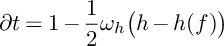 $\partial t=1-\dfrac {1}{2}\omega _h\big (h-h(f)\big )$
, which implies that if
 $p(x)\in N$
, then
 $xp(x)=(\partial t)p(x)\in N$
. Take
 $0\ne q(x)\in N$
with the minimal degree. Then, the action of
 $f\in \mathfrak {sl}_2$
suggests that
 $q(x)\in \mathbb {C}^{*}$
and hence we have
 $N=M(\lambda )_{\omega _h}$
.
Example 3.3. The polynomial algebra
 $\mathbb {C}[t]$
is a simple
 $\mathcal {W}$
-module, where the action of t is multiplication while
 $\partial $
acts by differentiation. In this case, we have the
 $\mathfrak {sl}_2$
-module
 $\mathbb {C}[t]_{\omega _h}$
, which actually is free of rank one when restricted to
 $U(\mathbb {C} f)$
. This kind of
 $\mathfrak {sl}_2$
-module has been classified and studied in detail in [Reference He, Cai and Lü23], [Reference Nilsson43]. It is necessary to point out that the
 $\mathfrak {sl}_2$
-module
 $\mathbb {C}[t]_{\omega _h}$
may be reducible (see [Reference He, Cai and Lü23, Theorem 3.4]), hence
 $\omega _h$
is not surjective.
The
 $\mathfrak {sl}_2$
-module
 $\mathbb {C}[t]_{\omega _h}$
can be extended to an
 $\widehat {\mathfrak {sl}_2}$
-module by (2.7). For
 $\alpha \in \mathbb {C}^{*}$
and
 ${h(t)\in \mathbb {C}[t]}$
, denote the
 $\widehat {\mathfrak {sl}_2}$
-module
 $\mathbb {C}[t]_{\omega _h}(\alpha )$
by
 $\Phi \big (\alpha ,h(t)\big )$
. For
 $i\in \mathbb {Z}$
and
 $p(t)\in \Phi \big (\alpha ,h(t)\big )$
, the actions of
 $\widehat {\mathfrak {sl}_2}$
on
 $\Phi \big (\alpha ,h(t)\big )$
are as follows:
 $$ \begin{align} \begin{aligned} h_ip(t)&=\alpha^ih(t)p(t)-2\alpha^itp'(t),\\ e_ip(t)&=\alpha^ig(t)p(t)+\alpha^ih(t)p'(t)-\alpha^itp"(t),\\ f_ip(t)&=\alpha^itp(t),\\ \mathbf{k}p(t)&=0. \end{aligned} \end{align} $$
Now, the following proposition holds.
Proposition 3.4. For
 $\alpha \in \mathbb {C}^{*}$
and
 $h(t)\in \mathbb {C}[t]$
, the following statements hold.
(1)
 $\Phi \big (\alpha ,h(t)\big )$
is an
 $\widehat {\mathfrak {sl}_2}$
-module.
(2) The module
 $\Phi \big (\alpha ,h(t)\big )$
is simple if and only if
 $h(0)\notin \mathbb {N}$
.
(3) If
 $h(0)=i\in \mathbb {N}$
, then
 $\Phi \big (\alpha ,h(t)\big )$
has a unique non-zero proper submodule
 $\Phi \big (\alpha ,h(t)\big )t^{i+1}$
. Furthermore, we have
 $$\begin{align*}\Phi\big(\alpha,h(t)\big)/\Phi\big(\alpha,h(t)\big)t^{i+1}\cong V_i(\alpha)\end{align*}$$
and
 $$\begin{align*}\Phi\big(\alpha,h(t)\big)t^{i+1}\cong\Phi\big(\alpha,h(t)-2i-2\big),\end{align*}$$
where
 $V_i(\alpha )$
is the simple
 $\widehat {\mathfrak {sl}_2}$
-module of dimension
 $i+1$
(see (2.4) and (2.7) for details).
Proof. (1), (2), and the first sentence of (3) follow from [Reference He, Cai and Lü23, Theorem 3.4] immediately. For the last statements, one can verify the map from
 $\Phi \big (\alpha ,h(t)\big )/\Phi \big (\alpha ,h(t)\big )t^{i+1}$
to
 $V_i(\alpha )$
, which maps
 $t^i+\Phi \big (\alpha ,h(t)\big )t^{i+1}$
to
 $v_i$
, and the map
 $$\begin{align*}\begin{aligned} \Phi\big(\alpha,h(t)\big)t^{i+1}&\to\Phi\big(\alpha,h(t)-2i-2\big)\\ p(t)t^{i+1}&\mapsto p(t) \end{aligned} \end{align*}$$
are isomorphisms of
 $\widehat {\mathfrak {sl}_2}$
-modules.
As a matter of fact, the
 $\widehat {\mathfrak {sl}_2}$
-modules
 $\Phi \big (\alpha ,h(t)\big )$
exhaust all the
 $\widehat {\mathfrak {sl}_2}$
-modules that are free modules of rank one when restricted to
 $U(\mathbb {C} f_0)$
.
Theorem 3.5. Suppose M is an
 $\widehat {\mathfrak {sl}_2}$
-module that is free of rank one when restricted to
 $U(\mathbb {C} f_0)$
. Then, M is isomorphic to
 $\Phi \big (\alpha ,h(t)\big )$
for some
 $\alpha \in \mathbb {C}^{*}$
and
 $h(t)\in \mathbb {C}[t]$
.
Proof. Assume that
 $m\in M$
is a
 $U(\mathbb {C} f_0)$
-basis with
 $h_im=H_i(f_0)m$
,
 $e_im=E_i(f_0)m$
,
 $f_im=F_i(f_0)m$
and
 $\mathbf {k}m=K(f_0)m$
, where
 $H_i(f_0),E_i(f_0),F_i(f_0),K(f_0)\in \mathbb {C}[f_0]=U(\mathbb {C} f_0)$
. From Lemma 2.3, we know that for
 $i\in \mathbb {Z}$
and
 $p(f_0)\in \mathbb {C}[f_0]$
, the following equations hold.
 $$ \begin{align*} h_ip(f_0)m&=p(f_0)H_i(f_0)m-2p'(f_0)F_i(f_0)m,\\ e_ip(f_0)m&=p(f_0)E_i(f_0)m+p'(f_0)H_i(f_0)m-p"(f_0)F_i(f_0)m,\\ f_ip(f_0)m&=p(f_0)F_i(f_0)m,\\ \mathbf{k}p(f_0)m&=p(f_0)K(f_0)m. \end{align*} $$
Using the relation
 $[h_0,f_i]=-2f_i$
, we have
 $F_i(f_0)=f_0F^{\prime }_i(f_0)$
. It follows that
 $F_i(f_0)=a_if_0$
for some
 $a_i\in \mathbb {C}$
. The relation
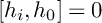 $[h_i,h_0]=0$
implies
 $f_0H^{\prime }_i(f_0)=H^{\prime }_0(f_0)F_i(f_0)$
. Hence, we have
 $H_i(f_0)=a_iH_0(f_0)+b_i$
for some
 $b_i\in \mathbb {C}$
. By
 $[h_i,f_j]=-2f_{i+j}$
, we deduce that
 $F_{i+j}(f_0)=F_i(f_0)F^{\prime }_j(f_0)$
, which implies
 $a_{i+j}=a_ia_j$
. Noting that
 $a_0=1$
, we see
 $a_i\ne 0$
for
 $i\in \mathbb {Z}$
and
 $a_i=\alpha ^i$
for some
 $\alpha \in \mathbb {C}^{*}$
. The relation
 $[h_i,h_j]=2i\delta _{i+j,0}\mathbf {k}$
suggests that
 $2i\delta _{i+j,0}K(f_0)=2H^{\prime }_i(f_0)F_j(f_0)-2H^{\prime }_j(f_0)F_i(f_0)=0$
. Hence,
 $K(f_0)=0$
. By
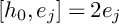 $[h_0,e_j]=2e_{j}$
, we have
 $$ \begin{align} \big(2f_0E_j(f_0)\big)'=\alpha^{j}\big(f_0H^{\prime\prime}_0(f_0)-H^{\prime}_0(f_0)H_0(f_0)\big), \end{align} $$
that is,
 $$\begin{align*}E_j(f_0) = \frac{\alpha^{j}}{2f_0} \left(f_0H^{\prime}_0(f_0)-H_0(f_0)-\frac{H_0(f_0)^2}{2}+H_0(0)+\frac{H_0(0)^2}{2} \right) =\alpha^jE_0(f_0). \end{align*}$$
By the relation
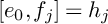 $[e_0,f_j]=h_{j}$
, we deduce that
 $H_{j}(f_0)=\alpha ^jH_0(f_0)$
. Now, it is straightforward to see that M is isomorphic to
 $\Phi \big (\alpha ,H_0(t)\big )$
.
The
 $\widehat {\mathfrak {sl}_2}$
-module
 $\Phi \big (\alpha ,h(t)\big )$
may shed light on the explicit constructions of
 $U(\mathbb {C} h_0)$
-free modules of arbitrary finite rank over
 $\widehat {\mathfrak {sl}_2}$
. Recall that an
 $\widehat {\mathfrak {sl}_2}$
-module M is called a weight module if
 $$\begin{align*}M=\bigoplus_{\lambda\in\mathbb{C}}M_\lambda, \end{align*}$$
where
 $M_\lambda =\left \{m\in M\mid h_0m=\lambda m\right \}$
. Based on the preceding results, we provide a characterization of the
 $U(\widehat {\mathfrak {sl}_2})$
-module structures on the subalgebra
 $U(\mathbb {C} h_0)$
instead of
 $U(\mathbb {C} f_0)$
.
Proposition 3.6. Suppose M is a non-weight simple
 $U(\widehat {\mathfrak {sl}_2})$
-module that is finitely generated over the subalgebra
 $U(\mathbb {C} h_0)$
. Then, M is a free module of finite rank over
 $U(\mathbb {C} h_0)$
. Moreover, for each
 $m\in \mathbb {Z}_{\ge 1}$
, there exists a simple
 $\widehat {\mathfrak {sl}_2}$
-module that is free of rank m when restricted to
 $U(\mathbb {C} h_0)$
.
Proof. Since M is finitely generated over
 $U(\mathbb {C} h_0)$
and
 $U(\mathbb {C} h_0)=\mathbb {C}[h_0]$
is a principal ideal domain, from [Reference Hungerford25, Theorem 6.6], we know that
 $M=F\oplus M_t$
, where F is a free
 $U(\mathbb {C} h_0)$
-module of finite rank and
 $M_t=\left \{v\in M\mid pv=0\;\mathrm {for\;some\;}0\ne p\in U(\mathbb {C} h_0)\right \}$
. If
 $M_t\ne 0$
, then we can find some
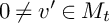 $0\ne v'\in M_t$
such that
 $h_0v'=\xi v'$
for some
 $\xi \in \mathbb {C}$
. The simple module M can be generated by
 $v'$
and hence M is a weight module, which leads to a contradiction.
An explicit construction of
 $U(\mathbb {C} h_0)$
-free simple
 $\widehat {\mathfrak {sl}_2}$
-modules of arbitrary finite rank is as follows.
We prove that for each
 $h(t)\in \mathbb {C}[t]$
with
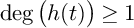 $\deg \big (h(t)\big )\ge 1$
, the
 $\widehat {\mathfrak {sl}_2}$
-module
 $\Phi \big (\alpha ,h(t)\big )$
is free of rank
 $\deg \big (h(t)\big )$
when restricted to
 $U(\mathbb {C} h_0)$
.
Suppose
 $\deg \big (h(t)\big )=m\in \mathbb {Z}_{\ge 1}$
and
 $$\begin{align*}h(t)=a_mt^m+a_{m-1}t^{m-1}+\cdots+a_0 \end{align*}$$
with
 $a_m\ne 0$
. Let
 $\mathbb {B}=\left \{t^{m-1},t^{m-2},\ldots ,1\right \}\subseteq \mathbb {C}[t]$
.
We first prove
 $\Phi \big (\alpha ,h(t)\big )=U(\mathbb {C} h_0)\mathbb {B}$
. By the action of
 $h_0$
, we know that for
 $s\in \mathbb {N}$
,
 $$ \begin{align} t^{m+s}=a_m^{-1}\left((2s+h_0)t^s-\sum_{i=0}^{m-1}a_it^{s+i}\right). \end{align} $$
Now an easy induction on s shows that
 $t^s\in U(\mathbb {C} h_0)\mathbb {B}$
for all
 $s\in \mathbb {N}$
.
Secondly, let us prove
 $\mathbb {B}$
is a
 $U(\mathbb {C} h_0)$
-basis. For
 $0\ne r(h_0)\in U(\mathbb {C} h_0)=\mathbb {C}[h_0]$
, by direct computations, we have
 $$ \begin{align} \deg\big(r(h_0)t^s\big)=s+\deg\big(r(h_0)\big)\deg\big(h(t)\big). \end{align} $$
Assume that
 $$\begin{align*}\sum_{i=0}^{m-1}r_i(h_0)t^i=0 \end{align*}$$
for
 $r_i(h_0)\in U(\mathbb {C} h_0)=\mathbb {C}[h_0]$
. If there exists some
 $j\in \left \{0,1,\ldots ,m-1\right \}$
such that
 $r_j(h_0)\ne 0$
, then from (3.4) we deduce that there exist
 $i_1,i_2\in \left \{0,1,\ldots ,m-1\right \}$
with
 $i_1\ne i_2$
such that
 $$\begin{align*}i_1+\deg\big(r_{i_1}(h_0)\big)\deg\big(h(t)\big)=i_2+\deg\big(r_{i_2}(h_0)\big)\deg\big(h(t)\big). \end{align*}$$
Hence, we get a contradiction since
 $\deg \big (h(t)\big )=m\in \mathbb {Z}_{\ge 1}$
.
Now, combined with Proposition 3.4, we conclude that for
 $h(t)\in \mathbb {C}[t]$
with
 $h(0)\notin \mathbb {N}$
and
 $\deg \big (h(t)\big )\ge 1$
,
 $\Phi \big (\alpha ,h(t)\big )$
is a simple
 $\widehat {\mathfrak {sl}_2}$
-module that is free of rank
 $\deg \big (h(t)\big )$
when restricted to
 $U(\mathbb {C} h_0)$
.
Remark 3.7. If
 $h(t)=\xi \in \mathbb {C}$
, then by (3.1), we see that
 $\Phi (\alpha ,\xi )$
is isomorphic to the
 $\widehat {\mathfrak {sl}_2}$
-module
 $V_\xi (\alpha )$
defined after (2.7).
The following observation will be useful in Theorem 3.11 and Proposition 4.7.
Proposition 3.8. The Casimir element c of
 $\mathfrak {sl}_2$
, as defined in (2.3), acts on
 $\Phi \big (\alpha ,h(t)\big )$
as a scalar
 $h(0)^2+2h(0)\in \mathbb {C}$
.
Proof. For
 $p(t) \in \mathbb {C}[t]$
, we have
 $cp(t)=\big (h(t)^2+2h(t)+4tg(t)-2th'(t)\big )p(t)=\big (h(0)^2+2h(0)\big )p(t)$
.
Now, we proceed to study the tensor products of a finite number of rank one
 $U(\mathbb {C} f_0)$
-free simple
 $\widehat {\mathfrak {sl}_2}$
-modules with an arbitrary simple restricted module. Recall that the subalgebra of
 $\widehat {\mathfrak {sl}_2}$
spanned by
 $\left \{h_0,e_0,f_0\right \}$
is isomorphic to
 $\mathfrak {sl}_2$
.
Definition 3.9. An
 $\widehat {\mathfrak {sl}_2}$
-module V is called a restricted module if for every
 $v\in V$
, there exists some
 $i_v\in \mathbb {N}$
such that
 $h_kv=e_kv=f_kv=0$
for all
 $k\ge i_v$
.
There are some explicitly constructed simple restricted
 $\widehat {\mathfrak {sl}_2}$
-modules in [Reference Adamović, Lü and Zhao1], [Reference Nguyen, Xue and Zhao40]. We pick an example here.
Example 3.10. For
 $\lambda ,\mu \in \mathbb {C}^{*}$
and
 $\kappa \in \mathbb {C}$
with
 $\kappa \ne -2$
, let
 $J_{\lambda ,\mu ,\kappa }$
be the left ideal of
 $U(\widehat {\mathfrak {sl}_2})$
generated by
 $$\begin{align*}\big\{f_{i+1},e_i,h_i,f_1-\mu,e_0-\lambda,\mathbf{k}-\kappa\mid i\in \mathbb{Z}_{>0}\big\}. \end{align*}$$
Denote the quotient module
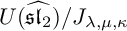 $U(\widehat {\mathfrak {sl}_2})/J_{\lambda ,\mu ,\kappa }$
by
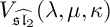 $V_{\widehat {\mathfrak {sl}_2}}(\lambda ,\mu ,\kappa )$
. It was proved in [Reference Adamović, Lü and Zhao1] that
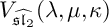 $V_{\widehat {\mathfrak {sl}_2}}(\lambda ,\mu ,\kappa )$
is a simple restricted
 $\widehat {\mathfrak {sl}_2}$
-module (see [Reference Adamović, Lü and Zhao1, Theorem 4.1]).
Let m be a positive integer. For
 $1 \leq k \leq m$
, as in (2.8), we have the bijective linear map
 $$ \begin{align} \begin{aligned} \Theta_k:\mathbb{C}[t_k]&\to\mathbb{C}[t_k]\\ p(t_k)&\mapsto 2p(t_k)+2t_kp'(t_k). \end{aligned} \end{align} $$
Assume that
 $\alpha _k\in \mathbb {C}^{*}$
,
 $h_k(t_k)\in \mathbb {C}[t_k]$
with
 $h_k(0)\notin \mathbb {N}$
and
 $g_k(t_k) =\Theta _k^{-1}\big ( t_kh^{\prime \prime }_k(t_k)-h^{\prime }_k(t_k)h_k(t_k)\big )$
. For a simple restricted
 $\widehat {\mathfrak {sl}_2}$
-module V, from equation (2.2), we define the tensor product
 $\widehat {\mathfrak {sl}_2}$
-module
 $$ \begin{align*} \mathbf{P}(\boldsymbol{\alpha},\boldsymbol{h}):=\bigotimes_{k=1}^{m}\Phi\big(\alpha_k,h_k(t_k)\big)\otimes V, \end{align*} $$
where
 $\boldsymbol {\alpha }=(\alpha _1,\ldots ,\alpha _m)\in (\mathbb {C}^{*})^m$
and
 $\boldsymbol {h}=(h_1(t_1),\ldots ,h_m(t_m))\in \mathbb {C}[t_1]\times \cdots \times \mathbb {C}[t_m]$
.
In the remaining parts of this section, we will provide a necessary and sufficient condition for the
 $\widehat {\mathfrak {sl}_2}$
-module
 $\mathbf {P}(\boldsymbol {\alpha },\boldsymbol {h})$
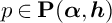
to be simple. We have a linear isomorphism
 $$\begin{align*}\mathbf{P}(\boldsymbol{\alpha},\boldsymbol{h})\cong \mathbb{C}[t_1,\ldots,t_m]\otimes V.\end{align*}$$
Every non-zero element
 $p\in \mathbf {P}(\boldsymbol {\alpha },\boldsymbol {h})$
has the form
 $$\begin{align*}p=\sum_{\mathbf{q}\in E} t_1^{q_1}\otimes\cdots\otimes t_m^{q_m}\otimes v_{\mathbf{q}}, \end{align*}$$
where
 $\mathbf {q}=(q_1,\ldots ,q_m)$
,
 $0\ne v_{\mathbf {q}}\in V$
, and
 $E\subseteq \mathbb {N}^m$
is a finite set.
Now, the following theorem is valid.
Theorem 3.11. The module
 $\mathbf {P}(\boldsymbol {\alpha },\boldsymbol {h})$
is simple if and only if
 $\alpha _1,\ldots ,\alpha _m$
are pairwise distinct.
Proof. Suppose
 $\alpha _1,\ldots ,\alpha _m$
are pairwise distinct and N is a non-zero submodule of
 $\mathbf {P}(\boldsymbol {\alpha },\boldsymbol {h})$
.
We shall prove that there exists some
 $0\ne u\in V$
such that
 $1\otimes \cdots \otimes 1\otimes u\in N$
.
Take a non-zero element
 $$\begin{align*}\sum_{\mathbf{q}\in E} t_1^{q_1}\otimes\cdots\otimes t_m^{q_m}\otimes v_{\mathbf{q}}\in N. \end{align*}$$
Choose an integer
 $n\in \mathbb {N}$
such that
 $h_iv_{\mathbf {q}}=e_iv_{\mathbf {q}}=f_iv_{\mathbf {q}}=0$
for all
 $i\ge n$
and
 $\mathbf {q}\in E$
. Then, by the actions of
 $f_i$
and
 $h_i$
with
 $i\ge n$
, we deduce that
 $$ \begin{align*} \sum_{k=1}^{m}\alpha_k^i\left(\sum_{\mathbf{q}\in E} t_1^{q_1}\otimes\cdots\otimes t_k^{q_k+1}\otimes\cdots\otimes t_m^{q_m}\otimes v_{\mathbf{q}}\right) \end{align*} $$
and
 $$ \begin{align*} \sum_{k=1}^{m}\alpha_k^i\left(\sum_{\mathbf{q}\in E} t_1^{q_1}\otimes\cdots\otimes\big(h_k(t_k)t_k^{q_k}-2q_kt_k^{q_k}\big)\otimes\cdots\otimes t_m^{q_m}\otimes v_{\mathbf{q}}\right) \end{align*} $$
belong to N. Applying the Vandermonde determinant, we know that
 $$ \begin{align} \sum_{\mathbf{q}\in E} t_1^{q_1}\otimes\cdots\otimes t_k^{q_k+1}\otimes\cdots\otimes t_m^{q_m}\otimes v_{\mathbf{q}}\in N \end{align} $$
and
 $$ \begin{align} \sum_{\mathbf{q}\in E} t_1^{q_1}\otimes\cdots\otimes\big(h_k(t_k)t_k^{q_k}-2q_kt_k^{q_k}\big)\otimes\cdots\otimes t_m^{q_m}\otimes v_{\mathbf{q}}\in N \end{align} $$
hold for every
 $1\le k\le m$
, which imply
 $$ \begin{align} \sum_{\mathbf{q}\in E} t_1^{q_1}\otimes\cdots\otimes q_kt_k^{q_k}\otimes\cdots\otimes t_m^{q_m}\otimes v_{\mathbf{q}}\in N. \end{align} $$
Moreover, we have
 $$ \begin{align*} \sum_{\mathbf{q}\in E} t_1^{q_1}\otimes\cdots\otimes q_k^it_k^{q_k}\otimes\cdots\otimes t_m^{q_m}\otimes v_{\mathbf{q}}\in N \end{align*} $$
for
 $1\le k\le m$
and
 $i \in \mathbb {N}$
. By the Vandermonde determinant again, we conclude that there exist
 $q_1,\ldots ,q_m\in \mathbb {N}$
and
 $0\ne u\in V$
such that
 $t_1^{q_1}\otimes \cdots \otimes t_m^{q_m}\otimes u\in N$
. Without loss of generality, assume that
 $e_iu=0$
for
 $i\ge n$
. Applying
 $e_i$
with
 $i\ge n$
, we have
 $$\begin{align*}\sum_{k=1}^{m}\alpha_k^i\left( t_1^{q_1}\otimes\cdots\otimes\big(g_k(t_k)t_k^{q_k}+q_kh_k(t_k)t_k^{q_k-1}-q_k(q_k-1)t_k^{q_k-1}\big)\otimes\cdots\otimes t_m^{q_m}\otimes u\right)\in N. \end{align*}$$
Using the Vandermonde determinant, we see that
 $$\begin{align*}t_1^{q_1}\otimes\cdots\otimes\big(g_k(t_k)t_k^{q_k}+q_kh_k(t_k)t_k^{q_k-1}-q_k(q_k-1)t_k^{q_k-1}\big)\otimes\cdots\otimes t_m^{q_m}\otimes u\in N. \end{align*}$$
Combined with (3.6), we deduce that for each
 $1\le k\le m$
, the element
 $$\begin{align*}q_k\big(h_k(0)-q_k+1\big)(t_1^{q_1}\otimes\cdots\otimes t_k^{q_k-1}\otimes\cdots\otimes t_m^{q_m}\otimes u)\in N. \end{align*}$$
Since
 $h_k(0)\notin \mathbb {N}$
, we must have
 $1\otimes \cdots \otimes 1\otimes u\in N$
.
Now from (3.6), we know that
 $$\begin{align*}\bigotimes_{k=1}^{m}\Phi\big(\alpha_k,h_k(t_k)\big)\otimes u\subseteq N. \end{align*}$$
Let
 $W=\left \{v\in V\mid \bigotimes _{k=1}^{m}\Phi \big (\alpha _k,h_k(t_k)\big )\otimes v\subseteq N\right \}$
. Then, W is a non-zero submodule of V, and hence we have
 $N=\mathbf {P}(\boldsymbol {\alpha },\boldsymbol {h})$
.
Conversely, let us prove the module
 $\mathbf {P}(\boldsymbol {\alpha },\boldsymbol {h})$
is not simple provided that
 $\alpha _1,\ldots ,\alpha _m$
are not pairwise distinct. To achieve this, we only need to consider the module
 $\Phi \big (\alpha ,h_1(t_1)\big )\otimes \Phi \big (\alpha ,h_2(t_2)\big )$
, where
 $\alpha \in \mathbb {C}^{*}$
. For
 $x\in \mathfrak {sl}_2$
and
 $i\in \mathbb {Z}$
, denote by
 $x_i=x\otimes t^i$
, then by direct computations, we see that
 $x_i$
and
 $\alpha ^ix_0$
act identically on the module
 $\Phi \big (\alpha ,h_1(t_1)\big )\otimes \Phi \big (\alpha ,h_2(t_2)\big )$
. Hence, we only need to prove
 $\Phi \big (\alpha ,h_1(t_1)\big )\otimes \Phi \big (\alpha ,h_2(t_2)\big )$
is reducible as a module over the subalgebra
 $\mathbb {C} h_0\oplus \mathbb {C} e_0\oplus \mathbb {C} f_0\cong \mathfrak {sl}_2$
. For
 $t_1^{q_1}\otimes t_2^{q_2}\in \Phi \big (\alpha ,h_1(t_1)\big )\otimes \Phi \big (\alpha ,h_2(t_2)\big )$
, the action of the Casimir element
 $c\in \mathfrak {sl}_2$
and Proposition 3.8 suggest that
 $$ \begin{align*} \begin{aligned} c(t_1^{q_1}\otimes t_2^{q_2}) =&\;(ct_1^{q_1})\otimes t_2^{q_2}+t_1^{q_1}\otimes (ct_2^{q_2})+4(et_1^{q_1})\otimes (ft_2^{q_2})+4(ft_1^{q_1})\otimes(et_2^{q_2})+2(ht_1^{q_1})\otimes(ht_2^{q_2})\\ =&\;\big(h_1(0)^2+2h_1(0)+h_2(0)^2+2h_2(0)\big)(t_1^{q_1}\otimes t_2^{q_2})+4(et_1^{q_1})\otimes (ft_2^{q_2})\\ &+4(ft_1^{q_1})\otimes(et_2^{q_2})+2(ht_1^{q_1})\otimes(ht_2^{q_2}). \end{aligned} \end{align*} $$
If the module
 $\Phi \big (\alpha ,h_1(t_1)\big )\otimes \Phi \big (\alpha ,h_2(t_2)\big )$
is simple, then by Schur’s lemma, we have
 $c(t_1^{q_1}\otimes t_2^{q_2})=\beta (t_1^{q_1}\otimes t_2^{q_2})$
for some
 $\beta \in \mathbb {C}$
. It follows that
 $$ \begin{align} 4(et_1^{q_1})\otimes (ft_2^{q_2}) +4(ft_1^{q_1})\otimes(et_2^{q_2})+2(ht_1^{q_1})\otimes(ht_2^{q_2})=\beta'(t_1^{q_1}\otimes t_2^{q_2}), \end{align} $$
where
 $\beta '=\beta -h_1(0)^2-2h_1(0)-h_2(0)^2-2h_2(0)\in \mathbb {C}$
. On the other hand, the coefficient of
 $t_1^{q_1}\otimes t_2^{q_2}$
of the left-hand side of (3.9) is
 $2\big (h_1(0)-2q_1\big )\big (h_2(0)-2q_2\big )$
, which fails to be a constant.
4 Representations of the algebra
$\widetilde {\mathfrak {sl}_2}$

4.1. The
$\widetilde {\mathfrak {sl}_2}$
-module
$\Omega \big (\alpha ,h(t)\big )$


In this section, we aim to classify all the
 $U(\widetilde {\mathfrak {sl}_2})$
-modules that are free of rank one when restricted to
 $U(\mathbb {C} L_0\oplus \mathbb {C} f_0)$
. For
 $\alpha \in \mathbb {C}^{*}$
and
 $h(t)\in \mathbb {C}[t]$
, let
 $\Phi \big (\alpha ,h(t)\big )$
be the
 $\widehat {\mathfrak {sl}_2}$
-module defined in (3.1). Then, we have the induced module
 $$ \begin{align} \Omega\big(\alpha,h(t)\big):=U(\widetilde{\mathfrak{sl}_2})\otimes_{U(\widehat{\mathfrak{sl}_2})}\Phi\big(\alpha,h(t)\big). \end{align} $$
Note that
 $\Omega \big (\alpha ,h(t)\big )$
has a
 $\mathbb {C}$
-basis
 $\left \{L_0^i\otimes t^j\mid i,j\in \mathbb {N}\right \}$
. If we identify
 $\Omega \big (\alpha ,h(t)\big )$
with
 $\mathbb {C}[s,t]$
by the linear isomorphism
 $L_0^i\otimes t^j\mapsto s^it^j$
, then the
 $\widetilde {\mathfrak {sl}_2}$
-module structures on
 $\mathbb {C}[s,t]$
can be described as follows:
 $$ \begin{align} \begin{aligned} L_0p(s,t)&=sp(s,t),\\ h_ip(s,t)&=\alpha^ih(t)p(s-i,t)-2\alpha^it\partial_tp(s-i,t),\\ e_ip(s,t)&=\alpha^ig(t)p(s-i,t)+\alpha^ih(t)\partial_tp(s-i,t)-\alpha^it\partial_t^2p(s-i,t),\\ f_ip(s,t)&=\alpha^itp(s-i,t),\\ \mathbf{k}p(s,t)&=0, \end{aligned} \end{align} $$
where
 $p(s,t)\in \mathbb {C}[s,t]$
and
 $g(t)$
is the preimage of
 $th"(t)-h'(t)h(t)$
with respect to the map
 $\Theta $
defined in (2.8).
Theorem 4.1. Assume that M is an
 $\widetilde {\mathfrak {sl}_2}$
-module that is free of rank one when restricted to
 $U(\mathbb {C} L_0\oplus \mathbb {C} f_0)$
. Then, we have
 $M\cong \Omega \big (\alpha ,h(t)\big )$
for some
 $\alpha \in \mathbb {C}^{*}$
and
 $h(t)\in \mathbb {C}[t]$
.
Proof. Assume that
 $m\in M$
is a
 $U(\mathbb {C} L_0\oplus \mathbb {C} f_0)$
-basis. For
 $i\in \mathbb {Z}$
, suppose
 $h_im=H_i(L_0,f_0)m$
,
 $e_im=E_i(L_0,f_0)m$
,
 $f_im=F_i(L_0,f_0)m$
and
 $\mathbf {k}m=K(L_0,f_0)m$
, where
 $H_i(L_0,f_0),E_i(L_0,f_0),F_i(L_0,f_0),K(L_0,f_0)\in U(\mathbb {C} L_0\oplus \mathbb {C} f_0)$
.
For any
 $p(L_0,f_0)\in U(\mathbb {C} L_0\oplus \mathbb {C} f_0)$
, by Lemma 2.3, the following equations hold true:
 $$ \begin{align*} h_ip(L_0,f_0)m=&\;H_i(L_0,f_0)p(L_0-i,f_0)m-2F_i(L_0,f_0)\partial_{f_0}p(L_0-i,f_0)m,\\ e_ip(L_0,f_0)m=&\;E_i(L_0,f_0)p(L_0-i,f_0)m+H_i(L_0,f_0)\partial_{f_0}p(L_0-i,f_0)m\\ &-F_i(L_0,f_0)\partial^{2}_{f_0}p(L_0-i,f_0)m,\\ f_ip(L_0,f_0)m=&\;F_i(L_0,f_0)p(L_0-i,f_0)m,\\ \mathbf{k}p(L_0,f_0)m=&\;K(L_0,f_0)p(L_0,f_0)m. \end{align*} $$
Using the relation
 $[f_i,f_j]=0$
, we deduce that
 $F_i(L_0,f_0)F_j(L_0-i,f_0)=F_j(L_0,f_0)F_i(L_0-j,f_0)$
. Assume that
 $$\begin{align*}F_i(L_0,f_0)=\sum_{k=0}^{k_i}b_{ik}(f_0)L_0^k, \end{align*}$$
where
 $b_{ik}(f_0)\in U(\mathbb {C} f_0)$
for
 $0\le k\le k_i$
and
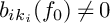 $b_{ik_i}(f_0)\ne 0$
. Then for
 $ij\le 0$
, we have
 $$ \begin{align*} 0&=\big(\sum_{k=0}^{k_i}b_{ik}(f_0)L_0^k\big)\big(\sum_{k=0}^{k_j}b_{jk}(f_0)(L_0-i)^k\big)-\big(\sum_{k=0}^{k_j}b_{jk}(f_0)L_0^k\big)\big(\sum_{k=0}^{k_i}b_{ik}(f_0)(L_0-j)^k\big)\\ &=b_{ik_i}(f_0)b_{jk_j}(f_0)(jk_i-ik_j)L_0^{k_i+k_j-1}+\mbox{terms with lower } L_0\mbox{-degree}. \end{align*} $$
It follows that
 $k_i=0$
for all
 $i\in \mathbb {Z}$
and
 $F_i(L_0,f_0)=F_i(f_0)\in U(\mathbb {C} f_0)$
. By
 $[h_i,f_j]=-2f_{i+j}$
, we have
 $$ \begin{align} 2F_{i+j}(f_0)-2F^{\prime}_j(f_0)F_i(f_0)=H_i(L_0-j,f_0)F_j(f_0)-H_i(L_0,f_0)F_j(f_0). \end{align} $$
If there exists some
 $j_0\in \mathbb {Z}$
such that
 $F_{j_0}(f_0)=0$
, then from equation (4.3), we see that
 $0=F_0(f_0)=f_0$
, which is a contradiction. Hence, from equation (4.3), we know that
 $\deg _{L_0}H_i(L_0,f_0)\le 1$
for
 $i\in \mathbb {Z}$
. Assume that for
 $i\in \mathbb {Z}$
,
 $$\begin{align*}H_i(L_0,f_0)=P_i(f_0)L_0+Q_i(f_0), \end{align*}$$
where
 $P_i(f_0),Q_i(f_0)\in U(\mathbb {C} f_0)$
. Taking
 $i=0$
in (4.3), we have
 $$ \begin{align} 2F_{j}(f_0)=2f_0F^{\prime}_j(f_0)-jP_0(f_0)F_j(f_0) \end{align} $$
for all
 $j\in \mathbb {Z}$
. It follows that
 $P_0(f_0)=\xi \in \mathbb {C}$
. Assume that
 $$\begin{align*}F_j(f_0)=\sum_{k=0}^{l_j}a_{jk}f_0^k, \end{align*}$$
where
 $a_{jk}\in \mathbb {C}$
for
 $0\le k\le l_j$
and
 $a_{jl_j}\ne 0$
. Then, equation (4.4) implies
 $$ \begin{align} a_{jk}(2k-j\xi-2)=0 \end{align} $$
for all
 $k\in \left \{0,1,\ldots ,l_j\right \}$
. It follows that
 $j\xi +2=2l_j\ge 0$
for
 $j\in \mathbb {Z}$
and thus we have
 $\xi =0$
. Now, equation (4.4) implies
 $F_j(f_0)=a_jf_0$
for
 $a_j\in \mathbb {C}^{*}$
. By use of the relation
 $[\mathbf {k},f_1]=0$
, we have
 $K(L_0-1,f_0)=K(L_0,f_0)$
and thus
 $K(L_0,f_0)=K(f_0)\in U(\mathbb {C} f_0)$
. From the relation
 ${[\mathbf {k},h_0]=0}$
, we obtain
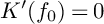 $K'(f_0)=0$
, which implies
 $K(f_0)=l\in \mathbb {C}$
. The relation
 $[h_i,h_j]=2i\delta _{i+j,0}\mathbf {k}$
suggests that
 $$ \begin{align} \begin{aligned} 2i\delta_{i+j,0}l=\,&H_i(L_0,f_0)H_j(L_0-i,f_0)-H_j(L_0,f_0)H_i(L_0-j,f_0)\\ &+2F_j(f_0)\partial_{f_0}H_i(L_0-j,f_0)-2F_i(f_0)\partial_{f_0}H_j(L_0-i,f_0). \end{aligned} \end{align} $$
Extracting the coefficient of
 $L_0$
in (4.6), we have
 $$ \begin{align} (j-i)P_j(f_0)P_i(f_0)=2a_if_0P^{\prime}_j(f_0)-2a_jf_0P^{\prime}_i(f_0). \end{align} $$
Note that
 $a_0=1$
and
 $P_0(f_0)=0$
. Taking
 $i=0$
in (4.7), we have
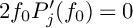 $2f_0P^{\prime }_j(f_0)=0$
. It follows that
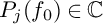 $P_j(f_0)\in \mathbb {C}$
and equation (4.7) becomes
 $(j-i)P_i(f_0)P_j(f_0)=0$
. Hence, we know that
 $P_i(f_0)=0$
except for one possible
 $i_0\in \mathbb {Z}$
. Now, equation (4.3) implies
 $a_{j+\epsilon }=a_ja_\epsilon $
for some
 $\epsilon \in \left \{\pm 1\right \}$
. Thus, we know that
 $a_j=\alpha ^j$
for some
 $\alpha \in \mathbb {C}^{*}$
. Using equation (4.3) again, we see that
 $P_i(f_0)=0$
for all
 $i\in \mathbb {Z}$
, and hence we have
 $H_i(L_0,f_0)=Q_i(f_0)\in U(\mathbb {C} f_0)$
. Taking
 $i=0$
in (4.6), we see that
 $Q^{\prime }_j(f_0)=\alpha ^jQ^{\prime }_0(f_0)$
. Using (4.6) again, we have
 $l=0$
. By the relation
 $[h_i,e_j]=2e_{i+j}$
, we have
 $$ \begin{align} \begin{aligned} 2E_{i+j}(L_0,f_0)=\,&Q_i(f_0)E_j(L_0-i,f_0)-Q_i(f_0)E_j(L_0,f_0)-2\alpha^if_0\partial_{f_0}E_j(L_0-i,f_0)\\ &-Q^{\prime}_i(f_0)Q_j(f_0)+\alpha^jf_0Q^{\prime\prime}_i(f_0). \end{aligned} \end{align} $$
Taking
 $i=0$
in (4.8), we see that
 $$\begin{align*}\partial_{f_0}\big(2f_0E_j(L_0,f_0)\big)=-Q^{\prime}_0(f_0)Q_j(f_0)+\alpha^jf_0Q^{\prime\prime}_0(f_0)\in U(\mathbb{C} f_0).\end{align*}$$
It follows that
 $2f_0E_j(L_0,f_0)=A_j(L_0)+B_j(f_0)$
, where
 $A_j(L_0)\in U(\mathbb {C} L_0)$
and
 $B_j(f_0)\in U(\mathbb {C} f_0)$
. Hence, we have
 $E_j(L_0,f_0)=\dfrac {B_j(f_0)-B_j(0)}{2f_0}\in U(\mathbb {C} f_0)$
. The remaining arguments are the same as that in the proof of Theorem 3.5. We conclude that M is isomorphic to
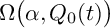 $\Omega \big (\alpha ,Q_0(t)\big )$
.
4.2. Properties of the module
$\Omega \big (\alpha ,h(t)\big )$

In this section, we examine some features of the
 $\widetilde {\mathfrak {sl}_2}$
-module
 $\Omega \big (\alpha ,h(t)\big )$
. First, let us study the simplicity and submodule structures of
 $\Omega \big (\alpha ,h(t)\big )$
.
Lemma 4.2. If N is a non-zero submodule of
 $\Omega \big (\alpha ,h(t)\big )$
, then there exist some
 $n\in \mathbb {N}$
and a monic polynomial
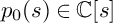 $p_0(s) \in \mathbb {C}[s]$
such that
 $$ \begin{align} N=p_0(s)\mathbb{C}[s]t^n +\Omega\big(\alpha,h(t)\big)t^{n+1}. \end{align} $$
Proof. If
 $p(s,t)=\sum \limits _{k=0}^{m}p_k(s)t^k\in N$
, then the actions of
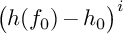 $\big (h(f_0)-h_0\big )^i$
imply that
 $$\begin{align*}\sum_{k=0}^{m}k^ip_k(s)t^k\in N \end{align*}$$
for all
 $i\ge 0$
. Using the Vandermonde determinant, we obtain
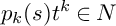 $p_k(s)t^k\in N$
for
 $0\le k\le m$
, and
 $$\begin{align*}N = \bigoplus_{i \in \mathbb{N}} a_i(s)\mathbb{C}[s]t^i \end{align*}$$
for
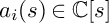 $a_i(s) \in \mathbb {C}[s]$
. Moreover, by the actions of
 $f_i$
, if
 $a_n(s) \neq 0$
, then
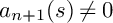 $a_{n+1}(s) \neq 0$
and
 $a_{n+1}(s)\mid a_{n}(s-i)$
for all
 $i \in \mathbb {Z}$
, that is,
 $a_{n+1}(s) \in \mathbb {C}^{*}$
.
Theorem 4.3. For the
 $\widetilde {\mathfrak {sl}_2}$
-module
 $\Omega \big (\alpha ,h(t)\big )$
, the following statements hold.
(1) The module
 $\Omega \big (\alpha ,h(t)\big )$
is simple if and only if
 $h(0)\notin \mathbb {N}$
.
(2) Suppose
 $h(0)=i\in \mathbb {Z}_{\ge 1}$
. Then,
 $\Omega \big (\alpha ,h(t)\big )$
has a unique non-zero proper submodule
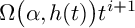 $\Omega \big (\alpha ,h(t)\big )t^{i+1}$
. Moreover, we have
 $$ \begin{align} \Omega\big(\alpha,h(t)\big)/\Omega\big(\alpha,h(t)\big)t^{i+1} \cong U(\widetilde{\mathfrak{sl}_2})\otimes_{U(\widehat{\mathfrak{sl}_2})}V_i(\alpha) \end{align} $$
and
 $$\begin{align*}\Omega\big(\alpha,h(t)\big)t^{i+1}\cong \Omega\big(\alpha,h(t)-2i-2\big),\end{align*}$$
where
 $V_i(\alpha )$
is the simple
 $\widehat {\mathfrak {sl}_2}$
-module of dimension
 $i+1$
(see (2.4) and (2.7) for details).
(3) If
 $h(0)=0$
and N is a non-zero submodule, then there exists some
 $p_0(s)\in \mathbb {C}[s]$
such that
 $N=\Omega \big (\alpha ,h(t)\big )t+p_0(s)\mathbb {C}[s]$
.
Proof. (1) Suppose N is a non-zero submodule as in (4.9). Then, the actions of
 $f_0$
and
 $e_0$
suggest that
 $n\big (h(0)-n+1\big )p_0(s)t^{n-1}\in N$
. It follows that
 $n\big (h(0)-n+1\big )=0$
. If
 $h(0)\notin \mathbb {N}$
, then we must have
 $n=0$
, and thus
 $p_0(s)\in N$
. The actions of
 $f_0$
and
 $f_1$
imply
 $t^kp_0(s-1)\in N$
for every
 $k\ge 1$
. Hence, from the action of
 $h_1$
, we deduce that
 $h(0)p_0(s-1)\in N$
. Since
 $h(0)\ne 0$
, we have
 $p_0(s)-p_0(s-1)\in N$
. It follows that
 $1\in N$
and
 $\Omega \big (\alpha ,h(t)\big )$
is simple. Conversely, if
 $h(0)=i\in \mathbb {N}$
, then by direct computations, one can verify
 $\Omega \big (\alpha ,h(t)\big )t^{i+1}$
is a non-zero proper submodule.
(2) Suppose
 $h(0)=i\in \mathbb {Z}_{\ge 1}$
and N is a non-zero proper submodule as in (4.9). Then from the above discussions, we know that
 $n=0$
or
 $n=i+1$
. If
 $n=0$
, then as in (1) we see that
 $1\in N$
, which is a contradiction. Hence, we have
 $n=i+1$
. Now, take
 $$\begin{align*}0\ne g(s,t)=\sum_{k=0}^{d}q_k(t)s^k\in N \end{align*}$$
with
 $q_d(t)\ne 0$
and d as small as possible. Then, the actions of
 $f_0$
and
 $f_1$
imply
 $$\begin{align*}tg(s,t)-tg(s-1,t)=dtq_d(t)s^{d-1}+\mbox{terms with lower } s\mbox{-degree} \end{align*}$$
belongs to N. Hence, we have
 $d=0$
. Take
 $0\ne q(t)\in N\cap \mathbb {C}[t]$
with the minimal
 $\deg \big (q(t)\big )$
. Then, the action of
 $h_0$
implies
 $q(t)\mid tq'(t)$
, and we may assume
 $q(t)=t^j$
for some
 $j\in \mathbb {N}$
. By the action of
 $e_0$
, we know that
 $j\big (h(0)-j+1\big )=0$
. Since N is proper, we must have
 $j=i+1$
and thus
 $t^{i+1}\in N$
. We conclude that
 $N=\Omega \big (\alpha ,h(t)\big )t^{i+1}$
.
Now, the quotient module
 $\Omega \big (\alpha ,h(t)\big )/\Omega \big (\alpha ,h(t)\big )t^{i+1}$
has a
 $\mathbb {C}$
-basis
 $$\begin{align*}\left\{s^kt^j+\Omega\big(\alpha,h(t)\big)t^{i+1}\mid k\in\mathbb{N}, j\in\mathbb{N},0\le j\le i\right\}\end{align*}$$
while the tensor product
 $U(\widetilde {\mathfrak {sl}_2})\otimes _{U(\widehat {\mathfrak {sl}_2})}V_i(\alpha )$
has a
 $\mathbb {C}$
-basis
 $$\begin{align*}\left\{L_0^k\otimes v_j\mid k\in\mathbb{N}, j\in\mathbb{N}, 0\le j\le i\right\},\end{align*}$$
thus there exists an
 $\widetilde {\mathfrak {sl}_2}$
-module isomorphism
 $$\begin{align*}\Omega\big(\alpha,h(t)\big)/\Omega\big(\alpha,h(t)\big)t^{i+1}\cong U(\widetilde{\mathfrak{sl}_2})\otimes_{U(\widehat{\mathfrak{sl}_2})}V_i(\alpha), \end{align*}$$
where the isomorphism maps the element
 $s^kt^i+\Omega \big (\alpha ,h(t)\big )t^{i+1}$
to
 $L_0^k\otimes v_i$
.
Finally, by direct computations, we know that
 $$ \begin{align*} \Omega\big(\alpha,h(t)\big)t^{i+1}&\to \Omega\big(\alpha,h(t)-2i-2\big)\\ p(s,t)t^{i+1}&\mapsto p(s,t) \end{align*} $$
is an isomorphism of
 $\widetilde {\mathfrak {sl}_2}$
-modules.
(3) Suppose
 $h(0)=0$
and N is a non-zero proper submodule as (4.9). Since N is proper, as in the proof of (2), we have
 $\Omega \big (\alpha ,h(t)\big )t \subseteq N$
. From (1), we know that
 $n=0$
or
 $n=1$
. If
 $n=1$
, then as in (2) we know that
 $N=\Omega \big (\alpha ,h(t)\big )t$
. If
 $n=0$
, then we have
 $N=\Omega \big (\alpha ,h(t)\big )t+p_0(s)\mathbb {C}[s]$
.
Remark 4.4. For a simple
 $\widehat {\mathfrak {sl}_2}$
-module S, there is naturally an induced
 $\widetilde {\mathfrak {sl}_2}$
-module
 $U(\widetilde {\mathfrak {sl}_2})\otimes _{U(\widehat {\mathfrak {sl}_2})}S$
. This construction provides us with a useful way to construct simple modules over
 $\widetilde {\mathfrak {sl}_2}$
(see (4.1), (4.10), and [Reference Adamović, Lü and Zhao1], [Reference Guo and Zhao21], [Reference Nguyen, Xue and Zhao40] for example). However, the induced
 $\widetilde {\mathfrak {sl}_2}$
-module may not be simple. Example of this can be found in [Reference Nguyen, Xue and Zhao40].
Corollary 4.5. The left
 $U(\widetilde {\mathfrak {sl}_2})$
-module
 $\Omega \big (\alpha ,h(t)\big )$
is always noetherian. Moreover,
 $\Omega \big (\alpha ,h(t)\big )$
is artinian if and only if
 $h(0)\ne 0$
.
Proof. It follows from the above proposition. Moreover, if
 $h(0)=0$
, then
 $J_k=\Omega \big (\alpha ,h(t)\big )t+s^k\mathbb {C}[s]$
is a submodule of
 $\Omega \big (\alpha ,h(t)\big )$
for
 $k\ge 1$
and
 $J_k/J_{k+1}\cong \mathbb {C}$
is a trivial
 $\widetilde {\mathfrak {sl}_2}$
-module.
The
 $\widetilde {\mathfrak {sl}_2}$
-module
 $\Omega \big (\alpha ,h(t)\big )$
also satisfies an interesting property analogous to that of the
 $\widehat {\mathfrak {sl}_2}$
-module
 $\Phi \big (\alpha ,h(t)\big )$
presented in Proposition 3.6.
Proposition 4.6. Assume that
 $\deg \big (h(t)\big )=m\ge 1$
. Then, the
 $U(\widetilde {\mathfrak {sl}_2})$
-module
 $\Omega \big (\alpha ,h(t)\big )$
is free of rank m when restricted to
 $U(\mathbb {C} L_0\oplus \mathbb {C} h_0)$
.
Proof. Let
 $\mathbb {B}=\left \{t^{m-1},t^{m-2},\ldots ,1\right \}\subseteq \mathbb {C}[s,t]$
. From the proof of Proposition 3.6, we have
 $\mathbb {C}[t]=U(\mathbb {C} h_0)\mathbb {B}$
. It follows that
 $\mathbb {C}[s,t]=U(\mathbb {C} L_0\oplus \mathbb {C} h_0)\mathbb {B}$
. Assume that
 $$ \begin{align*} \sum_{i=0}^{m-1}r_i(L_0,h_0)t^{i}=0, \end{align*} $$
where
 $r_i(L_0,h_0)\in U(\mathbb {C} L_0\oplus \mathbb {C} h_0)=\mathbb {C}[L_0,h_0]$
. If not all
 $r_i(L_0,h_0)$
are equal to
 $0$
, let
 $I=\left \{i\mid r_i(L_0,h_0)\ne 0, 0\le i\le m-1 \right \}$
, which is non-empty. For
 $i\in I$
, assume that
 $$\begin{align*}r_i(L_0,h_0)=\sum_{j=0}^{n_i}L_0^ju_{ij}(h_0), \end{align*}$$
where
 $u_{ij}(h_0)\in \mathbb {C}[h_0]$
for
 $0\le j\le n_i$
and
 $u_{in_i}(h_0)\ne 0$
. Then, we have
 $$\begin{align*}\sum_{i\in I}\sum_{j=0}^{n_i}s^j\big(u_{ij}(h_0)t^i\big)=0. \end{align*}$$
Note that
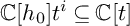 $\mathbb {C}[h_0]t^i\subseteq \mathbb {C}[t]$
for each
 $i\in \mathbb {N}$
, hence there exist pairwise distinct
 $i_1,i_2,\ldots ,i_k\in I$
such that
 $$\begin{align*}\sum_{q=1}^{k}u_{i_qn_{i_q}}(h_0)t^{i_q}=0. \end{align*}$$
As in the proof of Proposition 3.6, this leads to a contradiction.
Finally, we compare the
 $\widetilde {\mathfrak {sl}_2}$
-module
 $\Omega \big (\alpha ,h(t)\big )$
with other known simple modules. Recall that an
 $\widetilde {\mathfrak {sl}_2}$
-module M is called a weight module if
 $$\begin{align*}M=\bigoplus_{\lambda,\mu\in\mathbb{C}}M_{\lambda\mu}, \end{align*}$$
where
 $M_{\lambda \mu }=\left \{m\in M\mid L_0m=\lambda m, h_0m=\mu m\right \}$
.
Proposition 4.7. Assume that
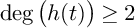 $\deg \big (h(t)\big )\ge 2$
and
 $h(0)\notin \mathbb {N}$
. Then, the simple
 $\widetilde {\mathfrak {sl}_2}$
-module
 $\Omega \big (\alpha ,h(t)\big )$
is neither a weight module nor isomorphic to any simple module constructed in [Reference Adamović, Lü and Zhao1], [Reference Cai, Tan and Zhao4], [Reference Christodoulopoulou13], [Reference Futorny, Guo, Xue and Zhao16], [Reference Guo, Huo and Liu18], [Reference Guo, Liu and Zhang20], [Reference Guo and Zhao21], [Reference Mazorchuk and Zhao39].
In order to prove this proposition, we need to make some preparations. Let
 $$\begin{align*}\mathcal{R}:=\mathbb{C}\left[x_0^{\pm1},x_1^{\pm1},\dfrac{\partial}{\partial x_0},\dfrac{\partial}{\partial x_1}\right] \end{align*}$$
be the Weyl algebra of degree 2. Denote by
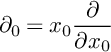 $\partial _0=x_0\dfrac {\partial }{\partial x_0}$
and
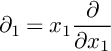 $\partial _1=x_1\dfrac {\partial }{\partial x_1}$
, respectively. For
 $b\in \mathbb {C}$
, denote by
 $Y_b=x_1^{-1}(b+\partial _1)\in \mathcal {R}$
. It is obvious that
 $\partial _0$
and
 $Y_b$
are algebraically independent. Moreover, for
 $k\in \mathbb {N}$
, we have
 $$ \begin{align} x_1Y_b^k=Y_b^kx_1-kY_b^{k-1}. \end{align} $$
For
 $\alpha ,\beta \in \mathbb {C}^{*}$
and
 $b\in \mathbb {C}$
, denote by
 $\Gamma (\alpha ,\beta ,b)=\mathbb {C}[s,t]$
the polynomial algebra of two variables. Then,
 $\Gamma (\alpha ,\beta ,b)$
is an
 $\mathcal {R}$
-module under the actions
 $$ \begin{align*} x_0p(s,t)&=\alpha p(s-1,t),\\ x_1p(s,t)&=\beta p(s,t)-\partial_t p(s,t),\\ \partial_0 p(s,t)&=sp(s,t),\\ \partial_1 p(s,t)&=(\beta t-b-1)p(s,t)-t\partial_tp(s,t), \end{align*} $$
where
 $p(s,t)\in \Gamma (\alpha ,\beta ,b)$
.
Lemma 4.8. Let
 $b\in \mathbb {C}$
. Suppose M is an
 $\mathcal {R}$
-module that is free of rank one when restricted to
 $\mathbb {C}[\partial _0,Y_b]$
. Then,
 $M\cong \Gamma (\alpha ,\beta ,b)$
for some
 $\alpha ,\beta \in \mathbb {C}^{*}$
.
Proof. Assume that
 $m\in M$
is a
 $\mathbb {C}[\partial _0,Y_b]$
-basis and
 $x_i^{\pm 1}m=g^{\pm }_i(\partial _0,Y_b)m$
, where
 $g^{\pm }_i(\partial _0,Y_b)\in \mathbb {C}[\partial _0,Y_b]$
for
 $i=0,1$
. Then for arbitrary
 $p(\partial _0,Y_b)\in \mathbb {C}[\partial _0,Y_b]$
, by equation (4.11), one has
 $$ \begin{align*} x_0p(\partial_0,Y_b)m&=p(\partial_0-1,Y_b)g^+_0(\partial_0,Y_b)m,\\ x_1p(\partial_0,Y_b)m&=p(\partial_0,Y_b)g^+_1(\partial_0,Y_b)m-\partial_{Y_b}p(\partial_0,Y_b)m. \end{align*} $$
Using the fact that
 $m=x_0(x_0^{-1}m)$
and
 $m=x_1(x_1^{-1}m)$
, one has
 $g^+_0(\partial _0,Y_b)g^-_0(\partial _0-1,Y_b)=1$
and
 $g_1^-(\partial _0,Y_b)g_1^+(\partial _0,Y_b)-\partial _{Y_b}g_1^-(\partial _0,Y_b)=1$
, respectively. It follows that there exist
 $\alpha ,\beta \in \mathbb {C}^{*}$
such that
 $g^{+}_0(\partial _0,Y_b)=\alpha $
and
 $g^{+}_1(\partial _0,Y_b)=\beta $
. Finally, we have
 $$ \begin{align*} \partial_1p(\partial_0,Y_b)m&=(x_1Y_b-b)p(\partial_0,Y_b)m=x_1\big(Y_bp(\partial_0,Y_b)\big)m-bp(\partial_0,Y_b)m\\ &=(\beta Y_b-b-1)p(\partial_0,Y_b)m-Y_b\partial_{Y_b}p(\partial_0,Y_b)m. \end{align*} $$
At this point, it is straightforward to see that
 $M\cong \Gamma (\alpha ,\beta ,b)$
.
Now, we are prepared to prove Proposition 4.7.
Proof of Proposition 4.7
We shall prove this proposition through a comparative analysis. The
 $\widetilde {\mathfrak {sl}_2}$
-module
 $\Omega \big (\alpha ,h(t)\big )$
is not a weight module since
 $L_0\in \widetilde {\mathfrak {sl}_2}$
acts multiplicatively.
For an
 $\widetilde {\mathfrak {sl}_2}$
-module M, we say that
 $x\in \widetilde {\mathfrak {sl}_2}$
acts on M locally finitely, if for every
 $m\in M$
, we have
 $\dim \sum _{k\in \mathbb {N}}\mathbb {C} x^km<\infty $
. The simple
 $\widetilde {\mathfrak {sl}_2}$
-modules in [Reference Adamović, Lü and Zhao1], [Reference Christodoulopoulou13], [Reference Guo and Zhao21], [Reference Mazorchuk and Zhao39] share the property that the action of
 $e_0\in \widetilde {\mathfrak {sl}_2}$
is locally finite. However, by the action of
 $e_0$
and the definition of
 $g(t)$
, we see that for
 $0\ne f(s,t)\in \Omega \big (\alpha ,h(t)\big )$
,
 $$\begin{align*}\deg_t\big(e_0^kf(s,t)\big)=\deg_t\big(f(s,t)\big)+k\left(2\deg\big(h(t)\big)-1\right). \end{align*}$$
It follows that the action of
 $e_0$
on
 $\Omega \big (\alpha ,h(t)\big )$
is not locally finite. The simple modules in [Reference Futorny, Guo, Xue and Zhao16] are restricted modules and hence can never be isomorphic to
 $\Omega \big (\alpha ,h(t)\big )$
. The modules in [Reference Cai, Tan and Zhao4], [Reference Guo, Liu and Zhang20] are
 $U(\mathbb {C} L_0\oplus \mathbb {C} h_0)$
-free modules of rank one and infinite rank, respectively. Thus, from Proposition 4.6, we see that
 $\Omega \big (\alpha ,h(t)\big )$
cannot be isomorphic to the modules in [Reference Cai, Tan and Zhao4], [Reference Guo, Liu and Zhang20] provided that
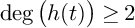 $\deg \big (h(t)\big )\ge 2$
.
Finally, let us prove
 $\Omega \big (\alpha ,h(t)\big )$
is not isomorphic to the modules in [Reference Guo, Huo and Liu18]. To achieve this, we need to recall the concrete module actions in [Reference Guo, Huo and Liu18]. Let
 $\mathfrak {b}=\mathbb {C} H\oplus \mathbb {C} E$
be the two-dimensional Lie algebra with Lie bracket
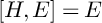 $[H,E]=E$
. For any
 $\mathcal {R}$
-module P and
 $\mathfrak {b}$
-module V, the
 $\widetilde {\mathfrak {sl}_2}$
-module structures on
 $P\otimes V$
are defined as follows:
 $$ \begin{align*} L_0(p\otimes v)&=\partial_0p\otimes v,\\ h_i(p\otimes v)&=2x_0^i\partial_1p\otimes v+2ix_0^ip\otimes Ev,\\ e_i(p\otimes v)&=-x_0^ix_1\partial_1p\otimes v-x_0^ix_1p\otimes(iE-H)v,\\ f_i(p\otimes v)&=x_0^ix_1^{-1}\partial_1p\otimes v+x_0^ix_1^{-1}p\otimes(iE+H)v,\\ \mathbf{k}(p\otimes v)&=0, \end{align*} $$
where
 $i\in \mathbb {Z}$
,
 $p\in P$
, and
 $v\in V$
. By [Reference Guo, Huo and Liu18, Theorem 4.12], one has
 $c(p\otimes v)=p\otimes (h^2+2h)v$
, where
 $c\in U(\mathfrak {sl}_2)$
is the Casimir element defined in (2.3). Suppose, on the contrary,
 $P\otimes V\cong \Omega \big (\alpha ,h(t)\big )$
. Assume first that
 $\dim V=\infty $
. Then from Proposition 3.8, we deduce that
 $\big (h^2+2h-h(0)^2-2h(0)\big )v=0$
for any
 $v\in V$
, which is impossible since V has infinite dimension (see [Reference Guo, Huo and Liu18, Lemma 3.2]). Suppose
 $\dim V=1$
. Then,
 $E\in \mathfrak {b}$
acts trivially while
 $H\in \mathfrak {b}$
acts on V as a scalar
 $b\in \mathbb {C}$
. That
 $P\otimes V\cong \Omega \big (\alpha ,h(t)\big )$
implies
 $P\otimes V$
is free of rank one when restricted to
 $U(\mathbb {C} L_0\oplus \mathbb {C} f_0)$
. Combining Proposition 4.6 and Lemma 4.8, we obtain a contradiction provided that
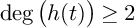 $\deg \big (h(t)\big )\ge 2$
.
5 Representations of the algebra
$\mathfrak {Vir}\ltimes \widehat {\mathfrak {sl}_2}$

For brevity, denote the Lie algebra
 $\mathfrak {Vir}\ltimes \widehat {\mathfrak {sl}_2}$
as L. Let
 $\mathbb {C}[x^{\pm 1}]$
be the Laurent polynomial algebra, and
 $D:=\dfrac {\mathrm {d}}{\mathrm {d}x}$
be the differential operator on
 $\mathbb {C}[x^{\pm 1}]$
. We then have the (associative) differential operator algebra
 $\mathcal {A}:=\mathbb {C}[x^{\pm 1},D]$
(see [Reference Kac and Radul29]).
Now, we introduce an associative algebra homomorphism from the universal enveloping algebra
 $U(L)$
to the tensor product algebra
 $\mathcal {A}\otimes \mathcal {W}$
. Recall that in Proposition 3.1, for every
 $h(t)\in \mathbb {C}[t]$
, we have a corresponding algebra homomorphism
 $\omega _h:U(\mathfrak {sl}_2)\to \mathcal {W}$
.
Proposition 5.1. Suppose
 $h(t)\in \mathbb {C}[t]$
and
 $\gamma \in \mathbb {C}$
. Let
 $\omega _h$
be the algebra homomorphism defined in Proposition 3.1. Then, the map given by
 $$ \begin{align*} \pi_{\gamma}: U(L)&\to\mathcal{A}\otimes\mathcal{W},\\ L_i&\mapsto x^i(xD+i\gamma )\otimes1,\\ h_i&\mapsto x^i\otimes \omega_h(h),\\ e_i&\mapsto x^i\otimes \omega_h(e),\\ f_i&\mapsto x^i\otimes \omega_h(f),\\ \mathbf{k}&\mapsto 0, \end{align*} $$
is an associative algebra homomorphism.
Proof. For
 $m,n\in \mathbb {Z}$
, one can easily verify the following identities hold in
 $\mathcal {A}$
:
 $$ \begin{align*} [x^{m+1}D,x^{n+1}D]=(n-m)x^{m+n+1}D,\quad\quad [x^{m+1}D,x^n]=nx^{m+n}. \end{align*} $$
Combined with Proposition 3.1, we know
 $\pi _{\gamma }$
is an associative algebra homomorphism.
Remark 5.2. To our knowledge, the restriction of
 $\pi _\gamma $
to the subalgebra generated by
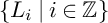 $\left \{L_i\mid i\in \mathbb {Z}\right \}$
first appeared in [Reference Lü and Zhao37].
Now, every
 $\mathcal {A}\otimes \mathcal {W}$
-module is naturally an L-module. We give some examples here.
Example 5.3. For
 $\eta \in \mathbb {C}$
, the space
 $P=\bigoplus _{k\in \mathbb {Z}}\mathbb {C} v_k$
is a simple
 $\mathcal {A}$
-module under the actions:
 $$\begin{align*}Dv_k=(\eta+k)v_{k-1},\quad\quad x v_k=v_{k+1}. \end{align*}$$
For
 $\lambda \in \mathbb {C}^{*}$
, let
 $M(\lambda )$
be the simple
 $\mathcal {W}$
-module in Example 3.2. Then, we have a simple L-module
 $P\otimes M(\lambda )$
, where the L-module structures on
 $P\otimes M(\lambda )$
are as follows:
 $$ \begin{align*} L_i(v_k\otimes u)&=(\eta+k+i\gamma)v_{k+i}\otimes u, \quad x_i(v_k\otimes u)=v_{k+i}\otimes\omega_h(x)u, \quad \mathbf{k}(v_k\otimes u)=0, \end{align*} $$
where
 $x_i\in \left \{h_i,e_i,f_i\right \}$
,
 $i,k\in \mathbb {Z}$
, and
 $u\in M(\lambda )$
.
Proof. Let N be a non-zero submodule of
 $P\otimes M(\lambda )$
. Then, by the action of
 $L_0$
, we see that
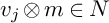 $v_j\otimes m\in N$
for some
 $j\in \mathbb {Z}$
and
 $0\ne m\in M(\lambda )$
. From Example 3.2 and the actions of
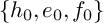 $\left \{h_0,e_0,f_0\right \}$
, we deduce that
 $v_j\otimes M(\lambda )\subseteq N$
. Using the action of
 $f_i$
and the fact that
 $\omega _h(f)M(\lambda )\ne 0$
, we know that there exists some
 $0\ne u\in M(\lambda )$
such that
 $v_{i+j}\otimes u\in N$
for each
 $i\in \mathbb {Z}$
. It follows that
 $P\otimes M(\lambda )=\sum _{k\in \mathbb {Z}}v_k\otimes M(\lambda )\subseteq N$
.
Remark 5.4. Recall that in [Reference Liu, Pei and Xia35], an L-module V is called a weight module if
 $$\begin{align*}V=\bigoplus_{\mu\in\mathbb{C}}V_\mu, \end{align*}$$
where
 $V_\mu =\left \{v\in V\mid L_0 v=\mu v\right \}$
. Moreover, V is called quasi-finite if
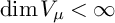 $\dim V_\mu <\infty $
for each
 $\mu \in \mathbb {C}$
. In [Reference Liu, Pei and Xia35], the authors classified all the simple quasi-finite weight modules over L. Example 5.3 provides us with a simple weight L-module with all weight spaces being infinite dimensional.
The following example provides us with a
 $U(L)$
-module that is free of rank one when restricted to
 $U(\mathbb {C} L_0\oplus \mathbb {C} f_0)$
.
Example 5.5. For
 $\alpha \in \mathbb {C}^{*}$
, the polynomial algebra
 $\mathbb {C}[s]_\alpha :=\mathbb {C}[s]$
is a simple
 $\mathcal {A}$
-module, where the actions are given by
 $$\begin{align*}Dp(s)=\alpha^{-1}(s+1)p(s+1),\quad xp(s)=\alpha p(s-1). \end{align*}$$
Recall that in Example 3.3, we have a simple
 $\mathcal {W}$
-module
 $\mathbb {C}[t]$
. It follows that the polynomial algebra
 $\mathbb {C}[s,t]\cong \mathbb {C}[s]\otimes \mathbb {C}[t]$
is an L-module. To be specific, for
 $\alpha \in \mathbb {C}^{*}$
,
 $\gamma \in \mathbb {C}$
and
 $h(t)\in \mathbb {C}[t]$
, denote by
 $\Omega \big (\alpha ,\gamma ,h(t)\big )=\mathbb {C}[s,t]$
the polynomial algebra of two variables. Assume that
 $g(t)\in \mathbb {C}[t]$
is the preimage of
 $th"(t)-h'(t)h(t)$
with respect to the map
 $\Theta $
defined in (2.8). Then,
 $\Omega \big (\alpha ,\gamma ,h(t)\big )$
is an L-module, where the L-actions are given by
 $$ \begin{align} \begin{aligned} L_if(s,t)&=\alpha^i(s+i\gamma)f(s-i,t),\\ h_if(s,t)&=\alpha^ih(t)f(s-i,t)-2\alpha^it\partial_tf(s-i,t),\\ e_if(s,t)&=\alpha^ig(t)f(s-i,t)+\alpha^ih(t)\partial_tf(s-i,t)-\alpha^it\partial_t^2f(s-i,t),\\ f_if(s,t)&=\alpha^itf(s-i,t),\\ \mathbf{k}f(s,t)&=0. \end{aligned} \end{align} $$
Note that the actions of
 $\left \{L_0,h_i,e_i,f_i,\mathbf {k}\mid i\in \mathbb {Z}\right \}$
coincide with that defined in (4.2).
Proposition 5.6.
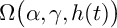 $\Omega \big (\alpha ,\gamma ,h(t)\big )$
is a
 $U(L)$
-module that is free of rank one when restricted to
 $U(\mathbb {C} L_0\oplus \mathbb {C} f_0)$
. Moreover, we have
 $\Omega \big (\alpha _1,\gamma _1,h_1(t)\big )\cong \Omega \big (\alpha _2,\gamma _2,h_2(t)\big )$
if and only if
 $\big (\alpha _1,\gamma _1,h_1(t)\big )=\big (\alpha _2,\gamma _2,h_2(t)\big )$
.
Proof. That
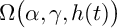 $\Omega \big (\alpha ,\gamma ,h(t)\big )$
is a rank one free
 $U(\mathbb {C} L_0\oplus \mathbb {C} f_0)$
-module follows from Theorem 4.1. Denote the identity map of
 $\mathbb {C}[s,t]$
by
 $\mathbf {id}_{\mathbb {C}[s,t]}$
. Suppose
 $$\begin{align*}\psi:\Omega\big(\alpha_1,\gamma_1,h_1(t)\big)\to\Omega\big(\alpha_2,\gamma_2,h_2(t)\big) \end{align*}$$
is an isomorphism map with
 $\psi (1)=g(s,t)$
. The actions of
 $L_0$
and
 $f_0$
in (5.1) imply
 $$\begin{align*}\psi\big(h(s,t)\big)=h(s,t)g(s,t) \end{align*}$$
for every
 $h(s,t)\in \Omega \big (\alpha _1,\gamma _1,h_1(t)\big )$
. That
 $\psi $
is surjective implies there exists some
 $f(s,t)$
such that
 $f(s,t)g(s,t)=1$
. Hence, we must have
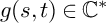 $g(s,t)\in \mathbb {C}^{*}$
and without loss of generality, we may assume
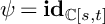 $\psi =\mathbf {id}_{\mathbb {C}[s,t]}$
. Now, it is easy to see that
 $\big (\alpha _1,\gamma _1,h_1(t)\big )=\big (\alpha _2,\gamma _2,h_2(t)\big )$
.
Based on the results in Theorem 4.1, we now classify all the
 $U(L)$
-modules that are free of rank one when restricted to
 $U(\mathbb {C} L_0\oplus \mathbb {C} f_0)$
.
Theorem 5.7. Suppose M is a
 $U(L)$
-module that is free of rank one when restricted to
 $U(\mathbb {C} L_0\oplus \mathbb {C} f_0)$
. Then, we have
 $M\cong \Omega \big (\alpha ,\gamma ,h(t)\big )$
, where
 $\alpha \in \mathbb {C}^{*}$
,
 $\gamma \in \mathbb {C}$
, and
 $h(t)\in \mathbb {C}[t]$
.
Proof. Note that
 $\widetilde {\mathfrak {sl}_2}$
is a subalgebra of L. By Theorem 4.1, we may assume the underlying vector space of M is
 $\mathbb {C}[s,t]$
, and the actions of
 $\widetilde {\mathfrak {sl}_2}$
on
 $\mathbb {C}[s,t]$
are as in (4.2).
By induction, we see that for
 $i\in \mathbb {Z}$
and
 $k\in \mathbb {N}$
, the equation
 $$\begin{align*}L_iL_0^k=(L_0-i)^kL_i \end{align*}$$
holds in
 $U(L)$
. Assume that
 $L_i1=D_i(s,t)\in \mathbb {C}[s,t]$
. Then, we deduce that
 $$\begin{align*}L_if(s,t)=\big(L_if(L_0,f_0)\big)1=f(s-i,t)D_i(s,t) \end{align*}$$
for every
 $f(s,t)\in \mathbb {C}[s,t]$
.
From
 $[L_i,f_j]=jf_{i+j}$
and (4.2), we see that
 $D_i(s,t)-D_i(s-j,t)=j\alpha ^i$
. It follows that
 $D_i(s,t)=\alpha ^is+\alpha ^iR_i(t)$
for some
 $R_i(t)\in \mathbb {C}[t]$
. Using the relation
 $ [L_i, L_j]=(j-i)L_{i+j}+\delta _{i+j,0}\frac {i^3-i}{12}\mathbf {k}$
and (4.2), we deduce that for
 $i,j\in \mathbb {Z}$
,
 $$ \begin{align} j R_j(t)-i R_i(t)=(j-i) R_{i+j}(t). \end{align} $$
Note that
 $R_0(t)=0$
, hence we have
 $R_i(t)=iR_{1}(t)$
for
 $i \in \mathbb {Z}$
. By the relation
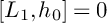 $[L_1,h_0]=0$
, we know that
 $R^{\prime }_1(t)=0$
. Thus,
 $R_1(t)=\gamma $
for some
 $\gamma \in \mathbb {C}$
, and then we have an L-module isomorphism
 $M\cong \Omega \big (\alpha ,\gamma ,h(t)\big )$
.
Next, we study the simplicity of the L-module
 $\Omega \big (\alpha ,\gamma ,h(t)\big )$
and characterize its submodules when
 $\Omega \big (\alpha ,\gamma ,h(t)\big )$
is reducible. Prior to proceeding with our analysis, we recall the notion of composition series of a module [Reference Erdmann and Holm15]. For a
 $\mathbb {C}$
-algebra A and an A-module M, a composition series of M is a finite chain of A-submodules
 $$\begin{align*}0=M_0\subseteq M_1\subseteq\cdots\subseteq M_n=M \end{align*}$$
such that the quotient modules
 $M_i/M_{i-1}$
are simple for all
 $1\le i\le n$
. The length of the composition series is n. The simple quotient modules
 $M_i/M_{i-1}$
are called the composition factors of M. As we shall show, the length of the
 $U(L)$
-module
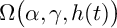 $\Omega \big (\alpha ,\gamma ,h(t)\big )$
is at most 3.
Theorem 5.8. Let
 $J=\mathbb {C}[s,t]s+\mathbb {C}[s,t]t$
. For the L-module
 $\Omega \big (\alpha ,\gamma ,h(t)\big )$
, the following statements hold.
(1) The module
 $\Omega \big (\alpha ,\gamma ,h(t)\big )$
is simple if and only if
 $h(0)\notin \mathbb {N}$
.
(2) If
 $h(0)=i\in \mathbb {Z}_{\ge 1}$
, then the unique non-zero proper submodule is
 $\Omega \big (\alpha ,\gamma ,h(t)\big )t^{i+1}$
.
(3) If
 $h(0)=0$
but
 $\gamma \ne 0$
, then the unique non-zero proper submodule is
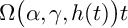 $\Omega \big (\alpha ,\gamma ,h(t)\big )t$
.
(4) If
 $h(0)=\gamma =0$
, then
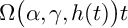 $\Omega \big (\alpha ,\gamma ,h(t)\big )t$
and J exhaust all the non-zero proper submodules.
Proof. We emphasize that
 $\widetilde {\mathfrak {sl}_2}$
is a subalgebra of L, and thus Theorem 4.3 will be used repeatedly throughout the proof. (1) and (2) follow from Theorem 4.3(1) and (2) directly.
Now, we prove statement (3). Suppose N is a non-zero submodule of
 $\Omega \big (\alpha ,\gamma ,h(t)\big )$
. Then by Theorem 4.3(3), we know that
 $$\begin{align*}N=\Omega\big(\alpha,\gamma,h(t)\big)t+p_0(s)\mathbb{C}[s]\end{align*}$$
for some
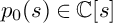 $p_0(s)\in \mathbb {C}[s]$
. If
 $p_0(s)=0$
, then we have
 $N=\Omega \big (\alpha ,\gamma ,h(t)\big )t$
. Otherwise, assume
 $p_0(s)$
is monic. For
 $j\in \mathbb {Z}$
, the action of
 $L_j$
implies
 $$\begin{align*}p_0(s)\mid (s+j\gamma)p_0(s-j).\end{align*}$$
Note that
 $\gamma \ne 0$
, hence we can take j sufficiently large such that
 $$\begin{align*}\big(p_0(s),(s+j\gamma)p_0(s-j)\big)=1.\end{align*}$$
Thus, we have
 $p_0(s)=1$
, which implies
 $N=\Omega \big (\alpha ,\gamma ,h(t)\big )$
.
As to statement (4), the proof is almost the same as that of (3). The difference is that the condition
 $$\begin{align*}p_0(s)\mid(s+j\gamma)p_0(s-j)\end{align*}$$
reduces to
 $$\begin{align*}p_0(s)\mid sp_0(s-j).\end{align*}$$
In this case, we have
 $p_0(s)\mid s$
. On the other hand, one can check that
 $\Omega \big (\alpha ,\gamma ,h(t)\big )t$
and J are indeed submodules of
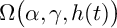 $\Omega \big (\alpha ,\gamma ,h(t)\big )$
.
Remark 5.9. After Theorem 5.8, the immediate question is to investigate the composition factors of the L-module
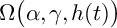 $\Omega \big (\alpha ,\gamma ,h(t)\big )$
. Suppose
 $h(0)=i\in \mathbb {N}$
. From Theorem 4.3(2), we deduce that there is an isomorphism of L-modules
 $$\begin{align*}\Omega\big(\alpha,\gamma,h(t)\big)t^{i+1}\cong\Omega\big(\alpha,\gamma,h(t)-2i-2\big).\end{align*}$$
Let
 $\Omega (\alpha ,\gamma )$
be the
 $\mathfrak {Vir}$
-module in (2.6) and
 $V_i$
be the simple
 $\mathfrak {sl}_2$
-module of dimension
 $i+1$
in (2.4). Then, the tensor product
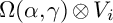 $\Omega (\alpha ,\gamma )\otimes V_i$
is a
 $\mathfrak {Vir}\ltimes \widehat {\mathfrak {sl}_2}$
-module. For
 $p(s)\in \Omega (\alpha ,\gamma )$
and
 $v\in V_i$
, the
 $\mathfrak {Vir}\ltimes \widehat {\mathfrak {sl}_2}$
-actions are defined as follows:
 $$\begin{align*}L_j(p(s)\otimes v)=\alpha^j(s+j\gamma)p(s-j)\otimes v,\quad x_j(p(s)\otimes v)=\alpha^j p(s-j)\otimes xv,\quad\mathbf{k}(p(s)\otimes v)=0, \end{align*}$$
where
 $x_j\in \left \{h_j,e_j,f_j\mid j\in \mathbb {Z}\right \}$
.
The quotient module
 $\Omega \big (\alpha ,\gamma ,h(t)\big )/\Omega \big (\alpha ,\gamma ,h(t)\big )t^{i+1}$
has a
 $\mathbb {C}$
-basis
 $$\begin{align*}\left\{s^kt^j+\Omega\big(\alpha,\gamma,h(t)\big)t^{i+1}\mid k\in\mathbb{N}, j\in\mathbb{N}, 0\le j\le i\right\}.\end{align*}$$
It follows that the map from
 $\Omega \big (\alpha ,\gamma ,h(t)\big )/\Omega \big (\alpha ,\gamma ,h(t)\big )t^{i+1}$
to
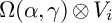 $\Omega (\alpha ,\gamma )\otimes V_i$
, which maps
 $s^kt^i+\Omega \big (\alpha ,\gamma ,h(t)\big )t^{i+1}$
to
 $s^k\otimes v_i$
is an isomorphism of L-modules.
For the case
 $i=\gamma =0$
, note that
 $\widehat {\mathfrak {sl}_2}\left (J/\Omega \big (\alpha ,\gamma ,h(t)\big )t\right )=0$
, it follows that
 $$\begin{align*}\begin{aligned} J/\Omega\big(\alpha,\gamma,h(t)\big)t&\to\Omega(\alpha,-1)\\ p(s)s+\Omega\big(\alpha,\gamma,h(t)\big)t&\mapsto p(s) \end{aligned} \end{align*}$$
is an isomorphism of simple
 $\mathfrak {Vir}$
-modules, where
 $\Omega (\alpha ,-1)$
is the
 $\mathfrak {Vir}$
-module defined in (2.6).
In summary, we have fully determined the composition factors of
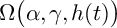 $\Omega \big (\alpha ,\gamma ,h(t)\big )$
.
6 Tensor product module for
$\mathfrak {Vir}\ltimes \widehat {\mathfrak {sl}_2}$

The aim of this section is to study a class of tensor product modules over the affine-Virasoro algebra of type
 $A_1$
.
First, let us introduce the following definition.
Definition 6.1. An L-module V is called a restricted module if for every
 $v\in V$
, there exists a sufficiently large integer
 $i_v\in \mathbb {N}$
such that
 $x_kv=0$
for all
 $x_k\in \left \{L_k,h_k,e_k,f_k\mid k\ge i_v\right \}$
.
Let m be a positive integer. For
 $1\le k\le m$
, suppose
 $\alpha _k\in \mathbb {C}^{*}$
,
 $\gamma _k\in \mathbb {C}$
and
 $h_k(t_k)\in \mathbb {C}[t_k]$
. Note that as vector spaces, we have
 $\Omega \big (\alpha _k,\gamma _k,h_k(t_k)\big )=\mathbb {C}[s_k,t_k]$
for
 $1\le k\le m$
. Assume that
 $g_k(t_k)$
is the preimage of
 $t_kh^{\prime \prime }_k(t_k)-h^{\prime }_k(t_k)h_k(t_k)$
with respect to the map
 $\Theta _k$
defined in (3.5). To guarantee each L-module
 $\Omega \big (\alpha _k,\gamma _k,h_k(t_k)\big )$
is simple, it is required that
 $h_k(0)\notin \mathbb {N}$
for each
 $1\le k\le m$
. For a simple restricted L-module V, we have the module of tensor products
 $$\begin{align*}\mathbf{T}(m,\boldsymbol{\alpha},\boldsymbol{\gamma},\boldsymbol{h},V):=\bigotimes_{k=1}^{m}\Omega\big(\alpha_k,\gamma_k,h_k(t_k)\big)\otimes V, \end{align*}$$
where
 $$ \begin{align*} \boldsymbol{\alpha}&=(\alpha_1,\ldots,\alpha_m)\in(\mathbb{C}^{*})^m,\quad\quad \boldsymbol{\gamma}=(\gamma_1,\ldots,\gamma_m)\in\mathbb{C}^m,\\ \boldsymbol{h}&=(h_1(t_1),\ldots,h_m(t_m))\in\mathbb{C}[t_1]\times\cdots\times\mathbb{C}[t_m]. \end{align*} $$
In this section, we will establish a necessary and sufficient condition for the tensor product modules
 $\mathbf {T}(m,\boldsymbol {\alpha },\boldsymbol {\gamma },\boldsymbol {h},V)$
to be simple and determine their isomorphism classes.
As a vector space, we have a linear isomorphism
 $$ \begin{align} \mathbf{T}(m,\boldsymbol{\alpha},\boldsymbol{\gamma},\boldsymbol{h},V)\cong \mathbb{C}[s_1,\ldots,s_m,t_1,\ldots,t_m]\otimes V. \end{align} $$
Consequently, the module
 $\mathbf {T}(m,\boldsymbol {\alpha },\boldsymbol {\gamma },\boldsymbol {h},V)$
inherits the lexicographic order on
 $\mathbb {N}^{2m}$
introduced in the final paragraph of Section 2. For
 $1\le k\le m$
and a non-zero element
 $$\begin{align*}g=\sum_{(\mathbf{p},\mathbf{q})\in S}s_1^{p_1}t_1^{q_1}\otimes\cdots\otimes s_m^{p_m}t_m^{q_m}\otimes v_{(\mathbf{p},\mathbf{q})}\in\mathbf{T}(m,\boldsymbol{\alpha},\boldsymbol{\gamma},\boldsymbol{h},V), \end{align*}$$
where
 $(\mathbf {p},\mathbf {q})=(p_1,\ldots ,p_m,q_1,\ldots ,q_m)$
,
 $0\ne v_{(\mathbf {p},\mathbf {q})}\in V$
, and
 $S\subseteq \mathbb {N}^{2m}$
is a finite set, we define
 $P_k=\max \left \{ p_k\mid (\mathbf {p},\mathbf {q})\in S \right \}$
and
 $S_k=\left \{(\mathbf {p},\mathbf {q})\in S\mid p_k=P_k\right \}$
, respectively. The following result was proved in [Reference Tan and Zhao46, Lemma 2].
Lemma 6.2. Suppose
 $\alpha _1,\ldots ,\alpha _m\in \mathbb {C}^{*}$
,
 $s_1,\ldots ,s_m\in \mathbb {Z}_{\ge 1}$
and
 $s_1+\cdots +s_m=s$
. For
 $n\in \mathbb {Z}$
,
 $1\le t\le m$
and
 $s_1+\cdots +s_{t-1}+1\le k\le s_1+\cdots +s_t$
, define
 $f_k(n)=n^{k-1-\sum _{j=1}^{t-1}s_j}\alpha _t^n$
. Let
 $\mathfrak {R}=(y_{pq})$
be the
 $s\times s$
matrix with
 $y_{pq}=f_q(p-1)$
, where
 $q=1,2,\ldots ,s$
and
 $p=r+1,r+2,\ldots ,r+s$
for some
 $r\ge 0$
. Then, we have
 $$ \begin{align*} \det\mathfrak{R}=\prod_{j=1}^{m}(s_j-1)^{!!}\alpha_j^{{s_j(s_j+2r-1)}/{2}} \prod_{1\le i<j\le m}(\alpha_j-\alpha _i)^{s_is_j}, \end{align*} $$
where
 $m^{!!}=m!\times (m-1)!\times \cdots \times 1!$
for
 $m\in \mathbb {Z}_{\ge 1}$
and
 $0^{!!}=1$
.
First, we study the simplicity of the tensor product module
 $\mathbf {T}(m,\boldsymbol {\alpha },\boldsymbol {\gamma },\boldsymbol {h},V)$
.
Lemma 6.3. Assume that
 $\alpha _1,\ldots ,\alpha _m$
are pairwise distinct non-zero complex numbers. If N is a non-zero submodule of
 $\mathbf {T}(m,\boldsymbol {\alpha },\boldsymbol {\gamma },\boldsymbol {h},V)$
, then for every
 $$ \begin{align} 0\ne g=\sum_{(\mathbf{p},\mathbf{q})\in S}s_1^{p_1}t_1^{q_1}\otimes\cdots\otimes s_m^{p_m}t_m^{q_m}\otimes v_{(\mathbf{p},\mathbf{q})}\in N, \end{align} $$
and
 $1\le k\le m$
, the following elements belong to N:
 $$ \begin{align} \sum_{(\mathbf{p},\mathbf{q})\in S_k}s_1^{p_1}t_1^{q_1}\otimes\cdots\otimes &t_k^{q_k+1}\otimes\cdots\otimes s_m^{p_m}t_m^{q_m}\otimes v_{(\mathbf{p},\mathbf{q})}, \end{align} $$
 $$ \begin{align} \sum_{(\mathbf{p},\mathbf{q})\in S}s_1^{p_1}t_1^{q_1}\otimes\cdots\otimes& s_k^{p_k}t_k^{q_k+1}\otimes\cdots\otimes s_m^{p_m}t_m^{q_m}\otimes v_{(\mathbf{p},\mathbf{q})}, \end{align} $$
 $$ \begin{align} \sum_{(\mathbf{p},\mathbf{q})\in S}s_1^{p_1}t_1^{q_1}\otimes\cdots\otimes& s_k^{p_k+1}t_k^{q_k}\otimes\cdots\otimes s_m^{p_m}t_m^{q_m}\otimes v_{(\mathbf{p},\mathbf{q})}. \end{align} $$
Proof. Choose a sufficiently large integer
 $n\in \mathbb {N}$
such that
 $L_iv_{(\textbf {p},\textbf {q})}=f_iv_{(\textbf {p},\textbf {q})}=0$
for all
 $i\ge n$
and
 $(\textbf {p},\textbf {q})\in S$
. For
 $i\ge n$
, by the actions in (5.1), applying
 $L_i$
and
 $f_i$
to the element in (6.2), we see that
 $$ \begin{align*} L_ig=&\sum_{(\textbf{p},\textbf{q})\in S}\sum_{k = 1}^{m}s_1^{p_1}t_1^{q_1}\otimes \cdots\otimes L_i(s_k^{p_k}t_k^{q_k}) \otimes \cdots\otimes s_m^{p_m}t_m^{q_m}\otimes v_{(\mathbf{p},\mathbf{q})}\\ =&\sum_{(\textbf{p},\textbf{q})\in S}\sum_{k = 1}^{m}s_1^{p_1}t_1^{q_1}\otimes \cdots\otimes \alpha_k^{i}(s_k+i\gamma_k)(s_k-i)^{p_k}t_k^{q_k} \otimes \cdots\otimes s_m^{p_m}t_m^{q_m}\otimes v_{(\mathbf{p},\mathbf{q})}\\ =&\sum_{(\textbf{p},\textbf{q})\in S}\sum_{k = 1}^{m} \sum_{y=0}^{p_k+1}(-i)^y \alpha_{k}^{i}s_1^{p_1}t_1^{q_1}\otimes \cdots\otimes \left(\binom{p_k}{y} -\gamma_k \binom{p_k}{y-1}\right)\\ &\quad\quad\quad\quad\quad\quad\quad\quad\quad\quad\quad\quad s_k^{p_k-y+1}t_k^{q_k}\otimes \cdots\otimes s_m^{p_m}t_m^{q_m}\otimes v_{(\mathbf{p},\mathbf{q})} \end{align*} $$
and
 $$ \begin{align*} f_ig=&\sum_{(\textbf{p},\textbf{q})\in S}\sum_{k = 1}^{m}s_1^{p_1}t_1^{q_1}\otimes \cdots\otimes f_i(s_k^{p_k}t_k^{q_k}) \otimes \cdots\otimes s_m^{p_m}t_m^{q_m}\otimes v_{(\mathbf{p},\mathbf{q})}\\ =& \sum_{(\textbf{p},\textbf{q})\in S}\sum_{k = 1}^{m}s_1^{p_1}t_1^{q_1}\otimes\cdots\otimes \alpha_k^i(s_k-i)^{p_k}t_k^{q_k+1}\otimes \cdots \otimes s_m^{p_m}t_m^{q_m}\otimes v_{(\mathbf{p},\mathbf{q})}\\ =&\sum_{(\textbf{p},\textbf{q})\in S}\sum_{k = 1}^{m}\sum_{y=0}^{p_k}(-i)^y\alpha_k^is_1^{p_1}t_1^{q_1}\otimes\cdots\otimes \binom{p_k}{y} s_k^{p_k-y}t_k^{q_k+1}\otimes \cdots \otimes s_m^{p_m}t_m^{q_m}\otimes v_{(\mathbf{p},\mathbf{q})} \end{align*} $$
belong to N. It follows that for
 $i\ge n$
, we have
 $$\begin{align*}\begin{aligned} &\sum_{k = 1}^{m}\sum_{y=0}^{P_k+1}(-i)^y\alpha_{k}^{i}\left(\sum_{(\textbf{p},\textbf{q})\in S}s_1^{p_1}t_1^{q_1}\otimes \cdots\otimes \left(\binom{p_k}{y} -\gamma_k \binom{p_k}{y-1}\right)\right.\\ &\left.\quad\quad\quad\quad\quad\quad\quad\quad\quad\quad\quad\quad\quad s_k^{p_k-y+1}t_k^{q_k}\otimes \cdots\otimes s_m^{p_m}t_m^{q_m}\otimes v_{(\mathbf{p},\mathbf{q})}\right)\in N \end{aligned} \end{align*}$$
and
 $$\begin{align*}\sum_{k = 1}^{m}\sum_{y=0}^{P_k}(-i)^y\alpha_k^i\left(\sum_{(\textbf{p},\textbf{q})\in S}s_1^{p_1}t_1^{q_1}\otimes\cdots\otimes \binom{p_k}{y} s_k^{p_k-y}t_k^{q_k+1}\otimes \cdots \otimes s_m^{p_m}t_m^{q_m}\otimes v_{(\mathbf{p},\mathbf{q})}\right)\in N. \end{align*}$$
Utilizing Lemma 6.2, set
 $s_t=P_k+2$
for all
 $1\le t\le m$
and
 $r=n$
, combining the assumption that
 $\alpha _1,\ldots ,\alpha _m$
are pairwise distinct non-zero complex numbers, we establish that for each
 $1\le k\le m$
and
 $0\le y\le P_k+1$
, the element
 $$ \begin{align} \sum_{(\textbf{p},\textbf{q})\in S}s_1^{p_1}t_1^{q_1}\otimes \cdots\otimes \left( \binom{p_k}{y} -\gamma_k \binom{p_k}{y-1} \right) s_k^{p_k-y+1}t_k^{q_k}\otimes \cdots\otimes s_m^{p_m}t_m^{q_m}\otimes v_{(\mathbf{p},\mathbf{q})} \end{align} $$
belongs to N. Similarly, we know that the element
 $$ \begin{align} \sum_{(\textbf{p},\textbf{q})\in S}s_1^{p_1}t_1^{q_1}\otimes\cdots\otimes \binom{p_k}{y} s_k^{p_k-y}t_k^{q_k+1}\otimes \cdots \otimes s_m^{p_m}t_m^{q_m}\otimes v_{(\mathbf{p},\mathbf{q})} \end{align} $$
belongs to N. In particular, by taking
 $y=P_k$
and
 $y=0$
in (6.7), we obtain that the elements in (6.3) and (6.4) belong to N, respectively. Taking
 $y=0$
in (6.6), we see that the element in (6.5) belongs to N.
Lemma 6.4. Under the hypothesis of Lemma 6.3, for every
 $0\ne v\in V$
, the element
 $1\otimes \cdots \otimes 1\otimes v$
is a generator of the module
 $\mathbf {T}(m,\boldsymbol {\alpha },\boldsymbol {\gamma },\boldsymbol {h},V)$
.
Proof. This follows from Lemma 6.3 and the fact that V is simple.
Theorem 6.5. The tensor product module
 $\mathbf {T}(m,\boldsymbol {\alpha },\boldsymbol {\gamma },\boldsymbol {h},V)$
is simple if and only if
 $\alpha _1,\ldots ,\alpha _m$
are pairwise distinct non-zero complex numbers.
Proof. Suppose
 $\alpha _1,\ldots ,\alpha _m$
are pairwise distinct non-zero complex numbers, and N is a non-zero submodule of
 $\mathbf {T}(m,\boldsymbol {\alpha },\boldsymbol {\gamma },\boldsymbol {h},V)$
. Take
 $$\begin{align*}0\ne g=\sum_{(\mathbf{p},\mathbf{q})\in S}s_1^{p_1}t_1^{q_1}\otimes\cdots\otimes s_m^{p_m}t_m^{q_m}\otimes v_{(\mathbf{p},\mathbf{q})}\in N \end{align*}$$
with the minimal
 $\deg (g)$
. Assume that
 $\deg (g)=(p^{\prime }_1,\ldots ,p^{\prime }_m,q^{\prime }_1,\ldots ,q^{\prime }_m)\in \mathbb {N}^{2m}$
.
If there exists some
 $1\le k\le m$
such that
 $p^{\prime }_k>0$
, let
 $k_1=\min \left \{k\mid 1\le k\le m, p^{\prime }_k>0 \right \}$
. From (6.3), we deduce that
 $$ \begin{align} 0\ne\sum_{(\mathbf{p},\mathbf{q})\in S_{k_1}}s_1^{p_1}t_1^{q_1}\otimes\cdots\otimes t_{k_1}^{q_{k_1}+1}\otimes\cdots\otimes s_m^{p_m}t_m^{q_m}\otimes v_{(\mathbf{p},\mathbf{q})}\in N, \end{align} $$
with a degree lower than that of g, leading to a contradiction. Thus,
 $p^{\prime }_k=0$
for
 $1\le k\le m$
, implying
 $$\begin{align*}g=\sum_{(\mathbf{0},\mathbf{q})\in S}t_1^{q_1}\otimes\cdots\otimes t_m^{q_m}\otimes v_{(\mathbf{0},\mathbf{q})}. \end{align*}$$
Utilizing the same method as in the proof of Theorem 3.11, we establish
 $1\otimes \cdots \otimes 1\otimes v\in N$
for some
 $0\ne v\in V$
. Consequently, by Lemma 6.4, we deduce that
 $N=\mathbf {T}(m,\boldsymbol {\alpha },\boldsymbol {\gamma },\boldsymbol {h},V)$
.
Conversely, suppose
 $\alpha _1,\ldots ,\alpha _m$
are not pairwise distinct, say
 $\alpha _i=\alpha _j$
for
 $1\le i\ne j\le m$
. Then, we have
 $$ \begin{align*} \mathbf{T}(m,\boldsymbol{\alpha},\boldsymbol{\gamma},\boldsymbol{h},V)&=\bigotimes_{k=1}^{m}\Omega\big(\alpha_k,\gamma_k,h_k(t_k)\big)\otimes V\\ &\cong\Omega\big(\alpha_i,\gamma_i,h_i(t_i)\big)\otimes\Omega\big(\alpha_j,\gamma_j,h_j(t_j)\big)\otimes\left(\bigotimes_{k\ne i,j}\Omega\big(\alpha_k,\gamma_k,h_k(t_k)\big)\otimes V\right). \end{align*} $$
Hence, it is sufficient to prove
 $\Omega \big (\alpha _i,\gamma _i,h_i(t_i)\big )\otimes \Omega \big (\alpha _j,\gamma _j,h_j(t_j)\big )$
is reducible. As a vector space, we have
 $$\begin{align*}\Omega\big(\alpha_i,\gamma_i,h_i(t_i)\big)\otimes\Omega\big(\alpha_j,\gamma_j,h_j(t_j)\big)\cong\mathbb{C}[s_i,s_j,t_i,t_j].\end{align*}$$
Define
 $N=\mathrm {span}\left \{ (s_i+s_j)^r\mathbb {C}[t_i,t_j]\mid r\in \mathbb {N}\right \}$
. By direct computations, one can verify N is a non-zero proper submodule of
 $\Omega \big (\alpha _i,\gamma _i,h_i(t_i)\big )\otimes \Omega \big (\alpha _j,\gamma _j,h_j(t_j)\big )$
.
Next, let us determine the isomorphism classes of these simple tensor product modules.
For the remainder of this section, we always assume
 $\alpha _1,\ldots ,\alpha _m$
are pairwise distinct non-zero complex numbers. For
 $g\in \mathbf {T}(m,\boldsymbol {\alpha },\boldsymbol {\gamma },\boldsymbol {h},V)$
, define
 $$\begin{align*}R_g=\lim_{s \to \infty}\dim\mathrm{span}\left\{g,f_ig\mid i\ge s\right\} \end{align*}$$
and
 $$\begin{align*}R_{\mathbf{T}}=\inf\left\{R_g\mid 0\ne g\in\mathbf{T}(m,\boldsymbol{\alpha},\boldsymbol{\gamma},\boldsymbol{h},V)\right\}. \end{align*}$$
Denote by
 $$\begin{align*}\mathbf{N}=\mathbb{C}[t_1]\otimes\cdots\otimes\mathbb{C}[t_m]\otimes V\subseteq\mathbf{T}(m,\boldsymbol{\alpha},\boldsymbol{\gamma},\boldsymbol{h},V).\end{align*}$$
Then, the following lemma holds true.
Lemma 6.6. For
 $0\ne g\in \mathbf {T}(m,\boldsymbol {\alpha },\boldsymbol {\gamma },\boldsymbol {h},V)$
, we always have
 $R_g\ge m+1$
. Moreover, the equality holds if and only if
 $0\ne g\in \mathbf {N}$
.
Proof. For a non-zero element
 $$\begin{align*}g=\sum_{(\mathbf{p},\mathbf{q})\in S}s_1^{p_1}t_1^{q_1}\otimes\cdots\otimes s_m^{p_m}t_m^{q_m}\otimes v_{(\mathbf{p},\mathbf{q})}, \end{align*}$$
choose a sufficiently large integer
 $n\in \mathbb {N}$
such that
 $f_iv_{(\mathbf {p},\mathbf {q})}=0$
for all
 $i\ge n$
and
 $(\mathbf {p},\mathbf {q})\in S$
. Then, by (6.7), we know that for
 $s\ge n$
,
 $$\begin{align*}\mathrm{span}\left\{g,f_ig\mid i\ge s\right\}=\mathrm{span}\left\{g,f_{yk}\mid 0\le y\le P_k,1\le k\le m\right\}, \end{align*}$$
where
 $$\begin{align*}f_{yk}=\sum_{(\textbf{p},\textbf{q})\in S}s_1^{p_1}t_1^{q_1}\otimes\cdots\otimes \binom{p_k}{y} s_k^{p_k-y}t_k^{q_k+1}\otimes \cdots \otimes s_m^{p_m}t_m^{q_m}\otimes v_{(\mathbf{p},\mathbf{q})}.\end{align*}$$
Assume that
 $\deg (g)=(p^{\prime }_1,\ldots ,p^{\prime }_m,q^{\prime }_1,\ldots ,q^{\prime }_m)\in \mathbb {N}^{2m}$
. Then, we have
 $$\begin{align*}\deg(f_{0k})=(p^{\prime}_1,\ldots,p^{\prime}_m,q^{\prime}_1,\ldots,q^{\prime}_k+1,\ldots,q^{\prime}_m)\succ\deg(g). \end{align*}$$
If there exists
 $1\le k\le m$
such that
 $p^{\prime }_k>0$
, then, as in (6.8), we can find
 $0\ne h\in \mathrm {span}\{g,f_ig\mid i\ge s\}$
such that
 $\deg (h)\prec \deg (g)$
. It follows that
 $\dim \mathrm {span}\left \{g,f_ig\mid i\ge s\right \}\ge m+2$
. If
 $p^{\prime }_k=0$
for all
 $1\le k\le m$
, then it is evident that
 $\{g,f_{01},\ldots ,f_{0m}\}$
forms a basis of
 $\mathrm {span}\{g,f_ig\mid i\ge s\}$
, and thus
 $\dim \mathrm {span}\{g,f_ig\mid i\ge s\}=m+1$
.
Take another simple L-module
 $$ \begin{align*} \mathbf{T}(m',\boldsymbol{\alpha}',\boldsymbol{\gamma}',\boldsymbol{p},V')=\bigotimes_{k=1}^{m'}\Omega\big(\alpha^{\prime}_k,\gamma^{\prime}_k,p_k(t_k)\big)\otimes V', \end{align*} $$
where
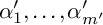 $\alpha ^{\prime }_1,\ldots ,\alpha ^{\prime }_{m'}$
are pairwise distinct non-zero complex numbers and
 $p_k(0)\notin \mathbb {N}$
for
 $1\le k\le m'$
. As vector spaces, we have
 $\Omega \big (\alpha ^{\prime }_k,\gamma ^{\prime }_k,p_k(t_k)\big )=\mathbb {C}[s_k,t_k]$
for
 $1\le k\le m'$
. Assume that
 $u_k(t_k)\in \mathbb {C}[t_k]$
is the preimage of
 $t_kp^{\prime \prime }_k(t_k)-p^{\prime }_k(t_k)p(t_k)$
with respect to the map
 $\Theta _k$
defined in (3.5). Denote by
 $$\begin{align*}\mathbf{N}'=\mathbb{C}[t_1]\otimes\cdots\otimes\mathbb{C}[t_{m'}]\otimes V'\subseteq \mathbf{T}(m',\boldsymbol{\alpha}',\boldsymbol{\gamma}',\boldsymbol{p},V').\end{align*}$$
Now, the following theorem is valid.
Theorem 6.7. The modules
 $\mathbf {T}(m,\boldsymbol {\alpha },\boldsymbol {\gamma },\boldsymbol {h},V)$
and
 $\mathbf {T}(m',\boldsymbol {\alpha }',\boldsymbol {\gamma }',\boldsymbol {p},V')$
are isomorphic if and only if
 $m=m'$
,
 $V\cong V'$
, and
 $\big (\alpha _k,\gamma _k,h_k(t_k)\big )=\big (\alpha ^{\prime }_k,\gamma ^{\prime }_k,p_k(t_k)\big )$
up to a permutation.
Proof. Suppose
 $\psi :\mathbf {T}(m,\boldsymbol {\alpha },\boldsymbol {\gamma },\boldsymbol {h},V)\to \mathbf {T}(m',\boldsymbol {\alpha }',\boldsymbol {\gamma }',\boldsymbol {p},V')$
is an isomorphism map. For
 $0\ne g\in \mathbf {N}$
, we have
 $m+1=R_g=R_{\psi (g)}\ge m'+1$
. By symmetry, we know that
 $m=m'$
. For a fixed
 $0\ne v\in V$
, let
 $\xi =1\otimes \cdots \otimes 1\otimes v$
. Then, we have
 $m+1=R_\xi =R_{\psi (\xi )}$
. It follows that
 $\psi (\xi )\in \mathbf {N}'$
. Assume that
 $$ \begin{align} \psi(1\otimes\cdots\otimes1\otimes v)=\sum_{(\mathbf{0},\mathbf{r})\in S}t_1^{r_1}\otimes\cdots\otimes t_m^{r_m}\otimes v_{(\mathbf{0},\mathbf{r})}, \end{align} $$
where
 $S\subseteq \mathbb {N}^{2m}$
is a finite set and
 $0\ne v_{(\mathbf {0},\mathbf {r})}\in V'$
for
 $(\mathbf {0},\mathbf {r})\in S$
. Choose a sufficiently large integer
 $n\in \mathbb {N}$
such that
 $x_iv=0$
and
 $x_iv_{(\mathbf {0},\mathbf {r})}=0$
for all
 $x_i\in \left \{L_i,h_i,e_i,f_i\mid i\ge n\right \}$
and
 $(\mathbf {0},\mathbf {r})\in S$
. The proof is divided into five steps.
Step 1. We have
 $(\alpha _k,\gamma _k)=(\alpha ^{\prime }_k,\gamma ^{\prime }_k)$
up to a permutation.
For
 $i\ge n$
, the actions in (5.1) and equation
 $$\begin{align*}\psi\left(L_i(1\otimes\cdots\otimes1\otimes v)\right)=L_i\psi\left(1\otimes\cdots\otimes1\otimes v\right)\end{align*}$$
imply
 $$ \begin{align} \begin{aligned} &\sum_{k=1}^{m}\psi\big(1\otimes\cdots\otimes\alpha_k^i(s_k+i\gamma_k)\otimes\cdots\otimes1\otimes v\big)\\ =&\sum_{k=1}^{m}\sum_{(\mathbf{0},\mathbf{r})\in S}t_1^{r_1}\otimes\cdots\otimes(\alpha^{\prime}_k)^i(s_k+i\gamma^{\prime}_k)t_k^{r_k}\otimes\cdots\otimes t_m^{r_m}\otimes v_{(\mathbf{0},\mathbf{r})}. \end{aligned} \end{align} $$
Note that
 $\{\alpha _1, \ldots , \alpha _m\}$
and
 $\{\alpha ^{\prime }_1, \ldots , \alpha ^{\prime }_m\}$
are two sets of pairwise distinct non-zero complex numbers. Combining Lemma 6.2 and the fact that
 $\psi (1\otimes \cdots \otimes s_k\otimes \cdots \otimes 1\otimes v)\ne 0$
for
 $1\le k\le m$
, we deduce that
 $\left \{\alpha _1,\ldots ,\alpha _m\right \}=\left \{\alpha ^{\prime }_1,\ldots ,\alpha ^{\prime }_m\right \}$
. Without loss of generality, we may assume
 $\alpha _k=\alpha ^{\prime }_k$
for
 $1\le k\le m$
. Then, equation (6.10) becomes
 $$ \begin{align*} \begin{aligned} 0=&\sum_{k=1}^{m}\alpha_k^i\bigg(\psi(1\otimes\cdots\otimes s_k\otimes\cdots\otimes1\otimes v)-\sum_{(\mathbf{0},\mathbf{r})\in S}t_1^{r_1} \otimes\cdots\otimes s_kt_k^{r_k}\otimes\cdots\otimes t_m^{r_m}\otimes v_{(\mathbf{0},\mathbf{r})}\bigg)\\&+i\alpha_k^i(\gamma_k-\gamma^{\prime}_k)\psi(1\otimes\cdots\otimes1\otimes v). \end{aligned} \end{align*} $$
Using Lemma 6.2 and noting that
 $\psi (1\otimes \cdots \otimes 1\otimes v)\ne 0$
, we have
 $\gamma _k=\gamma ^{\prime }_k$
for
 $1\le k\le m$
.
Step 2. For
 $q_1,\ldots ,q_m\in \mathbb {N}$
, we have
 $$ \begin{align} \psi(t_1^{q_1}\otimes\cdots\otimes t_m^{q_m}\otimes v)=\sum_{(\mathbf{0},\mathbf{r})\in S}t_1^{r_1+q_1}\otimes\cdots\otimes t_m^{r_m+q_m}\otimes v_{(\mathbf{0},\mathbf{r})}. \end{align} $$
We shall prove this equation by induction. Assume that equation (6.11) holds for
 $q_1+\cdots +q_m=l\in \mathbb {N}$
. For
 $i\ge n$
, the action of
 $f_i$
in (5.1) suggests that
 $$ \begin{align*} \begin{aligned} &\sum_{k=1}^{m}\alpha_k^i\psi(t_1^{q_1}\otimes\cdots\otimes t_k^{q_k+1}\otimes\cdots\otimes t_m^{q_m}\otimes v)\\ =&\;\sum_{k=1}^{m}\alpha_k^i \Bigg(\sum_{(\mathbf{0},\mathbf{r})\in S}t_1^{r_1+q_1}\otimes\cdots\otimes t_k^{r_k+q_k+1}\otimes\cdots\otimes t_m^{r_m+q_m}\otimes v_{(\mathbf{0},\mathbf{r})}\Bigg). \end{aligned} \end{align*} $$
Using the Vandermonde matrix, we know that
 $$ \begin{align*} \psi(t_1^{q_1}\otimes\cdots\otimes t_k^{q_k+1}\otimes\cdots\otimes t_m^{q_m}\otimes v)=\sum_{(\mathbf{0},\mathbf{r})\in S}t_1^{r_1+q_1}\otimes\cdots\otimes t_k^{r_k+q_k+1}\otimes\cdots\otimes t_m^{r_m+q_m}\otimes v_{(\mathbf{0},\mathbf{r})} \end{align*} $$
for each
 $1\le k\le m$
. It follows that equation (6.11) holds for
 $q_1+\cdots +q_m=l+1$
.
Step 3. The set S is a singleton, implying that the summation in (6.9) reduces to a single term.
For
 $i\ge n$
, the action of
 $h_i$
in (5.1) suggests that
 $$ \begin{align*} \sum_{k=1}^{m}\alpha_k^i\psi\big(1\otimes\cdots\otimes h_k(t_k)\otimes\cdots\otimes1\otimes v\big) =\sum_{k=1}^{m}\sum_{(\mathbf{0},\mathbf{r})\in S}t_1^{r_1}\otimes\cdots\otimes\alpha_k^i\big(p_k(t_k)-2r_k\big)t_k^{r_k}\otimes\cdots\otimes t_m^{r_m}\otimes v_{(\mathbf{0},\mathbf{r})}. \end{align*} $$
Using the Vandermonde matrix and equation (6.11), we know that for
 $1\le k\le m$
,
 $$ \begin{align} \sum_{(\mathbf{0},\mathbf{r})\in S}t_1^{r_1}\otimes\cdots\otimes\big(h_k(t_k)-p_k(t_k)+2r_k\big)t_k^{r_k}\otimes\cdots\otimes t_m^{r_m}\otimes v_{(\mathbf{0},\mathbf{r})}=0. \end{align} $$
For each
 $1\le k\le m$
, using the linear isomorphism in (6.1), we may assume that
 $$ \begin{align*} \psi(1\otimes\cdots\otimes1\otimes v)=\sum_{j=0}^{d_{k}}t_k^jf_j(t_1,\ldots,\widehat{t_k},\ldots,t_m), \end{align*} $$
where
 $f_j(t_1,\ldots ,\widehat {t_k},\ldots ,t_m)\in \mathbb {C}[t_1,\ldots ,\widehat {t_k},\ldots ,t_m]\otimes V'$
and
 $f_{d_k}(t_1,\ldots ,\widehat {t_k},\ldots ,t_m)\ne 0$
. Then, equation (6.12) implies
 $$ \begin{align} \sum_{j=0}^{d_{k}}\big(h_k(t_k)-p_k(t_k)+2j\big)t_k^jf_j(t_1,\ldots,\widehat{t_k},\ldots,t_m)=0. \end{align} $$
Hence, we have
 $h_k(t_k)-p_k(t_k)+2d_k=0$
. Now, equation (6.13) becomes
 $$ \begin{align} \sum_{j=0}^{d_{k}}2\big(j-d_k\big)t_k^jf_j(t_1,\ldots,\widehat{t_k},\ldots,t_m)=0, \end{align} $$
which implies
 $f_j(t_1,\ldots ,\widehat {t_k},\ldots ,t_m)=0$
for all
 $0\le j<d_k$
. It follows that
 $$\begin{align*}\psi(1\otimes\cdots\otimes1\otimes v)=t_k^{d_k}f_{d_k}(t_1,\ldots,\widehat{t_k},\ldots,t_m) \end{align*}$$
and
 $r_k=d_k$
for
 $1\le k\le m$
and
 $(\mathbf {0},\mathbf {r})\in S$
. Hence, the set S contains only one element.
Step 4.
 $S=\left \{(\mathbf {0},\mathbf {0})\right \}$
.
From Step 3, we know that for
 $v\in V$
,
 $$ \begin{align*} \psi(1\otimes\cdots\otimes1\otimes v)=t_1^{r_1}\otimes\cdots\otimes t_m^{r_m}\otimes v' \end{align*} $$
for some
 $v'\in V'$
. For
 $i\ge n$
, by the action of
 $e_i$
in (5.1) and the Vandermonde determinant, we have
 $$ \begin{align*} \psi\big(1\otimes\cdots\otimes g_k(t_k)\otimes\cdots\otimes1\otimes v\big)=t_1^{r_1}\otimes\cdots\otimes\big(u_k(t_k)t_k+r_kp_k(t_k)-r_k(r_k-1)\big)t_k^{r_k-1}\otimes\cdots\otimes t_m^{r_m}\otimes v'. \end{align*} $$
Using equation (6.11), for each
 $1\le k\le m$
, we have
 $$ \begin{align*} t_1^{r_1}\otimes\cdots\otimes\big(u_k(t_k)t_k-g_k(t_k)t_k+r_kp_k(t_k)-r_k(r_k-1)\big)t_k^{r_k-1}\otimes\cdots\otimes t_m^{r_m}\otimes v'=0, \end{align*} $$
which implies
 $$ \begin{align} u_k(t_k)t_k-g_k(t_k)t_k+r_kp_k(t_k)-r_k(r_k-1)=0. \end{align} $$
Taking
 $t_k=0$
in equation (6.15) and noting that
 $p_k(0)\notin \mathbb {N}$
, we must have
 $r_k=0$
. It follows that
 $S=\left \{(\mathbf {0},\mathbf {0})\right \}$
.
Step 5.
 $h_k(t_k)=p_k(t_k)$
for
 $1\le k\le m$
and
 $V\cong V'$
.
It has been proved that for
 $v\in V$
,
 $$ \begin{align*} \psi(1\otimes\cdots\otimes1\otimes v)=1\otimes\cdots\otimes1\otimes v' \end{align*} $$
for a unique
 $v'\in V'$
. For
 $i\ge n$
, by the action of
 $h_i$
in (5.1) and equation (6.11), we obtain
 $h_k(t_k)=p_k(t_k)$
for
 $1\le k\le m$
.
Define a linear map
 $$ \begin{align*} \begin{aligned} \tau:V&\to V'\\ v&\mapsto v'. \end{aligned} \end{align*} $$
Then, by the discussions above, one can verify
 $\tau $
is an isomorphism of L-modules directly. It follows that
 $V\cong V'$
.
We end this section with the following remarks. If
 $V=V'=\mathbb {C}$
are trivial L-modules, then the results obtained by Li in [Reference Li32] can be utilized to determine the isomorphism classes of the simple L-modules
 $\mathbf {T}(m,\boldsymbol {\alpha },\boldsymbol {\gamma },\boldsymbol {h},\mathbb {C})$
. The subsequent results are special cases of [Reference Li32, Propositions 3.6 and 3.7].
Proposition 6.8. Let
 $U_1,\ldots ,U_r,V_1,\ldots ,V_s$
be non-trivial simple
 $\mathfrak {sl}_2$
-modules. Suppose
 $\alpha _1,\ldots ,\alpha _r$
and
 $z_1,\ldots ,z_s$
are two groups of non-zero complex numbers such that
 $\alpha _i\ne \alpha _j$
and
 $z_k\ne z_l$
whenever
 $1\le i\ne j\le r$
and
 $1\le k\ne l\le s$
. Then, the following statements hold.
(1) The
 $\widehat {\mathfrak {sl}_2}$
-module
 $U_1(\alpha _1)\otimes \cdots \otimes U_r(\alpha _r)$
is simple.
(2)
 $U_1(\alpha _1)\otimes \cdots \otimes U_r(\alpha _r)\cong V_1(z_1)\otimes \cdots \otimes V_s(z_s)$
if and only if
 $r=s$
,
 $\alpha _i=z_i$
, and
 $U_i\cong V_i$
up to a permutation. Moreover, for
 $x\in \mathfrak {sl}_2$
and
 $v_i\in V_i$
, define
 $$ \begin{align*} \sigma_i(x)(v_1\otimes\cdots\otimes v_i\otimes\cdots\otimes v_r):=v_1\otimes\cdots\otimes xv_i\otimes\cdots\otimes v_r \end{align*} $$
and extend it linearly. Suppose
 $$ \begin{align*} \psi:U_1(\alpha_1)\otimes\cdots\otimes U_r(\alpha_r)\to V_1(\alpha_1)\otimes\cdots\otimes V_r(\alpha_r) \end{align*} $$
is the corresponding isomorphism of
 $\widehat {\mathfrak {sl}_2}$
-modules. Then for
 $1\le i\le r$
, we have
 $$ \begin{align*} \psi(u_1\otimes\cdots\otimes xu_i\otimes\cdots\otimes u_r)=\sigma_i(x)\psi(u_1\otimes\cdots\otimes u_i\otimes\cdots\otimes u_r). \end{align*} $$
Now, under the hypothesis that
 $V=V'=\mathbb {C}$
are trivial L-modules, we use Proposition 6.8 to determine the isomorphism classes of the simple L-modules
 $\mathbf {T}(m,\boldsymbol {\alpha },\boldsymbol {\gamma },\boldsymbol {h},\mathbb {C})$
. As before, set
 $\mathbf {N}=\mathbb {C}[t_1]\otimes \cdots \otimes \mathbb {C}[t_m]\subseteq \mathbf {T}(m,\boldsymbol {\alpha },\boldsymbol {\gamma },\boldsymbol {h},\mathbb {C})$
.
Take another simple module
 $$\begin{align*}\mathbf{T}(m',\boldsymbol{\alpha}',\boldsymbol{\gamma}',\boldsymbol{p},\mathbb{C})=\bigotimes_{k=1}^{m'}\Omega\big(\alpha^{\prime}_k,\gamma^{\prime}_k,p_k(t_k)\big). \end{align*}$$
As vector spaces, we have
 $\Omega \big (\alpha ^{\prime }_k,\gamma ^{\prime }_k,p_k(t_k)\big )=\mathbb {C}[s_k,t_k]$
for
 $1\le k\le m'$
. Let
 $\mathbf {N}'=\mathbb {C}[t_1]\otimes \cdots \otimes \mathbb {C}[t_{m'}]\subseteq \mathbf {T}(m',\boldsymbol {\alpha }',\boldsymbol {\gamma }',\boldsymbol {p},\mathbb {C})$
. Then, from Proposition 6.8(1), we know that
 $\mathbf {N}$
and
 $\mathbf {N}'$
are both simple
 $\widehat {\mathfrak {sl}_2}$
-modules.
Theorem 6.9. The tensor products
 $\mathbf {T}(m,\boldsymbol {\alpha },\boldsymbol {\gamma },\boldsymbol {h},\mathbb {C})\cong \mathbf {T}(m',\boldsymbol {\alpha }',\boldsymbol {\gamma }',\boldsymbol {p},\mathbb {C})$
if and only if
 $m=m'$
and
 $\big (\alpha _k,\gamma _k,h_k(t_k)\big )=\big (\alpha ^{\prime }_k,\gamma ^{\prime }_k,p_k(t_k)\big )$
up to a permutation.
Proof. For an isomorphism
 $\psi :\mathbf {T}(m,\boldsymbol {\alpha },\boldsymbol {\gamma },\boldsymbol {h},\mathbb {C})\to \mathbf {T}(m',\boldsymbol {\alpha }',\boldsymbol {\gamma }',\boldsymbol {p},\mathbb {C})$
and
 $0\ne g\in \mathbf {N}$
, we have
 $m+1=R_{g}=R_{\psi (g)}\ge m'+1$
. By symmetry, we obtain
 $m=m'$
, and thus
 $\psi (\mathbf {N})\subseteq \mathbf {N}'$
. Note that
 $\mathbf {N}'$
is a simple
 $\widehat {\mathfrak {sl}_2}$
-module. It follows that
 $\psi (\mathbf {N})=\mathbf {N}'$
, and
 $\psi $
induces an isomorphism of
 $\widehat {\mathfrak {sl}_2}$
-modules. Hence, from Proposition 6.8(2), we deduce that
 $\big (\alpha _k,h_k(t_k)\big )=(\alpha ^{\prime }_k,p_k(t_k))$
up to a permutation. Assume that
 $$\begin{align*}\psi(1\otimes\cdots\otimes1)=\sum_{(\mathbf{0},\mathbf{r})\in S} \lambda_{(\mathbf{0},\textbf{r})}t _{1}^{r_1}\otimes\cdots\otimes t_{m}^{r_{m}}, \end{align*}$$
where
 $ \lambda _{(\mathbf {0},\textbf {r})}\in \mathbb {C}^{*}$
. Then from Proposition 6.8(2), we know that for
 $q_1,\ldots ,q_m\in \mathbb {N}$
,
 $$ \begin{align*} \psi(t_1^{q_1}\otimes\cdots\otimes t_m^{q_m})=\sum_{(\mathbf{0},\textbf{r})\in S} \lambda_{(\mathbf{0},\textbf{r})}t _{1}^{r_1+q_1}\otimes\cdots\otimes t_{m}^{r_{m}+q_m}. \end{align*} $$
Since
 $\psi $
induces an isomorphism between
 $\mathbf {N}$
and
 $\mathbf {N}'$
, we must have
 $$\begin{align*}\psi(1\otimes\cdots\otimes1)=\lambda(1\otimes\cdots\otimes1) \end{align*}$$
for some
 $\lambda \in \mathbb {C}^{*}$
. The action of
 $L_i$
suggests that
 $$ \begin{align*} &\sum_{k=1}^{m}\alpha_k^{i}\psi(1\otimes\cdots\otimes s_k\otimes\cdots\otimes1)+\sum_{k=1}^{m}i\alpha_k^i\gamma_k\psi(1\otimes\cdots\otimes1)\\ =&\;\lambda\sum_{k=1}^{m}\alpha^i_k(1\otimes\cdots\otimes s_k\otimes\cdots\otimes1)+\lambda\sum_{k=1}^{m} i\alpha_k^i\gamma^{\prime}_k(1\otimes\cdots\otimes1). \end{align*} $$
Lemma 6.2 establishes that
 $\lambda (\gamma _k - \gamma ^{\prime }_k)(1 \otimes \cdots \otimes 1) = 0$
for all
 $1 \le k \le m$
, consequently yielding
 $\gamma _k = \gamma ^{\prime }_k$
.
Acknowledgements
We sincerely thank the referees for their constructive feedback and helpful suggestions that have enhanced this work. This article is partially supported by the National Key R&D Program of China (2024YFA1013802), NSF of China (11931009, 12101152, 12161141001, 12171132, 12401030, and 12401036), Innovation Program for Quantum Science and Technology (2021ZD0302902), and the Fundamental Research Funds for the Central Universities of China.
Data availability statement
Data sharing not applicable to this article as no datasets were generated or analyzed during the current study.



