Introduction
Dementia is a growing health and social issue worldwide; several countries have launched national dementia strategies (Alzheimer's Disease International, 2012; Nakanishi and Nakashima, Reference Nakanishi and Nakashima2014). Because dementia results in a progressive decline in multiple areas of function, national strategies should cover the entire course of the disease from early detection to the end-of-life. However, national dementia strategies may not include the end-of-life content or may not be linked to palliative care strategies. Palliative care is an approach that improves the quality of life of people and their families facing the problem associated with life-threatening illness. Historically, palliative care approaches have focused on the needs of people with cancer. The global initiatives in recent years have advocated “expanding palliative care to a wide range of chronic conditions and early in the course of illness” (Worldwide Palliative Care Alliance, 2014). Palliative care approaches may differ considerably from one disease to the next and from one person to the next. The provision of palliative care in dementia should ideally be introduced in a seamless manner, overlapping and complementing good dementia care (Alzheimer Europe, 2008). Therefore, in order to detect palliative care contents in the national dementia strategies, a framework is needed of what palliative care in dementia entails exactly.
Recently, the EAPC developed and published a white paper that defines palliative care in 11 domains, within which are 57 recommendations for optimal palliative care in dementia, including a separate research agenda (van der Steen et al., Reference van der Steen2014). The 57 recommendations consist of policy elements as well as practice recommendations for professional caregivers. The EAPC domains and recommendations were developed through a Delphi study to achieve consensus within a large and international group of experts from the fields of palliative and dementia care. Full consensus was achieved on all domains and most recommendations, but consensus was moderate for some recommendations regarding palliative care and specific recommendations on nutrition and hydration.
The present paper presents a qualitative review of the contents of the available national dementia strategies and a comparison of these contents to the domains and recommendations of the EAPC white paper to identify differences in content and possible gaps in recommendations and policy related to palliative care.
Methods
We examined the content of 16 national dementia strategies from 14 countries (the unit of analysis) that were available on 1 April 2014. A national dementia strategy was defined as a countrywide plan for treating dementia that was commissioned by a national government. We used the national dementia strategies from 12 countries identified as having them by Alzheimer's Disease International (ADI) (Alzheimer's Disease International, 2014): Australia (Australian Health Ministers’ Conference, 2006), Denmark (Socialministreriet og Indenrigs-og Sundhedsministeriet, 2010), England (Department of Health, 2009), Finland (Sosiaali- ja terveysministeriö, 2012; Ministry of Social Affairs and Health, 2013), France (L’Equipe de la Mission Plan Alzheimer, 2008; 2012), the Republic of Korea (Ministry of Health and Welfare, 2008), the Netherlands (Ministerie van Volksgezondheid et al., 2009; Ministry of Health, Welfare and Sport et al., 2009), Norway (Helse-og omsorgsdepartementet, 2007; Norwegian Ministry of Health and Care Services, 2008), Northern Ireland (Department of Health, Social Services and Public Safety, 2011), Scotland (The Scottish Government, 2010), the United States (U.S. Department of Health and Human Services, 2013), and Wales (Dementia stakeholder groups, 2010a; 2010b; 2010c; 2010d; Welsh Assembly Government, 2011). In addition, as in previous work (Nakanishi and Nakashima, Reference Nakanishi and Nakashima2014), the Orange Plan in Japan (Ministry of Health, Labour and Welfare, 2012a; 2012b) and the national guideline in Sweden (Socialstyrelsen, 2010) were included. Thus, the national dementia strategies of 14 countries were included in our analysis. Two new dementia strategies were published after the ADI's report in Scotland (The Scottish Government, 2013) and South Korea (Ministry of Health and Welfare, 2012). Although these were not updates, the new strategies contained the main components of the previous strategies. Therefore, both strategies of these countries were included in the analysis (see Appendix 1 published as supplementary material online attached to the electronic version of this paper at http://journals.cambridge.org/ipg). The Australian government published a consultation paper for the National Framework for Action on Dementia 2013–2017 in April 2013 (Department of Health, 2013); however, we could not include in our analysis because it was still under consideration in April 2014. No official English translation was available of the full contents of the national dementia strategies in Denmark, Sweden, Japan, and the Republic of Korea, and for some portions of the Netherlands strategy; thus, we used professional translation services to translate them into English. We focused on guidance for policy and practice, not research agendas. We therefore excluded the “Deltaplan Dementie” from the Netherlands (Nederlandse Federatie van Universitair Medische Centra et al., 2012), which has a research and innovation program called “Memorabel” that includes palliative care in its priorities (ZonMw, 2013) and is closely associated with the strategic research agenda of the European Joint Programme – Neurodegenerative Disease.
The comparison of domains in national dementia strategies was performed with an instrument developed by a Japanese research panel in a previous international comparison of dementia strategies (Nakanishi and Nakashima, Reference Nakanishi and Nakashima2014). The research panel consisted of a nurse, a social worker, and a policy scientist, who selected seventeen domains by consensus through the review of eight national dementia strategies and the ADI report. The ADI identified 18 areas of policy, including several societal aspects, such as quality of care, legal ethical issues/rights, improved data, research funding, policy office, and intergovernmental policies. Our coding focused on the aspects of dementia care in three categories and their domains: (1) early detection, (2) health and social care, and (3) environment.
Using this framework, four researchers (MN, TN, YM, and YS) compared the contents of national dementia strategies. The first researcher reviewed and coded all strategies. The other three researchers each coded the strategies of four or five countries. The results were then compared and differences were discussed until agreement was reached.
Comparison between national dementia strategies and the domains and recommendations from the EAPC white paper regarding sections and phrases identified as referring to palliative care by the research team was performed (MN and JS, in consultation with LR and DG). The results were compared and differences were discussed until agreement was reached about the content of palliative care. Palliative care content was identified in sections that were not specific to palliative care and in sections that referred to palliative care explicitly. An inclusive approach was employed throughout the coding to reduce the risk of missing content that covered domains and recommendations from the EAPC white paper.
Results
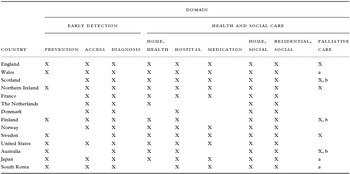
A separate section specifically on palliative care was present in the strategies of three countries (England, Northern Ireland, and Sweden). Three other countries also addressed palliative care, but not in a dedicated section: Scotland (second strategy; the newer one), Finland, and Australia (Table 1). A link to a national palliative care strategy was included in the dementia care strategies of four of these six countries: England (Department of Health, 2008), Scotland (The Scottish Government, 2008), Northern Ireland (Department of Health, Social Services and Public Safety, 2010), and Australia (Commonwealth of Australia, 2000). The national palliative care strategy in Finland was published before the establishment of the national dementia strategy (Sosiaali- ja terveysministeriö, 2010), but the palliative care strategy in Sweden was published afterwards (Socialstyrelsen, 2013). Among the remaining eight countries, three countries mentioned “end-of-life” care in dementia: end-of-life care for young-onset and specific, rare types of dementia in the Welsh strategy (an action plan); end-of-life care in group homes in the Japanese strategy; and guidance for dementia at the end-of-life in the South Korean strategy (Table 1).
Domain mapping of national dementia strategies in fourteen countries: “early detection”; “health and social care”

X, the domain was addressed.
a End-of-life care was mentioned, but not palliative care.
b Palliative care was mentioned in some sentences, but not in the specific section.
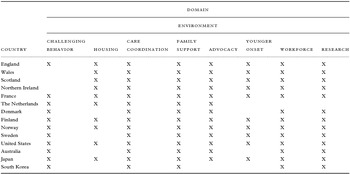
Whereas national dementia strategies shared several common domains, there were also a number of differences between the strategies of the 14 countries (Tables 1 and 2). Concerning early detection, the first of the three categories, all countries covered early diagnosis of dementia. More than two-thirds of the countries aimed to establish good access to information and support. Many strategies also included statements on promoting prevention and improved quality of health and social care services for people with dementia (2nd category; Table 1). In the environmental domains (3rd; Table 2), all countries included care coordination and family support. Other domains were addressed in two-thirds of the countries.
Domain mapping of national dementia strategies in fourteen countries: “environment”

X, the domain was addressed.
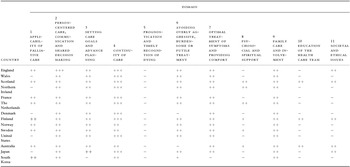
In spite of palliative care not being explicitly referred to in eight of the fourteen countries, a number of domains from the EAPC white paper were well represented, such as “person-centered care, communication, and shared decision making” (Domain 2), “continuity of care” (Domain 4; all national strategies), and “family care and involvement” (Domain 9) (Table 3). Although France, Japan, and South Korea included “family support,” they did not cover the recommendations of shared decision making (Recommendation 2.2) or family involvement (Recommendation 9.4) within this domain (see Appendix 2 published as supplementary material online attached to the electric version of this paper at http://journals.cambridge.org/ipg). All of the countries, with a few exceptions, covered the following domains: Domain 3, “setting care goals and advance planning” (except South Korea); Domain 6, “avoiding overly aggressive, burdensome, or futile treatment” (except Denmark and Australia); and Domain 7, “optimal treatment of symptoms and providing comfort” (except South Korea) were covered. Recommendation 6.1, “reducing avoidable hospitalizations,” was addressed by all countries except the Netherlands (2nd category; Table 1), as was the use of antipsychotic medication for challenging behaviors (Recommendation 7.4). Japan especially mentioned reducing psychiatric hospitalization rates of people with dementia (Appendix 2). Eight countries considered improving the quality of life as a goal of dementia care (Recommendation 1.2).
Domains and recommendations from the European Association for Palliative Care (EAPC) identified in sections of fourteen national dementia strategies that were not specific to palliative care

+++, all recommendations of the white paper were addressed.
++, some of the recommendations were addressed.
+, only the domain was mentioned (superficially, no recommendation).
−, not addressed at all.
Bold, the contents contradicted the recommendations.
In contrast to the domains above, several domains were not well represented, such as “education of the healthcare team” (Domain 10, addressed by Scotland, Finland, and Australia), and “societal and ethical issues” (Domain 11) (Table 3). In the domain of “psychosocial and spiritual support” (Domain 8), no countries addressed spiritual caregiving (Recommendation 8.2), religious activities (Recommendation 8.3), or a comfortable environment for dying people (Recommendation 8.4). Furthermore, none of the countries addressed “prognostication and timely recognition of dying” (Domain 5).
Almost all the recommendations in the national strategies were consistent with guidance provided by the EAPC white paper. However, Japan encouraged advance care planning for increasing impairments and interventions at crisis points by professional caregivers, instead of involving the patient and eliciting patient preferences, values, needs, and beliefs. This contradicted recommendations on advance care planning that actively involve the patient (Recommendation 3.2) and is reviewed with the patient and family when appropriate (3.6). Furthermore, South Korea stated, “In an early phase of the disease, dementia is curable and progression is preventable” in the Second Plan, which contradicts the definition of the EAPC white paper's first domain, “applicability of palliative care,” which refers to how dementia as a disease is unresponsive to curative treatment. Scotland's strategy declared palliative care as one component of “Right-based care,” which does not apply to the white paper. Finland's strategy illustrated a narrow view of palliative care in dementia: “Palliative care becomes relevant for people with dementia when prolonging life is no longer meaningful.” This statement contradicted some recommendations in Domain 1, “applicability of palliative care” (Appendix 2). Additionally, some minor differences in content were observed between some national dementia strategies and the EAPC white paper. For example, several national dementia strategies were aimed at cost reductions through avoiding admission to hospitals or long-term care facilities, while the EAPC recommendations for avoiding hospitalizations are aimed at improving or maintaining the quality of life.
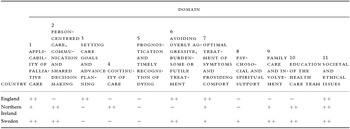
Within the independent sections of three national dementia strategies that explicitly referred to palliative care (Table 4), two domains were well represented: Domain 10, “education of the healthcare team” (except in England) and Domain 11, “societal and ethical issues.” Other domains were covered less well or only in general terms, including “optimal treatment of symptoms and providing comfort” (Domain 7), “psychosocial and spiritual support” (Domain 8), and “family care and involvement” (Domain 9). For example, Northern Ireland's strategy declared, “Services for patients with palliative and end of life care needs have developed considerably over the past decade. Management of pain and other physical symptoms and provision of psychological, social, and spiritual support for both the person and their family and carers are key elements of such care,” which represents the general content of Domain 7 (see Appendix 3 published as supplementary material online attached to the electric version of this paper at http://journals.cambridge.org/ipg). Although similar in general content (Table 3), the sections referring to palliative care (Table 4) lacked reference to “prognostication and timely recognition of approaching death” (Domain 5).
Domains and recommendations from the European Association for Palliative Care (EAPC) identified in sections of six national dementia strategies that explicitly refer to palliative care

+++, all recommendations of the white paper were addressed.
++, some of the recommendations were addressed.
+, only the domain was mentioned (superficially, no recommendation).
−, not addressed at all.
Discussion
Our qualitative content evaluation of national dementia strategies found several common domains, “early detection,” “health and social care,” and “environment,” across the 14 countries. However, there was significant variability with respect to the level of recommendations regarding palliative care in these the national dementia strategies. An independent section specifically on palliative care was available in only three countries (England, Northern Ireland, and Sweden). Comparison to the domains and recommendations of the EAPC white paper, used as a standard for palliative care in dementia, further identified differences in content between strategies and gaps in the addressing of palliative care.
The national dementia strategies across 14 countries cover most of the domains and a number of specific recommendations on palliative care in dementia. However, most frequently, there is either no or no explicit mention of this care being palliative care. More specifically, “person-centered care, communication, and shared decision making” (Domain 2), “continuity of care” (Domain 4), and “family care and involvement” (Domain 9) are well represented in sections that are not specific to palliative care. These domains are very important throughout the disease trajectory, and are consistent with recommendations for early application of palliative care in dementia. However, the national strategies covered medical issues in palliative care, such as “avoiding overly aggressive, burdensome, or futile treatment” (Domain 6), and “optimal treatment of symptoms and providing comfort” (Domain 7), to a lesser extent than the white paper did. The strategies all lacked reference to “prognostication and timely recognition of dying” (Domain 5) and spiritual caregiving. In the EAPC Delphi study, the experts found Domain 5, although important enough for inclusion, was the least important among the eleven domains. The lack of reference to prognostication in the strategies can also be attributed to differences in the targeted audience for the national dementia strategies and the EAPC recommendations. The EAPC white paper targeted a professional audience of doctors, nurses, and policymakers, whereas the dementia strategies are primarily for policymakers and the public. National dementia strategies in most countries have been issued by the health and social care departments of national governments in conjunction with advocacy groups (e.g. Alzheimer's associations). This might have led to focus on ensuring good access to the health and social care aspects of dementia care, rather than on the medical aspects. In addition, the development of national dementia strategies is often motivated by political aims, such as reducing social costs of dementia care and the development of drugs for dementia prevention and treatment. On the other hand, the EAPC white paper addresses optimal palliative care and, therefore, clarifies the principles of palliative care in dementia. The three countries that reported on palliative care explicitly referred to the end-of-life, but not to palliative care at the time of diagnosis. The national dementia strategies may reflect a narrower definition of palliative care in the dementia community than the EAPC domains.
The strategies in England, Scotland, Northern Ireland, and Australia addressed most of the domains of the EAPC white paper. The strategy of the US included less of the contents; this was a surprising finding given that the majority of research on palliative care in dementia originates in the US (van der Steen, Reference van der Steen2010). It has been suggested that a gap exists between policies and research about the end-of-life care for dementia in the US (Gusmano, Reference Gusmano2012). Further, some contradictory recommendations were observed in the national dementia strategies of Finland, Japan, and South Korea. A narrow view of palliative care in the Finnish strategy is in line with its focus on prevention and rehabilitation. The Japanese strategy may reflect the paternalism in clinical practice in Japan, where there is no legislation on advanced directives or care planning (Nakanishi and Nakashima, Reference Nakanishi and Nakashima2014). South Korea's strategy is also focused on prevention and treatment of dementia, and regarded dementia in its early stage as a curable disease and its progression as preventable. The contradictions in the Asian strategies (Japan and South Korea) may reflect differences in culture; in Japan, patient autonomy is not firmly established and there is controversy about withdrawing or withholding aggressive treatment (Yaguchi et al., Reference Yaguchi2005; Arcand et al., Reference Arcand2013; van der Steen et al., Reference van der Steen, Hertogh, de Graas, Nakanishi, Toscani and Arcand2013).
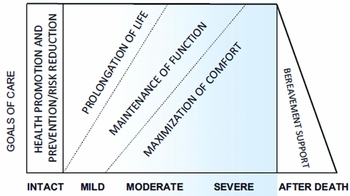
As dementia progresses to more severe stages, it becomes reasonable to consider quality of life specifically as maintenance of function and maximization of comfort. These are potential goals of care even with mild dementia, and may become the main goals of care with progressive dementia (Figure 1) (van der Steen et al., Reference van der Steen2014). Meanwhile, there is no consensus about the applicability of palliative care through dementia stages (van der Steen et al., Reference van der Steen2014). Dementia care specialists might be somewhat more critical of palliative care in dementia than palliative care specialists might (paper in progress).
The figure represents a model of changing care goals and priorities throughout the course of the dementia. It suggests prioritizing of care goals that may apply at the same time but have variable relevance to different stages of dementia. More than one care goal may apply at the same time. For example, for a patient with moderate dementia, the three goals may apply simultaneously but maximization of comfort and maintenance of function may be prioritized over prolongation of life. The figure was reproduced by permission of SAGE Publications Ltd., London, Los Angeles, New Delhi, Singapore and Washington DC, from van der Steen JT, Radbruch L, Hertogh CM, de Boer ME, Hughes JC, Larkin P, Francke AL, Jünger S, Gove D, Firth P, Koopmans RT, Volicer L; European Association for Palliative Care (EAPC), White paper defining optimal palliative care in older people with dementia: a Delphi study and recommendations from the European Association for Palliative Care, Palliative Medicine, Copyright (© The Authors, 2013).

The inclusion of content, without explicitly designating this content as relating to palliative care, might indicate a large overlap between the fields of palliative care and dementia care. Person-centered care, communication, and shared decision making, as well as family care and involvement may be core topics not only in palliative care, but also in other fields of medicine, such as dementia care. Thus, close collaboration between dementia and palliative care researchers and caregivers would have major benefits for both fields.
Collaboration certainly should not mean that palliative care services take over dementia care or that special palliative care services for patients with dementia are needed. Collaboration could be established with the participation of palliative care experts in the regular team services in dementia care. The role of palliative care experts could be identifying patients with palliative care needs, supporting the formulation or revision of treatment goals, and participating in decisions on withholding or withdrawing aggressive treatment. However, timely recognition of dying is crucial in order to make revisions to the goal of care, moving away from the focus on life prolongation and maintenance of function to providing comfort, and for withholding or withdrawing aggressive treatment interventions, such as feeding tubes or hospital admissions. Using all available expertise for prognostication is paramount for good care until the very end-of-life.
Collaboration between palliative care and dementia care experts allows for patients with dementia to benefit from recent palliative care developments, such as national palliative care strategies that have been developed in some countries or political initiatives such as the recent declaration on palliative care by the World Health Assembly in May 2014 (World Health Assembly, 2014). Much of this advantage might be lost if the term “palliative care” is replaced by other terms, such as “end-of-life care,” as is happening in some national strategies. A broad consensus has been reached that the term “palliative care” should also be used for other patient groups (Pastrana et al., Reference Pastrana, Junger, Ostgathe, Elsner and Radbruch2008).
These findings should be interpreted in light of the study limitations. We did not systematically examine the countries’ cultural influences if they had not been described in the national dementia strategies. Thus, some overlap between contents of national dementia strategies and recommendations from the EAPC white paper might have been missed. Furthermore, some of the countries’ national dementia strategies could have influenced the other countries’ strategies, thereby affecting the overlap in strategy content. For example, the strategy in Northern Ireland cited the strategies in England, Scotland, and Australia. While the development of the EAPC white paper included healthcare professionals from countries other than Europe, it generally stands on the views of professionals from two European countries out of the 14 countries with dementia care strategies described herein.
Despite these limitations, the present study provides a comprehensive examination of national dementia strategies and the extent that palliative care in dementia is included. National dementia strategies are partly covered by a recent definition of palliative care in dementia, although references to palliative care in these strategies are infrequently labeled as “palliative care.” Our results call for political efforts to add preparation for the last phase of life to national dementia strategies for promotion of palliative care in dementia patients across the world.
Conclusions
The present study explored a qualitative review of the contents of the available national dementia strategies and a comparison of these contents to the domains and recommendations of the EAPC white paper. National dementia strategies cover part of the recent definition of palliative care in dementia, although they do not frequently label these references as “palliative care.” In view of the growing numbers of people dying with dementia, preparation for the last phase of life should be added to national strategies.
Conflict of interest
None.
Description of authors’ roles
M. Nakanishi contributed to the study design, collecting data, analysis and interpretation of data, and writing the paper. T. Nakashima was involved in carrying out the data collection and analysis of data, and writing the paper. Y. Shindo was involved in carrying out the data collection, analysis and interpretation of data, and writing the paper. Y. Miyamoto was involved in carrying out the data collection and analysis of data, and writing the paper. D. Gove supervised the data collection, analysis, and interpretation of data. L. Radbruch contributed to designing the study, supervised analysis and interpretation of data, and assisted with writing the paper. J. van der Steen contributed to designing the study, and analysis and interpretation of data, supervised all aspects, and assisted with writing the paper.
Acknowledgments
This research received no specific grant from any funding agency in the public, commercial, or not-for-profit sectors. We thank following individuals for their valuable input: Jed A. Levine, M.A., Executive Vice President, Director, Programs and Services of the Alzheimer's Association, New York City Chapter; and Anne Arndal, M.D., former general practitioner, former chair of the Danish Alzheimer Association (Alzheimerforeningen).
Supplementary Material
To view supplementary material for this article, please visit http://dx.doi.org/10.1017/S1041610215000150.