Introduction
Stray cats are widespread in the urban area of Lisbon, where they survive by scavenging on garbage, human handouts and predation of reptiles, rodents and birds. These animals are not subjected to a regular anti-parasitic treatment and therefore contribute to the maintenance of parasite cycles in urban areas. Parasites are transmitted to humans either through direct contact with parasitized animals or through exposure to contaminated soil and water. Children, amongst the general population, are at greater risk of acquiring parasitic infections through contaminated soil in parks, schoolyards and playgrounds (Blaszkowska et al., Reference Blaszkowska, Wojcik, Kurnatowski and Szwabe2013). Household cats that have access to the outdoors become infected through parasitic stages in the environment or by ingestion of intermediate and paratenic hosts and may transmit parasites to their owners. In humans, Toxocara cati infection may cause visceral and ocular larva migrans. Toxocariasis was considered the most frequent and pathogenic helminthic zoonosis in the USA (Hotez, Reference Hotez2008). Mizgajska (Reference Mizgajska2001) recorded 38–53% infected soil samples in city backyards in Poland and found that human exposure to Toxocara spp. was proportional to the prevalence of eggs in soil samples. Other cat parasites that can infect humans but are believed to have a lower zoonotic and pathogenic potential include the hookworm Ancylostoma tubaeforme, which causes cutaneous larva migrans (Robertson & Thompson, Reference Robertson and Thompson2002) and the tapeworm Dipylidium caninum, which most often affects children, causing abdominal discomfort, diarrhoea and pruritus (Szwaja et al., Reference Szwaja, Romański and Zabczyk2011; Taylor & Zitzmann, Reference Taylor and Zitzmann2011). In cats, clinical manifestations associated with enteric and pulmonary parasites vary from asymptomatic to severe disease and even death, depending on the age of the animal, its immune status and parasite burden.
Current prevalence data on cat parasites in Portugal are based on results from surveys performed by means of coproscopy (Duarte et al., Reference Duarte, Castro, Pereira da Fonseca, lmeida, Madeira de Carvalho, Meireles, Fazendeiro, Tavares and Vaz2010; Ferreira et al., Reference Ferreira, Pereira-Baltasar, Parreira, Padre, Vilhena, Távora Tavira, Atouguia and Centeno-Lima2011). Although stool examination provides a general evaluation of parasites' prevalence, results may not accurately reflect their true prevalence and heterogeneity, due to the limitations inherent to coprology, i.e. absence of parasite shedding during the pre-patent period and in the case of immature or single-sex infections, intermittent shedding of parasitic stages, lack of sensitivity with low parasite burdens and choice of the best coprological method. Considering the role of stray cats as a reservoir of parasites, particularly those transmittable to humans, the aim of the present study was to assess parasite prevalence, diversity and intensity in stray cats from the urban area of Lisbon by post-mortem parasitological examination, contributing to a more accurate evaluation of the prevalence of several parasites in Portugal.
Materials and methods
Collection and examination of cats
The present work refers to a parasitological survey performed between June 2009 and June 2011 on 162 stray cats from Lisbon. Animals were captured and euthanized under animal control programmes by the city municipal services. Captures were performed in backyards from different residential areas, using baited cages. Season, approximate age and gender of animals were recorded prior to euthanasia. The age of the animals was estimated based on teeth and lens characteristics and general appearance. Cats with deciduous teeth were considered to be < 1 year old (Getty, Reference Getty1975; d'Autheville & Barrairon, Reference d'Autheville and Barrairon1985); cats with permanent teeth, showing absent to moderate dental calculus and dental wear, good physical condition and absence of lens opacification were considered to be aged 1–5 years; cats showing, heavy tartar build-up, increased dental wear, missing teeth, loss of muscle mass, thinning of skin and fur and lens opacification were considered to be >5 years old (d'Autheville & Barrairon, Reference d'Autheville and Barrairon1985; Verhaert & Van Wetter, Reference Verhaert and Van Wetter2004; Williams & Heath, Reference Williams and Heath2006). Internal organs (lungs, heart, liver, kidneys, bladder, stomach and intestines) from all animals and muscle tissue from 128 cats were collected and inspected for parasites as follows. Trachea and bronchi were cut longitudinally and examined macroscopically for parasites. Three wet-mount slides were prepared for each cat for microscopical observation of bronchial exudate and parenchyma samples. The stomach was cut along the major curvature. Gross undigested material was discarded and the entire gastric surface was scraped into 50 ml falcon tubes containing 30 ml alcohol 70% and vigorously shaken to dissolve gastric mucus and release parasites. The suspension was passed through a first sieve (aperture 1 mm) to separate larger debris and then passed through a second sieve (aperture 0.15 mm) to capture parasites. The retained material was transferred to Petri dishes for microscopic examination and parasite counting. The heart, kidneys, bladder and small and large intestines were analysed by standard parasitological techniques (Euzéby, Reference Euzéby1958).
Faecal samples were collected at necropsy for coproparasitological diagnosis of protozoa. All faecal samples were analysed by faecal floatation using a saturated sodium chloride solution (Willis, Reference Willis1921) and a subset of 120 samples was analysed by sedimentation (Bowman, Reference Bowman1999). Observation of helminth eggs and larvae was recorded for samples analysed by both techniques (n= 120). Diaphragms of 128 cats were collected for detection of Trichinella larvae. Diaphragms were pooled in samples of 100 g and submitted to artificial digestion in acid–pepsin solution using a magnetic stirrer (Gamble et al., Reference Gamble, Bessonov, Cuperlovic, Gajadhar, van Knapen, Nöckler, Schenone and Zhu2000). Helminths were cleared with lactophenol and identified under a light microscope using morphological descriptions provided by Soulsby (1982) and Bowman et al. (Reference Bowman, Hendrix, Lindsay and Barr2002). The species Joyeuxiella pasqualei and Diplopylidium nölleri were identified by means of the identification keys provided by Jones (Reference Jones1983) and Witenberg (Reference Witenberg1932).
Data analysis
Frequency distributions and statistical relationships were analysed using the statistical software package R 2.15.0 (R Development Core Team, 2008) and the epiR library. Prevalence and 95% confidence intervals (CI) were calculated for each parasite by Sterne's method (Reiczigel et al., Reference Reiczigel, Földi and Ozsvári2010). Fisher's exact test was used to compare prevalence values in cats according to sex, age and season categories, and to analyse prevalence relationships between pairs of parasites. Parasite diversity relative to host age, gender and season was measured by the mean species richness and the Shannon–Wiener index, H′. Differences in mean parasite richness were compared by one-way analysis of variance (ANOVA). Differences between Shannon–Wiener index values were compared using the Hutcheson's t-test (Hutcheson, Reference Hutcheson1970). Parasite mean intensity, mean abundance, confidence limits and the aggregation index variance/mean ratio were generated with the software package Quantitative Parasitology 3.0 (QP 3.0) (Rózsa et al., Reference Rózsa, Reiczigel and Majoros2000). Parasite mean intensity values were compared using a Bootstrap 2-sample t-test provided in QP 3.0.
Results
Parasite species richness and diversity
Of the 162 stray cats examined, 147 (90.7%; 95% CI: 85.3–94.6%) were found to be infected by one or more species of parasites. A total of 12 parasite species was recorded: three species of coccidia (Cystoisospora felis, Cystoisospora rivolta and Sarcocystis sp.), five species of nematodes (Ancylostoma tubaeforme, Toxocara cati, Ollulanus tricuspis, Aelurostrongylus abstrusus, Eucoleus aerophilus) and four species of cestodes (Taenia taeniaeformis, Dipylidium caninum, Joyeuxiella pasqualei, Diplopylidium nölleri). No Trichinella larvae were detected by artificial digestion of muscle tissue. Thirty-six cats (22.2%) were infected with 1 parasite species, 45 cats (27.8%) with 2 species, 30 cats (18.5%) with 3 species, 19 cats (11.7%) with 4 species, 13 cats (8.0%) with 5 species, 3 cats (1.9%) with 6 species and 1 cat (0.6%) with 7 species. The overall mean species richness was 2.36 ± 1.52 parasite species per animal. Mean species richness varied significantly with gender, being lower in females (2.1 ± 1.4) than in males (2.6 ± 1.6) (P < 0.05). The number of species per animal increased with host age (age group < 1 = 2.1 ± 1.6; age group 1–5 = 2.2 ± 1.6; age group >5 = 2.7 ± 1.4) and was highest in the trimester July–September (2.6 ± 1.6), compared to January–March (2.0 ± 1.6), April–June (2.1 ± 1.2) and October–December (2.3 ± 1.4), but the differences observed were not statistically significant. Parasite diversity measured by the Shannon–Wiener index was highest in the age group 1–5 (H′ = 0.850) and differed statistically from the age groups < 1 (H′ = 0.589) and >5 (H′ = 0.608) (P < 0.001). As for seasons, the Shannon–Wiener indices peaked in the trimesters January–March (H′ = 0.924) and July–September (H′ = 0.878). Differences between these two trimesters were not significant, but differed from the lower indices found in the trimesters April–June (H′ = 0.688) and October–December (H′ = 0.559) (P < 0.001). Parasite diversity was not influenced by gender (H′ males = 0.731 and H′ females = 0.755).
Levels of infection
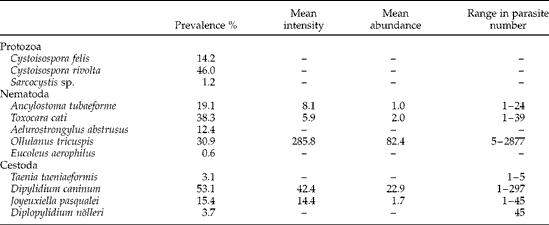
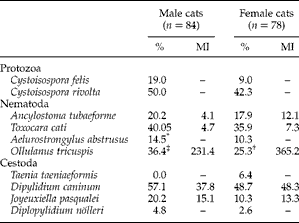
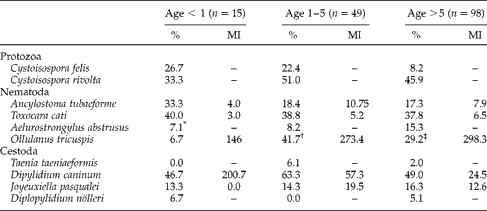
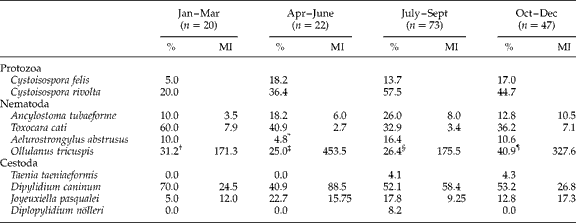
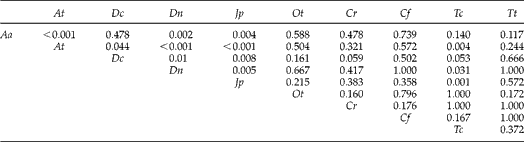
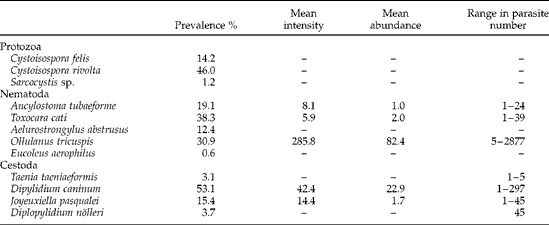
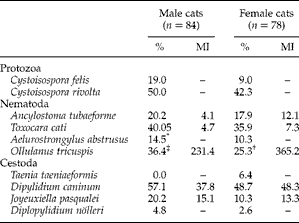
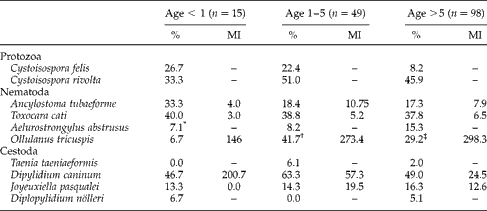
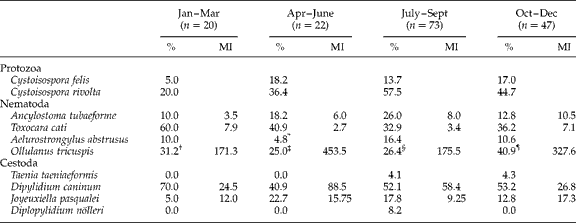
Toxocara cati and D. caninum were the most prevalent among nematodes and cestodes, respectively, and C. rivolta was the most prevalent of the coccidia (table 1). Statistically significant differences in prevalence between male and female cats were found only for T. taeniaeformis (6.4% in females vs. 0.0% in males; P < 0.05) (table 2). Age-related differences were detected for C. felis and O. tricuspis: the prevalence of C. felis was highest in the age groups < 1 and 1–5 years compared to animals >5 years, while O. tricuspis was more frequent in animals aged 1–5 years (P < 0.05) (table 3). Seasonal differences were found only for C. rivolta, which was more prevalent in the third and fourth quarters of the year, compared to the first and second quarters (P < 0.05) (table 4). Parasite counts were performed for 126 cats. Mean intensity, mean abundance, intensity range and variance/mean ratio were determined for A. tubaeforme, D. caninum, T. cati, O. tricuspis and J. pasqualei (tables 1–4). The intensity of infection ranged between 1–5 worms of T. taeniaeformis in 4 cats sampled, and 45 worms of D. nölleri in a single cat, although the number of cats examined was too low to allow statistical analysis. Female cats were more heavily infected with A. tubaeforme, D. caninum, T. cati and O. tricuspis than male cats, but differences were only significant for A. tubaeforme (mean intensity = 12.1 vs. 4.1; P < 0.05). With the exception of D. caninum, cats in the age groups 1–5 and >5 showed overall higher parasite burdens than animals < 1 years, although the differences were not statistically relevant (P > 0.05). Mean intensity of parasites was not influenced by season (P > 0.05). All helminths analysed presented an aggregated distribution across the host population, as demonstrated by the variance/mean ratio greater than unity. Prevalence relationships were determined for all pairs of parasites (table 5).
The prevalence (%), mean intensity and mean abundance of protozoan and helminth parasites in 162 stray cats from Lisbon.
The prevalence (%) and mean intensity (MI) of infection of parasites in male and female cats from Lisbon; n=number of cats examined; *n=83; †n=75; ‡n=77.
The prevalence (%) and mean intensity (MI) of infection of parasites relative to host age (years) in 162 stray cats from Lisbon; n= number of cats examined; *n=14; †n=48; ‡n=89.
The prevalence (%) and mean intensity (MI) of infection of parasites relative to season in 162 stray cats from Lisbon; n=number of cats examined; *n=21; †n=16; ‡n=20; §n=72; ¶n=44.
The relationship between prevalence of infection and parasite pairs using P values calculated from the Fischer's exact test.
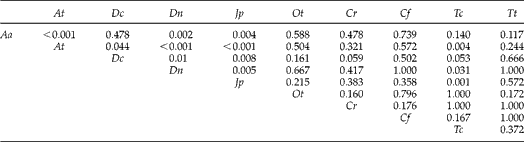
Aa, Aelurostrongylus abstrusus; At, Ancylostoma tubaeforme; Dc, Dipylidium caninum; Dn, Diplopylidium nölleri; Jp, Joyeuxiella pasqualei; Ot, Ollulanus tricuspis; Cr, Cystoisospora rivolta; Cf, Cystoisospora felis, Tc, Toxocara cati; Tt, Taenia taeniaeformis.
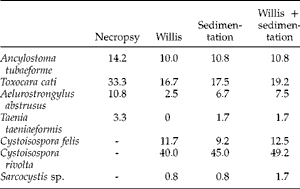
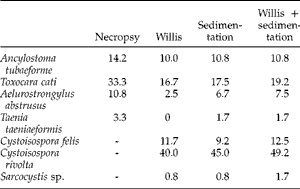
Faecal floatation and sedimentation methods allowed the identification of C. felis, C. rivolta, Sarcocystis sp., A. abstrusus, A. tubaeforme and T. cati, while T. taeniaeformis was detected by sedimentation only. Neither technique succeeded in diagnosing O. tricuspis, E. aerophilus, D. caninum, D. nölleri and J. pasqualei. Detection rates by the Willis method and sedimentation are shown in Table 6 for comparison with post-mortem parasitological examinations. Compared with necropsy, faecal analysis showed prevalence values of 19.2% for T. cati, 7.5% for A. abstrusus and 10.8% for A. tubaeforme.
The proportion (%) of parasite species recovered from 120 cats using necropsy, the Willis method and sedimentation.
Discussion
The overall prevalence of feline parasites (90.7%) found in the present study reflects a high level of parasitism in stray cats from the urban area of Lisbon. Our results are in agreement with the findings in other parasitological surveys worldwide, as shown by the prevalence of 85.0% in Germany (Schuster et al., Reference Schuster, Kaufmann and Hering1997), 89.7–100% in Spain (Calvete et al., Reference Calvete, Lucientes, Castillo, Estrada, Gracia, Peribáñez and Ferrer1998; Millán & Casanova, Reference Millán and Casanova2009), 91.0% in Egypt (Khalafalla, Reference Khalafalla2011), 92.9–95.6% in Iran (Zibaei et al., Reference Zibaei, Sadjjadi and Sarkari2007; Mohsen & Hossein, Reference Mohsen and Hossein2009), 83.0% in Qatar (Abu-Madi et al., Reference Abu-Madi, Behnke, Prabhaker, Al-Ibrahim and Lewis2010), 87.0% in the Arab Emirates (Schuster et al., Reference Schuster, Thomas, Sivakumar and O'Donovan2009), 82.5% in India (Borthakur & Mukharjee, Reference Borthakur and Mukharjee2011) and 89.6% in Brazil (Labarthe et al., Reference Labarthe, Serrão, Ferreira, Almeida and Guerrero2004).
Regarding the prevalence of 38.3% found for T. cati, studies carried out in other countries in Europe indicate generally higher infection rates. In the Mediterranean basin, the prevalence described for T. cati was 49.1% in Italy (Poglayen et al., Reference Poglayen, Traldi, Capelli and Genchi1985), 55.2% in Spain (Calvete et al., Reference Calvete, Lucientes, Castillo, Estrada, Gracia, Peribáñez and Ferrer1998) and 83.3% in Albania (Knaus et al., Reference Knaus, Kusi, Rapti, Xhaxhiu, Winter, Visser and Rehbein2011), while rates between 42 and 79% were reported from North and Central Europe (Nichol et al., Reference Nichol, Ball and Snow1981; Engbaek et al., Reference Engbaek, Madsen and Larsen1984; Vanparijs et al., Reference Vanparijs, Hermans and van der Flaes1991, O'Lorcain, Reference O'Lorcain1994; Schuster et al., Reference Schuster, Kaufmann and Hering1997). In this study, a prevalence of 19.1% was recorded for A. tubaeforme. Other authors showed prevalence values of 9.5% in Italy (Poglayen et al., Reference Poglayen, Traldi, Capelli and Genchi1985), 17% in Germany (Schuster et al., Reference Schuster, Kaufmann and Hering1997), 29.3% in continental Spain (Calvete et al., Reference Calvete, Lucientes, Castillo, Estrada, Gracia, Peribáñez and Ferrer1998), 44.4% in Albania (Knaus et al., Reference Knaus, Kusi, Rapti, Xhaxhiu, Winter, Visser and Rehbein2011) and 91.4% in Mallorca (Millán & Casanova, Reference Millán and Casanova2009). Concerning prevalence relationships, A. tubaeforme and T. cati were associated with each other (P < 0.01) but neither was associated with C. rivolta, nor with C. felis or T. taeniaeformis (P > 0.05) (table 5), suggesting that mice play a minor role as paratenic hosts.
Aelurostrongylus abstrusus is presently considered an emergent pathogen in Europe (Traversa & Guglielmini, Reference Traversa and Guglielmini2008; Traversa et al., Reference Traversa, Di Cesare and Conboy2010). Despite the paucity of case reports (Ferreira da Silva et al., Reference Ferreira da Silva, Pereira da Fonseca, Madeira de Carvalho, Meireles and Fazendeiro2005), the prevalence of 12.4% determined in the urban area of Lisbon along with results from an earlier survey showing a prevalence of 17.4% in the north-west region of the country (Payo-Puente et al., Reference Payo-Puente, Botelho-Dinis, Carvaja Urueña, Payo-Puente, Gonzalo-Orden and Rojo-Vazquez2008), indicate that A. abstrusus is prevalent in the cat population in Portugal and that aelurostrongylosis may be an underdiagnosed disease in clinical practice. The prevalence of A. abstrusus was positively associated with J. pasqualei (P < 0.01) and D. nölleri (P < 0.01), which also showed a close relationship (P < 0.01) with each other (table 5). Lizards are involved as paratenic hosts in the transmission of A. abstrusus (reviewed by Traversa & Guglielmini, Reference Traversa and Guglielmini2008) and were shown to harbour infective cysticercoid larvae of J. pasqualei and D. nölleri (Witenberg, Reference Witenberg1932). Tarentola mauritanica, the common wall gecko, and Podarcis hispanica, the Iberian wall lizard, are widespread in the Lisbon urban area, especially in backyards where most captures were performed. While no reports on parasitism by either of the two cestodes are available for P. hispanica, cysticercoid stages of J. pasqualei and D. nölleri have been found in T. mauritanica in Spain (Witenberg, Reference Witenberg1932, Roca & Lluch, Reference Roca and Lluch1986). Millán & Casanova (Reference Millán and Casanova2009) also reported a close relationship between J. pasqualei and the genus Diplopylidium in the island of Mallorca, and suggested T. mauritanica as a probable intermediate host for both cestodes. Although O. tricuspis is known to have a worldwide distribution, records on this parasite are scarce and point to markedly lower infection rates than those disclosed in the present work. The prevalence values reported for O. tricuspis were 0.8% in the United Arab Emirates (Schuster et al., Reference Schuster, Thomas, Sivakumar and O'Donovan2009), 3.4% in Italy (Poglayen et al., Reference Poglayen, Traldi, Capelli and Genchi1985), 11.4% and 4.8% in Tasmanian Midlands and King Islands (Gregory & Munday, Reference Gregory and Munday1976) and 13% in New Zealand (Guy, Reference Guy1984). Ollulanus tricuspis is considered to have a low pathogenicity; however, there is some evidence of severe chronic gastritis with fatal outcome (Bowman, Reference Bowman1999). Since clinical signs associated with O. tricuspis lack specificity and the parasite is rarely detected in faeces, the burden of infection with O. tricuspis is probably underestimated. In relation to frequency distributions of cestodes, D. caninum was the most prevalent (53.1%), followed by J. pasqualei (15.4%), D. nölleri (3.7%) and T. taeniaeformis (3.1%). While D. caninum has a worldwide distribution, J. pasqualei and D. nölleri are generally linked to the Middle East and southern Europe. The prevalence recorded for D. caninum in Europe ranges from 14 to 83.3% (Nichol et al., Reference Nichol, Ball and Snow1981; Engbaek et al., Reference Engbaek, Madsen and Larsen1984; Poglayen et al., Reference Poglayen, Traldi, Capelli and Genchi1985; Calvete et al., Reference Calvete, Lucientes, Castillo, Estrada, Gracia, Peribáñez and Ferrer1998; Knaus et al., Reference Knaus, Kusi, Rapti, Xhaxhiu, Winter, Visser and Rehbein2011). Joyeuxiella pasqualei was reported in 55.2% of cats surveyed in continental Spain (Calvete et al., Reference Calvete, Lucientes, Castillo, Estrada, Gracia, Peribáñez and Ferrer1998), 75.9% in Mallorca (Millán & Casanova, Reference Millán and Casanova2009), 11.1% in Albania (Knaus et al., Reference Knaus, Kusi, Rapti, Xhaxhiu, Winter, Visser and Rehbein2011) and 34.3% in Iran (Zibaei et al., Reference Zibaei, Sadjjadi and Sarkari2007). Available data on D. nölleri show prevalence values of 8.6% in Spain (Calvete et al., Reference Calvete, Lucientes, Castillo, Estrada, Gracia, Peribáñez and Ferrer1998), 37.1% in the United Arab Emirates (Schuster et al., Reference Schuster, Thomas, Sivakumar and O'Donovan2009) and 64.6% in Iran (Mohsen & Hossein, Reference Mohsen and Hossein2009). Infection with T. taeniaeformis is less common among stray cats from Lisbon (3.1%) when compared to other studies, as shown by the prevalence of 8.6–22.4% recorded in several countries in Europe (Nichol et al., Reference Nichol, Ball and Snow1981; Engbaek et al., Reference Engbaek, Madsen and Larsen1984; Poglayen et al., Reference Poglayen, Traldi, Capelli and Genchi1985; Vanparijs et al., Reference Vanparijs, Hermans and van der Flaes1991; Schuster et al., Reference Schuster, Kaufmann and Hering1997; Calvete et al., Reference Calvete, Lucientes, Castillo, Estrada, Gracia, Peribáñez and Ferrer1998; Millán & Casanova, Reference Millán and Casanova2009) and values up to 70.4% in India (Borthakur & Mukharjee, Reference Borthakur and Mukharjee2011) and 75.8% in the Middle East (Zibaei et al., Reference Zibaei, Sadjjadi and Sarkari2007; Abu-Madi et al., 2008, 2010; Mohsen & Hossein, Reference Mohsen and Hossein2009; Schuster et al., Reference Schuster, Thomas, Sivakumar and O'Donovan2009). Cats become infected with T. taeniaeformis through the ingestion of strobilocerci in the intermediate host, commonly small Muroidea rodents. Though rodents are known to serve as paratenic hosts for C. felis and C. rivolta, no prevalence relationships were found regarding T. taeniaeformis. In this study, 46.3% of cats were infected with C. rivolta and 14.2% with C. felis. The high prevalence of C. rivolta in stray cats from Lisbon contrasts with the prevalence values of 1.3–14.1% recorded in other countries in Europe, while infection rates up to 19.3% were reported for C. felis (Nichol et al., Reference Nichol, Ball and Snow1981; Robben et al., Reference Robben, le Nobel, Döpfer, Hendrikx, Boersema, Fransen and Eysker2004; Knaus et al., Reference Knaus, Kusi, Rapti, Xhaxhiu, Winter, Visser and Rehbein2011; Capári et al., Reference Capári, Hamel, Visser, Winter, Pfister and Rehbein2013).
In conclusion, the present research showed a high prevalence and diversity of parasites in the population of stray cats from the urban area of Lisbon, two of which, T. cati and A. tubaeforme, are zoonotic pathogens. High-level soil contamination with parasite eggs and cysts and predation of reptile intermediate/paratenic hosts seems to be the main method of parasite transmission in cat colonies living in semi-confined habitats in the city.
Willis' method and sedimentation were less sensitive in the diagnosis of T. cati, A. tubaeforme, T. taeniaeformis and A. abstrusus when compared to post-mortem parasitological examination, and missed diagnosis of Dilepididae cestodes, as well as O. tricuspis. The infection with A. abstrusus and O. tricuspis is probably largely underestimated. These parasites should therefore be specifically addressed by means of adequate diagnostic techniques in parasitological surveys and also be considered in the differential diagnosis of respiratory and gastric conditions. Considering the role of stray cats as reservoirs, parasite control strategies based on the demographic control of stray cat populations in urban areas are essential for animal and public health protection.
Acknowledgements
The authors are grateful to the head of the Division of Sanitary Control of the Municipality of Lisbon, Dr Luisa Costa Gomes, as well as Dr Filomena Oliveira, Dr Ana Machado, Dr Leonel Fernandes, Dr Augusto Batista and Dr Vasco Ribeiro for their precious collaboration in this study, and Lucinda Marques and Maria do Carmo Ramos (INIAV/Parasitology Laboratory) for invaluable technical assistance. We also thank Professor George Stilwell for help in language editing. This research received no specific grant from any funding agency, commercial or not-for-profit sectors.