Introduction
The Asian corn borer (ACB), Ostrinia furnacalis (Guenée, 1854) (Lepidoptera: Crambidea) is a polyphagous lepidopteran pest and is the most destructive pest of maize crop throughout Asia, including China (Chen et al., Reference Chen, Klein, Sheng, Li, Shao and Li2013, Reference Chen, Klein, Li, Li, Li and Sheng2015; Li et al., Reference Li, Dopman, Dong and Yang2024a). The incidence of maize borer infestation has increased in China due to the substantial growth of crop planting (covering over 20 million hectares of agricultural land), especially maize (Wang and Wang, Reference Wang and Wang2019; Liu et al., Reference Liu, Feng, Abbas, Abbas, Hafeez, Han, Romano and Chen2023a). In China, pests affect maize production by 10–30% annually (Myint et al., Reference Myint, Huang, Bai, Zhang, Babendreier, He and Wang2023). The larvae of O. furnacalis feed on all parts of the corn plant at all stages of its growth (Nafus and Schreiner, Reference Nafus and Schreiner1987, Reference Nafus and Schreiner1991), causing serious economic damage to other key food and fibre crops such as sorghum, millet and cotton (Chen et al., Reference Chen, Wang, Wu, Chang, Xie and Hung2016).
ACB is distributed throughout Asia and has also invaded the Solomon Islands, parts of Africa and certain regions of Australia (Mutuura and Munroe, Reference Mutuura and Munroe1970; Nafus and Schreiner, Reference Nafus and Schreiner1991; Boo and Park, Reference Boo and Park1998; Grahame, Reference Grahame2022). ACB overwinters as diapausing larvae and exhibits freeze tolerance, particularly in cold areas (Xie et al., Reference Xie, Li, Zhang, Mason, Wang, Lu, Cai and He2015). In China, ACB shows variable generational patterns depending on geographical latitude and altitude, ranging from one to seven generations each year, with higher latitudes having fewer generations (Shen et al., Reference Shen, Fu, Huang, Guo, Wu, He, Yang and Wu2020). With the widespread cultivation of maize in Asia, especially in the Northeastern part, the ACB has become highly adapted to this host plant (Kojima et al., Reference Kojima, Fujii, Suwa, Miyazawa and Ishikawa2010; Shen et al., Reference Shen, Fu, Huang, Guo, Wu, He, Yang and Wu2020). It has the ability for long-distance migration and poses a significant threat to new habitats and crop plant economic viability (Shen et al., Reference Shen, Fu, Huang, Guo, Wu, He, Yang and Wu2020). Hence, the present article provides an updated review on ACB to compile the global sustainable management alternatives for ACB control, including its (i) distribution (geographic range and seasonal variations), (ii) morphology and ecology (taxonomy, life cycle, host plant range and economic importance) and (iii) management techniques. The management section covers sustainable agricultural practices, mating disruption (MD), resistant cultivars, biological control, biopesticides and chemical control. Finally, we concluded this review with recommendations aimed at improving the sustainable management of ACB in newly infested areas, which may also be valuable for managing other serious crop pests.
Distribution of ACB
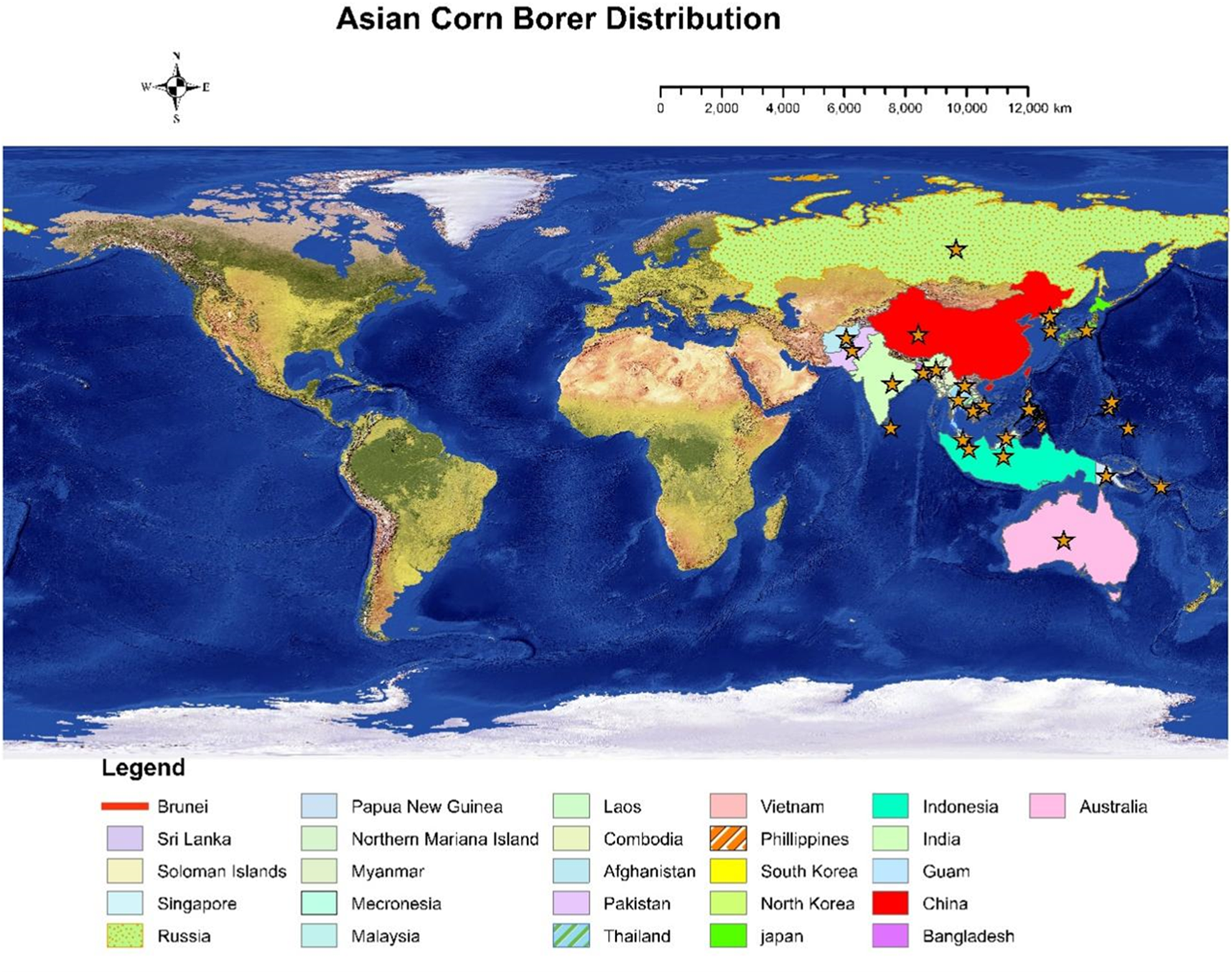
ACB is mainly distributed in Asia, which includes China, the Philippines, Thailand, Sri Lanka, India, Korea, Guam, Papua New Guinea, Vietnam, Brunei, Singapore, Laos, Bangladesh, Pakistan, Afghanistan, Cambodia, Indonesia, Myanmar, Malaysia and Japan as illustrated in fig. 1, based on the data collected from CABI and GBIF (GBIF, 2022; Grahame, Reference Grahame2022). Additionally, the Solomon Islands, Northern Mariana Island, parts of Africa and certain regions of Australia and Russia also host a limited population of ACB (Grahame, Reference Grahame2022; Li et al., Reference Li, Dopman, Dong and Yang2024a). ACB thrives in tropical regions due to sustained agricultural practices focused on its preferred host crop year-round. Globally, it is currently reported from 26 countries (Grahame, Reference Grahame2022).
Map showing the global distribution of ACB. The potential distribution herein based on available information from CABI website and GBIF (Global Biodiversity Information Facility). Occurrence points were obtained through the compilation of data from secondary literature sources and the GBIF website, which serves as a comprehensive repository of biodiversity records. The map was prepared by using ArcGIS 10.8.2 software. The occurrence points were geographically mapped onto the Natural Earth Layer, and subsequently (Figure Map), the coloration of the countries where the ACB was observed underwent corresponding alterations.

According to a study by Wu et al. (Reference Wu, Hill, Thomson and Hoffmann2018), the native range of ACB overlaps with major corn production areas in North-eastern, Eastern and South-eastern parts of China, Japan and South-western coastal regions, as presented in fig. 1. The predicted range of maize closely matches that of its herbivore, O. furnacalis, with some variations in Northern China and Japan. Li et al. (Reference Li, Dopman, Dong and Yang2024a) and Wu et al. (Reference Wu, Hill, Thomson and Hoffmann2018) also found that MaxEnt performed well in predicting the species distribution, with temperature during the Wettest quarter being the most influential variable. The CLIMEX model predicted suitable areas for O. furnacalis in Jiangsu and Yunnan, though it tended to be over-conservative in Yunnan Province. MaxEnt results indicated a correlation between species distribution and temperature, with preferences for areas with high summer precipitation and precipitation seasonality within moderate isothermal regions.
Insects, as essential arthropods, greatly influence an ecosystem (Ullah et al., Reference Ullah, Abbas, Gul, Güncan, Hafeez, Gadratagi, Cicero, Ramirez-Romero, Desneux and Li2024b). Temperature plays a crucial role in determining the insect and host plants interactions across the globe. Differences in thermal requirements impact the variations between host and pest distributions. ACB has a much lower developmental temperature threshold than its host and shows broader thermal requirements for development across different geographical variations (Quan et al., Reference Quan, Mason, He, Wang and Wei2023). Under future climate change scenarios, this suggests a reasonable potential for biological control, but also presents challenges due to variations in life-history traits within ACB populations and the occurrence of multiple generations per year, which could facilitate rapid adaptation to novel environments (Nafus and Schreiner, Reference Nafus and Schreiner1991; Franklin, Reference Franklin2010; Lozier and Mills, Reference Lozier and Mills2011; Wang et al., Reference Wang, He, Zhang, Lu and Babendreier2014; Xiao et al., Reference Xiao, He, Huang, Geng, Fu and Xue2016; Fu et al., Reference Fu, Huang, He, Tang, Wu and Xue2022; Li et al., Reference Li, Dopman, Dong and Yang2024a).
In conclusion, ACB's distribution spans Asia, Southeast Asia and beyond, with a notable preference for tropical regions. Understanding its native range and environmental factors affecting its distribution is crucial for pest management and agricultural practices. Although drastic climate variations can impact both host organisms and biocontrol agents, there are still potential opportunities for using biocontrol in an era of climate change. Therefore, the adaptability and diverse traits within species population underscore the need for continuous research and monitoring to mitigate future agricultural impacts.
Geographic range and seasonal variations in distribution
The developmental pathways of ACB across its geographical range exhibit significant variation. This diversity is crucial for comprehending life-history evolution, as emphasised by Nylin (Reference Nylin2001). ACB displays evolutionary intra-population differences in voltinism, ranging from one to seven generations annually across different regions of corn cultivation in China (Liu et al., Reference Liu, Wang, Zhang and He2023b). While commonly considered a facultative larval diapause insect, ACB's development varies under different photoperiods, resulting in distinct voltine ecotypes (Li et al., Reference Li, Wang, Xie and Yang1992). Notably, geographical populations showed variations in voltinism, generation rhythm and host plants, reflecting evolutionary adaptations (Liu et al., Reference Liu, Wang, Zhang and He2023b). Both univoltine and bi-/multivoltine ecotypes in ACB exhibit sigmoidal photoperiod-diapause responses, with differences in critical day length and photoperiodic sensitivity (Liu et al., Reference Liu, Wang, Zhang and He2023b). Similarly, European corn borer (ECB) ecotypes display differential responses to photoperiods (Showers et al., Reference Showers, Chiang, Keaster, Hill, Reed, Sparks and Musick1975; Ikten et al., Reference Ikten, Skoda, Hunt, Molina-Ochoa and Foster2011). Field studies reveal sympatric populations with mixed voltinism, indicating natural variation (Jin and Zhang, Reference Jin and Zhang1983; Xie et al., Reference Xie, Li, Zhang, Mason, Wang, Lu, Cai and He2015). Latitudinal variations significantly impact ACB's life-history traits, including developmental time, body weight and growth rate (Fu et al., Reference Fu, Huang, He, Tang, Wu and Xue2022). High-latitudinal populations exhibit shorter developmental times, higher body weights and faster growth in non-diapausing pathways, while diapausing pathways show the opposite pattern. Diapause incurs a metabolic cost, especially for males. ACB's body weight is larger in females, influencing sexual size dimorphism. Diapause duration correlates with winter climatic conditions and is genetically influenced. Climate warming may drive multivoltine biotypes and sympatric populations towards increased voltinism (Liu et al., Reference Liu, Wang, Zhang and He2023b). The differences in diapause duration among ACB populations may have genetic underpinnings, warranting future research. Additionally, ACB's potential spread is influenced by wind patterns and trade contamination, facilitating dissemination once established. In conclusion, the developmental pathways and life-history traits of ACB exhibit intricate adaptations across its geographical range. Understanding these variations sheds light on the evolution and ecological dynamics of this important insect species.
Morphology and ecology
Taxonomy and morphology
Ostrinia Hübner, 1825 is a genus of moths in the family Crambidae (Insecta: Lepidoptera) with 23 described species and 35 subspecies worldwide (Yang et al., Reference Yang, Plotkin, Landry, Storer and Kawahara2021). This genus includes several agricultural pests, such as O. furnacalis, O. nubilalis (ECB) and O. scapulalis (Adzuki bean borer). Among these, O. furnacalis is one of the most destructive pests of maize. As a result, the morphology and taxonomy of O. furnacalis is briefly discussed herein. Based on recent phylogenomics and extensive morphology examinations, the genus Ostrinia has been divided into three groups representing clade I (O. obumbratalis species group), clade II (O. penitalis species group) and clade III (O. nubilalis species group) (Han et al., Reference Han, Chen, Li, Wei, Qu, Klein and Wang2020). Among these groups, the third species group contributes 61.1% of all Ostrinia species. This species group can be recognised by the male genitalia with two cornuti in the phallus and a V-shaped juxta with both anterior and posterior arms (Yang et al., Reference Yang, Plotkin, Landry, Storer and Kawahara2021). Traditionally, this species group is further subdivided into two subgroups based on morphology of male mid-tibia: the small tibia and large tibia, however, this classification has not been supported in recent phylogenomic studies by Yang et al. (Reference Yang, Plotkin, Landry, Storer and Kawahara2021). Ostrinia furnacalis is included in the subgroup which comprises male genitalia with trilobed uncus and the small tibia (Kim et al., Reference Kim, Hoshizaki, Huang, Tatsuki and Ishikawa1999).
Life cycle and development
The ACB undergoes a well-defined life cycle, crucial for effective management (Rahayu and Trisyono, Reference Rahayu and Trisyono2018; Alam et al., Reference Alam, Abbas, Ali, Liangzhu, Shakeel, Ullah, Feng, Weibo, Haichao, Jiali, Abbas, Khan, Ghramh, Zhiming and Zhao2024). Eggs are laid in groups of 25–50, are initially white and later become black before hatching in 2–3 days. Caterpillars usually go through five instars, initially starting as pink or brown and later developing dark spots. The entire duration of the larval stage can be as short as 10–12 days. Larval survival is highest between the temperature ranging from 26 to 30°C. They begin feeding in leaf whorls, later move to tassels, ear and eventually bore into stalks after growing. They form pupae in stems, lasting 4–5 days before adult moths emerge. Adult lives up to 5–6 days, with females laying up to 1500 eggs. Females are pale yellow-brown with irregular bands across the wings, while males are darker with tapering abdomens (Nafus and Schreiner, Reference Nafus and Schreiner1991). The biology of ACB is also affected by its host plant species and varieties. In addition to their feeding behaviour, ACB larvae exhibit fascinating mobility strategies. Younger instars consume the tassel first, before moving to the ear to feed on the silk and kernels. Pupation occurs in the plant stems as the caterpillars develop by feeding on the stalks (Nafus and Schreiner, Reference Nafus and Schreiner1987). In case of limited food, larvae create silk connections (ballooning) for plant-to-plant travel or existing silk strands as trails for food and pupation (Grahame, Reference Grahame2022).
Host plant range and economic impact
Among the various types of host plants, maize (Zea mays) is the preferred host plant of ACB (Nafus and Schreiner, Reference Nafus and Schreiner1991; Afidchao et al., Reference Afidchao, Musters and de Snoo2013; Shen et al., Reference Shen, Fu, Huang, Guo, Wu, He, Yang and Wu2020). Young larvae create small pinhole feeding on the leaves. Mature larvae bore into the stems, tassels and cobs. It also attacks the following plant families: Apocynaceae, Cannabaceae, Cucurbitaceae, Malvaceae, Gramineae, Solanaceae, Gingiberaceae, Polygonaceae, Phytolaccaceae, Poaceae and Zingiberaceae (Nafus and Schreiner, Reference Nafus and Schreiner1991; Ishikawa et al., Reference Ishikawa, Takanashi, Kim, Hoshizaki, Tatsuki and Huang1999; Grahame, Reference Grahame2022). Some of the alternative host plants that the ACB may attack before moving to maize crop include, Abutilon theophrasti, Amaranthus spp., Apocynum cannabium, Arachis hypogaea, Artemisia spp., A. tricolor, Brassica oleracea, B. campestris, B. pekinensis, Blumea lacera, Capsicum annuum, C. frutescens, C. coronarium, Coix lacrymajobi, Glycine max, Gossypium spp., Helianthus annuus, Hibbertia scandens, Humulus lupulus, Lactuca sativa, Oryza sativa, Panicum miliaceum, Pennisetum glaucum, Pisum sativum, Polygonum lapathifolium, Proteus vulgaris, P. virlde, Ricinus communis, Saccharum officinarum, S. spontaneum, Setaria italica, Solanum melongena, S. nigrum, Sorghum bicolor, S. sudanense, S. viridis, Spinacia oleracea, Triticum aestivum, Urochloa mutica, Vigna radiata, V. angularis, Vicia faba, V. unguiculata, and Xanthium sibiricum (Atwal, Reference Atwal1976; Talekar et al., Reference Talekar, Pin Lin, Fei Yin, Yu Ling, De Wang and Chang1991; Tan et al., Reference Tan, Cayabyab, Alcantara, Ibrahim, Huang, Blankenship and Siegfried2011; Afidchao et al., Reference Afidchao, Musters and de Snoo2013; Chen et al., Reference Chen, Klein, Li, Li, Li and Sheng2015; Yuan et al., Reference Yuan, Wang, Wang, He and Bai2015; Su et al., Reference Su, Chen, Li, Gui and He2016; Wei and Chen, Reference Wei and Chen2020; Grahame, Reference Grahame2022) and grasses (barnyard grass, Johnson grass and other wild grasses).
Insect infestations severely reduce crop quantity and quality. An estimated account for 18.9 billion USD is lost annually due to invasive insect pest species, with direct losses exceeding 7.7 billion USD in China (Wan and Yang, Reference Wan and Yang2016). Lepidopteran pests, particularly O. furnacalis with their varied lateralised behaviours (Abbas et al., Reference Abbas, Alam, Abbas, Abbas, Ali, Schilthuizen, Romano and Zhao2024), cause substantial economic losses in maize and sweetcorn production, with yield losses ranging from 20 to 80% (Nicolas et al., Reference Nicolas, Tamayo and Caoili2013). Cavity counts in spikes are more reliable indicators of yield loss than larval or pupal numbers. ACB's polyphagous nature leads to extensive damage as larvae feed on various plant parts throughout corn growth stages (Sun et al., Reference Sun, Li, Wang, Yin, Wang, Du, Wei and An2022). The specific damage symptoms, such as stalk boring and larval frass, exacerbate fungal infections and ear contamination, significantly reducing corn quality and value (Chen et al., Reference Chen, Klein, Sheng, Li, Shao and Li2013, Reference Chen, Klein, Li, Li, Li and Sheng2015). Single larval attacks during the V10 phase can result in yield losses of 4.94%, and the number of egg masses per plant can range from 7 to 9% (Da-Lopez et al., Reference Da-Lopez, Trisyono, Witjaksono and Subiadi2014; Subiadi et al., Reference Subiadi, Trisyono and Martono2014). According to previous studies, ACB is responsible for annual crop yield losses ranging from 6 to 9 million tons, notably causing up to 10–30% yield losses per annum in China (Wang et al., Reference Wang, He, Zhang, Lu and Babendreier2014; Zang et al., Reference Zang, Wang, Zhang and Desneux2021) and similar damage rates likely in Myanmar (Myint et al., Reference Myint, Huang, Bai, Zhang, Babendreier, He and Wang2023). In the Philippines, late-planted corn can suffer up to 80% ACB infestation, resulting in a 27% corn yield reduction due to 40–60% corn borer infestation (Logroño, Reference Logroño2006; Afidchao et al., Reference Afidchao, Musters and de Snoo2013).
Furthermore, ACB damage on maize ears leads to increased fumonisins levels (Li et al., Reference Li, Shi, Huang, Guo, He and Wang2023b). Both ACB and ECB act as vectors for Fusarium verticillioides (a fungus that infects maize and known for producing fumonisins and fusarin) (Sun et al., Reference Sun, Li, Wang, Yin, Wang, Du, Wei and An2022; Li et al., Reference Li, Shi, Huang, Guo, He and Wang2023b). In the Philippines, an economic threshold of one larva per plant was established, while field losses varied from 4.8 to 30.9% across locations (Morallo-Rejesus et al., Reference Morallo-Rejesus, Buctuanon and Rejesus1990). In Chinese cotton fields, larval development rates were used to forecast adult appearance, with control thresholds ranging from 1st generation, 2nd and 3rd generation with 2.8, 1.1 and 3.1 egg masses/100 plants, respectively (Liu and Yuan, Reference Liu and Yuan1981; Nafus and Schreiner, Reference Nafus and Schreiner1991). Larval attack patterns also depend on the sowing periods of summer maize (Wang et al., Reference Wang, Song, Zhang and Liu2001), highlighting the complexity of ACB management in agricultural systems.
Pest traits influence control strategies
Ostrinia spp. succeeds as a polyphagous pest due to its short generation time, high fecundity, mobility, host-switching ability and rapid development of resistance (Li et al., Reference Li, Shi, Huang, Guo, He and Wang2023b). Herbivore-induced maize volatiles are crucial to the plant's ability to defend itself. The first documented elicitor, β-glucosidase, was identified in the regurgitant of the white butterfly (Pieris brassicae). Using β-glucosidase on leaves increased volatiles that attract parasitic wasps. Glucose oxidase (GOX) in saliva from noctuid caterpillars (Helicoverpa zea and Ostrinia nubilalis) upregulates Jasmonic acid biosynthesis pathway and late responding defence genes, such as proteinase inhibitor 2 in tomato (Tian et al., Reference Tian, Peiffer, Shoemaker, Tooker, Haubruge, Francis, Luthe and Felton2012; Louis et al., Reference Louis, Peiffer, Ray, Luthe and Felton2013). He et al. (Reference He, Wen, Wang, Zhou and Cong2000) examined four maize volatile compounds (hyacinthin, benzaldehyde, limonene and 3-hexen-1-ol) on maize affected ACB population. Damage by ACB larvae led to significant changes in the volatile profile of maize variety ‘Nongda 108’ (Huang et al., Reference Huang, Yan, Byers, Wang and Xu2009), influencing host searching capability of conspecific gravid female adults and newborn larvae. In insect–plant interaction, host volatiles affect insects differently depending on their life stage (Holopainen, Reference Holopainen2004). Chemical blends that resemble conspecific larvae-induced compounds may help to control ACB pests, but it is important to keep in mind that these mixtures may have distinct effects on larvae and adults (Huang et al., Reference Huang, Yan, Byers, Wang and Xu2009). The management of ACB is complicated by high demand of pesticide usage, resulted in the development of resistance (Fang et al., Reference Fang, Zhang, Cao, Wang, Qi, Wu, Qian, Zhu, Huang and Zhan2021). Therefore, before moving further in this direction, it is important to examine the currently used approaches and their pros and cons. Additionally, novel and sustainable management strategies are needed to address the ACB economic and agricultural implications and limitations.
Management
Agroecological approaches
Agroecological approaches play a crucial role in integrated pest management (IPM) by disrupting pest life cycles and promoting natural enemy populations, making them essential for managing the ACB. Adjusting planting dates and using corn varieties with high rind penetration strength can significantly impact ACB infestations by creating unfavourable conditions for pest development (Mitchell, Reference Mitchell1978; Guo et al., Reference Guo, He, Meng, Hellmich, Chen, Lopez, Lauter and Wang2022). Tillage practices also influence pest populations and soil health; while deep tillage harm soil quality and reduces beneficial insects, highlighting the value of zero tillage as a conservation method to maintain soil health, disrupt pest habitats and support natural enemies (Clark, Reference Clark1993; Somasundaram et al., Reference Somasundaram, Sinha, Dalal, Lal, Mohanty, Naorem, Hati, Chaudhary, Biswas and Patra2020; Rowen et al., Reference Rowen, Regan, Barbercheck and Tooker2020; Jasrotia et al., Reference Jasrotia, Kumari, Malik, Kashyap, Kumar, Bhardwaj and Singh2023). Balanced nutrient management is another critical factor, as excessive nitrogen use can lead to pest vulnerabilities, whereas practices such as organic manure, crop rotation and bio-inoculate-based nutrient modules improve crop productivity and stress tolerance (Altieri et al., Reference Altieri, Ponti and Nicholls2012; Rhioui et al., Reference Rhioui, Al Figuigui, Lahlali, Laasli, Boutagayout, El Jarroudi and Belmalha2023). In addition, ecological diversification through live mulches, intercropping and dense vegetation enhances soil quality and predator activity, reducing pest damage (Altieri et al., Reference Altieri, Francis, Van Schoonhoven and Doll1978; Gul et al., Reference Gul, Abbas, Ullah, Desneux, Tariq, Ali and Liu2022; Jasrotia et al., Reference Jasrotia, Kumari, Malik, Kashyap, Kumar, Bhardwaj and Singh2023). Trap cropping, involving methods such as perimeter trap cropping (surrounds the cash crop) and row intercropping (with trap crops planted alternately with the main crop), attracts pests away from the main crop, reducing pesticide use and increasing yields. Techniques such as corn–soybean intercropping in specific patterns further enhance pest resistance and nutrient absorption, while ‘push–pull’ cropping effectively combines pest-repellent and pest-attractive plants species (Reddy, Reference Reddy2017; Li et al., Reference Li, Duan, Li, Zou, Liu, Chen and Xing2022). Despite these, further research is needed to optimise agroecological approaches for effective ACB management.
Mating disruption
MD using sex pheromones is a promising method for managing moth pests, including the ACB, due to its species-specific and low toxicity characteristics (Lance et al., Reference Lance, Leonard, Mastro and Walters2016; Harari and Sharon, Reference Harari and Sharon2022; Alam et al., Reference Alam, Abbas, Abbas, Abbas, Hafeez, Shakeel, Xiao and Zhao2023). Successful implementation of MD has been observed for ACB (Chen et al., Reference Chen, Klein, Sheng, Li, Shao and Li2013) as well as other pests such as Conogethes punctiferalis (Kim et al., Reference Kim, Jung and Kim2024), Lymantria dispar (Lance et al., Reference Lance, Leonard, Mastro and Walters2016), Thaumatotibia leucotreta (Steyn et al., Reference Steyn, Malan and Addison2024), Chilo suppressalis (Liang et al., Reference Liang, Luo, Fu, Zheng and Wei2020), Ephestia cautella (Walker), E. kuehniella and Plodia interpunctella (Trematerra and Colacci, Reference Trematerra and Colacci2019). Effective compounds, such as (Z)-12-tetradecenyl acetate (Z12-14: Ac) and (E)-12-tetradecenyl acetate (E12-14: Ac) have been used alone and in combination with insecticides to trap, kill and monitor ACB populations, making them a valuable component of integrated ACB management (Chen et al., Reference Chen, Wang, Wu, Chang, Xie and Hung2016). Deng et al. (Reference Deng, Chen-yi-hang, Zhou, Yao, Yin, Fu, Ding, Guo, Wen and Na2023) investigated a ternary (Z12-14: Ac, E12-14: Ac and 14: Ac (n-tetradecyl acetate) in a ratio of 43:23:33) blend of sex pheromones which has variable roles in mediating behavioural responses to ACB, suggesting its potential integration into control strategies. Optimising pheromone trap effectiveness involves enhancing attractiveness and considering environmental factors such as temperature, crop stages and wind speed, which significantly influence moth trapping (Alam et al., Reference Alam, Abbas, Abbas, Abbas, Hafeez, Shakeel, Xiao and Zhao2023), particularly for nocturnal insects like ACB. In summary, wide-area applications of pheromone-based methods are essential for addressing ACB's high dispersal capability, maximising their effectiveness in sustainable pest control efforts.
Host plant resistance
Host plant resistance (HPR) is an effective, economical and environmental-friendly method of insect pest control. It offers several advantages, including cost-effectiveness, durability, non-pollution and adaptability to local conditions, promoting sustainable production (He et al., Reference He, Wang, Zhou, Wen, Song and Yao2003). One of the most attractive aspects of HPR is its simplicity in application, requiring minimal skill, and it does not necessitate significant financial investment, which is particularly beneficial for small-scale farmers. Significant progress has been achieved in identifying and producing pest resistant varieties of crops against O. furnacalis (Kim et al., Reference Kim, Jung, Kim and Kim2022). It is important to transfer resistance genes into high-yielding cultivars for diverse agro-ecosystems. In addition, varieties and hybrids released to farmers should be evaluated for pest resistance. Insect pests may be efficiently controlled by the use of genes from both wild crop relatives and novel genes including Bacillus thuringiensis (Bt). This method decreases chemical pesticide usage, inhibits insecticide resistance, as well as boost the beneficial organism's activity (Sharma and Ortiz, Reference Sharma and Ortiz2002). HPR is frequently integrated into broader IPM strategies for managing ACB (Kim et al., Reference Kim, Jung, Kim and Kim2022). Hence, it is important to note that HPR should be used in conjunction with other management practices to ensure its long-term effectiveness in controlling ACB and other insect pests.
Integrated genetic approaches to pest management
Genetic technologies have transformed pest management by integrating transgenic crops and advanced biotechnological tools such as RNA interference (RNAi) and CRISPR-Cas9 (Li et al., Reference Li, Shi, Wu, Li, Smagghe and Liu2021; Koo and Palli, Reference Koo and Palli2024). Transgenic crops, like genetically engineered maize and cotton, produce insecticidal proteins derived from Bt, such as Cry and Vip proteins. These proteins target specific pests like ACB by binding to midgut receptors, leading to pest mortality. Since their introduction in 1996 (Li and Wu, Reference Li and Wu2022), genetically modified maize has been cultivated on 66.2 million hectares globally as of 2022 (Li et al., Reference Li, Liu, Zhang, Wang, Tang and Wang2023a). Bt crops have proven effective in reducing pest populations, lowering pesticide use, minimising pollution and increasing farmer profitability (Romeis et al., Reference Romeis, Naranjo, Meissle and Shelton2019; Li et al., Reference Li, Hallerman, Wu and Peng2020). Toxins produced by Bt (Cry1Ab and Vip3Aa) maize in field studies confirm their efficacy, showing lower larval density and plant damage compared to conventional varieties (Li et al., Reference Li, Wang, Yang, Kang, Zhang and Wu2024b). Additionally, Bt maize events offer season-long protection against ACB (Chang et al., Reference Chang, Wang, Shen and Ye2013; Sun et al., Reference Sun, Quan, Wang, Wang and Kanglai2021). Previous research demonstrated that the O. furnacalis cadherin protein (OfCad) functions as a receptor for Cry1Ac toxin, and CRISPR-Cas9-mediated knockout of the OfCad gene conferred moderate resistance to Cry1Ac (Jin et al., Reference Jin, Zhai, Yang, Wu and Wang2021). Furthermore, studies reveal natural variations in ACB susceptibility to active Cry1Ab Cry1F, and Cry1le (Wang et al., Reference Wang, Quan, Yang, Shu, Wang, Zhang, Gatehouse, Tabashnik and He2019, Reference Wang, Zhao, Han, Wang, Chang, Liu, Quan, Wang and He2023), with resistance alleles present in low frequencies (Liu et al., Reference Liu, Liu, Long, Wang, Zhao, Shwe, Wang, He and Bai2022). Gene expression analysis has shown downregulation of Bt resistance genes, such as aminopeptidase N1 (apn1), apn3 and abcg, in resistant strains, although no structural gene alterations were detected (Zhang et al., Reference Zhang, Coates, Wang, Wang, Bai, Wang and He2017). However, resistance to Bt toxins has emerged, requiring innovative approaches.
RNAi has emerged as a powerful tool for gene functional studies (Fan et al., Reference Fan, Song, Abbas, Wang, Liu, Li, Enbo, Kun and Jianzhen2022a), specifically linked to insecticide resistance (Koo and Palli, Reference Koo and Palli2024; Ullah et al., Reference Ullah, Gul, Tariq, Hafeez, Desneux and Song2023b) and next-generation insect pest control. Previous studies have explored the application of RNAi as a promising tool for managing the O. furnacalis, focusing on various aspects such as dsRNA delivery efficiency, the role of dsRNA-degrading nucleases, and the molecular mechanisms governing RNAi pathways (Zhang et al., Reference Zhang, Zhang, Fu, Yin, Sayre, Pennerman and Yang2018; Fan et al., Reference Fan, Song, Abbas, Wang, Li, Ma, Anastasia, Kristopher, Kun and Zhang2021, Reference Fan, Song, Abbas, Wang, Liu, Li, Enbo, Kun and Jianzhen2022a, Reference Fan, Abbas, Liu, Wang, Song, Li, Ma, Zhu and Zhang2022b). In addition, CRISPR-Cas9, a precise gene-editing technology, further enables researchers to target pest resistance mechanisms in O. furnacalis (Wang et al., Reference Wang, Xu, Huang, Jin, Yang and Wu2020; Zhang et al., Reference Zhang, Jialaliding, Gu, Merchant, Zhang and Zhou2023). For example, editing the ABCG4 gene in ACB has increased susceptibility to Cry1 toxins (Gao et al., Reference Gao, Lin, Wang, Jing, Wang, He, Bai, Zhang and Zhang2022), while disrupting genes such as OfAbd-A and OfUbx has led to embryonic lethality and sterility, respectively (Bi et al., Reference Bi, Merchant, Gu, Li, Zhou and Zhang2022). By combining Bt crops with RNAi and CRISPR-Cas9, researchers are developing an IPM framework to address resistance evolution and ensure sustainable pest control. This approach reduces reliance on chemical pesticides, enhances crop resilience and supports long-term agricultural sustainability.
Chemical control
ACB infestation in maize-producing areas has surged due to changing climate conditions and farming practices such as increased plantation density and altered tillage methods. Consequently, insecticide use to combat ACB has risen. While various insecticides have been tested against ACB on corn (Lastushkina et al., Reference Lastushkina, Telichko, Syrmolot and Belova2023), their effectiveness varies. Granular insecticides applied to corn in the whorl stage can effectively manage ACB larvae (O'Sullivan and Bourke, Reference O'Sullivan and Bourke1975). However, research has shown that controlling ACB at this stage may not significantly reduce subsequent stalk tunnelling or yield loss (Nafus and Schreiner, Reference Nafus and Schreiner1991). In the Philippines, carbofuran application at the whorl stage without further treatment resulted in a negative net-marginal return (Felkl, Reference Felkl1988). Despite serious non-target effects on beneficial insects (Desneux et al., Reference Desneux, Decourtye and Delpuech2007), chemical insecticides are widely used to control agricultural pests (Jung et al., Reference Jung, Seo, Jeong, Kim and Lee2021), including both lethal and sublethal effects (Sun et al., Reference Sun, Li, Wang, Yin, Wang, Du, Wei and An2022; Ullah et al., Reference Ullah, Güncan, Abbas, Gul, Guedes, Zhang, Huang, Khan, Ghramh, Chavarín-Gómez, Ramirez-Romero, Li, Desneux and Lu2024c). Using various chemicals for pest management is a complex practice. Currently, neuro-insecticides with different target sites are regularly employed, including spinosyns, tetronic/tetramic acids, diacyl hydrazines, β-ketonitrile derivatives and diamides (Sparks et al., Reference Sparks, Wessels, Lorsbach, Nugent and Watson2019).
Population parameters have been used in many entomological studies to better demonstrate the toxic effects of pesticides, including lethal, sublethal and intergenerational impacts (Tosi et al., Reference Tosi, Sfeir, Carnesecchi and Chauzat2022; Abbas et al., Reference Abbas, Zhao, Arshad, Han, Iftikhar, Hafeez, Aslam and Ullah2023; Gul et al., Reference Gul, Ihsan ul, Ali, Arzlan, Shanza, Aqsa, Farman, Nicolas and Xiaoxia2024; Ullah et al., Reference Ullah, Güncan, Gul, Hafeez, Zhou, Wang, Zhang, Huang, Ghramh and Guo2024a). Moreover, sublethal effects of pesticides, including malathion and deltamethrin, have been shown to influence the behaviour, communication systems and resistance mechanisms in O. furnacalis (Wei and Du, Reference Wei and Du2004; Zhou et al., Reference Zhou, Du and Huang2005; Yu et al., Reference Yu, Zheng, Quan and Wei2018). Furthermore, these effects highlight the complexity of pesticide impact beyond direct mortality, underscoring the need for comprehensive assessments of their ecological consequences. Yang and Du (Reference Yang and Du2003) also revealed sublethal effects of deltamethrin on ACB's pheromone communication system and pheromone biosynthesis activating neuropeptide-like activity. In addition, a combination of 40% chlorantraniliprole and thiamethoxam also demonstrated the best control of ACB. On the other hand, Xu et al. (Reference Xu, Ding, Zhao, Luo, Mu and Zhang2017) found cyantraniliprole to be the best at lethal and sublethal concentrations against ACB control. In managing Ostrinia sp., Huseth et al. (Reference Huseth, Groves, Chapman and Nault2015) explored the use of new diamide insecticides, cyantraniliprole and chlorantraniliprole, with results similar to pyrethroids when applied during pod formation. A single well-timed application of any insecticide was as effective as two applications of the same one. For IPM programmes, spinosad, B. thuringiensis var. kurstaki (Btk) and insect growth regulators were effective, while organophosphates and pyrethroids showed moderate to good results against ACB (Gardner et al., Reference Gardner, Hoffmann, Pitcher and Harper2011; Yang et al., Reference Yang, Zhang, Yan, Wang and Yuan2014). Imidacloprid had limited efficacy against ECB. Furthermore, an excessive and indiscriminate chemical use can lead to pest resistance, plant damage, health and environmental risks (Cutler et al., Reference Cutler, Amichot, Benelli, Guedes, Qu, Rix, Ullah and Desneux2022). To address these issues, it is crucial to establish effective and environmentally sustainable biointensive ACB management strategies in corn fields.
Biological control
An apparent alternative to the chemical management of ACB is biological control. Maize IPM relies heavily on the employment of Trichogramma parasitoids as ACB biocontrol agents (Zang et al., Reference Zang, Wang, Zhang and Desneux2021; Wang et al., Reference Wang, Ding, Fu, Guo, Zhan, Yuan, Jia, Zhou, Jiang and Osman2022). Numerous species of Trichogramma (Hymenoptera: Trichogrammatidae) are being utilised to manage a wide variety of moth pests with significant economic and ecological benefits. There are 12 Trichogramma species including T. ostriniae, T. chilonis, T. evanescens and T. dendrolimi are distributed throughout the country (China). In addition, T. leucaniae, T. poliae, T. closterae, T. pintoi, T. ivelae, T. exiguum, T. forcipiformis and T. tielingensis identified from parasitised eggs of ACB (Wang et al., Reference Wang, He and Yan2005; Zang et al., Reference Zang, Wang, Zhang and Desneux2021). Between 2005 and 2015, the use of Trichogramma-treated maize in Northeast China increased significantly ranging from 0.6 to 5.5 million ha (Zhang et al., Reference Zhang, Ren, Yuan, Zang, Ruan, Sun and Shao2014; Huang et al., Reference Huang, Jaworski, Desneux, Zhang, Yang and Wang2020; Zang et al., Reference Zang, Wang, Zhang and Desneux2021). Among the diverse Trichogramma species, two species (T. ostrinae and T. dendrolimi) have recorded as highly promising biological control agents against ACB (Wu et al., Reference Wu, Hill, Thomson and Hoffmann2018; Zang et al., Reference Zang, Wang, Zhang and Desneux2021; Wang et al., Reference Wang, Ding, Fu, Guo, Zhan, Yuan, Jia, Zhou, Jiang and Osman2022). To produce female-biased offspring, egg parasitoids have an ability to parasitise an extensive number of eggs (Hoffmann et al., Reference Hoffmann, Ode, Walker, Gardner, van Nouhuys and Shelton2001). Since 2012, inundative releases of T. dendrolimi in northeast China have reached 2.3 million hectares (ha), making it a viable biocontrol agent against ACB in China (Zang et al., Reference Zang, Wang, Zhang and Desneux2021). Several recent research (Wang et al., Reference Wang, He and Yan2005, Reference Wang, He, Zhang, Lu and Babendreier2014; Zang et al., Reference Zang, Wang, Zhang and Desneux2021) have highlighted the promising potential use of T. ostriniae (Wu et al., Reference Wu, Hill, Thomson and Hoffmann2018) for ACB biological control. Over 90% parasitism of ACB eggs was attained using inundative releases of T. ostriniae (75,000–120,000 wasps per ha), outperforming other parasitoids such as T. dendrolimi (Wang et al., Reference Wang, He, Zhang, Lu and Babendreier2014; Zang et al., Reference Zang, Wang, Zhang and Desneux2021).
Expanding the horizon of potential biocontrol agents, three larval-pupal parasitoids, namely Xanthopimpla stemmator (Thunberg, 1824) and Trichomma cnaphalocrosis Uchida in family Ichneumonidae, and Brachymeria obscurata (Walker, 1874) in family Chalcididae has been considered to be the best against ACB (see table 1). Among these, T. cnaphalocrosis overwhelmingly satisfied the biological attributes of a potential biological control agent (Camarao and Morallo-Rejesus, Reference Camarao and Morallo-Rejesus2003). There has been a steady increase in the distribution of Trichogramma parasitoids due to their long-term efficacy against ACB control. Although there has been much success with these parasitoid species, but it is still unclear which species of Trichogramma is most successful. Therefore, addressing these issues is imperative, especially in the realm of enhancing mass production methods for Trichogramma and optimising their utilisation in inundative biological control programmes.
Asian corn borer parasitoids

Biopesticides
Biopesticides, comprising various Entomopathogens such as fungi, viruses, bacteria and nematodes, play a crucial role in implementing biological control strategies to combat pest-induced damage in crop plants (Marrone, Reference Marrone2024; Saddam et al., Reference Saddam, Idrees, Kumar and Mahamood2024; Ullah et al., Reference Ullah, Güncan, Gul, Hafeez, Zhou, Wang, Zhang, Huang, Ghramh and Guo2024a).
Entomopathogenic fungi
Among these, entomopathogenic fungi, including Beauveria bassiana, Metarhizium anisopliae, M. rileyi, Lecanicillium attenuatum, Trichoderma asperellum, Aspergillus spp., Fusarium spp., Lecanicillium lecanii, Nosema furnacalis, N. medinalis, N. pyrausta, Vairimorpha necatrix, Isaria fumosorosea and Penicillium polonicum have demonstrated high efficacy against a wide spectrum of insect pests, such as C. punctiferalis, O. furnacalis and O. nubilalis (Nafus and Schreiner, Reference Nafus and Schreiner1991; Kurtti et al., Reference Kurtti, Ross, Liu and Munderloh1994; Zimmermann et al., Reference Zimmermann, Huger, Langenbruch and Kleespies2016; Majeed et al., Reference Majeed, Fiaz, Ma and Afzal2017; Batool et al., Reference Batool, Umer, Wang, He, Zhang, Bai, Zhi, Chen and Wang2020; Grahame, Reference Grahame2022; Wang et al., Reference Wang, Ding, Fu, Guo, Zhan, Yuan, Jia, Zhou, Jiang and Osman2022; Duraimurugan et al., Reference Duraimurugan, Bharathi, Dharavath and Selvam2024; Sui et al., Reference Sui, Zhu, Wang, Zhang, Bidochka, Barelli, Lu and Li2024). In China, B. bassiana, Aspergillus spp., Fusarium spp. and M. anisopliae have shown promise as potential biocontrol agents for ACB (Zimmermann et al., Reference Zimmermann, Huger, Langenbruch and Kleespies2016; Wang et al., Reference Wang, Ding, Fu, Guo, Zhan, Yuan, Jia, Zhou, Jiang and Osman2022; Sui et al., Reference Sui, Zhu, Wang, Zhang, Bidochka, Barelli, Lu and Li2024). Notably, B. bassiana has been identified as a significant pathogen of O. furnacalis and O. nubilalis, with occurrences documented mainly in the USA (Steinhaus, Reference Steinhaus1951, Reference Steinhaus1952; Steinhaus and Marsh, Reference Steinhaus and Marsh1962; Bing and Lewis, Reference Bing and Lewis1993; Cherry et al., Reference Cherry, Lomer, Djegui and Schulthess1999; Inglis et al., Reference Inglis, Lawrence and Davis2000; Phoofolo et al., Reference Phoofolo, Obrycki and Lewis2001). Its presence in corn ecosystems, including crop residue, contributes to natural pest control, with potential for integration into environmentally sustainable corn cropping systems (Wang et al., Reference Wang, Ding, Fu, Guo, Zhan, Yuan, Jia, Zhou, Jiang and Osman2022). In another study, Sui et al. (Reference Sui, Zhu, Wang, Zhang, Bidochka, Barelli, Lu and Li2024) also emphasised the promising potential of using entomopathogenic fungi as endophytes in ACB management strategies under elevated CO2 conditions.
Entomopathogenic virus
Entomopathogenic viruses, also known as insect-killing viruses, are a recent development in pest control, with various types engineered specifically to target agricultural pests globally (López-Ferber, Reference López-Ferber2020; Singh et al., Reference Singh, Nangkar, Landge, Rana and Srisvastava2024). Although natural ACB populations have not been found to harbour viruses, the laboratory and field studies have confirmed the pathogenicity of two nucleopolyhedroviruses (NPVs), Autographa californica multicapsid nucleopolyhedrovirus (AcMNPV) and Rachiplusia ou multicapsid nucleopolyhedrovirus, against O. nubilalis (Lewis and Johnson, Reference Lewis and Johnson1982). Baculoviruses within the microbial control agents have garnered attention for their potential as bioinsecticides due to their specific virulence against hosts and enhanced safety for vertebrates (Ferrelli and Salvador, Reference Ferrelli and Salvador2023). Baculoviruses employ various strategies to suppress host defence mechanisms, including apoptosis, melanisation and RNAi (Ji et al., Reference Ji, Shen, Zhang, Wang and An2022). AcMNPV stands as a potential biocontrol agent against ACB, inhibiting Phenoloxidase activity, amidase activity and inducing the expression of ACB serpin-4 protein (Ji et al., Reference Ji, Shen, Zhang, Wang and An2022). In other members of the Crambidae family, such as the sugarcane borer, Diatraea saccharalis, two viruses, densovirus and granulovirus (GV), have been detected (Meynadier et al., Reference Meynadier, Galichet, Veyrunes and Amargier1977; Pavan et al., Reference Pavan, Boucias, Almeida, Gaspar, Botelho and Degaspari1983). Additionally, various NPVs and GVs have been recorded in cereal stem borers from Africa and Asia (Cherry et al., Reference Cherry, Lomer, Djegui and Schulthess1999; Hernández-Velázquez et al., Reference Hernández-Velázquez, Lina-García, Obregón-Barboza, Trejo-Loyo and Peña-Chora2012).
Entomopathogenic bacteria
Entomopathogenic bacteria are extensively employed biopesticides for insect control (Duraimurugan et al., Reference Duraimurugan, Bharathi, Dharavath and Selvam2024). In initial studies, Paillot (Reference Paillot1928) isolated the bacteria labelled as ‘Coccobacillae’ and ‘Micrococcus’, but these were found to be non-infectious to certain Ostrinia species larvae. Furthermore, entomopathogenic bacteria, including Alcaligenes, probably Achromobacter, Bacillus and Pseudomonas (P. aeruginosa), were recorded from diseased specimens (Steinhaus, Reference Steinhaus1951, Reference Steinhaus1952; Steinhaus and Marsh, Reference Steinhaus and Marsh1962). These findings align with the presence of bacteria (Alcaligenes sp., Achromobacter sp., B. thuringiensis, Enterobacter sp., Hafnia sp., Serratia sp. and Staphylococcus aureus) in natural Ostrinia populations (Zimmermann et al., Reference Zimmermann, Huger, Langenbruch and Kleespies2016). Mixed infections with Fusarium spp., N. pyrausta and nematodes have also been observed. Bacillus thuringiensis has emerged as a potent biological control agent against C. punctiferalis and ACB (Ma et al., Reference Ma, Liu, Ning, Zhang, Han, Guan, Tan and Zhang2008; Duraimurugan et al., Reference Duraimurugan, Bharathi, Dharavath and Selvam2024) and has been detected in field populations, particularly in summer maize areas (He et al., Reference He, Wang, Wen, Bai, Liu and Zhou2002). Previous studies have revealed the presence of bacterial endosymbionts, Spiroplasma and Wolbachia, in Ostrinia species, influencing sex determination mechanisms (Tabata et al., Reference Tabata, Hattori, Sakamoto, Yukuhiro, Fujii, Kugimiya, Mochizuki, Ishikawa and Kageyama2011; Hornett et al., Reference Hornett, Kageyama and Hurst2022). Various bacteria were also identified in Ostrinia sp. larvae from different maize fields, including Pseudomonas aeruginosa, Brevundimonas aurantiaca, Chryseobacterium formosense, Acinetobacter sp., Microbacterium thalassium, Bacillus megaterium, Serratia sp., Ochrobactrum sp., Variovorax paradoxus, Corynebacterium glutamicum, Paenibacillus sp., Alcaligenes faecalis, Microbacterium testaceum, Leucobacter sp. and Serratia marcescens. Among these, P. aeruginosa, Serratia sp., V. paradoxus and S. marcescens exhibited the highest mortality rates against larvae (Secil et al., Reference Secil, Sevim, Demirbag and Demir2012). These bacteria have also been isolated from other corn borer species, such as Diatraea grandiosella and D. crambidoides (Inglis et al., Reference Inglis, Lawrence and Davis2000).
Entomopathogenic nematode
Entomopathogenic nematodes (EPNs) hold considerable promise for their role in the biological control (Toepfer et al., Reference Toepfer, Yan and Vandenbossche2024). In an earlier compilation, various nematodes known to target ECB and ACB (He et al., Reference He, Zhou and Yang1991; Chau et al., Reference Chau, Anh, Vu and Phuc2022). These nematodes include Diplogaster brevicauda, Hexamermis meridionalis, Heterorhabditis indica and Steinernema Neoaplectana glaseri (in laboratory settings). Additionally, Steinernema feltiae stands out as an excellent candidate for developing conservation-based biological control strategies against ACB, as suggested by He et al. (Reference He, Zhou and Yang1991). Chau et al. (Reference Chau, Anh, Vu and Phuc2022) further reported that four indigenous EPN strains – namely, S-PQ16 (Steinernema sp. PQ16), S-TX1 (S. sangi TX1), S-DL13 (S. siamkayai DL13) and H-NT3 (H. indica NT3) – demonstrate substantial potential in reducing ACB's virulence and reproductive capabilities.
Insectivorous birds
Insectivorous birds are effective natural predators of crop-damaging pests, significantly contributing to pest management in agriculture (Morse, Reference Morse1971; Nyffeler et al., Reference Nyffeler, Şekercioğlu and Whelan2018; Díaz-Siefer et al., Reference Díaz-Siefer, Olmos-Moya, Fontúrbel, Blas, Rocío and Juan2022; Jerilyn et al., Reference Jerilyn, Eric, Jennifer, Eliza, Ross and Haldre2024). These birds have been observed reducing larval populations by up to 84% (Jones et al., Reference Jones, Sieving, Avery and Meagher2005), with species like the black drongo, house sparrow, blue jays, cattle egret, rosy pastor and mynah commonly targeting large larvae in crops. Borderline trees, offering perches and shelter, enhance farm biodiversity and support bird populations (Altieri et al., Reference Altieri, Ponti and Nicholls2012). These bird species are adept at extracting ACB larvae from maize plant whorls and husks.
Birds such as red-winged blackbirds are known to prey on both parasitised and non-parasitised larvae (Jones et al., Reference Jones, Sieving, Avery and Meagher2005), with perching opportunities vital for maximising their pest control impact. To support this, fast-growing plants should be cultivated within maize fields, providing strong perches for birds from the vegetative stage through crop maturity. In addition, recent studies have reinforced the role of birds in pest control, suggesting that maintaining bird-friendly habitats can reduce the reliance on chemical pesticides while boosting crop yields (Karina et al., Reference Karina, Elissa, Daniel and David2020; Díaz-Siefer et al., Reference Díaz-Siefer, Olmos-Moya, Fontúrbel, Blas, Rocío and Juan2022; Jerilyn et al., Reference Jerilyn, Eric, Jennifer, Eliza, Ross and Haldre2024). In summary, integrating bird perches in agricultural ecosystems offers a promising, eco-friendly method for managing pests like ACB, contributing to sustainable farming practices.
Botanical-based insecticides
Many plants possess insecticidal properties, leading to the development of botanical insecticides, which can be extracted or synthesised from plants and minerals (Isman, Reference Isman2006). As demand for environmentally friendly pest management in edible crop production rises, botanical solutions are increasingly being explored. Botanical insecticides are considered effective alternatives to synthetic chemical pesticides, as they have minimal environmental and human health impacts (Isman, Reference Isman2006). This has led to growing interest in botanical pest management strategies (Isman, Reference Isman2020; Abbas et al., Reference Abbas, Ullah, Hafeez, Han, Dara, Gul and Zhao2022; Dar et al., Reference Dar, Mahdi, Al Galil, Mir, Jan, Sultan, Bahar, Anwar and Mahdi2022; Surajit et al., Reference Surajit, Ramkumar, Karthi and Fengliang2023). Ginseng, a traditional Chinese medicine, is one example of a widely used botanical remedy in Asia (Liu et al., Reference Liu, Xu, Gao, Zhao, Zhang, Zang, Chunsheng and Zhang2020).
In many developing countries, farmers opt for eco-friendly, cost-effective botanical methods to manage pests in field crops and stored goods. Botanical extracts such as Milletia ferruginea, Azadirachta indica, Croton macrostachyus, Jatropha curcas, Phytolacea docendra, Chrysanthemum cinerariifollium and Nicotiana tabacum have shown success in pest control (Schmutterer, Reference Schmutterer1985; Isman, Reference Isman2006; Isman, Reference Isman2020; Dar et al., Reference Dar, Mahdi, Al Galil, Mir, Jan, Sultan, Bahar, Anwar and Mahdi2022). Azadirachtin, derived from neem, is particularly promising for managing ACB, with research showing its effects on ACB larvae's physiology and histopathology after exposure to azadirachtin-treated diets (Shinfoon et al., Reference Shinfoon, Xing, Siuking and Duanping1985). Additionally, Liu et al. (Reference Liu, Xu, Gao, Zhao, Zhang, Zang, Chunsheng and Zhang2020) reported that panaxadiol saponins treatment has also been shown to cause subtle variations in the global transcriptional state of O. furnacalis. Therefore, botanical insecticides are likely to play a crucial role in addressing the rapidly growing demand for sustainable control options against O. furnacalis.
Conclusion and recommendations
In conclusion, the ACB, O. furnacalis, remains a devastating pest affecting maize production across the globe, particularly in Asian countries. Despite extensive research efforts, several key aspects of ACB's ecology and management still require further exploration to mitigate its impact in invaded regions. Current management approaches rely heavily on agroecological methods, biotechnology and broad-spectrum chemical insecticides, which are often unsustainable and undesirable in many affected countries.
To advance sustainable ACB management, we propose several key recommendations for future research:
1. Tailored pheromones: Develop region-specific pheromones to enhance ACB monitoring, particularly in non-invaded and temperate areas.
2. Seasonal spread modeling: Create models for seasonal ACB spread and its impact in temperate and tropical Asian regions.
3. Yield loss relationships: Investigate the intricate links between ACB infestation, leaf and ear damage, yield loss and variations based on crop stage and agroecological conditions.
4. Biological control: Explore biological control methods, including the introduction of natural enemies, even in native regions.
5. Sustainability focus: Prioritise research on sustainable use of Bt maize, minimise the impact of chemical insecticides on the environment, assess social implications and emphasise cultural relevance in IPM recommendations.
6. AI and machine learning in sustainable pest management: The advent of digitalisation such as power of artificial intelligence (Kariyanna and Sowjanya, Reference Kariyanna and Sowjanya2024; Venkatasaichandrakanth and Iyapparaja, Reference Venkatasaichandrakanth and Iyapparaja2024), machine learning (Mittal et al., Reference Mittal, Gupta, Aamash and Upadhyay2024; Qin et al., Reference Qin, Abbas, Abbas, Alam, Chen, Hafeez, Ali, Romano and Chen2024) and deep learning (Chithambarathanu and Jeyakumar, Reference Chithambarathanu and Jeyakumar2023; Dong et al., Reference Dong, Sun, Han, Cai and Gao2024), smart agriculture can revolutionise pest control practices, making them more targeted, efficient and environmentally friendly, while ensuring optimal crop health and productivity (Guo et al., Reference Guo, Wang, Guo, Chen, Chen and Miao2024).
These targeted efforts will guide the development of effective and sustainable ACB management strategies, safeguarding maize crops and food security.
Data
Not applicable.
Acknowledgements
The authors extend their appreciation to the Deanship of Scientific Research (RGP2/271/45) at King Khalid University, Saudi Arabia for their support. This work was funded by the Project from Jilin province of China (20230302005NC).
Author contributions
Arzlan Abbas: conceptualisation, writing – original draft, writing – review and editing; Babu Saddam: writing – review and editing; Farman Ullah: writing – review and editing; Muhammad Asghar Hassan: critically revised manuscript; Komal Shoukat: writing – original draft; Faisal Hafeez: critically revised manuscript; Aleena Alam: writing – review and editing; Sohail Abbas: writing – review and editing; Hamed A. Ghramh: funding, writing – review and editing; Khalid Ali Khan: funding, writing – review and editing; Rashid Iqbal: writing – review and editing; Muhammad Zulqar Nain Dara: writing – review and editing; Jamin Ali: writing – review and editing; Chen Ri-Zhao: supervision, funding, resources and writing – review and editing.
Competing interests
None.
Ethical standards
Not applicable.