Introduction
It is estimated that the Neotropical freshwater fish fauna comprises more than 8000 species, distributed in more than 30 families, with Characidae, Loricariidae, Cichlidae, Cynolebiidae (formerly Rivulidae) and Poecilidae being the most diverse (Reis et al., Reference Reis, Kullander and Ferraris2003, Reference Reis, Albert, Dario, Di Mincarone, Petry and Rocha2016; Reis, Reference Reis2013). Among the Neotropical rivulids, annual fishes form a particularly interesting group. They inhabit ephemeral wetlands and temporary ponds that become completely dry during months of low rainfall. In order to survive in these extreme environments, they developed diapausing embryos that are resistant to the harsh conditions imposed by the drought of their habitat (Wuorms, Reference Wourms1972), a unique strategy among vertebrates. As such, the embryos remain buried in the substrate during dry seasons. The eggs hatch during the rainy season and rapidly develop into reproductive adults that will perish in the next dry season (Arenzon et al., Reference Arenzon, Peret and Bohrer1999; Pri-Tal et al., Reference Pri-Tal, Blue, Pau and Podrabsky2011). Annual killifishes that occur in southern Brazil are grouped into two genera, which often occur in sympatry: Cynopoecilus Regan, 1912, and Austrolebias Costa, 1998 (García et al., Reference García, Loureiro and Tassino2008). There are five species of endemic Cynopoecilus distributed between Brazil and Uruguay, with Cynopoecilus melanotaenia (Regan, 1912) being one of them. This species is a generalist predator, consuming mainly small crustaceans and insects (Gonçalves et al., Reference Gonçalves, Souza and Volcan2011).
Annual killifishes are endemic animals and most species are threatened with extinction. Moreover, the diversity of parasites that infest these species is scarcely known. The first record of an adult helminth in Cynolebiidae was published in Trinidad, when Schelkle et al. (Reference Schelkle, Paladini, Shinn, King, Johnson, Oosterhout, Mohammed and Cable2011) described Ieredactylus rivuli Schelkle, Paladini, Shinn, Johnson, Oosterhourt, Mohammed & Cable, 2011 (Monogenoidea; Gyrodactylidae) in the killifish Rivulus hartii (Boulenger, 1980). Regarding other parasitic groups, Taberner et al. (Reference Taberner, Volonterio and Leon2003) reported the presence of Telotha henselii (Von Martens, 1869), an isopod, in Cynolebias prognathus (synonym of Austrolebias prognathus (Amato, 1986)).
Dendrorchis Travassos, 1926 was proposed for Dendrorchis neivai Travassos, 1926, a digenean species collected in the swim bladder of Brycon lundi Lütken, 1875 (now Brycon orthotaenia Günther, 1864) (Characiformes: Characidae), collected from Icém or Água Doce, which is located in the Paraná River Basin, State of São Paulo, Brazil. Likewise, Dendrorchis retrobiloba has been described by Volonterio & Ponce de León (Reference Volonterio and Ponce de León2005) from specimens collected in gas bladders of Astyanax fasciatus (Cuvier, 1819) (Characiformes: Characidae), from Cañada Del Dragón stream, Montevideo, Uruguay. In addition, Volonterio & Ponce de León (Reference Volonterio and Ponce de León2005) presented a revision of the genus and noted that specimens of D. neivai deposited in the Helminthological Collection of the Oswaldo Cruz Institute (CHIOC) were lost. Unidentified species of Dendrorchis have been recorded by Salgado-Maldonado et al. (Reference Salgado-Maldonado, Mercado-Silva, Cabañas-Carranza, Caspeta-Mandujano, Aguila-Aguilar and Iñiguez-Dávalos2004) in Ilyodon furcidens (Jordan & Gilbert, 1882) (Cyprinodontiformes: Goodeidae), by Salgado-Maldonado et al. (Reference Salgado-Maldonado, Aguilar-Aguilar, Cabañas-Carranza, Soto-Galera and Mendoza-Palmero2005) in Dorosoma petenense (Günther, 1867) (Clupeiformes: Clupeidae), Eleotris sp. and Gobiomorus dormitor Lacepece, 1800 (both Perciformes: Eleotridae) and by Martínez-Aquino et al. (Reference Martínez-Aquino, Aguilar-Aguilar, Pérez-Rodríguez and León2009) in Xenotaenia resolanae Tuner, 1946 in different regions of Mexico (Cyprinodontiformes: Goodeidae). In Brazil, undetermined species of Dendrorchis were recorded by Weiblen & Brandão (Reference Weiblem and Brandão1992) in Hoplias malabaricus (Bloch, 1974) (Siluriformes: Erythrinidae), and by Kohn et al. (Reference Kohn, Moravec, Cohen, Canzi, Takemoto and Fernandes2011) in Pterygoplichthys sp. (Siluriformes: Loricariidae). More recently, Gonçalves et al. (Reference Gonçalves, Oliveira, Neves and Tavares-Dias2016) recorded the presence of D. neivai simultaneously in the abdominal cavity and in the intestine of H. malabaricus. Moreover, Dendorchis ritata Soofi, Birmani & Dharejo, 2016 was described from specimens collected in the intestine of Rita rita (Hamilton, 1822) (Siluriformes: Bagridae) in Jamshoro, Pakistan. In the present work, the first digenean species parasitizing an annual killifish from South America is described.
Materials and methods
Fifteen specimens of C. melanotaenia were collected in a seasonal wetland (31°48′25″S, 52°25′11″W) located on the floodplains of Padre Doutor stream (Patos-Mirim lagoon system, state of Rio Grande do Sul, southern Brazil) in December, 2011. The collected digenean specimens were fixed in cold AFA (ethyl alcohol, formalin, acetic acid) (Amato & Amato, Reference Amato and Amato2005) under minimal cover slip pressure. Specimens were stained using Delafield's haematoxylin and mounted in Canada balsam. Measurements are given in micrometres (μm) (when applicable, other units are indicated in the text). Data are expressed in range values (minimum and maximum), followed by mean and number of structures measured (n), both of which are presented in parentheses. To identify the generic level, we followed the procedures given by Bray et al. (Reference Bray, Gibson and Jones2008). Ecological terms were used according to Bush et al. (Reference Bush, Lafferty and Shostak1997) and scientific names for fish hosts are in accordance with Froese & Pauly (Reference Froese and Pauly2017). Type and paratype specimens were deposited in the Coleção Helmintológica do Instituto Oswaldo Cruz (CHIOC), Rio de Janeiro, Brazil.
Results
Dendrorchis pampae sp. n.
Description
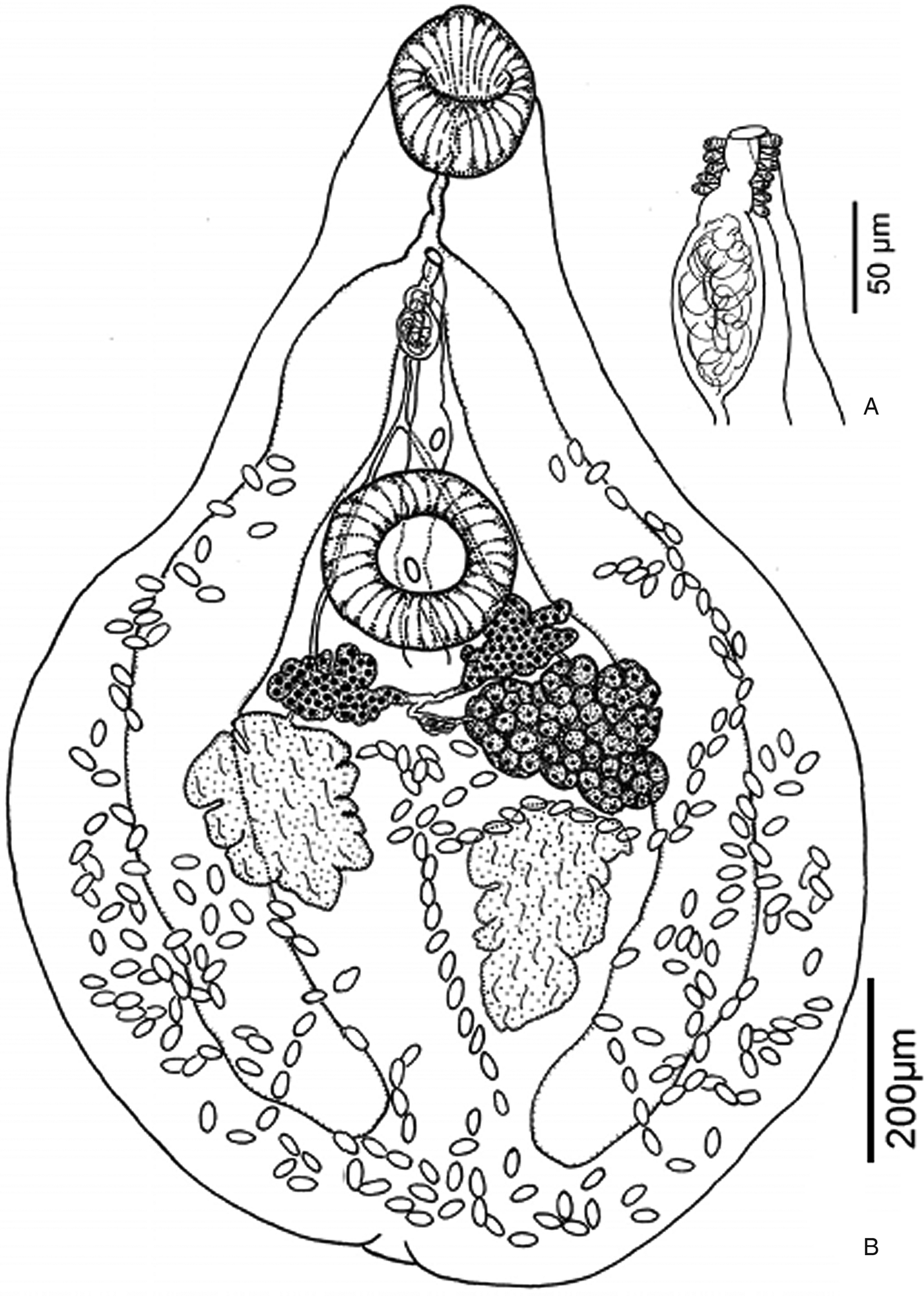
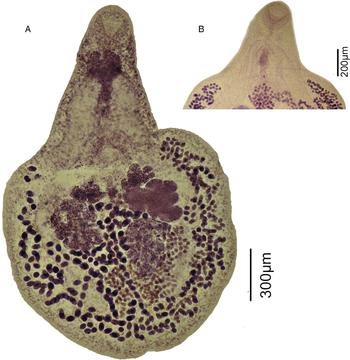
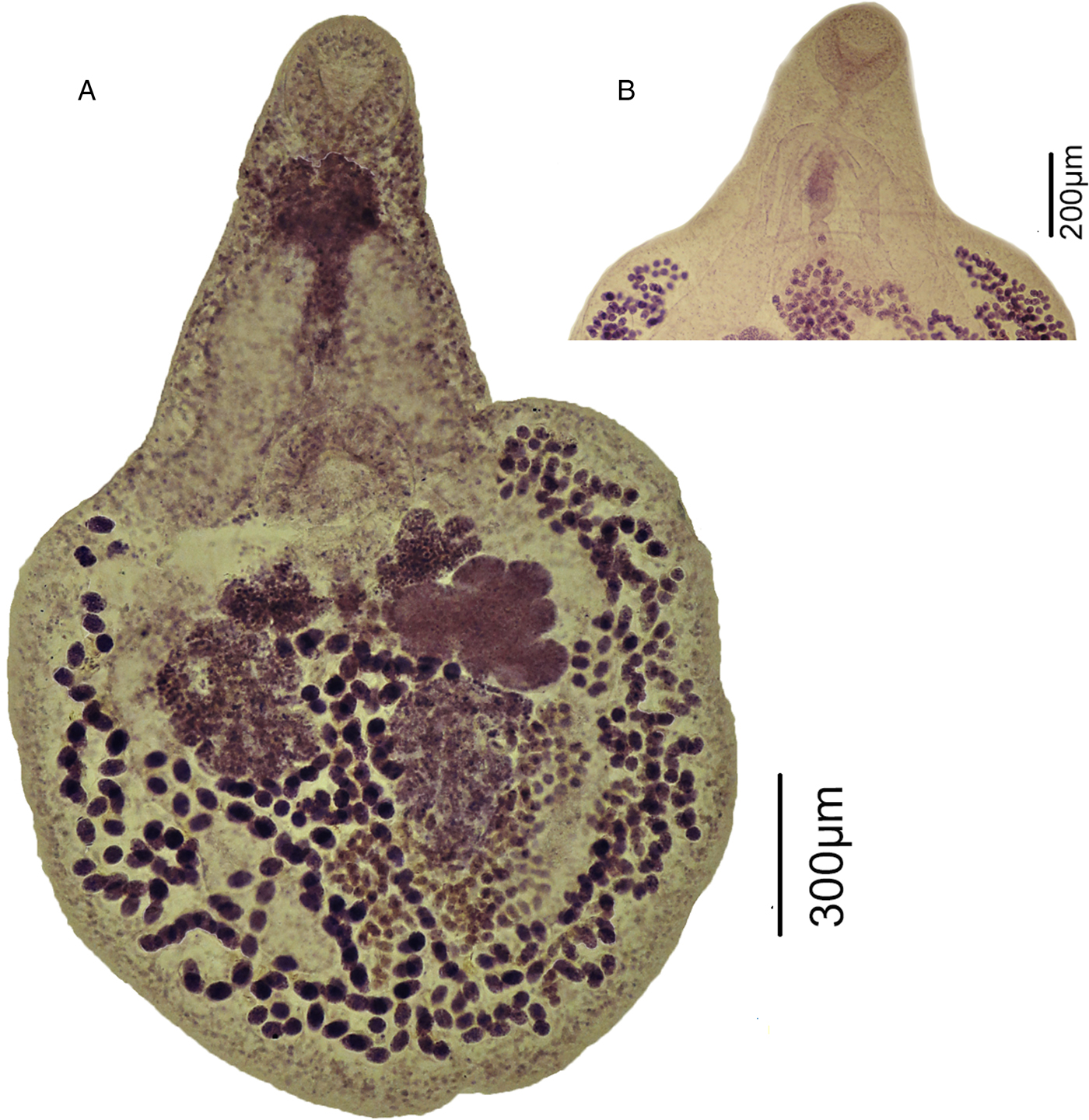
Based on six specimens. Pyriform body, smooth surface, flattened dorsoventrally (figs 1 and 2), 700–1970 (1520; n = 5) long and 420–1700 (1090; n = 5) wide in the middle of the hindbody. Oral sucker is well developed and subterminal, 82–230 (186; n = 5) in diameter. Ventral sucker is slightly anterior to the mid-body, 90–200 (165; n = 5) in diameter. The oral sucker to ventral sucker ratio is 0.88:1. Pharynx absent. Oesophagus slender, sinuous, and 80–90 (85; n = 4) long. Caecal bifurcation in the anterior region of the body. Intestinal caecum wide, slightly sinuous, terminating near the posterior body margin. Testes postovarian, intracaecal, oblique, lobed and irregular in shape. Dextral testis 110–262 (202; n = 5) long and 95–250 (179; n = 5) wide. Sinistral testis 110–260 (202; n = 5) long and 120–220 (179; n = 5) wide. Presence of the cirrus pouch, oval to elongate, 85–135 (115; n = 4) long and 52–67 (60; n = 4) wide. Cirrus pouch located immediately posterior to the intestinal bifurcation and ventral to terminal portion of the uterus. Internal seminal vesicle, oval to elongate, 55–102 (76; n = 4) long and 45–65 (56; n = 4) wide. Pars prostatica are not evident. Genital pore in the intestinal bifurcation region. Ovary pretesticular, either overlapping the zone of the anterior testis, and posterior to vitellaria, sinistral (dextral in 1 out of 6 specimens), lobed, 150–180 (166; n = 5) long and 150–270 (214; n = 5) wide. Seminal receptacle is absent; however there is one dilated proximal portion close to the uterus performing a sperm-storage function. Mehlis’ glands were not observed. Uterus is tubular and located between anterior limit of ventral sucker and posterior region of body, in intra- and extracaecal areas. Vitellaria in two elongate and compact branched masses, posterior to the ventral sucker. Right vitellarium 95–180 (141; n = 6) long and 70–170 (134; n = 6) wide. Left vitellarium 70–120 (98; n = 5) long and 95–250 (179; n = 5) wide. Oval eggs are thin shelled, variable in size, 25–37 (29; n = 30) long and 20–25 (21; n = 30) wide. Excretory vesicle is I-shaped and short. Excretory pore is located at the posterior margin of the body.
Dendrorchis pampae n. sp. from the swim bladder of the killifish Cynopoecilus melanotaenia: (A) in toto (ventral view, composite); (B) terminal ends of the reproductive tracts, with the cirrus pouch in detail

Dendrorchis pampae n. sp. from the swim bladder of the killifish Cynopoecilus melanotaenia: (A) i n toto (ventral view, composite); (B) anterior region, with the cirrus pouch in detail.
Taxonomic summary
Type host. Cynopoecilus melanotaenia (Regan, 1912) (Cyprinodontiformes: Cynolebiidae).
Site of infection. Swim bladder.
Type locality. Capão do Leão municipality, state of Rio Grande do Sul, Brazil (31°48′25″S and 52°25′11″W).
Prevalence. 20%
Intensity. 1–4 (mean 2.66) digeneans per host.
Etymology. The specific name ‘pampae’ refers to the Pampa biome, where the hosts were collected.
Specimens studied. Holotype CHIOC 39031 a. Paratypes CHIOC 39031 b; CHIOC 39031 c; CHIOC 39032; CHIOC 39033.
Remarks
Dendrorchis pampae n. sp. was compared to the original descriptions of D. neivai (Travassos, Reference Travassos1926), D. retrobiloba (Volonterio & Ponce de León, Reference Volonterio and Ponce de León2005) and D. ritata (Soofi et al., Reference Soofi, Birmani and Dharejo2016). The new species can be differentiated by the following combination of characteristics: (1) genital pore located in the intestinal bifurcation region; (2) elongate and lobed vitellaria; (3) uterine loops limited to between the acetabular region and the rear end of the body; and (4) wide intestinal caeca. In addition, D. pampae n. sp. has an ovary with similar size to the testicles, whereas D. neivai has an ovary approximately half of the size of its testicles. When compared to D. retrobiloba, D. pampae n. sp. can be distinguished by having: (1) a pyriform body shape; and (2) an oral sucker similar in size to the acetabulum. When D. pampae n. sp. is compared to D. ritata, it can be distinguished by: (1) the absence of a seminal receptacle; and (2) lobed vitellaria.
When Travassos (Reference Travassos1926) described D. neivai, the presence or shape of the seminal receptacle was not considered. These characters could not be further verified in the type species, as these specimens are considered lost (M. Knoff, pers. comm.). Volonterio & Ponce de León (Reference Volonterio and Ponce de León2005) reported and showed a small seminal receptacle, anterior or lateral to the ovary in D. retrobiloba. Moreover, Soofi et al. (Reference Soofi, Birmani and Dharejo2016) observed a long seminal receptacle in D. ritata. The new species does not have a seminal receptacle. Nonetheless, the accumulation of sperm can be clearly observed in a dilation within the proximal region of the uterus. It can be inferred that both the presence and the shape of the seminal receptacle are characteristics that might present variability in these species.
In addition to the morphological characters that differ between the four species currently grouped in Dendrorchis, they also have eggs of different sizes. Travassos (Reference Travassos1926, Reference Travassos1928) and Travassos et al. (Reference Travassos, Teixeira de Freitas and Kohn1969) described eggs of two sizes in D. neivai: large (45–53 long and 30–38 wide) and small (23–30 long and 15–23 wide). Other species of Dendrorchis also have shown variation in their egg sizes: D. retrobiloba: 33–41 length by 19–24 width; D. ritata: 29 length by 12–15 width; and D. pampae n. sp.: 25–37 length by 20–25 width. As such, the eggs observed in D. nevai are the largest reported for the genus so far. Travassos (Reference Travassos1926), as well as Volonterio & Ponce de León (Reference Volonterio and Ponce de León2005), made reference to eggs of variable sizes, reflecting different stages of maturation inside the body of the same specimen, which was also observed in D. pampae n. sp.
The diagnosis of Dendrorchis given by Travassos (Reference Travassos1926) was emended by Volonterio & Ponce de León (Reference Volonterio and Ponce de León2005). After that, Bray et al. (Reference Bray, Gibson and Jones2008) also emended the diagnosis of Dendrorchis. As such, a new amendment to this diagnosis is necessary in order to enlarge the morphological variation admitted for the genus, primarily in respect of the presence of the cirrus pouch, and also in terms of the position of the genital pore. In addition, the confirmed presence of a cirrus sac in two Dendrorchis species of the Gorgoderinae subfamily (D. retrobiloba and D. pampae n. sp.) is important and must be considered in future publications.
Dendrorchis Travassos, 1926
Gorgoderinae. Body is pyriform or elongate, with smooth margins, and flattened dorsoventrally. Oral sucker is ventral and subterminal. Ventral sucker is sub-equal to the oral sucker. Pharynx absent. Intestinal bifurcation is closer to the oral than to the ventral sucker. Caeca approach each other and terminate blindly near to the posterior extremity. Two testes diagonal, branched. Cirrus sac present or absent; seminal vesicle present. Submedian genital pore, located between the region of the intestinal bifurcation and the ventral sucker. Ovary submedian, almost opposite anterior testis, lobed or not. Seminal receptacle present or absent. Laurer's canal present. Uterus extending into intercaecal and/or extracaecal fields of the hindbody, and also intercaecal and extracaecal in forebody. Vitelline masses compact, lobed or not, paired and transversely elongate, between the ventral sucker and ovary and/or anterior testis. Excretory vesicle I-shaped; pore terminal. In swim bladder of Neotropical fish (B. lundi, A. fasciatus), Brazil, Uruguay; and intestine of catfish R. rita, Pakistan. Type-species D. neivai Travassos, 1926.
Discussion
Dendrorchis pampae n. sp. is the first record of an adult digenean in Rivulidae from Latin America. Considering the peculiar life cycle of C. melanotaenia, which hosts the new species, some questions arise. What happens to D. pampae n. sp. during the dry season, when the host is not present? Quintela et al. (Reference Quintela, Porciuncula, Condini, Vieira and Loebmann2007) showed that ephemeral ponds, in which C. melanotaenia occur, may be connected to adjacent streams during periods of heavy rainfall, allowing non-annual visitor species to invade and colonize these areas. It is possible that these non-annual species host D. pampae n. sp. in the non-ephemeral streams during the dry season and transport them to temporary environments during the flood, allowing the beginning of the reproductive cycle of D. pampae n. sp. and C. melanotaenia infection. Similarly, in the work of Taberner et al. (Reference Taberner, Volonterio and Leon2003), it was observed that the isopod T. henselii parasitized several hosts, such as A. prognathus, therefore being a non-specific parasite to its hosts. This low specificity of the parasite may aid the success of the species, since A. prognathus also undergoes reproductive cycles similar to the ones reported for Cynopoecilus.
Another possibility for the maintenance of the cycle of D. pampae n. sp. during dry periods is its permanence in the first intermediate host, i.e. molluscs that are buried in the substrate. With the beginning of the rainy season, these animals resume their activity. At this point, the emission of cercariae would occur and this would then give continuity to the biological cycle of D. pampae n. sp. Additionally, larval stages of this parasite may also remain encysted in the second intermediate host during dry seasons.
There is scarce information about the biological cycle of Dendrorchis species. In order to elucidate these questions, studies conducted in the ecosystems where D. pampae n. sp. occur might be of benefit in evaluating and correlating abiotic parameters (such as the pattern of floods and droughts) with biotic parameters (such as the parasitic fauna of C. melanotaenia and other sympatric species of fishes and invertebrates).
Acknowledgements
We are thankful to: Matheus Vieira Volcan MSc (Instituto Pró-Pampa) for the donation of the examined fish; Dr Marcelo Knoff, curator of the Coleção Helmintológica do Instituto Oswaldo Cruz (CHIOC), for information regarding the specimens of Dendrorchis neivai and to Dr Ricardo R. Robaldo (Universidade Federal de Pelotas) for permission to use his laboratory.
Financial support
E.W.W. and Y.D.Z. would like to thank Fundação de Amparo à pesquisa do Estado do Rio Grande do Sul (FAPERGS) and Conselho Nacional de Desenvolvimento Científico e Tecnológico (CNPq), respectively, for their undergraduate scholarships.
Conflict of interest
None.
Ethical standards
Killifish were collected under IBAMA/ICMBio collection license 15108-1.