Implications
The present study evaluated the use of increased supplementation of vitamins beyond Pig Improvement Company (2016) recommendations to boars in a commercial boar stud during the summer months. This has production and economic importance to the industry, as producers annually observe a decrease in reproductive performance during the summer. The use of increased levels of supplemental vitamins C, D and E is an attempt to mitigate the effects of seasonality. Previous studies have shown improvements in reproductive performance in boars with vitamin supplementation; however, they had not been tested in a commercial setting. The results of this study showed no improvements in semen production or quality during the summer months when additional vitamins were supplemented to boars in a commercial boar stud.
Introduction
In commercial swine production, both sows and boars are susceptible to reduced reproductive performance with elevated ambient temperatures and humidity. It is thought that the reductions in reproductive performance during this seasonal infertility are a direct result of elevated temperatures above the animal’s thermoneutral zone. Heat stress in the boar results in reductions in sperm production, total motility of sperm and morphologically normal spermatozoa in the ejaculate (McNitt and First, Reference McNitt and First1970; Wettemann et al., Reference Wettemann, Wells, Omtvedt, Pope and Turman1976 and Reference Wettemann, Wells and Johnson1979; Malmgren and Larsson, Reference Malmgren and Larsson1989). These factors cause an increase in discard rates for ejaculates and a decrease in the number of possible insemination doses. In 2008, a survey of US boar studs reported that season was a major factor resulting in discarded ejaculates due to abnormal sperm in 58% of the survey responses (Knox et al., Reference Knox, Levis, Safranski and Singleton2008).
Dietary supplementation with various micronutrients, such as vitamins, has been evaluated in boars with unequivocal results. Vitamin E (VE) has typically been studied in combination with selenium for their antioxidative effects and has been shown to improve semen output in boars (Marin-Guzman et al., Reference Marin-Guzman, Mahan, Chung, Pate and Pope1997 and Reference Marin-Guzman, Mahan and Pate2000). One study evaluating vitamin C (VC) supplementation to boars during a summer stress resulted in increased semen output (Lin et al., Reference Lin, Chen, Huang, Kuo and Wung1985). A study in rabbits suggests that supplementation with elevated VC and VE improved semen output; however, supplementation with VC and low levels of VE was detrimental to semen production (Castellini et al., Reference Castellini, Lattaioli, Bernardini and Dal Bosco2000). Vitamin D (VD) deficiency has been shown to cause reproductive failure in rats and mice (Halloran and Deluca, Reference Halloran and Deluca1980; Kwiecinski et al., Reference Kwiecinski, Petrie and DeLuca1989; Kinuta et al., Reference Kinuta, Tanaka, Moriwake, Aya, Kato and Sieno2000). More recently, vitamin D3 supplementation to boars resulted in improved sperm membrane integrity, acrosome intactness and sperm motility, as well as reduced sperm abnormalities (Lin et al., Reference Lin, Lv, Dong, Wu, Tao, Xu, Che, Fang, Bai, Feng, Li and Xu2017). Vitamin supplementation levels in boar diets were set by these research studies; however, few studies have investigated supplementation of additional vitamins compared to commercial concentrations.
Genetic selection for economically important traits has made great progress over the last 20 years in the swine industry. With these advancements, some genetic lines of boars have become more susceptible to heat stress than others (Flowers, Reference Flowers2008). With the effects of global climate change increasing the number of extremely hot days each year, investigations into strategies to mitigate negative impacts of heat on reproduction in various genetic lines of boars are warranted. Therefore, the objective of the present study was to investigate the use of increased levels of supplemental vitamins for mitigating the effects of summer heat stress in boars from two genetic lines.
Materials and methods
Animals and experimental design
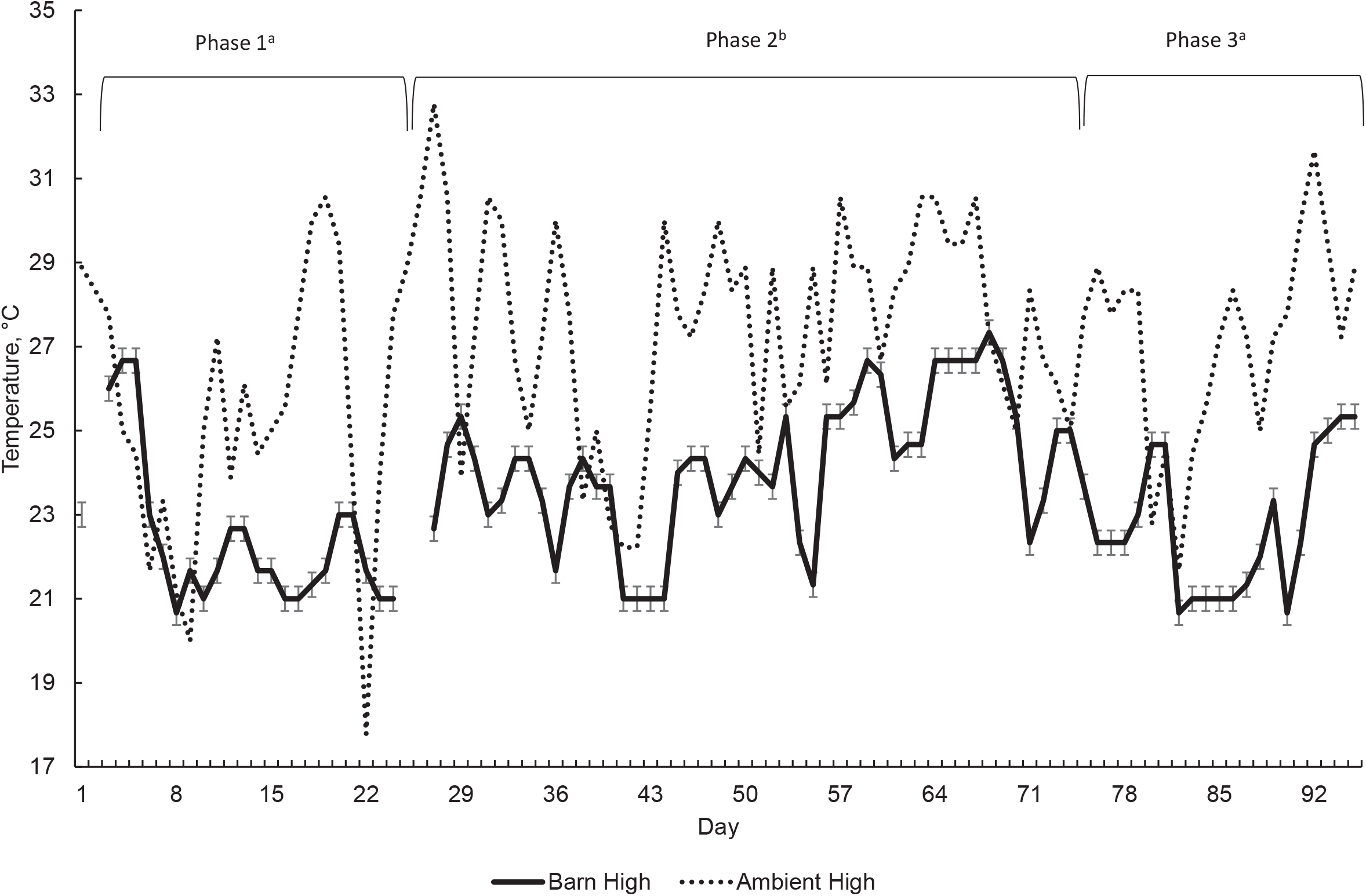
The study was performed at a commercial boar stud in West Manchester, Ohio, and was conducted during the summer months from 15 May through 18 August 2017. Two genetic lines were used in the study: a Pig Improvement Company (PIC) (North American, Hendersonville, TN 37075) terminal line (T, n = 160) and a PIC maternal line prone to heat stress (H, n = 39). The H boars had been observed over the years with a further reduced reproductive performance during the summer months compared to the T boars. High and low daily temperature and relative humidity (RH) were recorded at three equidistant locations in the barn using digital thermometers. Based on the analysis of high temperature and high humidity, three periods with repeated measures by week were determined and utilized for statistical analysis for all parameters measured (Figure 1). The periods consisted of period 1 (P1; weeks 1 to 4; mean high temperature of 22.4°C ± 0.4°C and mean high RH of 83.6% ± 1.3%), period 2 (P2; weeks 5 to 11; mean high temperature of 24.2°C ± 0.2°C and mean high RH of 94.9% ± 0.9%) and period 3 (P3, weeks 12 to 14; mean high temperature of 22.7°C ± 0.4°C and mean high RH of 87.5% ± 1.3%). Boars were limit-fed approximately 2.5 kg/day of a commercial corn and soybean meal-based diet (Table 1) formulated using PIC recommendations for all nutrients including all vitamins to maintain a healthy and productive individual boar body condition. Additionally, the boars were randomly allotted to receive one of five dietary top-dresses providing control (CNT), VC (560 mg/day Rovimix Stay-C 35, DSM, Parsippany, NJ, USA), VD (125 µg/day 25[OH]D3 from Rovimix HyD, DSM, Parspippany, NJ, USA), VE (275 mg/day Rovimix E-50 Adsorbate, DSM, Parsippany, NJ, USA) or vitamins C, D and E (CDE). All supplements were pre-mixed with wheat middlings and mineral oil for top-dressing daily (approximately 46 g/day). The five dietary treatments and two genetic lines represented formed 10 treatment groups consisting of T-CNT, T-VC, T-VD, T-VE, T-CDE, H-CNT, H-VC, H-VD, H-VE and H-CDE (genetic line-dietary treatment). Feed samples were collected at weeks 2 and 12 of the study and were sent to DSM Nutritional Products, Inc. (Belvidere, NJ, USA) for vitamin quantification.
Comparison of daily ambient high temperature with internal barn high temperatures during the summer months in a commercial boar stud in Ohio. Day 1 of the study corresponds with 15 May 2017 and day 92 corresponds with 14 August 2017. Statistical analysis of daily high internal barn temperatures revealed three periods with similar temperatures, where period 1 (day 1 to 27), period 2 (day 28 to 76) and period 3 (day 77 to 95). Periods 1 and 3 had a lower average daily high temperature than period 2 (P ≤ 0.004) and were similar to each other (P = 0.800). abValues with different letters are different (P ≤ 0.05).

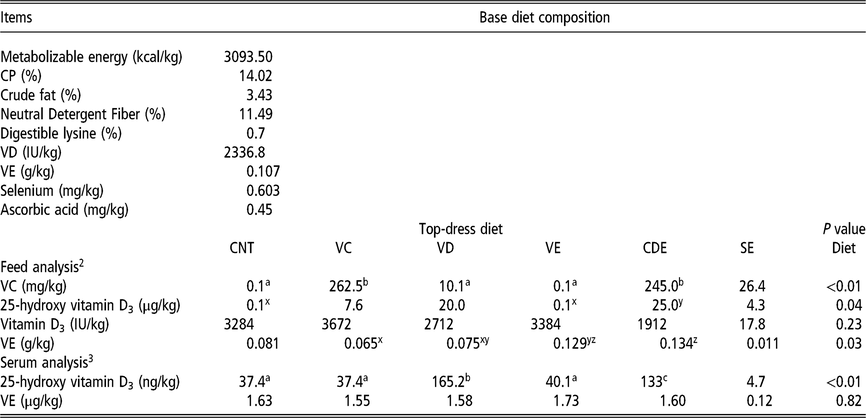
Proximate diet formulations, as-fed vitamin analyses and serum vitamin analyses in boars fed diets supplemented with increased levels of VC, VD and VE during the summer 1

CNT = control top-dress; VC = top-dress contained supplemental vitamin C; VD = top-dress contained supplemental vitamin D; VE = top-dress contained supplemental vitamin E; CDE = top-dress contained supplemental vitamin C, D and E.
ab Values with different letters within a row are different (P < 0.05); xyzValues with different letters within a row tend to differ (P ≤ 0.10).
1 Proximates of the formulation for the basal diet fed to all boars throughout the study.
2 Feed analysis for the supplemental vitamins (top-dressed) on an as fed basis.
3 Serum analysis for vitamin concentration; VC could not be analyzed due to degradation of the samples; abc Values with different letters within row are different (P ≤ 0.05).
Feed analysis
As-fed feed samples were sent to DSM and analyzed for vitamin concentrations. Analysis for VC was performed following a modified version of AOAC official method 967.21 for ascorbic acid using HPLC (Association of Official Analytical Chemists, 2016). Vitamin D3 was analyzed following a modified version AOAC official method 2011.12 using liquid chromatography tandem mass spectrometry (LC-MS/MS; AOAC, 2016). Analysis of VD consisted of sample mixture with d6-25-hydroxy vitamin D3 internal standard (for quantification), extraction with methyl tert-butyl ether, purification with HPLC and analysis by LC-MS/MS using a quadrupole analyzer (Agilent 6130). Vitamin E analysis was conducted following the modified protocol AOAC official method 971.30 for α-tocopherol and α-tocopherol acetate using HPLC fluorescence (AOAC, 2016).
Semen analysis
Semen was collected from boars according to the regular production schedule of the boar stud and consisted of an average of 171 collections per week with an average of 6.6 days rest between collections (28.0 ± 2.3 collections per diet per week for T and 6.3 ± 0.6 collections per diet per week for H; mean ± SD). Semen was analyzed on the farm immediately after collection using computer-assisted sperm assessment for motility parameter estimates (CASA; SpermVision; MOFA Global, Verona, WI, USA), a digital scale for semen volume (where it was assumed that 1 g of semen was equivalent to 1 ml; Matson et al., Reference Matson, Myssonski, Yovich, Morrison, Irving and Bakos2010), and spectrophotometry for sperm concentration (Libra S6, Biochrom, Holliston, MA, USA). Total sperm production was calculated (semen volume × sperm concentration) in order to assess the number of sperm produced per ejaculate. During weeks 2 (P1), 6 (P2) and 12 (P3) of the study, semen was sampled from a subset of 80 boars (n = 12 for line T per dietary treatment; n = 4 for line H per dietary treatment), diluted in a commercial extender (NutrixCell+; IMV Technologies, Maple Grove, MN, USA) and transported to Purdue University by a semen delivery truck. Upon arrival at Purdue University, 1 ml of semen per sample was preserved with 100 µl of 10% formalin within 15 h of semen collection and was analyzed within 30 h after preservation for morphological abnormalities and acrosome integrity. Sperm morphological analysis was conducted using phase contrast microscopy (40×), where a minimum of 200 sperm were counted and categorized as normal, or containing a proximal droplet, distal droplet, distal mid-piece retroflection (DMR) or tail abnormality. Acrosome integrity analysis was performed using phase contrast microscopy (100× oil immersion), where 100 sperm were counted and categorized as containing a normal or abnormal acrosome. Additionally, weekly discard rate was calculated and analyzed.
Serum analysis
Blood samples were taken from a subset of 80 boars (12 T boars and 4 H boars per dietary treatment) at weeks 1 (prior to dietary supplementation) and 12. Blood was collected from boars and stored at 4°C overnight prior to centrifugation at 1500×g for 25 min at 4°C. Serum was harvested and stored at –20°C prior to serum analysis. No preservative was added to the tubes prior to freezing; due to the lack of a preservation step in this procedure, serum VC degraded prior to analysis, and thus VC could not be analyzed. Vitamins D and E were quantified by sending serum samples to Heartland Assays LLC (Ames, IA, USA). Vitamin D internal standards were added to the samples after protein precipitation and samples were vortexed, mixed with hexanes and centrifuged. The organic layer of the centrifuged samples was transferred and dried. The samples were then resuspended for LC-MS/MS analysis using HPLC (Agilent 1290 infinity) coupled with an electrospray triple quadrupole analyzer (Agilent 6460). For VE, samples were extracted, mixed with internal standards, ethanol and hexane chloroform, and the protein layer was removed. Samples were transferred, dried and reconstituted for HPLC with a photodiode array detector for analysis. Vitamin E was analyzed at wavelengths of 292 and 286 nm for VE and VE acetate, respectively. Concentration of VE was calculated by comparing the standard curve to each sample analysis.
Statistical analysis
All statistical analyses were performed using an ANOVA with F-tests in the Mixed Procedure of SAS (v9.4). For CASA and semen production analysis, genetic line, dietary treatment and period were included as main effects with their interactions using individual boar as the experimental unit. Collection technician and laboratory technician were utilized as random effects, when appropriate. Number of days rest between collections, age and average pre-trial values were used as covariates. Average pre-trial values were calculated for semen production and CASA parameters over a 3-week period prior to initiation of the trial. For morphological and acrosome analysis, the statistical model consisted of genetic line, dietary treatment and period as main effects with their interactions. Number of days rest between collections and age were used as covariates. Weekly discard rates were analyzed with a statistical model that consisted of genetic line, dietary treatment and period as the main effects with their interactions. Total number of collections per week was used as a covariate for weekly discard rate. All parameters measured were repeated by week and utilized a compound symmetry covariate structure in order to minimize Akaike Information Criterion. Tukey–Kramer adjustments were used for least square means separations tests for all significant parameters. For vitamin analysis in boar serum, dietary treatment, genetic line and their interaction were used as main effects, with the week 1 serum concentration used as a covariate (week 1 serum was taken prior to feeding dietary treatments). Statistical significance was defined as P ≤ 0.05 and a tendency was determined at P > 0.05 and P ≤ 0.10.
Results
Diet compositions and as-fed vitamin analyses are presented in Table 1. As-fed VC was higher in the VC and CDE diets compared to CNT, VD and VE diets (P ≤ 0.001). As-fed 25-hydroxy vitamin D3 tended to be greater in CDE compared to CNT and VE (P ≤ 0.065). Vitamin D3 did not differ by diets (P = 0.232). The percentage of 25-hydroxy vitamin D3 out of the total VD fed was greater in CDE compared to CNT and VE (P = 0.022) and tended to be greater than VC (P = 0.059), whereas VD tended to be greater than CNT and VE (P = 0.064). As-fed VE tended to be greater for CDE compared to VC and VD (P ≤ 0.085), and VE tended to be greater than VC (P = 0.066). In general, the mean values for each diet were as expected based on vitamin supplementation, though not always statistically significant. Vitamin concentrations in serum are summarized in Table 1. In the serum, 25-hydroxy vitamin D3 was significantly greater in VD and CDE compared to the CNT, VC and VE (P < 0.001), but was greater for VD compared to CDE (P < 0.001). Vitamin E in serum did not differ by dietary treatment (P = 0.820). Due to the fast degradation of VC, no VC analysis could be accurately performed.
Daily high temperatures in the barn are compared with ambient high temperatures recorded near the barn’s location in Ohio (Figure 1). Daily high temperature was greater in P2 than in P1 or P3 (P ≤ 0.004). Similarly, daily high RH was greater in P2 (94.9% ± 0.9%) than in P1 (83.6% ± 1.3%) and P3 (87.5% ± 1.3%; P < 0.001) and tended to be greater in P3 than P1 (P = 0.089). Daily low temperature was greater in P2 (19.9°C = ±0.2°C) than in P1 (18.5°C ± 0.3°C) and P3 (18.7°C ± 0.3°C; P ≤ 0.002). Daily low RH was greatest in P2 (78.0% ± 1.6%), intermediate in P3 (70.6% ± 2.4%) and lowest in P1 (53.1% ± 2.3%; P ≤ 0.029).
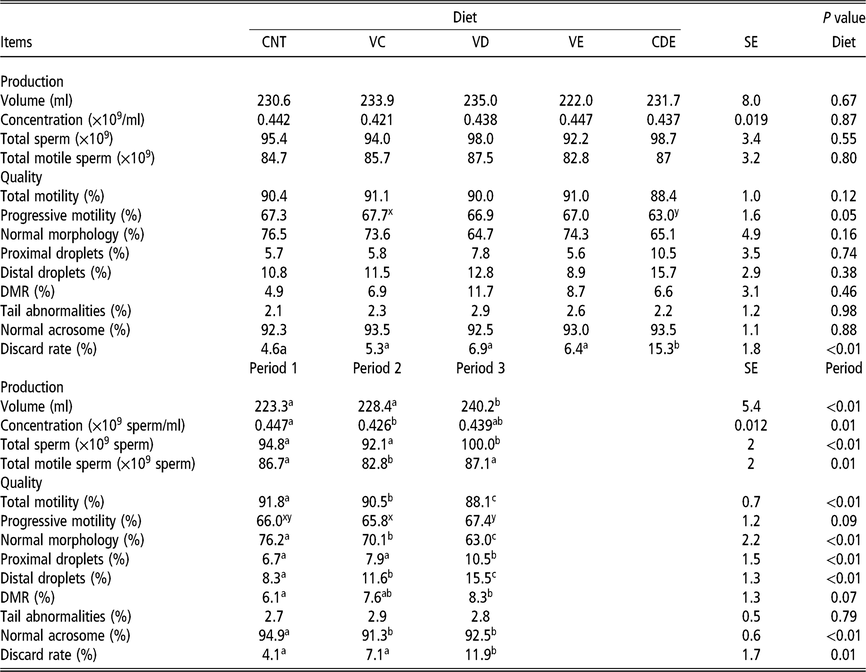
Overall diet and period effects for semen production and quality parameters are presented in Table 2. Semen volume was not affected by diet or genetic line (P = 0.673 and P = 0.767, respectively), but was affected by period (P < 0.001), where P3 was greater than P1 and P2 (P ≤ 0.001). Sperm concentration was not affected by diet or genetic line (P = 0.874 and P = 0.908, respectively) but was affected by period (P = 0.014), where P1 was greater than P2 (P = 0.013). There was no diet effect for total sperm production (P = 0.553); however, a period effect was observed (P < 0.001), where P3 was greater than P1 and P2 (P ≤ 0.008), and P1 weakly tended to be greater than P2 (P = 0.106). A three-way interaction of diet, period and genetic line was observed for total sperm production (P = 0.003), where H-VC P2 was less than H-VC P1, H-CDE P3, T-VC P1 and T-VC P3 (P ≤ 0.049).
Effect of diet supplemented with increased levels of VC, VD and VE and period on semen production and quality parameters during the summer in boars 1

CNT = control top-dress; VC = top-dress contained supplemental vitamin C; VD = top-dress contained supplemental vitamin D; VE = top-dress contained supplemental vitamin E; CDE = top-dress contained supplemental vitamin C, D and E; DMR, distal mid-piece retroflection.
abc Values with different letters within rows are different (P ≤ 0.05); xyValues with different letters within rows tend to differ (P ≤ 0.10).
1 Three environmental periods were determined where P1 represented weeks 1 to 4, P2 represented weeks 5 to 11, and P3 represented weeks 12 to 14.
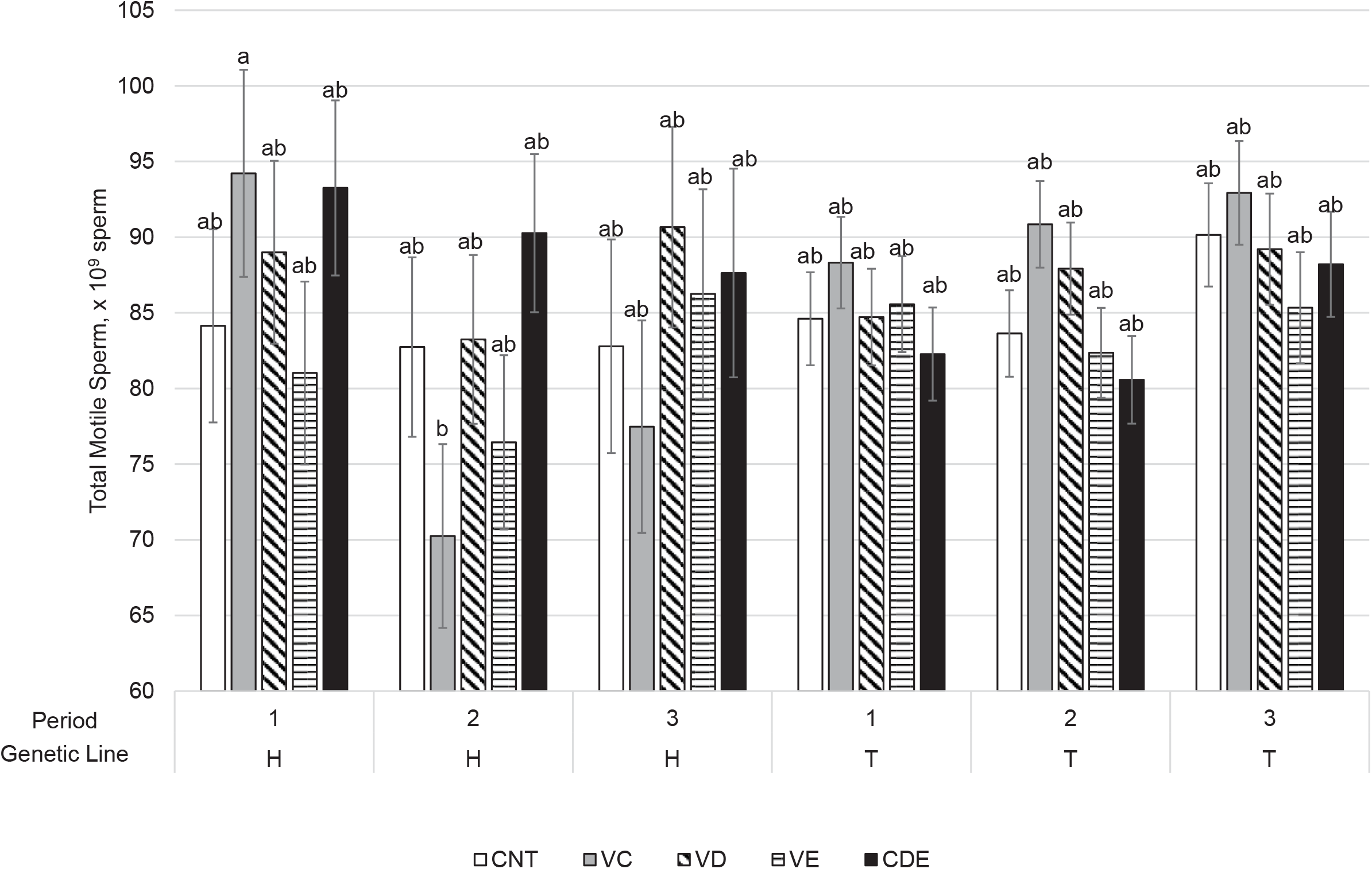
While there was no overall diet effect for total motility (P = 0.115), there was a significant period effect (P < 0.001), where total motility was reduced linearly from P1 through P3 (P ≤ 0.001). Additionally, there was a significant diet by genetic line by period effect for total motility (P < 0.001), where H-CDE during P3 was significantly reduced (P ≤ 0.048) compared to all other combinations except for H-CNT at P3 (P = 0.793), and P1 H-CNT was greater than P3 H-CNT (P = 0.001). Like total motility, progressive motility had a three-way interaction (P = 0.047), but no statistically significant differences were detected in the pairwise comparisons. An effect of dietary supplementation was observed from progressive motility (P = 0.046), where CDE-supplemented boars tended to have a reduced progressive motility compared to VC boars (P = 0.064). Total motile sperm production (viable sperm) was calculated by multiplying the total sperm production by the percentage of total motility. For this, there was a significant three-way interaction between diet, genetic line and period (P = 0.009; Figure 2), where H-VC had a reduced total motile sperm production in P2 compared to P1 (P = 0.006). Overall, there was a period effect for total motile sperm production (P = 0.001), where P2 was reduced compared to P1 and P3 (P ≤ 0.009).
Effect of genetic line by period by diet on total motile sperm. Semen was collected and analyzed on a commercial boar stud from two genetic lines of boars (heat sensitive, H; terminal, T) during the summer months. Boars were fed a commercial boar diet and received one of five top-dresses that contained wheat middlings (CNT), or wheat middlings plus VC, 25-hydroxy VD, VE or CDE. The summer was split into three periods based on internal temperatures in Figure 1. There was a genetic line by period by diet effect for total motile sperm production (P = 0. 009), where H-VC in period 2 was lower than H-VC in period 1 (P = 0.006). abBars with different letters are different (P ≤ 0.05). CNT = control; VC = vitamin C; VD = vitamin D; VE = vitamin E; CDE = combination of vitamins C, D and E.

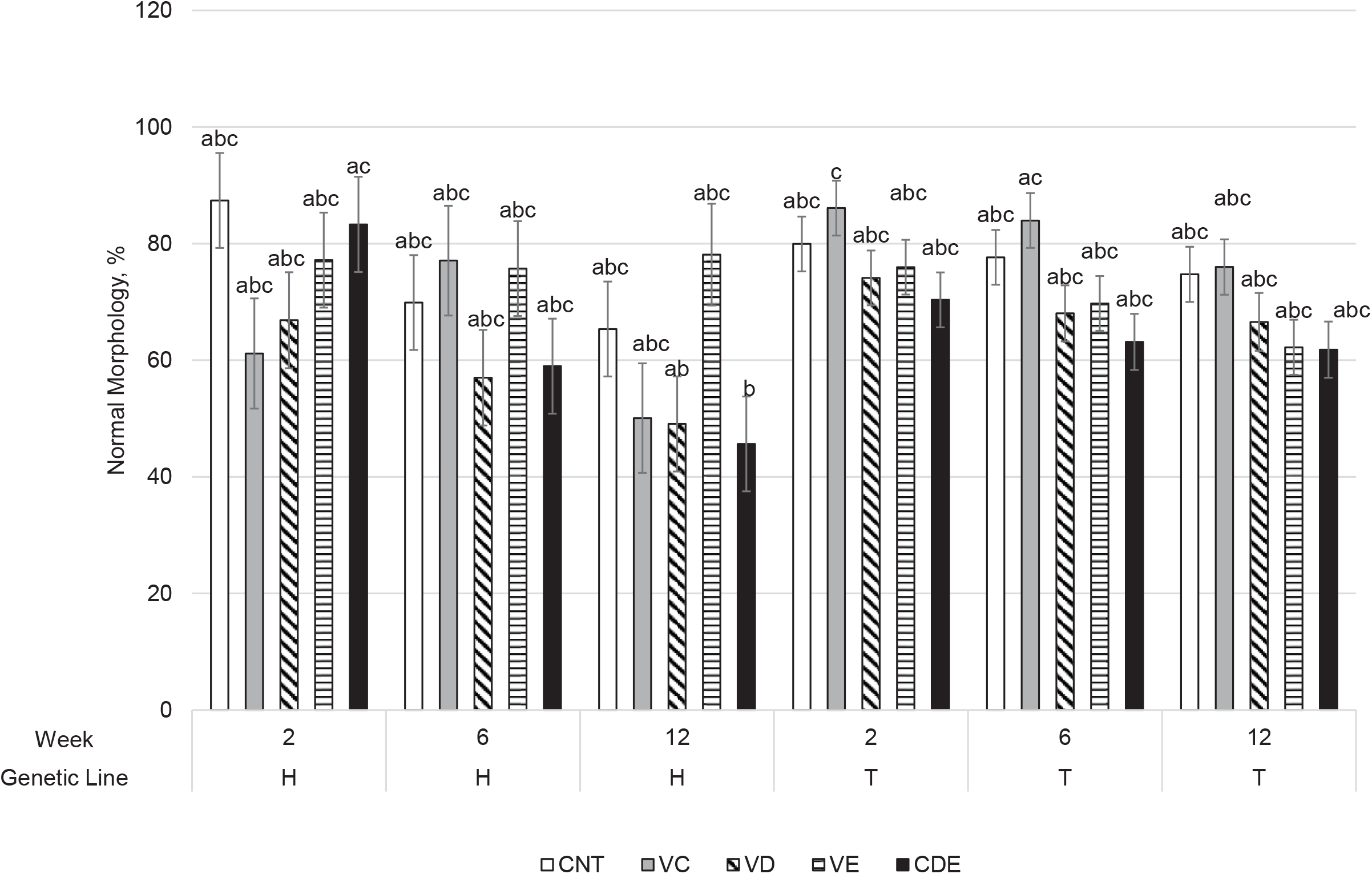
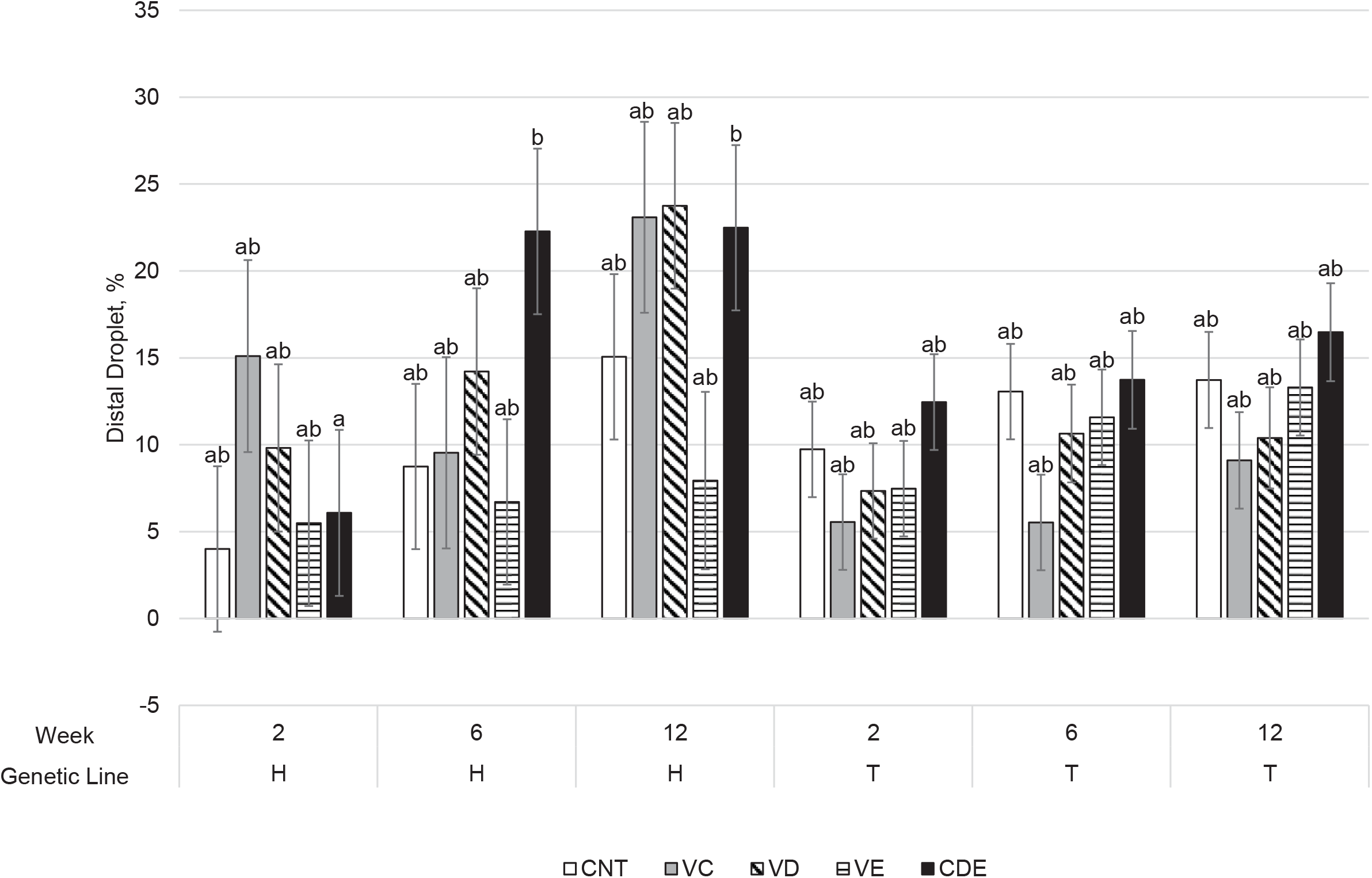
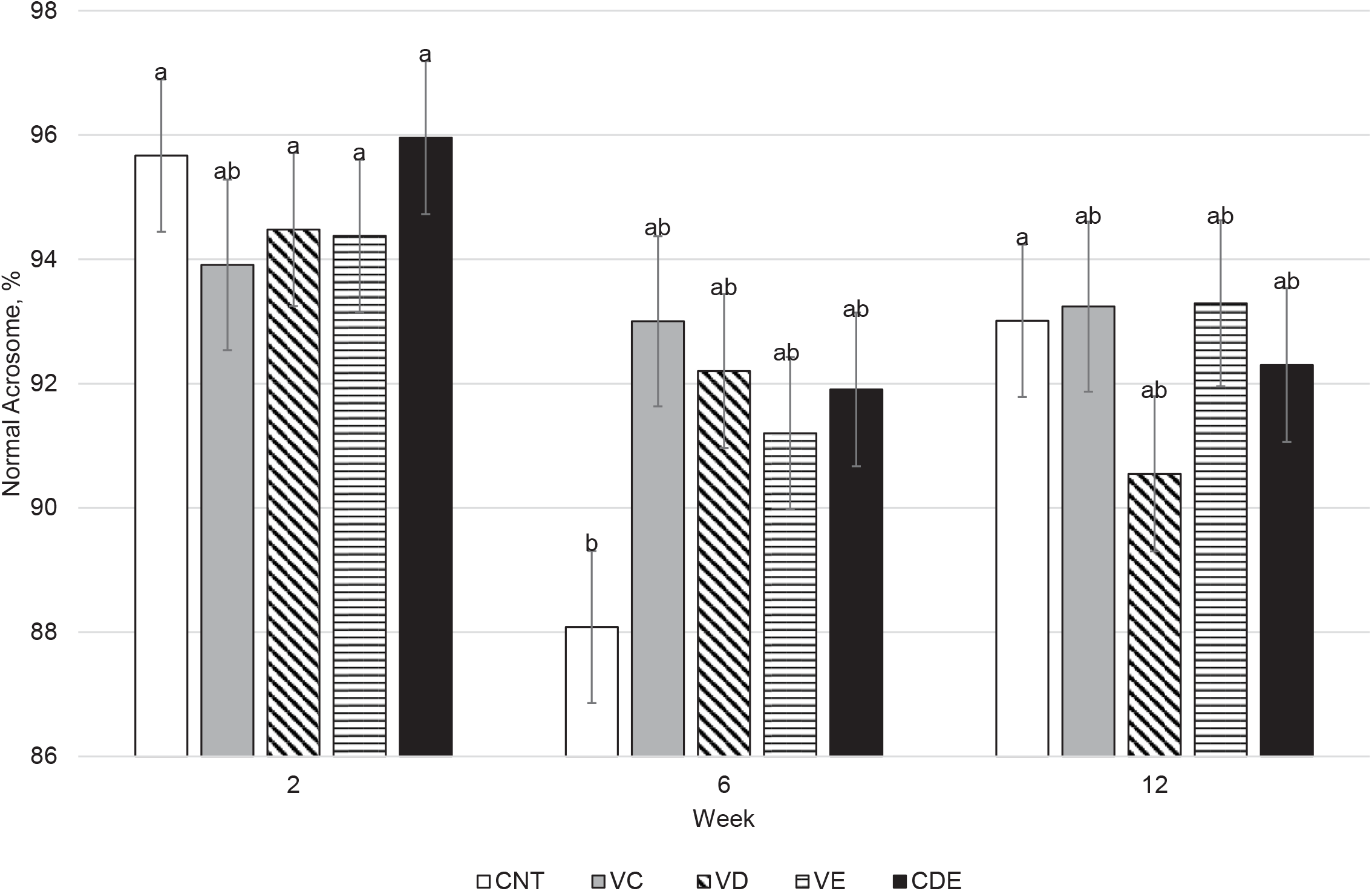
There was no effect of diet on percentage of morphologically normal sperm (P = 0.139), but a period effect was observed (P < 0.001), where percentage of morphologically normal sperm was reduced from week 2 to 6 and further reduced in week 12 (P ≤ 0.002). A significant three-way interaction with genetic line, diet and week was observed for percent normal sperm morphology (P = 0.003, Figure 3), where H-CDE at week 12 was lower than H-CDE at week 2 and T-VC at weeks 2 and 6 (P ≤ 0.042) and H-VD at week 12 was lower than T-VC at week 2 (P = 0.037). There was a significant effect of week on incidence of proximal droplets (P = 0.003; Table 2), where week 12 had an increase in proximal droplets compared to weeks 2 and 6 (P ≤ 0.034). Incidence of distal droplets had a significant genetic line by diet by week effect (P = 0.040; Figure 4), where H-CDE at week 2 was less than H-CDE at weeks 6 and 12 (P = 0.012 and P = 0.013, respectively), and tended to be greater for H-VD at week 12 compared to week 2 (P = 0.093). There was a significant three-way interaction for DMR (P = 0.001), where H-CDE tended to be greater at week 12 than week 2 (P = 0.055); however, no other differences were detected (P ≥ 0.147). No differences were detected for incidence of tail abnormalities (P = 0.967). A diet by week effect was observed for normal acrosome percentage (P = 0.010; Figure 5), where CNT was lower at week 6 compared to weeks 2 and 12 (P ≤ 0.021), and CNT at week 6 was lower than CDE at week 2, VD at week 2 and VE at week 2 (P ≤ 0.029). Overall, for normal acrosomes, all diets were reduced during week 6, though the only statistically different decrease was for the CNT.
Effect of genetic line by week by diet on percentage of morphologically normal sperm. Semen was collected and analyzed on a commercial boar stud from two genetic lines of boars (heat sensitive, H; terminal, T) during the summer months. Boars were fed a commercial boar diet and received one of five top-dresses that contained wheat middlings (CNT), or wheat middlings plus VC, 25-hydroxy VD, VE or CDE). Semen was analyzed for morphology analysis at weeks 2, 6 and 12 of the study. A three-way interaction of genetic line by week by diet was observed for percent normal morphology (P = 0.003), where H-CDE at week 12 was different than H-CDE at week 2, T-VC at week 2 and T-VC at week 6 (P ≤ 0.023). Additionally, H-VD at week 12 was less than T-VC at week 2 (P = 0.037). abcBars with different letters are different (P ≤ 0.05). CNT = control; VC = vitamin C; VD = vitamin D; VE = vitamin E; CDE = combination of vitamins C, D and E.

Effect of genetic line by week by diet on the incidence of distal droplets on sperm. Semen was collected and analyzed on a commercial boar stud from two genetic lines of boars (heat sensitive, H; terminal, T) during the summer months. Boars were fed a commercial boar diet and received one of five top-dresses that contained wheat middlings (CNT), or wheat middlings plus VC, 25-hydroxy VD, VE or CDE. Semen was analyzed for morphology analysis at weeks 2, 6 and 12 of the study. A three-way interaction of genetic line by week by diet was observed for percent distal droplets (P = 0.040), where H-CDE was lower at week 2 than H-CDE at week 6 or 12 (P ≤ 0.013). abBars with different letters are different (P ≤ 0.05). CNT = control; VC = vitamin C; VD = vitamin D; VE = vitamin E; CDE = combination of vitamins C, D and E.

Effect of week by diet on percentage of normal acrosomes. Semen was collected and analyzed on a commercial boar stud from two genetic lines of boars (heat sensitive, H; terminal, T) during the summer months. Boars were fed a commercial boar diet and received one of five top-dresses that contained wheat middlings (control, CNT), or wheat middlings plus VC, 25-hydroxy VD, VE or CDE. Semen was analyzed for morphology analysis at weeks 2, 6 and 12 of the study. An interaction effect of week by diet was observed (P = 0.010), where CNT at week 6 was reduced compared to CNT, VD, VE and CDE at week 2, and CNT at week 12 (P ≤ 0.029). abBars with different letters are different (P ≤ 0.05). CNT = control; VC = vitamin C; VD = vitamin D; VE = vitamin E; CDE = combination of vitamins C, D and E.

Discussion
Though the as-fed dietary analyses did not always result in statistical significance, the concentrations suggest that the diets were fed as intended. The VD serum results support the idea that the diets were formulated as planned, though as-fed vitamin analyses did not always differ statistically. The lack of differences for VE could have resulted from the treatment diets being too similar in VE concentration, or that the VE in the base diet was high enough that there was a physiological limitation of absorption. Due to the nature of VC degradation, no serum analysis could be conducted; however, the results of the feed analysis suggest that VC was mixed properly. Additionally, neither the feed nor the serum samples were preserved after sampling and thus degradation of the samples may have occurred prior to analysis and may partially explain the feed and serum results.
While the periods of the study differed by both temperature and RH, the temperatures in the barn were mild with a maximum temperature of 28°C. While 28°C is considered above the upper critical temperature for boars (27°C; Stone, Reference Stone1982), this elevated temperature only occurred on 1 day throughout the 14-week study. The boar stud used to conduct this study was equipped with a cool-cell system to filter and cool incoming air and to minimize the effects of heat stress during the summer. Daily high ambient (outdoor) temperatures during the 14-week study averaged around 27.6°C ± 0.6°C (LS Means ± SE) with a maximum near 32.8°C during P2, whereas daily high barn temperature averaged around 24.2°C ± 0.2°C (LS Means ± SE) with a maximum near 28°C in P2. The estimated heat index in the barn with a temperature of 24.2°C and RH of 95% results in a heat index of approximately 27°C (Rozeboom et al., Reference Rozeboom, See and Flowers2000). This clearly demonstrates that the cool-cell system used in this barn effectively lowered the barn temperature below the accepted upper critical temperature of boars. However, recent data suggest that the upper critical temperature of modern day swine is closer to 23°C (Brown-Brandl et al., Reference Brown-Brandl, Eigenberg and Purswell2013), demonstrating that the animals in the present study were still subjected to temperatures above the thermoneutral zone.
The results of the present study did not report changes in sperm production and semen quality during the summer months when additional vitamin supplementation was utilized. However, the three-way interactions yielded similar patterns where in general the H line of boars had poorer semen production and quality with greater variability among boars. The H line was selected due to its susceptibility to heat stress but is not a highly utilized genetic line and thus animal number was low for this group. The reduced animal number is likely a major cause for the variability seen in the H line data, specifically for incidence of DMR. The response to additional vitamin supplementation and season in these boars was greater than the T boars, which were not significantly impacted by either. In the present study, percentage of proximal droplets numerically increased from 6.8% to 7.9% to 10.5% ± 1.5% in weeks 2, 6 and 12, respectively. The linear reduction in percentage of normal sperm observed in the present study was partially explained by this linear increase in proximal droplets over time. Increased incidence of proximal droplets has been shown to occur during heat stress events in boars (Malmgren, Reference Malmgren1989). The reduction in percentage of normal acrosomes for the CNT at week 6, but not the other treatments, suggests that the supplementation with VC, VD, VE or the combination (CDE) may have mitigated the negative effects of heat stress on acrosome quality.
Vitamins C and E are known antioxidants, and most studies utilizing them have reported improved semen production in boars (Lin et al., Reference Lin, Chen, Huang, Kuo and Wung1985; Marin-Guzman et al., Reference Marin-Guzman, Mahan, Chung, Pate and Pope1997 and Reference Marin-Guzman, Mahan and Pate2000). Additionally, Kolodziej and Jacyno (Reference Kolodziej and Jacyno2005) reported improved sperm production and quality from boars that were supplemented with VE and selenium. Vitamins C and E both act as antioxidants and scavenge for radical oxygen species (as reviewed by Bendich et al. (Reference Bendich, Machlin, Scandurra, Burton and Wayner1986) and Yamauchi (Reference Yamauchi1997)). These antioxidant effects of VC and VE can prevent damage to sperm during production and epididymal transport, where reactive oxygen species could otherwise result in spermatozoa damage and apoptosis. However, supplementation with VC and VE did not appear to improve semen production or quality in the present study. Marin-Guzman et al. (Reference Marin-Guzman, Mahan and Pate2000) fed either 0 or 147 mg/kg of VE, and Kolodziej and Jacyno (Reference Kolodziej and Jacyno2005) fed either 30 or 60 mg/kg of VE, where the base diet of the present study contained 107 mg/kg of VE. This high level of VE in the CNT diet and the lack of a response in the supplemented diets (VE and CDE) suggest that the CNT diet contained a sufficient concentration of VE; however, without a negative CNT with no VE, this remains a hypothesis. Vitamin C results have been variable in the literature, where some studies have reported no benefit of VC supplementation in boars (Audet et al., Reference Audet, Laforest, Martineau and Matte2004) and humans (Rolf et al., Reference Rolf, Cooper, Yeung and Nieschlag1999). This may be due to genetics, species differences, stress level or the level of supplementation.
Vitamin D has been shown to be important for reproduction, where deficiencies in VD result in reduced fertility (Halloran and Deluca, Reference Halloran and Deluca1980; Kwiecinski et al., Reference Kwiecinski, Petrie and DeLuca1989). Vitamin D normally functions to regulate calcium balance in cells, which may serve as the mechanism for improving reproduction. One study reported that ovarian cells supplemented with VD had increased estradiol production (Parikh et al., Reference Parikh, Varadinova, Suwandhi, Araki, Rosenwaks, Poretsky and Seto-Young2010), and it has been suggested that VD is an important factor for aromatase activity (Kinuta et al., Reference Kinuta, Tanaka, Moriwake, Aya, Kato and Sieno2000). To the authors’ knowledge, only one study has investigated the specific role of VD on boar reproduction, and that study reported improved sperm quality when dietary supplementation was increased from 200 to 2000 IU/kg vitamin D3 (Lin et al., Reference Lin, Lv, Dong, Wu, Tao, Xu, Che, Fang, Bai, Feng, Li and Xu2017). However, sperm quality was not different between boars fed 200 and 4000 IU/kg (Lin et al., Reference Lin, Lv, Dong, Wu, Tao, Xu, Che, Fang, Bai, Feng, Li and Xu2017). The study by Lin et al. (Reference Lin, Lv, Dong, Wu, Tao, Xu, Che, Fang, Bai, Feng, Li and Xu2017) was conducted at temperatures between 22°C and 25°C and utilized three levels of vitamin D3, whereas the present study evaluated an increased supplementation using 25-hydroxy vitamin D3 in addition to a basal dietary level in excess of 2000 IU/kg vitamin D3. Blood levels of 25-hydroxy vitamin D3 were similar for the CNT boars in the present study and the study by Lin et al.; however, the serum levels for boars fed VD and CDE diets in the present study were nearly double the levels in the Lin study. This discrepancy is likely due to the levels and forms of vitamin D3 fed. It may also explain the limited positive results in the present study, where it is likely that the VD and CDE treatments exceeded the levels of VD required for optimal reproductive performance of boars.
Though there were no overall dietary effects on semen production or quality, the present study demonstrated period effects reflective of seasonal changes in production. The ambient temperature data would suggest that summer heat stress could be a possible explanation, especially if the upper critical temperature of modern day boars is around 23°C. The cool-cell system in the barn clearly lowered the barn temperature, maintaining it below the boars’ upper critical temperature of 27°C (Stone, Reference Stone1982), with only a few isolated incidents at or slightly above it. The period effects observed could be a result of two possible hypotheses. First, the concept of seasonality in pigs has been previously reported. Sows, for example, have been shown to have reduced fertility and increased nonproductive days in summer and early fall (Britt et al., Reference Britt, Szarek and Levis1983; Auvigne et al., Reference Auvigne, Leneveu, Jehannin, Peltoniemi and Salle2010). Interestingly, Auvigne et al. (Reference Auvigne, Leneveu, Jehannin, Peltoniemi and Salle2010) reported that the reduced fertility was observed regardless of ambient temperature. Prunier et al. (Reference Prunier, Dourmad and Etienne1994), however, suggested that seasonality in pigs was in fact caused by temperature and was not related to photoperiod, which was suggested in the other studies. In that study, sows were subjected to shortening and lengthening light regimens in both summer and winter and reported that sows that farrowed in July had a greater wean to estrus interval than those that farrowed in January (Prunier et al., Reference Prunier, Dourmad and Etienne1994). However, the authors did not discuss the source of semen used for artificial insemination of the sows, which may have been the source of the summertime reduction in fertility. In the present study, semen was collected from boars overnight and there were no windows in the barn for external light. Alternatively, the seasonal effects of the present study could be due to genetic selection for lean, efficient growth in pigs. This selection may have inadvertently lowered the upper critical temperature of the boars, which has been reported in finishing pigs (Brown-Brandl et al., Reference Brown-Brandl, Eigenberg and Purswell2013). Further research is needed to determine the upper and lower critical temperatures for modern-day boars to further define the ideal temperature.
Acknowledgements
The authors would like to acknowledge PIC and Birchwood Genetics for their support with this project. Additionally, the authors would like to acknowledge DSM Nutritional Products for their support and for supplying the supplements utilized for this study.
Kara Stewart, 0000-0002-6223-8159
Declaration of interest
Dietary supplements and feeding level recommendations were provided by DSM Nutritional Products. Animals and housing facilities were provided by PIC.
Ethics statement
All procedures in the study were approved by the IACUC at Purdue University #1903001868.
Software and data repository resources
None of the data were deposited in an official repository.