

1 Introduction
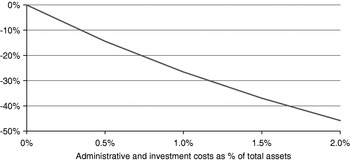
The ageing of the population in many industrial countries, the current low bond yields, and the fall in stock market returns during 2000–2002 have focussed the attention of policy makers on the cost of supplementary retirement provisions. Particularly, the low stock market returns over 2000–2002 have resulted in deficits; that is, insufficient cover ratios for many pension funds in the Netherlands and elsewhere. Consequently, the sustainability of many countries' pension systems has been called into question. In response, premiums were increased, pension schemes were made less generous, and part of the risks was shifted from companies to participants. The two major components determining the costs of pension provisioning are, of course, the quality of the pension scheme and the net rate of return on investments. However, administrative and investment costs can also substantially increase the cost of retirement security (Bateman and Mitchell, Reference Bateman and Mitchell2004). Figure 1 illustrates how, under certain conditions, operating costs (administrative costs and investment costs) erode retirement benefits. An increase in annual operating costs of 1% of pension fund assets implies a cumulated reduction of 27% of eventual pension benefits or, equivalently, an increase of more than 37% in pension costs (see also Bateman, Kingston and Piggot, Reference Bateman, Kingston and Piggot2001). In the Netherlands, annual administrative costs typically lie between 0.1% and 1.2% of pension fund assets. This wide spread is remarkable, but the average level is low compared with that in a number of other countries (Bateman and Mitchell, Reference Bateman and Mitchell2004; Dobronogov and Murthi, Reference Dobronogov and Murthi2005).
Erosion of retirement income due to annual costs Notes: To simulate the impact of administrative and investment costs on pension payouts, we assume an annual wage growth of 3%, yearly inflation of 2%, nominal investment returns of 7%, an uninterrupted contribution history of 40 years, and a remaining 20 years in which pension benefits will be received.

The relatively high cost level of pension plans was one of the main reasons for the closure of around 300 smaller Dutch pension funds (that is, around 25% of the funds) during 1992–2004. Nonetheless, this article will show that many relatively inefficient pension funds have continued to operate. During the recent pension crisis, pension funds have generally focussed on other measures, such as lower inflation or wage indexation and a move from final to average salary schemes, to reduce the overall costs of retirement security.Footnote 1 Given the significant cost differences across pension funds and the huge cumulative impact of additional costs, cost reduction should receive more attention.
This article examines both the administrative and investment costs of pension funds and their determinants. Using a new dataset with extensive information on all Dutch pension funds during 1992 and 2004, we find that administrative costs depend heavily on the size of pension funds and to a lesser extent on the governance structure (that is, type of pension fund), pension plan design, and management choices. Economies of scale may indeed be expected in pension fund administration and investment activities, as many costs are likely to increase less than proportionally with size. Examples are the costs of policy development (especially asset and liability management), data management systems and reporting, and the expert personnel required, such as actuaries, accountants, legal staff, and investment managers. Of course, pension funds can outsource fund administration and investment to specialized companies, thus gaining access to the necessary expertise at, particularly for smaller funds, relatively low costs.
This article is related to two streams of literature that investigate the efficiency of financial institutions.Footnote 2 First, there are a few studies that investigate how pension fund characteristics affect administrative costs of both defined benefit (DB) and collective defined contribution (DC) pension schemes. These studies focus on two countries: the US (Caswell, Reference Caswell1976; Mitchell and Andrews, Reference Mitchell and Andrews1981) and Australia (Bateman and Mitchell, Reference Bateman and Mitchell2004). In addition, there are a number of publications that examine fees and administrative costs in individual account DC pension schemes for 16 countries around the world (e.g. Whitehouse, Reference Whitehouse2000; Dobronogov and Murthi, Reference Dobronogov and Murthi2005; James, Smalhout, and Vittas, Reference James, Smalhout, Vittas, Holzmann and Stiglitz2001). Two important conclusions can be drawn from the results of these studies. One is that significant economies of scale may be attained in the administration of pension funds, and the other is that there are large differences in administrative costs across countries and pension plans.Footnote 3
Second, while little is known about the investment costs of pension funds, there is a large body of literature on the costs incurred by mutual funds.Footnote 4 The investment operations of pension funds are similar to those faced by mutual funds and many pension funds invest (part of) their funds through mutual funds.Footnote 5 Therefore, this literature can provide useful insights into the investment operations of pension funds as well.Footnote 6 Empirical evidence suggests substantial economies of scale related to costs in the mutual fund industry (e.g. Malhotra and McLeod, Reference Malhotra and Mcleod1997). However, these scale economies turn out to decrease as the fund size increases and become zero as soon as the optimal size has been reached (e.g. Indro et al., Reference Indro, Jiang, Hu and Lee1999; Collins and Mack, Reference Collins and Mack1997).
Of course, mutual funds may incur higher costs because they hunt for higher returns. A few studies suggest that mutual funds achieve superior returns, indeed offsetting higher expenses. For example, Ippolito (Reference Ippolito1989) compared the expenses and returns of mutual funds and index funds and found that mutual funds offset higher expenses with better results. Possibly, however, this outcome may be sensitive to the particular benchmark used, or could be explained by survivorship bias (e.g. Malkiel, Reference Malkiel1995). Many other studies have indeed found that higher costs are not related to superior performance relative to the risk-adjusted rate of return (e.g. Jensen, Reference Jensen1968; Malkiel, Reference Malkiel1995; Malhotra and McLeod, Reference Malhotra and Mcleod1997). Thus, the evidence suggests that, in general, higher costs incurred by mutual funds do not lead to higher returns. Since the investment operations of pension funds and mutual funds are similar, it seems reasonable to expect this result also to hold for pension funds.Footnote 7 We therefore conclude that, ceteris paribus, stakeholders are likely to be best served by pension funds with low investment costs.
The remainder of this article proceeds as follows. Section 2 discusses institutional details of the Dutch pension system. Section 3 presents summary statistics on administrative costs, size, and governance of pension funds. Section 4 discusses the model we apply to explain administrative costs and presents the variables used in our empirical analysis, while Section 5 presents estimates of this model. Sections 6 and 7 present similar summary statistics, model and estimation results for investment costs. Finally, Section 8 draws conclusions. Appendix A discusses the model of total operating costs, that is the sum of administrative costs and investment costs, and Appendix B provides alternative estimation outcomes for the investment costs model.
2 The pension system in the Netherlands
The Dutch retirement pension system is built on three pillars. The first pillar is the basic pension for every person over 65, under the Old Age Pensions Act (‘Algemene Ouderdomswet’, AOW). This benefit is funded by the government according to the pay-as-you-go method, i.e. current AOW pensions are paid out of current contribution income. The second pillar consists of employees' compulsory participation in company or industry-wide pension schemes, with employees saving for a pension in addition to the AOW benefit according to a funded scheme. The third pillar comprises (tax-supported) schemes, which people arrange individually in addition to the first and second pillar schemes.
At the end of 2005, 800 pension funds served the Dutch market. In total, they managed some € 630 billion in pension capital (125% of GDP) for around 6.3 million active members, 2.4 million pensioners, and 8 million inactive participants (on a population of 16 million).Footnote 8 Under Dutch law, employees must participate in the pension scheme offered by their employer. Generally, both the employer and the employee pay pension contributions, the employer bearing most of the cost. Almost all pension schemes in the Netherlands are DB schemes, meaning that the pension fund commits itself to paying benefits at a pre-defined level. This contrasts with DC schemes in which the financial contribution is fixed and the eventual benefit depends on the return on the funds invested. Most pension contracts guarantee only a nominal benefit, but pension funds do aim to link pensions to the wage or price index, provided there is sufficient pension capital. The Dutch situation can therefore best be described as a nominal DB pension combined with a ‘target benefit’ index-linked pension.
Internationally, the Dutch system of old age provision is rather unique. The size of the supplementary compulsory funding system is huge and based entirely on funding. Few countries have similarly high savings for their private pensions (OECD, 2004). Moreover, under the Dutch system, most pension schemes (90% in 2004) are DB schemes. In the UK and the US, which have also built up substantial pension capital through funding schemes, DC schemes dominate the market and their proportion is increasing. In the Netherlands many of the annuity and single premium policies, a significant element of third pillar provision, fall into this category. The fully funded nature of the second and third pillars promotes adequate savings as demographic pressures rise. The number of persons over 65 as a percentage of the 20–64 age group will double over the next 25 years. Because in international terms, the post-World War II decline in the birth rate came comparatively late in the Netherlands, the ageing of its population will also peak at a later stage.
In the Netherlands, three major types of pension funds can be distinguished: company funds, industry-wide funds, and professional group funds (including non-academic occupational groups). Company funds provide pension plans to the employees of their sponsor company. They are separate legal entities, but are run directly by the sponsor company and, often, the labour union of the employees. Industry funds provide pension plans for employees in an industry. Such pension plans are based on a collective labour agreement (CLA) between an industry's companies and the labour unions, representing the employees in this industry. There are two types of industry-wide pension funds: compulsory funds and non-compulsory funds. Compulsory funds are based on a CLA making participation mandatory for all employers and employees working in the respective industry. Non-compulsory industry funds refer to CLAs that leave employers a choice as to whether or not to participate. Finally, professional group funds offer pension schemes to specific professional groups (e.g. general practitioners, public notaries). In contrast to company and industry funds, professional group funds deal directly with workers and not with employers. Other types of pension funds include saving funds, but they constitute a very small share of the industry.Footnote 9 Insurance companies also offer individual and collective pension plans, but they are not considered in this study, since separate data on the operating costs of such pension plans is not available. For more details of the Dutch pension system and, particularly, its supervisory regime, see Bikker and Vlaar (Reference Bikker and Vlaar2006).
3 Administrative costs and size, governance, pension plan design, and outsourcing
Administrative costs include all costs laid out to operate the pension fund except investment costs; that is, personnel costs, costs charged by third parties, rent, depreciation, and so on. The administration of pension funds includes record-keeping, communication with participants, policy development, and compliance with reporting and supervisory requirements. Investment costs arising from asset management are discussed in Section 6. Although all pension funds are separate legal entities, many small and some medium-sized company funds use personnel and office space of their sponsor. The costs this involves are in many cases not (fully) passed on to the pension fund. For example, about 12% of company funds do not report any administrative costs at all. Obviously, these pension funds were disregarded by our respective data analyses. Small company funds in particular tend to underreport administrative costs.Footnote 10 Industry funds, by contrast, have several sponsor companies and are, therefore, unlikely to be able to (implicitly) transfer costs to sponsor companies. Furthermore, as much as 65% of company funds do not report wage costs. They may have been borne by the respective company or been booked as ‘other costs’. Again, small company funds in particular tend to underreport wage costs (see Table 1 below). Industry funds do not underreport as, again, they cannot pass on costs to (one of) their sponsors.
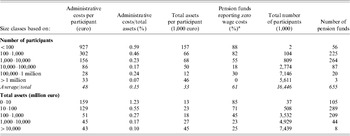
Administrative costs by size classes (2004)

Note: a Only company funds underreport wage cost.
We use a detailed dataset on all Dutch pension funds for the 1992–2004 period, provided by De Nederlandsche Bank, which is responsible for the prudential supervision of pension funds and their compliance with laws and regulations. The data set is an unbalanced panel, as observations for some pension funds are missing, due to new entrants, mergers, and terminations. The number of pension funds in our dataset declined gradually from 1,131 in 1992 to 742 in 2004. Tables 1 to 3 are based on the 655 pension funds that, in 2004, do report administrative costs. They present summary statistics of administrative costs during 2004 for, respectively, different size classes, various categories of pension funds and types of pension plans, and, finally, for various outsourcing choices. Size has been measured by either the number of participants or total assets. The ‘participants’ variable includes contributing employees, inactive participants, and pensioners. The tables also show sizes of pension funds and their distribution across categories. This distribution has been quite stable over time. Data from earlier years (1992–2003) lead to results similar to those found in the tables below.
The upper part of Table 1 shows the average administrative costs of pension funds for various size categories in terms of the number of participants. The table indicates that the (weighted) average of administrative costs per participant decrease sharply across the number of participants classes, although the average increases somewhat for participants in the highest size category. These costs vary, on average, from €927 for the smallest pension funds to around €30 for the largest two classes. Actual differences in costs across size classes are likely to be even larger, due to underreporting of costs by the smallest company funds. The average administrative costs as percentage of total assets decrease substantially across the number of participant classes, from 0.59% for the smallest funds to 0.07% for the largest class. About half of the pension funds in the smallest size category are legal vehicles for director-large shareholders and director funds for board members and supervisory board members, which explains why average total assets per participant for this size class is much higher than in the other categories.
The lower part of Table 1 provides the (weighted) average administrative costs for different size categories in terms of total assets. Administrative costs as a percentage of total assets are, again, negatively related to the size of the pension fund. Where the smallest pension funds run up administrative costs of, on average, 1.23% of total assets, the largest funds have costs of only 0.10% of total assets. This difference implies a potential reduction of benefits of more than 30%, or an increase of pension costs of more than 40%, see Figure 1. Table 1 shows that the provision of pension plans is characterized by large economies of scale, expressed either in number of participants or in total assets under administration.
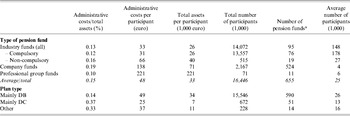
The upper part of Table 2 presents the administrative costs for different pension fund categories. At around €138, company funds' average annual administrative costs per participant are high compared with the mere €33 spent by industry funds. Again, actual differences are likely to be even larger, due to underreporting of costs by company funds. Industry funds provide relatively straightforward pension plans. Also, they face lower costs from the transfer of pension rights, whereas scale effects may play a role too. Company funds have generally higher total assets per participant than industry funds, often reflecting more generous pension plans.Footnote 11 Company funds often choose for custom-made pensions: the schemes can be tailored to the wishes of company and participants. Among the industry funds, compulsory funds face average administrative costs of only around €31 per participant per year, whereas non-compulsory funds are twice as expensive. The compulsory industry funds category has the largest number of participants. Professional group funds are, on average, more expensive, though less pricy than company funds. Scale effects seem to be the largest single cause of these cost differences across categories of pension funds. Differences in governance may also play a role, but, compared to the scale effects, they seem to be of minor importance. Table 2 shows that while most of the pension funds are company funds, they cover only a minor part of the number of participants.
Administrative costs by governance and pension plan (2004)

Note: a The type of fund is unknown for 21 pension funds; four funds are saving funds.
The lower part of Table 2 provides the administrative costs for different types of pension plans. We observe significantly higher average costs for DB schemes, of €49 per participant, compared to €25 per participant for DC schemes. In contrast, the costs as a percentage of total assets are much higher for DC schemes. This is due to the much higher average total assets per participant for DB schemes compared to DC schemes, probably because many of the DC schemes are quite new. So far, the number of DC participants is limited. Again, scale effects probably play a major role.
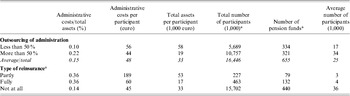
The upper part of Table 3 shows the administrative costs for different behaviour with respect to outsourcing. On balance, pension funds that outsource seem to incur lower administrative costs per participant (second column), although, remarkably, somewhat higher costs in terms of total assets (first column). The costs of pension funds that do not outsource are most probably underestimated due to the underreporting of costs by the smallest company funds, mentioned above. Of course, such underreporting is impossible in the case of outsourcing.
Administrative costs by outsourcing behaviour (2004)

Note: a The type of reinsurance is unknown for four pension funds.
Finally, the lower part of Table 3 displays administrative costs for different degrees of liability reinsurance. Fully reinsured pension funds have transferred all liability risks and (downward) investment risks of their (nominal) pension claims to an insurance company. In contrast, partly reinsured pension funds have transferred some of their liability and investment risks to an insurance company. Liability risks include longevity and disability risk. The transfer of these risks is generally coupled with the outsourcing of pension administration and asset management to the insurance company. Therefore, we use these variables also as an indicator of the outsourcing of administration and investment management.Footnote 12 Fully and partly reinsured pension funds have significantly higher cost per participant than funds without reinsurance, possibly because the latter category profits from large-scale effects.
This exploratory survey of possible drivers of administrative costs reveals that scale effects dominate governance characteristics, pension plan features, and managerial choices with respect to outsourcing. However, a multivariate approach, as presented below, is needed in order to determine the marginal contribution of each of these drivers more precisely.
4 Empirical model for administrative costs
In this article, we distinguish two production processes – administration and investment – both of which provide services to participants. In principle, these production processes are fully separable and, in practice, they are often outsourced to different service providers. Therefore, we discuss each component separately. For the ‘administration’ production process, we observe various inputs, such as labour, management, advice, and office premises. Production processes are often represented by their dual, the cost function, in order to test behavioural assumptions (Coelli et al., Reference Coelli, Rao and Battese1998). We will use the cost function to estimate scale economies. In theory, the cost function should include at least output volume and input prices. Although we observe input costs, we do not observe the respective input quantities and input prices. The true input prices would probably be of no use in an econometric model, because there is little or no price variation across the small country, the Netherlands. Gilligan and Smirlock (Reference Gilligan and Smirlock1984) and Kolari and Zardkoohi (Reference Kolari and Zardkoohi1990) assume that efficiency wages and other factor prices are equal for all financial institutions. Price changes across the years due to inflation would not provide additional information,Footnote 13 whereas minor changes in, say, wage rate due to increased productivity would probably be insufficient to identify their true impact of this price on costs. Therefore, following the cited authors above and Swank (Reference Swank1996), we omit input prices for both practical and theoretical reasons. As we will explain later, this simplification is of no consequences to our purpose: measuring the impact of scale, governance, and plan design on costs.
Section 3 indicates that pension funds' size, governance, plan design, and outsourcing choices each have their impact on administrative costs. In order to examine the marginal contributions of these determinants, we estimate the following multiple regression model of administrative costs:

AC i,t stands for the administrative costs of pension fund i at time t. As our scale variable, we use the pension fund's number of participants, focussing on service activities related to clients. An estimate for the coefficient of this scale variable, β1, of less than 1 would indicate the presence of scale economies in pension fund administration, as observed in the data analyses above. In variants of the model, we also include the square of this scale variable, to discern a possible non-linear relationship with changing economies of scale over the size classes. We use logarithms for costs and participants to reduce heteroskedasticity. The error term is represented by εit. We estimate the standard deviations with White's correction for heteroskedasticity.
The impact of governance is investigated using four dummy variables that indicate the type of pension provider: non-compulsory industry funds, compulsory industry funds, company funds and professional group funds.Footnote 14 Since industry funds have generally more straightforward pension schemes and face fewer transfers of accrued pension rights, they may incur lower costs compared to company funds. Professional group funds operate in a more decentralized environment and have to deal with the many ‘professionals’, rather than with one or a few companies; for instance, in collecting premiums. Therefore, their administration is expected to be more costly than that of industry funds. Pension plan design is represented by a dummy variable ‘defined contribution’, which identifies DC pension funds. DC plans may be easier to manage than DB plans as long as participants have no or limited choice with respect to pension fund and investment portfolio, as is commonly the case in the Netherlands.Footnote 15 However, DC plans are likely to entail additional education costs (if participants have investment choices) and marketing costs (where individual participants may choose their DC pension fund and/or insurer).Footnote 16 Outsourcing choices include a variable ‘outsourcing of administration’, which indicates the percentage of activities outsourced. This coefficient will be negative if outsourcing improves efficiency, that is if it leads to a net reduction of costs. In addition, we include two dummy variables for, respectively, fully and partly reinsured pension funds, reflecting full or partial coverage of liabilities and investment risks and outsourcing of investment management. Often, also outsourcing of administration is part of the reinsurance contract.
We also include a number of control variables, which help to explain administrative costs and may improve the estimates of the other coefficients. The ratio of total assets and participants represents the average investment per participant. Higher per capita investments may come with higher costs. The variables percentage pensioners and percentage inactive participants control for the composition of participants of the pension fund, as costs for these categories may differ from those of active participants. A dummy variable for ‘investment costs reported’ indicates whether or not the pension fund reports investment costs. If pension funds do not report investment costs, part of these costs may be reported under administrative costs. Hence, we expect reporting pension funds to have lower administrative costs. Finally, we aim at controlling for the number of pension rights transfers.Footnote 17 Transfers of pension rights are costly because they require the valuation of pension rights and the administration of the transfer. These costs are expected to be lower when employees switch jobs between employers that are both connected to the same industry-wide pension fund. Therefore, account transfer costs are expected to be lower for (large) industry funds – where job-switchers are likely to stay with the same industry fund – than for company funds. Due to the limited data on account transfers, this variable has been dropped from the final model. In the subsample where this variable is available its coefficient was positive, indeed indicating additional costs.
5 Empirical results for administrative costs
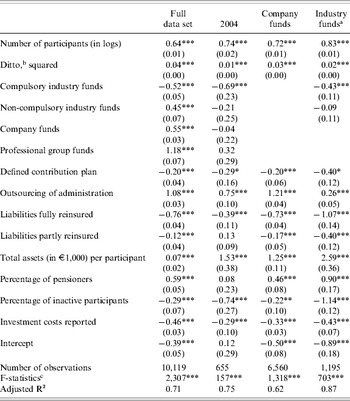
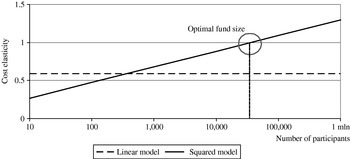
Table 4 presents estimation results of Equation (1) for, subsequently, the full data set (1992–2004), the latest year (2004), and for company funds and industry funds separately, both over the entire 1992–2004 period. For all data samples, the linear specification of the scale variable appeared to be inferior to the quadratic form.Footnote 18 Therefore, we only present the latter model. The scale coefficient β1 of the number of participants, at 0.64, is far removed from its constant-returns-to-scale value of 1. Apparently, very strong and significant economies of scale exist in the administration of most Dutch pension funds. An increase of the pension fund size by 1% would raise administrative costs by only 0.64%.Footnote 19 The observed 36% potential scale economies per additional unit of production are far greater for pension funds than those found for e.g. Dutch banks (10%) or insurance firms (21%).Footnote 20 The significant quadratic terms explain that these economies of scale for administration are not constant but decrease as the pension fund size increases. The empirical relationship between economies of scale and pension fund size is illustrated in Figure 2.Footnote 21 When cost elasticity becomes equal to 1, we see constant returns to scale. At this point, the pension fund size has reached its optimal scale. Larger pension funds face diseconomies of scale. More than 90% of the pension funds in our sample are below the optimal size. This size tends to increase over the investigated years; in 2004, all funds are below the optimal size.
Estimates for the administrative costs model (1992–2004)

Notes: ***, **, and * denote significantly different from zero at the 99%, 95%, and 90% confidence level, respectively (for the scale variable: significantly different from 1). Standard errors are corrected for heteroskedasticity and reported in parentheses. All variables are expressed in the 2004 price level. a The industry fund regression includes the professional group funds, which acts as a reference group; b Expressed as the deviation (in logs) from the average number of participants, allowing for easier interpretation of the coefficients; c Joint significance of coefficients.
Economies of scale and pension fund size (1992–2004) Note: Cost elasticities below one imply increasing returns to scale, a cost elasticity of one reflects constant returns to scale, while cost elasticities above one point to decreasing returns to scale. This graph is based on the estimates for the linear model (not presented in Table 4) and the quadratic model (as shown in Table 4), both using the full data set.

The governance dummy variables indicate that administrative costs differ across types of pension provider. Professional group funds are the most expensive, probably because they operate in a more decentralized environment and have to deal directly with individual professionals – instead of companies – which makes their administration more costly. Industry funds have lowest costs, which may be due to the relatively straightforward pension schemes under the corresponding collective labour agreement (CLA) and to the fact that they need to transfer pension rights less often. Among the industry funds, compulsory funds are most efficient, possibly because they do not need to compete for clients or suffer from adverse selection. Cost levels of non-compulsory industry funds and company funds take intermediate positions. Note that the ordering of pension fund categories by costs levels (from low-cost to expensive) remains constant across the various samples and specifications, although their coefficients vary across the samples.
The administration of DC plans appears to be less costly than that of DB plans, as becomes especially clear from the estimation for 2004 (when more pension funds had DC plans) and from the compulsory and industry fund estimates. Apparently, DC plans are easier to manage and – due to their limited range of options and, in the Netherlands, their collective nature – do not incur high marketing costs and costs of education in risk awareness.
Remarkably, outsourcing of the administration seems to raise costs significantly. This outcome is most probably due to underreporting of costs where pension funds keep their own administration.Footnote 22 Note that outsourcing is applied most frequently by the smallest pension funds. Full reinsurance, that is, outsourcing of liability and investment risks as well as – often – the administration appears to reduce administrative costs significantly, as expected. Where administration is included in the outsourcing contract, the administrative costs are included in the reinsurance premium. Partial reinsurance of liability and investment risks also reduces administrative costs, although generally less strongly and not significantly in the 2004 sample.
The significantly positive coefficient of total assets per participant confirms our expectation that administrative costs are higher for pension funds with relatively higher investments, since part of the administrative costs may be related to investment. Administration costs appear to be significantly higher for pension funds with relatively many pensioners and lower for funds with relatively many inactive participants. Finally, pension funds that report investment costs appear to have lower total operating costs than others. This, too, is in line with expectations: apparently, some non-reporting pension funds turn out to report (part of) their investment costs as administrative costs.
We also calculated the squared partial correlations (SPC), which indicate the marginal contribution of individual variables in explaining administrative cost differences (not reported here). The SPCs indicate that the scale variables have by far the greatest explanatory power. The reinsurance dummy, the percentage of pensioners and pension governance variables have some – although much less – explanatory power, whereas the contribution of the type of pension scheme is negligible. In addition, we calculated the variance inflation factors. These factors are below 4 for all coefficients, indicating that multicollinearity is never a problem. All in all, we find plausible and highly significant coefficients for most explanatory variables. Also, we observe similar outcomes across the various samples used, so that the results appear to be fairly robust.
We have re-estimated the model for every single year in our sample. In all 13 years, we observe strong economies of scale, but the potential to reduce costs by increasing scale appears to decreases over time. This is in line with the fact that the average number of participants per pension fund gradually increases.Footnote 23 The coefficient of the quadratic term also decreases with time. This implies that the optimal size increases over time, which is in line with additional costs due to IT investments and requirements of legal, supervisory and accounting regimes, which are likely to increase less than proportionally with size.
6 Investment costs and size, governance, pension plan design and outsourcing
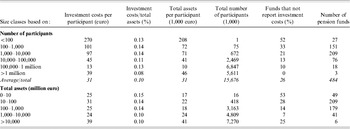
Investment costs include wages of portfolio managers and analysts, brokerage fees and the cost of electronic trading facilities. There are at least two possible causes for economies of scale in the investment of pension funds' assets. First, a larger fund can spread costs that increase less than proportionally with size over a larger asset base. Examples are the costs of trading facilities, asset managers, financial research, risk management, and compliance with regulatory standards and reporting requirements. Second, large pension funds are likely to have more bargaining power (e.g. James et al., Reference James, Smalhout, Vittas, Holzmann and Stiglitz2001).
Pension funds must report investment costs separately. In order to obtain net investment returns, these costs are deducted from gross returns. About 24% of the pension funds in our sample do not report any investment costs. There are various possible explanations for such missing observations or zero values. Sometimes these costs are included in the premium of reinsurance contracts. Also, the respective pension funds may have deducted investment costs from investment returns directly without reporting, or they may have allocated investment costs to administrative costs. This is confirmed in the empirical analysis of Section 5, showing that pension funds that do not report investment costs appear to have higher administrative costs. For this latter reason, we also examine total operating costs. The results are shown in Appendix A.
The upper part of Table 5 shows the average investment costs of pension funds for various size categories in terms of the number of participants. Average investment costs per participant decrease sharply across the number of participant classes, from €270 for the smallest pension funds to €13 and €31 for the largest two fund classes. Note that investment costs per participant are lowest for pension funds in the second largest class, which serves the greatest number of participants. Actual differences in costs across size classes are even larger than according to Table 5, as smaller pension funds report zero investment costs substantially more frequently than larger ones. The investment costs as percentage of total assets decrease across the number of participants classes, from around 0.14% for the three smallest fund classes to 0.08% for the largest funds. The lower part of Table 5 provides a similar overview for various size classes based on total assets with comparable conclusions. Remarkably, investment costs per participant do not vary systematically across the total assets size classes.
Investment costs by size classes (2004)

7 Empirical model for investment costs
We assume that the size, governance, plan design, and outsourcing choices of pension funds determine not only their administrative costs but also their investment costs. Since we do not have investment production input prices available, the investment costs model is very similar to the administrative costs model. Of course, the output measure differs, but the control variables are the same. In order to examine the marginal contribution of each determinant, we estimate the following multiple regression model of investment costs:

IC i,t stands for the investment costs of pension fund i at time t. As our scale variable, we use the pension funds' total assets, focusing on service activities as related to returns on investment. Compared to Equation (1) we drop ‘outsourcing of administration’ and ‘reporting of investment costs’, which are not relevant here, and add ‘percentage of investments in stocks’, as the costs of stock management are expected to be higher than that of fixed-income securities. This latter variable controls for the risk-return trade-off the pension funds face: more stocks imply higher risks and, hence, higher costs to manage that risk. Of course, the additional costs are expected to be compensated for by higher returns.
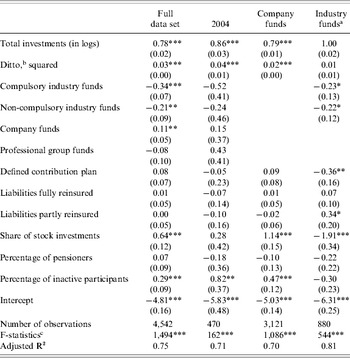
The coefficient β1 of the logarithm of total investment is, at 0.78, significantly different from 1, its constant-return-to-scale value (Table 6). This confirms that strong economies of scale exist with regard to investment costs as well. An increase of total assets by 1% would raise investment cost by only 0.78%. These economies of scale per additional unit of production (22%) are substantially less than those for administrative costs. The significant quadratic terms show that the economies of scale with respect to investment management are also not constant, but vary with the pension fund size, indicating the existence of an optimal fund size.
Estimates for the investment costs model (1992–2004)

Notes: ***, **, and * denote significantly different from zero at the 99%, 95%, and 90% confidence level, respectively (for the scale variable: significantly different from 1). Standard errors are corrected for heteroskedasticity and reported in parentheses. All variables are expressed in the 2004 price level. a The industry fund regression includes the professional group funds, which acts as a reference group; b Expressed as the deviation (in logs) from the average total investments, allowing for easier interpretation of the coefficients; c Joint significance of coefficients.
The governance dummy variables indicate that investment costs differ across types of pension institutions. Compulsory industry funds have, on average, lowest investment costs, while non-compulsory industry funds are second best in this respect. Apparently, these types of pension funds are able to manage their investment more efficiently than the other categories: industry funds have lower costs. These governance dummies reflect cost level differences similar to those in the administrative cost model. Pension funds with DC plans appear to have higher investment costs than those of DB plans in the quadratic full-data set sample. For the other samples, we do not observe any significant effect.
Full or partial outsourcing of liability and investment risks does not affect investment costs significantly. As reinsurance premiums are booked separately, we would have expected lower costs. Underreporting of investment costs for do-it-yourself company funds may have distorted the comparison.
The coefficient of ‘percentage of investments in stocks’ is significantly positive in most samples. These positive coefficients reflect that a higher share of investments in stocks is accompanied by higher costs, as stocks need more investment and risk management.Footnote 24 An exception is the industry funds sample, where a negative sign is observed. We cannot explain this unexpected sign, but the coefficient is positive in an alternative model, presented in Table 9 (see Appendix B). Apparently, industry funds are able to manage their stock investments relatively efficiently. The variable ‘percentage pensioners’ does not affect investment costs, whereas a relatively high share of inactive participants seems to raise costs.
All in all, we find plausible and (often highly) significant coefficients for many explanatory variables. Most results are similar across the various samples used, so that these estimates are fairly robust. An exception is the scale-economies coefficient in the industry model which is 1. Hence, for this category of pension funds, we observe no scale economies. As we cannot exclude the possibility that some pension funds may have reported investment costs as administrative costs, it might also be useful to model total costs instead of their two components, see Appendix A.
8 Conclusions
The administrative and investments costs of private pension funds are of great importance to both employees and employers, as they potentially erode the value of wealth accrued for retirement or, alternatively, increase the costs of retirement security. This study finds a strong dispersal in administrative and investment costs across Dutch pension funds, explained mainly by their size. These effects may also be expected in other countries, as confirmed by the literature cited above. Other pension fund characteristics play a minor role. Industry funds are significantly more efficient than company funds and other types of pension funds. The industry funds' DC plans are somewhat cheaper to manage than their DB plans. Higher shares of pensioners make pension funds more costly. Pension funds that outsource their administration appear to have higher costs than others, what we ascribe to underreporting of administrative cost of smaller funds. Finally, reinsurance, that is, the outsourcing of liabilities and investment, reduces costs, as expected.
A company's own pension fund can provide specific benefits, both to its participants and the sponsor company. In particular, such pension funds allow for more direct control, which potentially could result in superior alignment of the pension fund governance and policy with the interests of its stakeholders. These benefits may include tax gains, more discretion to adjust contributions, and the option to claim (part of) pension fund surpluses (e.g. Broeders, Reference Broeders2005). However, as shown in this article, such benefits come at high costs when the pension fund is small, as such pension funds are unable to (fully) exploit the large economies of scale that exist in pension plan administration and asset management. In addition, accounting principles and compliance rules, new information technology, and stricter supervision have increased the complexity of pension fund management and its costs, affecting smaller funds in particular.
The market for pension provisioning may be seen as imperfect because collective pension arrangements are generally much cheaper than individual ones, due to scale and the absence of marketing and education costs, adverse selection, and profits. This suggests scope for beneficial market intervention aimed at providing good pensions at low costs. For these reasons, many countries have introduced mandatory pension schemes. An example of a legal instrument that reduces costs further is, in the Netherlands, the possibility for sectors to ask the government for a mandatory status within the sector of a collective labour agreement, so that industry fund pensions become ‘compulsory’ for all companies in that industry. This appears to be quite efficient, as we find that operating costs are lowest for large compulsory industry-wide funds. In fact, this structure has contributed to low average operating costs of pension funds in the Netherlands (0.16% of total assets), compared to a number of other countries where costs vary from 0.54% to 1.36% of total assets (Bateman and Mitchell, Reference Bateman and Mitchell2004; Dobronogov and Murthi, Reference Dobronogov and Murthi2005).
Given this finding, the question may arise whether the continuing presence of small pension funds with relatively high costs points to market imperfections, which prevent stakeholders from fully exploiting the economies of scale. Many companies, however, have the choice to operate independently, to co-operate with other pension funds (but then with a common financial buffer), or to outsource all activities. Thus, since companies have different options, company funds indirectly face competition from other (financial) service providers. On the other hand, pension regulation limits the possibility for participants and firms to discipline pension funds, e.g. by switching pension funds, thereby eliminating competitive pressures that could potentially force (small) pension funds to lower their costs.
The results of this article support (policy) actions aimed at improving the efficiency of pension funds, particularly small funds, in the Netherlands, as well as in other countries.Footnote 25 Public policy could be used to promote the transparency of pension plan operating costs and to increase the incentives for small to medium-sized pension funds to merge. The latter would also reduce the costs of supervision. As industry funds are most efficient, it would also be desirable to promote further industry-wide consolidation of pension providers.
Appendix A: Total operating costs
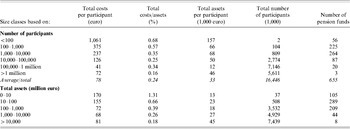
This article finds evidence that some pension funds may have reported investment costs as administrative costs. Therefore, we also investigate the determinants of total operating costs. Table 7 presents summary statistics on total operating costs for the same pension funds as in Sections 3–5, hence, also for funds that do not report investment costs. Total operating costs per participant depend also heavily on pension fund scale, falling from €1,061 to €72 across the number of participants classes. Total operating costs as percentage of total assets decreases sharply across the total assets classes from 1.31% for the smallest funds to 0.18% for the largest class. For the three classes serving the mass of participants, the average costs still vary strongly, from 0.18% to 0.39%. Again note that the smaller pension funds tend to underreport costs. Note that the average operating costs of the pension funds in the Netherlands (0.16%) are low compared to a number of other countries where average operating costs vary from 0.54% to 1.36% of total assets (Bateman and Mitchell, Reference Bateman and Mitchell2004; Dobronogov and Murthi, Reference Dobronogov and Murthi2005).
Total operating costs by size classes (2004)

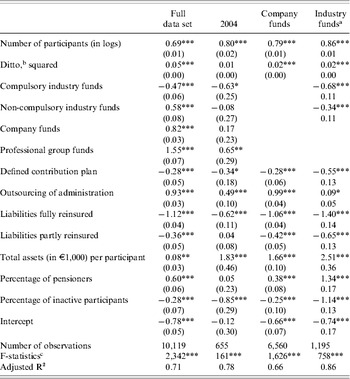
Table 8 presents estimation results of Equation (1) with total operating costs as the dependent variable. The results are very similar to the results for the administrative and investment costs models, shown in Tables 4 and 6, respectively. Most coefficients are significant at the 1% level and all significant coefficients have the same sign as in Table 4, where we observe similar mutual ordering of costs for the various fund types.
Estimates for the total operating costs model (1992–2004)
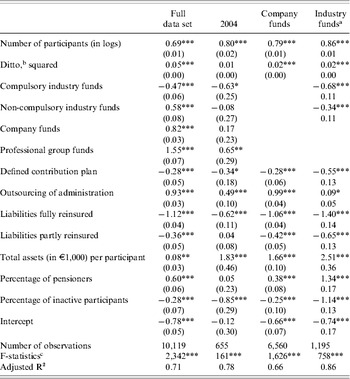
Notes: ***, **, and * denote significantly different from zero at the 99%, 95%, and 90% confidence level, respectively (for the scale variable: significantly different from 1). Standard errors are corrected for heteroskedasticity and reported in parentheses. All variables are expressed in the 2004 price level. a The industry fund regression includes the professional group funds, which acts as a reference group; b In deviation of the average number of participants (in logs), allowing for easier interpretation of the coefficients; c Joint significance of coefficients.
Appendix B: Alternative investment costs model
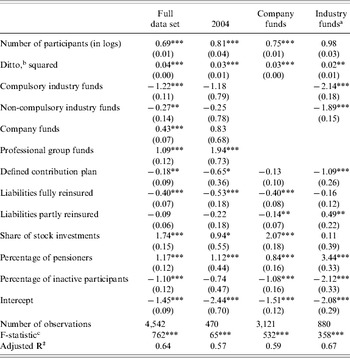
We consider ‘total investments’ as the most relevant scale variable for the investment costs model (see Table 6). Table 9 presents estimation results of an alternative model using the number of participants as scale variable, just as in the models of administrative costs and total operating costs. Although the outcomes have generally the same sign as in Table 6, the results in Table 9 are much better in the sense that the significance of most variables improves sharply across all samples. This suggests that, also for investment costs, the number of participants better captures scale than total assets. Remarkably, the results are now very close to those of the administrative cost model in Table 4. Note that this dependency of total investments on the type of scale variable was also observed in Table 5 where investment cost per participant behaved differently across number of participants classes and across total assets classes.
Estimates of the alternative investment costs model (1992–2004)

Notes: ***, **, and * denote significantly different from zero at the 99%, 95%, and 90% confidence level, respectively (for the scale variable: significantly different from 1). Standard errors are corrected for heteroskedasticity and reported in parentheses. All variables are expressed in the 2004 price level. a The industry fund regression includes the professional group funds, which acts as a reference group; b Expressed as the deviation (in logs) from the average number of participants, allowing for easier interpretation of the coefficients; c Joint significance of coefficients.