Introduction
Depression is a major cause of morbidity and mortality in the United States and worldwide, affecting more than 280 million people each year. 1 In the United States specifically, it is estimated that 8.4% of US adults have had at least one major depressive episode. 1 Women who suffer from depression and/or depressive episodes are at increased risk for other health conditions, including heart disease, diabetes, hypertension, and stroke. Reference Dong, Zhang, Tong and Qin2–Reference Nicholson, Kuper and Hemingway5 Depression has also been associated with an increased risk of developing certain cancers and dementia. Reference Chida, Hamer, Wardle and Steptoe6,Reference Yang, Wang and Li7 Identification of individuals most at risk of depression can significantly impact public health, allowing for counseling and/or intervention strategies. Despite this, few studies have examined the effect of early life exposures such as gestational age and birthweight on the risk of depression in later life.
The Developmental Origins of Health and Disease Hypothesis, or “Barker Hypothesis,” hypothesizes that the risk of adult-onset disease is increased among those with adverse in utero exposures and poor nutrition in early life. Reference Barker8 There is substantial evidence to support the hypothesis between early life exposures, such as preterm birth (<37 weeks gestation) and low birthweight (<2,500 m), and risk for chronic physical conditions, including type 2 diabetes, cancer, cardiovascular disease, disability, thyroid conditions, and autoimmune diseases. Reference Monahan, Farland, Shadyab, Hankinson, Manson and Spracklen9–Reference Brewer, D'Agata and Roberts16 Further, there is evidence that adverse in utero exposures (e.g., malnutrition) may influence epigenetic changes and/or brain development, predisposing one to mental health conditions. Reference Bale, Baram and Brown17,Reference Kim, Bale and Epperson18 A growing body of literature also suggests an association between early life exposures and cognition, schizophrenia, and/or general psychosis later in life, particularly in children; Reference Breeman, Jaekel, Baumann, Bartmann and Wolke19–Reference Su, D'Arcy and Meng23 however, much less research has been conducted on the association between early life exposures and depression in adulthood. A recent meta-analysis of prospective studies found an increased risk for low birthweight (<2500g) and preterm infants; however, only one of the included studies included adults over the age of 40 in the meta-analysis. Reference Geoffroy, Gunnell, Clark and Power24 The remaining pool of existing research is mostly limited to small sample sizes (n <1,000), Reference Boyle, Miskovic and Van Lieshout25–Reference Van Lieshout, Boyle, Saigal, Morrison and Schmidt29 performed using data from individuals living in Europe and Canada, Reference Boyle, Miskovic and Van Lieshout25–Reference Nosarti, Reichenberg and Murray32 and primarily focuses on extremely low birthweight or very early preterm birth. Reference Boyle, Miskovic and Van Lieshout25–Reference Van Lieshout, Boyle, Saigal, Morrison and Schmidt29,Reference Nosarti, Reichenberg and Murray32
Our study aims to evaluate the potential relationship(s) between birthweight and a personal history of being born preterm and risk for depression using data from the Women’s Health Initiative (WHI), a large, longitudinal cohort of women from the United States. We hypothesize that individuals born preterm (i.e., <37 weeks of gestation) and those born weighing <6lbs. (2721m) would be at increased risk for depression later in life compared to individuals born full-term and within a normal birthweight range.
Methods
Study population
We utilized data from the Women’s Health Initiative (WHI), a prospective cohort study designed to study major causes of chronic disease in postmenopausal women. Detailed information about the WHI study design and implementation has been described elsewhere. Reference Anderson, Manson and Wallace33 Briefly, 161,608 women between the ages of 49–81 at enrollment were recruited from the general United States population through 40 clinical recruitment sites between 1993 and 1998 and enrolled into overlapping clinical trials (WHI-CT) or a long-term observational study (WHI-OS). The present study used only individuals enrolled in WHI-OS. Reference Anderson, Manson and Wallace33,Reference Manson, Chlebowski and Stefanick34 All study protocols were approved by the Institutional Review Board of each clinical center and all study participants provided informed consent at enrollment.
Baseline measures
Individuals enrolled in WHI-OS were provided with structured, self-administered questionnaires that collected demographic information; medical, reproductive, and family history; psychosocial and behavioral information; and personal habits at study enrollment. Participants also reported their birthweight by choosing from one of the following categories: <6 pounds (lbs.), 6–7 lbs. 15 ounces (oz.), 8–9 lbs. 15 oz., ≥10 lbs., or unknown. Participants were also asked to record whether they were “born 4 or more weeks premature” or “full-term”, and if they were a “twin or triplet”. Participants were considered to have been born preterm if they responded “yes” when asked if they were born four or more weeks premature. The collection of self-reported birthweight categories has previously been validated (Spearman r = 0.74). Reference Troy, Michels and Hunter35
Depression definition and measurement
Data on depression status was obtained at enrollment using several approaches. At the enrollment visit with trained clinical staff, participants were asked to bring their medications with them, including any antidepressants. Additionally, to determine if individuals were currently experiencing symptoms consistent with major depression, participants were asked to complete the Burnam screen, a shortened version of the Center for Epidemiological Assessment (CES-D) depression screen. Reference Burnam, Wells, Leake and Landsverk36 Briefly, the Burnam screen is an 8-item questionnaire comprising six items from the CES-D scale Reference Lewinsohn, Seeley, Roberts and Allen37 and two items from the National Institute of Mental Health’s Diagnostic Interview Schedule. Reference Robins, Helzer, Croughan and Ratcliff38 Of the eight items in the Burnham screen, six concern the frequency of feelings in the past week, and two concern the duration of depressed mood. Unlike other screening tools, the Burnam screen logistically weights the responses, yielding a composite score between 0 and 1; a cut-point of ≥0.06 indicates individuals who screen positive for depression. Reference Burnam, Wells, Leake and Landsverk36 While it is still possible that there may be a self-reporting error in recording accurate depressive symptom severity, the Burnam screen has been validated in the WHI. Reference Tuunainen, Langer, Klauber and Kripke39 For this study, participants were classified as having depression if at least one of three conditions was met: (1) their Burnam score was ≥0.06; or (2) they reported current use of antidepressants at enrollment.
Exclusion criteria
Individuals were excluded from all analyses if they reported being a twin or triplet (n = 1,622) or if data were unknown or missing regarding their preterm birth status (n = 5,058, preterm birth analyses) or birthweight category (n = 8,791, birthweight analyses). Individuals were also excluded from the analyses if they did not complete the Burnam screen (n = 1,897 for birthweight analyses and n = 2,210 for preterm birth analyses). Additionally, to consider birthweight as an exposure separately from gestational age, individuals who reported being born preterm (n = 1,938) were excluded from birthweight analyses. The final maximum sample sizes were n = 74,299 for birthweight analyses and n = 84,715 for preterm birth analyses (Fig. 1).
Flow chart of subject selection from the women’s health initiative. Some individuals were missing information on more than one variable. CT, clinical trial; OS, observational study; WHI, women’s health initiative.

Statistical analysis
Descriptive statistics for WHI-OS participants were generated using baseline data and compared across preterm birth status or birthweight category using t-tests and ANOVAs for continuous variables and chi-square tests for categorical variables. Multivariable linear regression models were used to generate beta estimates (β) and associated p-values to evaluate the association between self-reported preterm birth status or birthweight category and Burnam scores with and without adjustment for potential confounding. Multivariable logistic regression models were used to estimate odds ratios (OR) and 95% confidence intervals (CI) for the association between self-reported preterm birth status, birthweight category, and depression (yes/no). Covariates examined for inclusion in the models were notable risk factors for depression, including demographic characteristics (age, education, race, ethnicity, neighborhood socioeconomic status (NSES), family history of depression, and geographic region) and baseline lifestyle factors (smoking status, alcohol consumption, BMI at baseline, and 2005 Healthy Eating Index (HEI) score). Due to controversy in the field of life-course epidemiology as to whether or not adult lifestyle factors such as BMI or race should be adjusted for in statistical models, Reference Farland, Correia and Dodge40 we present results unadjusted, partially adjusted, and fully adjusted for demographic and lifestyle factors.
Because we observed an association between the birthweight category and both Burnam score and depression, we considered presenting models for the preterm birth analyses with and without adjustment for the birthweight category. However, because gestational age (including preterm birth) and birthweight are strongly correlated, adjustment for birthweight category could attenuate the association between preterm birth and depression or Burnam scores (e.g., colliders). As such, we also present models for the preterm birth analyses stratified by self-reported birthweight category, but do not provide models adjusted for birthweight category. Statistical tests were two-sided, and p-values of <0.05 were considered statistically significant. All analyses used full-term birth or the “6 lb.–7 lb. 15 oz.” birthweight category as the referent group. All data analyses were performed using SAS 9.4 (SAS Institute Inc., Cary, NC, USA).
Results
Birthweight
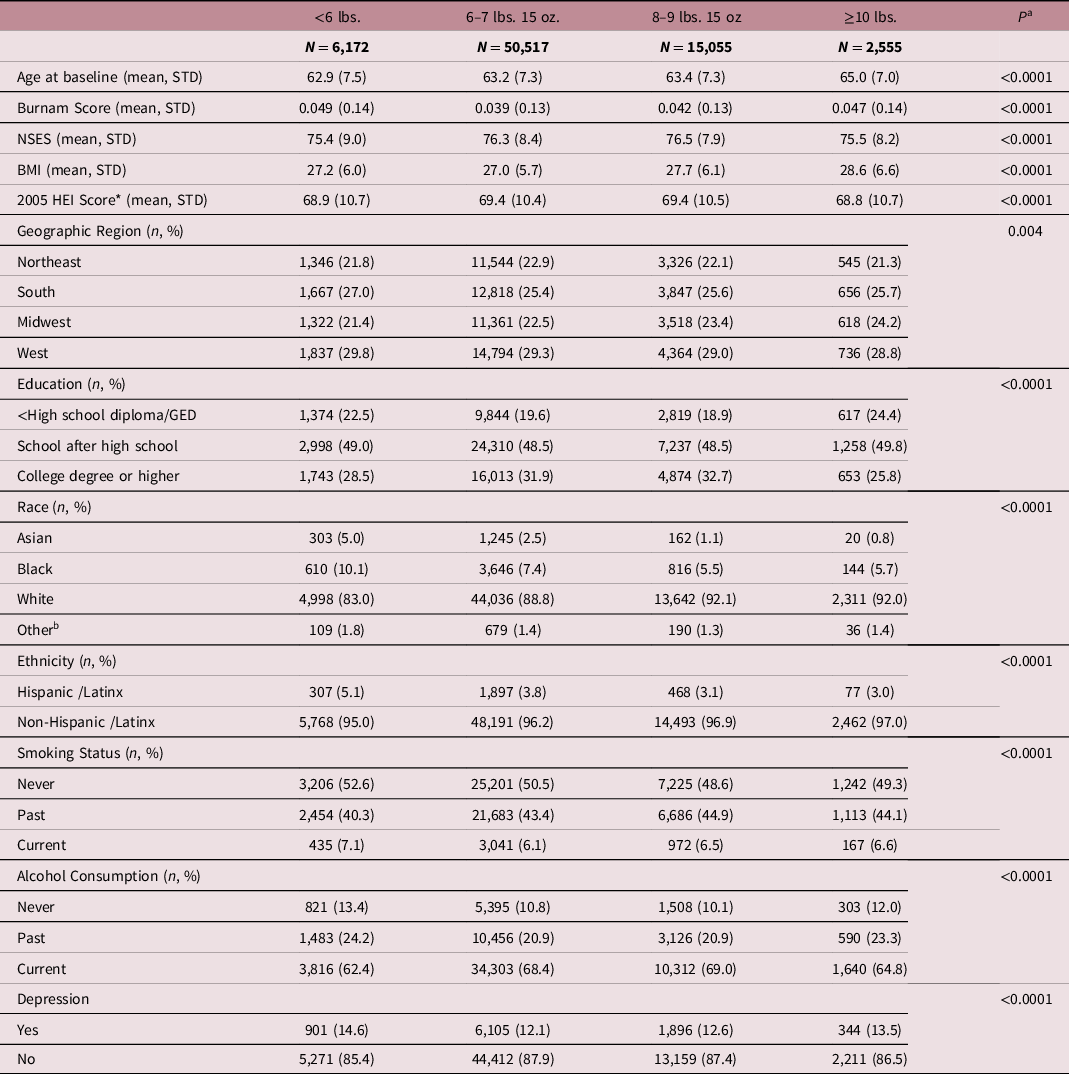
Baseline characteristics of participants stratified by birthweight category are shown in Table 1. Participants who reported weighing <6 lbs. at birth were more likely to be younger; live in the South or West regions of the United States; identify as Asian, Black, or other race; identify as Hispanic/Latinx; have never smoked; report never consuming alcohol; and have depression at baseline when compared to other birthweight categories. At enrollment, individuals who reported weighing≥10 lbs. at birth were more likely to be older, have a higher BMI, live in the Midwest, and have less than a high school diploma/GED compared to other birthweight categories.
Baseline characteristics of 74,299 women’s health initiative participants born at term, by birth weight

BMI, body mass index; HEI, healthy eating score; lbs, pounds; NSES, normalized neighborhood socioeconomic status.
a P-values are from ANOVA and chi-square statistics.
b Due to small sample sizes, we collapsed the Native Hawaiian/Other Pacific Islander, American Indian/Alaskan Native, and Multi-racial categories into one “other” category.
Numbers are N (%) for categorical variables or mean (standard deviation) for continuous variables.
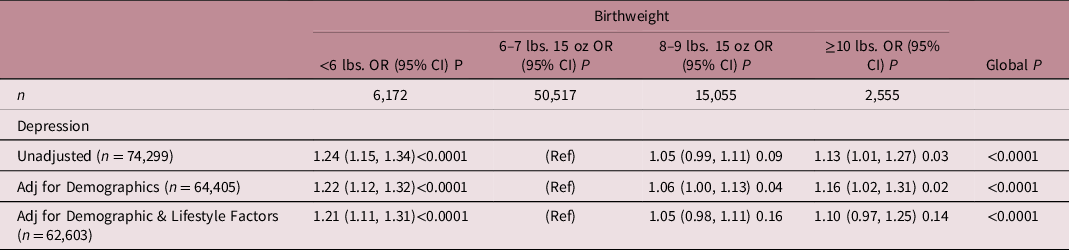
Crude and adjusted effect estimates for the association between birthweight category and Burnam score or birthweight category and depression are presented in Tables 2 and 3, respectively. Individuals born at term weighing <6 lbs. and ≥10 lbs. had significantly higher Burnam scores when compared to those born within a normal birthweight range, even after adjustments for demographic and lifestyle factors (<6 lbs.: β adj = 0.007, P < 0.001; ≥10 lbs.: β adj = 0.006, P = 0.02). Similarly, individuals born at term weighing <6 lbs. were at increased odds of depression compared to those born within the normal birthweight range (adjOR = 1.21, 95% CI 1.11–1.31). However, no significant association was observed between being born weighing ≥10 lbs. and odds for depression (adjOR = 1.10, 95% CI 0.97–1.25).
Association between birthweight and baseline Burnam score among postmenopausal women born at term in the women’s health initiative

adj, adjusted; lbs., pounds; SE, standard error; HEI, healthy eating index; NSES, neighborhood socioeconomic status.
Results presented as beta (standard error) and p-value. Positive beta-values indicate a higher Burnam score for that birthweight category compared to the reference category. Demographic factors include age at baseline, BMI, geographic region, education, race, and ethnicity. Lifestyle factors include NSES, 2005 dietary HEI score, smoking status, and alcohol consumption.
Associations between birthweight and depression among postmenopausal women born at term in the women’s health initiative

adj, adjusted; CI, confidence interval; lbs., pounds; OR, odds ratio.
Demographic factors include age at baseline, BMI score, geographic region, education, race and ethnicity. Lifestyle factors include NSES score, HEI score, Smoking Status, and Alcohol Consumption.
Preterm birth
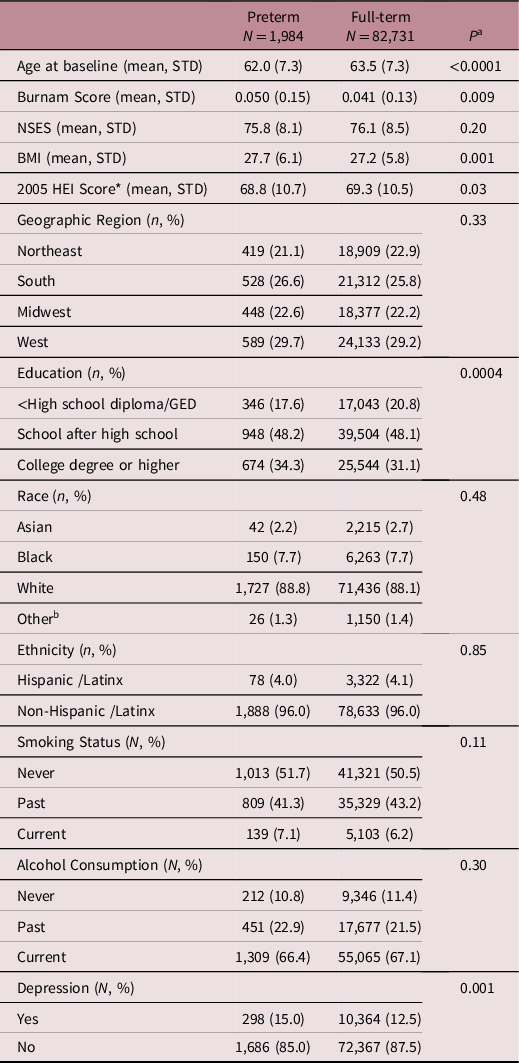
Baseline characteristics of participants stratified by preterm status are shown in Table 4. At enrollment, participants born preterm tended to be younger, have a higher Burnam score, have a higher BMI, have more years of education, and have a higher prevalence of depression compared to individuals born full-term.
Baseline characteristics of 84,715 women’s health initiative participants by preterm birth status

BMI, body mass index; HEI, healthy eating score; lbs, pounds; NSES, normalized neighborhood socioeconomic status.
a P-values are from t-tests and chi-square statistics.
b Due to small sample sizes, we collapsed the Native Hawaiian/Other Pacific Islander, American Indian/Alaskan Native, and Multi-racial categories into one “other” category.
Numbers are n (%) for categorical variables or mean (standard deviation) for continuous variables.
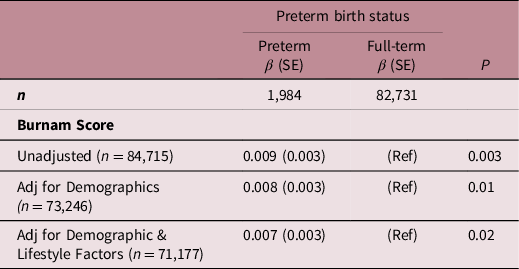
Crude and adjusted effect estimates for the association between preterm birth and Burnam score are presented in Table 5. Individuals born preterm had significantly higher Burnam scores compared to those born full-term in unadjusted and fully adjusted models (β unadj = 0.009, P = 0.003; β adj = 0.007, P = 0.02). When limiting analyses to individuals born in the lowest birthweight category (<6 lbs.), there were no statistically significant associations between preterm birth and Burnam score (β unadj = –0.0003, P = 0.95; β adj = 0.0004, P = 0.92; Supplementary Table S1). These results suggest that the association between low birthweight and Burnham score may explain the observed association between preterm birth and Burnham score.
Relationship between preterm birth status and baseline Burnam score among postmenopausal women in the women’s health initiative

adj, adjusted; CI, confidence interval; lbs., pounds; SE, standard error.
Results presented as beta (standard error) and p-value. Positive beta-values indicate a higher Burnam score for that birthweight category compared to the reference category. Demographic factors include age at baseline, BMI score, geographic region, education, race, and ethnicity. Lifestyle factors include NSES score, HEI score, smoking status, and alcohol consumption.
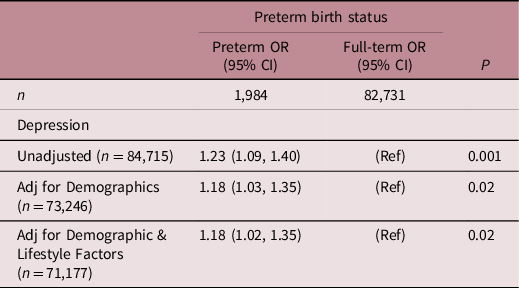
Crude and adjusted results for the association between preterm birth and depression are presented in Table 6. Individuals born preterm had significantly higher odds of depression when compared to those born full-term in unadjusted and demographic and lifestyle-adjusted models (unadjOR = 1.23, 95% CI 1.09–1.40; adjOR = 1.18, 95% CI 1.02–1.35). Results were consistent when limiting the analyses to individuals born in the lowest birthweight category (adjOR = 1.14, 95% CI 1.01–1.28; Supplementary Table S2).
Relationship between preterm birth and depression among postmenopausal women in the women’s health initiative

adj, adjusted; CI, confidence interval; lbs., pounds; OR, odds ratio.
Demographic factors include age at baseline, BMI score, geographic region, education, race, and ethnicity. Lifestyle factors include NSES score, HEI score, smoking status, and alcohol consumption.
Discussion
Utilizing the large, United States-based Women’s Health Initiative (WHI) cohort, we found that individuals who report being born at both lower (<6 lbs.) and heavier (≥10 lbs.) birthweights had significantly higher Burnham scores than those born in the normal birthweight category. Further, those born weighing <6 lbs. had a significantly increased risk for depression. Individuals born preterm also have significantly higher odds of depression compared to those born full-term.
There has been significant research demonstrating increased risks for externalizing and internalizing behavioral issues in preschool-age to young adulthood among children born preterm. Reference Kelly, Arcoleo, D'Agata and Sullivan41,Reference Scott, Winchester and Sullivan42 However, to our knowledge, fewer studies published to date have examined the relationship between gestational age or preterm birth and, specifically, depression in adulthood, however, the results are somewhat inconsistent. Reference Knud Larsen, Bendsen, Foldager and Munk-Jørgensen30–Reference Nosarti, Reichenberg and Murray32,Reference Herva, Pouta, Hakko, Läksy, Joukamaa and Veijola43,Reference Loret de Mola, de França, Quevedo Lde and Horta44 A large (n >1 million) population-based registry-linked study in Sweden found that individuals born <32 weeks and 32–36 weeks gestation were significantly more likely to develop depression by age 16 than those who were born term (<32 weeks: HR 2.9, 95% CI 1.8–4.6; 32–36 weeks: HR 1.3, 95% CI 1.1–1.7). Reference Nosarti, Reichenberg and Murray32 Conversely, three studies considering the risk for depression reported no association with preterm birth, Reference Knud Larsen, Bendsen, Foldager and Munk-Jørgensen30,Reference Lahti, Eriksson and Heinonen31,Reference Herva, Pouta, Hakko, Läksy, Joukamaa and Veijola43,Reference Loret de Mola, de França, Quevedo Lde and Horta44 including a study from Finland examining a cohort of 12,597 individuals of a similar age range (66–67 years) to our study. Reference Lahti, Eriksson and Heinonen31 Three of the aforementioned studies Reference Knud Larsen, Bendsen, Foldager and Munk-Jørgensen30–Reference Nosarti, Reichenberg and Murray32 were retrospective cohort studies linking birth records to ICD codes reported in nationalized health registries; undiagnosed and/or less severe cases of depression were likely to be missed with this approach, leading to misclassification of the outcome. Further, the prior studies were conducted in European and Canadian populations and, thus, may not be generalizable to a United States-based population.
To our knowledge, ten studies examined the relationship between birthweight and depression or mood disorders in adults. Reference Su, D'Arcy and Meng23,Reference Boyle, Miskovic and Van Lieshout25,Reference Jaekel, Baumann, Bartmann and Wolke26,Reference Lærum, Reitan and Evensen28–Reference Knud Larsen, Bendsen, Foldager and Munk-Jørgensen30,Reference Nosarti, Reichenberg and Murray32 In the largest of the three significant studies (N>490,000), Larsen et al. used a population-based case-control design within three linked Danish registries to examine the association between low birthweight (adjusted for gestational age) and mood (affective) disorders. Reference Knud Larsen, Bendsen, Foldager and Munk-Jørgensen30 While this study did not distinguish depression from other mood disorders, they did observe an increased risk for mood disorders among those born with low birthweight compared to those born within a normal birthweight range (OR 1.15; p = 0.04); this effect size is very similar to the one we observed. Two additional studies with much smaller sample sizes (n = 275–397) also found the prevalence of depression to be higher among those born extremely low (p = 0.007) Reference Boyle, Miskovic and Van Lieshout25 and very low (OR = 1.65, 95% CI 1.02–2.67) Reference Jaekel, Baumann, Bartmann and Wolke26 birthweight. While they did not attain statistical significance, the three additional studies also observed a consistently increased risk for depression or mood disorders among those born with low birthweight. Reference Lærum, Reitan and Evensen28,Reference Van Lieshout, Boyle, Saigal, Morrison and Schmidt29,Reference Nosarti, Reichenberg and Murray32 It is important to note that the age range for each of the populations with the ten studies mentioned here is between 18-45 years of age and are much younger than our own study population (45–81 years). Differences in participant age, in addition to sample sizes and population origin (e.g., Europe), could explain differences observed between all studies.
The exact mechanisms underlying the association between an individual’s weight at birth and/or preterm birth status and the increased risk for depression are unclear. At least two studies have demonstrated that maternal exposure to famine during the second and/or trimesters of pregnancy conferred an elevated risk for major depressive disorder. Reference Brown, Susser, Lin, Neugebauer and Gorman45,Reference Brown, van Os, Driessens, Hoek and Susser46 Current research suggests that a poor intrauterine environment and/or fetal growth restriction can result in structural brain differences, such as reduced gray matter, reduced brain reserve, and poor neuronal structure development. Reference Kim, Bale and Epperson18,Reference Brown, van Os, Driessens, Hoek and Susser46,Reference Ryznar, Phibbs and Van Winkle47 Other research supporting the Barker Hypothesis indicates that adverse in utero exposures may result in fetal epigenetic changes, which may predispose an individual to many chronic health outcomes, including mental health conditions. Reference Kim, Bale and Epperson18,Reference Ryznar, Phibbs and Van Winkle47,Reference Vaiserman48
The strengths of our study included the use of the large, U.S.-based WHI cohort with a sample size of more than 76,000. Our analyses were further strengthened by the availability of extensive phenotyping, allowing for the consideration of many potential confounders. We also performed sensitivity analyses stratified birthweight category. Further, we were able to use multiple approaches in classifying our participants as having depression, including the quantitative Burnham score and current use of antidepressant medication.
Participants in the WHI were born in the 1910s–1940s, well before the 1990s, when medical technologies and pharmacologic interventions to drastically improve the survival of preterm infants became widespread. It is likely that our study population is affected by survival bias, as survival of infants born extremely preterm and/or extremely low birthweight was low, and only the “healthiest” infants, or those with mild prematurity or moderately low birthweight, survived. Reference Philip49,Reference Swamy, Ostbye and Skjaerven50 Thus, it is possible that our results do not directly apply to preterm infants born in the current era. However, it is becoming more apparent that the overall quality of life is reduced among those born preterm. Reference Singer, Thiede and Perez51,Reference Stoelhorst, Rijken and Martens52 If true, it is likely that one would expect the associations observed in this study to be stronger among those preterm infants who did not survive to be included in our study but would survive with current technologies.
Our study was limited to self-report data for nearly all the considered exposures, outcomes, and potential covariates, which could have resulted in misclassification. Quantitative birthweight and gestational age data from birth records would have been ideal, however, self-reported categorical birthweight has been validated (Spearman r = 0.74). Reference Jaworowicz, Nie and Bonner53 The validity of self-reported preterm birth status, especially among older individuals born between 1910 and 1940s is unknown. Further, the definition of preterm birth as “being born 4 or more weeks premature” is inconsistent with current definition of preterm birth (< 37 weeks gestation). Because our study utilized data from the WHI, our analyses were restricted to women; generalizability of our results to men is unknown. Finally, the depression categorization of participants in our study was measured through the CES-D (Burnam) depression scale, while the ideal diagnosis collection is through diagnostic interviews. While the Burnam screen has been validated in the WHI, Reference Tuunainen, Langer, Klauber and Kripke39 it is important to recognize that the Burnam scale, itself, has a sensitivity of 74% and a positive predictive value of 20% for depression and may have resulted in misclassification of the outcome. Further, we compared the average Burnam score and depression prevalence among those with missing data (Supplementary Tables S3–S4): the mean Burnam score was higher among those with missing birthweight categories (P = 0.01) and those with missing preterm birth status (P < 0.0001) compared to those that remained in our study, as did the prevalence rates of depression. As such, it is possible that our study is subject to selection bias. There were no differences in birthweight category or preterm birth among those with missing Burnam scores.
Despite extensive phenotyping within the WHI, we could not adjust for all potential confounders of interest that may be important in the life-course pathophysiology of depression, including other in utero exposures (e.g., maternal smoking status during pregnancy). There are many known risk factors and causes of both low birthweight and preterm birth, some of which may also predict adult mental illness, but we were unable to consider them here (e.g., gestational infections, intimate partner violence, maternal substance use). As such, our results should not be considered to demonstrate a causal relationship between birthweight and depression. Additionally, because preterm birth status is closely linked to birthweight, birthweight may still confound our analyses. We were able to perform sensitivity analyses, limiting our models to only those reportedly born weighting<6 lbs., which allowed us to limit the impact of birthweight on the effect estimates; in doing so, a significant relationship was no longer observed between preterm birth and depression, suggesting the true association is with birthweight and not preterm birth.
In conclusion, we found that individuals born at lower and higher birthweights and/or preterm were at significantly increased risk of depression. Our research further supports the role of early life and in utero exposures on health risks across the life course. Individuals born at low or high birthweights and those born preterm may benefit from early evaluation and long-term follow-up for the prevention and treatment of mental health outcomes. Further, pre-pregnancy and prenatal interventions aimed at preventing prematurity and low/high birthweight infants may reduce the overall burden of depression at the population level.
Supplementary material
For supplementary material accompanying this paper visit https://doi.org/10.1017/S2040174423000296
Acknowledgments
We thank the WHI investigators and staff for their dedication and the study participants for making the program possible.
Author contribution
Neha Rahalkar and Aaron Holman-Vittone contributed equally.
Funding
The Women’s Health Initiative program is funded by the National Heart, Lung, and Blood Institute, National Institutes of Health, U.S. Department of Health and Human Services through contracts HHSN268201100046C, HHSN26801100001C, HHSN268201100002C, HHSN268201100003C, HHSN268201100004C, and HHSN271201100004C.
Competing interests
None.