Introduction
FM is a common cause of widespread pain in community-dwelling older adults. Point prevalence rates between the ages of 60 to 79 years are estimated at 7.4% and 1.2% for women and men, respectively (Wolfe et al., Reference Wolfe, Ross, Anderson, Russell and Hebert1995; Karp and Reynolds, Reference Karp and Reynolds2009). The symptoms of FM are chronic, persistent, and expensive, significantly impacting quality of life (Berger et al., Reference Berger, Dukes, Martin, Edelsberg and Oster2007). FM is a functional somatic syndrome with varied symptoms, but the core symptom of FM is widespread pain for three or more months. Associated symptoms include non-restorative sleep, cognitive disturbance, and psychological distress (Mease, Reference Mease2005; Mease et al., Reference Mease2008). FM patients are up to five times more likely to have depressive disorders than those without FM (Wolfe and Hawley, Reference Wolfe and Hawley1998; White et al., Reference White, Nielson, Harth, Ostbye and Speechley2002; Thieme et al., Reference Thieme, Turk and Flor2004; Arnold et al., Reference Arnold, Hudson, Keck, Auchenbach, Javaras and Hess2006; Reference Arnold, Clauw and McCarberg2011; Fiest et al., Reference Fiest, Currie, Williams and Wang2011). Indeed, FM may predict a more treatment-resistant depression and increase the risk of recurrence of depression (Maletic and Raison, Reference Maletic and Raison2009). Treatment is further complicated by the high sensitivity to medication side effects of many FM patients, the need for different treatment modalities, and antidepressant treatment non-adherence (Karp and Reynolds, Reference Karp and Reynolds2009). Because of the high comorbidity and complex interaction between FM and depression, accurate and early identification of FM may improve prognosis and treatment planning.
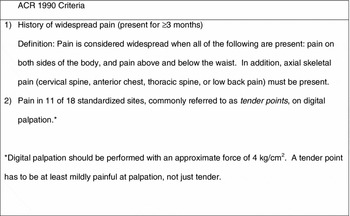
FM is a clinical diagnosis, as is common with functional pain syndromes (Goldenberg, Reference Goldenberg2009). In 1990, the ACR developed FM classification criteria for the purpose of distinguishing FM from other rheumatologic disorders with widespread pain (Wolfe et al., Reference Wolfe1990). These criteria are shown in Figure 1, and they include widespread pain for at least three months and at least 11 out of 18 tender points determined by tender point examination. In order to meet the widespread pain criterion, the patient must complain of axial skeletal pain (cervical spine, anterior chest, thoracic spine, or low back pain), which supports the high comorbidity of chronic low back pain and FM. It should be highlighted that although the ACR 1990 FM criteria are the de facto criteria for FM research (Katz et al., Reference Katz, Wolfe and Michaud2006), the ACR criteria were originally designed for classification in clinical trials, not for routine clinical diagnosis (Clauw, Reference Clauw2007), and certainly not for screening in geriatric and/or mental health settings. As the ACR 1990 FM criteria are rarely utilized clinically, the diagnosis of FM remains a challenge in late-life mental health settings, despite the high suggested prevalence.
Fibromyalgia classification criteria: American College of Rheumatology 1990 criteria for the classification of fibromyalgia.

The ACR released new criteria for FM in 2010. It is noteworthy that the ACR 2010 criteria were not meant to replace the 1990 classification criteria, but instead are an alternative more amenable to primary care and better for longitudinal care (Wolfe et al., Reference Wolfe2010). Unfortunately, the criteria have a symptom severity score that requires clinical assessment and renders the criteria inefficient for use as a questionnaire screener. Neither these criteria nor a slight modification designed for epidemiological surveys released in 2011 were available prior to the design of our study (Wolfe et al., Reference Wolfe2010; Reference Wolfe2011).
We were interested in characterizing the prevalence of FM in a sample of older adults with comorbid low back pain and depression. We were also primarily interested in evaluating the performance of three brief screeners for FM that could be easily applied by mental health clinicians, using a sensitivity of at least 0.90 as our desired threshold when compared to the ACR 1990 FM criteria. We chose a sensitivity of at least 0.90 in order to minimize false negatives and rule out FM in true negatives, due to the risk of undetected comorbid FM altering response to treatment. The first screener is a simple question asking, “Do you often feel like you hurt all over?” (Wolfe et al., Reference Wolfe1990; Weiner, Reference Weiner2007; Arnold et al., Reference Arnold, Clauw and McCarberg2011). The second is a pain map, which is a human figure onto which patients are asked to mark painful areas (Weiner et al., Reference Weiner, Peterson and Keefe1998; Arnold et al., Reference Arnold, Clauw and McCarberg2011).
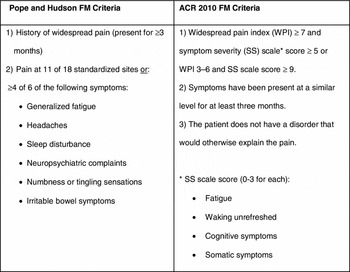
The third test we considered is a putative FM criteria developed by PH that is organized similarly to the Structured Clinical Interview for DSM-IV Axis I disorders (SCID) (Pope and Hudson, Reference Pope and Hudson1991). Although this test was developed in 1991, it is similar in many ways to the recently released ACR 2010 preliminary criteria, as detailed in Figure 2. The PH criteria were originally developed to facilitate further epidemiological research of FM in the setting of psychiatric clinical trials without requiring a tender point exam, when the history and exam are otherwise consistent (Pope and Hudson, Reference Pope and Hudson1991; Arnold, Reference Arnold2008). They were drafted as “first approximation” classification criteria based on administration to 33 participants with a primary diagnosis of FM. To our knowledge, no further testing has been accomplished to validate the original PH study results for FM.
Similarity of the Pope and Hudson criteria and the ACR 2010 FM diagnostic criteria.

Using a sample of depressed older adults with comorbid chronic low back pain, we hypothesized that there would be high prevalence of FM and that three simple screeners would show high sensitivity when compared to the ACR 1990 FM criteria.
Methods
Participants
Participants for this study were participating in a clinical trial for older adults with chronic low back pain and depression. The data presented here are from the screening phase, before participants received any treatment (Karp et al., Reference Karp2012). Participants were community dwelling and were recruited from primary care, a mental health clinic, and radio, print, and internet advertisements. All participants were 60 years of age and older. The study was approved by the University of Pittsburgh Institutional Review Board and all participants provided written informed consent.
Participants scored ≥ 10 on the Patient Health Questionnaire-9 (PHQ-9) (Kroenke et al., Reference Kroenke, Spitzer and Williams2001). A PHQ-9 score of this severity is considered the low end of the moderate range yet worthy of pharmacological treatment. All participants also met Primary Care Evaluation of Mental Disorders (PRIME-MD) criteria (Spitzer et al., Reference Spitzer1994) for a depressive syndrome (major depression, minor depression, dysthymia). The Modified Mini-Mental State Examination (Teng and Chui, Reference Teng and Chui1987) was used to evaluate cognitive impairment. Participants with mild cognitive impairment (scoring 80–83) were included. Participants with scores less than 80, indicating probable dementia were excluded (unless they scored 76–79 and were adjudicated by the study's neuropsychologist to not have dementia). Participants were included with other pain conditions (e.g. arthritis, neuropathic pain), but they had to identify chronic low back pain as their primary pain problem. Participants rated their back pain severity to be at least moderate, defined as at least an eight on a 0–20 numeric rating scale (Herr and Garand, Reference Herr and Garand2001; Herr et al., Reference Herr, Spratt, Garand and Li2007).
Fibromyalgia assessments
FM Classification: Though FM is a clinical diagnosis and there is no gold standard, ACR 1990 FM criteria are the de facto criteria for FM research (Katz et al., Reference Katz, Wolfe and Michaud2006). For example, the ACR 2010 FM criteria were developed and evaluated against the ACR 1990 FM criteria (Wolfe et al., Reference Wolfe2010). We similarly classified participants as having FM according to the ACR 1990 FM criteria. As noted earlier, the ACR 2010 FM criteria are not designed to replace the 1990 criteria, and the ACR 2010 FM criteria were not available at the start of our study. Participants were examined by the study psychiatrist (JFK, trained in tender point examination and diagnosis of FM by DKW, a rheumatologist).
Screening for Fibromyalgia: Prior to classifying participants according to the ACR 1990 FM criteria, we administered three potential screening instruments for FM. These included asking participants the simple yes/no question: “Do you often feel like you hurt all over?” A time frame was not included with this question. Participants then completed a pain map (Margolis et al., Reference Margolis, Tait and Krause1986). Participants shaded in areas where pain was experienced over the last week. The maps were then scored using placement of a transparent overlay that was transected into 45 regions as per established methods (Weiner et al., Reference Weiner, Peterson and Keefe1998). Each region was assigned a value of 1, and a cumulative score of 0–45 was calculated for the map by adding up the number of regions that were marked as painful.
The third screening instrument was the PH criteria. The PH criteria similarly require history of widespread pain for at least three months duration, but allow evaluation of either the tender point exam or presence of at least four of six symptoms to suggest FM (Pope and Hudson, Reference Pope and Hudson1991). The symptoms include generalized fatigue, headaches, sleep disturbance, neuropsychiatric complaints, numbness or tingling sensations, and irritable bowel symptoms. For the purposes of this study when scoring the PH criteria, participants were evaluated only on their history of widespread pain and their symptoms without scoring the tender point exam. These potential screeners were administered sequentially in the order listed above.
Statistical analysis
Prior to any analysis, the data were examined for normality of distributions and for the presence of outliers. Descriptive statistics (mean, standard deviation, or percentage (n)) were generated for the clinical and demographic variables collected at baseline. This was done for the whole group as well as separately for participants who met or did not meet ACR 1990 FM criteria. Group differences were tested with t-tests for the continuous variables and χ 2 or Fisher Exact tests for categorical variables. To assess the screening value of the “hurt all over?” question, pain map score, and PH criteria, we calculated the sensitivity, specificity, Positive Predictive Value (PPV) and Negative Predictive Value (NPV). A receiver operator curve (ROC) was used for pain map scores to determine a sensitivity cut-off of at least 0.90 when compared to the ACR 1990 FM criteria. Logistic regression was used to examine if any symptoms on the PH criteria distinguished participants with or without FM according to ACR 1990 FM criteria.
Results
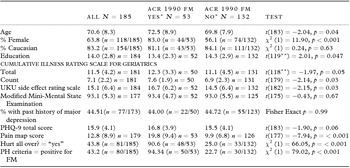
Between September 2, 2010 and January 27, 2014, we screened 892 participants, 226 of whom met inclusion and exclusion criteria and provided informed consent. A total of 194 participants began treatment. Of these 194 participants, 185 had information necessary to evaluate both the ACR 1990 FM criteria and information for the three screening instruments. The 41 participants who signed consent but excluded from these analyses were excluded for the following reasons: incomplete data (n = 10), further analysis of entry criteria between screening and baseline revealed ineligibility (n = 16), and withdrew consent before baseline (n = 15). Table 1 lists the demographic and clinical characteristics of the sample (n = 185). The mean age was 70.6 years old, and 63.8% were female.
Baseline demographic and clinical characteristics

*Fibromyalgia grouping determined by ACR 1990 classification criteria.
**Unequal variances: Satterthwaite method reported.
UKU: Udvalg for Kliniske Undersøgelser side effect rating scale.
PHQ-9: Patient Health Questionnaire – 9.
PH: Pope and Hudson.
Of these 185 participants, 53 (29%) met ACR 1990 criteria for FM. The participants in the FM group (defined as fulfilling the ACR 1990 FM criteria) were similar to those without FM in terms of depression diagnosis. Participants with FM were more likely to be older, female, less educated, have more medical comorbidity, and have higher numbers of somatic symptoms as measured with the UKU (Lingjaerde et al., Reference Lingjaerde, Ahifors, Bech, Dencker and Elgen1987). For the FM measures, the FM group had higher pain map scores, greater “yes” answers to the “hurt all over?” screening question, and more participants screened positive when scoring the PH criteria.
The area under the curve (AUC) of the ROC analyses using the pain map score to predict positive ACR 1990 FM criteria was 0.81 [95%CI 0.75–0.88]. A score of 8 or higher was determined to allow sensitivity greater than 0.90.
The sensitivity, specificity, and positive and negative predictive values for each of the screeners are summarized in Table 2. All three screeners offer sensitivity greater than 0.90. However, the pain map is notably less specific with a lower PPV when compared to the other two screeners, which suggests higher numbers of false positives.
Test characteristics of each of the screening methods

Because reduced pain reporting in mild cognitive impairment is a well-described phenomenon (Kunz et al., Reference Kunz, Mylius, Schepelmann and Lautenbacher2009; Shega et al., Reference Shega, Paice, Rockwood and Dale2010; Kruger et al., Reference Kruger, Abner, Mendiondo, Schmitt, Smith and Jicha2012), we performed a sensitivity analysis limited to participants who scored at least 84 on the Modified Mini-Mental State Examination. There were 19 participants who had a score less than 84 or were missing a score (n = 11, 8 respectively). Of those with a score of at least 84, 51 of 166 participants (31%) met the ACR 1990 FM criteria. To reach a sensitivity of at least 0.90, the cut-off score for the pain map was again 8. The sensitivity of the pain map, “hurt all over?” question, and PH criteria were 0.92 [95%CI 0.81–0.98], 0.90 [95%CI 0.79–0.97], and 0.94 [95%CI 0.84–0.99] respectively.
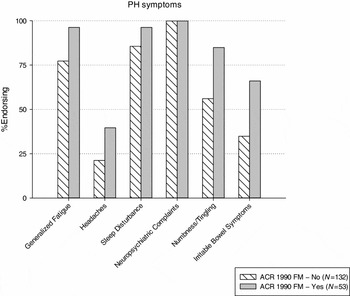
The frequencies of each of the endorsed PH symptoms are shown in Figure 3. Since all participants were depressed (by study design), they all endorsed neuropsychiatric complaints. Most participants with and without FM indicated high levels of sleep disturbance. In the logistic regression examining the five PH symptoms as predictors of FM, participants endorsing the PH criteria of generalized fatigue, numbness/tingling, and irritable bowel symptoms were more likely to have FM (respective OR = 7.96 [95%CI 1.71–37.13], 4.26 [95%CI 1.74–10.41], and 3.18 [95%CI 1.51–6.70]) while headaches and sleep disturbance failed to differentiate the groups at p < 0.05.
Breakdown of Pope and Hudson symptoms by ACR 1990 criteria status.

Conclusions
Because of the high comorbidity among late-life depression, chronic low back pain, and FM and the implications for treatment planning and prognosis, it is important to have a simple yet robust approach to FM screening in late-life psychiatric settings. Our findings support the feasibility of alternative screening methods for FM in this setting. Our findings are also novel in describing the estimated prevalence of FM in a late-life mental health sample. To our knowledge, this is the first such description.
While 7% of community-dwelling women are estimated to have clinically diagnosed FM (Wolfe et al., Reference Wolfe, Ross, Anderson, Russell and Hebert1995), it is remarkable we observed that 29% of participants in our clinical sample met the ACR 1990 FM criteria. While our sample of older adults suffering from comorbid pain and depression is admittedly a select subset of the broader geriatric population, the high FM prevalence in our sample suggests the need for additional characterization of FM in geriatric psychiatry settings. This observation also has relevance for treatment planning and referrals to other services, including rheumatology, pain, and psychosomatic specialists. Given the controversies involved with using the tender point exams in the ACR 1990 FM criteria (Harth and Nielson, Reference Harth and Nielson2007) and the low likelihood that psychiatrists and mental health clinicians would be trained to proficiency in the administration of the tender point exam, a psychometrically sound screener suitable for older adults with depression could guide further diagnostic testing or consultation.
Indeed, the simple screening question: “Do you often feel like you hurt all over?” demonstrated surprisingly high sensitivity and met our desired 0.90 sensitivity cut-off for screening. This finding is somewhat consistent with previous results, as the original ACR 1990 FM criteria study found “pain all over” to be a powerful discriminator with sensitivity and specificity of 0.67 and 0.81, respectively, when compared to expert clinical judgment of study investigators using their “usual method of diagnosis” (Wolfe et al., Reference Wolfe1990). It is remarkable that the question was more sensitive in our patient sample, as older adults suffer from a variety of causes of widespread pain, in particular generalized osteoarthritis. An obvious benefit of the “hurt all over?” question is its simplicity, as the question is “yes/no” format and could be easily added to an intake questionnaire or to a physician's review of systems.
The second test, a modified pain map with body regions divided into 45 equally-scored areas, was a slightly less robust screener, with strong sensitivity but markedly lower specificity. Previous studies have also looked at pain maps for use with older adults. Weiner et al. found a pain map to be useful for older adults in nursing homes because it is easy to comprehend, is a useful tool for documentation and treatment guidance, and has high test-retest reliability (Weiner et al., Reference Weiner, Peterson and Keefe1998). Other studies have used the McGill Pain Map to determine the existence of the widespread pain requirement for the ACR 1990 FM criteria (i.e. the first requirement of the ACR criteria, necessitating pain on both sides of the body, above and below the waist, and axial pain) (Wolfe et al., Reference Wolfe, Ross, Anderson, Russell and Hebert1995; Eggermont et al., Reference Eggermont, Shmerling and Leveille2010). To our knowledge, no studies have examined use of a pain map against the ACR 1990 FM criteria. We find this test less useful for broader use, as the lower specificity would result in higher numbers of false positives. It could also be more time consuming because of the need for clinical staff to score the map.
The sensitivity and specificity of the PH Interview were very similar to the “hurt all over?” question. The PH criteria may likewise offer a simple, scalable approach to screening for FM in psychiatric settings, as the questions could be added to an intake questionnaire and evaluated in a short amount of time. To our knowledge, this is the first study to evaluate the PH criteria subsequent to its initial publication.
We believe the “hurt all over?” and the PH criteria offer simple approaches for early identification of FM. In addition, the simple “hurt all over?” question may have good clinical utility given its simplicity and high NPV. That is, if patients deny “hurting all over,” they will not likely meet the 1990 ACR FM criteria. Given this robust combination of simplicity, high sensitivity, high NPV, and low assumed cost of implementation, we suggest further studies of the “hurt all over?” question as a screener for FM in late-life psychiatric settings. As part of an intake questionnaire, this question would serve as a red flag that would guide a thorough history to clarify the need for additional evaluation or formal diagnosis of FM. The trade-off in implementing such a strategy may be costs of further diagnostic evaluation of positive screeners that turn out to be false positives. For example, the “hurt all over?” question demonstrated a PPV of only 0.59 [95%CI 0.48–0.70]. This is a cost-benefit analysis that must be carefully weighed in the clinical setting. Our experience suggests that FM may complicate depression treatment and increase the risk for recurrent major depression, possibly supporting the benefits for screening and early diagnosis.
Using a scalable, stepped-approach with (1) a screener such as the “hurt all over?” question to identify potential FM cases, and (2) clinical judgment or further consultation for diagnosis, we feel that FM may be identified in late-life psychiatric settings with a high degree of sensitivity, again using the 1990 ACR classification criteria as our reference for diagnosis. Alternatively, given the relatively recent proliferation of screening tests for FM, another option for the geriatric psychiatrist is to choose a screener not evaluated in this study. The Fibromyalgia Rapid Screening Tool (FiRST) is one strong alternative (Perrot et al., Reference Perrot, Bouhassira, Fermanian and Cercle d’Etude de la Douleur en2010). This test is a self-completed questionnaire of “yes/no” questions that evaluates clinically-relevant characteristics of FM. To our knowledge, the FiRST has not been validated in late-life samples, especially those with depression. The items on the FiRST have high face validity and the self-report design suggest it may be useful in busy psychiatric practices. We plan to include it in future validation studies in our population of interest – depressed older adults. Indeed, the relatively high prevalence of FM in depressed older adults (especially those with chronic low back pain) combined with the challenge of precise diagnosis by non-rheumatologists supports the routine use of a screener with high precision. Our hope is that better characterization of FM in geriatric psychiatry clinics will lead to further research and development of treatment algorithms to guide the care of these complex patients.
Participants were included only if their primary pain complaint was low back pain. This is in contrast to the ACR 1990 FM criteria requirement of “axial pain” for classification of FM. Thus, the participants in our study who met criteria for FM may represent a subset of FM patients, since we excluded participants who primarily endorsed cervical or thoracic pain. Our study is limited in design, in that the screening methods and PH criteria were not administered as independent tests by clinicians blinded to the participant's ACR 1990 FM criteria classification status. This could have introduced bias. Similarly, as all screeners were presented to participants in the same order, there is a risk of priming of symptom reporting. We hypothesized that progressing from the simplest (hurt all over?) to the most complex (PH) would minimize primed symptom reporting. Another limitation is that the FM and no-FM groups differed in some respects (i.e. age, education, medical comorbidity, somatic symptom burden as measured with the UKU) and these differences may have affected our findings. Our results may not generalize to all older adults (i.e. those presenting to primary care without depression), given that all of our participants had comorbid low back pain and depression. On the other hand, our study population may be more representative of a geriatric psychiatry cohort, increasing the validity of these alternative tests with respect to patients seen in late-life mental health settings. Finally, we emphasize that in practice, FM is a clinical diagnosis, and our analysis examines characteristics of three screeners against the established research standard, the ACR 1990 FM classification criteria. Further validation against a clinical diagnosis of FM should be undertaken so that the value of these user-friendly measures in clinical practice can be further ascertained.
In summary, in late-life psychiatric clinics and studies, evaluation of FM using a simple screener to guide further diagnosis may have broad uptake, given the current limitations of the ACR criteria and difficulty of clinical diagnosis. One possible approach to screening in the psychiatric setting could be to administer the “hurt all over?” question. Because of the high NPV of this probe, if the patient responds “no,” then screening is complete. Validation of a FM screening measure for older adults, especially those with depression who may be at high risk of depression recurrence, and improved training of mental health professionals in its use, may improve patient outcomes by guiding treatment and informing a multidisciplinary approach to these complex patients. While it is beyond the scope of this paper to describe best practice approaches for these therapeutically challenging patients, given the relatively high rate of FM in this unique sample, there is a need for the development and testing of population-specific treatments. Promoting the use of high-quality screening and diagnostic criteria may advance precise classification and treatment planning.
Conflict of interest
Dr Karp has received medication supplies for investigator-initiated research from Pfizer and Reckitt Benckiser. The other authors do not declare any potential conflict of interest.
Description of authors’ roles
All authors contributed equally to the conceptualization of this project, writing, and analysis of data. Amy E. Begley provided biostatistical support. Dr Karp secured funding and directed participant recruitment.
Acknowledgments
Supported in part by AG033575 (Karp) and R25 MH071544 through the M-STREAM program: Medical Student Training and Research Experience in Aging and Mental Health (Jochum). The project also received support by P30 MH090333, UL1 RR024153, and UL1TR000005. The content is solely the responsibility of the authors.