Introduction
The global movement of people is an increasing feature of contemporary life that European nation states position as a problem to be controlled (Brambilla et al., Reference Brambilla, Laine and Bocchi2015). Within this, the UK has created an intentionally ‘hostile environment’ towards immigration, which includes restricting a person’s access to social welfare, dependent upon their immigration status. As such, internal ‘everyday bordering’ practices (Yuval-Davis et al., Reference Yuval-Davis, Wemyss and Cassidy2018) are an increasing feature of this control, with some social care practitioners being required to enact bordering practices, including checking the immigration status of migrant families they support and their subsequent entitlement to service provision. Whilst ways in which state policy is experienced in local communities has long been of sociological concern, we focus here on Lipsky’s work. Originally writing in 1980, Lipsky introduced the street-level bureaucracy framework (Reference Lipsky2010 [first published 1980]) to interrogate the relationship between state policy, the work of public sector officials – ‘street-level bureaucrats’ (SLBs) – and public experiences: the mechanisms through which statutory policy is made in everyday life. Although Lipsky initially applied his thinking to the American context, he argues that his framework is applicable to all public services where there are significant interactions with the public (Reference Lipsky2010: xvii). Indeed, the framework has been used extensively to examine the enactment and/or resistance of policy in different welfare states (Gjersøe and Strand, Reference Gjersøe and Strand2021; Farwa and Henman, Reference Farwa and Henman2023), by public servants representing specific professions (Alden, Reference Alden2015; Ellis, Reference Ellis2011).
Immigration policy garners considerable political and public attention in diverse national contexts, and scholars have drawn on Lipsky’s framework to examine the practices through which this policy arena is interpreted and ‘made’ at the street level (Brodkin, Reference Brodkin2012; Andreetta, Reference Andreetta2022; Anitha and Gill, Reference Anitha and Gill2022). In 2018, however, Yuval-Davis et al. introduced the concept of ‘everyday bordering’ to describe the unique ways in which migrants and other actors experience intensified bordering practices, and the extension of ‘hostile environment’ policies into everyday life (Bloch and McKay, Reference Bloch and McKay2015; Crawford et al., Reference Crawford, McKee and Leahy2020). Subsequently, scholars have applied this concept to the practices of those Lipsky would recognise as SLBs – public servants – and others who now have statutory duties to enact borders (Bloch and McKay, Reference Bloch and McKay2015; Dickson and Rosen, Reference Dickson and Rosen2021) as newly located, ‘untrained and unpaid border guards’ (Yuval-Davis et al., Reference Yuval-Davis, Wemyss and Cassidy2018: 235). Whilst Lipsky (Reference Lipsky2010) is briefly referenced in these works, consideration of the ways in which his work interacts with Yuval-Davis et al.’s (Reference Yuval-Davis, Wemyss and Cassidy2018) concept is absent. Here, we address this gap and articulate a different understanding of who is and is not an actor in the making of policy in contemporary welfare states. We do so by drawing on qualitative data generated during the Economic and Social Research Council (ESRC)-funded ‘Everyday Bordering in the UK’ project, with a focus on the narratives of UK social care practitioners. This study aimed, in part, to conceptualise differences between statutory and non-statutory ‘everyday bordering’ practices in social care services working with migrant family members in both the public, and voluntary and community sector (VCS), the latter being non-governmental organisations (NGOs). Our findings show that, in a context where welfare provision is increasingly outsourced and bordering practices continue to intensify (Griffiths and Yeo, Reference Griffiths and Yeo2021), the distinction between who enacts and/or resists these practices is opaque.
By bringing together Lipsky’s (Reference Lipsky2010) and Yuval-Davis et al.’s (Reference Yuval-Davis, Wemyss and Cassidy2018) conceptual frames, the paper considers the ways in which outsourcing has created a ‘network of support’ services – which we conceptualise as ‘networks of enactment’ and ‘networks of resistance’ – that perpetuate and dilute the implementation of bordering practices. By identifying these networks, we offer new ways of theorising the types of bordering practices that occur in social care provision within mixed welfare economies – ‘statutory bordering’, ‘co-opted bordering’, and ‘shadow bordering’ – as well as strategies employed to resist state exclusionary bordering practices. In doing so, we advance existing conceptualisations of everyday bordering and theorisations of street-level bureaucracies and provide a more nuanced perspective on the relationship between the state, social care practitioners and migrant families with whom they work.
The article starts by outlining pertinent features of Lipsky’s framework and example applications to the enactment of immigration policies in varied welfare states. The relationship between everyday bordering and the UK’s hostile environment towards immigration is then considered, as are the related roles of statutory and non-statutory actors, and the relevance to UK social care provision. Following this, the research design is described. Finally, we present empirical data to illustrate the ways in which a decentralised model of social care provision creates a ‘network of support’ services – characterised by ‘networks of resistance’ and ‘enactment’ – that enhance the street-level delivery of immigration legislation, whilst providing opportunities for state and non-state actors to navigate and soften impacts of hostile environment policies on members of migrant families.
Street-level bureaucrats and immigration policy
For Lipsky (Reference Lipsky2010), SLBs are public sector employees that interact with the public. As government employees, they are required to interpret and enact state policy in their professional practice. Policy is therefore reproduced in myriad ways by multiple actors, and every encounter between public sector officials and the public is an instance of policy delivery and an extension of state power. However, contextual factors impact on these employees’ practices, and they necessarily exercise discretion in decision-making, thereby playing a key role in the ways in which policy is reproduced and experienced by service recipients. In Lipsky’s words, ‘the decisions of street level bureaucrats, the routines they establish, and the devices they invent to cope with uncertainties and work pressures, effectively become the public policies they carry out’ (ibid: viii). He further argues that most public servants enter their work with intentions to realise positive change, that they arbitrate the relationship between individuals and the state, but are accountable to both (ibid: 5). However, because of structural restrictions – for example, reductions in state funding and complex bureaucracy – practitioners face difficult dilemmas and develop ‘coping mechanisms’ and ‘people processing’ strategies, and make what they see as ‘acceptable compromises’, allowing them to do ‘a reasonable job with the resources at their disposal’ (ibid: xviii). What is perceived as ‘acceptable’ is, of course, individualised, and compromises made can be at the expense of professional values and service users’ receiving tailored, timely interventions. As such, Lipsky asserts that the ‘ways in which street level bureaucrats deliver benefits and sanctions structure and delimit people’s lives and opportunities’ (ibid: 5). Consequently, SLBs also perform an important role in absorbing conflict between people and the state (ibid: 184).
Building on Lipsky’s claim that his framework is applicable to all contexts where public servants have significant face-to-face interactions with the public (Reference Lipsky2010: xvii), it has been applied to the ways in which immigration policy is implemented by public sector officials in different welfare state contexts. Specific examples include: the impact of ‘emotions’ in welfare officers’ assessments of migrants’ ‘deservingness’ when accessing welfare benefits in Belgium (Andreetta, Reference Andreetta2022), forced migrants’ accounts of obstacles to forming ‘trust’ with Finnish welfare representatives (Sundbäck, Reference Sundbäck2023) and how UK public servants’ enactment of immigration policy adds to psychological distress experienced by people seeking asylum (Bhatia, Reference Bhatia2020). Overall, analysis of immigration policy implementation concludes that, whilst public sector officials are conflicted in their enforcement of policy, SLBs do behave in ways that limit migrants’ ability to access public services (Brodkin, Reference Brodkin2012).
Everyday bordering and the hostile environment
In Europe, immigration policy continues to be concerned with the control of migration at national borders, but there is also an increasing focus on the governance of people within a country (Brambilla et al., Reference Brambilla, Laine and Bocchi2015). Indeed, in 2012, Teresa May, the UK’s then Home Secretary, announced the intention to create ‘a really hostile environment for illegal immigrants’ by denying undocumented migrants access to work, housing, bank accounts and services (Kirkup and Winnett, Reference Kirkup and Winett2012). Subsequently, the 2014 and 2016 Immigration Acts extended responsibilities to check a person’s migration status – to enact ‘everyday borders’ (Yuval-Davis et al., Reference Yuval-Davis, Wemyss and Cassidy2018) – to landlords, educational staff, bank administrators, and health and social care professionals. As such, not only are statutory duties to enact related policy imposed on those directly employed by the state – those traditionally positioned as ‘SLBs’ – but members of civil society are also positioned as ‘untrained and unpaid border guards’ (ibid: 235). Subsequently, this contributes to wider hostile environment policies being ‘difficult to pin down’, because they are implemented across policy arenas and sectors (Griffiths and Yeo, Reference Griffiths and Yeo2021: 2). As such, Griffiths and Yeo (Reference Griffiths and Yeo2021) position this policy as an ‘ideological stance’ which, whilst ostensibly aimed at deterring ‘illegal immigrants’ from entering and staying in the UK, has consequences for undocumented and documented migrants.
The relationship between immigration control and access to welfare has long been a feature of immigration policy, with entitlement to services being based on a range of factors, including immigration status (Oliver, Reference Oliver2020). This has, however, escalated as the hostile environment has gained momentum. State-funded services and benefits to which economic migrants have access are increasingly contingent upon the terms of their immigration status (Coddington, Reference Coddington2019), and the entitlements of people seeking asylum are restricted or denied (Lewis et al., Reference Lewis, Waite and Hodgkinson2017). Furthermore, increasing numbers of people are granted the status of ‘no recourse to public funds’ (NRPF), meaning they are unable to claim most benefits and housing assistance, often resulting in families experiencing manufactured precarity and destitution (Jolly and Gupta, Reference Jolly and Gupta2022). If, then, the ways in which SLBs enact policy are influenced by the societal contexts in which they operate (Lipsky, Reference Lipsky2010), in the hostile atmosphere described, social care professionals working with members of migrant families face multiple pressures.
Studies consider social actors that have a statutory duty to enact policy in the form of ‘everyday borders’, and their impacts on migrant populations (Bloch and McKay, Reference Bloch and McKay2015; Crawford et al., Reference Crawford, McKee and Leahy2020). However, few focus on statutory social care with families and children in the UK. Notable examples include Walsh et al’s. (Reference Walsh, Khoo and Nygren2022) comparative analysis of everyday border enactment in the UK, Sweden and Bulgaria; Jolly and Gupta’s (Reference Jolly and Gupta2022) examination of the impact of NRPF on children and families; and Wroe’s (Reference Wroe2019) and Humphries’ (Reference Humphries2004) exploration of the ways in which social workers uncritically play a role in the enactment of immigration policy. Further research shows that social care practitioners without statutory duties may also act in ways that reduce and/or enhance impacts of the hostile environment on those they aim to support. While Mayblin and James (Reference Mayblin and James2018) argue that the VCS ‘fills the gaps’ in state provision created by exclusionary immigration policy, limited literature considers the contribution of VCS organisations in reproducing and challenging hostile environment policies. Existent examples include: impacts on Survivors of Trafficking when faith-based organisations deliver Home Office (HO) contracts (Waite et al., Reference Waite, Lewis, Murray and Tomalin2023); and how, in the context of UK austerity, volunteers replace paid workers in support provision, resulting in their personal values shaping interventions with Romanian Roma (Humphris, Reference Humphris2019).
Within the hostile environment there are, then, sectors and people who would not, in any way, see themselves as SLBs responsible for delivering public services, such as bank clerks (Yuval-Davis et al., Reference Yuval-Davis, Wemyss and Cassidy2018). Our focus here, however, is on the under-explored relationship between the roles of public sector employees (formal SLBs), and VCS employees that have an ambiguous role in relation to the state. This is because the latter provide welfare support services to migrant families, but some are subcontracted by the state and others funded by independent bodies (see below).
The UK context and public service provision
The ways in which state welfare is provided has changed significantly since Lipsky (Reference Lipsky2010) introduced his framework in 1980. At that time, public services were primarily provided by the state, who directly employed SLBs. Individuals therefore became public servants expecting to deliver policy during face-to-face interactions with the public. However, since this time, the UK and other anglophone countries have explicitly promoted mixed welfare economies (Macmillan and Ellis Paine, Reference Macmillan and Ellis Paine2021); underpinned by a neoliberal narrative of ‘value for money’, local and national governments commissionFootnote 1 and regulate public services provided by VCS and private organisations (ibid). Austerity measures, implemented by the UK government in the wake of the 2008 global financial crash, have also led to the retrenchment of publicly funded services (Briggs and Hall, Reference Briggs and Hall2023). As such, a further financial driver for the state is that, in mixed economies, third-sector organisations can access additional sources of charitable funding that partly compensate for limited government-funded service provision (Waite et al., Reference Waite, Lewis, Murray and Tomalin2023). The role of the VCS in delivering services that were previously the remit of the public sector has thereby significantly increased. We contend, then, that within contemporary mixed welfare economies, ‘networks of support services’ develop. By this, we mean groups of services (some specific to migrant populations and some not), including: those delivered directly by the state; those procured by the state to be delivered by NGOs; and services funded by independent grant giving trusts and also delivered by NGOs.
In his original theory, Lipsky considers ‘professionalism’ and ‘discretion’ to conceptualise how frontline civil servants (SLBs) manage tensions experienced when maintaining professional standards to which they must adhere, whilst also exercising their subjective judgement (Borrelli et al., Reference Borrelli, Hedlund, Johannesson and Lindberg2023). Within the ‘networks of support’ identified, social care practitioners working face-to-face with the public have diverse professional backgrounds but are not always typically identified as SLBs. Furthermore, they are likely guided by different professional values and cultures, and feel varying levels of accountability for enacting state policy. Social workers in statutory services are, for example, guided by principles prescribed by the professional body with which they are registered, the first being to ‘promote the rights, strengths and wellbeing of people, families and communities’ (Social Work England, 2024). They are also expected to act as state agents and are subject to rising governmental control: factors that can limit their discretion (Murphy, Reference Murphy2023). By contrast, the VCS is historically independently funded, and employees, whilst highly skilled, are less likely to be bound by formal professional standards. Employees are subsequently less restricted by state and professional requirements, able to exercise more flexibility and discretion than public servants and often act as advocates that nurture close relationships with service users: characteristics of the VCS that are potentially undermined when NGOs deliver public sector contracts, with obligations related to policy delivery (Macmillan and Ellis Paine, Reference Macmillan and Ellis Paine2021). However, access to non-government charitable funds is increasingly competitive, and charities are ‘running on empty’ (Briggs and Hall, Reference Briggs and Hall2023: 5). Delivering state-funded services is therefore appealing in this context because it provides more security for VCS employees and service users.
Although recent iterations of Lipsky’s (Reference Lipsky2010) seminal text position changes to welfare states as being driven by a desire to improve quality in policy delivery, an examination of the ways in which policy is enacted across such networks is absent. Brodkin, however, calls for an analysis of ‘deep and complex organisational behaviours’ to understand whether such changes have supported policy being ‘made’ effectively at the street level (Reference Brodkin2012: 947): a call to which we respond. We focus on the ways in which the UK’s hostile environment is reproduced and/or diluted across these networks because, while statutory requirements related to immigration policy – everyday bordering practices (Yuval-Davis et al., Reference Yuval-Davis, Wemyss and Cassidy2018) – are imposed on some practitioners within these networks, for others, their role in enacting the ‘difficult to pin down’ (Griffiths and Yeo, Reference Griffiths and Yeo2021: 2) ideology is unspecified. Nevertheless, the increasing number of public services delivered by NGOs allows UK immigration controls to permeate the work of social care practitioners not typically seen as public servants and confuses who is positioned as a street-level actor that ‘makes’ policy in this context. We contribute, therefore, by developing understandings of how these changing structures support ‘everyday bordering’ practices and hostile environment ideologies – with a focus on social care services supporting migrant families – and by developing Lipsky’s framework in ways appropriate to contemporary mixed welfare economies in the UK and beyond.
Methodological approach
The study upon which we draw broadly explored whether, and how, the UK’s hostile environment towards immigration impacts on social care practice and the migrant families they support. We employed a multi-method ethnographic approach, underpinned by values of co-production, working with two social care providers in two under-researched northern post-industrial English cities: Hull and Sheffield. Our ontological position is committed to: conducting research with people and communities; reducing barriers between service users and providers; and valuing individuals as experts in their own lives.
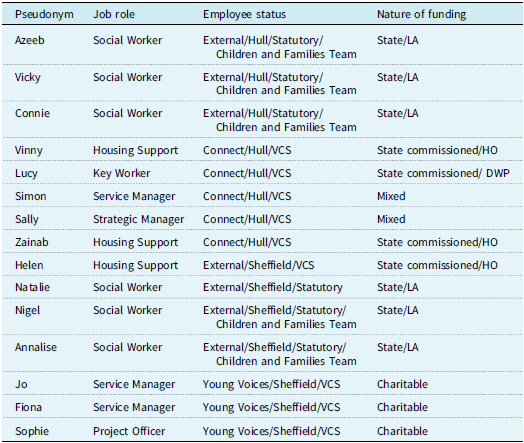
Between spring 2020 and winter 2021, we worked with practitioners representing varied occupations and migrant family members with diverse migratory experiences. As this was initially during coronavirus disease 2019 (COVID-19) restrictions, we engaged in online ethnographic activities which were later moved to in-person environments (Walsh et al., Reference Walsh, Khan and Ferazzoli2023). Alongside recording observations in field notes, we conducted focus groups and individual interviews with practitioners, using interviews and participatory methods when working with migrant family members. Here, we focus on practitioner accounts because of our interest in developing theorisations of SLB (Table 1).
Table of the participants cited in the paper

Table 1 Long description
A table listing participants with their job roles, employee status, and nature of funding. The table has four columns: Pseudonym, Job role, Employee status, and Nature of funding. It contains 13 rows of data. Row 1: Azeeb, Social Worker, External/Hull/Statutory/Children and Families Team, State/LA. Row 2: Vicky, Social Worker, External/Hull/Statutory/Children and Families Team, State/LA. Row 3: Connie, Social Worker, External/Hull/Statutory/Children and Families Team, State/LA. Row 4: Vinny, Housing Support, Connect/Hull/VCS, State commissioned/HO. Row 5: Lucy, Key Worker, Connect/Hull/VCS, State commissioned/DWP. Row 6: Simon, Service Manager, Connect/Hull/VCS, Mixed. Row 7: Sally, Strategic Manager, Connect/Hull/VCS, Mixed. Row 8: Zainab, Housing Support, Connect/Hull/VCS, State commissioned/HO. Row 9: Helen, Housing Support, External/Sheffield/VCS, State commissioned/HO. Row 10: Natalie, Social Worker, External/Sheffield/Statutory, State/LA. Row 11: Nigel, Social Worker, External/Sheffield/Statutory/Children and Families Team, State/LA. Row 12: Annalise, Social Worker, External/Sheffield/Statutory/Children and Families Team, State/LA. Row 13: Jo, Service Manager, Young Voices/Sheffield/VCS, Charitable. Row 14: Fiona, Service Manager, Young Voices/Sheffield/VCS, Charitable. Row 15: Sophie, Project Officer, Young Voices/Sheffield/VCS, Charitable.
Our definition of ‘social care’ is broad to capture the diversity of practitioners that migrant family members encounter when accessing support services. Professions represented included social workers, family support workers, youth and community workers, housing support officers and community-based educators. For Lipsky (Reference Lipsky2010), some – as public servants – would be recognised as ‘SLBs’ (statutory social workers), whilst others providing services (sometimes state funded) were directly employed by NGOs. Some had statutory and/or contractual duties to enact ‘everyday borders’ – checking residency documents and entitlement to welfare support – whilst others did not. Practitioners reflected on supporting migrant family members with varied migration backgrounds: people seeking asylum, refugees, people with family reunification visas and others who came to the UK as European Union (EU) citizens prior to Brexit. Data considered here include transcripts from: ‘first-wave’ focus groups and ‘follow-up’ interviews with practitioners working in collaborating organisations; and interviews with practitioners working for organisations within our collaborators’ networks, including VCS and statutory providers.
In Hull, we worked with a medium-sized charity we call ‘Connect’. Within its service portfolio it holds contracts with: the Home Office (HO), providing housing support to refugees; the local authority (LA), delivering support to families, young people and pregnant women; and the Department of Work and Pensions (DWP), to provide training and holistic support for individuals and families with ‘leave to remain’. It also generates income via charitable trusts to support projects, such as food banks and community development activities. In Sheffield, we worked with a smaller charity we call ‘Young Voices’ (YVs) that aims to empower young people in South Yorkshire. Within its service portfolio it holds contracts with: the National Health Service (NHS) to deliver projects supporting all young people’s wellbeing; and LAs to enable young people to have ‘voice’ within communities. It too generates income from charitable trusts to fund inclusion projects, including a support group for unaccompanied asylum-seeking childrenFootnote 2 (UASC).
‘First-wave’ focus groups (19 participants) were exploratory, allowing participants to discuss their experiences when supporting migrant family members and to shape subsequent stages of the study. Emergent themes were collated into a short document that was shared with practitioners prior to a follow-up, ‘mid-point interview’ (n = 15). This informed interview discussions, allowing participants to consider and add detail to the themes identified. In parallel to midpoint interviews, we conducted semi-structured interviews with practitioners external to collaborating organisations but within their professional networks when supporting migrant family members in Hull and Sheffield (n = 13).
Relevant ethical approval was sought prior to fieldwork, and throughout, we remained alert to the sensitivities of discussing lived experience of migration status and related practice interactions. Our ethnographic research design supported this, because the relational strengths of the approach (Walsh et al., Reference Walsh, Khan and Ferazzoli2023) enabled the development of trusting field relationships from the outset. This facilitated open and reciprocal interactions, ensuring that participation was voluntary and fully informed. We have also taken measures to protect identities: organisations (collaborating and partner) have been anonymised; individual identifying characteristics removed from data; and data are stored securely.
After each stage of the study, audio recordings were transcribed verbatim and thematic analysis applied. Transcriptions were read multiple times and emergent codes systematically applied to the data corpus and organised using Nvivo. This supported the emergence of themes relevant to the research aims and objectives. Analysis presented focusses on differences and similarities in practice narratives across sectors within the ‘network of support’ services described.
Findings
Analysis reveals that ‘networks of support’, resulting from mixed welfare provision, create opportunities for immigration policy to be enacted and/or resisted in contexts beyond support services directly provided by the state: traditional SLBs. Specifically, we argue that the organisation of services, combined with the ‘difficult to pin down’ nature of the hostile environment (Griffiths and Yeo, Reference Griffiths and Yeo2021: 2), means that ‘networks of enactment’ and ‘networks of resistance’ are enabled, simultaneously enhancing and diluting what contributory policies ‘become’ at street level (Lipsky, Reference Lipsky2010).
Networks of enactment
Data show that practitioners across sectors engage in three distinct and previously undefined bordering practices that combine and contribute to the enactment and amplification of hostile environment ideologies: ‘statutory bordering’, ‘co-opted bordering’ and ‘shadow bordering’. UK VCS organisations deliver significant aspects of public service, which creates pathways for exclusionary bordering practices – traditionally delivered by SLBs – to bleed through ‘networks of support’. This blurs the distinction between statutory and non-statutory enactment of ‘everyday borders’, effectively extending hostile environment policies and practices further into everyday life, and troubling conceptions of who is a SLB.
Statutory bordering
Social workers (public sector officials) delivering statutory children and families social care confirm that they enact overt border controls (Wroe, Reference Wroe2019). In Sheffield, Natalie and Nigel describe procedures when first meeting young people who are newly arrived and potentially UASC. At the initial meeting, they conduct ‘legality’ checks by asking to see ‘a passport’ or ‘Home Office documents’. Nigel further explains that they ‘check with the Home Office: “are you aware of this person, where are they at with their [age] assessment”Footnote 3 ’. Whilst Nigel’s primary concern is whether an age assessment has been conducted and, therefore, whether the young person should be a client in his service, their presence in the UK is willingly ‘documented’ with the Home Office.
Practitioners in Hull (Azeeb) and Sheffield (Natalie and Nigel) also conduct ‘age assessments’ – an overt bordering practice – but express unease at being attributed the role of ‘untrained’ border guards (Yuval-Davis et al., Reference Yuval-Davis, Wemyss and Cassidy2018: 235). Natalie’s account is, for example, infused with a tone protective of young people and her profession, expressed in her focus on procedural requirements: the assessment should be conducted by a ‘qualified social worker’; there should be ‘two social workers’; and the young person should have an ‘appropriate adult’ with them. She finishes by emphasising that social workers have some influence here, in that assessments should only be conducted if a ‘social worker thinks this is appropriate, and not as a matter of routine, even if the Home Office say’.
Azeeb also asserts his professional values in the face of being required to conduct assessments; as a practitioner in the area’s Children and Families Team, he found it unacceptable that ‘the quality of service and the knowledge was so minimal in terms of some unaccompanied young people coming over’ and successfully lobbied the LA to fund a team dedicated to UASC. As such, he reports that the team have increasing ‘expertise’ in working with UASC, and they have ‘recently gone on age assessment training’.
These public sector employees therefore develop strategies with the aim of achieving what they see as ‘acceptable compromises’ (Lipsky, Reference Lipsky2010: xviii) within the bounds of the professional discretion afforded them; they seemingly accept their formal SLB role in ‘people processing’ – as social workers – but distance themselves from the role of ‘border guard’. However, it remains that the overt bordering practice at the core of these narratives receives little professional challenge (Humphries, Reference Humphries2004) despite perpetuating the hostile environment, with significant ramifications; if a person is assessed as being a minor, they are afforded significantly more rights than an adult seeking asylum (BASW, 2023).
Co-opted bordering
Participants reveal that, when NGOs are commissioned by local or central government to deliver services, bordering practices are ‘deputised’ (Griffiths and Yeo, Reference Griffiths and Yeo2021) – or co-opted – to VCS employees. Helen (Sheffield) works for a charity funded by the Home Office to support women and their children in South Yorkshire who are in the process of claiming they are ‘modern slavery victims’ via the National Referral Mechanism.Footnote 4 Consequently, she is contractually expected to check that clients have ‘temporary leave to remain for a period, so they would be able to access our support during that time’. Similarly, in Hull, Connect receives Home Office funding to provide housing support to refugees, and Vinny (a project worker) describes how potential ‘beneficiaries’ must produce their ‘residence permit card and the British Residency Permit number’ before they can receive support. A second Connect project, funded by the DWP, supports people into employment, providing English for Speakers of Other Languages (ESOL) classes where required, and holistic support for service users’ families. As access to the project is dependent on learners having ‘leave to remain’, Lucy (community educator) explains that ‘a residency permit has to be proof of identification when people register for the programme’.
These VCS practitioner accounts differ from those of statutory participants, because they give less emphasis to professional frameworks, and more overt compassion is exhibited towards service users: when Vinny checks people’s documents, he tries to be ‘as friendly and as nice as possible, because it’s not nice meeting a complete stranger and asking for all your worldly sort of details and identification, is it?’; and Lucy ‘carries around’ a visual aid she has created, because ‘they’ll see a picture if they don’t understand English very well, and it’s just to let them know what they have to have’. These NGO employees do not, however, recognise these checks as exclusionary bordering practices but, rather, a ‘rationing’ (Lipsky, Reference Lipsky2010) process, informed by contractual terms. Vinny, for example, explains that status has to be checked, because the Home Office funding requires the project to reach a target of ‘14 unique beneficiaries every three months’, all with refugee status. Similarly, but in more explicit terms, Simon (Hull, team manager) states that:
I’m looking at it in a different way to the person who’s looking at it, who’s checking, if like, it’s a copper or some person who’s part of an immigration team […] If we saw that they weren’t meant to be here, they’d be ineligible, but I don’t know what else that’d mean. We’d probably still support them anyway. I don’t know if we’d ring the cops.
Nonetheless, commissioning processes position these VCS employees as ‘co-opted SLBs’, and they comply with what is contractually expected of them; here, NGO delivery of public sector contracts undermines their historical independence from the state, and they become actors in related policy delivery (Macmillan and Ellis Paine, Reference Macmillan and Ellis Paine2021). Whilst these VCS employees’ narratives reveal that, like formal SLBs, they ‘develop techniques to salvage decision-making values within the limits imposed on them by the structure of their work’ (Lipsky, Reference Lipsky2010: xiv), it remains that they do play a significant role in enacting exclusionary ‘everyday borders’ and, thereby, extend the reach of hostile environment ideologies.
Shadow bordering
Practitioners from VCS provision within ‘networks of support’ are also implicated in the maintenance of the hostile environment because they work in the presence of what we describe as ‘shadow borders’; they are not required to check a person’s immigration documents, but the increasingly targeted nature of charitably funded projects also excludes people on the basis of migration status. Zainab describes, for example, working within a Connect project that historically provided therapeutic services to refugees and people seeking asylum. However, when the funding term ended, managers were only able to secure resources to continue working with refugees, an exclusion that Zainab recognises adds to the psychological distress experienced by people seeking asylum (Bhatia, Reference Bhatia2020):
Mental health issue is not just for refugee […] But the usual, the fund always is specific for people. It’s difficult when they say there is no money for asylum seeker […] the fund is controlling which people can be included and which people are excluded […] Because at that time I received like ten referrals for asylum seeker, I said, “I’m sorry, our fund just for refugees, it’s not supporting asylum seekers”.
Similarly, a Young Voices project targeted at young people with migratory backgrounds is independently funded to specifically support UASC, which is a consequence of funding availability and organisational capacity. Indeed, Jo (project manager) reflects on the exclusionary nature of this project, stating that, ‘we’re doing what we can do, which is provide a safe space for and support for a particular group of young people […] I’m not sure we have capacity to do very much more’. She does, however, recognise that this means that ‘there are probably swathes of young people from other migrant communities that we’re not working with’. While funders have prioritised the target groups for these projects – on the basis of their conception of the ‘deservingness’ (Andreetta, Reference Andreetta2022) of UASC – and project workers are not responsible for this, it remains that they are implicated in the enactment of the ‘shadow borders’ and welfare exclusions of hostile environment ideologies.
Networks of support, underpinned by the shift to a mixed welfare model in anglophone countries (Macmillan and Ellis Paine, Reference Macmillan and Ellis Paine2021), can thereby lead to ‘networks of enactment’ that support the propagation of bordering practices in sectors that have not historically delivered public services or enacted policy at the street level. Whilst some social work participants – as formal SLBs – are tasked with conducting overt immigration checks, the outsourcing of government contracts allows the state to ‘co-opt SLBs’ and deputise bordering responsibilities to VCS employees. Independent funders also ‘ration’ resources by prioritising services for specific migrant groups, creating additional exclusionary ‘shadow borders’. The increased reach of bordering practices is further enabled when the ‘difficult to pin down’ nature of the hostile environment (Griffiths and Yeo, Reference Griffiths and Yeo2021: 2) coalesces with a reduction in funds across sectors; practitioners reject their role in enacting exclusionary ‘everyday borders’ (Yuval-Davis et al., Reference Yuval-Davis, Wemyss and Cassidy2018) by framing them as ‘rationing’ (Lipsky, Reference Lipsky2010) actions necessary within the context of scarce and targeted resource. Nevertheless, ‘networks of enactment’ do extend the reach of state power, and the hostile environment, further into everyday life.
Networks of resistance
Analysis reveals that, parallel to ‘networks of enactment’, mixed welfare economies simultaneously support ‘networks of resistance’, allowing practitioners across sectors to attempt to soften the impact of hostile environment policies at the street level. In this sense, practitioners from all sectors perform an important role in ‘absorbing conflict between people and the state’ (Lipsky, Reference Lipsky2010: 184). However, strategies employed differ, depending on: how outsourcing of state provision impacts on opportunities available to organisations; funding scarcity; the level of professional discretion that practitioners are afforded; and individual and/or organisational accountability to the state and service users.
Referring from statutory to VCS
Participants working in statutory provision (formal SLBs) describe little professional resistance in the context of enacting bordering practices (Humphries, Reference Humphries2004) and accept that they have limited professional discretion. Connie (Hull), for example, refers to her work with people seeking asylum and states that:
I think there’s probably no room for that discretion because, at the end of the day, those that we come across, they can’t, you know, they haven’t got an income, they haven’t got access to social housing, or benefits, and there’s not very much that we can do […] we have to be really realistic and resign ourselves to, you know, there are elements of services that we can’t have any influence on.
These participants do, however, also describe drawing on VCS organisations in their ‘network’ to navigate and resist restrictions. Indeed, Annalise (Sheffield) works with families facing destitution because of their NRPF status (Jolly and Gupta, Reference Jolly and Gupta2022) and assesses needs by asking ‘OK what is available to them, what charities can help, where can we access this support as opposed to just spending money’. Similarly, Vicky (Hull) draws on specialisms within the VCS – which she lacks – to address issues families face, and she lists organisations to whom she refers: a ‘project that works with refugee and asylum seeking families’, ‘a project specifically for [migrant] women and they can take children […] and a project that offers housing specifically for migrant families’.
VCS practitioners confirm that referral from statutory services – which is in essence a ‘people processing’ practice informed by ‘everyday bordering’ exclusions – can result in service users receiving ‘the best that they can under prevailing circumstances’ (Lipsky, Reference Lipsky2010: xv). For Pauline, (Hull, Connect), some migrant families are difficult to engage, but when they come into contact with statutory services (say when they have a baby), referral to her team ‘is where sometimes the ball can start rolling through’. Within Connect, this facilitates access to other internal projects: Lucy (Hull, Connect) describes how she can escort any migrant family to access charity mental health workers, or Citizens Advice Bureau workers based in the same building as her; and Pauline explains that, when they support families with NRPF, they access Connect projects, such as the food bank, to provide ‘nappies’ and other essentials. Fiona at Young Voices also explains that Sheffield LA have ‘been good’ at referring UASC to their project and, as a smaller charity, they have secured independent funding to deliver a partnership project with other specialist Sheffield charities. As such, when newly arrived members of migrant families are referred to Young Voices from social care, they access this specialised network, which Fiona outlines:
Welcome to All being a partner is great because they’ve got sort of that real expertise around working with asylum seekers and refugees. And where they’re based, lots of other organisations are based as well […] There’s Shared Kitchen who are a group of newly-arrived people that cook together, but then you’ve got all the – there’s a lot of solicitors based there.
Social workers thereby refer to VCS networks to reduce demand on public services, and to navigate the bureaucratic inflexibility they face as public servants; in the context of immigration policy, they remain accountable to the state – from a policy and resourcing perspective – and, to some degree, members of migrant families. Indeed, ‘networks of resistance’ allow formal SLBs to adopt strategies that soften some impacts of the hostile environment on service users, without adding to their workload (Lipsky, Reference Lipsky2010: 102), albeit in ways that add to that of other actors in the network.
VCS flexibility and diluted accountability to the state
Within ‘networks of support’, bureaucratic processes and practitioners’ commitment to enacting state policy vary considerably. Senior managers in both organisations note their recognition of, and support for, the added discretion that these differences afford the VCS and its employees. Sally (Connect, Senior Manager) explains, for example, that working with LA bureaucracy is ‘like trying to turn a tanker, you know’, but that the LA ‘know that and they would say to us, “Can you do this? Because we can’t,” or “It’s easier for you to do it than for us to do it” because we are “more nimble”’. Jo (Service Manager at Young Voices) adds detail to these differences, highlighting the ‘independent nature of the voluntary sector […] our ability to respond, our ability to be creative’ as distinctive to statutory provision. In line with this, data show that VCS participants – enabled by senior management and organisational cultures – have a diluted sense of accountability to the state and exercise discretion accordingly.
Practitioners working with young migrants in the VCS (charitably funded), including UASC, provide an overt example of how this manifests in their rejection of the role of SLB and, thereby, ‘border guard’ (Yuval-Davis et al., Reference Yuval-Davis, Wemyss and Cassidy2018). Fiona (Senior Manager, YVs) and Sophie (Project Worker, YVs) are acutely aware that young people they support have been subject to statutory age assessments – a formal bordering practice – which identified them as being under 18, giving them preferential access to support. As such, when talking with young people about their age, Fiona reports that, as an organisation, they always ‘take at face value what the young person is telling you’. Helen – working for another organisation supporting UASC (partly state funded) – further reflects on when one colleague questioned a young person’s age but the wider team agreed that:
We don’t actually have anything to back that up. There isn’t any evidence. There’s nothing to show social care and say, “Oh look, suddenly here’s a driving licence,” or, “Here’s an ID card that says this person’s older.” Social workers have done an assessment with them and given them an age, a date of birth.
In doing so, practitioners (including senior management) display that they do not identify with the role of SLB, and actively draw on the opacity in hostile environment ideologies (Griffiths and Yeo, Reference Griffiths and Yeo2021) by deferring responsibility to those that do have duties to enact policy.
Less overt examples of VCS actors using their flexibility and discretion to resist hostile environment exclusions are present in the ways that the VCS attempt to include those who are otherwise excluded (Mayblin and James, Reference Mayblin and James2018); a strategy enabled by the nature of targeted service delivery within the mixed welfare economy. Indeed, Connect uses the varied terms of funding contracts to navigate service users’ exclusion from their state-funded projects. Sally, for example, describes how her large team are encouraged to use Connect’s wider provision when people are excluded from their DWP-funded ESOL classes, ‘because you need, you know, to be in receipt of benefits. But then we have volunteer-led ESOL, you know, it’s not accredited – informal ESOL’. Simon further reports ‘stretching’ funding to include those excluded, if contract targets are achieved. When members of his smaller team ask, for example, if they can provide key worker support for families excluded from DWP-funded projects because they do not have ‘leave to remain’, he asks:
Well, have you got capacity to do so? […] Have we supported – have we got lots of people like this we’re supporting that might get in the way of us delivering our contract? […] They’re the conversations we’d have. We’ve done it.
This sentiment is further backed by Sally, who states:
The same staff would offer the support to somebody who doesn’t have the status, who doesn’t tick that particular box for the funder. I mean, the problem is, of course, you have your targets and if you spend, you know, a lot of time on people who are then not gonna mean you achieve your targets, you’re then at risk of not getting the next tranche of funding and, you know, etc., etc.
Whilst these strategies resonate with studies that show services are ‘rationed’ (Lipsky, Reference Lipsky2010) by making ‘deservingness’ judgements (Andreetta, Reference Andreetta2022) – those without ‘leave to remain’ are deprioritised if contract targets are not met, and they can also only access unaccredited, volunteer led ESOL – service managers do attempt to navigate the exclusions they also enact.
This is, however, at a cost to the VCS; despite financially ‘running on empty’ (Briggs and Hall, Reference Briggs and Hall2023: 5), practitioners report further examples of providing support for which they are not funded. Sophie (YVs) describes helping one ‘new arrival’ to, ‘write her university application […] [and] helping her out with her English GCSE work. Which is not my role’. Similarly, Lucy (Connect) explains that she and colleagues ‘go above and beyond’ their job roles to provide the support that is otherwise unavailable to migrant families:
The key worker role is basically to recruit, to deliver, and to progress [to employment] [but] in-between that I offer support for whatever support needs there are. It could be housing support, it could be benefit support, um, any sort of thing that’s going to help them really, but I also work with their families as well.
Practitioners across ‘networks of support’, therefore, actively draw on the landscape of mixed welfare provision to navigate impacts of the hostile environment on their practice. Statutory commissioners and providers – as formal SLBs – refer to the VCS to address their bureaucratic and resourcing limitations. Unlike these formal SLBs, VCS practitioners do not show an equal sense of accountability to service users and the state. Instead, despite delivering state-funded projects, the independence characteristic of the third sector persists; within a context where the responsibility to enact hostile environment policies is unclear (Griffiths and Yeo, Reference Griffiths and Yeo2021), practitioners defer what they see to be bordering practices to those with clear statutory duties. Furthermore, in this mixed economy, whereby the VCS deliver state and non-state-funded services side-by-side, practitioners – supported by senior managers – capitalise on this to provide some support to migrants facing welfare exclusions and do ‘a reasonable job with the resources at their disposal’ (Lipsky, Reference Lipsky2010: xviii). This does, however, add pressure to the VCS where, as articulated by Jo (Sheffield), ‘there’s a mopping up attempt to help to support people, by third sector organisations, which are not properly funded to do it’.
Concluding discussion
In mixed welfare economies, NGOs are commissioned by governments to deliver public services, expanding the range of actors shaping what policy becomes at street level. For Lipsky (Reference Lipsky2010), SLBs are directly employed by the state, but others expand definitions to include VCS employees (Berg et al., Reference Berg, Gidley and Krausova2019). However, our examination of the enactment of UK hostile environment ideologies reveals that mixed welfare models create ‘networks of support’ services, including sectors and practitioners with varied levels of accountability to the state, that understand exclusionary immigration politics differently. Whilst social workers employed in statutory services are compassionate towards those they support, they follow state-defined procedures more readily and display limited professional discretion. By contrast, NGO practitioners do not necessarily behave in line with Lipsky’s framework – despite delivering some state-funded services – and the ‘difficult to pin down’ (Griffiths and Yeo, Reference Griffiths and Yeo2021: 2) nature of the hostile environment contributes to enabling this.
Despite the noted different practice and professional approaches to enacting everyday borders at the street level, there is indisputable evidence that contracting public services to third-sector organisations enables exclusionary hostile environment policies to penetrate beyond the work of formal SLBs (Anitha and Gill, Reference Anitha and Gill2022; Waite et al., Reference Waite, Lewis, Murray and Tomalin2023). We advance the concept of ‘everyday bordering’ by showing that pluralistic welfare provision creates ‘networks of enactment’ in which three distinct, newly identified bordering practices are present: ‘statutory bordering’ that public sector officials accept as a feature of their role; ‘co-opted bordering’ conducted by VCS employees delivering government contracts; and ‘shadow bordering’, whereby access to VCS independently funded projects is exclusionary but immigration checks are not conducted and exclusions are more porous than in statutory contexts. Within ‘networks of enactment’, practitioners across sectors that provide welfare support to members of migrant families become ‘untrained and unpaid border guards’ (Yuval-Davis et al., Reference Yuval-Davis, Wemyss and Cassidy2018: 235), reproducing hostile environment policies throughout the network of social care provision. Combined with bordering practices extending to members of civil society that do not, in any way, see themselves as ‘agents of the state’ (Lipsky, Reference Lipsky2010), mixed welfare provision enables an interrelated web of exclusions and control in which public sector and NGO employees are deployed.
Our parallel identification of ‘networks of resistance’ – also created by mixed welfare provision – adds nuance to Lipsky’s (Reference Lipsky2010) original framework and the ways in which those within and beyond formal street-level bureaucracies shape and modify what policy becomes. In the context of enacting immigration policy, statutory practitioners – as formal SLBs – accept their limited professional discretion and role in policy delivery and develop mechanisms to maintain accountability to the state and service users (ibid: 5). By contrast, whilst VCS participants do enact bordering practices as ‘co-opted SLBs’, they perceive this as a contractual funding obligation and therefore navigate restrictions through this lens. Subsequently, they display practice traits that mirror the values traditional of the VCS: more decision-making flexibility, and more accountability to service users than the state. Within a mixed welfare model, where NGOs deliver state and non-state-funded services side-by-side, with different contractual exclusions, NGO management further report supporting and, thereby, enabling a culture whereby their employees can, and do, capitalise on this, a factor that is recognised by statutory providers, NGO management, and their employees. As such, public sector employees mediate acceptance of their role in policy implementation by knowingly referring service users to VCS organisations in their ‘networks’ so that they can benefit from this flexibility. Whilst practitioners do adopt ‘coping mechanisms’ to provide the best service they can – in line with Lipsky’s (Reference Lipsky2010) framework – factors that shape them vary across sectors. Here, a lack of clarity in duties related to the enactment of hostile immigration exclusions, combined with having access to ‘networks of resistance’, enables practitioners to provide some support to members of migrant families facing restricted welfare access, thereby diluting what policy becomes at street level.
It remains, however, that ‘networks of enactment’ within mixed welfare provision extend the reach of aggressive hostile environment exclusions, seriously restricting and limiting the lives of members of migrant families. Furthermore, in the context of sustained reductions in public sector funding, ‘networks of support’ services will likely continue expanding, making the historical independence of the VCS precarious; in the words of Jo (YVs, Sheffield), the VCS has ‘had to shift how it was prepared to be funded’ and deliver public sector contracts that position their employees as ‘co-opted SLBs’. In contexts where duties to enact immigration checks are far reaching, and extend to those who are not public civil servants in any way – such as bank clerks – ‘networks of resistance’ within social care provision also have some, but limited impacts. Furthermore, the enactment of ‘resistance’ is primarily at a cost to a VCS that, as Briggs and Hall note, is ‘running on empty’ (Reference Briggs and Hall2023: 5). Nevertheless, the third sector attempts to ‘fill the gaps’ (Mayblin and James, Reference Mayblin and James2018) in service provision created by hostile environment ideologies and by wider public service cuts.
Acknowledgements
First and foremost, we acknowledge the time that research participants committed to working with us and sharing their knowledge and experiences. We also acknowledge Asma Khan’s (Cardiff University) and Lucy Potter’s (University of Sheffield) contribution to data generation and analysis, as well as other colleagues and peer reviewers for their generous feedback on the paper at the various stages of its development.
Funding statement
The support of the Economic and Social Research Council (ESRC) is gratefully acknowledged. ESRC grant number: ES/S015833/1, Everyday Bordering in the UK: The impact on social care practitioners and the migrant families with whom they work.
Competing interests
The authors declare no competing interests.